patent · US4468474
Iron/silicon-based catalyst exhibiting high selectivity to C2 -C62 Fischer-Tropsch reactions
28 August 1984
Page 1 — bibliographic record
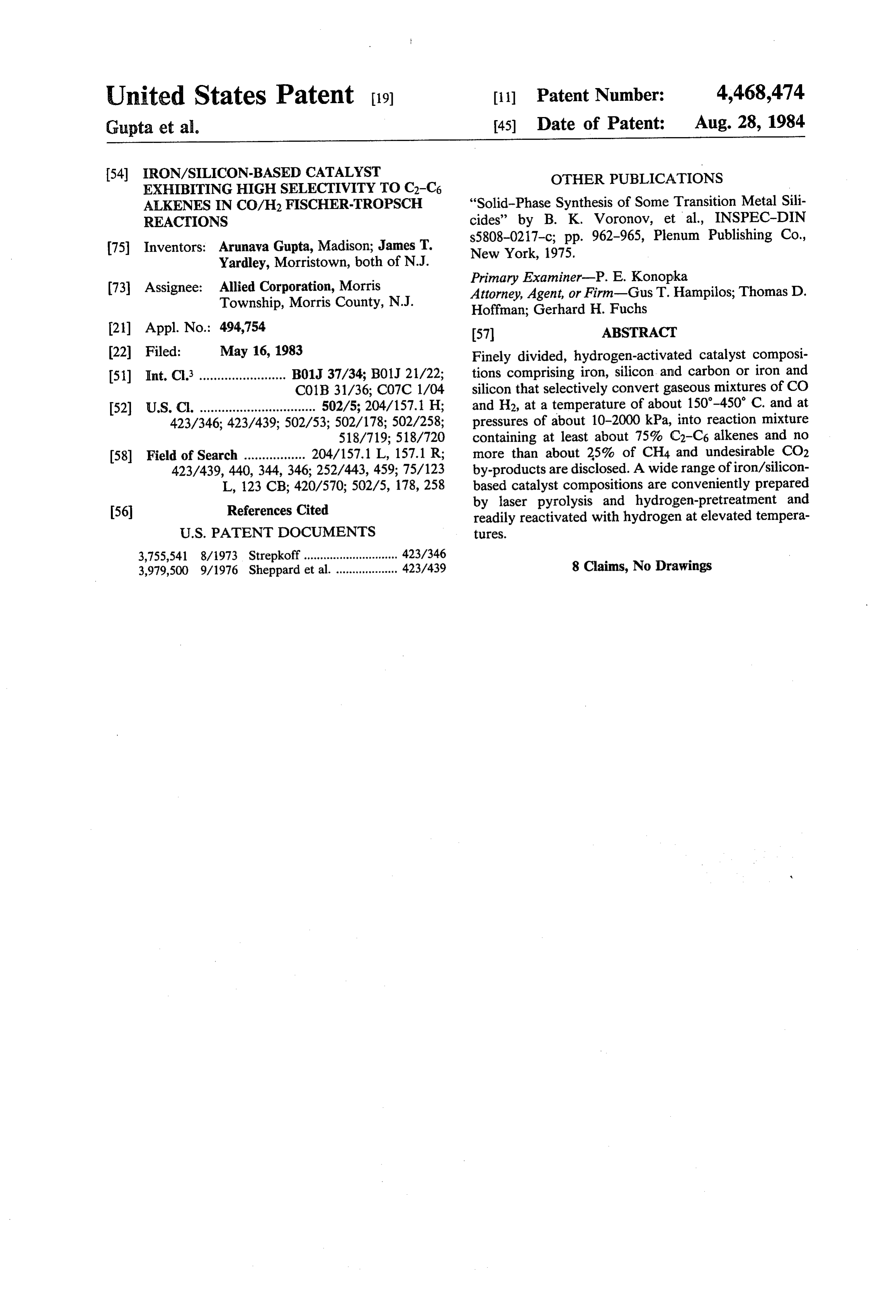
United States Patent (19) 11 Patent Number: 4,468,474 Gupta et al. (45) Date of Patent: Aug. 28, 1984
(54) IRON/SILICON-BASED CATALYST
EXHIBITING HIGH SELECTIVITY TO C-C6
OTHER PUBLICATIONS
ALKENES IN CO/H2 FISCHER-TROPSCH “Solid-Phase Synthesis of Some Transition Metal Sili REACTIONS cides” by B. K. Voronov, et al., INSPEC-DIN 75 Inventors: Arunava Gupta, Madison; James T. s5808-0217-c; pp. 962-965, Plenum Publishing Co., Yardley, Morristown, both of N.J. New York, 1975.
73 Assignee: Allied Corporation, Morris Primary Examiner-P. E. Konopka Township, Morris County, N.J. Attorney, Agent, or Firm-Gus T. Hampilos; Thomas D. Hoffman; Gerhard H. Fuchs 21) Appl. No.: 494,754 (57) ABSTRACT 22 Filed: May 16, 1983 Finely divided, hydrogen-activated catalyst composi 51) Int. Cl. ........................ B01J 37/34; B01J 21/22; tions comprising iron, silicon and carbon or iron and C01B31/36; CO7C 1/04 silicon that selectively convert gaseous mixtures of CO 52) U.S.C. ................................ 502/5; 204/157.1 H; and H2, at a temperature of about 150-450° C. and at 423/346; 423/439; 502/53; 502/178; 502/258; pressures of about 10-2000 kPa, into reaction mixture 518/719; 518/720 containing at least about 75% (C2-C6 alkenes and no 58) Field of Search ................. 204/157.1 L, 157.1 R; more than about 25% of CH4 and undesirable CO2 423/439, 440, 344, 346; 252/443, 459, 75/123 by-products are disclosed. A wide range of iron/silicon L, 123 CB; 420/.570; 502/5, 178,258 based catalyst compositions are conveniently prepared
by laser pyrolysis and hydrogen-pretreatment and readily reactivated with hydrogen at elevated tempera
3,755,541 8/1973 Strepkoff............................. 423/346 3,979,500 9/1976 Sheppard et al.................... 423/439 8 Claims, No Drawings
Page 2
limit the amounts of CO2 and H2O produced in reac
RON/SILICON-BASED CATALYST EXHIBITING tions 5-7 of the Fischer-Tropsch process. Not only does HIGH SELECTIVITY TO C-C6ALKENESIN removal of CO2 require a substantial cost in energy and CO/H2 FISCHER-TROPSCH REACTIONS equipment but CO2 and H2O also are thought to drasti
DESCRIPTION
cally reduce the service lifetime of the Fischer-Tropsch catalyst.
BACKGROUND OF THE INVENTION
SUMMARY OF THE INVENTION
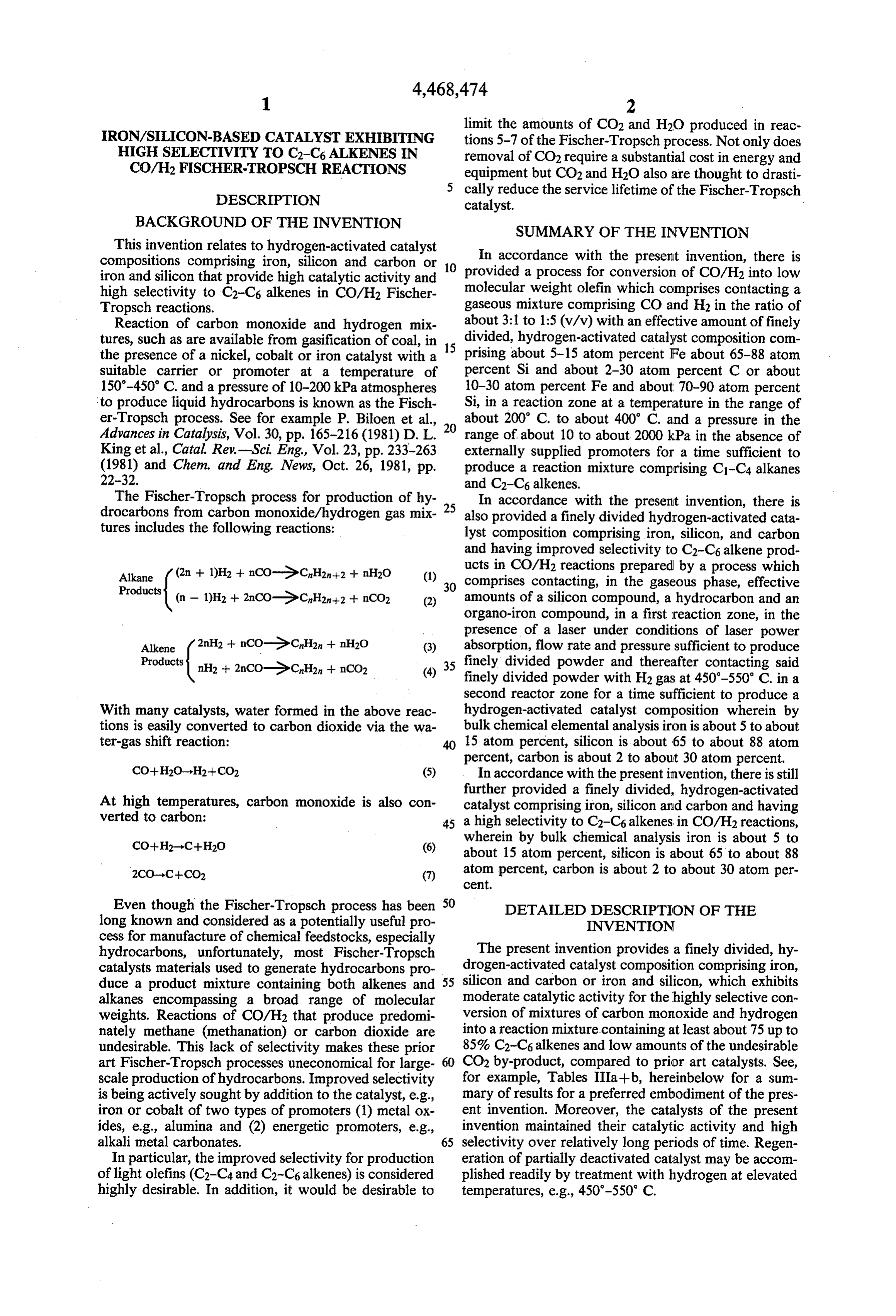
This invention relates to hydrogen-activated catalyst compositions comprising iron, silicon and carbon or 10 In accordance with the present invention, there is iron and silicon that provide high catalytic activity and provided a process for conversion of CO/H2 into low high selectivity to C2-C6 alkenes in CO/H2 Fischer molecular weight olefin which comprises contacting a Tropsch reactions. gaseous mixture comprising CO and H2 in the ratio of Reaction of carbon monoxide and hydrogen mix about 3:1 to 1:5 (v/v) with an effective amount of finely tures, such as are available from gasification of coal, in divided, hydrogen-activated catalyst composition com the presence of a nickel, cobalt or iron catalyst with a 15 prising about 5-15 atom percent Fe about 65-88 atom suitable carrier or promoter at a temperature of percent Si and about 2-30 atom percent C or about 150-450° C. and a pressure of 10-200 kPa atmospheres 10–30 atom percent Fe and about 70-90 atom percent to produce liquid hydrocarbons is known as the Fisch Si, in a reaction zone at a temperature in the range of er-Tropsch process. See for example P. Biloen et al., about 200 C. to about 400 C. and a pressure in the Advances in Catalysis, Vol. 30, pp. 165-216 (1981) D. L. 20 range of about 10 to about 2000 kPa in the absence of King et al., Catal Rev.-Sci Eng., Vol. 23, pp. 233-263 externally supplied promoters for a time sufficient to (1981) and Chem, and Eng. News, Oct. 26, 1981, pp. produce a reaction mixture comprising C1-C4 alkanes 22-32. and C2-C6 alkenes.
The Fischer-Tropsch process for production of hy 25 In accordance with the present invention, there is drocarbons from carbon monoxide/hydrogen gas mix also provided a finely divided hydrogen-activated cata tures includes the following reactions: lyst composition comprising iron, silicon, and carbon and having improved selectivity to C2-C6 alkene prod
ucts in CO/H2 reactions prepared by a process which
Products 30 comprises contacting, in the gaseous phase, effective (2) amounts of a silicon compound, a hydrocarbon and an organo-iron compound, in a first reaction zone, in the presence of a laser under conditions of laser power
Alkene (3) absorption, flow rate and pressure sufficient to produce Products finely divided powder and thereafter contacting said (4) 35 finely divided powder with H2 gas at 450-550° C. in a second reactor zone for a time sufficient to produce a
With many catalysts, water formed in the above reac hydrogen-activated catalyst composition wherein by tions is easily converted to carbon dioxide via the wa bulk chemical elemental analysis iron is about 5 to about ter-gas shift reaction: 15 atom percent, silicon is about 65 to about 88 atom percent, carbon is about 2 to about 30 atom percent.
CO-H2O-H2--CO2 (5) In accordance with the present invention, there is still further provided a finely divided, hydrogen-activated
At high temperatures, carbon monoxide is also con catalyst comprising iron, silicon and carbon and having verted to carbon: 45 a high selectivity to C2-C6 alkenes in CO/H2 reactions, wherein by bulk chemical analysis iron is about 5 to about 15 atom percent, silicon is about 65 to about 88 2CO-C-CO2 (7) atom percent, carbon is about 2 to about 30 atom per Cent.
Even though the Fischer-Tropsch process has been 50 DETAILED DESCRIPTION OF THE long known and considered as a potentially useful pro INVENTION cess for manufacture of chemical feedstocks, especially hydrocarbons, unfortunately, most Fischer-Tropsch The present invention provides a finely divided, hy catalysts materials used to generate hydrocarbons pro drogen-activated catalyst composition comprising iron, duce a product mixture containing both alkenes and 55 silicon and carbon or iron and silicon, which exhibits alkanes encompassing a broad range of molecular moderate catalytic activity for the highly selective con weights. Reactions of CO/H2 that produce predomi version of mixtures of carbon monoxide and hydrogen nately methane (methanation) or carbon dioxide are into a reaction mixture containing at least about 75 up to undesirable. This lack of selectivity makes these prior 85% C2-C6 alkenes and low amounts of the undesirable art Fischer-Tropsch processes uneconomical for large 60 CO2 by-product, compared to prior art catalysts. See, scale production of hydrocarbons. Improved selectivity for example, Tables IIIa+b, hereinbelow for a sum is being actively sought by addition to the catalyst, e.g., mary of results for a preferred embodiment of the pres iron or cobalt of two types of promoters (1) metal ox ent invention. Moreover, the catalysts of the present ides, e.g., alumina and (2) energetic promoters, e.g., invention maintained their catalytic activity and high alkali metal carbonates. 65 selectivity over relatively long periods of time. Regen In particular, the improved selectivity for production eration of partially deactivated catalyst may be accom of light olefins (C2-C4 and C2-C6 alkenes) is considered plished readily by treatment with hydrogen at elevated highly desirable. In addition, it would be desirable to temperatures, e.g., 450-550° C.
Page 3
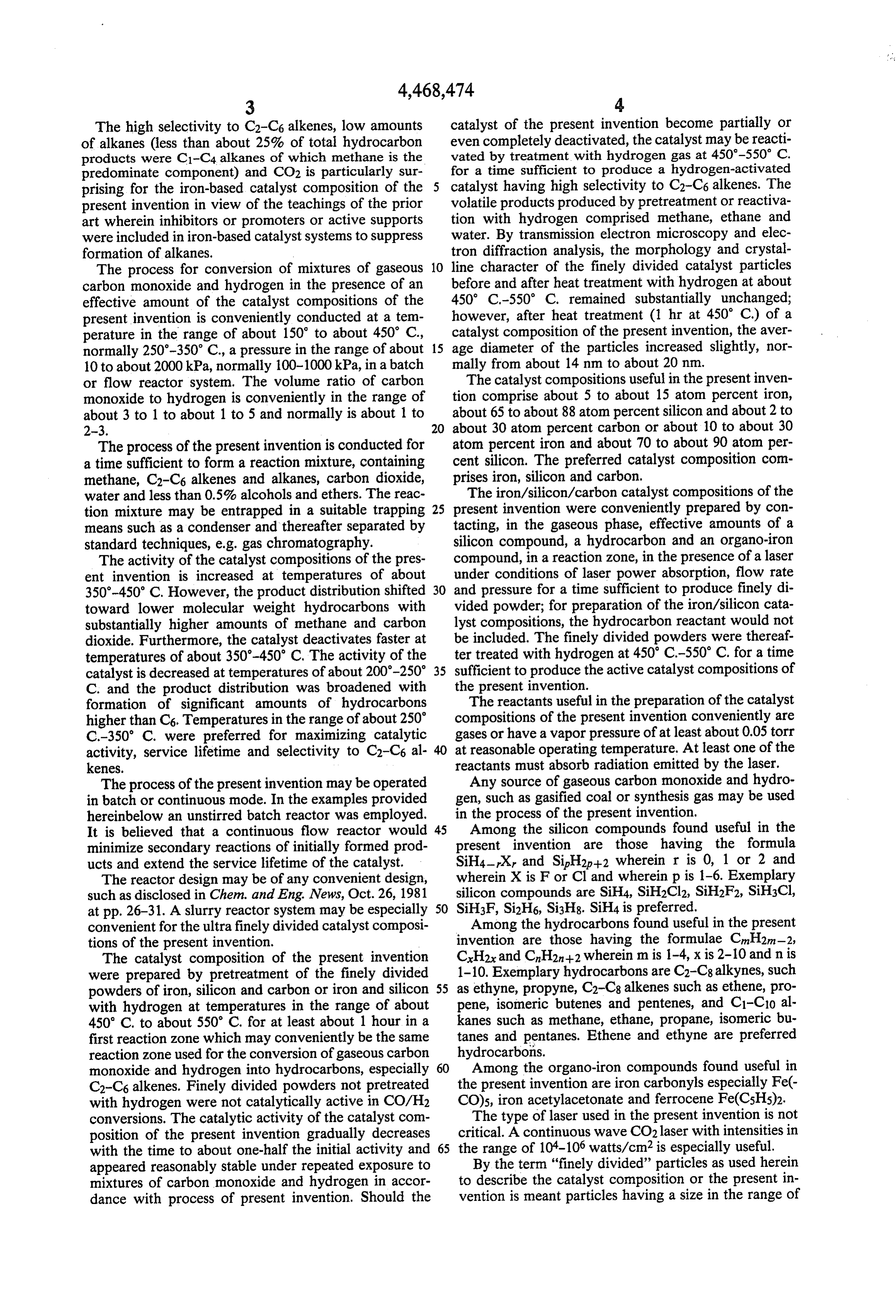
The high selectivity to C2-C6 alkenes, low amounts catalyst of the present invention become partially or of alkanes (less than about 25% of total hydrocarbon even completely deactivated, the catalyst may be reacti products were C1-C4 alkanes of which methane is the vated by treatment with hydrogen gas at 450-550° C. predominate component) and CO2 is particularly sur for a time sufficient to produce a hydrogen-activated prising for the iron-based catalyst composition of the 5 catalyst having high selectivity to C2-C6 alkenes. The present invention in view of the teachings of the prior volatile products produced by pretreatment or reactiva art wherein inhibitors or promoters or active supports tion with hydrogen comprised methane, ethane and were included in iron-based catalyst systems to suppress water. By transmission electron microscopy and elec formation of alkanes. tron diffraction analysis, the morphology and crystal The process for conversion of mixtures of gaseous 10 line character of the finely divided catalyst particles carbon monoxide and hydrogen in the presence of an before and after heat treatment with hydrogen at about effective amount of the catalyst compositions of the 450 C.-550° C. remained substantially unchanged; present invention is conveniently conducted at a tem however, after heat treatment (1 hr at 450° C.) of a perature in the range of about 150 to about 450° C., catalyst composition of the present invention, the aver normally 250-350° C., a pressure in the range of about 15 age diameter of the particles increased slightly, nor 10 to about 2000 kPa, normally 100-1000 kPa, in a batch mally from about 14 nm to about 20 nm. or flow reactor system. The volume ratio of carbon The catalyst compositions useful in the present inven monoxide to hydrogen is conveniently in the range of tion comprise about 5 to about 15 atom percent iron, about 3 to 1 to about 1 to 5 and normally is about 1 to about 65 to about 88 atom percent silicon and about 2 to 2-3. 20 about 30 atom percent carbon or about 10 to about 30 The process of the present invention is conducted for atom percent iron and about 70 to about 90 atom per a time sufficient to form a reaction mixture, containing cent silicon. The preferred catalyst composition com methane, C2-C6 alkenes and alkanes, carbon dioxide, prises iron, silicon and carbon.
water and less than 0.5% alcohols and ethers. The reac The iron/silicon/carbon catalyst compositions of the tion mixture may be entrapped in a suitable trapping 25 present invention were conveniently prepared by con means such as a condenser and thereafter separated by tacting, in the gaseous phase, effective amounts of a standard techniques, e.g. gas chromatography. silicon compound, a hydrocarbon and an organo-iron The activity of the catalyst compositions of the pres compound, in a reaction zone, in the presence of a laser ent invention is increased at temperatures of about under conditions of laser power absorption, flow rate 350-450° C. However, the product distribution shifted 30 and pressure for a time sufficient to produce finely di toward lower molecular weight hydrocarbons with vided powder; for preparation of the iron/silicon cata substantially higher amounts of methane and carbon lyst compositions, the hydrocarbon reactant would not dioxide. Furthermore, the catalyst deactivates faster at be included. The finely divided powders were thereaf temperatures of about 350-450° C. The activity of the ter treated with hydrogen at 450 C.-550° C. for a time catalyst is decreased at temperatures of about 200-250' 35 sufficient to produce the active catalyst compositions of C. and the product distribution was broadened with the present invention.
formation of significant amounts of hydrocarbons The reactants useful in the preparation of the catalyst higher than C6. Temperatures in the range of about 250' compositions of the present invention conveniently are C.-350° C. were preferred for maximizing catalytic gases or have a vapor pressure of at least about 0.05 torr activity, service lifetime and selectivity to C2-C6 al at reasonable operating temperature. At least one of the kenes. reactants must absorb radiation emitted by the laser. The process of the present invention may be operated Any source of gaseous carbon monoxide and hydro in batch or continuous mode. In the examples provided gen, such as gasified coal or synthesis gas may be used hereinbelow an unstirred batch reactor was employed. in the process of the present invention. It is believed that a continuous flow reactor would 45 Among the silicon compounds found useful in the minimize secondary reactions of initially formed prod present invention are those having the formula ucts and extend the service lifetime of the catalyst. SiH4-X and SiH2+2 wherein r is 0, 1 or 2 and The reactor design may be of any convenient design, wherein X is For Cl and wherein p is 1-6. Exemplary such as disclosed in Chem. and Eng. News, Oct. 26, 1981 silicon compounds are SiH4, SiH2Cl2, SiH2F2, SiH3Cl, at pp. 26-31. A slurry reactor system may be especially 50 SiH3F, Si2H6, Si3H8. SiH4 is preferred. convenient for the ultra finely divided catalyst composi Among the hydrocarbons found useful in the present tions of the present invention. invention are those having the formulae CnH2n-2, The catalyst composition of the present invention CH2 and CnH2n+2 wherein m is 1-4, x is 2-10 and n is were prepared by pretreatment of the finely divided 1-10. Exemplary hydrocarbons are C2-C8 alkynes, such powders of iron, silicon and carbon or iron and silicon 55 as ethyne, propyne, C2-C8 alkenes such as ethene, pro with hydrogen at temperatures in the range of about pene, isomeric butenes and pentenes, and C1-C10 al 450 C. to about 550 C. for at least about 1 hour in a kanes such as methane, ethane, propane, isomeric bu first reaction zone which may conveniently be the same tanes and pentanes. Ethene and ethyne are preferred reaction zone used for the conversion of gaseous carbon hydrocarbons.
monoxide and hydrogen into hydrocarbons, especially 60 Among the organo-iron compounds found useful in C2-C6 alkenes. Finely divided powders not pretreated the present invention are iron carbonyls especially Fe(- with hydrogen were not catalytically active in CO/H2 CO)5, iron acetylacetonate and ferrocene Fe(C5H5)2. conversions. The catalytic activity of the catalyst com The type of laser used in the present invention is not position of the present invention gradually decreases critical. A continuous wave CO2 laser with intensities in with the time to about one-half the initial activity and 65 the range of 10-106 watts/cm2 is especially useful. appeared reasonably stable under repeated exposure to By the term "finely divided' particles as used herein mixtures of carbon monoxide and hydrogen in accor to describe the catalyst composition or the present in dance with process of present invention. Should the vention is meant particles having a size in the range of
Page 4
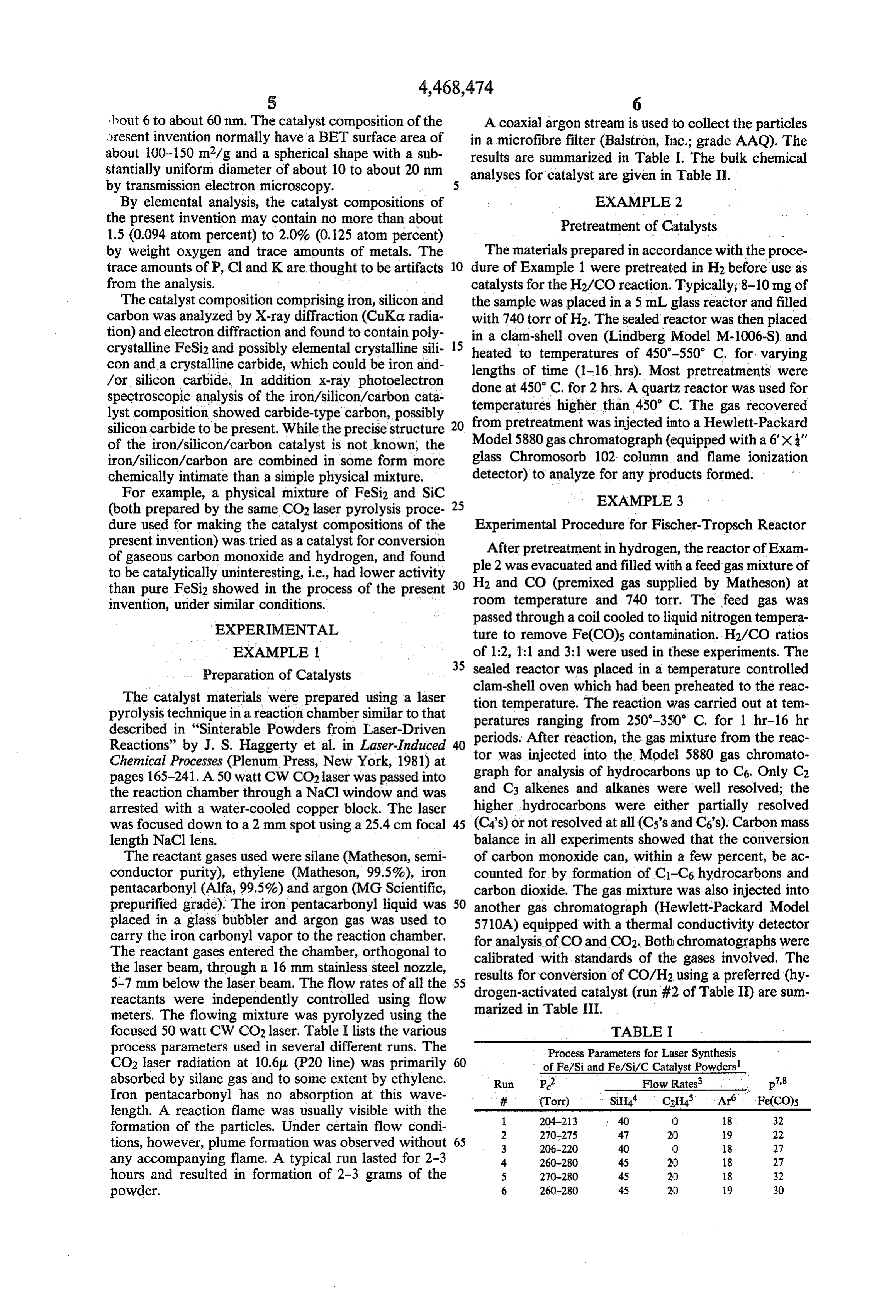
hout 6 to about 60 nm. The catalyst composition of the A coaxial argon stream is used to collect the particles .resent invention normally have a BET surface area of in a microfibre filter (Balstron, Inc.; grade AAQ). The about 100-150 m2/g and a spherical shape with a sub results are summarized in Table I. The bulk chemical stantially uniform diameter of about 10 to about 20 mm analyses for catalyst are given in Table II. by transmission electron microscopy. 5
By elemental analysis, the catalyst compositions of EXAMPLE 2 the present invention may contain no more than about Pretreatment of Catalysts
by weight oxygen and trace amounts of metals. The The materials prepared in accordance with the proce trace amounts of P, Cl and K are thought to be artifacts 10 dure of Example 1 were pretreated in H2 before use as from the analysis. catalysts for the H2/CO reaction. Typically, 8-10 mg of The catalyst composition comprising iron, silicon and the sample was placed in a 5 mL glass reactor and filled carbon was analyzed by X-ray diffraction (CuKa radia with 740 torr of H2. The sealed reactor was then placed tion) and electron diffraction and found to contain poly in a clam-shell oven (Lindberg Model M-1006-S) and crystalline FeSi2 and possibly elemental crystalline sili 15 heated to temperatures of 450-550° C. for varying con and a crystalline carbide, which could be iron and /or silicon carbide. In addition x-ray photoelectron lengths of time (1-16 hrs). Most pretreatments were spectroscopic analysis of the iron/silicon/carbon cata temperaturesC.higher done at 450° for 2 hrs. A quartz reactor was used for than 450° C. The gas recovered lyst composition showed carbide-type carbon, possibly silicon carbide to be present. While the precise structure 20 from pretreatment was injected into a Hewlett-Packard Model 5880 gas chromatograph (equipped with a 6'x' of the iron/silicon/carbon catalyst is not known, the glass Chromosorb 102 column and flame ionization iron/silicon/carbon are combined in some form more chemically intimate than a simple physical mixture, detector) to analyze for any products formed. For example, a physical mixture of FeSi2 and SiC EXAMPLE 3 (both prepared by the same CO2 laser pyrolysis proce 25 dure used for making the catalyst compositions of the Experimental Procedure for Fischer-Tropsch Reactor present invention) was tried as a catalyst for conversion After pretreatment in hydrogen, the reactor of Exam of gaseous carbon monoxide and hydrogen, and found to be catalytically uninteresting, i.e., had lower activity ple 2 was evacuated and filled with a feed gas mixture of than pure FeSi2 showed in the process of the present 30 H2 and CO (premixed gas supplied by Matheson) at invention, under similar conditions. room temperature and 740 torr. The feed gas was passed through a coil cooled to liquid nitrogen tempera
EXPERIMENTAL ture to remove Fe(CO)5 contamination. H2/CO ratios EXAMPLE 1. of 1:2, 1:1 and 3:1 were used in these experiments. The 35 sealed reactor was placed in a temperature controlled
Preparation of Catalysts
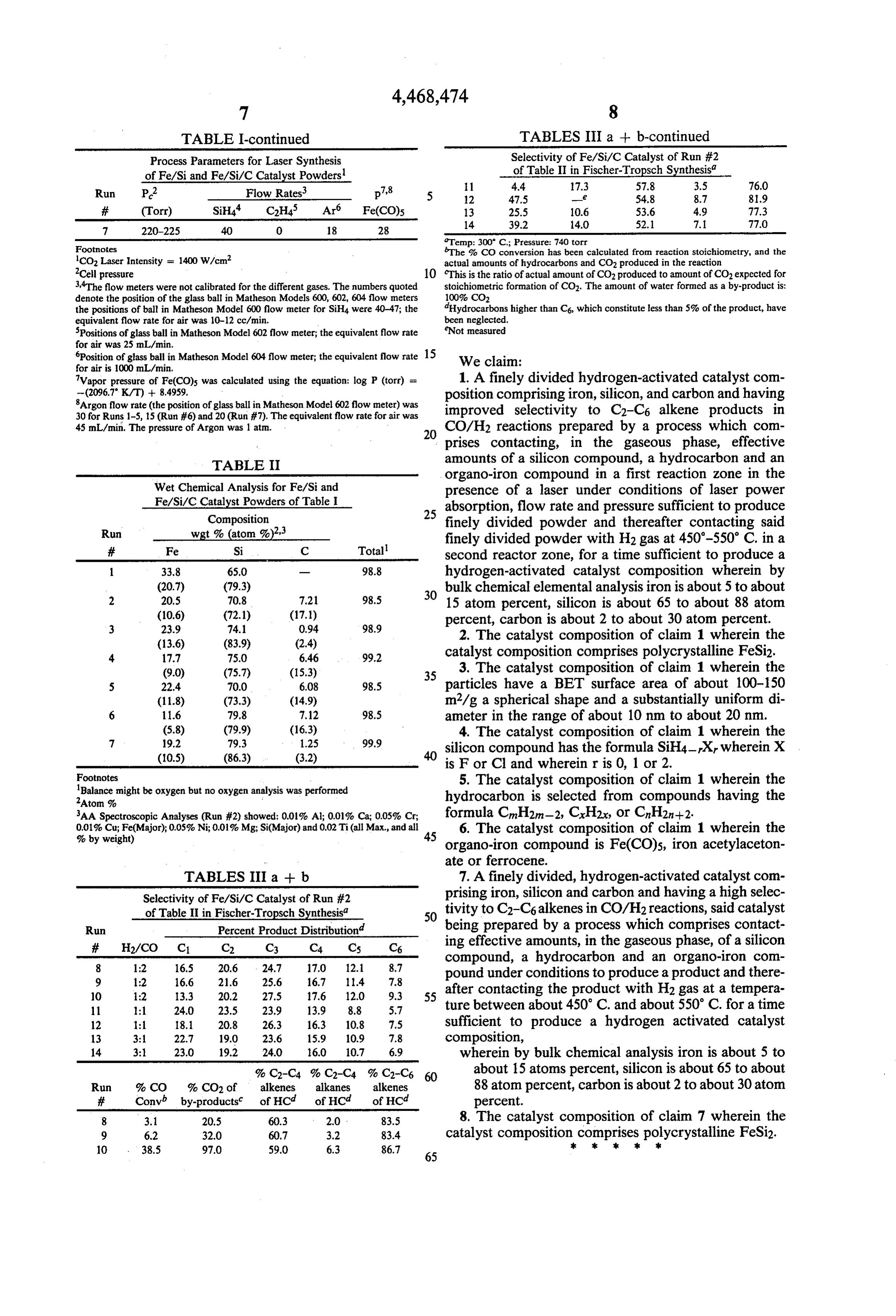
The catalyst materials were prepared using a laser clam-shell oven which had been preheated to the reac pyrolysis technique in a reaction chamber similar to that tion temperature. The reaction was carried out at tem described in “Sinterable Powders from Laser-Driven peratures ranging from 250-350° C. for 1 hr-16 hr Reactions” by J. S. Haggerty et al. in Laser-Induced periods. After reaction, the gas mixture from the reac Chemical Processes (Plenum Press, New York, 1981) at tor was injected into the Model 5880 gas chromato pages 165-241. A50 watt CW CO2 laser was passed into graph for analysis of hydrocarbons up to C6. Only C2 the reaction chamber through a NaCl window and was and C3 alkenes and alkanes were well resolved; the arrested with a water-cooled copper block. The laser higher hydrocarbons were either partially resolved was focused down to a 2 mm spot using a 25.4 cm focal 45 (C4's) or not resolved at all (C5's and C6's). Carbon mass length NaCl lens. balance in all experiments showed that the conversion The reactant gases used were silane (Matheson, semi of carbon monoxide can, within a few percent, be ac conductor purity), ethylene (Matheson, 99.5%), iron counted for by formation of C1-C5 hydrocarbons and pentacarbonyl (Alfa, 99.5%) and argon (MG Scientific, carbon dioxide. The gas mixture was also injected into prepurified grade). The iron pentacarbonyl liquid was 50 another gas chromatograph (Hewlett-Packard Model placed in a glass bubbler and argon gas was used to 5710A) equipped with a thermal conductivity detector carry the iron carbonyl vapor to the reaction chamber. for analysis of CO and CO2. Both chromatographs were The reactant gases entered the chamber, orthogonal to calibrated with standards of the gases involved. The the laser beam, through a 16 mm stainless steel nozzle, results for conversion of CO/H2 using a preferred (hy 5-7 mm below the laser beam. The flow rates of all the 55 reactants were independently controlled using flow drogen-activated catalyst (run #2 of Table II) are sum meters. The flowing mixture was pyrolyzed using the marized in Table III.
focused 50 watt CW CO2 laser. Table I lists the various TABLE I process parameters used in several different runs. The Process Parameters for Laser Synthesis CO2 laser radiation at 10.6p. (P20 line) was primarily 60 of Fe/Si and Fe/Si/C Catalyst Powders' absorbed by silane gas and to some extent by ethylene. Run P2 Flow Rates - p78 Iron pentacarbonyl has no absorption at this wave # (Torr) SiH4 CH4 Art Fe(CO)5 length. A reaction flame was usually visible with the 1. 204-213 40 O 18 32 formation of the particles. Under certain flow condi 2 270-275 47 20 19 22 tions, however, plume formation was observed without 65 3 206-220 40 O 18 27 any accompanying flame. A typical run lasted for 2-3 4 260-280 45 20 18 27 hours and resulted in formation of 2-3 grams of the 5 270-280 45 20 18 32 powder. 6 260-280 45 20 19 30
Page 5
TABLE I-continued TABLES III a -- b-continued
Process Parameters for Laser Synthesis Selectivity of Fe/Si/C Catalyst of Run #2 of Fe/Si and Fe/Si/C Catalyst Powders' of Table II in Fischer-Tropsch Synthesis
Run P2 Flow Rates p78 5 12 47.5 54.8 8.7 8.9 if (Torr) SiH4 C2H4 Ar Fe(CO)5 13 25.5 10.6 53.6 4.9 77.3
7 220-225 40 O 18 28
Footnotes
Temp: 300 C.; Pressure: 740 torr
The % CO conversion has been calculated from reaction stoichiometry, and the
CO, Laser Intensity = 1400 W/cm actual amounts of hydrocarbons and CO2 produced in the reaction cell pressure O This is the ratio of actual amount of CO2 produced to amount of CO2 expected for The flow meters were not calibrated for the different gases. The numbers quoted stoichiometric formation of CO2. The amount of water formed as a by-product is: denote the position of the glass ball in Matheson Models 600, 602, 604 flow meters 100% CO2 the positions of ball in Matheson Model 600 flow meter for SiH4 were 40-47; the Hydrocarbons higher than C6, which constitute less than 5% of the product, have equivalent flow rate for air was 10-12 cc?min. been neglected.
Positions of glass ball in Matheson Model 602 flow meter; the equivalent flow rate Not measured for air was 25 mL/min.
Position of glass ball in Matheson Model 604 flow meter; the equivalent flow rate 15 We claim:
for air is 1000 mL/min, vapor pressure of Fe(CO)5 was calculated using the equation: log P (torr) = 1. A finely divided hydrogen-activated catalyst com -(2096.7 K/T) -- 8.4959. position comprising iron, silicon, and carbon and having Argon flow rate (the position of glass ball in Matheson Model 602 flow meter) was improved selectivity to C2-C6 alkene products in 30 for Runs 1-5, 15 (Run #6) and 20 (Run #7). The equivalent flow rate for air was 45 mL/min. The pressure of Argon was 1 atm. 20 CO/H2 reactions prepared by a process which com prises contacting, in the gaseous phase, effective
TABLE II amounts of a silicon compound, a hydrocarbon and an organo-iron compound in a first reaction zone in the
Wet Chemical Analysis for Fe/Si and presence of a laser under conditions of laser power Fe/Si/C Catalyst Powders of Table I absorption, flow rate and pressure sufficient to produce Composition 25 finely divided powder and thereafter contacting said
Run - wat % (atom 20° finely divided powder with H2 gas at 450-550° C. in a i Fe Si C Totall second reactor zone, for a time sufficient to produce a 1 33.8 65.0 98.8 hydrogen-activated catalyst composition wherein by
bulk chemical elemental analysis iron is about 5 to about 15 atom percent, silicon is about 65 to about 88 atom (10.6) (72.1) (17.1) percent, carbon is about 2 to about 30 atom percent.
2. The catalyst composition of claim 1 wherein the 4 17.7 750 6.46 99.2 catalyst composition comprises polycrystalline FeSi2. (90) (75.7) (15.3) 3. The catalyst composition of claim 1 wherein the
5 22.4 700 6.08 98.5 particles have a BET surface area of about 100-150 (11.8) (73.3) (14.9) m2/g a spherical shape and a substantially uniform di 6 1.6 79.8 7.12 98.5 ameter in the range of about 10 nm to about 20 nm.
4. The catalyst composition of claim 1 wherein the
silicon compound has the formula SiH4-X, wherein X 40 is F or Cl and wherein r is 0, 1 or 2.
Footnotes
Balance might be oxygen but no oxygen analysis was performed 5. The catalyst composition of claim 1 wherein the Atom % hydrocarbon is selected from compounds having the AA Spectroscopic Analyses (Run #2) showed; 0.01% Al; 0.01% Ca; 0.05% Cr; formula CnH2n-2, CH2x, or CnH2n+2. 0.01% Cu; Fe(Major); 0.05% Ni; 0.01% Mg; Si(Major) and 0.02 Ti(all Max, and all % by weight) 45 6. The catalyst composition of claim 1 wherein the organo-iron compound is Fe(CO)5, iron acetylaceton ate or ferrocene.
TABLES III a -- b 7. A finely divided, hydrogen-activated catalyst com Selectivity of Fe/Si/C Catalyst of Run #2 prising iron, silicon and carbon and having a high selec of Table II in Fischer-Tropsch Synthesis 50 tivity to C2-C6alkenes in CO/H2 reactions, said catalyst Run Percent Product Distribution being prepared by a process which comprises contact if H2/CO C1 C2 C3 C4 Cs C6 ing effective amounts, in the gaseous phase, of a silicon 8 1:2 16.5 20.6 24.7 17.0 2. 8.7 compound, a hydrocarbon and an organo-iron com
pound under conditions to produce a product and there
O 1:2 3.3 20,2 27.5 17.6 12.0 9.3 55 after contacting the product with H2 gas at a tempera 11 :1 24.0 23.5 23.9 13.9 8.8 5.7 ture between about 450 C. and about 550 C. for a time 12 1:1 18. 20.8 26.3 16.3 10.8 7.5 sufficient to produce a hydrogen activated catalyst 13 3:1 22.7 19.0 23.6 15.9 10.9 7.8 composition, 14 3: 23.0 19.2 24.0 6.0 10.7 6.9 wherein by bulk chemical analysis iron is about 5 to % C2-C4 % C2-C4 % C-C6 60 about 15 atoms percent, silicon is about 65 to about
Run % CO % CO2 of alkenes alkanes alkenes 88 atom percent, carbon is about 2 to about 30 atom i Convb by-products of HCd of HCd of HCd percent.
8 3.1 20.5 60.3 2.0 83.5 8. The catalyst composition of claim 7 wherein the 9 6.2 32.0 60, 3.2 83.4 catalyst composition comprises polycrystalline FeSi2. 10 38.5 97.0 59.0 6.3 86. is is
Provenance
- Collection
- Cited prior art
- Original PDF
- patentimages.storage.googleapis.com →
- Filed
- 1983-05-16
- Pages
- 5
- Method
- pdftotext (the PDF's own text layer) + pdftoppm 300dpi page scans
- Source
- Google Patents bibliographic record
- Granted
- 1984-08-28
- Inventors
- Arunava Gupta; James T. Yardley; Allied Corp
- Transcribed from
- patentimages.storage.googleapis.com →