patent · US4884531
Operation of an internal combustion engine with a pre-engine reformer
5 December 1989
Page 1 — bibliographic record
United States Patent (19) 11 Patent Number: 4,884,531 Degnan, Jr. et al. (45) Date of Patent: Dec. 5, 1989 54 OPERATION OF AN INTERNAL Supports' in Advanced Materials in Catalysis, J. J. COMBUSTION ENGINE WITH A Burton and R. L. Garten, eds., Academic Press, New PRE-ENGINE REFORMER York (1977), pp. 293 to 324.
(75) Inventors: Thomas F. Degnan, Jr., Yardley, Pa.; J. Wei, "Catalysis for Motor Vehicle Emissions', Adv. Ralph M. Dessau, Edison, N.J. Catalysis, vol. 24 (1975), pp. 77-86. 73) Assignee: Mobil Oil Corporation, New York,
N.Y. Primary Examiner-E. Rollins Cross
Attorney, Agent, or Firm-Alexander J. McKillop;
(21) Appl. No.: 213,855 Charles J. Speciale; Malcolm D. Keen
51) Int. Cl." .............................................. FO2B 43/08 (57) ABSTRACT 52 U.S. Cl. ........................................................ 123/3 A method is provided of operating an internal combus 58 Field of Search .................................... 123/3, i A tion engine comprising subjecting a hydrocarbon fuel of 56) References Cited relatively low octane number to in situ reforming at elevated temperatures by passing it through a reaction
3,730,910 5/1973 Albers et al. . prising a Group VIII hydrogenation/dehydrogenation 3,855,980 12/1974 Weisz et al. ............................ 123/3 metallic element, e.g., platinum, and an intermediate 4,046,522 9/1977 Chen .......... ... 48/102 pore Zeolite, e.g., having an X-ray diffraction pattern 4,070,993 1/1978 Chen ....................................... 123/3 similar to that of an acidic zeolite which has a Con
4,560,820 12/1985 Field .................. ... 585/489 straint Index in the approximate range of about 1 to 12, 4,567,857 2/1986 Houseman et al. ..................... 123/3 such that the fuel leaving said reaction zone has an 4,652,360 3/1987 Dessau. increased octane number, and passing the fuel to the 4,716,859 1/1988 König ... combustion chamber of said engine.
OTHER PUBLICATIONS
J. P. DeLuca and L. E. Campbell, "Monolithic Catalyst 20 Claims, 1 Drawing Sheet
AIR
CATALYTC
REFORMER
Page 2
Drawing sheet — no readable text.
Page 3
has been mixed, to produce a higher octane gaseous
OPERATION OF AN INTERNAL COMBUSTION product. The patent also discloses providing heat to the ENGINE WITH A PRE-ENGINE REFORMER conversion reaction by adding a controlled amount of an oxygen-containing gas, e.g., air, to the fuel being fed
BACKGROUND OF THE INVENTION 5 to the converter so as to combust a minor amount of 1. Field of the Invention such fuel, and/or by heat exchange with the exhaust This invention relates to the operation of an internal gases from the engine.
combustion engine employing a pre-engine catalytic None of the foregoing references discloses or sug reformer for upgrading the octane number of the fuel. 10 gests the use of a primarily reforming catalyst in the 2. Background Information converter and specifically a non-acid catalyst compris Pre-engine converters utilizing catalysts comprising ing an intermediate pore zeolite.
intermediate pore zeolites for improving the octane U.S. Pat. No. 4,652,360 discloses low- or non-acid number of fuels utilized in internal combustion engines catalysts comprising an intermediate pore zeolite and a are known in the art as shown in the Information Dis Group VIII metal used in various hydrocarbon conver closure Statement set out hereinafter. However such 15 sion processes, including reforming of a hydrotreated catalysts generally rely for their effect on a substantial naphtha to raise its octane number. However, there is degree of acidic cracking activity. They are not particu no teaching of these catalysts in a pre-engine converter larly effective for catalyzing reactions more prevalent for the purpose of raising the octane number of a low in a reforming than a cracking process, e.g., dehydro octane fuel.
genation and dehydrocyclization such as are utilized for 20 U.S. Pat. No. 4,560,820 teaches a process of de the conversion of n-paraffins to aromatics in the pres alkylating alkylaromatic hydrocarbons, e.g., toluene to ence of cycloparaffins. In many instances, the latter produce benzene, using a catalyst comprising an inter reactions are more effective in raising the octane num mediate pore size zeolite substantially free of acidity, ber of a low octane chargestock than primarily cracking and platinum. However, there is no suggestion in this reactions, particularly in the synthesis of aromatics 25 patent of the use of the disclosed catalyst to reform a which are especially significant in obtaining higher naphtha, which generally contains a preponderance of octane numbers of gasolines.
There are many primarily reforming catalysts known suggestion toofraise aliphatics, the its octane number, nor is there any use of the catalyst in a pre-engine in the art which are suitable for use in a refinery for the reformer.
purpose of upgrading the octane number of refinery 30 streams intended as gasoline blending components. lystJ. Supports'
P. DeLuca and L. E. Campbell, "Monolithic Cata in Advanced Materials in Catalysis, J. J.
However, these catalysts have usually not been sug gested for use in a pre-engine converter, and, in fact, Burton and R. L. Garten, eds., Academic Press, New conventional reforming catalysts, such as those com York (1977), pages 293 to 324, teach various structures and catalytic agents in monolithic catalysts and methods prising platinum supported on alumina, deactivate fairly 35 for rapidly under the conditions preferred for the operation their fabrication.
of a pre-engine converter, e.g., the absence of added U.S. Pat. No. 3,730,910 teaches various methods for hydrogen and the use of relatively low absolute pres depositing zeolites on substrate surfaces, e.g., mono sure. These conditions are unlike those usually em liths. The deposited zeolite may be used as cracking or ployed in a refinery which generally include, for exam hydrocracking catalysts.
ple, hydrogen addition and the employment of higher J. Wei, "Catalysis for Motor Vehicle Emissions', absolute pressures. Other reforming catalysts disclosed i Adv. Catalysis, Vol. 24 (1975), pages 77-86, teaches the the art, e.g., comprising a Group VIII metal and a non use of monolithic structures comprising various materi or low-acid intermediate pore zeolite, are also generally als useful as oxidation catalysts applied to the treatment intended to be used with hydrogen in a refinery reform of gasoline engine exhaust gases. ing process. None of the foregoing references disclosing mono INFORMATION DISCLOSURE STATEMENT lithic catalysts teaches the use of such monoliths in a pre-engine reformer for the purpose of upgrading low
The following information is disclosed in accordance octane fuels.
with the terms of 37 CFR 1.56, 1.97 and 1.98. 50 Copending application Ser. No. 133,401, filed Dec. U.S. Pat. No. 3,855,980 discloses a pre-engine con 15, 1987 by Chen et al., teaches a pre-engine converter verter containing a bed of ZSM-5 or ZSM-8 zeolite comprising a zeolite incorporated in a monolithic struc catalyst which has substantial acid cracking activity as tle.
indicated by a high alpha value. Also disclosed is the SUMMARY OF THE INVENTION use of hot exhaust gases to provide heat necessary to 55 drive the cracking process occurring within the con In accordance with this invention, a relatively low Veter. octane incoming fuel is converted to a higher octane U.S. Pat. No. 4,046,522 discloses a pre-engine con fuel in the operation of an internal combustion engine verter comprising a bed of "cracking catalyst of the bypassing the incoming fuel at conversion temperatures ZSM-5 zeolite type” to convert the hydrocarbons in a through a pre-engine reformer situated between the fuel fuel mixture comprising hydrocarbons and oxygenated pump and the carburetor or fuel injector of the engine, organic compounds, to a higher octane gaseous hydro such reformer containing a non-acid reforming catalyst carbon fuel. Also disclosed is the use of the hot exhaust comprising a Group VIII hydrogenation/dehydrogena gases from the engine to heat the hydrocarbons under tion metallic element and a non-acid intermediate pore going reaction in the converter. 65 zeolite, preferably a zeolite having an X-ray diffraction U.S. Pat. No. 4,070,993 teaches a pre-engine con pattern similar to that of a corresponding acidic zeolite verter containing a ZSM-5 zeolite cracking catalyst for which has a Constraint Index (CI), as hereinafter de the conversion of a low octane fuel, into which oxygen fined, in the approximate range of about 1 to 12.
Page 4
BRIEF DESCRIPTION OF DRAWING supply the temperature requirement once the engine is warm, either by passing the incoming fuel through a
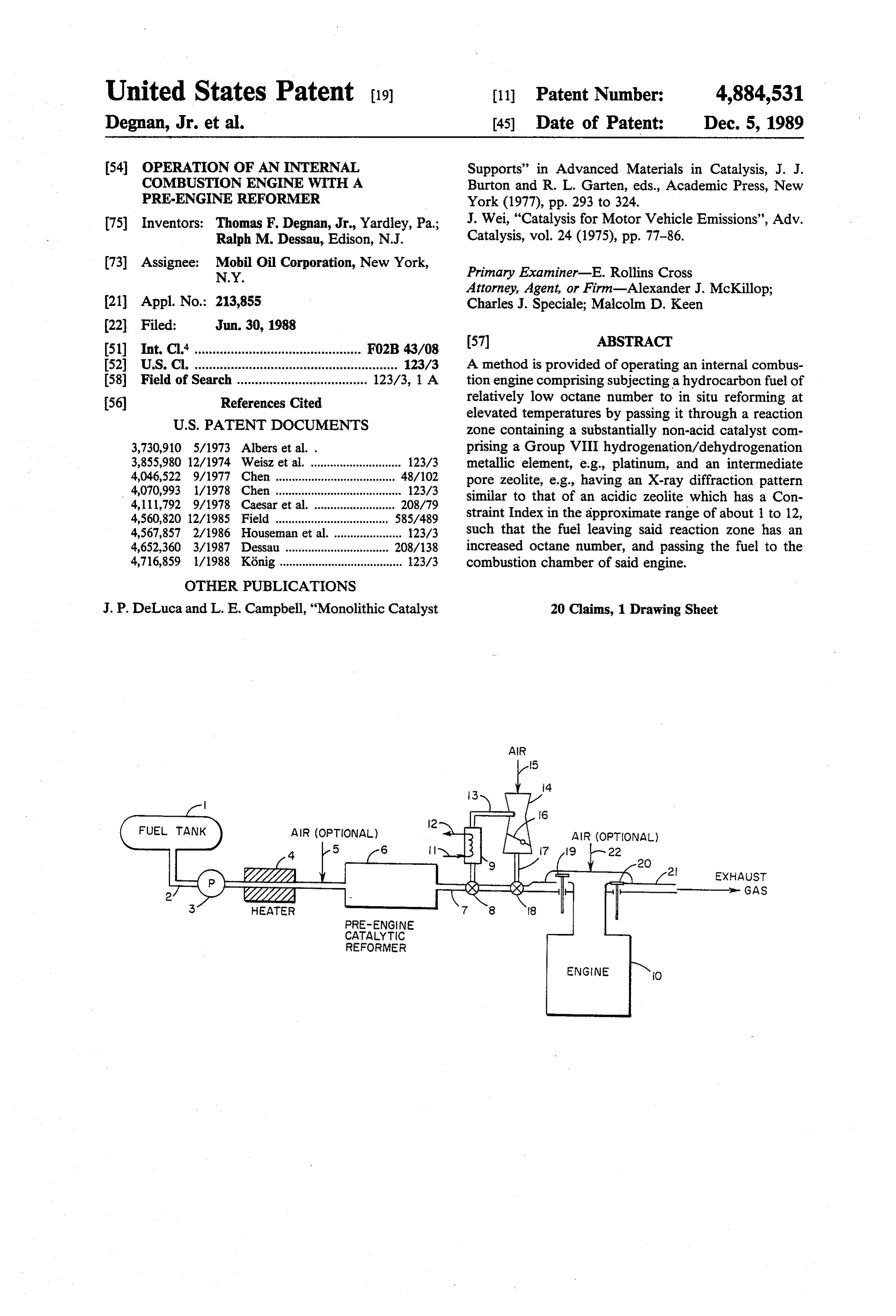
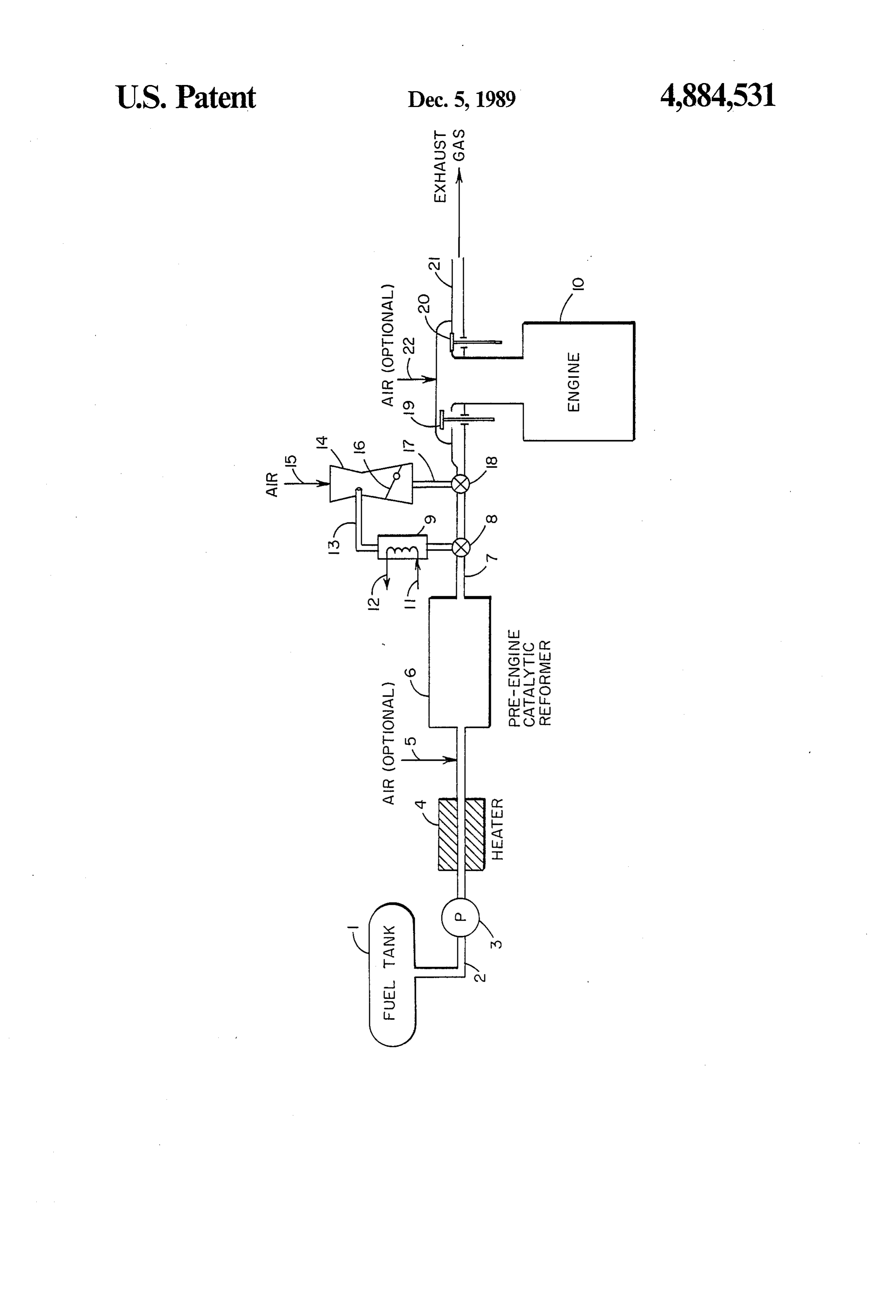
The drawing is a schematic diagram of an internal heat exchanger that transfers heat to the fuel from the combustion engine utilizing a pre-engine catalytic re engine exhaust gases directly or from the catalytic con former containing a non-acid catalyst comprising a version of the oxidizable components in such gases, or Group VIII hydrogenation/dehydrogenation metallic by passing the fuel through the heated engine block, as element and an intermediate pore zeolite, in accordance discussed previously.
with this invention. Referring to the drawing, relatively low octane fuel is DESCRIPTION OF SPECIFIC EMBODIMENTS 10 pumped from fuel tank 1 through line 2 by pump 3 through heater 4 where the fuel is volatilized and heated
The catalyst utilized in the pre-engine reformer of at least to a predetermined conversion and/or combus this invention may be in particulate form, e.g., pellets, tion temperature. The heat source in heater 4 in the case beads or powder, or when pressure drop is of concern, of a cold engine may be, for example, the combustion of a monolith or combination of monoliths. If it is pre a small amount of fuel mixed with air and ignited with ferred to employ the catalyst in the form of monoliths 15 an electric heating coil, or electricity from internal then the techniques of preparing and employing the and/or external batteries, while, in a warm engine, the monoliths may be applied as disclosed in previously heat source may be heat from the engine block or from cited copending application Ser. No. 133,401, except the exhaust gases, either directly or in the course of the that the catalyst is as described in this disclosure rather catalytic conversion of the oxidizable components in than that of the copending application. For this pur 20 such gases. Air is optionally added to the heated fuel pose, the entire disclosure of the cited copending appli from line 5 which then passes through pre-engine cata cation is incorporated by reference. lytic reformer 6 containing a zeolite catalyst of the type Since the reactions involved in the upgrading of the contemplated under this invention. If air is not added octane number of the fuel by reforming, e.g., hydrogen from line 5 to the heated fuel, then the temperature to olysis, dehydrogenation and dehydrocyclization with 25 which the fuel is heated must be high enough to sustain substantially no acid-catalyzed cracking activity, re the reforming reactions in reformer 6 at the necessary quire an elevated reaction temperature and are endo temperatures. However, if air is supplied from line 5, thermic in their totality, it is necessary to supply heat to then the heat added to the fuel in heater 4 need only be the reaction. This may be done under the invention by sufficient to heat the fuel to combustion temperature. any known means, e.g., heat exchange between the 30 Thereafter, the partial combustion of the fuel in the incoming fuel and the hot exhaust gases, by passing the presence of oxygen is sufficient to provide the necessary incoming fuel through the heated engine block, or par heat to sustain the reforming reactions. From reformer tial combustion of the fuel by injecting a small amount 6, the upgraded fuel with increased octane number of an oxygen-containing gas, e.g., air, with the fuel into which, despite the heat consumption in reformer 6, may the pre-engine reformer containing the zeolite catalyst. 35 still be above ignition temperature, passes through line 7 Heating of the incoming fuel by hot exhaust gases and depending on the position of selector valve 8, may may be accomplished by conventional heat exchange, enter cooler 9 where it is cooled by coolant from the e.g., wherein the pre-engine reformer is incorporated in radiator of engine 10 which enters cooler 9 by line 11 the exhaust manifold of the engine similar to the ar and leaves by line 12. The cooled upgraded fuel passes rangement shown with packed beds of zeolite catalyst through line 13 to carburetor 14 where it is mixed with in previously cited U.S. Pat. Nos. 3,855,980 and air from line 15. The cooled fuel-air mixture, metered 4,070,993, or is enclosed within a shell, with the hot by throttle 16, returns through line 17 to line 7 at selec exhaust gases flowing through the space between the tor valve 18 and thence through intake valve 19 into the interior surface of the shell and the exterior surface of intake manifold engine 10 for utilization in the engine. the monolith, similar to the arrangement shown in U.S. 45 Hot exhaust gases are passed through exhaust valve 20 Pat. No. 4,046,522. When a catalytic converter is used and travel through line 21 to a catalytic converter (not for the oxidation of combustible components in the shown) for oxidation of its oxidizable-components, or exhaust gas, such converter may be combined with the for discharge into the atmosphere. Alternatively, carbu pre-engine reformer of this invention in a dual con retion may be eliminated from the system by positioning verter, with, for example, tubular reactors in each cate 50 selector valves 8 and 18 so that the upgraded fuel from gory being spatially arranged so that heat flows from converter 6 passes directly through line 7 into the intake the exhaust gases being converted to the endothermic manifold of the engine. In this case, air necessary for reactions of the pre-engine reforming of the incoming combustion of the fuel is injected directly into the en fuel. To minimize pressure drops across this type of dual gine through line 22.
converter, alternating monolithic channel systems may 55 After extended use, the catalyst can be regenerated be used as disclosed previously cited copending applica using air. A suitable design would incorporate two or tion Ser. No. 133,401, particularly in FIGS. 3 to 5 of more reformer units, (not shown in the drawing), with that application. one unit being in operation converting the hydrocarbon To start a cold engine, a small amount of high octane while the remaining units are undergoing regeneration. gasoline may be fed to the carburetor or fuel injector 60 A microprocessor, complete with a CO2/CO detector from a separate tank. Alternatively, a small amount of to determine completion of the regeneration cycle, the low octane fuel may, for example, be mixed with air and ignited using an electric heating coil or electricity could be used to switch flows from one reformer unit to another.
from internal and/or external batteries may be used to As stated, the catalyst used in the pre-engine catalytic warm up the reactor to at least 600 F. to initiate the 65 reformer of this invention comprises a Group VIII conversion process. After that, only a small amount of metallic element and a non-acid intermediate pore zeo air is needed to maintain the reactor temperature. Heat lite. The zeolite utilized in preparing the catalyst may be from the operation of the engine may also be used to made by any of the methods known in the art. Thus,
Page 5
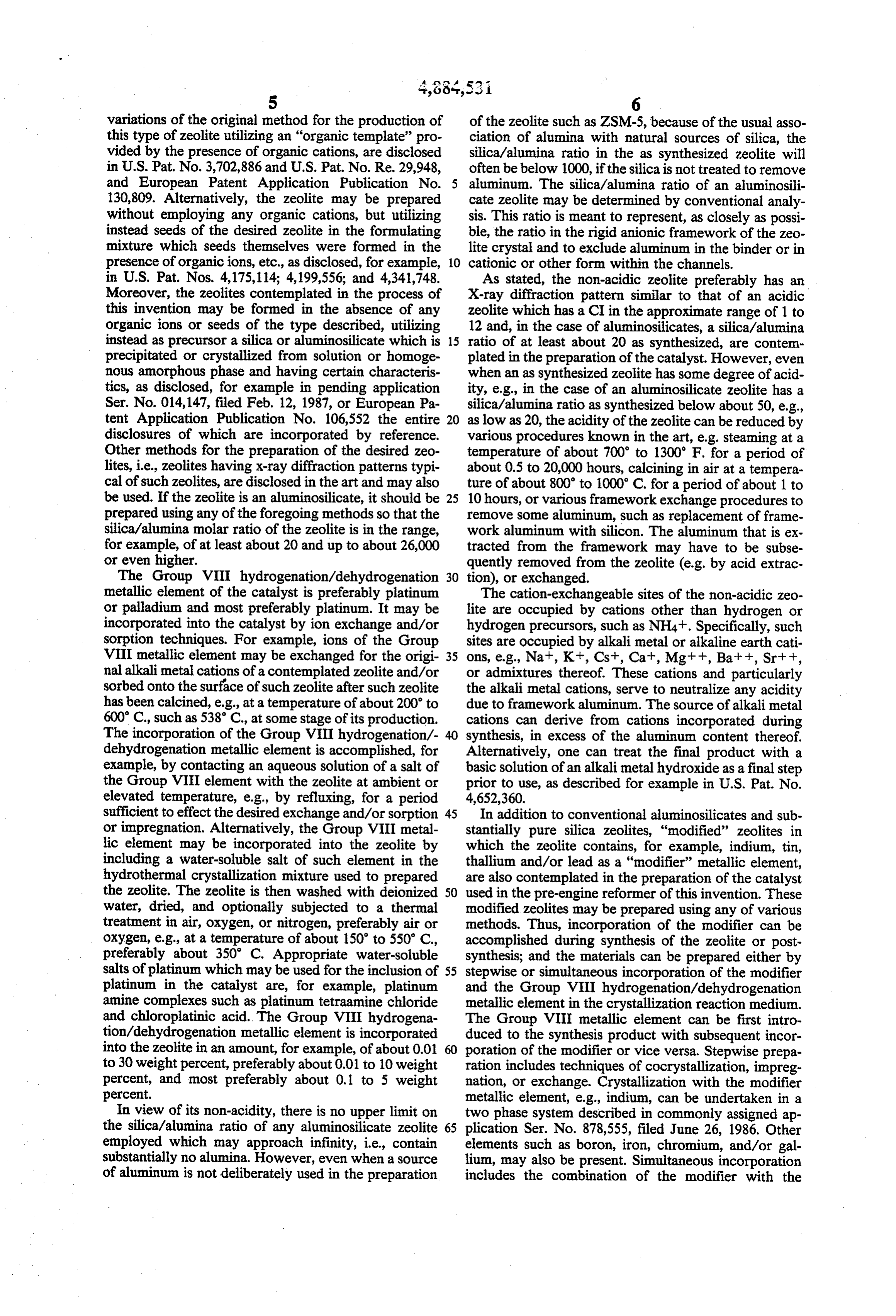
variations of the original method for the production of of the zeolite such as ZSM-5, because of the usual asso this type of zeolite utilizing an "organic template' pro ciation of alumina with natural sources of silica, the vided by the presence of organic cations, are disclosed silica/alumina ratio in the as synthesized zeolite will in U.S. Pat. No. 3,702,886 and U.S. Pat. No. Re.29,948, often be below 1000, if the silica is not treated to remove and European Patent Application Publication No. aluminum. The silica/alumina ratio of an aluminosili 130,809. Alternatively, the zeolite may be prepared cate zeolite may be determined by conventional analy without employing any organic cations, but utilizing sis. This ratio is meant to represent, as closely as possi instead seeds of the desired zeolite in the formulating ble, the ratio in the rigid anionic framework of the zeo mixture which seeds themselves were formed in the lite crystal and to exclude aluminum in the binder or in presence of organic ions, etc., as disclosed, for example, 10 cationic or other form within the channels. in U.S. Pat. Nos. 4,175,114; 4,199,556; and 4,341,748. As stated, the non-acidic zeolite preferably has an Moreover, the zeolites contemplated in the process of X-ray diffraction pattern similar to that of an acidic this invention may be formed in the absence of any zeolite which has a CI in the approximate range of 1 to organic ions or seeds of the type described, utilizing 12 and, in the case of aluminosilicates, a silica/alumina instead as precursor a silica or aluminosilicate which is 15 ratio of at least about 20 as synthesized, are contem precipitated or crystallized from solution or homoge plated in the preparation of the catalyst. However, even nous amorphous phase and having certain characteris when an as synthesized zeolite has some degree of acid tics, as disclosed, for example in pending application ity, e.g., in the case of an aluminosilicate zeolite has a Ser. No. 014,147, filed Feb. 12, 1987, or European Pa silica/alumina ratio as synthesized below about 50, e.g., tent Application Publication No. 106,552 the entire 20 as low as 20, the acidity of the zeolite can be reduced by disclosures of which are incorporated by reference. various procedures known in the art, e.g. steaming at a Other methods for the preparation of the desired zeo temperature of about 700 to 1300' F. for a period of lites, i.e., zeolites having x-ray diffraction patterns typi about 0.5 to 20,000 hours, calcining in air at a tempera cal of such zeolites, are disclosed in the art and may also ture of about 800 to 1000 C. for a period of about 1 to be used. If the zeolite is an aluminosilicate, it should be 25 10 hours, or various framework exchange procedures to prepared using any of the foregoing methods so that the remove some aluminum, such as replacement of frame silica/alumina molar ratio of the zeolite is in the range, work aluminum with silicon. The aluminum that is ex for example, of at least about 20 and up to about 26,000 tracted from the framework may have to be subse or even higher. quently removed from the zeolite (e.g. by acid extrac The Group VIII hydrogenation/dehydrogenation 30 tion), or exchanged.
metallic element of the catalyst is preferably platinum The cation-exchangeable sites of the non-acidic zeo or palladium and most preferably platinum. It may be lite are occupied by cations other than hydrogen or incorporated into the catalyst by ion exchange and/or hydrogen precursors, such as NH4. Specifically, such sorption techniques. For example, ions of the Group sites are occupied by alkali metal or alkaline earth cati VIII metallic element may be exchanged for the origi 35 ons, e.g., Na+, K+, Cs+, Ca+, Mg, Batt, Srt +, nal alkali metal cations of a contemplated zeolite and/or or admixtures thereof. These cations and particularly sorbed onto the surface of such zeolite after such zeolite the alkali metal cations, serve to neutralize any acidity has been calcined, e.g., at a temperature of about 200' to due to framework aluminum. The source of alkali metal 600 C., such as 538 C., at some stage of its production. cations can derive from cations incorporated during The incorporation of the Group VIII hydrogenation/- 40 synthesis, in excess of the aluminum content thereof. dehydrogenation metallic element is accomplished, for Alternatively, one can treat the final product with a example, by contacting an aqueous solution of a salt of basic solution of an alkali metal hydroxide as a final step the Group VIII element with the zeolite at ambient or prior to use, as described for example in U.S. Pat. No. elevated temperature, e.g., by refluxing, for a period 4,652,360.
sufficient to effect the desired exchange and/or sorption 45 In addition to conventional aluminosilicates and sub or impregnation. Alternatively, the Group VIII metal stantially pure silica zeolites, "modified' zeolites in lic element may be incorporated into the zeolite by which the zeolite contains, for example, indium, tin, including a water-soluble salt of such element in the thallium and/or lead as a "modifier' metallic element, hydrothermal crystallization mixture used to prepared are also contemplated in the preparation of the catalyst the zeolite. The zeolite is then washed with deionized 50 used in the pre-engine reformer of this invention. These water, dried, and optionally subjected to a thermal modified zeolites may be prepared using any of various treatment in air, oxygen, or nitrogen, preferably air or methods. Thus, incorporation of the modifier can be oxygen, e.g., at a temperature of about 150 to 550 C., accomplished during synthesis of the zeolite or post preferably about 350° C. Appropriate water-soluble synthesis; and the materials can be prepared either by salts of platinum which may be used for the inclusion of 55 stepwise or simultaneous incorporation of the modifier platinum in the catalyst are, for example, platinum and the Group VIII hydrogenation/dehydrogenation amine complexes such as platinum tetraamine chloride metallic element in the crystallization reaction medium. and chloroplatinic acid. The Group VIII hydrogena The Group VIII metallic element can be first intro tion/dehydrogenation metallic element is incorporated duced to the synthesis product with subsequent incor into the zeolite in an amount, for example, of about 0.01 poration of the modifier or vice versa. Stepwise prepa to 30 weight percent, preferably about 0.01 to 10 weight ration includes techniques of cocrystallization, impreg percent, and most preferably about 0.1 to 5 weight nation, or exchange. Crystallization with the modifier percent. metallic element, e.g., indium, can be undertaken in a In view of its non-acidity, there is no upper limit on two phase system described in commonly assigned ap the silica/alumina ratio of any aluminosilicate zeolite 65 plication Ser. No. 878,555, filed June 26, 1986. Other employed which may approach infinity, i.e., contain elements such as boron, iron, chromium, and/or gal substantially no alumina. However, even when a source lium, may also be present. Simultaneous incorporation of aluminum is not deliberately used in the preparation includes the combination of the modifier with the
Page 6
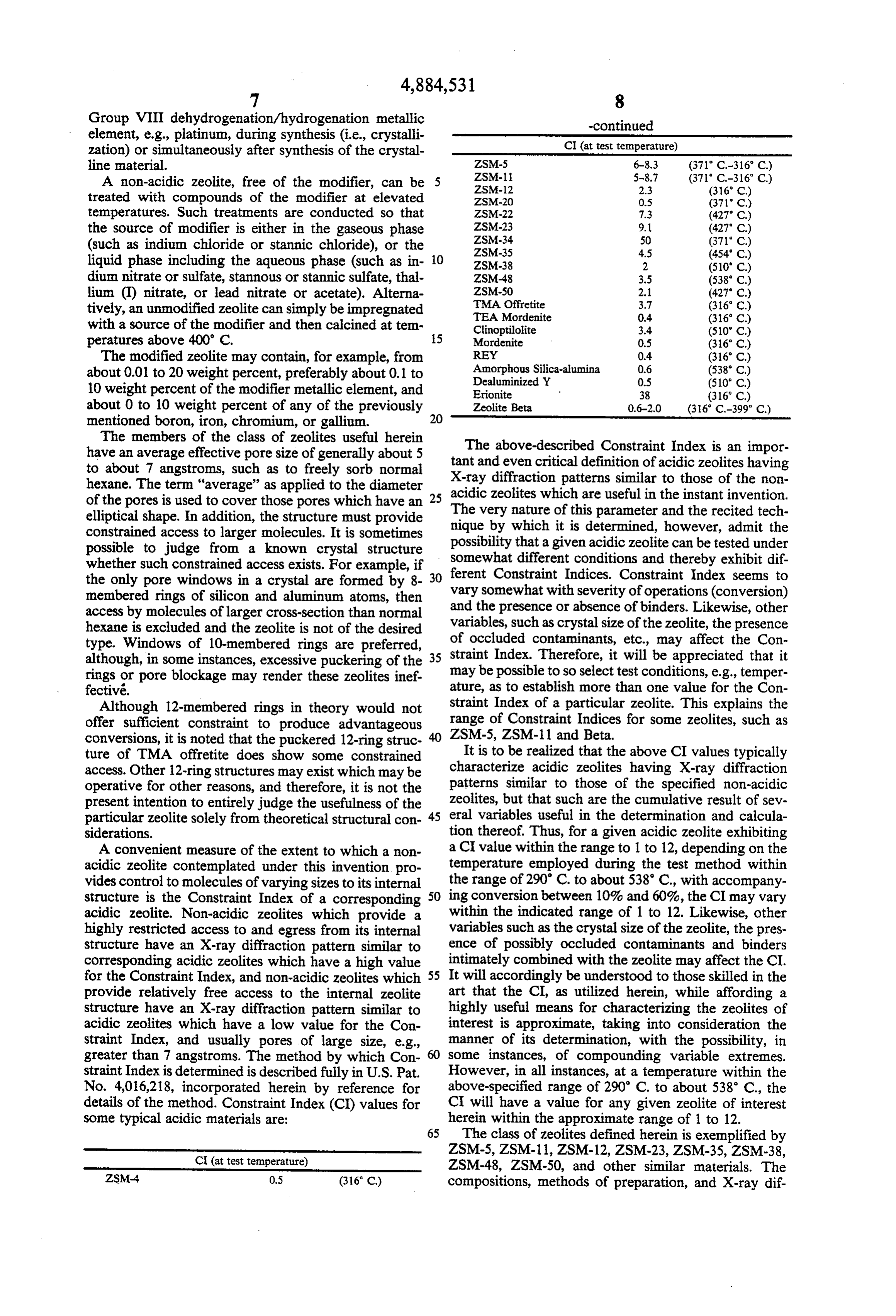
Group VIII dehydrogenation/hydrogenation metallic -continued element, e.g., platinum, during synthesis (i.e., crystalli CI (at test temperature) zation) or simultaneously after synthesis of the crystal line material. ZSM-5 6-8.3 (371 C-316 C.) A non-acidic zeolite, free of the modifier, can be ZSM-l 5-8.7 (371 C-316 C.)
treated with compounds of the modifier at elevated ZSM-20 0.5 (3.71° C) temperatures. Such treatments are conducted so that ZSM-22 7.3 (427 C.) the source of modifier is either in the gaseous phase ZSM-23
(such as indium chloride or stannic chloride), or the ZSM-35 4.5 (454 C.) liquid phase including the aqueous phase (such as in 10 ZSM-38 2 (510'. C.) dium nitrate or sulfate, stannous or stannic sulfate, thal ZSM-48 3.5 (538 C.) lium (I) nitrate, or lead nitrate or acetate). Alterna 2SM-SO
TMA Offretite
tively, an unmodified zeolite can simply be impregnated TEAMordenite 0.4 (316' C.) with a source of the modifier and then calcined at ten Clinoptilolite 3.4 (510 C) peratures above 400 C. 5 Mordenite 0.5 (316' C.) The modified zeolite may contain, for example, from REY
Amorphous Silica-alumina
about 0.01 to 20 weight percent, preferably about 0.1 to Dealuminized Y 0.5 (510'. C.) 10 weight percent of the modifier metallic element, and Erionite 38 (316' C.) about 0 to 10 weight percent of any of the previously Zeolite Beta 0.6-2.0 (316' C-399 C.) mentioned boron, iron, chromium, or gallium. 20
The members of the class of zeolites useful herein have an average effective pore size of generally about 5 tantThe above-described Constraint Index is an impor to about 7 angstroms, such as to freely sorb normal X-rayanddiffraction even critical definition of acidic zeolites having patterns similar to those of the non hexane. The term "average' as applied to the diameter acidic zeolites which of the pores is used to cover those pores which have an 25 The very nature of thisareparameter useful in the instant invention.
elliptical shape. In addition, the structure must provide nique by which it is determined, and the recited tech however, admit the constrained access to larger molecules. It is sometimes possibility possible to judge from a known crystal structure somewhat that a given acidic zeolite can be tested under different conditions and thereby exhibit dif whether such constrained access exists. For example, if ferent Constraint Indices. Constraint Index seems to the only pore windows in a crystal are formed by 8 30 membered rings of silicon and aluminum atoms, then vary somewhat with severity of operations (conversion) and the presence or absence of binders. Likewise, other access by molecules of larger cross-section than normal variables, hexane is excluded and the zeolite is not of the desired such as crystal size of the zeolite, the presence type. Windows of 10-membered rings are preferred, of occluded contaminants, etc., may affect the Con although, in some instances, excessive puckering of the 35 straint Index. Therefore, it will be appreciated that it rings or pore blockage may render these zeolites inef may be possible to so select test conditions, e.g., temper fectivé. ature, as to establish more than one value for the Con Although 12-membered rings in theory would not straint Index of a particular zeolite. This explains the offer sufficient constraint to produce advantageous range of Constraint Indices for some zeolites, such as conversions, it is noted that the puckered 12-ring struc ZSM-5, ZSM-11 and Beta.
ture of TMA offretite does show some constrained It is to be realized that the above CI values typically access. Other 12-ring structures may exist which may be characterize acidic zeolites having X-ray diffraction operative for other reasons, and therefore, it is not the patterns similar to those of the specified non-acidic present intention to entirely judge the usefulness of the zeolites, but that such are the cumulative result of sev particular zeolite solely from theoretical structural con 45 eral variables useful in the determination and calcula siderations. tion thereof. Thus, for a given acidic zeolite exhibiting A convenient measure of the extent to which a non a CI value within the range to 1 to 12, depending on the acidic zeolite contemplated under this invention pro temperature employed during the test method within vides control to molecules of varying sizes to its internal the range of 290 C. to about 538 C., with accompany structure is the Constraint Index of a corresponding 50 ing conversion between 10% and 60%, the CI may vary acidic zeolite. Non-acidic zeolites which provide a within the indicated range of 1 to 12. Likewise, other highly restricted access to and egress from its internal variables such as the crystal size of the zeolite, the pres structure have an X-ray diffraction pattern similar to ence of possibly occluded contaminants and binders corresponding acidic zeolites which have a high value intimately combined with the zeolite may affect the CI. for the Constraint Index, and non-acidic zeolites which 55 It will accordingly be understood to those skilled in the provide relatively free access to the internal zeolite art that the CI, as utilized herein, while affording a structure have an X-ray diffraction pattern similar to highly useful means for characterizing the zeolites of acidic zeolites which have a low value for the Con interest is approximate, taking into consideration the straint Index, and usually pores of large size, e.g., manner of its determination, with the possibility, in greater than 7 angstroms. The method by which Con some instances, of compounding variable extremes. straint Index is determined is described fully in U.S. Pat. However, in all instances, at a temperature within the No. 4,016,218, incorporated herein by reference for above-specified range of 290 C. to about 538 C., the details of the method. Constraint Index (CI) values for CI will have a value for any given zeolite of interest some typical acidic materials are: herein within the approximate range of 1 to 12. 65 The class of zeolites defined herein is exemplified by
C (at test temperature) ZSM-5, ZSM-11, ZSM-12, ZSM-23, ZSM-35, ZSM-38,
ZSM-48, ZSM-50, and other similar materials. The
ZSM-4 0.5 (316' C.) compositions, methods of preparation, and X-ray dif
Page 7
fraction patterns of these zeolites are typified in the about 1.6 grams per cubic centimeter. The dry density following patents: ZSM-5 in U.S. Pat. No. 3,702,886 for known structures may be calculated from the num and Re. No. 29,948; ZSM-11 in U.S. Pat. No. 3,709,979; ber of silicon plus aluminum atoms per 1000 cubic ang ZSM-12 in U.S. Pat. No. 3,832,449; ZSM-23 in U.S. Pat. strons, as given, e.g., on Page 19 of the article ZEO No. 4,076,842; ZSM-35 in U.S. Pat. No. 4,016,245; LITE STRUCTURE by W. M. Meier. This paper, the ZSM-38 in U.S. Pat. No. 4,046,859; ZSM-48 in U.S. Pat. entire contents of which are incorporated herein by No. 4,350,835; and ZSM-50 in U.S. Pat. No. 4,640,829. reference, is included in PROCEEDINGS OF THE Other intermediate pore zeolites which can be used as CONFERENCE OF MOLECULAR SIEVES, (Lon the substrate of the catalysts contemplated for use in the don, April 1967) published by the Society of Chemical pre-engine reformer of this invention are the alumino 10 Industry, London, 1968.
phosphates (AlPOs), particularly ALPO-11, ALPO-31 When the crystal structure is unknown, the crystal and ALPO-41, disclosed in U.S. Pat. No. 4,310,440; framework density may be determined by classical pyc silicoaluminophosphates (SAPOs), particularly SAPO nometer techniques. For example, it may be determined 11, SAPO-31 and SAPO-41, disclosed in U.S. Pat. No. by immersing the dry hydrogen form of the zeolite in an 4,440,871; any of certain metals, viz., Fe,Mg,Mn, Co or 15 organic solvent which is not absorbed by the crystal. Zn, combined with aluminophosphate (MeALPOs), Or, the crystal density may be determined by mercury particularly MeALPO-11, 31 and -41, disclosed in U.S. porosimetry, since mercury will fill the interstices be Pat. Nos. 4,544,143 and 4,567,029; and any of certain tween crystals but will not penetrate the intra-crystal other elements, viz., As, Be or Ti, combined with line free space.
aluminophosphate (ElAPOs) particularly ElAPO-11, 20 It is possible that the unusual sustained activity and disclosed in U.S. Pat. No. 4,500,651. The zeolites men stability of this special class of zeolites is associated with tioned in this paragraph are also described by E. M. a high crystal anionic framework density of not less Flanigen et al., “Aluminophosphate Molecular Sieves and the Periodic Table” published in New Developments than about 1.6 grams per cubic centimeter. This high density must necessarily be associated with a relatively in Zeolite Science and Technology, Studies in Surface 25 small amount of free space within the crystal, which Science and Calalysis 28, 103-112, Kodanska-Elsevier might be expected to result in more stable structures. (1986). This free space, however, is important as the locus of The entire disclosures of the patents and article cited catalytic activity.
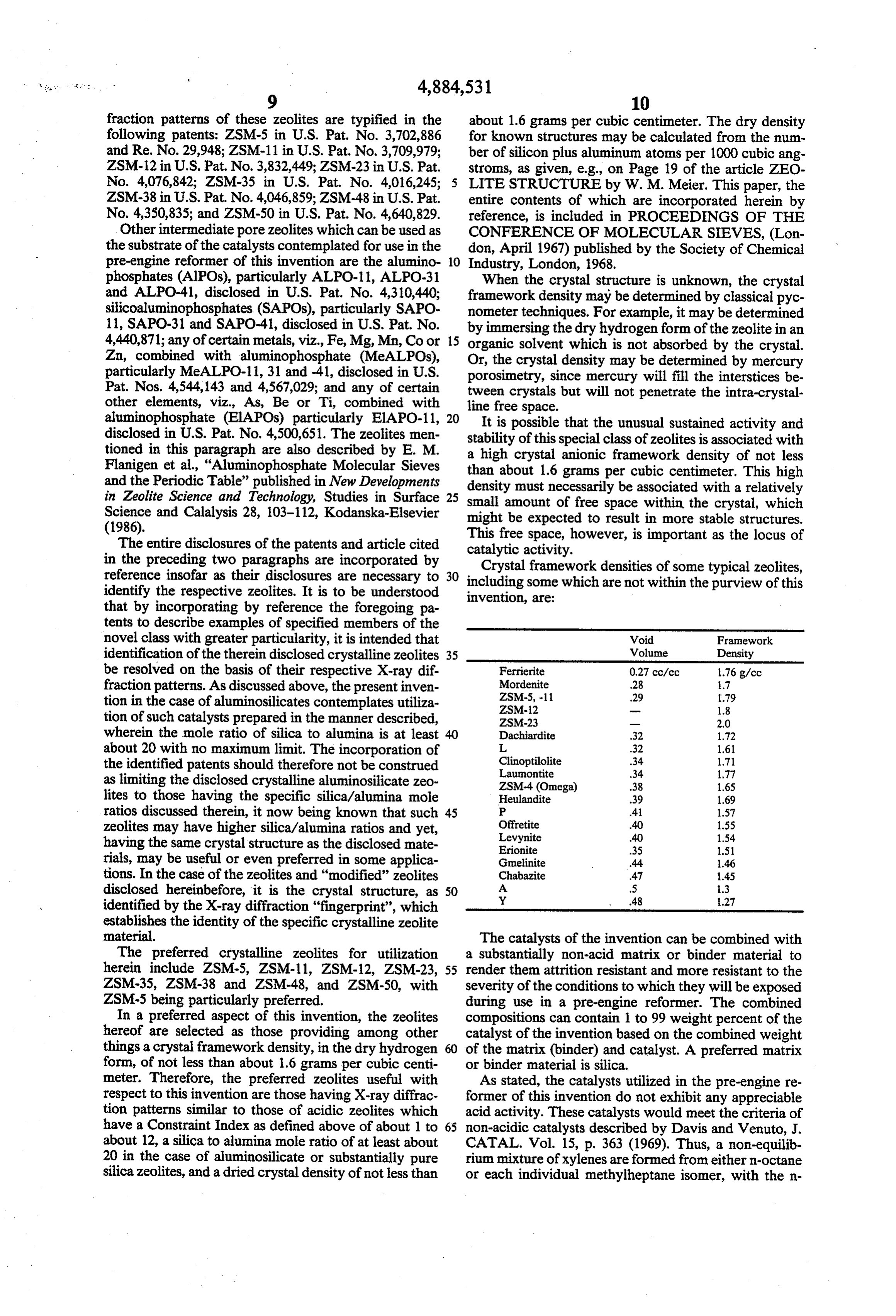
in the preceding two paragraphs are incorporated by Crystal framework densities of some typical zeolites, reference insofar as their disclosures are necessary to 30 including some which are not within the purview of this identify the respective zeolites. It is to be understood invention, are:
that by incorporating by reference the foregoing pa tents to describe examples of specified members of the novel class with greater particularity, it is intended that Void Framework identification of the therein disclosed crystalline zeolites 35 Volume Density be resolved on the basis of their respective X-ray dif Ferrierite 0.27 cc/cc 1.76 g/cc fraction patterns. As discussed above, the present inven Mordenite
tion in the case of aluminosilicates contemplates utiliza ZSM-12 1.8 tion of such catalysts prepared in the manner described, ZSM-23 - 2.0 wherein the mole ratio of silica to alumina is at least 40 Dachiardite .32 1.72 about 20 with no maximum limit. The incorporation of L
Clinoptilolite
the identified patents should therefore not be construed Laumontite .34 1.77 as limiting the disclosed crystalline aluminosilicate zeo ZSM-4 (Omega) 38 1.65 lites to those having the specific silica/alumina mole Heulandite 39 1.69 ratios discussed therein, it now being known that such 45 P
Offretite
zeolites may have higher silica/alumina ratios and yet, Levynite 40 1.54 having the same crystal structure as the disclosed mate Erionite .35 1.51 rials, may be useful or even preferred in some applica Gmelimite .44 1.46 tions. In the case of the zeolites and "modified” zeolites Chabazite 47 1.45 disclosed hereinbefore, it is the crystal structure, as 50 A
identified by the X-ray diffraction "fingerprint', which establishes the identity of the specific crystalline zeolite material. The catalysts of the invention can be combined with The preferred crystalline zeolites for utilization a substantially non-acid matrix or binder material to herein include ZSM-5, ZSM-11, ZSM-12, ZSM-23, 55 render them attrition resistant and more resistant to the ZSM-35, ZSM-38 and ZSM-48, and ZSM-50, with severity of the conditions to which they will be exposed ZSM-5 being particularly preferred. during use in a pre-engine reformer. The combined In a preferred aspect of this invention, the zeolites compositions can contain 1 to 99 weight percent of the hereof are selected as those providing among other catalyst of the invention based on the combined weight things a crystal framework density, in the dry hydrogen of the matrix (binder) and catalyst. A preferred matrix form, of not less than about 1.6 grams per cubic centi or binder material is silica. meter. Therefore, the preferred zeolites useful with As stated, the catalysts utilized in the pre-engine re respect to this invention are those having X-ray diffrac former of this invention do not exhibit any appreciable tion patterns similar to those of acidic zeolites which acid activity. These catalysts would meet the criteria of have a Constraint Index as defined above of about 1 to 65 non-acidic catalysts described by Davis and Venuto, J. about 12, a silica to alumina mole ratio of at least about CATAL. Vol. 15, p. 363 (1969). Thus, a non-equilib 20 in the case of aluminosilicate or substantially pure rium mixture of xylenes are formed from either n-octane silica zeolites, and a dried crystal density of not less than or each individual methylheptane isomer, with the n
Page 8
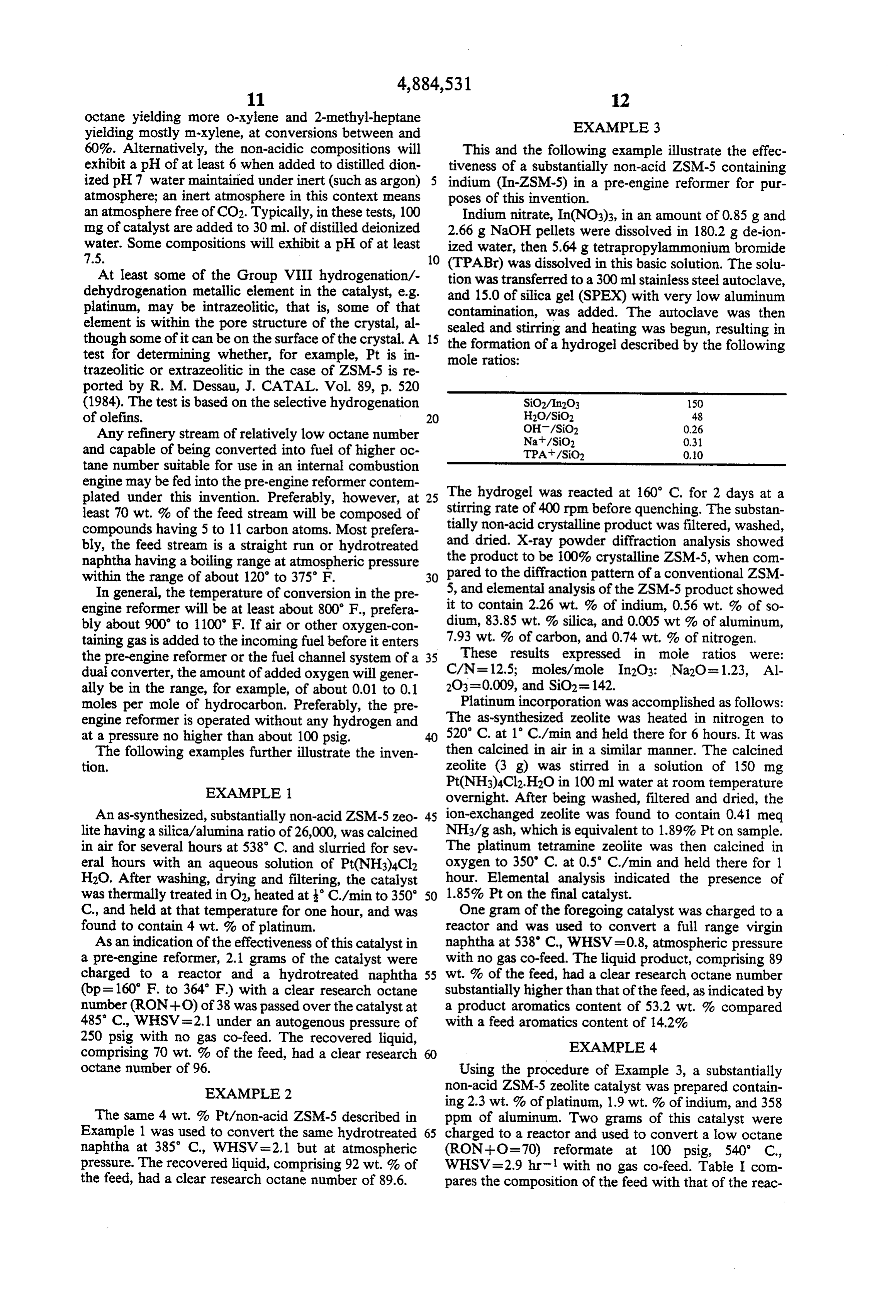
octane yielding more o-xylene and 2-methyl-heptane EXAMPLE 3 yielding mostly m-xylene, at conversions between and 60%. Alternatively, the non-acidic compositions will This and the following example illustrate the effec exhibit a pH of at least 6 when added to distilled dion tiveness of a substantially non-acid ZSM-5 containing ized pH 7 water maintained under inert (such as argon) indium (In-ZSM-5) in a pre-engine reformer for pur atmosphere; an inert atmosphere in this context means poses of this invention.
an atmosphere free of CO2. Typically, in these tests, 100 Indium nitrate, In(NO3)3, in an amount of 0.85g and mg of catalyst are added to 30 ml. of distilled deionized 2.66 g NaOH pellets were dissolved in 180.2 g de-ion water. Some compositions will exhibit a pH of at least ized water, then 5.64 g tetrapropylammonium bromide 7.5. 10 (TPABr) was dissolved in this basic solution. The solu At least some of the Group VIII hydrogenation/- tion dehydrogenation metallic element in the catalyst, e.g. and was transferred to a 300 ml stainless steel autoclave, 15.0 of silica gel (SPEX) with very low aluminum platinum, may be intrazeolitic, that is, some of that contamination, was added. The autoclave was then element is within the pore structure of the crystal, al sealed and stirring and heating was begun, resulting in though some of it can be on the surface of the crystal. A 15 the formation of a hydrogel described by the following test for determining whether, for example, Pt is in mole ratios:
trazeolitic or extrazeolitic in the case of ZSM-5 is re ported by R. M. Dessau, J. CATAL. Vol. 89, p. 520 (1984). The test is based on the selective hydrogenation SiO2/In2O3 150 of olefins. 20 H2O/SiO2 48 Any refinery stream of relatively low octane number OH/SiO2 0.26
and capable of being converted into fuel of higher oc TPAt/SiO2 0.0 tane number suitable for use in an internal combustion engine may be fed into the pre-engine reformer contem plated under this invention. Preferably, however, at 25 The hydrogel was reacted at 160 C. for 2 days at a least 70 wt.% of the feed stream will be composed of stirring rate of 400 rpm before quenching. The substan compounds having 5 to 11 carbon atoms. Most prefera tially non-acid crystalline product was filtered, washed, bly, the feed stream is a straight run or hydrotreated and dried. X-ray powder diffraction analysis showed naphtha having a boiling range at atmospheric pressure the product to be 100% crystalline ZSM-5, when com within the range of about 120' to 375 F. 30 pared to the diffraction pattern of a conventional ZSM In general, the temperature of conversion in the pre 5, and elemental analysis of the ZSM-5 product showed engine reformer will be at least about 800' F., prefera it to contain 2.26 wt.% of indium, 0.56 wt.% of so bly about 900 to 1100 F. If air or other oxygen-con dium, 83.85 wt.% silica, and 0.005 wt % of aluminum, taining gas is added to the incoming fuel before it enters 7.93 wt.% of carbon, and 0.74 wt.% of nitrogen. the pre-engine reformer or the fuel channel system of a 35 These results expressed in mole ratios were: dual converter, the amount of added oxygen will gener C/N = 12.5; moles/mole In2O3: Na2O= 1.23, Al ally be in the range, for example, of about 0.01 to 0.1 2O3=0.009, and SiO2=142.
moles per mole of hydrocarbon. Preferably, the pre Platinum incorporation was accomplished as follows: engine reformer is operated without any hydrogen and The as-synthesized zeolite was heated in nitrogen to at a pressure no higher than about 100 psig. 520' C. at 1 C./min and held there for 6 hours. It was The following examples further illustrate the inven then calcined in air in a similar manner. The calcined tion. zeolite (3 g) was stirred in a solution of 150 mg
EXAMPLE
Pt(NH3)4Cl2.H2O in 100 ml water at room temperature overnight. After being washed, filtered and dried, the
An as-synthesized, substantially non-acid ZSM-5 zeo 45 ion-exchanged zeolite was found to contain 0.41 meq lite having a silica/alumina ratio of 26,000, was calcined NH3/g ash, which is equivalent to 1.89% Pt on sample. in air for several hours at 538 C. and slurried for sev The platinum tetramine zeolite was then calcined in eral hours with an aqueous solution of Pt(NH3)4Cl2 oxygen to 350 C. at 0.5 C./min and held there for 1 H2O. After washing, drying and filtering, the catalyst hour. Elemental analysis indicated the presence of was thermally treated in O2, heated at C./min to 350 50 1.85% Pt on the final catalyst.
C., and held at that temperature for one hour, and was One gram of the foregoing catalyst was charged to a found to contain 4 wt.% of platinum. reactor and was used to convert a full range virgin As an indication of the effectiveness of this catalyst in naphtha at 538 C., WHSV=0.8, atmospheric pressure a pre-engine reformer, 2.1 grams of the catalyst were with no gas co-feed. The liquid product, comprising 89 charged to a reactor and a hydrotreated naphtha 55 wt.% of the feed, had a clear research octane number (bp=160 F. to 364 F.) with a clear research octane substantially higher than that of the feed, as indicated by number (RON--O) of 38 was passed over the catalyst at a product aromatics content of 53.2 wt.% compared 485 C., WHSV=2.1 under an autogenous pressure of with a feed aromatics content of 14.2% 250 psig with no gas co-feed. The recovered liquid, EXAMPLE 4 comprising 70 wt.% of the feed, had a clear research 60 octane number of 96. Using the procedure of Example 3, a substantially EXAMPLE 2 non-acid ZSM-5 zeolite catalyst was prepared contain ing 2.3 wt.% of platinum, 1.9 wt.% of indium, and 358
The same 4 wt.% Pt/non-acid ZSM-5 described in ppm of aluminum. Two grams of this catalyst were Example 1 was used to convert the same hydrotreated 65 charged to a reactor and used to convert a low octane naphtha at 385 C., WHSV=2.1 but at atmospheric (RON--O=70) reformate at 100 psig, 540 C., pressure. The recovered liquid, comprising 92 wt.% of WHSV=2.9 hr-1 with no gas co-feed. Table I com the feed, had a clear research octane number of 89.6. pares the composition of the feed with that of the reac
Page 9
tion product. The recovered liquid comprised 87.6 wt. EXAMPLE 7 % of the feed.
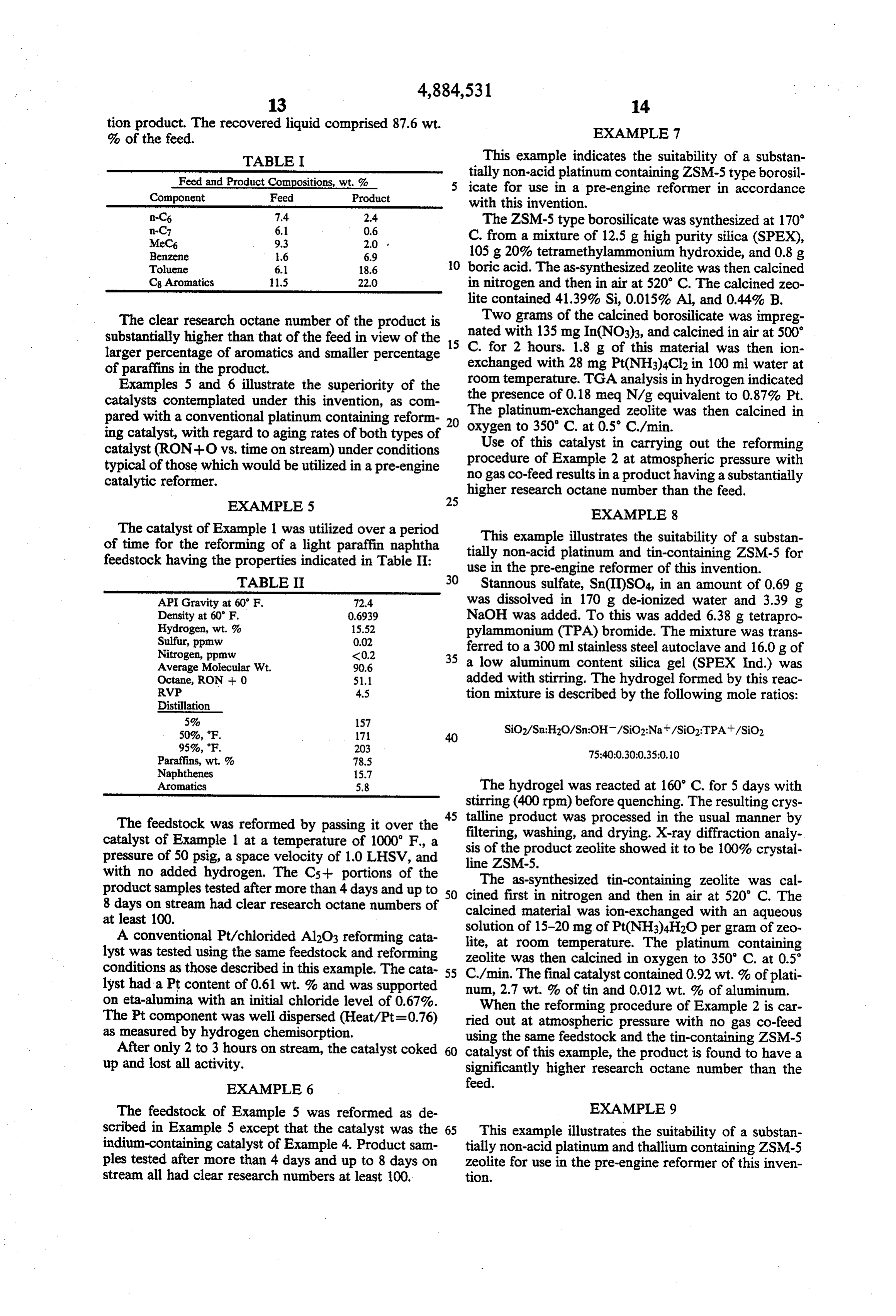
TABLE I This example indicates the suitability of a substan Feed and Product Compositions, wt % tially non-acid platinum containing ZSM-5 type borosil 5 icate for use in a pre-engine reformer in accordance
Component Feed Product with this invention.
The ZSM-5 type borosilicate was synthesized at 170
MeC6 9.3 2.0 C. from a mixture of 12.5g high purity silica (SPEX), Benzene 1.6 6.9 O 105 g 20% tetramethylammonium hydroxide, and 0.8g Toluene 6.1 18.6 boric acid. The as-synthesized zeolite was then calcined C8 Aromatics 11.5 22.0 in nitrogen and then in air at 520' C. The calcined zeo
The clear research octane number of the product is Two grams of the calcined borosilicate was impreg nated with 135 mg In(NO3)3, and calcined in air at 500' substantially higher than that of the feed in view of the 15 C.
larger percentage of aromatics and smaller percentage exchanged for 2 hours. 1.8 g of this material was then ion of paraffins in the product. with 28 mg Pt(NH3)4Cl2 in 100 ml water at Examples 5 and 6 illustrate the superiority of the room temperature. TGA analysis in hydrogen indicated the presence of 0.18 meq N/g equivalent to 0.87% Pt.
catalysts contemplated under this invention, as com The platinum-exchanged zeolite was then calcined in pared with a conventional platinum containing reform- 20 oxygen to 350° C. at 0.5 C/min. ing catalyst, with regard to aging rates of both types of catalyst (RON--O vs. time on stream) under conditions procedure this
Use of catalyst in carrying out the reforming typical of those which would be utilized in a pre-engine no gas co-feed results in 2a product of Example at atmospheric pressure with having a substantially catalytic reformer. higher research octane number than the feed.
EXAMPLE 8
The catalyst of Example 1 was utilized over a period This example illustrates the suitability of a substan of time for the reforming of a light paraffin naphtha tially non-acid platinum and tin-containing ZSM-5 for feedstock having the properties indicated in Table II: use in the pre-engine reformer of this invention. TABLE II 30 Stannous sulfate, Sn(II)SO4, in an amount of 0.69g API Gravity at 60 F. 724 was dissolved in 170 g de-ionized water and 3.39 g Density at 60' F. 0.6939 NaOH was added. To this was added 6.38 g tetrapro Hydrogen, wt.% 15.52 pylammonium (TPA) bromide. The mixture was trans
Nitrogen, ppmw <0.2 35 ferred to a 300 ml stainless steel autoclave and 16.0 g of Average Molecular Wt. 90.6 a low aluminum content silica gel (SPEX Ind.) was Octane, RON + 0 51.1 added with stirring. The hydrogel formed by this reac RVP distillation 4.5 tion mixture is described by the following mole ratios:
95%, F. 203 75:40:0.30:0.35:0.10
Aromatics 5.8 The hydrogel was reacted at 160° C. for 5 days with stirring (400 rpm) before quenching. The resulting crys talline product was processed in the usual manner by
The feedstock was reformed by passing it over the 45 filtering, catalyst of Example 1 at a temperature of 1000' F., a sis washing, and drying. X-ray diffraction analy pressure of 50 psig, a space velocity of 1.0 LHSV, and of the product zeolite showed it to be 100% crystal with no added hydrogen. The C5-- portions of the lineThe ZSM-5.
as-synthesized tin-containing zeolite was cal product samples tested after more than 4 days and up to so cined first in nitrogen and then in air at 520' C. The 8 days on stream had clear research octane numbers of calcined material was ion-exchanged with an aqueous at least 100.
solution of 15-20
A conventional Pt/chlorided Al2O3 reforming cata lite, at room temperature. mg of Pt(NH3)4H2O per gram of zeo lyst was tested using the same feedstock and reforming zeolite was then calcined in The platinum containing
conditions as those described in this example. The cata 55 C/min. The final catalyst contained 0.92 lyst had a Pt content of 0.61 wt.% and was supported num, 2.7 wt.% of tin and 0.012 wt.% ofwt.% of plati aluminum.
on eta-alumina with an initial chloride level of 0.67%. When the reforming procedure of Example 2 is car The Pt component was well dispersed (Heat/Pt=0.76) ried out at atmospheric pressure with no gas co-feed as measured by hydrogen chemisorption. using the same feedstock and the tin-containing ZSM-5 After only 2 to 3 hours on stream, the catalyst coked catalyst of this example, the product is found to have a up and lost all activity. significantly higher research octane number than the
The feedstock of Example 5 was reformed as de EXAMPLE 9 scribed in Example 5 except that the catalyst was the 65 This example illustrates the suitability of a substan indium-containing catalyst of Example 4. Product sam tially non-acid platinum and thallium containing ZSM-5 ples tested after more than 4 days and up to 8 days on zeolite for use in the pre-engine reformer of this inven stream all had clear research numbers at least 100. tion.
Page 10
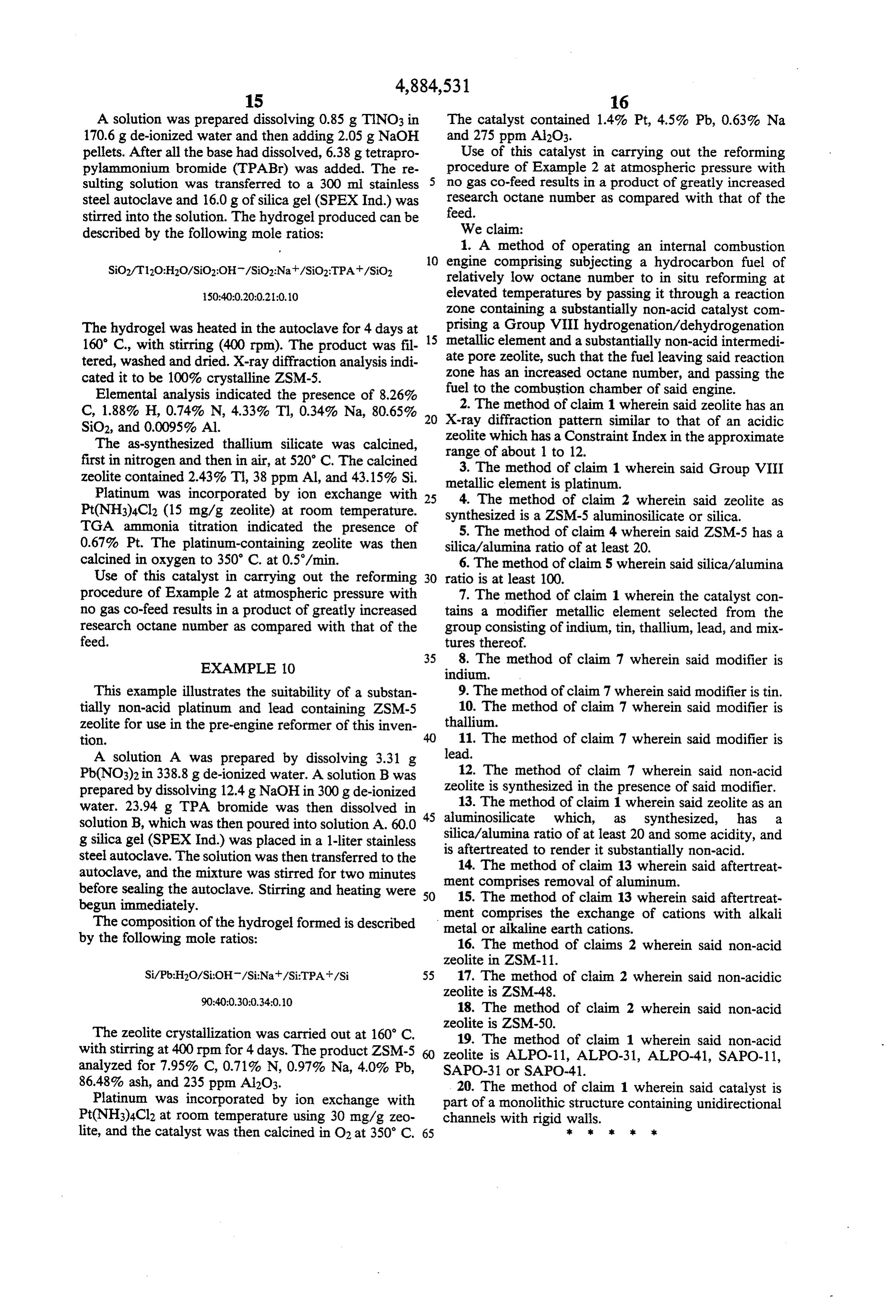
A solution was prepared dissolving 0.85g TiNO3 in The catalyst contained 1.4% Pt, 4.5% Pb, 0.63% Na 170.6 g de-ionized water and then adding 2.05 g NaOH and 275 ppm Al2O3.
pellets. After all the base had dissolved, 6.38g tetrapro Use of this catalyst in carrying out the reforming pylammonium bromide (TPABr) was added. The re procedure of Example 2 at atmospheric pressure with sulting solution was transferred to a 300 ml stainless no gas co-feed results in a product of greatly increased steel autoclave and 16.0 g of silica gel (SPEX Ind.) was research octane number as compared with that of the stirred into the solution. The hydrogel produced can be feed.
described by the following mole ratios: We claim:
1. A method of operating an internal combustion 10 engine comprising subjecting a hydrocarbon fuel of relatively low octane number to in situ reforming at 150:40:0.20:0.21:0.10 elevated temperatures by passing it through a reaction zone containing a substantially non-acid catalyst com
The hydrogel was heated in the autoclave for 4 days at 15 prising a Group VIII hydrogenation/dehydrogenation 160 C., with stirring (400 rpm). The product was fil metallic element and a substantially non-acid intermedi tered, washed and dried. X-ray diffraction analysis indi ate pore zeolite, such that the fuel leaving said reaction cated it to be 100% crystalline ZSM-5. zone has an increased octane number, and passing the Elemental analysis indicated the presence of 8.26% fuel2. to the combustion chamber of said engine. C, 1.88% H, 0.74% N, 4.33% Tl, 0.34% Na, 80.65% 20 X-rayThe method of claim 1 wherein said zeolite has an diffraction pattern similar to that of an acidic
The as-synthesized thallium silicate was calcined, range of about 1 toConstraint zeolite which has a
Index in the approximate first in nitrogen and then in air, at 520' C. The calcined 3. The method of claim 1 wherein said Group VIII zeolite contained 2.43%. T., 38 ppm Al, and 43.15% Si. metallic
Platinum was incorporated by ion exchange with 25 4. Theelement is platinum.
method of claim 2 wherein said zeolite as
Pt(NH3)4Cl2 (15 mg/g zeolite) at room temperature. synthesized is a ZSM-5 aluminosilicate or silica. TGA ammonia titration indicated the presence of 5. The method of claim 4 wherein said ZSM-5 has a 0.67% Pt. The platinum-containing zeolite was then silica/alumina ratio of at least 20.
calcined in oxygen to 350° C. at 0.5/min. 6. The method of claim 5 wherein said silica/alumina Use of this catalyst in carrying out the reforming 30 ratio is at least 100.
procedure of Example 2 at atmospheric pressure with 7. The method of claim 1 wherein the catalyst con no gas co-feed results in a product of greatly increased tains a modifier metallic element selected from the research octane number as compared with that of the group consisting of indium, tin, thallium, lead, and mix feed. tures thereof.
35 8. The method of claim 7 wherein said modifier is
This example illustrates the suitability of a substan 9. The method of claim 7 wherein said modifier is tin. tially non-acid platinum and lead containing ZSM-5 10. The method of claim 7 wherein said modifier is zeolite for use in the pre-engine reformer of this inven thallium.
tion. 11. The method of claim 7 wherein said modifier is A solution. A was prepared by dissolving 3.31 g lead.
Pb(NO3)2 in 338.8g de-ionized water. A solution B was 12. The method of claim 7 wherein said non-acid prepared by dissolving 12.4 g NaOH in 300g de-ionized zeolite is synthesized in the presence of said modifier. 13. The method of claim 1 wherein said zeolite as an water. 23.94 g TPA bromide was then dissolved in 45 aluminosilicate solution B, which was then poured into solution A. 60.0 silica/alumina ratiowhich, as synthesized, has a of at least 20 and some acidity, and g silica gel (SPEX Ind.) was placed in a 1-liter stainless is aftertreated to render it substantially non-acid. steel autoclave. The solution was then transferred to the autoclave, and the mixture was stirred for two minutes 14. The method of claim 13 wherein said after treat ment comprises removal of aluminum.
before sealing the autoclave. Stirring and heating were 50 15. The method of claim 13 wherein said after treat begun immediately.
The composition of the hydrogel formed is described ment comprises the exchange of cations with alkali metal or alkaline earth cations.
by the following mole ratios: 16. The method of claims 2 wherein said non-acid zeolite in ZSM-11.
55 17. The method of claim 2 wherein said non-acidic
Zeolite is ZSM-48.
18. The method of claim 2 wherein said non-acid zeolite is ZSM-50.
The zeolite crystallization was carried out at 160 C. 19. The method of claim 1 wherein said non-acid with stirring at 400 rpm for 4 days. The product ZSM-5 zeolite is ALPO-11, ALPO-31, ALPO-41, SAPO-11, analyzed for 7.95% C, 0.71% N, 0.97% Na, 4.0% Pb, SAPO-3 or SAPO-41.
86.48% ash, and 235 ppm Al2O3. 20. The method of claim 1 wherein said catalyst is Platinum was incorporated by ion exchange with part of a monolithic structure containing unidirectional Pt(NH3)4Cl2 at room temperature using 30 mg/g zeo channels with rigid walls. lite, and the catalyst was then calcined in O2 at 350° C. 65 k s k xt 2k
Provenance
- Collection
- Cited prior art
- Original PDF
- patentimages.storage.googleapis.com →
- Filed
- 1988-06-30
- Pages
- 10
- Method
- pdftotext (the PDF's own text layer) + pdftoppm 300dpi page scans
- Source
- Google Patents bibliographic record
- Granted
- 1989-12-05
- Inventors
- Thomas F. Degnan, Jr.; Ralph M. Dessau; Mobil Oil AS
- Transcribed from
- patentimages.storage.googleapis.com →