patent · US4862836
Operation of an internal combustion engine with a pre-engine converter
5 September 1989
Page 1
United States Patent (19) 11 Patent Number: 4,862,836 Chen et al. 45 Date of Patent: Sep. 5, 1989
54 COMBUSTION
OPERATION OFENGINE
AN INTERNAL
WITH A OTHER PUBLICATIONS
PRE-ENGINE CONVERTER J. P. DeLuca and L. E. Campbell, "Monolithic Catalyst w a Supports' in Advanced Materials in Catalysis, J. J. 75 Inventors: NE ES'E, Pa. Burton and R. L. Garten, eds., Academic Press, New ava e ''" York (1977), pp. 293 to 324.
73 Assignee: Mobil Oil Corporation, New York, J. Wei, "Catalysis for Motor Vehicle Emissions', Adv. N.Y. Catalysis, vol. 24 (1975), pp. 77 cc 86. 21 Appl. No.: 133,401 Primary Examiner-E. Rollins Cross 22 Filled: Dec. 15, 1987 Attorney, Agent, or Firm-Alexander J. McKillop; s nt. Cl."4 ..............................................
C. S. FO2B 43/08 Charles J. Speciale; Malcolm D. Keen 52 ... 123/3; 502/253 (57) ABSTRACT 58 Field of Search ............................ 123/3, 180 AC; A method is provided of operating an internal combus 252/455 Z, tion engine comprising subjecting a hydrocarbon fuel of 56 References Cited relatively low octane number to conversion at elevated temperatures by passing it through a reaction zone con
3,730,910 5/1973 Albers et al. . ... 252/455 Z. parallel, channels with rigid walls, e.g., a monolith or 3,855,980 12/1974 Weisz et al. ............................ 123/3 series of monoliths, at least the internal surfaces of 4,046,522 9/1977 Chen ..................................... 48/102 which contain an aluminosilicate zeolite catalyst having 4,070,993 1/1978 Chen ....................................... 2 a Constraint Index in the approximate range of about 1. 4,157.375 6/1979 Brown et al. ... ... 252/455 4,180,689 12/1979 Davies et al. ....................... 585/415 to 12 and a silica/alumina ratio in a range of about 20 to 4,304,686 12/1981 Telford ................................. 5000, e.g., ZSM-5 preferably containing gallium or zinc, 4.3508355/1982 Chester et al... 585/15 such that the fuel leaving said channels has an increased 4,392,989 7/1983 Chu et al. . octane number, and passing the fuel to the combustion
FOREIGN PATENT DOCUMENTS
chamber of said engine.
0050021 4/1981 European Pat. Off. . 15 Claims, 4 Drawing Sheets
AIR se-- CARBURETOR
GAS COOER
O RADATOR
EXHAUS
GAS
(OPTIONAL) CONVERTER
Page 2
Drawing sheet — no readable text.
Page 3
Drawing sheet — no readable text.
Page 4
Drawing sheet — no readable text.
Page 5
Drawing sheet — no readable text.
Page 6
None of the foregoing references discloses or sug
OPERATION OF AN INTERNAL COMBUSTION gests the use of the pre-engine converter zeolite in the ENGINE WITH A PRE-ENGINE CONVERTER form of a monolith.
J. P. DeLuca and L. E. Campbell, "Monolithic Cata
BACKGROUND OF THE INVENTION 5 lyst Supports' in Advanced Materials in Catalysis, J. J. 1. Field of the Invention Burton and R. L. Garten, eds., Academic Press, New This invention relates to the operation of an internal York (1977), pages 293 to 324, teach various structures and catalytic agents in monolithic catalysts and methods combustion engine employing a pre-engine converter for their fabrication.
for upgrading the octane number of the fuel, which 10 U.S. Pat. No. 3,730,910 teaches various methods for incorporates a monolithic structure comprising a zeo depositing zeolites on substrate surfaces, e.g., mono lite. liths. The deposited zeolite may be used as cracking or 2. Background Information hydrocracking catalysts.
Pre-engine converters for improving the octane num J. Wei, "Catalysis for Motor Vehicle Emissions', ber of fuels utilized in internal combustion engines are 5 Adv. Catalysis, Vol. 24 (1975), pages 77-86, teaches the known in the art as shown in the Information Disclo use of monolithic structures comprising various materi sure Statement set out hereinafter. As described, such als useful as oxidation catalysts applied to the treatment converters utilize a packed bed of catalyst which neces of gasoline engine exhaust gases.
sitates that the catalyst be in particulate form, e.g., as U.S. Pat. No. 4,157,375 discloses the reduction of pellets, beads or powders. 20 nitrogen oxides in exhaust gas using as catalyst a Zeolite, A significant problem connected with the use of pre e.g., ZSM-5, in the form of a monolithic honeycomb engine converters utilizing a packed bed of catalyst is structure containing channels and prepared by calcining the relatively large pressure drop incurred in passing a kaolin preform having the desired shape and treating the volatized fuel through the packed bed at the high the calcined preform with a caustic solution. space velocities required for a reasonably sized pre 25 None of the foregoing references disclosing mono engine converter. In general, catalyst conversion and lithic catalysts teaches the use of such monoliths in engine requirements often require that the catalyst be pre-engine converters for the purpose of upgrading low able to operate in about the 10 to 30 LHSV range, cor octane fuels.
responding to a gas hourly space velocity (GHSV) in U.S. Pat. Nos. 4, 180,689; 4,304,686; 4,350,835; and the range of about 3,000 to 10,000 hr pressure drops 30 each European Patent Specification Publication No. 50,021 for particulate catalysts under these conditions can be poundsdiscloses a process of converting aliphatic com to aromatics utilizing as catalyst a zeolite, e.g., substantial resulting in serious impairment of engine efficiency. Thus, any means for reducing the problem of ZSM-5, containing gallium in impregnated or cation pressure drop while still allowing for the advantages of exchanged form.
a pre-engine converter in terms of octane enhancement 35 ingU.S. a
Pat. No. 4,392,989 discloses a catalyst compris zeolite, e.g., ZSM-5, containing gallium and zinc, of the fuel being utilized, are very desirable. which is useful in converting paraffinic feeds containing Information Disclosure Statement propane to aromatics. Also disclosed for comparison purposes are catalysts consisting of the Zeolite plus
The following information is disclosed in accordance 40 gallium with the terms of 37 CFR 1.56, 1.97 and 1.98. alone, zinc alone, gallium with palladium, or U.S. Pat. No. 3,855,980 discloses a pre-engine con zinc with palladium.
verter containing a packed bed of a ZSM-5 or ZSM-8 SUMMARY OF THE INVENTION zeolite catalyst. The disclosure refers to a converter In accordance with this invention, a relatively low vessel containing varying numbers of quarts of catalyst 45 octane incoming fuel is converted to a higher octane which indicates that the catalyst is employed in particu fuel in the operation of an internal combustion engine late form. Also disclosed is the use of hot exhaust gases by passing the incoming fuel at conversion temperatures to provide heat necessary to drive the cracking process through a pre-engine converter situated between the occurring within the converter. fuel pump and the carburetor of the engine, such con U.S. Pat. No. 4,046,522 discloses a pre-engine con 50 verter comprising a plurality of unidirectional, prefera verter comprising a bed of particulate "cracking cata bly substantially parallel channels with rigid walls, at lyst of the ZSM-5 zeolite type' to convert the hydro least the internal surfaces of which contain an alumino carbons in a fuel mixture comprising hydrocarbons and silicate zeolite catalyst having a Constraint Index in the oxygenated organic compounds, to a higher octane approximate range of about 1 to 12 as hereinafter de gaseous hydrocarbon fuel. Also disclosed is the use of 55 fined, and effective to convert a hydrocarbon mixture the hot exhaust gases from the engine to heat the hydro of relatively low octane number to a higher octane carbons undergoing reaction in the converter. number. The zeolite may be in acid form but preferably U.S. Pat. No. 4,070,993 teaches a pre-engine con contains gallium or zinc incorporated by ion exchange verter containing a ZSM-5 zeolite for the conversion of or impregnation techniques. A zeolite having any con a low octane fuel, into which oxygen has been mixed, to 60 bination of acid, gallium and zinc sites may also be used. produce a higher octane gaseous product. The Zeolite is The described catalyst structure is preferably in the employed in the form of a “fixed bed” of presumably a form of a "monolith' or "monolithic' structure, and the particulate form of the catalyst. The patent also dis arrangement of the channels is referred to as a "honey closes providing heat to the conversion reaction by comb,' regardless of whether the passageways have a adding a controlled amount of an oxygen-containing 65 hexagonal cross-section or some other shape, e.g., gas, e.g., air, to the fuel being fed to the converter to square. It has been found that the use of a monolithic combust a minor amount of such fuel, and/or by heat pre-engine converter of the type described results in exchange with the exhaust gases from the engine. substantial improvement in the octane number of the
Page 7
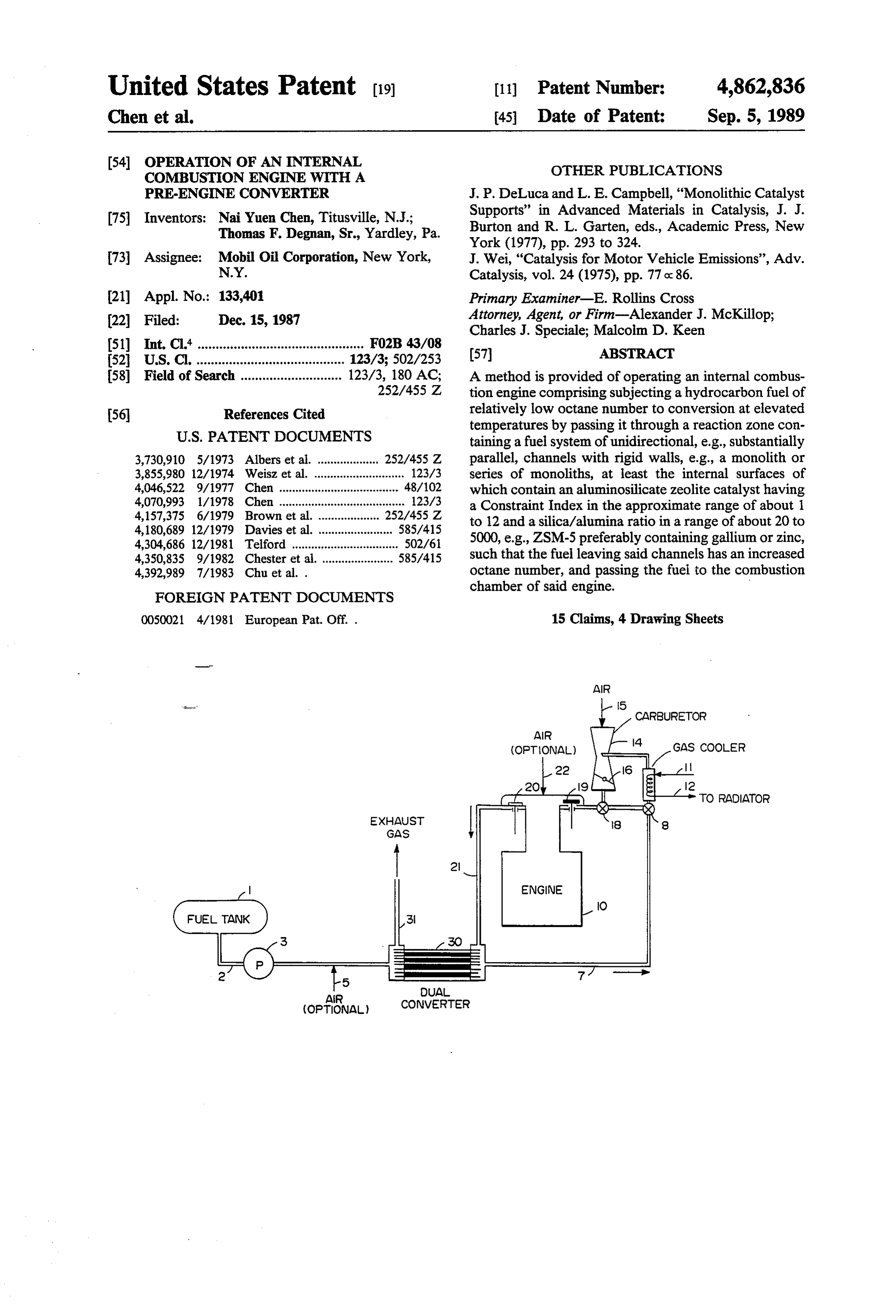
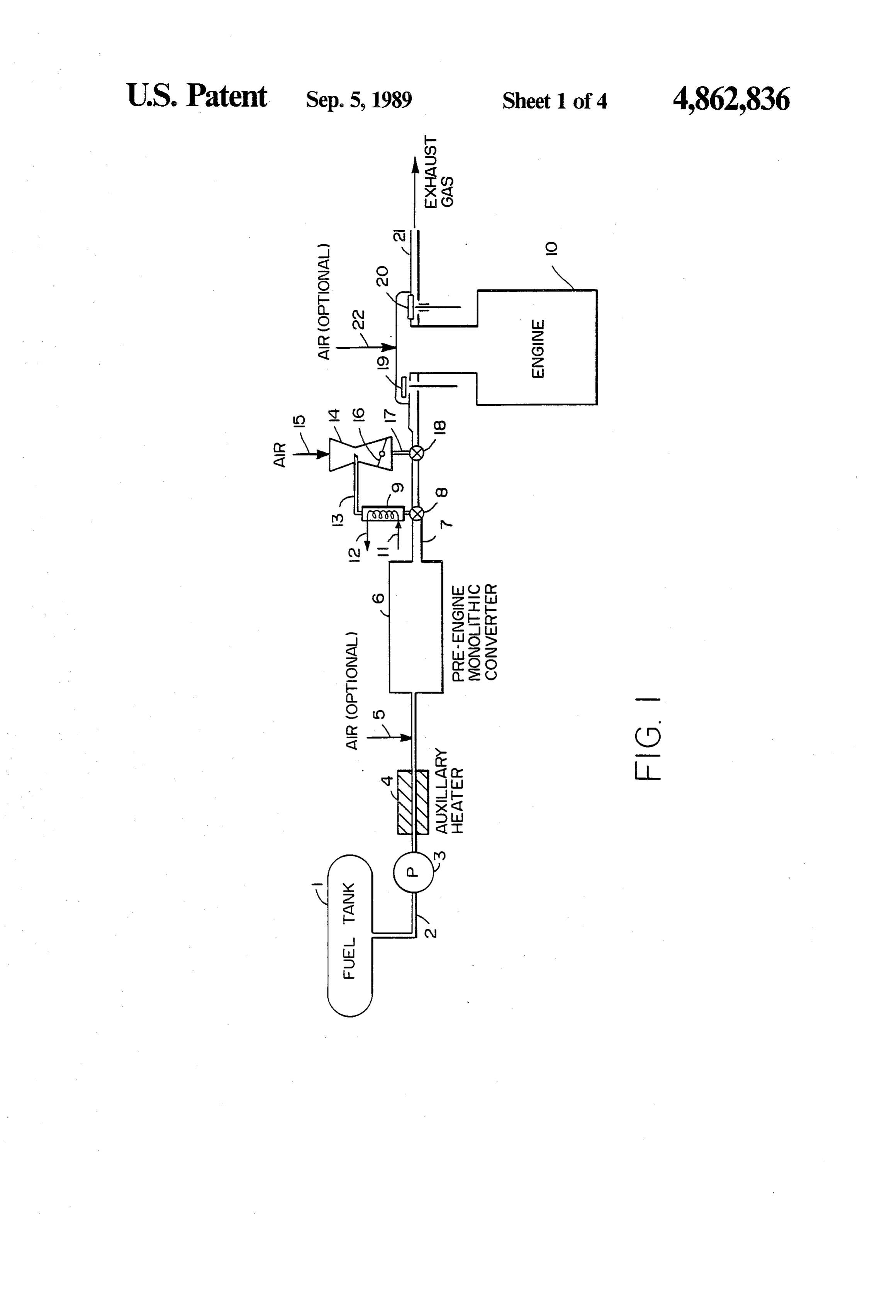
fuel without the relatively large and efficiency reducing the inner surfaces of the exhaust gas channels contain a pressure drops caused by the use of a converter contain catalyst effective in exothermically oxidizing the oxidiz ing a packed particulate bed of catalyst. able components of the exhaust gas, e.g., to carbon Since the reactions involved in the upgrading of the dioxide and water. Preferably, the zeolite catalyst in the octane number of the fuel, e.g., cracking, alkylation, and 5 fuel channels contains gallium or zinc, or a combination aromatization, require an elevated reaction temperature of gallium or zinc with platinum or palladium, incorpo and are endothermic, it is necessary to supply heat to rated by ion exchange or impregnation, and/or is in the the reaction. This may be done under the invention by acid, i.e., protonated form, and the catalyst in the ex any known means, e.g., heat exchange between the haust gas channels is a zeolite of the same type utilized incoming fuel and the hot exhaust gases or by passing 10 in the fuel channels which contains a group VIII metal, the incoming fuel through the heated engine blocks. e.g., platinum or palladium, or a combination of the However, in accordance with another aspect of the two, incorporated by ion exchange or impregnation. invention, heat for the conversion reaction is supplied BRIEF DESCRIPTION OF DRAWINGS by injecting a small amount of an oxygen-containing gas, e.g., air, with the fuel into the pre-engine converter 15 FIG. 1 is a schematic diagram of an internal combus containing the monolith incorporating the zeolite cata tion engine utilizing a pre-engine converter without any lyst. The resulting partial combination of the fuel pro heat exchange with exhaust gas.
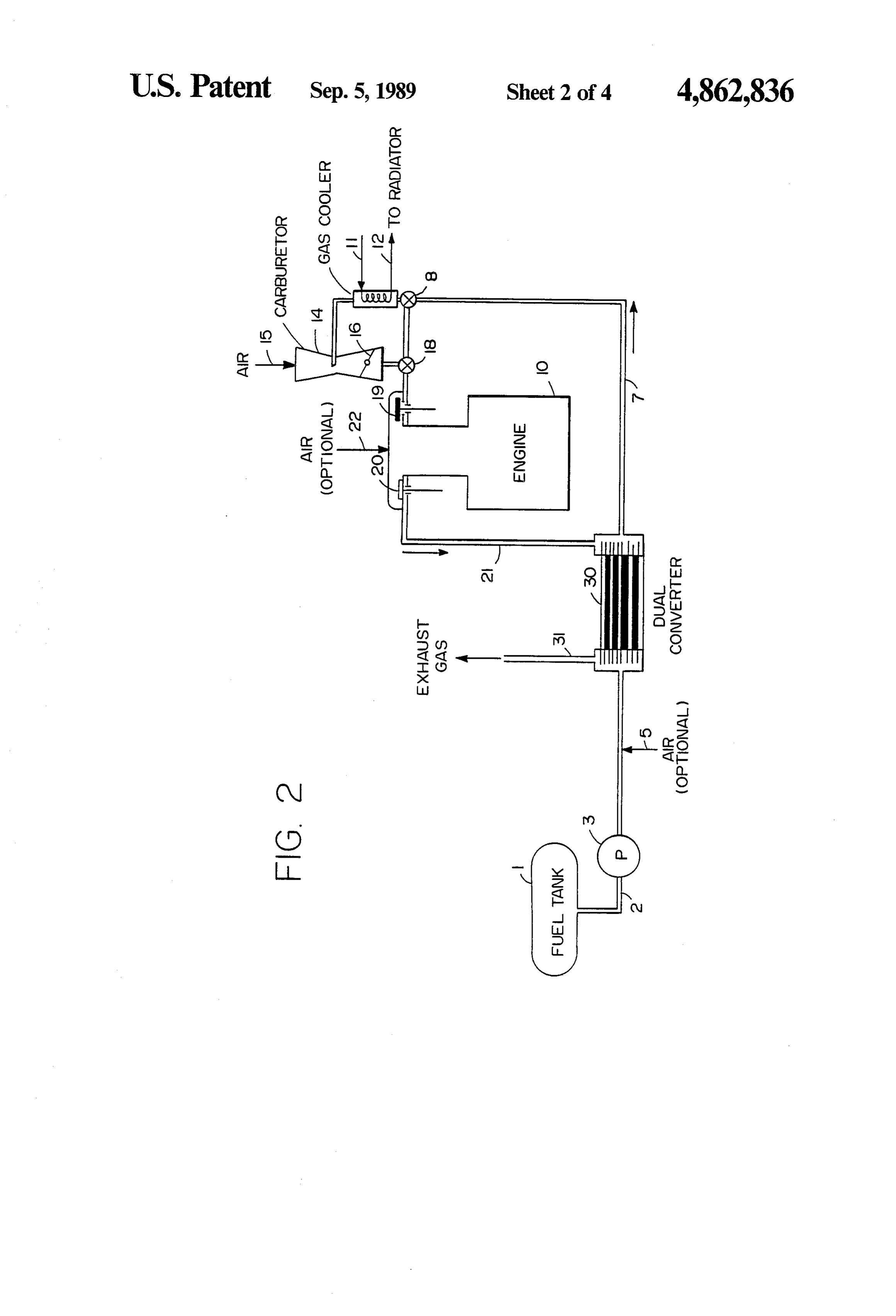
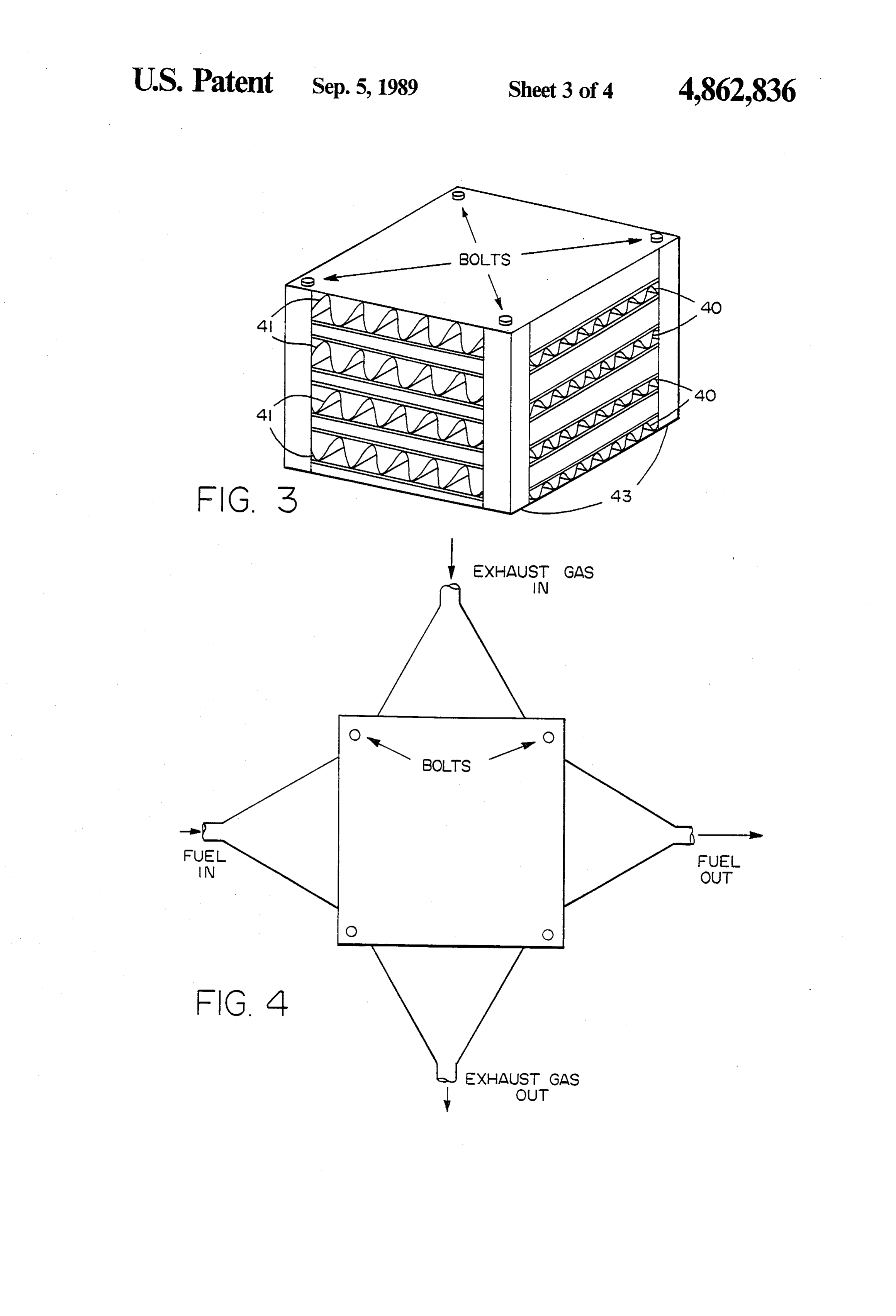
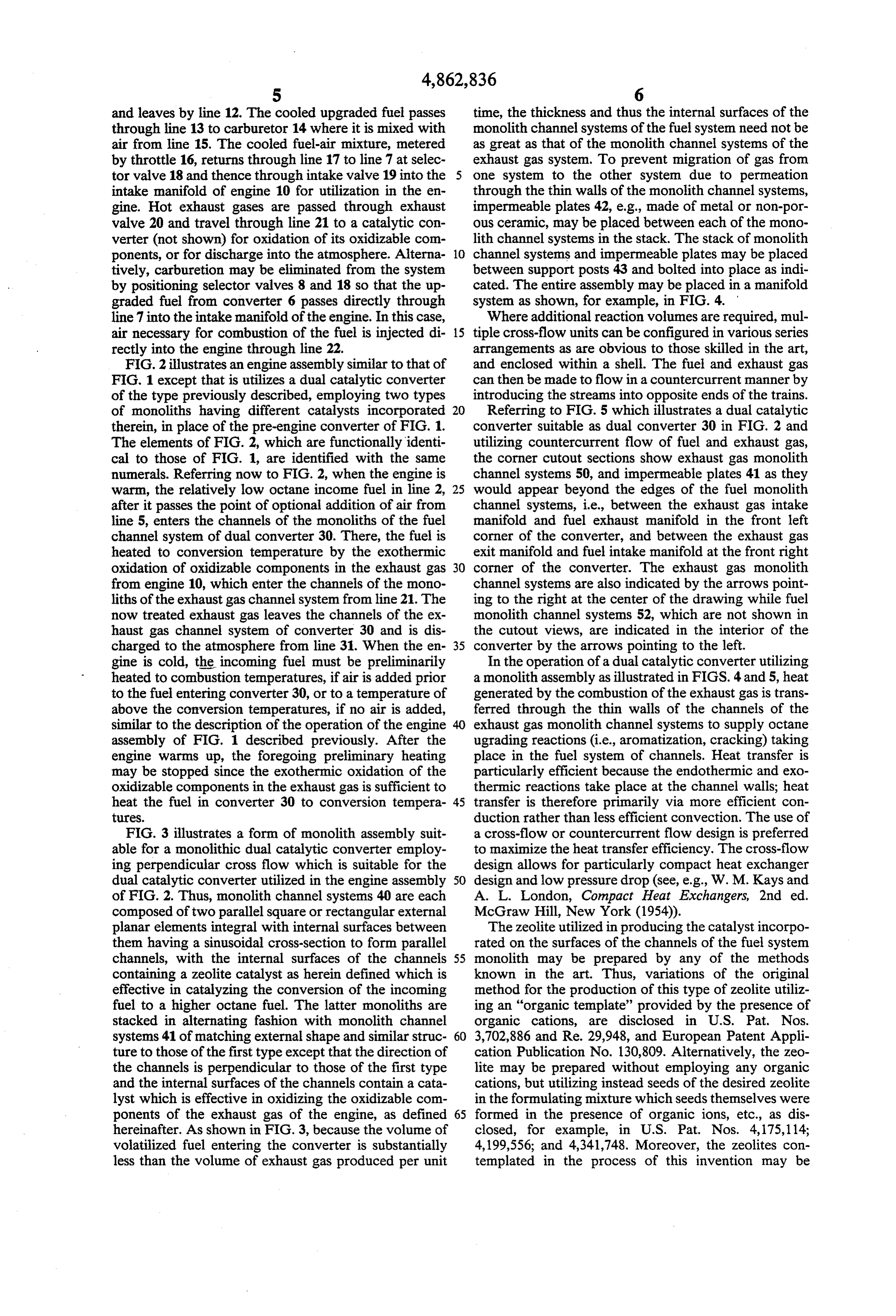
vides the necessary heat of reaction in the converter. FIG. 2 is a schematic diagram of an internal combus The low thermal mass of the monolith permits rapid tion engine assembly utilizing a monolithic dual cata heat up the catalyst bed and the low pressure drop 20 lytic converter which effectuates heat exchange be across the monolith permits more complete volatiliza tween the exothermic oxidation of oxidizable compo tion of the feed stream. nents in exhaust gas and the endothermic conversion of To start a cold engine, a small amount of the low the incoming fuel to a fuel of higher octane number. octane fuel may, for example, be mixed with air and FIG. 3 is a schematic diagram of a dual converter ignited using an electric heating coil to warm up the 25 utilizing cross-flow of incoming fuel and exhaust gases reactor to at least about 600 F. to initiate the conver and made up of stacked alternating monolith channel sion process. After that, only a small amount of air is systems separated by impermeable plates. needed to maintain the reactor temperature. Heat from FIG. 4 is a top view of the dual converter of FIG. 3 the exhaust gas may also be used to supply the tempera as part of a cross-flow manifold system. ture requirement once the engine is warm, either by 30 FIG. 5 is a schematic diagram of a dual converter passing it through a heat exchanger that transfers heat utilizing countercurrent flow of incoming fuel and ex from the engine exhaust gases or by passing the fuel haust gas and made up of stacked alternating monoliths through the heated engine block. separated by impermeable plates, with the channels of Heating of the incoming fuel by hot exhaust gases all the monoliths being parallel.
may be accomplished by conventional heat exchange, 35 DESCRIPTION OF SPECIFIC EMBODIMENTS e.g., wherein the pre-engine converter comprising the monolithic structure of this invention is incorporated in Referring to FIG. 1, relatively low octane fuel is the exhaust manifold of the engine similar to the ar pumped from fuel tank 1 through line 2 by pump 3 rangement shown with packed beds of zeolite catalyst through auxiliary heater 4 where the fuel is volatized in previously cited U.S. Pat. Nos. 3,855,980 and and heated at least to a predetermined conversion and 4,070,993, or is enclosed within a shell, with the hot /or combustion temperature. The heat source in auxil exhaust gases flowing through the space between the iary heater 4 in the case of a cold engine may be, for interior surface of the shell and the exterior surface of example, the combustion of a small amount of fuel the monolith, similar to the arrangement shown in U.S. mixed with air and ignited with an electric heating coil, Pat. No. 4,046,522 with a reactor containing particulate 45 or electricity from internal and/or external batteries, catalyst. However, in accordance with another aspect while, in a warm engine, the heat source may be heat of the invention a dual catalytic converter is employed from the engine block. Air is optionally added to the containing two distinct systems of channels, e.g., each a heated fuel from line 5 which then passes through pre monolith or series of monoliths, wherein the two chan engine monolithic converter 6 comprising at least one nel systems are aligned so as to provide efficient heat 50 monolith with channels, at least the surfaces of which transfer from one channel system to the other; exhaust contain a zeolite catalyst of the type contemplated gas flows through one system and the fuel components under this invention. If air is not added from line 5 to the flow through the other system, with the oxidizable heated fuel, then the temperature to which the fuel is components of the exhaust gas being exothermically heated must be high enough such that the heat content converted to oxidized products such as carbon dioxide 55 of the fuel is sufficient to provide enough heat to sustain and water. Each channel system is composed of a plu the conversion reactions in converter 6 at the necessary rality of unidirectional, preferably substantially parallel, temperatures. However, if air is supplied from line 5, channels, with rigid walls. The two systems may be then the heat added to the fuel in heater 4 need only be oriented in any convenient angle to each other, e.g., sufficient to heat the fuel to combustion temperature. cross-flow, i.e., perpendicular, parallel or at an acute 60 Thereafter, the partial combustion of the fuel in the angle, and the flows of gases may be cross-flow, or, if presence of oxygen is sufficient to provide the necessary the channels are substantially parallel or at an acute heat to sustain the conversion reaction. From converter angle, countercurrent or cocurrent in direction. Prefer 6, the upgraded fuel with increased octane number ably, the flow directions of the fuel and exhaust gas are which despite the heat consumption in converter 6, may cross-flow or countercurrent through parallel channels. 65 still be above ignition temperature, passes through line 7 At least the inner surfaces of the fuel channels contain a and depending on the position of selector valve 8, may zeolite catalyst as previously defined which is effective enter cooler 9 where it is cooled by coolant from the in raising the octane number of the fuel, while at least radiator of engine 10 which enters cooler 9 by line 11
Page 8
and leaves by line 12. The cooled upgraded fuel passes time, the thickness and thus the internal surfaces of the through line 13 to carburetor 14 where it is mixed with monolith channel systems of the fuel system need not be air from line 15. The cooled fuel-air mixture, metered as great as that of the monolith channel systems of the by throttle 16, returns through line 17 to line 7 at selec exhaust gas system. To prevent migration of gas from tor valve 18 and thence through intake valve 19 into the one system to the other system due to permeation intake manifold of engine 10 for utilization in the en through the thin walls of the monolith channel systems, gine. Hot exhaust gases are passed through exhaust impermeable plates 42, e.g., made of metal or non-por valve 20 and travel through line 21 to a catalytic con ous ceramic, may be placed between each of the mono verter (not shown) for oxidation of its oxidizable com lith channel systems in the stack. The stack of monolith ponents, or for discharge into the atmosphere. Alterna 10 channel systems and impermeable plates may be placed tively, carburetion may be eliminated from the system between support posts 43 and bolted into place as indi by positioning selector valves 8 and 18 so that the up cated. The entire assembly may be placed in a manifold graded fuel from converter 6 passes directly through system as shown, for example, in FIG. 4. line 7 into the intake manifold of the engine. In this case, Where additional reaction volumes are required, mul air necessary for combustion of the fuel is injected di 15 tiple cross-flow units can be configured in various series rectly into the engine through line 22. arrangements as are obvious to those skilled in the art, FIG. 2 illustrates an engine assembly similar to that of and enclosed within a shell. The fuel and exhaust gas FIG. 1 except that is utilizes a dual catalytic converter can then be made to flow in a countercurrent manner by of the type previously described, employing two types introducing the streams into opposite ends of the trains. of monoliths having different catalysts incorporated 20 Referring to FIG. 5 which illustrates a dual catalytic therein, in place of the pre-engine converter of FIG. 1. converter suitable as dual converter 30 in FIG. 2 and The elements of FIG. 2, which are functionally identi utilizing countercurrent flow of fuel and exhaust gas, cal to those of FIG. 1, are identified with the same the corner cutout sections show exhaust gas monolith numerals. Referring now to FIG. 2, when the engine is channel systems 50, and impermeable plates 41 as they warm, the relatively low octane income fuel in line 2, 25 would appear beyond the edges of the fuel monolith after it passes the point of optional addition of air from channel systems, i.e., between the exhaust gas intake line 5, enters the channels of the monoliths of the fuel manifold and fuel exhaust manifold in the front left channel system of dual converter 30. There, the fuel is corner of the converter, and between the exhaust gas heated to conversion temperature by the exothermic exit manifold and fuel intake manifold at the front right oxidation of oxidizable components in the exhaust gas 30 corner of the converter. The exhaust gas monolith from engine 10, which enter the channels of the mono channel systems are also indicated by the arrows point liths of the exhaust gas channel system from line 21. The ing to the right at the center of the drawing while fuel now treated exhaust gas leaves the channels of the ex monolith channel systems 52, which are not shown in haust gas channel system of converter 30 and is dis the cutout views, are indicated in the interior of the charged to the atmosphere from line 31. When the en 35 converter by the arrows pointing to the left. gine is cold, the incoming fuel must be preliminarily In the operation of a dual catalytic converter utilizing heated to combustion temperatures, if air is added prior a monolith assembly as illustrated in FIGS. 4 and 5, heat to the fuel entering converter 30, or to a temperature of generated by the combustion of the exhaust gas is trans above the conversion temperatures, if no air is added, ferred through the thin walls of the channels of the similar to the description of the operation of the engine 40 exhaust gas monolith channel systems to supply octane assembly of FIG. 1 described previously. After the ugrading reactions (i.e., aromatization, cracking) taking engine warms up, the foregoing preliminary heating place in the fuel system of channels. Heat transfer is may be stopped since the exothermic oxidation of the particularly efficient because the endothermic and exo oxidizable components in the exhaust gas is sufficient to thermic reactions take place at the channel walls; heat heat the fuel in converter 30 to conversion tempera 45 transfer is therefore primarily via more efficient con tures. duction rather than less efficient convection. The use of FIG. 3 illustrates a form of monolith assembly suit a cross-flow or countercurrent flow design is preferred able for a monolithic dual catalytic converter employ to maximize the heat transfer efficiency. The cross-flow ing perpendicular cross flow which is suitable for the design allows for particularly compact heat exchanger dual catalytic converter utilized in the engine assembly 50 design and low pressure drop (see, e.g., W. M. Kays and of FIG. 2. Thus, monolith channel systems 40 are each A. L. London, Compact Heat Exchangers, 2nd ed. composed of two parallel square or rectangular external McGraw Hill, New York (1954)).
planar elements integral with internal surfaces between The zeolite utilized in producing the catalyst incorpo them having a sinusoidal cross-section to form parallel rated on the surfaces of the channels of the fuel system channels, with the internal surfaces of the channels 55 monolith may be prepared by any of the methods containing a zeolite catalyst as herein defined which is known in the art. Thus, variations of the original effective in catalyzing the conversion of the incoming method for the production of this type of zeolite utiliz fuel to a higher octane fuel. The latter monoliths are ing an "organic template' provided by the presence of stacked in alternating fashion with monolith channel organic cations, are disclosed in U.S. Pat. Nos. systems 41 of matching external shape and similar struc 60 3,702,886 and Re. 29,948, and European Patent Appli ture to those of the first type except that the direction of cation Publication No. 130,809. Alternatively, the zeo the channels is perpendicular to those of the first type lite may be prepared without employing any organic and the internal surfaces of the channels contain a cata cations, but utilizing instead seeds of the desired zeolite lyst which is effective in oxidizing the oxidizable com in the formulating mixture which seeds themselves were ponents of the exhaust gas of the engine, as defined 65 formed in the presence of organic ions, etc., as dis hereinafter. As shown in FIG. 3, because the volume of closed, for example, in U.S. Pat. Nos. 4,175,114; volatilized fuel entering the converter is substantially 4,199,556; and 4,341,748. Moreover, the zeolites con less than the volume of exhaust gas produced per unit templated in the process of this invention may be
Page 9
formed in the absence of any organic ions or seeds of the Whichever method of catalyst preparation is used, type described, utilizing instead as precursor a silica or the amount of metallic element present in the total cata aluminosilicate which is precipitated or crystallized lyst composition, if used, may vary, for example, be from solution or homogenous amorphous phase and tween about 0.5 and 5 percent by weight, preferably having certain characteristics, as disclosed, for example between about 0.5 and 2.0 percent by weight. Metallic in pending application Ser. No. 014,147, filed Feb. 12, elements which may be present as promoters in impreg 1987, or European Patent Application Publication No. nated form or as replacing cations are one or more of 106,552 the entire disclosures of which are incorporated various suitable metals in Groups I through VIII of the by reference. Other methods for the preparation of the Periodic Table including by way of example gallium, desired zeolites, i.e., zeolites having X-ray diffraction O zinc, platinum, rhenium, cobalt, titanium, tellurium, patterns typical of such zeolites, are disclosed in the art and may also be used. In general, the zeolite should be sodium, dium, nickel, chromium, aluminum, copper, palla tin, iron, calcium, manganese, magnesium, cad prepared using any of the foregoing methods so that the mium, aluminum and rare earth metals or combinations silica/alumina molar ratio of the zeolite is in the range 15 of two or more elements. Non-metallic modifiers, such of about 20 to about 5000.
Ion exchange of the zeolite as synthesized can be element promoters are gallium The as phosphorus may be used.
preferred metallic zinc alone or in con conducted to effect ammonium exchange at their cati bination with platinum, palladium or titanium. onic sites. The source of the ammonium ion is not criti cal; thus the source can be ammonium hydroxide or an 20 The silica/alumina ratio of the catalyst may be deter ammonium salt such as ammonium nitrate, ammonium mined by conventional analysis. This ratio is meant to sulfate, ammonium chloride and mixtures thereof. represent, as closely as possible, the ratio in the rigid These reagents are usually in aqueous solutions, e.g., of anionic aluminum framework of the zeolite crystal and to exclude in the binder or in cationic or other form one normal concentration, and ammonium exchange may be conducted in multiple stages. Calcination of the 25 within the channels. Zeolites having a silica/alumina ammonium exchanged zeolite at a temperature, for molar ratio near the high point of the contemplated example, of up to 600 C., will produce the zeolite in its range, e.g., approaching 5000, may be prepared as-syn acid, i.e., "H" or protonated form, contemplated for use thesized, or by decreasing the aluminum content of low in the process of this invention. silica to alumina ratio zeolites by steaming, dealuminiz The octane number enhancing conversion reactions 30 ing or framework exchange procedures. of the present invention may be carried out using cata The members of the class of zeolites useful herein lysts in which a metallic element promoter is impreg have an effective pore size of generally about 5 to about nated on the surface of the acid form of the zeolite or is 7 angstroms, such as to freely sorb normal hexane. In ion-exchanged with some of the original cations or addition, the structure must provide constrained access ammonium or hydrogen ions of the zeolite using tech 35 to larger molecules. It is sometimes possible to judge niques of impregnation or ion-exchange which are well from a known crystal structure whether such con known in the art. For example, the metallic element strained access exists. For example, if the only pore may be impregnated on the surface of the zeolite by windows in a crystal are formed by 8-membered rings preparing a solution, e.g., an aqueous solution of the of silicon and aluminum atoms, then access by mole metallic element compound such as the nitrate or chlo cules of larger cross-section than normal hexane is ex ride and adding to this solution a preshaped form of the cluded and the zeolite is not of the desired type. Win desired zeolite, e.g., an extruded monolith, with or dows of 10-membered rings are preferred, although, in without a matrix or binder as hereinafter defined, and some instances, excessive puckering of the rings or pore allowing the zeolite to be thoroughly contacted with the solution. The contacted catalyst is then dried under 45 blockage may render these zeolites ineffective. Although 12-membered rings in theory would not vacuum at a moderate temperature, e.g., 100 to 120 C. offer sufficient constraint to produce advantageous After calcination, e.g., at 538 C., the zeolite contains conversions, the metallic element impregnated on its surface in the ture of TMAit isoffretite noted that the puckered 12-ring struc does show some constrained form of the metal oxide.
The metallic element in the catalyst composition may 50 access. Other 12-ring structures may exist which may be operative for other reasons, and therefore, it is not the be in the ionic form if some cations in the aluminosili cate support have been exchanged with metal ions. In present intention to entirely judge the usefulness of the this case, the metal ions are suitably provided as an particular zeolite solely from theoretical structural con aqueous solution of a salt such as for instance, the sui siderations.
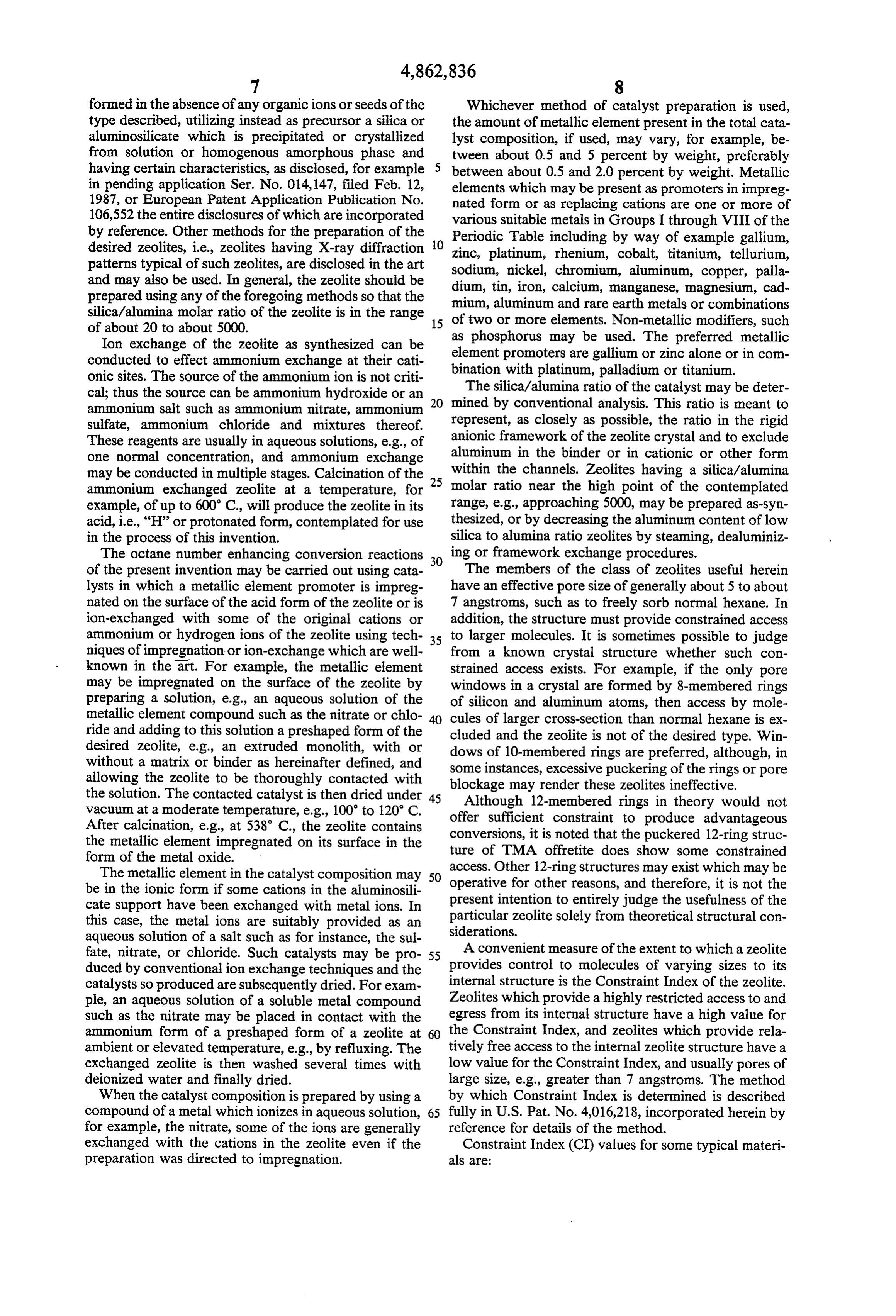
fate, nitrate, or chloride. Such catalysts may be pro 55 A convenient measure of the extent to which a zeolite duced by conventional ion exchange techniques and the provides control to molecules of varying sizes to its catalysts so produced are subsequently dried. For exam internal structure is the Constraint Index of the zeolite. ple, an aqueous solution of a soluble metal compound Zeolites which provide a highly restricted access to and such as the nitrate may be placed in contact with the egress from its internal structure have a high value for ammonium form of a preshaped form of a zeolite at the Constraint Index, and zeolites which provide rela ambient or elevated temperature, e.g., by refluxing. The tively free access to the internal zeolite structure have a exchanged zeolite is then washed several times with low value for the Constraint Index, and usually pores of deionized water and finally dried. large size, e.g., greater than 7 angstroms. The method When the catalyst composition is prepared by using a by which Constraint Index is determined is described compound of a metal which ionizes in aqueous solution, 65 fully in U.S. Pat. No. 4,016,218, incorporated herein by for example, the nitrate, some of the ions are generally reference for details of the method. exchanged with the cations in the zeolite even if the Constraint Index (CI) values for some typical materi preparation was directed to impregnation. als are:
Page 10
CI (at test temperature) 4,076,842; ZSM-35 in U.S. Pat. No. 4,016,245; ZSM-38
ZSM-4 O.S (316. C.) No. 4,350,835. The entire disclosures of these patents
ZSM-11 5-8.7 (371 C-316 C.) are incorporated by reference insofar as their disclo ZSM-12 2.3 (316° C) sures are necessary to identify the respective zeolites.
It is to be understood that by incorporating by refer
ZSM-23 9.1 (427 C) ence the foregoing patents to describe examples of spec ZSM-34 50 (371° C) ified members of the novel class with greater particular ZSM-35 4.5 (454 C.) 10 ity, it is intended that identification of the therein dis ZSM-38 2 (51.0 C) closed crystalline zeolites be resolved on the basis of
ZSM-50 2.1 (427 C) their respective X-ray diffraction patterns. As discussed TMA Offretite 3.7 (316. C.) above, the present invention contemplates utilization of TEA Mordenite 0.4 (316. C.) such catalysts prepared in the manner described, Clinoptilolite 3.4 (51.0 C) 15 wherein the mole ratio of silica to alumina is at least
REY 0.4 (316. C.) about 20 and may be as high as about 5000. The incor Amorphous Silica-alumina
Dealuminized Y
poration of the identified patents should therefore not
Erionite 38 (316. C.) be construed as limiting the disclosed crystalline Zeo
lites to those having the specific silica/alumina mole ratios discussed therein, it now being known that such zeolites
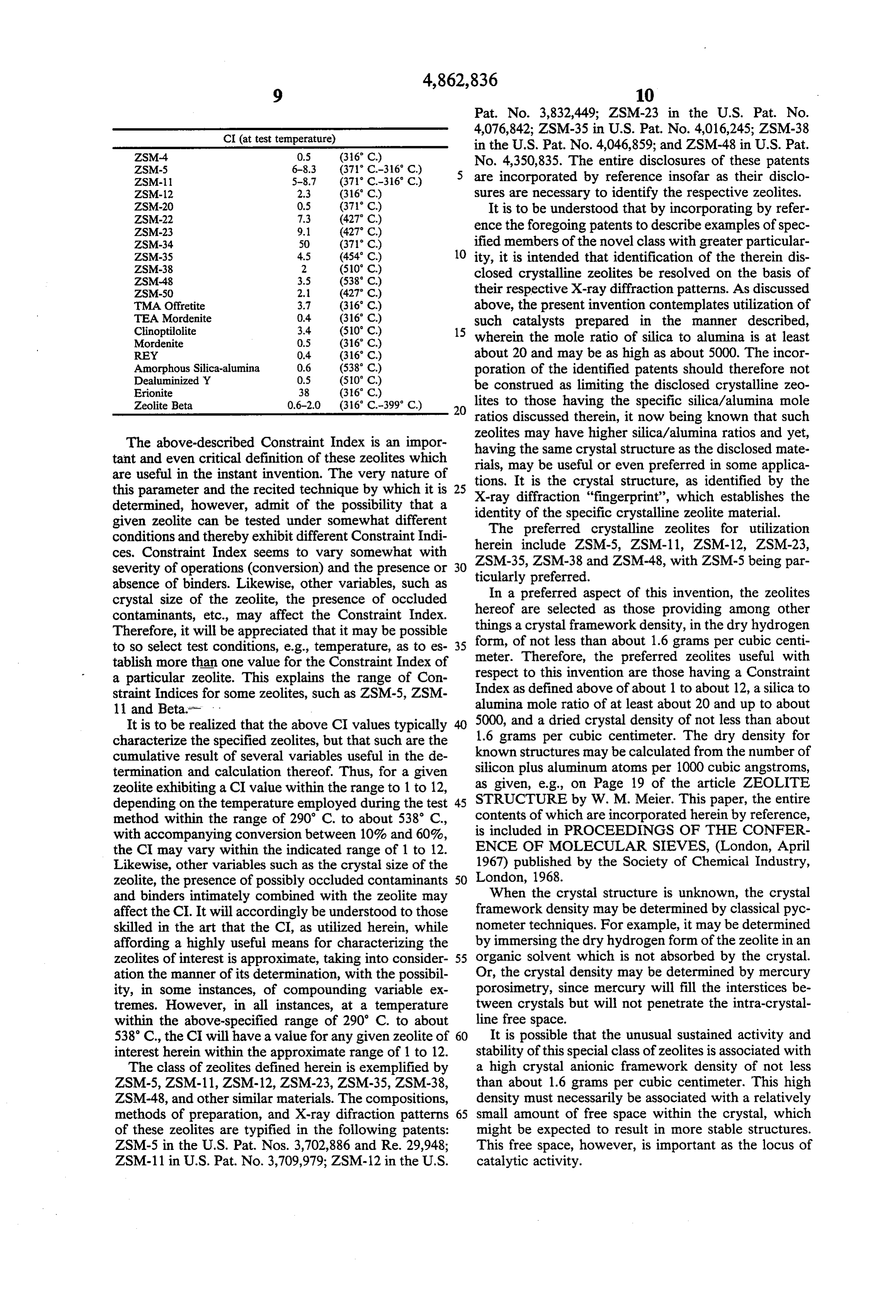
The above-described Constraint Index is an impor having the may have higher silica/alumina ratios and yet, tant and even critical definition of these zeolites which same crystal structure as the disclosed mate are useful in the instant invention. The very nature of tions. It is theuseful rials, may be or even preferred in some applica crystal structure, as identified by the this parameter and the recited technique by which it is X-ray diffraction "fingerprint',
determined, however, admit of the possibility that a identity of the specific crystallinewhich zeolite establishes the material.
given zeolite can be tested under somewhat different conditions and thereby exhibit different Constraint Indi herein include ZSM-5, ZSM-11, ZSM-12, utilization The preferred crystalline zeolites for
ces. Constraint Index seems to vary somewhat with ZSM-35, ZSM-38 and ZSM-48, with ZSM-5 being par severity of operations (conversion) and the presence or 30 absence of binders. Likewise, other variables, such as ticularly preferred.
In a preferred aspect of this invention, the zeolites crystal size of the zeolite, the presence of occluded hereof are selected as those providing among other contaminants, etc., may affect the Constraint Index. things a crystal framework density, in the dry hydrogen Therefore, it will be appreciated that it may be possible to so select test conditions, e.g., temperature, as to es 35 form, of not less than about 1.6 grams per cubic centi tablish more than one value for the Constraint Index of meter. Therefore, the preferred zeolites useful with a particular zeolite. This explains the range of Con respect to this invention are those having a Constraint Index as defined above of about 1 to about 12, a silica to straint Indices for some zeolites, such as ZSM-5, ZSM 1 and Beta.-- alumina mole ratio of at least about 20 and up to about It is to be realized that the above CI values typically 5000, and a dried crystal density of not less than about characterize the specified zeolites, but that such are the 1.6 grams per cubic centimeter. The dry density for cumulative result of several variables useful in the de known structures may be calculated from the number of termination and calculation thereof. Thus, for a given silicon plus aluminum atoms per 1000 cubic angstroms, zeolite exhibiting a CI value within the range to 1 to 12, as given, e.g., on Page 19 of the article ZEOLITE depending on the temperature employed during the test 45 STRUCTURE by W. M. Meier. This paper, the entire method within the range of 290 C. to about 538 C., iscontents of which are incorporated herein by reference, included in PROCEEDINGS OF THE CONFER with accompanying conversion between 10% and 60%, the C may vary within the indicated range of 1 to 12. ENCE OF MOLECULAR SIEVES, (London, April Likewise, other variables such as the crystal size of the 1967) published by the Society of Chemical Industry, zeolite, the presence of possibly occluded contaminants 50 London, 1968.
and binders intimately combined with the zeolite may When the crystal structure is unknown, the crystal affect the CI. It will accordingly be understood to those framework density may be determined by classical pyc skilled in the art that the CI, as utilized herein, while nometer techniques. For example, it may be determined affording a highly useful means for characterizing the by immersing the dry hydrogen form of the zeolite in an zeolites of interest is approximate, taking into consider 55 organic solvent which is not absorbed by the crystal. ation the manner of its determination, with the possibil Or, the crystal density may be determined by mercury ity, in some instances, of compounding variable ex porosimetry, since mercury will fill the interstices be tremes. However, in all instances, at a temperature tween crystals but will not penetrate the intra-crystal within the above-specified range of 290 C. to about line free space.
538 C., the CI will have a value for any given zeolite of 60 It is possible that the unusual sustained activity and interest herein within the approximate range of 1 to 12. stability of this special class of zeolites is associated with The class of zeolites defined herein is exemplified by a high crystal anionic framework density of not less ZSM-5, ZSM-11, ZSM-12, ZSM-23, ZSM-35, ZSM-38, than about 1.6 grams per cubic centimeter. This high ZSM-48, and other similar materials. The compositions, density must necessarily be associated with a relatively methods of preparation, and X-ray difraction patterns 65 small amount of free space within the crystal, which of these zeolites are typified in the following patents: might be expected to result in more stable structures. ZSM-5 in the U.S. Pat. Nos. 3,702,886 and Re.29,948; This free space, however, is important as the locus of ZSM-11 in U.S. Pat. No. 3,709,979; ZSM-12 in the U.S. catalytic activity.
Page 11
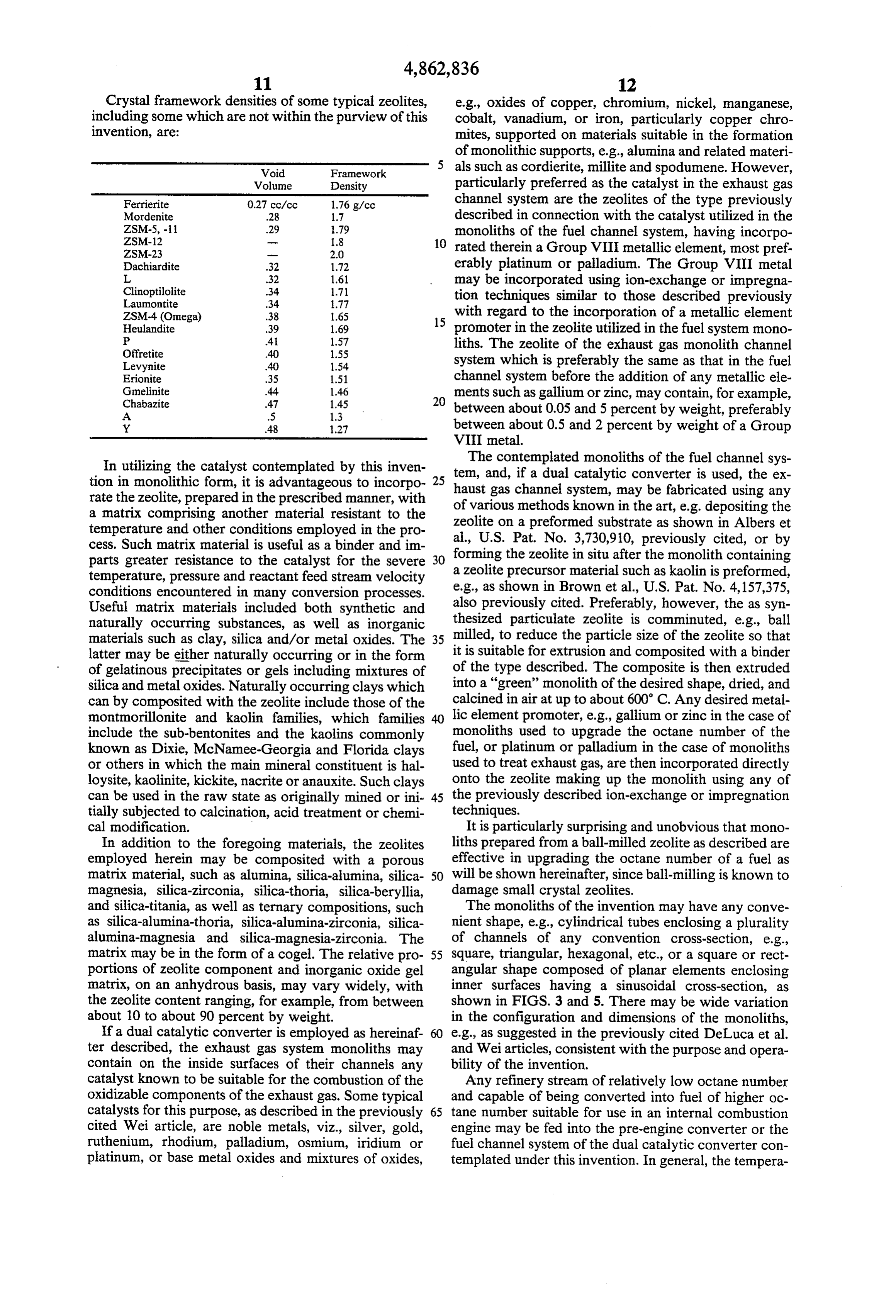
Crystal framework densities of some typical zeolites, e.g., oxides of copper, chromium, nickel, manganese, including some which are not within the purview of this cobalt, vanadium, or iron, particularly copper chro invention, are: mites, supported on materials suitable in the formation of monolithic supports, e.g., alumina and related materi
Void Framework als such as cordierite, millite and spodumene. However,
Volume Density particularly preferred as the catalyst in the exhaust gas Ferrierite 0.27 cc/cc 1.76 g/cc channel system are the zeolites of the type previously Mordenite 28 1.7 described in connection with the catalyst utilized in the
monoliths of the fuel channel system, having incorpo 10 rated therein a Group VIII metallic element, most pref.
Dachiardite 32 1.72 erably platinum or palladium. The Group VIII metal
Clinoptilolite
may be incorporated using ion-exchange or impregna
Laumontite .34 .77 tion techniques similar to those described previously
with regard to the incorporation of a metallic element
Heulandite
promoter in the zeolite utilized in the fuel system mono
Offretite 40 1.55 liths. The zeolite of the exhaust gas monolith channel Levynite 40 1.54 system which is preferably the same as that in the fuel Erionite 35 1.51 channel system before the addition of any metallic ele Gmelinite
Chabazite
1.45 20 ments such as gallium or zinc, may contain, for example,
A 5 1.3 between about 0.05 and 5 percent by weight, preferably Y .48 1.27 between about 0.5 and 2 percent by weight of a Group VIII metal.
In utilizing the catalyst contemplated by this inven The contemplated monoliths of the fuel channel sys tion in monolithic form, it is advantageous to incorpo 25 tem, haust and, if a dual catalytic converter is used, the ex gas channel system, may be fabricated using any rate the zeolite, prepared in the prescribed manner, with a matrix comprising another material resistant to the of various methods known in the art, e.g. depositing the zeolite on a preformed substrate as shown in Albers et temperature and other conditions employed in the pro al., U.S. Pat. No. 3,730,910, previously cited, or by cess. Such matrix material is useful as a binder and im parts greater resistance to the catalyst for the severe 30 forming the zeolite in situ after the monolith containing temperature, pressure and reactant feed stream velocity a zeolite precursor material such as kaolin is preformed, conditions encountered in many conversion processes. also e.g., as shown in Brown et al., U.S. Pat. No. 4,157,375, Useful matrix materials included both synthetic and previously cited. Preferably, however, the as syn naturally occurring substances, as well as inorganic thesized particulate zeolite is comminuted, e.g., ball materials such as clay, silica and/or metal oxides. The 35 milled, to reduce the particle size of the zeolite so that latter may be either naturally occurring or in the form it is suitable for extrusion and composited with a binder of gelatinous precipitates or gels including mixtures of of the type described. The composite is then extruded silica and metal oxides. Naturally occurring clays which into a "green' monolith of the desired shape, dried, and can by composited with the zeolite include those of the calcined in air at up to about 600 C. Any desired metal montmorillonite and kaolin families, which families lic element promoter, e.g., gallium or zinc in the case of include the sub-bentonites and the kaolins commonly monoliths used to upgrade the octane number of the known as Dixie, McNamee-Georgia and Florida clays fuel, or platinum or palladium in the case of monoliths or others in which the main mineral constituent is hal used to treat exhaust gas, are then incorporated directly loysite, kaolinite, kickite, nacrite or anauxite. Such clays onto the zeolite making up the monolith using any of can be used in the raw state as originally mined or ini 45 the previously described ion-exchange or impregnation tially subjected to calcination, acid treatment or chemi techniques.
cal modification. It is particularly surprising and unobvious that mono In addition to the foregoing materials, the zeolites liths prepared from a ball-milled zeolite as described are employed herein may be composited with a porous effective in upgrading the octane number of a fuel as matrix material, such as alumina, silica-alumina, silica 50 will be shown hereinafter, since ball-milling is known to magnesia, silica-zirconia, silica-thoria, silica-beryllia, damage small crystal zeolites.
and silica-titania, as well as ternary compositions, such The monoliths of the invention may have any conve as silica-alumina-thoria, silica-alumina-zirconia, silica nient shape, e.g., cylindrical tubes enclosing a plurality alumina-magnesia and silica-magnesia-zirconia. The of channels of any convention cross-section, e.g., matrix may be in the form of a cogel. The relative pro 55 square, triangular, hexagonal, etc., or a square or rect portions of zeolite component and inorganic oxide gel angular shape composed of planar elements enclosing matrix, on an anhydrous basis, may vary widely, with inner surfaces having a sinusoidal cross-section, as the zeolite content ranging, for example, from between shown in FIGS. 3 and 5. There may be wide variation about 10 to about 90 percent by weight. in the configuration and dimensions of the monoliths, If a dual catalytic converter is employed as hereinaf e.g., as suggested in the previously cited DeLuca et al. ter described, the exhaust gas system monoliths may and Wei articles, consistent with the purpose and opera contain on the inside surfaces of their channels any bility of the invention.
catalyst known to be suitable for the combustion of the Any refinery stream of relatively low octane number oxidizable components of the exhaust gas. Some typical and capable of being converted into fuel of higher oc catalysts for this purpose, as described in the previously 65 tane number suitable for use in an internal combustion cited Wei article, are noble metals, viz., silver, gold, engine may be fed into the pre-engine converter or the ruthenium, rhodium, palladium, osmium, iridium or fuel channel system of the dual catalytic converter con platinum, or base metal oxides and mixtures of oxides, templated under this invention. In general, the tempera
Page 12
ture of conversion will be at least about 600°F., prefera The cylindrical monoliths were abraded to produce bly about 600 to 1100 F. If air or other oxygen-con uniform 1.0 cm x 5 cm long segments which were taining gas is added to the incoming fuel before it enters placed inside 1.27 cmo.d.X6 cm long pieces of 0.89 mm the pre-engine converter or the fuel channel system of wall 316 stainless steel tubing. Saureisen No. 78 high the dual converter, the amount of added oxygen will 5 temperature ceramic cement was used to bond the generally be in the range, for example of about 0.01 to monoliths to the inside of the stainless steel tubing. The 0.1 moles per mole of hydrocarbon. If a dual converter cement also provided a seal against bypassing of the gas is utilized, then the exhaust gas entering the exhaust gas in the annular volume between the monolith and the channel system of the converter will generally be no tubing. The 6 cm long converter was then immersed in higher than about 1200 F., preferably in the range of 10 an isothermal sandbath. Prior to initiation of the conver about 700 to 1100 F. sion reaction, the converter was heated in the sandbath The following examples further illustrate the inven to 538 C. (1000 F) or, in Example 3, to 620 C. (1148 tion. - Y- - - - - - , , . . . S F.) in flowing dry air over a 6 hour period. The Ga and EXAMPLES 1 to 5 Zn containing monoliths were not reduced prior to These examples illustrate the invention applied to a 15 contacting with the chargestock. The C5-C7 light paraffinic naphtha chargestock had a
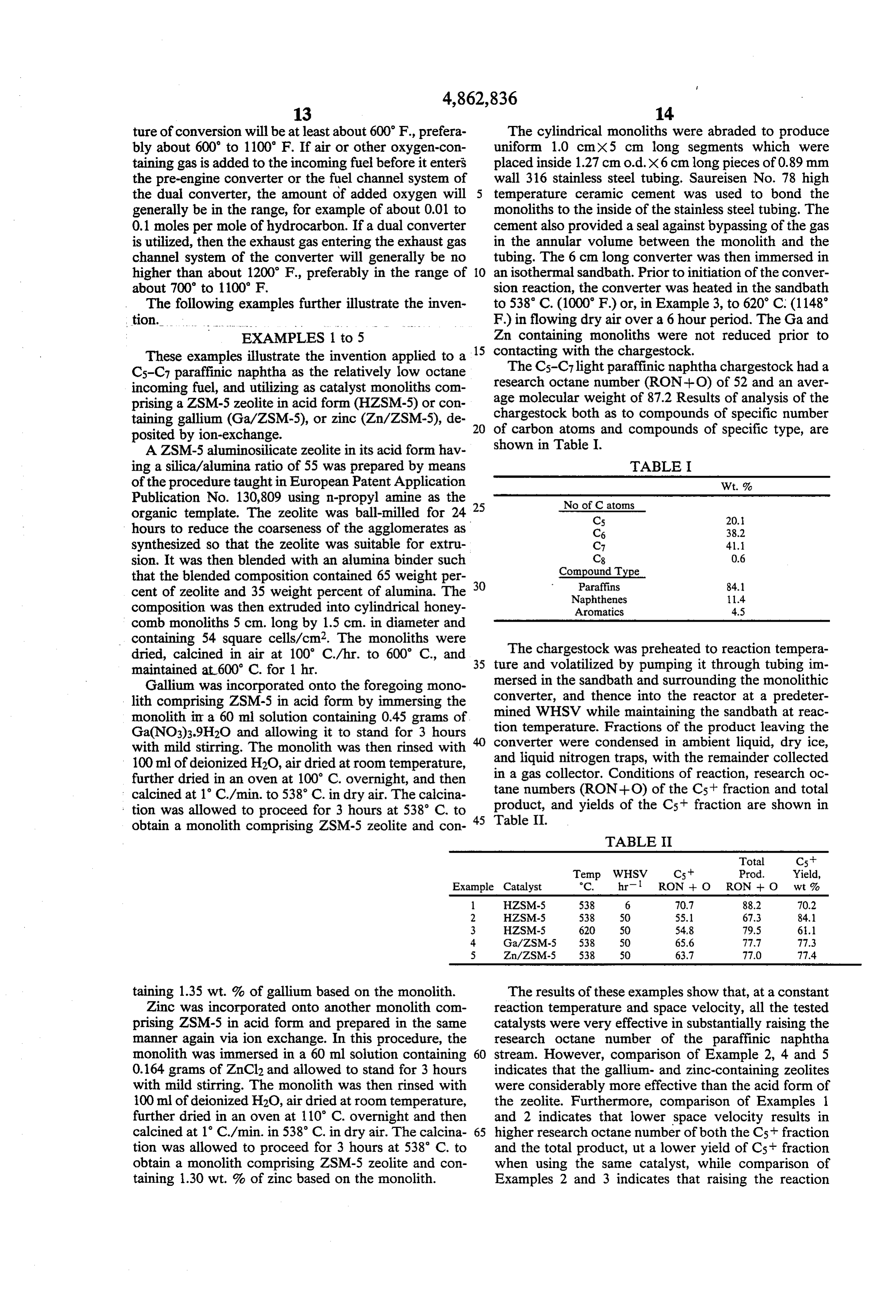
C5-C7 paraffinic naphtha as the relatively low octane incoming fuel, and utilizing as catalyst monoliths com ageresearch octane number (RON--O) of 52 and an aver molecular weight of 87.2 Results of analysis of the prising a ZSM-5 zeolite in acid form (HZSM-5) or con chargestock taining gallium (Ga/ZSM-5), or zinc (Zn/ZSM-5), de both as to compounds of specific number posited by ion-exchange. 20 of carbon atoms and compounds of specific type, are AZSM-5 aluminosicate zeolite in its acid form hav- shown in Table I.
ing a silica/alumina ratio of 55 was prepared by means TABLE I of the procedure taught in European Patent Application Wit. 9% Publication No. 130,809 using n-propyl amine as the No of Cat organic template. The zeolite was ball-milled for 24 25 -Nooratoms - 20. hours to reduce the coarseness of the agglomerates as c 38.2 synthesized so that the zeolite was suitable for extru- C 41.1 sion. It was then blended with an alumina binder such C3 0.6 that the blended composition contained 65 weight per- Compound Type - cent of zeolite and 35 weight percent of alumina. The NG t composition was then extruded into cylindrical honey- E. 4.5 comb monoliths 5 cm. long by 1.5 cm. in diameter and containing 54 square cells/cm2. The monoliths were dried, calcined in air at 100 C./hr. to 600 C., and The chargestock WaS preheated to reaction tempera maintained at 600 C. for 1 hr. 35 ture and volatilized by pumping it through tubing im Gallium was incorporated onto the foregoing mono- mersed in the sandbath and surrounding the monolithic lith comprising ZSM-5 in acid form by immersing the converter, and thence into the reactor at a predeter monolithin a 60 ml solution containing 0.45 grains of
Ga(NO3)3.9H2O and allowing it to stand for 3 hours mined WHSY while maintaining the Sandbath at reac tion temperature. Fractions of the product leaving the with mild stirring. The monofith was then rinsed with 40 converter were condensed in ambient liquid, dry ice, 100 ml of deionized H2O, air dried at room temperature, and liquid nitrogen traps, with the remainder collected further dried in an oven at 100° C. overnight, and then in a gas collector. Conditions of reaction, research OC calcined at 1 c/min.to 538 C. in dry air. The calcina. tane numbers (RON-O) of the Cs' fraction and total tion was allowed to proceed for 3 hours at 538 C. to Pu, and yields of the C5 fraction are shown in obtain a monolith comprising ZSM-5 zeolite and con- “ Table
TABLE II
Total C5+
Temp WHSV C5t Prod. Yield,
Example Catalyst °C. hri RON - O RON + O wt % 1 HZSM-5 538 6 0.7 88.2 70.2 2 HZSM-5 S38 50 S5.1 67.3 84.1
4. Ga/ZSM-S 538 50 65.6 777 77.3
taining 1.35 wt.% of gallium based on the monolith. The results of these examples show that, at a constant Zinc was incorporated onto another monolith com reaction temperature and space velocity, all the tested prising ZSM-5 in acid form and prepared in the same catalysts were very effective in substantially raising the manner again via ion exchange. In this procedure, the research octane number of the paraffinic naphtha monolith was immersed in a 60 ml solution containing 60 stream. However, comparison of Example 2, 4 and 5 0.164 grams of ZnCl2 and allowed to stand for 3 hours indicates that the gallium- and zinc-containing zeolites with mild stirring. The monolith was then rinsed with were considerably more effective than the acid form of 100 ml of deionized H2O, air dried at room temperature, the zeolite. Furthermore, comparison of Examples 1 further dried in an oven at 110 C. overnight and then and 2 indicates that lower space velocity results in calcined at 1 C./min. in 538 C. in dry air. The calcina 65 higher research octane number of both the C5' fraction tion was allowed to proceed for 3 hours at 538 C. to and the total product, ut a lower yield of Cst fraction obtain a monolith comprising ZSM-5 zeolite and con when using the same catalyst, while comparison of taining 1.30 wt.% of zinc based on the monolith. Examples 2 and 3 indicates that raising the reaction
Page 13
temperature results in an increase in research octane EXAMPLE 12 number of total product but a reduction in yield of the
C5 fraction. The gas phase pressure drops across a 1 cm diameter EXAMPLES 6 to 11 monolith (54 square cells/cm2, 85% open area) and a 1 5 cm diameter packed bed of 0.08 cm diax 0.64 cm long
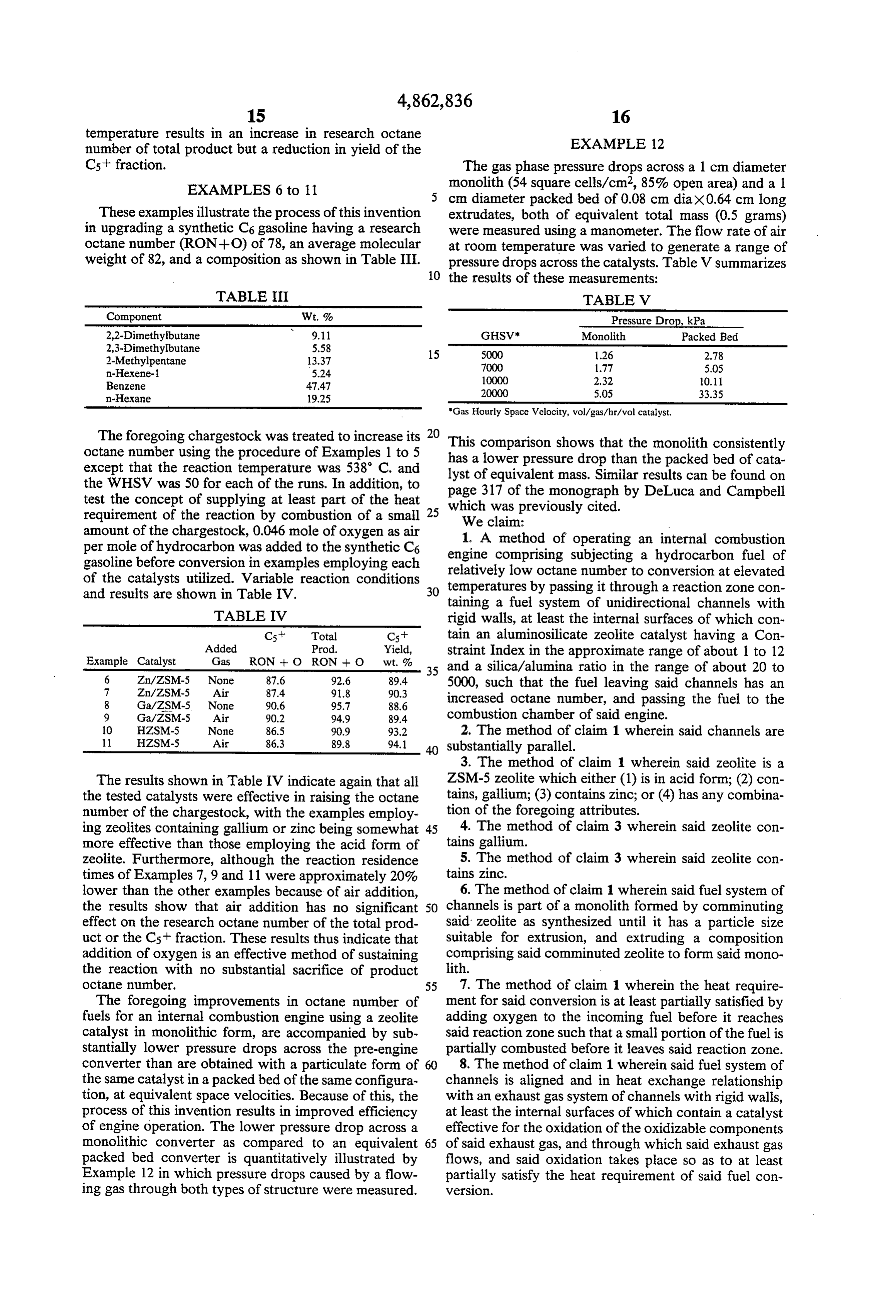
These examples illustrate the process of this invention extrudates, both of equivalent total mass (0.5 grams) in upgrading a synthetic C6 gasoline having a research were measured using a manometer. The flow rate of air octane number (RON--O) of 78, an average molecular at room temperature was varied to generate a range of weight of 82, and a composition as shown in Table III. pressure drops across the catalysts. Table V summarizes O the results of these measurements:
TABLE III TABLE V
Component Wt. 2 Pressure Drop, kPa 2,2-Dimethylbutane 9.11 GHSV Monolith Packed Bed 2,3-Dimethylbutane 5.58 15 5000 1.26 2.78 2-Methylpentane 13.37 7000 1.77 5.05
Benzene 47.47 10000 2.32 10.11 n-Hexane 19.25 20000 5,05 33.35 *Gas Hourly Space Velocity, vol/gas/hr/volcatalyst.
The foregoing chargestock was treated to increase its 20 This comparison shows that the monolith consistently octane number using the procedure of Examples l to 5 has a lower pressure drop than the packed bed of cata except that the reaction temperature was 538 C. and lyst of equivalent mass. Similar results can be found on the WHSV was 50 for each of the runs. In addition, to page 317 of the monograph by DeLuca and Campbell test the concept of supplying at least part of the heat which was previously cited.
requirement of the reaction by combustion of a small 25 We claim:
amount of the chargestock, 0.046 mole of oxygen as air 1. A method of operating an internal combustion per mole of hydrocarbon was added to the synthetic C6 engine gasoline before conversion in examples employing each relativelycomprising low octane subjecting a hydrocarbon fuel of number to conversion at elevated of the catalysts utilized. Variable reaction conditions temperatures by passing it through a reaction zone con
taining a fuel system of unidirectional channels with
TABLE IV rigid walls, at least the internal surfaces of which con
Cst Total Cs+ tain an aluminosilicate zeolite catalyst having a Con
Example Catalyst
Added
Gas
Prod.
RON - O RON - O
Yield, straint Index in the approximate range of about 1 to 12 wt.% 35 and a silica/alumina ratio in the range of about 20 to 6 Zn/ZSM-5 None 87.6 92.6 89.4 5000, such that the fuel leaving said channels has an
8 Ga/ZSM-5 None 90.6 95.7 88.6 increased octane number, and passing the fuel to the 9 Ga/ZSM-5 Air 90.2 94.9 89.4 combustion chamber of said engine. 10 HZSM-5 None 86.5 90.9 93.2 2. The method of claim 1 wherein said channels are 40 substantially parallel.
3. The method of claim 1 wherein said zeolite is a
The results shown in Table IV indicate again that all ZSM-5 zeolite which either (1) is in acid form; (2) con the tested catalysts were effective in raising the octane tains, gallium; (3) contains zinc, or (4) has any combina number of the chargestock, with the examples employ tion of the foregoing attributes.
ing Zeolites containing gallium or zinc being somewhat 45 4. The method of claim 3 wherein said zeolite con more effective than those employing the acid form of tains gallium.
zeolite. Furthermore, although the reaction residence 5. The method of claim 3 wherein said zeolite con times of Examples 7, 9 and 11 were approximately 20% tains zinc.
lower than the other examples because of air addition, 6. The method of claim 1 wherein said fuel system of the results show that air addition has no significant 50 channels is part of a monolith formed by comminuting effect on the research octane number of the total prod said zeolite as synthesized until it has a particle size uct or the Cs fraction. These results thus indicate that suitable for extrusion, and extruding a composition addition of oxygen is an effective method of sustaining comprising said comminuted zeolite to form said mono the reaction with no substantial sacrifice of product lith.
octane number. 55 7. The method of claim 1 wherein the heat require The foregoing improvements in octane number of ment for said conversion is at least partially satisfied by fuels for an internal combustion engine using a zeolite adding oxygen to the incoming fuel before it reaches catalyst in monolithic form, are accompanied by sub said reaction zone such that a small portion of the fuel is stantially lower pressure drops across the pre-engine partially combusted before it leaves said reaction zone. converter than are obtained with a particulate form of 60 8. The method of claim 1 wherein said fuel system of the same catalyst in a packed bed of the same configura channels is aligned and in heat exchange relationship tion, at equivalent space velocities. Because of this, the with an exhaust gas system of channels with rigid walls, process of this invention results in improved efficiency at least the internal surfaces of which contain a catalyst of engine operation. The lower pressure drop across a effective for the oxidation of the oxidizable components monolithic converter as compared to an equivalent 65 of said exhaust gas, and through which said exhaust gas packed bed converter is quantitatively illustrated by flows, and said oxidation takes place so as to at least Example 12 in which pressure drops caused by a flow partially satisfy the heat requirement of said fuel con ing gas through both types of structure were measured. version.
Page 14
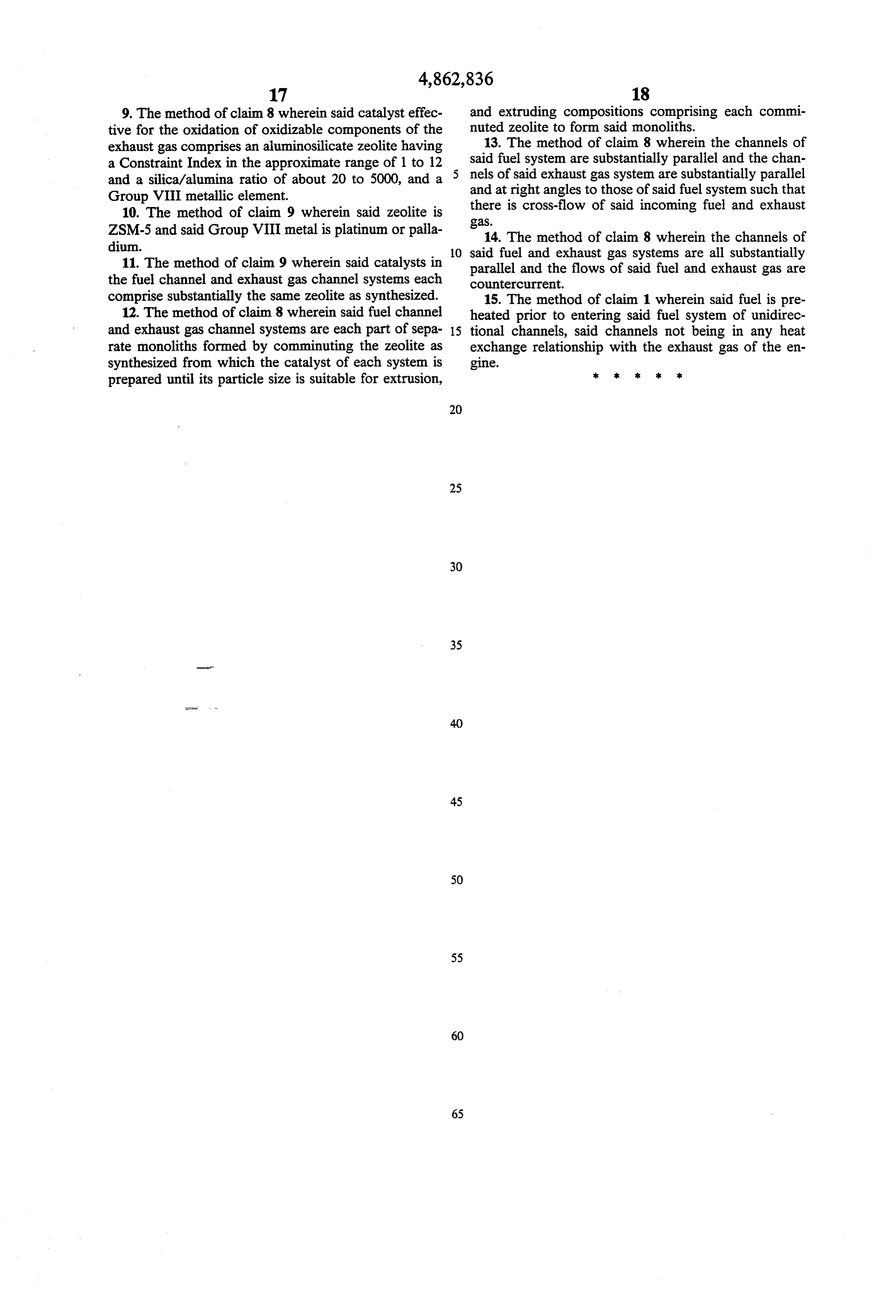
9. The method of claim 8 wherein said catalyst effec and extruding compositions comprising each commi tive for the oxidation of oxidizable components of the nuted zeolite to form said monoliths. exhaust gas comprises an aluminosilicate Zeolite having 13. The method of claim 8 wherein the channels of a Constraint Index in the approximate range of 1 to 12 said fuel system are substantially parallel and the chan and a silica/alumina ratio of about 20 to 5000, and a nels of said exhaust gas system are substantially parallel Group VIII metallic element. and at right angles to those of said fuel system such that 10. The method of claim 9 wherein said zeolite is there is cross-flow of said incoming fuel and exhaust gas.
ZSM-5 and said Group VIII metal is platinum or palla 14. The method of claim 8 wherein the channels of dium. 10 said fuel and exhaust gas systems are all substantially 11. The method of claim 9 wherein said catalysts in parallel and the flows of said fuel and exhaust gas are the fuel channel and exhaust gas channel systems each countercurrent.
comprise substantially the same zeolite as synthesized. 15. The method of claim 1 wherein said fuel is pre 12. The method of claim 8 wherein said fuel channel heated prior to entering said fuel system of unidirec and exhaust gas channel systems are each part of sepa 15 tional channels, said channels not being in any heat rate monoliths formed by comminuting the zeolite as exchange relationship with the exhaust gas of the en synthesized from which the catalyst of each system is gine.
prepared until its particle size is suitable for extrusion, it is
Provenance
- Collection
- Cited prior art
- Original PDF
- patentimages.storage.googleapis.com →
- Filed
- 1987-12-15
- Pages
- 14
- Method
- pdftotext (the PDF's own text layer) + pdftoppm 300dpi page scans
- Source
- Google Patents bibliographic record
- Granted
- 1989-09-05
- Inventors
- Nai Yuen Chen; Thomas F. Degnan, Sr.; Mobil Oil AS
- Transcribed from
- patentimages.storage.googleapis.com →