patent · US4770764
Process for converting heavy hydrocarbon into more valuable product
13 September 1988
Page 1 — bibliographic record
United States Patent (19) 11 Patent Number: 4,770,764 Ohtake et al. (45) Date of Patent: Sep. 13, 1988 54 PROCESS FOR CONVERTING HEAVY 4,348,270 9/1982 Bearden, Jr. et al. .............. 208/112 HYDROCARBON INTO MORE VALUABLE 4,357,299 11/1982 Bearden, Jr. et al. . ... 208/12 PRODUCT 4,376,037 3/1983 Dahlberg et al....... ... 208/11 4,389,301 6/1983 Dahlberg et al... ... 208/108 (75) Inventors: Nobumitsu Ohtake, Setagaya; Koji 4,406,772 9/1983 Sasaki et al........ . . 208/112 Kuri, Fuji, both of Japan 4,431,520 2/1984 Giuliani et al. . . 208/108 73) Assignee: Asahi Kasei Kogyo Kabushiki Kaisha, 4,495,306 1/1985 Budahn et al. ...................... 208/12 Japan 4,578,181 3/1986 Derouane et al. . . . 208/112 L 4,579,646 4/1986 Grosboll et al. ................ 208/112 L (21) Appl. No.: 931,964 4,606,809 8/1986 Garg ..................................... 208/59 (22 Filed: Nov. 18, 1986 FOREIGN PATENT DOCUMENTS
Related U.S. Application Data 332336 7/1930 United Kingdom.
63 Continuation of Ser. No. 588,932, Mar. 13, 1984, aban 1052603 12/1965 United Kingdom. doned. 1050084 12/1966 United Kingdom .
(30) Foreign Application Priority Data 2096164 10/1982 United Kingdom.
Mar. 19, 1983 JP Japan .................................. 58-46437 2135691 9/1984 United Kingdom. Mar. 19, 1983 JP Japan .................................. 58-8.5447
Dec. 2, 1983 (JP) Japan .. ... 58-227992 Primary Examiner-H. M. S. Sneed Dec. 7, 1983 JP Japan ................................ 58-231094 Assistant Examiner-Helane Myers Attorney, Agent, or Firm-Finnegan, Henderson, 51) Int. Cl.' .............................................. C10G 51/02 Farabow, Garrett & Dunner 52 U.S.C. ........................................ 208/73; 208/59; 57 ABSTRACT
58 Field of Search ................... 208/108, 61, 130, 59, A process for converting a heavy hydrocarbon into a 208/112 L more valuable product which comprises:
56) References Cited adding to the heavy hydrocarbon at least two kinds of
transition metal compound and an ultra-fine powder 3,235,508 2/1966 Mills................................ 208/112 L which can be suspended in a hydrocarbon and has an 3,839,484 10/1974 Zimmerman et al. ................ 208/61 average particle size within the range from 5 to 1000 3,842,138 10/1974 Chahvekilian et al. ... 208/130 nu;
3,898,299 8/1975 Jones ..................... ... 208/6 thermally cracking the heavy hydrocarbon in the pres 4,097,363 6/1978 McKinney et al.................... 208/61 ence of a hydrogen gas or a hydrogen sulfide-contain 4,134,825 1/1979 Bearden, Jr. et al. .... ... 208/108 ing hydrogen gas; and
4,216,077 8/1980 Chahvekilian et al. ............... 208/61 recovering the resulting lighter hydrocarbon oil. 4,298,454 11/1981 Aldridge et al....... ... 208/108 4,299,685 l/1981 Khulbe et al. ...................... 208/112 12 Claims, 1 Drawing Sheet
Page 2
Drawing sheet — no readable text.
Page 3
of the operation. Therefore, this process is generally
PROCESS FOR CONVERTING HEAVY applicable only to conversion to lighter product to an HYDROCARBON INTO MORE VALUABLE extent such that coking poses no problem. For improve PRODUCT ment of this point, the so called hydrobisbreaking pro 5 cess has been proposed. This process, however, cannot
This application is continuation, of application Ser. give sufficient coking inhibition effect even if the hy No. 06/588,932, filed 3/13/84 now abandoned. drogen pressure is increased to a high pressure of 300 BACKGROUND OF THE INVENTION kg/cm2. The coker process is also proposed, in which 1. Field of the Invention conversion to lighter product is conducted while form 10 ing positively cokes. This process, in addition to the
This invention relates to a process for converting a disposal of cokes by-produced in a large amount, cannot heavy hydrocarbon, particularly a heavy oil such as an be free from the problem of lowered yield of light oil. atmospheric residue or a vacuum residue of crude oils, Besides, the light oil obtained is enriched in aromatic highly into lighter and more valuable product, and a components and olefin components, thus involving the process for further hydrotreating the lighter hydrocar 15 drawback of poor quality.
bon oil, and also to a process for producing gaseous Thus, in the prior art, even when attempted to con olefins and monocyclic aromatics from a heavy hydro vert a high boiling material into lighter product by carbon as the feedstock by using these processes. catalytic processing of a heavy oil, impurities contained 2. Description of the Prior Art in the oil such as sulfur or heavy metals as a matter of In recent years, in addition to the trend of converting 20 course, particularly the presence of basic polymer com crude oils to heavy oils, unbalance between the demand pounds will markedly lower the acidic ability of the and the supply of petroleum products accompanied by catalyst. As the result, there is involved the problem the increase in demand of lighter oils is arousing social that the cracking activity due to acidity of the catalyst problems, and effective utilization of excessive heavy cannot persist. Also, in thermal cracking of a hydrocar oils is nowadays an issue of crucial importance in the 25 bon in absence of catalyst, the reaction rate is known to field of petroleum industries. be greater as its molecular weight is greater. However, On the other hand, in production of gaseous olefins since the reaction rates of side reactions such as cokes such as ethylene, propylene, butadiene, etc. and mono formation and polycondensation are also great, it is very cyclic aromatics such as benzene, toluene, xylene, etc., difficult in reaction operations to increase the degree of light hydrocarbons such as oil field gases or petroleum 30 cracking.
refinery by-products such as naphtha have been primar On the other hand, various techniques have been ily employed. These are now suffering from shortage of reported for hydrotreating heavy hydrocarbons by the supply with their costs being increased, and economical reaction in a dispersed state with addition of solid mate advantages to obtain gaseous olefins or monocyclic rials. U.S. Pat. Nos. 3, 131,142, 4,134,825, 4,172,814 and aromatics are becoming markedly lowered. Accord 35 4,285,804 disclose hydrotreatments by adding an oil ingly, in order to solve such a problem related to the soluble metal compound or an emulsion of an aqueous structure of industries, various attempts have recently solution of a water-soluble metal compound. U.S. Pat. been made to produce petrochemical starting materials Nos. 3,161,585 and 3,657,111 disclose hydrotreatments by hydrotreating lighter oils such as kerosenes, gas oils, by using a thermally cracked colloidal material of an vacuum gas oils, etc. followed by steam pyrolysis. oil-soluble metal compound or vanadium sulfide colloid However, in these methods, various kinds of oils em particles. Canadian Pat. Nos. 1,073,389, 1,076,983, U.S. ployed as the feedstock are available as petroleum prod Pat. Nos. 4,176,051, 4,214,977 and 4,376,695 disclose ucts, and the situation of starting material supply is the hydrocracking by using pulverized coal or pulverized same as in the case of the light hydrocarbon such as coal coated with a metal salt. U.S. Pat. Nos. 3,707,461 naphtha. 45 and 4,299,685 disclose hydrotreatments by use of pull Thus, in either petroleum industries or petrochemical verized coal ash. U.S. Pat. Nos. 4,169,038, 4,178,227, industries, it is now an important task to convert a 4,204,943, Japanese Laid-open Patent Publication Nos. heavy oil into lighter and more valuable product for 207688/1982 and 69289/1983 disclose hydrotreatments effective utilization as light petroleum products or start by using cokes by-produced or petroleum ash by-pro ing materials for petroleum chemistry. Accordingly, a 50 duced. Japanese Laid-open Patent Publication Nos. number of processes have been proposed for hydro 40806/1979 141388/1981 disclose hydrocracking by cracking or thermal cracking of heavy oils, but none of using a desulfurized catalyst or a pulverized waste cata these processes are not necessarily satisfactory for con lyst thereof. U.S. Pat. Nos. 4,066,530 and 4,067,799 verting a heavy oil such as a vacuum residue into lighter disclose hydrotreatment by use of a combination of an product, since some drawbacks are involved. 55 oil-soluble metal compound and an iron component For example, in a fixed-bed or fluidized-bed hydro particle, Japanese Laid-open Patent Publication No. cracking process in which the reaction is conducted in 108294/1983 by use of a combination of a metal com a reactor packed with a granular or powderly catalyst, pound and a metal-containing dust by-produced, and when. high conversion to lighter product is effected, U.S. Pat. Nos. 3,331,769 and 4,376,037 by use of a com by-produced carbon and metal components contained bination of a metal compound and a porous solid cata in the feedstock oil will be gradually deposited on the lyst or a porous carrier, respectively. However, most of catalyst layer, whereby depletion in activity of the cata these techniques employ the reactions approximate to lyst or plugging of the catalyst layer may be brought desulfurization conditions, and they are proposals aim about. ing at primarily metal removal, hetero-atom removal On the other hand, when it is desired to accomplish 65 such as sulfur or nitrogen removal or residual carbon high conversion of a heavy hydrocarbon to lighter removal from heavy hydrocarbons. A part of these product according to thermal cracking, so called coking techniques employ a heavy hydrocarbon which can be phenomenon will be caused, which will lead to stopping cracked with relative ease as the feedstock and attempt
Page 4
to apply an appropriate degree of hydrocracking by In the process for converting a heavy oil into lighter, utilizing a waste catalyst, cokes by-produced or a natu more valuable product according to the present inven ral product. Thus, according to any of these techniques, tion, a synergetic effect can be brought about by using when applied for high conversion of heavy hydrocar at least two kinds of substances in combination. This bons such as atmospheric residue or vacuum residue may be considered to be exhibited due to the action a into lighter products, the technical problems from prac described below.
tical aspect such plugging of equipments and economi An oil-soluble or water-soluble transition metal com cal problems remain to be solved. pound may be considered to be converted by thermal treatment in the present of hydrogen and/or hydrogen
SUMMARY OF THE INVENTION sulfide in the reaction zone of a heavy hydrocarbon or
The present inventors have made extensive studies to in the stage prior thereto into a substance having a overcome the drawbacks possessed by the processes of hydrotreating thereby catalytic activity in a hydrocarbon inhibiting polycondensation reaction or cokes the prior art and to develop a process for converting precursor or cokes forming reaction which are inevita highly a heavy hydrocarbon as the feedstock into ligh 15 ble ter and more valuable product economically and at high carbonside reaction in high conversion of a heavy hydro yield. As a consequence, it has now been found that by addition,into lighter, more valuable hydrocarbon. In other advantages are also exhibited such as adding at least two kinds of components of an oil-solu suppression of the amount of the gases generated as ble or water-soluble transition metal compound and a ultra-fine powder having an average particle size within 20 by-product, prevention of deterioration of the proper the range from 5 to 1000 m, which can be suspended in tiesOnof the the oil produced by thermal cracking, etc. other hand, a ultra-fine powder having an a hydrocarbon to the feedstock of a heavy hydrocarbon and carrying out thermal cracking in the presence of average particle size within the range from about 5 to 1000 mu, which can be suspended in a hydrocarbon may hydrogen gas or hydrogen sulfide-containing hydrogen also be considered to prevent the scaling (coking) phe gas, side reactions of polycondensation reaction and 25 nomenon in the reaction zone, which is also inevitable cokes forming reaction can be suppressed and scaling in high conversion of a heavy hydrocarbon into lighter, (coking) in the equipment, particularly in the reaction more valuable hydrocarbons, by ensuring floating state zones, can be inhibited, whereby valuable light oils can of cokes precursor, cokes or the like or through its be obtained economically, stable and at high yield from ability to transport and migrate these materials. In addi a heavy hydrocarbon, and at the same time deteriora 30 tion, when tion of the residue can be suppressed to reduce its a substanceahaving transition metal compound is converted to a hydrotreating catalytic activity, it amount remarkable. The present invention has been may be considered to serve in forming high dispersibil accomplished on the basis of such a finding.
More specifically, the present invention provides a ity and high surface area. As the result, there are addi process for converting a heavy hydrocarbon into a 35 with aadvantages tional such that the effect can be exhibited small amount of the transition metal compound more valuable product which comprises: and that the effect can be exhibited even with a transi adding to the heavy hydrocarbon at least two kinds tion metal having weak hydrogenating function. of substances comprising an oil-soluble or water-soluble In practicing the process for high conversion of a transition metal compound and an ultra-fine powder heavy hydrocarbon into lighter, more valuable hydro which can be suspended in a hydrocarbon and has an 40 carbons of the present invention, it is essentially re average particle size of 5-1000 mu;
thermally cracking the heavy hydrocarbon in the quired that at least two kinds of substances of an oil soluble or water-soluble transition metal compound or a presence of a hydrogen gas or a hydrogen sulfide-con substance having hydrotreating catalytic activity con taining hydrogen gas; and verted from such a compound and a ultra-fine powder recovering the resulting lighter hydrocarbon oil. 45 having an average particle size within the range from BRIEF DESCRIPTION OF THE DRAWINGS about 5 to 1000 m. should be simultaneously present in a heavy hydrocarbon. However, it is not necessary to
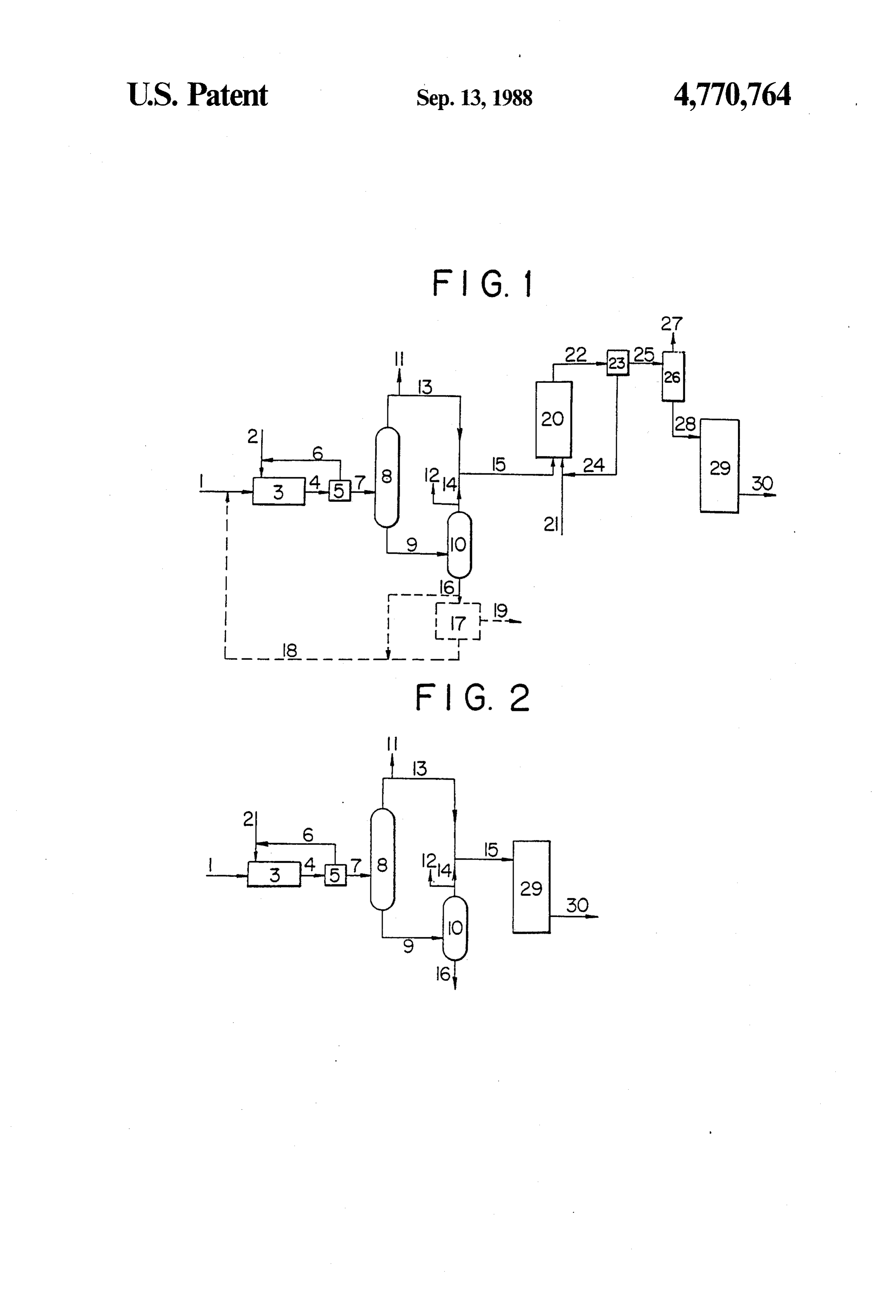
FIG. 1 and FIG. 2 show flow charts for practicing prepare a specifically compounded mixture beforehand, the different embodiments of the process for producing but it is only sufficient to add separately these sub gaseous olefins and monocyclic aromatics, respectively, 50 stances into a feedstock of a heavy hydrocarbon. Even in which 3 is a cracking heater unit, 5 is a high pressure when the respective components may be added sepa gas-liquid separator, 8 is an atmospheric flusher, 10 is a rately, it may be considered that the transition metal vacuum flusher, 17 is a liquid-solid separator, 20 is a compound interacts with the ultra-fine powder to be hydrotreating units, 23 is a high pressure gas-liquid changed automatically into a substance system exhibit separator, 26 is a gas-liquid separator and 29 is a steam 55 ing a desired function in the reaction zone or at the stage pyrolysis unit. prior to the reaction zone. The ultra-fine powder is DESCRIPTION OF PREFERRED required to be suspended in a heavy hydrocarbon. The EMBODIMENTS "suspended" hereinmentioned refers to the state where solid particles exist substantially in a liquid or the state
The heavy hydrocarbon to be used in the present where solid phases are distributed incontinuously invention is a crude oil or an atmospheric residue, or a through the liquid phase which is continuous phase, vacuum residue of a crude oil, including also shale oil, including those called as colloid, slurry or paste. tar sand extract and liquefied coal oil. A heavy hydro Of course, it is also possible to prepare a substance carbon containing a large amount of a fraction worth system capable of exhibiting a desired function with at while giving high conversion of heavy oil into lighter, 65 east two kinds of substances beforehand and use this more valuable product, for example, a fraction having substance system for addition into the feedstock of a b.p. of 520 C. or higher under atmospheric pressure, heavy hydrocarbon. For example, an oil-soluble transi has greater economical effects. tion metal compound is dissolved or an aqueous solu
Page 5
tion of a water-soluble transition metal compound is ferred, because less amounts may be used for the neces emulsified in an oil such as gas oil or vacuum gas oil, a sary announts of the transition metal. ultra-fine powder having an average particle size within Examples of water-soluble compounds are carbon the range from about 5 to 1000 mu is dispersed in the ates, carboxylates, sulfates, nitrates, hydroxides, halo solution or emulsion. The resultant dispersion is sub genide and ammonium or alkali metal salts of transition jected to the thermal treatment at a temperature at metal acids such as ammonium heptamolybenate. which the transition metal compound is decomposed in In the case of an oil-soluble transition metal com the presence of hydrogen gas or hydrogen sulfide-con pound, it can be used as a solution by additing directly taining hydrogen gas to prepare a solid, which is sepa into the feedstock of a heavy hydrocarbon. However, in rated or concentrated by a known solid-liquid separat 10 the case of a water-soluble transition metal compound, ing method and added to a heavy hydrocarbon. The it is necessary to form an emulsion by adding an aqueous heavy hydrocarbon is then provided for use in a process solution thereof into the feedstock of a heavy hydrocar for converting the heavy hydrocarbon into lighter, bon. In this case, including the method employing an more valuable product by thermal cracking in the pres emulsifier, any of the known methods for emulsification ence of hydrogen gas or hydrogen sulfide-containing 15 may be applicable.
hydrogen gas. As another example, a gaseous phase of The ultra-fine powder having an average particle size hydrogen gas or hydrogen sulfide-containing hydrogen within the range from about 5 to 1000 mu which can be gas having a ultra-fine powder with an average particle suspended in a hydrocarbon can exhibit excellent effects size of about 5 to 1000 mu is heated and into its atmo 20 as described below as compared with solid catalysts, sphere is sprayed an oil solution having an oil-soluble carriers employed for solid catalysts and merely transition metal compound dissolved therein or an aque crushed products of these known in the prior art of this ous solution having a water-soluble transition metal and field. That is to say, (1) it can ensure high dispersibility compound dissolved therein to decompose the transi great free movement in the reaction zone and can tion metal compound, followed by drying. The resul 25 give a site for uniform reaction without localization; (2) it will reside scarcely in the reaction zone, but discharge tant solid is added to a heavy hydrocarbon, which is easily then subjected to thermal cracking in the presence of such asadhered or deposited polycondensed products asphaltenes, cokes precursors, cokes, etc. under hydrogen gas or hydrogen sulfide-containing hydrogen gas to convert the heavy hydrocarbon into lighter, highly dispersed, floated state out of the reaction zone, more valuable hydrocarbons. However, in the impreg 30 itthereby avoiding plugging in the reaction zone; and (3) can prevent agglomeration of substances having hy nation method or the precipitation method, in which the drotreating catalytic activity formed from transition transition metal compound is supported on a ultra-fine powder, it is not desirable to use a preparation method metal compound to effect high dispersion, thereby en hancing the activity of the substance having hydrotreat in which agglomeration or sintering will occur between ing catalytic activity. In addition, the greatest feature of mutual transition metal compounds, between mutual 35 the ultra-fine powder is an extremely great outer surface ultra-fine powders or between the transition metal com area as compared with substantially porous solid cata pound and the ultra-fine powder. lysts and carriers. The solid catalysts and carriers of the As another substance system having a desired func prior art, even when crushed, will be broadly distrib tion, it is also possible to reuse a thermally cracked uted generally in the range from several microns to product obtained by the present process for converting 40 some ten microns, having a very small outer surface. a heavy hydrocarbon into lighter, more valuable hydro The effect expected is derived mostly from the inner carbons or a heavy residue fractionated by distillation of surfaces within the pores. However, in the case when the thermally cracked product as such, or alternatively the reaction occurs within the pores, the diffusion rate to use a solid separated and recovered from these dis of the reactants poses a problem, and there is created a persed oils. 45 concentration gradient of the reactants between the In the oil-soluble or water-soluble transition metal center portion of the particle and the vicinity of the compound, the transition metal is inclusive of all the surface, whereby the site for the reaction becomes un transition elements in the Periodic Table of Elements, and selected particularly from the group consisting of uniform. Accordingly, the effective coefficient is al ways the problem, and physical structures such as pore vanadium, chromium, iron, cobalt, nickel, copper, mo 50 distribution or crushed particle size distribution may lybdenum, tungsten and mixtures thereof. have effects greatly on the resultant performance. Be Examples of the oil-soluble compounds containing sides, when employing a heavy hydrocarbon as the desired transition metals are so called m-complexes feedstock, substances having large molecular weights containing cyclopentadienyl group or allyl group as the contained ligand, organic carboxylic acid compounds, organic 55 substances therein such as asphaltenes, porphyrin-like containing heavy metals and cokes precur alkoxy compounds, diketone compounds such as acetyl sors or cokes formed cannot enter to the inner portions acetonate complex, carbonyl compounds, organic sul of the pores but will readily plug the pores in the vicin fonic acid or organic sulfinic acid compounds, xanthinic ity of the surface, whereby the inner surfaces depending acid compounds such as dithiocarbamate, amine com substantially on the pores can function little to give no pounds such as organic diamine complexes, phthalocya 60 expected effect. In contrast, the ultra-fine powder is a nine complexes, nitrile or isonitrile compounds, phos substance system which is not substantially porous or phine compounds and others. Particularly preferable not expected to be porous and can exhibit a desired oil-soluble compounds are salts of aliphatic carboxylic effect through the effective action of only the large acids such as stearic acid, octylic acid, etc., since they outer surface. The outer surface area will be dramati have high solubilities in oil, contain no hetero atom such 65 cally increased as the particle sizes are smaller. For as nitrogen or sulfur and can be converted with relative example, in the case of the particle sizes of 10 to 50 mu, ease to a substance having hydrotreating catalytic activ the surface area can be about 300 to 60 mg to give an ity. Compounds of smaller molecular weights are pre extremely excellent effect. The ultra-fine powder satis
Page 6
fying these properties can be classified into inorganic face area, the outer surface area calculated from the substances and carbonaceous, substances. Illustrative of particle size measured by an electron microscope and inorganic substances are so called fine ceramics such as the specific surface area determined by the gas adsorp ultra-fine particulate silicic acid, silicates, alumina, tita tion method (BET method) coincide substantially with nia, etc. and ultra-fine metal particles such as those 5 each other, and it is within the range of approximately obtained by the vapor deposition method. Of these from 5 to 400 m2/g.
substances to describe about ultra-fine particles of silicic When the ultra-fine powder of the present invention acid acid silicates, these are a group of many kinds of is added to the feedstock of a heavy hydrocarbon, it substances called conventionally as white carbon, and may be added directly as such or as a concentrated they can be synthesized according to the vapor-phase 10 dispersion in a different medium. The dispersion con processes such as by thermal decomposition of silicon taining the ultra-fine powder may be subjected to me halides, thermal decomposition of silicic acid-contain chanical operation such as by a stirrer, ultra-sonic wave ing compounds, thermal decomposition of organic si or a mill, or alternatively or in combination admixed licic compounds, etc.; and according the liquid-phase with dispersants such as a neutral or basic phosphonate, processes such as decomposition of sodium silicate with 15 a metal salt such as sulfonic acid salt of calcium or an acid, decomposition of sodium silicate with an am barium, succinimide and succinate, benzylamine or a monia salt or an alkali salt, formation of an alkaline polypolar type polymeric compound. earth metal silicate from sodium silicate followed by In practicing the process for converting a heavy hy decomposition with an acid ion-exchange by treating an drocarbon into lighter, more valuable product, the aqueous sodium silicate solution with an ion-exchange 20 amounts of at least two kinds of substances to be added resin, pressurized decomposition of an organogel, de may be within the range from 10 to 1000 ppm, more composition of silicon halide with water, decomposition preferably from 50 to 500 ppm, for the transition metal of sodium silicate solution with silicofluoric acid by compound calculated as metal based on the weight of produced in the manufacturing step of calcium super the feedstock of a heavy hydrocarbon, and within the phosphate, production utilizing natural silicic acid or 25 range of from 0.05 to 10% by weight, more preferably silicates, the reaction of sodium silicate with a hydrox from 0.1 to 3% by weight, for the ultra-fine powder ide such as calcium hydroxide or calcium chloride, based on the weight of the feedstock of a heavy hydro aluminum chloride or sodium aluminate, the treatment carbon. In the case of preparing a substance system of quartz or silica gel with calcium hydroxide in an capable of exhibiting the desired function of at least two autoclave, etc. The particle size can be measured by an 30 kinds of substances beforehand, it is desirable to prepare electron microscope, and it may range approximately a formulation having a composition so as to fall within from 5 to 50 mu, although different depending on the the ranges as specified above. At a level of less than 10 kind. As to the surface area, the outer surface area cal ppm of the transition metal of the transition metal com culated from the particle size measured by an electron pound based on the heavy hydrocarbon or at a level of microscope and the specific surface area determined by 35 less than 0.05 wt.% of the ultra-fine powder, no suffi the gas adsorption method (BET method) coincide cient effect of inhibiting the side reactions of polycon substantially with each other, and it is within the range densation reaction and cokes forming reaction, and also approximately from 50 to 400 m2/g. no sufficient effect of preventing scaling (coking) can be On the other hand, the carbonaceous substances are a obtained. On the other hand, in excess of 1000 ppm of group of substances obtained by formation of carbon, 40 the transition metal of the transition compound or in namely carbonization, which can be classified into liq excess of 10 wt.% of the ultra-fine powder, no further uid phase or solid phase carbonized substances such as improvement corresponding to such amounts can be petroleum cokes, coal cokes, pitch cokes, activated recognized, but rather unfavorable side reactions or charcoal, charcoal, etc. and gas phase carbonized sub solid-liquid separation in the reaction zone and plugging stances such as carbon blacks. Carbonaceous sub 45 accompanied thereby may occur.
stances, as compared with inorganic substances, are In practicing the process for converting a heavy hy combustible and therefore advantageous when the drocarbon into lighter, more valuable product, the ther heavy residue which is a product after the reaction of mal cracking conditions depend on the heavy hydrocar converting a heavy hydrocarbon into lighter, more bon employed as the feedstock and the properties and valuable hydrocarbons is utilized as boiler fuel. 50 amounts added of at least two kinds of substances, but, Liquid phase or solid phase carbonized substances are in general, the reaction temperature employed may generally great in particle sizes formed, and most of range from 400 to 550 C., preferably from 430 to 520 them are required to be subjected to micropulverization C. At a higher temperature region exceeding this tem operation and classification operation in order to have perature range, thermal cracking will proceed so far desired particle sizes. On the other hand, most of the gas 55 that formation of cokes and generation of gases will phase carbonized substances have particle sizes falling become marked until there is substantially no feedstock within the particle size range of the present invention, to be converted into lighter oil. On the other hand, at a and therefore they are available as such. Among them, lower temperature region lower than this temperature carbon blacks include a variety of kinds formed as the range, the thermal cracking rate tends to become mark gas phase carbonized substances, which can be prepared 60 edly slow.
according to the methods such as oil furnace method, The reaction pressure may be 30 Kg/cm2 to 300 gas furnace method, channel method, thermal method, Kg/cm2 preferably 50 Kg/cm2 to 250 Kg/cm2. acetylene black method, by-produced carbon black The thermal cracking may be operable by either method, lamp black method and others. The particle batchwise or continuous system, and the reaction time size can be measured by an electron microscope and it is 65 or the time for residence of the heavy hydrocarbon approximately 9 to 500 mu, although different depend within the reactor may be 1 minute to 2 hours, desirably ing on the kind, approximately 9 to 100 mp. except for 3 minutes to one hour. These processing conditions do those produced by the thermal method. As to the sur not take individually optimum values, but they are re
Page 7
lated to each other, and therefore the optimum ranges nickel-tungsten and the like, supported on an inorganic may be changed depending on the situation. Further, porous carrier. These metal species are used generally the amount of hydrogen to be fed in practicing thermal as oxides or sulfides, and the inorganic porous carrier cracking may be 100 to 5,000 Nm/kl, more preferably may include, for example, alumina, silica, silica-alumina, 500 to 2,000 Nm/kl, in terms of the volume ratio rela zeolite, zeolite-containing alumina, aluminaboria, silica tive to the feedstock and it is generally desirable to continue running with supplement of hydrogen gas in alumina-titania and others. The hydrotreating condi tions may be selected as desired depending on the heavy an amount corresponding to the amount of hydrogen hydrocarbon oil employed as the feedstock and the gas consumed. As the hydrogen to be fed, either high properties of the catalyst, but the reaction temperature purity hydrogen gas or a gas mixture containing a large O may be 250 to 480 C., preferably 300 to 450° C. If the amount of hydrogen gas may be employed. Even when reaction temperature exceeds 480 C., thermal cracking employing hydrogen sulfide-containing hydrogen gas, of the side reaction proceeds too much, whereby in the amount to be used may be such as amount as corre crease of the carbon deposited on the catalyst, increase sponding to that as mentioned above as the total amount, but the content of hydrogen sulfide may prefer 15 ofof the hydrogen consumed accompanied with increase gas generation and reduction of liquid yield are rec ably about 1 to 10 mole %. ognized. On the other hand, at a temperature lower than The type of the reaction equipment when carrying 250 C., the reaction rate will become markedly smaller. out the reaction continuously may be either a tubular The reactor, a tower reactor or a soaker type reactor, but in bly 50 to 250pressure reaction may be 3 to 300 Kg/cm2, prefera any of these reactors, it is desirable to perform suspen 20 hydrotreating capacity which
of the is related greatly to the catalyst. Further, the sion reaction while maintaining a ultra-fine powder liquid hourly space velocity (LHSV) under suspended state without forming a fixed-bed, hrl, preferably 0.2 to 3.0 hr, andmaythebeamount 0.1 to 5.0
fluidized-bed or ebulating-bed. The reactor structure can be simpler for suspension reaction, and the reaction hydrogen to be fed is within the range from 200 to 2000 Nm3/kl in terms of the volume ratio relative to the temperature can be controlled more easily without 25 feedstock oil to be hydrotreated. These conditions are change in performance with lapse of time and plugging by coking will hardly occur. In addition, a high temper not selected so as to take individually optimum values, ature and short time reaction can be practiced with are but they are related to each other and optimum ranges relative ease and therefore a great space velocity can be to be selected in correspondence to the require taken to afford a large amount of unit treatment, with 30 ments, including of course the properties of the feed additional advantage of making chemical consumption stock oil and the catalyst activity, and also the purpose amount of hydrogen gas smaller while suppressing hy of use of the hydrotreated product oil.
drogenating activity such as hydrogenation of aromatic The process for producing gaseous olefins and mono nuclei. cyclic aromatic hydrocarbons by use of a heavy hydro Of the product oils obtained by practicing the process 35 carbon as the feedstock comprises as a first embodi for converting a heavy hydrocarbon into lighter, more ment:
valuable product of the present invention, the destillates (A) adding to a heavy hydrocarbon may be available as a whole or after fractionation as (i) at least two kinds of substances comprising an substitute for naphtha in petroleum chemistry, or can be oil-soluble or water-soluble transition metal con separated into fractions having respective boiling pound and an ultra-fine powder which can be sus ranges for use as intermediate starting materials for pended in a hydrocarbon and has an average parti petroleum products such as gasoline, jet fuel oil, kero cle size within the range from 5 to 1000 mu; or sene, gas oil, diesel fuel, lubricant and others. (ii) a solid prepared by dissolving an oil-soluble tran In the process for further hydrotreating the hydro sition metal compound in an oil or emulsifying an carbon oil obtained as the lighter, more valuable prod 45 aqueous solution of a water-soluble transition metal uct according to the process of the present invention, in an oil; dispersing an ultra-fine powder having an the hydrocarbon oil obtained may be subjected to hy average particle size within the range from 5 to drotreatment as such or after removal by separation of 1000 mu in the oil solution or in the oil/aqueous the high boiling fraction from the hydrocarbon oil ob emulsion; and heating the dispersion at the decom tained. Hydrotreating may advantageously be carried 50 position temperature of the transition metal com out after removal of the high boiling fraction, since pound in the presence of a hydrogen gas or a hy substances such as asphaltenes or metals can be re drogen sulfide-containing hydrogen gas; or moved thereby. In addition, the high boiling fraction (iii) a solid prepared by dissolving an oil-soluble tran removed by separation can be handled substantially sition metal compound in an oil or dissolving a similarly as the liquid fuel oil, which can be utilized as 55 water-soluble transition metal compound in water the fuel source in the process practiced in the present and converting the solution to a dry solid by spray invention or otherwise for use in boilers in general. As ing the solution in a hydrogen gas or a hydrogen the method for separation of high boiling fraction, there sulfide-containing hydrogen gas in which an ultra may be employed conventionally used high pressure gas fine powder having an average particle size within separation, atmospheric distillation, vacuum distillation 60 the range from 5 to 1000 mu is dispersed and by and further solvent deasphalting. simultaneously heating the gas to decompose the The catalyst to be used in practicing the hydrotreat itransition metal compound and to dry the solid; ing process may be any of the catalysts known for hy (B) thermally cracking the heavy hydrocarbon in the drotreating of petroleum fractions and heavy oils, pref. presence of a hydrogen gas or a hydrogen sulfide-con erably a catalyst containing each at least one kind of 65 taining hydrogen gas and recovering the resulting ligh metals selected from the group VIb metals and the ter hydrocarbon oil;
group VIII metals of the Periodic Table such as metal (C) removing a fraction having a high boiling point species of nickel-molybdenum, cobalt-molybdenum, from the lighter hydrocarbon oil; and
Page 8
(D) pyrolyzing a fraction having a low boiling point The thermal cracking step employs the process for or a mixture of the fraction and a petroleum fraction converting a heavy hydrocarbon into lighter, more with steam, and recovering a gaseous olefins product valuable product as described above. Accordingly, and a monocyclic aromatics product. through the effect of at least two kinds of substances to Alternatively, according to a second embodiment, be added to the feedstock of a heavy hydrocarbon in the the process comprises: presence of hydrogen gas or hydrogen sulfide-contain (A) adding to a heavy hydrocarbon ing hydrogen gas, the side reactions of polycondensa (i) at least two kinds of substance comprising an oil tion reaction and cokes formation reaction can be inhib ited, and also scaling (coking) in the equipment particu soluble or water-soluble transition metal com pound and an ultra-find powder which can be sus O useful larly in the reaction zone can be prevented, whereby pended in a hydrocarbon and has an average parti carbonlighter oil can be obtained from a heavy hydro economically, stably and at high yield, with cle size within the range from 5 to 1000 mu; or (ii) a solid prepared by dissolving an oil-soluble tran additional great advantage that deterioration of proper ties of the lighter oil as well as the high boiling residue sition metal compound in an oil or emulsifying an 15 can be prevented. This can be exhibited particularly in aqueous solution of a water-soluble transition metal the case compound in an oil; dispersing an ultra-fine particle residue ofof ausing an atmospheric residue or a vacuum having an average particle size within the range of crudes, Taching crudes, etc.crude paraffin-based oil such as Minus known as the heavy oil from 5 to 1000 mu in the oil solution or in the crudes. More specifically, these heavy residues are oil/aqueous emulsion; and converting the disper heavy oils which have been deemed to be relatively sion at the to a solid by heating the dispersion at the difficult in high conversion to lighter, valuable product decomposition temperature of the transition metal by phase separation of product. According to the compound in the presence of a hydrogen gas or a ent invention, by taking advantage of the excellentpres fea hydrogen sulfide-containing hydrogen gas; or (iii) a solid prepared by dissolving an oil-soluble tran 25 ture of paraffinic properties of these heavy oils, it is rendered possible to effect high conversion thereof into sition metal compound in an oil or dissolving a lighter, more valuable product. Accordingly, the frac water-soluble transition metal compound in water; tion having the low boiling point of lighter product and converting the solution to a dry solid by spray obtained by atmospheric ing the solution in a hydrogen gas or a hydrogen provided for use directlyorinvacuum distillation can be sulfide-containing hydrogen gas in which an ultra 30 further passing through the hydrotreating step without steam pyrolysis fine particle having an average particle size within starting materials for petroleum chemistry. As atoconse give the range from 5 to 1000 mu is dispersed and by quence, equipments such as hydrotreating equipment simultaneously heating the gas to decompose the are no more necessary, and there is also a great effect of transition metal compound and to dry the solid; decreased amount of hydrogen consumption. More (B) thermally cracking the heavy hydrocarbon in the 35 over, the high boiling residue removed by distillation presence of a hydrogen gas or a hydrogen sulfide-con can sufficiently be utilized as the liquid fuel substantially taining hydrogen gas and recovering the resulting ligh similarly as the straight heavy oils for the fuel source in ter hydrocarbon oil; practicing the present process or boilers in general. (C) removing a fraction having a high boiling point The steps of removing a high boiling fraction is re from the lighter hydrocarbon oil; 40 quired for feeding a fraction having a low boiling point (D) hydrotreating a fraction having a low boiling to the subsequent steam pyrolysis steps or hydrotreating point under hydrogenation conditions and recovering step. As the method for removing a high boiling frac the resulting hydrotreated oil; and tion, there may employed high pressure gas separation, (E) pyrolyzing the hydrotreated oil or a mixture of atmospheric distillation or vacuum distillation conven the hydrotreated oil and a petroleum fraction with 45 tionally used, and further solvent deasphalting. It is also steam, and recovering a gaseous olefins product and a possible to effect fractionation into naphtha fraction monocyclic aromatics product. (boiling point lower than 200 C.), kerosene gas oil According to a third embodiment of the process, in fraction (boiling point of 200-343 C.) and vacuum gas the process according to the first or second embodiment oil fraction (boiling point of 343-545 C.). Various as defined above, the whole or a part of a solid which is 50 kinds of these lighter fractions may be subjected to separated and recovered from the lighter hydrocarbon steam pyrolysis as such or after hydrotreatment. oil obtained in step (B) or the fraction having a high In subjecting the thermally cracked oil after removal boiling point removed in step (C) is recycled to step (B). of the high boiling fraction to be hydrotreating step, the According to a fourth embodiment of the process, in method for hydrotreatment as described above can be the process according to the first or second embodiment 55 employed as such. However, since the feedstock oil as defined above, the whole or a part of the fraction employed is the thermally cracked oil from which the having a high boiling point removed in step (C) is recy toxic materials for the catalyst such as asphaltenes and cled to step (B). metals have been removed, the catalyst employed has Thus, the process for producing gaseous olefins and greater activity as the surface area as the physical prop monocyclic aromatics according to the present inven erty of porous carrier is greater, whereby it is not par tion comprises as the basic steps four or five steps. In the ticularly required to increase the pore volume of large case of the four steps, it is consisted of the step of adding pore sizes as in the case of the catalyst for treatment of to a heavy hydrocarbon at least two kinds of substances, an oil with a high level content ef asphaltenes or metals. the thermal cracking step, the step of removing a high The thermally cracked oil from which the high boil boiling fraction and the steam pyrolysis step. In the case 65 ing fraction has been separated and removed in the of the five steps, it has the hydrotreating step between separating step or the hydrotreated oil recovered from the step of removing a high boiling fraction and the the hydrotreating step may be used as the feedstock oil steam pyrolysis step. in the steam pyrolysis step, and it is also possible to
Page 9
carry out steam pyrolysis of each fraction fractionated in which steam is blown from the tower bottom to separately or as a mixture with other petroleum frac lower the partial pressure of the oil. The atmospheric tions depending on the purpose. fraction from the atmospheric flusher 8 and the vacuum The mode of steam pyrolysis to be used in the steam fraction from the vacuum flusher 10, after removal of pyrolysis step in the process of the present invention is 5 off-gas through lines 11 and 12, respectively, are mixed not particularly limited, but various modes can be em by passing through lines 13 and 14 to be introduced into ployed, and it is also possible to use a tubular heater a line 15. On the other hand, the vacuum residue with which is an existing naphtha cracking heater as such or drawn through a withdrawing pipe 16 from the bottom with a slight modification. of the vacuum flusher 10 may be employed as such as a The reaction conditions in the steam pyrolyzing step O liquid fuel, but it may be introduced into a solid separa may be a steam oil weight ratio of 0.2 to 2.0, preferably tor 17 to be subjected to the solid separation operation. 0.4 to 1.5, a pyrolysis temperature of 700 to 900 C., The solid separator 17 may comprise, for example, a preferably 750 to 900 C., and a residence time of 0.05 centrifugal separator, a filter, a solvent sedimentor and to 2.0 seconds, preferably 0.1 to 0.6 seconds. a combination thereof. A part of the vacuum residue or The product obtained by the steam pyrolysis reaction 15 the solid or the solid subjected to further cleaning and is led from the heater to a quenching heat exchanger for drying operations (not shown) may be recycled via the heat recovery, followed by separation and purification, line 18 to be added to the feedstock of heavy hydrocar to give gaseous olefins and monocyclic aromatics, by bon. The liquid vacuum residue separated from most of produced fuel oils and other by-produced hydrogen and the solid in the solid separator 17 is discharged through hydrocarbons. 20 a line 19 and may be used as liquid fuel. The distillate oil In practicing the process of the present invention, introduced into the line 15 is elevated in pressure by a hydrogen gas to be used in the thermal cracking step, feeding pump and fed into a hydrotreating equipment and the hydrotreating step may be supplied by circula 20 to be hydrotreated therein with hydrogen gas ele tion from the hydrogen gases separated from the respec vated in pressure by means of a compressor. The hydro tive steps, sometimes after removal of hydrogen sulfide 25 treated product is cooled to a desired temperature by and ammonia contained therein, and it is generally de means of a heat-exchanger, etc. and delivered via a line sirable to supplement hydrogen gas in an amount corre 22 to a high pressure gas-liquid separator 23 to be sepa sponding to the hydrogen gas consumed. In this case, as rated into gas and liquid. The hydrogen-enriched gas hydrogen source, the hydrogen gas by-produced in separated is circulated via a line 24, after elevation to a steam pyrolysis or hydrogen gas obtained in steam mod 30 desired pressure, by a compressor 21, if necessary, to ification of by-produced hydrocarbon gas or by-pro the hydrotreating equipment 20. On the other hand, the duced fuel oil may also be available. hydrotreated liquid product is dropped in pressure by Referring now to the accompanying drawings, the passing through a line 25 to be fed into a gas-liquid embodiments of the process for producing gaseous ole separator, and, after discharging the off-gas with a high fins and monocyclic aromatics by use of a heavy hydro 35 vapor pressure through a line 27, delivered via a line 28 carbon as the feedstock in the present invention is de to a steam pyrolysis equipment 29. In this equipment, scribed in detail, but the present invention is not limited the hydrotreated product is steam pyrolyzed and the thereby. pyrolyzed product is withdrawn through a line 30, FIG. 1 and FIG. 2 show different examples of flow cooled, separated, purified and recovered as gaseous charts for practicing the process for producing gaseous olefins, monocyclic aromatics, by-produced hydrogen, olefins and monocyclic aromatics according to the pres by-produced fuel oil, etc.
ent invention. To describe with reference to the steps in The flow chart shown in FIG. 2 shows the case when FIG. 1, the feedstock of a heavy hydrocarbon admixed no hydrotreating step is required, corresponding to the with at least two kinds of substances according to the chart shown in FIG. 1 from which the symbols 20 to 28 present invention is elevated in pressure by means of a 45 are omitted.
feed pump and fed through a line 1, and hydrogen gas The present invention is described in further detail by or hydrogen sulfide-containing gas is elevated in pres referring to the following Examples, by which the pres sure by means of a compressor and fed through a line 2, ent invention is not limited.
respectively, into a thermal cracking equipment 3, EXAMPLE 1. wherein the heavy hydrocarbon is converted to lighter, 50 more valuable product. The lighter product obtained is Using a vacuum residue of Minus crudes (100 wt.% delivered through a line 4, to be quenched therein, to a of a fraction having boiling point higher than 520' C.) as gas-liquid separator 5. The high pressure gas-liquid the feedstock oil, thermal cracking was carried out by separator consists generally of the two stages of a hot means of a continuous type equipment operated with Separator and a cold separator. The hydrogen-enriched 55 high pressures having a reactor of a soaker type vessel gas from the separator is discharged through a line 6 of 40 mm in inner diameter and 100 mm in height and after elevation to a desired pressure, if desired, equipped with a stirrer mounted with three turbine type circulated to the thermal cracking equipment 3. The blades each having three fans. As the two kinds of the liquids from the hot separator and the cold separator are components to be added to the feedstock oil, nickel not required to be preheated and fed through a line 7 to octoate was added in an amount of 200 ppm as nickel an atmospheric flusher 8. Next, the atmospheric residue based on the feedstock oil, and oil furnace carbon blacks withdrawn through a withdrawing pipe 9 from the average particle size of 20 ml by electron microscope bottom of the atmospheric flusher 8 is further delivered (E.M.), specific surface area of 120 m2/g by BET to a vacuum flusher 10 to be treated therein. The vac method in an amount of 2 wt.% based on the feedstock uum flusher 10 is operated under vacuum with equip 65 oil, respectively, and the feedstock oil was thoroughly ment of a vacuum generating device for the purpose of stirred before it was fed into the reactor. lowering the operating temperature, and sometimes it is The reaction conditions employed for the thermal also possible to use steam distillation as auxiliary means cracking were a temperature of 495 C., a pressure of
Page 10
200 kg/cm2, a residence time (based on cold liquid) of about 3 hours after initiation of running, the reactor was 20 minutes and a hydrogen/feedstock oil ratio of 2000 completely plugged with coking. The yield of the liquid N/1, with the number of revolutions of the stirrer being fraction having b.p. lower than 520 C. was 73 wt.%, 1000 rpm. The continuous running time was 100 hours but the amount of cokes formed was 3.1 wt.%, of as the steady state running time. which about 2.2 wt.% was found to have undergone The products obtained were 5.8 wt.% of C1-C4 coking together with the pulverized delayed cokes gases, 45.2% of the GO - fraction by atmospheric dis added in the reactor.
tillation (b.p.: 343 C.>), 29.0 wt.% of the VGO frac COMPARATIVE EXAMPLE 5 tion by vacuum distillation (b.p. 343'-520' C.) and 20.0 wt.% of the vacuum residue (VR). The content of O Example 1 was repeated except that 3 wt.% of nick asphaltenes idefined as insoluble in hexane and soluble in tetrahydrofuran) was 2.1 wt.%, and the content of el-tungsten with a catalyst supported on porous I-alumina specific surface area of 220 m2/g (BET method) cokes (defined as insoluble in both tetrahydrofuran and containing 4 wt.% of nickel oxide and 15 wt.% of hexane) was 1.0 wt.%. The amount of hydrogen con tungsten oxide, pulverized to particles sizes of 60 or sumed was 110 N1 per kg of the feedstock. The conver 15 sion of heavy feedstocks into lighter, more valuable less, was employed instead of nickel octoate and carbon blacks. As the result, after running for about 7 hours, product as defined by the following formula: the reactor was completely plugged and stable running could be continued no longer. The yield of the liquid proportion of fraction having fraction having b.p. lower than 520 C. was 72 wt.% 1 - b.p. higher tha29 and the amount of cokes formed was i.8 wt.%, but proportion of fractionCin product having b.p. X 100 within the reactor, about 1.2 wt.% of the cokes was higher than 520' C. in feedstock found to have undergone coking in the form containing partially the catalyst added.
was found to be 80 wt.%. The yield of the liquid frac 25 COMPARATIVE EXAMPALE6 tion converted to lighter product of b.p. lower than 520' C. was 74.2 wt.% as the sum of GO and VGO. Example 1 was repeated except that an aqueous solu In addition, the amount of coking (scaling amount) on tion of ammonium molybdenate dissolved in water was the inner wall surface of the reactor after 100 hours of added in an amount of 500 ppm as molybdenum into the steady state running was extremely small as 40 ppm 30 feedstock oil to form an emulsion, to which were fur based on the total weight of the feedstock oil fed. ther added 3 wt.% of pulverized particles of about 10p. COMPARATIVE EXAMPLE 1. to 30 of a complex oxide of silica-alumina (silica 60%, alumina 40%) which was a porous material with a spe
Example 1 was repeated except that the two kinds of cific surface area of 400 m2/g (BET method) instead of components were not added into the feedstock oil. As 35 nickel octoate and carbon blacks. As the result, after the result, about 2 hours after initiation of running, the running for about 10 hours, the reactor was completely reactor was completely plugged with coking, whereby plugged and stable running could be continued no no stable running could be practiced. Under the condi longer. The yield of the liquid fraction having b.p. tions where stable running was possible, the yield of the lower than 520' C. was 75 wt.% and the amount of liquid fraction having b.p. lower than 520' C. was 34.1 40 cokes formed was 3.5 wt.%, but within the reactor, wt.%, being less than half of the yield in Example 1. about 1.2 wt.% of the cokes was found to have under COMPARATIVE EXAMPLE 2 gone coking in the form containing partially the partic Example 1 was repeated except that no ultrafine par ulate As material added.
apparently seen from the results of Example 1 and ticle was added and only nickel octoate was added in an 45 Comparative examples amount of 500 ppm as nickel. As the result, about 4 tion can be appreciated to1 through be 6, the present inven excellent as the method for hours after initiation of running, the reactor was com obtaining a high yield of lighter oil by cracking of a pletely plugged with coking. The yield of the liquid heavy hydrocarbon. Moreover, the residual oil having fraction having b.p. lower than 520' C. was 75 wt.%, b.p. higher than 520' C. obtained in the present inven but the amount of cokes formed was 3.5 wt.% and most 50 tion has a viscosity as low as 22 cSt at 150 of them, namely about 3.0 wt.% was found to partici combustibility by thermogravimetric analysis is similar C., and its pate in the coking in the reactor.
to the vacuum residue of the feedstock Minus crudes,
COMPARATIVE EXAMPLE 3 and thus it was sufficiently available as fuel oil. Example 1 was repeated except that no transition EXAMPLES 2-10 metal compound was added and only oil furnace carbon 55 blacks were added in an amount of 4 wt.%. As the Using a vacuum residue of Minus crudes (100 wt.% result, about 15 hours after initiation of running, the of the fraction having b.p. higher than 520 C.) as the reactor was completely plugged with coking. The yield feedstock oil, various combinations of two kinds of of the liquid fraction having b.p. lower than 520' C. was components were added thereto in predetermined 74 wt.%, but the amount of the cokes formed was as 60 amounts as mentioned below to carry out thermal much as 6.1 wt. with the amount of coking in the reac cracking by means of the same reaction apparatus as in tor being about 0.8 wt.%. Example 1.
COMPARATIVE EXAMPLE 4
That is, in the case of Example 2, vanadium octoate was added in an amount of 300 ppm as vanadium and
Example 1 was repeated except that 3 wt.% of pull 65 channel carbon black average particle size: 14 mu verized delayed cokes uniformized to have a particle (E.M. method), specific surface area: 300 m2/g (BET size distribution within the range from about 10 to 60. method) was added in an amount of 2 wt.%, respec were employed instead of carbon blacks. As the result, tively.
Page 11
In the case of Example 3, copper octoate was added from 70 to 78 wt.%. In addition, the amount of cokes in an amount of 500 ppm as copper and silicas produced formed was within the range from 0.7 to 2 wt.%, and by liquid-phase process average particle size: 20 mu, the amount of coking on the inner wall surface in the
(E.M. method), specific surface area: 150 m2/g (BET reactor was within the range from 40 to 200 ppm based method) was added in an amount of 2 wt.%, respec- 5 on the total weight of the feedstock fed. tively.
In the case of Example 4, molybdenum naphthenate EXAMPLE 11 was added in an amount of 100 ppm as molybdenum and An Arabian light vacuum gas oil (b. p. 343-520' C.) silicas produced by vapor-phase processes average containing particle size:8 mu (E.M. method), specific surface area: 10 wt.% of oil1000 ppm as nickel of nickel stearate and 10 350 m2/g (BET method) was added in an amount of 1 15 mu (E.M.furnace carbon black average particle size: method), specifid surface area 200 m2/g) wt.%, respectively.
In the case of Example 5, an aqueous solution of an was charged in an amount of 3 kg into an autoclave of ammonium heptatungstate was added in an amount of mole inner volume of 10 liter, hydrogen gas containing 5 600 ppm as tungsten and an alumina produced by vapor- 15 % of hydrogen sulfide was pressurized into the phase process average particle size: 20 mu (E.M. autoclave at a charging pressure of 100 kg/cm2 and the method), specific surface area: 100 m2/g (BET reaction was carried out under stirring at 1000 rpm at a method) was added in an amount of 3 wt.%, respec the temperature of 420 C. for one hour. After the reaction, tively. contents were filtered, washed and extracted with In the case of Example 6, an aqueous solution of 20 tetrahydrofuran, followed by drying to obtain a solid cobalt sulfate was added in an amount of 800 ppm as product. The solid product was added to a vacuum cobalt and an anatase type titanium oxide produced by residue of Minus crudes dissolved by heating (100 wt. vapor-phase process average particle size: 30 mu (E.M. % of the fraction having b.p. higher than 520' C.) to a method), specific surface area: 50 m2/g (BET method) content of 10 wt.% and dispersed highly therein by was added in an amount of 6 wt.%, respectively. 25 ultrasonic wave. The resultant dispersion was added to In the case of Example 7, nickel stearate was added in the same Minus vacuum residue as mentioned above to an amount of 300 ppm as nickel and calcined cokes a solid content of 2 wt.%. The mixture was thoroughly micropulverized by a jet crusher average particle size: stirred and provided for use in steady state running of 400 mu (E.M. method), specific surface area: 35 m2/g the reaction conducted by the same reaction apparatus (BET method) was added in an amount of 10 wt.%, 30 and under the same conditions as in Example 1 for 30 respectively. hours.
In the case of Example 8, chromium resinate was As the result of the experiment, running could be added in an amount of 700 ppm as chromium and ther accomplished stably without causing plugging of the mal decomposition carbon black average particle size: reactor, with the conversion being 81.6 wt.% and the 180 m (E.M. method), specific surface area: 15 m/g 35 yield of the liquid fraction obtained having b.p. lower (BET method) was added in an amount of 7 wt.%, than 520' C. being 75.6 wt.%. The amount of the cokes respectively. formed was 0.8 wt.% and the amount of coking on the In the case of Example 9, nickel acetylacetonate was inner wall surface of the reactor was 40 ppm based on added in an amount of 500 ppm as nickel and fluid cokes the total weight of the feedstock fed. micropulverized by a jet crusher average particle size:
800 mu (E.M. method), specific surface area: 25 m/g EXAMPLE 12 (BET method) was added in an amount of 10 wt.%, Silicas produced by vapor-phase processes average respectively.
In the case of Example 10, iron pentacarbonyl was area: 200size:
particle
16 mu (E.M. method), specific surface
(BET method) (300 g) was suspended in added in an amount of 1000 ppm as iron and silicates 45 hydrogen gas containing 5 mole % of hydrogen sulfide produced by liquid-phate processes (containing 18% of in a fluidized bed and, while being permitted to fly with calcium oxide) average particle size: 30 mu (E.M. rotation through the gas stream, subjected to atomizing method), specific surface area: 80 m2/g (BET method) mixing with an aqueous solution of ammonium hep was added in an amount of 3 wt.%, respectively. tamolybdate in an amount of 15 g as molybdenum. In Examples 7 and 9, each 1 wt.% of a dispersant 50 Then, while maintaining the temperature of the gas composed primarily of calcium petroleum sulfonate and a dispersant composed primarily of polybutenylsuccini stream at 430' C., the reaction was carried out for one mide was further added to the feedstock oil, respec hour. The solid product obtained by this procedure was tively. added to the vacuum residue of Minus crudes (100 wt. The reaction conditions employed for thermal crack 55 % of the fraction having b.p. higher than 520 C) to a ing were a temperature of 495 C., a pressure of 200 content of 2 wt.%, and the feedstock oil was thor kg/cm2, a residence time (based on cold liquid) of 20 oughly stirred and fed to the reactor. The reaction ap minutes and the number of revolutions of the stirrer of paratus and the reaction conditions were the same as in 1000 rpm in all Examples 2 to 10, a hydrogen/feedstock Example 1, and the steady state running conducted for oil ratio of 2000 N/1 in Examples 2 to 7, and a hydrogen 60 20 hours.
with 3 mol % of hydrogen sulfide/feedstock oil ratio of As the result of the experiment, running could be 2000 NI/l in Examples 8 to 10. The steady state running accomplished stably without causing plugging of the for each Example was 30 hours. reactor, with the conversion being 80.9 wt.% and the As the result of the experiment, in all these Examples, yield of the liquid fraction obtained having b.p. lower stable running was possible without causing plugging of 65 than 520' C. being 74.9 wt.%. The amount of the cokes the reactor, with the conversion being within the range formed was 1.2 wt.% and the amount of coking on the from 75 to 85 wt.% and the yield of the liquid fraction inert wall surface of the reactor was 95 ppm based on boiling at lower than 520 C. being within the range the total weight of the feedstock fed.
Page 12
EXAMPLE 13
N/1, with the number of revolutions of the stirrer being 1000 rpm. The steady state running was continued for
The product oil obtained in Example 1 was subjected 50 hours.
to atmospheric distillation and vacuum distillation to As the result of the experiment, running could be remove the fraction boiling at lower than 520 C. The 5 accomplished stably without causing plugging of the resultant residue was filtered under heating. The solidreactor, with the conversion being 81.4 wt.% and the residue after extraction of the filtered product with yield of the liquid fraction obtained having b.p. lower tetrahydrofuran was dried and added to a vacuum resi than 520' C. being 76.0 wt.%. The amount of the cokes due of Minus crudes (100 wt.% of the fraction having formed was 1.4 wt.% and the amount of coking on the b.p. higher than 520 C) to 4 wt.%, followed by addi O inner wall surface of the reactor was 20 ppm based on tion of 0.5 wt.% of a dispersant composed primarily of the total weight of the feedstock fed. The amount of calcium petroleum sulfonate. The mixture was thor hydrogen consumed was found to be 100 N1/kg-feed oughly stirred and fed into the reactor. The reaction stock.
apparatus and the reaction conditions were the same as EXAMPLE 16 in Example 1, and the steady state running conducted 15 for 30 hours. Using a vacuum residue of Arabian light crudes (100 As the result of the experiment, running could be wt.% of the fraction having b.p. higher than 520 C.) as accomplished stably without causing plugging of the the feedstock oil, thermal cracking was conducted by reactor, with the conversion being 81.8 wt.% and the means of the same continuous type equipment operated yield of the liquid fraction obtained having b.p. lower 20 with high pressures as used in Example 1. than 520' C. being 75.4 wt.%. The amount of the cokes As the components to be added to the feedstock oil, formed was 1.6 wt.% and the amount of coking on the vanadium acetylacetonate was added in an amount of inner wall surface of the reactor was 140 ppm based on 500 ppm as vanadium and further silicas produced by the total weight of the feedstodik fed. vapor-phase processes average particle size: 12 mu 25 (E.M. method), specific surface area: 230 m2/g (BET
EXAMPLE 14 method) was added to a dontent of 3 wt.%. The feed The product oil obtained in Example 1 was subjected stock was thoroughly stirred before feeding to the reac to atmospheric distillation and vacuum distillation to tOr.
remove the fraction having b.p. lower than 520C. The The reaction conditions employed for thermal crack resultant residue was added to a vacuum residue of 30 ing were a temperature of 480 C., a pressure of 200 Minus crudes (100 wt.% of the fraction having b.p. kg/cm2, a residence time (based on cold liquid) of 25 higher than 520' C.) to 4 wt.%, followed by addition of minutes and a hydrogen/feedstock oil ratio of 2000 molybdenum naphthenate in an amount of 500 ppm as N1/1, with the number of revolutions of the stirrer being molybdenum based on the feedstock oil and further by 1000 rpm. The steady state running was continued for addition of 0.5 wt.% of silicas produced by vapor 35 100 hours.
phase processes average particle size: 8 m (E.M. As the result of the experiment, running cold be ac method), specific surface area: 350 m2/g (BET complished stably without causing plugging of the reac method) to the feedstock oil. The mixture was thor tor, with the conversion being 74.7 wt.% and the yield oughly stirred and fed into the reactor. The reaction of the liquid fraction obtained having b.p. lower than apparatus and the reaction conditions were the same as 520 C. being 68.9 wt.%. The amount of the cokes in Example l, and the steady state running conducted formed was 1.0 wt.% and the amount of coking on the for 30 hours. inner wall surface of the reactor was 200 ppm based on As the result of the experiment, running could be the total weight of the feedstock fed. The amount of accomplished stably without causing plugging of the hydrogen consumed was found to be 170 Nl/kg-feed reactor, with the conversion being 74.8 wt.% and the 45 stock.
yield of the liquid fraction obtained having b.p. lower EXAMPLE 17 than 520' C. being 69.7 wt.%. The amount of the cokes formed was 2.0 wt.% and the amount of coking on the Using a vacuum residue of Venezuela crudes (100 wt. inner wall surface of the reactor was 180 ppm based on % of the fraction having b.p. higher than 520' C.) as the the total weight of the feedstock fed. 50 feedstock oil, thermal cracking was conducted by
EXAMPLE 1.5
means of the same continuous type equipment operated with high pressures as used in Example 1.
Using a vacuum residue of Taching crudes (100 wt. As the components to be added to the feedstock oil, % of the fraction having b.p. higher than 520' C.) as the nickel naphthenate was added in an amount of 500 ppm feedstock oil, thermal cracking was conducted by 55 as nickel and further silicas produced by liquid-phase means of the same continuous type equipment operated processes average particle size: 15 mu (E.M. method), with high pressures as used in Example 1. specific sufface area: 210 m2/g (BET method) was As the components to be added to the feedstock oil, added to a content of 2 wt.%. The feedstock was thor copper naphthenate was added in an amount of 500 ppm oughly stirred before feeding to the reactor. as copper and silicas produced by liquid-phase pro The reaction conditions employed for thermal crack cesses average particle size: 15 m (E.M. method), ing were a temperature of 485 C., a pressure of 200 specific surface area: 210 m2/g (BET method) was kg/cm2, a residence time (based on cold liquid) of 25 added to a content of 2 wt.%. The feedstock was thor minutes and a hydrogen/feedstock oil ratio of 2000 oughly stirred before feeding to the reactor. Nl/l, with the number of revolutions of the stirrer being The reaction conditions employed for thermal crack 65 1000 rpm. The steady state running was continued for ing were a temperature of 490 C., a pressure of 150 20 hours.
kg/cm2, a residence time (based on cold liquid) of 20 As the result of the experiment, running could be minutes and a hydrogen/feedstock oil ratio of 2000 accomplished stably without causing plugging of the
Page 13
reactor, with the conversion being 78.2 wt.% and the was packed with Ni-Mo/Alcatalyst with a surface area yield of the liquid fraction obtained having b.p. lower of 270 m2/g and a porosity of 0.75 ml/g containing 5 wt. than 520' C. being 71.9 wt.%. The amount of the cokes % of nickel oxide and 20 wt.% of molybdenum oxide, formed was 2.8 wt.% and the amount of coking on the after application of presulfiding on the catalyst, hydro inner wall surface of the reactor was 240 ppm based on 5 genation was conducted under the reaction conditions the total weight of the feedstock fed. The amount of of a hydrogen/feedstock oil ratio of 1000 N/l, a tem hydrogen consumed was found to be 190 Nl/kg-feed perature of 400 C., a pressure of 180 kg/cm2 and stock. LHSV of 0.8 hr-1. The properties of the feedstock oil EXAMPLE 18 and the hydrotreated oil recovered are shown in Table
Using a vacuum residue of Maya crudes (100 wt. of EXAMPLE 20 the fraction having b.p. higher than 520' C.) as the feedstock oil, thermal cracking was conducted by Using a fraction obtained by removing high boiling means of the same continuous type equipment operated components having b.p. higher than 520 C. from the with high pressures as used in Example 1. 15 product oil in Example 1 by atmospheric distillation and As the components to be added to the feedstock oil, vacuum distillation, as the feedstock oil, and Co-Mo/Al nickel naphthenate was added in an amount of 500 ppm catalyst with a surface area of 240 m2/g and a porosity as nickel and further silicas produced by liquid-phase of 0.53 ml/g containing 4 wt.% of cobalt oxide and 14 processes average particle size: 15 mu (E.M. method), wt.% of molybdenum oxide, applied with presulfiding, specific surface area: 210 m2/g (BET method) was 20 hydrotreatment was conducted by means of the same added to a content of 2 wt.%. The feedstock was thor continuous type hydrotreating reaction apparatus as oughly stirred before feeding to the reactor. used in Example 19 under the reaction conditions of a The reaction conditions employed for thermal crack hydrogen/feedstock oil ratio of 1000 N1/1, a tempera ing were a temperature of 485 C., a pressure of 200 ture of 390 C., a pressure of 150 kg/cm2 and LHSV of kg/cm2, a residence time (based on cold liquid) of 25 25 1.0 hr. The properties of the feedstock oil and the minutes and a hydrogen/feedstock oil ratio of 2000 hydrotreated oil recovered are shown in Table 1. Nl/1, with the number of revolutions of the stirring EXAMPLE 21 being 1000 rpm. The steady state running was continued for 20 hours. Using a fraction obtained by removing high boiling As the result of the experiment, running could be 30 components having b.p. higher than 520 C. from the accomplished stably without causing plugging of the product in Example 16 by atmospheric distillation and reactor, with the conversion being 75.4 wt.% and the vacuum distillation, as the feedstock oil, and Ni-Mo/Al yield of the liquid fraction obtained having b.p. lower catalyst with a surface area of 230 m2/g and a porosity than 520 C. being 68.1 wt.%. The amount of the cokes of 0.60 m/g containing 4 wt.% of nickel oxide and 14 formed was 2.7 wt.% and the amount of coking on the 35 wt.% of molybdenum oxide, applied with presulfiding, inner wall surface of the reactor was 280 ppm based on hydrotreatment was conducted by means of the same the total weight of the feedstock fed. The amount of continuous type hydrotreatment reaction apparatus as hydrogen consumed was found to be 220 N1/kg-feed used in Example 19 under the reaction conditions of a stock. hydrogen/feedstock oil ratio of 1000 N1/1, a tempera 40 ture of 400° C., a pressure of 200 kg/cm2 and LHSV of
EXAMPLE 19
0.8 hr-1. The properties of the feedstock oil and the
A mixture of all the product oils of Examples 1 to 5 hydrotreated oil recovered are shown in Table 1. and 10 to 14 was used as the feedstock oil. By means of a continuous type hydrotreating reaction apparatus of 18 mm dinner diameter in which the fixed-bed reactor
TABLE
Changes in Oil Properties by Hydrotreatment
Feed- treated Feed- treated Feed- treated
Specific gravity (15/4" C.) 0.8490 0.800 0.8327 0.8048 0.8703 0.8358 H/C (atomic ratio) 1.79 1.95 1.88 1.99 1.69 1.92 Sulfur content (wt.%) 0.05 trace 0.02 tace 2.3 0.01 Nitrogen content (wt.%) 0.12 0.05 0.05 0.02 0.06 0.01 Conradson carbon 6.40 0.02 0.07 trace 0.15 trace residue (wt.%)
Type analysis (column chromatography)
Saturated component (wt.%) 75.0 91.5 79.3 93,0 55.2 91. Aromatic component (wt.%) 18.9 8.3 15.7 6.9 39.4 8.4 Polar components (wt.%) 6.1 0.2 5.0 0,1 5.4 0.5 Hydrogen distribution
Aromatic hydrogen (%) 3.9 1.1 3.2 1.0 6.1 1.3 Olefinic hydrogen (%) 1.1 trace 1.0 trace 1.4 trace Aromatic a-position 6.0 4.8 5.8 4.8 12.8 7.2 hydrogen (%)
Methylene hydrogen (%) 66.4 69.3 65.8 69.5 55.5 66.4 Methyl hydrogen (%) 22.6 25.0 24.2 24.7 24.2 25.
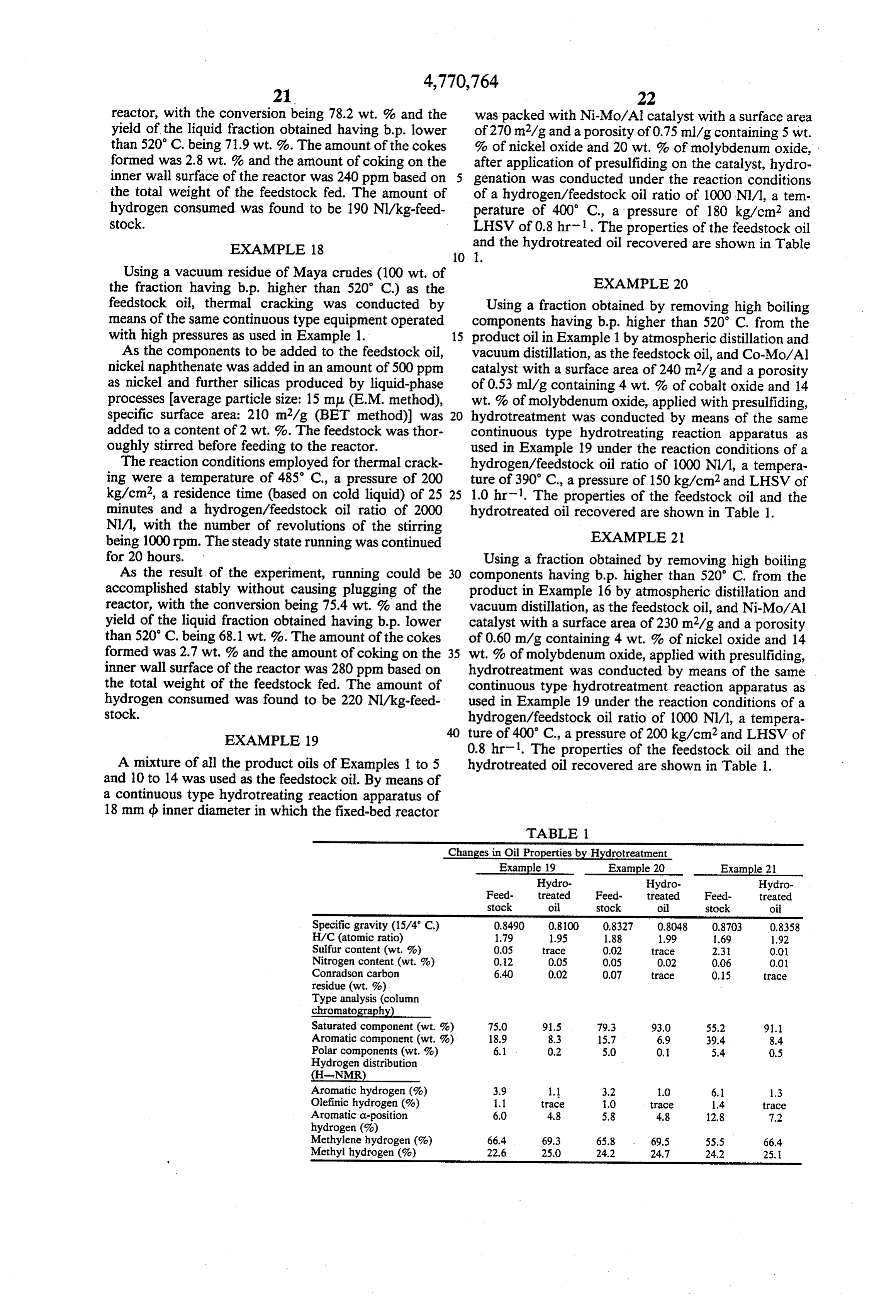
Page 14
EXAMPLE 22
Example 22. The results of the steam pyrolysis are given together with the yields of the main chemical starting
From the thermally cracked product removed of the materials (main gaseous olefins and monocyclic aromat gaseous components obtained in Example 1 using the ics) per feedstock in Table 2.
vacuum residue of Minus crudes as the feedstock, the 5 As apparently seen from the results in Examples 22 high boiling components having b.p. higher than 520 and 23 and Comparative examples 7 and 8, the method C. were removed according to atmospheric and vac of the present invention can be appreciated to be excel uum distillation. lent as the method for decomposing heavy hydrocar The fraction boiling at lower than 520C. was steam 10 bons to give starting materials to be supplied for steam pyrolyzed by means of a tubular heater type pyrolyzer pyrolysis, thus providing high yields of petrochemical under the conditions of an inlet temperature of 550 C, starting materials.
an outlet temperature of 830 C, an outlet pressure of EXAMPLE 24 0.8 kg/cm2G, a steam oil weight ratio of 1.0 and a resi dence time of 0.2 seconds to obtain olefins and monocy 15 From the thermally cracked product removed of the clic aromatics. gaseous components obtained in Example 15 using the The results of the steam pyrolysis are given together vacuum residue of Taching crudes as the feedstock, the with the yields of the main chemical starting materials high boiling components having b.p. higher than 520 (main gaseous olefins and monocyclic aromatics) per C. were removed according to atmospheric and vac feedstock of the vacuum residue of Minus crudes in 20 uum distillation.
Table 2. The fraction boiling at lower than 520C. was steam
EXAMPLE 23
pyrolyzed by means of a tubular heater type pyrolyzer under the conditions of an inlet temperature of 550' C.,
The hydrotreated oil removed of the gaseous compo an outlet temperature of 830 C, an outlet pressure of nents obtained in Example 20 using the Minus vacuum 25 0.8 kg/cm2G, a steam oil weight ratio of 1.0 and a resi residue as the starting material was subjected to steam dence time of 0.2 seconds to obtain olefins and monocy pyrolysis similarly as in Example 22 under the condi clic aromatics.
tions of an inlet temperature of 550 C., an outlet tem The results of the steam pyrolysis are given together perature of 830 C, an outlet pressure of 0.8 kg/cmG, 30 with the yields of the main chemical starting materials a steam/hydrotreated oil weight ratio of 1.0 and a resi (main gaseous olefins and monocyclic aromatics) per dence time of 0.2 seconds to obtain olefins and monocy feedstock in Table 2.
clic aromatics.
EXAMPLE 25
The results of the steam pyrolysis are given together with the yields of the main chemical starting materials 35 From the thermally cracked product removed of the (main gaseous olefins and monocyclic aromatics) per gaseous components obtained in Example 16 using the feedstock in Table 2. vacuum residue of Arabian light crudes as the feed
COMPARATIVE EXAMPLE 7
stock, the high boiling components having b.p. higher than 520 C. were removed by separation according to
The thermally cracked product obtained in stable atmospheric and vacuum distillation.
running in Comparative example 1, from which the The fraction boiling at lower than 520C. was steam gaseous components were removed, was subjected to pyrolyzed by means of a tubular heater type pyrolyzer atmospheric and vacuum distillation in the separation under the conditions of an inlet temperature of 550 C., step, and the fraction boiling at lower than 520' C. was an outlet temperature of 830 C, an outlet pressure of applied with the procedure of hydrotreating step and 45 0.8 kg/cm2G, a steam oil weight ratio of 1.0 and a resi steam pyrolysis step similarly as in Example in 20 and dence time of 0.2 seconds to obtain olefins and monocy 23, respectively. clic aromatics.
The results of the steam pyrolysis are shown together The results of the steam pyrolysis are given together with the yields of the main chemical starting materials with the yields of the main chemical starting materials (main gaseous olefins and monocyclic aromatics) in 50 (main gaseous olefins and monocyclic aromatics) per Table 2. feedstock in Table 2.
COMPARATIVE EXAMPLE 8 EXAMPLE 26
The thermal cracking step was practiced by using a 55 The hydrotreated oil removed of the gaseous compo vacuum residue of Minus crudes as the feedstock oil, the nents obtained in Example 21 using the vacuum residue same hydrotreating apparatus as in Example 19, Ni-W of Arabian light crudes as the feedstock was steam catalyst on 70 wt.% silica/30 wt.% alumina with a pyrolyzed by means of a tubular heater type pyrolyzer surface area of 230 m2/g and a porosity of 0.37 ml/g under the conditions of an inlet temperature of 550 C., containing 6 wt.% of nickel oxide and 19 wt.% of 60 an outlet temperature of 830 C, an outlet pressure of tungsten oxide, and also employing the conditions 0.8 kg/cm2G, a steam/hydrogenated oil weight ratio of under which the catalyst activity deterioration is not 1.0 and a residence time of 0.2 seconds to obtain olefins marked in initiation of running, namely a temperature of and monocyclic aromatics.
380 C., a reaction pressure of 200 kg/cm2G, LHSV of The results of the final step of subjecting the hydro 0.5 hr 1 and a hydrogen/feedstock oil ratio of 2000 65 genated oil to the steam pyrolysis are given together NI/l. The yield of the liquid fraction boiling at lower with the yields of the main chemical starting materials than 520' C. was only 16.5 wt.%. The resultant liquid (main gaseous olefins and monocyclic aromatics) per fraction was subjected to the same steam pyrolysis as in feedstock in Table 2.
Page 15
TABLE 2
Results of Steam Pyrolysis and Yields of Main Chemical Starting Materials per Feedstock
Example Example Comparative Comparative Example Example Example 22 23 example 7 example 8 24 25 26
Yield Hydrogen 0.7 0.8 0.8 0.7 0.7 0.7 0.9 of Methane 10.4 0.6 10.6 9. 9.7 9.0 11.0 Main Ethylene 28. 32.0 30.8 31.2 29.2 23.0 28.9 Products Propylene 14.2 15.8 15. 15.5 13.8 0.7 14. (wt.%) Butadiene 5.1 7.4 6.8 7.0 6.1 5.0 7.2 Monocyclic aromatics (C6-C8) 11.1 12.4 9.8 13.2 0.2 8.6 14.7 Cracked gasoline (C5-200 C.) 17.3 19.7 8.8 20.1 16.6 13.8 21.7 Heavy oil (higher than 200 C.) 16.9 6.2 7.1 5.8 5.8 32.3 8.2 Yield of main chemical starting materials 58.5 67.6 62.5 66.9 59.3 47.3 64.9 (wt.%) (1) -
Yield of thermally cracked oil boiling at lower 74.2 74.2 34.1 16.5 76.0 68.9 68.9 than 520' C. in the thermal cracking step
Yield of hydrotreated oil in the hydro- wn 99.3 99.5 O -- 99.0 treating step (wt.%) (3)
Yield of main chemical starting materials 43.4 49.8 21.2 11.0 45.1 32.6 44.3 per feedstock (wt.%) (4)
Note (1) Yield of main chemical starting materials = Ethylene yield + Propylene yield -- Butadiene yield + Monocyclic aromatics (C6-C3) yield (4) Yield of main chemical starting materials per feedstock = (1) x (2) X (3)
Each of the hydrotreated oil removed of gaseous
EXAMPLES 27-30 components was subjected to steam pyrolysis similarly The thermally cracked product obtained in Examples 25 as in Example 22.
11, from which the gaseous components were removed, The results of the steam pyrolysis are given together in the case of Example 27, with the yields of the main chemical starting materials the thermally cracked product obtained in Examples (main gaseous olefins and monocyclic aromatics) per 12, from which the gaseous components were removed, vacuum residue of Minus crudes which is the starting in the case of Example 28, 30 material in Table 3.
TABLE 3
Results of Steam Pyrolysis and Yields of Main Chemical Starting
Materials per Feedstock
Example 27 Example 28 Example 29 Example 30
Yields Hydrogen 0.7 0.7 0.8 0.8 of Methane 10.0 9.6 10.8 9.9 Main Ethylene 33.2 33.8 31.0 32.1 Products Propylene 16.2 16.1 15.2 16.0 (wt.%) Butadiene 7.8 7.8 7.9 7.5 Monocyclic aromatics (C6-C8) 10.5 10.3 12.7 11.8
Cracked gasoline (C5-200' C.) 17.9 16.6 18.5 19.3
Heavy oil (higher than 200' C.) 7.5 6.5 8.0 7.7
Yield of main chemical starting materials 67.7 68.0 66.8 67.4
Yield of thermally cracked oil boiling at lower 75.6 74.9 75.4 69.7 than 520' C. in the thermal cracking step
Yield of hydrotreated oil in the hydrotreating step 99.4 99.3 99.2 99.4
Yield of main chemical starting materials per 50.9 50.6 50.0 46.7 feedstock (wt.%) (4)
Note (1) Yield of main chemical starting materials = Ethylene yield -- Propylene yield -- Butadiene yield -- Monocyclic aromatics (C6-C8) yield (4) Yield of main chemical starting materials per feedstock = (1) x (2) X (3)
the thermally cracked product obtained in Example 55 EXAMPLES 31 and 32 13, from which the gaseous components were removed, Using an atmospheric residue of Minus crudes (100 in the case of Example 29, wt.% of fraction having b.p. higher than 343 C., 45 wt. the thermally cracked product obtained in Examples % of fraction having b.p. higher than 520 C.) as the 14, from which the gaseous components were removed, feedstock, thermal cracking was conducted by means of in the case of Example 30, were each employed as the 60 the same continuous type equipment operated with high hydrocarbon oil converted to lighter products in the pressures as in Example 1.
respective thermal cracking steps, and each oil was As the two kinds of the components to be added to subjected to atmospheric and vacuum distillations in the the feedstock oil in thermal cracking, there were added respective separation steps for removal of the compo- molybdenum naphthenate in an amount of 100 ppm as nents having b.p. higher than 520 C. 65 molybdenum and oil furnace carbon black average
Each of the hydrocarbon oils stripped of the high particle size: 15 mu (E.M. method), specific surface boiling components with b.p. higher than 520 C. was area: 200 m2/g (BET method) in an amount of 2 wt.%, subjected to hydrotreatment similarly as in Example 20, respectively, in the case of Example 31; and an aqueous
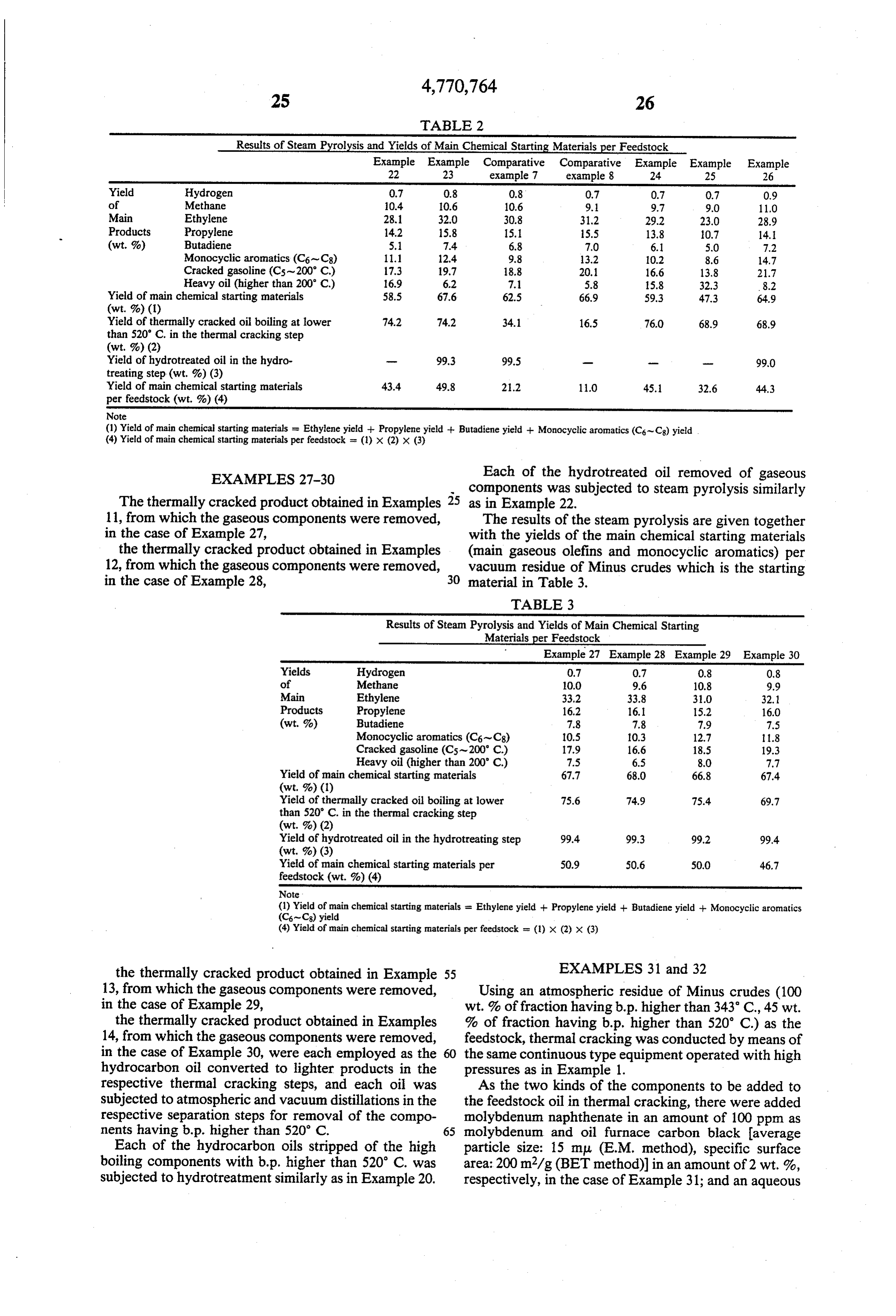
Page 16
solution of ammonium molybdenate dissolved in water a hydrogen/feedstock oil ratio of 2000 N1/1, with the in an amount of 500 ppm as molybdenum to form an number of revolutions of the stirrer of 1000 rpm. emulsion, to which was further added an alumina pro The thermally cracked products freed of gaseous duced by the vapor-phase processes average particle components were each subjected to atmospheric and size: 20 mp. (E.M. method), specific surface area: 100 5 vacuum distillations in the respective separation step for m2/g (BET method) in an amount of 3 wt. in the case removal of high boiling components with b.p. higher
of Example 32.
The thermal cracking conditions were, in each case, a Using the fraction boiling at lower than 520 C. ob temperature of 490 C., a presence of 150 kg/cm, a tained as the feedstock oil, hydrotreatment was con residence time (based on cold liquid) of 18 minutes and O ducted by means of the same continuous type hydro a hydrogen/feedstock ratio of 1500 N1/1, with the num treating reaction apparatus and fixed-bed catalyst as in ber of revolutions of the stirrer of 1000 rpm. Example 19 under the conditions of a hydrogen/feed The thermally cracked products freed of gaseous stock oil ratio of 1000 N/1, a temperature of 395 C., a components were each subjected to atmospheric and pressure of 180 kg/cm2 and LHSV of 0.8 hr-1. vacuum distillations in the respective separation step 15 The hydrotreated oil recovered was steam pyrolyzed similarly as in Example 20 for removal of high boiling by means of a tubular heater type pyrolyzer under the components with b.p. higher than 520' C., and the frac conditions of an inlet temperature of 550 C., an outlet tion boiling at lower than 520' C. was steam pyrolyzed temperature of 830 C., an outlet pressure of 0.8 to obtain olefins and monocyclic aromatics. kg/cm2G, a steam/hydrogenated oil weight ratio of 1.0 The results of steam pyrolysis of Example 31 and 32 20 and a residence time of 0.2 seconds to obtain olefins and are set forth in Table 4, together with the yields of the monocyclic aromatics.
main chemical starting materials (main gaseous olefins The results of steam pyrolysis of Examples 33 and 34 and monocyclic aromatics). are set forth in Table 4, together with the yields of the
EXAMPLES 33 AND 34
main chemical starting materials (main gaseous olefins 25 and monocyclic aromatics).
TABLE 4
Results of Steam Pyrolysis and Yields of Main Chemical Starting
Materials per Feedstock
Example 31 Example 32 Example 33 Example 34
Yields Hydrogen 0.7 0.7 0.7 0.8 of Methane 10,3 10.1 11.3 11.6 Main Ethylene 29.4 28.5 30.5 31.0 Products Propylene 14.9 15.0 16.7 14.7 (wt.%) Butadiene 5.2 5.5 6.8 7.0 Monocyclic aromatics (C6-C8) 9.8 10.0 3.0 12.1 Cracked gasoline (C5-200' C.) 16.4 16.8 21.8 19.5 Heavy oil (higher than 200' C.) 19.2 18.8 8.8 9.2 Yield of main chemical starting materials 59.3 59.0 67.0 64.8
Yield of thermally cracked oil boiling at lower 85.3 84.5 84.5 84.7 than 520' C. in the thermal cracking step
Yield of hydrotreated oil in the hydrotreating step - - 99.1 99.1
Yield of main chemical starting materials per 50.6 49.9 56.1 544 feedstock (wt.%) (4)
Note (1) Yield of main chemical starting materials = Ethylene yield - Propylene yield -- Butadiene yield -- Monocyclic aromatics (4) Yield of main chemical starting materials per feedstock = (1) x (2) x (3)
Using an atmospheric residue of Arabian light crudes What is claimed is:
(100 wt.% of fraction having b.p. higher than 343 C, 50 1. A process for converting a heavy hydrocarbon 46 wt.% of fraction having b.p. higher than 520' C.) as containing a fraction having a boiling point higher than the feedstock, thermal cracking was conducted by 520 C. into a more valuable product which comprises: means of the same continuous type equipment operated adding to the heavy hydrocarbon an oil-soluble tran with high pressures as in Example 1. sition metal compound and separately adding an As the two kinds of the components to be added to 55 ultra-fine powder selected from the group consist the feedstock oil in thermal cracking, there were added ing of fine ceramics and carbonaceous substances iron pentacarbonyl in an amount of 800 ppm as iron and which can be suspended in a hydrocarbon and has channel carbon black average particle size: 14 mu an average paticle size within the range of from 5 (E.M. method), specific surface area: 300 m2/g (BET to 1000 mu;
method) in an amount of 2 wt.%, respectively, in the 60 cracking the heavy hydrocarbon in the presence of a case of Example 33; and cobalt resinate in an amount of hydrogen gas or a hydrogen sulfide-containing 300 ppm as cobalt and thermal carbon black-average hydrogen gas; and particle size: 80 mu (E.M. method), specific surface recovering the resulting lighter hydrocarbon oil. area: 15 m/g (BET method) in an amount of 6 wt.% 2. A process for converting a heavy hydrocarbon in the case of Example 34. 65 containing a fraction having a boiling point higher than The thermal cracking conditions were, in each case, a 520 C. into a more valuable product which comprises: temperature of 470 C., a pressure of 200 kg/cm2, a dissolving an oil-soluble transition metal compound residence time (based on cold liquid) of 30 minutes and in an oil;
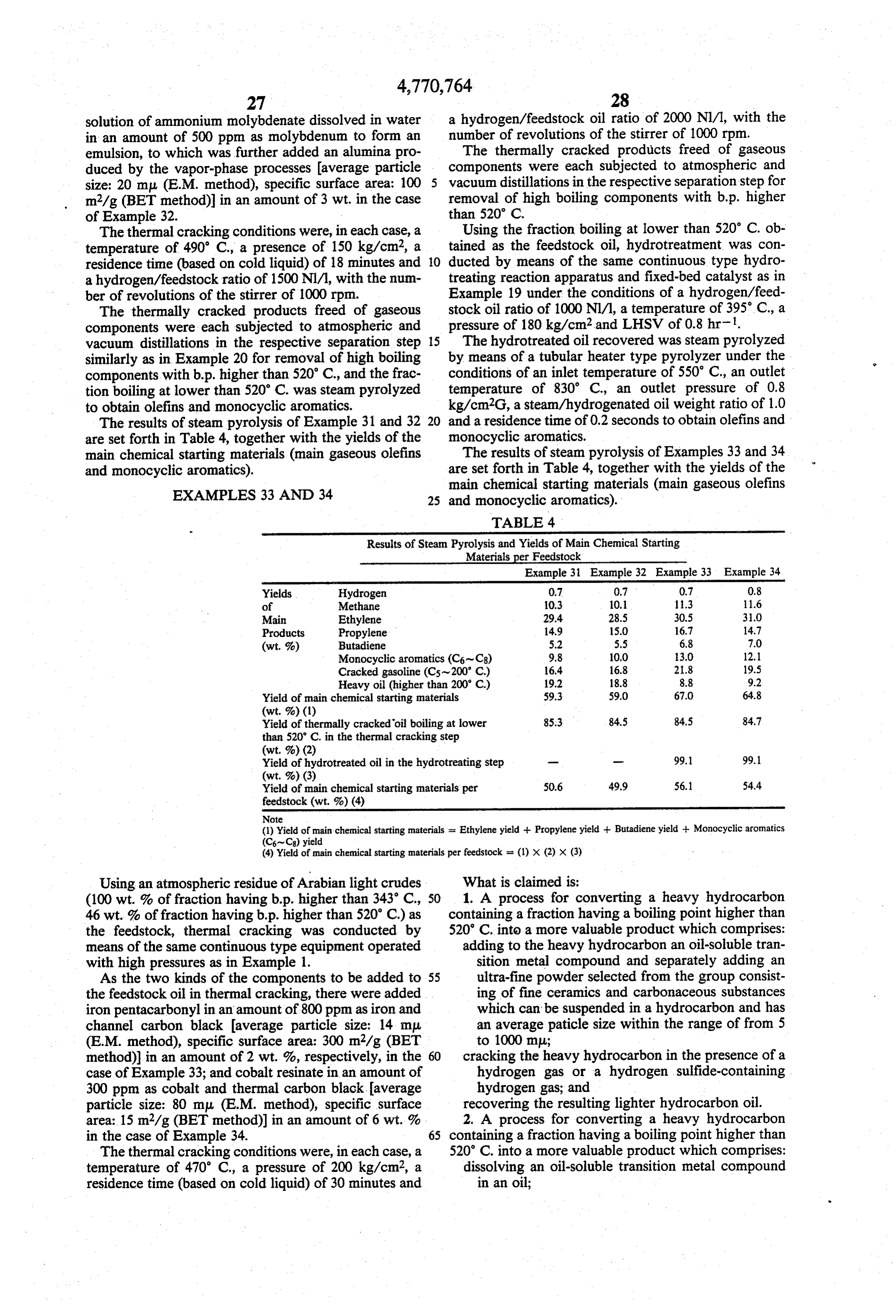
Page 17
dispersing an ultra-fine powder selected from the hydrogen gas and recovering the resulting lighter group consisting of fine ceramics and car hydrogen oil;
bonaceouus substances having an average particle (C) removing a fraction having a high boiling point size within the range of from 5 to 1000 mu in the oil from the lighter hydrocarbon oil; solution; 5 (D) hydrotreating at least a portion of said lighter heating the dispersion at the decomposition tempera hydrocarbon oil under hydrotreating conditions ture of the transition metal compound in the pres and recovering the resulting hydrotreated oil; and ence of a hydrogen gas or a hydrogen sulfide-con (E) pyrolyzing at least a portion of said hydrotreated taining hydrogen gas; oil with steam, and recovering a gaseous olefins separating a solid from the dispersion; O product and a monocylic aromatics product.
adding the solid to a heavy hydrocarbon;
cracking the heavy hydrocarbon in the presence of a wholeThe 5.
process according to claim 4, wherein the part of a solid which is separated and recov hydrogen gas or a hydrogen sulfide-containing ered from the lighter hydrocarbon oil obtained in step hydrogen gas; and recovering the resulting lighter hydrocarbon oil. 15 (B) or the fraction having a high boiling point removed 3. A process for converting a heavy hydrocarbon in step (C) is recycled to step (B).
containing a fraction having a boiling point higher than whole 6. The process according to claim 4, wherein the 520' C. into a more valuable product which comprises: point removed or a part of the fraction having a high boiling (A) adding to a heavy hydrocarbon in step (C) is recycled to step (B). 7. A process (i) an oil-soluble transition metal compound and an containing a fraction 20 for converting a heavy hydrocarbon ultra-fine powder selected from the group con having a boiling point higher than sisting of fine ceramics and carbonaceous sub 520 C. into a more valuable product which comprises: stances which can be suspended in a hydrocar (A) adding to a heavy hydrocarbon bon and has an average particle size within the (i) an oil-soluble transition metal compound and an range from 5 to 1000 mu, separately; 25 ultra-fine powder selected from the group con (ii) a solid prepared by dissolving an oil-soluble sisting of fine ceramics and carbonaceous sub transition metal compound in an oil; dispersing stances which can be suspended in a hydrocar an ultra-fine powder selected from the group bon and has an average particle size within the consisting of fine ceramics and carbonaceous range of from 5 to 1000 mp separately; or substances having an average particle size within 30 (ii) a solid prepared by dissolving an oil-soluble the range of from 5 to 1000 mu in the oil solu transition metal compound in an oil; dispersing tion; and heating the dispersion at the decompo an ultra-fine powder selected from the group sition temperature of the transition metal com consisting of fine ceramics and carbonaceous pound in the presence of a hydrogen gas or a substances having an average particle size within hydrogen sulfide-containing hydrogen gas; 35 the range of from 5 to 1000 mu in the oil solu (B) cracking the heavy hydrocarbon in the presence tion; and converting the dispersion to a solid by of a hydrogen gas or a hydrogen sulfide-containing heating the dispersion at the decomposition tem hydrogen gas and recovering the resulting lighter perature of the transition metal compound in the hydrocarbon oil; presence of a hydrogen gas or a hydrogen sul (C) removing a fraction having a high boiling point fide-containing hydrogen gas; from the ligher hydrocarbon oil; and (B) cracking the heavy hydrocarbon in the presence (D) pyrolyzing at least a portion of said lighter hy of a hydrocarbon gas or a hydrogen sulfide-con drocarbon oil with steam, and recovering a gaseous taining hydrogen gas and recovering the resulting olefins product and a monocyclic aromatic prod lighter hydrocarbon oil; and
4. A process for converting a heavy hydrocarbon (C) hydrotreating at least a portion of said lighter containing a fraction having a boiling point higher than hydrocarbon oil under hydrotreating conditions and recovering the resulting hydrotreated oil.
520C. into a more valuable product which comprises: 8. A process for converting a heavy hydrocarbon (A) adding to a heavy hydrocarbon (i) an oil-soluble transition metal compound and an 50 520 C. intoa afraction containing more having a boiling point higher than valuable product which comprises:
ultra-fine powder selected from the group con (A) adding to a heavy hydrocarbon sisting of fine ceramics and carbonaceous sub (i) an oil-soluble transition metal compound and an stances which an be suspended in a hydrocarbon and has an average particle size within the range ultra-fine powder selected from the group con of from 5 to 000m, separately; or 55 sisting of fine ceramics and carbonaceous sub (ii) a solid prepared by dissolving an oil-soluble stances which can be suspended in a hydrocar transition metal compound in an oil; dispersing bon and has an average particle size within the an ultra-fine powder selected from the group range of from 5 to 1000 mu separately; or consisting of fine ceramics and carbonaceous (ii) a solid prepared by dissolving an oil-soluble substances having an average particle size within 60 transition metal compound in an oil; dispersing the range of from 5 to 1000 mu in the oil solu an ultra-fine powder selected from the group tion; and converting the dispersion to a solid by consisting of fine ceramics and carbonaceous heating the dispersion at the decomposition tem substances having an average particle size within perature of the transition metal compound in the the range of from 5 to 1000 mu in the oil solu pressure of a hydrogen gas or a hydrogen sul 65 tion; and heating the dispersion at the decompo fide-containing hydrogen gas; sition temperature of the transition metal com (B) cracking the heavy hydrocarbon in the presence pound in the presence of a hydrogen gas or a of a hydrogen gas or a hydrogen sulfide-containing hydrogen sulfide-containing gas;
Page 18
(B) cracking the heavy hydrocarbon in the presence 10. A process for converting a heavy hydrocarbon of a hydrogen sulfide-containing hydrogen gas and into a more valuable product as claimed in claim 2 recovering the resulting lighter hydrocarbon oil; wherein the ultrafine power has an average particle size (C) removing a fraction having a high boiling point within the range from 10 to 50 nu. from the lighter hydrocarbon oil; and 11. The process according to claim 3, wherein the (D) hydrotreating at least a portion of said lighter whole or a part of a solid which is separated and recov ered from the lighter hydrocarbon oil obtained in step hydrocarbon oil under hydrotreating conditions (B) or the fraction having a high boiling point removed and recovering the resulting hydrotreated oil. in step (C) is recycled to step (B). 9. A process for converting a heavy hydrocarbon into O 12. The process according to claim 3, wherein the a more valuable product as claimed in claim 1 wherein whole or a part of the fraction having a high boiling the ultrafine power has an average particle size within point removed in step - (C) is recycled to step (B). the range from 10 to 50 mu,
Provenance
- Collection
- Cited prior art
- Original PDF
- patentimages.storage.googleapis.com →
- Filed
- 1986-11-18
- Pages
- 18
- Method
- pdftotext (the PDF's own text layer) + pdftoppm 300dpi page scans
- Source
- Google Patents bibliographic record
- Granted
- 1988-09-13
- Inventors
- Nobumitsu Ohtake; Koji Kuri; Asahi Kasei Kogyo KK
- Transcribed from
- patentimages.storage.googleapis.com →