patent · US2692274
Process for catalytic reduction of carbon dioxide with hydrogen
19 October 1954
Page 1
Patented Oct. 19, 1954 2,692,274
UNITED STATES PATENT OFFICE
PROCESS FOR CATALYTICREDUCTION OF
. . - CARBON DOXIDE WITH HYDROGEN
4. Herbert-KöEbel, Homberg (Niederrhein), Kreis
Moers, and Paul Ackermann, Moers, Kreis
Meers, Germany, assignors to Rheinpreussen
Aktiengeselschaft fir Bergbau und Chemie, : Homberg (Niederrhein), Germany, a German corporation - No Drawing. Application May 4, 1950,
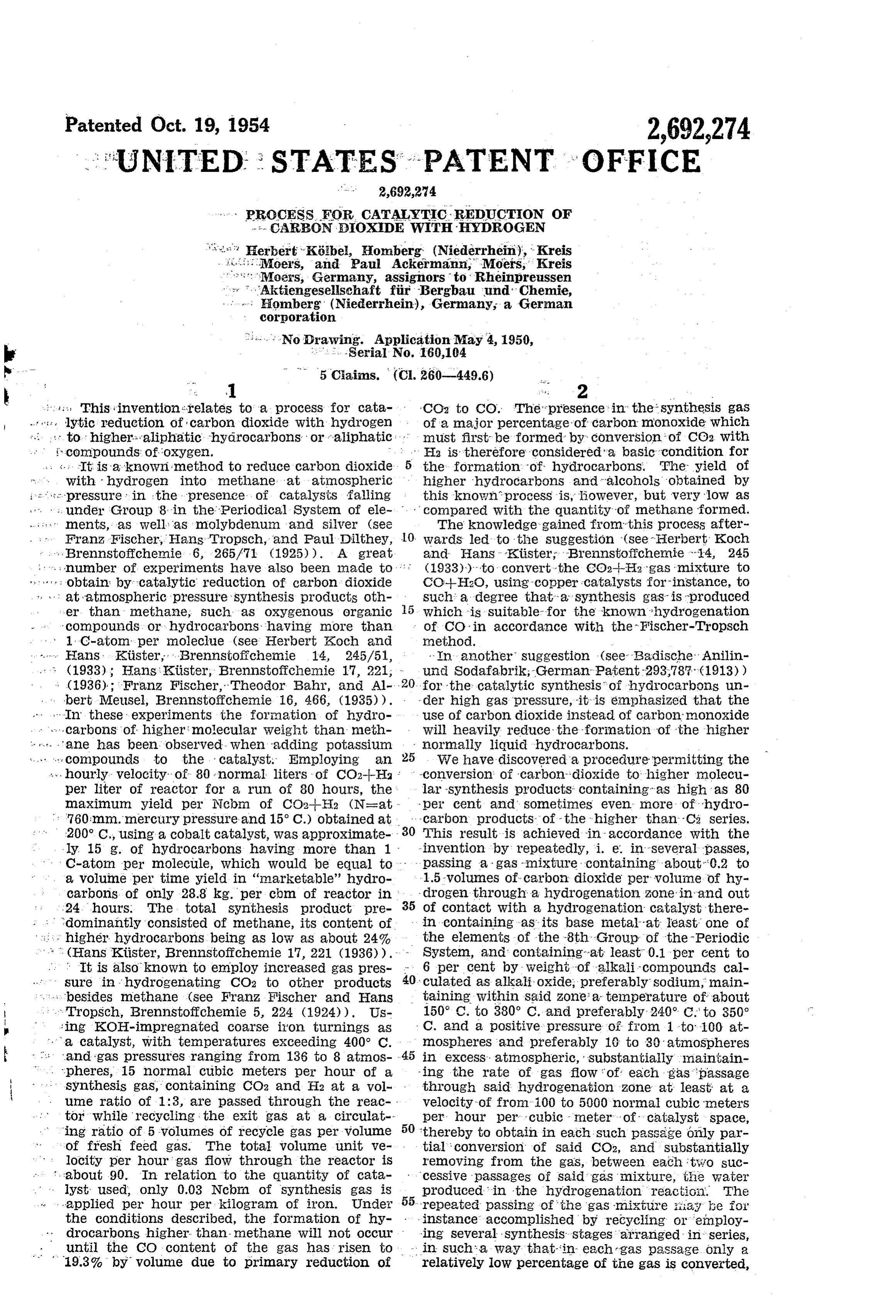
; ; ; ; ; ; This invention :-relates to a process for cata CO2 to CO. The presence in the synthesis gaS lytic reduction of carbon dioxide with hydrogen of a major percentage of carbon monoxide which : . . . . to higher- aliphatic hydrocarbons or *-aliphatic : : must first beformed by conversion of CO2 with :- compounds of oxygen. H2 is therefore considered a basic condition for s. It is a kaowninethod to reduce carbon dioxide the formation of hydrocarbons. The yield of with hydrogen into methane at atmospheric higher hydrocarbons and alcohols obtained by *:::pressure in the presence of catalysts falling this known process is, iowever, but very low as . . under Group 8 in the Periodical System of ele • compared with the quantity of methane formed. : ments, as well: as molybdenun and silver (See The knowledge gained from this process after Franz Fischer, Hans Tropsch, and Paul Dilthey, 0, wards led to the suggestion (see Herbert Koch - Brennstoffchemie 6, 265/71 (1925)). A great and Hans Ktister Brennstoffchennie stiá, 245 : -. number of experiments have also been inade to (1933) ) - to convert the CO2-i-H2 gas mixture to ; : obtain by catalytic reduction of carbon dioxide CO-H2O, using copper catalysts for instance, to ; : at atmospheric preSSure Synthesis products oth such a degree that a synthesis gas is produced er... than methane, Such as oxygenous Organic 5 which is suitable for the known hydrogenation compounds, or hydrocarbons having more than of CO in accordance with the Fischer-TropSch 1, C-aton, per moleclue (see Herbert Koch and method.
1. -- Hans:Ktister, . Brennstoffchenie 14, 24.5/51, -In another suggestion (see: Ba dische Anilin (1933); Hans Kister, Brennstoffchennie 17, 221; - und. Sodafabrik, German Patent:293.78 (1913) ) ; (1936); Franz Fischer, Theodor Bahr, and Al 20, . for the catalytic synthesis" of hydrocarbons un bert Metusel, Brennstoffchenie 16, 466, (1935)). - der high gas pressure, it is enphasized that the In these . . experiments the forination of hydro - use of carbon dioxide instead of carbon monoxide c. . . Carbons of higher; molecular Weight than neith will heavily reduce the formation of the higher - ane has been observed. When adding potassium normally liquid hydrocarbons. compounds to the catalyst. Employing an We have discovered a procedure permitting the ... hourly velocity of 80 normal liters of CO2-i-Ha conversion of carbon dioxide to higher molecu per liter of reactor for a run of 80 hours, the lar synthesis products containing" as high as 80 maximum yield per Nebm of CO2--12 (N=at per cent and sometimes even more of hydro 760 mm. mercury pressure and 15° C.) obtained at -carbon products of the -higher than C2 series. 200° C., using a cobalt catalyst, was approximate 30 This result is achieved in accordance with the ly 15 g. of hydrocarbons having more than 1 : -invention by repeatedly, i. e. in several passes, C-atom per molecule, which would be equal to : paSSing a gas imixture containing about *0.2 to a volume per time yield in “marketable' hydro - 1.5-volumes of carbon dioxide per volume of hy carbons of only 28.8 kg. per cbm of reactor in drogen through a hydrogenation Zone in and out 24 hours. The total Synthesis product pre 35 Of contact with a hydrogenation catalyst there dominantly consisted of methane, its content of in containing as its base metal at least one of higher hydrocarbons being as low as about 24% the elements of the 8th Group of the Periodic * - (Hans Kister, Brennstoffchemie 17, 221 (1936)). System, and containing at least 0.1 per cent to It is also known to employ increased gas pres 6 per cent by Weight of alkali-compounds cal Sure in hydrogenating CO2 to other products 40 culated as alkali oxide; preferably sodium, main ... besides methane (see Franz Fischer and Hans taining within said Zone a temperature of about : ... TropSch, Brennstoffchemie 5, 224 (1924)). US 150° C. to 380° C. and preferably. 240° C. to 350 *ing KOH-impregnated coarse iron turnings as : C. and a positive pressure of from 1 to 100 at a catalyst, with temperatures exceeding 400° C. mospheres and preferably 10 to 30 atmospheres and gaS preSSures ranging from 136 to 8 atmos .45 in exceSS. atmospheric, 'Substantially maintain pheres, 15 normal cubic meters per hour of a -ing the rate of gas flow of each gas passage Synthesis gas, Containing CO2 and H2 at a wol through said hydrogenation zone at least at a unne ratio of 1:3, are paSSed through the reac Velocity of from 100 to 5000 normal cubic meters tor While recycling the exit gas at a circulat per hour per cubic meter of catalyst space, ing ratio of 5 volumes of recycle gas per volume 50 "thereby to obtain in each such passage only par of fresh feed gas. The total volume unit ve tial conversion of said CO2, and substantially locity per hour gas flow through the reactor is removing from the gas, between each two suc * , about 90. In relation to the quantity of cata ceSSive passages of said gas mixture, the water lyst used, only 0.03 Ncbm of synthesis gas is produced in the hydrogenation reactigin. The applied per hour per kilogram of iron. Under 55. repeated passing of the gas mixture ; ;ay be for the conditions described, the formation of hy instance accomplished by recycling or employ drocarbons higher, than-nethane will not occur ing Several Synthesis stages arranged in series, until the CO content of the gas has risen to - in Such a way that-in each gas passage only a 19.3% by volume due to primary reduction of relatively low percentage of the gas is converted,
Page 2
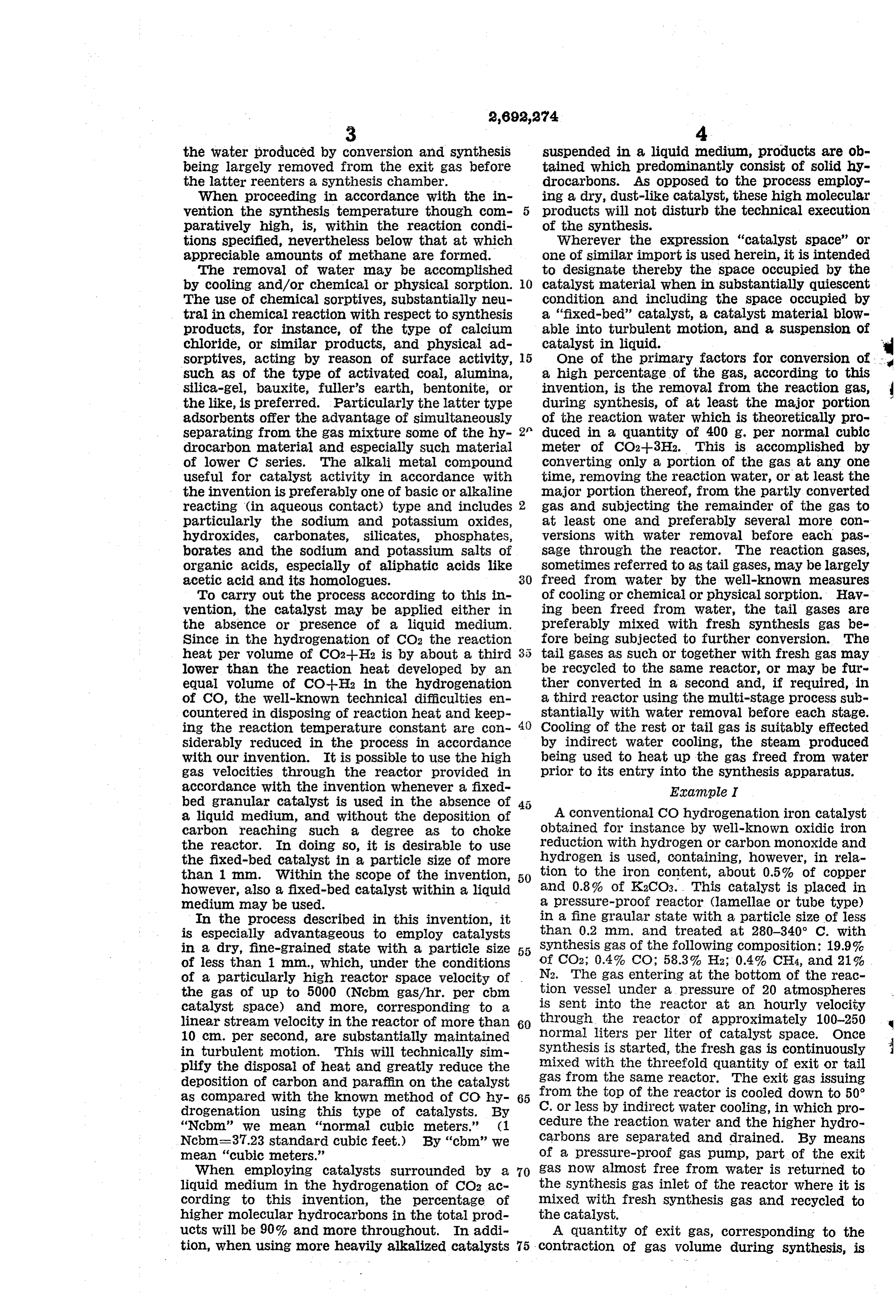
the water produced by conversion and synthesis suspended in a liquid medium, products are ob being largely removed from the exit gas before tained which predominantly consist of solid hy the latter reenters a synthesis chamber. drocarbons. AS Opposed to the proceSS employ When proceeding in accordance with the in ing a dry, dust-like catalyst, these high molecular vention the Synthesis temperature though Com products will not disturb the technical execution paratively high, is, Within the reaction condi of the Synthesis.
tions specified, nevertheless below that at which Wherever the expression 'catalyst space' or appreciable amounts of methane are formed. one of similar import is used herein, it is intended The removal of Water may be accomplished to designate thereby the Space Occupied by the by cooling and/or chemical or physical sorption. O catalyst material when in Substantially quiescent The use of chemical sorptives, substantially neu Condition and including the Space Occupied by tral in chemical reaction with respect to synthesis a "fixed-bed' catalyst, a catalyst material blow products, for instance, of the type of calcium able into turbulent motion, and a Suspension of chloride, or similar products, and physical ad catalyst in liquid.
Sorptives, acting by reaSon of Surface activity, 15 One of the primary factors for conversion of Such as of the type of activated coal, alumina, a high percentage of the gas, according to this silica-gel, bauxite, fuller's earth, bentonite, or invention, is the removal from the reaction gas, the like, is preferred. Particularly the latter type during Synthesis, of at least the major portion adsorbents offer the advantage of simultaneously of the reaction water which is theoretically pro Separating from the gas mixture some of the hy duced in a quantity of 400 g. per normal cubic drocarbon material and especially such material meter of CO2-3H2. This is accomplished by of lower C. Series. The alkali metal compound converting only a portion of the gas at any one useful for catalyst activity in accordance with time, removing the reaction water, or at least the the invention is preferably one of basic or alkaline major portion thereof, from the partly converted reacting (in aqueous contact) type and includes gas and Subjecting the remainder of the gas to particularly the Sodium and potassium oxides, at least One and preferably several more con hydroxides, carbonates, silicates, phosphates, versions with water removal before each pas borates and the sodium and potassium salts of Sage through the reactor. The reaction gases, organic acids, especially of aliphatic acids like Sometimes referred to as tail gases, may be largely acetic acid and its homologues. 30 freed from Water by the well-known measures To carry out the process according to this in of cooling or chemical or physical sorption. Hav vention, the catalyst may be applied either in ing been freed from Water, the tail gases are the absence or presence of a liquid medium. preferably mixed with fresh synthesis gas be Since in the hydrogenation of CO2 the reaction fore being Subjected to further conversion. The heat per volume of CO2--H2 is by about a third tail gases as Such or together with fresh gas may lower than the reaction heat developed by an be recycled to the same reactor, or may be fur equal volume of CO--H2 in the hydrogenation ther converted in a second and, if required, in of CO, the well-known technical difficulties en a third reactor using the multi-stage process sub Countered in disposing of reaction heat and keep stantially with water removal before each stage. ing the reaction temperature constant are con 40 Cooling of the rest or tail gas is suitably effected siderably reduced in the process in accordance by indirect water cooling, the steam produced With Our invention. It is possible to use the high being used to heat up the gas freed from water gas velocities through the reactor provided in prior to its entry into the synthesis apparatus. accordance with the invention whenever a fixed Eacample I bed granular catalyst is used in the absence of a liquid medium, and without the deposition of A conventional CO hydrogenation iron catalyst carbon reaching such a degree as to choke obtained for instance by well-known oxidic iron the reactor. In doing so, it is desirable to use reduction with hydrogen or carbon monoxide and the fixed-bed catalyst in a particle size of more hydrogen is used, containing, however, in rela than 1 mm. Within the scope of the invention, 50 tion to the iron content, about 0.5% of copper however, also a fixed-bed catalyst within a liquid and 0.8% of K2CO3. This catalyst is placed in medium may be used. a pressure-proof reactor (lamellae or tube type) In the process described in this invention, it in a fine graular state with a particle size of less is especially advantageous to employ catalysts than 0.2 mm. and treated at 280–340° C. with in a dry, fine-grained state with a particle size 55 Synthesis gas of the following composition: 19.9% of less than 1 mm., which, under the conditions of CO2, 0.4% CO; 58.3% H2; 0.4% CH4, and 21% of a particularly high reactor space velocity of N2. The gas entering at the bottom of the reac the gas of up to 5000 (Ncbm gas/hr. per cbm tion vessel under a pressure of 20 atmospheres catalyst Space) and more, corresponding to a is Sent into the reactor at an hourly velocity linear Stream Velocity in the reactor of more than 60 through the reactor of approximately 100-250 normal liters per liter of catalyst space. Once 10 cm. per second, are substantially maintained Synthesis in turbulent motion. This will technically sim is Started, the fresh gas is continuously plify the disposal of heat and greatly reduce the mixed with the threefold quantity of exit or tail deposition of carbon and paraffin on the catalyst gas from the same reactor. The exit gas issuing as compared with the known method of CO hy 65 from the top of the reactor is cooled down to 50° drogenation using this type of catalysts. By C. or less by indirect water cooling, in which pro "Ncbm' we mean 'normal cubic meters.' (1. cedure the reaction water and the higher hydro Nchm=37.23 standard cubic feet.) By “com' we carbons are separated and drained. By means of a pressure-proof gas pump, part of the exit mean 'cubic meters.'
When employing catalysts surrounded by a 70 gas now almost free from water is returned to liquid medium in the hydrogenation of CO2 ac the Synthesis gas inlet of the reactor where it is cording to this invention, the percentage of mixed with fresh Synthesis gas and recycled to higher molecular hydrocarbons in the total prod the catalyst, lucts will be 90% and more throughout. In addi A quantity of exit gas, corresponding to the tion, when using more heavily alkalized catalysts 75 contraction of gas volume during synthesis, is
Page 3
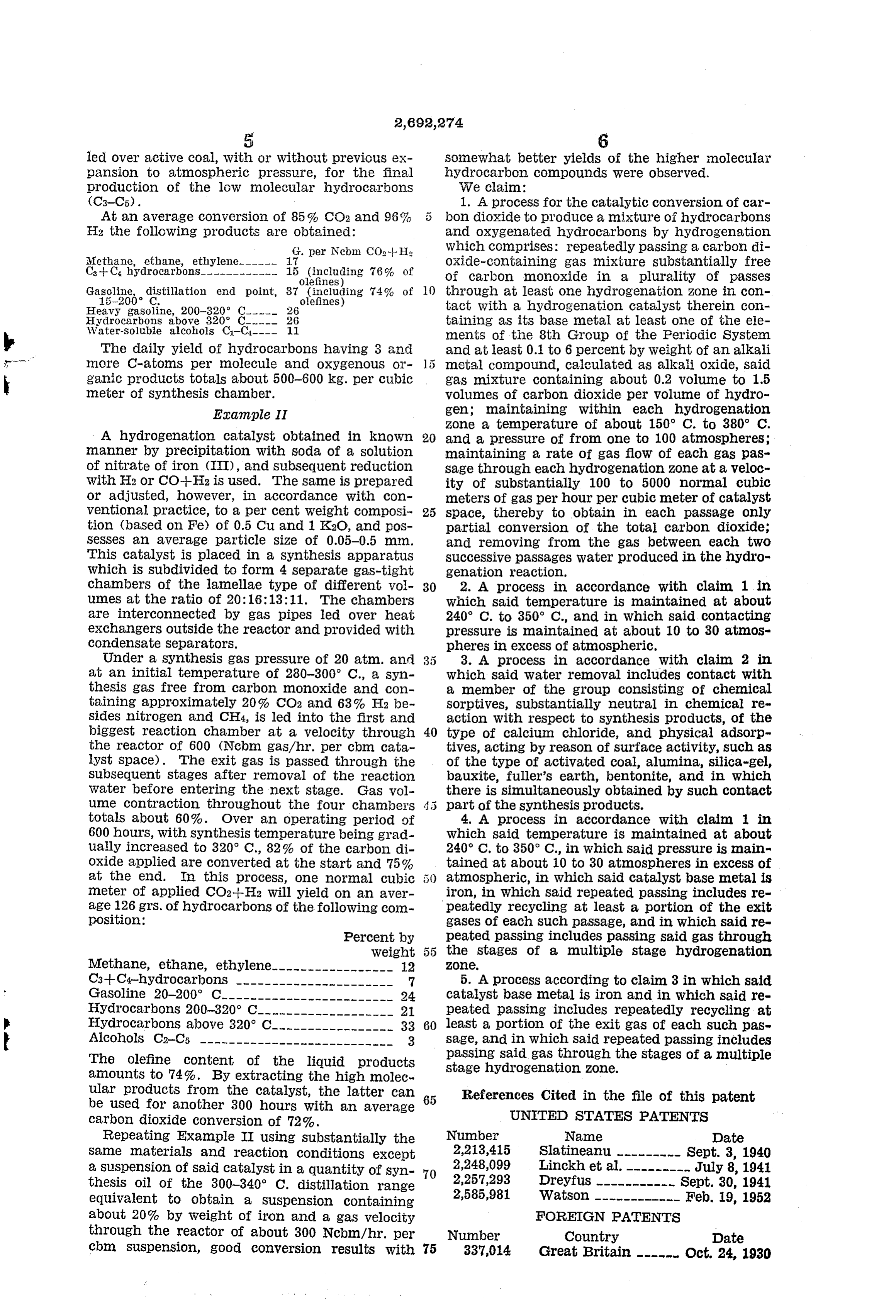
led over active coal, with or without previous ex Somewhat better yields of the higher molecular pansion to atmospheric pressure, for the final hydrocarbon compounds were observed. production of the low molecular hydrocarbons We claim:
(C3-C5). 1. A proceSS for the catalytic conversion of car At an average conversion of 85% CO2 and 96% s bOn dioxide to produce a mixture of hydrocarbons Ha the following products are obtained: and OXygenated hydrocarbons by hydrogenation G. per Ncon COe--He Which comprises: repeatedly passing a carbon di
Methane, ethane, ethylene------ .
Cs--C4 hydrocarbons------------ 15 (including 76% of
Oxide-containing gas mixture substantially free olefines) of carbon monoxide in a plurality of passes
Gasoline, distillation end point, 37 (including 74% of O through at least one hydrogenation zone in con 3660 C. olefines) tact with a hydrogenation catalyst therein con
Hydrocarbons above 320 C- 26 taining as its base metal at least one of the ele Water-soluble alcohols C-C4---- 11 ments of the 8th Group of the Periodic System The daily yield of hydrocarbons having 3 and and at least 0.1 to 6 percent by weight of an alkali more C-atoms per molecule and oxygenous Or metal compound, calculated as alkali Oxide, Said ganic products totals about 500-600 kg. per cubic gas mixture containing about 0.2 volume to 1.5 meter of Synthesis chanber. volumes of carbon dioxide per Volume of hydro Eacample II gen; maintaining Within each hydrogenation
Zone a temperature of about 150° C. to 380° C.
A hydrogenation catalyst obtained in known 20 and a pressure of from one to 100 atmospheres; manner by precipitation with Soda of a solution maintaining a rate of gas flow of each gas paS of nitrate of iron (III), and Subsequent reduction Sage through each hydrogenation ZOne at a Veloc With H2 or CO--H2 is used. The same is prepared ity of substantially 100 to 5000 normal cubic or adjusted, however, in accordance with con meters of gas per hour per cubic meter of catalyst Ventional practice, to a per cent weight composi 25 Space, thereby to obtain in each paSSage only tion (based on Fe) of 0.5 Cu and 1 K2O, and pos partial conversion of the total carbon dioxide; SeSSeS an average particle Size of 0.05-0.5 mm. and removing from the gas between each tWO This catalyst is placed in a synthesis apparatus successive passages water produced in the hydro Which is Subdivided to form 4 separate gas-tight genation reaction.
chambers of the lamellae type of different vo 30 2. A process in accordance with claim 1 in umes at the ratio of 20:16:13:11. The chambers which said temperature is maintained at about are interconnected by gas pipes led over heat 240 C. to 350° C., and in which said contacting eXchangers outside the reactor and provided with pressure is maintained at about 10 to 30 atmos Condensate Separators. pheres in exceSS of atmospheric. Under a Synthesis gas pressure of 20 atm. and 3. A process in accordance With claim 2 in at an initial temperature of 280-300° C., a syn which said water removal includes Contact With thesis gas free from carbon monoxide and con a member of the group consisting of chemical taining approximately 20% CO2 and 63%. Ha be SOrptives, Substantially neutral in chemical re Sides nitrogen and CH4, is led into the first and action. With respect to synthesis products, of the biggest reaction chamber at a velocity through 40 type of calcium chloride, and physical adsorp the reactor of 600 (Nicbm gas/hr. per cbm cata tives, acting by reason of surface activity, such as lyst Space). The exit gas is passed through the of the type of activated coal, alumina, silica-gel, Subsequent stages after removal of the reaction bauxite, fuller's earth, bentonite, and in Which Water before entering the next stage. Gas vol there is simultaneously obtained by such contact une Contraction throughout the four chambers part of the synthesis products. totals about 60%. Over an operating period of 4. A process in accordance with claim in 600 hours, with Synthesis temperature being grad which said temperature is maintained at about ually increased to 320° C., 82% of the carbon di 240 C. to 350° C., in which said pressure is main Oxide applied are converted at the start and 75%, tained at about 10 to 30 atmospheres in excess of at the end. In this process, one normal cubic 3) atmospheric, in Which Said catalyst base metal is meter of applied CO2-H2 will yield on an aver iron, in which said repeated passing includes re age 126 grS. of hydrocarbons of the following com peatedly recycling at least a portion of the exit position: gases of each Such paSSage, and in which said re Percent by peated passing includes passing said gas through
Weight the Stages of a multiple stage hydrogenation
Methane, ethane, ethylene.---------------- 12 ZOne,
C3-C4-hydrocarbons ---------------------- 7 5. A process according to claim 3 in which said Gasoline 20-200 C------------------------ 24 catalyst base metal is iron and in which said re Hydrocarbons 200-320 C------------------ 21. peated passing includes repeatedly recycling at Hydrocarbons above 320° C---------------- 33 60 least a portion of the exit gas of each such pas Alcohols C2-C5 --------------------------- 3 Sage, and in which Said repeated passing includes The olefine content of the liquid products stagepassing said gas through the stages of a multiple hydrogenation zone.
anotunts to 74%. By extracting the high molec ular products from the catalyst, the latter can References Cited in the file of this patent be used for another 300 hours with an average 65 carbon dioxide conversion of 72%. UNITED STATES PATENTS Repeating Example II using substantially the Number Name Date Same materials and reaction conditions except 2,213,415 Slatineanu --------- Sept. 3, 1940 a suspension of Said catalyst in a quantity of syn 70 2,248,099 Tinckh et al.--------- July 8, 1941 thesis oil of the 300–340° C. distillation range 2,257,293 Dreyfus ----------- Sept. 30, 1941 equivalent to obtain a suspension containing 2,585,981. Watson ------------ Feb. 19, 1952 about 20% by weight of iron and a gas velocity FOREIGN PATENTS through the reactor of about 300 Nicbm/hr. per Number Country Date cbn Suspension, good conversion results with 75 337,014 Great Britain ------ Oct. 24, 1930
Provenance
- Collection
- Cited prior art
- Original PDF
- patentimages.storage.googleapis.com →
- Filed
- 1950-05-04
- Pages
- 3
- Method
- pdftotext (the PDF's own text layer) + pdftoppm 300dpi page scans
- Source
- Google Patents bibliographic record
- Granted
- 1954-10-19
- Inventors
- Kolbel Herbert; Ackermann Paul; Rheinpreussen AG fuer Bergbau und Chemie
- Transcribed from
- patentimages.storage.googleapis.com →