patent · US4781803
Electrolytic processes employing platinum based amorphous metal alloy oxygen anodes
1 November 1988
Page 1 — bibliographic record
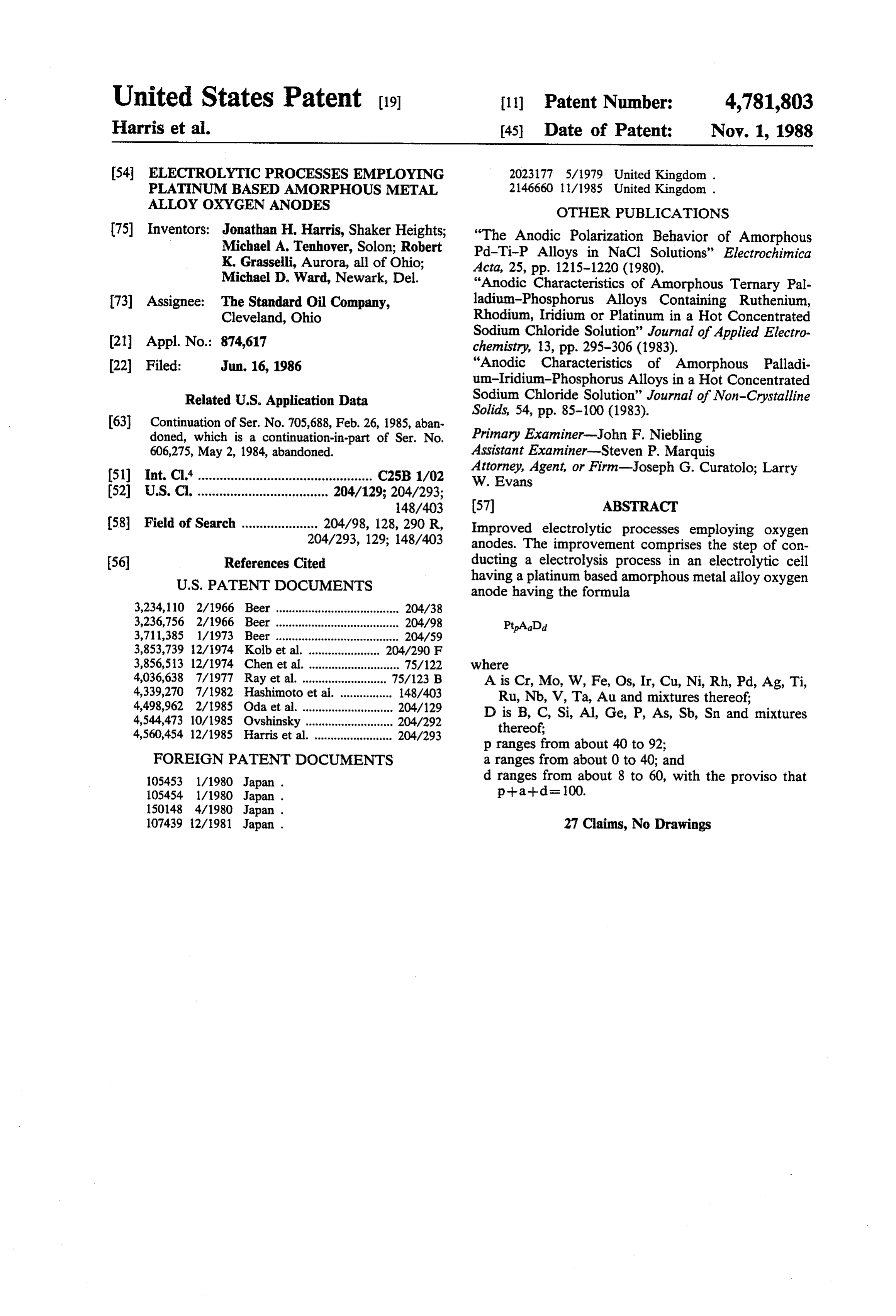
United States Patent (19) 11) Patent Number: 4,781,803 Harris et al. 45) Date of Patent: Nov. 1, 1988 54 ELECTROLYTIC PROCESSES EMPLOYING 2023177 5/1979 United Kingdom. PLATINUM BASED AMORPHOUS METAL 2146660 1 1/1985 United Kingdom . ALLOY OXYGENANODES OTHER PUBLICATIONS (75) Inventors: Jonathan H. Harris, Shaker Heights; "The Anodic Polarization Behavior of Amorphous Michael A. Tenhover, Solon; Robert Pd-Ti-P Alloys in NaCl Solutions' Electrochimica K. Grasselli, Aurora, all of Ohio; Acta, 25, pp. 1215-1220 (1980).
Michael D. Ward, Newark, Del. "Anodic Characteristics of Amorphous Ternary Pal 73) Assignee: The Standard Oil Company, ladium-Phosphorus Alloys Containing Ruthenium, Cleveland, Ohio Rhodium, Iridium or Platinum in a Hot Concentrated (21) Appl. No.: 874,617 Sodium Chloride Solution' Journal of Applied Electro
22) Filed: Jun. 16, 1986 "Anodic Characteristics of Amorphous Palladi um-Iridium-Phosphorus Alloys in a Hot Concentrated
Related U.S. Application Data Sodium Chloride Solution' Journal of Non-Crystalline
doned, which is a continuation-in-part of Ser. No. Primary Examiner-John F. Niebling 606,275, May 2, 1984, abandoned. Assistant Examiner-Steven P. Marquis (51) Int. Cl.' ................................................ C25B 1/02 Attorney, Agent, or Firm-Joseph G. Curatolo; Larry W. Evans (52) U.S. C. .................................... 204/129; 204/293;
58) Field of Search ..................... 204/98, 128, 290 R, Improved electrolytic processes employing oxygen 204/293, 129; 148/403 anodes. The improvement comprises the step of con 56) References Cited ducting a electrolysis process in an electrolytic cell
anode having the formula 3,234,110 2/1966 Beer ...................................... 204/38 3,236,756 2/1966 Beer ...................................... 204/98 PtpAaDd 3,711,385 1/1973 Beer ...................................... 204/59 3,853,739 12/1974 Kolb et al. ...... 204/290 F 3,856,513 12/1974 Chen et al. ............................ 75/122 where 4,036,638 7/1977 Ray et al. ................ ... 75/123 B A is Cr, Mo, W, Fe, Os, Ir, Cu, Ni, Rh, Pd, Ag, Ti, 4,339,270 7/1982 Hashimoto et al. .... ... 148/403 Ru, Nb, V, Ta, Au and mixtures thereof; 4,498,962 2/1985 ... 204/129 D is B, C, Si, Al, Ge, P, As, Sb, Sn and mixtures
4,560,454 12/1985 ... 204/293 thereof;
p ranges from about 40 to 92;
FOREIGN PATENT DOCUMENTS a ranges from about 0 to 40; and 105453 1/1980 Japan . d ranges from about 8 to 60, with the proviso that 105454 1/1980 Japan. p-- a--d=100.
107439 12/1981 Japan. 27 Claims, No Drawings
Page 2
X-ray diffraction measurements, was ductile, and had a
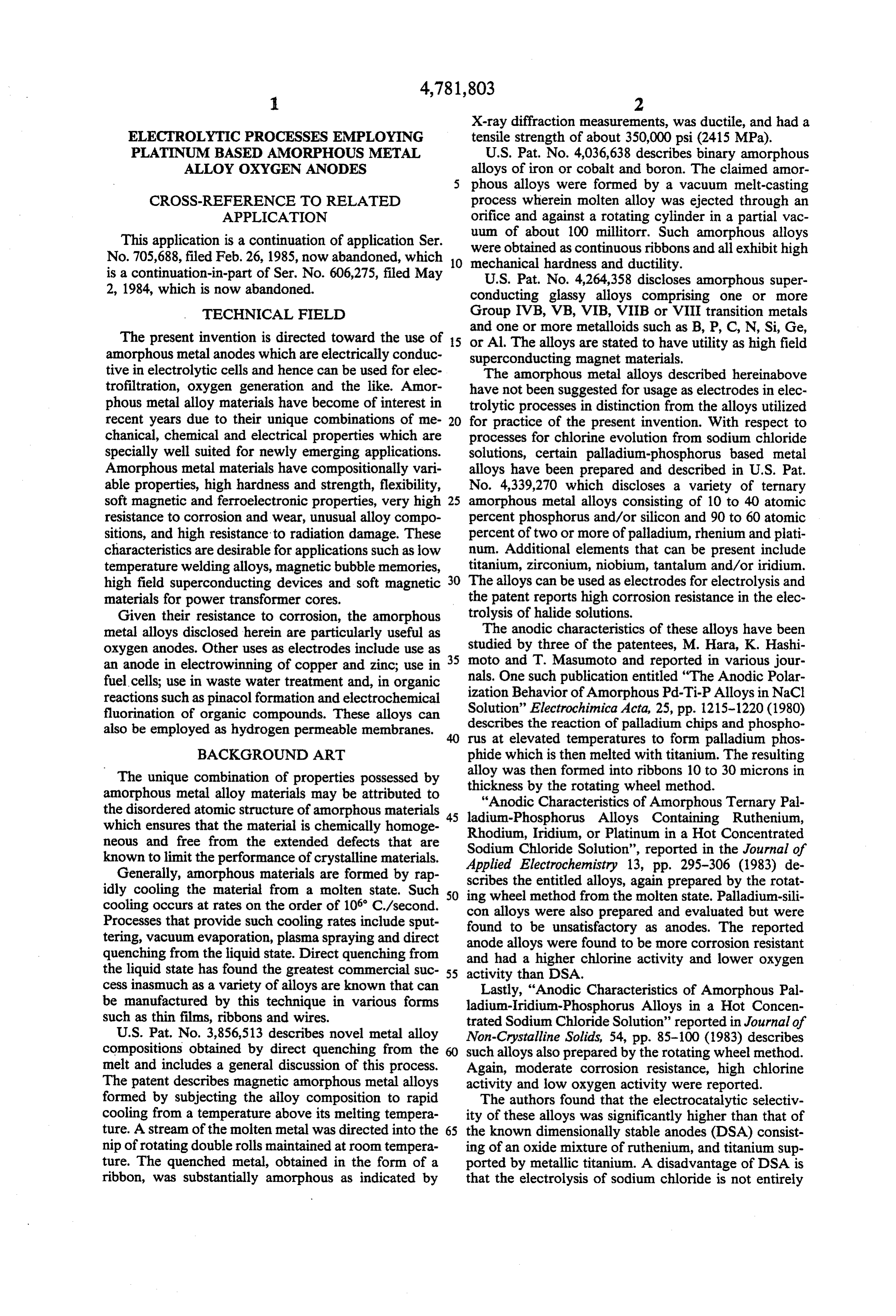
ELECTROLYTIC PROCESSESEMPLOYING tensile strength of about 350,000 psi (2415 MPa). PLATINUM BASED AMORPHOUS METAL U.S. Pat. No. 4,036,638 describes binary amorphous ALLOY OXYGENANODES alloys of iron or cobalt and boron. The claimed anor phous alloys were formed by a vacuum melt-casting
CROSS-REFERENCE TO RELATED process wherein molten alloy was ejected through an APPLICATION orifice and against a rotating cylinder in a partial vac uum of about 100 millitorr. Such amorphous alloys
This application is a continuation of application Ser. were obtained as continuous ribbons and all exhibit high No. 705,688, filed Feb. 26, 1985, now abandoned, which 10 mechanical is a continuation-in-part of Ser. No. 606,275, filed May hardness and ductility. 2, 1984, which is now abandoned. U.S. Pat. No. 4,264,358 discloses amorphous super conducting glassy alloys comprising one or more
TECHNICAL FIELD Group IVB, VB, VIB, VIIB or VIII transition metals and one or more metalloids such as B, P, C, N, Si, Ge,
The present invention is directed toward the use of 15 or Al. The alloys are stated to have utility as high field amorphous metal anodes which are electrically conduc superconducting magnet materials.
tive in electrolytic cells and hence can be used for elec The amorphous metal alloys described hereinabove trofiltration, oxygen generation and the like. Amor have not been suggested for usage as electrodes in elec phous metal alloy materials have become of interest in trolytic processes in distinction from the alloys utilized recent years due to their unique combinations of me 20 for practice of the present invention. With respect to chanical, chemical and electrical properties which are processes for chlorine evolution from sodium chloride specially well suited for newly emerging applications. solutions, certain palladium-phosphorus based metal Amorphous metal materials have compositionally vari alloys have been prepared and described in U.S. Pat. able properties, high hardness and strength, flexibility, No. 4,339,270 which discloses a variety of ternary soft magnetic and ferroelectronic properties, very high 25 amorphous metal alloys consisting of 10 to 40 atomic resistance to corrosion and wear, unusual alloy compo percent phosphorus and/or silicon and 90 to 60 atomic sitions, and high resistance to radiation damage. These percent of two or more of palladium, rhenium and plati characteristics are desirable for applications such as low num. Additional elements that can be present include temperature welding alloys, magnetic bubble memories, titanium, zirconium, niobium, tantalum and/or iridium. high field superconducting devices and soft magnetic 30 The alloys can be used as electrodes for electrolysis and materials for power transformer cores. the patent reports high corrosion resistance in the elec Given their resistance to corrosion, the amorphous trolysis of halide solutions.
metal alloys disclosed herein are particularly useful as The anodic characteristics of these alloys have been oxygen anodes. Other uses as electrodes include use as 35 studied by three of the patentees, M. Hara, K. Hashi an anode in electrowinning of copper and zinc, use in moto and T. Masumoto and reported in various jour nals. One such publication entitled "The Anodic Polar fuel cells; use in waste water treatment and, in organic ization reactions such aspinacol formation and electrochemical Solution' Behavior of Amorphous Pd-Ti-PAlloys in NaCl fluorination of organic compounds. These alloys can describes the Electrochimica Acta, 25, pp. 1215-1220 (1980) also be employed as hydrogen permeable membranes. reaction of palladium chips and phospho rus at elevated temperatures to form palladium phos
BACKGROUND ART phide which is then melted with titanium. The resulting alloy was then formed into ribbons 10 to 30 microns in
The unique combination of properties possessed by thickness amorphous metal alloy materials may be attributed to by the rotating wheel method. "Anodic Characteristics of Amorphous Ternary Pal the disordered atomic structure of amorphous materials 45 ladium-Phosphorus which ensures that the material is chemically homoge Alloys Containing Ruthenium, neous and free from the extended defects that are Rhodium, Iridium, or Platinum in a Hot Concentrated Sodium Chloride Solution', reported in the Journal of known to limit the performance of crystalline materials. Applied
Generally, amorphous materials are formed by rap scribes theElectrochemistry 13, pp. 295-306 (1983) de idly cooling the material from a molten state. Such 50 ing wheel method from theagain entitled alloys, prepared by the rotat cooling occurs at rates on the order of 106 C/second. con alloys were also prepared and state. molten Palladium-sili
Processes that provide such cooling rates include sput found to be unsatisfactory as anodes. The but evaluated were reported tering, vacuum evaporation, plasma spraying and direct anode alloys were found to be more corrosion resistant quenching from the liquid state. Direct quenching from and had a higher chlorine activity and lower oxygen the liquid state has found the greatest commercial suc 55 activity than DSA.
cess inasmuch as a variety of alloys are known that can Lastly, "Anodic Characteristics of Amorphous Pal be manufactured by this technique in various forms ladium-Iridium-Phosphorus Alloys in a Hot Concen such as thin films, ribbons and wires. trated Sodium Chloride Solution' reported in Journal of U.S. Pat. No. 3,856,513 describes novel metal alloy Non-Crystalline Solids, 54, pp. 85-100 (1983) describes compositions obtained by direct quenching from the 60 such alloys also prepared by the rotating wheel method. melt and includes a general discussion of this process. Again, moderate corrosion resistance, high chlorine The patent describes magnetic amorphous metal alloys activity and low oxygen activity were reported. formed by subjecting the alloy composition to rapid The authors found that the electrocatalytic selectiv cooling from a temperature above its melting tempera ity of these alloys was significantly higher than that of ture. A stream of the molten metal was directed into the 65 the known dimensionally stable anodes (DSA) consist nip of rotating double rolls maintained at room tempera ing of an oxide mixture of ruthenium, and titanium sup ture. The quenched metal, obtained in the form of a ported by metallic titanium. A disadvantage of DSA is ribbon, was substantially amorphous as indicated by that the electrolysis of sodium chloride is not entirely
Page 3
selective for chlorine and some oxygen is produced. A is Cr, Mo, W, Fe, Os, Ir, Cu, Ni, Rh, Pd, Ag, Ti, The alloys reported were less active for oxygen evolu Ru, Nb, V, Ta, Au and mixtures thereof; tion than DSA. D is B, C, Si, Al, Ge, P, As, Sb, Sn and mixtures Dimensionally stable anodes are described in the thereof;
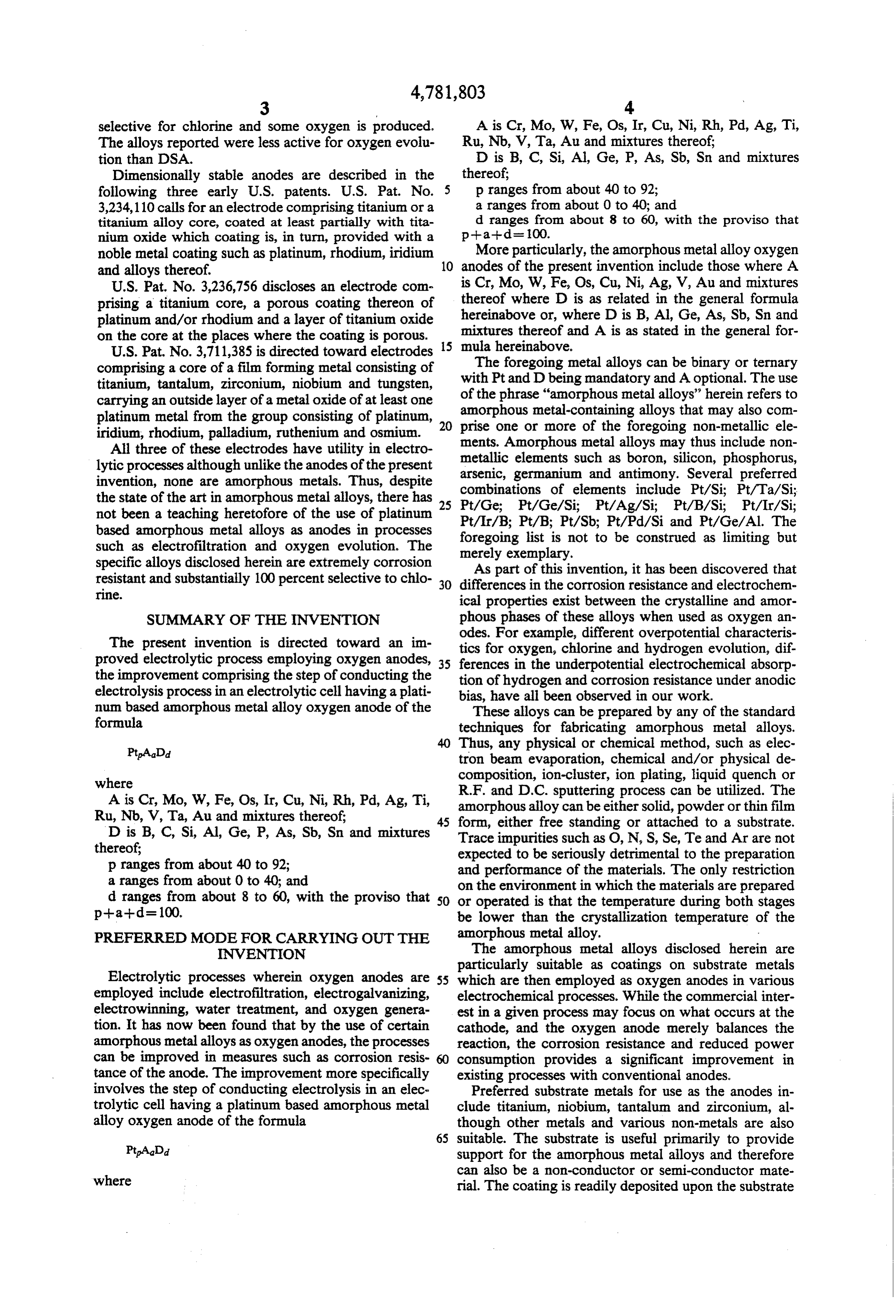
following three early U.S. patents. U.S. Pat. No. p ranges from about 40 to 92; 3,234,110 calls for an electrode comprising titanium or a a ranges from about 0 to 40; and titanium alloy core, coated at least partially with tita d ranges from about 8 to 60, with the proviso that nium oxide which coating is, in turn, provided with a p-- a--d=100.
noble metal coating such as platinum, rhodium, iridium More particularly, the amorphous metal alloy oxygen and alloys thereof. 10 anodes of the present invention include those where A U.S. Pat. No. 3,236,756 discloses an electrode com is Cr, Mo, W, Fe, Os, Cu, Ni, Ag, V, Au and mixtures prising a titanium core, a porous coating thereon of thereof where D is as related in the general formula platinum and/or rhodium and a layer of titanium oxide hereinabove or, where D is B, Al, Ge, As, Sb, Sn and mixtures thereof and A is as stated in the general for on the core at the places where the coating is porous. 15 mula
U.S. Pat. No. 3,711,385 is directed toward electrodes hereinabove.
comprising a core of a film forming metal consisting of The foregoing metal alloys can be binary or ternary titanium, tantalum, zirconium, niobium and tungsten, of with Pt and D being mandatory and A optional. The use the phrase “amorphous metal alloys' herein refers to carrying an outside layer of a metal oxide of at least one amorphous metal-containing alloys that may also com platinum metal from the group consisting of platinum, iridium, rhodium, palladium, ruthenium and osmium. 20 prise one or more of the foregoing non-metallic ele All three of these electrodes have utility in electro ments. Amorphous metal alloys may thus include non metallic elements such as boron, silicon, phosphorus, lytic processes although unlike the anodes of the present arsenic, germanium and antimony. Several preferred invention, none are amorphous metals. Thus, despite the state of the art in amorphous metal alloys, there has 25 combinations of elements include Pt/Si; Pt/Ta/Si; not been a teaching heretofore of the use of platinum Pt/Ge; Pt/Ge/Si; Pt/Ag/Si; Pt/B/Si; Pt/Ir/Si; Pt/Ir/B; Pt/B; Pt/Sb; Pt/Pd/Si and Pt/Ge/Al. The based amorphous metal alloys as anodes in processes foregoing list is not to be construed as limiting but such as electrofiltration and oxygen evolution. The merely exemplary.
specific alloys disclosed herein are extremely corrosion As part of this invention, it has been discovered that resistant and substantially 100 percent selective to chlo differences in the corrosion resistance and electrochem ical properties exist between the crystalline and amor
SUMMARY OF THE INVENTION phous phases of these alloys when used as oxygen an odes. For example, different overpotential characteris
The present invention is directed toward an im tics for oxygen, chlorine and hydrogen evolution, dif proved electrolytic process employing oxygen anodes, 35 ferences in the underpotential electrochemical absorp the improvement comprising the step of conducting the tion electrolysis process in an electrolytic cell having a plati bias, ofhave hydrogen and corrosion resistance under anodic all been observed in our work.
num based amorphous metal alloy oxygen anode of the These alloys can be prepared by any of the standard formula techniques for fabricating amorphous metal alloys. PAaDd
Thus, any physical or chemical method, such as elec tron beam evaporation, chemical and/or physical de where composition, ion-cluster, ion plating, liquid quench or A is Cr, Mo, W, Fe, Os, Ir, Cu, Ni, Rh, Pd, Ag, Ti, amorphous alloysputtering
R.F. and D.C. process can be utilized. The can be either solid, powder or thin film
Ru, Nb, V, Ta, Au and mixtures thereof; 45 form, either free standing or attached to a substrate. D is B, C, Si, Al, Ge, P, As, Sb, Sn and mixtures Trace impurities such as O, N, S, Se, Te and Arare not thereof; expected to be seriously detrimental to the preparation p ranges from about 40 to 92; and performance of the materials. The only restriction a ranges from about 0 to 40; and on the environment in which the materials are prepared d ranges from about 8 to 60, with the proviso that 50 or operated is that the temperature during both stages p--a-d=100. be lower than the crystallization temperature of the PREFERRED MODE FOR CARRYING OUT THE amorphous metal alloy.
INVENTION The amorphous metal alloys disclosed herein are particularly suitable as coatings on substrate metals
Electrolytic processes wherein oxygen anodes are 55 which are then employed as oxygen anodes in various employed include electrofiltration, electrogalvanizing, electrochemical processes. While the commercial inter electrowinning, water treatment, and oxygen genera est in a given process may focus on what occurs at the tion. It has now been found that by the use of certain cathode, and the oxygen anode merely balances the amorphous metal alloys as oxygen anodes, the processes reaction, the corrosion resistance and reduced power can be improved in measures such as corrosion resis 60 consumption provides a significant improvement in tance of the anode. The improvement more specifically existing processes with conventional anodes. involves the step of conducting electrolysis in an elec Preferred substrate metals for use as the anodes in trolytic cell having a platinum based amorphous metal clude titanium, niobium, tantalum and zirconium, al alloy oxygen anode of the formula though other metals and various non-metals are also 65 suitable. The substrate is useful primarily to provide
PtAadd support for the amorphous metal alloys and therefore can also be a non-conductor or semi-conductor mate where rial. The coating is readily deposited upon the substrate
Page 4
by sputtering, as was done for the examples presented are clearly distinguishable therefrom as well as from hereinbelow. Coating thicknesses are not crucial and each other.
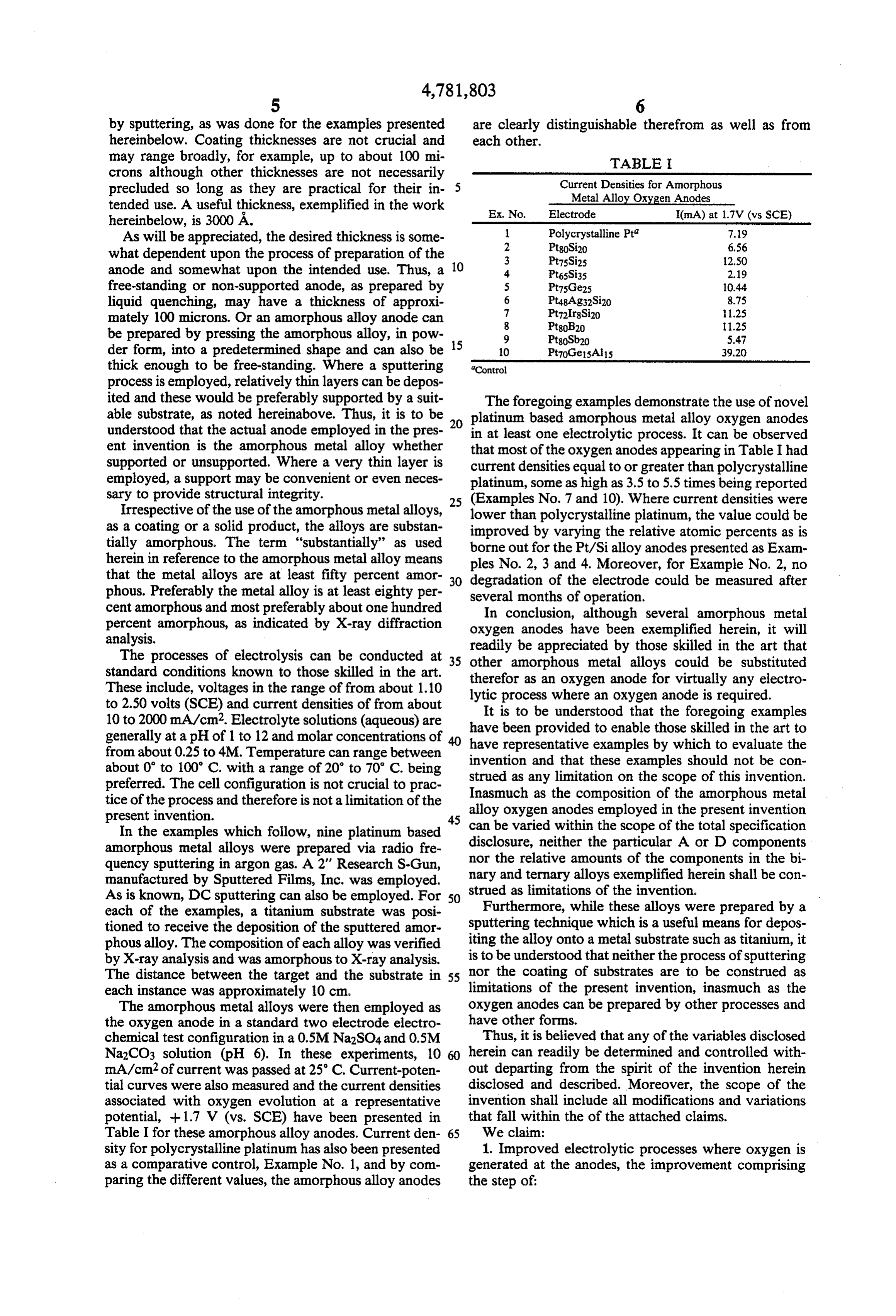
may range broadly, for example, up to about 100 mi TABLE crons although other thicknesses are not necessarily precluded so long as they are practical for their in Current Densities for Amorphous Metal Alloy Oxygen Anodes tended use. A useful thickness, exemplified in the work Ex, No. Electrode I(mA) at 1.7V (vs SCE) hereinbelow, is 3000 A.
As will be appreciated, the desired thickness is some Polycrystalline Pt 7.19
what dependent upon the process of preparation of the 3. Ptissi25 12.50 anode and somewhat upon the intended use. Thus, a 10 4 Pt65Si35 2.19 free-standing or non-supported anode, as prepared by 5 PtF5Ges 0.44 liquid quenching, may have a thickness of approxi 6
mately 100 microns. Or an amorphous alloy anode can 8 Pt30B20 1.25 be prepared by pressing the amorphous alloy, in pow 9 Pt30Sb20 5.47 der form, into a predetermined shape and can also be 15 10 PtoGesA15 39.20 thick enough to be free-standing. Where a sputtering Control process is employed, relatively thin layers can be depos ited and these would be preferably supported by a suit The foregoing examples demonstrate the use of novel able substrate, as noted hereinabove. Thus, it is to be platinum based amorphous metal alloy oxygen anodes understood that the actual anode employed in the pres in at least one electrolytic process. It can be observed ent invention is the amorphous metal alloy whether that most of the oxygen anodes appearing in Table I had supported or unsupported. Where a very thin layer is current densities equal to or greater than polycrystalline employed, a support may be convenient or even neces platinum, some as high as 3.5 to 5.5 times being reported sary to provide structural integrity. (Examples No. 7 and 10). Where current densities were Irrespective of the use of the amorphous metal alloys, 25 lower than polycrystalline platinum, the value could be as a coating or a solid product, the alloys are substan improved by varying the relative atomic percents as is tially amorphous. The term "substantially' as used borne out for the Pt/Sialloy anodes presented as Exam herein in reference to the amorphous metal alloy means that the metal alloys are at least fifty percent amor 30 ples No. 2, 3 and 4. Moreover, for Example No. 2, no degradation of the electrode could be measured after phous. Preferably the metal alloy is at least eighty per several months of operation. cent amorphousand most preferably about one hundred In conclusion, although several amorphous metal percent amorphous, as indicated by X-ray diffraction oxygen anodes have been exemplified herein, it will analysis.
The processes of electrolysis can be conducted at 35 other amorphous metalbyalloys readily be appreciated those skilled in the art that could be substituted standard conditions known to those skilled in the art. therefor as an oxygen anode for virtually any electro These include, voltages in the range of from about 1.10 lytic process where an oxygen anode is required. to 2.50 volts (SCE) and current densities of from about It is to be understood that the foregoing examples 10 to 2000 mA/cm2. Electrolyte solutions (aqueous) are have been provided to enable those skilled in the generally at a pH of 1 to 12 and molar concentrations of 40 have representative examples by which to evaluateartthe to from about 0.25 to 4M. Temperature can range between invention and that these examples should not be con about 0 to 100° C. with a range of 20 to 70° C. being strued as any limitation on the scope of this invention. preferred. The cell configuration is not crucial to prac Inasmuch as the composition of the amorphous metal tice of the process and therefore is not a limitation of the alloy oxygen anodes employed in the present invention present invention. 45 can
In the examples which follow, nine platinum based disclosure, be varied within the scope of the total specification amorphous metal alloys were prepared via radio fre nor neither the particular A or D components quency sputtering in argon gas. A 2' Research S-Gun, nary and ternaryamounts the relative of the components in the bi alloys exemplified herein shall be con manufactured by Sputtered Films, Inc. was employed. strued as limitations
As is known, DC sputtering can also be employed. For 50 Furthermore, whileofthese the invention. each of the examples, a titanium substrate was posi sputtering technique which isalloys a were prepared by a useful means for depos tioned to receive the deposition of the sputtered amor phous alloy. The composition of each alloy was verified iting the alloy onto a metal substrate such as titanium, it by X-ray analysis and was amorphous to X-ray analysis. is to be understood that neither the process of sputtering The distance between the target and the substrate in 55 nor the coating of substrates are to be construed as each instance was approximately 10 cm. limitations of the present invention, inasmuch as the The amorphous metal alloys were then employed as oxygen anodes can be prepared by other processes and the oxygen anode in a standard two electrode electro have other forms.
chemical test configuration in a 0.5M Na2SO4 and 0.5M Thus, it is believed that any of the variables disclosed Na2CO3 solution (pH 6). In these experiments, 10 herein can readily be determined and controlled with mA/cm2 of current was passed at 25 C. Current-poten out departing from the spirit of the invention herein tial curves were also measured and the current densities disclosed and described. Moreover, the scope of the associated with oxygen evolution at a representative invention shall include all modifications and variations potential, +1.7 V (vs. SCE) have been presented in that fall within the of the attached claims. Table I for these amorphous alloy anodes. Current den 65 We claim:
sity for polycrystalline platinum has also been presented 1. Improved electrolytic processes where oxygen is as a comparative control, Example No. 1, and by com generated at the anodes, the improvement comprising paring the different values, the amorphous alloy anodes the step of:
Page 5
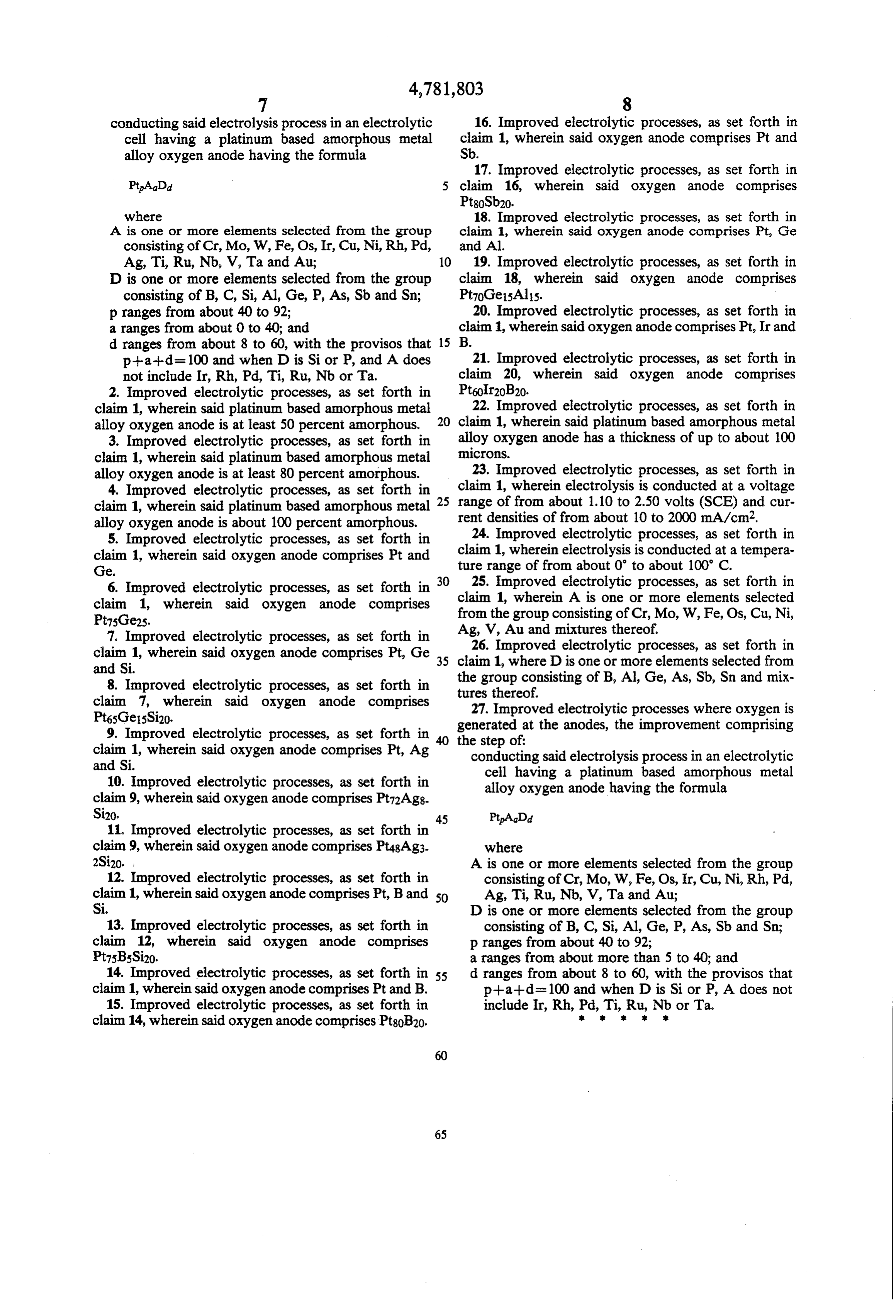
conducting said electrolysis process in an electrolytic 16. Improved electrolytic processes, as set forth in cell having a platinum based amorphous metal claim 1, wherein said oxygen anode comprises Pt and alloy oxygen anode having the formula Sb.
17. Improved electrolytic processes, as set forth in
PAaDa claim 16, wherein said oxygen anode comprises
where 18. Improved electrolytic processes, as set forth in A is one or more elements selected from the group claim 1, wherein said oxygen anode comprises Pt, Ge consisting of Cr, Mo, W, Fe, Os, Ir, Cu, Ni, Rh, Pd, and Al.
Ag, Ti, Ru, Nb, V, Ta and Au; O 19. Improved electrolytic processes, as set forth in D is one or more elements selected from the group claim 18, wherein said oxygen anode comprises consisting of B, C, Si, Al, Ge, P, As, Sb and Sn; PtioGe15Al15.
p ranges from about 40 to 92; 20. Improved electrolytic processes, as set forth in a ranges from about 0 to 40; and claim 1, wherein said oxygen anode comprises Pt, Irand d ranges from about 8 to 60, with the provisos that 15 B.
p--a--d=100 and when D is Sior P, and A does 21. Improved electrolytic processes, as set forth in not include Ir, Rh, Pd, Ti, Ru, Nb or Ta. claim 20, wherein said oxygen anode comprises 2. Improved electrolytic processes, as set forth in Pt60Ir20B20.
claim 1, wherein said platinum based amorphous metal 22. Improved electrolytic processes, as set forth in alloy oxygen anode is at least 50 percent amorphous. 20 claim 1, wherein said platinum based amorphous metal 3. Improved electrolytic processes, as set forth in alloy oxygen anode has a thickness of up to about 100 claim 1, wherein said platinum based amorphous metal microns.
alloy oxygen anode is at least 80 percent amorphous. 23. Improved electrolytic processes, as set forth in 4. Improved electrolytic processes, as set forth in claim 1, wherein electrolysis is conducted at a voltage range of from about 1.10 to 2.50 volts (SCE) and cur claim 1, wherein said platinum based amorphous metal 25 rent alloy oxygen anode is about 100 percent amorphous. densities of from about 10 to 2000 mA/cm2. 5. Improved electrolytic processes, as set forth in 24. Improved electrolytic processes, as set forth in claim 1, wherein said oxygen anode comprises Pt and claim 1, wherein electrolysis is conducted at a tempera Ge. ture range of from about 0 to about 100° C. 6. Improved electrolytic processes, as set forth in 30 25. Improved electrolytic processes, as set forth in claim 1, wherein said oxygen anode comprises from claim 1, wherein A is one or more elements selected PtsGe25. the group consisting of Cr, Mo, W, Fe, Os, Cu, Ni, 7. Improved electrolytic processes, as set forth in Ag,26.V,Improved
Au and mixtures thereof.
electrolytic processes, as set forth in claim 1, wherein said oxygen anode comprises Pt, Ge 35 claim 1, where D is one or more elements selected from and Si.
8. Improved electrolytic processes, as set forth in the group consisting of B, Al, Ge, As, Sb, Sn and mix tures thereof.
claim 7, wherein said oxygen anode comprises 27. Improved electrolytic processes where oxygen is Pt65Ge15Si20. generated at the anodes, the improvement comprising 9. Improved electrolytic processes, as set forth in the step of:
claim 1, wherein said oxygen anode comprises Pt, Ag conducting said electrolysis process in an electrolytic and Si. cell having a platinum based amorphous metal 10. Improved electrolytic processes, as set forth in alloy oxygen anode having the formula claim 9, wherein said oxygen anode comprises Pty2Ag8
Si20. 45 PtpADd 11. Improved electrolytic processes, as set forth in claim 9, wherein said oxygen anode comprises Ptas.Ag3 where 2Si20. A is one or more elements selected from the group 12. Improved electrolytic processes, as set forth in consisting of Cr, Mo, W, Fe, Os, Ir, Cu, Ni, Rh, Pd, claim 1, wherein said oxygen anode comprises Pt, Band SO Ag, Ti, Ru, Nb, V, Ta and Au; Si. D is one or more elements selected from the group 13. Improved electrolytic processes, as set forth in consisting of B, C, Si, Al, Ge, P, As, Sb and Sn; claim 12, wherein said oxygen anode comprises p ranges from about 40 to 92; PtisB5Si20. a ranges from about more than 5 to 40; and 14. Improved electrolytic processes, as set forth in 55 d ranges from about 8 to 60, with the provisos that claim 1, wherein said oxygen anode comprises Pt and B. p--a--d=100 and when D is Si or P, A does not 15. Improved electrolytic processes, as set forth in include Ir, Rh, Pd, Ti, Ru, Nb or Ta. claim 14, wherein said oxygen anode comprises Pt30B20.
Provenance
- Collection
- Cited prior art
- Original PDF
- patentimages.storage.googleapis.com →
- Filed
- 1986-06-16
- Pages
- 5
- Method
- pdftotext (the PDF's own text layer) + pdftoppm 300dpi page scans
- Source
- Google Patents bibliographic record
- Granted
- 1988-11-01
- Inventors
- Jonathan H. Harris; Michael A. Tenhover; Robert K. Grasselli; Michael D. Ward; Standard Oil Co
- Transcribed from
- patentimages.storage.googleapis.com →