patent · US3711385
Electrode having platinum metal oxide coating thereon,and method of use thereof
16 January 1973
Page 1 — bibliographic record
United States Patent Office Patented Jan. 16, 1973
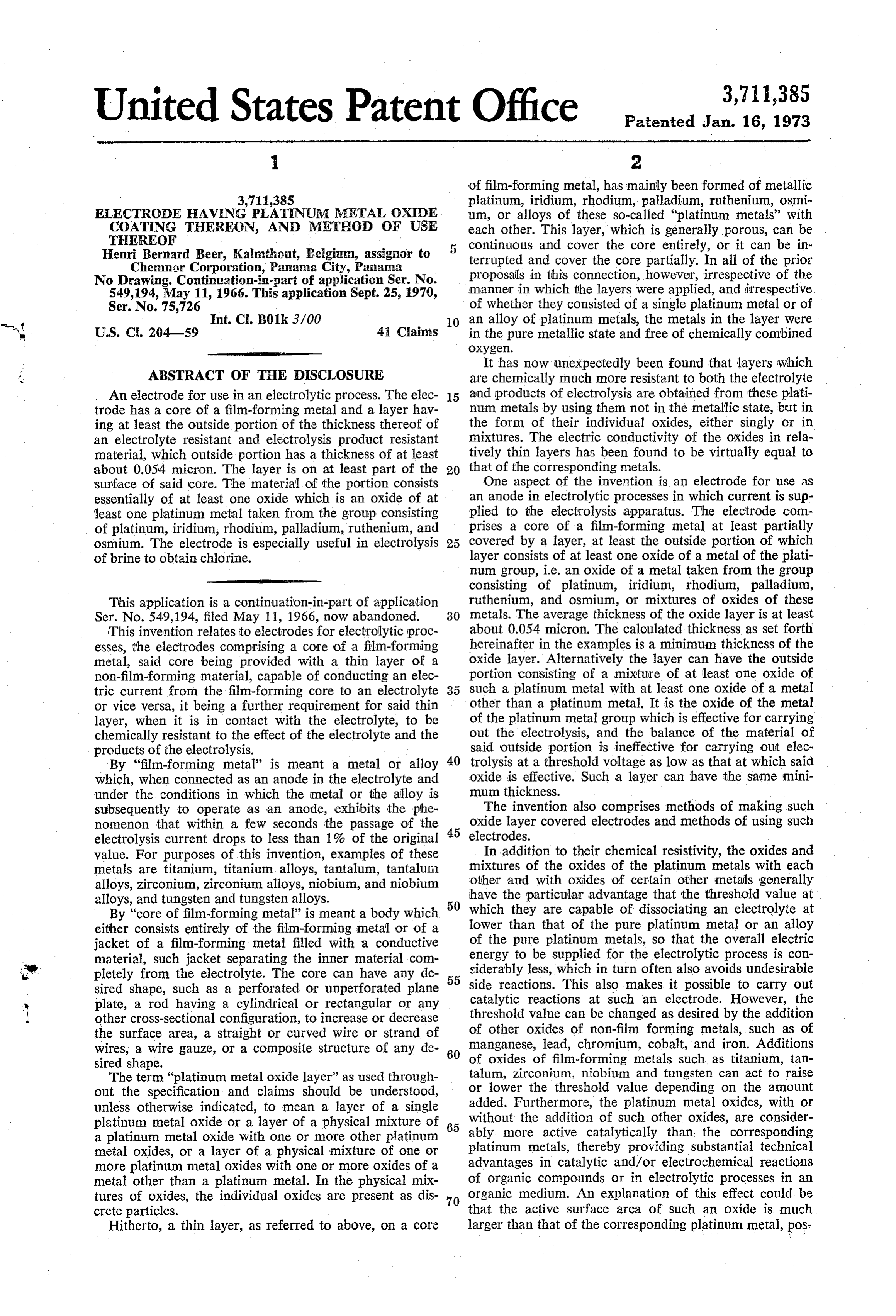
of film-forming metal, has mainly been formed of metallic 3,711,385 platinum, iridium, rhodium, palladium, ruthenium, osmi
ELECTRODE HAVING PLATINUME METAL OXDE um, or alloys of these so-called "platinum metals' with COATING THEREON, AND METHOD OF USE each other. This layer, which is generally porous, can be THEREOF continuous and cover the core entirely, or it can be in Henri Bernard Beer, Kanthout, Belgian, assignior to terrupted and cover the core partially. In all of the prior Cheranor Corporation, Panama City, Panama proposals in this connection, however, irrespective of the No Drawing. Continuation-in-part of application Ser. No. manner in which the layers were applied, and irrespective
Ser. No. 75,726 of whether they consisted of a single platinum metal or of int. C. B.01k 3/00 O an alloy of platinum metals, the metals in the layer were U.S. C. 204-59 4. Cains in the pure metallic state and free of chemically combined OXygen.
It has now unexpectedly been found that layers which
ABSTRACT OF THE DISCLOSURE are chemically much more resistant to both the electrolyte An electrode for use in an electrolytic process. The elec5 and products of electrolysis are obtained from these plati trode has a core of a film-forming metal and a layer hav num metals by using them not in the metallic state, but in ing at least the outside portion of the thickness thereof of the form of their individual oxides, either singly or in an electrolyte resistant and electrolysis product resistant mixtures. The electric conductivity of the oxides in rela material, which outside portion has a thickness of at least tively thin layers has been found to be virtually equal to about 0.054 micron. The layer is on at least part of the 20 that of the corresponding metals. surface of said core. The material of the portion consists One aspect of the invention is an electrode for use as essentially of at least one oxide which is an oxide of at an anode in electrolytic processes in which current is sup least one platinum metal taken from the group consisting plied to the electrolysis apparatus. The electrode com of platinum, iridium, rhodium, palladium, ruthenium, and prises a core of a film-forming metal at least partially osmium. The electrode is especially useful in electrolysis 25 covered by a layer, at least the outside portion of which of brine to obtain chlorine. layer consists of at least one oxide of a metal of the plati num group, i.e. an oxide of a metal taken from the group consisting of platinum, iridium, rhodium, palladium,
This application is a continuation-in-part of application ruthenium, and osmium, or mixtures of oxides of these Ser. No. 549,194, filed May 11, 1966, now abandoned. 30 metals. The average thickness of the oxide layer is at least This invention relates to electrodes for electrolytic proc about 0.054 micron. The calculated thickness as set forth esses, the electrodes comprising a core of a film-forming hereinafter in the examples is a minimum thickness of the metal, said core being provided with a thin layer of a oxide layer. Alternatively the layer can have the outside non-film-forming material, capable of conducting an elec portion consisting of a mixture of at least one oxide of tric current from the film-forming core to an electrolyte 35 such a platinum metal with at least one oxide of a metal or vice versa, it being a further requirement for said thin other than a platinum metal. It is the oxide of the metal layer, when it is in contact with the electrolyte, to be of the platinum metal group which is effective for carrying chemically resistant to the effect of the electrolyte and the out the electrolysis, and the balance of the material of products of the electrolysis. said outside portion is ineffective for carrying out elec By "film-forming metal' is meant a metal or alloy 40 trolysis at a threshold voltage as low as that at which said which, when connected as an anode in the electrolyte and oxide is effective. Such a layer can have the same mini under the conditions in which the metal or the alloy is mum thickness.
subsequently to operate as an anode, exhibits the phe The invention also comprises methods of making such nomenon that within a few seconds the passage of the 45 oxide layer covered electrodes and methods of using such electrolysis current drops to less than 1% of the original electrodes.
value. For purposes of this invention, examples of these In addition to their chemical resistivity, the oxides and metals are titanium, titanium alloys, tantalum, tantalurin mixtures of the oxides of the platinum metals with each alloys, zirconium, zirconium alloys, niobium, and niobium other and with oxides of certain other metals generally alloys, and tungsten and tungsten alloys. have the particular advantage that the threshold value at By “core of film-forming metal' is meant a body which 50 which they are capable of dissociating an electrolyte at either consists entirely of the film-forming metal or of a lower than that of the pure platinum metal or an alloy jacket of a film-forming metal filled with a conductive of the pure platinum metals, so that the overall electric material, such jacket separating the inner material com energy to be supplied for the electrolytic process is con pletely from the electrolyte. The core can have any de 55 siderably less, which in turn often also avoids undesirable sired shape, such as a perforated or unperforated plane side reactions. This also makes it possible to carry out plate, a rod having a cylindrical or rectangular or any catalytic reactions at such an electrode. However, the threshold value can be changed as desired by the addition other cross-sectional configuration, to increase or decrease of the surface area, a straight or curved wire or strand of other oxides of non-film forming metals, such as of wires, a wire gauze, or a composite structure of any de 60 manganese, lead, chromium, cobalt, and iron. Additions sired shape. of oxides of film-forming metals such as titanium, tan The term “platinum metal oxide layer” as used through talum, zirconium, niobium and tungsten can act to raise out the specification and claims should be understood, or lower the threshold value depending on the amount unless otherwise indicated, to mean a layer of a single added. Furthermore, the platinum metal oxides, with or without the addition of such other oxides, are consider platinum metal oxide or a layer of a physical mixture of 65 ably, a platinum metal oxide with one or more other platinun more active catalytically than the corresponding metal oxides, or a layer of a physical mixture of one or platinum metals, thereby providing substantial technical more platinum metal oxides with one or more oxides of a advantages in catalytic and/or electrochemical reactions metal other than a platinum metal. In the physical mix of organic compounds or in electrolytic processes in an tures of oxides, the individual oxides are present as dis 70 organic medium. An explanation of this effect could be crete particles. that the active surface area of such an oxide is much Hitherto, a thin layer, as referred to above, on a core larger than that of the corresponding platinum metal, pos
Page 2
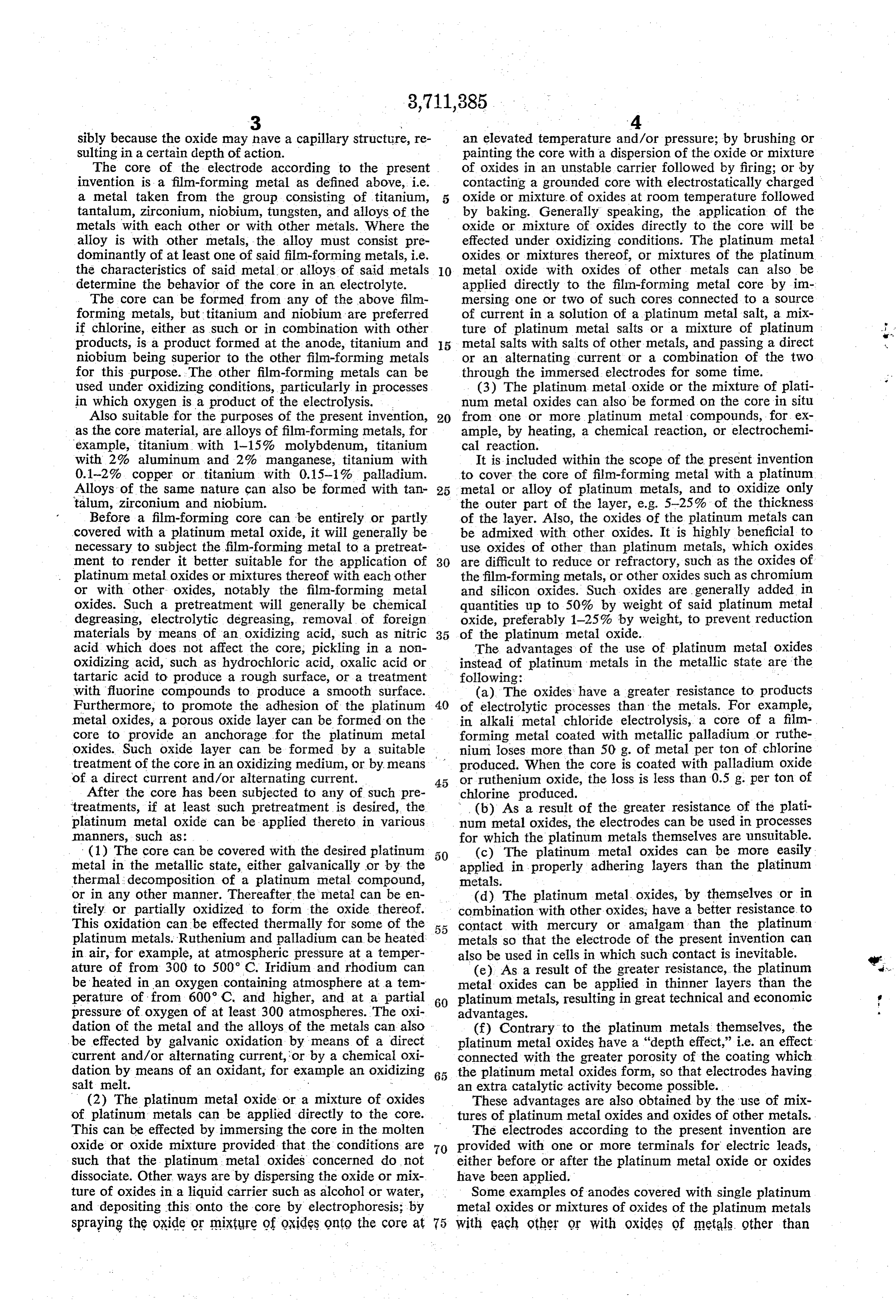
sibly because the oxide may nave a capillary structure, re an elevated temperature and/or pressure; by brushing or Sulting in a certain depth of action. painting the core with a dispersion of the oxide or mixture The core of the electrode according to the present of oxides in an unstable carrier followed by firing; or by invention is a film-forming metal as defined above, i.e. contacting a grounded core with electrostatically charged a metal taken from the group consisting of titanium, oxide or mixture of oxides at room temperature followed tantalum, zirconium, niobium, tungsten, and alloys of the by baking. Generally speaking, the application of the metals with each other or with other metals. Where the oxide or mixture of oxides directly to the core will be alloy is with other metals, the alloy must consist pre effected under oxidizing conditions. The platinum metal dominantly of at least one of said film-forming metals, i.e. oxides or mixtures thereof, or mixtures of the platinum the characteristics of said metal or alloys of said metals O metal oxide with oxides of other metals can also be determine the behavior of the core in an electrolyte. applied directly to the film-forming metal core by im The core can be formed from any of the above film mersing one or two of such cores connected to a source forming metals, but titanium and niobium are preferred of current in a solution of a platinum metal salt, a mix if chlorine, either as such or in combination with other ture of platinum metal salts or a mixture of platinum products, is a product formed at the anode, titanium and 5 metal salts with salts of other metals, and passing a direct niobium being superior to the other film-forming metals or an alternating current or a combination of the two for this purpose. The other film-forming metals can be through the immersed electrodes for some time. used under oxidizing conditions, particularly in processes (3) The platinum metal oxide or the mixture of plati in which oxygen is a product of the electrolysis. num metal oxides can also be formed on the core in situ Also suitable for the purposes of the present invention, 20 from one or more platinum metal compounds, for ex as the core material, are alloys of film-forming metals, for ample, by heating, a chemical reaction, or electrochemi example, titanium with 1-15% molybdenum, titanium cal reaction. - with 2% aluminum and 2% manganese, titanium with It is included within the scope of the present invention 0.1-2% copper or titanium with 0.15-1% palladium. to cover the core of film-forming metal with a platinum Alloys of the same nature can also be formed with tan 25 metal or alloy of platinum metals, and to oxidize only talum, zirconium and niobium. the outer part of the layer, e.g. 5-25% of the thickness Before a film-forming core can be entirely or partly of the layer. Also, the oxides of the platinum metals can covered with a platinum metal oxide, it will generally be be admixed with other oxides. It is highly beneficial to necessary to subject the film-forming metal to a pretreat use oxides of other than platinum metals, which oxides ment to render it better suitable for the application of 30 are difficult to reduce or refractory, such as the oxides of platinum metal oxides or mixtures thereof with each other the film-forming metals, or other oxides such as chromium or with other oxides, notably the film-forming metal and silicon oxides. Such oxides are generally added in oxides. Such a pretreatment will generally be chemical quantities up to 50% by weight of said platinum metal degreasing, electrolytic degreasing, removal of foreign oxide, preferably 1-25% by weight, to prevent reduction materials by means of an oxidizing acid, such as nitric 35 of the platinum metal oxide.
acid which does not affect the core, pickling in a non The advantages of the use of platinum metal oxides oxidizing acid, such as hydrochloric acid, oxalic acid or instead of platinum metals in the metallic state are the tartaric acid to produce a rough surface, or a treatment following:
with fluorine compounds to produce a smooth surface. (a) The oxides have a greater resistance to products Furthermore, to promote the adhesion of the platinum 40 of electrolytic processes than the metals. For example, metal oxides, a porous oxide layer can be formed on the in alkali metal chloride electrolysis, a core of a film core to provide an anchorage for the platinum metal forming metal coated with metallic palladium or ruthe oxides. Such oxide layer can be formed by a suitable nium loses more than 50 g. of metal per ton of chlorine treatment of the core in an oxidizing medium, or by means produced. When the core is coated with palladium oxide of a direct current and/or alternating current. 45 or ruthenium oxide, the loss is less than 0.5 g. per ton of After the core has been subjected to any of such pre chlorine produced.
treatments, if at least such pretreatment is desired, the (b) As a result of the greater resistance of the plati platinum metal oxide can be applied thereto in various num metal oxides, the electrodes can be used in processes manners, such as: for which the platinum metals themselves are unsuitable. (1) The core can be covered with the desired platinum 50 (c) The platinum metal oxides can be more easily metal in the metallic state, either galvanically or by the applied in properly adhering layers than the platinum thermali decomposition of a platinum metal compound, metals.
or in any other manner. Thereafter the metal can be en (d) The platinum metal oxides, by themselves or in tirely or partially oxidized to form the oxide thereof. combination with other oxides, have a better resistance to This oxidation can be effected thermally for some of the 55 contact with mercury or amalgam than the platinum platinum metals. Ruthenium and palladium can be heated metals so that the electrode of the present invention can in air, for example, at atmospheric pressure at a temper also be used in cells in which such contact is inevitable. ature of from 300 to 500° C. Iridium and rhodium can (e) As a result of the greater resistance, the platinum be heated in an oxygen containing atmosphere at a tem metal oxides can be applied in thinner layers than the perature of from 600 C. and higher, and at a partial platinum metals, resulting in great technical and economic pressure of oxygen of at least 300 atmospheres. The oxi 60 advantages.
dation of the metal and the alloys of the metals can also (f) Contrary to the platinum metals themselves, the be effected by galvanic oxidation by means of a direct platinum metal oxides have a "depth effect," i.e. an effect current and/or alternating current, or by a chemical oxi connected with the greater porosity of the coating which dation by means of an oxidant, for example an oxidizing 65 the platinum metal oxides form, so that electrodes having salt melt. v an extra catalytic activity become possible. (2) The platinum metal oxide or a mixture of oxides These advantages are also obtained by the use of mix of platinum metals can be applied directly to the core. tures of platinum metal oxides and oxides of other metals. This can be effected by immersing the core in the molten The electrodes according to the present invention are oxide or oxide mixture provided that the conditions are 70 provided with one or more terminals for electric leads, such that the platinum metal oxides concerned do not either before or after the platinum metal oxide or oxides dissociate. Other ways are by dispersing the oxide or mix have been applied.
ture of oxides in a liquid carrier such as alcohol or water, Some examples of anodes covered with single platinum and depositing this onto the core by electrophoresis; by metal oxides or mixtures of oxides of the platinum metals spraying the oxide or mixture of oxides onto the core at 75 with each other or with oxides of metals, other than
Page 3
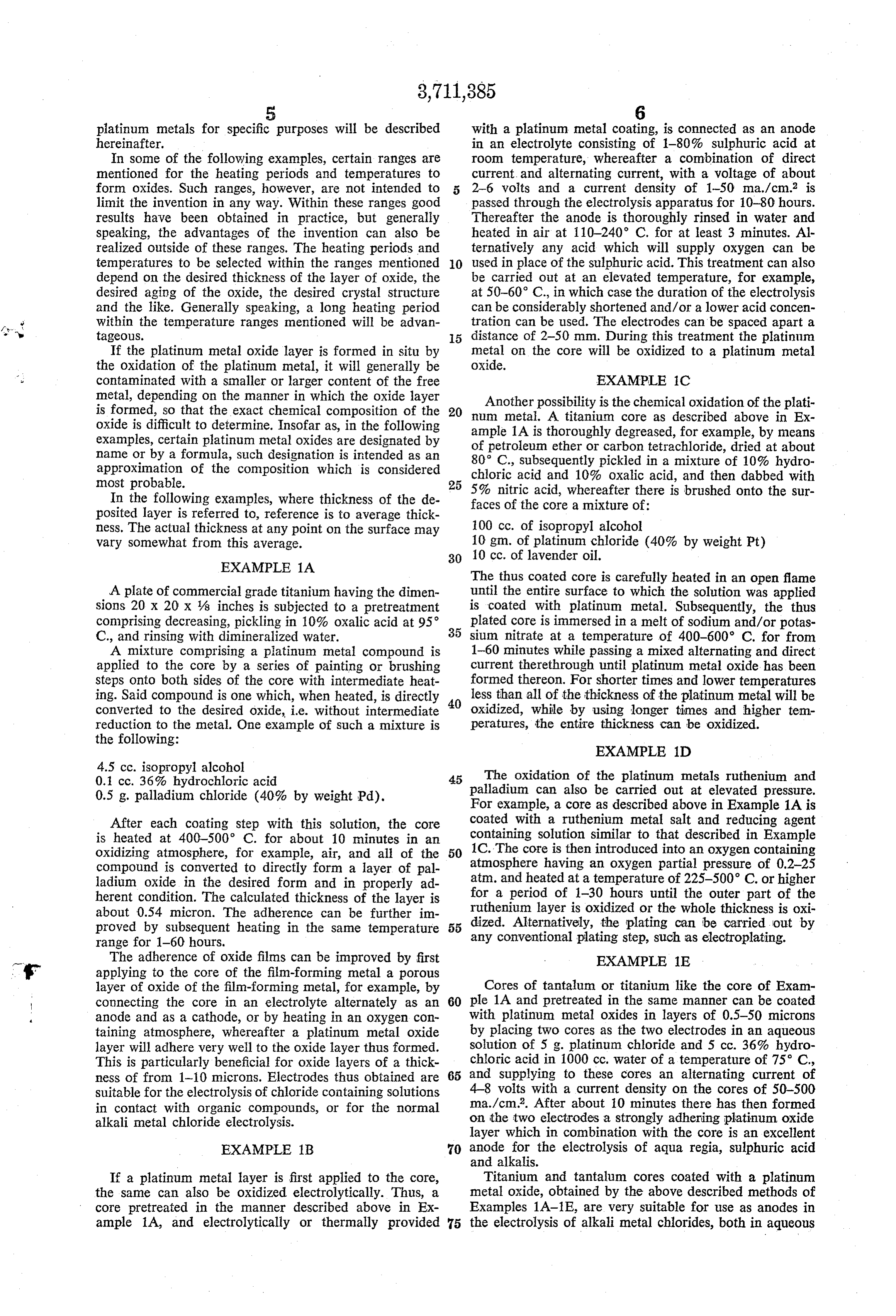
S 6 platinum metals for specific purposes will be described with a platinum metal coating, is connected as an anode hereinafter. in an electrolyte consisting of 1-80% sulphuric acid at In some of the following examples, certain ranges are room temperature, whereafter a combination of direct mentioned for the heating periods and temperatures to current, and alternating current, with a voltage of about form oxides. Such ranges, however, are not intended to 2-6 volts and a current density of 1-50 ma/cm. is limit the invention in any way. Within these ranges good passed through the electrolysis apparatus for 10-80 hours. results have been obtained in practice, but generally Thereafter the anode is thoroughly rinsed in water and speaking, the advantages of the invention can also be heated in air at 110-240° C. for at east 3 minutes. Al realized outside of these ranges. The heating periods and ternatively any acid which will supply oxygen can be temperatures to be selected within the ranges mentioned O used in place of the sulphuric acid. This treatment can also depend on the desired thickness of the layer of oxide, the be carried out at an elevated temperature, for example, desired aging of the oxide, the desired crystal structure at 50-60° C., in which case the duration of the electrolysis and the like. Generally speaking, a long heating period can be considerably shortened and/or a lower acid concen within the temperature ranges mentioned will be advan tration can be used. The electrodes can be spaced apart a tageous. 5 distance of 2-50 mm. During this treatment the platinum If the platinum metal oxide layer is formed in situ by metal on the core will be oxidized to a platinum metal the oxidation of the platinum metal, it will generally be oxide.
contaminated with a smaller or larger content of the free EXAMPLE 1C metal, depending on the manner in which the oxide layer Another possibility is the chemical oxidation of the plati is formed, so that the exact chemical composition of the 20 num
Oxide is difficult to determine. Insofar as, in the following amplemetal.
A titanium core as described above in Ex thoroughly degreased, for example, by means examples, certain platinum metal oxides are designated by of petroleum ether or carbon tetrachloride, dried at about name or by a formula, such designation is intended as an 80 C., Subsequently pickled in a mixture of 10% hydro approximation of the composition which is considered chloric acid and 10% oxalic acid, and then dabbed with most probable. 25 5% nitric acid, whereafter there is brushed onto the sur In the following examples, where thickness of the de posited layer is referred to, reference is to average thick faces of the core a mixture of:
ness. The actual thickness at any point on the surface may 100 cc. of isopropyl alcohol vary somewhat from this average. 10 gm. of platinum chloride (40% by weight Pt) 30 10 cc. of lavender oil.
EXAMPLE 1A
The thus coated core is carefully heated in an open flame
A plate of commercial grade titanium having the dimen until the entire surface to which the solution was applied sions 20 X 20 X % inches is subjected to a pretreatment is coated with platinum metal. Subsequently, the thus comprising decreasing, pickling in 10% oxalic acid at 95 35 plated core is immersed in a melt of sodium and/or potas C., and rinsing with dimineralized water. sium nitrate at a temperature of 400-600 C. for from A mixture comprising a piatinum metal compound is 1-60 minutes while passing a mixed alternating and direct applied to the core by a series of painting or brushing current therethrough until platinum metal oxide. has been Steps onto both sides of the core with intermediate heat formed thereon. For shorter times and lower temperatures ing. Said compound is one which, when heated, is directly 40 less than all of the thickness of the platinum metal will be converted to the desired oxide, i.e. without intermediate oxidized, while by using longer times and higher tem reduction to the metal. One example of such a mixture is peratures, the entire thickness can be oxidized. the following:
EXAMPLE 1D
4.5 cc. isopropyl alcohol The oxidation of the platinum metals ruthenium and 0.1 cc. 36% hydrochloric acid 45 0.5 g. palladium chloride (40% by weight Pd). palladium can also be carried out at elevated pressure. For example, a core as described above in Example 1A is
After each coating step with this solution, the core coated with a ruthenium metal salt and reducing agent is heated at 400-500 C. for about 10 minutes in an containing solution similar to that described in Example oxidizing atmosphere, for example, air, and all of the 50 1C. The core is then introduced into an oxygen containing compound is converted to directly form a layer of pal atmosphere having an oxygen partial pressure of 0.2-25 ladium oxide in the desired form and in properly ad atm.aand heated at a temperature of 225-500 C. or higher herent condition. The calculated thickness of the layer is for period of 1-30 hours until the outer part of the ruthenium layer is oxidized or the whole thickness is oxi about 0.54 micron. The adherence can be further im proved by Subsequent heating in the same temperature 55 dized. Alternatively, the plating can be carried out by any conventional plating step, such as electroplating.
range for 1-60 hours.
The adherence of oxide films can be improved by first EXAMPLE 1E r applying to the core of the film-forming metal a porous
Cores of tantalum or titanium like the core of Exam layer of oxide of the film-forming metal, for example, by connecting the core in an electrolyte alternately as an 60 ple 1A and pretreated in the same manner can be coated anode and as a cathode, or by heating in an oxygen con with platinum metal oxides in layers of 0.5-50 microns taining atmosphere, whereafter a platinum metal oxide by placing two cores as the two electrodes in an aqueous layer will adhere very well to the oxide layer thus formed. solution of 5 g. platinum chloride and 5 cc. 36% hydro This is particularly beneficial for oxide layers of a thick chloric acid in 1000 cc. water of a temperature of 75 C., ness of from 1-10 microns. Electrodes thus obtained are 65 and supplying to these cores an alternating current of suitable for the electrolysis of chloride containing Solutions 4-8 volts with a current density on the cores of 50-500 in contact with organic compounds, or for the normal ma./cm. After about 10 minutes there has then formed alkali metal chloride electrolysis. on the two electrodes a strongly adhering platinum oxide layer which in combination with the core is an excellent
EXAMPLE 1B 0 anode for the electrolysis of aqua regia, sulphuric acid and alkalis.
If a platinum metal layer is first applied to the core, Titanium and tantalum cores coated with a platinum the same can also be oxidized electrolytically. Thus, a metal oxide, obtained by the above described methods of core pretreated in the manner described above in Ex Examples 1A-1E, are very suitable for use as anodes in ample 1A, and electrolytically or thermally provided 75 the electrolysis of alkali metal chlorides, both in aqueous
Page 4
and in non-aqueous mediums, the oxides PtCl2 and RuO2 tremely finely divided ruthenium oxide. In this so there being preferred as being much more resistant to nascent are placed two of the pretreated titanium cores or one of chlorine, which is formed in such chloride electrolysis, the pretreated titanium cores with another electrode of a than metallic platinum or ruthenium, which, unlike the material which acts as a cathode, and a direct current oxides, is dissolved under these conditions. 5 is passed through the electrodes. The electrophoresis which EXAMPLE 2A then occurs causes extremely finely divided particles to be deposited from the sol onto the electrode. By careful dry
A core of normal commercial titanium can be degreased ing and heating, and excellently adhering layer is obtained. by means of any of the compositions commercially avail It is also possible to deposit a mixture of platinum able for the purpose, followed by electrolytic degreasing O metal oxides onto the core by dissolving salts of the de in a standard bath, whereafter the core is rinsed and placed sired platinum metals in the desired quantities, making in a 5% nitric acid solution to remove foreign metals, a sol of the solution thus obtained in a known manner such as iron, from its surface. Thereafter, the core is again and depositing these precipitated particles on the core by rinsed and pickled for 5 hours in an aqueous oxalic acid electrophoresis. The precipitated particles are converted solution to which a chlorine compound, such as ammonium to oxides by careful drying and heating. chloride, has been added. Subsequently the core is rinsed A sol can also be made by combining the platinum and then again placed in 5% nitric acid, whereby the im metal oxides in the desired quantities with oxides of other purities present in the titanium, such as iron and copper, metals such as manganese or lead, whereafter the plati are removed from the freshly pickled surface. After about num metal oxides, together with the other metal oxides, 0.5 hour, the core is rinsed well and dried at 50° C. Sub 20 are deposited on the core by electrophoresis. sequently, platinum dioxide is sprayed onto the core by In each instance of electrophoretic deposition the de means of a plasma burner, and an excellent adherence is posited coating should be carefully dried and heated to obtained. promote adherence. Titanium cores thus coated can be EXAMPLE 2B used for a large diversity of electrolytic processes, it being 25 possible to render the overvoltage either high or low by
It is also possible to apply a platinum oxide coating to the selection of the quantity and the nature of the oxides the core by coating the core with a dispersion of the of the metals other than the platinum metals. Electrodes oxide in a carrier. For this purpose there is first prepared thus obtained are suitable for use in the electrolysis of a platinum dioxide dispersion by mixing 5 g. finely di metal chlorides, both in aqueous and in non-aqueous vided PtC), e.g. particles having a size less than 1 micron, 30 media for cathodic protection, and for use in the galvanic in 1 litre of a mixture of water and alcohol, which acts as industry.
the carrier, whereafter the dispersion thus obtained is Ruthenium oxide has a greater chemical resistance applied to a titanium core prepared according to Example than ruthenium and in addition requires less energy for. 1A by brushing or spraying. The core thus coated is dried effecting the desired reaction in an electrolytic process. to remove the carrier, and the coated core is then baked at a temperature of at least 460 C. in an oxygen containing EXAMPLE 4 atmosphere at an oxygen partial pressure of 0.2 atm. for A core of commercial grade titanium is degreased and at least 5 min. Thereafter the core is cooled at the same subsequently pickled in a solution of a fluorine compound, pressure, whereby the platinum dioxide is left on the core for example, 80 parts by weight of water, 18 parts of metal in a properly adhering condition. The calculated 40 nitric acid, and 2 parts of sodium fluoride. After the thickness of the layer of platinum dioxide is about 0.95 pickling, the titanium has a very smooth, almost polished microns. surface.
The core to which the dispersion of the platinum oxide A dispersion of ruthenium oxide in water is prepared in a mixture and alcohol is applied is preferably first pro by means of a non-ionic moistener, for example, an ethyl vided, either thermally, chemically, or galvanically, with ene oxide condensation product. This dispersion is painted an extremely thin layer of porous titanium oxide in which onto the pretreated core, whereafter the core thus painted the platinum oxide can anchor itself. After the platinum is carefully dried. Then the ruthenium oxide present on oxide has been applied to this oxide layer, the coated core the surface is forced into the surface of the core by ham is preferably subjected to a thermal treatment under pres mering or pressing, which produces an electrode which is sure to enable any amorphous oxides to be converted into mechanically very strong, and is excellently suited for crystalline oxides so that an ideal adherence of the plati cathodic protection of objects in sea water and other sur num oxide to the core is obtained. roundings where the electrode is subjected to mechanical Another method of anchoring the platinum oxide is the wear by contact with objects such as floating logs and use of at least partially porous titanium, provided the porosity is not so high as to inhibit the formation of a 55 theThis like.
electrode is also excellently suited for use in elec barrier layer under anodic conditions. The porosity of trolytes containing non-dissolved salt particles, or elec titanium can be reduced, after the application of the dis trolytes in which salt particles are deposited on the elec persion and the drying, by rolling, which improves the trode, which is apt to cause excessive mechanical Wear. anchorage of the platinum oxide embedded in the porous titanium. EXAMPLE 5 The titanium cores coated with platinum oxide manu 60 A tube of practically pure tantalum, having a diam factured in accordance with. Examples. 2A and 2B are very suitable for use an anodes under the same conditions eter of 150 mm., a length of 1500 mm., and a wall thick as described in Examples 1A-1E, and also for purposes of ness of 1 mm., and which is closed on one end, is pre cathodic protection. treated by degreasing, for example, by means of petro 65. leum ether or carbon tetrachloride and is then pickled.
EXAMPLE 3 The tube is galvanically coated with ruthenium in a known manner. After this the tantalum, coated with ruthenium,
A core of commercially pure titanium is degreased and metal is heated in an oven in air at temperatures between pickled in the manner described in Example 1A and dried 450 and 600° C. for 3 hours, whereby more of the ru in air at 120° C. Subsequently ruthenium oxide (RuO2) is 70 thenium-metal is converted into the oxide. (In general 1 applied to the thus pretreated core electrophoretically in micron of ruthenium-metal is for the largest part con the following manner. verted into the oxide in 6 hours at a temperature of 550 Ruthenium chloride is dissolved in a mixture of equal C. in air.) The formed coated core is then filled with a parts of water and alcohol. Then the solution is alkalized, melt consisting of 50% lead and 50% bismuth, where e.g. to pH 9 by means of ammonia, to form a sol of ex 75 after the filled core is cooled,
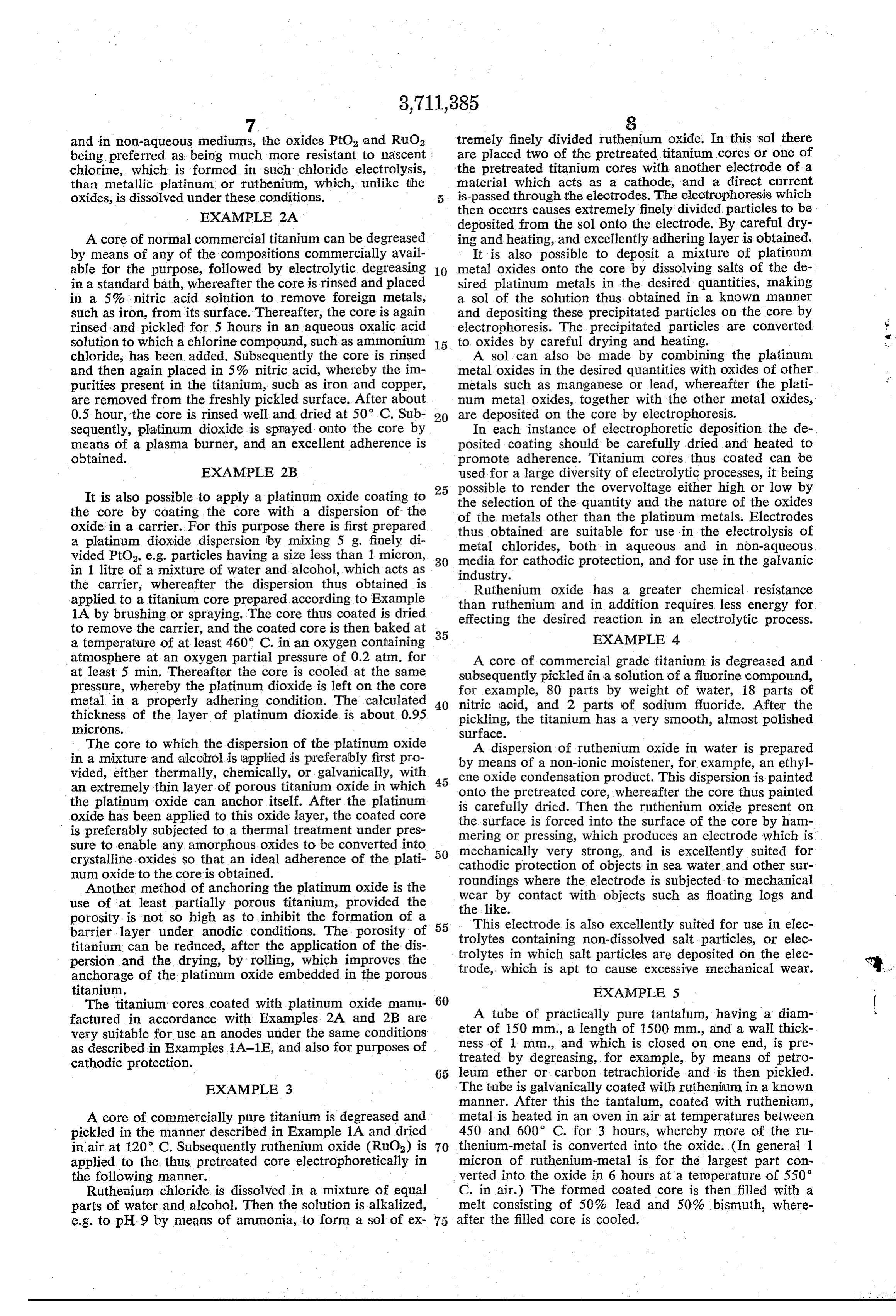
Page 5
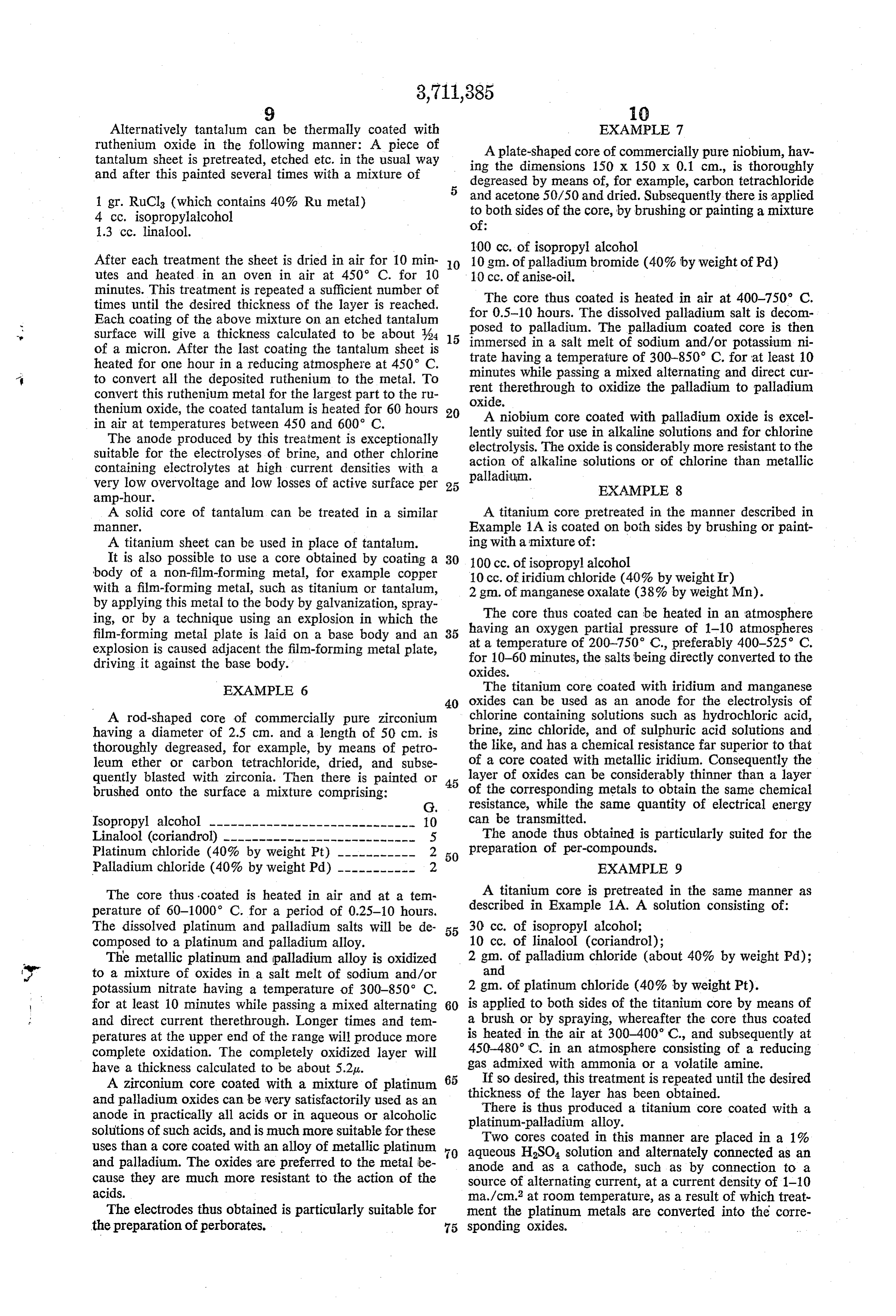
Alternatively tantalum can be thermally coated with EXAMPLE 7 ruthenium oxide in the following manner: A piece of A plate-shaped core of commercially pure niobium, hav tantalum sheet is pretreated, etched etc. in the usual way ing the dimensions 150 x 150 x 0.1 cm., is thoroughly and after this painted several times with a mixture of degreased by means of, for example, carbon tetrachloride 1 gr. RuOl (which contains 40% Ru metal) and acetone 50/50 and dried. Subsequently there is applied 4 cc. isopropylalcohol to both sides of the core, by brushing or painting a mixture 1.3 cc. linalool. of:
100 cc. of isopropyl alcohol
After each treatment the sheet is dried in air for 10 min O 10gm. of palladium bromide (40% by weight of Pd) utes and heated in an oven in air at 450° C. for 10 10 cc. of anise-oil.
minutes. This treatment is repeated a sufficient number of The core thus coated is heated in air at 400-750° C. times until the desired thickness of the layer is reached. for 0.5-10 hours. The dissolved palladium salt is decom Each coating of the above mixture on an etched tantalum posed to palladium. The palladium coated core is then Surface will give a thickness calculated to be about 34 5 immersed in a salt melt of sodium and/or potassium ni of a micron. After the last coating the tantalum sheet is trate having a temperature of 300-850° C. for at least 10 heated for one hour in a reducing atmosphere at 450° C. minutes while passing a mixed alternating and direct cur to convert all the deposited ruthenium to the metal. To rent therethrough to oxidize the palladium to palladium convert this ruthenium metal for the largest part to the ru thenium oxide, the coated tantalum is heated for 60 hours 20 oxide.
A niobium core coated with palladium oxide is excel in air at temperatures between 450 and 600° C. lently suited for use in alkaline solutions and for chlorine The anode produced by this treatment is exceptionally electrolysis. The oxide is considerably more resistant to the suitable for the electrolyses of brine, and other chlorine action of alkaline solutions or of chlorine than metallic containing electrolytes at high current densities with a palladium.
very low overvoltage and low losses of active surface per 25 EXAMPLE 8
A solid core of tantalum can be treated in a similar A titanium core pretreated in the manner described in a. Example 1A is coated on both sides by brushing or paint A titanium sheet can be used in place of tantalum. ing with a mixture of:
It is also possible to use a core obtained by coating a 30 100 cc. of isopropyl alcohol body of a non-film-forming metal, for example copper 10 cc. of iridium chloride (40% by weight Ir) with a film-forming metal, such as titanium or tantalum, 2 gm. of manganese oxalate (38% by weight Mn). by applying this metal to the body by galvanization, spray ing, or by a technique using an explosion in which the The core thus coated can be heated in an atmosphere film-forming metal plate is laid on a base body and an 35 at having an oxygen partial pressure of 1-10 atmospheres explosion is caused adjacent the film-forming metal plate, a temperature of 200-750° C., preferably 400-525 C. driving it against the base body. for 10-60 minutes, the salts being directly converted to the oxides.
EXAMPLE 6 The titanium core coated with iridium and manganese 40 oxides can be used as an anode for the electrolysis of
A rod-shaped core of commercially pure zirconium chlorine containing solutions such as hydrochloric acid, having a diameter of 2.5 cm. and a length of 50 cm. is brine, zinc chloride, and of sulphuric acid solutions and thoroughly degreased, for example, by means of petro the like, and has a chemical resistance far superior to that leum ether or carbon tetrachloride, dried, and subse of a core coated with metallic iridium. Consequently the quently blasted with zirconia. Then there is painted or 45 layer of oxides can be considerably thinner than a layer brushed onto the surface a mixture comprising: of the corresponding metals to obtain the same chemical G, resistance, while the same quantity of electrical energy
Isopropyl alcohol ----------------------------- O can be transmitted.
Linalool (coriandrol) --------------------------- 5 The anode thus obtained is particularly suited for the Platinum chloride (40% by weight Pt) ----------- 2 50 preparation of per-compounds.
Palladium chloride (40% by weight Pd) ----------- 2 EXAMPLE 9 The core thus coated is heated in air and at a tem A titanium core is pretreated in the same manner as perature of 60-1000 C. for a period of 0.25-10 hours. described in Example 1A. A solution consisting of: The dissolved platinum and palladium salts will be de 55 30 cc. of isopropyl alcohol;
composed to a platinum and palladium alloy. 10 cc. of linalool (coriandrol);
The metallic platinum and palladium alloy is oxidized 2 gm. of palladium chloride (about 40% by weight Pd); to a mixture of oxides in a salt melt of sodium and/or and potassium nitrate having a temperature of 300-850° C. 2 gm. of platinum chloride (40% by weight Pt). for at least 10 minutes while passing a mixed alternating 60 is applied to both sides of the titanium core by means of and direct current therethrough. Longer times and tem a brush or by spraying, whereafter the core thus coated peratures at the upper end of the range will produce more is heated in the air at 300-400° C., and subsequently at complete oxidation. The completely oxidized layer will 450-480 C. in an atmosphere consisting of a reducing have a thickness calculated to be about 5.2u. gas admixed with ammonia or a volatile amine. If so desired, this treatment is repeated until the desired
A Zirconium core coated with a mixture of platinum 65 thickness and palladium oxides can be very satisfactorily used as an of the layer has been obtained. anode in practically all acids or in aqueous or alcoholic There is thus produced a titanium core coated with a platinum-palladium alloy.
solutions of such acids, and is much more suitable for these Two cores coated in this manner are placed in a 1% uses than a core coated with an alloy of metallic platinum aqueous H2SO4 solution and alternately connected as an and palladium. The oxides are preferred to the metal be anode and as a cathode, such as by connection to a cause they are much more resistant to the action of the source of alternating current, at a current density of 1-10 acids. ma./cm. at room temperature, as a result of which treat The electrodes thus obtained is particularly suitable for ment the platinum metals are converted into the corre the preparation of perborates. 75 sponding oxides.
Page 6
EXAMPLE 10 EXAMPLE 12
A tantalum core of the same size as that of Example A core of titanium containing 4% molybdenum is pre 5 is pretreated in the manner described in Example 5, treating in the manner described in Example 1A, where whereafter there is formed on the surface of the core a after a mixture of 90% platinum oxide and 10% man layer of a mixture containing 90% palladium oxide and ganese dioxide is applied to the surface of the core. 10% iridium oxide. The mixture is applied as follows: The mixture of platinum oxide and manganese dioxide 1 g. palladium chloride (40% by weight Pd), 0.1 g. can be applied to the core by any of the methods men iridium chloride (40% by weight Ir), and 1 cc, 36% tioned hereinbefore, for example, by burning in from a hydrochloric acid are dissolved in 10 cc. isopropyl alco O solution, by electrophoresis from a Sol, mechanically, hol. This mixture is applied to the tantalum core by paint for example, by pressure, but also by placing the core in ing, dipping or spraying. To obtain a better adherence, an electrolyte, containing a solution of the salts of the the tantalum core is preferably provided with an extremely metals in the desired ratio, connecting the core to the thin layer of tantalum oxide in a manner known per se, negative pole of a source of direct current while employ for example, electrolytically, or by heating in an oxygen 5 ing an inert material as the anode, for example platinized containing atmosphere, for example air, whereafter the titanium, the desired alloy of platinum and manganese solution is easily absorbed in the layer of tantalum oxide. being deposited on the core from the electrolyte by the By simple heating in the air at 300-600 C. for a period direct current, and converting the alloy into the oxides, of 2 or 3 minutes to 1 hour the desired mixture of these for example, by galvanic oxidation. oxides is directly formed on the tantalum surface and 20 A titanium core pretreated in a similar manner is coated adheres well. The layer is calculated to be about 0.099 with a mixture of 95% platinum oxide and 5% silicon micron thick. dioxide, which may be effected in the following manner: It is also possible to deposit the mixture of the oxides The titanium core is degreased and provided with a directly onto the tantalum core by means of electro thin film of oxide by heating in the air at 400° C. for 0.5 phoresis from a solution in the following manner: 25 hour. Subsequently a dispersion of 95 parts by weight of 1 g. palladium chloride (40% by weight Pd) and 0.1 PtO2 and 5 parts by weight of SiO2 in a liquid carrier, g. iridium chloride (40% by weight iridium) are dissolved such as pure water, which dispersion can be stabilized in 100 cc. of water. By blowing ammonia gas into the by means of a protective colloid, is applied to the core by solution of these salts are precipitated as hydroxides, brushing or dipping, and dried. If so desired, this treat which can be dehydrated in a known manner, for example, 30 ment is repeated until the desired quantity of PtCl2 and by boiling and adding an oxidant if necessary. In some SiO2 has been applied to the surface of the titanium core. cases, particularly if a sol of a higher concentration is The thus treated core is heated for 5-300 minutes at desired, the addition of a protective colloid may be neces 800-1100° C. under mildly oxidizing conditions. During sary to enable the sol to be kept and used for longer this heating, the platinum oxide and the silicon oxide periods of time. By connecting a tantalum core as an 35 are baked or sintered to the titanium surface so that a electrode in the sol and applying an electric voltage for very strong adherence is obtained. The adherence of some seconds to some minutes, a dense layer of the pre platinum metal oxide to metallic titanium by baking or cipitated oxides is caused to adhere to the tantalum core, sintering is not only improved by the addition of silicon which layer can be made to adhere to the core very well 40 Oxide, but also by the addition of substances such as titanium hydroxide, zirconium oxide, and/or other so by careful drying and subsequent heating. In this case it - .
is recommended that the tantalum core be previously called refractory oxides.
superficially oxidized. A titanium core pretreated in a similar manner is The tantalum core coated with the palladium and coated with a mixture of platinum oxide and chromium iridium oxides thus obtained is excellently Suited as an oxide in the following manner. voltage and a greater chemical resistance than a core A Solution of 5 g. platinum chloride and 2 g. am anode in the electrolysis of aqueous solutions of potas monium dichromate in ethyl alcohol is applied to the sium or sodium chloride, e.g. brine, and has a lower over titanium core by painting or spraying, and dried at 120 coated with an alloy of the corresponding metals. C. If so desired, this treatment is repeated until the de sired thickness has been obtained. Subsequently, the thus
EXAMPLE 11 50 coated core is heated at 460-480
C. in oxygen under a preSSure of 8-15 atmospheres to form platinum and
A niobium core is pretreated in the manner described chromium and chromium oxides directly. in Example 7 and coated with a mixture of 50% rhodium The electrode thus obtained is particularly resistant oxide and 50% iridium oxide in the following manner: and, inter alia, extremely well-suited for use in a galvanic Rhodium and iridium salts are dissolved in water in 55 bath containing small quantities of fluorine. the desired ratio and precipitated by means of a base, The titanium cores coated with mixtures of platinum such as NaOH, whereafter the mixture is converted into oxide and another metal oxide can be used under the the oxides by means of an oxidant, such as oxygen gas. same conditions as the electrodes described in Examples Subsequently the precipitated oxides are filtered, dried, 1-4, 8 and 9.
and, if desired, brought into the desired oxidation state. 60 EXAMPLE. 13 The mixture of oxides thus obtained is milled or finely A rod of tungsten is sandpapered, electrolytically de divided in any other manner, and then dispersed in a greased and after this, painted with a solution of 1. gr. liquid carrier, such as ethanol, whereafter the dispersion is applied to the niobium core by means of a brush or by 65 propyl alcohol. contains
The coated rod is dried in the air for 10 dipping the core into the dispersion, and is carefully dried. minutes and after this is heated in an oven in air at 300 The mixture of oxides is then embedded in the surface C. for 10 minutes. This treatment is repeated 5 times. of the niobium by hammering, pressing, or subjecting the After this treatment the coated rod is heated again in an core to any other form of pressure, or by means of ultra oven in air for an hour at 450° C. The rod is thereby sonic vibrations. 70 coated with a layer of ruthenium oxide. This is proven The niobium core thus coated with a mixture of by exposing the coated rod to aqua regia, to which the rhodium and iridium oxides is excellently suited for the layer, is resistant. (Ruthenium metal is not resistant to electrolysis of hydrochloric acid, nickel salt Solutions, aqua regia.). The tungsten rod coated in this way with chromic acid solutions, and for the preparation of chlo ruthenium oxide is an excellent anode for the electrolyses rates and per-chlorates. 75 of brine, hydrochloric acid etc. at low power-consump
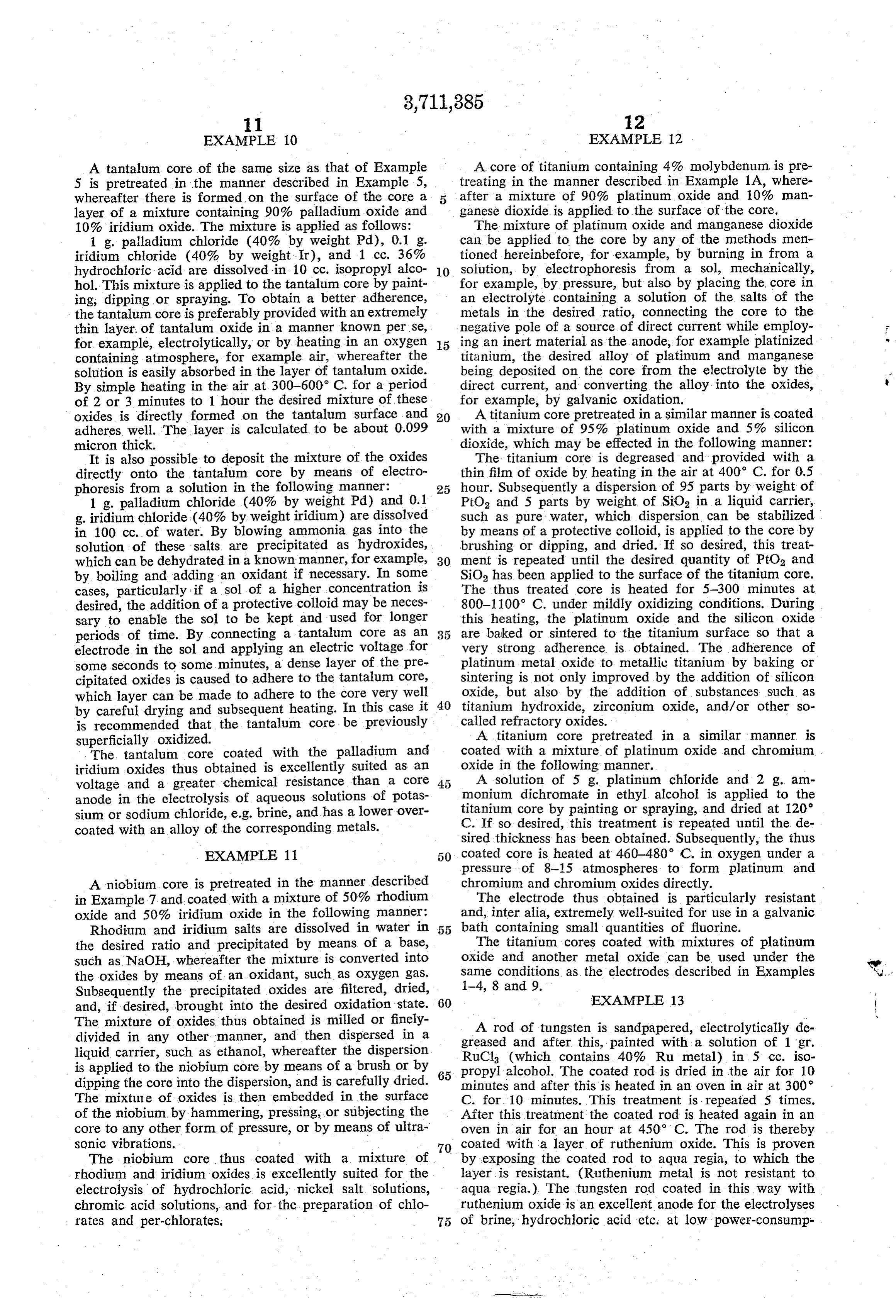
Page 7
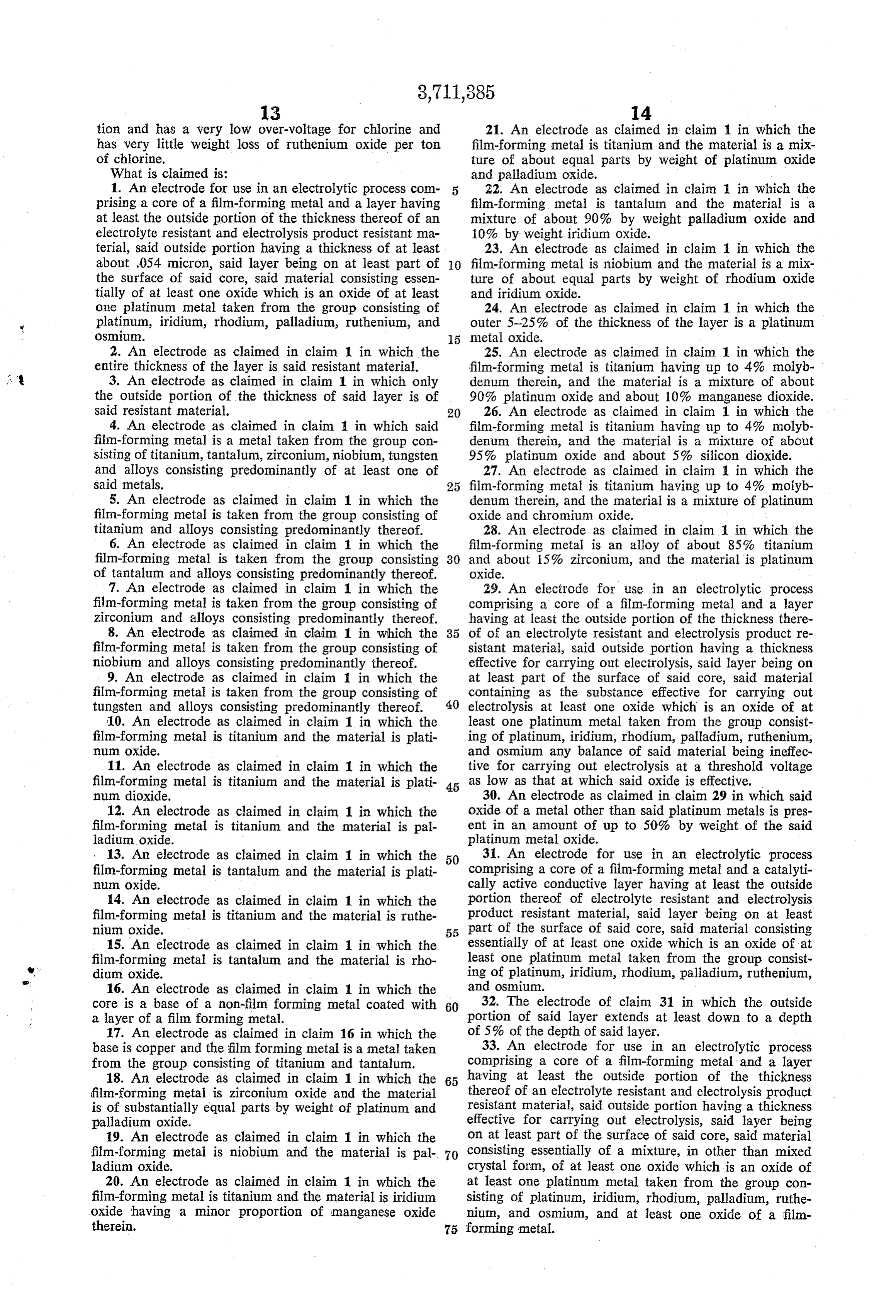
tion and has a very low over-voltage for chlorine and 21. An electrode as claimed in claim 1 in which the has very little weight loss of ruthenium oxide per ton film-forming metal is titanium and the material is a mix of chlorine. ture of about equal parts by weight of platinum oxide What is claimed is: and palladium oxide.
1. An electrode for use in an electrolytic process com 22. An electrode as claimed in claim 1 in which the prising a core of a film-forming metal and a layer having film-forming metal is tantalum and the material is a at least the outside portion of the thickness thereof of an mixture of about 90% by weight palladium oxide and electrolyte resistant and electrolysis product resistant ma 10% by weight iridium oxide. terial, said outside portion having a thickness of at least 23. An electrode as claimed in claim in which the about .054 micron, said layer being on at least part of O film-forming metal is niobium and the material is a mix the Surface of said core, said material consisting essen ture of about equal parts by weight of rhodium oxide tially of at least one oxide which is an oxide of at least and iridium oxide.
one platinum metal taken from the group consisting of 24. An electrode as claimed in claim 1 in which the platinum, iridium, rhodium, palladium, ruthenium, and outer 5-25% of the thickness of the layer is a platinum osmium. 5 metal oxide.
2. An electrode as claimed in claim 1 in which the 25. An electrode as claimed in claim 1 in which the entire thickness of the layer is said resistant material. film-forming metal is titanium having up to 4% molyb 3. An electrode as claimed in claim in which only denum therein, and the material is a mixture of about the outside portion of the thickness of said layer is of 90% platinum oxide and about 10% manganese dioxide. said resistant material. 20 26. An electrode as claimed in claim 1 in which the 4. An electrode as claimed in claim in which said film-forming metal is titanium having up to 4% molyb film-forming metal is a metal taken from the group con denum therein, and the material is a mixture of about sisting of titanium, tantalum, zirconium, niobium, tungsten 95% platinum oxide and about 5% silicon dioxide. and alloys consisting predominantly of at least one of 27. An electrode as claimed in claim in which the said metals. film-forming metal is titanium having up to 4% molyb 5. An electrode as claimed in claim 1 in which the denum therein, and the material is a mixture of platinum film-forming metal is taken from the group consisting of oxide and chromium oxide.
titanium and alloys consisting predominantly thereof. 28. An electrode as claimed in claim in which the 6. An electrode as claimed in claim 1 in which the film-forming metal is an alloy of about 85% titanium film-forming metal is taken from the group consisting 30 and about 15% zirconium, and the material is platinum of tantalum and alloys consisting predominantly thereof. oxide.
7. An electrode as claimed in claim 1 in which the 29. An electrode for use in an electrolytic process film-forming metal is taken from the group consisting of comprising a core of a film-forming metal and a layer Zirconium and alloys consisting predominantly thereof. having at least the outside portion of the thickness there 8. An electrode as claimed in claim 1 in which the 35 of of an electrolyte resistant and electrolysis product re film-forming metal is taken from the group consisting of sistant material, said outside portion having a thickness niobium and alloys consisting predominantly thereof. effective for carrying out electrolysis, said layer being on 9. An electrode as claimed in claim 1 in which the at least part of the surface of said core, said material film-forming metal is taken from the group consisting of containing as the substance effective for carrying out tungsten and alloys consisting predominantly thereof. 40 electrolysis at least one oxide which is an oxide of at 10. An electrode as claimed in claim 1 in which the least one platinum metal taken from the group consist film-forming metal is titanium and the material is plati ing of platinum, iridium, rhodium, palladium, ruthenium, num oxide. and osmium any balance of said material being ineffec 11. An electrode as claimed in claim 1 in which the tive for carrying out electrolysis at a threshold voltage film-forming metal is titanium and the material is plati 45 as low as that at which said oxide is effective. num dioxide. 30. An electrode as claimed in claim 29 in which said 12. An electrode as claimed in claim 1 in which the oxide of a metal other than said platinum metals is pres film-forming metal is titanium and the material is pal ent in an amount of up to 50% by weight of the said ladium oxide. platinum metal oxide.
13. An electrode as claimed in claim 1 in which the 50 31. An electrode for use in an electrolytic process film-forming metal is tantalum and the material is plati comprising a core of a film-forming metal and a catalyti num oxide. - cally active conductive layer having at least the outside 14. An electrode as claimed in claim 1 in which the portion thereof of electrolyte resistant and electrolysis film-forming metal is titanium and the material is ruthe product resistant material, said layer being on at least nium oxide. 55 part of the surface of said core, said material consisting 15. An electrode as claimed in claim 1 in which the essentially of at least one oxide which is an oxide of at film-forming metal is tantalum and the material is rho least one platinum metal taken from the group consist dium oxide. ing of platinum, iridium, rhodium, palladium, ruthenium, 16. An electrode as claimed in claim 1 in which the and osmium.
core is a base of a non-film forming metal coated with 60 32. The electrode of claim 31 in which the outside a layer of a film forming metal. portion of said layer extends at least down to a depth 17. An electrode as claimed in claim 16 in which the of 5% of the depth of said layer.
base is copper and the film forming metal is a metal taken 33. An electrode for use in an electrolytic process from the group consisting of titanium and tantalum. comprising a core of a film-forming metal and a layer i8. An electrode as claimed in claim 1 in which the 65 having at least the outside portion of the thickness film-forming metal is zirconium oxide and the material thereof of an electrolyte resistant and electrolysis product is of substantially equal parts by weight of platinum and resistant material, said outside portion having a thickness palladium oxide. effective for carrying out electrolysis, said layer being 19. An electrode as claimed in claim 1 in which the on at least part of the surface of said core, said material film-forming metal is niobium and the material is pal O consisting essentially of a mixture, in other than mixed ladium oxide. crystal form, of at least one oxide which is an oxide of 20. An electrode as claimed in claim 1 in which the at least one platinum metal taken from the group con film-forming metal is titanium and the material is iridium sisting of platinum, iridium, rhodium, palladium, ruthe Oxide having a minor proportion of manganese oxide nium, and osmium, and at least one oxide of a film therein. 75 forming metal.
Page 8
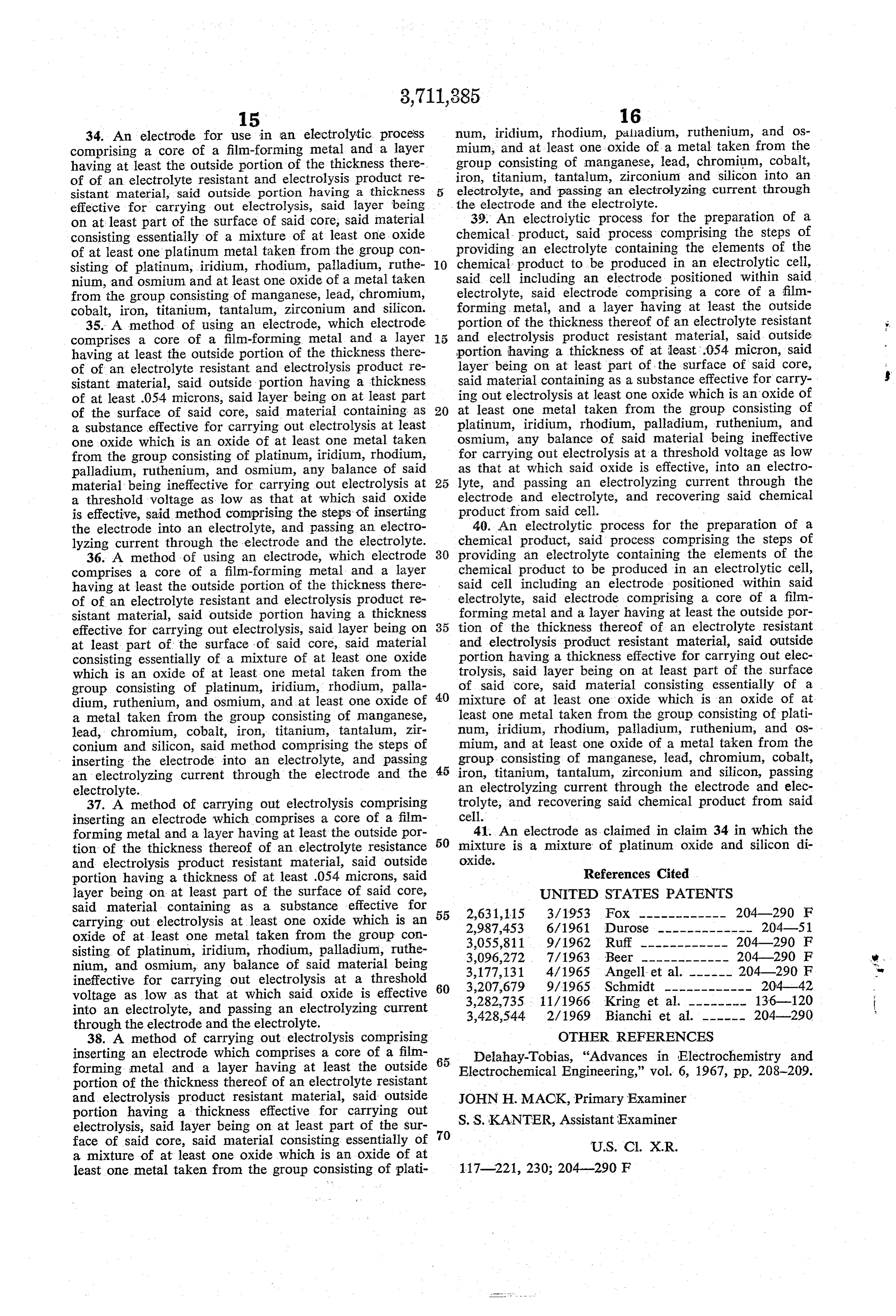
34. An electrode for use in an electrolytic process num, iridium, rhodium, paladium, ruthenium, and os comprising a core of a film-forming metal and a layer mium, and at least one oxide of a metal taken from the having at least the outside portion of the thickness there group consisting of manganese, lead, chromium, cobalt, of of an electrolyte resistant and electrolysis product re iron, titanium, tantalum, zirconium and silicon into an sistant material, said outside portion having a thickness electrolyte, and passing an electrolyzing current through effective for carrying out electrolysis, said layer being the electrode and the electrolyte. on at least part of the surface of said core, said material 39. An electrolytic process for the preparation of a consisting essentially of a mixture of at least one oxide chemical product, said process comprising the steps of of at least one platinum metal taken from the group con providing an electrolyte containing the elements of the sisting of platinum, iridium, rhodium, palladium, ruthe O chemical product to be produced in an electrolytic cell, nium, and osmium and at least one oxide of a metal taken said cell including an electrode positioned within said from the group consisting of manganese, lead, chromium, electrolyte, said electrode comprising a core of a film cobalt, iron, titanium, tantalum, zirconium and silicon. forming metal, and a layer having at least the outside 35. A method of using an electrode, which electrode portion of the thickness thereof of an electrolyte resistant comprises a core of a film-forming metal and a layer 5 and electrolysis product resistant material, said outside having at least the outside portion of the thickness there portion having a thickness of at least .0.54 micron, said of of an electrolyte resistant and electrolysis product re layer being on at least part of the surface of said core, sistant material, said outside portion having a thickness said material containing as a substance effective for carry of at least .054 microns, said layer being on at least part ing out electrolysis at least one oxide which is an oxide of of the surface of said core, said material containing as 20 at least one metal taken from the group consisting of a substance effective for carrying out electrolysis at least platinum, iridium, rhodium, palladium, ruthenium, and one oxide which is an oxide of at least one metal taken osmium, any balance of said material being ineffective from the group consisting of platinum, iridium, rhodium, for carrying out electrolysis at a threshold voltage as low palladium, ruthenium, and osmium, any balance of said as that at which said oxide is effective, into an electro material being ineffective for carrying out electrolysis at 25 lyte, and passing an electrolyzing current through the a threshold voltage as low as that at which said oxide electrode and electrolyte, and recovering said chemical is effective, said method comprising the steps of inserting product from said cell.
the electrode into an electrolyte, and passing an electro 40. An electrolytic process for the preparation of a lyzing current through the electrode and the electrolyte. chemical product, said process comprising the steps of 36. A method of using an electrode, which electrode 30 providing an electrolyte containing the elements of the comprises a core of a film-forming metal and a layer chemical product to be produced in an electrolytic cell, having at least the outside portion of the thickness there said cell including an electrode positioned within said of of an electrolyte resistant and electrolysis product re electrolyte, said electrode comprising a core of a film sistant material, said outside portion having a thickness forming metal and a layer having at least the outside por effective for carrying out electrolysis, said layer being on 35 tion of the thickness thereof of an electrolyte resistant at least part of the surface of said core, said material and electrolysis product resistant material, said outside consisting essentially of a mixture of at least one oxide portion having a thickness effective for carrying out elec which is an oxide of at least one metal taken from the trolysis, said layer being on at least part of the surface group consisting of platinum, iridium, rhodium, palla 40 of said core, said material consisting essentially of a dium, ruthenium, and osmium, and at least one oxide of mixture of at least one oxide which is an oxide of at a metal taken from the group consisting of manganese, least one metal taken from the group consisting of plati lead, chromium, cobalt, iron, titanium, tantalum, Zir num, iridium, rhodium, palladium, ruthenium, and os conium and silicon, said method comprising the steps of mium, and at least one oxide of a metal taken from the inserting the electrode into an electrolyte, and passing group consisting of manganese, lead, chromium, cobalt, an electrolyzing current through the electrode and the 45 iron, titanium, tantalum, zirconium and silicon, passing electrolyte. an electrolyzing current through the electrode and elec 37. A method of carrying out electrolysis comprising trolyte, and recovering said chemical product from said inserting an electrode which comprises a core of a film cell.
forming metal and a layer having at least the outside por 50 41. An electrode as claimed in claim 34 in which the tion of the thickness thereof of an electrolyte resistance mixture is a mixture of platinum oxide and silicon di and electrolysis product resistant material, said outside oxide.
portion having a thickness of at least .054 microns, said References Cited layer being on at least part of the surface of said core, UNITED STATES PATENTS said material containing as a substance effective for 55 2,631,115 3/1953 Fox ------------ 204-290 F carrying out electrolysis at least one oxide which is an 2,987,453 6/1961. Durose ------------- 204-51 oxide of at least one metal taken from the group con 3,055,811 9/1962 Ruff ----------- 204290 F sisting of platinum, iridium, rhodium, palladium, ruthe 3,096,272 7/1963 Beer ---------- 204-290 F nium, and osmium, any balance of said material being 3,177,131 4/1965 Angell et al. ------ 204, 290 F ineffective for carrying out electrolysis at a threshold 3,207,679 9/1965 Schmidt ---------- 204-42 voltage as low as that at which said oxide is effective 60 3,282,735 - 11/1966, Kring et al. -------- 136-120 into an electrolyte, and passing an electrolyzing current 3,428,544 2/1969 Bianchi et al. ------ 204-290 through the electrode and the electrolyte.
38. A method of carrying out electrolysis comprising OTHER REFERENCES inserting an electrode which comprises a core of a film 65. Delahay-Tobias, "Advances in Electrochemistry and forming metal and a layer having at least the outside Electrochemical Engineering," vol. 6, 1967, pp. 208-209. portion of the thickness thereof of an electrolyte resistant and electrolysis product resistant material, said outside JOHN H. MACK, Primary Examiner portion having a thickness effective for carrying out electrolysis, said layer being on at least part of the sur S. S. KANTER, Assistant Examiner face of said core, said material consisting essentially of 70 U.S. C. X.R. a mixture of at least one oxide which is an oxide of at least one metal taken from the group consisting of plati 1.17-221, 230; 204-290 F
Page 9
UNITED STATES PATENT OFFICE
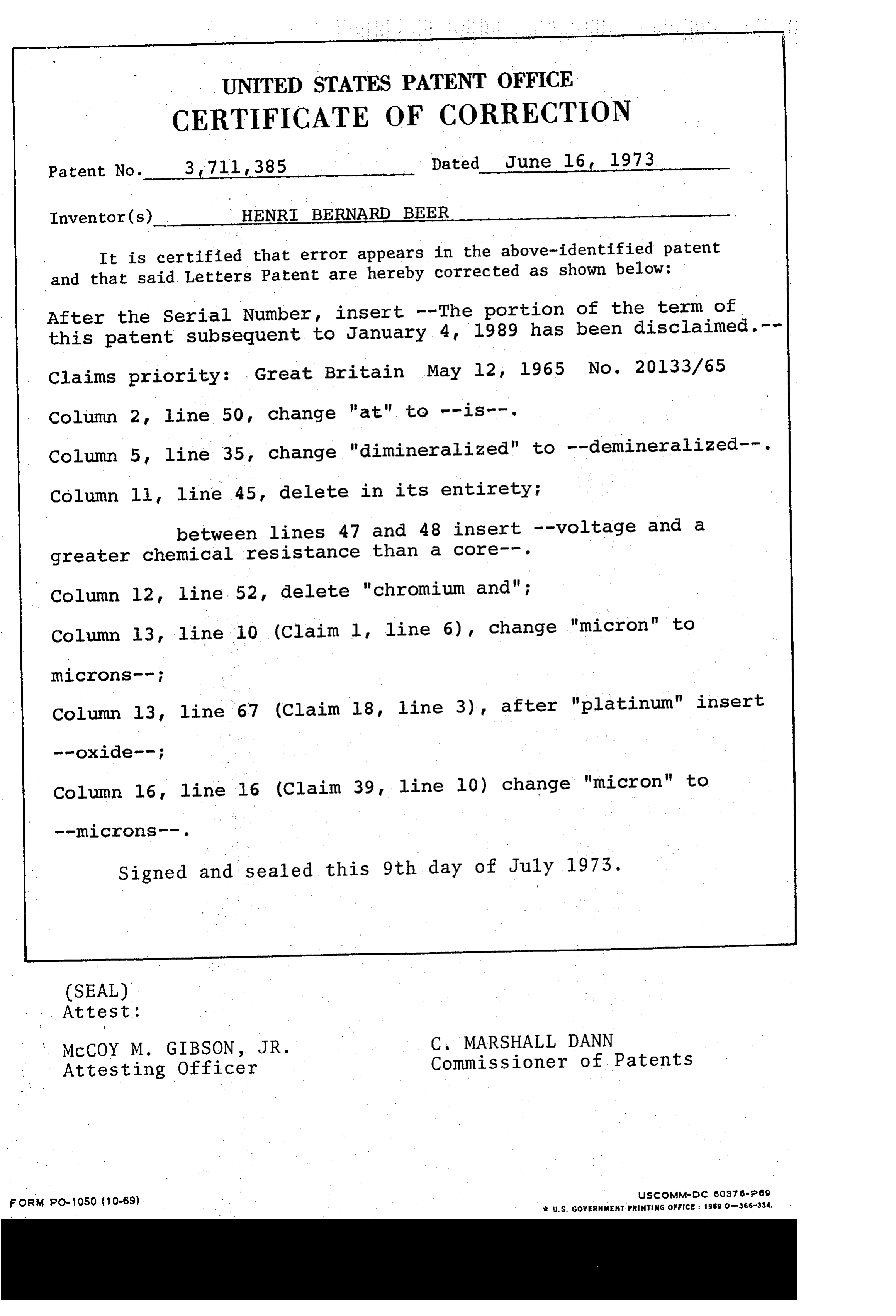
CERTIFICATE OF CORRECTION
Inventor(s) HENRI BERNARD BEER
It is certified that error appears in the above-identified patent and that said Letters Patent are hereby corrected as shown below: After the Serial Number, insert --The portion of the term of this patent subsequent to January 4, 1989 has been disclaimed. -- Claims priority: Great Britain May 12, 1965 No. 20133/65 Column 2 line 50 change "at" to re-isr-.
Column 5 line 35, change "dimineralized" to --demineralized--. Column ll line 45, delete in its entirety;
between lines 47 and 48 insert --voltage and a greater chemical resistance than a core--.
Column l2, line 52, delete "chromium and";
Column l3, line 10 (Claim l, line 6), change "micron" to
Column l3, line 67 (Claim l8, line 3), after "platinum" insert
Column 16, line 16 (Claim 39, line lo) change "micron" to
Signed and sealed this 9th day of July 1973.
(SEAL)
Attest:
McCOY M. GIBSON, JR. C. MARSHALL DANN Attesting Officer Commissioner of Patents
FORM PO-1050 (10-69) w USCOMMadc SO376-P69 A U.S. GoveRNMENT PRINTING OfFECE: 99 O-366-334,
Page 10
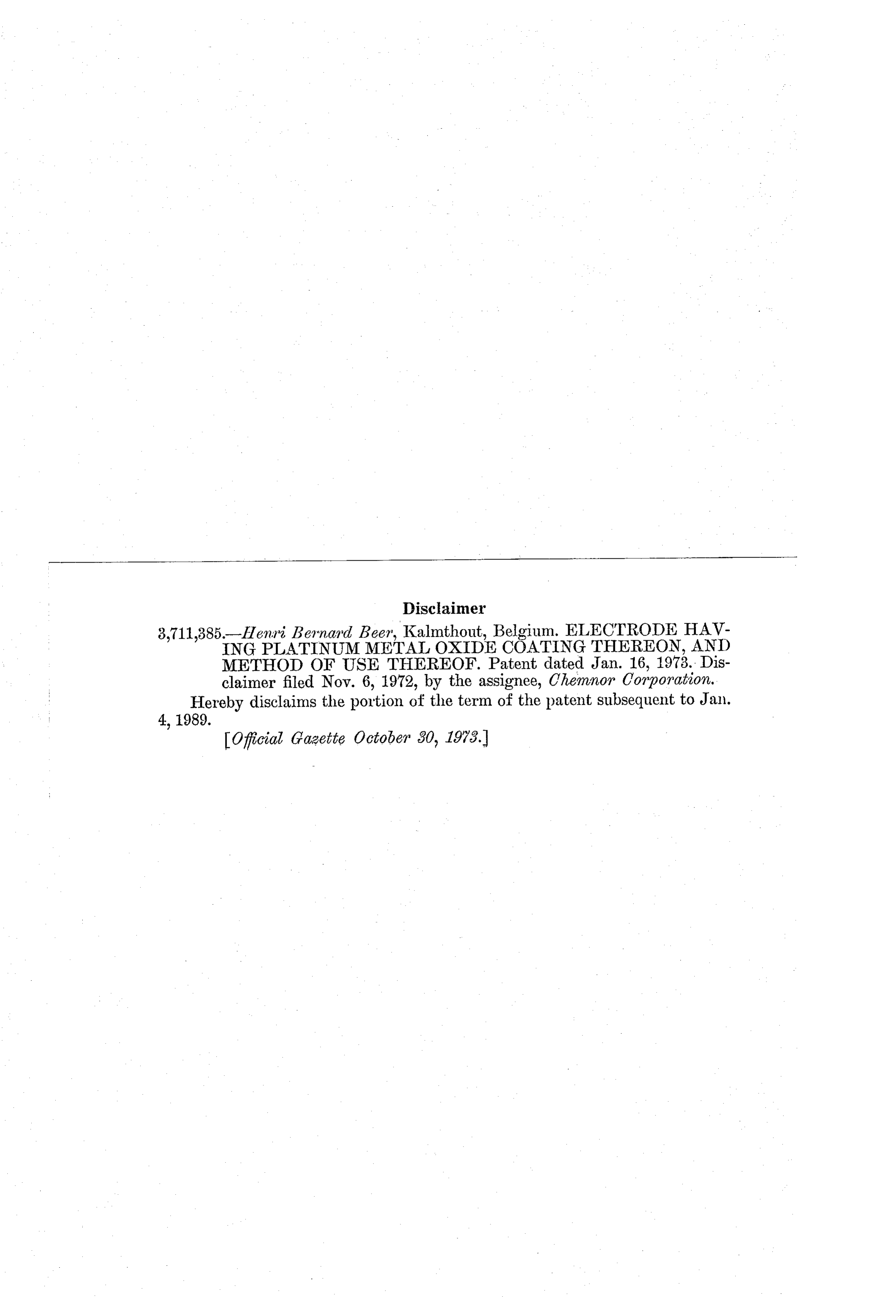
Disclaimer 3,711,385-Henri Bernard Beer, Kalmthout, Belgium. ELECTRODE HAV
ING PLATINUMMETAL OXIDE COATING THEREON, ANI)
METHOD OF USE THEREOF. Patent dated Jan. 16, 1973. Dis claimer filed Nov. 6, 1972, by the assignee, Cheminor Corporation. Hereby disclaims the portion of the term of the patent subsequent to Jan.
Official Gazette October 30, 1973.
Provenance
- Collection
- Cited prior art
- Original PDF
- patentimages.storage.googleapis.com →
- Filed
- 1970-09-25
- Pages
- 10
- Method
- pdftotext (the PDF's own text layer) + pdftoppm 300dpi page scans
- Source
- Google Patents bibliographic record
- Granted
- 1973-01-16
- Inventors
- H Beer; Chemnor Corp
- Transcribed from
- patentimages.storage.googleapis.com →