patent · US4491172
Energy storage apparatus
1 January 1985
Page 1 — bibliographic record
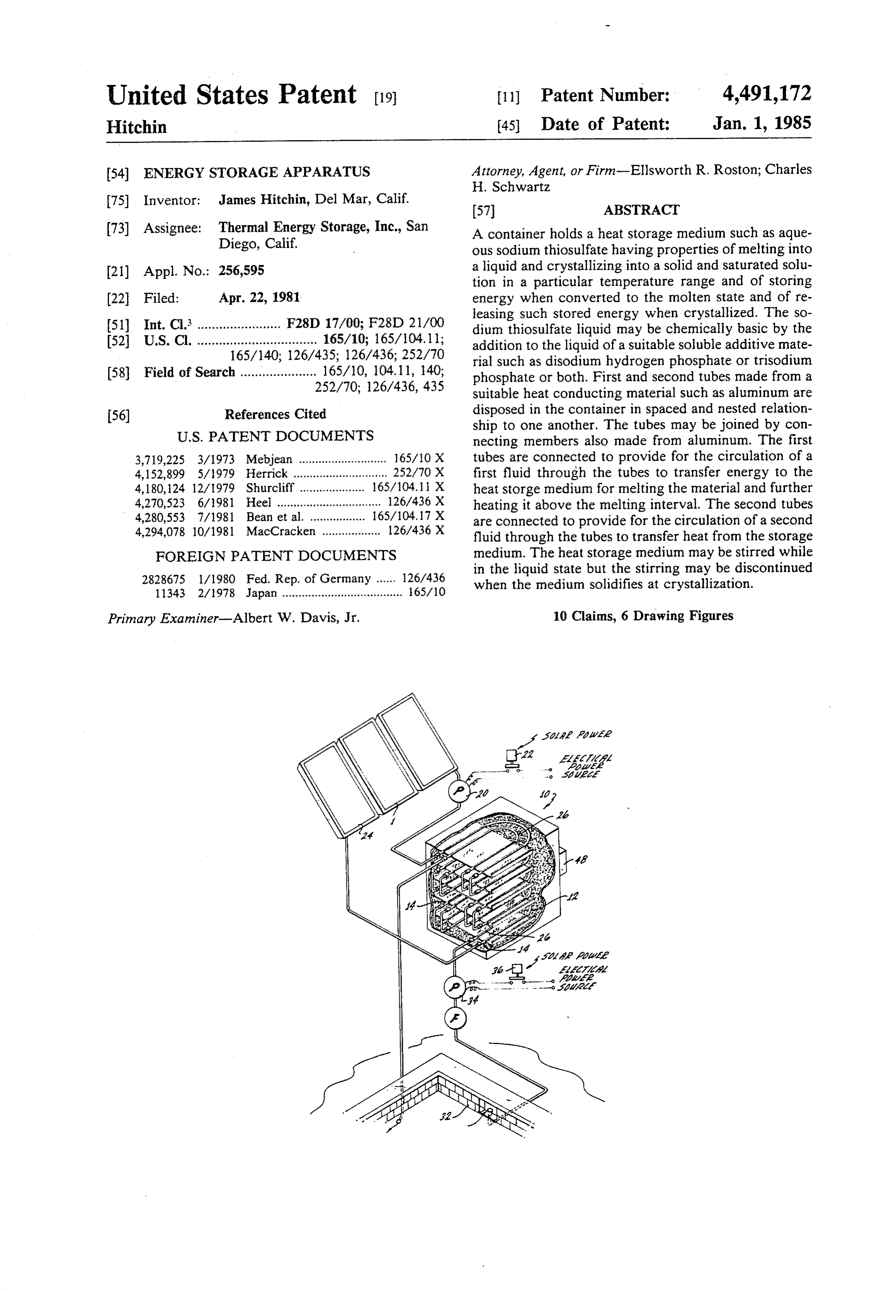
United States Patent (19) [11] Patent Number: 4,491,172 Hitchin (45) Date of Patent: Jan. 1, 1985 (54) ENERGY STORAGE APPARATUS Attorney, Agent, or Firm-Ellsworth R. Roston; Charles H. Schwartz 75) Inventor: James Hitchin, Del Mar, Calif. 57 ABSTRACT 73) Assignee: Thermal Energy Storage, Inc., San A container holds a heat storage medium such as aque Diego, Calif. ous sodium thiosulfate having properties of melting into (21) Appl. No.: 256,595 a liquid and crystallizing into a solid and saturated solu tion in a particular temperature range and of storing 22 Filed: Apr. 22, 1981 energy when converted to the molten state and of re leasing such stored energy when crystallized. The so 51 Int. Cl. ....................... F28D 17/00; F28D 21/00 dium thiosulfate liquid may be chemically basic by the 52 U.S. Cl. ................................. 165/10; 165/104.11; addition to the liquid of a suitable soluble additive mate 165/140; 126/435; 126/436; 252/70 rial such as disodium hydrogen phosphate or trisodium 58) Field of Search ..................... 165/10, 104.1 1, 140; phosphate or both. First and second tubes made from a 252/70; 126/436, 435 suitable heat conducting material such as aluminum are 56) References Cited disposed in the container in spaced and nested relation ship to one another. The tubes may be joined by con
3,719,225 3/1973 Mebjean ........................... 165/10 X tubes are connected to provide for the circulation of a 4,152,899 5/1979 Herrick ............................. 252/70 X first fluid through the tubes to transfer energy to the 4, 180,124 12/1979 Shurcliff .. ... 165/104.11 X heat storge medium for melting the material and further 4,270,523 6/1981 Heel ................................ 126/436 X heating it above the melting interval. The second tubes 4,280,553 7/1981 Bean et al. .. ... 165/104.17 X are connected to provide for the circulation of a second 4,294,078 10/1981 MacCracken .................. 126/436 X fluid through the tubes to transfer heat from the storage FOREIGN PATENT DOCUMENTS medium. The heat storage medium may be stirred while
in the liquid state but the stirring may be discontinued 11343 2/1978 Japan ..................................... 165/10 when the medium solidifies at crystallization. Primary Examiner-Albert W. Davis, Jr. 10 Claims, 6 Drawing Figures
salaa Aava
sea
Page 2
Drawing sheet — no readable text.
Page 3
Drawing sheet — no readable text.
Page 4
the disodium hydrogen phosphate and trisodium phos
ENERGY STORAGE APPARATUS phate.
First and second tubes are disposed in the container,
This invention relates to apparatus for providing an preferably in spaced and nested relationship to one efficient storage of energy and for providing for an 5 another. The tubes are preferably made from a suitable efficient release of such energy at particular times. heat conducting material such as aluminum because As the cost of fossil energy and other depletable aluminum will not corrode in aqueous sodium thiosul sources of energy rises, expanded efforts are being made fate buffered in the pH range 8-10 by the dissolved to obtain energy from alternative sources such as the phosphate. Pairs of the first and second tubes are sun. However, this source has certain limitations. For 10 bridged by a connecting member which may also be example, solar energy is available on Earth only during made from aluminum.
daylight hours and may then be attenuated by clouds. The first tubes are connected to provide for the pas As a result, the solar energy must be stored when avail sage of a first fluid through the tubes to transfer solar able and then released at times, such as during the night, energy or other forms of energy as heat to the first fluid. or during cloudy conditions when energy from the sun The heat is then transferred from the first fluid to the cannot be directly provided. Another intermittent heat storage medium to melt this medium and to heat it source requiring storage is low cost electricity at night further above the melting range. The second tubes are by many power distributors. connected to provide for the passage of a second fluid Although considerable effort has been made to pro 20 through the tubes to transfer heat from the storage vide an efficient system for storing solar energy, a satis medium to an outlet such as hot tap water or a heat factory system has still not been provided. This has exchanger for space heating.
resulted from the fact that the solar energy accumulated The heat storage medium may be stirred while in the as sensible heat in the systems now in use is stored at liquid state to insure an efficient transfer of heat to the relatively low energy density and is being progressively heat exchanger fluid. However, the stirring may be dissipated with time. As a result, only a relatively small, 25 discontinued when the medium solidifies at crystalliza proportion of the energy captured from intermittent tion. In the drawings:
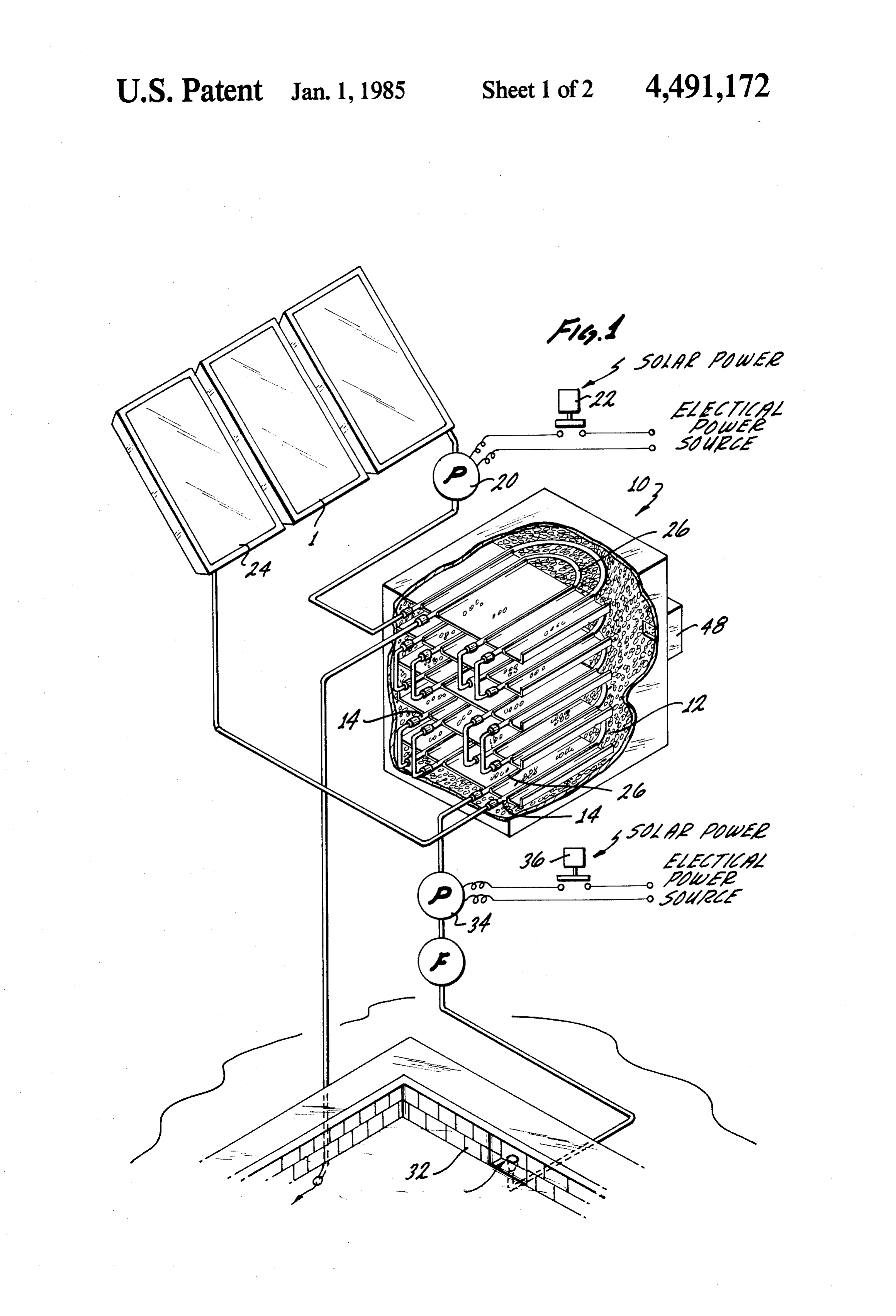
sources such as the sun has been available for subse quent use in such systems and the energy, when drawn of FIG. 1 is a schematic view, partially in perspective, from such systems, appears at decreasing temperatures 30 tionapparatus constituting one embodiment of this inven for storing solar or other intermittently available as the heat storage medium is being cooled. Storage energy and for providing for a release of this energy at Inedia such as rocks have proven to be a potential health hazard because of their designation of radon gas into the particular times;
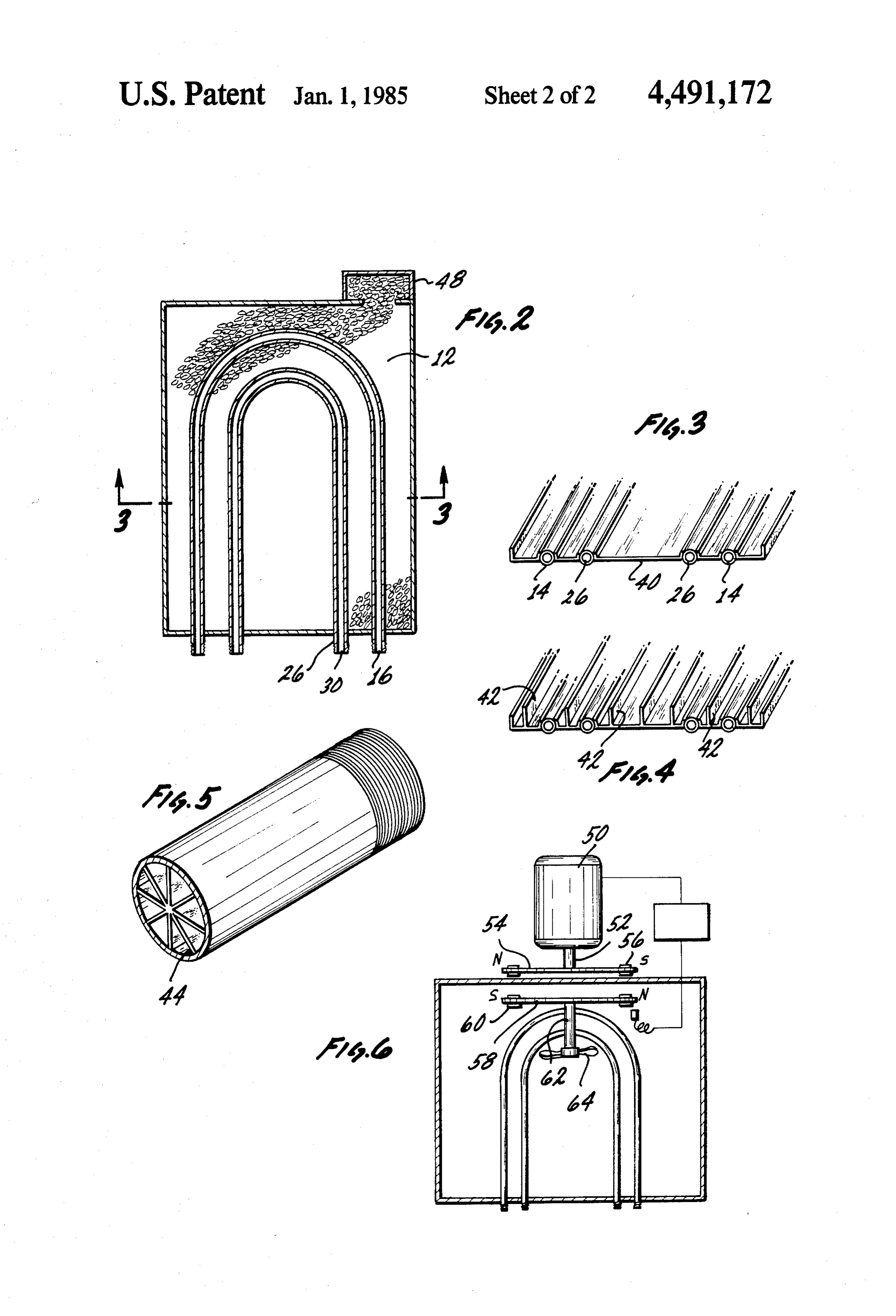
FIG. 2 is a sectional view of heat transfer members air used for heat removal. Other systems, using phase included in the embodiment shown in FIG. 1; change materials, have been designed to overcome is FIG. 3 is a sectional view of the heat transfer men these limitations, but suffer from other shorcomings bers shown in FIG. 2 and is taken substantially on the such as incongruent melting and inefficient heat trans line 3-3 of FIG. 2;
fer. Such systems also have shortcomings in that they FIG. 4 is a sectional view of heat transfer members lead to formation of refractory phases with low latent forming a modification of the members shown in FIG. heat of crystallization and low solubility. 40 3;
This invention provides apparatus which overcomes the above difficulties. For example, the apparatus of this to FIG. 5 is a perspective view of a further modification the heat transfer members shown in FIG. 3; and invention is able to store solar energy for controlled FIG. 6 is a sectional view of additional apparatus periods of time, and even indefinitely, without any sig which may be included in the heat transfer apparatus nificant loss in such energy. Furthermore, the apparatus 45 shown in FIG. 1.
of this invention is able to provide an efficient transfer In one embodiment of the invention, a containergen of solar energy and other forms of energy to the storage erally indicated at 10 is provided. The container 10 may medium and an efficient transfer of the stored energy at be made from any suitable material including fiberglas acceptable temperatures to an outlet for such energy or high density polyethylene. If the container 10 is made such as for use as water or space heating. 50 from a different material than fiberglass or high density In the apparatus of this invention, a container holds a polyethylene, its interior walls may be lined with fiber heat storage medium such as aqueous sodium thiosulfate glass or high density polyethylene or a material provid having properties of melting and crystallizing in a par ing a similar vapor barrier. However, the container may ticular range of temperatures and of storing energy be made from other suitable material such as aluminum. when converted to the molten state and of releasing 55 The container 10 is filled with a heat storage medium such energy when crystallized. The sodium thiosulfate 12. Preferably, the heat storage medium is provided liquid may be chemically basic by the addition to the with properties of melting in a particular temperature liquid of a suitable soluble material such as disodium range of limited values and of crystallizing in such par hydrogen phosphate or trisodium phosphate or both. ticular temperature range. The heat storage medium has The increase of pH and buffering of the melt prevents 60 properties of receiving heat to become congruently the gradual decomposition of sodium thiosulfate that converted to the molten state without the intervention otherwise takes place leading to deterioration of the of any second phase of lower solubility and of retaining heat storage medium. This solute also has properties of this heat in a liquid supercooled state for an indefinite controlling the size and adhesion properties of the crys period of time without loss of any latent heat of crystal tals which preferentially form on the heat exchanger 65 lization. The supercooled liquid further has properties surfaces when the latent heat of crystallization is with of being nucleated on a controlled basis to the crystal drawn from the melt. Alternatively, the potassium and line state and of releasing the stored latent heat when ammonium analogs may be respectively substituted for thus nucleated.
Page 5
Preferably the heat storage medium constitutes So has less heat conductivity than copper, it does not cor dium thiosulphate in the a-pentahydrate phase. The rode in the heat storage media such as sodium thiosul sodium thiosulphate may be adjusted with a solvent fate, particularly when the medium is chemically main such as water, or with another suitable solid, to peritec tained moderately basic. However, the tubes 14 may tic composition, ensuring congruent melting. Sodium have an insert of copper or plastic or other material thiosupphate in such a system has properties of storing which may be compatible with the heat transfer fluid. considerable amounts of heat as latent heat of melting, The tubes 14 are filled with a suitable fluid 15 such as and as sensible heat above and below the peritectic distilled water or another aqueous or a non-aqueous temperature, and of releasing such considerable heat transfer liquid and are connected in a closed circuit amounts of heat when crystallization is induced by nu O with a reservoir 18 of the fluid, a pump 10 and a switch cleation. However, other compounds combined with a 22. The switch 22 is responsive to solar heat to provide second phase or alone may also be used. These include for an operation of the pump when solar heating of the sodium sulfate decahydrate, calcium chloride hexahy heat transfer fluid is being provided, such as occurs drate, calcium nitrate tetrahydrate, magnesium chloride during daylight hours on a sunny day. When the pump hexahydrate alone or in eutectic proportions, magne 15 operates, it tends to pass, into the reservoir 18, fluid 16 sium nitrate hexahydrate, disodium hydrogen phos which has been heated by solar panels 24 in a conven phate dodecahydrate, trisodium phosphate dodecahy tional manner. Although solar energy is discussed as the drate, sodium acetate trihydrate, pinacol hexahydrate source of energy, it will be appreciated that other en and various paraffins and waxes. ergy sources may also be used. For example, electricity A soluble additive material is preferably dissolved in 20 at non-peak hours may also be used since electricity is the liquid heat storage medium. The soluble additive relatively inexpensive at such times. Industrial waste material controls the size and habit of the crystals pro heat or fireplace waste heat may also be used. duced in the heat storage medium when heat is removed A plurality of tubes 26 or hollow coils are also dis at the liquidus temperature, or when the heat storage posed in the container and are also preferably made medium is nucleated. Preferably the additive solute 25 from aluminum. The tubes 26 may have an insert such a constitutes disodium hydrogen phosphate or trisodium copper or plastic in a manner similar to that described phosphate or a combination or both. When disodium above for the tubes 14. The tubes 26 are disposed in hydrogen phosphate or trisodium phosphate is used as spaced and nested relationship to the tubes 14. The the liquid additive material, it also controls the pH of tubes 26 are preferably disposed in a looped or U the liquid so that the liquid is chemically basic. By con 30 shaped configuration with the legs of the U extending trolling the relative amounts of the disodium hydrogen from the container 10. The tubes 26 are connected in a phosphate and trisodium phosphate in the liquid, the pH series or parallel relationship or a combination of both. of the liquid can be maintained in a range of approxi The tubes 26 are preferably paired with the tubes 14. mately eight (8) to eleven (11). Preferably the relative The spacing between the paired tubes 14 and 26 are amount of the disodium hydrogen phosphate and triso 35 preferably in the order of a few inches when the tubes dium phosphate in the medium is maintained between are disposed in a container having a width, height and approximately two percent (2%) and four percent (4%) length of several feet.
by weight. The potassium and ammonium analogs may A suitable fluid 30 such as water or other heat trans be respectively used instead of disodium hydrogen fer fluid is disposed in the tubes 26. The fluid 30 is phosphate and trisodium phosphate. This particular adapted to be recirculated through a system including a additive is only applicable when the heat storage me member 32 to be heated. For example, the member 32 dium consists of such materials as sodium thiosulfate, may be a water heater which is provided to heat cold Sodium sulfate or sodium acetate. water, or the member 32 may be a space heater. A pump A material such as disodium hydrogen phosphate or 34 and a switch 36 may be included in a fluid circuit trisodium phosphate when added in low concentration 45 with the tubes 26 and the member 32 to provide for the for controlling the pH and the crystal texture of the flow of the fluid 30 through the circuit. The switch 36 medium is also advantageous because it does not attack may be closed in any suitable manner such as by a timer. commonly used fiberglass resins or the glass fiber in Instead of being connected as described above, the such composite material and also does not attack such tubes 14 and 26 may be connected in parallel to decrease metals as aluminum. 50 the drop in system pressure. The parallel tubes 14 and The use of disodium hydrogen phosphate or triso 26 may be connected to the source of heat or the load or dium phosphate, or a combination of both, as the solu both the source and the load.
ble additive material is disclosed and claimed in copend Connecting or bridging members 40 (FIG. 3) made ing application Ser. No. 254,547 filed on Apr. 15, 1981, from a suitable material such as aluminum ar disposed now U.S. Pat. No. 4,391,267, by Gustaf Arrhenius for a 55 between the paired tubes 14 and 26 to brace the tubes "Heat Storage Material' and assigned of record to Kay and to facilitate the transfer of heat between the heat Laboratories, Inc. The asignee of record of this applica storage medium 12 and the fluid in the tubes 14 and 26. tion has a cross-licensing arrangement with Kay Labo The connecting or bridging members 40 also facilitate ratories, Inc. the simultaneous formation of the paired tubes 14 and 26 A plurality of tubes 14 or hollow coils are disposed in 60 in a single operation. Fins 42 (FIG. 4) may be provided the heat storage medium 12 in spaced relationship to on the connecting members 40 and the tubes 14 and 26 one another. The tubes 14 are preferably provided with to facilitate such transfer. When the fins 42 are pro a looped or U-shaped configuration with the legs of the vided, the fins preferably terminate at a position within U extending from the container 10. The tubes 14 are the container 10 So that a connection from the tubes 14 connected in a series relationship or in a parallel rela 65 and 26 to the tubes external to the container 10 will not tionship or in a combination of series and parallel. The be impeded.
tubes 14 are preferably made from a suitable heat-con Upon the closure of the switch 22, the solar heat ducting material such as aluminum. Although aluminum obtained from the solar panels 24 is transferred to the
Page 6
fluid 16. This fluid is circulated through the tubes 14 to nucleation of a heat storage material are known in the heat the supercooled fluid 12 to the particular tempera prior art.
ture range. This causes the heat storage medium 12 to An arrangement (FIG. 6) may be provided for stir melt and to store the heat in the molten state. If the ring the melt 12 in the container 10. This arrangement Inedium is allowed to supercool, the latent heat of melt includes a motor 50 having a drift shaft 52 for rotating ing can then be stored without any loss until such time a disc 54 disposed externally of the container 10. The as it is desired to release such stored energy by nucle disc 54 is provided with south and north poles 56 at ation. opposite diametrical ends.
When it is desired to use the stored latent heat of The disc 54 is disposed in magnetically coupled rela crystallization, the supercooled liquid 12 is nucleated 10 tionship to a disc 58 within the container 10. The disc 58 and begins to crystallize. This causes the latent heat is provided with north and south poles 60 at diametri stored in the supercooled liquid 12 to become liberated cally opposite ends. A shaft 62 extends downwardly as the temperature of the heat storage medium rises to into the heat storage medium 12 from the disc 58. A stirrer 64 is disposed at the bottom end of the shaft 62 to the peritectic temperature and the main portion of the 15 stir liquid crystallizes. This released heat is transferred to the melt.
the fluid 30 in the tubes 26 when the switch 36 becomes A sensor 66 is disposed adjacent the disc 58 at one closed. This heated fluid is then introduced to the mem diametrical end of the disc. The sensor 66 may consti ber 32 to heat the member. tute a semiconductor diode (well known in the art) The nucleation of the liquid heat storage medium 12 which is responsive to the opposite magnetic poles 60 may be controlled by a portion of the heat storage me 20 on the disc 58 to distribute ions in the two electrodes of dium or another crystalline nucleation agent kept in the the diodes in accordance with the magnetic polarity of pole acting upon it. The sensor 66 may operate on solid crystalline state in a snout 48 which extends from the basis the container 10. The crystalline solid in the snout 48 the northofand a Hall effect to produce a pulsating signal as may have the same composition as the solid forming in 25 the sensor. Thesouth poles 60 on the disc 58 rotate past sensor 66 may be connected in a circuit equilibrium with the liquid medium 12 in the container with the motor 50 to provide for an operation of the 12. The snout 48 may constitute a pipe extending from motor until the heat storage medium 12 becomes suffi the container for a few inches when the container 10 has the size discussed above. The snout 48 may be made ciently crystallized to impede the rotation of the disc 58. from a suitable material such as aluminum or other 30 During the time that the motor 50 is operated, it material with sufficiently high heat conductivity to drives the disc 54. Because of the magnetic coupling retain the seed crystals in the snout near ambient tem between the discs 54 and 58, the disc 54 in turn drives perature and well below the temperature where melting the disc 58 while the heat storage medium 12 is in a fluid is complete. state. This causes the fluid crystallizing heat storage medium to be mixed so that (a) crystals, preferentially
The crystalline nucleation material in the snout 48 is 35 forming on the heat exchanger surfaces, deteriorating subjected to ambient temperatures because the snout is the heat transfer, exposed to the atmosphere. The nucleation agent is a the circulating fluidcanandbe(b)removed by frictional stres in heat transfer is improved by solid crystalline material at and below ambient (room) forcing the heat storage medium into contact with the temperature and remains solid also at higher tempera heat exchanger.
tures. In the case where it consists of the main com When the viscosity in the crystallizing heat storage pound of the heat storaged medium (e.g. sodium thiosul medium rises above a certain limit due to the increasing fate pentahydrate or sodium acetate trihydrate), it volume of crystals over liquid, this viscous resistance would not melt unless it reaches the peritectic melting prevents temperature of the heat storage medium. Keeping it ingly slipstherelative disc 58 from rotating. The disc 58 accord near ambient temperature prevents it from ever melting. 45 should continue to betorotated the disc 54 even if the disc 54 by the motor 50. Since the
If desired, the nucleation by the snout 48 of the mol disc 58 no longer rotates, a pulsating signal is not longer ten heat storage medium in the container 10 may be produced by the sensor 60. This causes the operation of avoided, permitting the molten heat storage medium to the motor 50 to become interrupted, thereby conserving persist as a supercooled liquid at temperatures down to energy.
ambient of practically unlimited times. In this way, the 50 The apparatus described above has certain important latent heat of crystallization can be stored any length of advantages. It provides for an efficient transfer of heat time. The arrangement for preventing nucleation may into and out of the heat storage medium and an efficient consist of a valve at the base of the snout, and embedded storage of heat in a form in which the latent heat of within, and isothermal with, the heat storage medium. crystallization can be released at any selective time and This interior, basal part of the snout should then be 55 at a predetermined, practically useful temperature or constructed of a material with low heat conductivity, temperature range. Furthermore, the storage of latent such as a plastic. The valve should then be operated heat of crystallization can occur for an indefinite period with a linkage through the heat storage medium. Stor of time without any loss of this particular component age of the latent heat of crystallization for indefinite during such period of storage.
periods of time may be particularly advantageous for 60 The apparatus also has other advantages of some temporarily or irregularly occupied buildings such as importance. For example, by using separate tubes 14 mountain cabins. and 26, the circulating fluids 16 and 30 can be main It will be appreciated that the snout 48 is only one tained isolated from each other. This considerably ex convenient way of instituting the nucleation of the heat pands the uses which can be made of the apparatus storage material and that other nucleation techniques 65 constituting this invention. By way of illustration, the may also be used. Some of these techniques provide for fluid 30 can be a food material which is heated by the the institution of nucleation at any conventient instant energy stored in the apparatus of this invention. If this of time. A number of different techniques for instituting food material were to be contacted by the heat storage
Page 7
material or by the heat transfer fluid 16, it might be at the first controlled times and abutting the second considered inedible from the standpoint of strict health tubes to transfer to the fluid in the second tubes the standards. Water, either for drinking or washing, may heat stored in the heat storage medium, also have to be separated in this manner in the tubes 14 a plurality of connecting members each made from a from the heat storage material and the fluid in the tubes 5 heat conducting metal and each connected, in the 26. As will be appreciated, the isolation of the fluids 16 planes common to the first and second tubes, be and 30 is facilitated by the use of aluminum for the tubes tween individual ones of the first tubes and individ 14 and 26 because aluminum is not corroded by the heat ual ones of the second tubes, storage media. the first tubes, the second tubes and the connecting Although this application has been disclosed and members being made from aluminum, illustrated with reference to particular applications, the means for stirring the heat storage medium in the principles involved are susceptible of numerous other fluid state, and applications which will be apparent to persons skilled in means operatively coupled to the stirring means for the art. The invention is, therefore, to be limited only as interrupting the operation of the stirring means indicated by the scope of the appended claims. 15 when the melted or partially melted heat storage I claim: medium reaches a state of crystallization to provide 1. In combination in apparatus for storing energy and a viscous resistance to the operation of the stirring for providing for a subsequent use of such energy as means, heat, the heat storage medium being an aqueous system of a container, sodium thiosulfate forming sodium thiosulfate pen first tubes disposed in looped and spaced relationship tahydrate in the crystalline state, and in the container and connected to provide for the a soluble additive material selected selected from a passage of a first fluid through the tubes, group consisting of disodium hydrogen phosphate, means for providing for the passage of the first fluid trisodium phosphate and their potassium and am through the first tubes at first controlled times, 25 monium analogs and controlling the pH of the second tubes disposed in looped and spaced relation medium and the size of the crystals produced in the ship in the container and in the same planes as the medium.
first tubes and connected to provide for the passage 3 The combination set forth in claim 2 wherein of a second fluid through the tubes at second con trolled times corresponding to the release from the 30 the soluble additive material is dissolved in the liquid container of the heat stored in the container, and heat storage medium in the range of approximately a heat storage medium disposed in the container and two percent (2%) to four percent (4%) by weight having properties of melting and crystallizing in a and the relative amounts of the disodium hydrogen particular temperature range and of storing heat in phosphate, trisodium phosphate and their potas the melted state and of releasing heat when nucle 35 sium and ammonium analogs in the soluble additive ated into the crystalline state in the particular tem material is controlled to place the pH of the liquid perature range, the heat storage medium abutting in a predetermined range and to impart desirable the first tubes to become melted and further heated physical properties to the crystalline compound of at the first controlled times and abutting the second the heat storage medium.
tubes to transfer to the fluid in the second tubes the 40 4. In combination in apparatus for storing energy and heat Stored in the heat storage medium, for providing for a subsequent use of such energy, a plurality of connecting members each made from a a container, heat conducting metal and each connected in the a heat storage medium in the container, the medium planes common to the first and second tubes, be having properties of melting and crystallizing in a tween individual ones of the first tubes and individ 45 limited temperature range and of remaining in the ual ones of the second tubes in the common planes. melted state at temperatures below the limited 2. In combination in apparatus for storing energy and temperature range and of storing energy when for providing for a subsequent use of such energy as converted to the melted state and of releasing such heat, stored energy as heat when crystallized, a container, 50 first tubes made from heat conducting material and first tubes disposed in looped and spaced relationship disposed in the heat storage medium and connected in the container and connected to provide for the to provide for the passage of a first circulating fluid passage of a first fluid through the tubes, through the tubes, means for providing for the passage of the first fluid means for providing for the passage of the first fluid through the first tubes at first controlled times, 55 through the first tubes during the transfer of heat to Second tubes disposed in looped and spaced relation the first fluid to convert the heat storage medium to ship in the container and in planes common to the the melted state and to increase its temperature first tubes and connected to provide for the passage above the temperature of conversion, of a second fluid through the tubes at second con second tubes made from heat conducting material trolled times corresponding to the release from the 60 and disposed in the heat storage medium and con container of the heat stored in the container, and nected to provide for the passage of a second circu a heat storage medium disposed in the container and lating fluid through the tubes and having properties of melting and crystallizing in a means for providing for the passage of the second particular temperature range and of storing heat in fluid through the second tubes during the removal the molten state and of releasing heat when nucle 65 of heat from the storage medium to provide for the ated into the crystalline state in the particular tem transfer of the heat stored in the container, perature range, the heat storage medium abutting bridging members made from a heat conducting ma the first tubes to become melted and further heated terial,
Page 8
the first and second tubes being disposed in spaced first tubes disposed in looped and spaced relationship and nested relationship and being connected in the in the container and connected to provide for the nested relationship by the bridging members, passage of a first fluid through the tubes, the heat storage medium being an aqueous sodium means for providing for the passage of the first fluid thiosulfate system, and through the first tubes at first controlled times, a soluble additive material included in the medium to second tubes disposed in looped and spaced relation maintain the medium chemically basic and non ship in the container and connected to provide for corrosive and to control various parameters of the the passage of a second fluid through the tubes at crystals produced by the heat storage medium, second controlled times corresponding to the re the heat storage medium being sodium thiosulfate O lease from the container of the heat stored in the pentahydrate and the additive being selected from container, a group consisting of disodium hydrogen phos the first and second tubes being disposed in paired phate and trisodium phosphate and their potassium relationship in a common plane, and ammonium analogs. a heat storage medium disposed in the container and 5. The combination set forth in claim 4 wherein 15 having properties of melting and crystallizing in a a snout extends from the container and communicates limited temperature range and of storing heat in the with the container and melted state at temperatures below the limited means are disposed in the snout for providing a con temperature range and of releasing heat when nu cleated into the crystalline state in the limited ten trolled initiation in the crystallization of the heat 20 perature range, the heat storage medium abutting storage medium. the first tubes to become melted and further heated 6. In combination in apparatus for storing energy and at the first controlled times and abutting the second for providing for a subsequent use of such energy, tubes to transfer to the fluid in the second tubes the a container, heat stored in the heat storage medium, a heat storage medium disposed in the container and 25 the heat storage medium being an aqueous system of having properties of melting and crystallizing in a sodium thiosulfate forming sodium thiosulfate pen limited temperature range and of remaining melted tahydrate in the crystalline state, and at temperatures below the limited temperature a soluble additive material included in the heat stor range and of retaining stored energy in the melted age medium to maintain the medium basic and state and of releasing such stored energy when non-corrosive and to control the size physical cooling and crystallizing, properties of the crystals produced in the crystalli first means disposed in the container for providing for zation of the molten heat storage medium. the transfer of the energy to the heat storage me 8. In combination in apparatus for dium in the container to heat and melt the medium storing energy and for providing for a subsequent use in the container, and 35 of such energy, second means disposed in the container in spaced a container, relationship to the first means for providing for the a heat storage medium disposed in the container and transfer of the heat released from the storage me having properties of melting and crystallizing in a dium by the cooling and crystallization of the me limited temperature range and of remaining melted dium, 40 at temperatures below the limited temperature the heat storage medium being an aqueous system of range and of retaining stored energy in the melted sodium thiosulfate, and state and of releasing such stored energy when an additive material dissolved in the liquid medium to cooling and crystallizing, limit the size, strength and cohesion of the crystals first means disposed in the container for providing for produced in the medium and to maintain the pH of 45 the transfer of the energy to the heat storage me dium in the container to heat and melt the medium the medium chemically basic and non-corrosive, in the container, and fins disposed at spaced positions on the connecting second means disposed in the container in spaced members and extending in a direction transverse to relationship to the first means for providing for the the connecting members to facilitate the transfer of 50 transfer of the heat released from the storage me heat between the connecting members and the heat dium by the cooling and crystallization of the me storage medium, dium, the heat storage being an aqueous system of sodium the heat storage medium being an aqueous system of thiosulfate forming sodium thiosulfate pentahy sodium thiosulfate, drate in the crystalline state, and a soluble additive 55 an additive material dissolved in the liquid medium to material selected from a group consisting of diso limit the size, strength and cohesion of the crystals dium hydrogen phosphate and trisodium phos produced in the medium and to maintain the pH of phate and their potassium and ammonium analogs, the medium chemically basic and non-corrosive, the soluble additive material being included in the fins disposed at spaced positions on the connecting heat storage medium to maintain the medium basic 60 members and extending in a direction transverse to and non-corrosive and to control the size, strength the connecting members to facilitate the transfer of and cohesion of the crystals produced in the crys heat between the connecting members and the heat tallization of the molten heat storage medium, and storage medium, members connecting the paired first and second tubes the heat storage being an aqueous system of sodium in the common plane. 65 thiosulfate forming sodium thiosulfate pentahy 7. In combination in apparatus for storing energy and drate in the crystalline state, and for providing for a subsequent use of such energy as a soluble additive material being included in the heat heat, storage medium to maintain the medium basic and
Page 9
non-corrosive and to control the size, strength and are paired and wherein connecting means bridge cohesion of the crystals produced in the crystalliza the paired first and second means in the common tion of the molten heat storage medium, and plane and wherein fins are disposed on the connect members connecting the paired first and second tubes ing means to facilitate the transfer of heat between in the common plane, the first and second means and the heat storage the additive material being selected from a group medium.
consisting of disodium hydrogen phosphate and 10. The combination set forth in claim 9 wherein trisodium phosphate and their potassium and an a snout extends from the container in communication monium analogs.
9. The combination set forth in claim 8 wherein with the container and the first and second means are disposed in spaced and means are disposed in the snout for initiating a con nested relationship in common planes and wherein trolled crystallization of the sodium thiosulfate.
the first and second means in the common planes
Provenance
- Collection
- Cited prior art
- Original PDF
- patentimages.storage.googleapis.com →
- Filed
- 1981-04-22
- Pages
- 9
- Method
- pdftotext (the PDF's own text layer) + pdftoppm 300dpi page scans
- Source
- Google Patents bibliographic record
- Granted
- 1985-01-01
- Inventors
- James Hitchin; Thermal Energy Storage Inc
- Transcribed from
- patentimages.storage.googleapis.com →