patent · US4280553
System and process for storing energy
28 July 1981
Page 1 — bibliographic record
United States Patent (19) 11 4,280,553 Bean et al. 45) Jul. 28, 1981 54) SYSTEM AND PROCESS FOR STORING 4, 154,2925/1979 Herrick ........................ 165/104 S X
ENERGY
FOREIGN PATENT DOCUMENTS
(75) Inventors: Samuel L. Bean, Jamesville; James
W. Swaine, Jr., Manlius; Paul R. 50-90584 7/1975 Japan ......................................... 252/70 Crawford, Freeville, all of N.Y. 52-11 181 1/1977 Japan ......................................... 252/70 73) Assignee: Allied Chemical Corporation, Morris Primary Examiner-Albert W. Davis Township Morris County, N.J. Attorney, Agent, or Firm-Thomas D. Hoffman;
Anthony J. Stewart 21 Appl. No.: 21,282 57 ABSTRACT 22 Filed: Mar. 16, 1979 There is disclosed a process for storing energy by use of 51) Int. Cl. .............................................. F28D 21/00 the heat of fusion of hydrated salts which are within a 52 U.S. Cl. ................................... 165/1; 165/104.17; bulk container having heat exchange means. The pro 126/435; 252/70 cess prevents stratification and supercooling from oc 58) Field of Search .................... 165/104 S; 126/400, curring during the heat releasing cycles by internally 126/435; 252/70 circulating the molten salt within the container and also 56) References Cited by preventing the temperature of the salt from rising
tals within the container occurs.
3,952,519 4/1976 Watson .............................. 252/70 X 4,091,863 5/1978 Schroder ...................... 165/104 SX 7 Claims, 3 Drawing Figures
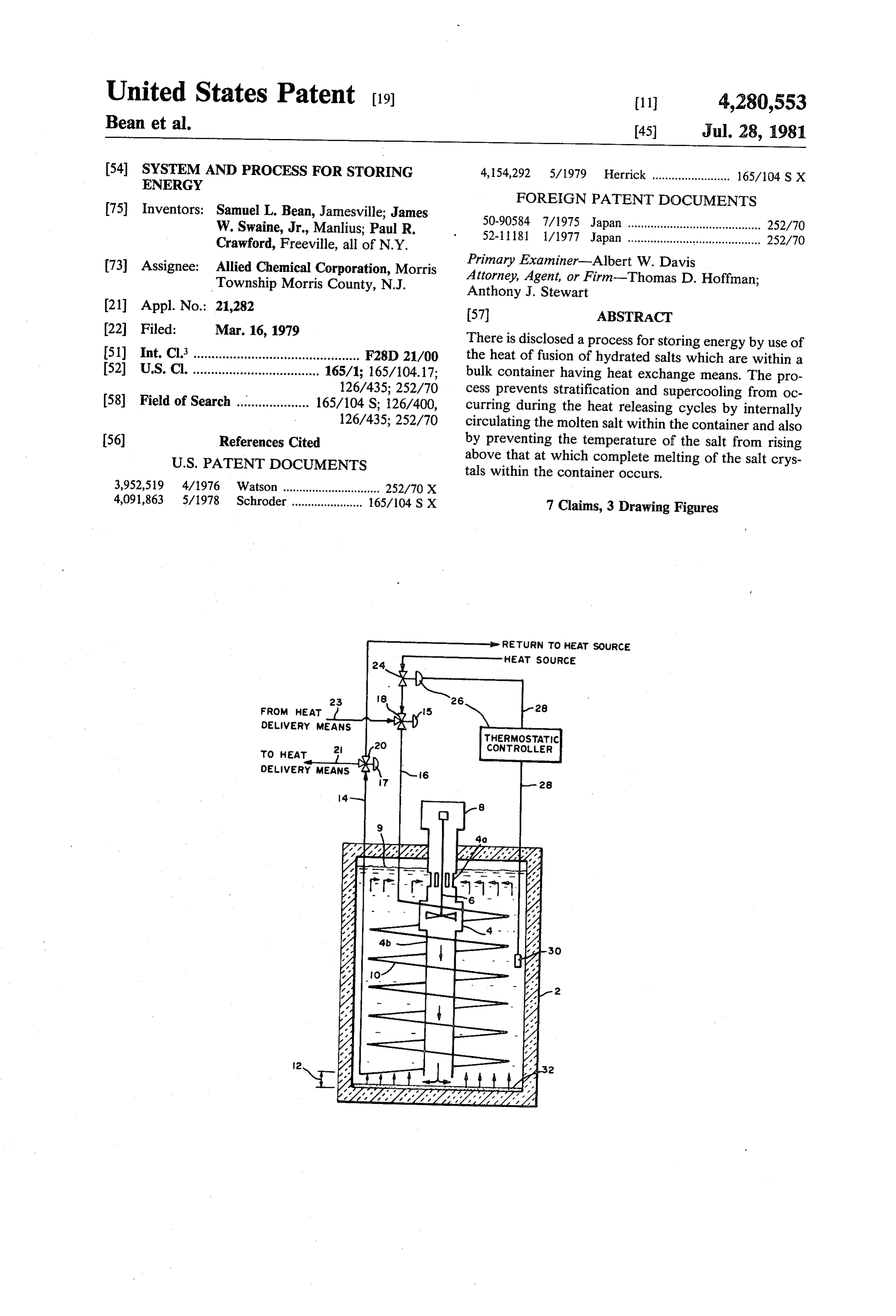
Return TO HEAT Source
HEAT SOURCE
FROM HEAT
DEIVERY MEANS
To HEAT
DEVERY MEANS
Page 2
Drawing sheet — no readable text.
Page 3
Drawing sheet — no readable text.
Page 4
Drawing sheet — no readable text.
Page 5
It is accordingly an object of this invention to provide
SYSTEM AND PROCESS FOR STORING ENERGY a process for storing and releasing heat employing the heat of fusion of hydrated salts contained within bulk
BACKGROUND OF THE INVENTION containers.
It is another object of this invention to provide a heat
This invention relates to a system for storing and storage-releasing releasing energy as heat and to a process for operating bulk process employing such salts stored in such a system. and which avoids the problems of supercooling It has been known for some time that hydrated salts andIt stratification.
is an additional object of this invention to provide having a heat of fusion of above about 116 kJ/kg (50 10 a system
BTUs per pound) can be used as heat storage media. stored in for storing and releasing heat in a hydrated salt bulk.
Heat is absorbed in these hydrated salts causing a phase change from solid to liquid. Thereafter, the heat is re theThese and other objects will become apparent from description which follows.
covered by allowing the molten salt to solidify and release the heat which was absorbed. 15 BRIEF SUMMARY OF THE INVENTION Certain serious problems have heretofore been en In accordance with this invention there is provided countered in the operation of these hydrated salt heat an improved process for storing and releasing heat storing systems. The phenomenon known as supercool wherein heat is absorbed by a solid hydrated salt, pref ing prevents the release of useful heat from these sys tems. This occurs when a molten salt cools below its 20 erably an inorganic salt, stored in a bulk container freezing point without the formation of solid material. thereby causing said salt to become molten, and thereaf Thus, instead of employing the heat of fusion of the released molten ter said salt is allowed to solidify, and the heat from said salt in the solidification step is recov hydrated salt, only the sensible heat, which is many ered.
times less than the heat of fusion, is recovered. The of heatThe improvement comprises terminating the input prior art has attempted to avoid the problem of super 25 said solid saltsaid into
salt prior to the complete conversion of the molten state and internally circulat cooling by introducing nucleating agents which pro ing said salt within said container during the solidifica vide an initial seed for the formation of salt crystals. tion step.
An additional problem associated with the use of There is also provided a system for storing heat hydrated salts as bulk heat storage media is the known through the heat of fusion of a hydrated salt, which tendency of these materials to also form other salts of 30 system comprises a closed container for said salt, heat lower hydration with a corresponding loss in the heat of exchange means within fusion. Since the density of these crystals is greater than heat to and remove heatsaid container adapted to supply from the contents of the con the density of the solution the crystals settle to the bot tainer, means to terminate the supply of heat to the tom of the container. During subsequent heat absorp contents of the container in response to the temperature tion-heat releasing (melting-solidification) cycles the 35 of said contents, and means within said container to system becomes stratified vertically into layers with circulate the contents thereof.
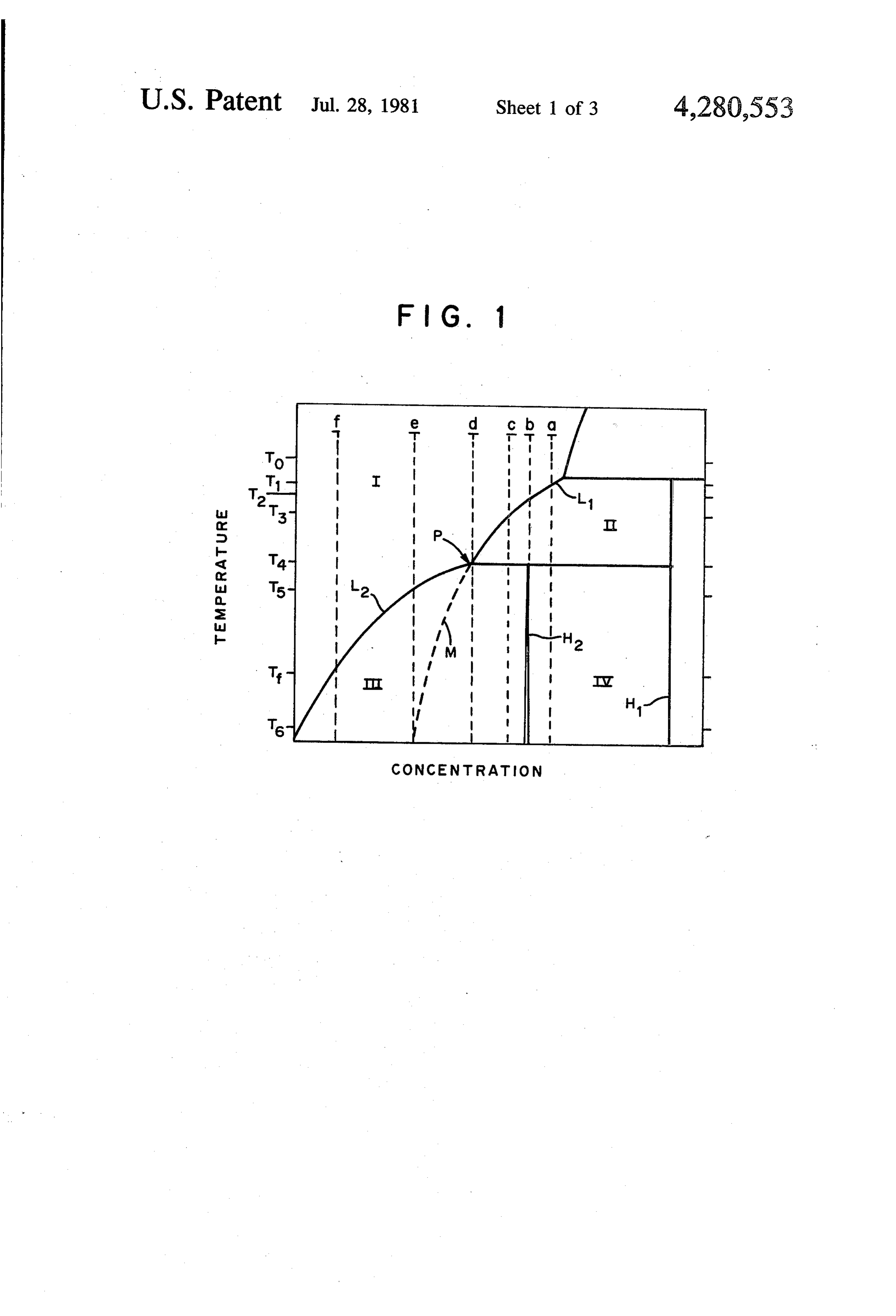
both decreasing density and composition. Eventually It has been found that by operating in accordance the amount of lower hydrated salt, or even anhydrous with the process of this invention supercooling and salt, grows progressively larger with a corresponding stratification of the hydrated salt are avoided and the increase in an upper weak liquor layer and a significant heat storage efficiency of the salt stored in bulk is not deterioration in the energy storage capability of the significantly decreased over a large number of heat system. Prior art attempts to overcome this stratifica absorbing-heat releasing cycles. By terminating the tion problem have involved the use of thickeners to input of heat into the hydrated salt prior to the conver prevent the formation of layers by so dispersing the salt sion of all of the solid particles to the molten state, the media and excess water in such a way that the appropri 45 solid particles remaining act as nucleating agents during ate number of water molecules are available in the im the cooling and supercooling is thereby avoided. mediate vicinity of the anhydrous or lower hydrated salt in order to recombine in the next heating cycle. BRIEF DESCRIPTION OF THE DRAWINGS It has also been suggested by the prior art that both FIG. 1 is a portion of a generalized equilibrium phase problems, i.e., supercooling and stratification, could be 50 diagram for an incongruently melting hydrated salt avoided by mixing or stirring of the molten hydrated system.
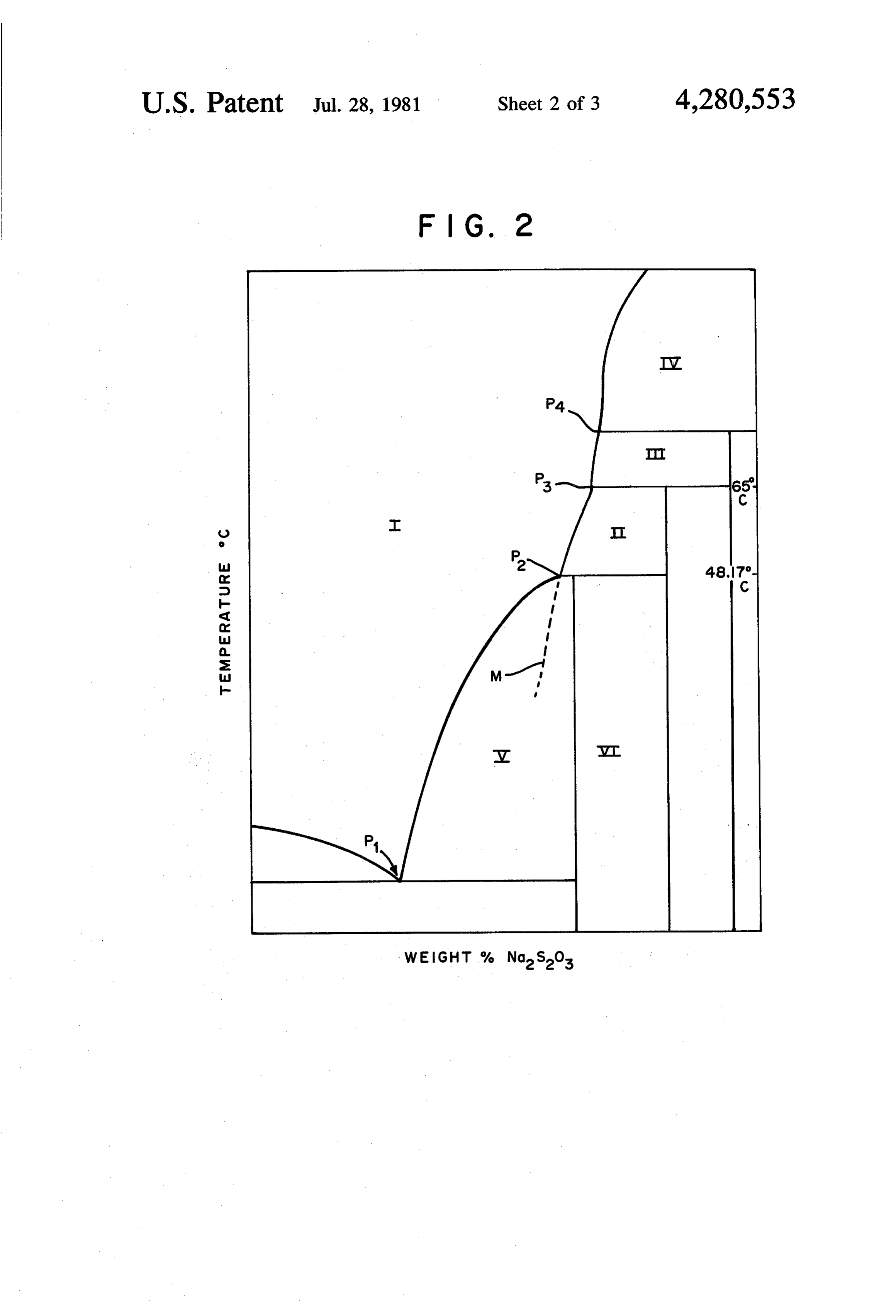
salt. However, such a solution was discarded due to the FIG. 2 is an equilibrium phase diagram for the system inconvenience or impossibility of affecting agitation in sodium thiosulfate-water.
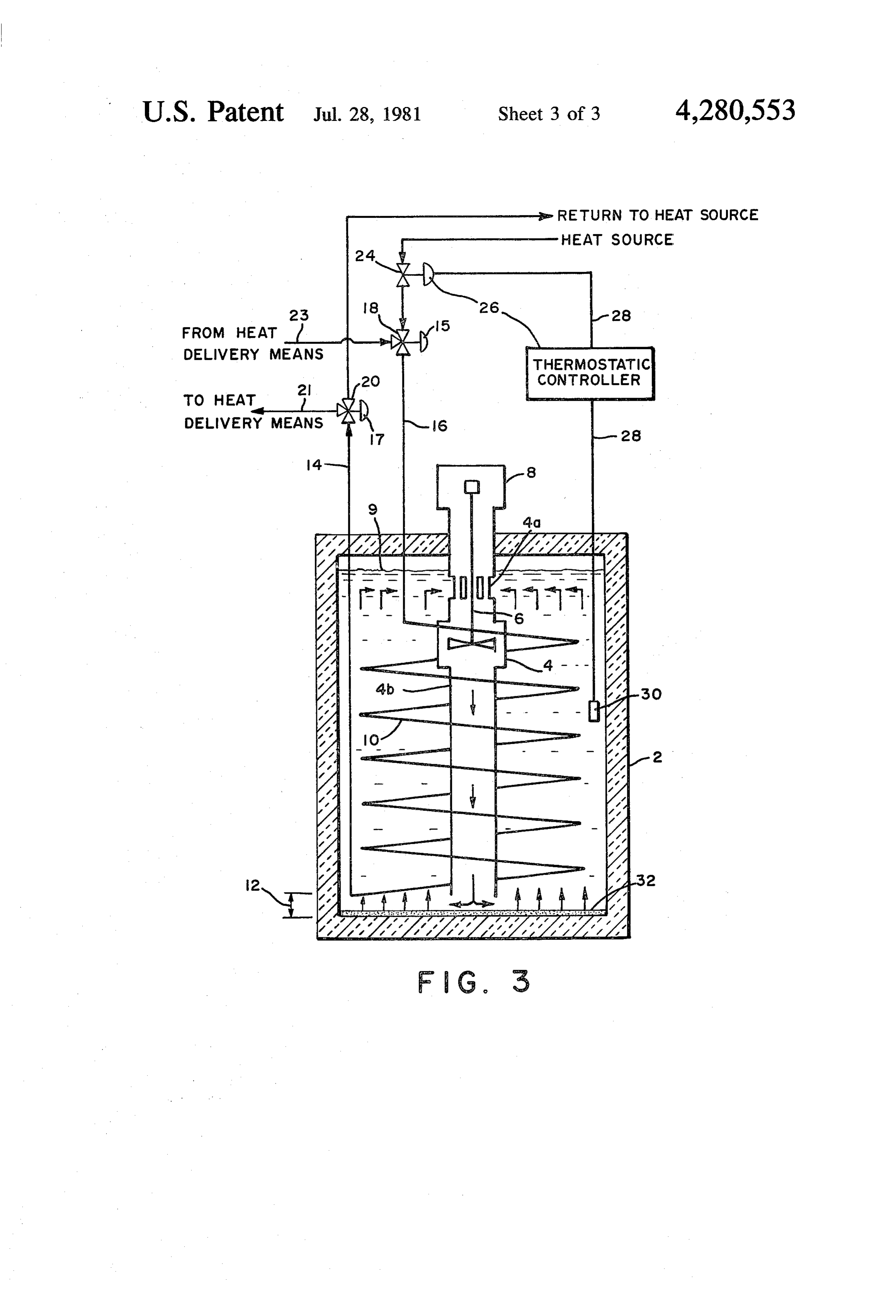
heat storage systems. Indeed, much of the focus of the FIG. 3 is a systematic representation of an embodi prior artworkers in this field have been on the use of a 55 ment of the process and system of the present invention. large number of relatively small sealed containers of DETAILED DESCRIPTION OF THE hydrated salts having at least one dimension thin INVENTION enough to assist in preventing stratification. Generally, the prior art teaches away from the use of bulk contain Hydrated salts useful as heat storage media are those ers of hydrated salts as heat storage media and those which exhibit a heat of fusion of more than 116 kJ/kg prior art systems which do contain the salt in bulk are (50 BTUs per pound). Among the salts which can be awkward to operate and also require nucleating agents mentioned as falling within this category, and which are to prevent supercooling. useful in the process and system of the present inven Ideally, heat storage systems for large buildings or tion, are:
homes, e.g., in conjunction with solar heat receiving 65 Na2SO4.10H2O means, would involve storage of the hydrated salts in Na2S2O3.5H2O bulk. Such a system has the obvious advantage of lower NaH2PO4.7H2O cost, maintenance and the like. Na2HPO4.12H2O
Page 6
Na3PO4.12H2O crystallizes and the liquid composition follows the line Na2CO3.10H2O L2 between Area I and Area III to composition f. CH3COONa.3H2O Cooling a homogeneous solution of composition d CaCl2.6H2O from To down to T4 produces either solid H1 or solid MgCl2.6H2O H2 (or both H1 and H2) at equilibrium and on further Ca(NO3)2.4H2O cooling any H1 formed should be converted to H2 and KF.2H2O the remaining liquor composition follows the line L2 to K2Mg(SO4)2.6H2O, T? (or composition f).
and other like salts. A common characteristic among If however, on cooling down below T4 no crystals of these salts is their tendency under certain conditions to 10 H2 form spontaneously (or are added intentionally as form another hydrate other than the one which exhibits crystal seed) supercooling occurs and there is produced a high heat of fusion. For example, sodium thiosulfate relatively large quantities of H1 below the metastable pentahydrate melts in its own water of crystallization dotted line extension M of liquids curve L1 thru P. and will, upon cooling and solidification in certain Cooling a homogeneous solution of composition e cases, tend to form sodium thiosulfate dihydrate which 15 from To down to Ts produces no H1 solid. (In fact in is useless as a heat storage material. A similar result order to produce H1 solid supercooling would have to occurs in other salt hydrate systems upon formation of occur to a temperature less than Ts where the composi undesired lower hydrates or anhydrous salts. tion e intersects with the line M at Ts). Nucleation of This characteristic will be more fully understood H2 should occur at Ts and with continuing H2 crystal with reference to FIG. 1 wherein dotted lines identified 20 growth the remaining liquor composition follows the as a, b, c, d, e and frepresent different concentrations of line L2 to composition f at the final temperature Tf. the salt in water. Points T0, T1, T2, T3, T4, T5, T6 and Referring to FIG. 2, an equilibrium phase diagram for Tfrepresent specific temperatures, H1 and H2 represent the sodium thiosulfate water system, Area I represents different solid hydrates of the same salt, H2 being the the temperature-concentration region of the phase dia desired hydrate; P represents the peritectic composi 25 gram where all solutions of sodium thiosulfate are ho tion; L1 and L2 represent liquidus lines; M represents a mogeneous and liquid. Area IV represents liquid in metastable extension of L1, and I, II, III and IV repre equilibrium with anhydrous salt, Area III liquid in equi sent areas of different physical states of the salt. librium with hemihydrate, Area II liquid in equilibrium Area I represents the combinations of temperature with dihydrate, Area V liquid in equilibrium with pen and liquor composition that are homogeneous and liq 30 tahydrate, and Area VI represents solid dihydrate in uid. The boundary between Area I and Area II repre equilibrium with solid pentahydrate. P1 represents a sents the temperature at which, for each liquor compo eutetic point; and P2, P3 and P4 represent peritectic sition, the first crystals of composition H1 appear on points. The liquidus line connecting the eutectic point cooling and the last crystals of H1 disappear on heating. P1 with point P2 defines the temperature at which for If a liquid mixture having the composition a is cooled 35 each liquor composition in the range of 30% Na2S2O3 slowly from To, the first crystals of H1 appear at T1. to 61.6% Na2S2O3 the first crystal of pentahydrate ap Upon continued cooling more solid H1 appears while pears on cooling and the last crystal of pentahydrate the liquor concentration decreases along line L1 toward disappears on heating. The liquidus line between P2 and the peritectic composition P. When the temperature T4 P3 defines the temperature at which for each liquor is reached the remaining liquid of composition d reacts composition in the range of 61.6% Na2S2O3 to 68.0% with solid H1 to form a new solid phase of composition Na2S2O3 the first crystals of dihydrate appear on cool H2. As long as solid H1 and H2 both remain in equilib ing and the last crystals of dihydrate disappear on heat rium with the residual liquid the temperature must re 1ng.
main constant at T4. Once all of the liquid has been Similar points to those presented for FIG. 1 could be consumed in forming crystal, the temperature of the 45 used to describe the heating and cooling of sodium solids remaining will continue to decrease to the final thiosulfate solutions of various concentrations as they cooling temperature Tf with no additional transforma pertain to the equilibrium phase diagram especially in tion of H1 and H2. the concentration range 50% to 68% Na2S2O3. While If a pure solid of composition H2 (or b) obtained in a the concentration is important as illustrated in the phase crystallization process is melted by heating from Tf to 50 diagram, it is not a determinative factor in the formation To, it has been found that on cooling it is not pure H2 of either the desired pentahydrate crystal or the nonde that is first formed, but a mixture of H and H2. When sirable dihydrate crystal. In fact the equilibrium phase cooling the homogeneous melt of composition b from diagram can be used to explain observations of real To the first crystals of H1 appear at T2 while the liquid nonequilibrium bulk systems. In repeated cycles of heat composition decreases along the boundary Li toward 55 absorption and heat release of any solution in this con the peritectic composition P. When the temperature T4 centration range (50-68% Na2S2O3) crystals of dihy is reached, the remaining liquid of composition d reacts drate or pentahydrate, if they form, being more dense with solid H1 to form a new solid phase H2. As long as than the solution, will settle through the bulk solution to solid H1 and H2 both remain in equilibrium with residual the bottom of the container. Since the melting point of liquid the temperature must remain constant at T4. For 60 the dihydrate is higher than the anticipated upper tem this particular composition b, the only way that all the perature limit of flat plate solar collectors for example, liquid can be consumed is to convert all the H1 eventu dihydrate crystals will not melt on the next heating ally into solid H2. cycle and therefore cannot recombine with any excess Cooling a homogeneous solution of c from Ta is simi water. Pentahydrate crystal will melt on the next heat lar to b until T4 is reached and there is now sufficient 65 ing cycle producing a liquid layer which on the next liquid remaining to convert all the H1 solid into H2 and cooling cycle will produce more dihydrate which set to leave a small residual liquid of composition d. Upon tles out on the bottom of the container. This is one further cooling to the temperature Tr additional H2 mechanism which will explain the observation that
Page 7
heretofore bulk systems eventually produce dihydrate mercially produced chemical. Its pentahydrate crystal crystal, weak liquor, and some actually stored less ther is known to have good heat storage properties. The mal energy than an equivalent volume of water. A sec amount of heat required to melt this crystal is 33 times ond mechanism for system failure involves supercool as much as the amount required to heat an equal volume ing of thiosulfate solutions to temperatures below the of water 20° C. This heat can be recovered at the freez dotted line extension M of the dihydrate liquidus curve ing point temperature which is about 48" C. Thus such P3-P2. At temperatures below this curve existing crys a heat storage system could be made to absorb and tals of dihydrate continue to grow and new crystals of release large quantities of heat over a very small tem dihydrate may form depleting the solution of thiosulfate perature range. Another preferred salt is sodium acetate without the ability to form more energy storing penta 10 trihydrate. The freezing point of this salt is about 58 C. hydrate crystal. The water rejected in this process be and thus, when the heat input is from a source generat comes the weak thiosulfate liquor layer. Each succes ing heat at a higher temperature than, e.g., a flat plate sive cycle which does not produce pentahydrate crystal collector, heat storage capacity at a higher temperature adds to the progressive failure of bulk energy storage. is realized.
The invention is better understood by reference to 15 It has been discovered that supercooling, and resul FIG.3, exemplary of an embodiment of the process and tant stratification, can be avoided in bulk, hydrated salt system of the present invention for storing and releasing heat storage systems by the process of the present in heat. A closed, insulated cylindrical storage vessel 2 vention. By providing for internal circulation of the containing heat storage medium in the form of an aque heat storage medium during solidification the liquid ous solution of sodium thiosulfate (Na2S2O3), a pump 4 20 layers which would otherwise settle are prevented from and heat exchange means 10 is presented. The pump 4 doing so and the system becomes conducive to the comprises a stirrer 6 driven by motor 8 which are en formation of the desired hydrate, e.g., sodium thiosul closed conveniently in a hollow cylindrical tube open at fate pentahydrate. Circulation, or mixing, of the salt the bottom, and is provided with openings 4a positioned medium will not, by itself, insure the avoidance of su just below solution level 9 to allow for circulation of the 25 percooling. It is believed that some solid crystals of the heat storage medium from top of vessel 2 downward desired hydrate should be present in the system during through downcomer 4b of pump 4 to bottom of said the heat-release operation in order to insure solidifica vessel 2. The action of stirrer 6 within pump 4 distrib tion as the desired hydrate. According to the present utes the solution radially across the bottom and up invention, this is accomplished by terminating the input through the annular space between heat exchange 30 of heat into the system prior to the point at which all of means 10 and walls of vessel 2. Heat exchange means 10, the solid desired hydrate, e.g., sodium thiosulfate penta comprising a hollow tube or tubes, is positioned within hydrate, is melted. Since the salt storage medium is in vessel 2 so that a gap 12, usually a 2 to 3 centimeter gap, bulk, even though the temperature indicators signify is provided between the bottom of vessel 2 and heat that the melting point of the salt is reached, or even that exchange means 10. Conveniently, the same heat ex 35 the temperature is slightly higher than the melting change means 10 is used to provide heat as well as to point, somewhere within the bulk system solid particles withdraw heat. Accordingly, exchange means 10 is will remain. For example, encrustation at the bottom or connected to heat source (not shown) by a inlet connec elsewhere in the tank. By insuring the presence of some tion means 16 containing values 18 and 24, and by outlet solid hydrate, when the system is circulated there is the connection means 14 containing valve 20. Valves 18 and 40 required degree of nucleation and thus, supercooling is 20 are provided with heat controller means 15 and 17, avoided.
respectively, for connection to a heat delivery means The heat storage system of the present invention (not shown) via line 21, and return therefrom via line employs a bulk container which is closed during opera 23. Water, or other liquid, is pumped (not shown) from tion to protect the contents and to reduce loss of liquid heat source through the connecting means 16 to heat 45 through evaporation. Within the container are provided exchange means 10 thereby transferring heat from heat means for providing heat to the salt as well as means for source to the hydrated salt. The input of heat into the withdrawing heat as the salt is allowed to solidify. Con hydrated salt (Na2S2O3.5H2O) in contact with a solu veniently, such means comprise a hollow tube or tubes tion of sodium thiosulfate is terminated at about 50 C. located on the inside of the container. Preferably the as measured by a temperature sensing device such as 50 same heat exchange tube is used to provide heat as well thermocouple 30 connected to valve 24 via wire 28 and as to withdraw heat. Accordingly, the external connec thermostatic controller 26, thereby preserving a thin tion to the tube has valve means to allow for connection crust 32 of solid sodium thiosulfate pentahydrate (Na2S with, e.g., a collector of solar heat, and water, or other 2O3.5H2O) which covers the bottom surface of storage liquid, is pumped from collector through the inside of vessel 2. When heat is needed for delivery means, a 55 the heat storage means whereby heat is transferred to liquid, such as water, is pumped from a storage means the hydrated salt. The valve would also provide for (not shown) through the heat delivery means (not connection to a heat delivery means, e.g., a baseboard shown) and back to storage means whereby heat is heating system, and when heat is needed a liquid, such withdrawn from the aqueous sodium thiosulfate solu as water, would be pumped from the storage means tion and transferred to heat delivery means via the cir 60 through the heat delivery means and bask to the storage culating liquid. Circulation of the slightly cooler liquid means whereby heat is withdrawn from the salt as it is from heat delivery means within heat exchange means allowed to solidify and transferred to the circulating 10 produces a slightly cooler solution of sodium thiosul liquid. The system is supplied with means, i.e., a pump, fate which is circulated via pump 4 downward across to internally circulate the salt stored in the container the surface of the crust 32 at the bottom of vessel 2 and 65 during the solidification thereof. This circulation, as nucleation of the system occurs promptly. described above, will prevent supercooling and stratifi The preferred hydrated salt for use in the process of cation and accordingly formation of disadvantageous this invention is sodium thiosulfate (Na2S2O3), a com amounts of undesired hydrate, by bringing the liquid
Page 8
phase into contact with crystals of the desired hydrate is a mass of crystal on the bottom of the unit which will which in turn act as nucleating means. The presence of not melt even at 60° C. The contents, while cycling in crystals is assured by providing the container with tem this fashion, tend to separate into a solid phase on the perature sensitive means which will terminate the input bottom which will not melt and a liquid phase on the of heat into the container at a point prior to the com top which will not freeze. Chemical analyses of these plete conversion of the salt from solid to liquid. Conve layers show that the solid is sodium thiosulfate dihy niently, such temperature sensitive means will automati drate and the liquid is dilute thiosulfate solution. cally stop the input of heat of the salt when a predeter mined temperature is reached within the container. Example 2 In operation, it has been found desirable to provide a 10 space, preferably near the bottom of the container, coilA issimilar unit with a modified heating and cooling fitted with hot 63.7% sodium thiosulfate solution.
where no heat input means are placed. For example, in a 75 cm (30 inches) high, 114 liter (30 gallon) container, The coil is designed to cool the top part of the unit the bottom 2 to 5 cm would be devoid of heat exchange faster and freeze the solution from the top down to the means. Since it is impracticable to expect that the entire 15 bottom. After 30 cycles the heat storage capacity has 114 liters of hydrated salt will reach the melting point at descreased to less than half of the original 27 400 kJ. the same time, such a temperature, or preferably even a The tank is opened up and the material is found to have slightly higher temperature, is conveniently used for the separated into dihydrate crystal on the bottom and di cut off. That is, when the temperature sensing device senses the melting point, the input of heat is terminated. 20 lute solution on top.
Some solid crystals have been found to remain within Example 3 the container in that area where the heat exchange tubes Another 114 liter unit is filled with 63.7% sodium have been eliminated. When it is desired to withdraw heat from the salt, the liquid is circulated, preferably thiosulfate solution at 80 C. The unit is cooled as in the from top to bottom, thus providing contact of the solu 25 previous examples and the temperature drops to about tion with the crystals which have remained and which 25 C. without any crystal formation or heat evolution. in turn act as a nucleating agent for formation of the The heat recovered from the unit amounts to only the desired solid hydrated salt. sensible heat from cooling the hot solution and no heat It has been found preferable to employ a hydrated salt of crystallization.
having a concentration slightly less than the composi 30 The heat storage capacity of a supercooled unit is tion of the desired hydrate. Solidification from a solu essentially the same as one filled with water. This unit tion having the exact composition of the desired hy would continue to supercool each cooling cycle until drate will result in the formation of undesired hydrate accidentally or deliberately seeded with pentahydrate which is, of course, of no benefit to the heat storage crystal.
operation. For example, a sodium thiosulfate solution 35 having a concentration of 63.7% which corresponds to Example 4 Na2S2O3.5H2O, will, upon cooling, produce some dihy drate before the pentahydrate crystallizes. With this The unit described in Example 3 is heated to about system, it is preferred to employ a solution having a 50° C. Upon cooling, some pentahydrate seed crystal is concentration below 61.6%, generally 55 to 61%. added at about 45 C. and the crystals begin to grow. Additionally, it is also necessary to add seed crystals The temperature rises to the freezing point of 48 C. and of the desired hydrate for the first cooling cycle. Since holds steady until the heat of crystallization has been the bulk container will ordinarily be filled with liquid removed from the unit.
salt solution the probability of crystals being present is Example 5 remote. However, once operation in accordance with 45 this invention is commenced, the upper temperature A 114 liter unit is filled with hot sodium thiosulfate cutoff will, as described above, insure the presence of solution at a composition of 60%, or slightly less than crystals of the desired hydrate. that of the pentahydrate (63.7%). The unit is cooled and DESCRIPTION OF PREFERRED the heat storage capacity is measured to be about 27400 EMBODIMENTS 50 kJ. As the unit is cycled, there is a gradual but progres Example 1 sive loss of heat storage capacity. After about 15 cycles, the capacity has descreased to less than half of the origi
A 114 liter (30 gallon) tank with a coil inside for nal 27 400 kJ. As in Examples 1 and 2, the unit is opened heating and cooling is filled with hot sodium thiosulfate up and it is found that the sodium thiosulfate has sepa solution. The composition of the material, as hot solu 55 rated into dilute solution on top and dihydrate crystal tion is 63.7% Na2S2O3 by weight which is equivalent to on the bottom.
that of pentahydrate crystal. This unit is cycled by heat ing it to a temperature above the melting point of 48 C. Example 6 and cooling it well below the freezing point of 48 C. A similar unit is filled with 63.7% sodium thiosulfate For comparative purposes, only the heat removed be 60 solution at about 80° C. Means are provided to circulate tween 50 C. and 30° C. in a cooling cycle is said to be the heat storage capacity. the salt solution from the top of the unit to the bottom. As the unit is cycled repeatedly, there is a gradual but As the unit is cooled, crystals begin to form at a few progressive loss in heat storage capacity from about 27 degrees above 48 C., the pentahydrate freezing point. 400 kJ (26,000 BTU) originally to about 12 700 kJ 65 There is virtually no heat of crystallization released, (12,000 BTU) in less than 20 cycles. The unit is opened compared to the formation of pentahydrate, as the unit up and a considerable amount of dilute solution is found cools to 25° C. The crystals are identified to be sodium at the top of the unit even at 30° C. or lower. Also there thiosulfate dihydrate.
Page 9
Example 7 ture limit is set at 48.5 C. and the unit is cycled once an hour for a 24 hour period. Then the high temperature
In this example the unit is filled with 60% sodium limit is raised of a degree and the unit is cycled for thiosulfate solution at about 80 C. As in Example 6, another day. This is repeated until the high temperature means are provided for circulating the solution. As the limit is too high and the unit supercools as in Example unit is cooled, the temperature drops below the freezing. 7 every cycle. In this case, the maximum high tempera point of the desired pentahydrate (of 48° C) to about ture limit for a 60% sodium thiosulfate system is about 40 C. At this point crystals start forming, as in Example 49.5 C. It is noticed that all of the crystal from the 6, without the heat release expected from the pentahy previous cycle is readily dissolved upon heating above drate. The crystals are identified to be sodium thiosul 10 49.5 C, fate dihydrate. We claim:
Example 8 1. In a process for storing and releasing heat wherein heat is absorbed by a solid hydrated salt stored in a bulk
A 114 liter unit is filled with hot sodium thiosulfate container thereby causing said solid salt to become solution at a composition of 60%. As in Example 6, a 15 molten, and thereafter said molten salt is allowed to means are provided for circulating the solution. In addi solidify and heat released from said salt in the solidifica tion, a thermostatic device is provided to terminate the tion step is recovered, the improvement which com input of heat into the unit at a certain temperature to prises terminating the input of said heat into said solid prevent overheating. The high temperature limit is set salt prior to the complete conversion of said solid salt to at about 50° C. Upon cooling the unit to about 45 C., in the molten state to prevent formation of an undesired the first cooling cycle, sodium thiosulfate pentahydrate 20 lower energy solid hydrated salt and thereby to main seed crystals are added to be sure that the desired crys tain heat storage capacity of said salt substantially un tal forms. changed, and internally circulating said mixture of said The heat storage capacity is measured to be about 27 molten salt and said solid salt within said container 400 kJ in the first cycle. After cycling more than 1500 times, the heat storage capacity has not decreased from 25 during cation the solidification step thereby preventing stratifi and supercooling.
its original value which corresponds to about 200 kJ/kg 2. The process as described in claim 1 wherein the of material in the unit. hydrated salt is sodium thiosulfate pentahydrate. Example 9 3. The process as described in claim 1 wherein the hydrated
The same unit from Example 8 is cycled without 30 4. In a process salt is sodium acetate trihydrate. circulation of the sodium thiosulfate solution. After for storing and releasing heat wherein about 20 cycles, the heat storage capacity has de heat absorbed by solid sodium thiosulfate pentahydrate stored in a bulk container thereby causing said sodium screased to less than half of the 27 400 kJ it stored each thiosulfate pentahydrate to become molten and form an cycle in Example 8. The unit is opened up and it is aqueous solution of sodium thiosulfate, and thereafter found that the sodium thiosulfate has separated into 35 said sodium thiosulfate is allowed to solifiy as sodium dilute solution on top and dihydrate crystal on the bot thiosulfate pentahydrate and heat is recovered there torn.
from, the improvement which comprises terminating
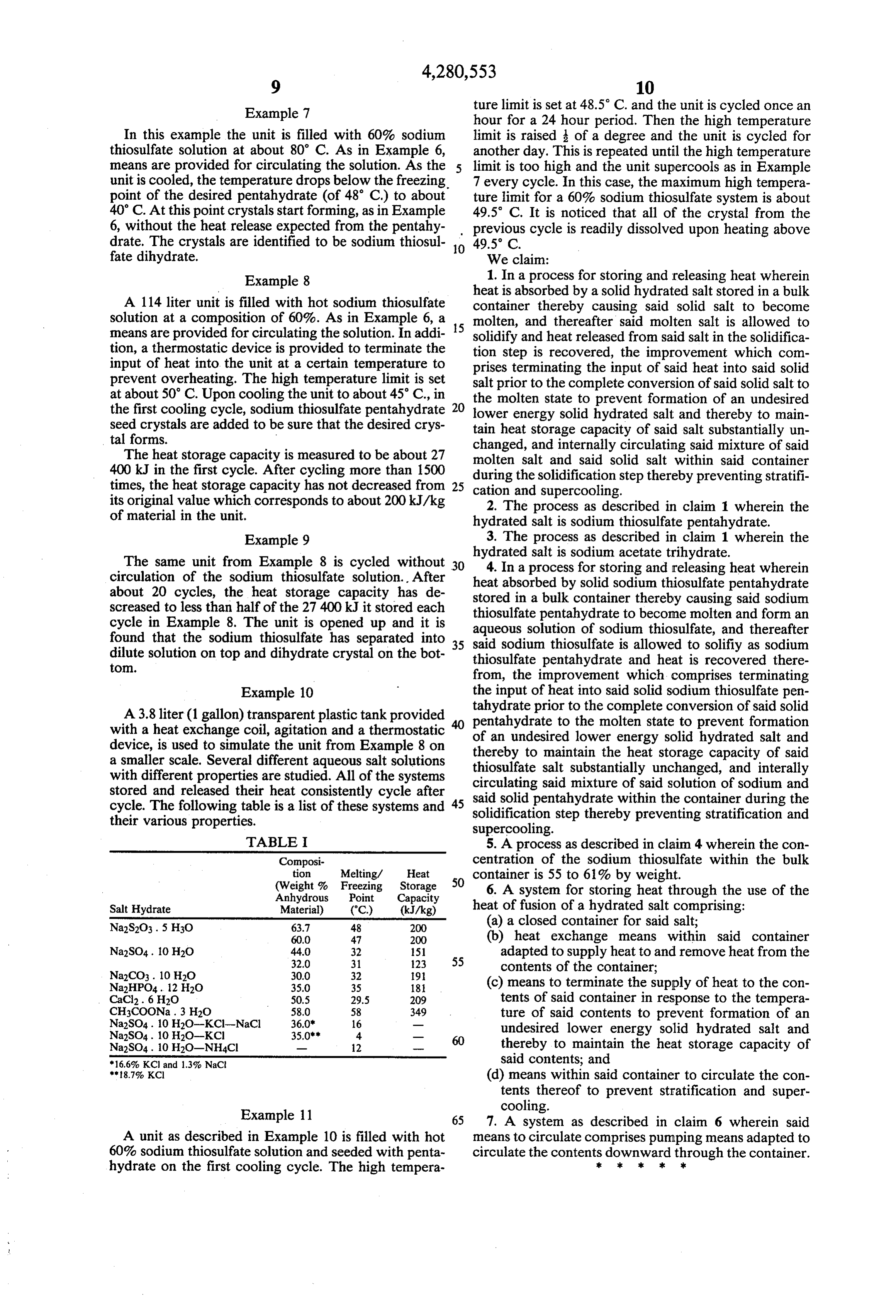
Example 10 the input of heat into said solid sodium thiosulfate pen A 3.8 liter (1 gallon) transparent plastic tank provided tahydrate pentahydrate prior to the complete conversion of said solid to the molten state to prevent formation with a heat exchange coil, agitation and a thermostatic of an undesired lower energy solid hydrated salt and device, is used to simulate the unit from Example 8 on thereby to maintain the heat storage capacity of said a smaller scale. Several different aqueous salt solutions thiosulfate salt substantially unchanged, and interally with different properties are studied. All of the systems stored and released their heat consistently cycle after circulating said mixture of said solution of sodium and said solid pentahydrate within the container during the cycle. The following table is a list of these systems and 45 solidification step thereby preventing stratification and their various properties. supercooling.
TABLE I 5. A process as described in claim 4 wherein the con
Composi centration of the sodium thiosulfate within the bulk tion Melting/ Heat
(Weight % Freezing Storage container is 55 to 61% by weight.
Anhydrous Point Capacity 6. A system for storing heat through the use of the
Salt Hydrate Material) (C) (kJ/kg) heat of fusion of a hydrated salt comprising: Na2S2O3. 5 H3O 63.7 48 200 (a) a closed container for said salt; 60.0 47 200 (b) heat exchange means within said container
adapted to supply heat to and remove heat from the
Na2CO3. 10 H2O 30.0 32 19 contents of the container; Na2HPO4. 12 H2O 35.0 35 18 (c) means to terminate the supply of heat to the con CaCl2. 6H2O 50.5 29.5 209 tents of said container in response to the tempera
ture of said contents to prevent formation of an
Na2SO4. 10 H2O-KCl 35.0tt 4. - 60 undesired lower energy solid hydrated salt and
Na2SO4. 10 H2O-NH4Cl - 12 --- thereby to maintain the heat storage capacity of 16.6% KC and 1.3% NaC said contents; and tes.7%. KCl (d) means within said container to circulate the con tents thereof to prevent stratification and super
65 7. A system as described in claim 6 wherein said
A unit as described in Example 10 is filled with hot means to circulate comprises pumping means adapted to 60% sodium thiosulfate solution and seeded with penta circulate the contentsk downward through the container. hydrate on the first cooling cycle. The high tempera k k k k
Provenance
- Collection
- Cited prior art
- Original PDF
- patentimages.storage.googleapis.com →
- Filed
- 1979-03-16
- Pages
- 9
- Method
- pdftotext (the PDF's own text layer) + pdftoppm 300dpi page scans
- Source
- Google Patents bibliographic record
- Granted
- 1981-07-28
- Inventors
- Samuel L. Bean; James W. Swaine, Jr.; Paul R. Crawford; Allied Chemical Corp
- Transcribed from
- patentimages.storage.googleapis.com →