patent · US4384943
Fluid treatment
24 May 1983
Page 1 — bibliographic record
United States Patent (19) 11 4,384,943 Stoner et al. (45) May 24, 1983 54) FLUID TREATMENT 3,305,472 2/1967 Oldershaw et al. ................ 204/268
(75) Inventors: Glenn E. Stoner; Louie L. Scribner, 3,340,175 9/1967 Mehl ................................... 204/268 Jr.; George L. Cahen, Jr., all of 3,600,286 8/1971 Sabins ... ... 204/149 Charlottesville, Va. 3,654,534 4/1972 Fischer. 317/262 AE 73) Assignee: The University of Virginia Alumni 3,725,226 4/1973 Stoner ... 204/149 3,753,886 8/1973 Myers .... ... 204/186
Patents Foundation, Charlottesville, 3,769,196 10/1973 Wikey ... ... 204/275 Va. 3,891,535 6/1975 Wikey ... ... 204/275 21 Appl. No.: 185,733 3,923,629 12/1975 Shaffer. ... 204/260 4,048,030 2/1975 Miller .................................. 204/149 22) Filed: Sep. 11, 1980 Primary Examiner-T. M. Tufariello (51) int. Cl. ................................................ CO2F 1/46 Attorney, Agent, or Firm-Leblanc, Nolan, Shur & Nies (52) U.S.C. .................................................... 204/149 57 ABSTRACT
204/180 R, 275,260, 268,237; 317/262 AE Methods and apparatus for electrochemically disinfect ing or treating contaminated aqueous liquids by contact (56) References Cited disinfection and/or the generation of a biocidally active
943,188 12/1909 Hartman ..... . 204/149 X ization of reactor electrodes after polarity reversal and 1,507,121 9/1924 Landreth ............................. 204/149 out-of-phase operation of paired reactors can be em 1,956,411 4/1934 Bonone ... . . 204/149 X ployed to promote efficient disinfection, reduce the 2,046,467 7/1936 Krause ........ . 204/149 X bulk of the apparatus, and protect the reactor electrodes 2,887,444 5/1959 Lindstaedt .......................... 204/152 against damage.
3,076,754 2/1963 Evans .......... ... 204/237 3, 192,142 6/1965 Vellas et al. ........................ 204/149 10 Claims, 6 Drawing Figures
SUPPLY
HOLDING TANK
TREATED EFFLUENT
Page 2
Drawing sheet — no readable text.
Page 3
Drawing sheet — no readable text.
Page 4
Drawing sheet — no readable text.
Page 5
In applications such as shipboard sewage systems,
FUED TREATMENT appropriate saline, compounds are already present in effective amounts. Suitable compounds can readily be
The invention herein described was in part made in added as to the influent in swimming pool and other the course of or under a contract or subcontract there 5 applications where they are not initially present. under, (or grant) with the United States Navy. Generation of a halogen disinfectant or biocide is The present invention relates to the treatment of often important. Contact disinfection in apparatus of the aqueous fluids and, more particularly, to novel, im type described above is not an instantaneous process proved methods and apparatus for electrochemically even though it is extremely potent, and disinfection by eliminating harmful and other unwanted organisms O electrolytically generated oxidants may not suffice to from aqueous fluids contaminated with such organisms. neutralize the remaining unwanted organisms. In such Our invention can be employed in shipboard seawa circumstances the halogen reliably completes the disin ter sewage systems, for swimming pool disinfection, to fection process.
purify biologically contaminated industrial process By liberating sufficient halogen in the fluid being streams, to inhibit the growth of algae, and for a variety 15 treated (typically at least 1 to 1.2 ppm of free available of other purposes. Consequently, to the extent that they chlorine in the case of swimming pool water), an envi are not expressly excluded from the appended claims, ronment is established in which disinfection occurs for the foregoing and other applications of our invention many minutes after the fluid is discharged from the are fully intended to be embraced by those claims. electrochemical cells of the treatment system in com Electrochemical processes for neutralizing or de 20 parison to the few seconds in which contact disinfection stroying pathogenic organisms in aqueous fluids are may occur.
well-known and are discussed in some detail in U.S. Pat. As the treatment process proceeds in systems of the No. 3,725,226 issued Apr. 3, 1973, to Stoner for ELEC character just described, chemical fouling occurs by TROCHEMICAL INACTIVATION OF PATHO virtue of oxidation reactions at the electrode serving as GENS. 25 an anode and reduction reactions as that electrode act Typically, in a process of the type just identified, ing as the cathode. Biological fouling by a build-up of contaminated aqueous fluid is caused to flow between the neutralized organisms on that electrode onto which two electrodes across which an appropriate voltage is they are adsorbed also occurs. impressed. The unwanted organisms are adsorbed onto 30 andEfficiencybiological suffers as a consequence of both chemical fouling.
the anode and inactivated or rendered harmless by a Excessive biological fouling can be avoided by peri contact process which appears to involve oxidation odically reversing the polarity of, and the direction of reactions and the giving up of electrons by the organ flow of electrical current between, the electrodes.
The fouled electrode
In one respect our novel process for treating aqueous 35 ode. As pointed out in the thereupon becomes the cath fluids differs from that disclosed by Stoner in that we generated at the cathode; and Stoner patent, hydrogen is generate in the fluid being treated a biocidally active vated, adsorbed organisms, thereby it displaces the inacti chemical which is effective to neutralize unwanted effecting what organisms in the fluid being treated. This is done by Stoner terms a biological "defouling' of that electrode. maintaining in the fluid a compound that is electrolyti periodic Chemical fouling is concomitantly eliminated by the cally decomposable to yield bromine, chlorine, or per flow. Thisreversal of polarity and direction of current reverses the character of the reactions which haps iodine and/or by decomposing water being treated occur at the respective anodes (oxidation to reduction to produce biocidally active 02 or 03 oxidants.
The biocidal effects of peroxides and other species of and ing vice versa). This is important in applications involv biocidally active halogens because the chemical oxygen such as ozone are well-known. 45 species existing at the electrode which becomes an In our novel apparatus both the in situ generation of anode upon polarity reversal are much more readily such disinfectants by the in situ decomposition of the oxidized than the halogen of the oxidant liberating com fluid being treated and the electrochemical adsorption pound in the aqueous fluid being treated. Consequently, and destruction of organisms (or contact disinfection) oxidation of those reduced chemical species in the vi can be simultaneously accomplished, a decided benefit 50 cinity of the electrode must be accomplished before because advantage can be taken of the attributes of both liberation of the halogen can proceed. techniques-the potency of contact disinfection and the A finite time is also required after a reversal of polar long-lasting effect of the 02 or 03 disinfectant. ity and current flow before the then cathode can be The use of chlorine to disinfect swimming pools, charged in the opposite direction to the potential at drinking water, etc. is well-known as are the biocidal 55 which it is capable of functioning as an anode for our properties of iodine. U.S. Pat. No. 3,305,472 issued Feb. purposes. During this "polarization' or dead time, dis 21, 1967, to Oldershaw etal for PURIFYING WATER infection or neutralization does not occur to the wanted WITH BROMINE points out that bromine can be used extent.
for water purification in swimming pool and other ap Our novel fluid treatment systems and techniques plications. Oldershaw et al propose to produce this 60 furnish two solutions to this problem. reagent by electrolytically decomposing an appropriate First, during polarization, we increase current flow bromine compound in situ in the water being treated. ing between the electrodes of the disinfection cells in In our novel apparatus both the in situ generation of such a manner that the electrodes are polarized much a biocidally active halogen and contact disinfection can more rapidly than has heretofore been the case. There also be simultaneously accomplished. Again, this is a 65 after, the voltage is maintained at the desired level of decided benefit because advantage can be taken of the polarization, and the current is simply allowed to vary attributes of both the potency of contact disinfection inversely with cell resistance. Alternatively, when po and the long-lasting effect of the halogen disinfectant. larization is achieved, the current may be stepped down
Page 6
to a lower, constant level and the voltage allowed to the character just described in which the voltage across vary proportionally, with cell resistance at a voltage the electrodes is periodically reversed but in which approximating the desired level of polarization. polarization of the electrodes to an operable level is By thus effecting rapid polarization and then allow effected much more rapidly than in heretofore pro ing the current (or voltage) to vary while the other of 5 posed systems and in which a greater part of each per those parameters is maintained constant or otherwise iod ending in the reversal of potential can be employed controlled, the cells are capable of effecting disinfection for disinfection.
or neutralization by both contact disinfection and by Yet another important, primary object of our inven contact with an electrolytically generated biocide over tion is the provision of electrochemical fluid treatment a greater portion of the period or cycle ending with 10 techniques and systems capable of treating fluids which reversal of polarity and current flow than has hereto have a high solids content and/or which are more cor fore been the case. rosive than can be handled by existing equipment. The second of our solutions to the problem of elimi And still another important and primary object of the nating the dead time during polarization is to connect present invention is the provision of electrochemical two reactors in series and to supply electrical power to 15 fluid treatment processes and systems which are capable the two reactors in the same manner but out-of-phase. of neutralizing or destroying harmful organisms both by This ensures that at least one of the reactors will always a potent contact disinfection of those organisms and by be capable of effecting organism neutralization or de liberating in situ a chemical reagent which is capable of struction and that the apparatus as a total entity will not neutralizing or destroying such organisms in the water have any dead time. 20 being treated over a longer period than is available for Another above suggested advantage of our novel contact disinfection.
apparatus and techniques for electrochemically de Other important objects and features and additional stroying and inactivating, or otherwise neutralizing, advantages of our invention will become apparent from harmful or unwanted organisms by contact disinfection the appended claims and as the ensuing detailed descrip is that we can carry that out while maintaining the 25 tion and discussion proceeds in conjunction with the parameters (potential and current density) which are accompanying drawing, in which:
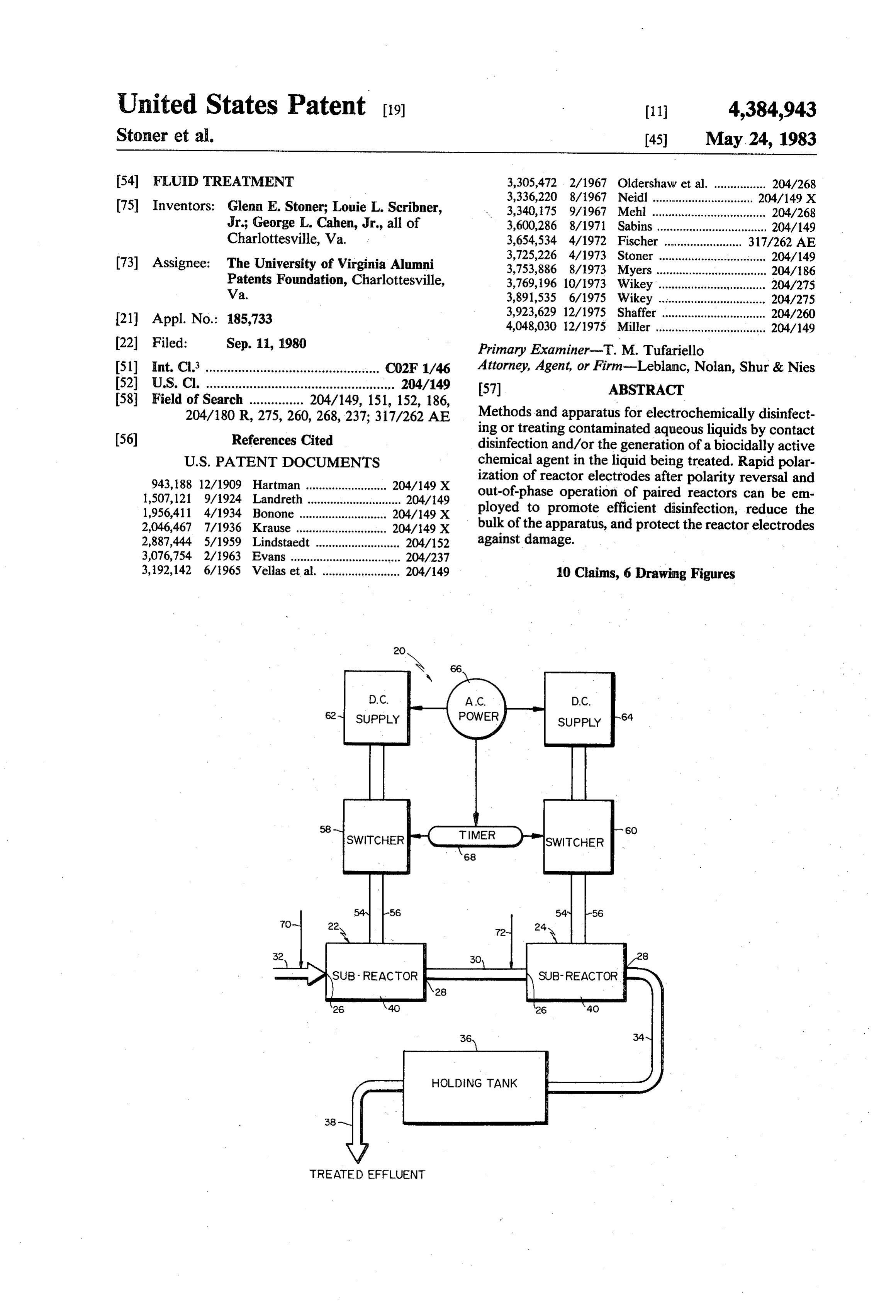
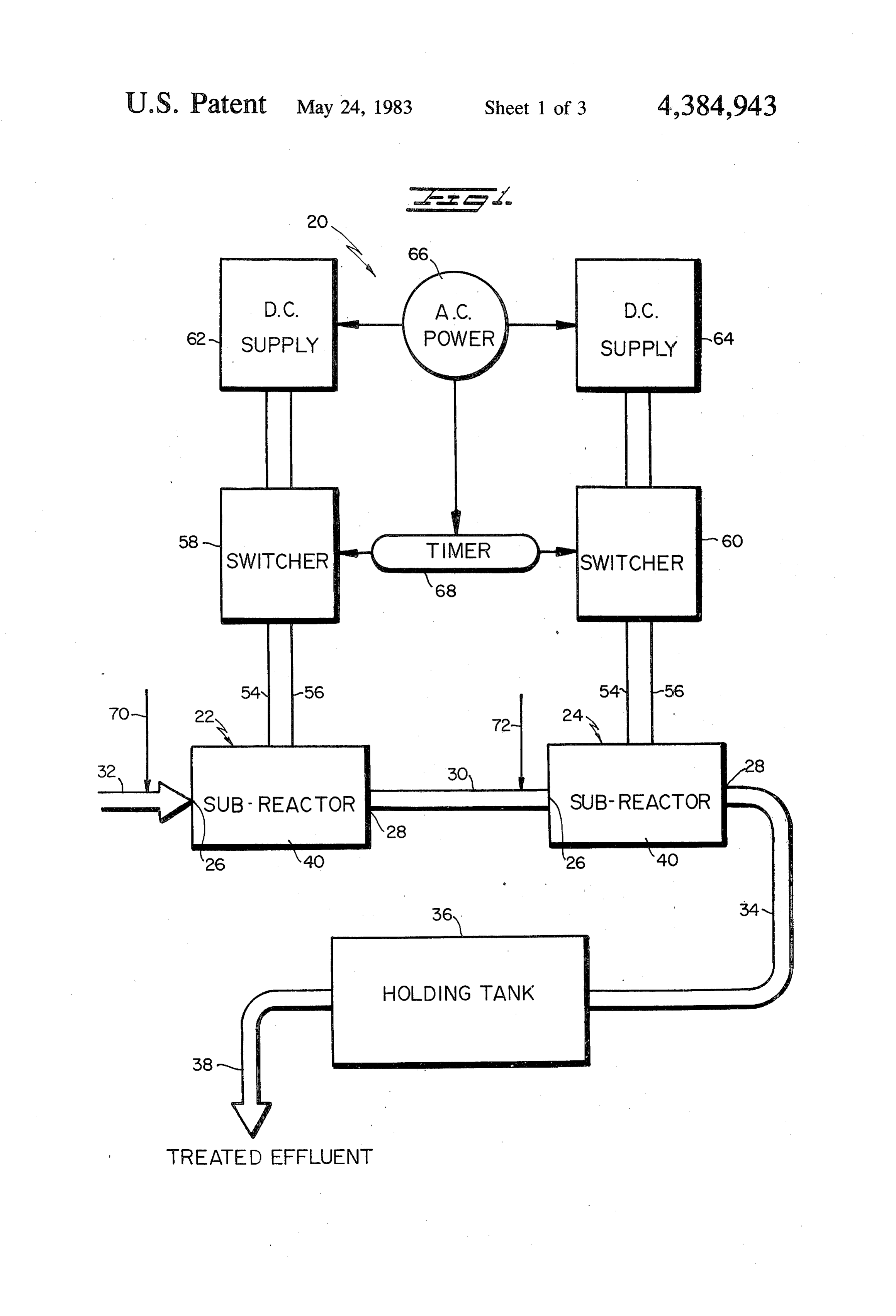
effective to decompose bromine salts and liberate bio FIG. 1 is a block diagram of a fluid treatment system cidally active free bromine in the water being treated. employing, and constructed in accord with, the princi We can, in this same manner, liberate other halogen ples of the present invention;
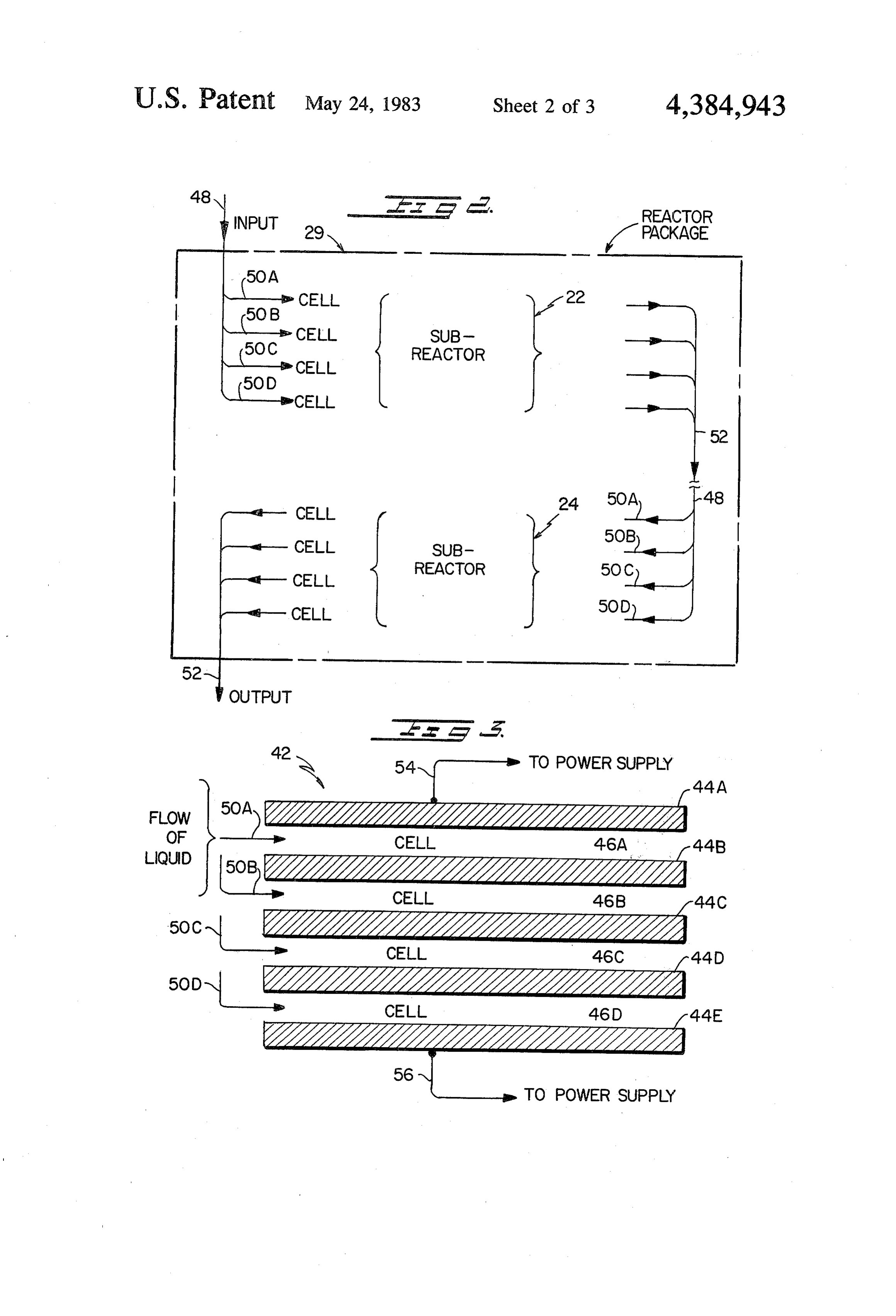
biocides in the water being treated to purify it or other 30 FIG. 2 is a flow diagram for the system of FIG. 1; wise electrolytically generate a biocidally active specie FIG. 3 is a generally schematic illustration of one of in the water. In fact, in swimming pool and other appli two essentially identical sub-reactors which are part of cations where high solids contents are not involved, the FIG. 1 system;
disinfection via liberation or generation of a biocide or FIG. 4 is a timing diagram showing the out-of-phase disinfectant in the liquid being treated can replace 35 operating relationship of the sub-reactors; contact disinfection as the primary neutralization mech FIG. 5 shows the current and voltage wave forms for anism. one mode of operation of the FIG. 1 system in which, Other advantages of our invention, attributable prin after initial polarization, voltage across the reactors cipally to rapid polarization and the utilization of a cells is maintained constant and current allowed to vary larger part of the wave form (or power supply cycle) 40 in inverse proportion to cell resistance; and for fluid treatment, are that our equipment is more effi FIG. 6 is a similar diagram showing an alternate cient, more compact, and less expensive in terms of mode of operation in which, after initial polarization, capital investment and operating costs. the current is stepped down and the voltage across the Longer service life of the electrodes is also obtained, reactor cells allowed to similarly vary. and we can furthermore treat fluids which are corrosive 45 Referring now to the drawing, FIG. 1 depicts a sys and high in solids content. tem 20 for neutralizing or destroying harmful or other A corollary advantage is that we can employ elec unwanted microorganisms in aqueous fluids in accord trodes which are much less expensive than the noble or with the principles of the present invention. precious metal electrodes heretofore commonly used in The major components of system 20 are reactors or comparable electrochemical apparatus. 50 sub-reactors 22 and 24 each having an inlet 26 and an From the foregoing, it will be apparent to the reader outlet 28. Reactors 22 and 24 are typically incorporated that one important and primary object of our invention into a single package 29 (see FIG. 2), and they are con resides in the provision of novel, improved methods and nected in series by a conduit 30.
apparatus for electrochemically neutralizing harmful or The fluid to be treated is introduced into the first of otherwise unwanted organisms contaminating aqueous 55 the two reactors 22 through a conduit 32, and the fluids. treated fluid is discharged from the second of the two A further, important, and primary object of the pres reactors 24 through a conduit 34.
ent invention resides in the provision of novel, in In the illustrated system, which is designed for ship proved electrochemical techniques and systems for board sewage treatment, the treated fluid flows from treating aqueous fluids which are more efficient, less conduit 34 into a holding tank 36 where disinfection is expensive to construct and operate, and more conserv completed by contact with a biocidally active halogen ing of electrical energy than those heretofore available. generated in situ from salts in the seawater as described A related, also important object of the invention above and by decomposition of the water being treated resides in the provision of novel, improved electro to generate biocidally active oxygen. The treated fluid chemical fluid treatment techniques and systems in 65 can be dumped overboard through conduit 38. which dead time is minimized if not entirely eliminated. In other applications, such as the treatment of swim Another important and related object of our inven ming pool water, for example, the treated fluid is in tion resides in the provision of processes and systems of stead recirculated.
Page 7
Referring now to FIGS. 2 and 3 as well as FIG. 1, The foregoing are residual values; i.e., the values each of the reactors 22 and 24 includes a tank 40 in existing after polarization is effected. which an array 42 of electrodes 44A-44E is housed. Operation under these parameters is effective and These electrodes, which have rectangular, plate-like also relatively economical as the power consumption is configurations, are disposed in parallel, spaced apart only 0.5 to 0.75 kilowatt hours per 1,000 gallons of fluid relationship and oriented so that they extend from the treated.
inlet 26 toward the outlet 28 of the reactor in which As treatment of the fluid being processed proceeds, they are incorporated. the electrodes become biologically and chemically This divides the interior of each reactor into four, fouled. The biological material can be dispersed or parallel flow paths or cells 46A-46D defined, respec 10 displaced from the anode-serving electrode and the tively, by electrode pairs 44A and B, 44B and C, 44C latter whereby defouled by reversing the polarity of the and D, and 44D and E. potential across the cells in reactors 22 and 24. As shown diagrammatically in FIG. 2, the fluid 48 In the illustrated, exemplary system 20 this is auto flowing into each of the reactors is divided into four matically accomplished by a timer 68 connected to streams 50A-D, one of these streams flowing through 15 switchers 58 and 60. Timer 68 is set for the desired each of the cells 46A-46D. At the outlet side of each interval; and, at the end of each such interval, it actuates reactor, these four streams are recombined into a single the appropriate switcher 58 or 60. The switcher there stream 52. upon reverses the electrical connections between the The preferred electrode materials are disclosed in 20 64.associated reactor 22 or 24 and its power supply 62 or
1978, by Glenn E. Stoner et al and entitled "Electrolysis The switchers need be nothing more than relays with Electrode'. Those electrodes are composites of con two sets of contacts so wired that current will flow in ductive, carbon fibers dispersed in a non-conductive, one direction when the relay solenoid is energized and polymeric matrix. Among the polymers that are suitable 25 in the opposite direction when it is deenergized. In are epoxies, polyamides, various polyesters, polyphen switchers of this type just described, energization and ylene sulfides and oxides, and polysulfones. deenergization of the solenoids is controlled by timer A decided advantage of the preferred electrodes, 68. The connections are simple and conventional and aside from those discussed in the Stoner et al applica have accordingly not been shown.
tion, is that they are corrosion resistant in seawater. Chemical fouling is also eliminated by the reversal of Comparable and compatible, extended service lives can 30 polarity reactions via the reversal of oxidation and reduction discussed above.
be obtained by fabricating the reactor tanks or shells, the conduits, and other components contacted by the fected is dependentwith
The frequency upon which polarity reversal is ef the rapidity with which foul fluid being treated of stainless steel, plastics, or other ing occurs. To keep fouling to a level compatible with corrosion resistant materials or by employing appropri 35 the level of efficiency we consider ate coatings, a number of which are commercially avail sal of polarity is effected once everynecessary, the rever
able.
An electrical potential is maintained across each of i.e.,Referring every 2.5 to 5 minutes.
now to FIGS. 4-6 of the drawing, the the cells 46A-D in reactors 22 and 24 by connecting the outermost electrodes 44A and 44E in each of the two 40 electrodes must be polarized upon a reversal of polarity arrays 42 by leads 54 and 56 through a switcher 58 or 60 Thatbefore the neutralization of organisms can be resumed. to a D.C. power supply 62 or 64 which may be a Soren required is, a finite time after the reversal of polarity is son Model No. SRL 20-12 or an Adtech Power Brute I, level where to build up the potential across each cell to the for example. Both have constant voltage and constant to produce contact it becomes effective for our purposes, i.e., current operating modes with adjustable outputs and an 45 disinfectant and/ordisinfection generate and liberate the halogen biocidally active oxygen.
automatic crossover capability that causes the unit to One of the important features of our invention is that we automatically transfer from one mode to the other as can minimize, or even eliminate, the polarization period load requirements change. or dead time, thereby making systems in accord with As shown in FIG. 1, the two D.C. power supplies are the principles disclosed herein more efficient than those connected to an A.C. power source 66 in the illustrated, 50 heretofore proposed in that a greater portion of the exemplary embodiment of our invention.
With the power supplies 62 and 64 energized, a D.C. period between polarity reversals can be employed for neutralization of unwanted organisms.
potential is established across each of the fluid treatment We effect this desirable, rapid polarization (or repo cells 46A-46D in reactors 22 and 24 and between the larization) by, at the time polarity is reversed, increasing electrode pairs 44A and B, etc. bounding those cells. 55 the current flow between
Microorganisms in fluid flowing through the cells are cell to a level substantiallytheabove electrodes bounding each that needed to main neutralized by contact disinfection and by contact with tain the potential across the cell at the biocides generated by electrolytic decomposition of the neutralization of microorganisms. level required for salts in the seawater carrier of the sewage being treated Specifically, as discussed above, an adequate voltage and/or by biocidally active forms of oxygen generated 60 level for organism neutralization can be insured by by in situ decomposition of the water being treated. maintaining a current density in the 0.01 to 0.016 To accomplish this, the potential across each elec amp/cm2 range in the applications involving highly trode array 42 is maintained in the range of 14-16 volts, saline solutions such as seawater (10,000 to 20,000 ppm which means that the potential across each cell 46A-D or 1 to 2 percent). To insure rapid polarization, we or between the pair of electrodes defining it is in the 65 adjust the power supply 62 or 64 manually, or automati range of 3.5 to 4.4 volts. The current density is kept in cally, to generate an increased current density (see the range of 0.01 to 0.016 amp/cm2 in this and compara FIGS. 5 and 6) of 0.03 to 0.05 amps/cm2. The current ble applications of our invention. flow is maintained at this level for a period of 1 to 45
Page 8
seconds, and it is then reduced to the level indicated In the exemplary embodiment of our invention illus above. trated in the drawing and described above, the dead Repolarization time is a function of current density time in which there is no disinfection or neutralization and the concentration of biocide in the liquid being of unwanted microorganisms is not only minimized in treated. Minimum conditions at which rapid repolariza each reactor as just described but is entirely eliminated tion is advantageous are in the neighborhood of 9.5 considering system 20 as an entity. This is accomplished milli-amps/cm2 and 300 ppm of halogen compound, for by phasing the polarity reversals in the two reactors 22 example. In such applications a repolarization current and 24 as shown in FIG. 4 so that one reactor is operat of three amps increased from a residual current of one ing in the disinfection or neutralization part of its cycle amp can cause repolarization to occur in a matter of 10 while the electrodes of the second reactor are being milliseconds. polarized. Preferably, as is also shown by the timing On the other hand, rapid repolarization is important diagrams in FIG. 4, the operating cycles of the two at much different salinities if the current density is reactors 22 and 24 are ninety degrees out-of-phase in higher or lower. Flow rates and the surface conditions time.
of the electrodes can also effect the circumstances 15 Another advantage of our novel systems, described under which rapid repolarization is an asset. As exam above, is that they are capable of electrolytically gener ples, flowing water can strip electrochemically gener ating a chemical disinfectant in situ; i.e., in reactors 22 ated species from the electrodes, reducing chemical and/or 24, to neutralize or destroy any unwanted mi fouling and repolarization times, while this effect can be croorganisms that might not be reached by the electro inhibited by roughened electrode surfaces. 20 chemical neutralization process described above. More In any event, the leading edge of the voltage wave particularly, when operated within the parameters de form will preferably approximate that of a square wave scribed above, systems such as that shown in the draw as shown in FIGS. 5 and 6. That rapid repolarization as ing are capable of electrolytically decomposing compo we define it has the advantages discussed above is en sitions containing biocidally effective halogens, typi tirely unexpected in view of the statement in the Stoner 25 cally chlorine or bromine, thereby introducing free patent that a square-shaped waveform is "generally less bromine or chlorine into the fluid being treated. They effective' than a saw-toothed or sinusoidal one. are also capable of decomposing water being treated Another important advantage of our novel, just-dis into biocidally active 02 and 03 oxidants. cussed repolarization technique, mentioned above, is Appropriate halogen compositions are described in the increased electrode service life this provides. 30 the Oldershaw et al patent identified above and in U.S. We identified above the electrodes we prefer and a Pat. No. 2,887,444 issued May 19, 1959, to Lindstaedt number of advantages they possess. Another is that they for PROCESSES OF AND MEANS FOR CHLOR are relatively inexpensive. NATING SWIMMING POOLS OR THE LIKE. Absent rapid repolarization, however, such elec If not already present as in applications where seawa trodes are not usable in the apparatus disclosed herein. 35 ter or other saline solutions are involved, the compound Subjected to a D.C. voltage of the magnitude we em employed to supply disinfectant can be introduced into ploy without rapid repolarization, exemplary electrodes the reactors 22 and 24 by metering or dosing it into flow of the character described in the Stoner etal application conduits 32 and 30 as indicated schematically by arrows deteriorated to an unservicable condition in ca. 48 70 and 72 in FIG. 1.
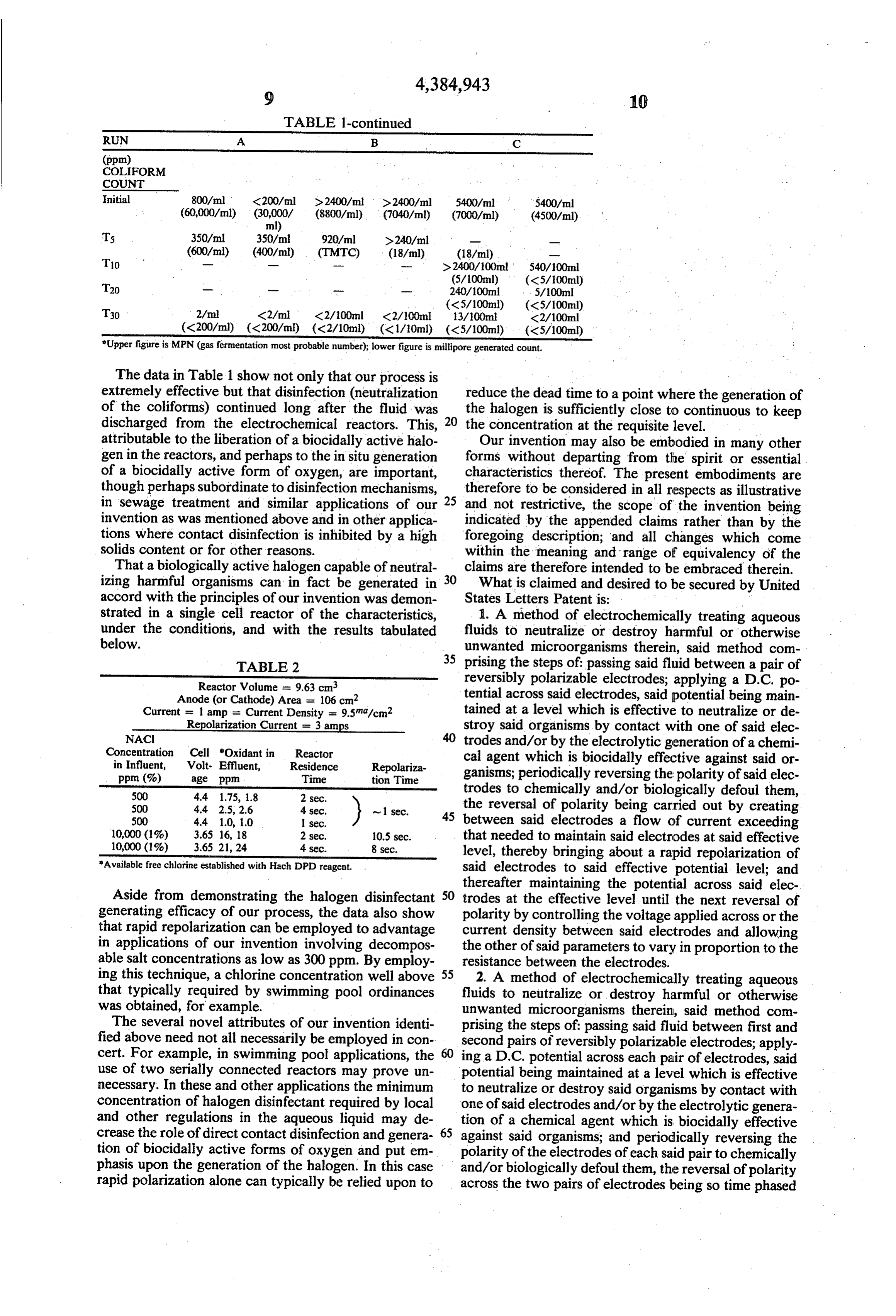
hours. Periodic (150 to 300 second) repolarization ex The efficacy of our novel method for treating aque tended the life of such electrodes without noticeable ous fluids was demonstrated by tests conducted on sea loss of effectiveness to an extent which is acceptable water sewage contaminated with fecal coliforms in and has not been determined because the tested elec apparatus of the character described above with two trodes are still servicable. serially connected reactors and a three gallon per min As shown in FIG. 5, voltage control can be employed 45 ute throughput rate. Millipore and gas fermentation to maintain the residual potential across the treatment techniques, both conventional, were used to measure cells at the required level with the current simply being the decrease in live or active microorganisms affected in allowed to vary in proportion to cell resistance. Alter the reactors. Biological enummerations were made after natively, as shown in FIG. 6, the same result can be holding the treated fluid for periods of 5, 10, 20, and 30 accomplished by stepping down and controlling the 50 minutes.
residual current flow between the electrodes bounding Results of exemplary tests conducted in the manner the cells, allowing the voltage to similarly vary at about just described are summarized in the following table. the selected level.
TABLE 1
RUN B C
Salinity of 2 2
Influent (%)
Flow Rate 3 3 (gpm)
Residence 2 2
Time (sec.)
Polarizing 10 10
Current (amps)
Residual 2 3 2 3 2 3
Current (amps)
Potential 4.2 14.3 13.98 4.3 14.0 4.25 (volts)
Solids 123 23 126 126 236 236
Page 9
TABLE 1-continued
RUN A B C (ppm)
COLEFORM
Initial 800/ml <200/ml 2400/ml >2400/ml 5400/ml 5400/ml (60,000/ml) (30,000/ (8800/ml) (7040/ml) (7000/ml) (4500/ml)
T5 350/ml 350/mi 920/ml >240/ml - - (600/ml) (400/ml) (TMTC) . (18/ml) (18/ml) --
T10 - m --- >2400/100m 540/100ml
T20 - - --- m 24.0/100m 5/100ml
T30 2/m <2Ami <2/100ml (2/100m 13/100m <2/100ml (<200/ml) (<200/ml) (<2/10ml) (<1/10ml) (<5/100ml) (<5/100ml)
"Upper figure is MPN (gas fermentation most probable number); lower figure is millipore generated count. The data in Table 1 show not only that our process is extremely effective but that disinfection (neutralization reduce the dead time to a point where the generation of of the coliforms) continued long after the fluid was 20 the halogen is sufficiently close to continuous to keep discharged from the electrochemical reactors. This, the concentration at the requisite level.
attributable to the liberation of a biocidally active halo Our invention may also be embodied in many other gen in the reactors, and perhaps to the in situ generation forms without departing from the spirit or essential of a biocidally active form of oxygen, are important, characteristics thereof. The present embodiments are though perhaps subordinate to disinfection mechanisms, therefore to be considered in all respects as illustrative in sewage treatment and similar applications of our 25 and not restrictive, the scope of the invention being invention as was mentioned above and in other applica indicated by the appended claims rather than by the tions where contact disinfection is inhibited by a high foregoing description; and all changes which come solids content or for other reasons. within the meaning and range of equivalency of the That a biologically active halogen capable of neutral claims are therefore intended to be embraced therein. izing harmful organisms can in fact be generated in 30 What is claimed and desired to be secured by United accord with the principles of our invention was demon States Letters Patent is:
strated in a single cell reactor of the characteristics, 1. A method of electrochemically treating aqueous under the conditions, and with the results tabulated fluids to neutralize or destroy harmful or otherwise below. unwanted microorganisms therein, said method com TABLE 2 35 prising the steps of passing said fluid between a pair of Reactor Volume = 9.63 cm reversibly polarizable electrodes; applying a D.C. po Anode (or Cathode) Area = 106 cm tential across said electrodes, said potential being main Current = 1 amp = Current Density = 9.5"/cm tained at a level which is effective to neutralize or de Repolarization Current = 3 amps stroy said organisms by contact with one of said elec NAC 40 trodes and/or by the electrolytic generation of a chemi Concentration Cell 'Oxidant in Reactor cal agent which is biocidally effective against said or in Influent, Volt- Effluent, Residence Repolariza ppm (%) age ppm Time tion Time ganisms; periodically reversing the polarity of said elec 500 4.4 1.75, 1.8 2 sec. trodes to chemically and/or biologically defoul them, 500 4.4 2.5, 2.6 4 sec. ) -1 sec. 45 the reversal of polarity being carried out by creating 500 4.4 1.0, i.0 1 sec. between said electrodes a flow of current exceeding 10,000 (1%) 3.65 16, 18 2 sec. 10.5 sec. that needed to maintain said electrodes at said effective 10,000 (1%) 3.65 21, 24 4 sec. 8 sec. level, thereby bringing about a rapid repolarization of Available free chlorine established with Hach DPD reagent. said electrodes to said effective potential level; and thereafter maintaining the potential across said elec
Aside from demonstrating the halogen disinfectant 50 trodes at the effective level until the next reversal of generating efficacy of our process, the data also show polarity by controlling the voltage applied across or the that rapid repolarization can be employed to advantage current density between said electrodes and allowing in applications of our invention involving decompos the other of said parameters to vary in proportion to the able salt concentrations as low as 300 ppm. By employ resistance between the electrodes.
ing this technique, a chlorine concentration well above 55 2. A method of electrochemically treating aqueous that typically required by swimming pool ordinances fluids to neutralize or destroy harmful or otherwise was obtained, for example. unwanted microorganisms therein, said method com The several novel attributes of our invention identi prising the steps of: passing said fluid between first and fied above need not all necessarily be employed in con second pairs of reversibly polarizable electrodes; apply cert. For example, in swimming pool applications, the ing a D.C. potential across each pair of electrodes, said use of two serially connected reactors may prove un potential being maintained at a level which is effective necessary. In these and other applications the minimum to neutralize or destroy said organisms by contact with concentration of halogen disinfectant required by local one of said electrodes and/or by the electrolytic genera and other regulations in the aqueous liquid may de tion of a chemical agent which is biocidally effective crease the role of direct contact disinfection and genera 65 against said organisms; and periodically reversing the tion of biocidally active forms of oxygen and put em polarity of the electrodes of each said pair to chemically phasis upon the generation of the halogen. In this case and/or biologically defoul them, the reversal of polarity rapid polarization alone can typically be relied upon to across the two pairs of electrodes being so time phased
Page 10
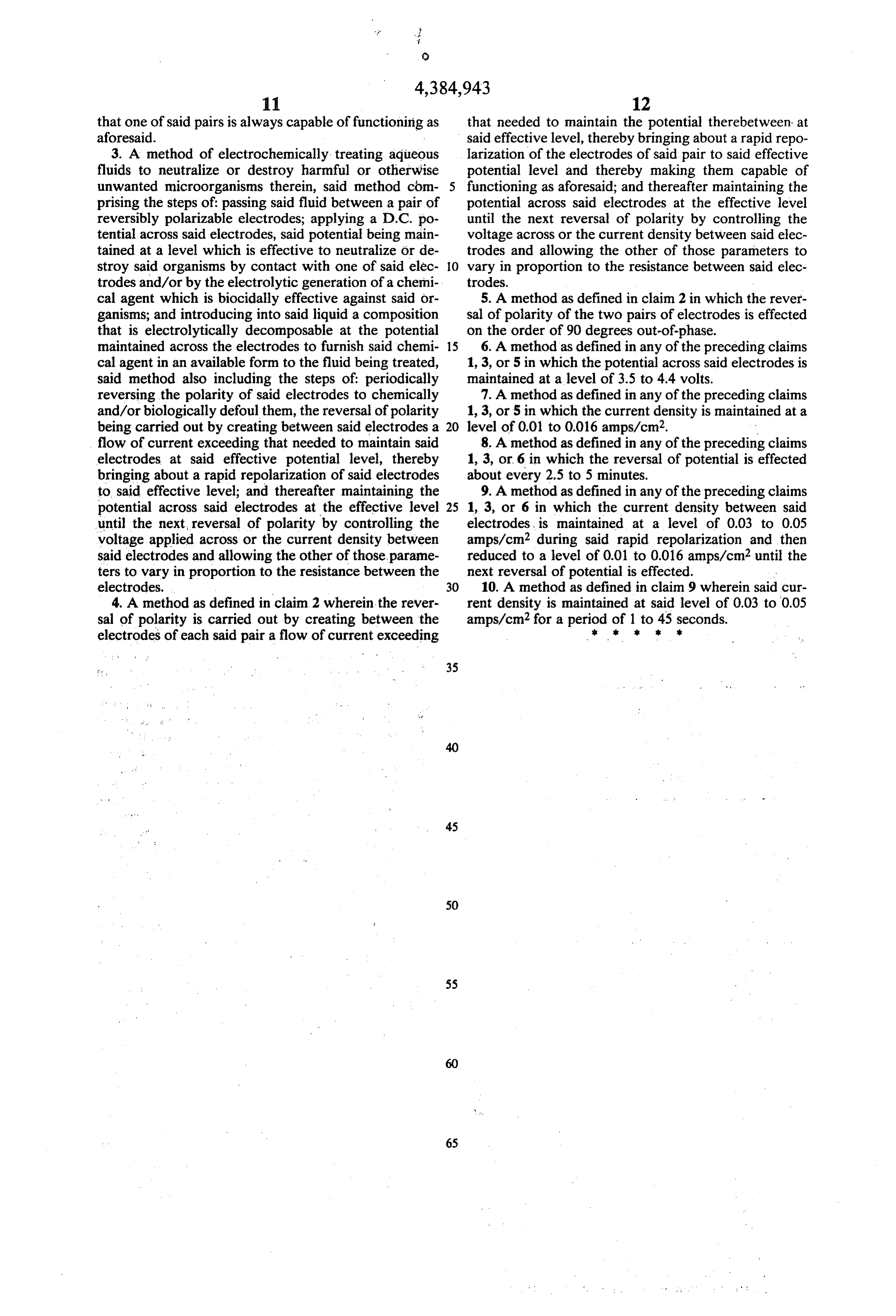
that one of said pairs is always capable of functioning as that needed to maintain the potential therebetween at aforesaid. said effective level, thereby bringing about a rapid repo 3. A method of electrochemically treating aqueous larization of the electrodes of said pair to said effective fluids to neutralize or destroy harmful or otherwise potential level and thereby making them capable of unwanted microorganisms therein, said method cbm 5 functioning as aforesaid; and thereafter maintaining the prising the steps of: passing said fluid between a pair of potential across said electrodes at the effective level reversibly polarizable electrodes; applying a D.C. po until the next reversal of polarity by controlling the tential across said electrodes, said potential being main voltage across or the current density between said elec tained at a level which is effective to neutralize or de trodes and allowing the other of those parameters to stroy said organisms by contact with one of said elec O vary in proportion to the resistance between said elec trodes and/or by the electrolytic generation of a chemi trodes.
cal agent which is biocidally effective against said or 5. A method as defined in claim 2 in which the rever ganisms; and introducing into said liquid a composition sal of polarity of the two pairs of electrodes is effected that is electrolytically decomposable at the potential on the order of 90 degrees out-of-phase. maintained across the electrodes to furnish said chemi 15 6. A method as defined in any of the preceding claims cal agent in an available form to the fluid being treated, 1, 3, or 5 in which the potential across said electrodes is said method also including the steps of: periodically maintained at a level of 3.5 to 4.4 volts. reversing the polarity of said electrodes to chemically 7. A method as defined in any of the preceding claims and/or biologically defoul them, the reversal of polarity 1, 3, or 5 in which the current density is maintained at a being carried out by creating between said electrodes a 20 level of 0.01 to 0.016 amps/cm2. flow of current exceeding that needed to maintain said 8. A method as defined in any of the preceding claims electrodes at said effective potential level, thereby 1, 3, or 6 in which the reversal of potential is effected bringing about a rapid repolarization of said electrodes about every 2.5 to 5 minutes.
to said effective level; and thereafter maintaining the 9. A method as defined in any of the preceding claims potential across said electrodes at the effective level 25 1, 3, or 6 in which the current density between said until the next, reversal of polarity by controlling the electrodes, is maintained at a level of 0.03 to 0.05 voltage applied across or the current density between amps/cm2 during said rapid repolarization and then said electrodes and allowing the other of those parame reduced to a level of 0.01 to 0.016 amps/cm2 until the ters to vary in proportion to the resistance between the next reversal of potential is effected. electrodes. 10. A method as defined in claim 9 wherein said cur 4. A method as defined in claim 2 wherein the rever rent density is maintained at said level of 0.03 to 0.05 sal of polarity is carried out by creating between the amps/cm2 for a period of 1 to 45 seconds. electrodes of each said pair a flow of current exceeding t
Page 11
UNITED STATES PATENT AND TRADEMARK OFFICE
CERTIFICATE OF CORRECTION
NVENTOR(S) : GLENN E. STONER; LOUIE L. SCRIBNER, JR. ;
It is certified tfEFSFEpists f a Seidified patent and that said Letters Patent is hereby Corrected as shown below:
Column 2, line 25, "as" should be --at--.
Column 6, line ll, "whereby" should be --thereby --. signed and sealed this
SEAL Winth Day of August 1983 Attest:
GERALD J. MOSSINGHOFF
Attesting Officer Commissioner of Patents and Trademarks
Provenance
- Collection
- Cited prior art
- Original PDF
- patentimages.storage.googleapis.com →
- Filed
- 1980-09-11
- Pages
- 11
- Method
- pdftotext (the PDF's own text layer) + pdftoppm 300dpi page scans
- Source
- Google Patents bibliographic record
- Granted
- 1983-05-24
- Inventors
- Glenn E. Stoner; Louie L. Scribner, Jr.; George L. Cahen, Jr.; University of Virginia Patent Foundation
- Transcribed from
- patentimages.storage.googleapis.com →