patent · US3753886
Selective destruction of bacteria
21 August 1973
Page 1
Drawing sheet — no readable text.
Page 2
United States Patent Office Patented Aug.3,753,886
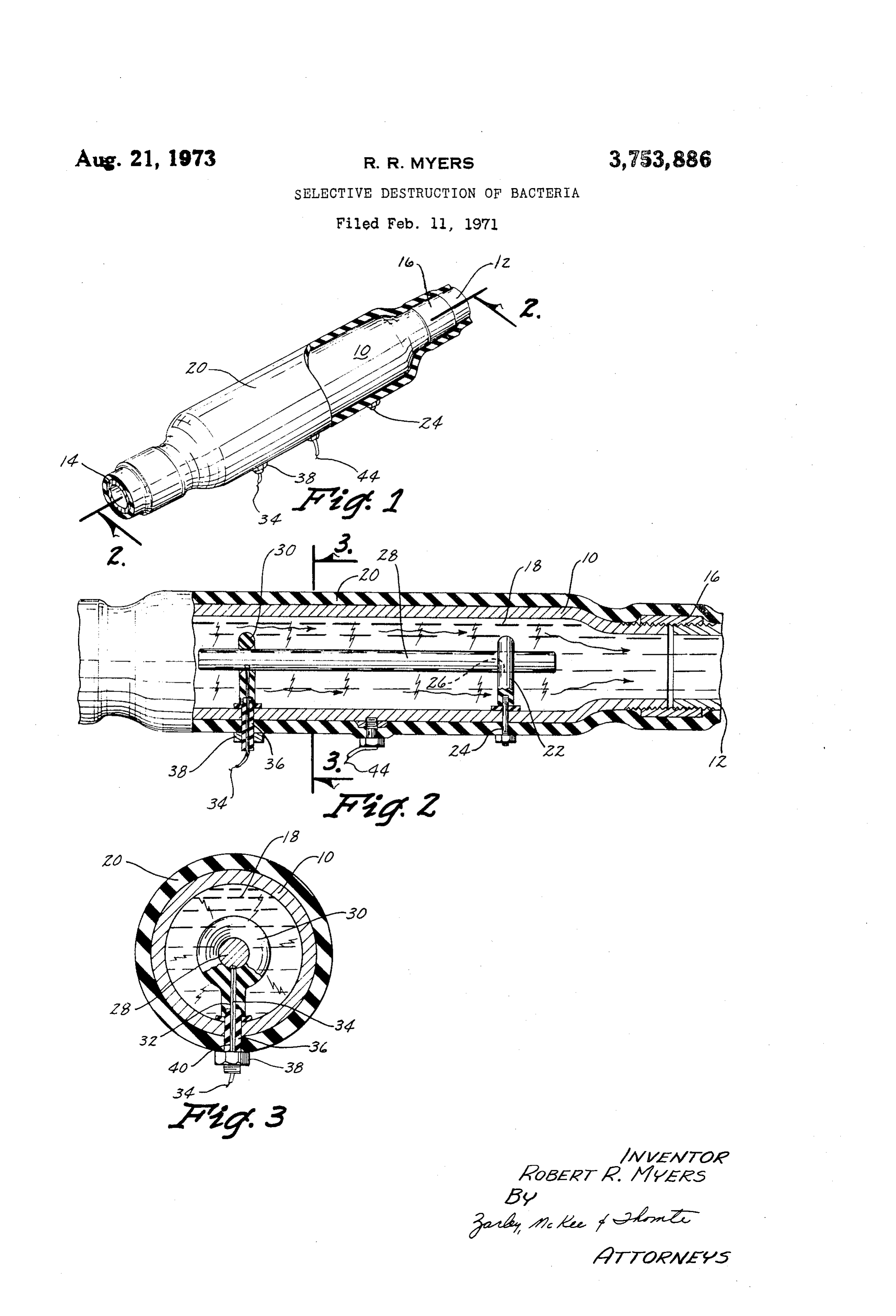
3,753,886 for purifying the liquid with portions thereof cut away to SELECTIVE DESTRUCTION OF BACTERIA more fully illustrate the invention; Robert R. Myers, deceased, by Helen T. Myers, Executor, FIG. 2 is an enlarged sectional view as seen along lines 904 NE. 2nd St., Boca Raton, Fla. 33432 2-2 of FIG. 1 with portions thereof cut away to more Continuation-in-part of abandoned application Ser. No. fully illustrate the invention; and 710,202, Mar. 4, 1968. This application Feb. 11, 1971, FIG. 3 is an enlarged sectional view as seen along lines
Int. Cl. C02b 1/82, C02c 1/00, 1/02 3-3 of FIG. 2 with portions thereof broken away to U.S. C. 204-186 1 Claim more fully illustrate the invention. The numeral 10 generally designates a hollow metal 0. housing having conduits 12 and 14 threadably connected
ABSTRACT OF THE DISCLOSURE thereto at its opposite ends by collars 16. Conduit 14 A method and means for purifying water and water may be in communication with a source of liquid to be base liquids whereby a controlled amount of alternating purified if desired and conduit 12 may be in communica electrical current is passed through the liquid to destroy tion with a suitable receptacle for the purified liquid. The all forms of plant and animal life therein, thereby purify 5 liquid 18 may be pumped through the housing 10 if de ing the same. A hollow housing is utilized and has an sired which would necessarily depend upon the particular elongated terminal provided therein which is electrically environment in which the apparatus is to be used. connected to a source of electrical energy. The housing Conduits 12 and 14, collars 16 and housing 10 are is grounded and is covered with an insulative material. covered with an insulative layer 20 comprised of suitable Liquid in the housing will act as a conductor between 20 material such as plastic, rubber, etc. An insulative support the terminal and the grounded housing thereby causing post 22 is mounted in housing 10 and is prevented from electrical current to flow therethrough which causes the movement by a screw or bolt means 24 secured thereto liquid to be purified. and extending outwardly through housing 10 and layer 20 as seen in FIG. 2. Post 22 includes a central opening
This is a continuation-in-part application of Ser. No. 25 26 which receives one end of a round rod 28 which 710,202 filed Mar. 4, 1968, now abandoned. is comprised of a suitable conductive material such as It is a principal object of this invention to provide a copper, method and means for purifying water or water-base theAother post 30 comprised of an insulative material embraces end of rod 28 as seen in FIG. 3 and has a liquids.
A further object of this invention is to provide a 30 bore 32 formed therein through which a wire 34 extends. Posts 22 and 30 are constructed of plastic, nylon, rubber method and means for purifying water-base liquids in cluding means for passing an alternating electrical current or other suitable insulative material. through the liquid to purify the same. Wire 34 is electrically connected to rod 28 and extends A further object of this invention is to provide a means 35 through bore 32 as previously mentioned. An insulative for purifying water-base liquids by means of an alter wardly stud 36 is threadably secured to post 30 and extends out nating electrical current and including an insulated hous through housing 10 and layer 20 as illustrated in ing within which the liquid is contained. FIGS. 2 and 3. A nut 38 threadably embraces stud 36 A further object of this invention is to provide a outwardly of layer 20 as seen in FIG. 3. Stud 36 is means for purifying water-base liquids which meets all 40 whichprovided with a bore 40 extending therethrough through necessary safety requirements. wire 34 extends. The outer end of stud 36 is sealed A further object of this invention is to provide a to prevent liquid from passing outwardly of bore 40. Wire 34 is connected to the "hot" side of a source of method and means for purifying water-base liquids which economically destroys all forms of animal and 42 alternating electrical current. A metal terminal screw plant life therein. 45 is threadably secured to housing 10 (FIG. 2) and A further object of this invention is to provide a extends outwardly through layer 20. Screw 42 is con nected to a wire 44 which is electrically connected to the method and means for purifying water-base liquids wherein the liquid is subjected to an alternating electrical ground side of the source of electrical current. current. Thus, when housing 10 contains water or water-base liquid such as sewage, milk, etc., electrical current will
A further object of this invention is to provide a method 50 pass and means for purifying water-base liquids such as water, therethrough between rod 28 and the grounded milk, sewage, etc. wherein the bacteria or the like is housing 10. The central location of rod 28 insures that destroyed by means of an alternating electrical current. a uniform electrical field will be present between the rod 28 and the housing 10 to uniformly and efficiently destroy
A further object of this invention is to provide a method and means for purifying water-base liquids which 55 all forms of bacteria, plant and animal life, etc. The amount of electrical current (amperage) supplied to the is economical and durable. rod 28 will depend upon the "killing power' desired These and other objects will be apparent to those which will vary with the particular liquid being purified skilled in the art. while the voltage will remain substantially constant. This invention consists in the construction, arrange 60 A number of samples of canal water were collected ments, and combination of the various parts of the de from the Loxahatchee Game Reserve and were subjected vice, whereby the objects contemplated are attained as to certain experiments and tests caused to be conducted hereinafter more fully set forth, specifically pointed out by Robert L. Klein, Jr., of the Division of Research and in the claims, and illustrated in the accompanying draw Invention, of Earle M. Scott & Associates, Inc., of Lan ings in which: 65 caster, N.Y. The test data from those tests and experi FIG. 1 is a fragmentary perspective view of the means ments is found immediately hereinafter.
Page 3
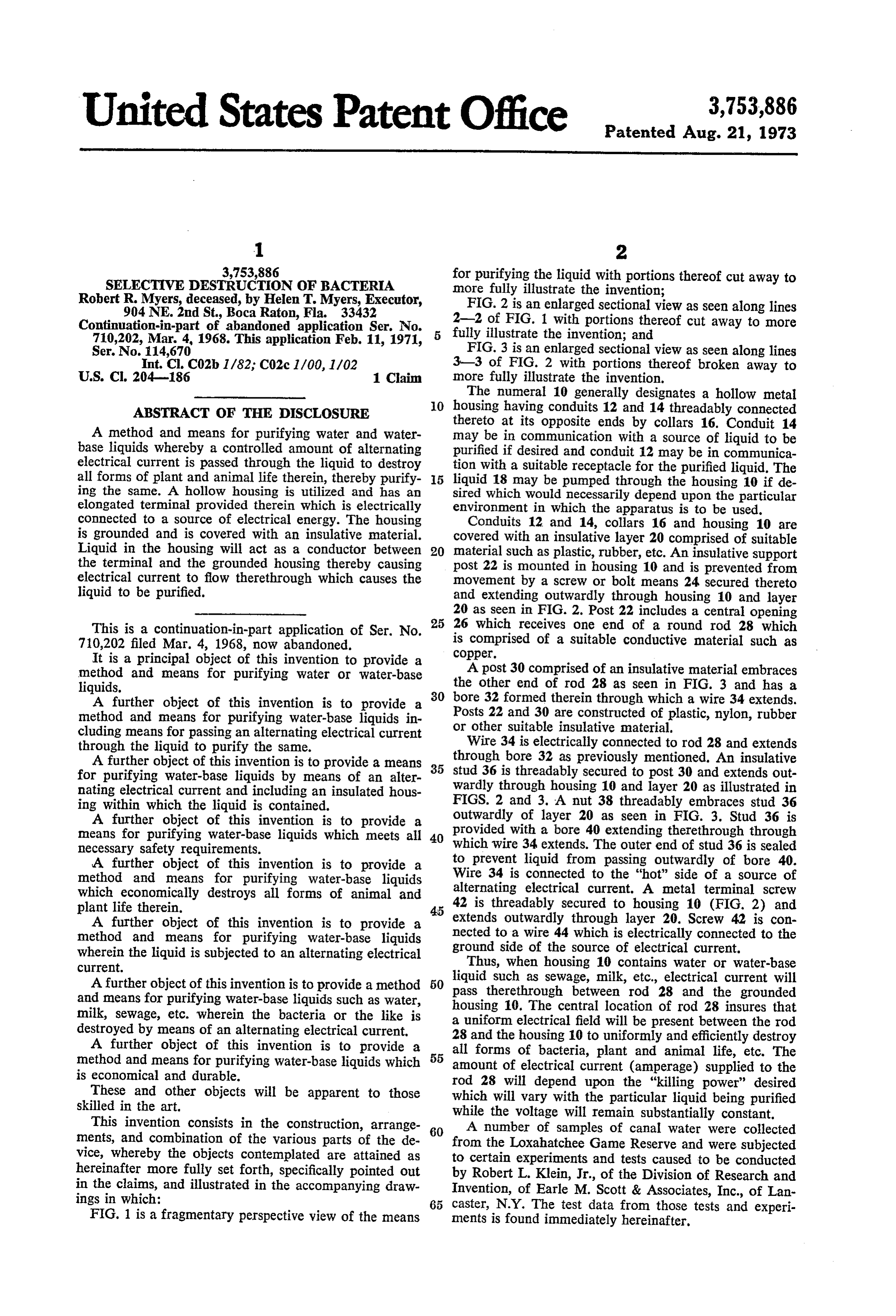
TEST DATA
Initia Final
Flow rate, Woltage Wolts temp., temp., ml.fmin. Residence time 1 Amps applied CM o C. oC.
48 10 minutes---------------------- 12 5, 4 29.8 38 199.5 2 minutes, 31 seconds----------- 27 33.8 1,31 22.08 seconds. 26 35 1.31 22.08 seconds. 28 60 1.31 22.08 seconds.----- 32.3 33.5
1 Residence timesVolume of water whichflow the sterilizing instrument can hold rate
NOTE.-Volume of water which the sterilizing instrument can hold is 478.5 m.
Results:
Standard, 1.0--- 2.2 Standard, 3.0 97
Sample, 1.1----- 2.2 Sample, 3.3 2.2
Standard, 2.0--- 240 ---------------------------
Sample 2.2----- 240 Standard, 4.... 23
2M.P.N. seMost probable number of coliform.
Meaning of bacterial count-2.2=Water which can be used for domestic purposes (washing clothes, dishes, etc.) but not for drink ing; -2,2'-Domestic and drinking purposes-ideal sterilization.
In the foregoing experiments, the bacterial count was It appears that the killing phenomenon at lower fre determined through the use of a microscope having 500X 25 quencies, i.e., 2 to 200 c.p.s. is different from the killing magnification. The flow rate and the amperage (for the phenomenon at higher frequencies. It is believed that the purpose of the test) was chosen so that the temperature killing phenomenon at lower frequencies, that is up to of the water remained below 36 C. so that no sterilization 500 c.p.s. it is known that depolarization of cell boundary would occur due to elevated temperatures. From the fore time the polarity is reversed, or electrical stimulus pulsed, going it is concluded that a strong electric field and con 30 the muscles or muscle structures of the bacteria must react sequently the alternating current produced has a steriliza and that, depending on such frequency, they eventually tion effect on water. This is evidenced by comparing die of exhaustion. This is believed to be why the time the test data above. By increasing the current, and at the variable is exponential.
same time increasing the flow rate to keep the temperature As the frequency increases, the muscles are not as of the water below 36 C., the water can be sterilized to 35 Susceptible to the higher frequeucies, and at least at about ideal conditions. A current of 10 amps and a flow rate 500 c.p.s. it is known that depolarization of cell boundary layers begins and that the bacteria are killed by de of 1.3 liters/minute (residence time-22.08 seconds) is polarization.
sufficient for the sterilization of canal water.
A second test apparatus consisted of a section of Selective killing of bacteria appears to exist only be plastic pipe lined with a metal sleeve which served as one 40 tween 2 and 300 c.p.s. At approximately 60 cp.s., the electrode. A second electrode was inserted along the killing phenomenon applies only to selective bacteria. The centerline of the first electrode. End closures and con more developed forms of bacteria, which seem to be the nections for water and electrical input were provided. undesirable ones, are apparently killed preferentially while The outer electrode was 1%' I.D. x 232' long, the the less developed forms of bacteria (perhaps with less inner electrode 5%' O.D., thus providing a flow face area 45 developed muscles) which are beneficial and should not of 6.45 cm2 and a contact volume of essentially 460 be killed, are not killed as readily.
cm3. Packing with glass fibres reduced said contact Direct current applied to most metal electrodes will volume available for liquid to 320 cm.; packing with produce the metal hydroxide at the anode and it is known grains of sand to 140 cm. that the metal hydroxide has an effect on bacteria. How Several control tests were conducted to establish the 50 ever, with alternating current, no metal hydroxide is ability to sterilize and obtain repeatability of the necessary produced at least at 60 cp.s. or higher. The movement bacteria counts. For the bacteria counts, all samples were of bacteria in a DC field is an automatic or directed response to stimulus (topotaxis) as opposed to a undi placed in Petri dishes on nutrient agar and incubated at rected essentially 30° C. for 24 hours before counting. Upon avoidance response to undersirable stimuli (pho application of 60 Hertz power to the system, the follow 55 botaxis). Moreover, bacteria move by manipulation of ing results were obtained: hairlike appendages (cilia) which are controlled and co ordinated by their neuromotor apparatus. It was ob
Time, Percentage
Imin. ofki served miscroscopically that the bacteria moved toward the cathode under DC stimulus, However, with 60 Hertz 60 stimulus, the bacteria stay essentially in one place and
2. 2 10 "vibrate' until they are destroyed. At about 200 to 400
Hertz they stay in one place and slowly rotate or tumble;
4. 4. 20 and this rotation appears to cause no lasting harm, altough 3287 : 33 after the electrical stimulus is removed, it takes about one 8 55 65 or two seconds for the bacteria to regain normal move 4. 8 60 ment abilities.
21 8 95 From the foregoing, it can be seen that alternating
electrical current can be utilized to purify liquid either
The above tests were conducted under static flow passing through the housing 10 or contained therein in conditions. It was determined that the effect of contact 70 abacteria stationary condition. The killing phenomenon of is most efficient at a frequency of approximately time is exponential and that amperes are only a weak 60 cps. It is therefore seen that this invention achieves its function of the percent kill. These functions were also found to be valid under flow conditions. Further tests in principal objectives.
dicated that 60 Hertz is as efficient as about 2,500 Hertz 75 I1. claim:
The method of purifying a water-base liquid by insofar as the percentage of kill was concerned.
Page 4
selective killing of only undesirable bacteria, comprising, 1,183,753 5/1916 Moody ------------ 204-149 placing the liquid to be purified in a container, and 2,490,730 12/1949 Dubilier ------------ 204-305 passing approximately 60 c.p.s. alternating electrical cur 2.530,524 11/1950 Hlavin ------------- 204-21.7 rent of 2-8 amperes at 7-28 volts through said liquid to 2,839,463 6/1958 Vellas et al. -------- 204-212 destroy only undersirable living impurities therein by
vibrating the muscles of the bacteria, said current being
passed through said liquid for 1 to 8 minutes until the
liquid reaches a desired purity level. 3,336.220 8/1967 Neidl ------------- 99-221 X References Cited
UNITED STATES PATENTS JOHN H. MACK, Primary Examiner 501,732 7/1893 Roeske ------------- 204-152. A. C. PRESCOTT, Assistant Examiner 661,340 1 1/1900 Grever ------------- 204-149 U.S. C. X.
1,057,367 3/1913 Van Pelt ----------- 204-149 21-54. R; 204-149; 210-19; 99-221
Provenance
- Collection
- Cited prior art
- Original PDF
- patentimages.storage.googleapis.com →
- Filed
- 1971-02-11
- Pages
- 4
- Method
- pdftotext (the PDF's own text layer) + pdftoppm 300dpi page scans
- Source
- Google Patents bibliographic record
- Granted
- 1973-08-21
- Inventors
- R Myers; H Myers
- Transcribed from
- patentimages.storage.googleapis.com →