patent · US4382845
Selective electrowinning of palladium
10 May 1983
Page 1 — bibliographic record
United States Patent (19) (11) 4,382,845 Hubred 45 May 10, 1983 (54) SELECTIVE ELECTROWINNING OF (56) References Cited PALLADIUM FOREIGN PATENT DOCUMENTS 75 Inventor: Gale L. Hubred, Richmond, Calif. 454280 10/1972 U.S.S.R. ........................... 204/43 N
OTHER PUBLICATIONS
73) Assignee: Chevron Research Company, San Chemical Abstracts 94:34295f. Francisco, Calif. Kirk-Othmer, Encyclopedia of Chemical Technology, 2d
21 Appl. No.: 291,607 Primary Examiner-R. L. Andrews - Attorney, Agent, or Firm-D. A. Newell; S. R. LaPaglia; 22 Filed: Aug. 10, 1981 C. L. Hartman 51) int. Cl. ................................................ C25C1/20 ABSTRACT 52 U.S. Cl. .................................... 204/111; 204/1 T; A process for electrowinning palladium values from an 204/47; 356/300 aqueous solution that contains platinum and palladium.
204/47, 1 T; 356/300 4 Claims, 2 Drawing Figures
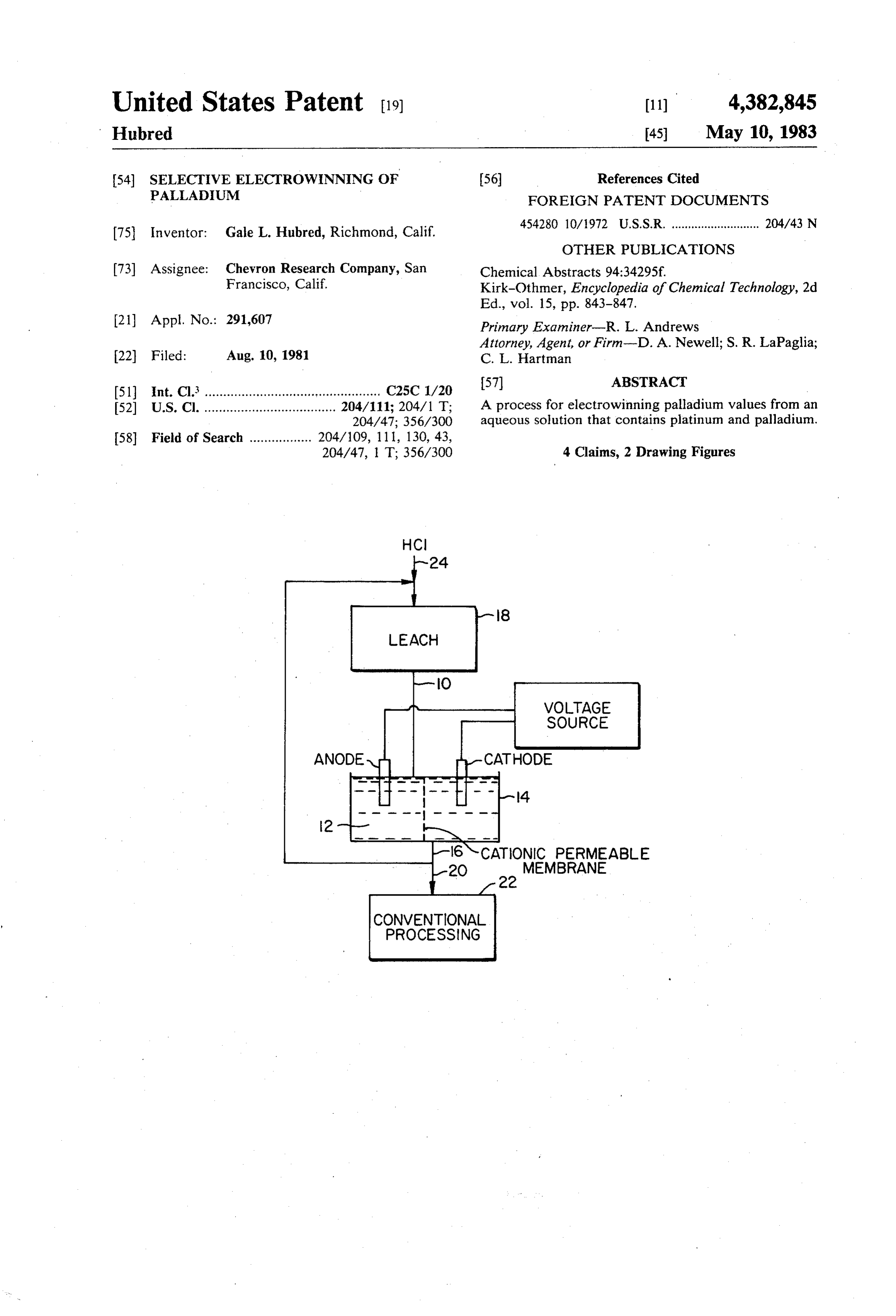
VOLTAGE
SOURCE
CATHODE
16 NCATIONIC PERMEABLE
2O 22 MEMBRANE
CONVENTIONAL
PROCESSING
Page 2
Drawing sheet — no readable text.
Page 3
of nitric and hydrochloric acids, known as aqua regia.
SELECTIVEELECTROWINNING OF PALLADIUM Any other solution that will dissolve the metals from the ore will be satisfactory as long as it contains at least
BACKGROUND OF THE INVENTION . 1 M hydrochloric acid. Dissolving the metals from the ore
This invention pertains to methods of producing pre beaker is done in what is herein defined as a leach tank. A cious metals electrolytically from solutions and in par dium is,containing chloride salts of platinum and palla ticular methods of producing palladium from solutions a leach tank. Solutions ofofhydrochloric upon addition acid, defined as hydrochloric acid and plati containing palladium and platinum. -
In natural ores the metals platinum and palladium are num(IV) hexachloride and palladium (II) tetrachloride frequently associated with each other. Ores are known 10 will be made which can then be used as electrolyte for that have much more palladium than platinum. A recovery of metal, if hydrochloric acid containing solu method of enriching the relative concentrations of plati tion is used to leach platinum and palladium from an num to palladium would be very useful for processing ore. If an ore contains substantially more palladium than these ores. The conventional method of recovering platinum, electrolysis of the hydrochloric acid leach platinum from a solution of platinum and palladium 15 solution can provide an enriched source of platinum for involves precipitating ammonium platinum VI hexa conventional treating, as well as pure palladium metal chloride to a solution containing platinum hexachloride plated onto the cathode.
and palladium tetrachloride. The cell for this invention is constructed by partition A process for the separation and recovery of noble 20 ing a cell containing the aqueous acidic solution with a metals disclosed in Chemical Abstracts 94:34295f show cation permeable membrane. The metal ions, in a first the electrowinning of both platinum and palladium solution as platinum (IV) hexachloride and palladium from a solution that contains other metal ions. Neither (II) tetrachloride, are placed in the cathode compart platinum nor palladium was selectively removed. ment. As reaction proceeds, the palladium initially
plates out on the cathode. It has been observed that platinum will not plate out until the concentration of
The present invention provides a method for selec platinum is about equal to the concentration of palla tively electrowinning palladium metal from a first solu dium, when concentration is measured in grams per tion that contains more palladium by weight than plati liter. In the bulk process of this invention, that is, when num prepared by dissolving palladium and platinum in the cell is charged with pregnant liquor and voltage at least 1 molar hydrochloric acid. 30 applied until platinum starts to plate out, monitoring of
The first solution is in contact with a cathode, in a the relative concentrations of the metals in the solution cathode compartment of an electrowinning cell, sepa is necessary if plating of the cathode with platinum is to rated from an anode by a cation permeable membrane. be avoided. This can be done by analyzing aliquots of The anode is in contact with a second solution consist ing of at least 0.5 molar hydrochloric acid. Electric 35 electrolyte by atomic absorption spectroscopy. The anode is in contact with a second solution that must be current is passed across the anode and cathode. Palla at least 0.5 molar hydrochloric acid. The second solu dium is selectively electrowon until the concentrations tion may have metal ions in its as well. Both the anode of platinum and palladium are substantially equal. and the cathode must be made from non-corroding DESCRIPTION OF THE DRAWINGS 40 material, such as titanium. The applied voltage across FIG. 1 shows flow scheme for one embodiment of the cell is typically about 1.5 volts, and should not ex this invention. ceed about 5 volts.
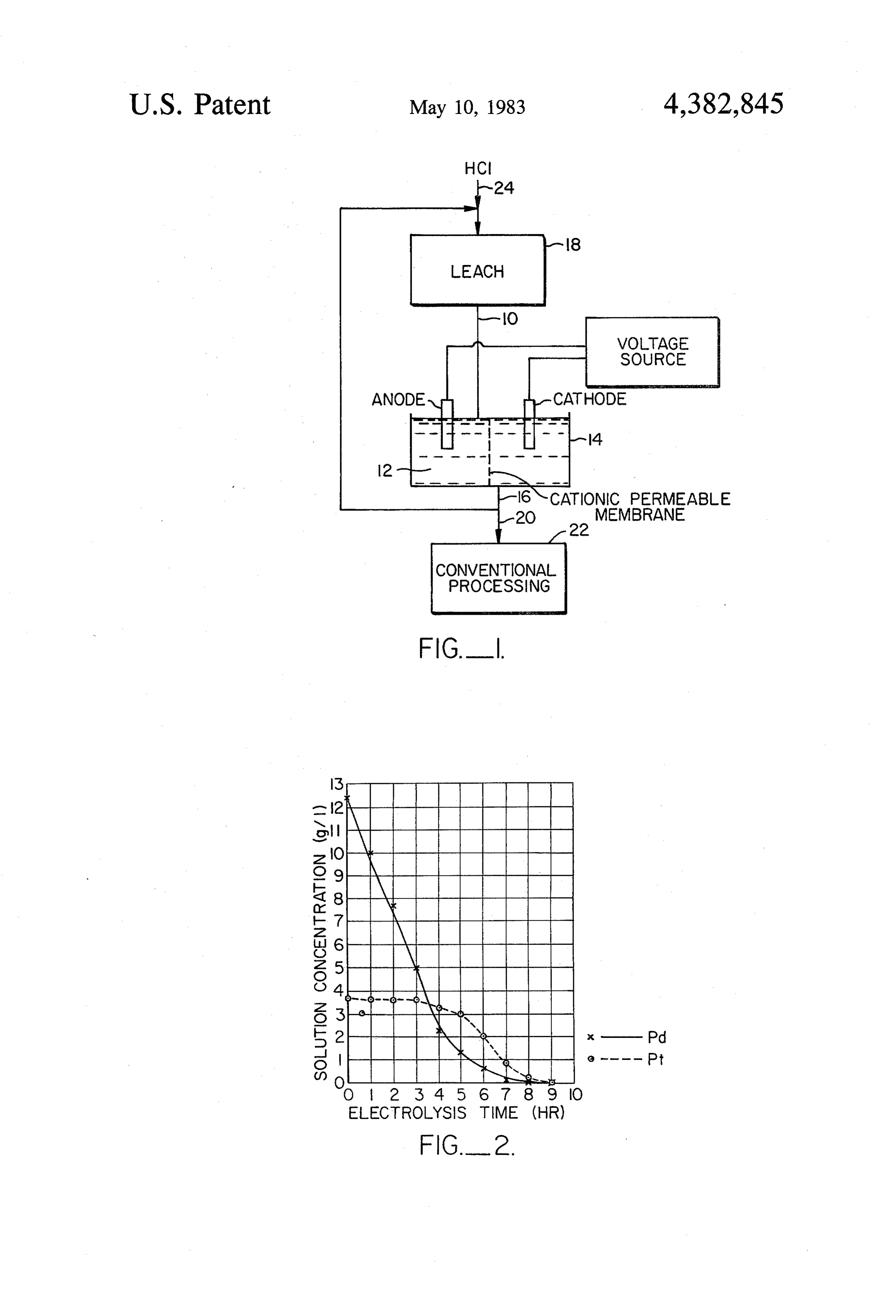
FIG. 2 shows a graphical representation of relative representedAn embodiment of this invention, is schematically concentrations of platinum and palladium in the opera the pregnantinliquor FIG. 1., a leach-electrolysis cycle where from the hydrochloric acid leach 10 tion of this invention. 45 is continuously supplied to the anode compartment 12
DETAILED DESCRIPTION of the cell 14. Electrolyte 16 is bled from the cell and Platinum and palladium are known to be associated platinum recycled to the leach tank 18 where it further dissolves with one another in naturally occurring ores along with leach and palladium from the ore. In this way the solution other platinum group metals and gold and silver. Vari platinum. A bleed 50 becomes increasingly concentrated with ous chemical processes are known that selectively sepa electrolyte for conventionalstream 20 removes platinum enriched rate platinum from palladium. An example of such pro Make up hydrochloric acid 24 platinum processing 22. cesses is shown in Kirk-Othmer's Encyclopedia of Chem stream to maintain volume in the system. can be added to the ical Technology, Second Edition, in Volume 15, pages are The flow rates determined by analysis of the concentrations 843-847. The process shown therein shows precipita metals in the bleed stream. As long as the bleed stream 55 of tion of platinum hexachloride with ammonium ion has more palladium than platinum, the metal plating out which selectively precipitates only the platinum and does not precipitate the palladium chloride. on the cathode will be essentially all palladium. It has been found that in a concentrated hydrochloric EXAMPLE acid solution containing platinum and palladium ions, 60 palladium can be selectively be removed by electrolysis The following example shows one embodiment of the of the solution, if concentration of palladium is greater present invention and is not intended to be limiting. A than the concentration of platinum. Such solutions can mixture of 100 ml of a solution that is 22.1 grams plati be obtained as the leach liquor from ores herein defined num per liter of solution made from H2PtCl6 in water as either naturally occurring or artificial, such as scrap 65 and 300 ml of a solution that is 60.0113 grams palladium metal, containing more palladium than platinum. It will per liter of solution made from dissolving PdCl2 in 1.0 be appreciated by those skilled in the art, that a leach M HCl was prepared for cathode compartment. A 4.00 solution for noble metals will many times be the mixture percent HCl solution was prepared for an anode com
Page 4
partment. A cell was prepared by dividing a container forming a first solution in a leach tank, which con with a NAFION membrane obtainable from DuPont tains at least 1 M hydrochloric acid, and said palla that had been pretreated by boiling for 30 minutes in dium and platinum;
10% sulfuric acid and wet mounted. A 30 mm x50 mm contacting said first solution with a cathode, said piece of platinum gauze was used as the anode and a 20 cathode in a compartment in a cell separated from mm x 45 mm piece of expanded titanium was used as an anode by a cation permeable membrane, said cathode. An electric current of 1.5 volts from a Hewl anode in contact with a second solution consisting ett-Packard 6428B DC Power Supply was passed of at least 0.5 molar hydrochloric acid; and through the solution and the concentrations of platinum 1 O passing electric current across said anode and cath and palladium measured approximately every one-half ode until the concentration of palladium and plati hour by atomic absorption. Results are shown in FIG. 2. num is substantially equal in said first solution, It will be seen that there was no detectable difference when said concentrations are measured in grams of metal per liter.
in concentration in platinum until the concentrations of platinum and palladium were nearly equal. This pro 15 ing2. the The process of claim 1 further including monitor concentrations of metals in the solutions by vides a gauge for commercial plant operation utilizing atomic absorption spectroscopy.
the flow Scheme of FIG. 1. 3. The process of claim 1 wherein the voltage of the What is claimed is: electric energy does not exceed 5 volts. 1. A process for selectively removing palladium from 4. The process of claim further comprising recy a mixture containing more palladium by weight than 20 cling the solution from said cell to said leach tank. platinum comprising: sk sk k s
Provenance
- Collection
- Cited prior art
- Original PDF
- patentimages.storage.googleapis.com →
- Filed
- 1981-08-10
- Pages
- 4
- Method
- pdftotext (the PDF's own text layer) + pdftoppm 300dpi page scans
- Source
- Google Patents bibliographic record
- Granted
- 1983-05-10
- Inventors
- Gale L. Hubred; Chevron Research Co
- Transcribed from
- patentimages.storage.googleapis.com →