patent · US4305794
Photochemical electrode
15 December 1981
Page 1 — bibliographic record
United States Patent (19) 11 4,305,794 Davidson et al. 45) Dec. 15, 1981 54 PHOTOCHEMICAL ELECTRODE 56 References Cited
75) Inventors: Robert S. Davidson; Charles J.
Willsher, both of Leicester, England 4,037,029 7/1977 Anderson ............................ 429/11
73) Assignee: National Research Development 4,225,408 9/1980 Barlow et al. .................. 204/181 N Corporation, London, England FOREIGN PATENT DOCUMENTS 2i Appl. No.: 178,463 55-94.19 1/1980 Japan ................................... 429/11 22, PCT Filed: Apr. 18, 1979 OTHER PUBLICATIONS 86 PCT No.: PCT/GB79/00062 A. W. Copeland et al., “The Photovoltaic Effect',
S 371 Date: Dec. 19, 1979 G. Athanasiu, Compt. Rend, vol. 175, pp. 214-27 S 102(e) Date: Dec. 19, 1979 (1922).
G. Athanasiu, Compt. Rend, vol. 180, pp. 587-589 87 PCT Pub. No.: WO79/00992 (1925).
PCT Pub. Date: Nov. 29, 1979 Primary Examiner-Aaron Weisstuch
Attorney, Agent, or Firm-Oblon, Fisher, Spivak, (30) Foreign Application Priority Data McClelland & Maier
Apr. 27, 1978 GB) United Kingdom ............... 16766/78 57 ABSTRACT
Photochemical electrode can decompose water when 5 Int. Cl........................... C25B 1/04; HO1M 6/36 irradiated with visible light and consists of red mercuric 52 U.S. C. .................................... 204/129; 204/130; sulphide blackened by iodide treatment as a coating on
204/129, DIG. 3, 130 12 Claims, 2 Drawing Figures
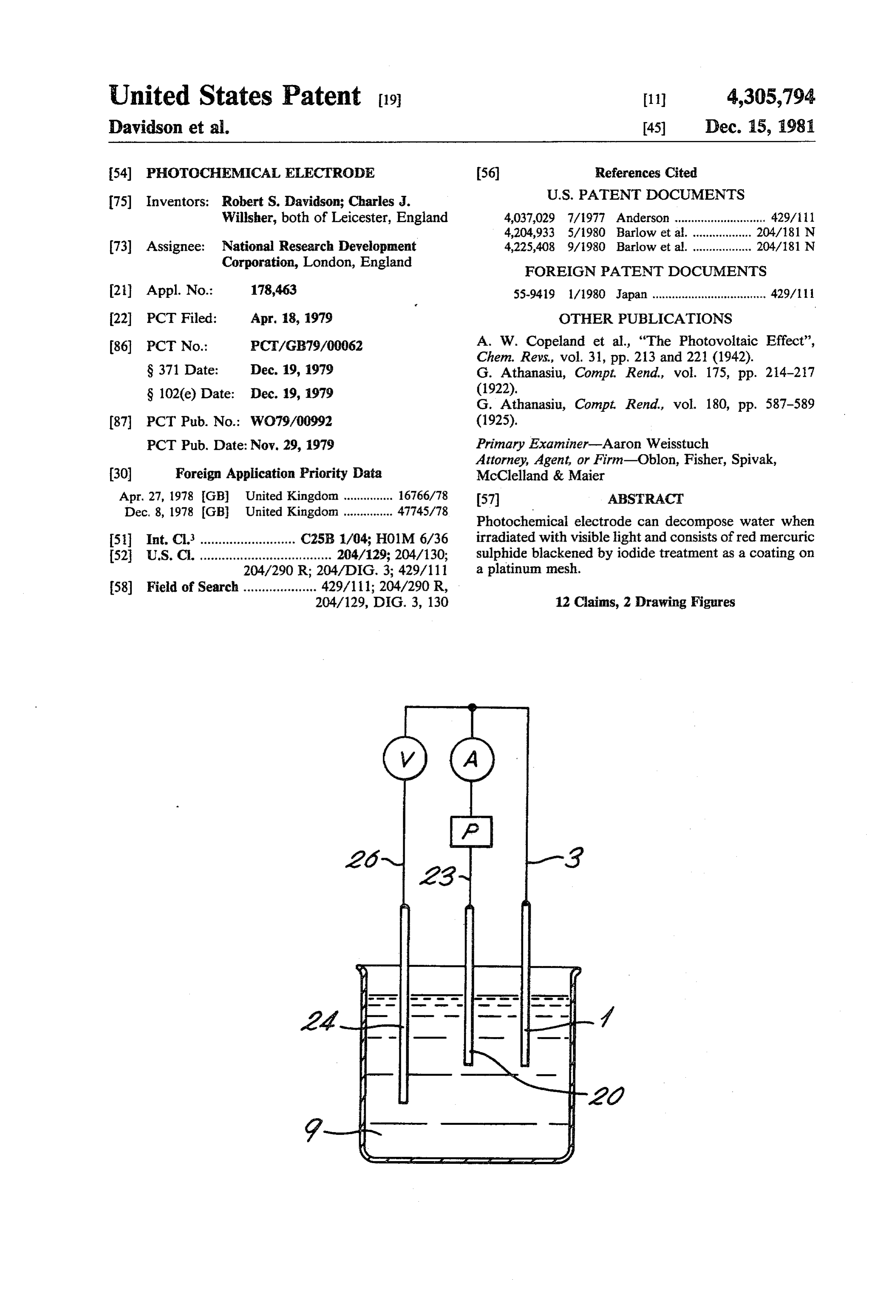
Page 2
Drawing sheet — no readable text.
Page 3
Drawing sheet — no readable text.
Page 4
Some reducing agents such as iodide ion may increase
PHOTOCHEMICAL ELECTRODE the photocurrent but may also solubilise the mercuric sulphide.
This invention relates to a photochemical electrode. This cell need not be driven by an applied potential, A photochemical electrode will exhibit, in electro but it may be if desired.
lyte, a potential difference relative to a reference elec The invention in a further aspect is photoassisted trode, this potential difference varying with the inten electrolysis of water using the photochemical electrode sity and wavelength of illumination. Using such an elec set forth above, applying, between the photochemical trode, light energy can be converted into electrical 10 electrode and a counterelectrode both in the same body energy, for example by putting a photochemical elec of water, a biassing potential (which may be 0.0V) less trode and an inert counterelectrode into electrolyte, than the thermodynamic potential for electrolysing the making an electrical circuit between the electrodes, and curicwater, allowing visible light to be absorbed by the mer illuminating the photochemical electrode while keeping sulphide, and collecting any product(s) from the the other dark. counterellectrode and/or photochemical electrode. Known photochemical electrodes are usually either 15 The best biassing potential appears to be pH-depend stable towards light, but responsive only to wave ent, and to depend on the duration of the blackening lengths in the ultraviolet, or responsive to visible light pretreatment. Where that was from 120 to 240 minutes, but decompose under its action. The ultraviolet-respon a 0.0V bias can deliver good photocurrent. A preferred sive type may be sensitized to visible light by expedients 20 biassing potential vs. the standard calomel electrode for such as adsorbed dyes, dopants or dissolved sensitizers, a reasonable rate of electrolysis is +0.2 to + 1.0 V, and the light-decomposable type may be protected by preferably -0.3 to -0.6 V.
coating with metal or stable semiconductor or by add Red (non-preblackened) mercuric sulphide in some ing redox couples which will compete with the decom circumstances becomes black in use. In this form it still position reaction, but these efforts are troublesome. 25 does not always dissolve and furthermore it absorbs A photochemical electrode would thus be desirably longer wavelengths, which is advantageous. Red cinna stable towards visible light and photochemically re bar from different sources can give rise to photopoten sponsive to it. tials of different magnitude. After blackening, however, The present invention is a photochemical electrode all samples behave consistently.
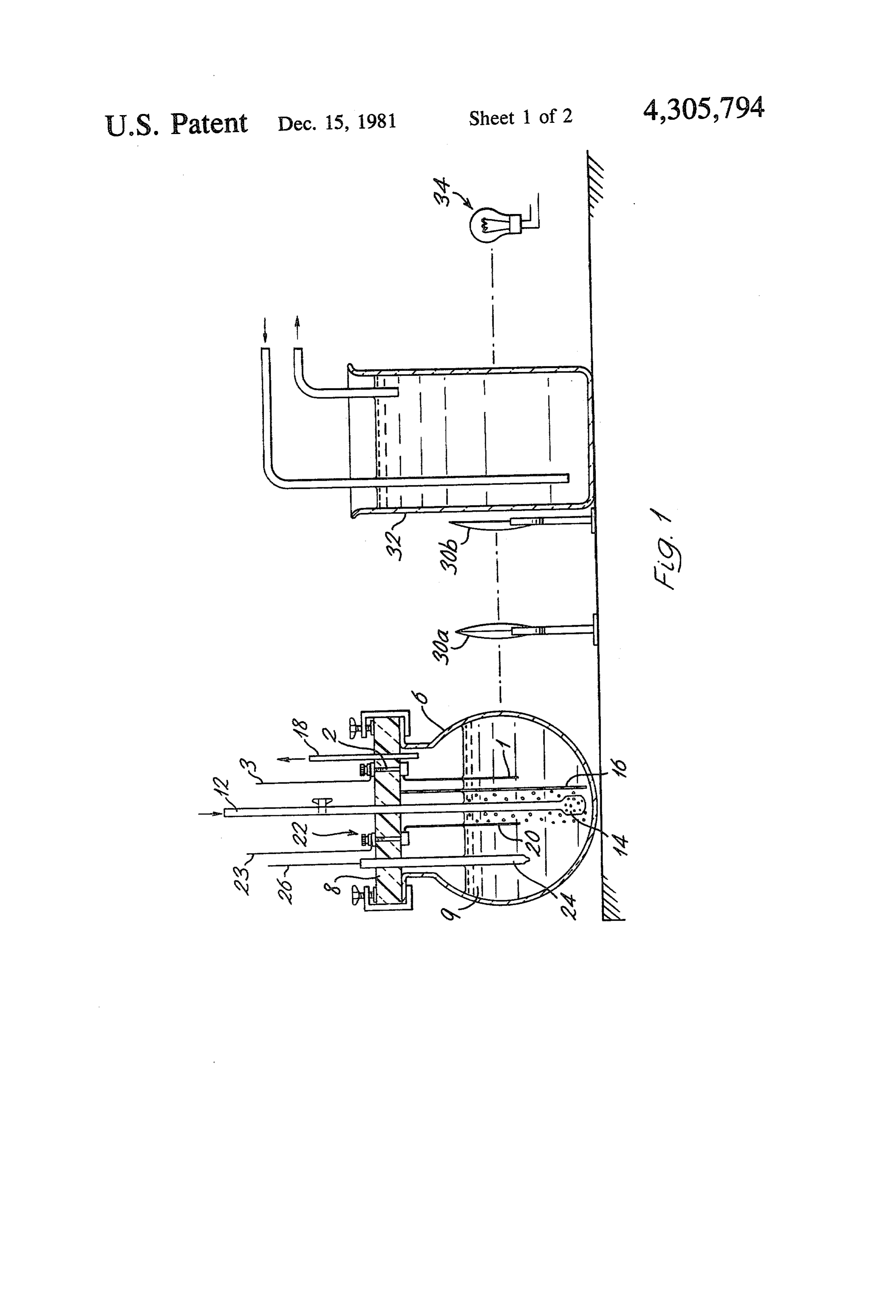
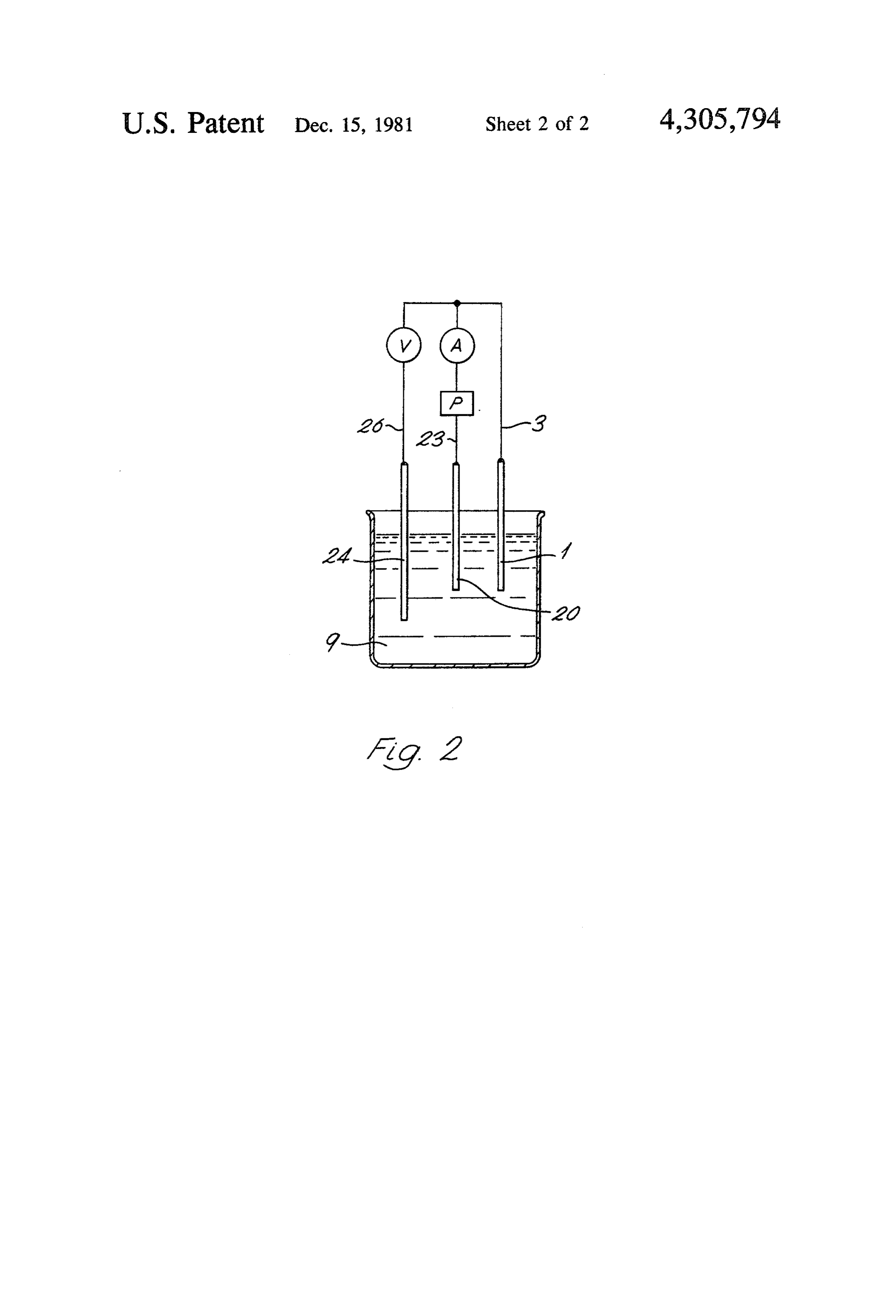
comprising a conductive member contacting initially 30 The invention will now be described by way of exam red mercuric sulphide, which need not be a single crys ple with reference to the accompanying drawings, in tal. The member may be a mesh (which may be woven which or expanded), for example of metal such as platinum or FIG. 1 shows a cell including a photochemical elec titanium or of carbon fibers, and the mercuric sulphide trode according to the invention, and may form a coating on the member. Alternatively, the 35 FIG. 2 is a circuit diagram of the cell of FIG. 1. mercuric sulphide may be in some such form as a slurry PREPARATION OF PHOTOCHEMICAL or suspension or fluidised bed. ELECTRODE The coating may be applied by dipping the conduc tive member (carrier) in a suspension of red mercuric Analytical grade red mercuric sulphide HgS (2 g) is sulphide and drying the conductive member in air (pref 40 placed in 30 ml of de-oxygenated de-ionized water, erably blown hot air), and repeating the dipping and which is boiled until the volume is 25 ml, thus ensuring drying as necessary. The mercuric sulphide coated on a dispersed suspension of the mercuric sulphide. The the electrode may be pretreated by using the electrode suspension is further dispersed by an ultrasonic probe. in a reducing electrolyte until the mercuric sulphide is A platinum mesh is taken. This mesh consists of a blackened; the electrode is then preferably washed 45 plain weave of 0.25 mm diameter platinum wire at 0.7 clean of reductant. The atomic 9% of mercury in the mm centers. (Other weaves, such as twill and hollander, blackened mercuric sulphide is preferably at least may also be used.) A rectangle of mesh 15 mmX30 mm 48.9%. The blackening is preferably performed while is mounted on a platinum strap 5 mmX 15 mm, the long irradiating the mercuric sulphide. The reductant is pref direction of the strap being parallel to the shorter side of erably from 0.05 M to 1.0 M. The duration of this pre 50 the rectangle and midway along the longer side. The treatment may be from 30 to 240 minutes, preferably strap has a 1 mm diameter platinum wire about 60 mm from 45 to 180 minutes, more preferably up to 120 min long for electrical connection purposes. utes, preferably at a potential in the reductant of within The mesh is swirled around the suspension, removed 0.2 V of the standard calomel electrode. The reductant and dried in a blown hot air stream. This is repeated may be a halide (especially iodide) or thiocyanate for 55 until an even red coating is obtained, weighing in prac example. tice 20 to 25 mg, although this is not critical; by using a The invention in another aspect comprises convert more dilute suspension, a 5 mg coating has been ob ing visible light into electricity using the photochemical tained which behaves the same as a 20 mg coating. electrode set forth above, whereto no biassing potential Solubilisation of mercury from the mercuric sulphide need be applied. For this purpose there may be pro 60 occurs when it is used in an electrolyte containing easily vided a cell comprising the photochemical electrode, an oxidisable ions such as iodide. This is unfortunate since inert counterelectrode, and an electrolyte, such as aque the presence of iodide ions can considerably enhance ous sodium nitrate solution, optionally including a re the photocurrent and can furthermore cause darkening ducing agent, and allowing visible light to be absorbed of the mercuric sulphide, which, extremely advanta by the mercuric sulphide, a circuit being provided con 65 geously, enhances spectral response (that is, it will ab necting the photochemical electrode and the counter sorb not only visible but also longer (infra-red) wave electrode, in which circuit electricity flows depending lengths). The darkened material includes cinnabar, on the light. metacinnabar and unidentified material. The atomic 2%
Page 5
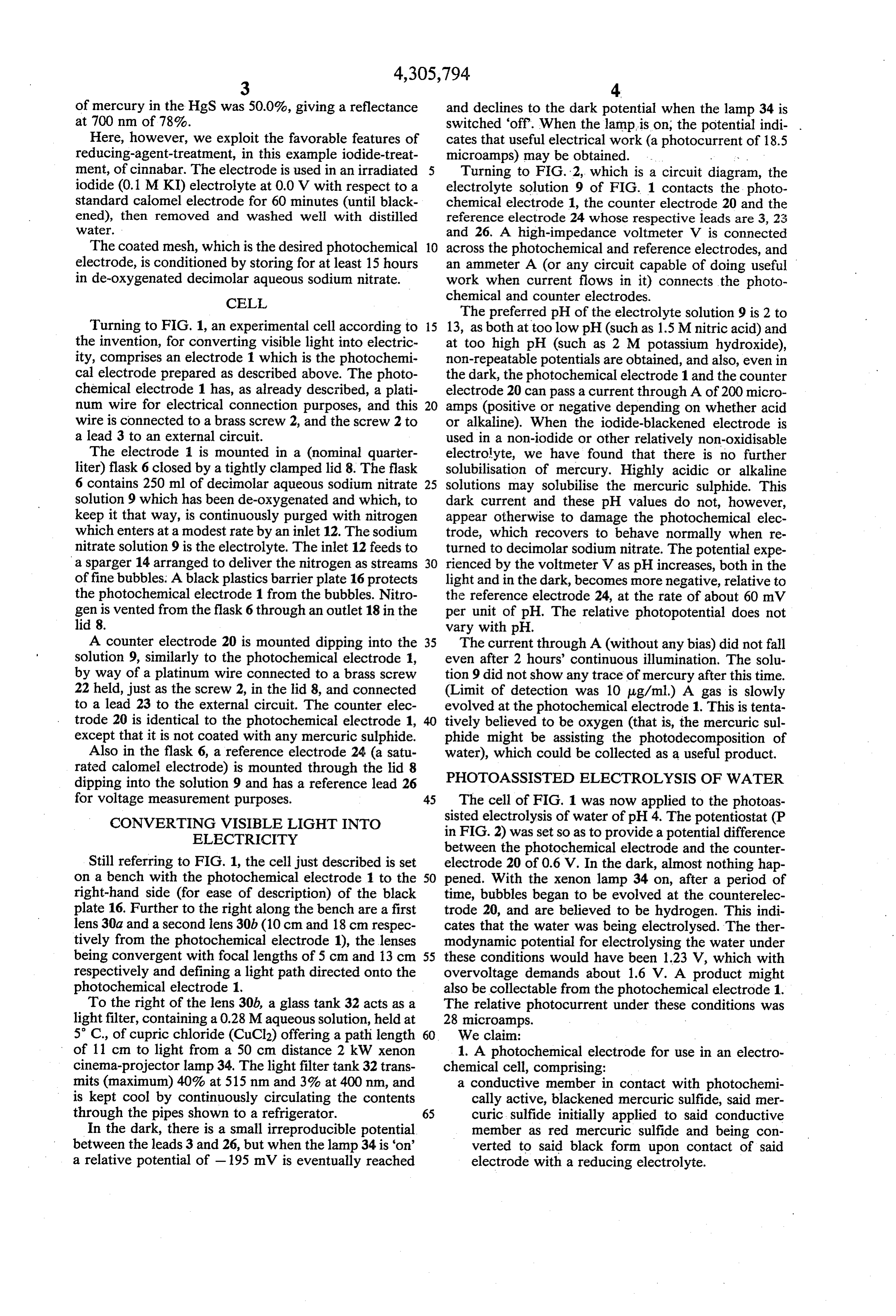
of mercury in the HgS was 50.0%, giving a reflectance and declines to the dark potential when the lamp 34 is at 700 nm of 78%. switched "off. When the lamp, is on, the potential indi- . Here, however, we exploit the favorable features of cates that useful electrical work (a photocurrent of 18.5 reducing-agent-treatment, in this example iodide-treat microamps) may be obtained. ... . .. . ment, of cinnabar. The electrode is used in an irradiated Turning to FIG. 2, which is a circuit diagram, the iodide (0.1 M KI) electrolyte at 0.0 V with respect to a electrolyte solution 9 of FIG. 1 contacts the photo standard calomel electrode for 60 minutes (until black chemical electrode 1, the counter electrode 20 and the ened), then removed and washed well with distilled reference electrode 24 whose respective leads are 3, 23 Water. and 26. A high-impedance voltmeter V is connected The coated mesh, which is the desired photochemical 10 across the photochemical and reference electrodes, and electrode, is conditioned by storing for at least 15 hours an ammeter A (or any circuit capable of doing useful in de-oxygenated decimolar aqueous sodium nitrate. work when current flows in it) connects the photo CELL chemical and counter electrodes.
The preferred pH of the electrolyte solution 9 is 2 to
Turning to FIG. 1, an experimental cell according to 15 13, as both at too low pH (such as 1.5M nitric acid) and the invention, for converting visible light into electric at too high pH (such as 2 M potassium hydroxide), ity, comprises an electrode 1 which is the photochemi non-repeatable potentials are obtained, and also, even in cal electrode prepared as described above. The photo the dark, the photochemical electrode 1 and the counter chemical electrode 1 has, as already described, a plati electrode 20 can pass a current through A of 200 micro num wire for electrical connection purposes, and this 20 amps (positive or negative depending on whether acid wire is connected to a brass screw 2, and the screw 2 to or alkaline). When the iodide-blackened electrode is a lead 3 to an external circuit. used in a non-iodide or other relatively non-oxidisable The electrode 1 is mounted in a (nominal quarter electrolyte, we have found that there is no further liter) flask 6 closed by a tightly clamped lid 8. The flask solubilisation of mercury. Highly acidic or alkaline 6 contains 250 ml of decimolar aqueous sodium nitrate 25 solutions may solubilise the mercuric sulphide. This solution 9 which has been de-oxygenated and which, to dark current and these pH values do not, however, keep it that way, is continuously purged with nitrogen appear otherwise to damage the photochemical elec which enters at a modestrate by an inlet 12. The sodium trode, which recovers to behave normally when re nitrate solution 9 is the electrolyte. The inlet 12 feeds to turned to decimolar sodium nitrate. The potential expe a sparger 14 arranged to deliver the nitrogen as streams 30 rienced by the voltmeter V as pH increases, both in the of fine bubbles. A black plastics barrier plate 16 protects light and in the dark, becomes more negative, relative to the photochemical electrode 1 from the bubbles. Nitro the reference electrode 24, at the rate of about 60 mV gen is vented from the flask 6through an outlet 18 in the per unit of pH. The relative photopotential does not lid 8. vary with pH.
A counter electrode 20 is mounted dipping into the 35 The current through A (without any bias) did not fall solution 9, similarly to the photochemical electrode 1, even after 2 hours' continuous illumination. The solu by way of a platinum wire connected to a brass screw tion 9 did not show any trace of mercury after this time. 22 held, just as the screw 2, in the lid 8, and connected (Limit of detection was 10 ug/ml.) A gas is slowly to a lead 23 to the external circuit. The counter elec evolved at the photochemical electrode 1. This is tenta trode 20 is identical to the photochemical electrode 1, tively believed to be oxygen (that is, the mercuric sul except that it is not coated with any mercuric sulphide. phide might be assisting the photodecomposition of Also in the flask 6, a reference electrode 24 (a satu water), which could be collected as a useful product. rated calonel electrode) is mounted through the lid 8 PHOTOASSISTED ELECTROLYSIS OF WATER dipping into the solution 9 and has a reference lead 26 for voltage measurement purposes. 45 The cell of FIG. 1 was now applied to the photoas CONVERTING VISIBLE LIGHT INTO sisted electrolysis of water of pH4. The potentiostat (P ELECTRICITY in FIG. 2) was set so as to provide a potential difference between the photochemical electrode and the counter
Still referring to FIG. 1, the cell just described is set electrode 20 of 0.6 V. In the dark, almost nothing hap on a bench with the photochemical electrode 1 to the 50 pened. With the xenon lamp 34 on, after a period of right-hand side (for ease of description) of the black time, bubbles began to be evolved at the counterelec plate 16. Further to the right along the bench are a first trode 20, and are believed to be hydrogen. This indi lens 30a and a second lens 30b (10 cm and 18 cm respec cates that the water was being electrolysed. The ther tively from the photochemical electrode 1), the lenses modynamic potential for electrolysing the water under being convergent with focal lengths of 5 cm and 13 cm 55 these conditions would have been 1.23 V, which with respectively and defining a light path directed onto the overvoltage demands about 1.6 V. A product might photochemical electrode 1. also be collectable from the photochemical electrode 1. To the right of the lens 30b, a glass tank 32 acts as a The relative photocurrent under these conditions was light filter, containing a 0.28 Maqueous solution, held at 28 microamps.
5 C., of cupric chloride (CuCl2) offering a path length 60 We claim:
of 11 cm to light from a 50 cm distance 2 kW xenon 1. A photochemical electrode for use in an electro cinema-projector lamp 34. The light filter tank 32 trans chemical cell, comprising:
mits (maximum) 40% at 515 nm and 3% at 400 nm, and a conductive member in contact with photochemi is kept cool by continuously circulating the contents cally active, blackened mercuric sulfide, said mer through the pipes shown to a refrigerator. 65 curic sulfide initially applied to said conductive In the dark, there is a small irreproducible potential member as red mercuric sulfide and being con between the leads 3 and 26, but when the lamp 34 is "on' verted to said black form upon contact of said a relative potential of -195 mV is eventually reached electrode with a reducing electrolyte.
Page 6
2. The electrode of claim 1, wherein said conductive electrode comprising a conductive member in member is a mesh. contact with photochemically active, blackened 3. The electrode of claim 2, wherein said conductive mercuric sulfide, said mercuric sulfide initially member is a mesh of metal or of carbon fibers. applied to said conductive member as red mercuric 4. The electrode of claim 1, wherein said mercuric sulfide and being converted to said black form sulfide forms a coating on said conductive member. upon contact of said electrode with a reducing 5. The electrode of claim 1, wherein said mercuric electrolyte.
sulfide is applied to said conductive member in the form 11. A method of electrolysing water in a photochemi of a slurry, suspension or fluidised bed of initially red cal cell, comprising;
mercuric sulfide. subjecting a photochemical electrode 13 to light in 6. The electrode of claim 1, wherein said reducing said photochemical ceil additionally containing an electrolyte contains a halide ion or thiocyanate ion as a inert counterelectrode and an aqueous electrolyte reducing agent. in which said electrodes are immersed, thereby 7. The electrode of claim 1 or 6, wherein the atomic generating an electrical current within said cell percent of mercury in said blackened mercuric sulfide is 5 which results in the generation of hydrogen at one at least 48.9%. of said electrodes and oxygen at the other elec 8. The electrode of claim 6, wherein said mercuric trode; and sulfide is blackened in said reducing electrolyte at a collecting the products of electrolysis said photo potential of within 0.2 V of the standard calomel elec 20 chemical electrode comprising a conductive men trode. ber in contact with photochemically active, black 9. The electrode of claim 6 or 8, wherein said mercu ened mercuric sulfide, said mercuric sulfide ini ric sulfide is blackened over a period of from 30–240 tially applied to said conductive member as red minutes. mercuric sulfide and being converted to said black 10. A method for converting light into electricity in a form upon contact of said electrode with a reduc photochemical cell, comprising; 25 subjecting a photochemical electrode to light in said ing electrolyte.
photochemical cell additionally containing an inert tial12.ofThe
method of claim 11, wherein a biasing poten potential less than the thermodynamic potential counterelectrode and an electrolyte in which said electrodes are immersed, thus generating an electri 30 for electrolysing water k is applied
across
said electrodes.
cal current within said cell said photochemical
Provenance
- Collection
- Cited prior art
- Original PDF
- patentimages.storage.googleapis.com →
- Filed
- 1979-12-19
- Pages
- 6
- Method
- pdftotext (the PDF's own text layer) + pdftoppm 300dpi page scans
- Source
- Google Patents bibliographic record
- Granted
- 1981-12-15
- Inventors
- Robert S. Davidson; Charles J. Willsher; National Research Development Corp UK
- Transcribed from
- patentimages.storage.googleapis.com →