patent · US4045316
Photochemical process for decontaminating gaseous or vaporous streams
30 August 1977
Page 1 — bibliographic record
United States Patent 19 (11) 4,045,316 Legan 45) Aug. 30, 1977
(54) PHOTOCHEMICAL PROCESS FOR 3,977,952 8/1976 Knoevenagel et al. ...... 204/157.1 R DECONTAMINATING GASEOUS OR 3,984,296 10/1976 Richards ....................... 204/157.1 R WAPOROUS STREAMS OTHER PUBLICATIONS (75) Inventor: Robert W. Legan, Houston, Tex. Chemistry & Industry (Jan. 23, 1971) pp. 116-119, Stiff. (73) Assignee: Shintech Incorporated, Houston, Tex. Primary Examiner-Howard S. Williams 21) Appl. No.: 581,239 Attorney, Agent, or Firm-Roylance, Abrams, Berdo & Kaul
(51) Int. Cl.' ........................... B01J 1/10; B01K 1/00 A process for photochemically treating hydrocarbons (52) U.S. Cl. ........................... 204/158 R; 204/162 R; and halogenated or partially oxidized hydrocarbons in a
(58) Field of Search ....................... 204/158 R, 162 R; gaseous or vaporous mixture, by exposing the mixture 250/527 to ultraviolet light, preferably of relatively short wave length in the presence of oxygen or its allotropes, in 56) References Cited order to oxidize the hydrocarbons to very simple con
3,657,087 4/1972 Scott ................................ 204/158 R 3,844,914 10/1974 Marchison ....................... 204/158 R 13 Claims, 2 Drawing Figures
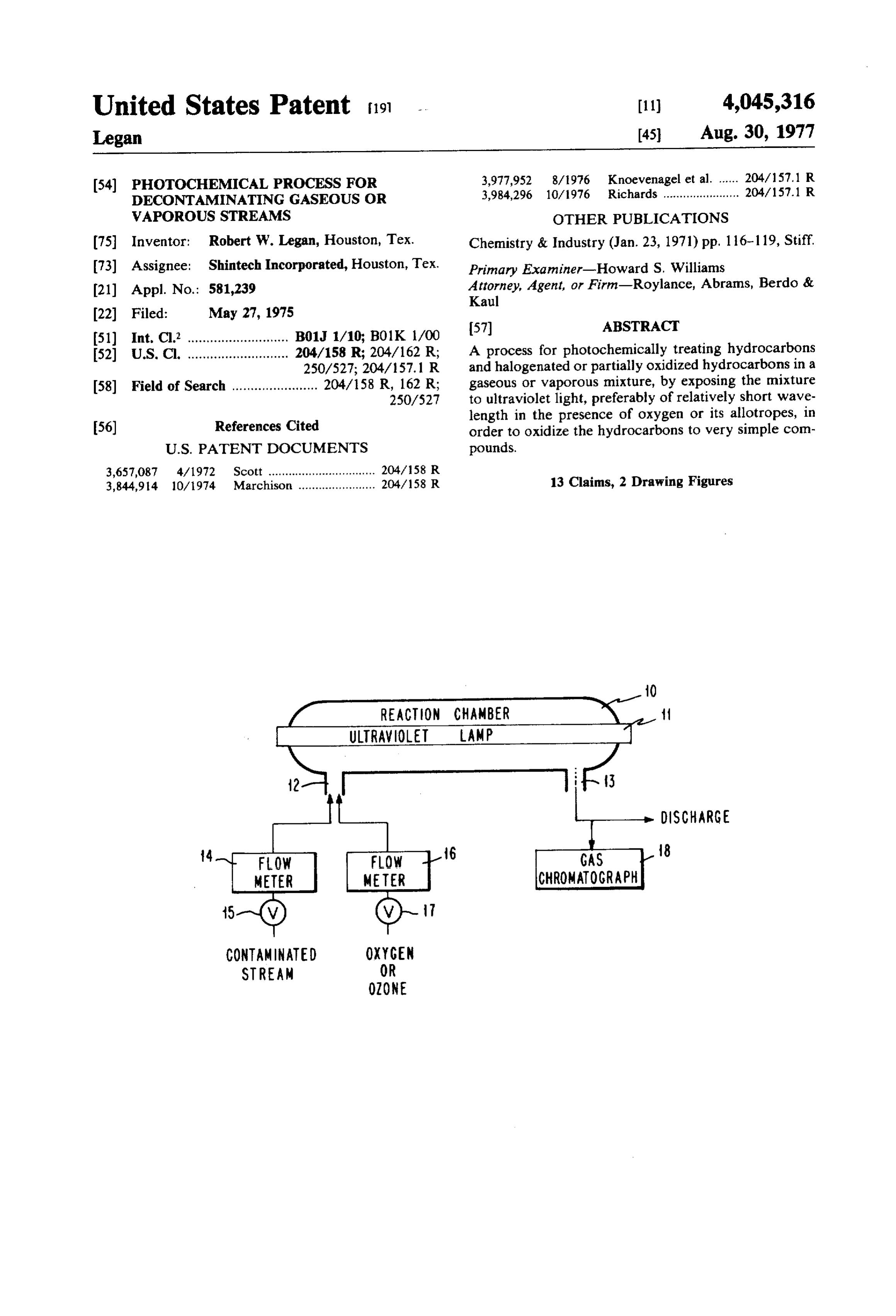
ULTRAVIOLET LAMP
DISCHARGE
CONTAMINATED OXYGEN
OZONE
Page 2
REACTION CHAMBER
ULTRAVIOLET LAMP
DISCHARGE
CONTAMINATED OXY GEN
OZONE
FIG.
Ond
OZONE
VINYL CHLORIDE DESTRUCTION
VCM CONTENT (INLET)= OOp.p.m.
LB. OZONE/LB, VCM =
REACTION TIME, SECONDS
Page 3
service, so that to date the technology as applied to
PHOTOCHEMICAL PROCESS FOR VCM has not been demonstrated commercially. DECONTAMINATING GASEOUS OR WAPOROUS The use of ozone as an oxidizing agent is known in the STREAMS art. Ozonolysis of unsaturated organic liquids to yeild This invention relates primarily to the decontamina 5 aldehydes and ketones is a common analytical proce tion of noxious hydrocarbons in gaseous or vaporous dure. William T. Miller, in U.S. Pat. Nos. 2,712,554 and mixtures by the photochemical interaction with acti 2,712,555 teaches the use of ozone in the partial oxida vated oxygen species to oxidize the contaminants to tion of hydrocarbons using ozone in the liquid and simple compounds. vapor phase respectively. Miller's technique is prepara O tive in nature, in that it is useful for the preparation of
BACKGROUND OF THE INVENTION specific partially oxidized compounds. Neither Miller's In recent years legislation has been providing stricter method nor classical ozonolysis is known to be suffi regulation over the emission of contaminants into the ciently reactive to oxidize hydrocarbons to the simple atmosphere. In most instances governmental standards products necessary to achieve the objectives of the rigidly control the concentration of pollutants to within 15 present invention.
stringent limits. The economic impact of such control SUMMARY OF THE INVENTION on certain industries has been severe. In some situations factories have been forced to close their doors and cease The present invention is primarily concerned with the operations because conformance to the new regulations decontamination of gaseous or vaporous streams, typi has involved complete replacement of elaborate pro cally of emissions into the atmosphere from industrial duction equipment or has involved introducing proce processes, where the contamination consists of certain dures that were not economically feasible. For example, hydrocarbons, halogenated hydrocarbons and/or par a Federal regulation promulgated in 1974 stipulates that tially oxidized hydrocarbons.
within a prescribed time period, concentrations of vinyl The present process utilizes photochemical genera chloride monomer (VCM), a suspected carcinogen, in 25 tion of activated oxygen species to effect the oxidation industrial atmospheres must not exceed one part per of these contaminants to simple compounds. Essentially million, a requirement so stringent as compared with the process comprehends exposing the contaminated existing practice that many firms have projected com gaseous stream to ultraviolet light in the presence of plete plant shutdowns with consequent idling of thou oxygen and/or ozone. In a preferred embodiment, sur sands of employees. By means of the present invention, prising advantages are derived from the use of ultravio atmospheric emissions containing certain environmen let light having component wave lengths below 2100 A tal pollutants in light or heavy concentrations become combined with specified quantities of ozone. drastically decontaminated through improved photo The principal object of the present invention is to chemical oxidation procedures. provide a new and useful method of and apparatus for 35 decontaminating gaseous or vaporous streams contain
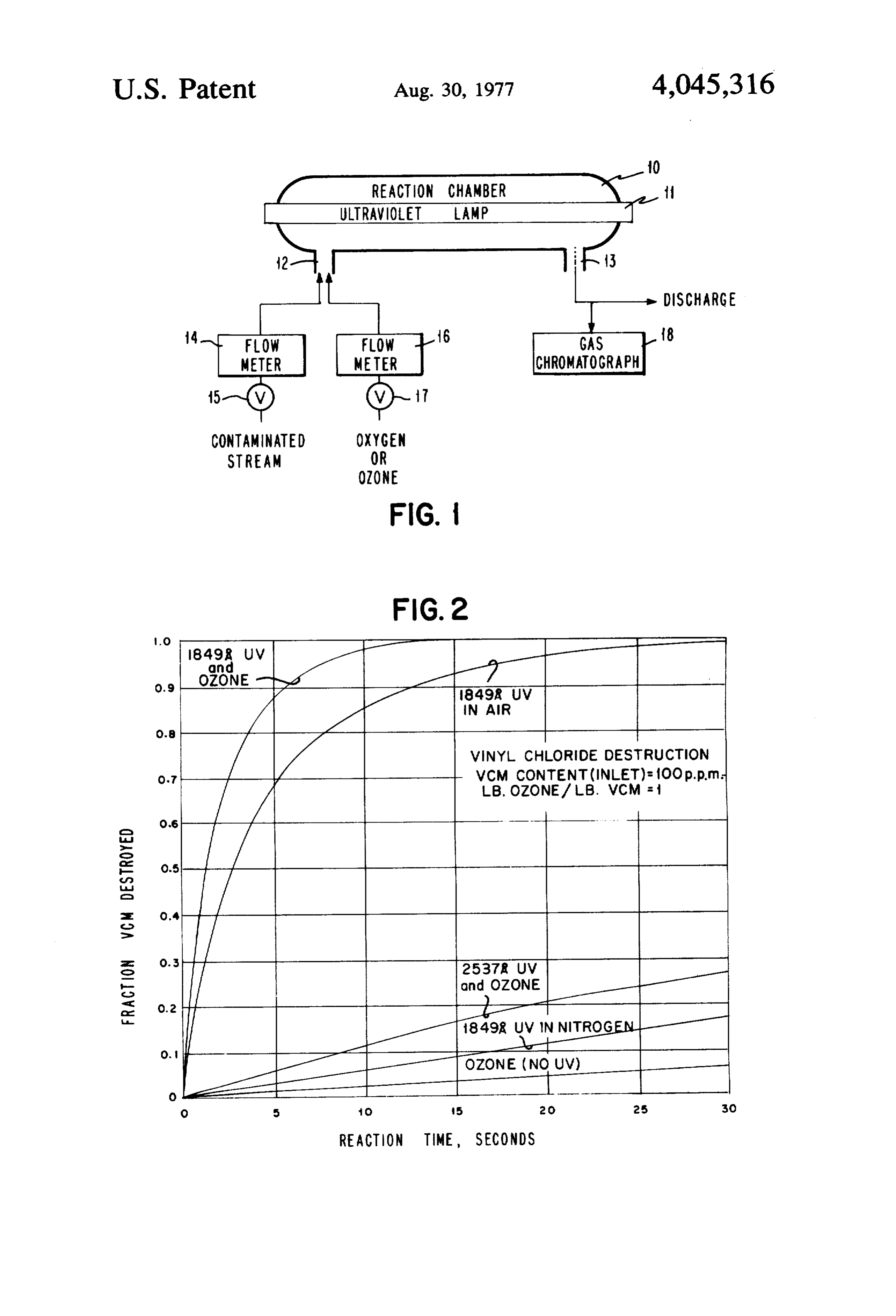
STATE OF THE ART ing certain hydrocarbons, halogenated hydrocarbons With specific reference again to vinyl chloride mono and/or partially oxidized hydrocarbons; and, to provide mer, several processes have been proposed to reduce such a method and apparatus wherein use is made of the concentration of contaminants in emissions, with ultraviolet light in the presence of activated oxygen varying degrees of success. Among these, solvent ab species to oxidize these contaminants efficiently and sorption, while theoretically attainable, becomes in economically to simple compounds such as carbon di practical as applied to stack emissions of any substantial oxide, water, hydrogen halides and halogen gases. capacity because of the unreasonably large flow of These and other objects will become more apparent solvent required in a stripping column, the impractical from the following detailed description, in conjunction size of such a solvent absorption column, and the uneco 45 with the accompanying drawing, wherein: nomically vast energy needs for the system. Conse FIG. 1 is a diagrammatic view of a typical apparatus quently, the approach has not been deemed commer for carrying out the present process; and cially feasible. FIG. 2 is a graph summarizing experimental data Incineration of vinyl chloride has been considered illustrating advantages to be obtained with the present where ambient air is available as a diluent. However, 50 process.
supplemental fuel is required in proportion to the quan DETALED DESCRIPTION tity of air used, and since the fuel needs become enor mous especially with dilute quantities of VCM in the In connection with the present decontamination pro emission, and especially where substantially complete cess, the compounds comprehended as contaminants removal of the VCM is required, the process becomes 55 are constrained to the following classes: uneconomical. It has been estimated that for poly (vinyl A. Saturated and unsaturated hydrocarbons contain chloride) production, fuel needs for incineration entail ing 2-8 carbon atoms. Examples of such hydrocarbons from 33 percent to over 400 percent increases in overall include but are not limited to ethene (ethylene), ethyne plant fuel consumption, depending upon the type of (acetylene), propane, iso-butane, 1,3 butadiene, 2 plant involved. Incinerators have a reputation for me 60 methylbutane, 1-pentyne and isoprene 1,2,4 trimethyl chanical unreliability, and the unusually high mainte pentane, n-heptane, toluene and cyclohexane. nance costs additionally militate heavily against the B. Halogen-substituted variants of the hydrocarbons wide-scale adoption of incineration as a control process. in the foregoing Class A. Halogen substituents are Adsorption of organic vapors by passing them chosen from the group containing fluorine (--F), Chlo through beds of activated carbon has been tried with 65 rine(-Cl), Bromine (-Br) and Iodine (-I). Examples some success, but some recent tests indicate a typical 50 of such halogen-substituted hydrocarbons include but percent loss in bed capacity and a 300 percent increase are not limited to 1,1,1, trichloroethylene, vinyl flur in regeneration time with less than 3 days' continuous oide, vinyl chloride, vinyl bromide, vinylidene chloride,
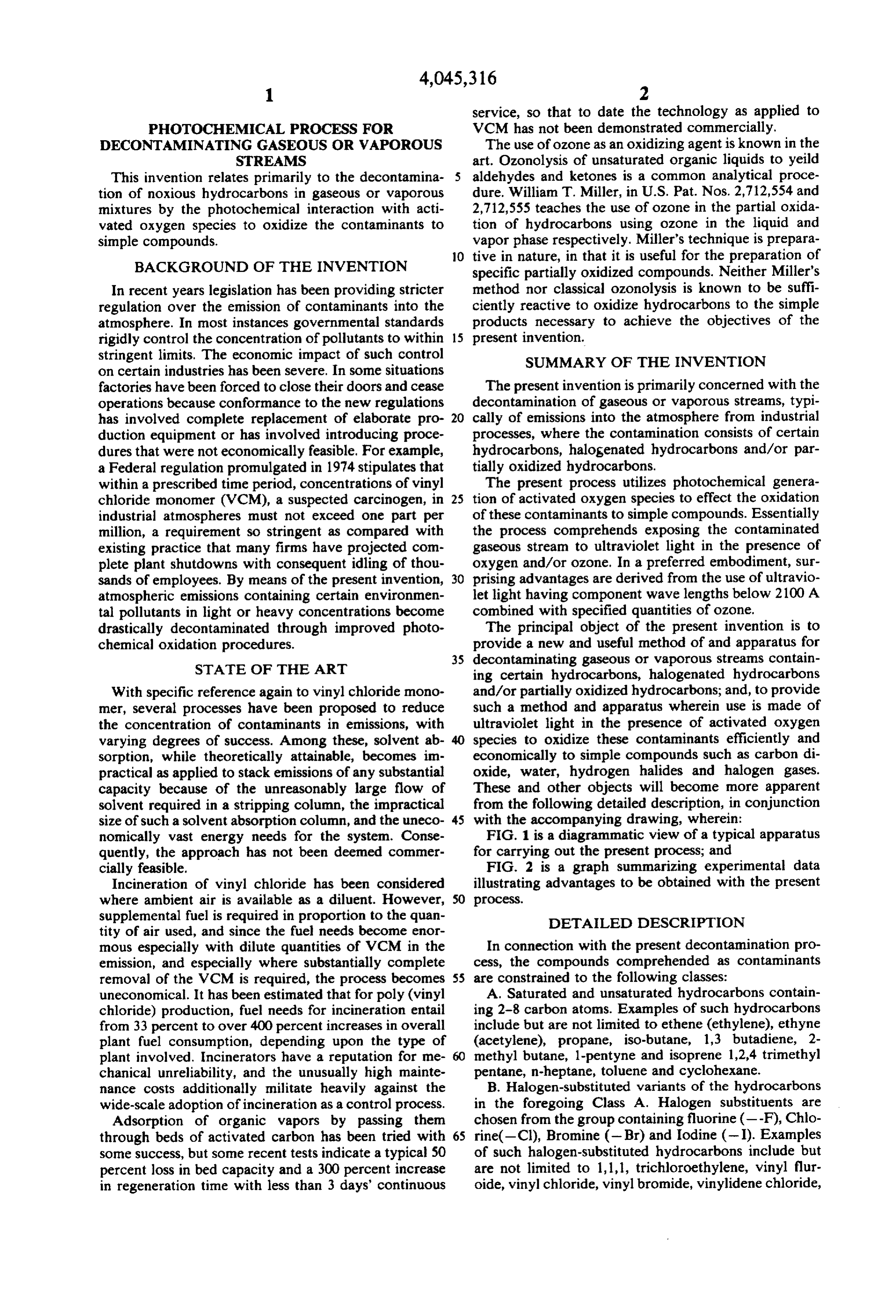
Page 4
chloroprene, ethylene dichloride, 1-bromo-3-chloro energy of ultraviolet radiation is known to increase with propane, fluorotricholorethylene and secbutyl chloride, decreasing wavelength, according to the relationship E C. Partially oxidized variants of the hydrocarbons = A and halogen substituted hydrocarbons of the foregoing Where:
Classes A and B. Such compounds result from inclusion E = Quantum Energy (energy/mole) of oxygen-containing groups such as hydroxyl (-OH), h = Planck's Constant keto A = Wavelength (length units)
The pressure at which the decontamination reaction is conducted is again limited by practical consider (-C-), O ations. The gaseous or vaporous streams of this process aldehyde are subject to ordinary gas laws, allowing effective residence time in a continuous reaction vessel to be
H manipulated by choice of reaction pressure. The decon / tamination reaction per se is rather insensitive to pres (-C=O), 15 sure within ordinary limits of 0.01 to 10 Atm. With the
ether(C-O-C), ester present process, a gaseous or vaporous stream contain ing certain hydrocarbon contaminants is introduced
into a reaction chamber. Ultraviolet light is provided
within the reaction chamber to effect a photochemical (-C-O-C-), oxidation reaction. Some species of oxygen must be present. The ultraviolet light is believed to react with epoxy both oxygen and ozone to produce various activated species, including atomic oxygen and O, O, and O
forms with excited electron states. I have chosen the
M. N. term "oxygen species' to refer collectively to oxygen,
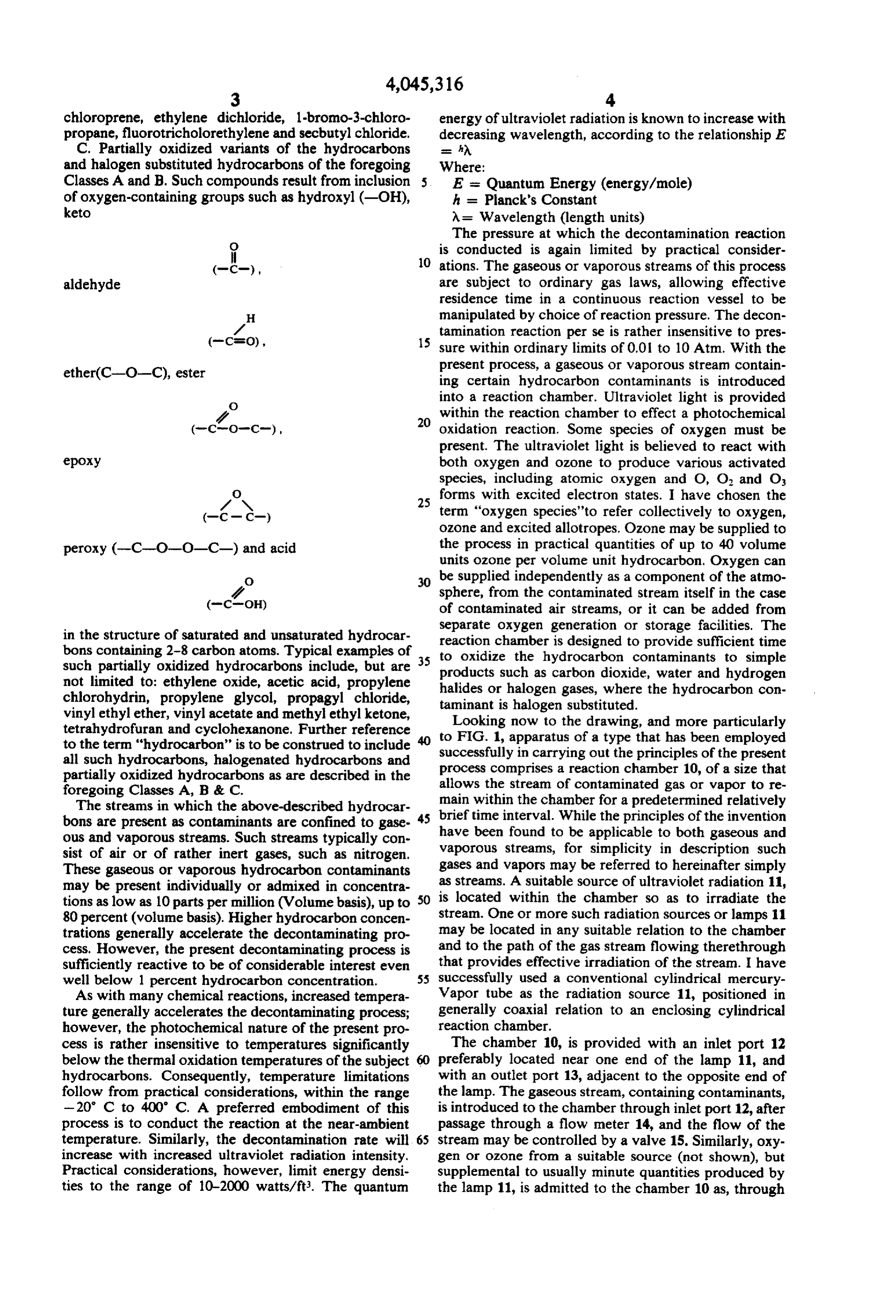
ozone and excited allotropes. Ozone may be supplied to peroxy (-C-O-O-C-) and acid the process in practical quantities of up to 40 volume units ozone per volume unit hydrocarbon, Oxygen can 30 be supplied independently as a component of the atmo sphere, from the contaminated stream itself in the case of contaminated air streams, or it can be added from separate oxygen generation or storage facilities. The in the structure of saturated and unsaturated hydrocar reaction chamber is designed to provide sufficient time bons containing 2-8 carbon atoms. Typical examples of 35 to oxidize the hydrocarbon contaminants to simple such partially oxidized hydrocarbons include, but are products such as carbon dioxide, water and hydrogen not limited to: ethylene oxide, acetic acid, propylene halides or halogen gases, where the hydrocarbon con chlorohydrin, propylene glycol, propagyl chloride, taminant is halogen substituted. vinyl ethyl ether, vinyl acetate and methyl ethyl ketone, Looking now to the drawing, and more particularly tetrahydrofuran and cyclohexanone. Further reference to FIG. 1, apparatus of a type that has been employed to the term "hydrocarbon' is to be construed to include successfully in carrying out the principles of the present all such hydrocarbons, halogenated hydrocarbons and process comprises a reaction chamber 10, of a size that partially oxidized hydrocarbons as are described in the allows the stream of contaminated gas or vapor to re foregoing Classes A, B & C. main within the chamber for a predetermined relatively The streams in which the above-described hydrocar bons are present as contaminants are confined to gase 45 briefhave time interval. While the principles of the invention been found to be applicable to both gaseous and ous and vaporous streams. Such streams typically con sist of air or of rather inert gases, such as nitrogen. gases vaporous streams, for simplicity in description such These gaseous or vaporous hydrocarbon contaminants and vapors may be referred to hereinafter simply may be present individually or admixed in concentra as streams. A suitable source of ultraviolet radiation 11, tions as low as 10 parts per million (Volume basis), up to 50 is located within the chamber so as to irradiate the 80 percent (volume basis). Higher hydrocarbon concen stream. One or more such radiation sources or lamps 11 trations generally accelerate the decontaminating pro may be located in any suitable relation to the chamber cess. However, the present decontaminating process is and to the path of the gas stream flowing therethrough sufficiently reactive to be of considerable interest even that provides effective irradiation of the stream. I have well below 1 percent hydrocarbon concentration. 55 successfully used a conventional cylindrical mercury As with many chemical reactions, increased tempera Vapor tube as the radiation source 11, positioned in ture generally accelerates the decontaminating process; generally coaxial relation to an enclosing cylindrical however, the photochemical nature of the present pro reaction chamber.
cess is rather insensitive to temperatures significantly The chamber 10, is provided with an inlet port 12 below the thermal oxidation temperatures of the subject preferably located near one end of the lamp 11, and hydrocarbons. Consequently, temperature limitations with an outlet port 13, adjacent to the opposite end of follow from practical considerations, within the range the lamp. The gaseous stream, containing contaminants, -20 C to 400° C. A preferred embodiment of this is introduced to the chamber through inlet port 12, after process is to conduct the reaction at the near-ambient passage through a flow meter 14, and the flow of the temperature. Similarly, the decontamination rate will stream may be controlled by a valve 15. Similarly, oxy increase with increased ultraviolet radiation intensity. gen or ozone from a suitable source (not shown), but Practical considerations, however, limit energy densi supplemental to usually minute quantities produced by ties to the range of 10-2000 watts/ft3. The quantum the lamp 11, is admitted to the chamber 10 as, through
Page 5
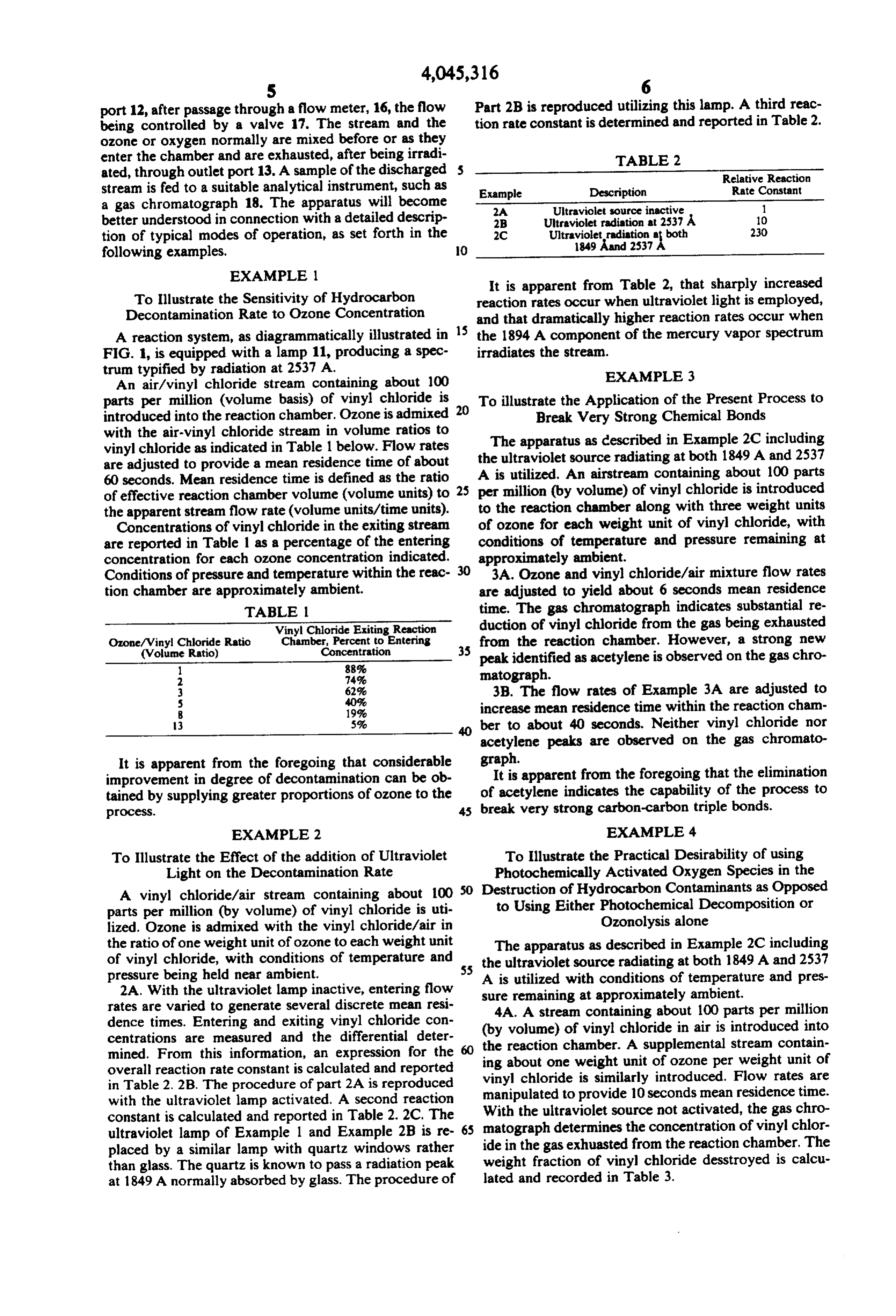
port 12, after passage through a flow meter, 16, the flow Part 2B is reproduced utilizing this lamp. A third reac being controlled by a valve 17. The stream and the tion rate constant is determined and reported in Table 2. ozone or oxygen normally are mixed before or as they enter the chamber and are exhausted, after being irradi TABLE 2 ated, through outlet port 13. A sample of the discharged Relative Reaction stream is fed to a suitable analytical instrument, such as Example Description Rate Constant a gas chromatograph 18. The apparatus will become 2A Ultraviolet source inactive 1 better understood in connection with a detailed descrip 2B Ultraviolet radiation at 2537 A 10 tion of typical modes of operation, as set forth in the 2C Ultraviolet radiation at both
EXAMPLE 1.
It is apparent from Table 2, that sharply increased
To Illustrate the Sensitivity of Hydrocarbon reaction rates occur when ultraviolet light is employed, Decontamination Rate to Ozone Concentration and that dramatically higher reaction rates occur when A reaction system, as diagrammatically illustrated in the 1894. A component of the mercury vapor spectrum FIG. 1, is equipped with a lamp 11, producing a spec irradiates the stream.
trum typified by radiation at 2537 A. EXAMPLE 3 An air/vinyl chloride stream containing about 100 parts per million (volume basis) of vinyl chloride is To illustrate the Application of the Present Process to introduced into the reaction chamber. Ozone is admixed 20 Break Very Strong Chemical Bonds with the air-vinyl chloride stream in volume ratios to vinyl chloride as indicated in Table 1 below. Flow rates theThe apparatus as described in Example 2C including ultraviolet source radiating at both 1849A and 2537 are adjusted to provide a mean residence time of about A is utilized. An airstream containing about 100 parts 60 seconds. Mean residence time is defined as the ratio of effective reaction chamber volume (volume units) to 25 per million (by volume) of vinyl chloride is introduced the apparent stream flow rate (volume units/time units). to the reaction chamber along with three weight units Concentrations of vinyl chloride in the exiting stream of ozone for each weight unit of vinyl chloride, with are reported in Table 1 as a percentage of the entering conditions of temperature and pressure remaining at concentration for each ozone concentration indicated. approximately ambient.
Conditions of pressure and temperature within the reac 30 3A.. Ozone and vinyl chloride/air mixture flow rates tion chamber are approximately ambient. are adjusted to yield about 6 seconds mean residence TABLE 1 time. The gas chromatograph indicates substantial re
Vinyl Chloride Exiting Reaction duction of vinyl chloride from the gas being exhausted
Ozone/Vinyl Chloride Ratio Chamber, Percent to Entering
Concentration 35 from the reaction chamber. However, a strong new
(Volume Ratio) peak identified as acetylene is observed on the gas chro
3B. The flow rates of Example 3A are adjusted to 19% increase mean residence time within the reaction chan 5% ber to about 40 seconds. Neither vinyl chloride nor acetylene peaks are observed on the gas chromato
It is apparent from the foregoing that considerable graph.
improvement in degree of decontamination can be ob It is apparent from the foregoing that the elimination tained by supplying greater proportions of ozone to the of acetylene indicates the capability of the process to process. 45 break very strong carbon-carbon triple bonds. EXAMPLE 2. EXAMPLE 4
To Illustrate the Effect of the addition of Ultraviolet To Illustrate the Practical Desirability of using Light on the Decontamination Rate Photochemically Activated Oxygen Species in the A vinyl chloride/air stream containing about 100 50 Destruction of Hydrocarbon Contaminants as Opposed to Using Either Photochemical Decomposition or parts per million (by volume) of vinyl chloride is uti Ozonolysis alone lized. Ozone is admixed with the vinyl chloride/air in the ratio of one weight unit of ozone to each weight unit The apparatus as described in Example 2C including of vinyl chloride, with conditions of temperature and 55 the ultraviolet source radiating at both 1849A and 2537 pressure being held near ambient. A is utilized with conditions of temperature and pres 2A. With the ultraviolet lamp inactive, entering flow sure remaining at approximately ambient. rates are varied to generate several discrete mean resi dence times. Entering and exiting vinyl chloride con (by4A.volume)
A stream containing about 100 parts per million of vinyl chloride in air is introduced into centrations are measured and the differential deter the reaction chamber. A supplemental stream contain mined. From this information, an expression for the ing about one weight unit overall reaction rate constant is calculated and reported vinyl chloride is similarly of ozone per weight unit of in Table 2.2B. The procedure of part 2A is reproduced manipulated to provide 10 seconds mean Flow introduced. rates are residence time.
with the ultraviolet lamp activated. A second reaction With the ultraviolet source not activated, the gas chro constant is calculated and reported in Table 2. 2C. The matograph determines the concentration of vinyl chlor ultraviolet lamp of Example 1 and Example 2B is re placed by a similar lamp with quartz windows rather ide in the gas exhuasted from the reaction chamber. The than glass. The quartz is known to pass a radiation peak weight fraction of vinyl chloride desstroyed is calcu at 1849 A normally absorbed by glass. The procedure of lated and recorded in Table 3.
Page 6
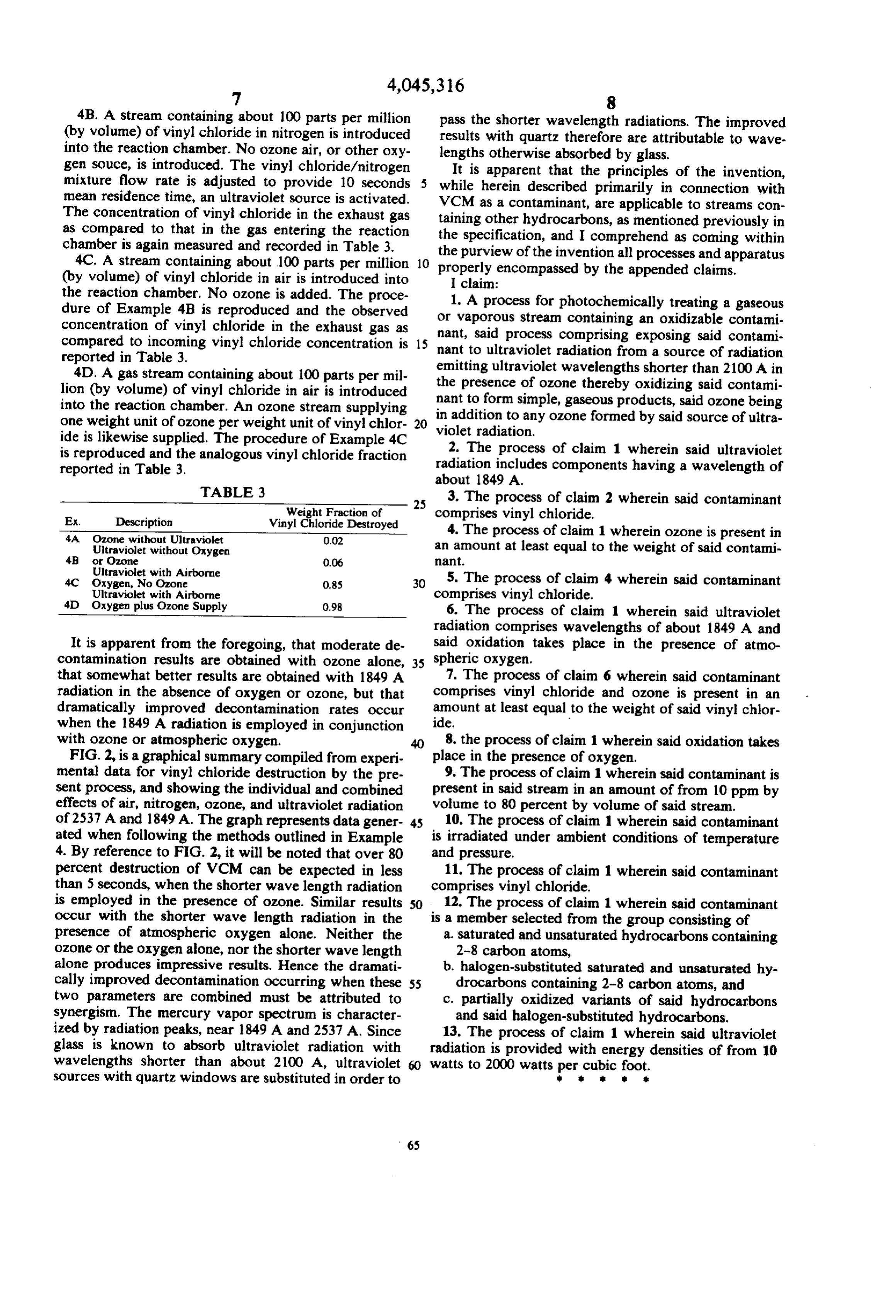
4B. A stream containing about 100 parts per million pass the shorter wavelength radiations. The improved (by volume) of vinyl chloride in nitrogen is introduced results with quartz therefore are attributable to wave into the reaction chamber. No ozone air, or other oxy lengths otherwise absorbed by glass. gen souce, is introduced. The vinyl chloride/nitrogen It is apparent that the principles of the invention, mixture flow rate is adjusted to provide 10 seconds 5 while herein described primarily in connection with mean residence time, an ultraviolet source is activated. VCM as a contaminant, are applicable to streams con The concentration of vinyl chloride in the exhaust gas as compared to that in the gas entering the reaction taining the other hydrocarbons, as mentioned previously in specification, and I comprehend as coming within chamber is again measured and recorded in Table 3. the purview of the invention all processes and apparatus 4C. A stream containing about 100 parts per million 10 properly encompassed by the appended claims. (by volume) of vinyl chloride in air is introduced into I claim:
the reaction chamber. No ozone is added. The proce dure of Example 4B is reproduced and the observed or1.vaporous A process for photochemically treating a gaseous stream containing an oxidizable contami concentration of vinyl chloride in the exhaust gas as nant, said process comprising exposing said contami compared to incoming vinyl chloride concentration is 15 nant to ultraviolet radiation from a source of radiation reported in Table 3. emitting ultraviolet wavelengths shorter than 2100A in 4D. A gas stream containing about 100 parts per mil the presence of ozone thereby oxidizing said contami lion (by volume) of vinyl chloride in air is introduced nant to form simple, gaseous products, said ozone being into the reaction chamber. An ozone stream supplying in addition to any ozone formed by said source of ultra one weight unit of ozone per weight unit of vinyl chlor 20 violet radiation.
ide is likewise supplied. The procedure of Example 4C is reproduced and the analogous vinyl chloride fraction 2. The process of claim 1 wherein said ultraviolet reported in Table 3. radiation includes components having a wavelength of
TABLE 3 3. The process of claim 2 wherein said contaminant
Ex. Description
Weight Fraction of
Vinyl Chloride Destroyed comprises vinyl chloride.
4A, Ozone without Ultraviolet 0.02 4. The process of claim 1 wherein ozone is present in Ultraviolet without Oxygen an amount at least equal to the weight of said contami 4B or Ozone 0.06 nant.
Ultraviolet with Airborne 4C Oxygen, No Ozone 0.85 5. The process of claim 4 wherein said contaminant
Ultraviolet with Airborne
comprises vinyl chloride.
6. The process of claim 1 wherein said ultraviolet radiation comprises wavelengths of about 1849 A and
It is apparent from the foregoing, that moderate de said oxidation takes place in the presence of atmo contamination results are obtained with ozone alone, 35 spheric oxygen.
that somewhat better results are obtained with 1849 A 7. The process of claim 6 wherein said contaminant radiation in the absence of oxygen or ozone, but that comprises vinyl chloride and ozone is present in an dramatically improved decontamination rates occur amount at least equal to the weight of said vinyl chlor when the 1849 A radiation is employed in conjunction ide.
with ozone or atmospheric oxygen. 8. the process of claim 1 wherein said oxidation takes FIG. 2, is a graphical summary compiled from experi place in the presence of oxygen.
mental data for vinyl chloride destruction by the pre 9. The process of claim 1 wherein said contaminant is sent process, and showing the individual and combined present in said stream in an amount of from 10 ppm by effects of air, nitrogen, ozone, and ultraviolet radiation volume to 80 percent by volume of said stream. of 2537A and 1849A. The graph represents data gener 45 10. The process of claim 1 wherein said contaminant ated when following the methods outlined in Example is irradiated under ambient conditions of temperature 4. By reference to FIG. 2, it will be noted that over 80 and pressure.
percent destruction of VCM can be expected in less 11. The process of claim 1 wherein said contaminant than 5 seconds, when the shorter wave length radiation comprises vinyl chloride.
is employed in the presence of ozone. Similar results 50 12. The process of claim 1 wherein said contaminant occur with the shorter wave length radiation in the is a member selected from the group consisting of presence of atmospheric oxygen alone. Neither the a saturated and unsaturated hydrocarbons containing ozone or the oxygen alone, nor the shorter wave length 2-8 carbon atoms, alone produces impressive results. Hence the dramati b. halogen-substituted saturated and unsaturated hy cally improved decontamination occurring when these 55 drocarbons containing 2-8 carbon atoms, and two parameters are combined must be attributed to c. partially oxidized variants of said hydrocarbons synergism. The mercury vapor spectrum is character and said halogen-substituted hydrocarbons. ized by radiation peaks, near 1849A and 2537 A. Since 13. The process of claim 1 wherein said ultraviolet glass is known to absorb ultraviolet radiation with radiation is provided with energy densities of from 10 wavelengths shorter than about 2100 A, ultraviolet 60 watts to 2000 watts per cubic foot. sources with quartz windows are substituted in order to
Provenance
- Collection
- Cited prior art
- Original PDF
- patentimages.storage.googleapis.com →
- Filed
- 1975-05-27
- Pages
- 6
- Method
- pdftotext (the PDF's own text layer) + pdftoppm 300dpi page scans
- Source
- Google Patents bibliographic record
- Granted
- 1977-08-30
- Inventors
- Robert W. Legan; Shintech Inc
- Transcribed from
- patentimages.storage.googleapis.com →