patent · US4197142
Photochemical device for conversion of visible light to electricity
8 April 1980
Page 1 — bibliographic record
United States Patent (19) (11) 4,197,142 Bolton et al. 45) Apr. 8, 1980
54 PHOTOCHEMICAL DEVICE FOR
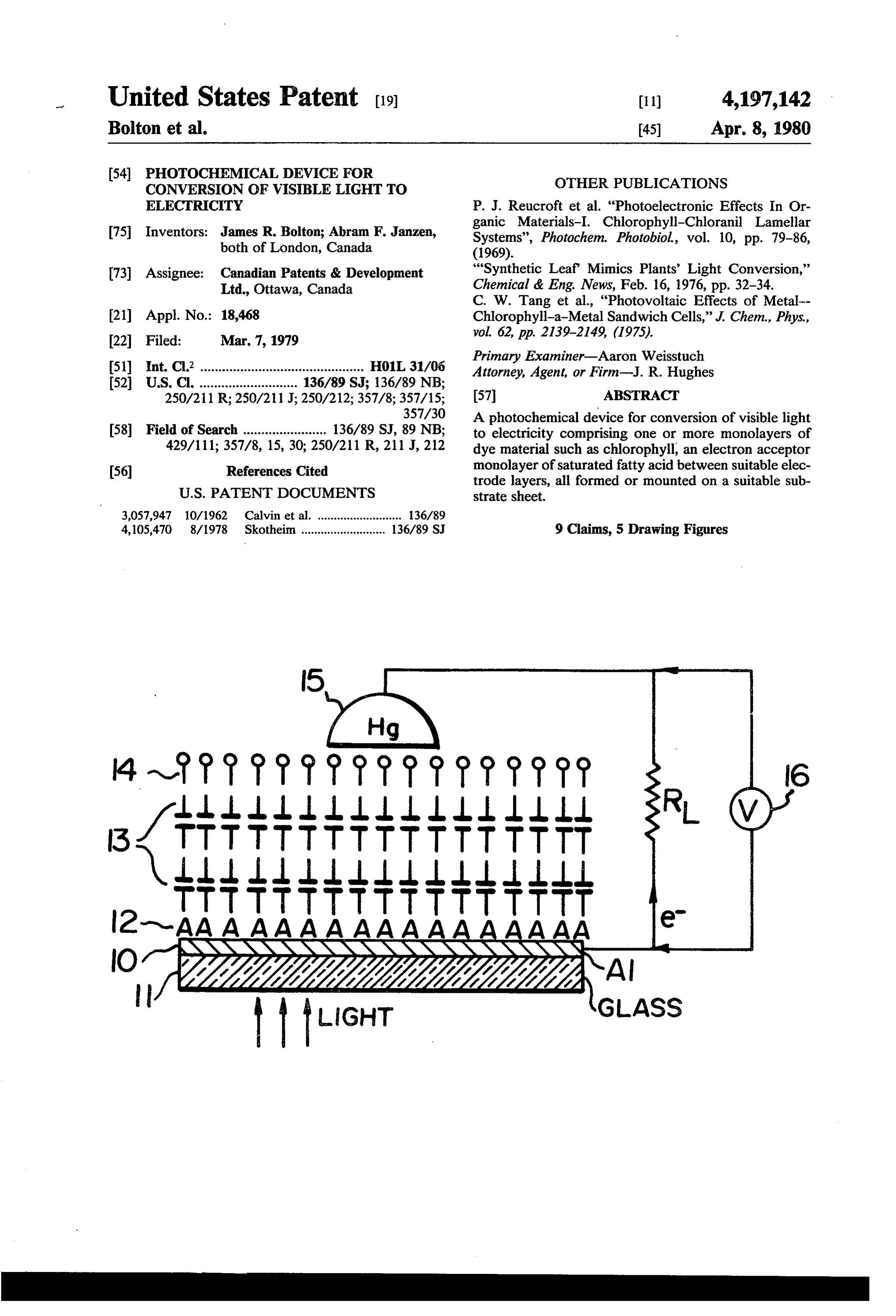
CONVERSION OF VISIBLE LIGHT TO OTHER PUBLICATIONS ELECTRICTY P. J. Reucroft et al. "Photoelectronic Effects In Or ganic Materials-I. Chlorophyll-Chloranil Lamellar 75 Inventors: James R. Bolton; Abram F. Janzen, Systems', Photochem. Photobiol, vol. 10, pp. 79-86,
73) Assignee: Canadian Patents & Development Synthetic Leaf Mimics Plants' Light Conversion,' Ltd., Ottawa, Canada Chemical & Eng. News, Feb. 16, 1976, pp. 32-34. C. W. Tang et al., “Photovoltaic Effects of Metal 21 Appl. No.: 18,468 Chlorophyll-a-Metal Sandwich Cells,” J. Chem., Phys, 22 Filed: Mar.a 7,sy 1979 vol. 62, pp. 2139-2149 (1975). 2 Primary Examiner-Aaron Weisstuch
XV8 Yak
Attorney, Agent, or Firm-J. R. Hughes 250/211R; 250/211 J; 250/212;357/8; 357/15; 57 ABSTRACT t 357/30 A photochemical device for conversion of visible light 58 Field of Search ....................... 136/89 SJ, 89 NB; to electricity comprising one or more monolayers of 429/111; 357/8, 15, 30; 250/211 R, 211 J, 212 dye material such as chlorophyll, an electron acceptor monolayer of saturated fatty acid between suitable elec 56 References Cited trode layers, all formed or mounted on a suitable sub
3,057,947 10/1962 Calvin et al. .......................... 136/89 4,105,470 8/1978 Skotheim .......................... 36/89 SJ 9 Claims, 5 Drawing Figures
NNNNNNNNNNNNNNNNNN
Page 2
Drawing sheet — no readable text.
Page 3
Drawing sheet — no readable text.
Page 4
All cells constructed as in FIG. 1 exhibited rectifying
PHOTOCHEMICAL DEVICE FOR CONVERSION behaviour and responded to light by generating photo OF VISIBLE LIGHT TO EECTRICTY currents and photovoltages. The photocurrent in creased with the number of chlorophyll layers up to 4
This invention relates to solar energy converters and 5 but did not increase further for more that 4 layers of more particularly to photochemical devices for con chlorophyll. That chlorophyll is photooxidized by the verting visible light to electrical energy. light was confirmed by electron spin resonance (ESR) Photocells in use at present involve semiconductors experiments in which an ESR spectrum of the chloro such as: (1) single crystals of silicon or GaAs, (2) photo phyll cation radical was detected. The action spectrum electrochemical regenerative cells utilizing an aqueous 10 of the photocurrent follows that of the absorption spec electrolyte solution, and (3) amorphous films of dyes trum of chlorophyll.
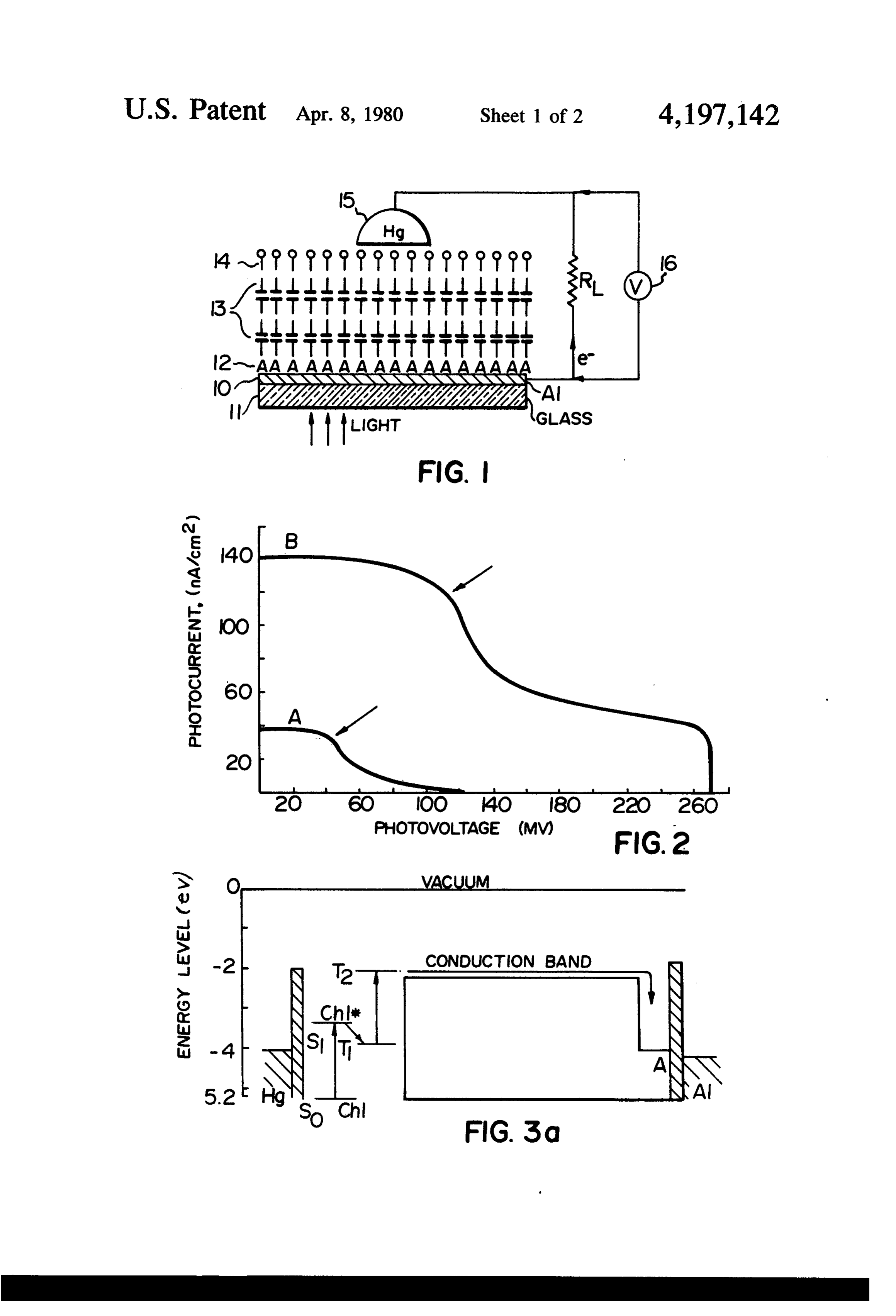
placed between two electrodes. The limitation on the FIG. 2 shows photocurrent-photovoltage plots for use of the first two is the high cost e.g. $10,000/kilowatt two types (A and B) of acceptor layer. Type A corre and of the third, the low efficiency of conversion. sponds to cells in which the acceptor contained fully Chlorophyll monolayers have been thoroughly char 15 saturated aliphatic chains such as pure stearic acid. In acterized by earlier investigators. S. M. Costa and G. this case the conversion efficiency was found to be very Porter in Proc. Roy. Soc. Lond. A. 341, 167-176 (1974) low (~ 10-3%) for absorbed red light and furthermore and J. M. Harris in Ph. D. Dissertation, University of the photocurrent is proportional to the square of the London, 1970, have investigated the effect of various light intensity at low light levels indicating a biphotonic acceptors on the spectroscopic properties of chloro 20 mechanism. This mechanism is further substantiated by phyll monolayers and found that quenching of fluores a double flash experiment in which the photocurrent cence is likely due to electron transfer to the acceptors. drops when flashes are spaced longer than ~ 1.5 ms. Photoconductivity in chlorophyll monolayers was first The triplet lifetime of chlorophyll a is known to be 1.7 observed by R. C. Nelson, J. Chem. Phys. 27, 864-867 S.
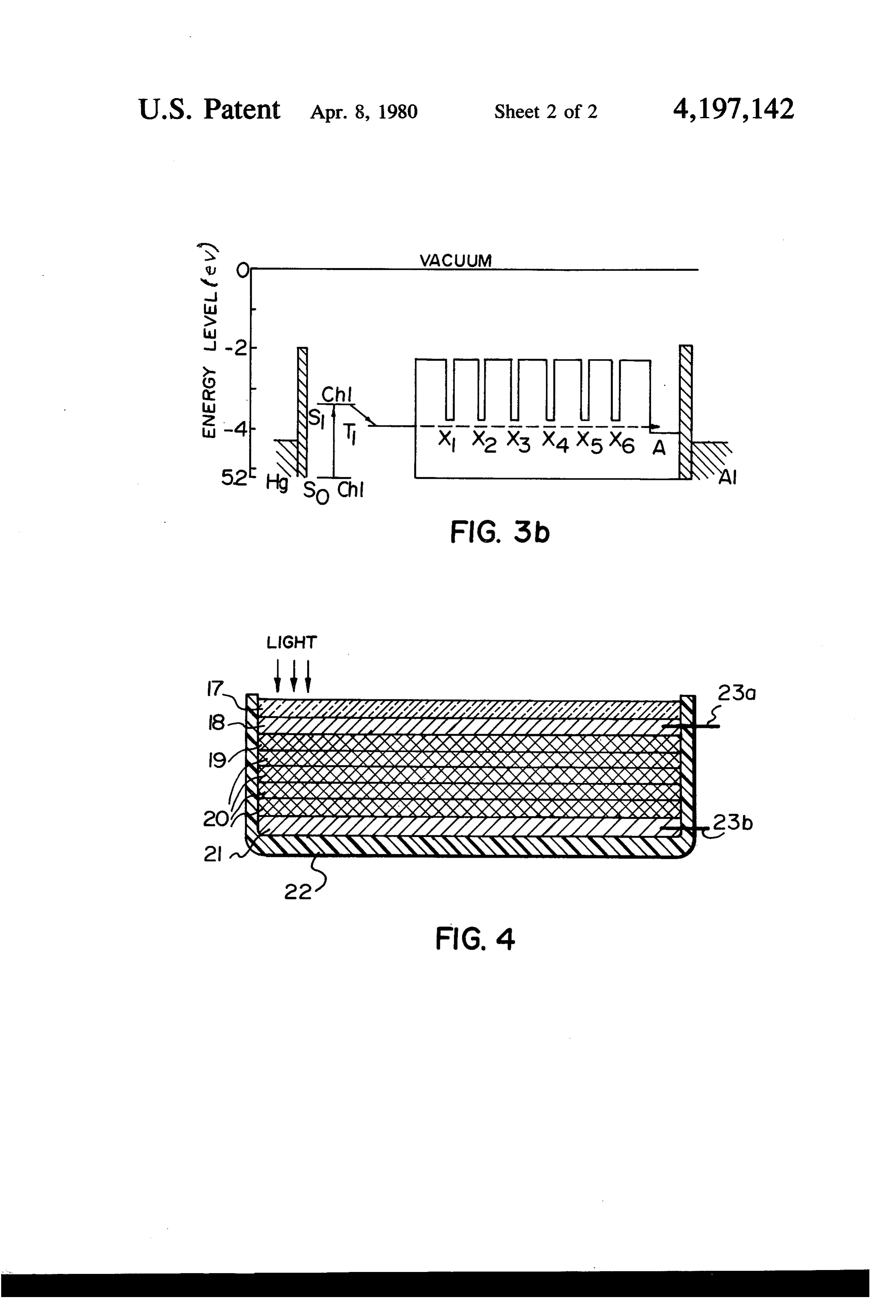
(1957) and photovoltaic experiments on a system con 25 For type A cells it is considered that the energy-level sisting of chlorophyll monolayers and sublimed chlor scheme to be that of FIG. 3a, Chlorophyll is excited by anil as an acceptor were reported by P. J. Reucroft and two photons (via the intermediate triplet state Tl) to the W. H. Simpson, Photochem. Photobiol. 10, 79-86 second excited triplet state T2 where electron transfer (1969). into the conduction band of the lipid occurs. The triplet It is an object of the present invention to provide a 30 manifold must be involved because incorporation of photochemical device for conversion of solar energy to As-carotene (an efficient triplet quencher) into the chlo electrical energy that has relatively good efficiency and rophyll layers completely eliminates the photoelectric which is cheap to manufacture. response.
This and other objects of the invention are achieved In Type B cells, the only change is to incorporate by a photochemical device comprising one or more 35 - 10 mole % of either plastoquinone (I) or ubiquinone monolayers of dye material such as chlorophyll, an (II) into a stearic acid acceptor layer. The photore electron acceptor monolayer of saturated fatty acid sponse of the cell improves dramatically (see Curve B between suitable electrode layers, all formed or of FIG. 2) with a power conversion efficiency over ten mounted on a suitable substrate sheet. times better (-10-2%) than for Type A cells. Now the In drawings which illustrate an embodiment of the photocurrent is proportional to the first power of the invention, light intensity indicating a monophotonic process. It is FIG. 1 is a schematic view of an experimental photo considered that electron tunnelling directly from T1 is cell and output circuit, the mechanism as is shown in FIG. 3b. FIG. 2 is a plot of photocurrent vs photovoltage for Plastoquinone and ubiquinone have two features--a two systems, 45 long polyisoprene side chain with a double bond every FIGS. 3a and 3b are graphs of energy-level schemes fourth carbon atom and a quinone head group. Appar for the two systems, and ently the latter has little effect on the photoelectric FIG. 4 is a cross-section of a practical photocell de behaviour as chemical reduction of the quinone does W1Ce. not affect the response significantly. Indeed, substitu Referring to FIG. 1, a schematic representation of a 50 tion of the natural quinone by the simple polyisoprene cell and circuit is shown. A semi-transparent aluminum chain, squalene, or even by certain unsaturated fatty electrode 10 is evaporated onto a glass substrate layer acids (such as linoleic acid) resulted in a higher effi 11. A monolayer of an acceptor 12 (designated as a line ciency Type B cell.
of A's) such as plastoquinone (about 11%) in stearic It is considered that the double bonds in the acceptor acid, one or more monolayers of chlorophyll 13, and a 55 layer provide a sufficient local lowering of the energy monolayer of stearic acid 14 acting as a buffer are laid barrier so that quantum-mechanical electron tunnelling on the acceptor layer. These monolayers are applied is permitted from T1 directly to the aluminum electrode using a technique described by H. Kuhn in Chem. Phys. as shown in FIG. 3b, Molecular models show that in the Lipids 8,401–404, 1972 and by H. Kuhn etal in Physical polyisoprene chain the head to tail distance from one Methods of Chemistry, Part III B, 645-702, Wiley double bond to the next is only ~2.5 A.
Interscience, New York, 1972. A drop of mercury 15 FIG. 4 is a cross-sectional view of the device in typi acting as the positive electrode and the aluminum elec cal physical form. A glass plate 17 has formed on it: a trode are connected across a load RL. The mercury semi-transparent electrode material layer 18; an accep layer may be replaced by an electrochemical solution. tor layer 19; a dye layer (one or more monolayers) 20; In this case the buffer layer is not needed. When light 65 and a counter electrode layer 21. The device is com strikes the device, a photo-induced electron current e pleted by an encapsulation layer 22 and electrical con flows through the load resistance as measured by volt nections to the electrodes 23a and 23b. Although light meter 16. would normally enter through the glass plate, the de
Page 5
vice could be designed to have light enter through the forming a Schottky barrier between it and the ac counter electrode side provided transparent or semi ceptor monolayer, transparent materials are used for the apropriate layers. (d) at least one monolayer of a dye material formed The materials for the various layers are as follows: 5 on the acceptor layer,
Electrode 18 must be conducting, transparent or (e) a counter electrode of a material that is a good semi-transparent, and must form a Schottky barrier at source of electrons, contacting the dye layers, ei its interface with the acceptor layer. Examples of suit ther the substrate sheet and its associated electrode able materials are a semi-transparent aluminum film or a layer or the counter electrode being transparent tin oxide semiconductor layer. such that light may enter the monolayers, and The acceptor layer 19 is formed of one monolayer of (f) means for taking electric current from the elec trodes.
saturated fatty acid e.g. stearic acid containing about 10 2. A photochemical device as in claim 1 wherein the mole % of one of plastoquinone, ubiquinone, squalene acceptor monolayer is a saturated fatty acid containing or some unsaturated fatty acid. This material must con about 10 mole % of one of plastoquinone, ubiquinone, tain a certain concentration of double bonds in the mol 15 squalene, or an unsaturated fatty acid. ecules. 3. A photochemical device as in claim 1 wherein the The dye layer 20 (one or more monolayers) consists at least one dye monolayer is chlorophyll. of chlorophyll or the dioctadecyl ester of Tris (2-2' 4. A photochemical device as in claim 3 wherein the bipyridyl) Ruthenium II+. Other possible materials are electrode layer is a semitransparent tin oxide semi-con porphyrins, acridine dyes, and Azo dyes. A buffer layer 20 ductor layer.
of e.g. stearic acid may be helpful between dye layers 5. A photochemical device as in claim 1 wherein the and counter electrode. at least one dye monolayer is a material chosen from the The counter electrode 21 must make good ohmic groups:II, dioctadecyl ester of Tris (2-2' bipyridyl) Ruthe contact with the dye layers and should be a good source 25 nium
porphyrin, acridine dyes, and Azo dyes.
photochemical device as in claim 1 wherein the of electrons. Examples of suitable materials are amer electrode layer is a semitransparent aluminum film and cury droplet as shown in FIG. 1 or an aqueous solution the substrate sheet is glass.
of 0.1 M Na2SO4 and 0.05 M hydroquinone. 7. A photochemical device as in claim 1 wherein the We claim: number of dye monolayers is four.
1. A photochemical device for converting light en 30 8. A photochemical device as in claim 1 wherein the ergy to electrical energy comprising: counter electrode is mercury. (a) a substrate sheet, 9. A photochemical device as in claim 1 wherein a (b) a layer of conducting electrode material formed buffer layer of stearic acid is positioned between the on the substrate, counter electrode and the at least one monolayer of dye (c) a monolayer of an electron acceptor material 35 material.
formed on the electrode layer, said electrode layer
Provenance
- Collection
- Cited prior art
- Original PDF
- patentimages.storage.googleapis.com →
- Filed
- 1979-03-07
- Pages
- 5
- Method
- pdftotext (the PDF's own text layer) + pdftoppm 300dpi page scans
- Source
- Google Patents bibliographic record
- Granted
- 1980-04-08
- Inventors
- James R. Bolton; Abram F. Janzen; Canadian Patents and Development Ltd
- Transcribed from
- patentimages.storage.googleapis.com →