patent · US4263112
Cell and method for electrolysis of water and anode therefor
21 April 1981
Page 1 — bibliographic record
United States Patent (19) (11) 4,263,112 Aylward (45) Apr. 21, 1981 54 CELL AND METHOD FOR ELECTROLYSIS Attorney, Agent, or Firm-Carl O. McClenny; John R. OF WATER AND ANODE THEREFOR. Manning; Marvin F. Matthews 76 Inventors: Robert A. Frosch, Administrator of (57) ABSTRACT the National Aeronautics and Space An electrolytic cell for the conversion of water vapor Administration, with respect to an to oxygen and hydrogen included an anode comprising invention of John R. Aylward, a foraminous conductive metal base member having a Vernon, Conn. coating thereon of 65-85 weight percent iridium oxide (21) Appl. No.: 161,255 and 15-35 weight percent of a high temperature resin binder. Also included are a matrix member and a cath 22 Filed: Jun. 20, 1980 ode, with the matrix member containing an electrolyte 51 Int. Cl. .......................... C25B 1/08; C25B 1/10; and the cathode being substantially inert to the electro C25B 9/00; C25B 11/08 lyte. The foraminous metal member is most desirably 52 U.S. C. ................................ 204/129; 204/290 R; expanded tantalum mesh, and the cell desirably includes 204/290 F; 204/291; 204/252; 204/266 reservoir elements of porous sintered metal in contact 58 Field of Search ............... 204/129, 290 R, 290 F, with the anode to receive and discharge electrolyte to 204/291, 252,258, 266 the matrix member as required. Upon entry of a water 56) References Cited vapor-containing airstream into contact with the outer surface of the anode and thence into contact with irid
3,853,739 12/1974 Kolb et al. ....................... 204/290 F converted to hydrogen ions and oxygen with the hydro 3,878,083 4/1975 De Nora et al. .. ... 204/290 F gen ions migrating through the matrix to the cathode 3,922,226 11/1975 Entwisle........................... 204/290 F and the oxygen gas produced at the anode to enrich the 3,926,751 12/1975 De Nora et al. ................. 204/290 F air stream passing by the anode. 3,993,653 1 1/1976 Blum et al. ....................... 204/290 F
Primary Examiner-R. L. Andrews 20 Claims, 8 Drawing Figures
Page 2
Drawing sheet — no readable text.
Page 3
Drawing sheet — no readable text.
Page 4
Drawing sheet — no readable text.
Page 5
Drawing sheet — no readable text.
Page 6
contact with the iridium oxide catalyst coating to effect
CELL AND METHOD FOR ELECTROLYSIS OF electrolysis of the water vapor to hydrogen ions and WATER AND ANODE THEREFOR oxygen. The oxygen gas formed at the anode is dis charged through, the oxygen outlet and the hydrogen
BACKGROUND OF THE INVENTION 5 ions pass through the matrix member to the cathode to Various devices have been proposed for recovering form hydrogen gas which is discharged through the oxygen from the moisture and waste gases in a closed hydrogen outlet of the housing.
environment, particularly in connection with space In the preferred structure, the conductive base mem travel vehicle. In some instances, organic means have 10 ber of the anode is fabricated from a metal selected from been employed, and, in other instances, catalytic or the group consisting of tantalum, gold and titanium and electro-catalytic devices have been employed. Gener the coating thereon is produced by sintering an intimate ally, the catalytic type of devices have been considered mixture of iridium oxide and resin upon the base mem most feasible for extended use and economy of opera ber. The base member is preferably about 0.003-0.010 tion since by-product gases may also be employed for inch in thickness and the mesh provides 500-2,000 pores other purposes. 15 per square inch. The foraminous structure of the base
The general structure and operation of an oxygen member may be provided by an expanded mesh and the generator utilizing water vapor electrolysis has been resin desirably comprises polytetrafluoroethylene. The described in a paper presented at the Environmental coating desirably provides 10-30 milligrams iridium Control and Life Support Systems Conference, San oxide per square centimeter of the underlying portion of Francisco, California, on Aug. 14-16, 1972 and entitled 20 the surface of the base member. "Integrated Water Vapor Electrolysis Oxygen Genera In one embodiment of the cell assembly, there are tor and Hydrogen Depolarized Carbon Dioxide Con included centrator Development' by J. C. Huddleston and F. H. titanium reservoir members comprising porous sintered elements in contact with the surface of the
Greenwood. The paper was printed by the American anode spaced from the matrix member, and these tita Society of Mechanical Engineers in 1972 under No. 25 nium elements contain electrolyte for transfer to the 72-ENAV-7. The devices described therein have proven advantageous but problems have remained with respect matrix member through the anode. Most desirably, the electrolyte is selected from the to efficiency of the anode and with respect to providing group a means for storing electrolyte to compensate for varia mixturesconsisting of sulfuric acid, phosphoric acid and tions in the humidity of the air stream passing through 30 porous inorganic and thereof, the matrix member comprises a material wetable by the electrolyte the cell.
It is an object of the present invention to provide such andInhaving a thickness of about 0.005-0.030 inch. the method of electrolytically converting the a converter having a highly efficient anode to effect water vapor in air to hydrogen and oxygen, the anode is electrolysis of the moisture vapor in the air stream to hydrogen and oxygen. 35 formed by sintering on the foraminous metal base mem It is also an object to provide such a converter con ber the mixture of iridium ion and resin binder to form taining novel and highly effective electrolyte reservoir a coating which is bonded to at least one face and at elements to transfer to and receive from the matrix least a portion of the surfaces of the pores of the base member the electrolyte required for cell operation in member. The anode is then assembled with a cathode response to variations in the humidity of the air stream. and an intermediate matrix member containing electro Another object is to provide a method for electro lyte and a potential is applied across the anode and lytic conversion of the moisture vapor to hydrogen and cathode. A stream of air containing water vapor is oxygen utilizing such improved anodes. passed in contact with the outer surface of the anode
SUMMARY OF THE INVENTION
with the water vapor therein contacting the coating of 45 the anode and being electrolytically converted to hy
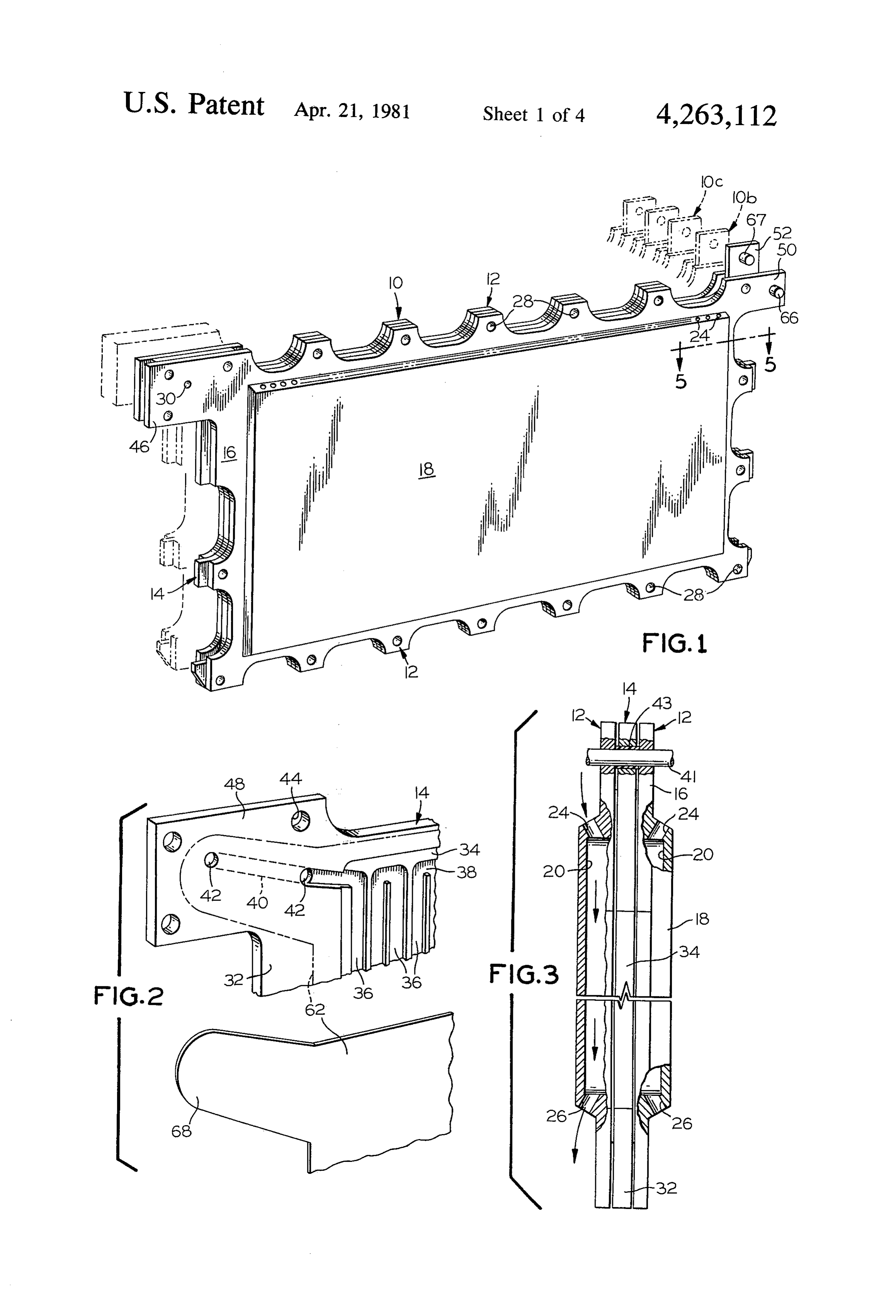
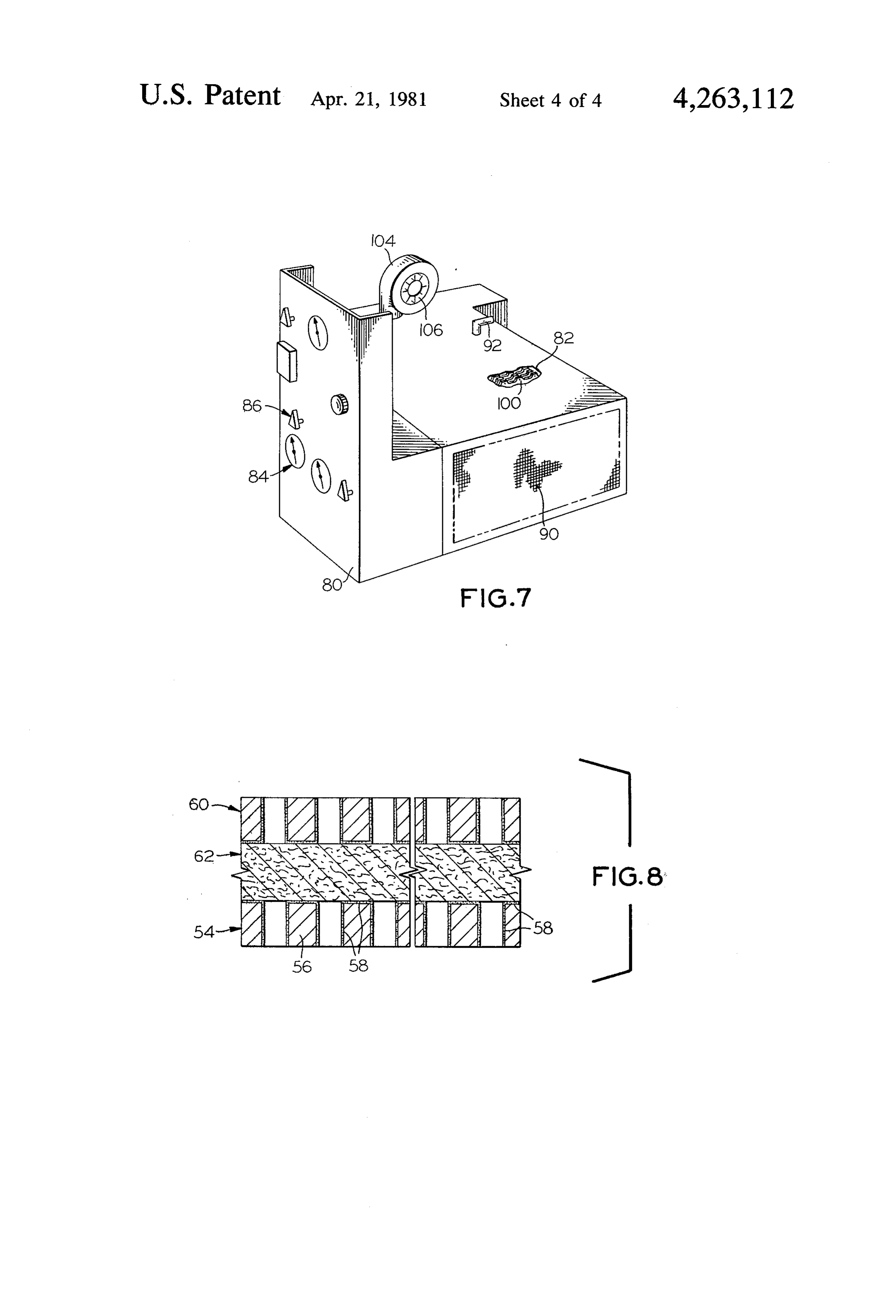
It has now been found that the foregoing and related drogen ions and oxygen gas. The hydrogen ions pass objects and advantages may be attained in an electro through the matrix member to the cathode where hy lytic converter for electrolytically converting water drogen gas is formed, and the oxygen gas formed at the and moisture vapor to hydrogen and oxygen. The con anode passes outwardly therefrom in the air stream to verter includes a housing providing a cell chamber, an 50 enrich the oxygen content of the air. inlet for water vapor, an outlet for oxygen and an outlet In the operation of the cell, the applied potential is for hydrogen. In the chamber is disposed at least one desirably within the range of 1.5-1.85 volts. The cell is cell assembly including an anode, a cathode and a ma desirably maintained at ambient temperatures for opera trix member between the anode and cathode providing tion although it will operate effectively at elevated a conductive path therebetween and containing an elec 55 temperatures wherein the stream passing through the trolyte. Both the anode and cathode are pervious to cell contains increased amounts of moisture vapor such gases, and the anode comprises a foraminous conduc as might be provided by steam. At cell shutdown, the tive base member having a catalytic coating bonded to cell is desirably purged of hydrogen bypassing nitrogen at least the face thereof adjacent the matrix member. or another inert gas therethrough so as to avoid delete The catalytic coating comprises 65-85 percent by 60 rious effects upon the components of the assembly. weight iridium oxide and 15-35 percent by weight of BRIEF DESCRIPTION OF THE DRAWINGS high temperature resin as a binder. Both the conductive base member of the anode and the cathode are substan FIG. 1 is a perspective view of a single cell assembly tially inert to the electrolyte of the matrix member. embodying the present invention with additional cell Conductor means are operatively connected to the 65 subassemblies being fragmentarily illustrated in phan anode and the cathode to apply a potential thereacross. tom line;
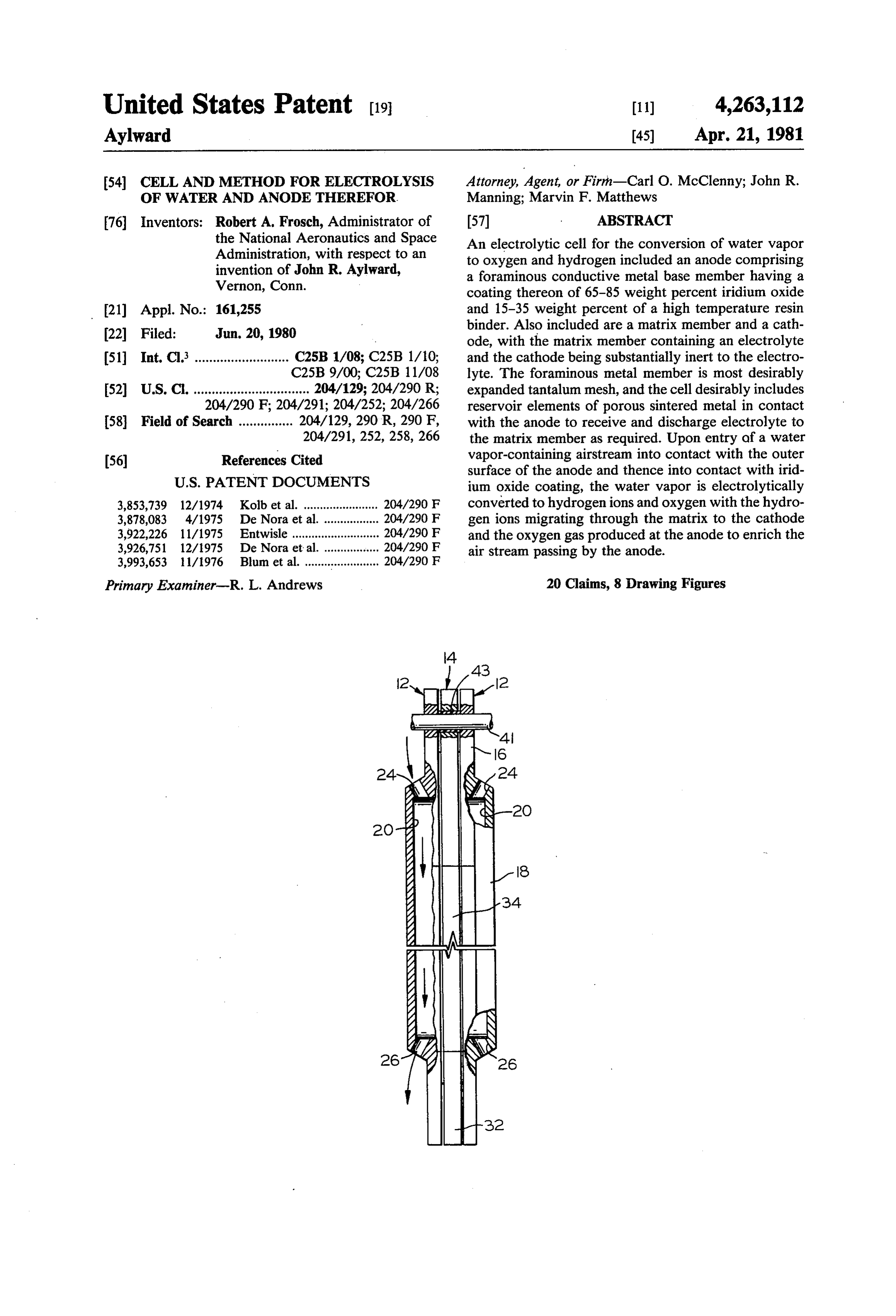
The housing provides a passage for water vapor from FIG. 2 is a fragmentary perspective view to an en the inlet and adjacent the surface of the anode for larged scale of the upper left hand corner of the center
Page 7
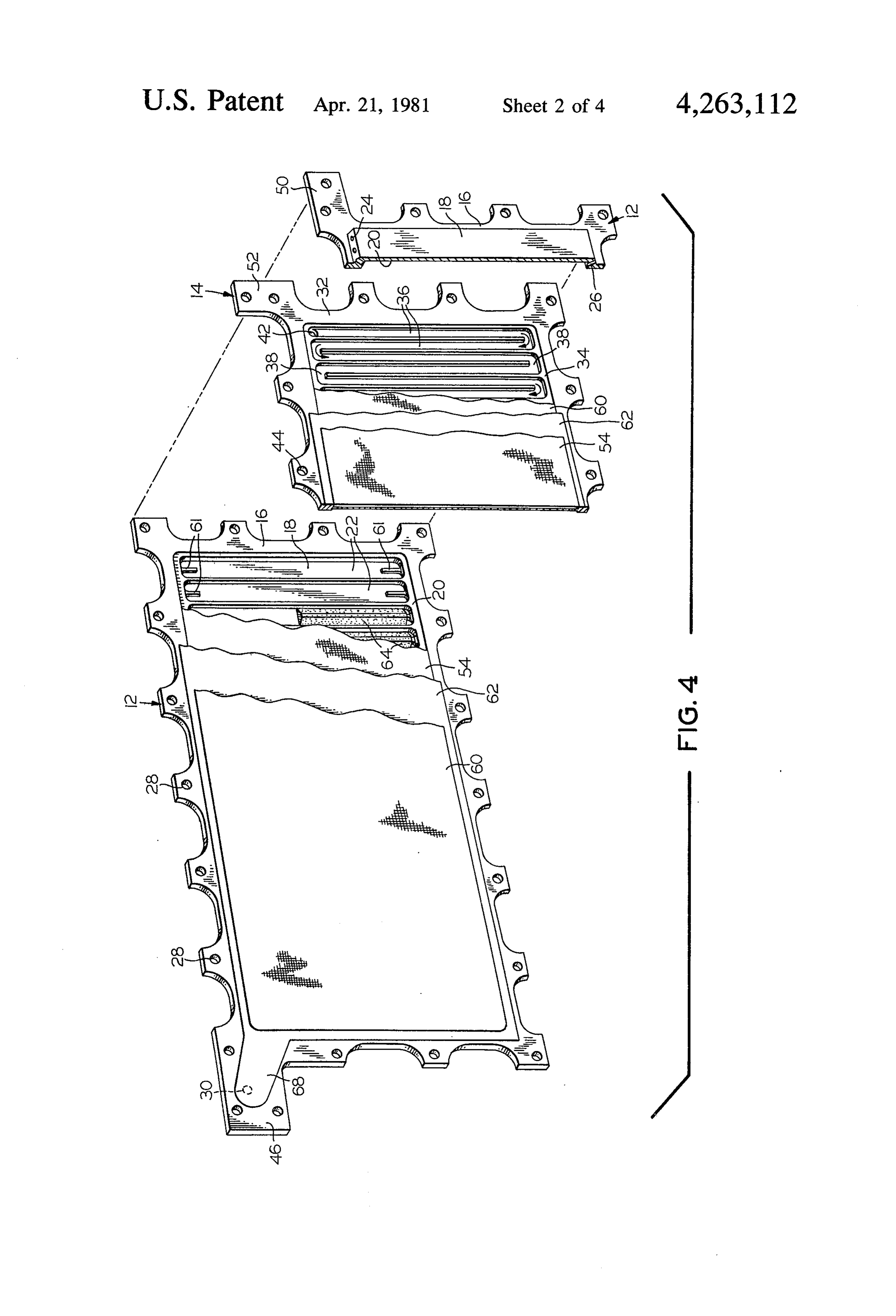
housing element of a cell subassembly of FIG. 1 and As seen in FIGS. 3-5 and 8, each cell housing assem separated therefrom a fragmentary portion of one of the bly 10 in fact provides a pair of cells, one being disposed matrix members utilized thereon; on each side of the intermediate member 14. Each cell FIG. 3 is a fragmentary cross sectional view in eleva comprises an anode generally designated by the nu tion of a cell subassembly of FIG. 1 drawn to an en meral 54 which is comprised of a foraminous conduc larged scale and showing the flow of air therethrough; tive metal screen 56 having a catalytic coating 58 FIG. 4 is a fragmentary, partially exploded view of a thereon, a cathode generally designated by the numeral cell subassembly of FIG. 1 with portions of the anode, 60 and a matrix element 62 therebetween containing cathode and matrix members broken away at different electrolyte to provide a conductive path between the points to reveal internal construction; 10 anode 54 and cathode 60.
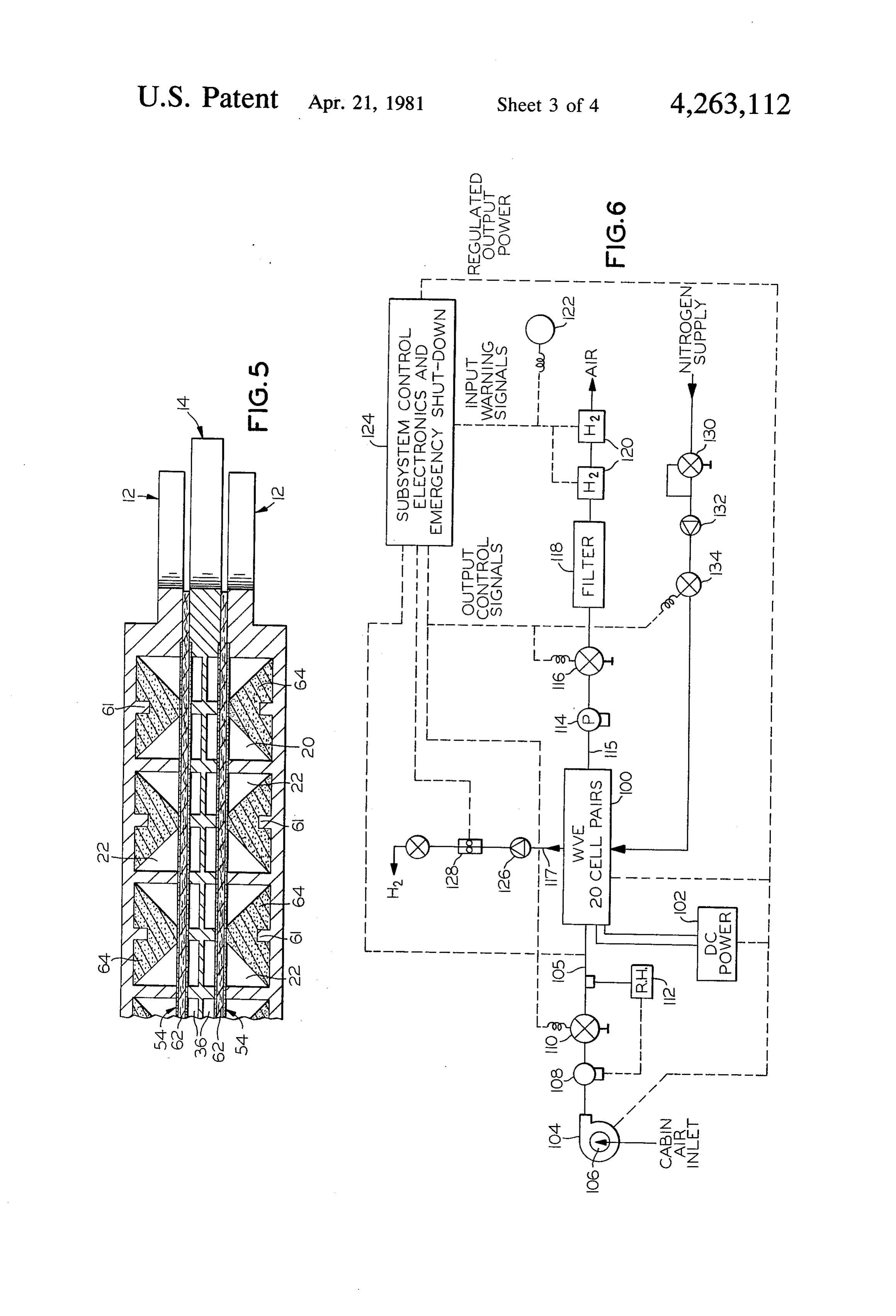
FIG. 5 is a fragmentary sectional view to an enlarged As best seen in FIG. 5, seated on the shallow and scale along the line 5-5 of FIG. 1; shortened ribs 61 in some of the channels 22 of the shell FIG. 6 is a diagrammatic view of the operating com members 12 are reservoir elements 64 of porous sintered ponents of an electrolytic cell assembly for the conver metal which contain excess electrolyte. The reservoir sion of water vapor to oxygen and hydrogen; 15 elements 64 are of truncated triangular cross section FIG. 7 is a perspective view of a converter assembly with their apices being disposed in contact with the constructed substantially in accordance with the dia anodes 54. Depending upon the moisture content of the grammatic representation of FIG. 6 with portions air passing through the channels 22, electrolyte will be thereof broken away to reveal internal construction; transferred to and from the matrix member 62 through and 20 the anodes 54 to maintain the desired electrolyte level FIG. 8 is a greatly enlarged cross section of an anode, therewithin.
cathode and matrix member subassembly. As seen in FIGS. 2-5, the matrix member 62 is of DETAILED DESCRIPTION OF THE greater length and width dimensions than the body ILLUSTRATED EMBODIMENT portions 18,34 of the shell and intermediate members 25 12,14, so that it extends between the peripheral portions
Turning now in detail to FIG. 1, therein illustrated in 16,32 and beyond the margins of the anode 54 and cath solid line is a first cell housing assembly generally desig ode 60. When the several elements of the housing as nated by the numeral 10 and a series of additional cell sembly 10 are clamped together tightly, the matrix housing assemblies 10b, 10c, et seq. fragmentarily illus member 62 is compressed between the peripheral por trated in phantom line. As will be readily appreciated, a 30 tions 16,32 to effect a seal about the operative portion of converter may include such number of cell housing the cells. The matrix member 62 also serves to insulate assemblies 10 as is necessary to provide the required the conductive shell and intermediate members 12,14 converting activity with respect to a predetermined from each other except to the extent that current passes volume of water vapor or air containing such water through the electrolyte-containing portion thereof be vapor. 35 tween the anode and cathode 54,60. Each housing assembly 10 is comprised of a pair of As seen in FIG. 2, the matrix member 62 also has a shell members generally designated by the numeral 12 finger portion 68 projecting from the body thereof be and an intermediate member generally designated by tween the projecting portions 46,48 of the shell and the numeral 14. The shell members 12 are substantially intermediate members 12,14 and over the hydrogen identical in configuration and include a peripheral por discharge channels 40. This serves to effect sealing tion 16, a central body portion 18 providing an internal thereabout and to facilitate the flow of hydrogen along cavity 20 which is divided into a multiplicity of parallel the channel 40 to the discharge aperture 30. The fas channels 22, all as best seen in FIGS. 3-5. At one end of tener elements 41 seated in the mounting apertures 28,44 the channels 22, the wall of the body portion 18 is pro to secure the cell housing assemblies 10 in assembly and vided with a series of inlet apertures 24 and at the other 45 the insulating sleeves 43 which are disposed in the inter end of the channels 22 there are provided similar outlet mediate members 14 about the fasteners so as to provide apertures 26. Spaced about the peripheral portion 16 are insulation therefor. The fasteners 41, however, provide a multiplicity of mounting apertures 28 and a hydrogen the means for conducting current between the shell discharge aperture 30 is provided in a projecting por members 12 and thus to the anodes 54, while the con tion 46 at one corner thereof. A projecting portion 50 at 50 ductor stud 67 provides the electrical connection to the the opposite corner thereof provides an aperture receiv several intermediate elements 14 and thereby to the ing a conductor stud 66 to provide means for effecting cathodes 60.
electrical contact with a source of power. Turning now to FIG. 6, therein diagrammatically, The intermediate member 14 has a substantially pla illustrated in a converter embodying the present inven nar peripheral portion 32 and a body portion 34 which 55 tion. In this embodiment, twenty cell housing assem has elongated channels 36 in both faces thereof. These blies 10 of the type illustrated in FIGS. 1-5 are assem channels 36 extend generally parallel to the channels 22 bled to provide the basic cell subassembly 100 and a of the shell members 12 and their ends are intercon source of DC power 102 is connected thereto. Air from nected by cross channels 38. As seen in FIG. 2, the the environment is drawn into the fan 104 through the leftmost channel 36 has discharge channel 40 extending 60 inlet 106 and conducted into the cell 100 for contact therefrom into the projecting portion 48 and through with the anodes thereof. Initially, the air exiting from apertures 42 are provided therein, the outermost of the fan 104 passes through the conduit 105 over a pres which is aligned with the hydrogen discharge aperture sure transducer 108 and through a cutoff valve 110, and 30 of the shell member 12. At the opposite corner its relative humidity is determined by the sensor 112. thereof, the intermediate member 14 is provided with a 65 The oxygen enriched air stream exits from the cell projecting portion 52 having a cathode connector stud 100 through the conduit 115 and then passes by the 67 seated therein to receive a conductor (not shown) to pressure transducer 114 through the shutoff valve 116, complete the electrical circuit. through the filter 118 and through the hydrogen gas
Page 8
sensors 120, before being discharged to the atmosphere. prise sulfuric acid, phosphoric acid and mixtures The partial pressure of oxygen in the air being issued thereof.
from the converter is determined by the transducer 122. Although various porous materials may be utilized The hydrogen produced by the cell assembly 100 for the reservoir elements, sintered porous metal struc exits through the conduit 117, passes through the check tures have proven particularly advantageous, particu valve 126 and through the flow meter 128 before being larly those made of titanium, tantalum and other metals conducted to appropriate instrumentation for the use which are substantially inert to the cell electrolyte. A thereof. The control electronics system is generally particularly preferred material is a porous titanium designated by the numeral 124 and receives signals from product made by Gould, Inc. of St. Paul, Minnesota. the various elements within the apparatus and will ef. 10 The cell housing elements may be fabricated from fect shutdown in the event that malfunctioning is deter various metals including tantalum and titanium. If tita mined. Upon shutdown automatically or manually, the nium is utilized, the intermediate element should be cell assembly 100 is purged of hydrogen by nitrogen plated with gold, rhodium or platinum to prevent hy introduced thereinto through the valve 130, check 15 drogen embrittlement.
valve 132 and solenoid valve 134. The anode coating may contain 15-35 percent by Turning now to FIG. 7, a substantially self-contained weight polytetrafluoroethylene resin with the preferred converter apparatus is illustrated as being comprised of content being about 20-25 percent. Although other the housing 80, having a cell receptacle 82 in which are high temperature resins may be used as the binder, poly disposed a multiplicity of cell housing assemblies. The 20 tetrafluoroethylene is preferred because of its combina tion of properties. The coating may be applied by any instrumentation providing the readouts for the various convenient transducers and meters is shown generally by the nu provide 10-30 technique but should be sufficiently thick to meral 84 and the manually operable cutoff valves are milligrams of iridium oxide per square shown generally by the numeral 86. Mounted on the base member whenunderlying centimeter of the surface of the screen or the screen has a standard mesh size housing is the fan 104 having its inlet 106 and air from 25 of 20 by 35. Lesser loading may be used with a smaller the fan 104 is conducted through a conduit (not shown) mesh size and greater loading may be used with a larger into the cell receptacle 82 wherein it passes through the mesh size.
cell housing assemblies. The moisture in the air is elec The cell will operate with an applied potential as low trolytically converted into hydrogen and oxygen with as 1.4 volts to as much as 1.85 Pl volts depending upon the oxygen-enriched air stream discharged through the the water vapor content of the air passing through the vent 90 and with the hydrogen being discharged 30 cell.
through the hydrogen conduit 92. Not shown in this cell is operable at least
Preferably, at about 1.5 volts are applied. The diagrammatic illustration of the assembly are the DC taining water vapor or at temperatures ambient higher with air con temperatures with power source and the nitrogen source, as well as vari steam. It may also be operated at superatmospheric ous of the fittings and components. 35 pressures.
The substrate for the anode may comprise tantalum, gold or titanium, but tantalum is preferred because of EXAMPLE OF ANODE CONSTRUCTION AND the combination of low cost, inertness and resistance to CELL OPERATION hydrogen embrittlement. The substrate may vary from A preferred method for making the anodes of the as little as 0.003 to as much as 0.015 inch in thickness, 40 present invention involves the following procedure. and the foraminous structure may provide as little as 500 to as many as 1,500 pores per square inch, and even orAiridium soluble iridium compound such as chloroiridic acid chloride is dissolved in the minimum amount more. Although screens may be employed, expanded of water required for dissolution. Sodium nitrate in an mesh structures have been found particularly advanta amount equal to 11 times the weight of the iridium geous. 45 compound is wetted with the iridium solution previ For the metal of the cathode, gold, platinum, palla ously prepared. This admixture is dried at 110° C. and dium and tantalum are preferred because of their inert fused at 400 C. for four hours which results in oxida ness and their resistance to hydrogen embrittlement. tion of the iridium to iridium oxide. After cooling, the Since hydrogen is being evolved in the cathode, tita fused cake is leached with water (270 ml. H2O per gram nium may be employed only if it is provided with a 50 of iridium) to dissolve the soluble salts in the cake. The protective electroplated deposit of gold or the like. The iridium oxide is then filtered from the leaching solution cathode is conveniently of the same range of thickness and washed with water to remove the remaining salts as the anode and desirably exhibits the same degree of contained therein.
porosity by use of a similar expanded metal or screen Following drying, the iridium oxide is intimately structure. To provide the desired catalytic effect, a 55 admixed in water with polytetrafluoroethylene in a catalytic coating of platinum black with a resin binder is weight ratio of 15-30 percent polytetrafluoroethylene used. (duPont TEFLON 30) to 70-85 percent iridium oxide The matrix member is most conveniently fabricated and the dispersion is then filtered on Whatman No. 50 from a compounded asbestos material such as blue as filter paper. The filter paper containing the water-moist bestos since this material will resist degradation by the intimate admixture of iridium oxide and resin has placed electrolytes which are preferred and will also be wetted thereon an expanded tantalum mesh of about 0.005 inch by such electrolytes. Other mineral fibers may also be thickness with the mesh size being 20 by 35 (standard). employed, although they may require pretreatment to The tantalum mesh is a commercial product made by provide the desired wetability. The pore volume of the Exmet Corporation of Bridgeport, Connecticut. The matrix member should be within the range of about 65 tantalum mesh is then pressed by manual pressure into 40-80 percent; and its thickness may vary from 0.005 to the coating material upon the filter paper to transfer the 0.030 inch, and is preferably about 0.010 to 0.015 inch. coating material to the surface thereof. The coated The electrolytes used in the matrix most desirably com mesh is then sintered at 310 C. for five minutes to pro
Page 9
duce a highly adherent uniform coating upon one sur 3. The method of claim 1 wherein said cell is main face or the mesh and in the pores thereof with a loading tained at an ambient temperature of about 50-100' F. of about 20 mg. per square centimeter (dry basis). during operation thereof.
A cell is prepared using the anode thus produced and 4. The method of claim 1 wherein said potential is a cathode comprising a similar tantalum mesh structure, 5 1.5-1.85 volts.
with a platinum black catalyst coating of about 20 mg. 5. In an electrolytic converter for electrolytically per square centimeter. A matrix member comprising converting water to hydrogen and oxygen, the combi blue asbestos fiber mat of 0.010 inch thickness and hav nation comprising:
ing pore volume of about 65 percent is saturated with O A. a housing providing a cell chamber, an inlet for sulfuric acid (55%). water vapor, an outlet for oxygen, and an outlet for Reservoir elements are fabricated from a sintered hydrogen;
porous titanium material. The cell housing members are B. at least one cell assembly in said chamber includ fabricated from titanium and plated with gold on the ing:
surfaces defining the cells. (1) an anode;
In operation of apparatus substantially as illustrated 15 (2) a cathode;
in the accompanying drawing utilizing the above de (3) a matrix member between said anode and cath scribed cell, current efficiencies greater than 99 percent ode providing a conductive path therebetween are obtained in ambient temperatures using atmospheric and containing an electrolyte; air and a constant current density of about 60 amperes 20 said anode and cathode being pervious to gases, said per square foot. This cell voltage will range from anode comprising a foraminous conductive base mem 1.5-1.85 depending upon the water vapor content of the ber having a coating bonded to at least the face thereof air stream (90-20% relative humidity) and the air veloc adjacent said matrix member, said coating comprising ity through the cell. As variations in atmospheric hu 65-85 weight percent iridium oxide and 15-35 weight midity occur, the electrolyte passes through the anode 25 percent of a high temperature resin as a binder, said pores into and from the reservoir elements to provide conductive base member and said cathode being sub and maintain the desired electrolyte level in the matrix stantially inert to said electrolyte of said matrix mem member. ber; and
From the foregoing detailed description and attached C. conductor means operatively connected to said drawings, it is readily apparent that the electrolytic 30 anode and said cathode to apply a potential there converter of the present invention provides a highly across, said housing providing a passage for water efficient assembly for electrolytically converting mois vapor from said inlet and adjacent said anode for ture vapor into hydrogen and oxygen. The anode may contact with said iridium oxide coating thereon to be readily and conveniently fabricated, and the internal effect electrolysis thereof to hydrogen ions and reservoir members provide an effective means for main 35 oxygen, oxygen gas being discharged through said taining the desired level of electrolyte in the matrix oxygen outlet and the hydrogen ions passing despite fluctuations in relative humidity of the air pass through said matrix member to said cathode to ing through the cell. form hydrogen gas for discharge through said hy Having thus described the invention I claim: drogen outlet.
1. In a method for the electrolysis of water vapor in 6. The electrolytic converter of claim 5 wherein said air, the steps comprising: conductive base member of said anode is frabricated A. forming an anode by sintering on the surface of a talum,from a metal selected from the group consisting of tan foraminous metal base member a mixture of 65-85 gold and titanium, said coating thereon being weight percent iridium oxide and 15-35 weight 45 oxide and by produced sintering an intimate mixture of iridium said resin on said base member.
percent of a high temperature resin binder to form 7. The electrolytic converter of claim 6 wherein said a coating bonded to at least one face and at least a portion of the surfaces of the pores of said base base member is about 0.003-0.010 inch in thickness and wherein said mesh provides 500-2,000 pores per square member; inch.
B. assembling an electrolytic cell comprising said 50 8. The electrolytic converter of claim 5 wherein said anode, a cathode and an intermediate matrix mem ber containing electrolyte and providing a conduc metal nous of said base member is tantalum and said forami structure is provided by an expanded mesh.
tive path therethrough; 9. The electrolytic converter of claim 5 wherein said C. applying a potential across said anode and cath resin is polytetrafluoroethylene.
ode; and 55 10. The electrolytic converter of claim 5 wherein said D. passing into contact with the outer surface of said anode coating provides 10-30 milligrams of iridium anode a stream of air containing water vapor, said oxide per square centimeter of the underlying portion of water vapor contacting said coating of said anode the surface of said base member.
and being electrolytically converted to hydrogen 11. The electrolytic converter of claim 5 wherein said ions and oxygen, said hydrogen ions passing cell assembly includes reservoir members comprising through said matrix member to said cathode where porous sintered titanium elements in contact with the hydrogen gas is formed therefrom, said oxygen gas surface of said anode spaced from said matrix member, produced at said anode and passing outwardly said porous titanium elements containing electrolyte for therefrom in the air passing through said cell to transfer to said matrix member through said anode. enrich the oxygen content of said air. 65 12. The electrolytic converter of claim 5 wherein said 2. The method of claim 1 wherein said electrolyte is electrolyte is selected from the group consisting of sul selected from the group consisting of sulfuric acid, furic acid, phosphoric acid and mixtures thereof, and phosphoric acid, and mixtures thereof. wherein said matrix member comprises a porous inor
Page 10
ganic material wettable by said electrolyte and having a containing electrolyte for transfer to said matrix mem thickness of about 0.005-0.030 inch. ber through said anode.
13. The electrolytic converter of claim 5 wherein said 16. An anode for the electrolysis of water comprising: housing includes first and second shell members, an 5 A. a porous conductive base member of a metal se intermediate member therebetween, means securing lected from the group consisting of tantalum, gold said shell and intermediate members in assembly, said and titanium; and intermediate member cooperating with each of said B. a coating bonded to at least one face and at least a shell members to provide a cell chamber therebetween portion of the surfaces of the pores of said base and said inlets and outlets therefor. member, said coating comprising 65-85 weight 10 percent iridium oxide and 15-35 weight percent of 14. The electrolytic converter of claim 5 wherein said a high temperature resin as a binder, said coating shell members are provided with elongated channels in being produced by sintering an intimate mixture of their faces adjacent said intermediate member providing iridium oxide and said resin on said base member. passageways for water vapor and oxygen, said interme 17. The anode of claim 16 wherein said metal and said diate member having elongated channels in each of its 15 base member is tantalum and the porous structure is faces providing passages for hydrogen and further hav provided by an expanded mesh.
ing passages interconnecting said elongated passages to 18. The anode of claim 17 wherein said base member conduct hydrogen to said outlet. is about 0.003-0.010 inch in thickness and wherein said 15. The electrolytic converter of claim 14 wherein 20 19. The anode500-2,000 mesh provides pores per square inch.
of claim 16 wherein said resin is poly said housing including reservoir members in at least tetrafluoroethylene.
some of said channels of said shell elements, said reser 20. The anode of claim 16 wherein said coating pro voir members comprising porous sintered titanium ele vides 10-30 milligrams of iridium oxide per square cen ments in contact with the surface of said anode spaced timeter of the underlying surface of said base member. from said matrix member, said porous titanium elements 25 it is is a k
Provenance
- Collection
- Cited prior art
- Original PDF
- patentimages.storage.googleapis.com →
- Filed
- 1980-06-20
- Pages
- 10
- Method
- pdftotext (the PDF's own text layer) + pdftoppm 300dpi page scans
- Source
- Google Patents bibliographic record
- Granted
- 1981-04-21
- Inventors
- Robert A. Frosch; John R. Aylward
- Transcribed from
- patentimages.storage.googleapis.com →