patent · US4256814
Photoelectro-chemical cell system
17 March 1981
Page 1 — bibliographic record
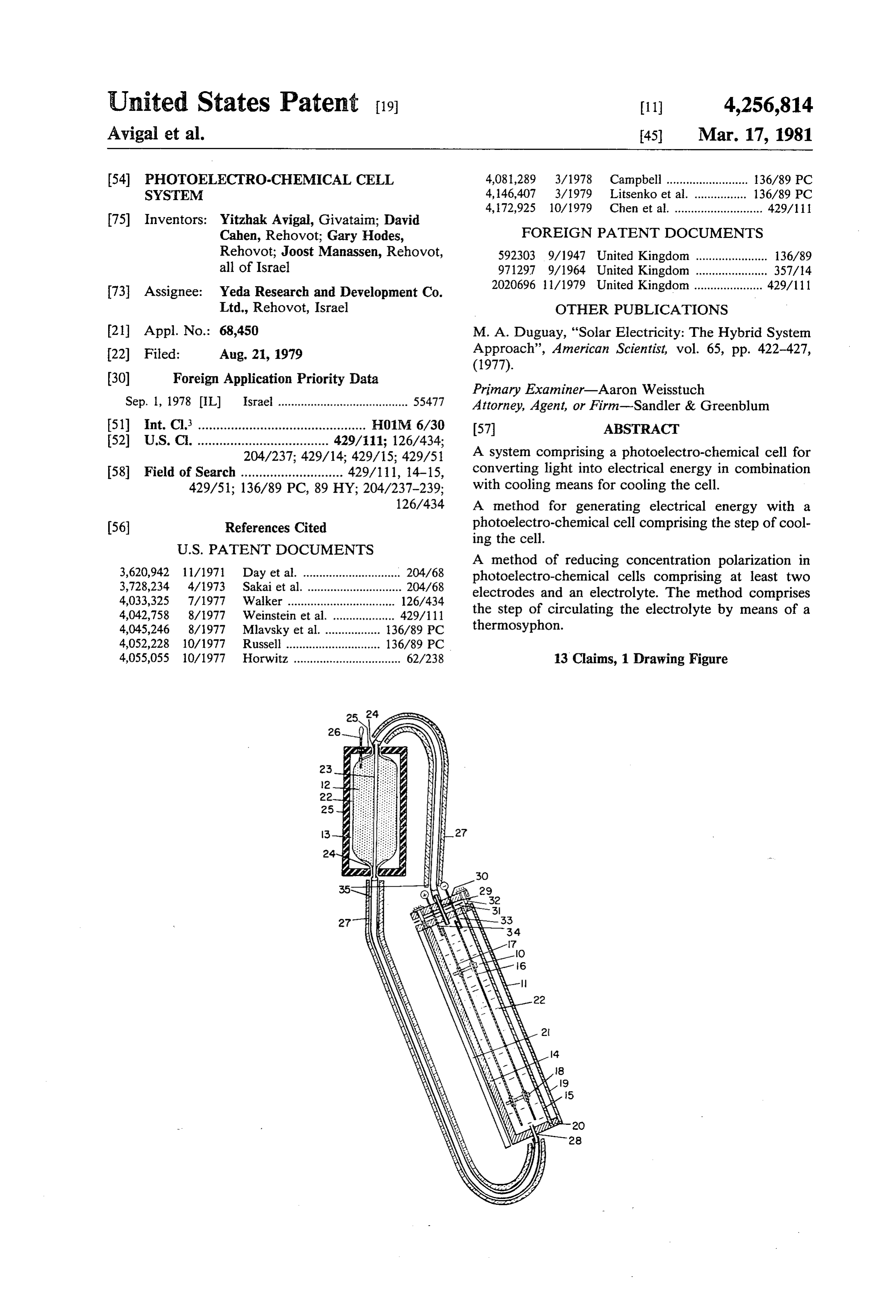
United States Patent (19) (11) 4,256,814 Avigal et al. 45) Mar. 17, 1981 (54) PHOTOELECTRO-CHEMICAL CELL 4,081,289 3/1978 Campbell ......................... 136/89 PC SYSTEM 4,146,407 3/1979 Litsenko et al. ................ 136/89 PC 4, 172,925 10/1979 Chen et al. ........................... 429/11 75) Inventors: Yitzhak Avigal, Givataim; David
Cahen, Rehovot; Gary Hodes, FOREIGN PATENT DOCUMENTS
Rehovot; Joost Manassen, Rehovot, 592303 9/1947 United Kingdom ...................... 136/89 all of Israel 971297 9/1964 United Kingdom ... ... 357/14 73) Assignee: Yeda Research and Development Co. 2020696 11/1979 United Kingdom ..................... 429/111 Ltd., Rehovot, Israel OTHER PUBLICATIONS 21 Appl. No.: 68,450 M. A. Duguay, "Solar Electricity: The Hybrid System 22 Filed: Aug. 21, 1979 Approach'', American Scientist, vol. 65, pp. 422-427,
(30) Foreign Application Priority Data
Primary Examiner-Aaron Weisstuch
Sep. 1, 1978 (IL) Israel ........................................ 55477 Attorney, Agent, or Firm-Sandler & Greenblum 51) int. Cl. .............................................. HO1M 6/30 57 ABSTRACT 52 U.S. C. .................................... 429/111; 126/434; A system comprising a photoelectro-chemical cell for
58) Field of Search ............................ 429/11 1, 14-15, converting light into electrical energy in combination 429/51; 136/89 PC, 89 HY; 204/237-239; with cooling means for cooling the cell. 126/434 A method for generating electrical energy with a 56) References Cited photoelectro-chemical cell comprising the step of cool
ing the cell.
A method of reducing concentration polarization in 3,620,942 11/1971 Day et al. .............................. 204/68 photoelectro-chemical cells comprising at least two 3,728,234 4/1973 Sakai et al. ............................. 204/68 electrodes and an electrolyte. The method comprises 4,033,325 7/1977 Walker .............. ... 126/434 the step of circulating the electrolyte by means of a 4,042,758 8/1977 Weinstein et al. ... 429/111 4,045,246 8/1977 Mlavsky et al. ... ... 136/89 PC thermosyphon.
4,052,228 10/1977 Russell ............................. 136/89 PC 4,055,055 10/1977 Horwitz. ................................. 62/238 13 Claims, 1 Drawing Figure
Page 2
Drawing sheet — no readable text.
Page 3
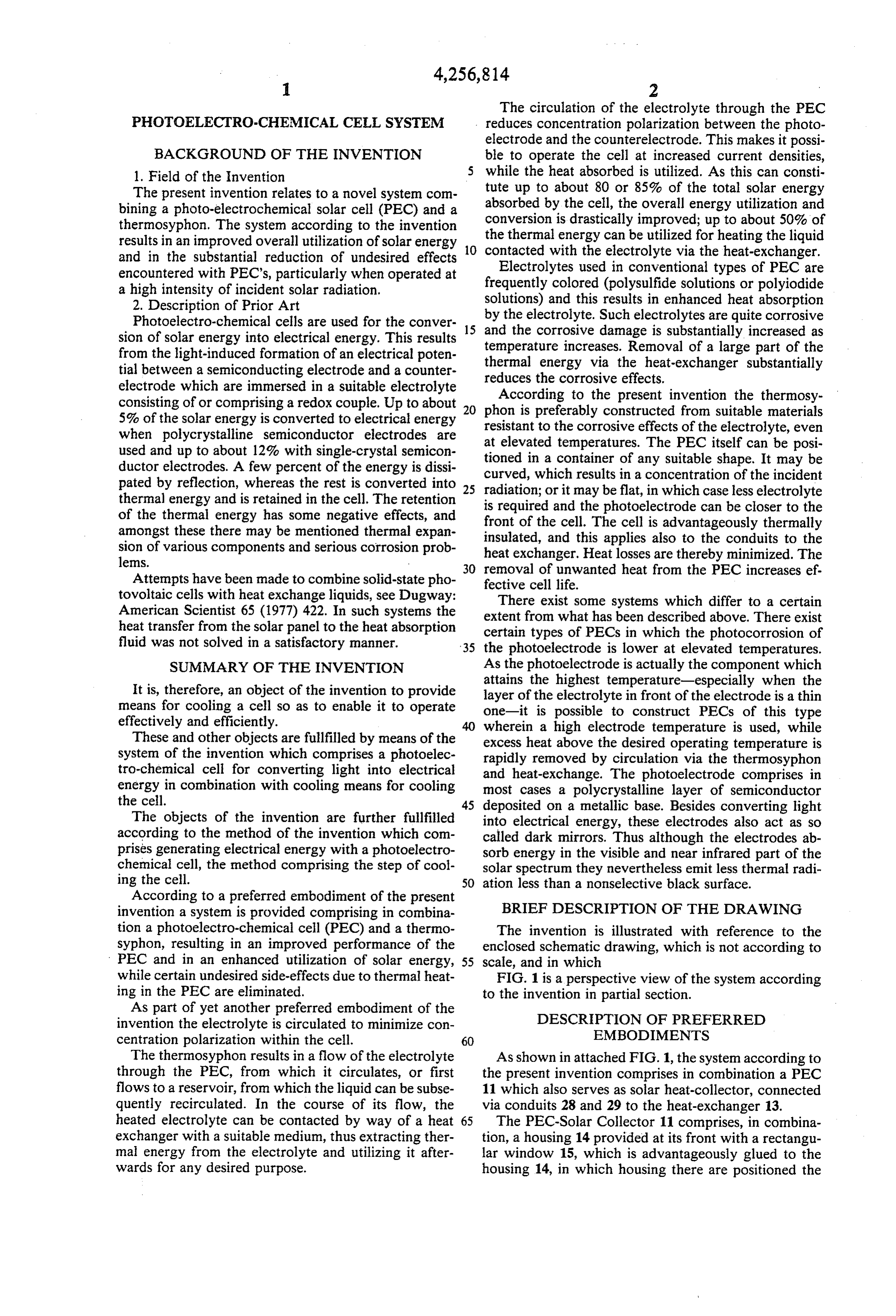
The circulation of the electrolyte through the PEC
PHOTOELECTRO-CHEMICAL CELL SYSTEM reduces concentration polarization between the photo electrode and the counterelectrode. This makes it possi
BACKGROUND OF THE INVENTION ble to operate the cell at increased current densities, 1. Field of the Invention while the heat absorbed is utilized. As this can consti tute
The present invention relates to a novel system com absorbed up to about 80 or 85% of the total solar energy bining a photo-electrochemical solar cell (PEC) and a conversion by the cell, the overall energy utilization and thermosyphon. The system according to the invention is drastically improved; up to about 50% of the thermal energy can be utilized for heating the liquid results in an improved overall utilization of solar energy 10 contacted and in the substantial reduction of undesired effects with the electrolyte via the heat-exchanger. Electrolytes encountered with PEC's, particularly when operated at frequently colored used in conventional types of PEC are a high intensity of incident solar radiation. (polysulfide solutions or polyiodide 2. Description of Prior Art solutions) and this results in enhanced heat absorption Photoelectro-chemical cells are used for the conver 15 by the electrolyte. Such electrolytes are quite corrosive and the corrosive damage is substantially increased as sion of solar energy into electrical energy. This results temperature from the light-induced formation of an electrical poten thermal energy increases. Removal of a large part of the tial between a semiconducting electrode and a counter reduces the corrosive via the heat-exchanger substantially effects.
electrode which are immersed in a suitable electrolyte consisting of or comprising a redox couple. Up to about 20 phon is preferably constructedinvention According to the present from the thermosy suitable materials 5% of the solar energy is converted to electrical energy resistant to the corrosive effects of the electrolyte, even when polycrystalline semiconductor electrodes are at elevated temperatures. The PEC itself can be posi used and up to about 12% with single-crystal semicon ductor electrodes. A few percent of the energy is dissi tioned in a container of any suitable shape. It may be pated by reflection, whereas the rest is converted into 25 radiation;which curved, results in a concentration of the incident thermal energy and is retained in the cell. The retention is required and the be or it may flat, in which case less electrolyte photoelectrode can be closer to the of the thermal energy has some negative effects, and front of the cell. The cell is advantageously thermally amongst these there may be mentioned thermal expan insulated, and this applies also to the conduits sion of various components and serious corrosion prob heat exchanger. Heat losses are thereby minimized.toThe the lems. 30 removal of unwanted heat from the PEC increases ef Attempts have been made to combine solid-state pho fective cell life.
tovoltaic cells with heat exchange liquids, see Dugway: There exist some systems which differ to a certain American Scientist 65 (1977) 422. In such systems the extent from what has been described above. There exist heat transfer from the solar panel to the heat absorption certain types of PECs in which the photocorrosion of fluid was not solved in a satisfactory manner. 35 the photoelectrode is lower at elevated temperatures. SUMMARY OF THE INVENTION As the photoelectrode is actually the component which attains the highest temperature-especially when the
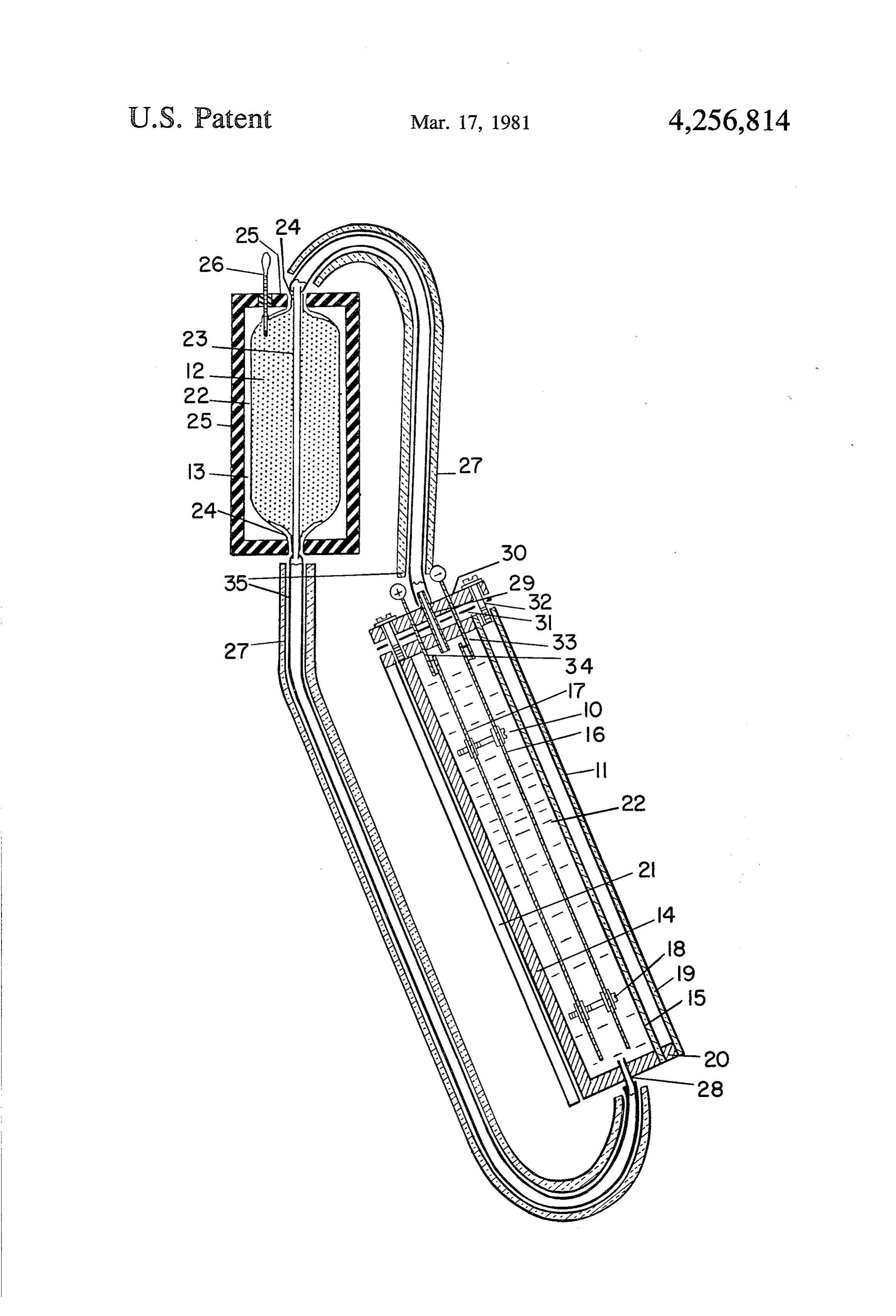
It is, therefore, an object of the invention to provide layer of the electrolyte in front of the electrode is a thin means for cooling a cell so as to enable it to operate one-it is possible to construct PECs of this type effectively and efficiently. wherein a high electrode temperature is used, while These and other objects are fulfilled by means of the excess heat above the desired operating temperature is system of the invention which comprises a photoelec rapidly removed by circulation via the thermosyphon tro-chemical cell for converting light into electrical and heat-exchange. The photoelectrode comprises in energy in combination with cooling means for cooling most cases a polycrystalline layer of semiconductor the cell. 45 deposited on a metallic base. Besides converting light The objects of the invention are further fullfilled into electrical energy, these electrodes also act as so according to the method of the invention which com called dark mirrors. Thus although the electrodes ab prises generating electrical energy with a photoelectro sorb energy in the visible and near infrared part of the chemical cell, the method comprising the step of cool solar spectrum they nevertheless emit less thermal radi ing the cell. 50 ation less than a nonselective black surface. According to a preferred embodiment of the present invention a system is provided comprising in combina BRIEF DESCRIPTION OF THE DRAWING tion a photoelectro-chemical cell (PEC) and a thermo The invention is illustrated with reference to the syphon, resulting in an improved performance of the enclosed schematic drawing, which is not according to PEC and in an enhanced utilization of solar energy, 55 scale, and in which while certain undesired side-effects due to thermal heat FIG. 1 is a perspective view of the system according ing in the PEC are eliminated. to the invention in partial section. As part of yet another preferred embodiment of the DESCRIPTION OF PREFERRED invention the electrolyte is circulated to minimize con centration polarization within the cell. 60 EMBODIMENTS The thermosyphon results in a flow of the electrolyte As shown in attached FIG. 1, the system according to through the PEC, from which it circulates, or first the present invention comprises in combination a PEC flows to a reservoir, from which the liquid can be subse 11 which also serves as solar heat-collector, connected quently recirculated. In the course of its flow, the via conduits 28 and 29 to the heat-exchanger 13. heated electrolyte can be contacted by way of a heat 65 The PEC-Solar Collector 11 comprises, in combina exchanger with a suitable medium, thus extracting ther tion, a housing 14 provided at its front with a rectangu mal energy from the electrolyte and utilizing it after lar window 15, which is advantageously glued to the wards for any desired purpose. housing 14, in which housing there are positioned the
Page 4
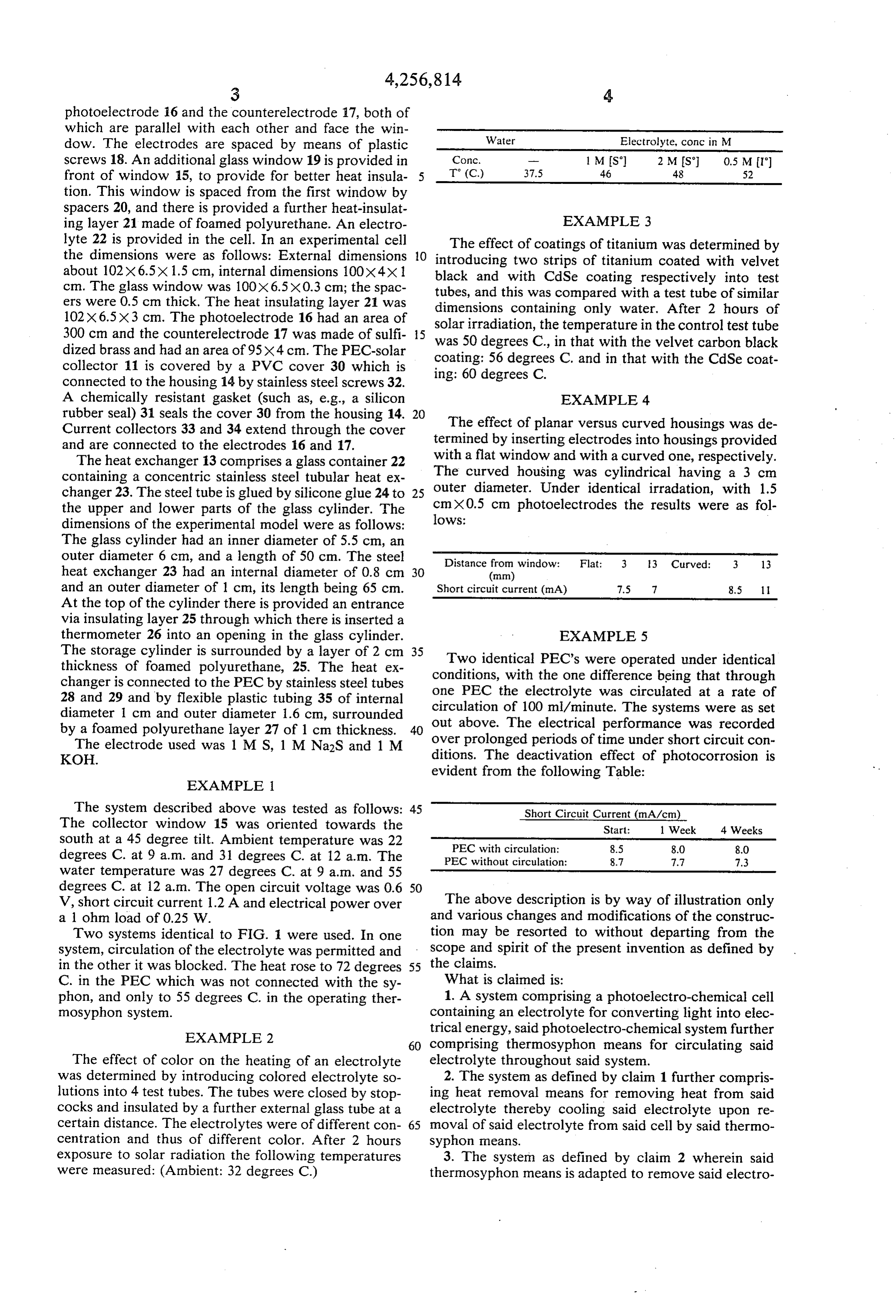
photoelectrode 16 and the counterelectrode 17, both of which are parallel with each other and face the win Water Electrolyte, conc in M dow. The electrodes are spaced by means of plastic screws 18. An additional glass window 19 is provided in Conc. 1 M Sl 2 MIS 0.5 M (I) front of window 15, to provide for better heat insula T (C.) 37.5 46 48 52 tion. This window is spaced from the first window by spacers 20, and there is provided a further heat-insulat ing layer 21 made of foamed polyurethane. An electro EXAMPLE 3 lyte 22 is provided in the cell. In an experimental cell The effect of coatings of titanium was determined by the dimensions were as follows: External dimensions 10 introducing two strips of titanium coated with velvet about 102X 6.5x 1.5 cm, internal dimensions 100X4X 1 black and with CdSe coating respectively into test cm. The glass window was 100X 6.5 x 0.3 cm; the spac tubes, and this was compared with a test tube of similar ers were 0.5 cm thick. The heat insulating layer 21 was dimensions containing only water. After 2 hours of 102 x 6.5x3 cm. The photoelectrode 16 had an area of 300 cm and the counterelectrode 17 was made of sulfi 5 solar irradiation, the temperature in the control test tube dized brass and had an area of 95X4 cm. The PEC-solar was 50 degrees C., in that with the velvet carbon black collector 11 is covered by a PVC cover 30 which is coating: 56 degrees C. and in that with the CdSe coat connected to the housing 14 by stainless steel screws 32. ing: 60 degrees C.
A chemically resistant gasket (such as, e.g., a silicon EXAMPLE 4 rubber seal) 31 seals the cover 30 from the housing 14. 20 The effect of planar versus curved housings was de Current collectors 33 and 34 extend through the cover termined by inserting electrodes into housings provided and are connected to the electrodes 16 and 17.
The heat exchanger 13 comprises a glass container 22 with a flat window and with a curved one, respectively. containing a concentric stainless steel tubular heat ex The curved housing was cylindrical having a 3 cm changer 23. The steel tube is glued by silicone glue 24 to 25 outer diameter. Under identical irradation, with 1.5 the upper and lower parts of the glass cylinder. The cm x 0.5 cm photoelectrodes the results were as fol dimensions of the experimental model were as follows: lows:
The glass cylinder had an inner diameter of 5.5 cm, an outer diameter 6 cm, and a length of 50 cm. The steel Distance from window: Flat 3 3 Curved: 3 13 heat exchanger 23 had an internal diameter of 0.8 cm 30 (nm) and an outer diameter of 1 cm, its length being 65 cm. Short circuit current (mA) 7.5 7 8.5 At the top of the cylinder there is provided an entrance via insulating layer 25 through which there is inserted a thermometer 26 into an opening in the glass cylinder. EXAMPLE 5
The storage cylinder is surrounded by a layer of 2 cm 35 Two identical PEC's were operated under identical thickness of foamed polyurethane, 25. The heat ex changer is connected to the PEC by stainless steel tubes conditions, with the one difference being that through 28 and 29 and by flexible plastic tubing 35 of internal one PEC the electrolyte was circulated at a rate of circulation of 100 ml/minute. The systems were as set diameter 1 cm and outer diameter 1.6 cm, surrounded by a foamed polyurethane layer 27 of 1 cm thickness. 40 out above. The electrical performance was recorded The electrode used was 1 M S, 1 M Na2S and 1 M over prolonged periods of time under short circuit con KOH. ditions. The deactivation effect of photocorrosion is evident from the following Table:
EXAMPLE
The system described above was tested as follows: 45 Short Circuit Current (mA/cm) The collector window 15 was oriented towards the Start: 1 Week 4 Weeks south at a 45 degree tilt. Ambient temperature was 22 PEC with circulation: 8.5 8.0 8.0 degrees C. at 9 a.m. and 31 degrees C. at 12 a.m. The PEC without circulation: 8.7 7.7 7.3 water temperature was 27 degrees C. at 9 a.m. and 55 degrees C. at 12 a.m. The open circuit voltage was 0.6 50
V, short circuit current 1.2 A and electrical power over The above description is by way of illustration only a 1 ohm load of 0.25 W. and various changes and modifications of the construc Two systems identical to FIG. 1 were used. In one tion may be resorted to without departing from the system, circulation of the electrolyte was permitted and scope and spirit of the present invention as defined by in the other it was blocked. The heat rose to 72 degrees 55 the claims.
C. in the PEC which was not connected with the sy What is claimed is:
phon, and only to 55 degrees C. in the operating ther 1. A system comprising a photoelectro-chemical cell mosyphon system. containing an electrolyte for converting light into elec
EXAMPLE 2
trical energy, said photoelectro-chemical system further 60 comprising thermosyphon means for circulating said
The effect of color on the heating of an electrolyte electrolyte throughout said system.
was determined by introducing colored electrolyte so 2. The system as defined by claim 1 further compris lutions into 4 test tubes. The tubes were closed by stop ing heat removal means for removing heat from said cocks and insulated by a further external glass tube at a electrolyte thereby cooling said electrolyte upon re certain distance. The electrolytes were of different con 65 moval of said electrolyte from said cell by said therno centration and thus of different color. After 2 hours syphon means.
exposure to solar radiation the following temperatures 3. The system as defined by claim 2 wherein said were measured: (Ambient: 32 degrees C.) thermosyphon means is adapted to remove said electro
Page 5
lyte from said cell and to return said cooled electrolyte on a metallic base whereby said electrode acts as a dark to said cell. mirror.
4. The system as defined by claim 3 wherein said heat 10. A method for generating electrical energy with a removal means comprises a heat exchanger for remov photoelectro-chemical cell comprising an electrolyte, ing heat from said electrolyte. 5 said method comprising the step of circulating said 5. The system as defined by claim 3 wherein said electrolyte through said cell by means of a thermosy thermosyphon means consists of a line through which phon.
said electrolyte passes and said heat exchanger, said line 11. A method as defined by claim 10 further compris being positioned at least partially above said cell. ing circulating said electrolyte through and out of said 6. The system as defined by claim 5 wherein said O cell, cooling said removed electrolyte, and returning electrolyte is colored whereby said electrolyte is adapted to collect a high percentage of incident solar said cooled electrolyte into said cell. radiation as heat while in said cell. 12. The method as defined by claim 11 further com 7. The system as defined by claim 6 wherein said cell prising cooling said electrolyte by circulating said re further comprises an electrode and a counterelectrode. 15 moved electrolyte through a heat exchanger wherein 8. The system as defined by claim 7 wherein said heat said electrolyte releases heat to heat a fluid. exchanger is insulated so as to minimize heat losses. 13. The method as defined by claim 12 further com 9. The system as defined by claim 8 wherein said prising using said heated fluid as an energy source. electrode comprises a polycrystalline layer deposited k ck k
Provenance
- Collection
- Cited prior art
- Original PDF
- patentimages.storage.googleapis.com →
- Filed
- 1979-08-21
- Pages
- 5
- Method
- pdftotext (the PDF's own text layer) + pdftoppm 300dpi page scans
- Source
- Google Patents bibliographic record
- Granted
- 1981-03-17
- Inventors
- Yitzhak Avigal; David Cahen; Gary Hodes; Joost Manassen; Yeda Research and Development Co Ltd
- Transcribed from
- patentimages.storage.googleapis.com →