patent · US4230546
Method of molecular specie alteration by nonresonant laser induced dielectric breakdown
28 October 1980
Page 1 — bibliographic record
United States Patent (19) 11) 4,230,546 Ronn 45) Oct. 28, 1980 (54) METHOD OF MOLECULAR SPECIE OTHER PUBLICATIONS
ALTERATION BY NONRESONANT LASER
INDUCED DIELECTRIC BREAKDOWN Verdieck et al., Chemical Communications (1969), p.
(75) Inventor: Avigdor M. Ronn, Great Neck, N.Y. Rockwood et al., Chemical Physics Letters, vol. 34, No.
(73) Assignee: Research Foundation of the City Primary Examiner-Howard S. Williams University of New York, New York, Attorney, Agent, or Firm-Watson, Leavenworth,
N.Y. Kelton & Taggart
21) Appl. No.: 825,987 Irradiation of a molecular specie by itself or in the pres 22) Filed: Aug. 19, 1977 ence of a secondary material at a pressure above a threshold value for the particular system by a laser of predetermined minimum power and having a frequency 51 Int. Cl. ................................................ B01J 1/10 displaced from an absorption line of the specie causes 52 U.S. Cl. ......................... 204/157.1 R; 204/158 R; severance of the weakest bond and a yield of products 204/162 R; 204/DIG. 11 containing at least one dissociative fragment from said (58) Field of Search ................ 204/DIG. 11, 157.1 R, specie. A Rogowski type TEA CO2-N2-He laser has 204/158 R, 162 R been used successfully on a wide variety of molecular species. Solid, liquid and gaseous end products have 56) References Cited been obtained depending upon the starting materials.
4,012,301 3/1977 Rich et al. ......... - 204/158 R microfine particles or microfine aggregates. A neodym 4,063,896 12/1977 Merritt et al. ..... ... 204/DIG. 11 ium glass laser has also been used successfully. 4,070,261 1/1978 Merritt et al. ..... ... 204/DIG. 11 4,075,072 2/1978 Merritt ......................... 204/DIG. 11 13 Claims, 1 Drawing Figure
Page 2
Drawing sheet — no readable text.
Page 3
With the foregoing in mind it is an object of the pres
METHOD OF MOLECULAR SPECIE ent invention to provide a laser induced dissociation ALTERATION BY NONRESONANT LASER process which has been freed from the restraints hereto INDUCED DIELECTRICBREAKDOWN fore imposed. It is a further object to provide a process for producing stable products from dissociated frag
The Government has rights in this invention pursuant ments obtained from dissociative molecular species by to Contract No. E(04-3)-1 107 awarded by the U.S. En laser irradiation which is characterized by nonresonant, ergy Research and Development Administration. as opposed to resonant, operation. The present invention relates to the alteration of a In accordance with one aspect of the present inven molecular specie by irradiation with the output from a 10 end tion there is provided a method for obtaining a stable product comprising in combination the steps of laser and more particularly to the production of a stable end product containing at least one dissociative frag irradiating a quantity of a dissociative molecular specie with the output from a laser having a predetermined ment from said specie. power level and a frequency displaced from any absorp The irradiation of targets with a laser beam has been 15 tion described in various patents as being useful for the pur extentfrequencies of said of said specie, said power level and the irradiation being selected to cause dielec pose of altering biological and chemical activity of a tric breakdown in said specie molecular specie or for isotope separation. In each in ance of the weakest bond and ataccompanied least by sever temporary forma stance the described phenomenon has been predicated tion of at least two fragments, and extracting from the on exciting electronic vibrational and/or rotational products of said dielectric breakdown a stable end prod
states of the irradiated specie which entails using a laser uct containing one of said fragments. whose beam frequency matches an absorption line of the specie, giving rise to photon or multiphoton absorp theThe invention will be better understood after reading following detailed description of the presently pre tion. Thus, the Pratt, Jr., U.S. Pat. No. 3,941,670, issued ferred embodiments thereof with reference to the ap Mar. 2, 1976, describes the deactivation of dry Bacillus 25 pended drawing, in which the single figure illustrates subtilis spores by projecting an unfocused CO2 laser diagrammatically the arrangement of typical apparatus beam of 23 watts power upon the spore sample for 1/10 for performing the method that constitutes the subject of a second. According to said patent the laser excites vibrational and rotational states of the irradiated spores of the present invention.
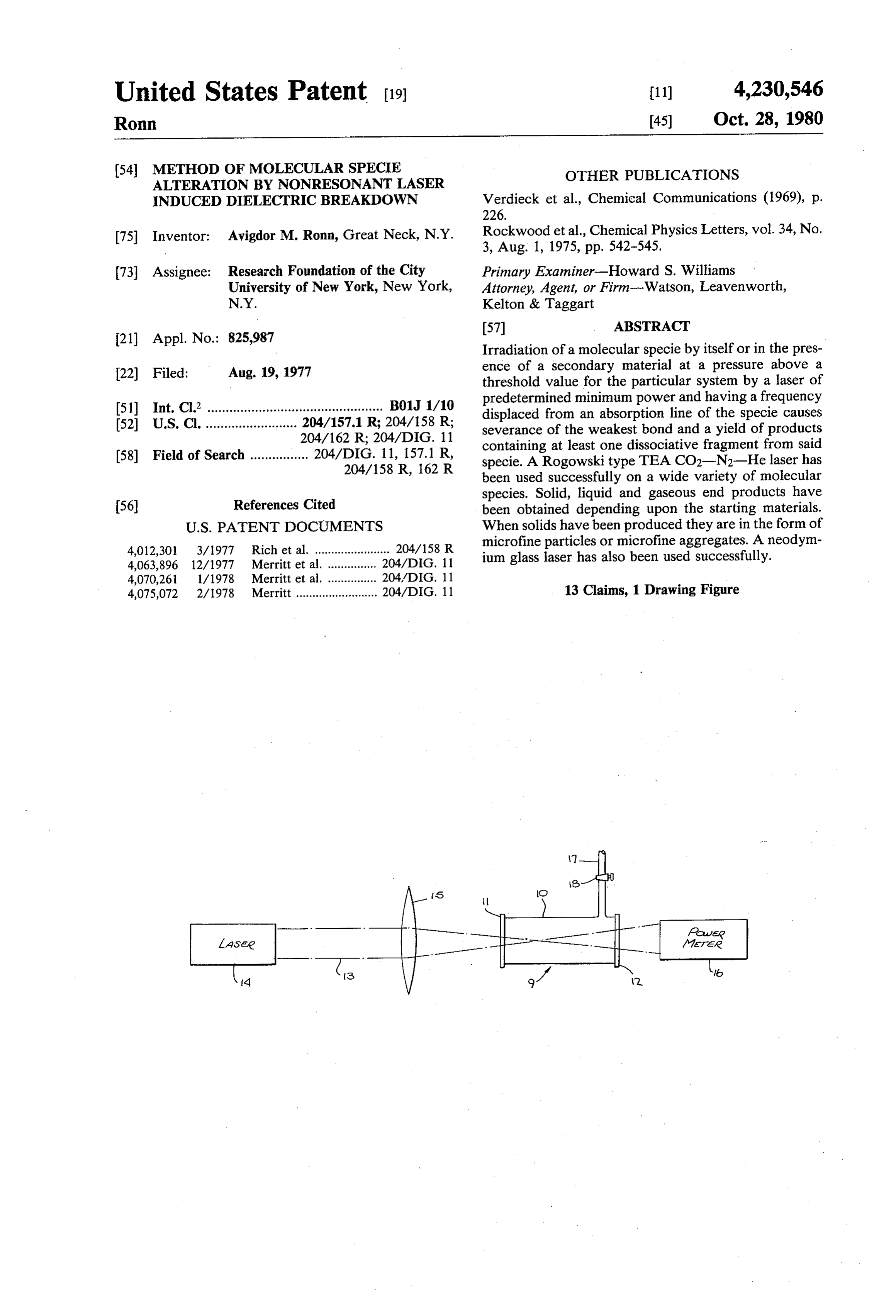
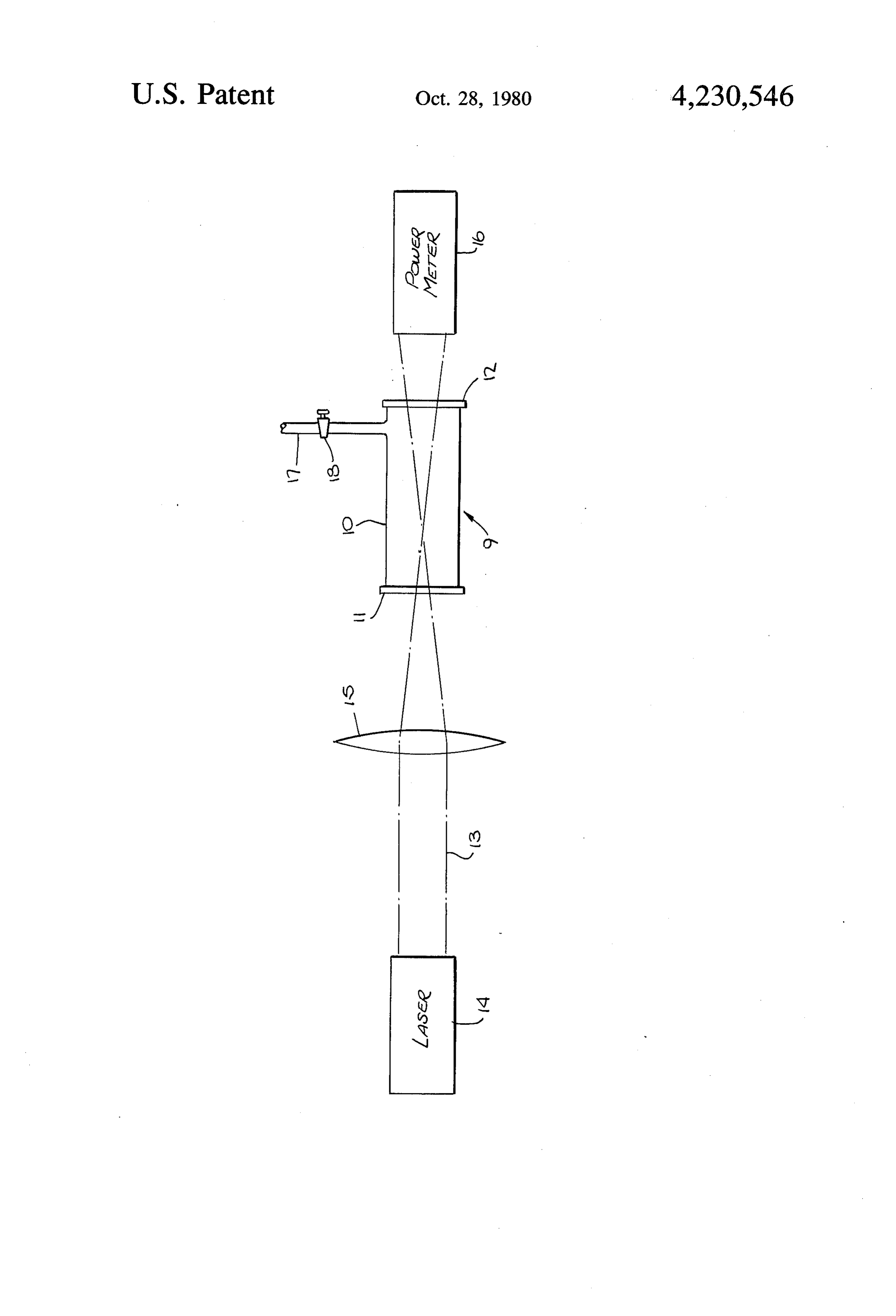
Referring to the drawing, the specimen to be irradi with the attendant large amplitudes of induced oscilla 30 ated is confined within a chamber 9 having a central tion in the spores being sufficient to disrupt such mac section 10 whose opposite ends are closed by suitable romolecules in a physical or mechanical manner with windows 11 and 12 which are transparent to the laser out burning. beam 13 produced by laser 14 focused through lens 15 In Kaldor U.S. Pat. No. 4,000,051, issued Dec. 28, 35 within chamber 9. A power meter 16 is provided for 1976, the prior art relating to isotope separation is re adjusting the laser output to the desired output power viewed and the invention therein is described as based level. A pipe 17 controlled by a suitable gas cock 18 is upon photon absorption, a phenomenon requiring, as joined to the chamber 9 for initially enabling the cham observed above, irradiation of a specie with light at a ber to be evacuated and subsequently filled with the frequency that matches an absorption line, in this case 40 material to be irradiated.
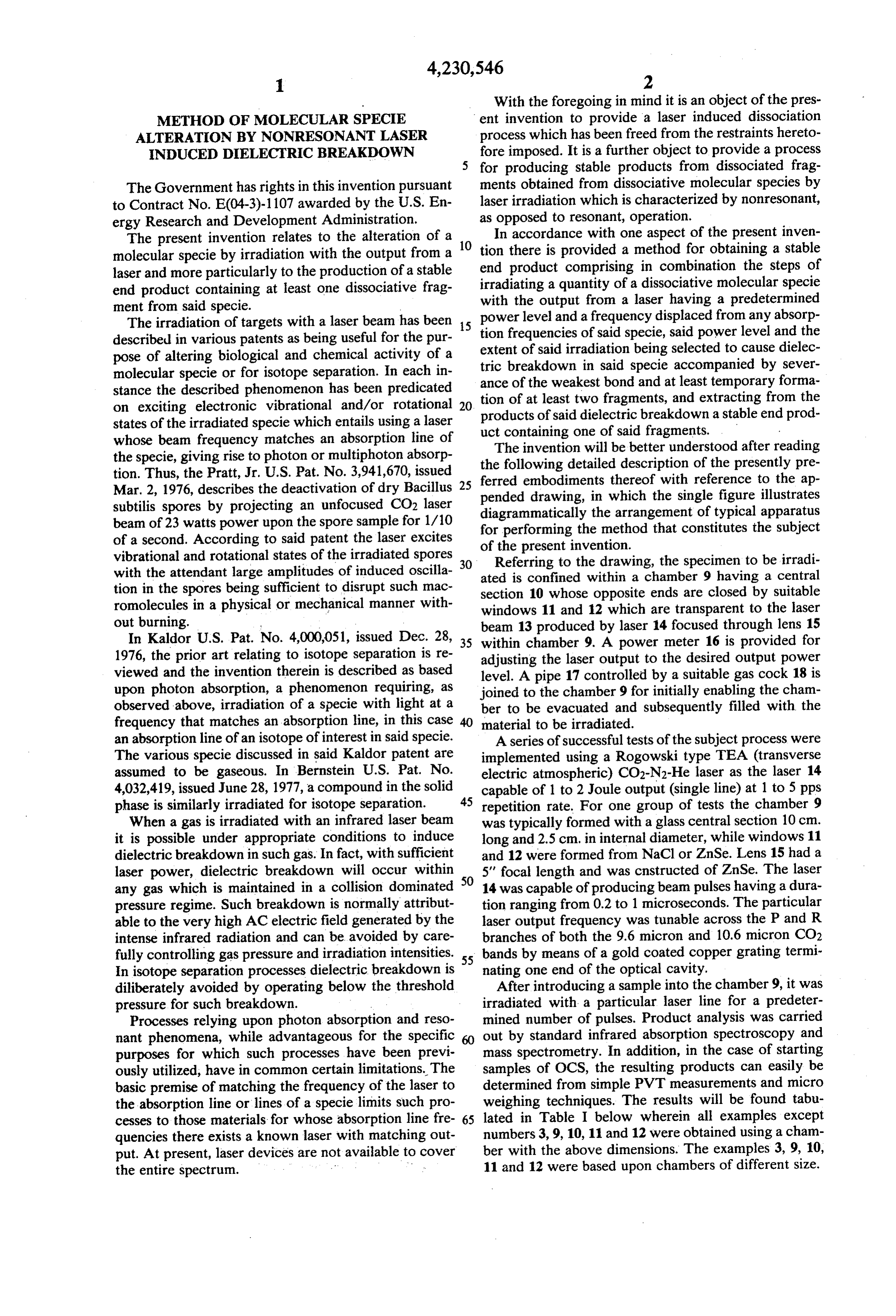
an absorption line of an isotope of interest in said specie. A series of successful tests of the subject process were The various specie discussed in said Kaldor patent are implemented using a Rogowski type TEA (transverse assumed to be gaseous. In Bernstein U.S. Pat. No. electric atmospheric) CO2-N2-He laser as the laser 14 4,032,419, issued June 28, 1977, a compound in the solid capable of 1 to 2 Joule output (single line) at 1 to 5 pps phase is similarly irradiated for isotope separation. 45 repetition rate. For one group of tests the chamber 9 When a gas is irradiated with an infrared laser beam was typically formed with a glass central section 10 cm. it is possible under appropriate conditions to induce long and 2.5 cm. in internal diameter, while windows 11 dielectric breakdown in such gas. In fact, with sufficient and 12 were formed from NaCl or ZnSe. Lens 15 had a laser power, dielectric breakdown will occur within 5' focal length and was cnstructed of ZnSe. The laser any gas which is maintained in a collision dominated 50 14 was capable of producing beam pulses having a dura pressure regime. Such breakdown is normally attribut tion ranging from 0.2 to 1 microseconds. The particular able to the very high AC electric field generated by the laser output frequency was tunable across the P and R intense infrared radiation and can be avoided by care branches of both the 9.6 micron and 10.6 micron CO2 fully controlling gas pressure and irradiation intensities. 55 bands by means of a gold coated copper grating termi in isotope separation processes dielectric breakdown is nating one end of the optical cavity. diliberately avoided by operating below the threshold After introducing a sample into the chamber 9, it was pressure for such breakdown. irradiated with a particular laser line for a predeter Processes relying upon photon absorption and reso mined number of pulses. Product analysis was carried nant phenomena, while advantageous for the specific out by standard infrared absorption spectroscopy and purposes for which such processes have been previ mass spectrometry. In addition, in the case of starting ously utilized, have in common certain limitations. The samples of OCS, the resulting products can easily be basic premise of matching the frequency of the laser to determined from simple PVT measurements and micro the absorption line or lines of a specie limits such pro weighing techniques. The results will be found tabu cesses to those materials for whose absorption line fre 65 lated in Table I below wherein all examples except quencies there exists a known laser with matching out numbers 3, 9, 10, 11 and 12 were obtained using a cham put. At present, laser devices are not available to cover ber with the above dimensions. The examples 3, 9, 10, the entire spectrum. 11 and 12 were based upon chambers of different size.
Page 4
TABLE
LASER ENER OF PRES.(6) IDENTIFIED
EX SPECIE FREQUENCY GY(5) PULSES (torr) PRODUCTS 1 OCS 944.15 cm l 3200 60 CO & S 2 OCS P(20) 10.6 i.7 38 CO & S 3 OCS 1.06.Nd- 0.3 1 90 CO & S 4 SF6 P(20) 9.6. 1 200-300 2 10 NONE OBSERVED 5 SF6 + H2 P(20) 9.6. 2.5 st000 40/40 HF & SF4 &S 6 SF6 + H2 P(20) 9.6. 2.5 3000 30/90 HF & S 7 Fe(C5H5)2 P(20) 10.6. 1.7 Fe 8 Mo(CO)6 P(20) 10.6. 1.7 Mo & CO 9 CrO2Cl2 P(20) 10.6 1.3 st200 1 NONE OBSERVED 10 CrO2Cl2 P(20) 10.6 1.3 st200 15 BROWN SOLID (1) 11 CrO2Cl2 + H2 P(20) 9.6. 2.5 15/15 Cr2O3 & HC(2) 12 CrO2Cl2 + H2 P(20) 9.6. 2.5 1 15/30 Cr2O3 & HCl 13 CH2F2 P(20) 10.6. 1.5 st500 15 C2F4 & H2 14 C6H6 P(20) 10.6l. 2.0. 500 25 C2H2 & C 15 CHF P(20) 10.6. 1.7 22 16 CHF3 F(20) 10.6. 1.7 st300 22 MIXED GASES 17 PH3 P(20) 10.6l. 1.2 200 1-4 P & H2 18 CH3i P(20) 10.6 1.5 500 : & 19 CH3I -- O2 P(20) 10.6p. 1.5 18/30 CO2 & H2O & I2() Notes to Table I
Assumed to be CrO2 or CrO3 or both.
(Plus some unreacted material and non-identified products,
All of the iodine was in solid form.
'Some iodine solid, remainder in solution.
(Energy is in Joules per pulse.
(where two numbers are separated by a slash (/) the first specifies the pressure of the principal specie and the second the pressure of the scavenger.
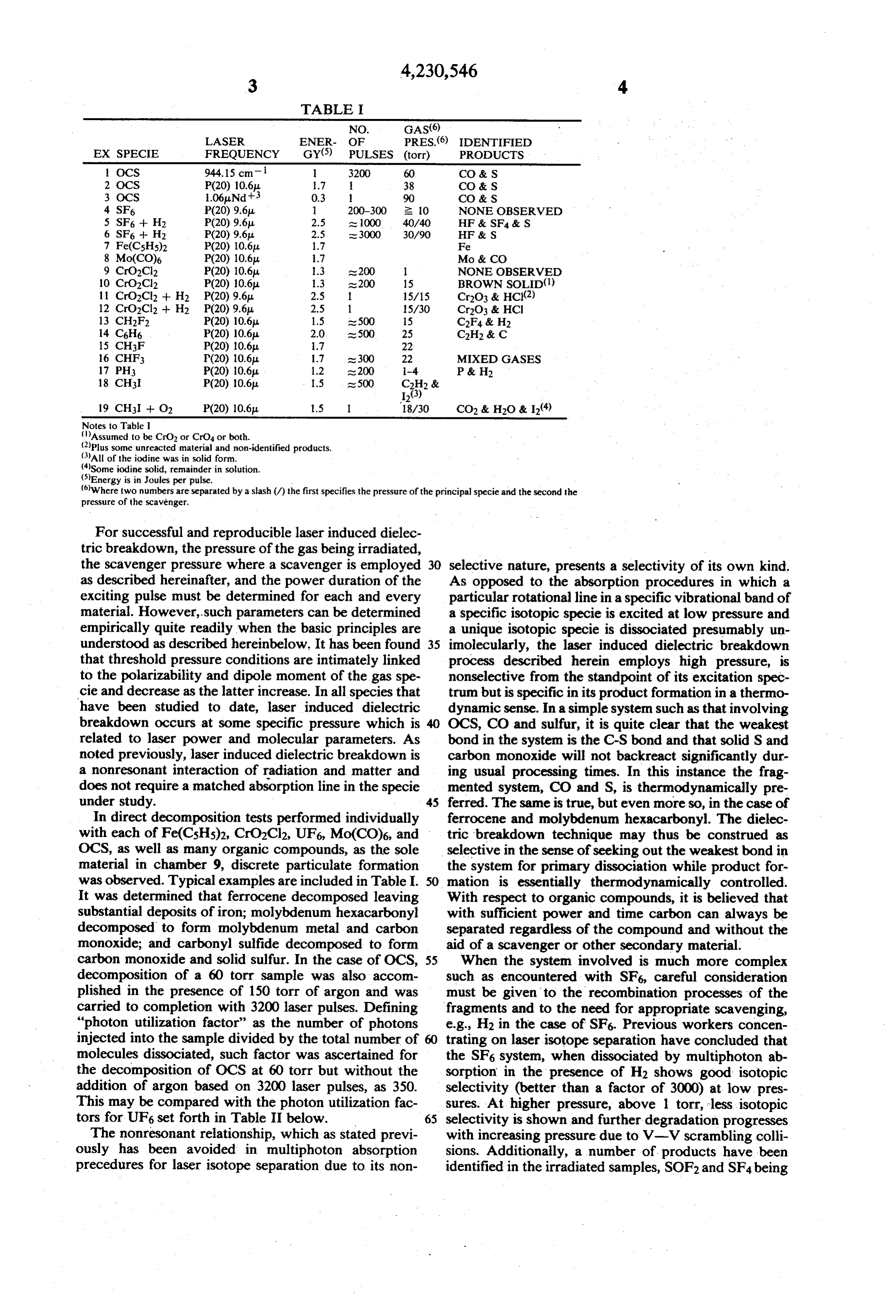
For successful and reproducible laser induced dielec tric breakdown, the pressure of the gas being irradiated, the scavenger pressure where a scavenger is employed 30 selective nature, presents a selectivity of its own kind. as described hereinafter, and the power duration of the As opposed to the absorption procedures in which a exciting pulse must be determined for each and every particular rotational line in a specific vibrational band of material. However, such parameters can be determined a specific isotopic specie is excited at low pressure and empirically quite readily when the basic principles are a unique isotopic specie is dissociated presumably un understood as described hereinbelow. It has been found 35 imolecularly, the laser induced dielectric breakdown that threshold pressure conditions are intimately linked process described herein employs high pressure, is to the polarizability and dipole moment of the gas spe nonselective from the standpoint of its excitation spec cie and decrease as the latter increase. In all species that trum but is specific in its product formation in a thermo have been studied to date, laser induced dielectric dynamic sense. In a simple system such as that involving breakdown occurs at some specific pressure which is 40 OCS, CO and sulfur, it is quite clear that the weakest related to laser power and molecular parameters. As bond in the system is the C-S bond and that solid S and noted previously, laser induced dielectric breakdown is carbon monoxide will not backreact significantly dur a nonresonant interaction of radiation and matter and ing usual processing times. In this instance the frag does not require a matched absorption line in the specie mented system, CO and S, is thermodynamically pre under study. 45 ferred. The same is true, but even more so, in the case of In direct decomposition tests performed individually ferrocene and molybdenum hexacarbonyl. The dielec with each of Fe(C5H5)2, CrO2Cl2, UF6, Mo(CO)6, and tric breakdown technique may thus be construed as OCS, as well as many organic compounds, as the sole selective in the sense of seeking out the weakest bond in material in chamber 9, discrete particulate formation the system for primary dissociation while product for was observed. Typical examples are included in Table I. 50 mation is essentially thermodynamically controlled. It was determined that ferrocene decomposed leaving With respect to organic compounds, it is believed that substantial deposits of iron; molybdenum hexacarbonyl with sufficient power and time carbon can always be decomposed to form molybdenum metal and carbon separated regardless of the compound and without the monoxide; and carbonyl sulfide decomposed to form aid of a scavenger or other secondary material. carbon monoxide and solid sulfur. In the case of OCS, 55 When the system involved is much more complex decomposition of a 60 torr sample was also accom such as encountered with SF6, careful consideration plished in the presence of 150 torr of argon and was must be given to the recombination processes of the carried to completion with 3200 laser pulses. Defining fragments and to the need for appropriate scavenging, "photon utilization factor” as the number of photons e.g., H2 in the case of SF6. Previous workers concen injected into the sample divided by the total number of 60 trating on laser isotope separation have concluded that molecules dissociated, such factor was ascertained for the SF6 system, when dissociated by multiphoton ab the decomposition of OCS at 60 torr but without the sorption in the presence of H2 shows good isotopic addition of argon based on 3200 laser pulses, as 350. selectivity (better than a factor of 3000) at low pres This may be compared with the photon utilization fac sures. At higher pressure, above 1 torr, less isotopic tors for UF6 set forth in Table II below. 65 selectivity is shown and further degradation progresses The nonresonant relationship, which as stated previ with increasing pressure due to V-V scrambling colli ously has been avoided in multiphoton absorption sions. Additionally, a number of products have been precedures for laser isotope separation due to its non identified in the irradiated samples, SOF2 and SF4 being
Page 5
the major species. In comparison, in accordance with resonant and nonresonant conditions, the latter will the present invention, when a high pressure mixture of occur with less power, generally as much as 50% less. SF6 and H2 at 1:3 ratio is subjected to laser induced Comparing the examples of 1 to 3 in Table I employ dielectric breakdown and subsequent scavenging a very ing OCS, it will be observed that satisfactory results clear-cut chemical reaction takes place, namely: 5 have been obtained with a neodymium glass laser as well as with the Rogowski type TEA CO2-N2-He laser, the latter being used in all of the other examples. For purpose of comparison, the absorption line of OCS
Clearly, the products are thermodynamically preferred corresponds to the frequency of the P(22) 9.6 line of over the reactants, and scavenging of all fluorine atoms 10 the CO2 laser. A comparison of examples 1 and 2 shows is easily effected. Although no selectivity in terms of the clearly the inverse relationship between laser energy isotopes of sulfur is observed, none is expected due to and gas pressure.
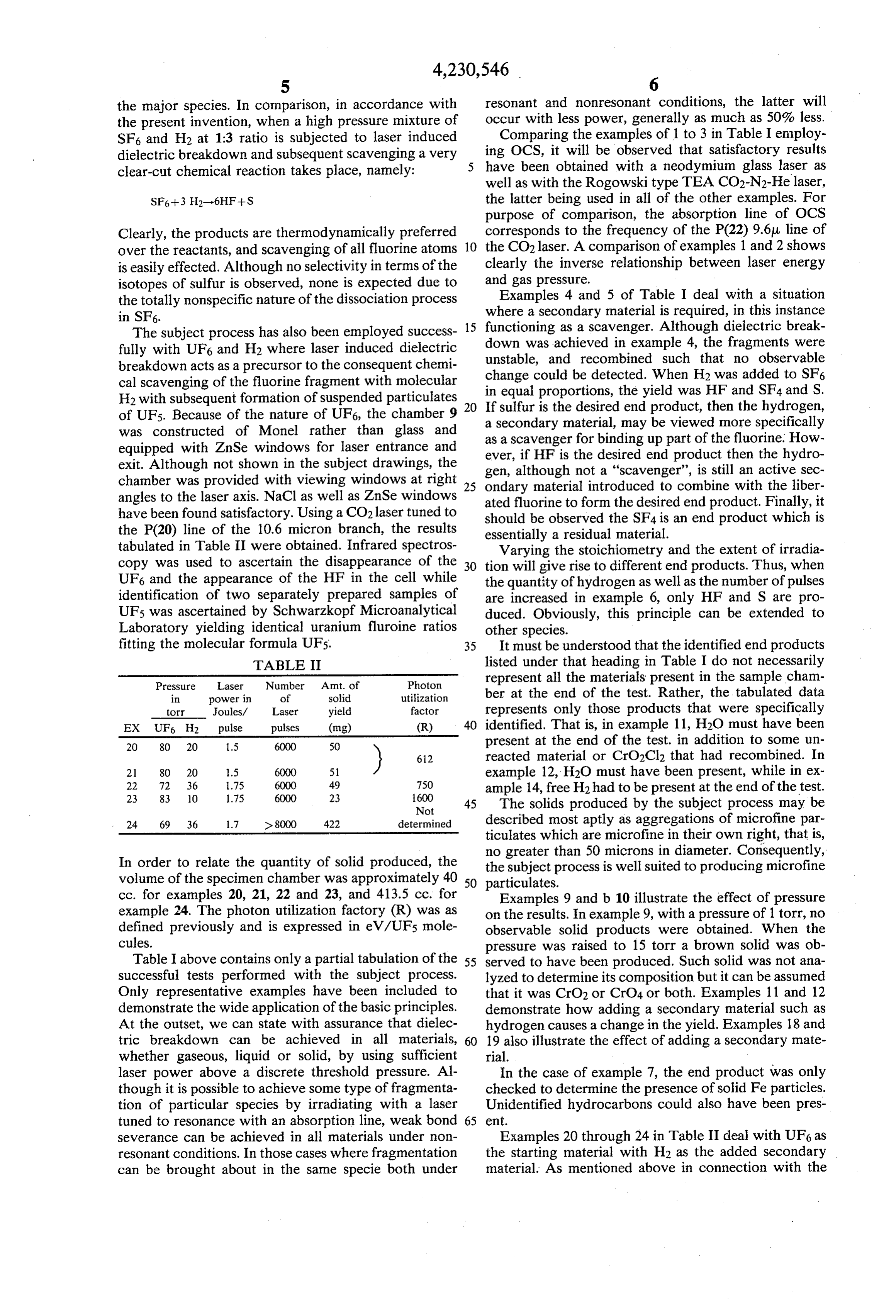
the totally nonspecific nature of the dissociation process Examples 4 and 5 of Table I deal with a situation in SF6. where a secondary material is required, in this instance The subject process has also been employed success 15 down functioning as a scavenger. Although dielectric break fully with UF6 and H2 where laser induced dielectric unstable, was achieved in example 4, the fragments were breakdown acts as a precursor to the consequent chemi change and recombined such that no observable could cal scavenging of the fluorine fragment with molecular in equal proportions, be detected. When H2 was added to SF6 H2 with subsequent formation of suspended particulates 20 If sulfur is the desiredthe yield was HF and SF4 and S. of UF5. Because of the nature of UF6, the chamber 9 a secondary material, may product, end be viewed then the hydrogen, more specifically was constructed of Monel rather than glass and as a scavenger for binding up part of the fluorine. How equipped with ZnSe windows for laser entrance and ever, if HF is the desired end product then the hydro exit. Although not shown in the subject drawings, the gen, although not a "scavenger', is still an active sec chamber was provided with viewing windows at right 25 ondary material introduced to combine with the liber angles to the laser axis. NaCl as well as ZnSe windows ated fluorine to form the desired end product. Finally, it have been found satisfactory. Using a CO2 laser tuned to should be observed the SF4 is an end product which is the P(20) line of the 10.6 micron branch, the results essentially a residual material.
tabulated in Table II were obtained. Infrared spectros Varying the stoichiometry and the extent of irradia copy was used to ascertain the disappearance of the 30 tion will give rise to different end products. Thus, when UF6 and the appearance of the HF in the cell while the quantity of hydrogen as well as the number of pulses identification of two separately prepared samples of are increased in example 6, only HF and S are pro UF5 was ascertained by Schwarzkopf Microanalytical duced. Obviously, this principle can be extended to Laboratory yielding identical uranium fluroine ratios other species.
fitting the molecular formula UF5. 35 It must be understood that the identified end products TABLE II listed under that heading in Table I do not necessarily Pressure Laser Number Amt. of Photon represent all the materials present in the sample cham in power in of solid utilization ber at the end of the test. Rather, the tabulated data tort Joules/ Laser yield factor represents only those products that were specifically EX UF6 H2 pulse pulses (mg) (R) 40 identified. That is, in example 11, H2O must have been 20 80 20 1.5 6000 50 present at the end of the test. in addition to some un
} 61.2 reacted material or CrO2Cl2 that had recombined. In example 12, H2O must have been present, while in ex
ample 14, free H2 had to be present at the end of the test.
Not 45 The solids produced by the subject process may be 24 69 36 1.7 >8000 422 determined described most aptly as aggregations of microfine par ticulates which are microfine in their own right, that is, no greater than 50 microns in diameter. Consequently,
In order to relate the quantity of solid produced, the the subject process is well suited to producing microfine volume of the specimen chamber was approximately 40 50 particulates.
cc. for examples 20, 21, 22 and 23, and 413.5 cc. for Examples 9 and b 10 illustrate the effect of pressure example 24. The photon utilization factory (R) was as on the results. In example 9, with a pressure of 1 torr, no defined previously and is expressed in eV/UF5 mole observable solid products were obtained. When the cules. pressure was raised to 15 torr a brown solid was ob Table I above contains only a partial tabulation of the 55 served to have been produced. Such solid was not ana successful tests performed with the subject process. lyzed to determine its composition but it can be assumed Only representative examples have been included to that it was CrO2 or CrO4 or both. Examples 11 and 12 demonstrate the wide application of the basic principles. demonstrate how adding a secondary material such as At the outset, we can state with assurance that dielec hydrogen causes a change in the yield. Examples 18 and tric breakdown can be achieved in all materials, 60 19 also illustrate the effect of adding a secondary mate whether gaseous, liquid or solid, by using sufficient rial.
laser power above a discrete threshold pressure. Al In the case of example 7, the end product was only though it is possible to achieve some type of fragmenta checked to determine the presence of solid Fe particles. tion of particular species by irradiating with a laser Unidentified hydrocarbons could also have been pres tuned to resonance with an absorption line, weak bond 65 ent.
severance can be achieved in all materials under non Examples 20 through 24 in Table II deal with UF6 as resonant conditions. In those cases where fragmentation the starting material with H2 as the added secondary can be brought about in the same specie both under material. As mentioned above in connection with the
Page 6
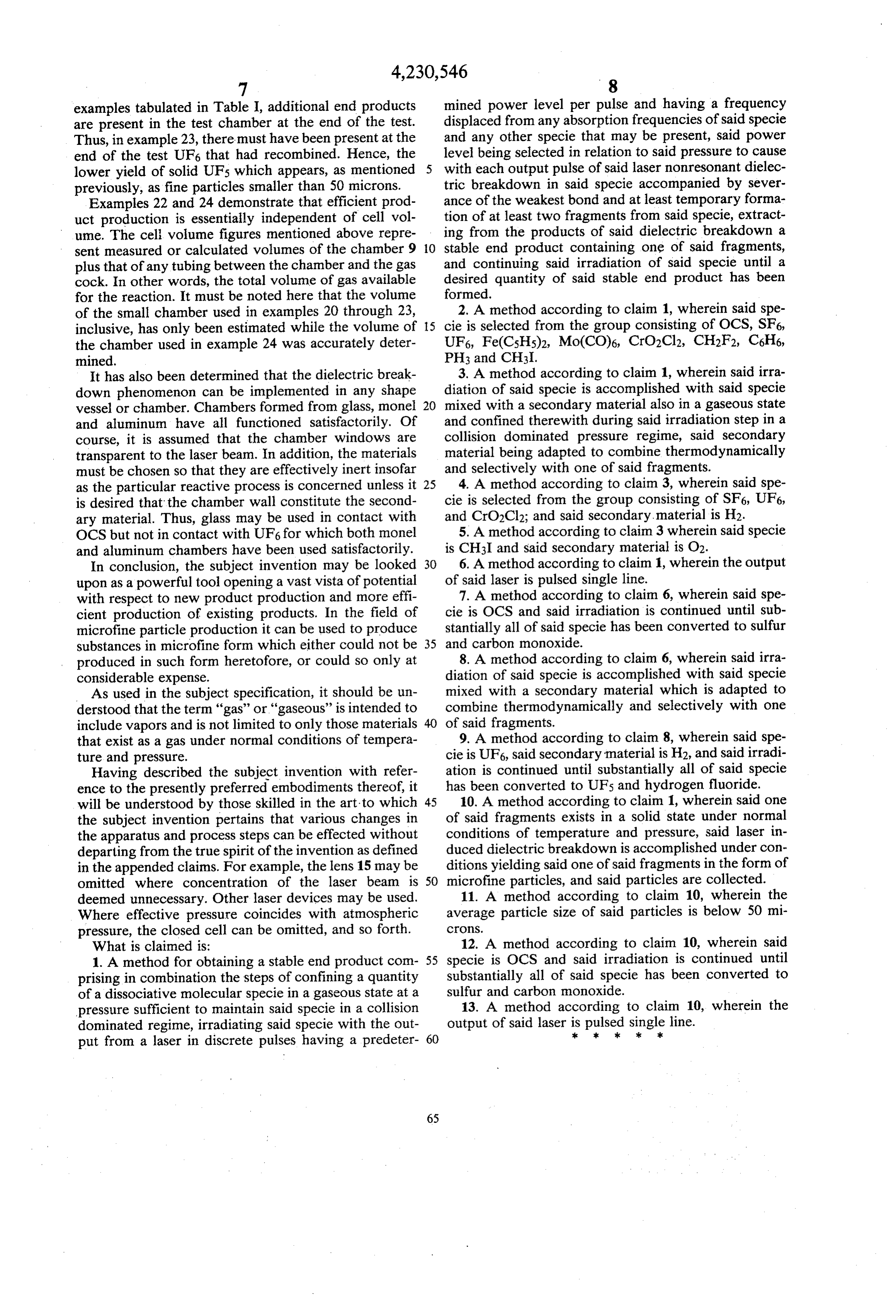
examples tabulated in Table I, additional end products mined power level per pulse and having a frequency are present in the test chamber at the end of the test. displaced from any absorption frequencies of said specie Thus, in example 23, there must have been present at theand any other specie that may be present, said power end of the test UF6 that had recombined. Hence, the level being selected in relation to said pressure to cause lower yield of solid UF5 which appears, as mentioned with each output pulse of said laser nonresonant dielec previously, as fine particles smaller than 50 microns. tric breakdown in said specie accompanied by sever Examples 22 and 24 demonstrate that efficient prod ance of the weakest bond and at least temporary forma uct production is essentially independent of cell vol tion of at least two fragments from said specie, extract ume. The cell volume figures mentioned above repre ing from the products of said dielectric breakdown a sent measured or calculated volumes of the chamber 9 10 stable end product containing one of said fragments, plus that of any tubing between the chamber and the gas and continuing said irradiation of said specie until a cock. In other words, the total volume of gas available desired quantity of said stable end product has been for the reaction. It must be noted here that the volume formed.
of the small chamber used in examples 20 through 23, 15 2. A method according to claim 1, wherein said spe inclusive, has only been estimated while the volume of cie is selected from the group consisting of OCS, SF6, the chamber used in example 24 was accurately deter UF6, Fe(C5H5)2, Mo(CO)6, CrO2Cl2, CH2F2, C6H6, mined. PH3 and CH3I.
It has also been determined that the dielectric break 3. A method according to claim 1, wherein said irra down phenomenon can be implemented in any shape diation of said specie is accomplished with said specie vessel or chamber. Chambers formed from glass, monel 20 mixed with a secondary material also in a gaseous state and aluminum have all functioned satisfactorily. Of and confined therewith during said irradiation step in a course, it is assumed that the chamber windows are collision dominated pressure regime, said secondary transparent to the laser beam. In addition, the materials material being adapted to combine thermodynamically must be chosen so that they are effectively inert insofar and selectively with one of said fragments. as the particular reactive process is concerned unless it 25 4. A method according to claim 3, wherein said spe is desired that the chamber wall constitute the second cie is selected from the group consisting of SF6, UF6, ary material. Thus, glass may be used in contact with and CrO2Cl2; and said secondary, material is H2. OCS but not in contact with UF6 for which both monel 5. A method according to claim 3 wherein said specie and aluminum chambers have been used satisfactorily. is CH3I and said secondary material is O2. In conclusion, the subject invention may be looked 30 6. A method according to claim 1, wherein the output upon as a powerful tool opening a vast vista of potential of said laser is pulsed single line. with respect to new product production and more effi 7. A method according to claim 6, wherein said spe cient production of existing products. In the field of cie is OCS and said irradiation is continued until sub microfine particle production it can be used to produce stantially all of said specie has been converted to sulfur substances in microfine form which either could not be 35 and carbon monoxide.
produced in such form heretofore, or could so only at 8. A method according to claim 6, wherein said irra considerable expense. diation of said specie is accomplished with said specie As used in the subject specification, it should be un mixed with a secondary material which is adapted to derstood that the term "gas' or "gaseous' is intended to combine thermodynamically and selectively with one include vapors and is not limited to only those materials of said fragments.
that exist as a gas under normal conditions of tempera 9. A method according to claim 8, wherein said spe ture and pressure. cie is UF6, said secondary material is H2, and said irradi Having described the subject invention with refer ation is continued until substantially all of said specie ence to the presently preferred embodiments thereof, it has been converted to UF5 and hydrogen fluoride. will be understood by those skilled in the art to which 45 10. A method according to claim 1, wherein said one the subject invention pertains that various changes in of said fragments exists in a solid state under normal the apparatus and process steps can be effected without conditions of temperature and pressure, said laser in departing from the true spirit of the invention as defined duced dielectric breakdown is accomplished under con in the appended claims. For example, the lens 15 may be ditions yielding said one of said fragments in the form of omitted where concentration of the laser beam is 50 microfine particles, and said particles are collected. deemed unnecessary. Other laser devices may be used. 11. A method according to claim 10, wherein the Where effective pressure coincides with atmospheric average particle size of said particles is below 50 mi pressure, the closed cell can be omitted, and so forth. COS.
What is claimed is: 12. A method according to claim 10, wherein said 1. A method for obtaining a stable end product com 55 specie is OCS and said irradiation is continued until prising in combination the steps of confining a quantity substantially all of said specie has been converted to of a dissociative molecular specie in a gaseous state at a sulfur and carbon monoxide.
pressure sufficient to maintain said specie in a collision 13. A method according to claim 10, wherein the dominated regime, irradiating said specie with the out output of said laser issk pulsed
single
line.
put from a laser in discrete pulses having a predeter 60
Page 7
UNITED STATES PATENT AND TRADEMARK OFFICE
CERTIFICATE OF CORRECTION
NVENTOR(S) : Avigdor M. Ronn it is Certified that error appears in the above-identified patent and that said Letters Patent are hereby Corrected as shown below:
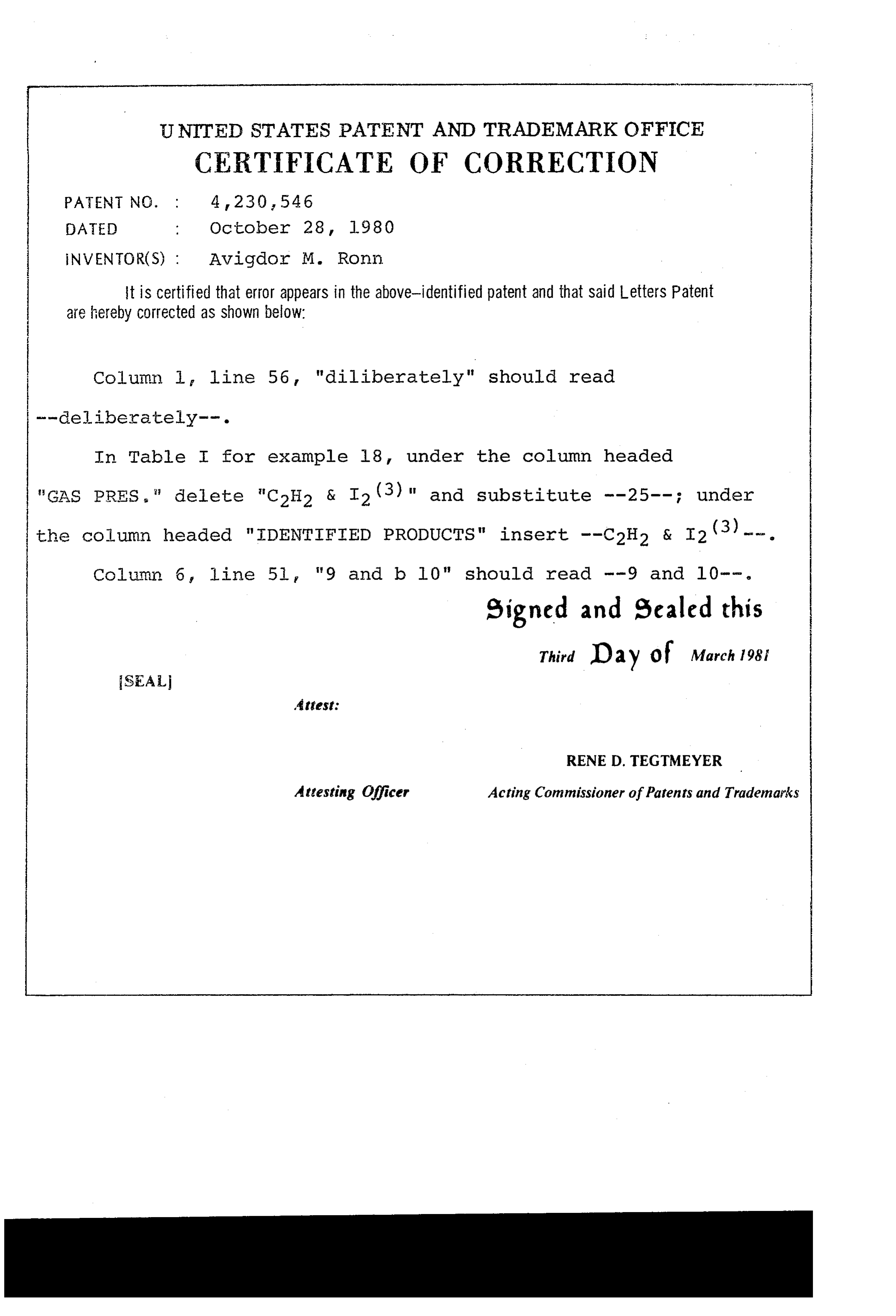
Column line 56, "diliberately" should read
In Table I for example l8, under the column headed
"GAS PRES.. " delete "C2H2 & I (3) " and substitute --25- - ; under the column headed "IDENTIFIED PRODUCTS" insert --C2H2 & I2(3)--. Column 6, 1ine 5, "9 and b lo" should read --9 and lo--. eigned and sealed this
Third Day of March 1981
RENE D. TEGTMEYER
Attesting Officer Acting Commissioner of Patents and Trademarks
Page 8
UNITED STATES PATENT AND TRADEMARK OFFICE
CERTIFICATE OF CORRECTION
NVENTOR(S) : Avigdor M. Ronn
It is certified that error appears in the above-identified patent and that said Letters Patent are hereby Corrected as shown below:
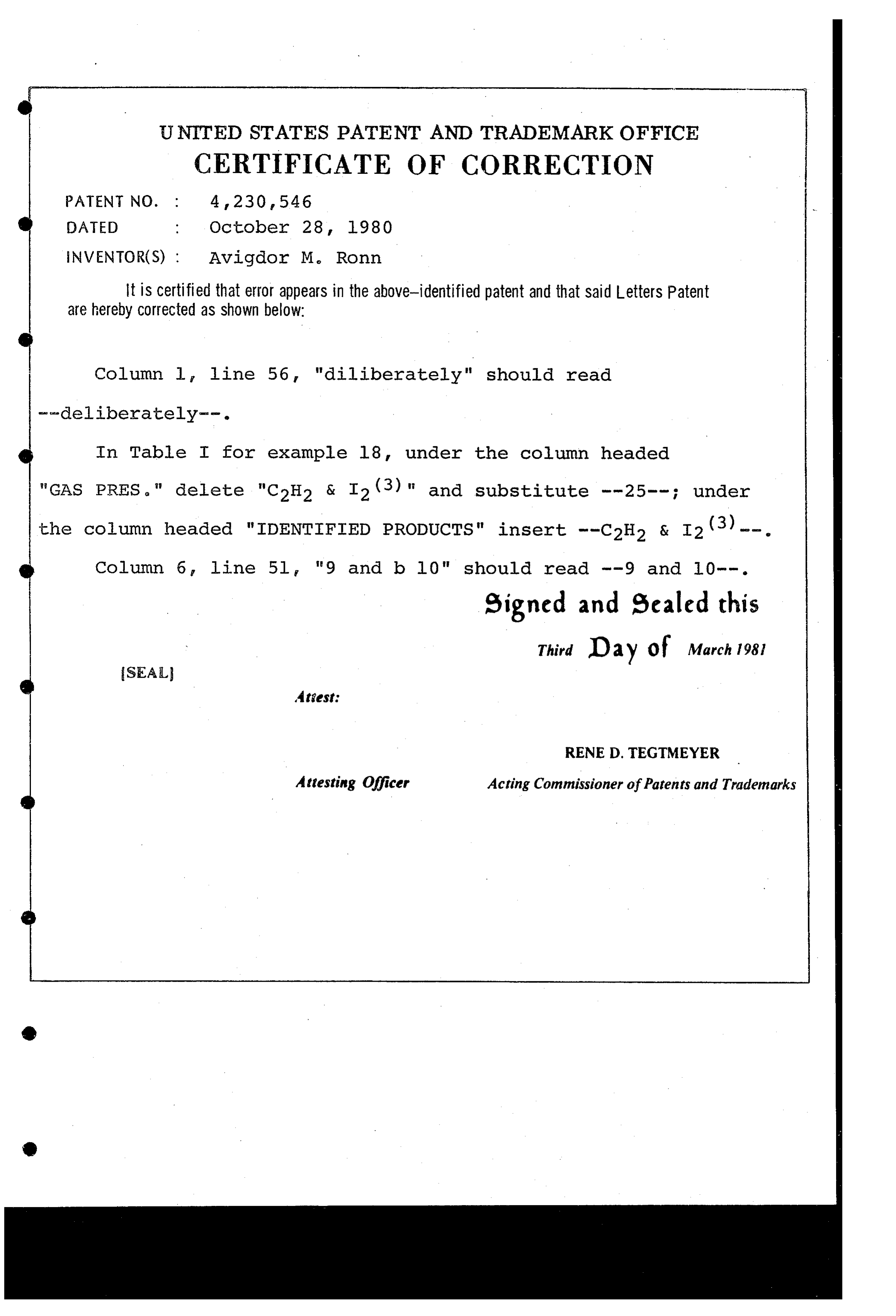
Column l line 56, "diliberately" should read
In Table I for example l8, under the column headed PRES..." delete "C2H2 & I (3) " and substitute --25-- under the column headed "IDENTIFIED PRODUCTS" insert --C2H2 & I2 (--. Column 6 line 5l "9 and b lo" should read --9 and 10--. signed and Sealed this
Third Day of March 1981
SEAL
Altiest:
RENE D. TEGTMEYER
Attesting Officer Acting Commissioner of Patents and Trademarks
Provenance
- Collection
- Cited prior art
- Original PDF
- patentimages.storage.googleapis.com →
- Filed
- 1977-08-19
- Pages
- 8
- Method
- pdftotext (the PDF's own text layer) + pdftoppm 300dpi page scans
- Source
- Google Patents bibliographic record
- Granted
- 1980-10-28
- Inventors
- Avigdor M. Ronn; Research Foundation of City University of New York
- Transcribed from
- patentimages.storage.googleapis.com →