patent · US4063896
Removal of phosgene impurity from boron trichloride by laser radiation
20 December 1977
Page 1 — bibliographic record
United States Patent (19) 11) 4,063,896 Merritt et al. 45) Dec. 20, 1977 54 REMOVAL OF PHOSGENE IMPURITY Primary Examiner-Robert M. Reese FROM BORONTRICHLORIDE BY LASER Attorney, Agent, or Firm-Nathan Edelberg; Robert P. RADATION Gibson; Jack W. Voight 75) Inventors: James A. Merritt, Pulaski; Lawrence 57 ABSTRACT C. Robertson, Fayetteville, both of
Tenn. Phosgene, COCl, an impurity in BCls is dissociated by 73 Assignee: The United States of America as CO2 laser radiation that is passed through a stainless represented by the Secretary of the steel laser cell with NaCl windows on each end of the Army, Washington, D.C. cell. The power level of a cw CO multiline laser can be varied to accomplish the irradiation to effectively disso (21) Appl. No.: 754,304 ciate the COCl into its dissociation products, substan (22 Filed: Dec. 27, 1976 tially CO and Cl. The BCl, v(956 cm-1) fundamental 51) Int. Cl’................................................ B01J 1/10 is resonant with CO2 (P20) laser line and strongly ab 52 U.S. Cl. .......................... 23/254 R; 204/157.1 R; sorbs this energy which is followed by an intramolecu 204/DIG. 11 lar V-V transfer of energy to the COCl which results 58) Field of Search ............... 23/254 R; 204/157.1 R in its dissociation. The gaseous compound C2H4 having combination bands and overtones that match reason (56) References Cited ably close to the energy levels of COCl can also serve PUBLICATIONS as a diluent for COCl to effect transfer of energy for T. A. Osial, Instruments & Control Systems, Oct. 1967, dissociation of COCl by cw CO2 laser radiation.
Chem. Abstr. 75, 56720a (1971), Okabe et al. 7 Claims, 6 Drawing Figures
WAVE NUMBER Cm 3OOO 2500 2000 500 400 300 200 OO IOOO soo 800 700 IOO
70 BC3 BC13 BC3
BCis
s 4. 5 6 7 8. 9 O 2 s t4 s
WAVELENGTH IN MICRONS
Page 2
Drawing sheet — no readable text.
Page 3
Drawing sheet — no readable text.
Page 4
Drawing sheet — no readable text.
Page 5
Drawing sheet — no readable text.
Page 6
Drawing sheet — no readable text.
Page 7
Drawing sheet — no readable text.
Page 8
certain that the COCl2 has been dissociated and to ascer
REMOVAL OF PHOSGENE IMPURITY FROM tain any depletion of the BCls or CHhd 4 concentra BORON TRICHLORIDE BY LASER RADATION tion.
DEDICATORY CLAUSE 5 BRIEF DESCRIPTION OF THE DRAWING The invention described herein may be manufac The figures of the drawing are infrared spectra tured, used, and licensed by or for the Government for wherein the percent transmittance is shown on the ordi governmental purposes without the payment to us of nate and the wave number and wavelength are shown any royalties thereon. on the abscissa.
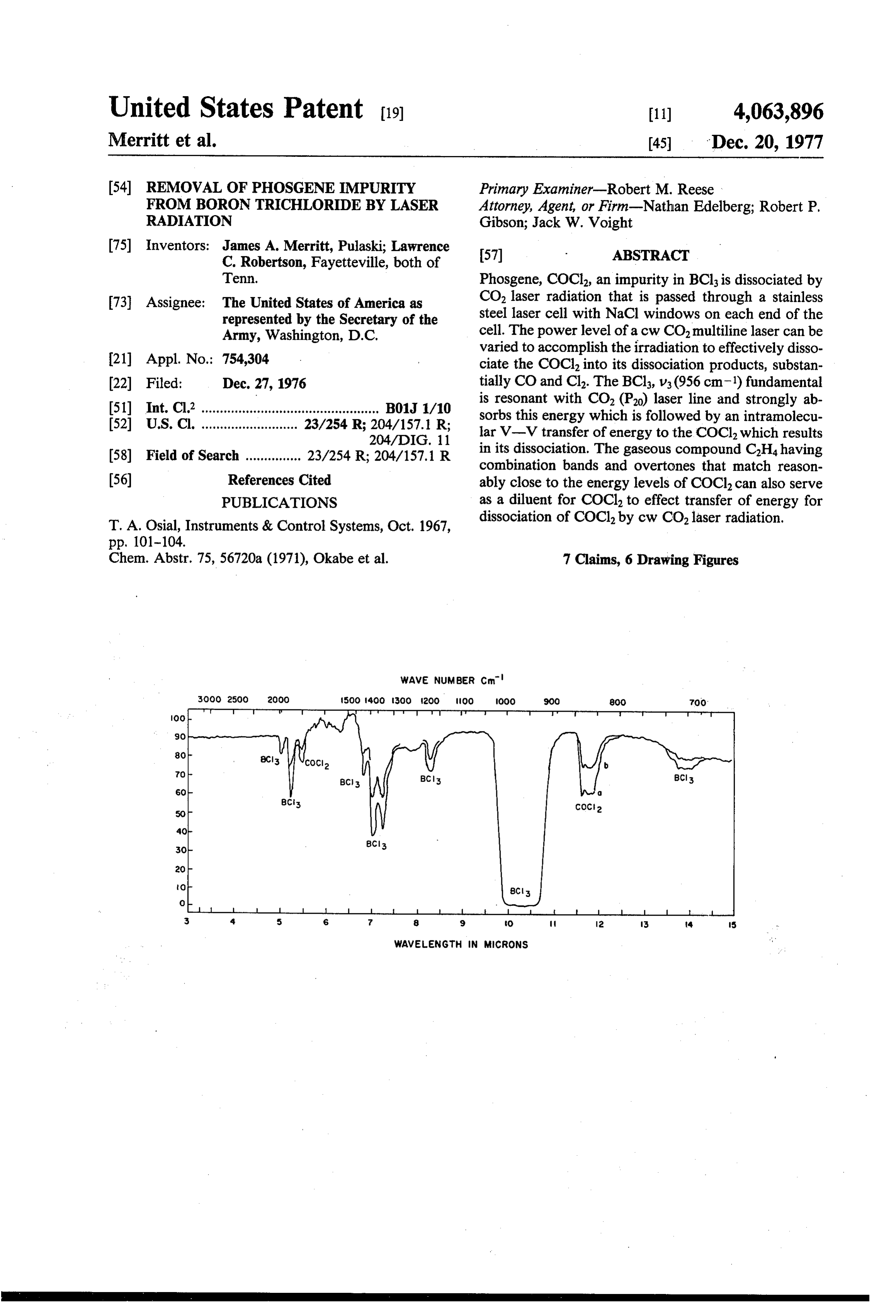
10 FIG. 1 is the spectra of BCls at 50 and 100 torr pres
BACKGROUND OF THE INVENTION
Commercially available BCls (boron trichloride) of bandsshowing sure of COCl
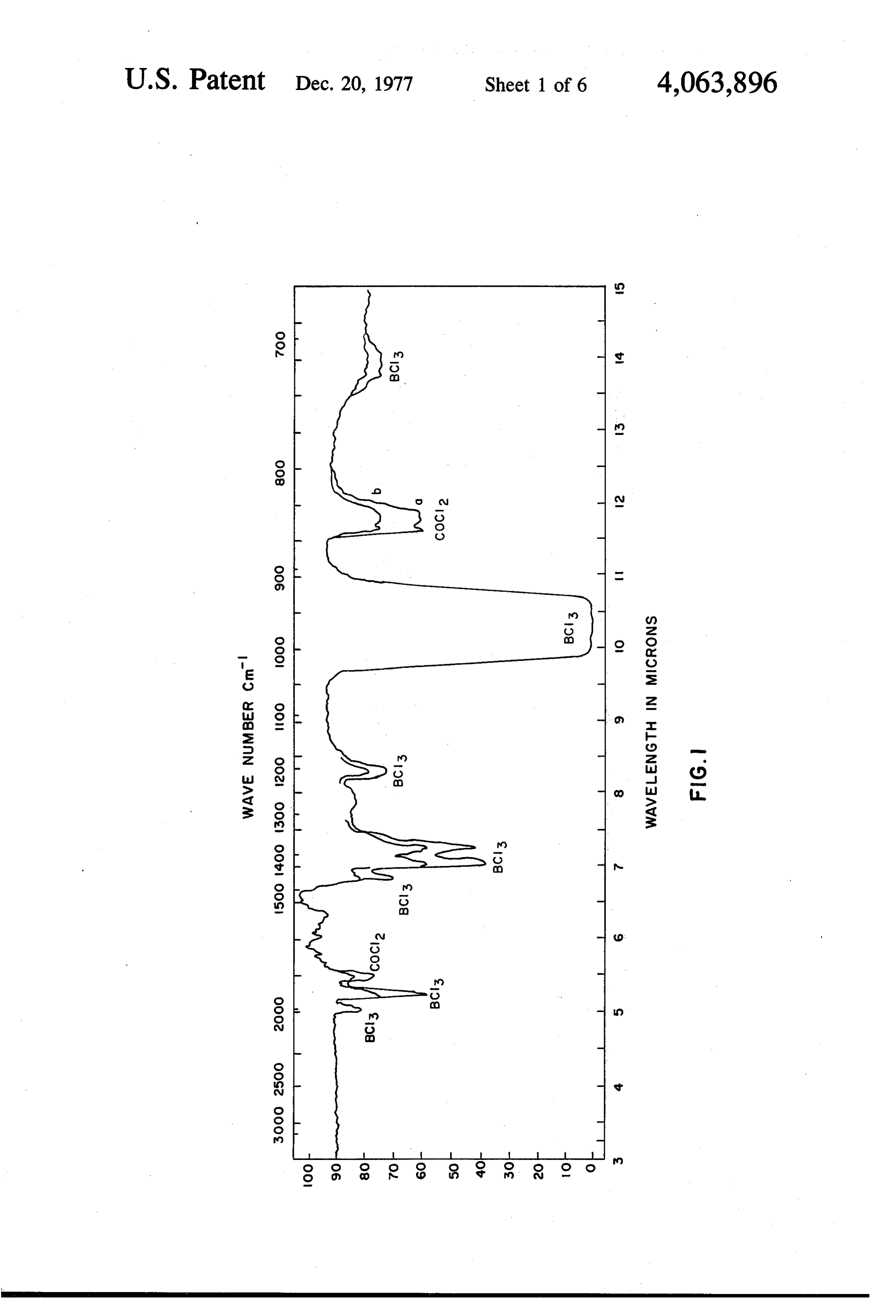
impurity, the highest purity still contains up to 0.1 percent COCl. FIG. 2 is the spectra of the gases of FIG. 1 after being (phosgene) contaminant. This contaminant or impurity mixed with varying concentrations of H2 and irradiated causes difficulties when BCl3 is used in the electronics 15 industry, as a catalyst in numerous ways such as in the with cw CO2 laser radiation. production of styrene, as an additive for high energy BCls and3 0.8
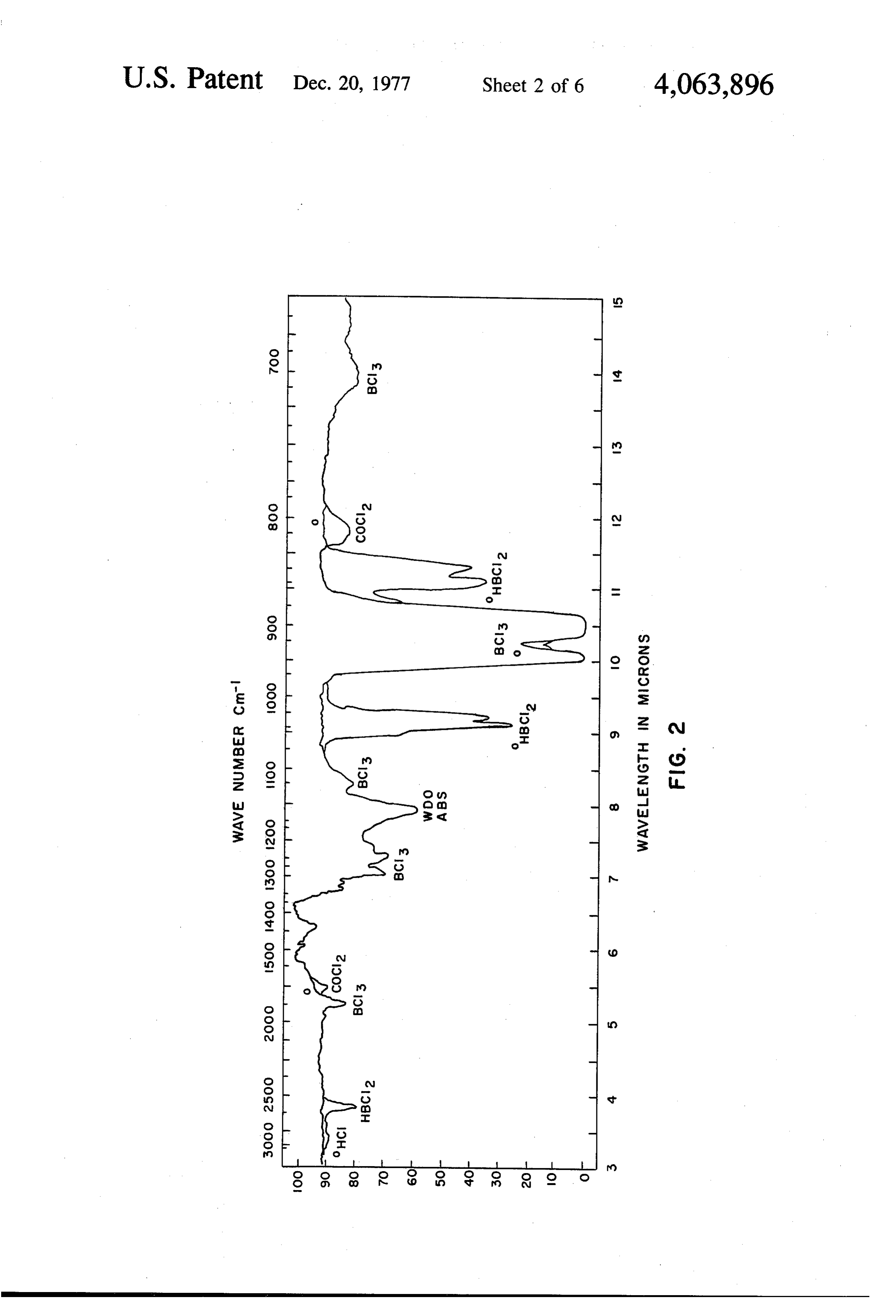
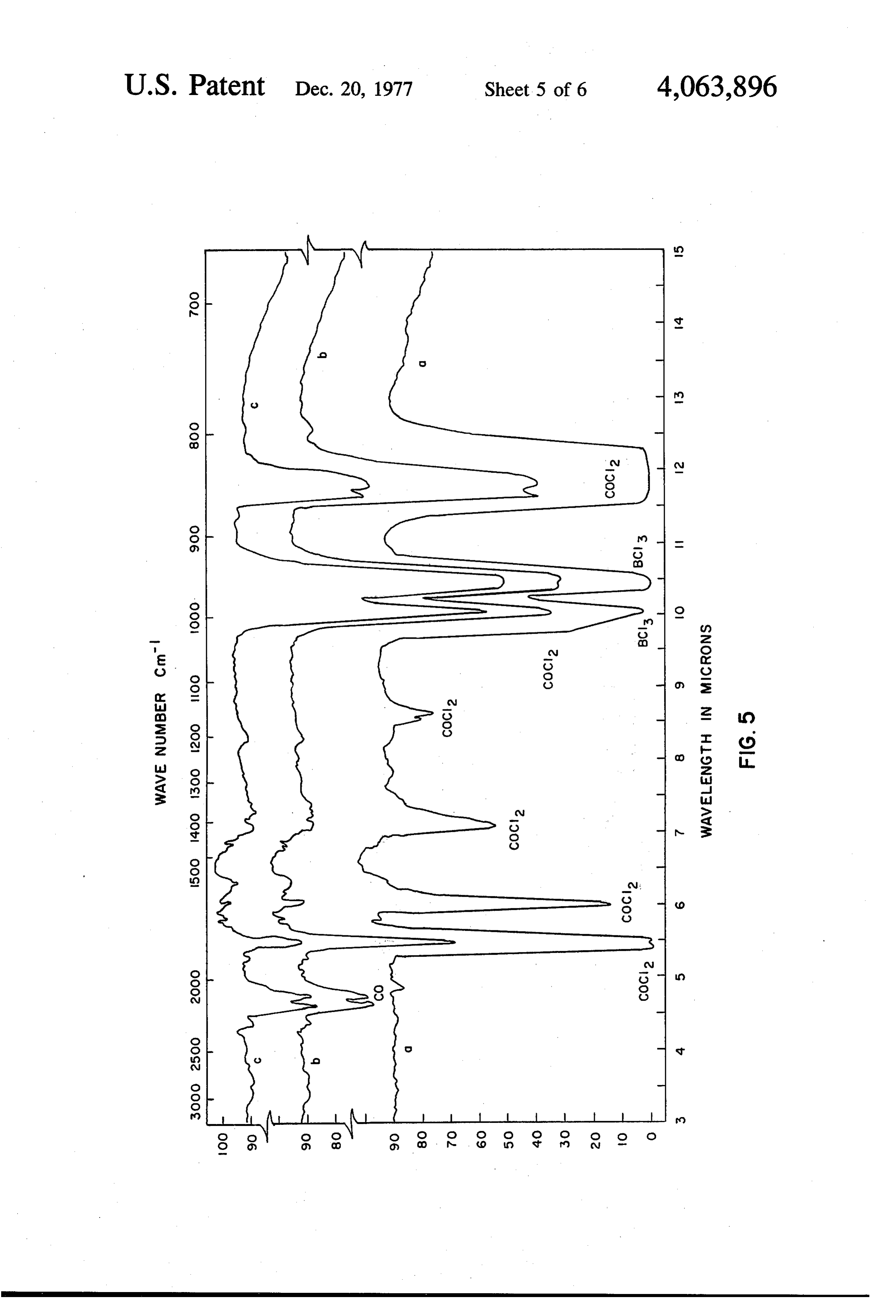
FIG. is the spectra of a mixture of 50 torr pressure torr pressure COCl after being irradiated fuels, in the refining of various refractory metals, etc. with a 100 watt cw CO2 multiline laser. Removal of the impurity from BCls by economical FIGS. 4 and 5 are spectra which further illustrate the methods has to data proven unsuccessful. 20 destruction of COCl in BCl3 without loss of BClcon
Advantageous would be a method to remove phos centration, using a CO2 laser and a few seconds irradia gene from boron trichloride or to change the phosgene to dissociation products which do not interfere with tionFIG. time.
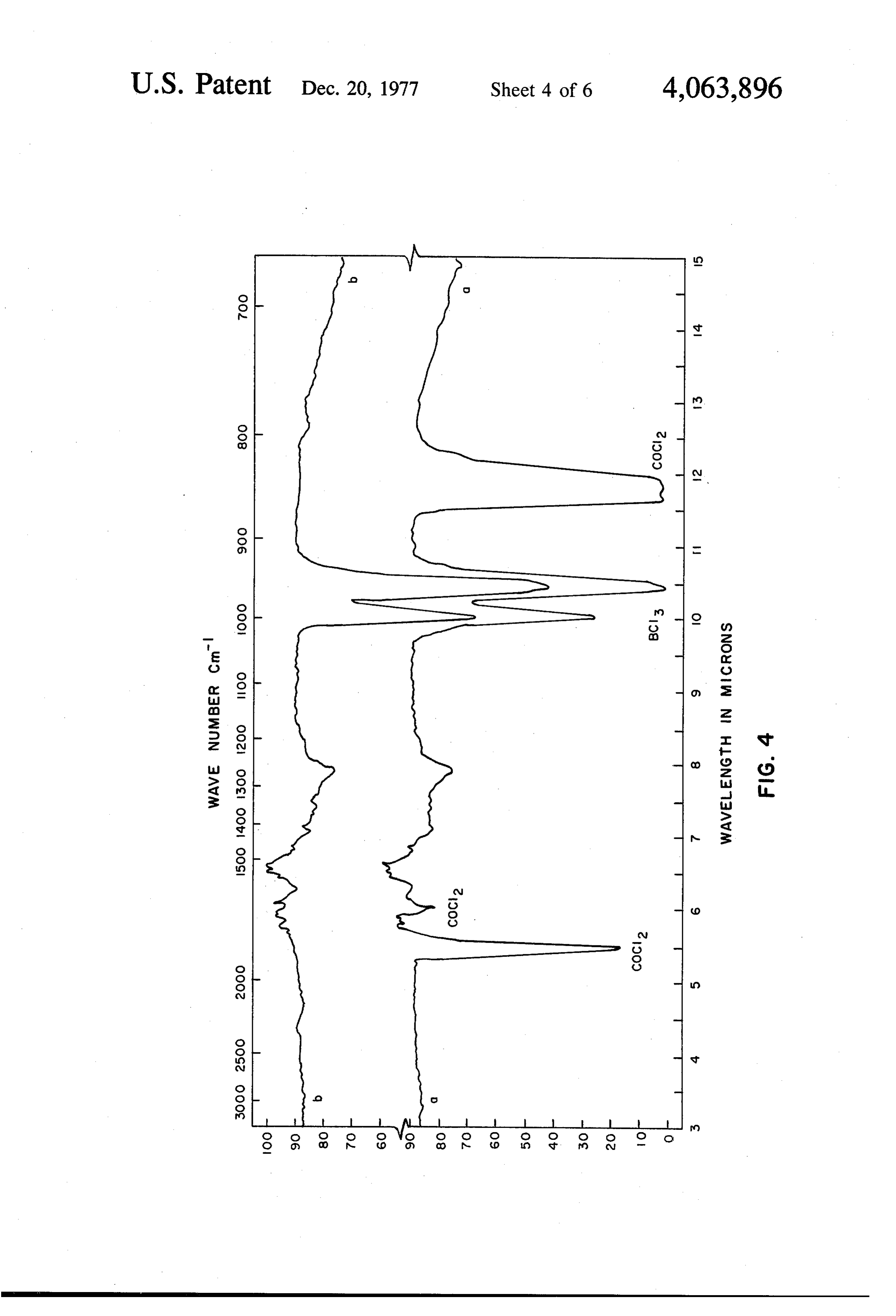
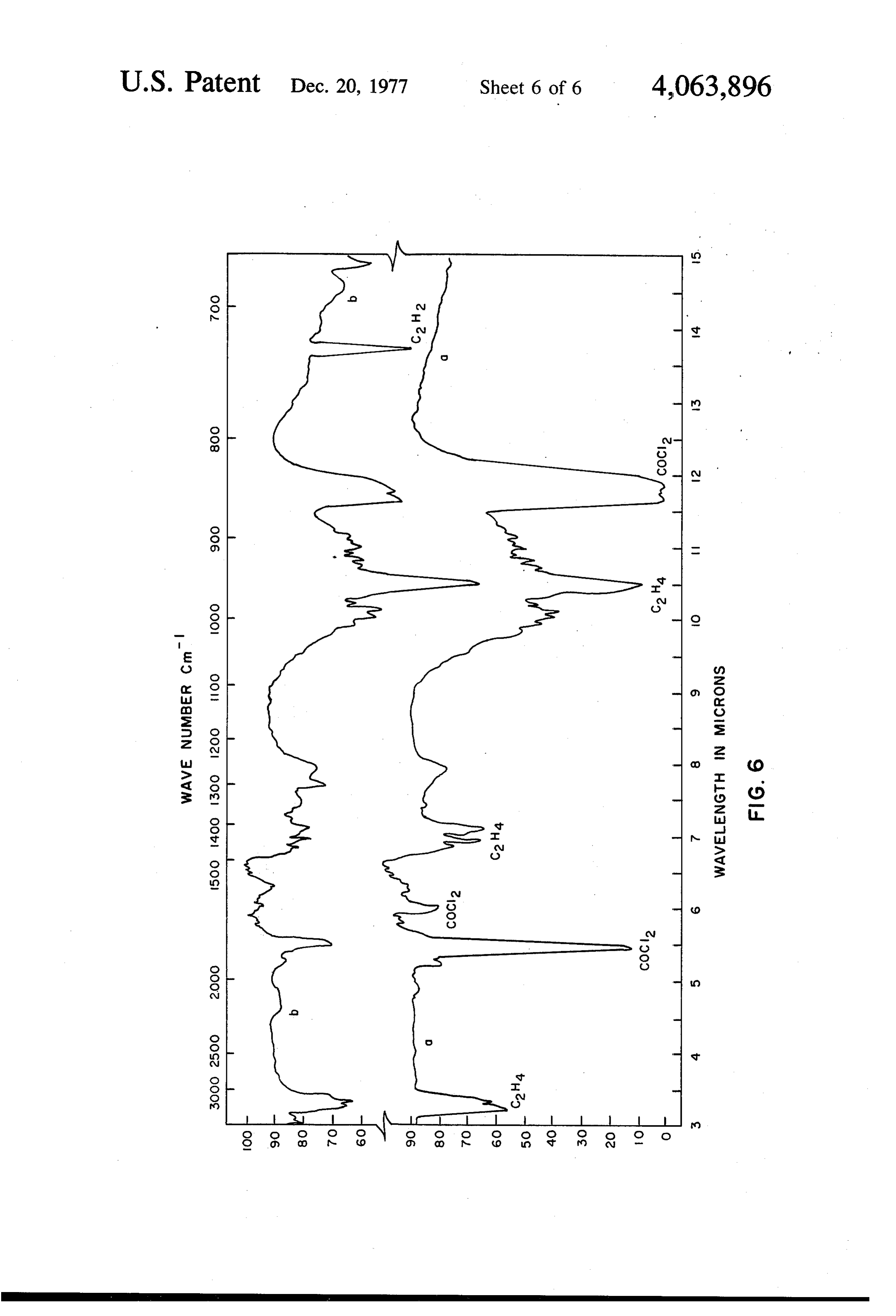
6 is the spectra of a mixture of 6 torr pressure of boron trichloride for its particular function or whereby COCl2 and 50 torr pressure of C.H. Curveb illustrates the dissociation products of phosgene can be easily 25 separated by conventional methods if required for the destruction of COCl, but not as efficiently as when boron trichloride catalysis function. BCl3 is used to transfer energy to COCl. Therefore, an object of this invention is to provide a DESCRIPTION OF THE PREFERRED method for the dissociation of phosgene in the presence EMBODIMENTS of BCl3 without loss of BC13 concentration. 30
Another object of this invention is to provide a The BCl3 was obtained from Matheson Gas Products method to purify BCls from the contaminant phosgene and had a stated impurity of 0.1% COCl maximum. It with laser radiation. was used without further attempts to purify it. The H. A further object of this invention is to provide a (hydrogen) was obtained from Silox Inc., and used method for dissociation of phosgene in BCls with a cw 35 without further purification as were the COCl and CO2 laser radiation whereby the fundamentals of BCls C2H4 (ethylene) which were obtained from Matheson are resonant with the laser radiation to effect energy Gas Products.
transfer to COCl and results in its dissociation. The gases were metered into a laser cell (e.g., a 10 cm Still a further object of this invention is to provide a by 3 cm stainless steel cell with NaCl windows on each method of dissociation of phosgene in the presence of 40 end) to provide a pressure in the range from about 5 torr C2H4 that has combination bands and overtones that to about 100 torr. Irradiation was accomplished with a match reasonably close to the fundamental energy of cw CO, multiline laser at varying power levels. The phosgene to effect efficient V-V transfer of laser en unfocused beam was passed through the cell for a given ergy responsible for the dissociation of phosgene. period of time after which the spectra of the static prod 45 ucts were obtained with a Beckman IR5 spectropho
SUMMARY OF THE INVENTION tometer.
The removal of COCl impurity in BCl3 is accom The detailed description of the drawing includes the plished by using cw CO2 laser radiation. Mixtures of figure captions as related to the experimental proce BCls and COCl and mixtures of CH and COCl are dures as follows:
irradiated by cw CO multiline laser at a power level to 50 FIG. 1. Spectra of BCls (with the COCl contaminant). achieve dissociation of COCl. BCls and CH4 are gase a. 100 torr pressure.
ous compounds which are involved in the energy trans b. 50 torr pressure.
fer from laser radiation to COCl to cause dissociation, FIG. 2. The spectrum of 25 torr pressure of BCls (with of the COCl. the COCl2 contaminant) and 25 torr pressure of H. The gases in admixture were metered into a stainless 55 before and after irradiation (O) for 2 sec with a 150 steel cell with NaCl windows on each end to achieve a watt cw CO laser. The term WDO ABS is window predetermined pressure and subsequently exposed to absorption.
cw CO, multiline laser radiation for a predetermined FIG. 3. Spectra of 50 torr pressure of BC and 0.8 torr period of time to effect dissociation of COCl. The pressure COCl.
predetermined pressure is to ensure efficient irradiation a. Before irradiation.
by the power level of the laser employed. That is, the b. After 3 sec irradiation time - 100 watts cw CO. molecular concentration of the gas in the cell should be c. Additional 1 sec irradiation time - 100 watts cw in consonance with the power level of the cw CO, CO2.
multiline laser to achieve an efficient transfer of energy FIG. 4. Spectra of 6 torr pressure BCls and 6 torr pres from the gases, either CH4 or BCls, to COCl, to effect 65 sure COCl.
dissociation of the COCl. The spectra of the static a. Before irradiation.
products are then obtained with a spectrophotometer b. After irradiation with a 100 watt cw CO laser for (e.g., Beckman IR5) to evaluate the experiment to as 15 sec.
Page 9
FIG. 5. Spectra of 10 torr pressure BCls and 100 torr radiation, BCls being a case in point, wherein efficient pressure COCl. V-V transfer of energy takes place between the mate a. Before irradiation. rial being purified (BCl3) and the contaminant (COCl2). b. After irradiation with a 100 watt cw CO laser for As shown by examples, the contaminant COCl is 15 sec, dissociated by laser radiation if a diluent is employed c. After an additional 20 irradiation time. such as CH4 which has combination bands and over FIG. 6. Spectra of 50 torr pressure CH4 and 6 torr tones that match reasonably close to the energy of the pressure COCl. COClso that energy transfer takes place to effect disso a. Before irradiation. ciation. This technique of using a diluent could be ad b. After irradiation with a 100 watt cw CO2 laser for 10 vantageous if neat phosgene were desired to be dissoci 50 sec. ated as a means to dispose of the poisonous gas. This The irradiations of mixtures of BCls and COCl were same technique may be applicable to other combina accomplished with varying power levels of a cw CO, tions of an undesirable and a diluent or a host material multiline laser; however, the data illustrated by the which contains a contaminant whereby the contaminant Figures are based on a power level of a 100 watt cw 15 or undesirable compound can receive energy transfer CO, multiline laser except as in FIG. 2 where the power from laser radiation via a gaseous diluent or host mate level was at 150 watts. rial to effect dissociation.
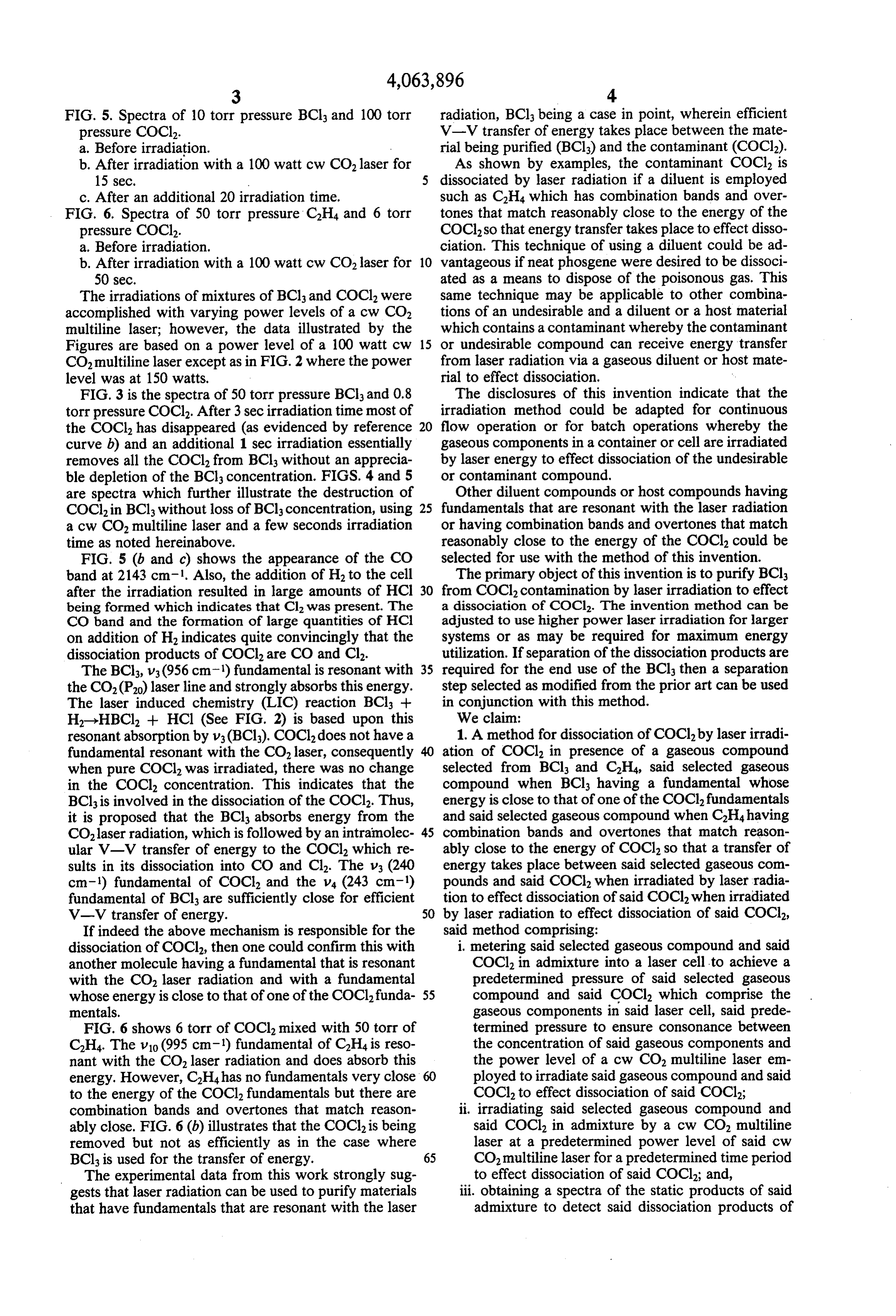
FIG. 3 is the spectra of 50 torr pressure BC and 0.8 The disclosures of this invention indicate that the torr pressure COCl. After 3 sec irradiation time most of irradiation method could be adapted for continuous the COCl has disappeared (as evidenced by reference 20 flow operation or for batch operations whereby the curve b) and an additional 1 sec irradiation essentially gaseous components in a container or cell are irradiated removes all the COCl2 from BCl3 without an apprecia by laser energy to effect dissociation of the undesirable ble depletion of the BCls concentration. FIGS. 4 and 5 or contaminant compound.
are spectra which further illustrate the destruction of Other diluent compounds or host compounds having COCl in BCl3 without loss of BCl3 concentration, using 25 fundamentals that are resonant with the laser radiation a cw CO multiline laser and a few seconds irradiation or having combination bands and overtones that match time as noted hereinabove. reasonably close to the energy of the COCl could be FIG. 5 (b and c) shows the appearance of the CO selected for use with the method of this invention. band at 2143 cm-1. Also, the addition of H2 to the cell The primary object of this invention is to purify BCls after the irradiation resulted in large amounts of HCl 30 from COCl2 contamination by laser irradiation to effect being formed which indicates that Cl2 was present. The a dissociation of COCl. The invention method can be CO band and the formation of large quantities of HCl adjusted to use higher power laser irradiation for larger on addition of H indicates quite convincingly that the systems or as may be required for maximum energy dissociation products of COCl are CO and Cl2. utilization. If separation of the dissociation products are The BCls, v3 (956 cm-l) fundamental is resonant with 35 required for the end use of the BCls then a separation the CO, (Po) laser line and strongly absorbs this energy. step selected as modified from the prior art can be used The laser induced chemistry (LIC) reaction BCls -- in conjunction with this method. H-HBCl + HCl (See FIG. 2) is based upon this We claim:
resonant absorption by vs (BCl). COCl does not have a 1. A method for dissociation of COCl by laser irradi fundamental resonant with the CO, laser, consequently ation of COCl in presence of a gaseous compound when pure COCl was irradiated, there was no change selected from BCl3 and CH4, said selected gaseous in the COCl concentration. This indicates that the compound when BCls having a fundamental whose BC1 is involved in the dissociation of the COCl. Thus, energy is close to that of one of the COCl, fundamentals it is proposed that the BCls absorbs energy from the and said selected gaseous compound when C2H4 having CO2 laser radiation, which is followed by an intramolec 45 combination bands and overtones that match reason ular V-V transfer of energy to the COCl which re ably close to the energy of COCl, so that a transfer of sults in its dissociation into CO and Cl2. The v3 (240 energy takes place between said selected gaseous com cm-1) fundamental of COCl and the v4 (243 cm) pounds and said COCl when irradiated by laser radia fundamental of BCls are sufficiently close for efficient tion to effect dissociation of said COCl when irradiated V-V transfer of energy. 50 by laser radiation to effect dissociation of said COCl, If indeed the above mechanism is responsible for the said method comprising:
dissociation of COCl, then one could confirm this with i. metering said selected gaseous compound and said another molecule having a fundamental that is resonant COCl in admixture into a laser cell to achieve a with the CO2 laser radiation and with a fundamental predetermined pressure of said selected gaseous whose energy is close to that of one of the COCl, funda 55 compound and said COCl, which comprise the mentals. gaseous components in said laser cell, said prede FIG. 6 shows 6 torr of COCl mixed with 50 torr of termined pressure to ensure consonance between CH4. The vio (995 cm-l) fundamental of CH4 is reso the concentration of said gaseous components and nant with the CO2 laser radiation and does absorb this the power level of a cw CO2 multiline laser em energy. However, C2H4 has no fundamentals very close ployed to irradiate said gaseous compound and said to the energy of the COCl, fundamentals but there are COCl to effect dissociation of said COCl2: combination bands and overtones that match reason ii. irradiating said selected gaseous compound and ably close. FIG. 6 (b) illustrates that the COCl is being said COCl in admixture by a cw CO multiline removed but not as efficiently as in the case where laser at a predetermined power level of said cw BCl3 is used for the transfer of energy. 65 CO, multiline laser for a predetermined time period The experimental data from this work strongly sug to effect dissociation of said COCl; and, gests that laser radiation can be used to purify materials iii. obtaining a spectra of the static products of said that have fundamentals that are resonant with the laser admixture to detect said dissociation products of
Page 10
said COCl and to determine when all the COCl. 4. The method of claim 1 wherein said selected gase has been dissociated into dissociation products ous compound is BCls and said COClare mixed to form which are substantially CO and Cland said spectra said admixture wherein said predetermined pressure of to additionally detect any appreciable depletion of said BCl3 varies from about 6 torr to about 50 torr and said selected gaseous compound. 5 said COCl varies from about 0.8 torr to about 100 torr; 2. The method of claim 1 wherein said selected gase said predetermined power level of said cw CO, multi ous compound is BCl3 and said COCl is present as a line laser is about 100 watts; said predetermined time of contaminant in an amount of about 0.1%, said predeter irradiating is from about 4 seconds to about 35 seconds; and wherein said spectra detects that essentially all of mined pressure is in the range from about 50 torr to O said COCl has been dissociated into said dissociation about 100 torr; said predetermined power level of said products and that no appreciable depletion of said BC cw CO2 multiline laser is about 100 watts; said predeter concentration has taken place. mined time of irradiating is from about 3 seconds to about 4 seconds; and wherein said spectra detects that pressure of said of 5. The method claim 4 wherein said predetermined essentially all of said COCl has been dissociated into 15 mined pressure of said isCOCl BCl3 about 50 torr, said predeter is about 0.8 torr; and said said dissociation products and that no appreciable de predetermined time of irradiating is about 4 seconds. pletion of said BCl3 concentration has taken place. 6. The method of claim 4 wherein said predetermined 3. The method of claim 1 wherein said selected gase pressure of said BCl3 is about 6 torr; said predetermined ous compound is C2H4 and said COCl are mixed to pressure of said COCl is about 6 torr; and said predeter form said admixture wherein said predetermined pres mined time of irradiating is about 15 seconds. sure of said CH4 is about 50 torr; said predetermined 7. The method of claim 4 wherein said predetermined pressure of said COCl is about 6 torr; said predeter pressure of said BCl3 is about 10 torr; said predeter mined power level of said cw CO, multiline laser is mined pressure of said COCl is about 100 torr; and said about 100 watts; and said predetermined time or irradi predetermined time of irradiating is about 35 seconds. ating is about 50 seconds. 25 k . . . .
Provenance
- Collection
- Cited prior art
- Original PDF
- patentimages.storage.googleapis.com →
- Filed
- 1976-12-27
- Pages
- 10
- Method
- pdftotext (the PDF's own text layer) + pdftoppm 300dpi page scans
- Source
- Google Patents bibliographic record
- Granted
- 1977-12-20
- Inventors
- James A. Merritt; Lawrence C. Robertson; United States Department of the Army
- Transcribed from
- patentimages.storage.googleapis.com →