patent · US4213836
Laser-induced separation of hydrogen isotopes in the liquid phase
22 July 1980
Page 1 — bibliographic record
United States Patent (19) (11) 4,213,836 Freund et al. 45) Jul. 22, 1980 54) LASER-INDUCED SEPARATION OF 4,025,408 5/1977 Marling ....................... 204/DIG. 11 HYDROGEN ISOTOPES IN THE LIQUID 4,049,515 9/1977 Robinson et al. ............. 204/157.1 R PHASE 4,081,339 3/1978 Benson ............................. 204/158 R 75) Inventors: Samuel M. Freund; William B. Maier, OTHER PUBLICATIONS II; Willard H. Beattie; Redus F. Marling, J. Chem. Phys., 66, 4200 (1977).
Holland, all of Los Alamos, N. Mex.
Primary Examiner-Howard S. Williams 73 Assignee: The United States of America as Attorney, Agent, or Firm-R. V. Lupo; Edward C. represented by the United States Walterscheid; Paul D. Gaetjens
Department of Energy, Washington,
D.C. (57) ABSTRACT 21 Appl. No.: 839,238 Hydrogen isotope separation is achieved by either (a) dissolving a hydrogen-bearing feedstock compound in a 22 Filed: Oct. 4, 1977 liquid solvent, or (b) liquefying a hydrogen-bearing (Under 37 CFR 1.47) feedstock compound, the liquid phase thus resulting 51) Int. Cl’................................................ BO1 1/10 being kept at a temperature at which spectral features of 52 U.S. Cl. ......................... 204/157.1 R; 204/158 R; the feedstock relating to a particular hydrogen isotope 204/162 R; 204/DIG. 11 are resolved, i.e., a clear-cut isotope shift is delineated, 58 Field of Search ................................. 204/DIG. 11; irradiating the liquid phase with monochromatic radia 157. 1 R, 158 R, 162 R tion of a wavelength which at least preferentially ex (56) References Cited cites those molecules of the feedstock containing a first hydrogen isotope, inducing photochemical reaction in
3,904,500 9/1975 Jenson ......................... 2O4/DIG. 11 uct containing the first isotope from the liquid phase. 3,947,335 3/1976 Marling ........ ... 204/DIG.
3,983,020 9/976 Moore et al. ................ 2O4/DIG. 11 12 Claims, 3 Drawing Figures
--- Deco
27O 28O 29O. 3OO 3O 32O 33O 34O
WAVELENGTH (nm)
Page 2
Drawing sheet — no readable text.
Page 3
Drawing sheet — no readable text.
Page 4
Drawing sheet — no readable text.
Page 5
easily accomplished if the molecular density of the hy
LASER-INDUCED SEPARATION OF HYDROGEN drogen-bearing feed material is reasonably high. More ISOTOPES IN THE LIQUID PHASE over, the foregoing requirements must be capable of being met in a practical environment envisioned for a
BACKGROUND OF THE INVENTION 5 given isotope separation scheme. It will be apparent The invention described herein relates to a method that for efficient, large-scale isotope separation, this for separating the isotopes of hydrogen, and more spe environment will preferably be a flowing one. Finally, cifically to a method wherein the isotopes of hydrogen the raw or feed materials should be inexpensive and the are separated as a result of isotope preferential or selec O separation of the products simple. tive photochemical reaction in the liquid phase. Heretofore the art has disclosed laser-induced hydro The Candu fission reactor employs natural uranium gen isotope separation methods in which the irradiation rather than enriched uranium as its fuel. To do this, occurs to a feed material in the gaseous phase. But to however, requires the use of heavy water (D2O) as the meet the foregoing criteria, it would be highly advanta moderator and coolant. The separation of hydrogen geous to perform the irradiation of the feed material isotopes in quantities sufficient to meet the large 15 when it is in a liquid phase. The published literature amounts of heavy water required constitutes a signifi does not disclose any method for achieving laser cant portion of the cost of Candu reactors. At present, induced isotope separation using a feed material in the most of the heavy water is produced by the Girdler liquid phase.
sulfide process, a process which requires large quanti A basic reason why laser-induced isotope separation ties of H2S at high pressure. Since H2S in quantities methods based on irradiation in the liquid phase have larger than a few parts per million is poisonous, the notheretofore been reported is that the spectral features accidental release of this material represents a signifi exhibited by compounds in the liquid state or in solution cant potential health hazard in the use of the Girdler at or near room temperature process. Thus, another efficient and economical means 25 be substantially broader than(300 K.) are considered to the isotope shift so that of achieving the required hydrogen isotope separation is highly desirable. condition (1) listed herein cannot be met. Laser-induced separation of hydrogen isotopes is SUMMARY OF THE INVENTION known in the art. To accomplish laser-induced separa tion of hydrogen isotopes by photochemical techniques We have found that when a compound containing a requires the following requirements to be met: (1) A 30 mixture of hydrogen isotopes is liquified or placed in chemical compound of hydrogen must be available solution in an appropriate solvent and sufficiently which has optical absorption features for which the cooled, spectral features of the compound are suffi absorption varies rapidly with wavelength and which ciently narrowed that a clear-cut isotope shift is delin appear at different wavelengths for different hydrogen eated, and selective or at least preferential excitation of isotopes, i.e., there must be a well delineated isotope 35 those molecules containing a particular hydrogen iso shift, so that the excitation can be preferentially induced tope is readily achieved by irradiating the solution with in isotopically distinct molecules of the compound. (2) monochromatic radiation of the proper wavelength. The excited molecules must then either spontaneously This excitation provides the basis for hydrogen isotope undergo or be induced to undergo some sort of chemi separation in the liquid phase using photochemistry. cal change more rapidly than the unexcited molecules. In its broad sense our invention encompasses a pro (3) The product hydrogen compound or molecule cess for separating hydrogen isotopes which comprises which results must possess properties which permit its (a) forming a liquid phase of a hydrogen-bearing feed separation by physical or chemical means from the stock compound at a temperature at which the spectral reactant or feed hydrogen compound. The separated features of the feedstock compound are narrow enough hydrogen-bearing product molecules will then be isoto 45 or the absorption edges sharp enough to permit spectral pically enriched. It will be apparent that the degree of features corresponding to the different hydrogen iso enrichment will depend upon the amount of selectivity topes to be separated to be distinguished, (b) irradiating in the excitation and photochemical reaction steps and the liquid phase at this temperature with monochro the amount of scrambling which occurs before the matic radiation of a first wavelength which selectively product hydrogen-bearing molecules are separated 50 or at least preferentially excites those molecules of the from the reactant or feed hydrogen compound. By feedstock compound containing a first hydrogen iso scrambling is meant any chemical or physical process tope, and (c) subjecting the excited molecules to physi the effect of which is to exchange isotopes or excitation cal or chemical processes or a combination thereof and which results in a lesser degree of selectivity.
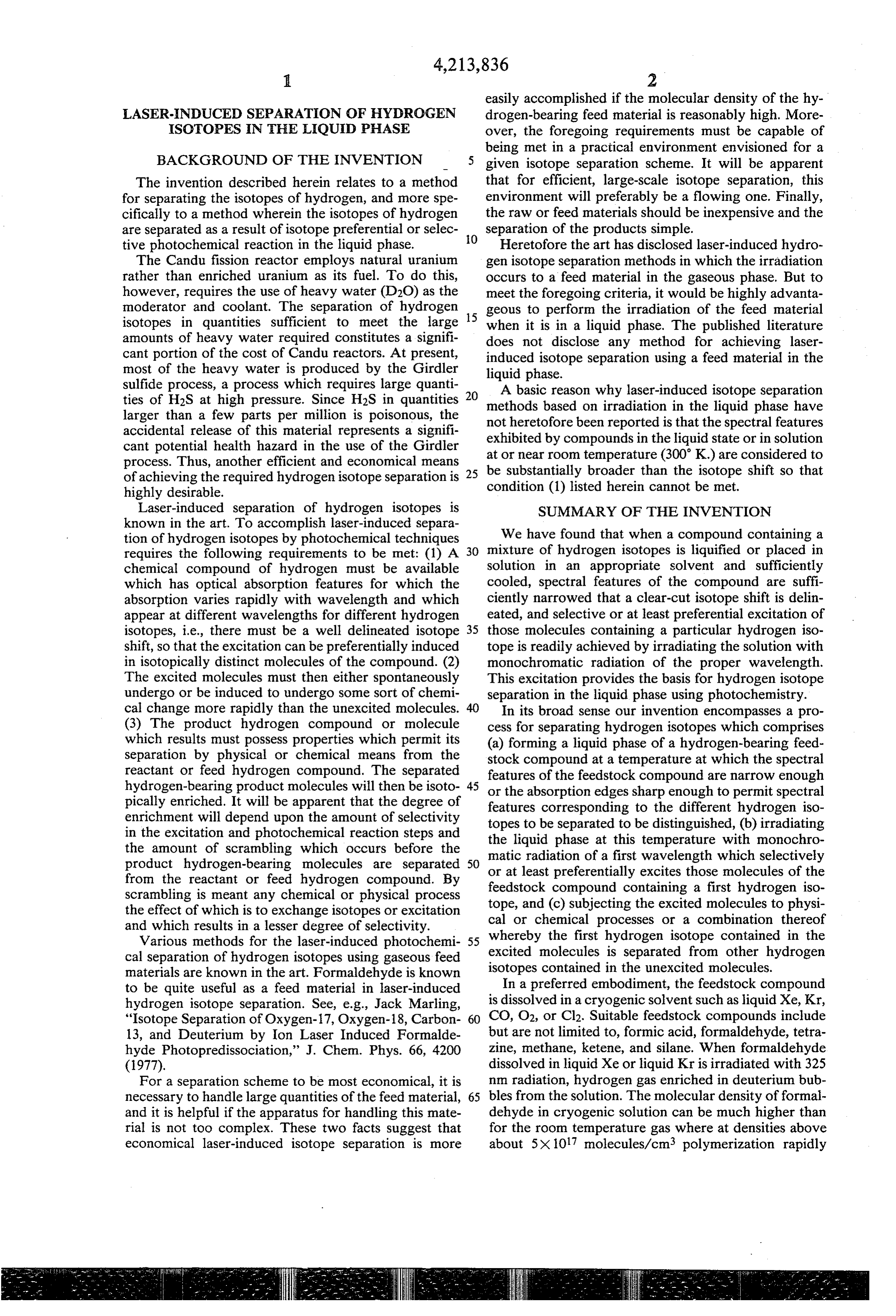
Various methods for the laser-induced photochemi 55 whereby the first hydrogen isotope contained in the cal separation of hydrogen isotopes using gaseous feed excited molecules is separated from other hydrogen materials are known in the art. Formaldehyde is known isotopes contained in the unexcited molecules. to be quite useful as a feed material in laser-induced In a preferred embodiment, the feedstock compound hydrogen isotope separation. See, e.g., Jack Marling, is dissolved in a cryogenic solvent such as liquid Xe, Kr., "Isotope Separation of Oxygen-17, Oxygen-18, Carbon 60 CO, O2, or Cl2. Suitable feedstock compounds include 13, and Deuterium by Ion Laser Induced Formalde but are not limited to, formic acid, formaldehyde, tetra hyde Photopredissociation,” J. Chem. Phys. 66, 4200 zine, methane, ketene, and silane. When formaldehyde (1977). dissolved in liquid Xe or liquid Kris irradiated with 325 For a separation scheme to be most economical, it is nm radiation, hydrogen gas enriched in deuterium bub necessary to handle large quantities of the feed material, 65 bles from the solution. The molecular density of formal and it is helpful if the apparatus for handling this mate dehyde in cryogenic solution can be much higher than rial is not too complex. These two facts suggest that for the room temperature gas where at densities above economical laser-induced isotope separation is more about 5X 10¹⁷ molecules/cm3 polymerization rapidly
Page 6
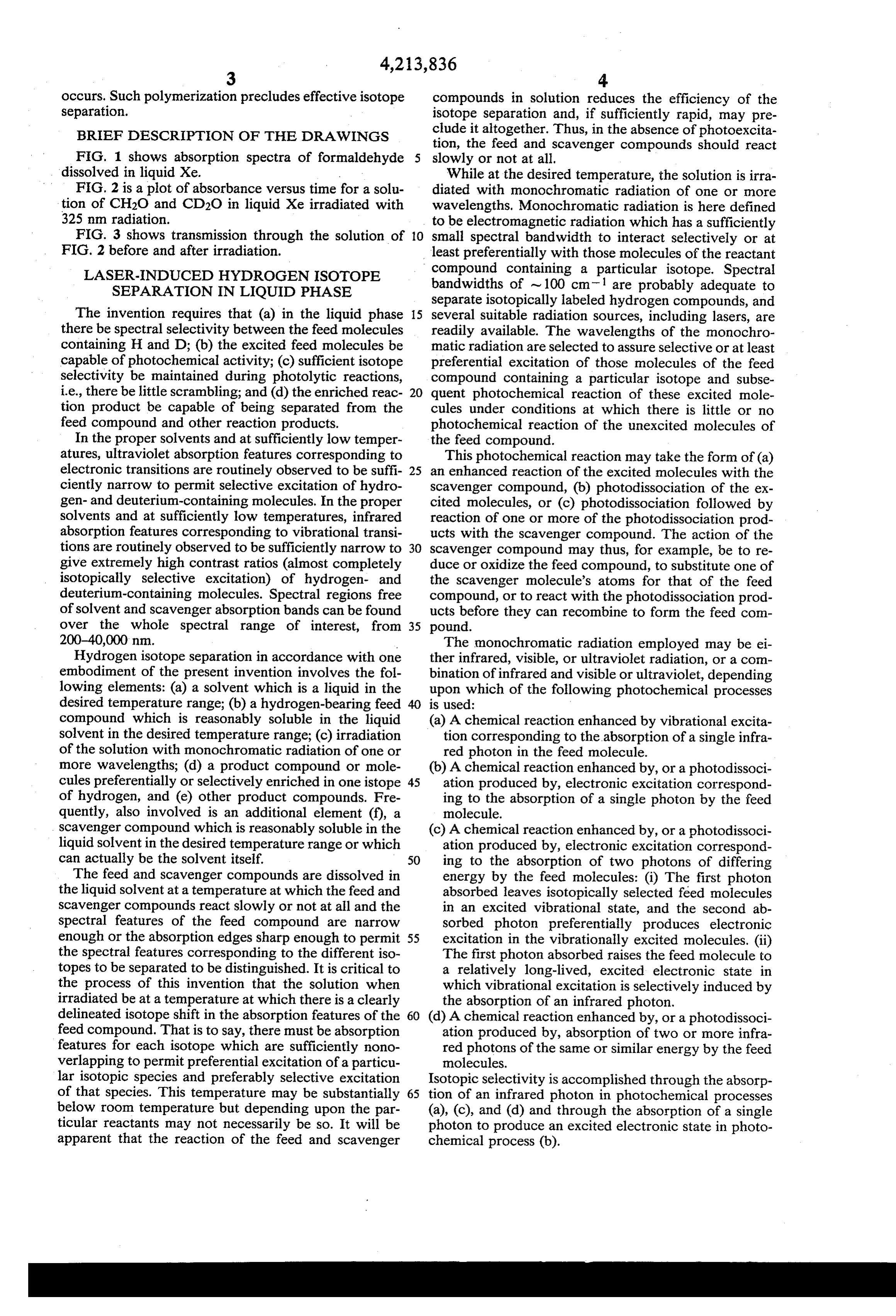
occurs. Such polymerization precludes effective isotope compounds in solution reduces the efficiency of the separation. isotope separation and, if sufficiently rapid, may pre BRIEF DESCRIPTION OF THE DRAWINGS clude it altogether. Thus, in the absence of photoexcita tion, the feed and scavenger compounds should react
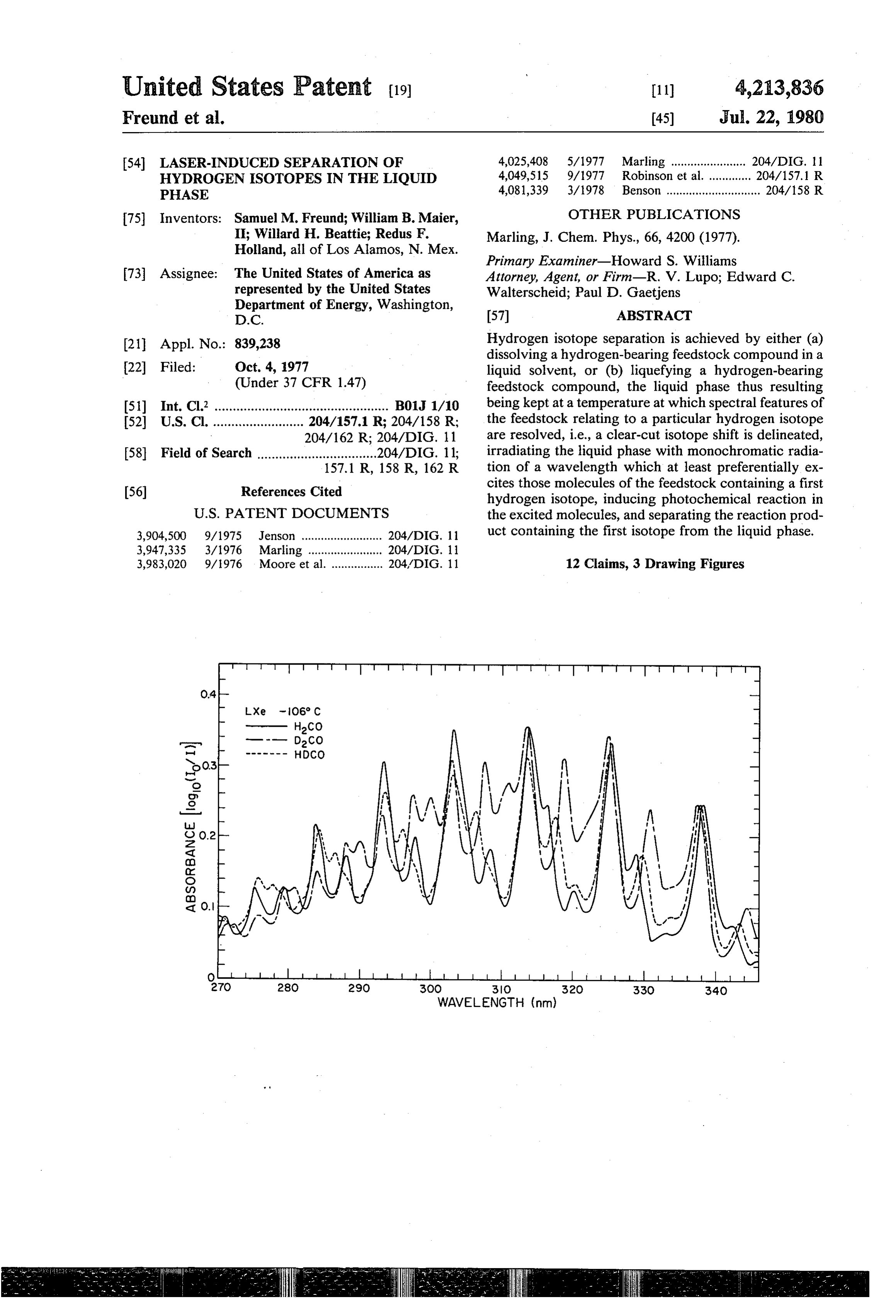
FIG. 1 shows absorption spectra of formaldehyde 5 slowly or not at all.
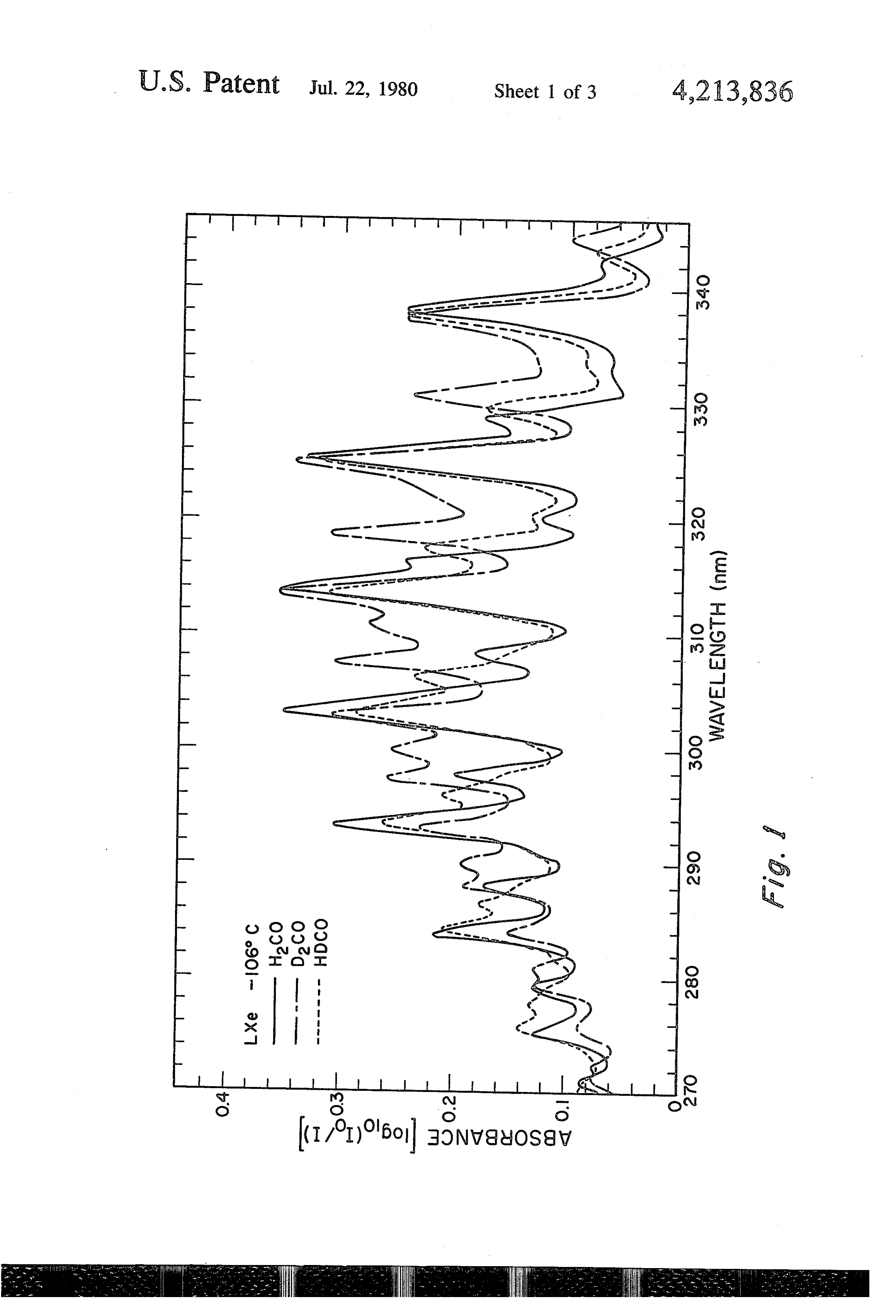
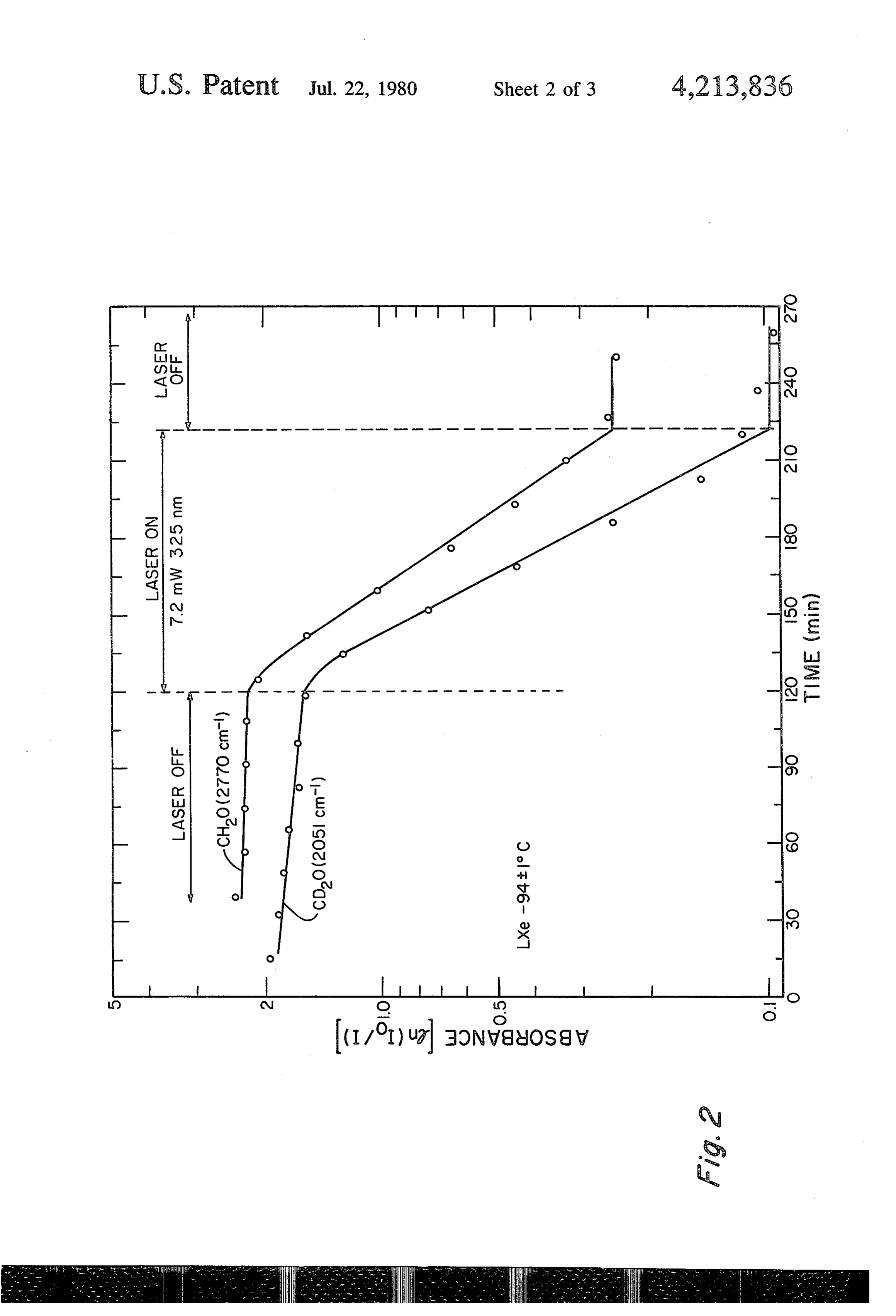
dissolved in liquid Xe. While at the desired temperature, the solution is irra FIG. 2 is a plot of absorbance versus time for a solu diated with monochromatic radiation of one or more tion of CH2O and CD2O in liquid Xe irradiated with wavelengths. Monochromatic radiation is here defined 325 nm radiation. to be electromagnetic radiation which has a sufficiently FIG. 3 shows transmission through the solution of 10 small spectral bandwidth to interact selectively or at FIG. 2 before and after irradiation. least preferentially with those molecules of the reactant LASER-INDUCED HYDROGEN ISOTOPE compound containing a particular isotope. Spectral SEPARATION IN LIQUID PHASE bandwidths of ~ 100 cm are probably adequate to separate isotopically labeled hydrogen compounds, and
The invention requires that (a) in the liquid phase 15 several suitable radiation sources, including lasers, are there be spectral selectivity between the feed molecules readily available. The wavelengths of the monochro containing H and D; (b) the excited feed molecules be matic radiation are selected to assure selective or at least capable of photochemical activity; (c) sufficient isotope preferential excitation of those molecules of the feed selectivity be maintained during photolytic reactions, compound containing a particular isotope and subse i.e., there be little scrambling; and (d) the enriched reac 20 quent photochemical reaction of these excited mole tion product be capable of being separated from the cules under conditions at which there is little or no feed compound and other reaction products. photochemical reaction of the unexcited molecules of In the proper solvents and at sufficiently low temper the feed compound.
atures, ultraviolet absorption features corresponding to This photochemical reaction may take the form of (a) electronic transitions are routinely observed to be suffi 25 an enhanced reaction of the excited molecules with the ciently narrow to permit selective excitation of hydro scavenger compound, (b) photodissociation of the ex gen- and deuterium-containing molecules. In the proper cited molecules, or (c) photodissociation followed by solvents and at sufficiently low temperatures, infrared reaction of one or more of the photodissociation prod absorption features corresponding to vibrational transi ucts with the scavenger compound. The action of the tions are routinely observed to be sufficiently narrow to 30 scavenger compound may thus, for example, be to re give extremely high contrast ratios (almost completely duce or oxidize the feed compound, to substitute one of isotopically selective excitation) of hydrogen- and the scavenger molecule's atoms for that of the feed deuterium-containing molecules. Spectral regions free compound, or to react with the photodissociation prod of solvent and scavenger absorption bands can be found ucts before they can recombine to form the feed com over the whole spectral range of interest, from 35 pound.
200-40,000 nm. The monochromatic radiation employed may be ei Hydrogen isotope separation in accordance with one ther infrared, visible, or ultraviolet radiation, or a con embodiment of the present invention involves the fol bination of infrared and visible or ultraviolet, depending lowing elements: (a) a solvent which is a liquid in the upon which of the following photochemical processes desired temperature range; (b) a hydrogen-bearing feed is used:
compound which is reasonably soluble in the liquid (a) A chemical reaction enhanced by vibrational excita solvent in the desired temperature range; (c) irradiation tion corresponding to the absorption of a single infra of the solution with monochromatic radiation of one or red photon in the feed molecule. more wavelengths; (d) a product compound or mole (b) A chemical reaction enhanced by, or a photodissoci cules preferentially or selectively enriched in one istope 45 ation produced by, electronic excitation correspond of hydrogen, and (e) other product compounds. Fre ing to the absorption of a single photon by the feed quently, also involved is an additional element (f), a molecule.
scavenger compound which is reasonably soluble in the (c) A chemical reaction enhanced by, or a photodissoci liquid solvent in the desired temperature range or which ation produced by, electronic excitation correspond can actually be the solvent itself. 50 ing to the absorption of two photons of differing The feed and scavenger compounds are dissolved in energy by the feed molecules: (i) The first photon the liquid solvent at a temperature at which the feed and absorbed leaves isotopically selected feed molecules scavenger compounds react slowly or not at all and the in an excited vibrational state, and the second ab spectral features of the feed compound are narrow sorbed photon preferentially produces electronic enough or the absorption edges sharp enough to permit 55 excitation in the vibrationally excited molecules. (ii) the spectral features corresponding to the different iso The first photon absorbed raises the feed molecule to topes to be separated to be distinguished. It is critical to a relatively long-lived, excited electronic state in the process of this invention that the solution when which vibrational excitation is selectively induced by irradiated be at a temperature at which there is a clearly the absorption of an infrared photon. delineated isotope shift in the absorption features of the 60 (d) A chemical reaction enhanced by, or a photodissoci feed compound. That is to say, there must be absorption ation produced by, absorption of two or more infra features for each isotope which are sufficiently nono red photons of the same or similar energy by the feed verlapping to permit preferential excitation of a particu molecules.
lar isotopic species and preferably selective excitation Isotopic selectivity is accomplished through the absorp of that species. This temperature may be substantially 65 tion of an infrared photon in photochemical processes below room temperature but depending upon the par (a), (c), and (d) and through the absorption of a single ticular reactants may not necessarily be so. It will be photon to produce an excited electronic state in photo apparent that the reaction of the feed and scavenger chemical process (b).
Page 7
The isotopically enriched product compound which ;S350 nm. Absorption spectra of CH2O, CHDO, and results from the photochemical reaction is chemically CD2O have rotational lines spectrally resolved from and physically different from the product compound each other, so that any of these gaseous species can be and can be separated from it in various ways well preferentially excited by laser light in the presence of known in the chemical arts, as, e.g., by filtration of a the others.
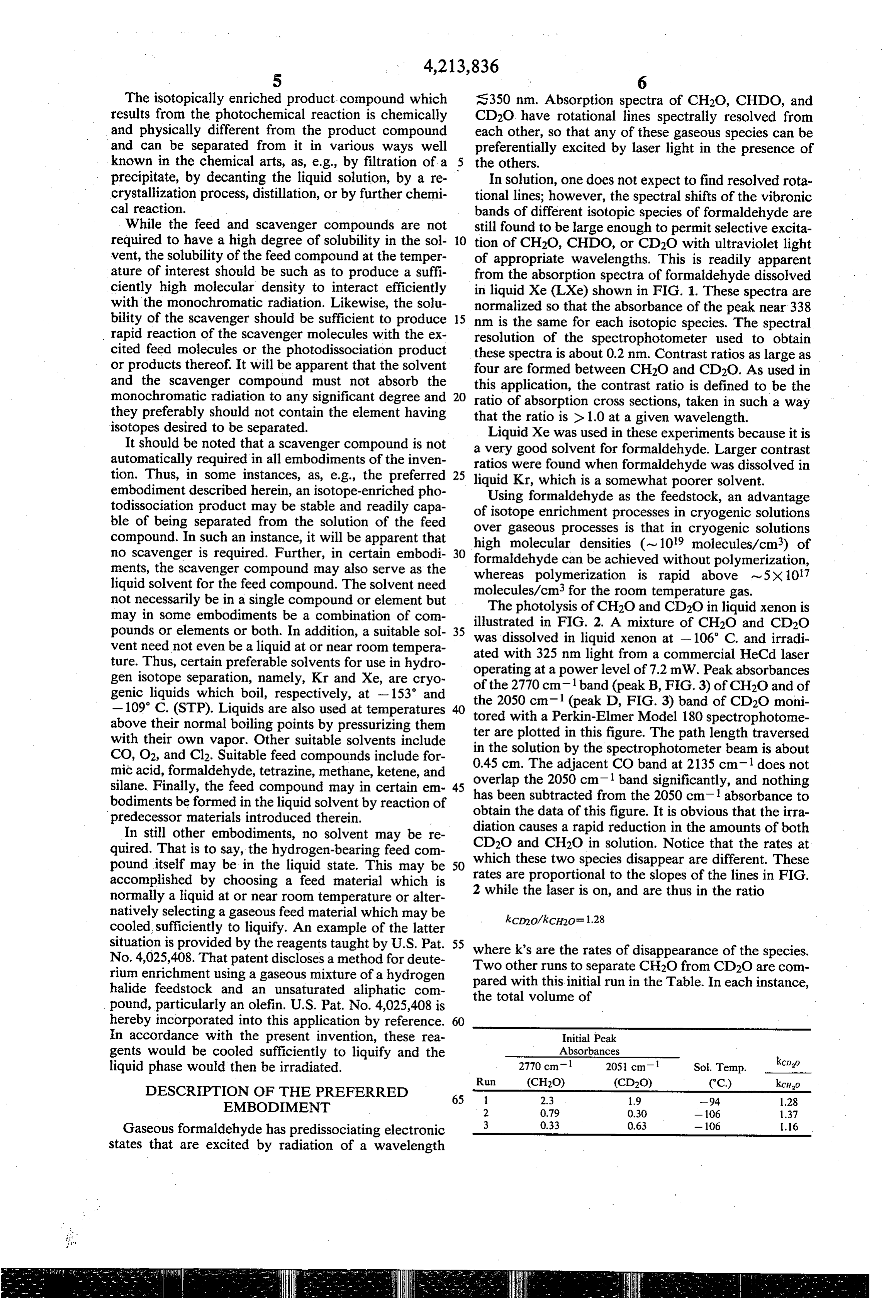
precipitate, by decanting the liquid solution, by a re In solution, one does not expect to find resolved rota crystallization process, distillation, or by further chemi tional lines; however, the spectral shifts of the vibronic cal reaction. bands of different isotopic species of formaldehyde are While the feed and scavenger compounds are not still found to be large enough to permit selective excita required to have a high degree of solubility in the sol 10 tion of CH2O, CHDO, or CD2O with ultraviolet light vent, the solubility of the feed compound at the temper of appropriate wavelengths. This is readily apparent ature of interest should be such as to produce a suffi from the absorption spectra of formaldehyde dissolved ciently high molecular density to interact efficiently in liquid Xe (LXe) shown in FIG. 1. These spectra are with the monochromatic radiation. Likewise, the solu normalized so that the absorbance of the peak near 338 bility of the scavenger should be sufficient to produce 15 nm is the same for each isotopic species. The spectral rapid reaction of the scavenger molecules with the ex resolution of the spectrophotometer used to obtain cited feed molecules or the photodissociation product these spectra is about 0.2 nm. Contrast ratios as large as or products thereof. It will be apparent that the solvent four are formed between CH2O and CD2O. As used in and the scavenger compound must not absorb the this application, the contrast ratio is defined to be the monochromatic radiation to any significant degree and 20 ratio of absorption cross sections, taken in such a way they preferably should not contain the element having that the ratio is > 1.0 at a given wavelength. isotopes desired to be separated. Liquid Xe was used in these experiments because it is It should be noted that a scavenger compound is not a very good solvent for formaldehyde. Larger contrast automatically required in all embodiments of the inven ratios were found when formaldehyde was dissolved in tion. Thus, in some instances, as, e.g., the preferred 25 liquid Kr, which is a somewhat poorer solvent. embodiment described herein, an isotope-enriched pho todissociation product may be stable and readily capa ofUsing isotope formaldehyde as the feedstock, an advantage enrichment processes in cryogenic solutions ble of being separated from the solution of the feed over gaseous compound. In such an instance, it will be apparent that high molecularprocesses densities is that in cryogenic solutions
no scavenger is required. Further, in certain embodi 30 formaldehyde can be achieved without polymerization, ments, the scavenger compound may also serve as the whereas polymerization is rapid above - 5X 10¹⁷ liquid solvent for the feed compound. The solvent need molecules/cm3 for the room temperature gas. not necessarily be in a single compound or element but may in some embodiments be a combination of com illustrated in FIG. 2. A mixture of CH2O andxenon The photolysis of CH2O and CD2O in liquid
pounds or elements or both. In addition, a suitable sol was dissolved in liquid xenon at -106° C. and irradi
vent need not even be a liquid at or near room tempera ated with 325 nm light from a commercial HeCd laser ture. Thus, certain preferable solvents for use in hydro operating gen isotope separation, namely, Kr and Xe, are cryo of the 2770atcm-1 a power level of 7.2 mW. Peak absorbances band (peak B, FIG. 3) of CH2O and of genic liquids which boil, respectively, at -153 and the 2050 cm-1 (peak D, FIG. 3) band of CD2O moni -109 C. (STP). Liquids are also used at temperatures tored with a Perkin-Elmer Model 180 spectrophotome above their normal boiling points by pressurizing them ter are plotted in this figure. The path length traversed with their own vapor. Other suitable solvents include in the solution by the spectrophotometer beam is about CO, O2, and Cl2. Suitable feed compounds include for 0.45 cm. The adjacent CO band at 2135 cm mic acid, formaldehyde, tetrazine, methane, ketene, and overlap the 2050 cm band significantly, anddoes not nothing silane. Finally, the feed compound may in certain em 45 has been subtracted from the 2050 cm absorbance to bodiments beformed in the liquid solvent by reaction of obtain the data of this figure. It is obvious that the irra predecessor materials introduced therein.
In still other embodiments, no solvent may be re diation causes a rapid reduction in the amounts of both quired. That is to say, the hydrogen-bearing feed com CD2O and CH2O in solution. Notice that the rates at pound itself may be in the liquid state. This may be 50 which these two species disappear are different. These accomplished by choosing a feed material which is rates are proportional to the slopes of the lines in FIG. normally a liquid at or near room temperature or alter 2 while the laser is on, and are thus in the ratio natively selecting a gaseous feed material which may be cooled sufficiently to liquify. An example of the latter situation is provided by the reagents taught by U.S. Pat. 55 where k's are the rates of disappearance of the species. No. 4,025,408. That patent discloses a method for deute rium enrichment using a gaseous mixture of a hydrogen Two other runs to separate CH2O from CD2O are com halide feedstock and an unsaturated aliphatic com pared with this initial run in the Table. In each instance, the total volume of pound, particularly an olefin. U.S. Pat. No. 4,025,408 is hereby incorporated into this application by reference. 60
In accordance with the present invention, these rea Initial Peak gents would be cooled sufficiently to liquify and the Absorbances liquid phase would then be irradiated. 2770 cm-l 2051 cm- Sol. Temp. kcdo
DESCRIPTION OF THE PREFERRED 65 2.3 1.9 -94 1.28 EMBODIMENT 2 0.79 0.30 - 106 1.37 Gaseous formaldehyde has predissociating electronic 3 0.33 0.63 - 106 1.16 states that are excited by radiation of a wavelength
Page 8
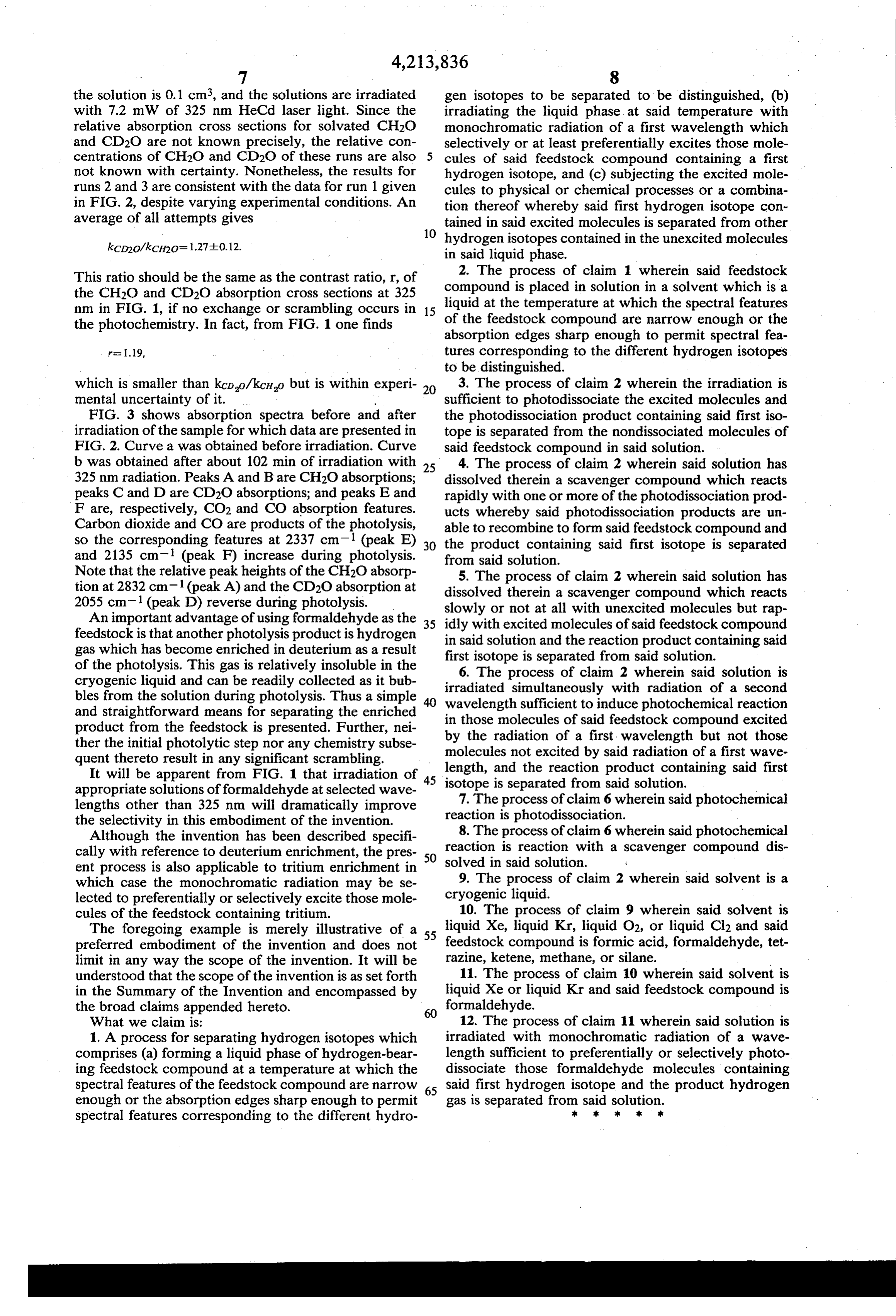
the solution is 0.1 cm3, and the solutions are irradiated gen isotopes to be separated to be distinguished, (b) with 7.2 mW of 325 nm HeCd laser light. Since the irradiating the liquid phase at said temperature with relative absorption cross sections for solvated CH2O monochromatic radiation of a first wavelength which and CD2O are not known precisely, the relative con selectively or at least preferentially excites those mole centrations of CH2O and CD2O of these runs are also 5 cules of said feedstock compound containing a first not known with certainty. Nonetheless, the results for hydrogen isotope, and (c) subjecting the excited mole runs 2 and 3 are consistent with the data for run 1 given cules to physical or chemical processes or a combina in FIG. 2, despite varying experimental conditions. An tion thereof whereby said first hydrogen isotope con average of all attempts gives tained in said excited molecules is separated from other 1O hydrogen isotopes contained in the unexcited molecules kCD2O/kCH2O= 1.270.12. in said liquid phase.
This ratio should be the same as the contrast ratio, r, of 2. The process of claim 1 wherein said feedstock the CH2O and CD2O absorption cross sections at 325 compound is placed in solution in a solvent which is a nm in FIG. 1, if no exchange or scrambling occurs in 15 liquid at the temperature at which the spectral features the photochemistry. In fact, from FIG. 1 one finds of the feedstock compound are narrow enough or the absorption edges sharp enough to permit spectral fea re: 1.19, tures corresponding to the different hydrogen isotopes to be distinguished.
which is smaller than kcdo/kcho but is within experi- 20 3. The process of claim 2 wherein the irradiation is mental uncertainty of it. sufficient to photodissociate the excited molecules and FIG. 3 shows absorption spectra before and after the photodissociation product containing said first iso irradiation of the sample for which data are presented in tope is separated from the nondissociated molecules of FIG. 2. Curve a was obtained before irradiation. Curve said feedstock compound in said solution. b325wasnmobtained after about 102 min of irradiation with 4. The process of claim 2 wherein said solution has radiation. Peaks A and B are CH2O absorptions; dissolved therein a scavenger compound which reacts peaks C and D are CD2O absorptions; and peaks E and rapidly with one or more of the photodissociation prod Fare, respectively, CO2 and CO absorption features. ucts whereby said photodissociation products are un Carbon dioxide and CO are products of the photolysis, able to recombine to form said feedstock compound and so the corresponding features at 2337 cm (peak E) 30 the product containing said first isotope is separated and 2135 cm (peak F) increase during photolysis. from said solution.
Note that the relative peak heights of the CH2O absorp 5. The process of claim 2 wherein said solution has tion at 2832 cm (peak A) and the CD2O absorption at dissolved therein a scavenger compound which reacts 2055 cm (peak D) reverse during photolysis.
An important advantage of using formaldehyde as the 35 slowly or not at all with unexcited molecules but rap feedstock is that another photolysis product is hydrogen idly with excited molecules of said feedstock compound in said solution and the reaction product containing said gas which has become enriched in deuterium as a result first isotope is separated from said solution. of the photolysis. This gas is relatively insoluble in the 6. The process of claim 2 wherein said solution is cryogenic liquid and can be readily collected as it bub irradiated bles from the solution during photolysis. Thus a simple wavelengthsimultaneously sufficient to with radiation of a second induce photochemical reaction and straightforward means for separating the enriched in those molecules of said feedstock compound excited product from the feedstock is presented. Further, nei by the radiation of a first wavelength ther the initial photolytic step nor any chemistry subse molecules not excited by said radiation ofbut not those a first wave quent thereto result in any significant scrambling.
It will be apparent from FIG. 1 that irradiation of 45 length, and the reaction product containing said first appropriate solutions of formaldehyde at selected wave isotope is separated from said solution. 7. The process of claim 6 wherein said photochemical lengths other than 325 nm will dramatically improve reaction is photodissociation. the selectivity in this embodiment of the invention. 8. The process of claim 6 wherein said photochemical Although the invention has been described specifi reaction cally with reference to deuterium enrichment, the pres 50 solved inissaidreaction with a scavenger compound dis solution.
ent process is also applicable to tritium enrichment in which case the monochromatic radiation may be se cryogenic liquid. of claim 2 wherein said solvent is a 9. The process lected to preferentially or selectively excite those mole cules of the feedstock containing tritium. 10. The process of claim 9 wherein said solvent is The foregoing example is merely illustrative of a 55 liquid Xe, liquid Kr, liquid O2, or liquid Cl2 and said preferred embodiment of the invention and does not feedstock compound is formic acid, formaldehyde, tet limit in any way the scope of the invention. It will be razine, ketene, methane, or silane. understood that the scope of the invention is as set forth 11. The process of claim 10 wherein said solvent is in the Summary of the Invention and encompassed by liquid Xe or liquid Kr and said feedstock compound is the broad claims appended hereto. formaldehyde.
What we claim is: 12. The process of claim 11 wherein said solution is 1. A process for separating hydrogen isotopes which irradiated with monochromatic radiation of a wave comprises (a) forming a liquid phase of hydrogen-bear length sufficient to preferentially or selectively photo ing feedstock compound at a temperature at which the dissociate those formaldehyde molecules containing spectral features of the feedstock compound are narrow 65 said first hydrogen isotope and the product hydrogen enough or the absorption edges sharp enough to permit gas is separated from said solution. spectral features corresponding to the different hydro six k
Provenance
- Collection
- Cited prior art
- Original PDF
- patentimages.storage.googleapis.com →
- Filed
- 1977-10-04
- Pages
- 8
- Method
- pdftotext (the PDF's own text layer) + pdftoppm 300dpi page scans
- Source
- Google Patents bibliographic record
- Granted
- 1980-07-22
- Inventors
- Samuel M. Freund; II William B. Maier; Willard H. Beattie; Redus F. Holland; US Department of Energy
- Transcribed from
- patentimages.storage.googleapis.com →