patent · US3904500
Hydrogen isotope separation from water
9 September 1975
Page 1 — bibliographic record
United States Patent (19) 11 3,904,500 Jensen (45) Sept. 9, 1975 54 HYDROGEN ISOTOPE SEPARATION FROM (June, 1944) pages 430, 431 and 451.
WATER
Mayer et al., Applied Physics Letters (Dec. 15, 1970) 75) Inventor: Reed J. Jensen, Los Alamos, N. Vol. 17, No. 12, pages 516-59. Mex.
73) Assignee: The United States of America as Primary Examiner-Howard S. Williams represented by the United States Attorney, Agent, or Firm-John A. Horan; Edward C. Energy Research and Development Walterscheid
Administration, Washington, D.C.
A process for separating tritium from tritium 52 U.S. Cl.............................................. 204/162 R containing water or deuterium enrichment from water 51 Int. Cl.............................................. B01 1/10 by selective, laser-induced two-photon excitation and (58) Field of Search............ . . . . . . . . . . 204/157. 1, 162 R photodissociation of those water molecules containing deuterium or tritium followed by immediate reaction 56 References Cited of the photodissociation products with a scavenger gas UNITED STATES PATENTS which does not substantially absorb the laser light. The reaction products are then separated from the un 2,713,025 7/1955 Billings......................... 204/1571 R dissociated water.
OTHER PUBLICATIONS 5 Claims, 3 Drawing Figures Le Roy, Canadian Chemistry and Process Industries
Page 2
Drawing sheet — no readable text.
Page 3
Drawing sheet — no readable text.
Page 4
Drawing sheet — no readable text.
Page 5
HYDROGEN ISOTOPE SEPARATION FROM laser light forms the basis of an efficient method for re WATER moving tritium from water or deuterium enrichment BACKGROUND OF THE INVENTION from water. The dissociation products are made to react rapidly with a scavenger gas that is not affected
The invention described herein was made in the by the laser irradiation. The reaction products are then course of, or under, a contract with the U.S. ATOMIC separated from the undissociated water. Ethylene is ENERGY COMMISSION. It relates to a method of iso particularly appropriate for use as a scavenger gas. tope separation based on selective excitation of isotope Broadly, the process of the invention comprises (1) species and more particularly to a method wherein the vaporizing water containing deuterium or tritium, (2) selective excitation is initiated by laser means. mixing the water vapor with ethylene, (3) irradiating There are three isotopes of hydrogen: H, with at. wt. the mixture of water vapor and ethylene with light from l; D, with at, wt. 2; and T, with at. wt. of 3. Deuterium a first laser of a frequency which excites water mole occurs in only about one part in six thousand of natural cules containing a particular isotopic species of hydro hydrogen. Tritium is unstable, with a half-life of 12.5 gen, e.g., deuterium or tritium, (4) simultaneously irra years. Deuterium and tritium have substantial utility in 15 diating the mixture with light from a second laser of a various nuclear applications, including nuclear weap frequency sufficient to photodissociate those molecules ons and controlled thermonuclear research. Unfortu excited by the light from the first laser but not to photo nately, tritium is produced in small quantities as a dissociate those molecules not excited by the first laser highly unwanted contaminant in nuclear reactor cool light, both lasers having frequencies that are not sub ing water. It is necessary as a part of nuclear reactor 20 stantially absorbed by the ethylene, and (5) separating waste management that such tritium be removed from the reaction products produced by the reaction of the the cooling water before the water is returned to the photodissociation products with the ethylene from the natural environment. undissociated water.
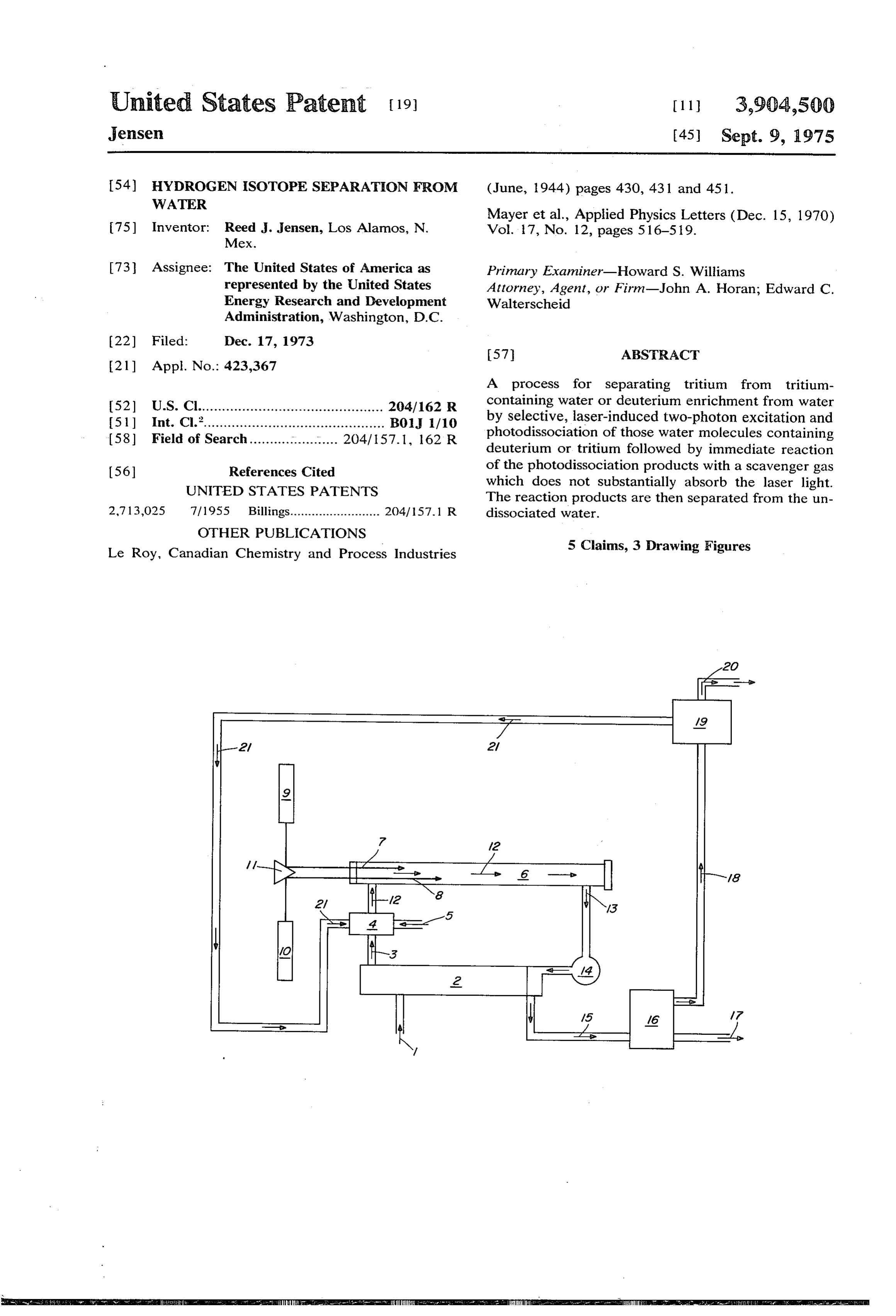
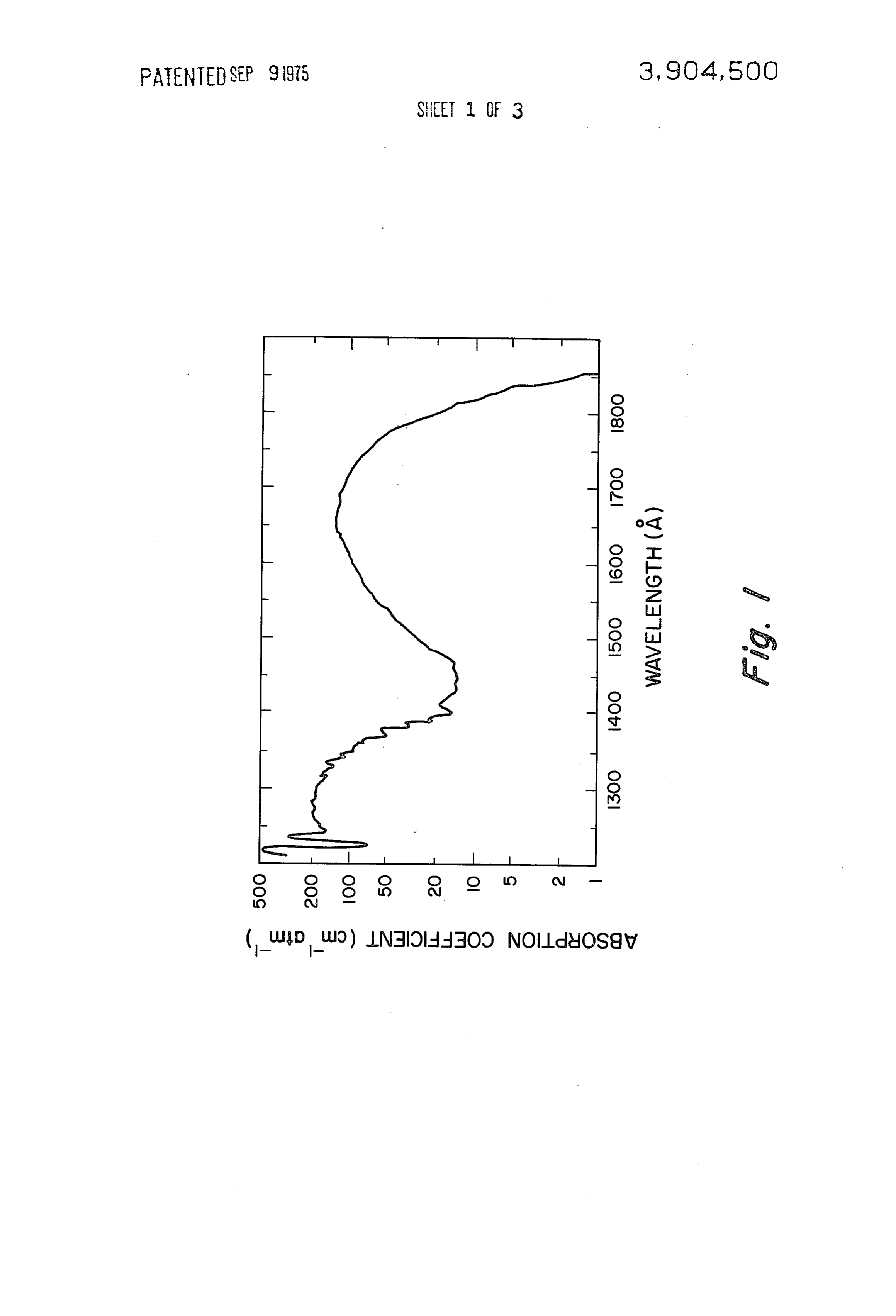
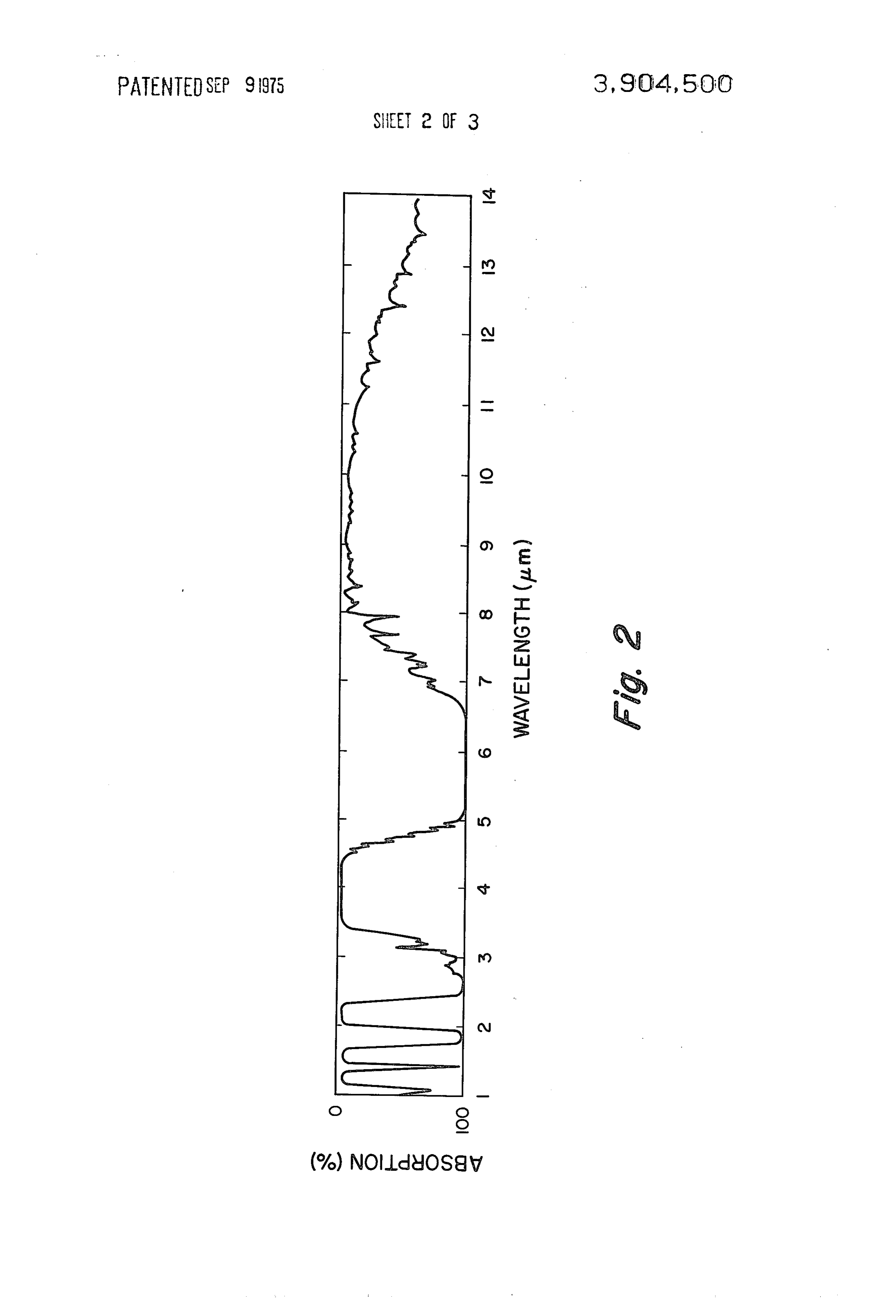
With the advent of lasers tunable to very narrow fre BRIEF DESCRIPTION OF THE DRAWINGS quencies over a wide range of the spectrum, it has be 25 come apparent that by controlling the spectral re FIG. 1 is the ultraviolet room temperature absorption sponse of the interaction of light with matter, it is possi spectrum of water in the region 1200 to 1900 A. ble, in principle, to produce selective reactions that can FIG. 2 is the infrared absorption spectrum at room change the composition and properties of the matter. temperature in the region from 1 to 13 um. The conditions required to achieve such selectivity are: 30 FIG. 3 is a schematic diagram showing an embodi (1) high monochromaticity of the exciting light; (2) the ment of the invention.
selectivity of the primary process of light interaction LASER ISOTOPE SEPARATION with the matter (the existence of narrow nonoverlap ping absorption lines); and (3) conservation of the in For every molecule, there is a minimum energy state duced selectivity in successive physical and chemical 35 called the ground state. Above this ground state are ad processes. See, e.g., R. V. Ambartzumian and V. S. ditional discrete energy states. A molecule in the Letokhov, “Selective Two-Step (STS) Photoionization ground state or excited to a particular energy state may of Atoms and Photodissociation of Molecules by Laser be excited to a higher energy state by absorption of ra Radiation, 11 Applied Optics 354 (1972). diation of the proper frequency. In accordance with The literature reveals several reports of laser-induced 40 quantum theory, molecular spectra show that the en separation of hydrogen isotopes. For example, Mayer ergy states of a molecule correspond to (a) different et al., state that by irradiating a mixture of 50% metha electronic orbits, (b) different internuclear distances, nol (HCOH) and 50% deuteromethanol (DCOD) (c) rotations of some elements of the molecule with re with an HF laser in the presence of gaseous bromine 45 spect to other elements of the molecule, or (d) particu (Br), substantially all of the HaCOH reacted with the lar combinations of these. The optical spectrum of en Br, whereas very little of the DaCOD did. The net result ergy absorbed when the molecule is excited from one reported was that the DCOD concentration was in energy state to another may thus consist of (a) a vibra creased from 50% to 95%. See 17 Applied Physics Let tional spectrum, (b) a rotational spectrum, or (c) a ters 516 (1970). Yeung and Moore disclose a ratio of compound spectrum, e.g., a vibrational-rotational enrichment D.H. of about 6: 1 in the products of the spectrum or a vibrational-electronic-rotational spec photopredissociation of a 1:1 mixture of H2CO and trum. For a polyatomic molecule no pure electronic ab DCO by a frequency-doubled ruby laser operating at sorption spectrum is possible.
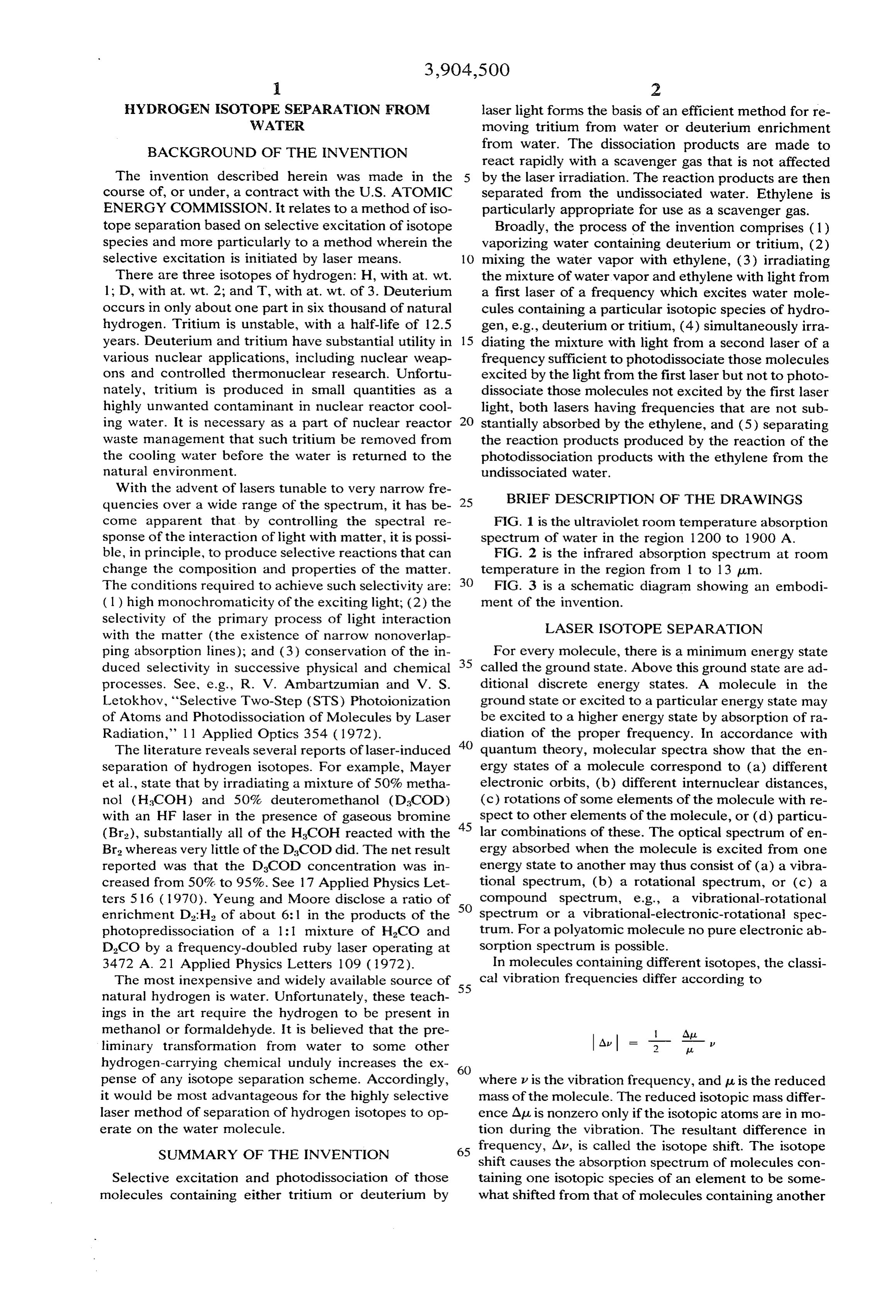
3472 A. 21 Applied Physics Letters 109 (1972). In molecules containing different isotopes, the classi The most inexpensive and widely available source of 55 cal vibration frequencies differ according to natural hydrogen is water. Unfortunately, these teach ings in the art require the hydrogen to be present in methanol or formaldehyde. It is believed that the pre Apl. liminary transformation from water to some other - a hydrogen-carrying chemical unduly increases the ex pense of any isotope separation scheme. Accordingly, 60 where w is the vibration frequency, and u is the reduced it would be most advantageous for the highly selective mass of the molecule. The reduced isotopic mass differ laser method of separation of hydrogen isotopes to op ence Apu is nonzero only if the isotopic atoms are in mo erate on the water molecule. tion during the vibration. The resultant difference in SUMMARY OF THE INVENTION 65 frequency, Av, is called the isotope shift. The isotope shift causes the absorption spectrum of molecules con
Selective excitation and photodissociation of those taining one isotopic species of an element to be some molecules containing either tritium or deuterium by what shifted from that of molecules containing another
Page 6
isotopic species of that element. If the shift in the ab
Sorption spectrum is such that narrow nonoverlapping Nonetheless, over the absorption spectrum given in absorption lines exist for molecules containing the dif FIG. 1, reaction (1) clearly predominates. The onset of ferent isotopic species, then in principle light of the absorption at 0.86 pum (53,760 cm or 6.66 eV) is proper frequency will be absorbed only by and excite well above the 5.1 13 eV or 41,250 cm dissociation only molecules containing a particular isotopic species. energy of water into H -- OH fragments, and absorption Laser isotopic separation is possible because the fre in this region of the spectrum produces these dissocia quency purity of laser light is sufficient to be resonantly tion fragments with a quantum yield near unity. Even absorbed by one isotopic species without affecting at 1236 A, about 75% of the primary processes in water other nonresonant isotopes. In any isotope separation 10 photolysis are attributable to reactions (1) and (3). process based on the slective excitation of isotopic spe The present very selective, energy conservative, two cies by tuned laser light, it is essential that the isotopic photon dissociation process for separating hydrogen shift be as sharply delineated as possible. By selective isotopes and removing tritium from water depends on excitation is meant the tuning of the laser light fre coupling the ultraviolet absorption processes by which quency to effect absorption by an optical absorption 15 H atoms are produced in the photolysis of water with state of one isotope only. a preliminary selective vibrational excitation of those To obtain very sharp spectral features, it is highly water molecules containing a particular hydrogen iso preferable that the isotopic mixture which is to undergo topic species. This preliminary vibrational excitation separation be in the gaseous state when it is irradiated can readily be accomplished through use of an appro with tuned laser light. Gaseous mixtures permit effi priately tuned infrared laser. FIG. 2 shows the infrared cient interaction of the laser light with the desired iso spectrum of water in the absorption region from 1 to 15 topic species while at the same time limiting the possi plm. The v3 fundamental near 2.6 plm is of particular bility that selectively excited molecules will undergo interest in that the precise absorption frequencies for scrambling, that is, transfer of their excitation to Water containing various hydrogen isotopic species are nonexcited species. It will be readily apparent that 25 known for this fundamental. The values for these fre scrambling reduces the efficiency of isotope separation quencies are given in the Table.
and if sufficiently severe may prevent any separation at TABLE all.
Even so, once selective excitation has been made to occur, there are numerous processes by which the slec Frequencies (cm)
tivity may be lost. A primary loss mechanism even in the gaseous state is collisional energy transfer between HO
molecules. Thus it is highly desirable that the selec DO 2883.79 2758.06 2025 tively excited species be quickly transformed to a stable DTO 2830.7 2357.1 1 if 9
or metastable state. One means by which the selectivity 35 HO 3882.6 2365.O 13746 can be stabilized is through photoionization or photo dissociation of an excited species. The stabilizing effect of photodissociation in particular may be advanta It is readily apparent that the HOT and HOD fre geously utilized if the photodissociation step is sepa quencies are well separated from each other and espe rated from the selective excitation step through use of 40 cially from the H2O frequency. In this regard, it should photons or light quanta of differing energies havi and be noted that laser light can be tuned to less than 0.001 hu. Photons of energy hui excite a certain state of the cm 1. It is thus a straightforward matter in this region discrete energy spectrum in a particular species, and of the infrared absorption spectrum to excite HOD or photons of energy hue photodissociate the excited spe HOT from contaminated or natural water vapor while cies. The energies of the photons satisfy the following 45 leaving the HOH in the ground state. The absorption conditions: strength near the us fundamental at 2.6 pum is known to hu -- hul D. E. be only a few Torr centimeter so that infrared laser photons can be efficiently utilized.
hvi Ed Additionally, the very high oscillator strength and an
where Ed is the photodissociation energy of a molecule harmonicity of water give rise to strong overtone ab from the ground state. Sorption at 1.2 and 1.35 pum, as shown in FIG. 2, and
DESCRIPTION OF THE PREFERRED
EMBODIMENT
overtone at 1.35 pum displays a near coincidence with 55 the frequencies of a number of good lasers such as io
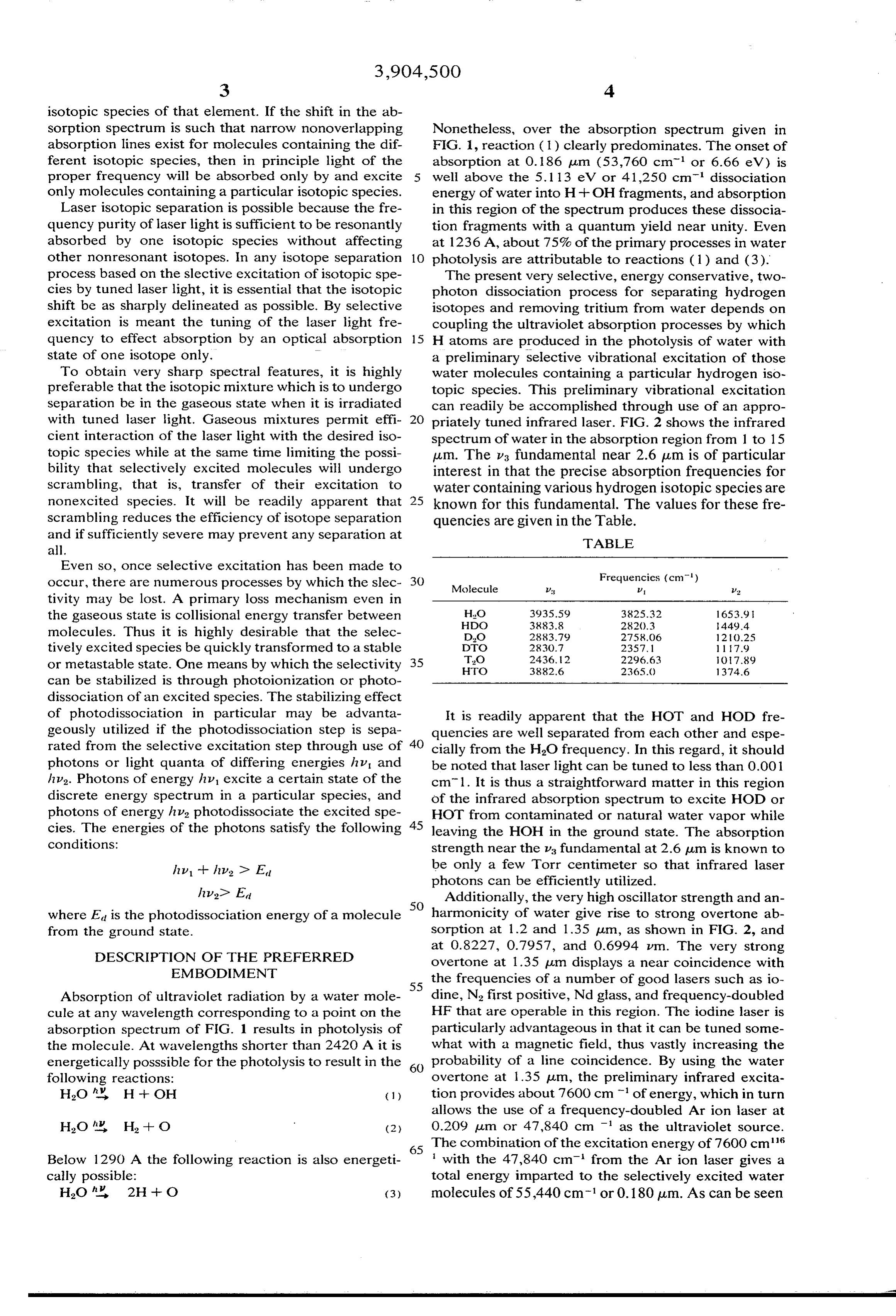
Absorption of ultraviolet radiation by a water mole dine, N2 first positive, Nd glass, and frequency-doubled cule at any wavelength corresponding to a point on the HF that are operable in this region. The iodine laser is absorption spectrum of FIG. 1 results in photolysis of particularly advantageous in that it can be tuned some the molecule. At wavelengths shorter than 2420 A it is what with a magnetic field, thus vastly increasing the energetically posssible for the photolysis to result in the probability of a line coincidence. By using the water following reactions: overtone at 1.35 p.m., the preliminary infrared excita HO H -- OH (1) tion provides about 7600 cm of energy, which in turn allows the use of a frequency-doubled Ar ion laser at
HOh H -- O (2) 0.209 pum or 47,840 cm as the ultraviolet source. 65 The combination of the excitation energy of 7600 cm
Below 1290 A the following reaction is also energeti with the 47,840 cm from the Arion laser gives a cally possible: total energy imparted to the selectively excited water HO 2H -- O (3) molecules of 55,440 cm or 0.180 pum. As can be seen
Page 7
S 6 from FIG. 1, this is well within the absorption region tion products, and ethylene then flows to separation for water and indeed is in the region at which the chamber 6 wherein the water 7 is removed and the absorption very efficiently results in the formation of mixture 18 of ethylene and other gaseous reaction H -- OH. products is transferred to separation chamber 19. In A critical feature of the method of the present inven chamber 19 the ethylene 21 is removed from the reac tion is the presence in the photolysis region of a gas tion products 20. Among the reaction products 20 will which will rapidly and efficiently scavenge all atomic be ethane, butane, and possibly H2. hydrogen produced as a result of the photolysis of se On the basis of the foregoing description it will be ap lectively excited water molecules. The presence of such parent that what has been disclosed is a laser isotope a scavenger is essential to avoid recombination of H 10 separation process wherein tritium may be removed atoms and OH free radicals or exchange reactions from tritium-containing water and wherein a substan which result in scrambling. A scavenger must meet tial enrichment of a desired hydrogen isotope, e.g., three important requirements: deuterium, may be achieved, using natural water as a 1. It must permanently quench H and OH radicals source of natural hydrogen. By natural water is meant without inducing subsequent significant chain reac 5 water containing a ratio of deuterium to hydrogen tions. It cannot form acids.
equivalent to that normally found in nature, i.e., about 2. It must not absorb optically in the region where the 1:6000.
ultraviolet or infrared laser operates.
3. It must be separable from water. What I claim is:
The art discloses that hydrogen atoms produced by 1. A method of removing tritium from tritium the photolysis of water are rapidly and permanently containing water which comprises: (a) forming a vapor scavenged by ethylene gas. See, e.g., McNesby et al., of said water, (b) mixing said vapor with ethylene, (c) “Vacuum Ultraviolet Photochemistry. III. Primary Pro irradiating said mixture with a first laser light of a fre cesses in the Vacuum Ultraviolet Photolysis of Water quency which selectively excites those water molecules and Ammonia,' 36 J. Chen. Phys. 605 (1962). In the 25 containing tritium but not tritium free molecules, (d) event that the ultraviolet laser used operates at a wave simultaneously irradiating said mixture with a second length shorter than 0.19 pum, it is desirable to use deu laser light of a frequency sufficient to photodissociate terated ethylene to minimize optical absorption by the water molecules selectively excited by said first laser scavenger. light but not sufficient to photodissociate those water One mode of operation of the process of the inven molecules not selectively excited by said first laser tion is shown in FIG. 3. A flow 1 of natural water or light, said first and second laser lights having frequen water contaminated with tritium is fed into heat ex cies that are not substantially absorbed by ethylene, changer 2 where it is vaporized. The vapor 3 flows into and (e) separating undissociated water from the reac mixing chamber 4 where it mixes with ethylene pro tion products produced by the reaction of the photodis vided by feed 5 and reclaimed ethylene 21. The mix 35 sociation products of said excited water molecules with ture 12 of ethylene and water vapor then flows through said ethylene.
photolysis chamber 6. Within chamber 6 the water 2. The method of claim 1 wherein said first laser is vapor is at approximately one Torr pressure and the iodine, N first positive, Nd glass, or frequency-doubled ethylene is at a few Torr pressure. Laser radiation 7, 8 HF and said second laser is frequency-doubled Arion. from infrared laser 9 and ultraviolet laser 10 is directed 40 3. The method of claim 1 wherein said first laser is through the length of chamber 6 by mirror means 11. magnetically tuned iodine.
Water molecules containing deuterium or tritium are 4. A method of deuterium enrichment which com selectively excited by laser radiation 7 from infrared prises (a) forming a vapor of natural water, (b) mixing laser 9. Laser radiation 8 from ultraviolet laser 10 is said vapor with ethylene, (c) irradiating said mixture sufficiently energetic to photolyze those water mole 45 with a first laser light of a frequency which selectively cules excited by laser radiation 7. The lifetime of the excites those water molecules containing deuterium vibrationally excited state of the selectively excited but not those water molecules containing no deute water molecules is about 1 OO insec (1 O collisions) which provides sufficient time for dissociation of these arium, (d) simultaneously irradiating said mixture with second laser light of a frequency sufficient to photo molecules by radiation 8 during the lifetime of the ex dissociate water molecules selectively excited by said cited state. In one embodiment, radiation 7 is at a fre quency at the 1.35 pum overtone of water. For this pur first laser light but not sufficient to photodissociate those water molecules not selectively excited by said pose, infrared laser 9 is an iodine laser magnetically tuned to selectively excite water molecules containing first laser light, said first and second laser lights having tritium or deuterium. Ultraviolet laser 10 is a frequen 55 ylene, and (e)that frequencies are not substantially absorbed by eth separating undissociated water and unre cy-doubled argon ion laser.
Within photolysis chamber 6 the H + OH fragments acted ethylene from the reaction products produced by are rapidly scavenged by the ethylene and the mixture the reaction of the photodissociation products of said 13 of undissociated water, ethylene, and reaction prod excited water molecules with ethylene. ucts, then flows through compressor 14 where the 5. The method of claim 4 wherein said ethylene is water is condensed and the heat transferred to heat ex deuterated ethylene.
changer 2. The mixture 15 of condensed water, reac ck ck s: ck sk
Provenance
- Collection
- Cited prior art
- Original PDF
- patentimages.storage.googleapis.com →
- Filed
- 1973-12-17
- Pages
- 7
- Method
- pdftotext (the PDF's own text layer) + pdftoppm 300dpi page scans
- Source
- Google Patents bibliographic record
- Granted
- 1975-09-09
- Inventors
- Reed J Jensen; US Department of Energy
- Transcribed from
- patentimages.storage.googleapis.com →