patent · US4206188
Removal of acetylene from HCl streams
3 June 1980
Page 1 — bibliographic record
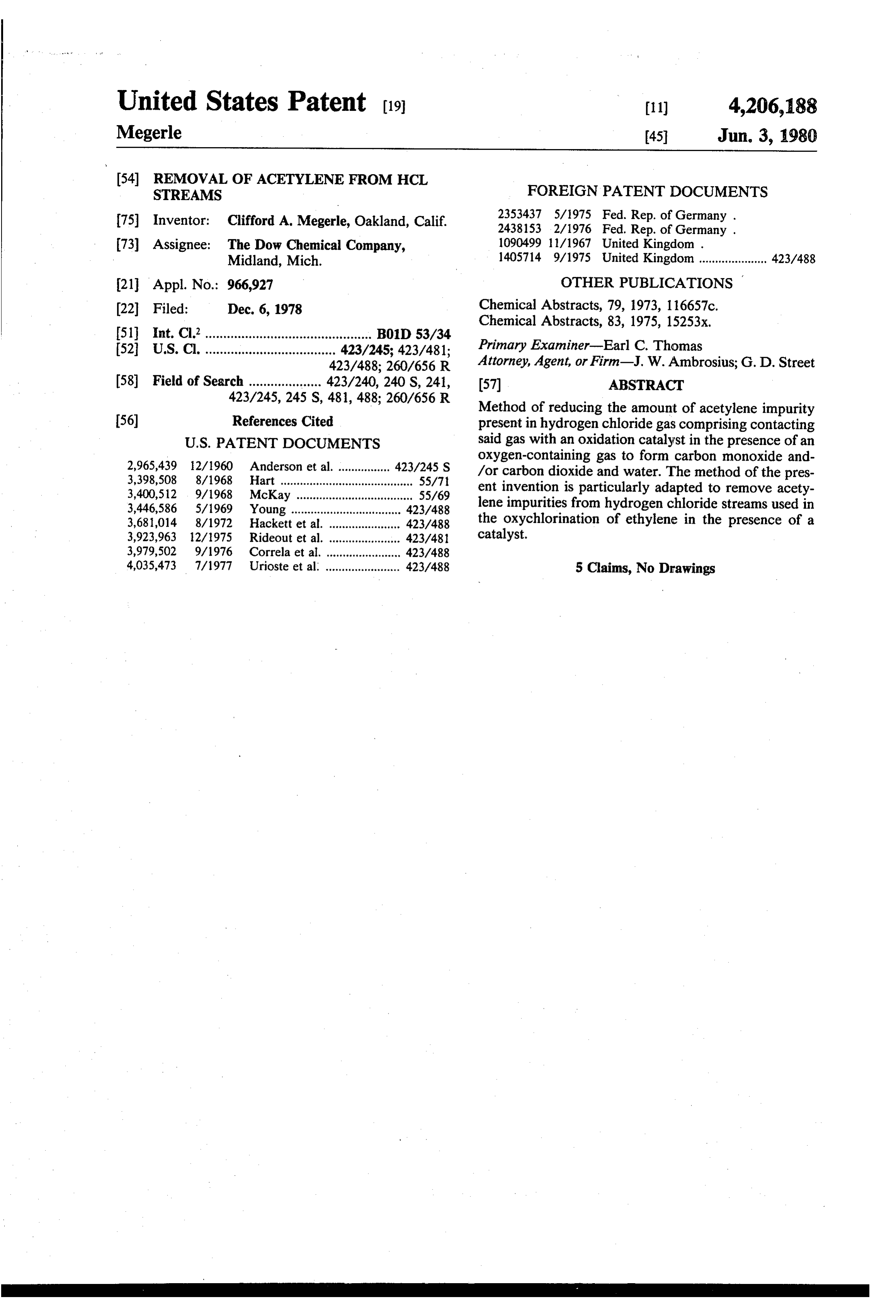
United States Patent (19) (11) 4,206,188 Megerle 45 Jun. 3, 1980 54 REMOVAL OF ACETYLENE FROM HCL FOREIGN PATENT DOCUMENTS
STREAMS
(75) Inventor: Clifford A. Megerle, Oakland, Calif. 2353437 5/1975 Fed. Rep. of Germany .
73) Assignee: The Dow Chemical Company, 1090499 11/1967 United Kingdom . Midland, Mich. 1405714 9/1975 United Kingdom..................... 423/488 21 Appl. No.: 966,927 OTHER PUBLICATIONS (22 Filed: Dec. 6, 1978 Chemical Abstracts, 79, 1973, 116657c.
51 int. Cl.’.............................................. B01D 53/34 52 U.S. Cl. .................................... 423/245; 423/481; Primary Examiner-Earl C. Thomas 423/488; 260/656 R Attorney, Agent, or Firm-J. W. Ambrosius; G. D. Street 58 Field of Search .................... 423/240, 240S, 241, (57) ABSTRACT 423/245, 245 S, 481,488; 260/656R Method of reducing the amount of acetylene impurity (56) References Cited present in hydrogen chloride gas comprising contacting
2,965,439 2/1960 Anderson et al. ................ 423/245 S oxygen-containing gas to form carbon monoxide and 3,398,508 8/1968 Hart ................... ...... S5/71 /or carbon dioxide and water. The method of the pres 3,400,512 9/1968 McKay .................................... 55/69 ent invention is particularly adapted to remove acety 3,446,586 5/1969 Young ................ 423/488 lene impurities from hydrogen chloride streams used in 3,681,014 8/1972 Hackett et al. 423/488 the oxychlorination of ethylene in the presence of a 3,923,963 2/1975 Rideout et al. .... ... 42.3/481 catalyst.
3,979,502 9/1976 Correla et al. ....................... 423/488 4,035,473 7/1977 Urioste et al. ....................... 423/488 5 Claims, No Drawings
Page 2
catalyst to form a mixture of carbon monoxide, carbon
REMOVAL OF ACETYLENE FROM HCL dioxide and water, even in the presence of large STREAMS amounts of hydrogen chloride. This result is surprising BACKGROUND since it is known and expected that acetylene and hy drogen chloride would react in the presence of catalysts
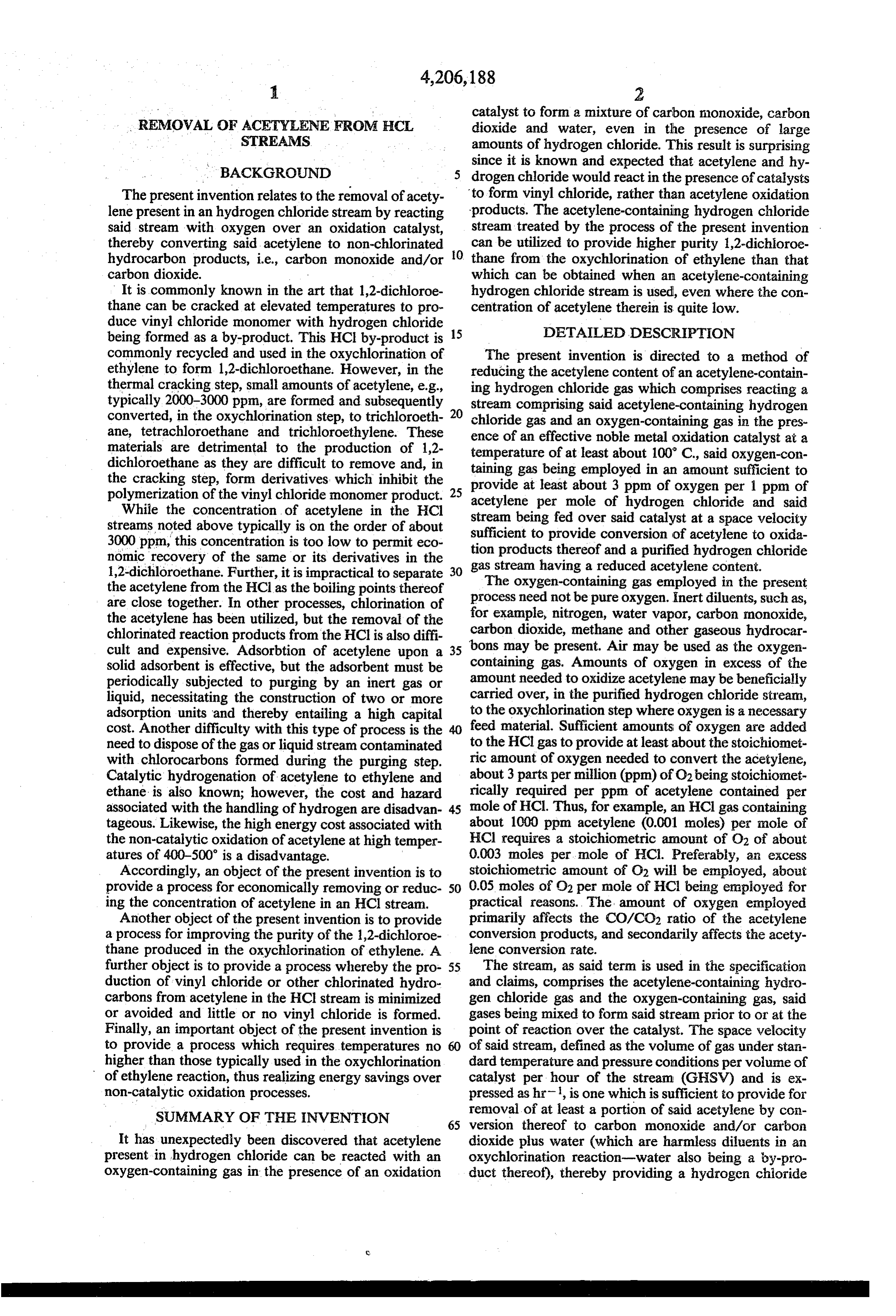
The present invention relates to the removal of acety to form vinyl chloride, rather than acetylene oxidation lene present in an hydrogen chloride stream by reacting products. The acetylene-containing hydrogen chloride said stream with oxygen over an oxidation catalyst, stream treated by the process of the present invention thereby converting said acetylene to non-chlorinated 0 can be utilized to provide higher purity 1,2-dichioroe hydrocarbon products, i.e., carbon monoxide and/or thane from the oxychlorination of ethylene than that carbon dioxide. which can be obtained when an acetylene-containing It is commonly known in the art that 1,2-dichloroe hydrogen chloride stream is used, even where the con thane can be cracked at elevated temperatures to pro centration of acetylene therein is quite low. duce vinyl chloride monomer with hydrogen chloride 15 OETAILEED DESCRIPTION being formed as a by-product. This HCl by-product is commonly recycled and used in the oxychlorination of The present invention is directed to a method of ethylene to form 1,2-dichloroethane. However, in the reducing the acetylene content of an acetylene-contain thermal cracking step, small amounts of acetylene, e.g., ing hydrogen chloride gas which comprises reacting a typically 2000-3000 ppm, are formed and subsequently 20 stream comprising said acetylene-containing hydrogen converted, in the oxychlorination step, to trichloroeth chloride gas and an oxygen-containing gas in the pres ane, tetrachloroethane and trichloroethylene. These ence of an effective noble metal oxidation catalyst at a materials are detrimental to the production of 1,2- temperature of at least about 100 C., said oxygen-con dichloroethane as they are difficult to remove and, in taining gas being employed in an amount sufficient to the cracking step, form derivatives which inhibit the polymerization of the vinyl chloride monomer product. 25 provide acetylene at least about 3 ppm of oxygen per 1 ppm of per mole of hydrogen chloride and said
While the concentration of acetylene in the HCl stream being fed over said catalyst at a space velocity streams noted above typically is on the order of about sufficient to provide 3000 ppm, this concentration is too low to permit eco tion products thereofconversion and a of acetylene to oxida purified hydrogen chloride nomic recovery of the same or its derivatives in the gas stream having a reduced acetylene content. 1,2-dichloroethane. Further, it is impractical to separate 30
The oxygen-containing gas employed in the present the acetylene from the HCl as the boiling points thereof process need not be pure oxygen. Inert diluents, such as, are close together. In other processes, chlorination of for example, nitrogen, water vapor, carbon monoxide, the acetylene has been utilized, but the removal of the chlorinated reaction products from the HCl is also diffi bons carbon dioxide, methane and other gaseous hydrocar cult and expensive. Adsorbtion of acetylene upon a 35 containing may be present. Air may be used as the oxygen solid adsorbent is effective, but the adsorbent must be gas. Amounts of oxygen in excess of the periodically subjected to purging by an inert gas or amount needed to oxidize acetylene may be beneficially liquid, necessitating the construction of two or more carried over, in the purified hydrogen chloride stream, adsorption units and thereby entailing a high capital to the oxychlorination step where oxygen is a necessary cost. Another difficulty with this type of process is the feed material. Sufficient amounts of oxygen are added need to dispose of the gas or liquid stream contaminated to the HCl gas to provide at least about the stoichiomet with chlorocarbons formed during the purging step. ric amount of oxygen needed to convert the acetylene, Catalytic hydrogenation of acetylene to ethylene and about 3 parts per million (ppm) of O2 being stoichiomet ethane is also known; however, the cost and hazard rically required per ppm of acetylene contained per associated with the handling of hydrogen are disadvan 45 mole of HCl. Thus, for example, an HCl gas containing tageous. Likewise, the high energy cost associated with about 1000 ppm acetylene (0.001 moles) per mole of the non-catalytic oxidation of acetylene at high temper HCl requires a stoichiometric amount of O2 of about atures of 400-500 is a disadvantage. 0.003 moles per mole of HC1. Preferably, an excess Accordingly, an object of the present invention is to stoichiometric amount of O2 will be employed, about provide a process for economically removing or reduc 50 0.05 moles of O2 per mole of HCl being employed for ing the concentration of acetylene in an HCl stream. practical reasons. The amount of oxygen employed Another object of the present invention is to provide primarily affects the CO/CO2 ratio of the acetylene a process for improving the purity of the 1,2-dichloroe conversion products, and secondarily affects the acety thane produced in the oxychlorination of ethylene. A lene conversion rate.
further object is to provide a process whereby the pro 55 The stream, as said term is used in the specification duction of vinyl chloride or other chlorinated hydro and claims, comprises the acetylene-containing hydro carbons from acetylene in the HCl stream is minimized gen chloride gas and the oxygen-containing gas, said or avoided and little or no vinyl chloride is formed. gases being mixed to form said stream prior to or at the Finally, an important object of the present invention is point of reaction over the catalyst. The space velocity to provide a process which requires temperatures no of said stream, defined as the volume of gas under stan higher than those typically used in the oxychlorination dard temperature and pressure conditions per volume of of ethylene reaction, thus realizing energy savings over catalyst per hour of the stream (GHSV) and is ex non-catalytic oxidation processes. pressed ashr, is one which is sufficient to provide for SUMMARY OF THE INVENTION removal of at least a portion of said acetylene by con 65 version thereof to carbon monoxide and/or carbon
It has unexpectedly been discovered that acetylene dioxide plus water (which are harmless diluents in an present in hydrogen chloride can be reacted with an oxychlorination reaction-water also being a by-pro oxygen-containing gas in the presence of an oxidation duct thereof), thereby providing a hydrogen chloride
Page 3
gas having a reduced acetylene content. In some in which must be removed prior to use in the oxychlorina stances, such as where the initial acetylene content is tion of ethylene. In a preferred embodiment of the pres not too excessive, it may not be necessary or desirable ent invention, an alumina-supported platinum catalyst is to achieve substantial or complete acetylene removal employed. The particle size and amount or volume of for a particular process application. While the scope of 5 catalyst to be employed will vary depending on the the present invention is intended to encompass such reactor size, the type of reactor employed, the gas resi uses of the claimed method, it will obviously be desir dence or contact time with the catalyst, e.g., total space able in methods of oxychlorinating ethylene to use said velocity, and the like. Based on the specification teach method to accomplish substantial or complete removal ings and examples herein, those skilled in the art will be of acetylene from an hydrogen chloride gas without 10 able to readily determine the exact catalyst amount formation of vinyl chloride. Hence, in a preferred em needed for a particular operation.
bodiment, a substantial amount, i.e., about 50% or more, The method of the present invention can be con of the acetylene content is removed from the HCl gas. ducted at a temperature of at least about 100 C. or In another preferred embodiment, the method of the more. Temperatures up to about 500 C. can be em present invention is carried out in a manner such that 15 ployed, with temperatures from about 100 to about 300 complete removal of the acetylene present in an HCl C. being preferred because of energy costs. A highly gas is achieved. In another preferred embodiment, the preferred temperature range is from about 200 to about method of the present invention is carried out in a man 275 C. Generally, the acetylene-containing HCl gas ner such that a hydrogen chloride gas stream is obtained and the oxygen-containing gas are preheated to the having a reduced acetylene content and low amounts, 20 temperature of the catalyst prior to contact with the e.g., about 5% or less by weight, of vinyl chloride. In a catalyst, although this is not essential. Such preheating further preferred embodiment, the method of the pres can conveniently be accomplished by using a reactor ent invention is carried out in a manner such that sub stantial or complete removal of the acetylene content of packed with turnings or other materials, e.g., glass, an HCl gas is achieved with the HCl product gas being 25 alumina, tantalum turnings, etc., which can be heated to the desired temperature.
free of vinyl chloride. Atmospheric pressure can be employed as well as The foregoing can be accomplished by carrying out elevated pressures up to about 1000 psig or more. The the method described herein in a fixed-bed or fluidized bed reactor or by using two or more reactors in staged preferred
operating pressure is from about 5 to about with a range of from about 75 to about 125 or series connection. The reactor is preferably made of 30 being particularly preferred. a material which is inert to the catalyst and gas stream, The best mode presently known for carrying out the such as tantalum, monel or the like. The exact size and invention comprises reacting a preheated stream of an capacity of the reactor or reactors will be apparent to acetylene-containing those skilled in the art and will vary depending upon the gas and an oxygen-containing gas providing about 0.2 mole of O2 per mole of HCl over an particular HCl gas stream to be treated, the intended use 35 alumina-supported thereof, the pressure, temperature, O2-HCl mole ra platinum catalyst at a temperature of tios, space velocities, the degree of acetylene removal about 225 C., a pressure of about 5 psig and a total desired and the like. Generally, longer contact times of space velocity of about 33.5 hr-1. the stream with the catalyst are desired as better con The following examples illustrate the practice of the version of the acetylene can be achieved and lower, 40 present invention.
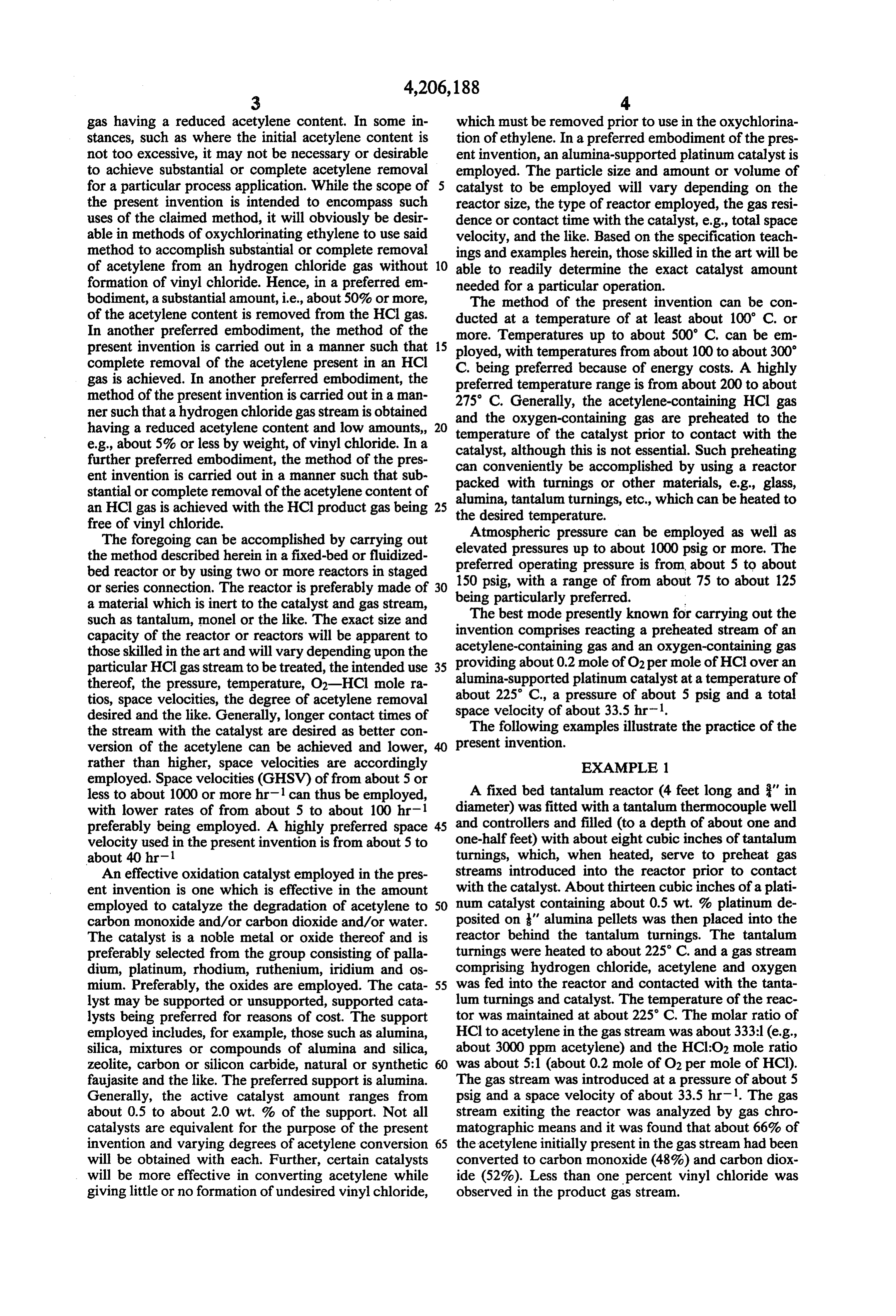
rather than higher, space velocities are accordingly EXAMPLE 1 employed. Space velocities (GHSV) of from about 5 or less to about 1000 or more hr 1 can thus be employed, A fixed bed tantalum reactor (4 feet long and " in with lower rates of from about 5 to about 100 hr-l diameter) was fitted with a tantalum thermocouple well preferably being employed. A highly preferred space 45 and controllers and filled (to a depth of about one and velocity used in the present invention is from about 5 to one-half feet) with about eight cubic inches of tantalum about 40 hr-l turnings, which, when heated, serve to preheat gas An effective oxidation catalyst employed in the pres streams introduced into the reactor prior to contact ent invention is one which is effective in the amount with the catalyst. About thirteen cubic inches of a plati employed to catalyze the degradation of acetylene to 50 num catalyst containing about 0.5 wt.% platinum de carbon monoxide and/or carbon dioxide and/or water. posited on '' alumina pellets was then placed into the The catalyst is a noble metal or oxide thereof and is reactor behind the tantalum turnings. The tantalum preferably selected from the group consisting of palla turnings were heated to about 225 C. and a gas stream dium, platinum, rhodium, ruthenium, iridium and os comprising hydrogen chloride, acetylene and oxygen mium. Preferably, the oxides are employed. The cata 55 was fed into the reactor and contacted with the tanta lyst may be supported or unsupported, supported cata lum turnings and catalyst. The temperature of the reac lysts being preferred for reasons of cost. The support tor was maintained at about 225 C. The molar ratio of employed includes, for example, those such as alumina, HCl to acetylene in the gas stream was about 333:1 (e.g., silica, mixtures or compounds of alumina and silica, about 3000 ppm acetylene) and the HCl:O2 mole ratio zeolite, carbon or silicon carbide, natural or synthetic was about 5:1 (about 0.2 mole of O2 per mole of HCl). faujasite and the like. The preferred support is alumina. The gas stream was introduced at a pressure of about 5 Generally, the active catalyst amount ranges from psig and a space velocity of about 33.5 hr. The gas about 0.5 to about 2.0 wt.% of the support. Not all stream exiting the reactor was analyzed by gas chro catalysts are equivalent for the purpose of the present matographic means and it was found that about 66% of invention and varying degrees of acetylene conversion 65 the acetylene initially present in the gas stream had been will be obtained with each. Further, certain catalysts converted to carbon monoxide (48%) and carbon diox will be more effective in converting acetylene while ide (52%). Less than one percent vinyl chloride was giving little or no formation of undesired vinyl chloride, observed in the product gas stream.
Page 4
The above example demonstrates the operability of or scope thereof and is to be understood that the inven the process under a particular set of reaction parame tion is limited only as defined in the appended claims. ters. Higher conversion rates of acetylene can be ob What is claimed is:
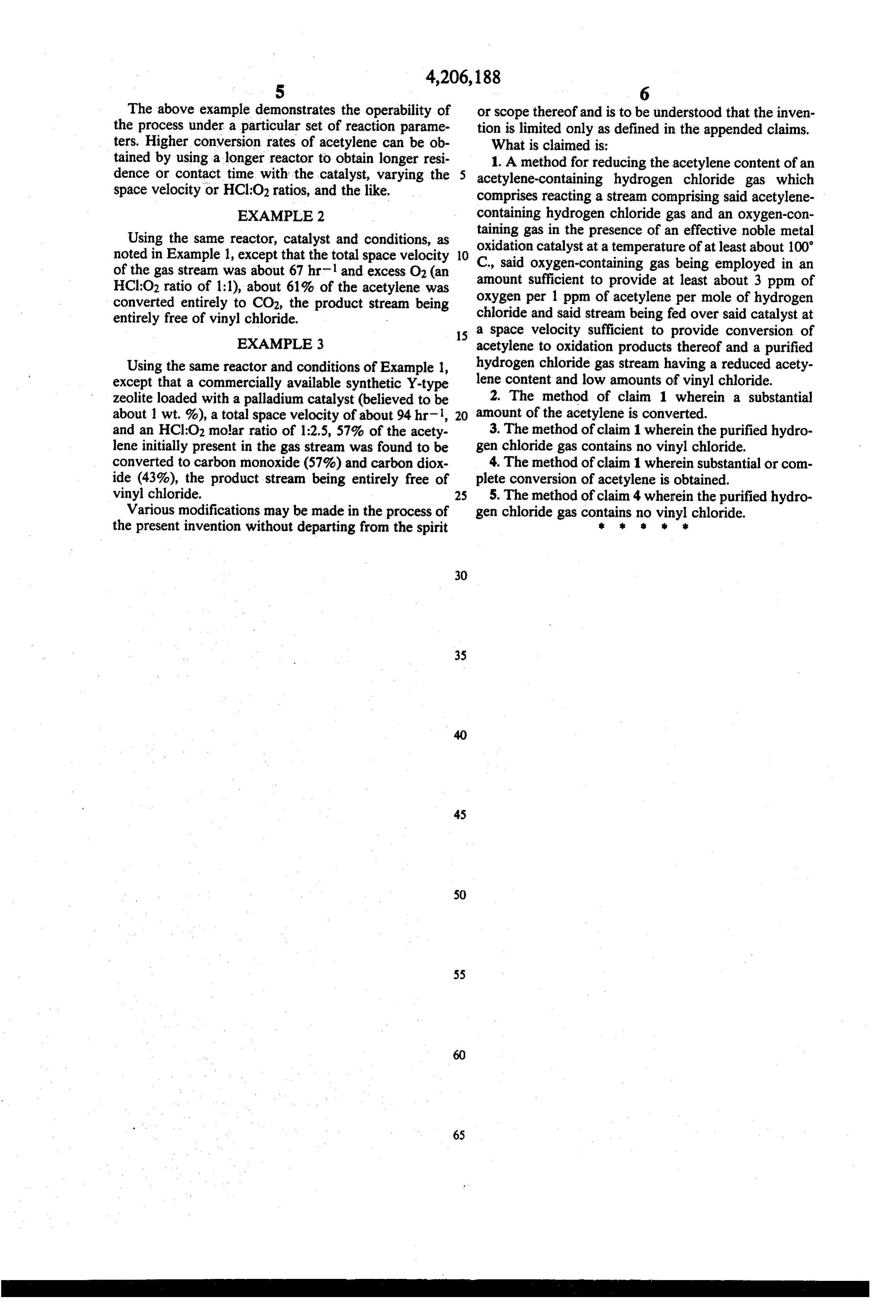
tained by using a longer reactor to obtain longer resi 1. A method for reducing the acetylene content of an dence or contact time with the catalyst, varying the 5 acetylene-containing hydrogen chloride gas which space velocity or HCl:O2 ratios, and the like. comprises reacting a stream comprising said acetylene EXAMPLE 2 containing hydrogen chloride gas and an oxygen-con
Using the same reactor, catalyst and conditions, as oxidationgascatalyst taining in the presence of an effective noble metal at a temperature of at least about 100' noted in Example 1, except that the total space velocity 10 C., said oxygen-containing of the gas stream was about 67 hr 1 and excess O2 (an amount sufficient to providegasat being least employed in an about 3 ppm of
HCl:O2 ratio of 1:1), about 61% of the acetylene was oxygen per 1 ppm of acetylene per mole of hydrogen converted entirely to CO2, the product stream being entirely free of vinyl chloride. chloride and said stream being fed over said catalyst at 15 a space velocity sufficient to provide conversion of
EXAMPLE 3 acetylene to oxidation products thereof and a purified Using the same reactor and conditions of Example 1, hydrogen chloride gas stream having a reduced acety except that a commercially available synthetic Y-type lene content and low amounts of vinyl chloride. zeolite loaded with a palladium catalyst (believed to be 2. The method of claim 1 wherein a substantial about 1 wt.%), a total space velocity of about 94 hr, 20 amount of the acetylene is converted. and an HCl:O2 molar ratio of 1:2.5, 57% of the acety 3. The method of claim 1 wherein the purified hydro lene initially present in the gas stream was found to be gen chloride gas contains no vinyl chloride. converted to carbon monoxide (57%) and carbon diox 4. The method of claim 1 wherein substantial or com ide (43%), the product stream being entirely free of plete conversion of acetylene is obtained. vinyl chloride. 25 5. The method of claim 4 wherein the purified hydro Various modifications may be made in the process of gen chloride gas contains no vinyl chloride. the present invention without departing from the spirit is is
Provenance
- Collection
- Cited prior art
- Original PDF
- patentimages.storage.googleapis.com →
- Filed
- 1978-12-06
- Pages
- 4
- Method
- pdftotext (the PDF's own text layer) + pdftoppm 300dpi page scans
- Source
- Google Patents bibliographic record
- Granted
- 1980-06-03
- Inventors
- Clifford A. Megerle; Dow Chemical Co
- Transcribed from
- patentimages.storage.googleapis.com →