patent · US3446586
Purification of hydrogen chloride
27 May 1969
Page 1 — bibliographic record
United States Patent Office 3,446,586 Patented May 27, 1969
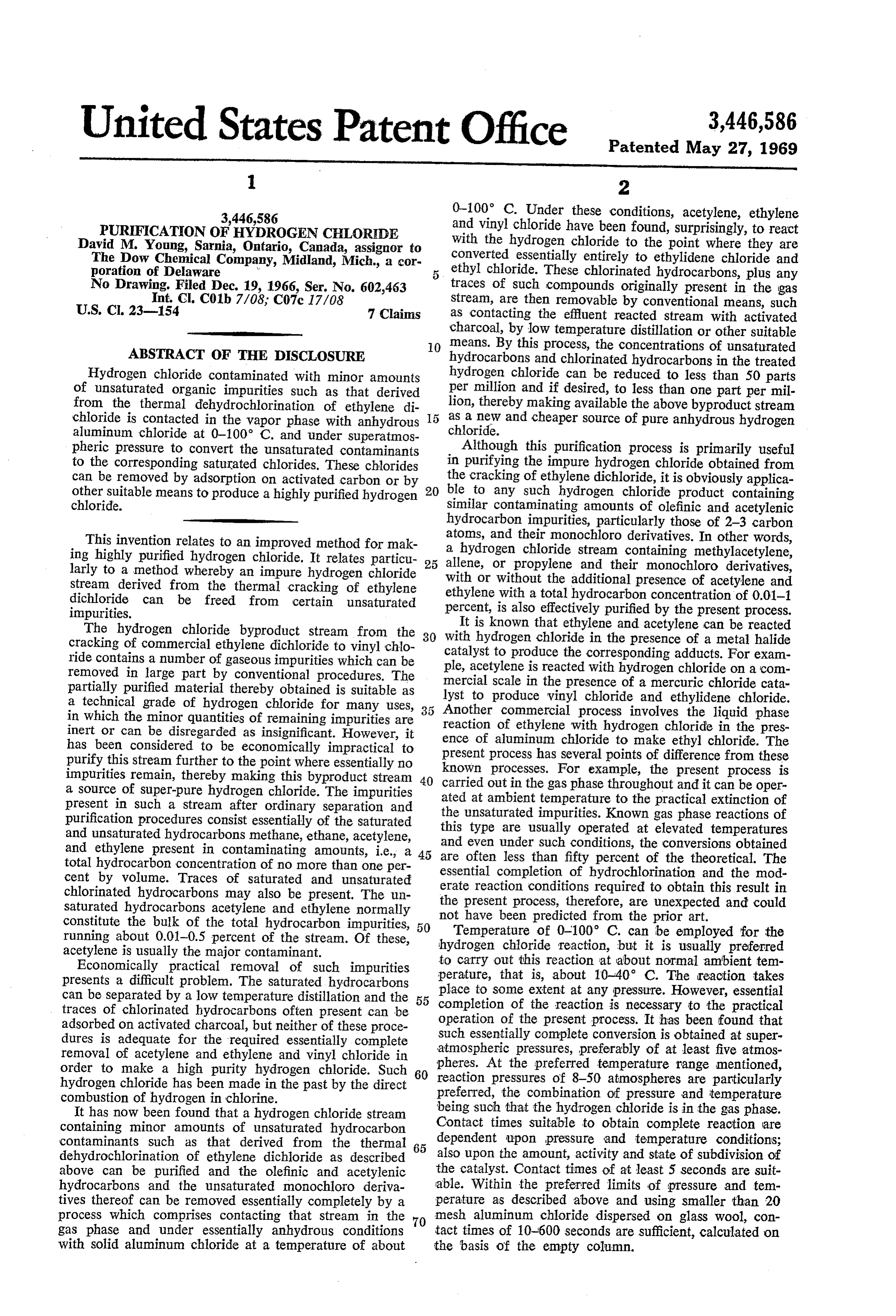
3,446,586 0-100° C. Under these conditions, acetylene, ethylene PURIFICATION OF HYDROGEN CHILORDE and vinyl chloride have been found, surprisingly, to react David M. Young, Sarnia, Ontario, Canada, assignor to with the hydrogen chloride to the point where they are The Dow Chemical Company, Midland, Mich., a cor converted essentially entirely to ethylidene chloride and poration of Delaware V ethyl chloride. These chlorinated hydrocarbons, plus any No Drawing. Filed Dec. 19, 1966, Ser. No. 602,463 traces of Such compounds originally present in the gas Int. C. C01b 7/08, C07c 17/08 stream, are then removable by conventional means, such U.S. C. 23-154 7 Claims as contacting the effluent reacted stream with activated charcoal, by low temperature distillation or other suitable 0 means. By this process, the concentrations of unsaturated
ABSTRACT OF THE DISCLOSURE hydrocarbons and chlorinated hydrocarbons in the treated Hydrogen chloride contaminated with minor amounts hydrogen chloride can be reduced to less than 50 parts of unsaturated organic impurities such as that derived per million and if desired, to less than one part per mil from the thermal dehydrochlorination of ethylene di lion, thereby making available the above byproduct stream as a new and cheaper source of pure anhydrous hydrogen chloride is contacted in the vapor phase with anhydrous chloride.
aluminum chloride at 0-100° C. and under superatmos pheric pressure to convert the unsaturated contaminants Although this purification process is primarily useful to the corresponding Saturated chlorides. These chlorides in purifying the impure hydrogen chloride obtained from can be removed by adsorption on activated carbon or by the cracking of ethylene dichloride, it is obviously applica other Suitable means to produce a highly purified hydrogen 20 ble to any such hydrogen chloride product containing chloride. similar contaminating amounts of olefinic and acetylenic hydrocarbon impurities, particularly those of 2-3 carbon
This invention relates to an improved method for mak atoms, and their monochloro derivatives. In other words, ing highly purified hydrogen chloride. It relates particu 25 aallene, hydrogen chloride stream containing methylacetylene, larly to a method whereby an impure hydrogen chloride with or orwithout propylene and their monochloro derivatives, the additional presence of acetylene and stream derived from the thermal cracking of ethylene ethylene with a total hydrocarbon concentration of 0.01-1 dichloride can be freed from certain unsaturated percent, is also effectively purified by the present process. impurities.
The hydrogen chloride byproduct stream from the 30 withIt ishydrogenknown that ethylene and acetylene can be reacted chloride in the presence of a metal halide cracking of commercial ethylene dichloride to vinyl chlo catalyst to produce the corresponding adducts. For exam ride contains a number of gaseous impurities which can be ple, acetylene is reacted with hydrogen chloride on a com removed in large part by conventional procedures. The mercial scale in the presence of a mercuric chloride cata partially purified material thereby obtained is suitable as lyst to produce vinyl chloride and ethylidene chloride. a technical grade of hydrogen chloride for many uses, Another commercial process involves the liquid phase in which the minor quantities of remaining impurities are reaction of ethylene with hydrogen chloride in the pres inert or can be disregarded as insignificant. However, it ence has been considered to be economically impractical to presentof processaluminum chloride to make ethyl chloride. The has several points of difference from these purify this stream further to the point where essentially no known processes.
impurities remain, thereby making this byproduct stream 40 carried out in the gasForphase example, the present process is a source of Super-pure hydrogen chloride. The impurities ated at ambient temperaturethroughout and it can be oper present in such a stream after ordinary separation and the unsaturated impurities. Known gas phaseextinction to the practical of reactions of purification procedures consist essentially of the saturated this type are usually operated at elevated temperatures and unsaturated hydrocarbons methane, ethane, acetylene, and even under such conditions, the conversions obtained and ethylene present in contaminating amounts, i.e., a are often less than fifty percent of the theoretical. The total hydrocarbon concentration of no more than one per cent by volume. Traces of saturated and unsaturated essential completion of hydrochlorination and the mod erate reaction conditions required to obtain this result in chlorinated hydrocarbons may also be present. The un the present process, therefore, are unexpected and could saturated hydrocarbons acetylene and ethylene normally constitute the bulk of the total hydrocarbon impurities, 50 notTemperature have been predicted from the prior art.
of 0-100° C. can be employed for the running about 0.01-0.5 percent of the stream. Of these, hydrogen chloride reaction, but it is usually preferred acetylene is usually the major contaminant.
Economically practical removal of such impurities to carry out this reaction at about normal ambient tem presents a difficult problem. The Saturated hydrocarbons perature, that is, about 10-40 C. The reaction takes place to some extent at any pressure. However, essential can be separated by a low temperature distillation and the 55 completion traces of chlorinated hydrocarbons often present can be operation ofofthethepresent reaction is necessary to the practical process. It has been found that adsorbed on activated charcoal, but neither of these proce such essentially complete conversion is obtained at super dures is adequate for the required essentially complete atmospheric pressures, preferably of at least five atmos removal of acetylene and ethylene and vinyl chloride in pheres. At the preferred temperature range mentioned, order to make a high purity hydrogen chloride. Such 60 reaction pressures of 8–50 atmospheres are particularly hydrogen chloride has been made in the past by the direct preferred, the combination of pressure and temperature combustion of hydrogen in chlorine. being such that the hydrogen chloride is in the gas phase. It has now been found that a hydrogen chloride stream containing minor amounts of unsaturated hydrocarbon Contact times suitable to obtain complete reaction are contaminants such as that derived from the thermal 65 dependent upon pressure and temperature conditions; dehydrochlorination of ethylene dichloride as described also upon the amount, activity and state of Subdivision of above can be purified and the olefinic and acetylenic the catalyst. Contact times of at least 5 seconds are suit hydrocarbons and the unsaturated monochloro deriva able. Within the preferred limits of pressure and tem tives thereof can be removed essentially completely by a perature as described above and using smaller than 20 process which comprises contacting that stream in the 70 mesh aluminum chloride dispersed on glass wool, con gas phase and under essentially anhydrous conditions tact times of 10-600 seconds are sufficient, calculated on with solid aluminum chloride at a temperature of about the basis of the empty column.
Page 2
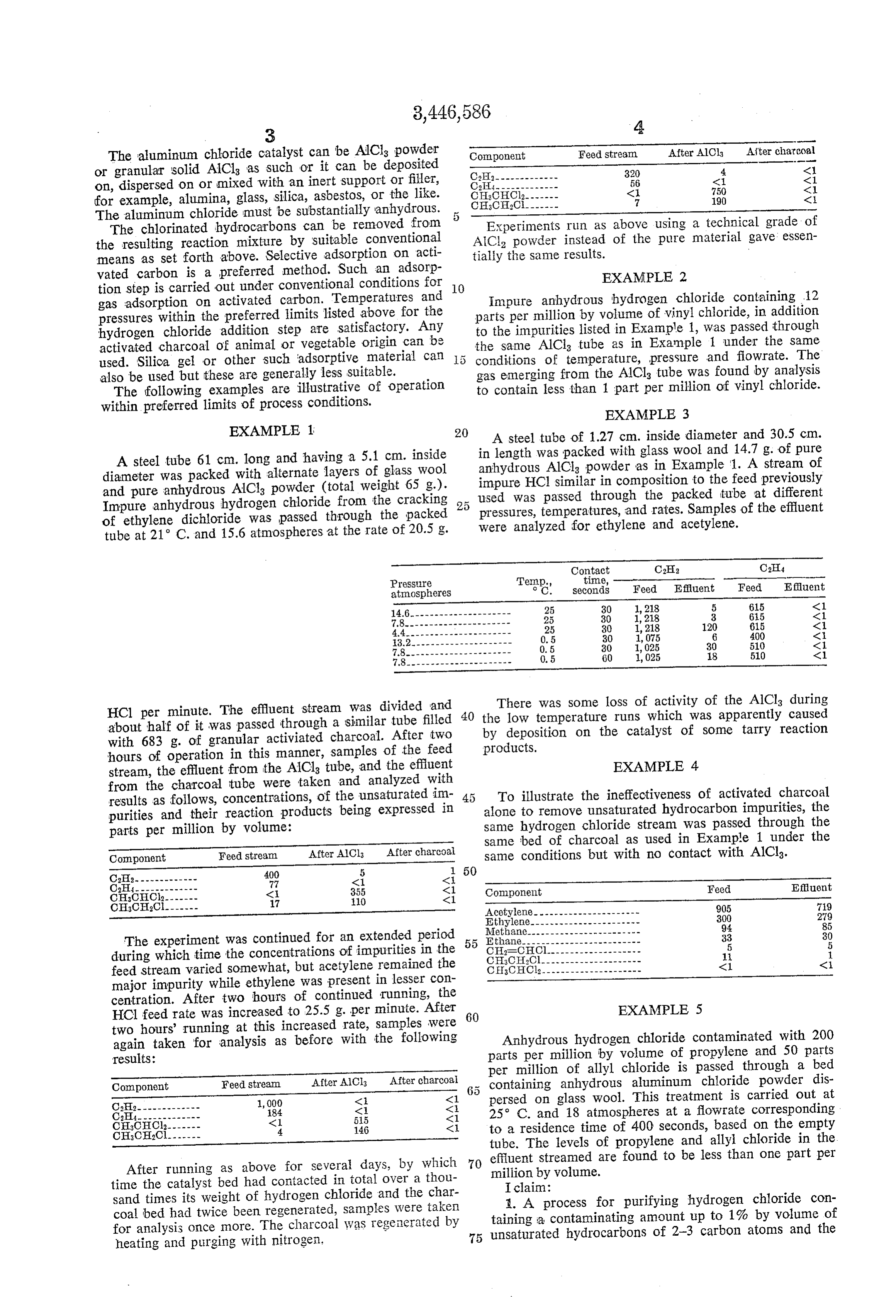
The aluminum chloride catalyst can be AlCls powder Component Feed stream After AlCls After charcoal or granular solid AlCls as such or it can be deposited C2H2------------- 320 4 r on, dispersed on or mixed with an inert support or filler, C2H4------------- 56 <1. <1 for example, alumina, glass, silica, asbestos, or the like. CH3CH2Cl-------
The aluminum chloride must be substantially anhydrous. 5
The chlorinated hydrocarbons can be removed from Experiments run as above using a technical grade of the resulting reaction mixture by suitable conventional AlCl2 powder instead of the pure material gave essen means as set forth above. Selective adsorption on acti tially the same results.
vated carbon is a preferred method. Such an adsorp EXAMPLE 2. tion step is carried out under conventional conditions for 10 gas adsorption on activated carbon. Temperatures and Impure anhydrous hydrogen chloride containing 12 pressures within the preferred limits listed above for the parts per million by volume of vinyl chloride, in addition hydrogen chloride addition step are satisfactory. Any to the impurities listed in Example 1, was passed through activated charcoal of animal or vegetable origin can be the same AlCl3 tube as in Example 1 under the same used. Silica gel or other such adsorptive material can l3 conditions of temperature, pressure and flowrate. The also be used but these are generally less suitable. gas emerging from the AlCl3 tube was found by analysis The following examples are illustrative of operation to contain less than 1 part per million of vinyl chloride. within preferred limits of process conditions. EXAMPLE 3 EXAMPLE 1. 20 A steel tube of 1.27 cm. inside diameter and 30.5 cm. A steel tube 61 cm. long and having a 5.1 cm. inside in length was packed with glass wool and 14.7 g. of pure diameter was packed with alternate layers of glass Wool impure HClAlCl3 anhydrous powder as in Example 1. A stream of similar in composition to the feed previously and pure anhydrous AlCl3 powder (total weight 65 g.). 25 used was passed through the packed tube at different Impure anhydrous hydrogen chloride from the cracking pressures, temperatures, and rates. Samples of the effluent of ethylene dichloride was passed through the packed were analyzed for ethylene and acetylene. tube at 21° C. and 15.6 atmospheres at the rate of 20.5 g.
atmospheres o C. Seconds Feed Effluent Feed Effluent
HCl per minute. The effluent stream was divided and 40 theThere was some loss of activity of the AlCls during low temperature runs which was apparently caused about half of it was passed through a similar tube filled by deposition on the catalyst of some tarry reaction with 683 g. of granular activiated charcoal. After two products.
hours of operation in this manner, samples of the feed stream, the effluent from the AICl tube, and the effluent EXAMPLE 4 from the charcoal tube were taken and analyzed with results as follows, concentrations, of the unsaturated in 45 To illustrate the ineffectiveness of activated charcoal purities and their reaction products being expressed in alone to remove unsaturated hydrocarbon impurities, the parts per million by volume: same hydrogen chloride stream was passed through the Same bed of charcoal as used in Example 1 under the
Component Feed stream After AlCl3 After charcoal same conditions but with no contact with AlCl. C2H2------------- 400 5 50
C2H4------------- 77 <1 < Component Feed Effluent
CH3CH2Ci------- 17 10 K1 Acetylene---------------------- 905 79 Ethylene 300 279
The experiment was continued for an extended period SEAe. ale-- 94.3 85 during which time the concentrations of impurities in the 55 CH2=CHCl - s: ag feed stream varied somewhat, but acetylene remained the CH3CHCl2----------------------
major impurity while ethylene was present in lesser con centration. After two hours of continued running, the
HCl feed rate was increased to 25.5 g. per minute. After 60 EXAMPLE 5 two hours' running at this increased rate, samples were again taken for analysis as before with the following Anhydrous hydrogen chloride contaminated with 200 results: parts per million by volume of propylene and 50 parts per million of allyl chloride is passed through a bed
Component Feed stream After AlCl3 After charcoal is containing anhydrous aluminum chloride powder dis C2H2------------- 1,000 K <1. persed on glass wool. This treatment is carried out at C2H4---- 84 < < 25 C. and 18 atmospheres at a flowrate corresponding
<1. to a residence time of 400 seconds, based on the empty tube. The levels of propylene and allyl chloride in the
After running as above for several days, by which 70 effluent million streamed are found to be less than one part per by volume.
time the catalyst bed had contacted in total over a thou I claim:
sand times its weight of hydrogen chloride and the char . A process for purifying hydrogen chloride con coal bed had twice been regenerated, samples were taken taining a contaminating amount up to 1% by volume of for analysis once more. The charcoal was regenerated by 75 unsaturated hydrocarbons of 2-3 carbon atoms and the heating and purging with nitrogen.
Page 3
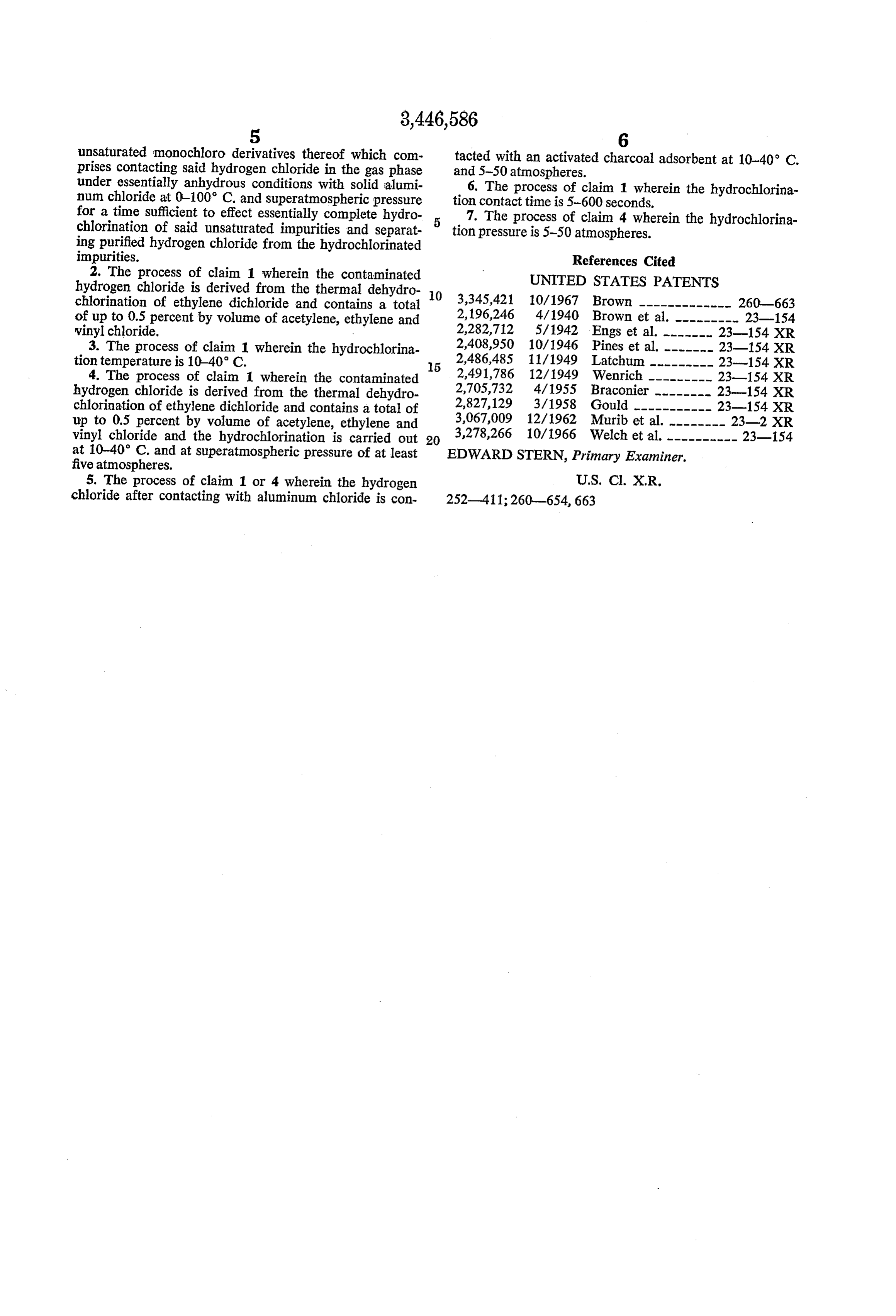
unsaturated monochloro derivatives thereof which com tacted with an activated charcoal adsorbent at 10-40 C. prises contacting said hydrogen chloride in the gas phase and 5-50 atmospheres.
under essentially anhydrous conditions with solid alumi 6. The process of claim 1 wherein the hydrochlorina num chloride at 0-100° C. and superatmospheric pressure tion contact time is 5-600 seconds. for a time sufficient to effect essentially complete hydro 7. The process of claim 4 wherein the hydrochlorina chlorination of said unsaturated impurities and separat tion pressure is 5-50 atmospheres. ing purified hydrogen chloride from the hydrochlorinated impurities. References Cited 2. The process of claim 1 wherein the contaminated UNITED STATES PATENTS hydrogen chloride is derived from the thermal dehydro O chlorination of ethylene dichloride and contains a total 3,345,421 10/1967 Brown ------------- 260-663 of up to 0.5 percent by volume of acetylene, ethylene and 2,196,246 4/1940 Brown et al. --------. 23-154 vinyl chloride. 2,282,712 5/1942 Engs et al. ------- 23-154 XR 3. The process of claim 1 wherein the hydrochlorina 2,408,950 10/1946 Pines et al. ------ 23-154 XR tion temperature is 10-40 C. 5 2,486,485 11/1949 Latchum --------- 23-154 XR 4. The process of claim 1 wherein the contaminated 2,491,786 12/1949 Wenrich --------- 23-154 XR hydrogen chloride is derived from the thermal dehydro 2,705,732 4/1955 Braconier -------- 23-154 XR chlorination of ethylene dichloride and contains a total of 2,827,129 3/1958 Gould ----------- 23-154 XR up to 0.5 percent by volume of acetylene, ethylene and 3,067,009 12/1962 Murib et al. -------- 23-2 XR vinyl chloride and the hydrochlorination is carried out 20 3,278,266 10/1966 Welch et al. ---------- 23-154 at 10-40' C. and at superatmospheric pressure of at least EDWARD STERN, Primary Examiner. five atmospheres.
5. The process of claim 1 or 4 wherein the hydrogen U.S. C. X.R. chloride after contacting with aluminum chloride is con 252-411; 260-654, 663
Provenance
- Collection
- Cited prior art
- Original PDF
- patentimages.storage.googleapis.com →
- Filed
- 1966-12-19
- Pages
- 3
- Method
- pdftotext (the PDF's own text layer) + pdftoppm 300dpi page scans
- Source
- Google Patents bibliographic record
- Granted
- 1969-05-27
- Inventors
- David M Young; Dow Chemical Co
- Transcribed from
- patentimages.storage.googleapis.com →