patent · US4035473
Method of removing acetylene from anhydrous-hydrogen chloride
12 July 1977
Page 1 — bibliographic record
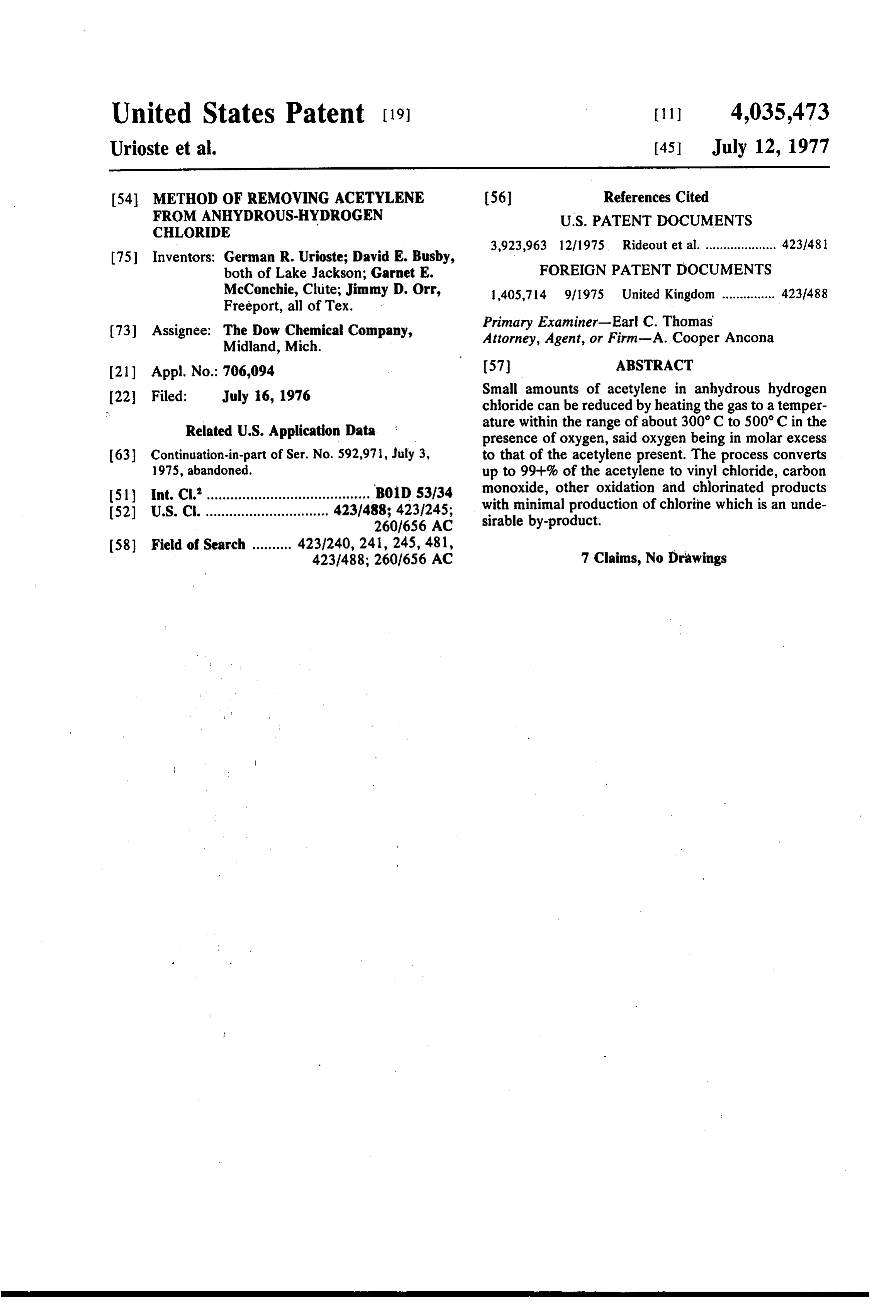
United States Patent (19) 11 4,035,473 Urioste et al. (45) July 12, 1977 54 METHOD OF REMOVING ACETYLENE (56) References Cited
FROM ANHYDROUS-HYDROGEN
CHLORDE
(75) Inventors: German R. Urioste; David E. Busby, both of Lake Jackson; Garnet E. FOREIGN PATENT DOCUMENTS
McConchie, Clute; Jimmy D. Orr, 1405,714 9/1975 United Kingdom ............... 4231488 Freeport, all of Tex.
(73) Assignee: The Dow Chemical Company, Primary Examiner-Earl C. Thomas Midland, Mich. Attorney, Agent, or Firm-A. Cooper Ancona (21) Appl. No.:706,094 (57) ABSTRACT 22) Filed: July 16, 1976 Small amounts of acetylene in anhydrous hydrogen chloride can be reduced by heating the gas to a temper ature within the range of about 300°C to 500C in the
Related U.S. Application Data presence of oxygen, said oxygen being in molar excess (63) Continuation-in-part of Ser. No. 592,971, July 3, to that of the acetylene present. The process converts 1975, abandoned. up to 99% of the acetylene to vinyl chloride, carbon (51) Int. C.’......................................... B01D 53/34 monoxide, other oxidation and chlorinated products (52) U.S. C. ............................... 4231488; 423/245; with minimal production of chlorine which is an unde
4231488; 260/656 AC 7 Claims, No Drawings
Page 2
The operating reaction time is about 0.05 to about
METHOD OF REMOVING ACETYLENE FROM 5.0 seconds and the most preferred range is 0.5 to 1.6 ANHYDROUS-HYDROGEN CHLORIDE seconds.
The reaction should be carried out in equipment
CRoss REFERENCE TO RELATED APPLICATION 5 which is resistant to oxidation and to the corrosive This application is a continuation-in-part of our co effects of hot HCl and small amounts of Cl2. Thus, the pending application Ser. No. 592,971 filed July 3, reactor can be ceramic or ceramic-lined or it can be 1975, now abandoned. made of a corrosion resisting metal, e.g., nickel or
BACKGROUND OF THE INVENTON
alloys thereof, representative of which are those con 10 taining 14-25% chromium, 0-8% iron and the remain
Anhydrous hydrogen chloride is formed in the crack der nickel.
ing of many chlorinated hydrocarbons. In the cracking Since the reactor must be made of corrosion resistant of 1,2-dichloroethane (ethylene dichloride, EDC) to materials which are expensive, it is preferred to employ vinyl chloride some acetylene, up to about 0.6 mole .15 high pressures which makes possible a smaller, and percent of the hydrogen chloride, is also formed. Acet therefore, less expensive, reactor. Any pressure within ylene impurity in the HCl cannot be separated easily by practical limits is satisfactory, but a pressure within the known methods, such as distillation. Acetylene-free range of from about 30 to about 110 psig (2.0 to 7.5 hydrogen chloride is directly applicable to many pro atm) is preferred.
cesses, in which acetylene is responsible for significant The principal product is that from the reaction be yield losses or unwanted impurity formations, e.g., amountsHCl 20 tween and acetylene, i.e., vinyl chloride. Minor of carbon monoxide and organic chlorination oxychlorination of ethylene.
It is an object of this invention to reduce the quantity and oxidation products of acetylene are also formed. of acetylene in anhydrous HCl to a very low level. Only small amounts of chlorine (<1000 ppm mole It is another object of this invention to minimize the 25 basis) are formed from oxidation of HCl. Acetylene contentis reduced by up to 99%, making it possible to production of chlorine (Cl) from the oxidation of feed the reactor effluent directly to an oxychlorination hydrogen chloride. process.
sUMMARY OF THE INVENTION Thus the method of the present invention reduces the acetylene
It has been found that if anhydrous hydrogen chlor 30 heating said content of anhydrous hydrogen chloride by ide containing small amounts of acetylene is mixed with molar excess hydrogen chloride in the presence of a oxygen or an oxygen-containing gas at high tempera perature of at least aboutbased of oxygen, on acetylene, to a tem 300° C. for a contact time tures, the acetylene content is greatly reduced without sufficient to convert the acetylene to chlorinated deriv the formation of large amounts of chlorine. -
The acetylene content in the anhydrous hydrogen 35 atives, primarily vinyl chloride.
chloride produced in the cracking of EDC generally is DETAILED DISCLOSURE OF THE INVENTION present in a small amount of up to about 0.6 mole percent and the most frequent range is 0.15 to 0.3 mole butThenotexamples which follow are intended to illustrate, to limit, the invention. All parts and percent percent. Even this amount is deleterious and must be ages are on a mole basis, unless specifically designated reduced. . . . 40 otherwise.
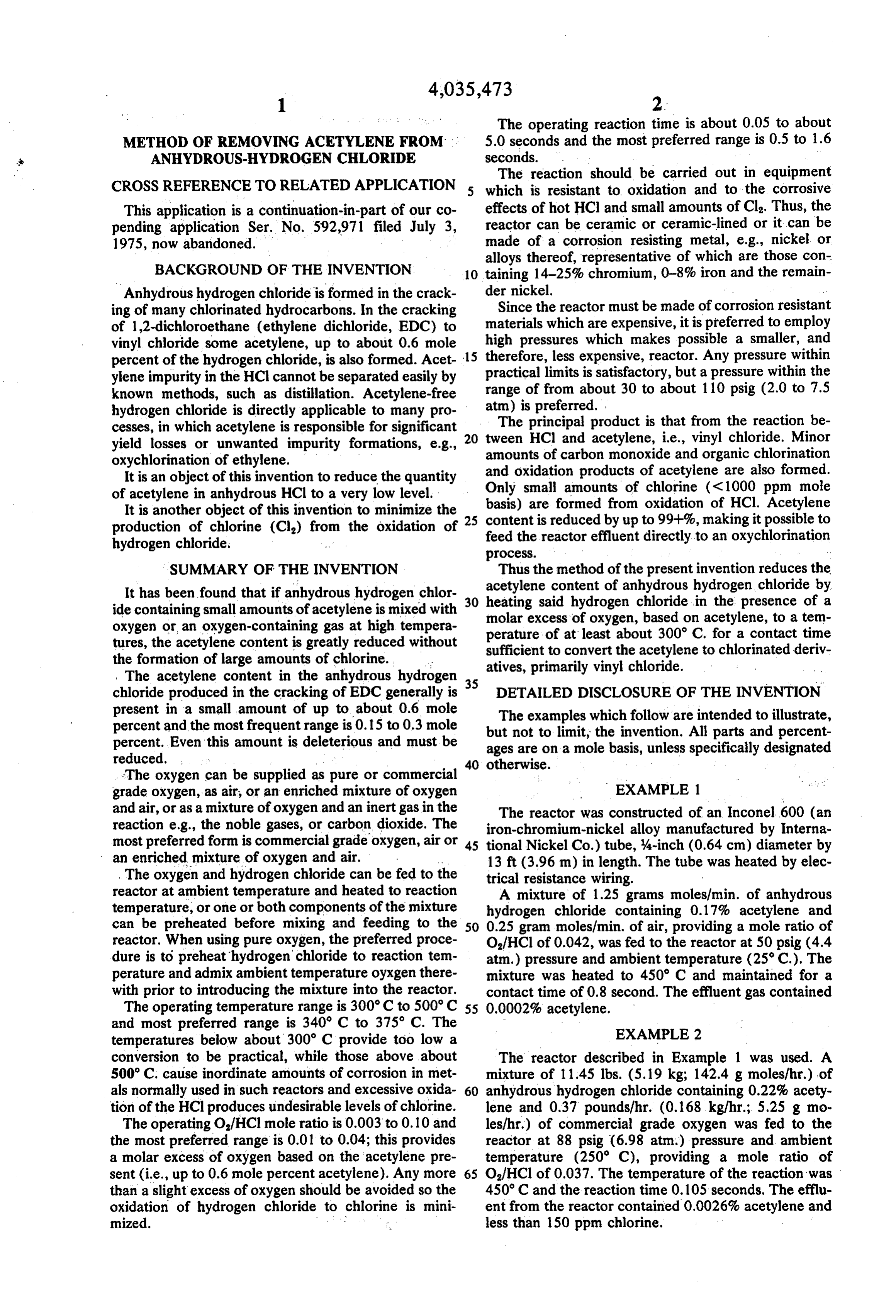
The oxygen can be supplied as pure or commercial grade oxygen, as air, or an enriched mixture of oxygen EXAMPLE 1 and air, or as a mixture of oxygen and an inert gas in the The reactor was constructed of an Inconel 600 (an reaction e.g., the noble gases, or carbon dioxide. The iron-chromium-nickel alloy manufactured by Interna most preferred form is commercial grade oxygen, air or 45 tional Nickel Co.) tube, 4-inch (0.64 cm) diameter by an enriched mixture of oxygen and air. . 13 ft (3.96 m) in length. The tube was heated by elec The oxygen and hydrogen chloride can be fed to the trical resistance wiring.
reactor at ambient temperature and heated to reaction A mixture of 1.25 grams moles/min. of anhydrous temperature, or one or both components of the mixture hydrogen chloride containing 0.17% acetylene and can be preheated before mixing and feeding to the 50 0.25 gram moles/min. of air, providing a mole ratio of reactor. When using pure oxygen, the preferred proce O/HCl of 0.042, was fed to the reactor at 50 psig (4.4 dure is to preheat hydrogen chloride to reaction tem atm.) pressure and ambient temperature (25 C.). The perature and admix ambient temperature oyxgen there mixture was heated to 450 C and maintained for a with prior to introducing the mixture into the reactor. contact time of 0.8 second. The effluent gas contained The operating temperature range is 300°C to 500C 55 0.0002% acetylene.
and most preferred range is 340 C to 375 C. The temperatures below about 300° C provide too low a EXAMPLE 2 conversion to be practical, while those above about The reactor described in Example 1 was used. A 500 C. cause inordinate amounts of corrosion in met mixture of 11.45 lbs. (5.19 kg; 142.4 g moles/hr.) of als normally used in such reactors and excessive oxida 60 anhydrous hydrogen chloride containing 0.22% acety tion of the HCl produces undesirable levels of chlorine. lene and 0.37 pounds/hr. (0.168 kg/hr.; 5.25 g mo The operating O, HCl mole ratio is 0.003 to 0.10 and les/hr.) of commercial grade oxygen was fed to the the most preferred range is 0.01 to 0.04; this provides reactor at 88 psig (6.98 atm.) pressure and ambient a molar excess of oxygen based on the acetylene pre temperature (250 C), providing a mole ratio of sent (i.e., up to 0.6 mole percent acetylene). Any more O/HCl of 0.037. The temperature of the reaction was than a slight excess of oxygen should be avoided so the 450 C and the reaction time 0.105 seconds. The efflu oxidation of hydrogen chloride to chlorine is mini ent from the reactor contained 0.0026% acetylene and mized. less than 150 ppm chlorine.
Page 3
alumina apparently provided no catalytic effect on the
EXAMPLE 3 reaction.
The reactor unit was constructed of an Inconel 600 EXAMPLES 5-10
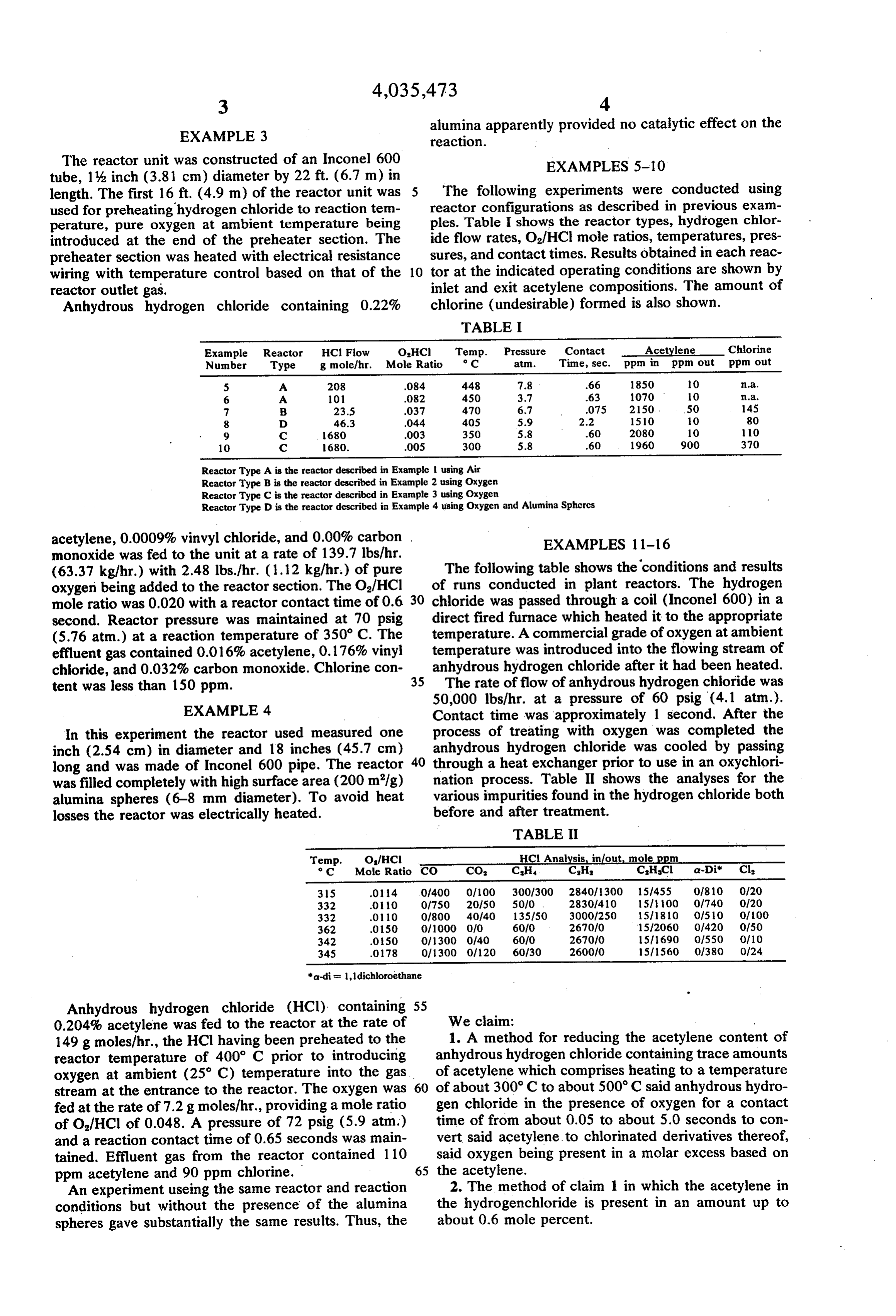
length. The first 16 ft. (4.9 m) of the reactor unit was 5 The following experiments were conducted using used for preheating hydrogen chloride to reaction tem- reactor configurations as described in previous exam perature, pure oxygen at ambient temperature being ples. Table I shows the reactor types, hydrogen chlor introduced at the end of the preheater section. The ide flow rates, O2/HCl mole ratios, temperatures, pres preheater section was heated with electrical resistance sures, and contact times. Results obtained in each reac wiring with temperature control based on that of the 10 tor at the indicated operating conditions are shown by reactor outlet gas. inlet and exit acetylene compositions. The amount of Anhydrous hydrogen chloride containing 0.22% chlorine (undesirable) formed is also shown.
TABLE I
Example Reactor HCl Flow OHC Temp. Pressure Contact Acetylene Chlorine Number Type g mole/hr. Mole Ratio C atm. Time, sec. ppm in ppm out ppm out 5 A 208 .084 448 7.8 .66 1850 10 la. 6 A 101 .082 450 3.7 .63 1070 0 2. 7 B 23.5 037 470 6.7 .075 2150, 50 145 8 D 46.3 .044 405 5.9 2.2 1510 10 80 9 C 1680 003 350 5.8 .60 2080 10 1 10 10 C 1680. 005 300 5.8 60 1960 900 370 Reactor Type A is the reactor described in Example 1 using Air
Reactor Type B is the reactor described in Example 2 using Oxygen
Reactor Type C is the reactor describcd in Example 3 using Oxygen
Reactor Type D is the reactor described in Example 4 using Oxygen and Alumina Sphcres
acetylene, 0.0009% vinvyl chloride, and 0.00% carbon . EXAMPLES 11-16 monoxide was fed to the unit at a rate of 139.7 lbs/hr.
(63.37 kg/hr.) with 2.48 lbs./hr. (1.12 kg/hr.) of pure The following table shows the conditions and results oxygen being added to the reactor section. The O/HCl of runs conducted in plant reactors. The hydrogen mole ratio was 0.020 with a reactor contact time of 0.6 30 chloride was passed through a coil (Inconel 600) in a second. Reactor pressure was maintained at 70 psig direct fired furnace which heated it to the appropriate (5.76 atm.) at a reaction temperature of 350° C. The temperature. A commercial grade of oxygen at ambient effluent gas contained 0.016% acetylene, 0.176% vinyl temperature was introduced into the flowing stream of chloride, and 0.032% carbon monoxide. Chlorine con anhydrous hydrogen chloride after it had been heated. tent was less than 150 ppm. 35 The rate of flow of anhydrous hydrogen chloride was
EXAMPLE 4
Contact time was approximately 1 second. After the
In this experiment the reactor used measured one process of treating with oxygen was completed the inch (2.54 cm) in diameter and 18 inches (45.7 cm) anhydrous hydrogen chloride was cooled by passing long and was made of Inconel 600 pipe. The reactor 40 through a heat exchanger prior to use in an oxychlori was filled completely with high surface area (200 m/g) nation process. Table II shows the analyses for the alumina spheres (6-8 mm diameter). To avoid heat various impurities found in the hydrogen chloride both losses the reactor was electrically heated. before and after treatment.
TABLE II
Temp. OHCl HCl Analysis, inlout, mole ppm
C Mole Ratio CO CO CH CH C.HCl a-Di" Cl, 315 .0114 0/400 0/100 300/300 284.0/1300 151455 01810 0120
332 .01.10 01800 40/40 135/50 3000/250 151810 01510 Of 100 362 0.150 0/1000 0/0 60/0 267010 1512060 Of420 O150 342 .050 0/1300 0/40 60/0 267010 1571690 0.1550 0110 345 .0178 0/1300 01120 60/30 260010 1511560 01380 0/24
Anhydrous hydrogen chloride (HCl) containing 55 0.204% acetylene was fed to the reactor at the rate of We claim:
149 g moles/hr., the HCl having been preheated to the 1. A method for reducing the acetylene content of reactor temperature of 400 C prior to introducing anhydrous hydrogen chloride containing trace amounts oxygen at ambient (25° C) temperature into the gas of acetylene which comprises heating to a temperature stream at the entrance to the reactor. The oxygen was 60 of about 300°C to about 500 C said anhydrous hydro fed at the rate of 7.2 g moles/hr., providing a mole ratio gen chloride in the presence of oxygen for a contact of O/HCl of 0.048. A pressure of 72 psig (5.9 atm.) time of from about 0.05 to about 5.0 seconds to con and a reaction contact time of 0.65 seconds was main vert said acetylene to chlorinated derivatives thereof, tained. Effluent gas from the reactor contained 110 said oxygen being present in a molar excess based on ppm acetylene and 90 ppm chlorine. 65 the acetylene.
An experiment useing the same reactor and reaction 2. The method of claim 1 in which the acetylene in conditions but without the presence of the alumina the hydrogenchloride is present in an amount up to spheres gave substantially the same results. Thus, the about 0.6 mole percent.
Page 4
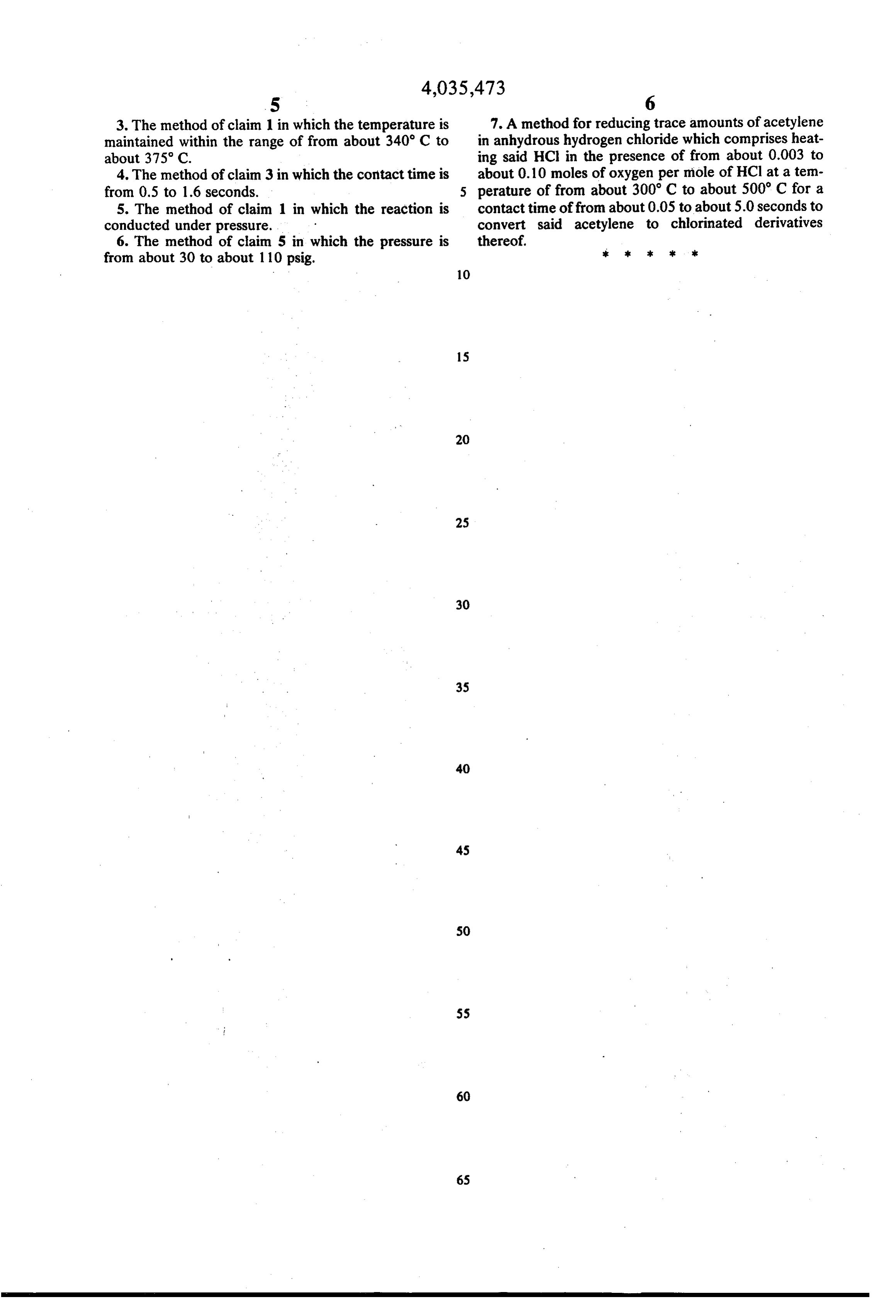
3. The method of claim 1 in which the temperature is 7. A method for reducing trace amounts of acetylene maintained within the range of from about 340 C to in anhydrous hydrogen chloride which comprises heat about 375 C. ing said HCl in the presence of from about 0.003 to 4. The method of claim 3 in which the contact time is about 0.10 moles of oxygen per mole of HCl at a tem from 0.5 to 1.6 seconds. 5 perature of from about 300° C to about 500° C for a 5. The method of claim 1 in which the reaction is contact time of from about 0.05 to about 5.0 seconds to conducted under pressure. convert said acetylene to chlorinated derivatives 6. The method of claim 5 in which the pressure is thereof.
from about 30 to about 110 psig,
Provenance
- Collection
- Cited prior art
- Original PDF
- patentimages.storage.googleapis.com →
- Filed
- 1976-07-16
- Pages
- 4
- Method
- pdftotext (the PDF's own text layer) + pdftoppm 300dpi page scans
- Source
- Google Patents bibliographic record
- Granted
- 1977-07-12
- Inventors
- German R. Urioste; David E. Busby; Garnet E. McConchie; Jimmy D. Orr; Dow Chemical Co
- Transcribed from
- patentimages.storage.googleapis.com →