patent · US4124466
Enhancing chemical reactions
7 November 1978
Page 1 — bibliographic record
United States Patent (19) 11) 4,124,466 Morrey (45) Nov. 7, 1978
54 ENHANCING CHEMICAL REACTIONS 57 ABSTRACT 75 Inventor: John R. Morrey, Richland, Wash. Methods of enhancing selected chemical reactions. The population of a selected high vibrational energy state of 73) Assignee: Battelle Memorial Institute, a reactant molecule is increased substantially above its Columbus, Ohio population at thermal equilibrium by directing onto the 21) Appl. No.: 480,411 molecule a beam of radiant energy from a laser having a combination of frequency and intensity selected to 22 Filed: Jun. 18, 1974 pump the selected energy state, and the reaction is car ried out with the temperature, pressure, and concentra
Related U.S. Application Data tions of reactants maintained at a combination of values 63 Continuation-in-part of Ser. No. 307,380, Nov. 17, selected to optimize the reaction in preference to ther 1972, abandoned. mal degradation by transforming the absorbed energy 5ll Int. Cl. ................................................ B01J 1/10 into translational motion. The reaction temperature is 52) U.S. Cl................. ... 204/157.1 R; 204/158 R selected to optimize the reaction. 58) Field of Search ............204/5R 158R, Typically a laser and a frequency doubler emit radiant 204/162 R, DIG. 11 energy at frequencies of v and 2v into an optical dye 56) References Cited within an optical cavity capable of being tuned to a wanted frequency 8 or a parametric oscillator compris
FOREIGN PATENT DOCUMENTS ing a non-centrosymmetric crystal having two indices 1,284,620 8/1972 United Kingdom ............ 204/DIG. 1 of refraction, to emit radiant energy at the frequencies OTHER PUBLICATIONS of v, 2v, and 8 (and, with a parametric oscillator, also at 2v-8). Each unwanted frequency is filtered out, and
Artamonova et al, Soviet Physics JETP, vol. 31 No. 6 each desired frequency is focused to the desired radia (Dec. 1970) pp. 1185-1188. tion flux within a reaction chamber and is reflected Ambartzumian et al., Applied Optics, vol. 11, No. 2 repeatedly through the chamber while reactants are fed (Feb. 1972) pp. 354-358. into the chamber and reaction products are removed Primary Examiner-Howard S. Williams therefrom.
Attorney, Agent, or Firm-Philip M. Dunson; Joseph J. 4 Claims, 16 Drawing Figures Hauth; David L. Prezbindowski
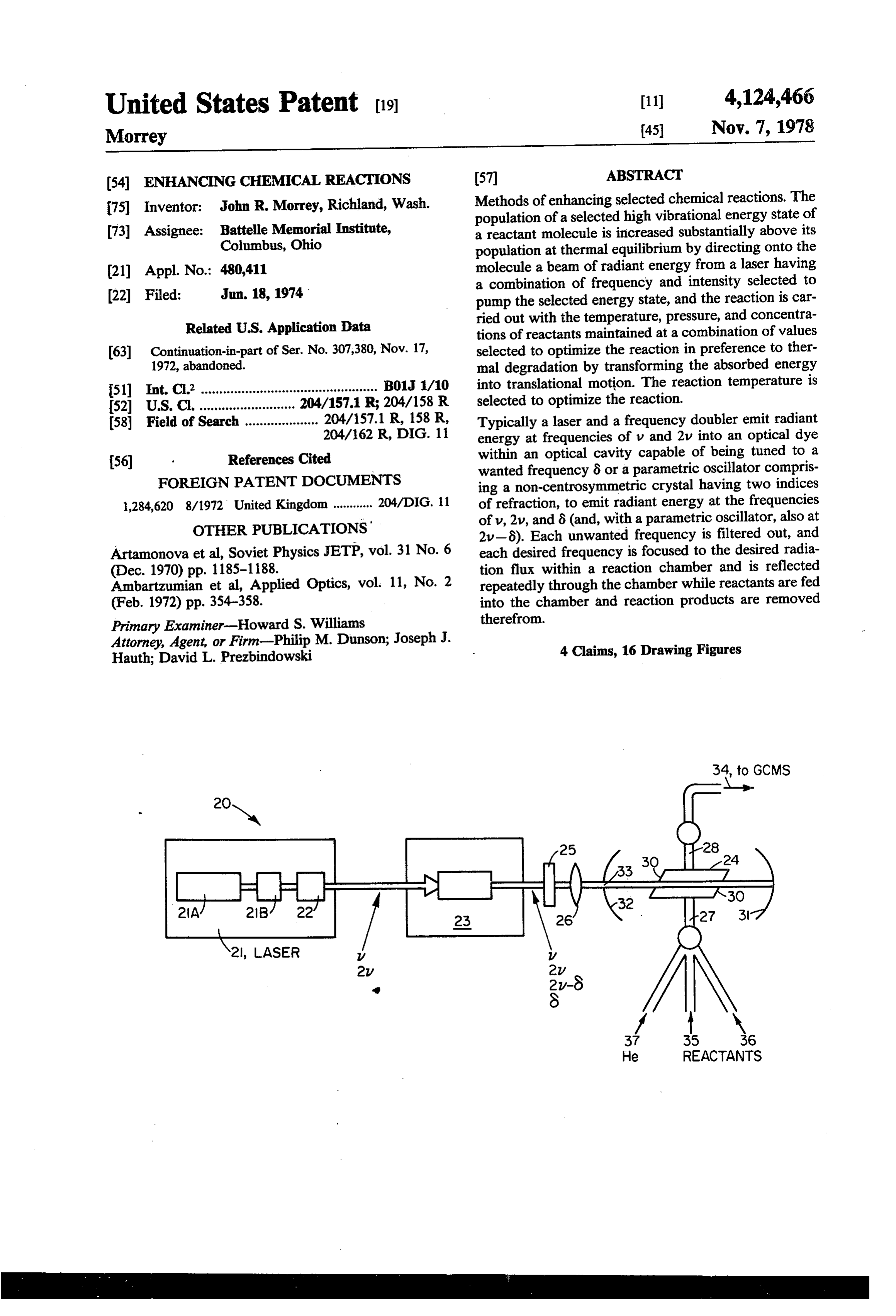
34, to GCMS
He REACTANTS
Page 2
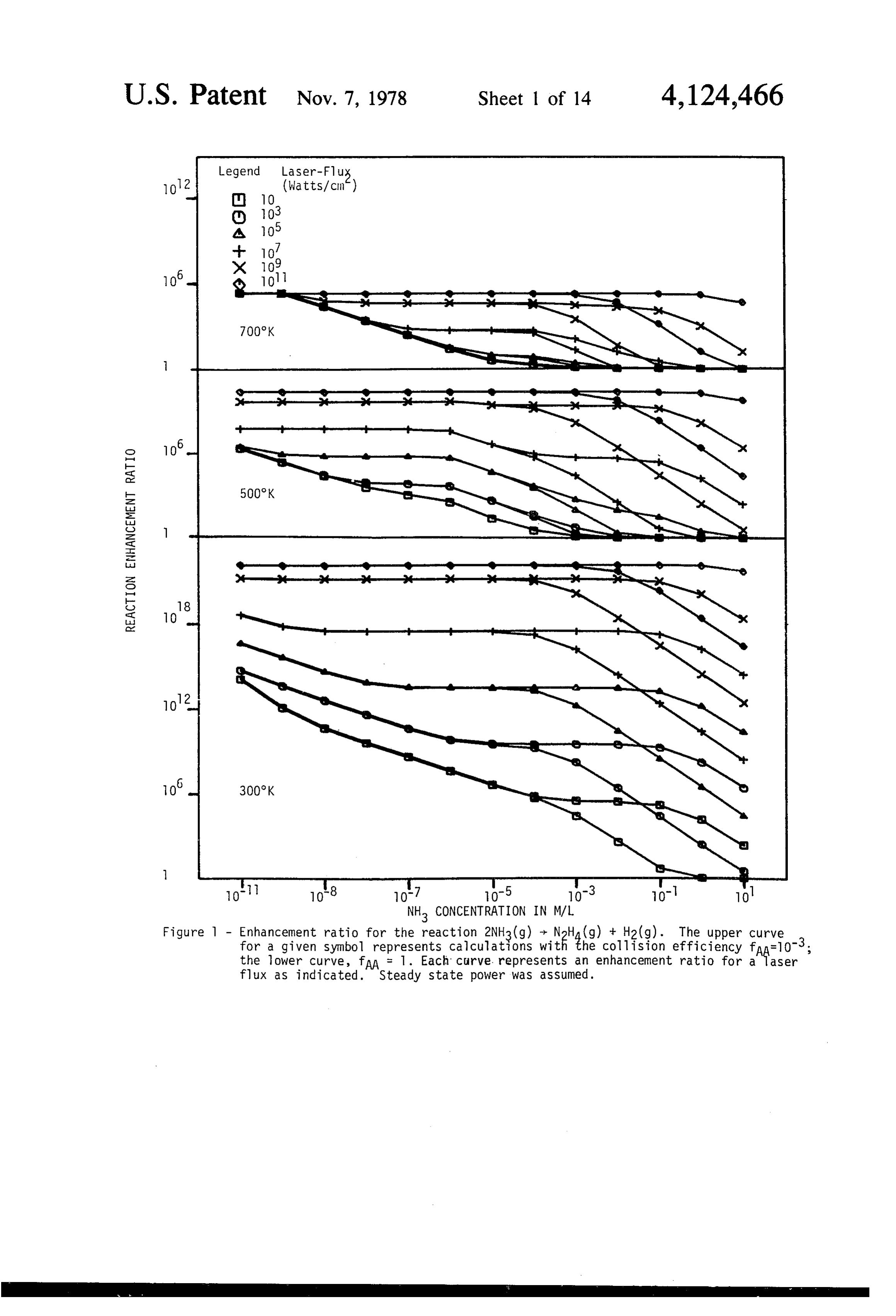
Legend Laser-Flu
oil 10-8 0-7 0-5 lo-3 o-l l
NH CONCENTRATION IN M/L
Figure - Enhancement ratio, for the reaction 2NH3(g) + 2") + H2(g). The upper curve for a given symbol represents calculations with the C ollision efficiency f -O-3; the lower Curve, f = 1. Each curve. represents an enhancement ratio for aA. aSer flux as indicated. Steady state power was assumed.
Page 3
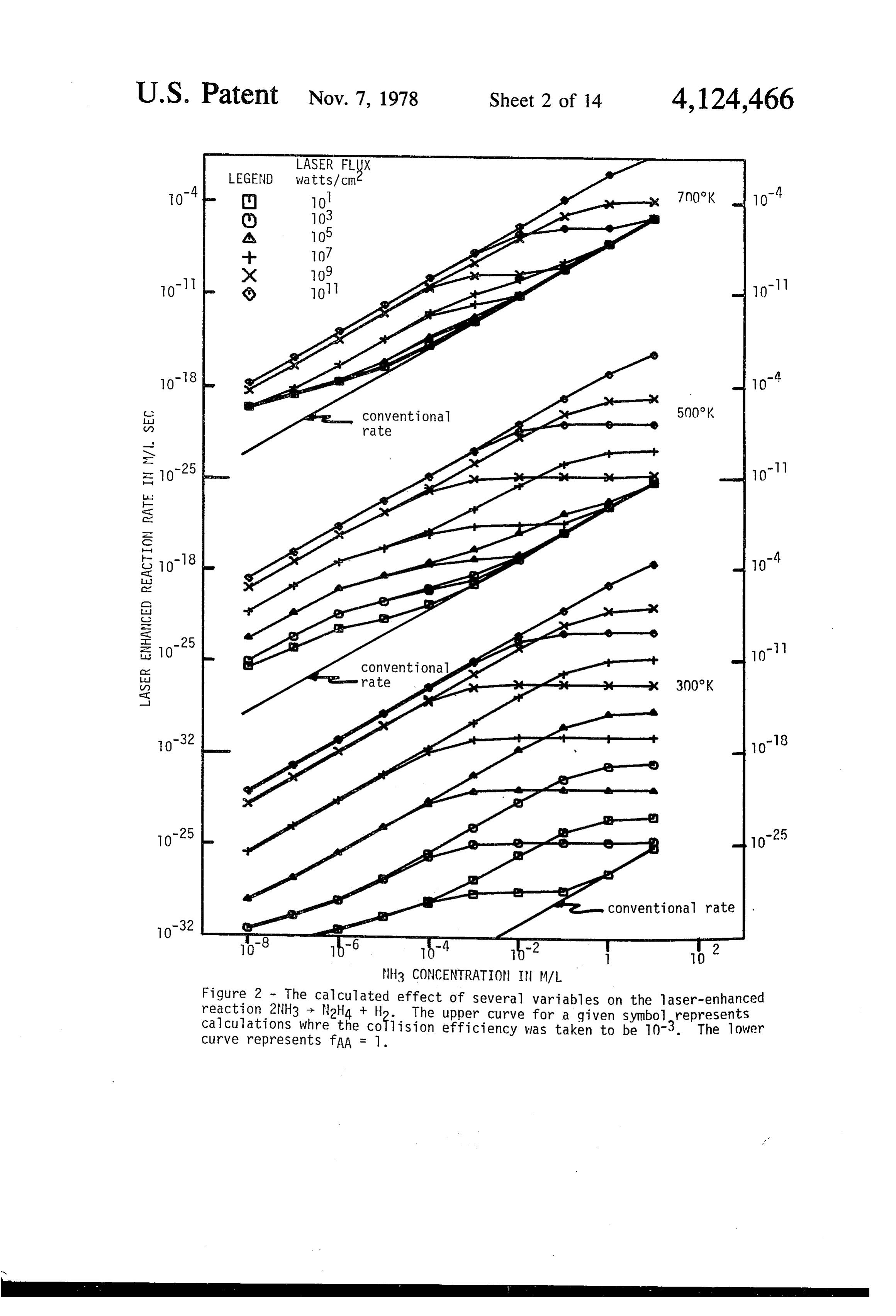
LASER FLUX
LEGEND watts/cm
O -4 O 10-4
09 . .' -l loll 10
10-8 O -4
rate s -1
, O-l 8 10 -4
10-32 O-18
10-25 O -25
NH3 CONCENTRATION II M/L
Figure 2 - The calculated effect of several variables on the laser-enhanced reaction 2NH3 - N2H4 + H2. The upper curve for a given symbol represents calculations whre the ciision efficiency was taken to be 0-3. The lower curve represents faA = ).
Page 4
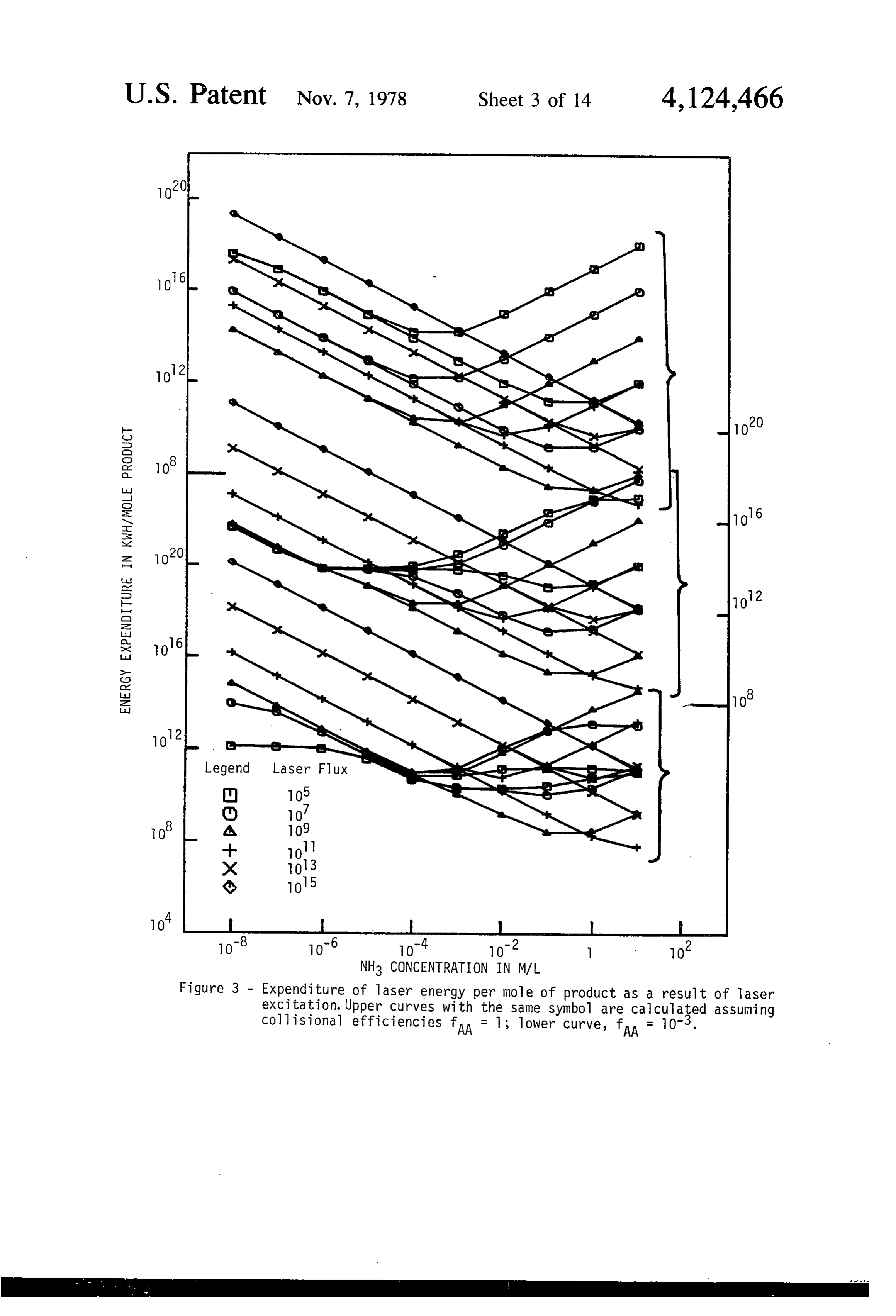
Legend Laser Flux
loll
NH3 CONCENTRATION IN M/L
Figure 3 - Expenditure of laser energy per mole of product as a result of laser excitation, Upper Curves with the same symbol are calculated assuming Collisional efficiencies AA = l; lower curve, fAA = 0-3.
Page 5
Drawing sheet — no readable text.
Page 6
Drawing sheet — no readable text.
Page 7
Drawing sheet — no readable text.
Page 8
16x10 X
5 l 2 g 2xl O 2 C H
X 2d
TIME IN MICROSECONDS
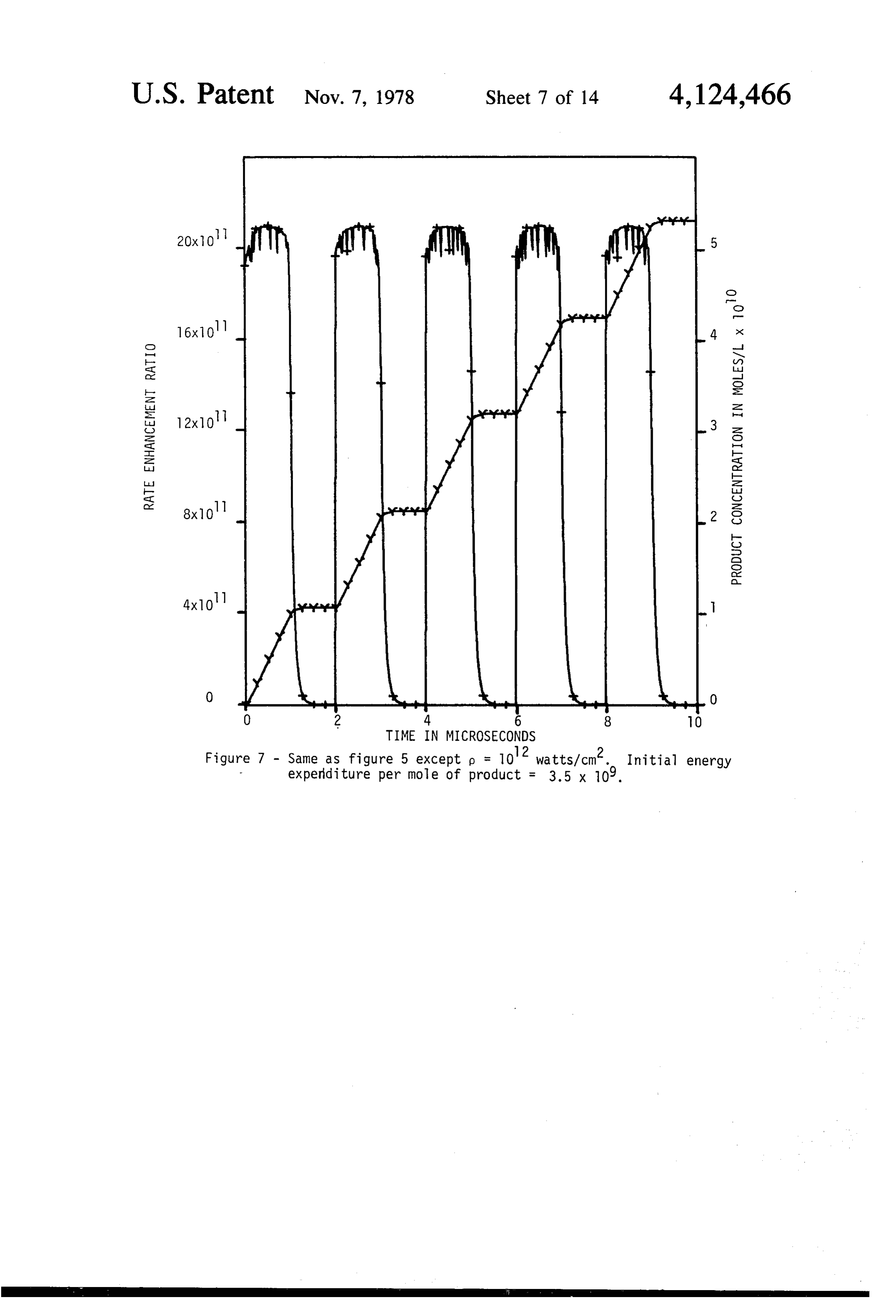
Figure 7 - Same as figure 5 except p = 10 2 watts/cm. Initial energy experiditure per mole of product = 3.5 x 10⁹.
Page 9
TIME IN MICROSECONDS
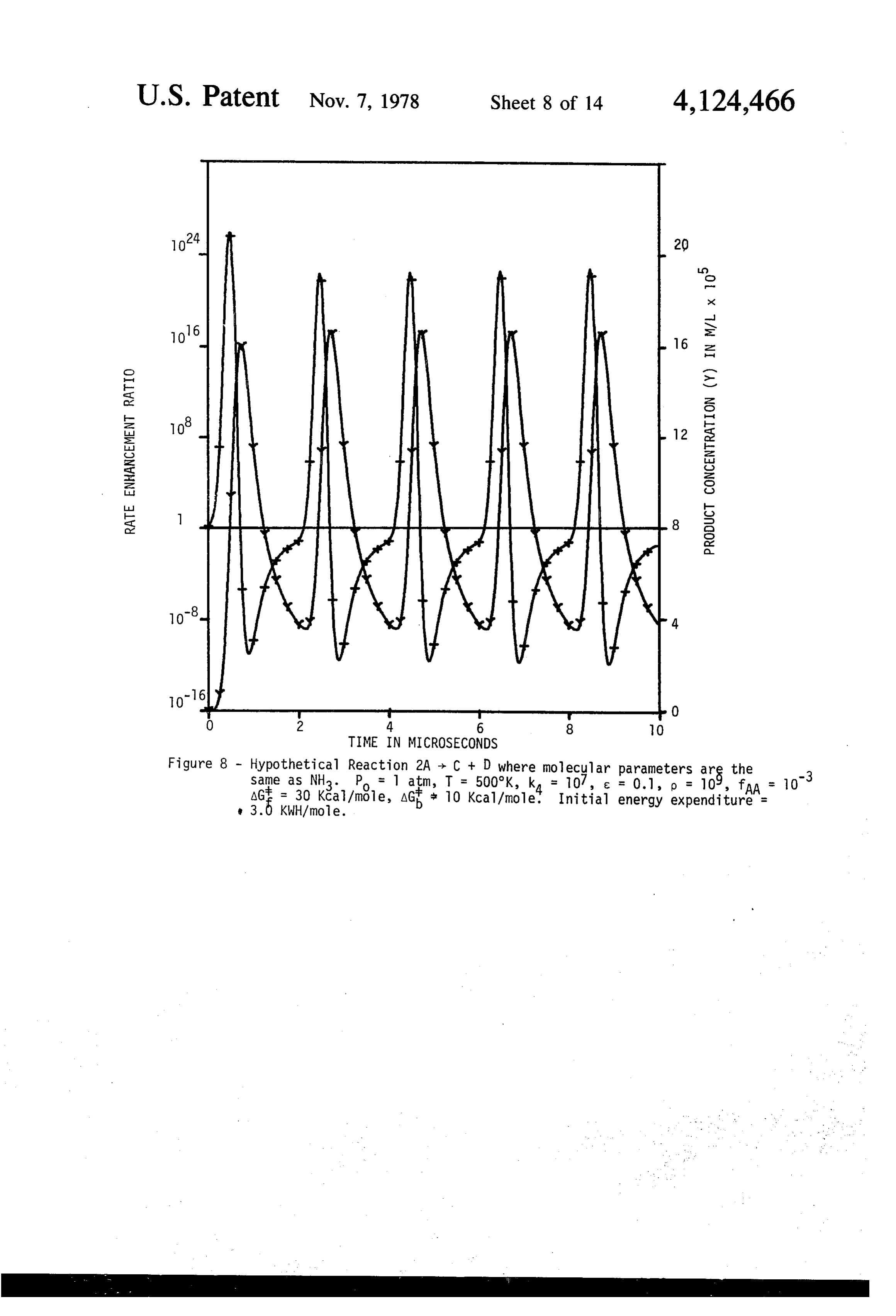
Figure 8 - Hypothetical Reaction 2A -- C + D where molecular parameters are the -3 Sage as NH3. Po, l am, T = 500K, k = 107, e - 0.1, p = 109, f AG = 30 Kcal/móle, AG, the O kcal/file Initial energy expenditure =
Page 10
Drawing sheet — no readable text.
Page 11
Drawing sheet — no readable text.
Page 12
Eact
LOGO (A)
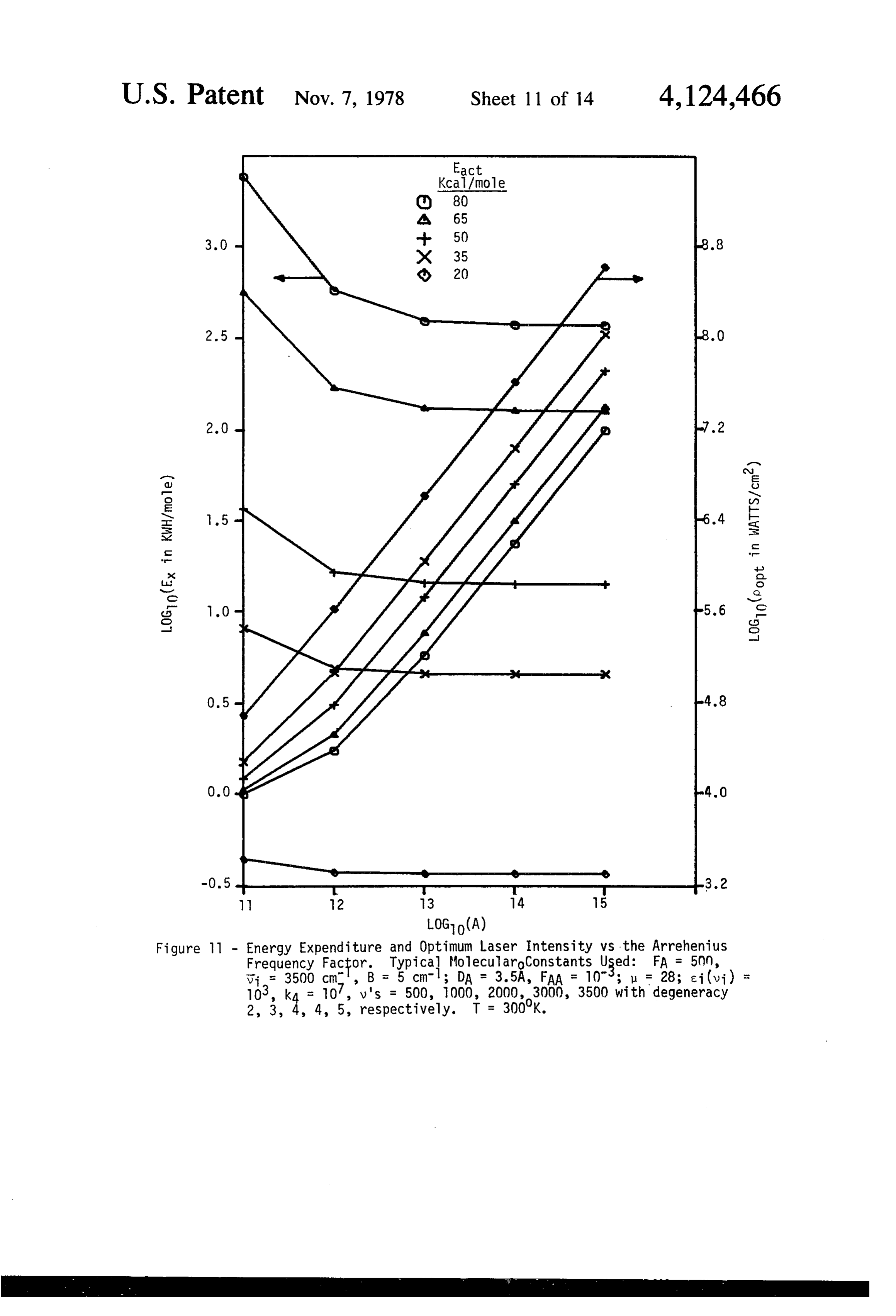
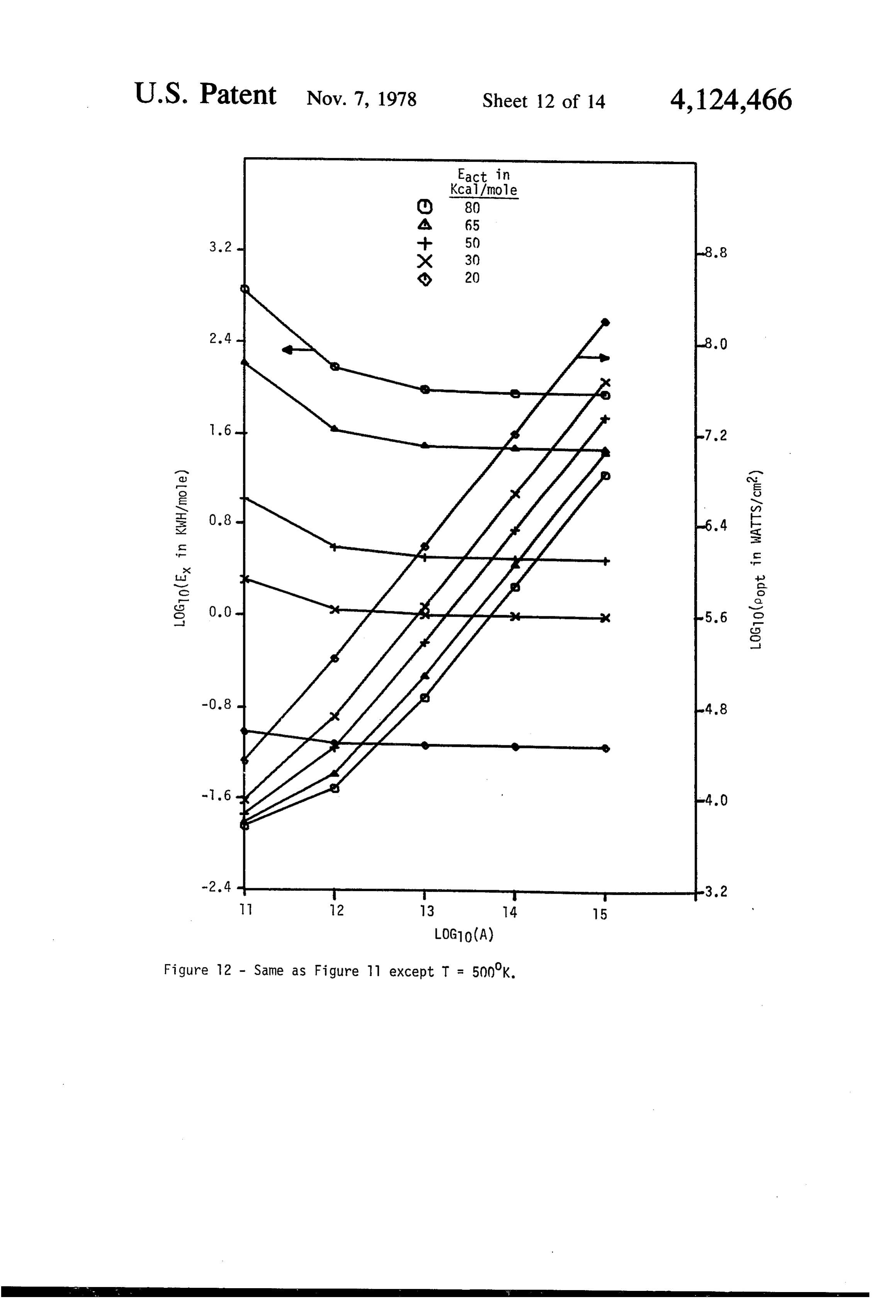
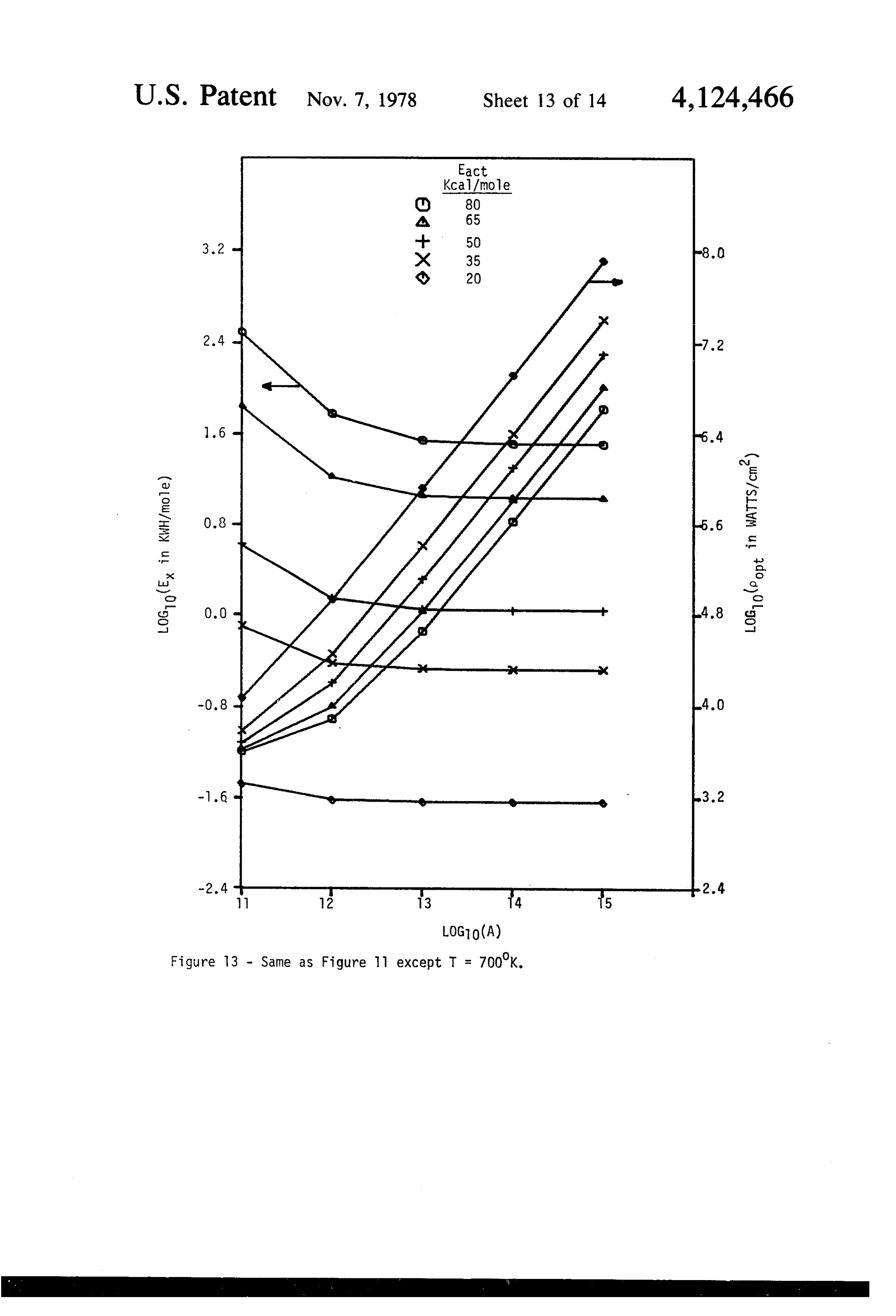
Figure ll - Energy Expenditure and Optimum laser Intensity vs the Arrehenius Frequency Factor: Typical Molecularo Constants Used: FA = 50n, v3500 cm, B = 5 cm-l; DA = 3.5A, FAA = 10; p = 28; ei (vi) = lO3, k4 = 07, v's = 500, 000, 2000,3000, 3500 with degeneracy
Page 13
Drawing sheet — no readable text.
Page 14
Drawing sheet — no readable text.
Page 15
Drawing sheet — no readable text.
Page 16
that time, the number of available infrared laser fre
ENHANCING CHEMICAL REACTIONS quencies was severely limited and the techniques for CROSS REFERENCE TO RELATED tuning were not sufficiently advanced for our needs as APPLICATION we saw them then, when we envisioned the need for a 5 laser capable of being tuned over an appreciable range
This application is a continuation in part of applica in a nanosecond. Now, in 1974, a wide range of infrared tion Ser. No. 307,380, filed Nov. 17, 1972, now aban laser frequencies can be generated and laser systems doned. which can be tuned over wide frequency ranges are BACKGROUND OF THE INVENTION commercially available. Practical modulation rates of
The advent of powerful frequency-modulated infra these systems are still slow for this application, but it is red lasers brings into practical possibility the activation range maythat expected tuning over a wide enough frequency soon be accomplished in short enough times of chemical reactions by vibrational excitation. Because such reactions will involve systems with vibrational to ing minimize the effect of collisional process by cascad molecules into highly excited vibrational states in states out of thermal equilibrium, reactions may also be 5 shorter induced which are not normally observed. Further chemiststhan and collision times. Such a capability will allow physicists to measure single vibrational more, solid state reactions may be affected at cryogenic temperatures and equilibria may be displaced signifi and rotational relaxation processes definitively and to cantly by optical pumping. This paper examines the and measure in detail the contribution of specific vibrational conditions necessary for infrared-laser-activated reac 20 Infrared rotational states to chemical reactions. tions. Appropriate experimental conditions are pre lasers already have been used in the study of dicted. vibrational relaxation times for some simple molecu One of the important applications of infrared lasers les.(890) They have been used in conjunction with may well be the activation of highly selective chemical molecular beam experiments to elucidate the impor reactions and the study of their fundamental dynamics. 25 tance of vibrational energy in chemical reactions. () Although initial success is likely to occur with gaseous Some preliminary experiments have also been reported reactions, liquid and solid reactions may follow. Isoto which verify that infrared lasers can markedly enhance pic separation may also be made highly selective by this chemical reactions even when competing coilisional technique. processes are important.(12") Excitation by infrared lasers is fundamentally differ 30 A number of recent papers report experiments and ent than excitation by high energy lasers in the visible or theory baaring on the general questigin of relaxatio:a u.V. range, the latter causing electronic transitions, usu processes within the molecule, many of which must be ally with secondary energy transitions to the transla considered as competitors to the actual reaction ra tional and vibrational degrees of freedom in a somewhat te.) Both intramolecular and intermolecular processes random fashion. Excitation by infrared places energy in 35 are important in the prediction of laser reaction en the vibrational modes in a selective fashion, giving rise hancement. Considerable emphasis has been given to to the possibility of highly selective reactions. simple molecules in this regard, but little has been re We began to seriously consider the possibility of ported on vibrational relaxation processes of heavier using infrared lasers for chemical activation over five molecules in the ground electronic state. Until this in years ago. However, at that time, the number of avail formation is available, the complete potential of laser able infrared laser frequencies was severely limited and enhanced reactions in activating specific chemical the techniques for modulation were not sufficiently bonds cannot be completely assessed. Selective reac advanced for our needs as we saw them then. Now a tions for simple molecules, on the other hand, caused by wide range of infrared laser frequencies can be gener energy enrichment of specific vibrational modes will ated and laser systems which can be tuned over wide 45 most certainly produce products not normally observed frequency ranges are commercially available. under thermally equilibrated conditions. Practical modulation rates of these systems are still Our approach has been to develop a mathematical slow for this application, but it is conceivable that in the formulation which, when used along with molecular not-too-distant future frequency modulation over a dynamic measurements, can predict the rate enhance wide range may be accomplished in nanosecond times. 50 ment caused by appropriately tuned lasers. The devel This will allow infrared cascading to be used to gener opment follows the method used ate excited vibrational states resulting in larger popula ory. It does not incorporate eitherin the transition state the tions than would be obtainable under thermal equilib tion nor does its usage depend upon the adiabatic condi thermal equilib rium conditions at thousands of degrees, under which rium approximation, although it is derived from consid conditions, of course, the simplest molecule would be 55 torn apart. eration of conditions of thermal equilibrium. Apparently the first experimental paper which de All molecules have characteristic vibrational fre scribes laser infrared activation of a chemical reaction quencies. Their bonding is partly covalent and partly can be attributed to Borde etal who used a CO2 laser to ionic, and all reactions which result in formation of new excite and react SF6, C2H4, C3H6, and PH3.) Mayer et products involve breaking of bonds through extension al) used a continuous-wave hydrogen fluoride laser to 60 of the distance between atoms within the molecuie. The successfully separate deuterium from hydrogen by spe extension is a function of the vibrational excitation of cific activation of the reaction of methanol with bro the molecule, so the principles and techniques of this mine. Russian workers at the Lebedev Physics Institute, invention are applicable to all molecules. When the also known to be working in the field, have reported 65 spectroscopy is known, excitation schernes can be de laser induced reactions with N2F, B.Cl3, SiH4, and SF6 veloped and reaction conditions can be specified for which proceed at explosive rates.() production of specific compounds.
We seriously considered the possibility of using infra Efficient and easily employed conditions typically red lasers for chemical activation in 1965. However, at involve multiple excitation of a given molecule using
Page 17
one laser frequency, on a time scale that is short by If rotational equilibrium is rapidly attained, S in equa comparison with the average time between molecular tion (9c) does not include the rotational energy levels. collisions. This increases the magnitude of , and thus the enhance An important objective of our latest activity is to ment of the reaction.
select and experimentally measure the laser-enhanced In a typical method according to this invention, a reaction of a simple system which can be used to deter laser and a frequency doubler emit radiant energy at mine the predictive accuracy of the previously devel frequencies of v and 2v into an optical dye within an oped theory. The simplest systems involve molecules optical cavity capable of being tuned to a wanted fre with only one degree of vibrational freedom where quency 8 or a parametric oscillator comprising a non intramolecular relaxations do not occur. Hence, reac 10 centrosymmetric crystal having two indices of refrac tions involving diatomics are attractive. tion to emit radiant energy at the frequencies of V, 2v, SUMMARY OF THE INVENTION and 8 (and, with a parametric oscillator, also a 2v - Ö). These frequencies are adjusted to desired values by
A typical method according to the present invention selection of the lasing materials, by tuning of the optical for enhancing a selected chemical reaction comprises 15 cavities, and by controlling the temperature of the para increasing the population of a selected high vibrational metric oscillator. Typically each unwanted frequency is energy state of a reactant molecule substantially above filtered out, and each desired frequency is focused to its population at thermal equilibrium by directing onto the desired radiation flux within a reaction chamber and the molecule a beam of radiant energy from a laser is reflected repeatedly through the chamber while reac having a combination of frequency and intensity se 20 lected to pump the selected energy state, and carrying tants are fed into the chamber and reaction products are removed therefrom.
out the reaction with the temperature, pressure, and In a typical method for enhancing the reaction of HCl concentrations of reactants maintained at a combination of values selected to optimize the reaction in preference yttriaNO with to yield the HNO dimer, a neodymium doped garnet laser provides radiant energy at a fre to thermal degradation by transforming the absorbed 25 quency of about energy into translational motion. The reaction tempera doubled to about10565 cm, the radiation frequency is ture preferably is selected to optimize the reaction as radiant energy is 21130 cm", the doubled frequency determined by equation (44). (The equations and table niobate at a temperature ofthrough passed about a crystal of lithium 350 Cand oriented to referred to in this summary appear in the description of emit radiant energy at frequencies of about 2924 cm preferred embodiments.) 30
Photons are excited from one energy level either to cm and 2924 cm is directed to the reactants.10565 and 18206 cm, and the radiant energy at about the next higher energy level or to a level above the next In another typical method NO is excited to the 5th higher energy level. In the latter case, radiant energy is vibrational provided having a plurality of selected frequencies, about 1814.6state cm by radiant energy at a frequency of as illustrated in FIG. 15.
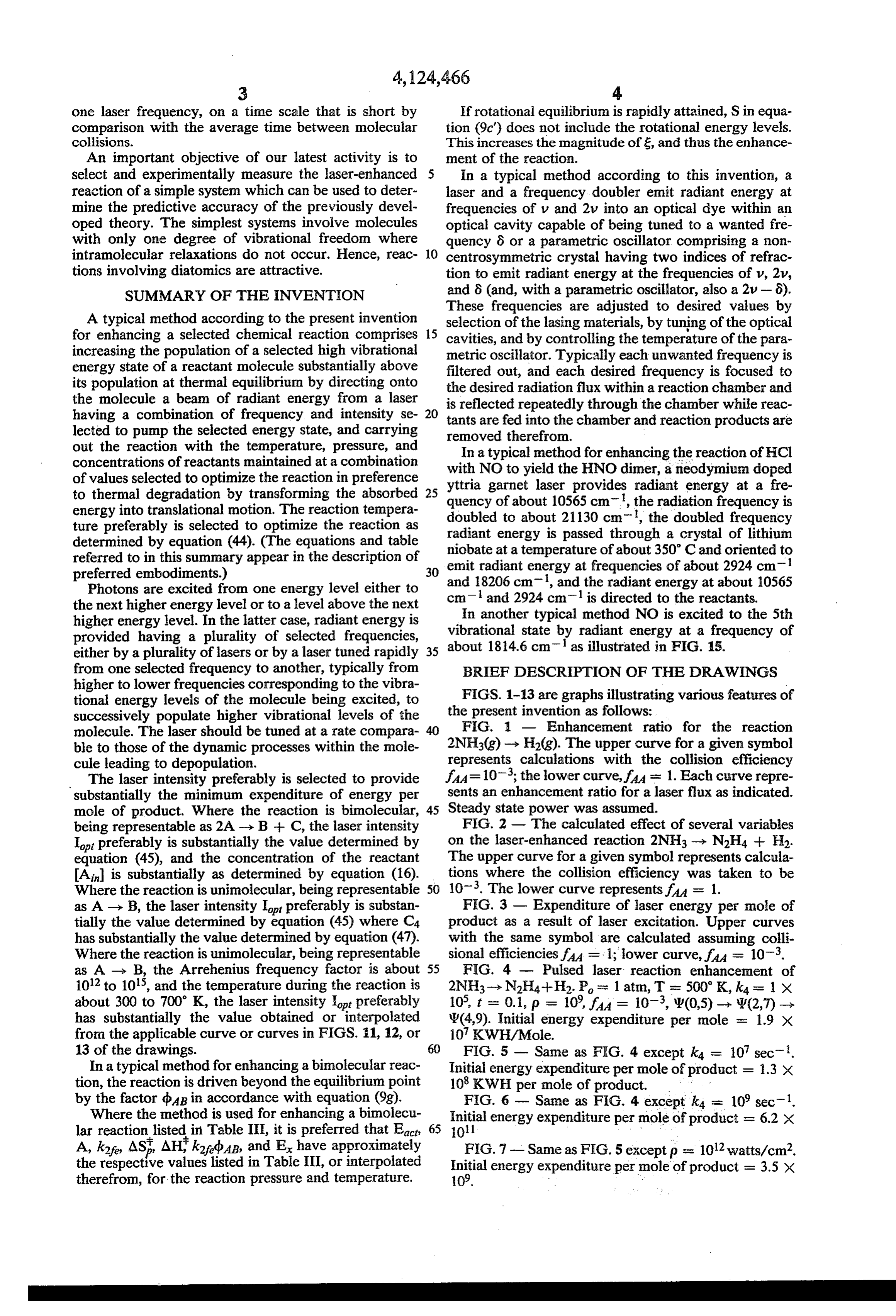
either by a plurality of lasers or by a laser tuned rapidly 35 from one selected frequency to another, typically from BRIEF DESCRIPTION OF THE DRAWINGS higher to lower frequencies corresponding to the vibra tional energy levels of the molecule being excited, to FIGS. 1-13 are graphs illustrating various features of successively populate higher vibrational levels of the theFIG. present invention as follows: - Enhancement ratio for the reaction molecule. The laser should be tuned at a rate compara ble to those of the dynamic processes within the mole 2NH3(g) - HGs). The upper curve for a given symbol cule leading to depopulation. represents calculations with the collision efficiency The laser intensity preferably is selected to provide faA=10; the lower curve.faa = 1. Each curve repre sents an enhancement ratio for a laser flux as indicated.
substantially the minimum expenditure of energy per mole of product. Where the reaction is bimolecular, 45 Steady state power was assumed.
FIG. 2 - The calculated effect of several variables being representable as 2A - B -- C, the laser intensity
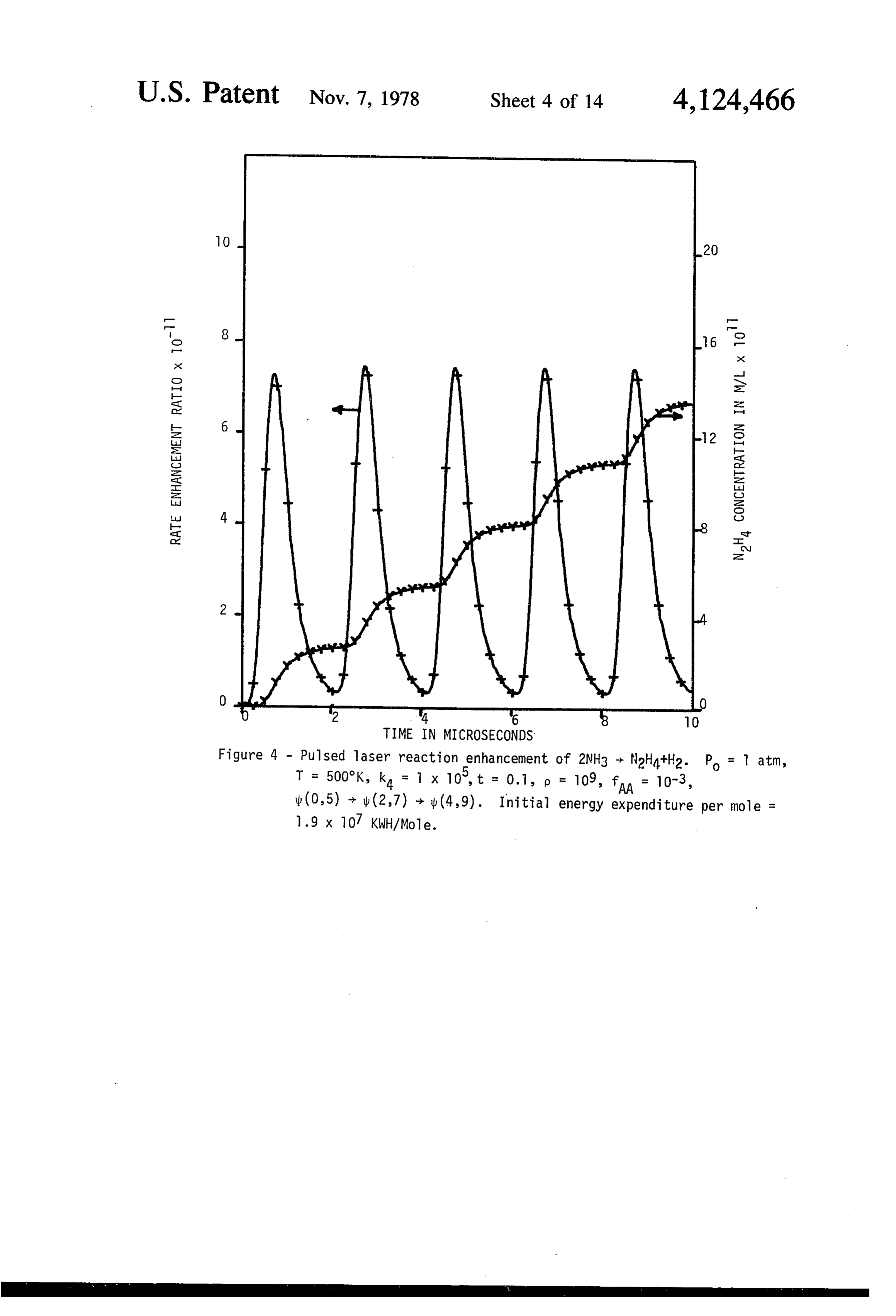
It preferably is substantially the value determined by on the laser-enhanced reaction 2NH3 - N2H4 + H2. equation (45), and the concentration of the reactant The upper curve for a given symbol represents calcula Ai is substantially as determined by equation (16). tions where the collision efficiency was taken to be Where the reaction is unimolecular, being representable 50 10. The lower curve represents f4 = 1. as A- B, the laser intensity. It preferably is substan FIG. 3 - Expenditure of laser energy per mole of tially the value determined by equation (45) where C4 product as a result of laser excitation. Upper curves has substantially the value determined by equation (47). with the same symbol are calculated assuming colli Where the reaction is unimolecular, being representable sional efficiencies fa = 1; lower curve, f = 10. as A- B, the Arrehenius frequency factor is about 55 FIG. 4 - Pulsed laser reaction enhancement of 1012 to 101, and the temperature during the reaction is 2NH3->N2H4+ H2. P = 1 atm, T = 500 K, k = 1 x about 300 to 700 K, the laser intensity of preferably 10, t = 0.1, p = 10, f = 10-3, (0,5) - (2,7) - has substantially the value obtained or interpolated '(4,9). Initial energy expenditure per mole = 1.9 x from the applicable curve or curves in FIGS. 11, 12, or 10 KWH/Mole.
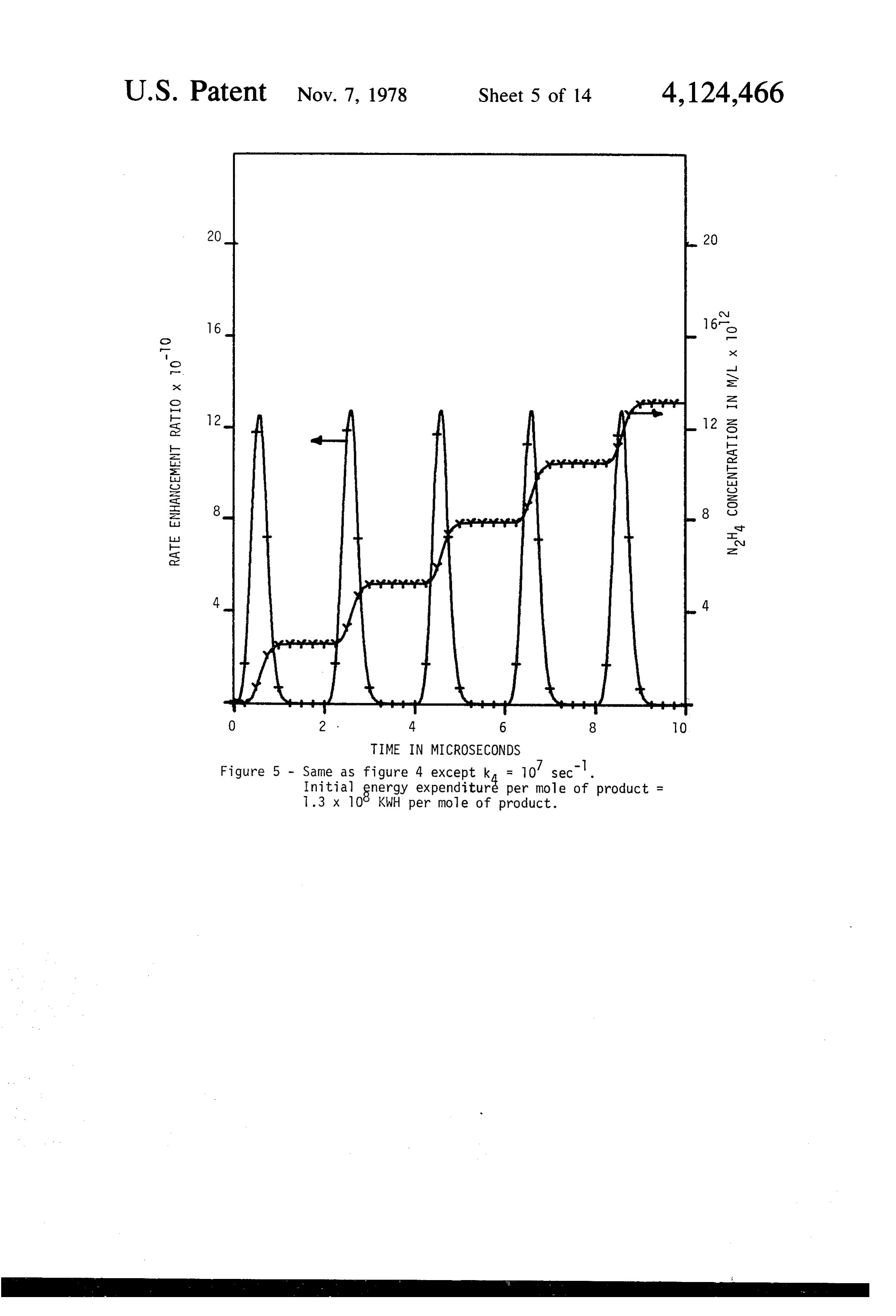
13 of the drawings. FIG. 5 - Same as FIG. 4 except k = 107 sec-1. In a typical method for enhancing a bimolecular reac Initial energy expenditure per mole of product = 1.3 x tion, the reaction is driven beyond the equilibrium point 10 KWH per mole of product.
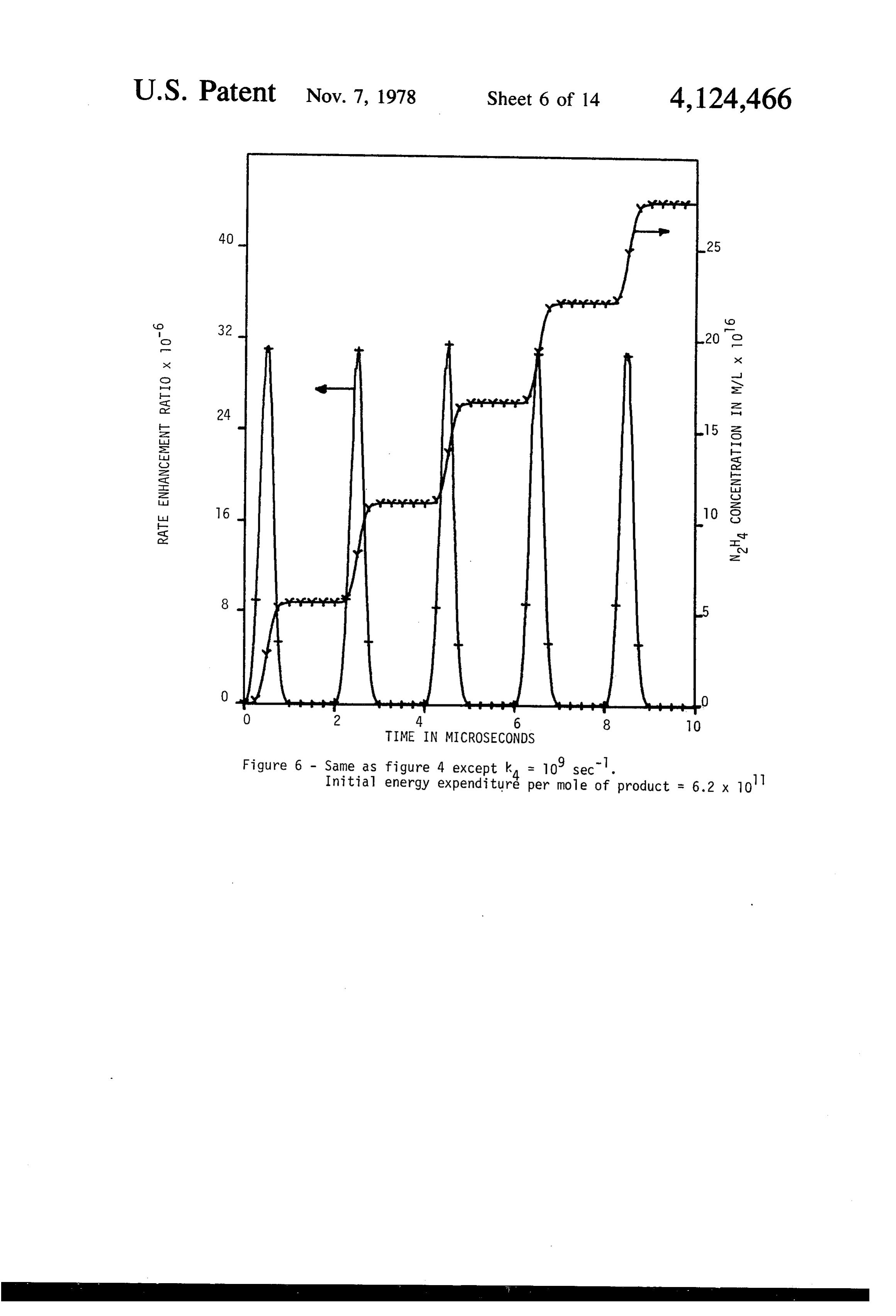
by the factor dAB in accordance with equation (9g). FIG. 6 - Same as FIG. 4 except k = 109 sec-l. Where the method is used for enhancing a bimolecu Initial energy expenditure per mole of product = 6.2 x lar reaction listed in Table III, it is preferred that Eact, 65 O
A, k2fe, AS, AH k2 edbaB, and E. have approximately FIG. 7 - Same as FIG. 5 except p = 1012 watts/cm2. the respective values listed in Table III, or interpolated Initial energy expenditure per mole of product = 3.5 x therefrom, for the reaction pressure and temperature. 109.
Page 18
FIG. 8 - Hypothetical Reaction 2A - C -- D. Since for perfect gases Frcan be written FyV, where V is to be found in the translational partition function, it where molecular parameters are the same as NH3. P = 1 atm, T = 500 K, k = 10, e = 0.1, p = 10, f4 = follows that
Initial energy expenditure = 3.0 KWH/mole. k -Éof (4)
FIG. 9 - Expected energy expenditure for gaseous k2? =– FF re kT .
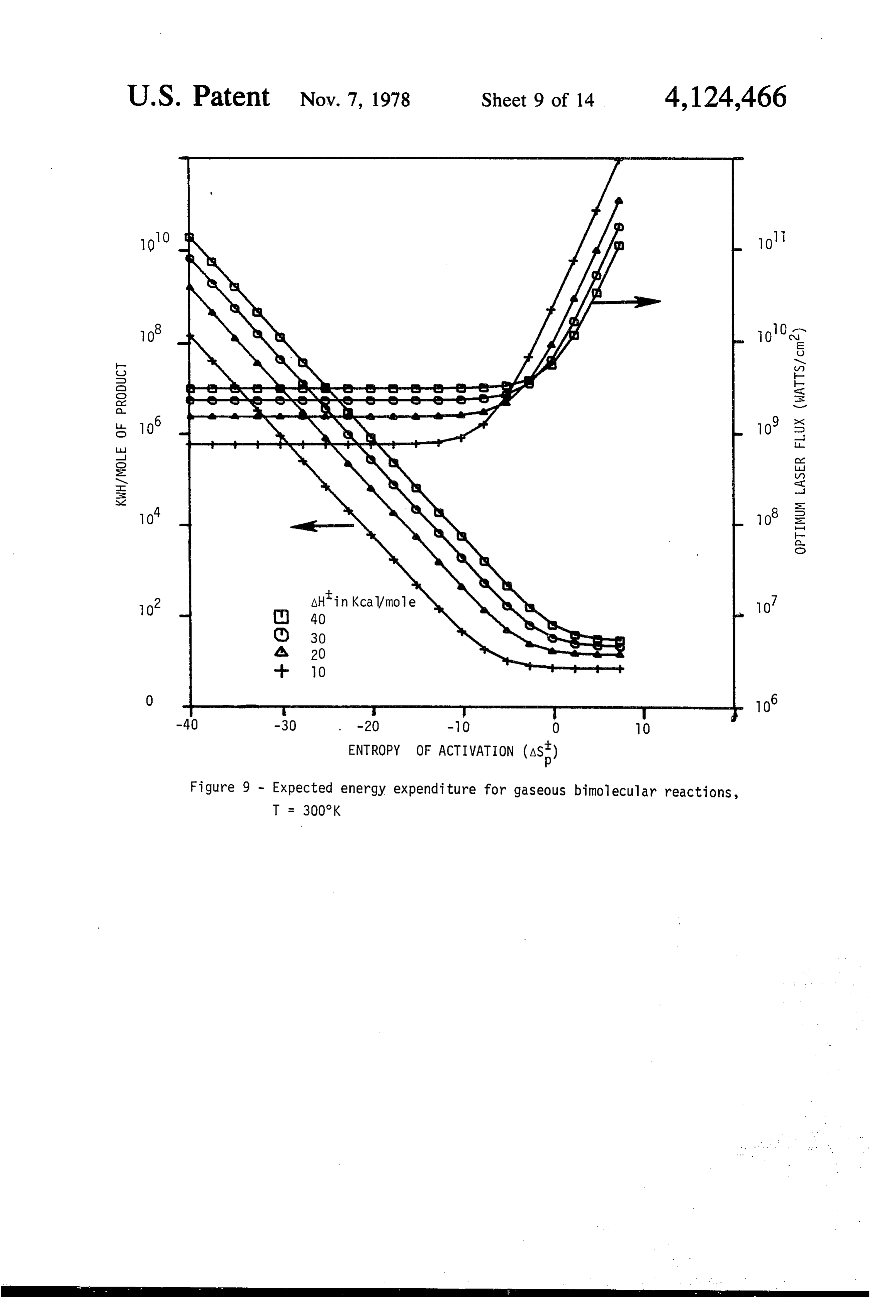
bimolecular reactions, T = 300 K
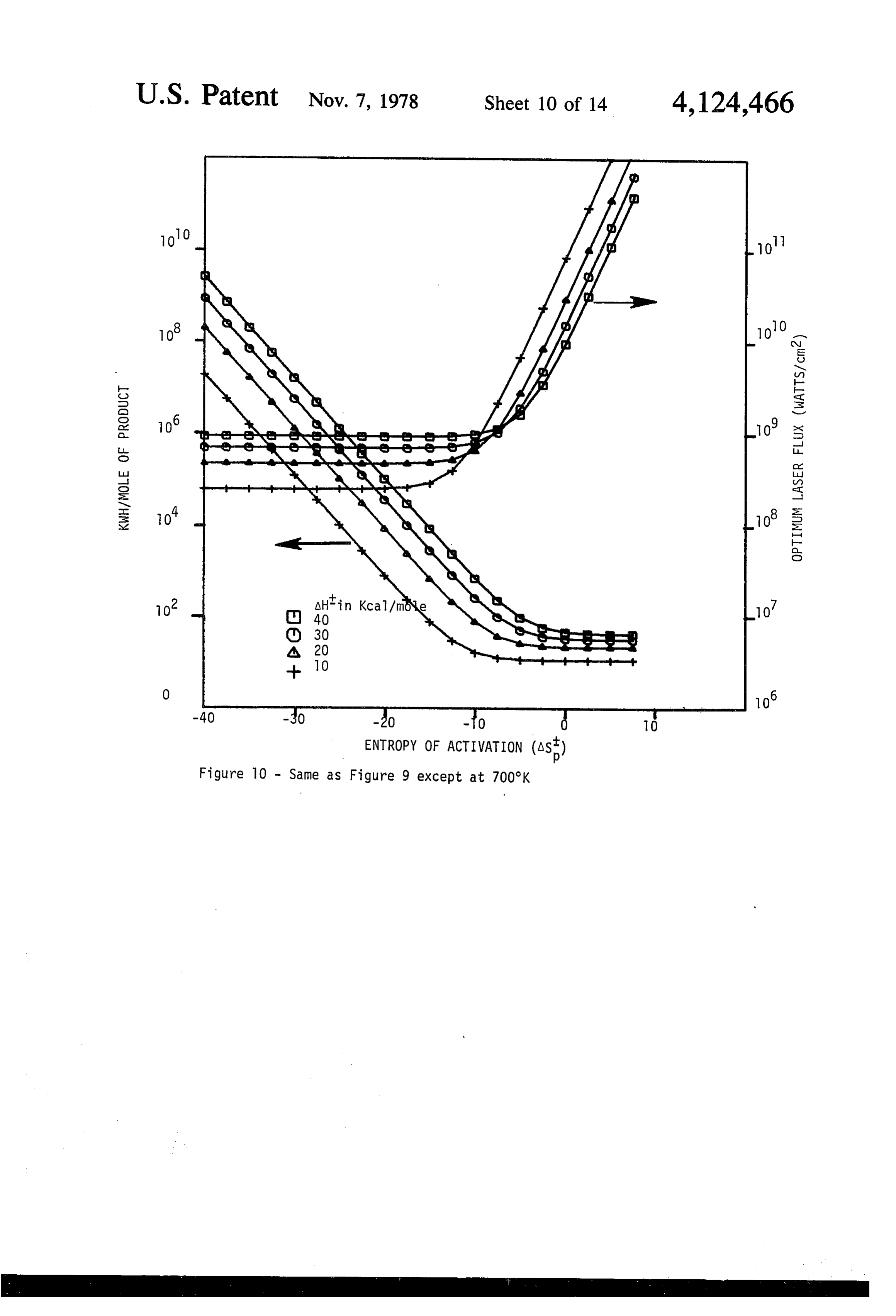
FIG. 10 - Same as FIG. 9 except at 700 K
FIG. 11 - Energy Expenditure and Optimum Laser 10 Likewise,
Intensity vs the Arrehenius Frequency Factor. Typical - eob (4a) Molecular Constants Used: F = 500, v = 3500 cm, k2be == kT. FoFD
degeneracy 2, 3, 4, 4, 5, respectively. T = 300 K. 15 Because
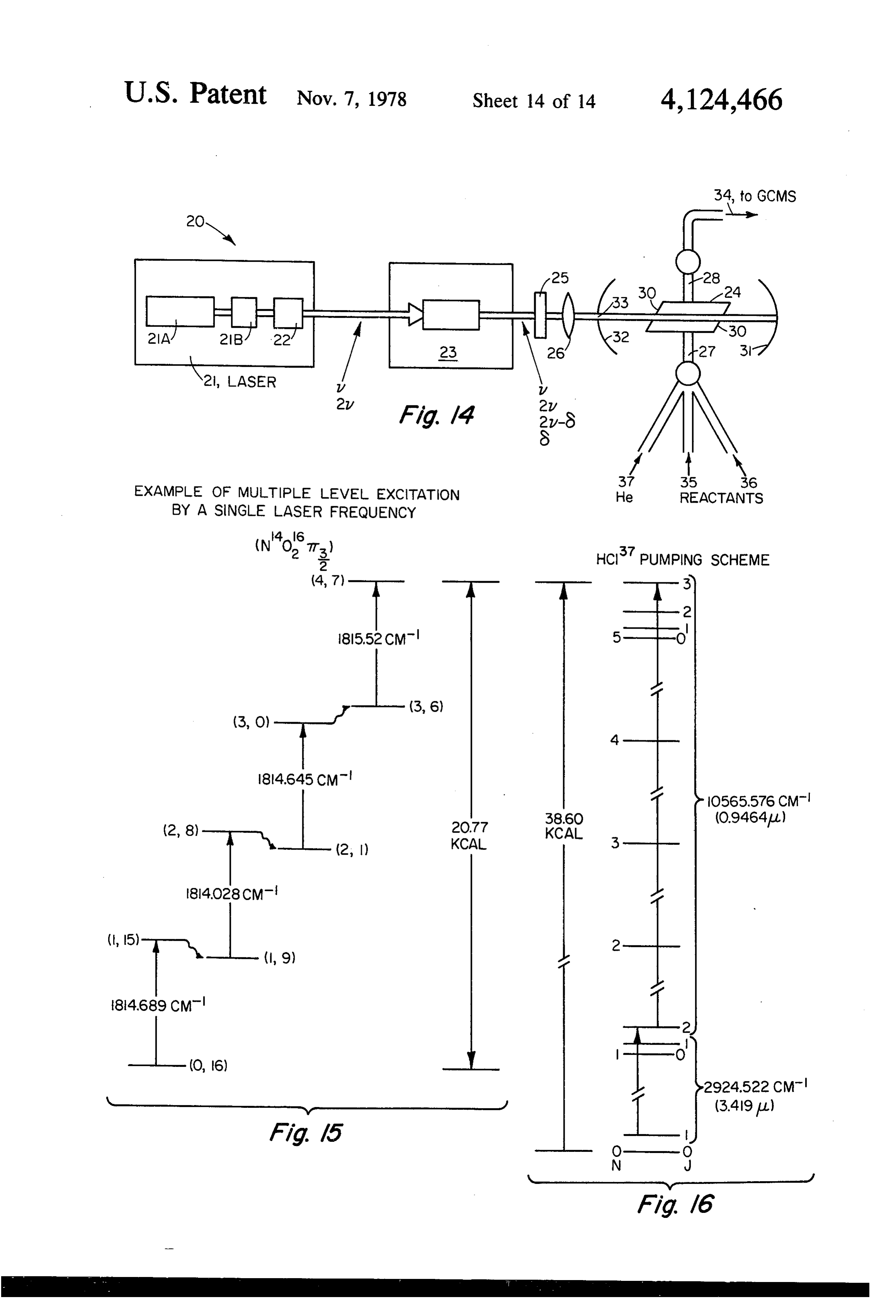
FIG. 13 - Same as FIG. 11 except T = 700 K. 3i -eir (4b) FIG. 14 is a schematic view of typical apparatus for (X = X(X) and (X. = H(X,je kT use in practicing the present invention.
FIG. 15 is an energy diagram illustrating an example 20 where gix designates the multiplicity of state i of mole of multiple level excitation by a single laser frequency in cule X, we can also write accordance with this invention.
FIG. 16 is an energy diagram illustrating an example of excitation by a pair of selected radiation frequencies.
six
DESCRIPTION OF PREFERRED
EMBODIMENTS which will be useful in later derivations.
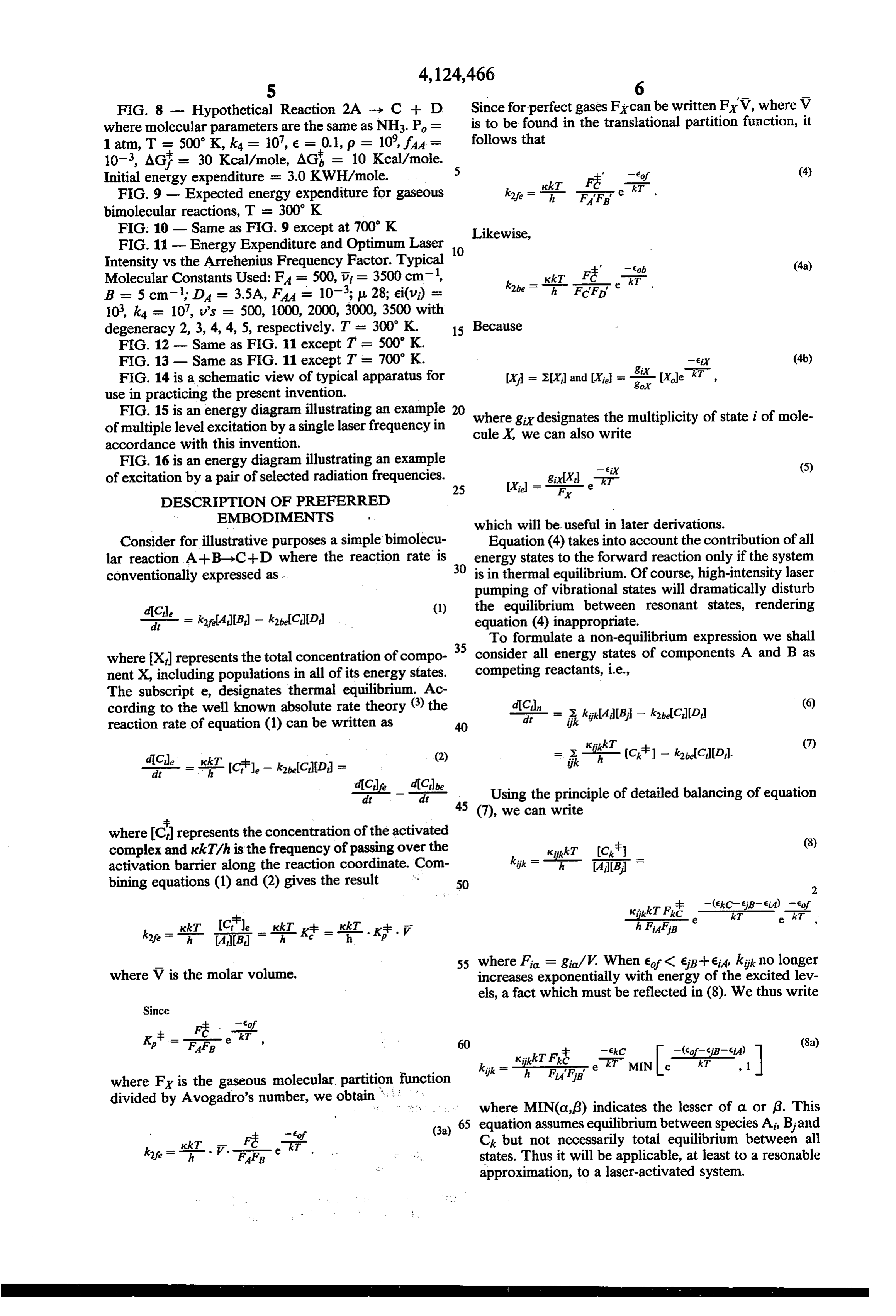
Consider for illustrative purposes a simple bimolecuEquation (4) takes into account the contribution of all lar reaction A-B-C-D where the reaction rate is 30 energy states to the forward reaction only if the system conventionally expressed as . is in thermal equilibrium. Of course, high-intensity laser pumping of vibrational states will dramatically disturb dCle the equilibrium between resonant states, rendering
dt equation (4) inappropriate.
To formulate a non-equilibrium expression we shall where X represents the total concentration of compo consider all energy states of components A and B as nent X, including populations in all of its energy states. competing reactants, i.e.,
The subscript e, designates thermal equilibrium. Ac cording to the well known absolute rate theory () the C 6 reaction rate of equation (1) can be written as All- ikola)(B) -ko (CID) (6) Cle 2 :: rikkT (Cal-kab (CID). (7)7
dClfe dClbe Using the principle of detailed balancing of equation
where C represents the concentration of the activated 8 complex and kkT/h is the frequency of passing over the - to 1-- (8) activation barrier along the reaction coordinate. Com pk = b - AIP = bining equations (1) and (2) gives the result 50 2
likTF.
where V is the molar volume.
55 where Fig. = gia/V. When Eof < ep+eia, kik no longer increases exponentially with energy of the excited lev els, a fact which must be reflected in (8). We thus write
Since
K ts Ft ekT (8a)
Kiki kc.
where Fy is the gaseous molecular partition function divided by Avogadro's number, we obtain where MIN(a6) indicates the lesser of a or 6. This
65 equation assumes equilibrium between species A, B, and
F. Ck but not necessarily total equilibrium between all
i. V FF e kT states. Thus it will be applicable, at least to a resonable approximation, to a laser-activated system.
Page 19
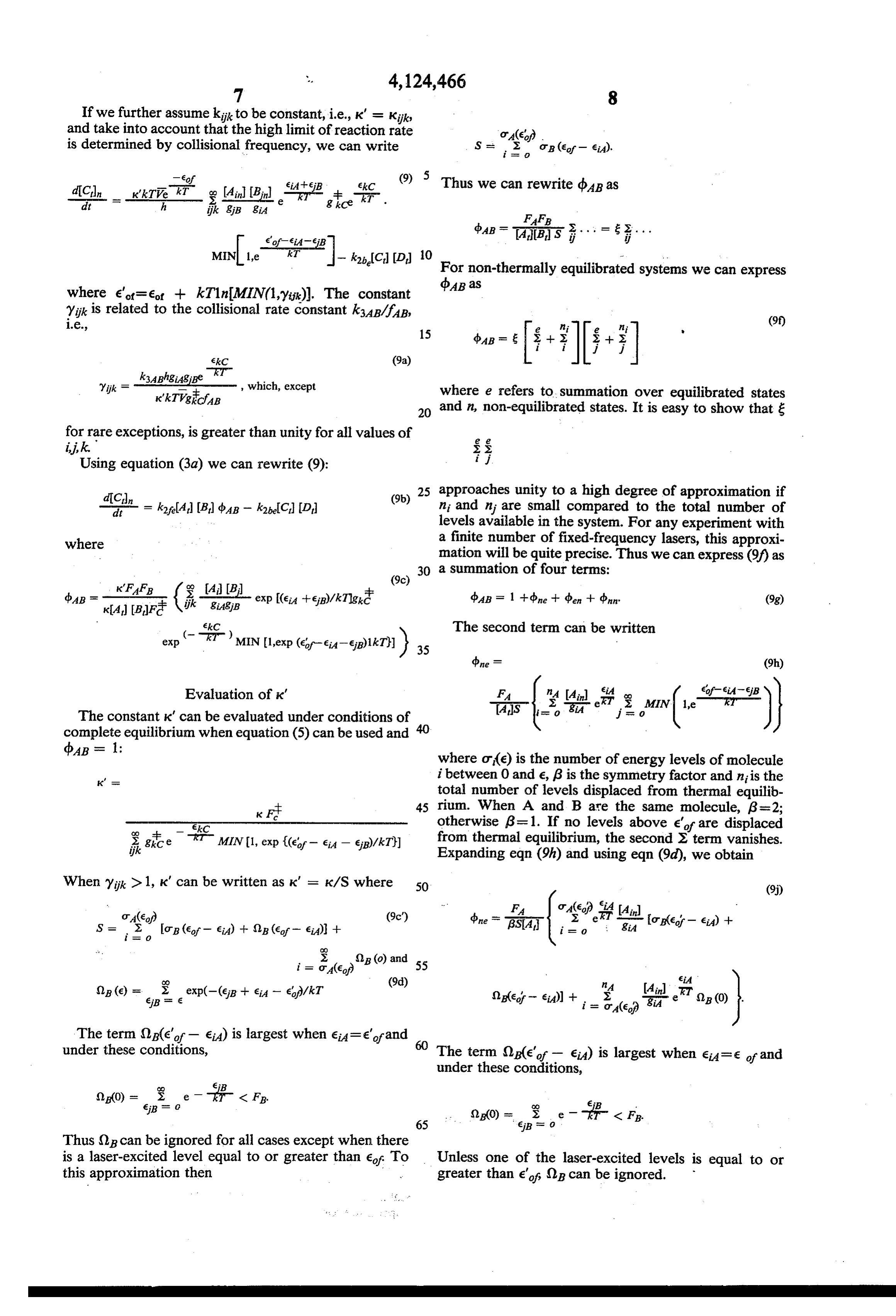
If we further assume kik to be constant, i.e., k" = Kilk, and take into account that the high limit of reaction rate oA(ef) is determined by collisional frequency, we can write S =s 2 o ob (sof- CiA).
9. eiA-6B sc () 5 Thus we can rewrite d4B as dCln e ckTie kT : Ain Bin) style g --
For non-thermally equilibrated systems we can express where e' =eo + kT1nMIN(1,y)). The constant dAB as yik is related to the collisional rate constant k3AB/fAB, i.e., 15
- , which, except where e refers to summation over equilibrated states 20 and n, non-equilibrated states. It is easy to show that 8 for rare exceptions, is greater than unity for all values of ijk. s
Using equation (3.a) we can rewrite (9):
C (9b) 25 approaches unity to a high degree of approximation if dt = k2(A)(B) baB - k2b-IC) (D) ni and n are small compared to the total number of levels available in the system. For any experiment with where a finite number of fixed-frequency lasers, this approxi mation will be quite precise. Thus we can express (9f) as a summation of four terms:
FF S. A. B. (9c) 30
Kffs db = -- -- exp (e. +sp/kTlged dAB = 1 + dine + den + ban. (9g) ABF Milk si43B (--) MIN (1,exp (c-sa-spikr) 35 The second term can be written
Evaluation of K' FAAS to
The constant k' can be evaluated under conditions of complete equilibrium when equation (5) can be used and 40 dbaB = 1: where oce) is the number of energy levels of molecule i between 0 and e, g is the symmetry factor and n is the total number of levels displaced from thermal equilib 45 rium. When A and B are the same molecule, 6=2;
ekC k F. otherwise g = 1. If no levels above e'? are displaced iske MIN (1, exp {(e? - ea - sp/kT}) from thermal equilibrium, the second X term vanishes. Expanding eqn (9h) and using eqn (9d), we obtain
When y > 1, k" can be written as k" = k/S where so (9)
dine = BSA
ASdP (Aa)
(9d) eia eiB E 8 exp(-(eB + eta - ep/kT OB(ef - éta)) + i - (c.
The term (2B(e'? - eia) is largest when el4 =e'of and under these conditions, The term (2B(e"of eia) is largest when eta=e of and under these conditions,
Thus Ocan be ignored for all cases except when there is a laser-excited level equal to or greater than eof. To Unless one of the laser-excited levels is equal to or this approximation then greater than e' (2B can be ignored.
Page 20
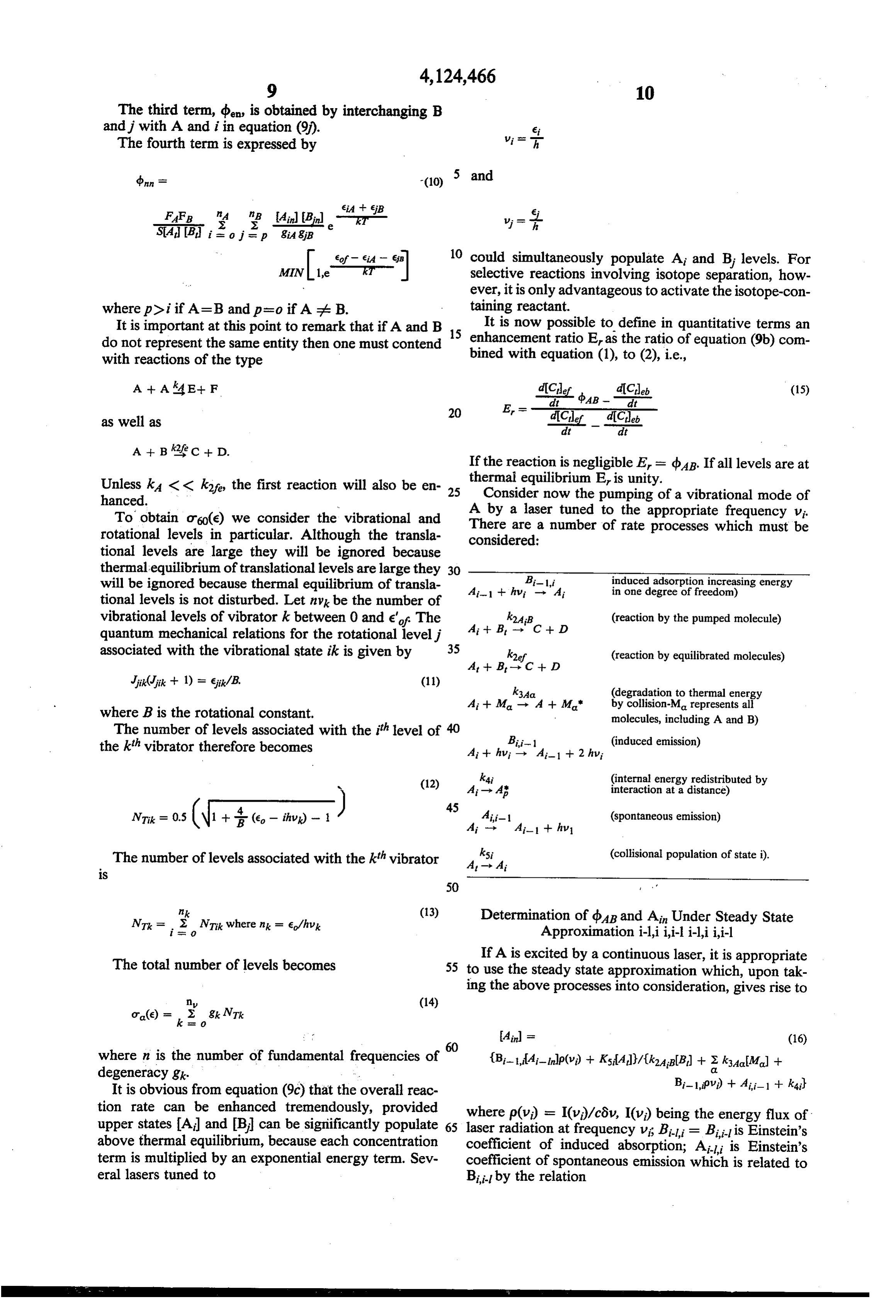
The third term, den, is obtained by interchanging B and j with A and i in equation (9)). ei
The fourth term is expressed by vi =
dinn = (10) 5 and
SAIB) i? a j p gia gib €of - Eia - eye 10 could simultaneously populate A and B levels. For
MINI le ki, selective reactions involving isotope separation, how ever, it is only advantageous to activate the isotope-con where pdi if A=B and p=o if A A. B. taining reactant.
It is important at this point to remark that if A and B 15 It is now possible to define in quantitative terms an do not represent the same entity then one must contend binedenhancement ratio E, as the ratio of equation (9b) com with reactions of the type with equation (1), to (2), i.e.,
E = al? d'AB- age (15)
as well as d d.
If the reaction is negligible E, = db AB. If all levels are at
Unless k << k2te, the first reaction will also be en- 25 thermal equilibrium E is unity.
Consider now the pumping of a vibrational mode of
To obtain oso(e) we consider the vibrational and A by a laser tuned to the appropriate frequency v. rotational levels in particular. Although the transla considered: There are a number of rate processes which must be tional levels are large they will be ignored because thermal equilibrium of translational levels are large they 30 induced adsorption increasing energy will be ignored because thermal equilibrium of transla Bi-1,i
tional levels is not disturbed. Let nv be the number of vibrational levels of vibrator k between 0 and e". The k2App (reaction by the pumped molecule) quantum mechanical relations for the rotational levelj At + B - C -- D associated with the vibrational state ik is given by 35 k2ef (reaction by equilibrated molecules)
Jik(Jik + 1) = sik/B. (11) k3Aa (degradation to thermal energy A + M. - A + M." by collision-M represents all where B is the rotational constant. molecules, including A and B) The number of levels associated with the it level of 40 the kh vibrator therefore becomes Bi-1 (induced emission)
a (12) k4. (internal energy redistributed by
Nk = 0.5 (N + (c. - ifive - 1 ) 4iii-1 (spontaneous emission)
The number of levels associated with the kth vibrator (collisional population of state i).
nk (13) Determination of dbaB and An Under Steady State NT X O Nik where n = e/hvk Approximation i-lii,i-li-lii,i-l The total number of levels becomes
If A is excited by a continuous laser, it is appropriate 55 to use the steady state approximation which, upon tak ing the above processes into consideration, gives rise to
oa(e) C k s o gk NTk
where n is the number of fundamental frequencies of 60 degeneracy gr.
It is obvious from equation (9c) that the overall reac tion rate can be enhanced tremendously, provided where p(v) = I(v)/cöu, I(v) being the energy flux of upper states A) and B can be significantly populate 65 laser radiation at frequency vi; Bi-li = Bitlis Einstein's above thermal equilibrium, because each concentration coefficient of induced absorption; Ali is Einstein's term is multiplied by an exponential energy term. Sev coefficient of spontaneous emission which is related to eral lasers tuned to Bill by the relation
Page 21
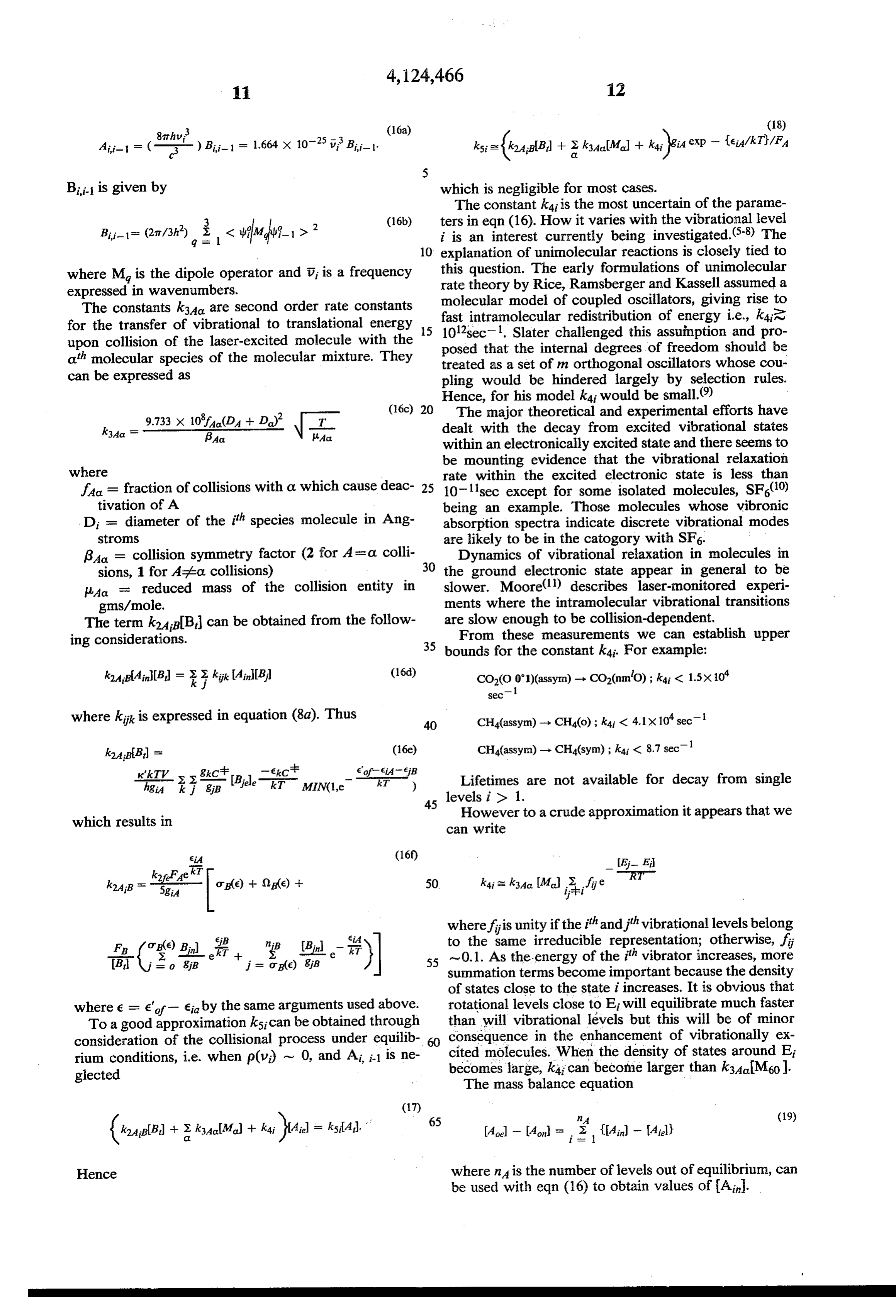
4iii-1 ( c ) Bii-1 = 1664 x 10 vi Bii-1. k-(-(e) + X. k3A.M.) + k). exp - {e1/kT/FA
Bi-1 is given by which is negligible for most cases. The constant k4 is the most uncertain of the parame 3 16b) ters in eqn (16). How it varies with the vibrational level Bit 1 = (27/3h) 1 |Muf- 2 ( i is an interest currently being investigated.() The 10 explanation of unimolecular reactions is closely tied to where M is the dipole operator and Vi is a frequency this question. The early formulations of unimolecular expressed in wavenumbers. rate theory by Rice, Ramsberger and Kassell assumed a The constants k34 are second order rate constants molecular fast model of coupled oscillators, giving rise to intramolecular redistribution of energy i.e., kaat for the transfer of vibrational to translational energy 101'sec. Slater challenged this assumption and pro upon collision of the laser-excited molecule with the 15 posed that the internal degrees of freedom should be ath molecular species of the molecular mixture. They treated as a set of m orthogonal oscillators whose cou can be expressed as pling would be hindered largely by selection rules. Hence, for his model kai would be small.9) (16c) 20 The major theoretical and experimental efforts have k ... = 3 10'f(DA + D.) T dealt with the decay from excited vibrational states
within an electronically excited state and there seems to be mounting evidence that the vibrational relaxation where rate within the excited electronic state is less than f = fraction of collisions with a which cause deac- 25 10 sec except for some isolated molecules, SF6(10) tivation of A - being an example. Those molecules whose vibronic D = diameter of the i species molecule in Ang absorption spectra indicate discrete vibrational modes Strons are likely to be in the catogory with SF6. g = collision symmetry factor (2 for A = a colli Dynamics of vibrational relaxation in molecules in sions, 1 for Al-A'a collisions) 30 the ground electronic state appear in general to be u = reduced mass of the collision entity in slower. Moore() describes laser-monitored experi gms/mole. ments where the intramolecular vibrational transitions The term k24B) can be obtained from the follow are slow enough to be collision-dependent. ing considerations. 35 From these measurements we can establish upper bounds for the constant ki. For example:
k24Blair.JLB) = i kiik Ainlb) (16d) CO2(O-1O'1)(assym) - CO2(nm'o); k < 1.5x10 Sec
where kiik is expressed in equation (8a). Thus 40 CH4(assym) - CH4(o); ka ( 4.1 x 10' sect k2Ab{B} = (16e) CH4(assy) - CH4(sym); k < 8.7 sec k'kTY syskcfrn. -skct e'of-ÉiA-siB Lifetimes are not available for decay from single
which results in
However to a crude approximation it appears that we can write eia (16f) (Ej- Eil
k2AB = ge' o -- 0(e) + 50 k4 as k3Ag Mo.) i-Fi fie where fis unity if the ith and jth vibrational levels belong 6B eiA to the same irreducible representation; otherwise, f,
Bll Vi a gib ; j = "go(e) (Pnl
SiB - i) ~0.1. As the energy of the it vibrator increases, more 55 summation terms become important because the density of states close to the state i increases. It is obvious that where e = e'er-eia by the same arguments used above. rotational levels close to E will equilibrate much faster To a good approximation ksi can be obtained through than will vibrational levels but this will be of minor consideration of the collisional process under equilib- 60 consequence in the enhancement of vibrationally ex rium conditions, i.e. when p(v) ~ 0, and Ai i-1 is ne cited molecules. When the density of states around E, becomes large, kai can become larger than k3AMsol.
glected The mass balance equation
(...) + kaa(Ma) + k4i }4. = ksi.A.). 65 Ace) - Aon is i 2. 1. {(Air) Ail
Hence where n is the number of levels out of equilibrium, can be used with eqn (16) to obtain values of A.
Page 22
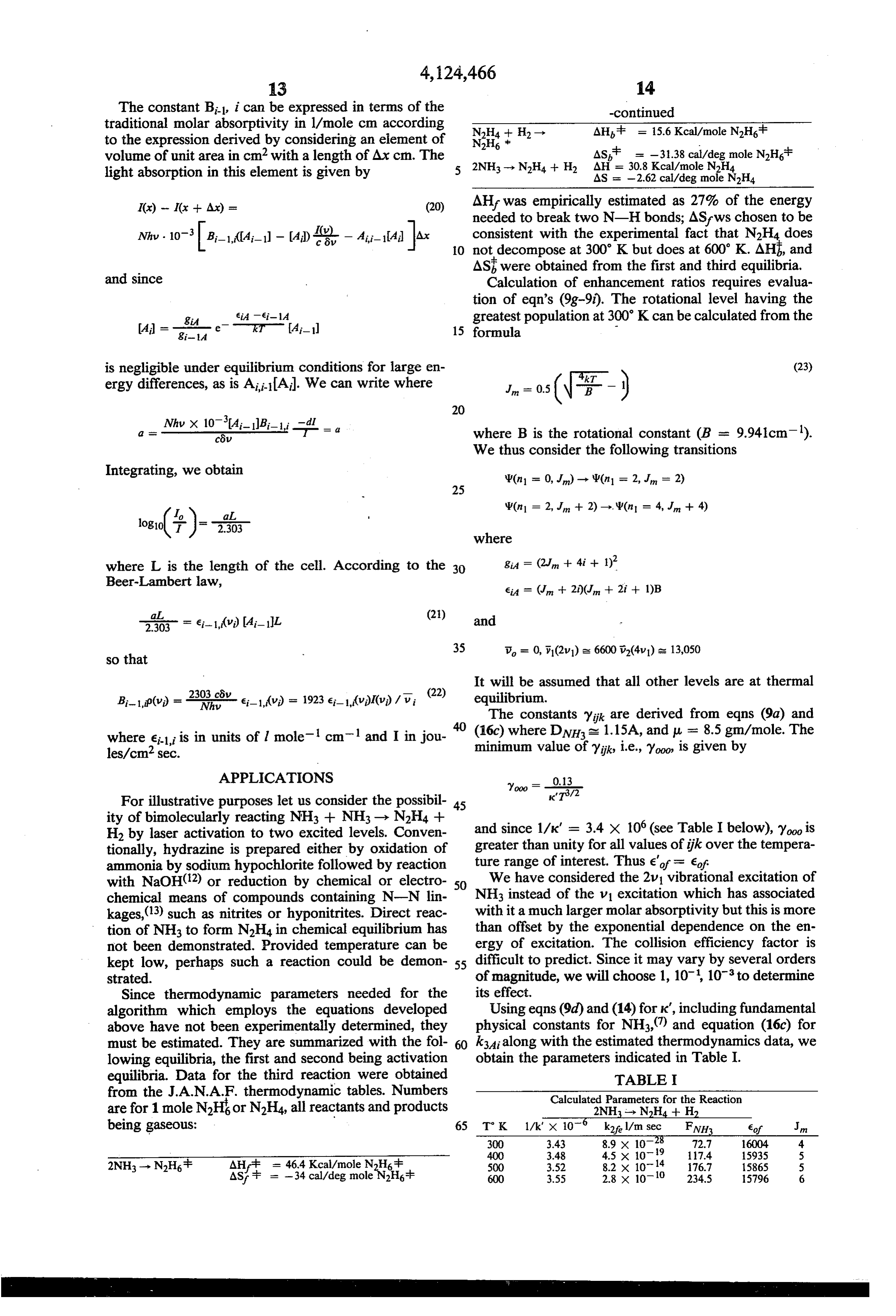
The constant B-1, i can be expressed in terms of the -continued traditional molar absorptivity in l/mole cm according NH4+ H2--> AH+ = 15.6 Kcal/mole NH to the expression derived by considering an element of N2H6+ volume of unit area in cm with a length of Ax cm. The As = -31.38 cal/deg mole NH6+ light absorption in this element is given by 5 AH = 30.8 Kcal/mole N2H4 AS = -2.62 cal/deg mole N2H4
I(x) - (x + Ax) = (20) AH? was empirically estimated as 27% of the energy needed to break two N-H bonds; ASws chosen to be
Nhu. 10 P- (4-) - (A) - Ai-A) As consistent with the experimental fact that N2H4 does O not decompose at 300K but does at 600 K. AH, and
and since
AS were obtained from the first and third equilibria.
Calculation of enhancement ratios requires evalua tion of eqn's (9g-9i). The rotational level having the 3ia iA (i-1A greatest population at 300 K can be calculated from the A) = 8-1A e Ai-l 15 formula -
is negligible under equilibrium conditions for large en (23) ergy differences, as is Ai-A). We can write where
Nhu X 10
a=- - -r I = where B is the rotational constant (B = 9.941cm). We thus consider the following transitions
Integrating, we obtain
loglo Ial-- al.
where where L is the length of the cell. According to the 30 gia = (2 m + 4 + 1) Beer-Lambert law, e4 = (J -- 2i)(J -- 2i + 1)B
is = ei-1, (vi) Ai-L (21) and
so that
It will be assumed that all other levels are at thermal
Bi-lip(v) = 23. ei-1(v) = 1923 e 1(v).I(v) / vi (22) equilibrium.
The constants yik are derived from eqns (9a) and where ei-li is in units of 1 mole cm and I in jou (16c) where DNH’s 1.15A, and u = 8.5gm/mole. The les/cm sec. minimum value of yik, i.e., yoo, is given by APPLICATIONS yo000 = - 0T3/2
For illustrative purposes let us consider the possibil- is ity of bimolecularly reacting NH3 - NH3 - N2H4 +
H2 by laser activation to two excited levels. Conven and since 1/k' = 3.4 x 10° (see Table I below), y is tionally, hydrazine is prepared either by oxidation of greater than unity for all values of ijk over the tempera ammonia by sodium hypochlorite followed by reaction ture range of interest. Thus e'? = ef. with NaOHO2) or reduction by chemical or electro 50 We have considered the 2u vibrational excitation of chemical means of compounds containing N-N lin NH3 instead of the v1 excitation which has associated kages,() such as nitrites or hyponitrites. Direct reac with it a much larger molar absorptivity but this is more tion of NH3 to form N2H4 in chemical equilibrium has than offset by the exponential dependence on the en not been demonstrated. Provided temperature can be ergy of excitation. The collision efficiency factor is kept low, perhaps such a reaction could be demon 55 difficult to predict. Since it may vary by several orders strated. of magnitude, we will choose 1, 10, 10 to determine Since thermodynamic parameters needed for the its effect.
algorithm which employs the equations developed Using eqns (9d) and (14) for k', including fundamental above have not been experimentally determined, they physical constants for NH3) and equation (16c) for must be estimated. They are summarized with the fol 60 k34i along with the estimated thermodynamics data, we lowing equilibria, the first and second being activation obtain the parameters indicated in Table I. equilibria. Data for the third reaction were obtained TABLE I from the J.A.N.A.F. thermodynamic tables. Numbers Calculated Parameters for the Reaction are for 1 mole NH or N2H4, all reactants and products 2NH - NH4+ H being gaseous: 65 T. K 1/k' x 10-6 k2 l/m sec FNH €of Jim 300 3.43 89 x 1028 72.7 16004 4.
400 3.48 4.5 x 10⁹ 117.4 15935 5 = 46.4 Kcal/mole N2H6+ 500 3.52 8.2 x 10- 176.7 15865 5 As + = -34 cal/deg Aoi N+ 600 3.55 2.8 x 100 234.5 15796 6
Page 23
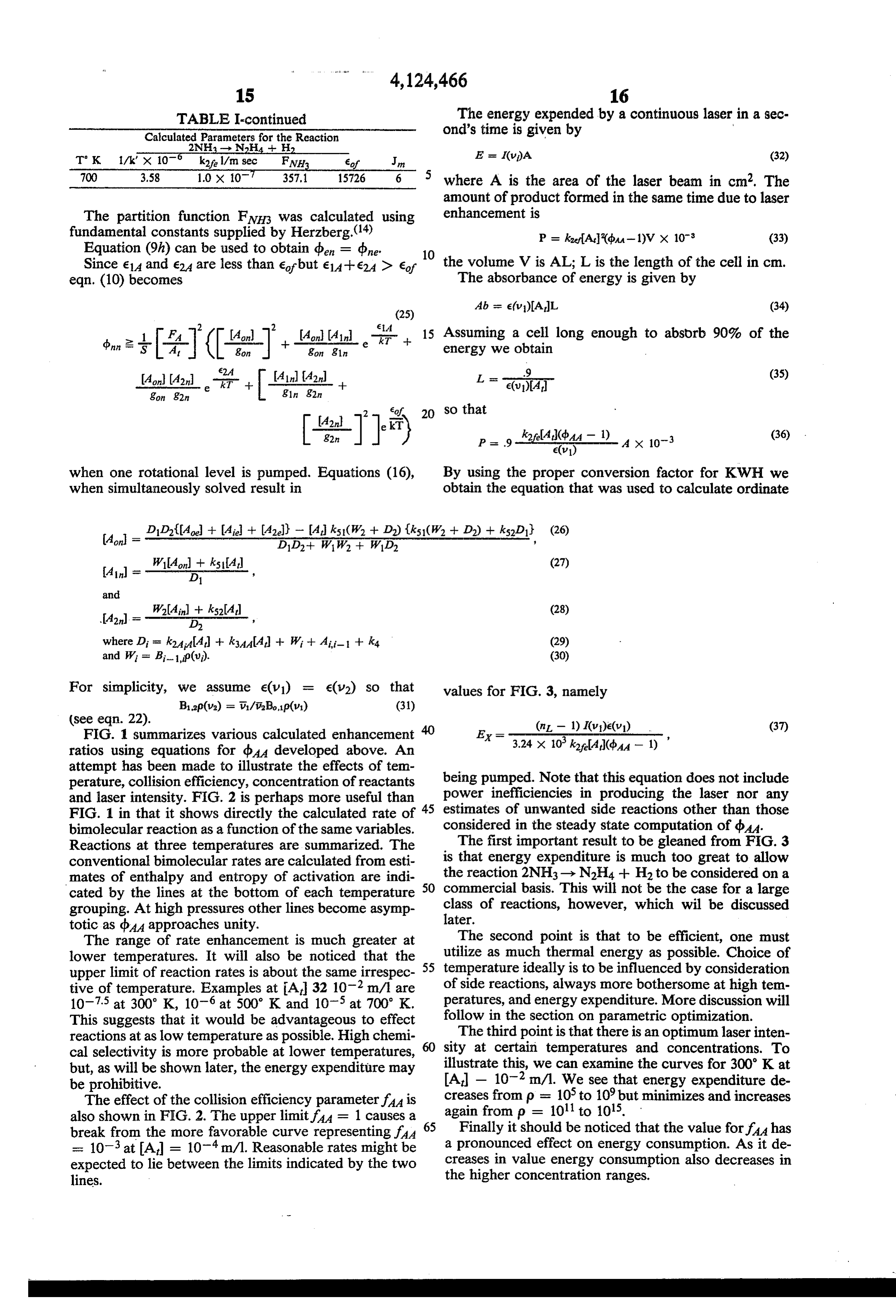
TABLE I-continued The energy expended by a continuous laser in a sec Calculated Parameters for the Reaction ond's time is given by
TK 1/k' x 10 k2, 1/m sec FNH Sof Jm E = (v)A (32) 700 3,58 1.0 x 10 357.1 15726 6 5 where A is the area of the laser beam in cm. The amount of product formed in the same time due to laser
The partition function FNH3 was calculated using enhancement is fundamental constants supplied by Herzberg (1) P = keyAdaa-1)V x 10 (33) Equation (9h) can be used to obtain de = dbe. 10
Since é1A and e24 are less than eaf but e14+é24 > ef theThe volume V is AL; L is the length of the cell in cm.
absorbance of energy is given by eqn. (10) becomes (25) Ab = e(v)AL (34)
cb > -- 4. Aon) -- Aan) A1 kT + 15 Assuming a cell long enough to abstorb 90% of the nn S A. 8on on 31n energy we obtain €24 9 (35) Aon A2nd T- + All A2) -- L = ce),4-
when one rotational level is pumped. Equations (16), By using the proper conversion factor for KWH we when simultaneously solved result in obtain the equation that was used to calculate ordinate A = DD2{Ae) + Ai + (A2)} - A k51(W2 + D2) {k51(W2 + D2) + k52D (26)
WA) -- ks Al (27)
and
WA) -- k52A (28)
A2n = racial salad s where D = k24(A) + k3A4(A) + Wii + Ait-1 + k4 (29) and W = B-1p(v). (30) For simplicity, we assume e(v1) = e(v2) so that values for FIG. 3, namely
(see eqn. 22). (nL - 1) (vi)e(v) FIG. 1 summarizes various calculated enhancement 0 Ex arrania al-es (37) ratios using equations for dAA developed above. An 3.24 x 10 k2(AJ(bAA - 1) ' attempt has been made to illustrate the effects of tem perature, collision efficiency, concentration of reactants being pumped. Note that this equation does not include and laser intensity. FIG. 2 is perhaps more useful than power inefficiencies in producing the laser nor any estimates of unwanted side reactions other than those
FIG. 1 in that it shows directly the calculated rate of considered bimolecular reaction as a function of the same variables. in the steady state computation of d44. Reactions at three temperatures are summarized. The The first important result to be gleaned from FIG. 3 conventional bimolecular rates are calculated from esti is that energy expenditure is much too great to allow mates of enthalpy and entropy of activation are indi 50 the reaction 2NH3 -> N2H4+ H2 to be considered on a cated by the lines at the bottom of each temperature commercial basis. This will not be the case for a large grouping. At high pressures other lines become asymp class later.
of reactions, however, which will be discussed totic as dba A approaches unity.
The range of rate enhancement is much greater at The second point is that to be efficient, one must lower temperatures. It will also be noticed that the 55 utilize as much thermal energy as possible. Choice of upper limit of reaction rates is about the same irrespec temperature ideally is to be influenced by consideration tive of temperature. Examples at All 32 10 m/1 are of side reactions, always more bothersome at high tem 10-75 at 300 K, 10-6 at 500 K and 10-5 at 700 K. peratures, and energy expenditure. More discussion will This suggests that it would be advantageous to effect follow in the section on parametric optimization. reactions at as low temperature as possible. High chemi The third point is that there is an optimum laser inten cal selectivity is more probable at lower temperatures, sity at certain temperatures and concentrations. To but, as will be shown later, the energy expenditure may illustrate this, we can examine the curves for 300 K at be prohibitive. All - 10 m/1. We see that energy expenditure de The effect of the collision efficiency parameter f44 is creases from p = 10 to 10” but minimizes and increases also shown in FIG. 2. The upper limitfa = 1 causes a 65 again from p = 1011 to 1015.
Finally it should be noticed that the value for f has break from the more favorable curve representing fa a pronounced = 10-3 at A) = 10 m/1. Reasonable rates might be creases in valueeffect on energy consumption. As it de expected to lie between the limits indicated by the two the higher concentrationconsumption energy ranges.
also decreases in lines.
Page 24
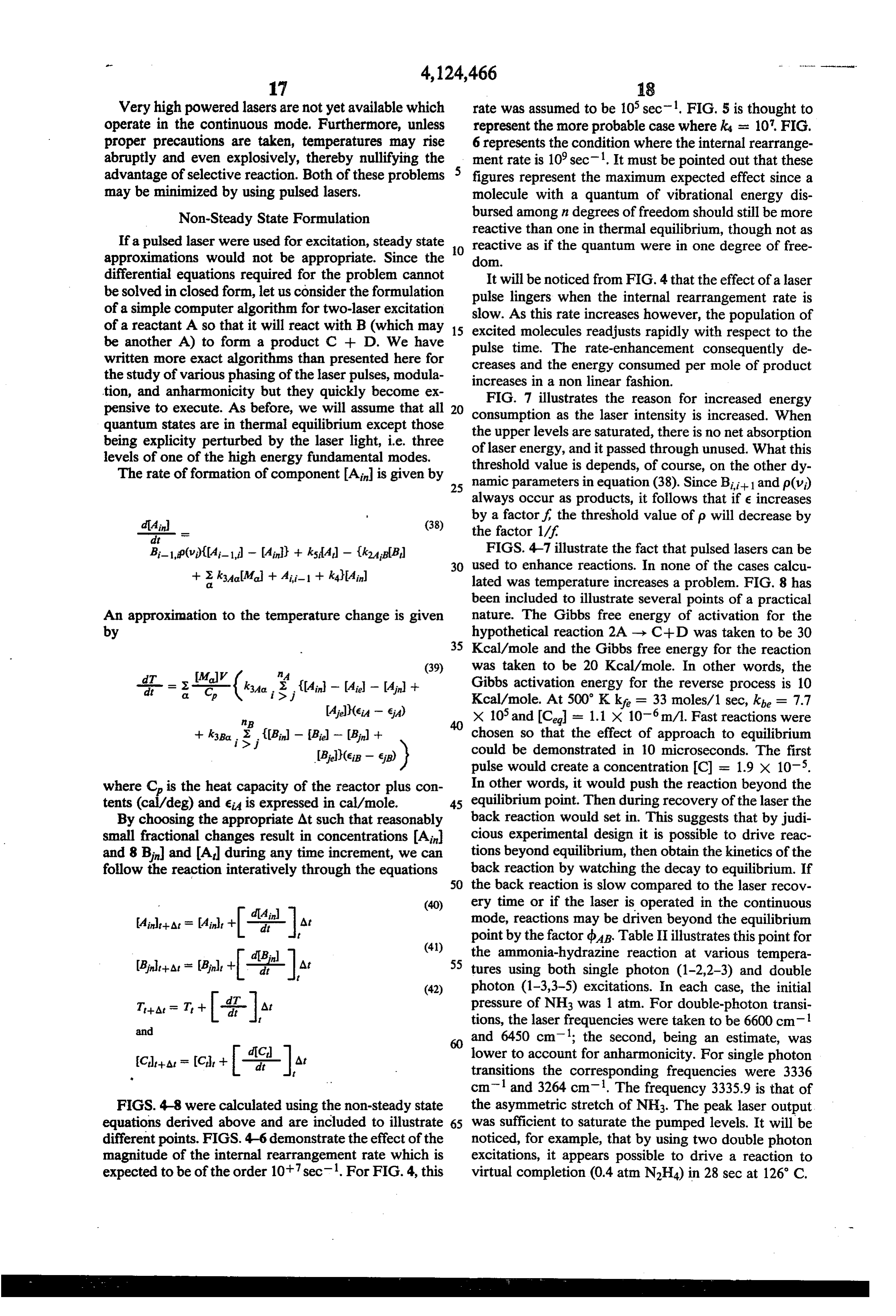
Very high powered lasers are not yet available which rate was assumed to be 10 sect. FIG. 5 is thought to operate in the continuous mode, Furthermore, unless represent the more probable case where k = 10. FIG. proper precautions are taken, temperatures may rise 6 represents the condition where the internal rearrange abruptly and even explosively, thereby nullifying the ment rate is 109 sec. It must be pointed out that these advantage of selective reaction. Both of these problems figures represent the maximum expected effect since a may be minimized by using pulsed lasers. molecule with a quantum of vibrational energy dis Non-Steady State Formulation bursed among n degrees of freedom should still be more reactive than one in thermal equilibrium, though not as
If a pulsed laser were used for excitation, steady state 10 reactive as if the quantum were in one degree of free approximations would not be appropriate. Since the dom.
differential equations required for the problem cannot It will be noticed from FIG. 4 that the effect of a laser be solved in closed form, let us consider the formulation pulse lingers when the internal rearrangement rate is of a simple computer algorithm for two-laser excitation slow. As this rate increases however, the population of of a reactant A so that it will react with B (which may 15 excited molecules readjusts rapidly with respect to the be another A) to form a product C + D. We have pulse time. The rate-enhancement consequently de written more exact algorithms than presented here for creases and the energy consumed per mole of product the study of various phasing of the laser pulses, modula increases in a non linear fashion.
tion, and anharmonicity but they quickly become ex FIG. 7 illustrates the reason for increased energy pensive to execute. As before, we will assume that all 20 consumption as the laser intensity is increased. When quantum states are in thermal equilibrium except those the upper levels are saturated, there is no net absorption being explicity perturbed by the laser light, i.e. three of laser energy, and it passed through unused. What this levels of one of the high energy fundamental modes.
The rate of formation of component Ai is given by namic parameters in equationof(38).
threshold value is depends, course, on the other dy
Since Bit-1 and p(vi)
always occur as products, it follows that if e increases dAi) (38) by a factorf, the threshold value of p will decrease by dt the factor 1/f
B-1 p(v)(A-1) - Airl + ksi.A.) - (k24bbl FIGS. 4–7 illustrate the fact that pulsed lasers can be 30 used to enhance reactions. In none of the cases calcu lated was temperature increases a problem. FIG. 8 has been included to illustrate several points of a practical
An approximation to the temperature change is given nature. The Gibbs free energy of activation for the hypothetical reaction 2A - C+D was taken to be 30 35 Kcal/mole and the Gibbs free energy for the reaction
na (39) was taken to be 20 Kcal/mole. In other words, the
Gibbs activation energy for the reverse process is 10 (i. 3, (4)–(4) - (4) + Kcal/mole. At 500 K k = 33 moles/1 sec, k = 7.7
(A)(eiA - 54) x 10 and (C) = 1.1 x 10⁶ m/1. Fast reactions were -- kBal 3 (P.) - {B} - (Bill) + chosen so that the effect of approach to equilibrium (B)(eiB - 5p) ) could be demonstrated in 10 microseconds. The first pulse would create a concentration (C) = 1.9 x 10⁵.
where C is the heat capacity of the reactor plus con In other words, it would push the reaction beyond the tents (cal/deg) and ei is expressed in cal/mole. 45 equilibrium point. Then during recovery of the laser the By choosing the appropriate At such that reasonably back reaction would set in. This suggests that by judi small fractional changes result in concentrations Ain cious experimental design it is possible to drive reac and 8 B) and (A) during any time increment, we can back tions beyond equilibrium, then obtain the kinetics of the follow the reaction interatively through the equations reaction by watching the decay to equilibrium. If 50 the back reaction is slow compared to the laser recov dAir (40) ery time or if the laser is operated in the continuous (Air); A = Airl + di At mode, reactions may be driven beyond the equilibrium
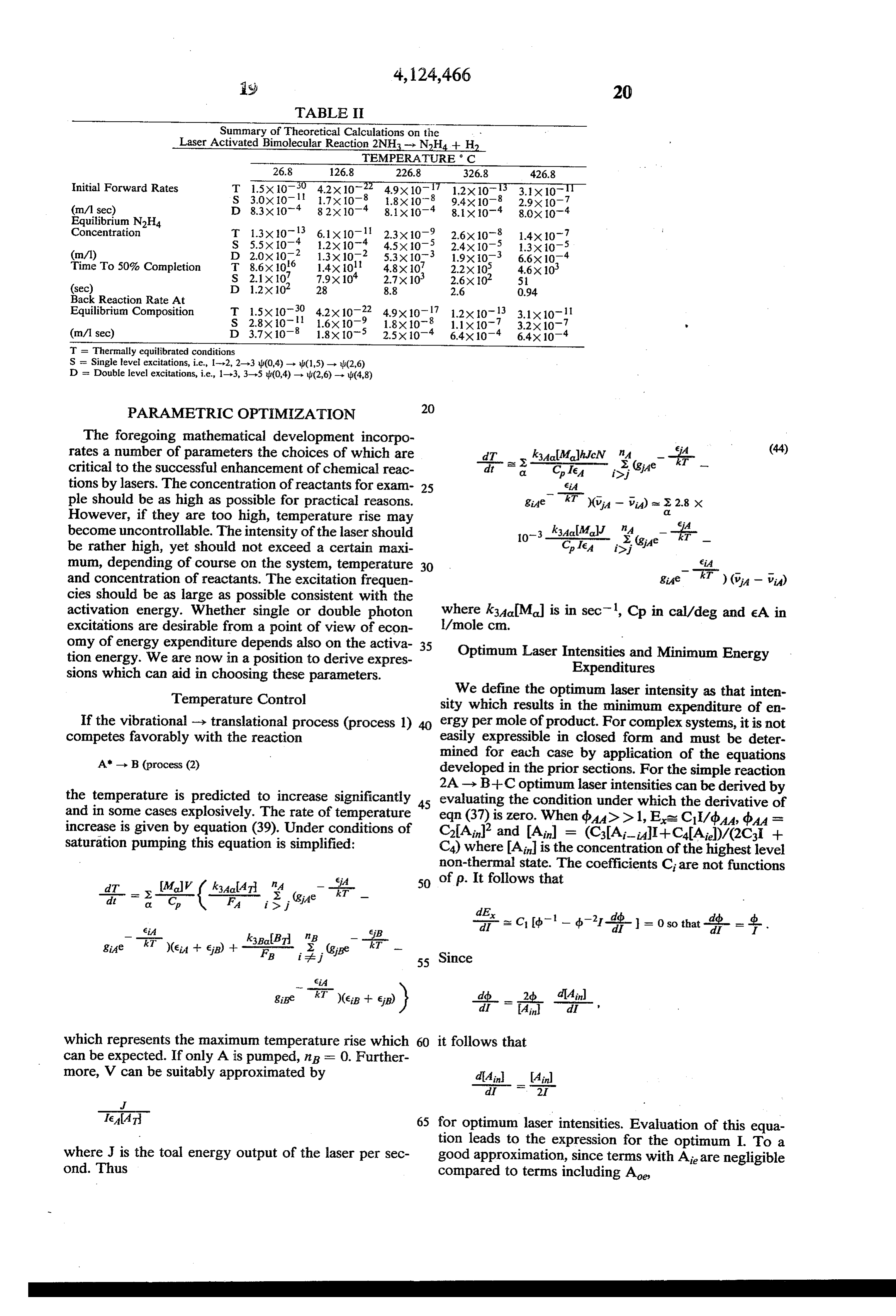
point by the factor (bAB. Table II illustrates this point for dB; the ammonia-hydrazine reaction at various tempera
At 55 tures using both single photon (1-2,2-3) and double
T (42) photon (1-3,3-5) excitations. In each case, the initial T-A = T + -4- At pressure of NH3 was 1 atm. For double-photon transi and t tions, the laser frequencies were taken to be 6600 cm and 6450 cm; the second, being an estimate, was
At lower to account for anharmonicity. For single photon
t transitions the corresponding frequencies were 3336 cm and 3264 cm. The frequency 3335.9 is that of
FIGS. 4-8 were calculated using the non-steady state the asymmetric stretch of NH3. The peak laser output equations derived above and are included to illustrate 65 was sufficient to saturate the pumped levels. It will be different points. FIGS. 4-6 demonstrate the effect of the noticed, for example, that by using two double photon magnitude of the internal rearrangement rate which is excitations, it appears possible to drive a reaction to expected to be of the order 107 sec. For FIG.4, this virtual completion (0.4 atm N2H) in 28 sec at 126 C.
Page 25
TABLE II
Summary of Theoretical Calculations on the
Laser Activated Bimolecular Reaction 2NH3 - N2H4+ H2
TEMPERATURE C
Initial Forward Rates T 1.5 x 10⁻³⁰ 42 x 10-22 49x10-17 12x10-13 3.1xo-1
(m/1 sec) D 8.3X10- 82x10 8.1X 10- 8.1X10 80x10
Equilibrium N2H4
Concentration T 1.3X 10. 6.1 x 10 2.3X 10 2.6X 10- 1.4x 10⁷
(m/1) D 20x102 1.3X 10.2 5.3X10³ 19x10-3 6.6X 10.
(sec) D 12x102 28 8.8 2.6 0.94 Back Reaction Rate At 22 17
Equilibrium Composition T 1.5x100 4.2x 10²² 4.9x10⁻⁷ 1.2 x 101 3.1x10⁻¹¹
S 2.8x10-il 16X 109 18X10- 1.1X10 - 32X107 s (m/1 sec) D 3.7x10⁻⁸ 1.8x10⁻⁵ 2.5X10' 64x10-4 64x10-4
T = Thermally equilibrated conditions
S = Single level excitations, i.e., 1-2, 2-3 f(0,4) -> (1,5) -> (2,6)
D = Double level excitations, i.e., 1-3, 3-5 iO4) -> |(2,6) - (4,8)
PARAMETRIC OPTIMIZATION 20
The foregoing mathematical development incorpo- eia (44) rates a number of parameters the choices of which are dT = x k34.M..h.JcN g (ge KT critical to the successful enhancement of chemical reac- dt CIe 94 tions by lasers. The concentration of reactants for exam- 25 ---- - - ple should be as high as possible for practical reasons. gile '' )(A - via) as 2.8 X However, if they are too high, temperature rise may e become uncontrollable. The intensity - of the laser should 10-3-34ac,
be rather high, yet should not exceed a certain maxi- Cp leA i> mum, depending of course on the system, temperature 30 - - - and concentration of reactants. The excitation frequen- 8tae ) (via - via) cies should be as large as possible consistent with the o 1 activation energy. Whether single or double photon where k3AaMall is in sec', Cp in cal/deg and EA in excitations are desirable from a point of view of econ- l/mole cm.
omy of energy expenditure depends also on the activa 35 optimum Laser Intensities tion energy. We are now in a position to derive expresand Minimum Energy
Expenditures sions which can aid in choosing these parameters.
We define the optimum laser intensity as that inten
Temperature Control sity which results in the minimum expenditure of en If the vibrational - translational process (process 1) 40 ergy per mole of product. For complex systems, it is not competes favorably with the reaction easily expressible in closed form and must be deter
mined for each case by application of the equations developed in the prior sections. For the simple reaction the temperature is predicted to increase significantly 2A-> B--C optimum laser intensities can be derived by and in some cases explosively. The rate of temperature evaluating the condition under which the derivative of increase is given by equation (39). Under conditions of eqn (37) is Zero. When dAA) > 1, Es C1/b44, d44 = saturation pumping this equation is simplified: C2Airl and Airl = (C3Ai-ia--C4Ai)/(2C3 + C4) where Ai is the concentration of the highest level non-thermal state. The coefficients Care not functions
C. *34gard (side - E
F, suya
eia
siB
3AC )(eta + sie) + -itB 2 (gbe 55 Since
dAirl
which represents the maximum temperature rise which 60 it follows that can be expected. If only A is pumped, n = 0. Further more, V can be suitably approximated by dAin Ain
IeAAT 65 for optimum laser intensities. Evaluation of this equa tion leads to the expression for the optimum I. To a where J is the toal energy output of the laser per sec good approximation, since terms with Ae are negligible ond. Thus compared to terms including Age,
Page 26
Molecular constants for NH3 were used but are of rela (45) tively minor consequence in the calculation. Both fig opt R C3 192.3 Aielei-1,i ures are included to illustrate the effect of temperature. If the laser excitation frequency is such that hvi =
This equation can be substituted into equation (16) to 5 e"/2 then the term de becomes important:
yield a value for the optimum concentration of Ai).
Assuming that a two level process is in question, we &oe 8oe sof arrive at the values. dAA as 1 + V 13 g2e 13 g. JekT Aon = 9/13Ae) 10
Ai) =3/13A as 1 - €of
When elA < e2A Seaf/2 we can approximate dAA by 15 The effect is large enough to decrease E by a factor including only the ban term in eqn 9g: goe/13g2e.
For NH3 the factor is 0.037.
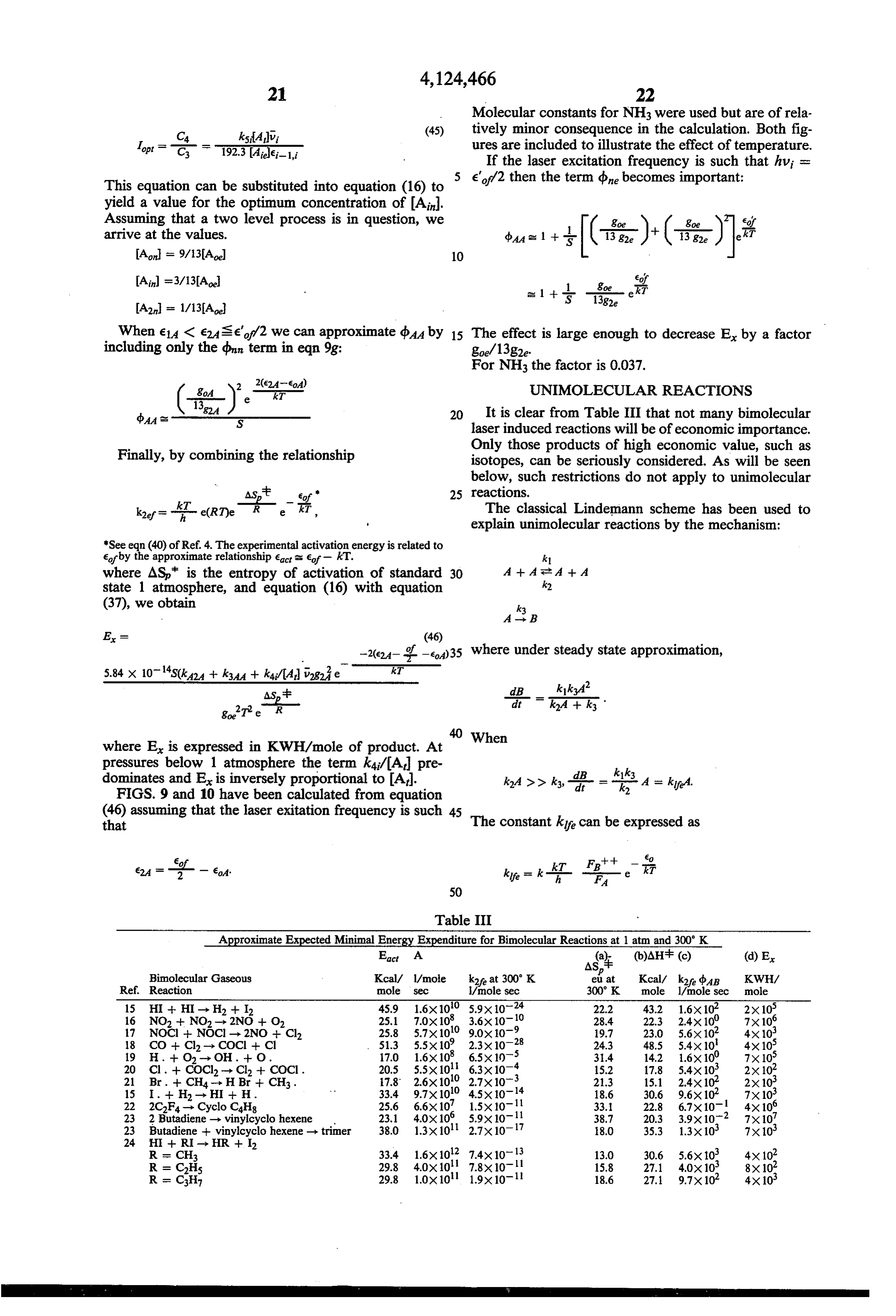
( 13&oa ) god UNIMOLECULAR REACTIONS 82A 20. It is clear from Table III that not many bimolecular
laser induced reactions will be of economic importance.
Finally, by combining the relationship Only those products of high economic value, such as isotopes, can be seriously considered. As will be seen below, such restrictions do not apply to unimolecular
k2ef= f e(RT)e --- kT, The classical Lindemann scheme has been used to explain unimolecular reactions by the mechanism:
*See eqn (40) of Ref. 4. The experimental activation energy is related to earby the approximate relationship eacts ef- kT. k where AS" is the entropy of activation of standard 30 A -- A era -- a state 1 atmosphere, and equation (16) with equation k2 (37), we obtain k3
E = (46) -2(e2A- g 35 where under steady state approximation,
AS,2 - dBdt -- kilf
Tika + k g’t e R f 2A - k3
where E is expressed in KWH/mole of product. At 40 When pressures below 1 atmosphere the term ka/A pre- kik dominates and E is inversely proportional to A. k2A >> k3, - E- . A = klea. FIGS. 9 and 10 have been calculated from equation 2 (46) assuming that the laser exitation frequency is such 45 that The constant ke can be expressed as
-- kT Frt - 624 = - - - ea. k = k-i- - F -e T
Table III
Approximate Expected Minimal Energy Expenditure for Bimolecular Reactions at 1 atm and 300 K.
Eact. A AS) (b)AH (c) (d) E.
Bimolecular Gaseous Kcal/ /mole k2 at 300 K. e at Kcal/ k2fe AB KWHA Ref. Reaction mole sec /nole sec 300 K. mole lamole sec mole 15 HI + HI-> H2 + 12 45.9 16x100 5.9x10⁻² 22.2 43.2 16x10 2x10 16 NO2 + NO2 - 2NO + O. 25.1 7.0x10 3.6x100 28.4 22.3 2.4x 10⁹ 7x10 17 NOCl + NOCl - 2NO + Cl 25.8 5.7x100 90x 109 19.7 23.0 5.6x10 4x10 18 CO + Cl-) COCl + Cl 51.3 5.5x10 2.3x10² 24.3 48.5 5.4x10 4x10 19 H. -- O - OH. + O. 17.0 1.6x10. 6.5x10 31.4 142 1.6x10⁹ 7x10 20 Cl. + COCl2 - Cl2 + COCl. 20.5 5.5x10 6.3x10 15.2 17.8 5.4x10 2x10? 21 Br. + CH4 - H Br + CH3. 17.8' 2.6x100 2.7x10- 21.3 15.1 24x10 2x10 15 I. + H2-HI + H. -- 33.4 9.7x100 4.5x10 18.6 306 9.6x10 7x10 22 2C2F4 - Cyclo C4H8 25.6 6.6x10 1.5x10 33. 22.8 6.7x10 4x10 23 2. Butadiene - vinylcyclohexene 23.1 40x10 5.9x10 38.7 20.3 3.9x10⁻² 7x10 23 Butadiene + vinylcyclohexene - trimer 38.0 1.3x10 2.7x10 18.0 35.3 1.3x10 7x10
R = CH3 33.4 1.6x101 7.4x10 13.0 30.6 5.6x10 4x10? R = CH5 29.8 40x10 7.8x10 15.8 27.1 40x10 8x10 R = CH 29.8 1.0x10 1.9X10 18.6 27.1 9.7x10 4x10
Page 27
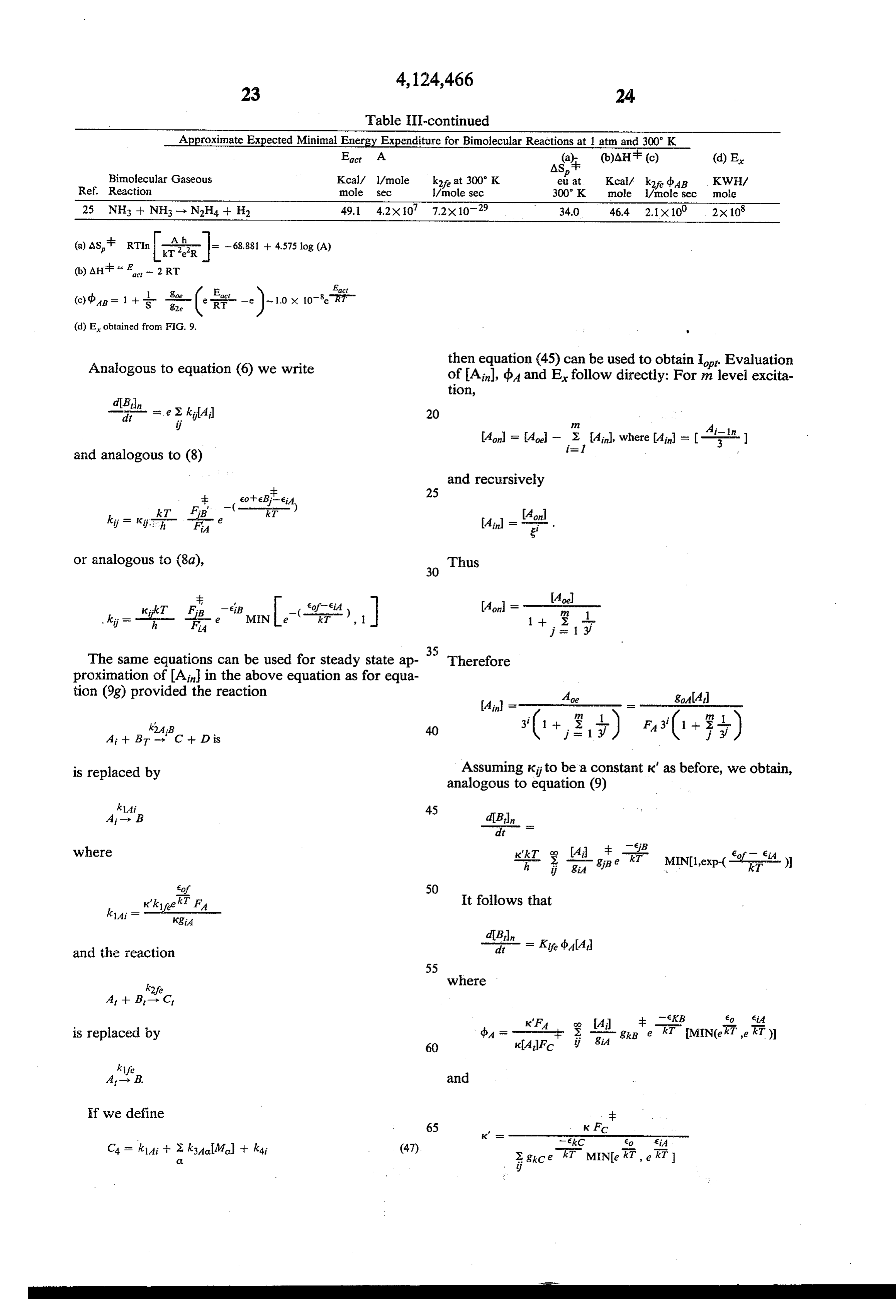
Table III-continued
Approximate Expected Minimal Energy Expenditure for Bimolecular Reactions at 1 atm and 300 K.
Eact. A A. (b)AH (c) (d) E. Bimolecular Gaseous Kcal/ 1/mole k2 at 300 K e at Kcal/ k2fe AB KWH/ Ref. Reaction mole sec /mole sec 300 K. mole Mmole sec mole 25 NH3 + NH3 - N2H4+ H2 49.1 4.2x 10⁷ 7.2x 1029 34.0 46.4 2.1 x 10⁹ 2x10
(a) As RTIn fAheR - 68,881 -- 4.575 log (A)
(d) E, obtained from FIG. 9.
Analogous to equation (6) we write then equation (45) can be used to obtain I. Evaluation of Ain), dA and E follow directly: For in level excita tion, dLB dt = e X kiA) 20
Airl, where Ain s (-sul and analogous to (8) and recursively
t cotticia
ki = kills FA e 4.in) At or analogous to (8a), 30
Aoel ki . Aon P 1
The same equations can be used for steady state ap 35 Therefore proximation of Ai in the above equation as for equa tion (9g) provided the reaction A
is replaced by Assuming k to be a constant k" as before, we obtain, analogous to equation (9)
A- B 45 dBln
where k'kT g (Ail
It follows that
and the reaction - = Ki bAA)
where
A. F -ekB go eia is replaced by
E + ijš is
kfe
A. B. and
If we define -E
Page 28
-- 4,124,466
k -continued CONCLUSIONS is ge), The reaction 2NH3 - N2H4+ H2 was chosen for illustration because it does not take place under ther analogous to equation (9d). It follows, using the same 5 mally equilbrated conditions. High energies of
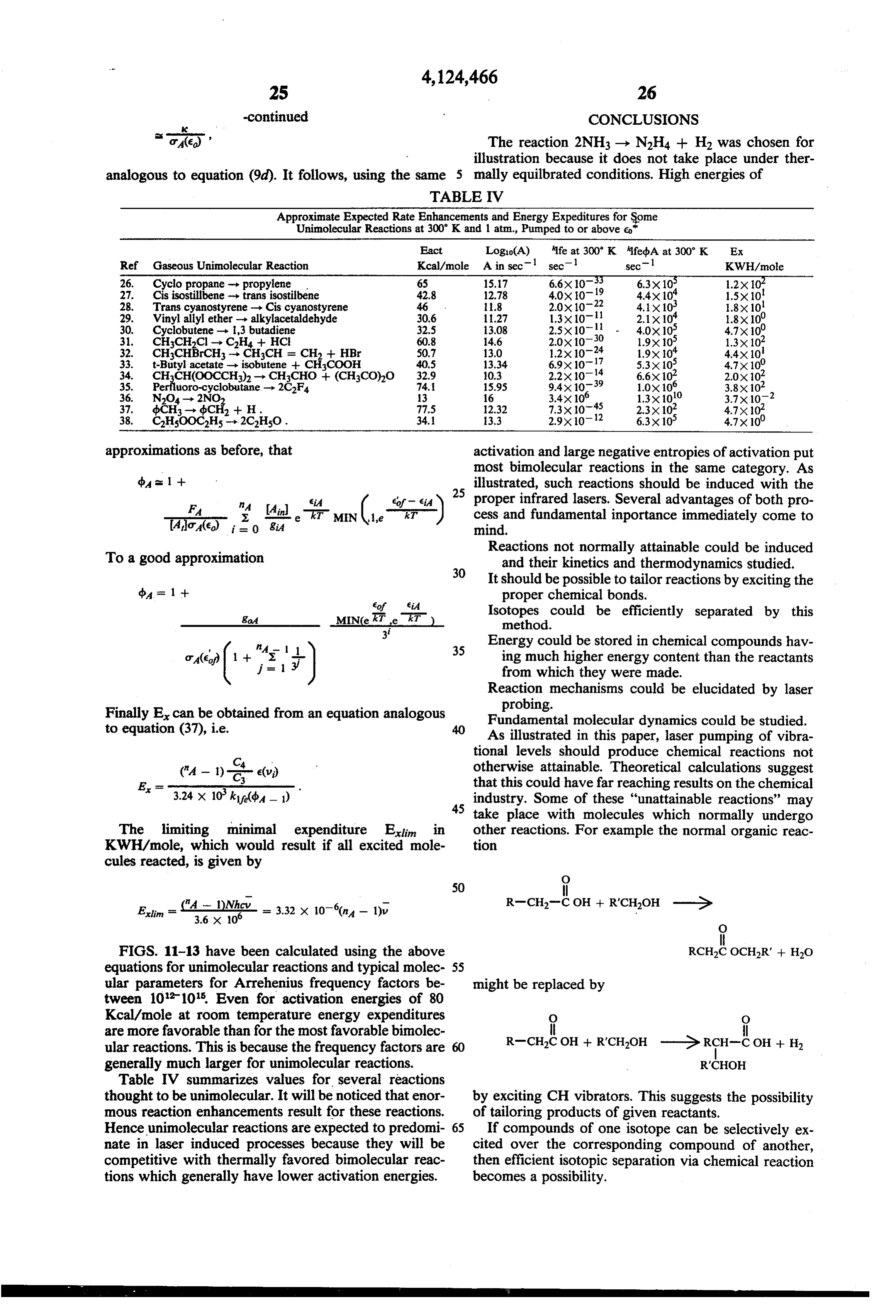
TABLE IV
Approximate Expected Rate Enhancements and Energy Expeditures for Some
Unimolecular Reactions at 300 K and 1 atm., Pumped to or above co"
Eact Logio(A) *1fe at 300 K fedbA at 300 K Ex
Ref Gaseous Unimolecular Reaction Kcal/mole A in sec sec sec KWH/mole 26. Cyclo propane -> propylene 65 15.17 6.6x1033 6.3x10 12x10 27. Cis isostill bene - trans isostilbene 42.8 12.78 40x1019 4.4x10 1.5X10 28. Trans cyanostyrene -> Cis cyanostyrene 46 . 1.8 20x10-22 4.1 x 10 1.8x10 29. Vinyl allyl ether - alkylacetaldehyde 30.6 11.27 1.3X10¹¹ 2.1 x 10 1.8x100 30. Cyclobutene -> 1,3 butadiene 32.5 13.08 2.5x10 - 40x10 4.7x100 31. CH3CH2Cl - CH4+ HC 60.8 14.6 20x100 19x10 1.3x10² 32. CHCHBrCH-CH3CH = CH2 + HBr 50.7 13.0 1.2x10² 19x10 4.4x10 33. t-Butyl acetate - isobutene -- CH3COOH 40.5 13.34 6.9X10⁷ 5.3X10 4.7x100 34. CHCHOOCCH) - CHCHO + (CH3CO)O 32.9 10.3 22x0-1 6.6x10² 20x102 35. firefore - 2C2F4 74. 15.95 9.4x10-39 10x108 3.8x10 36. NO4- 2NO 13 16 3.4x10⁶ 1.3x100 3.7x10² 37. dCH-> fi, - H. 77.5 12.32 7.3x10⁻⁵ 2.3 x 10² 4.7x10² 38. CHOOCH5-)-2C2H5O. 34.1 3.3 2.9X10⁻¹² 6.3x10 4.7x100 approximations as before, that activation and large negative entropies of activation put most bimolecular reactions in the same category. As da as 1 + 25 illustrated, such reactions should be induced with the F "4 (A) -- ef - Gia proper infrared lasers. Several advantages of both pro A. line kTMIN TRT cess and fundamental inportance immediately come to Ao(e) i = 0 8ia mind.
Reactions not normally attainable could be induced
To a good approximation 3 and their kinetics and thermodynamics studied. It should be possible to tailor reactions by exciting the d =1 - f € proper chemical bonds.
of . A Isotopes could be efficiently separated by this 8aa - MIN(ee ) Rid y sep y
a- 1 3 35 Energy could be stored in chemical compounds hav oA(e) 1 + 2. ing much higher energy content than the reactants j= 1 from which they were made.
Reaction mechanisms could be elucidated by laser probing.
Ely E. obtained from an equation analogous Fundamental molecular dynamics could be studied. eq 9 saw As illustrated in this paper, laser pumping of vibra tional levels should produce chemical reactions not
(A - 1) C4 c(v) otherwise attainable. Theoretical calculations suggest E = C3 that this could have far reaching results on the chemical 3.24 x 10kv (b 1) industry. Some of these "unattainable reactions' may take place with molecules which normally undergo
The limiting minimal expenditure Elin in other reactions. For example the normal organic reac KWH/mole, which would result if all excited mole- tion cules reacted, is given by
E-i = (A - DNhev - 3.32 X 10 (n - 1)v R-CH-COH + RCHOH - G slim - of O FIGS. 11-13 have been calculated using the above Rch. OCH2R' + H2O equations for unimolecular reactions and typical molec- 55 ular parameters for Arrehenius frequency factors be- might be replaced by tween 1010. Even for activation energies of 80
Kcal/mole at room temperature energy expenditures O O are more favorable than for the most favorable bimolec- t ular reactions. This is because the frequency factors are 60 R-CHCOH + R'CH-OH - Ge. Rh-c OH + H2 generally much larger for unimolecular reactions. R"CHOH
Table IV summarizes values for several reactions thought to be unimolecular. It will be noticed that enor- by exciting CH vibrators. This suggests the possibility mous reaction enhancements result for these reactions. of tailoring products of given reactants.
Hence unimolecular reactions are expected to predomi- 65 If compounds of one isotope can be selectively ex nate in laser induced processes because they will be cited over the corresponding compound of another, competitive with thermally favored bimolecular reac- then efficient isotopic separation via chemical reaction tions which generally have lower activation energies. becomes a possibility.
Page 29
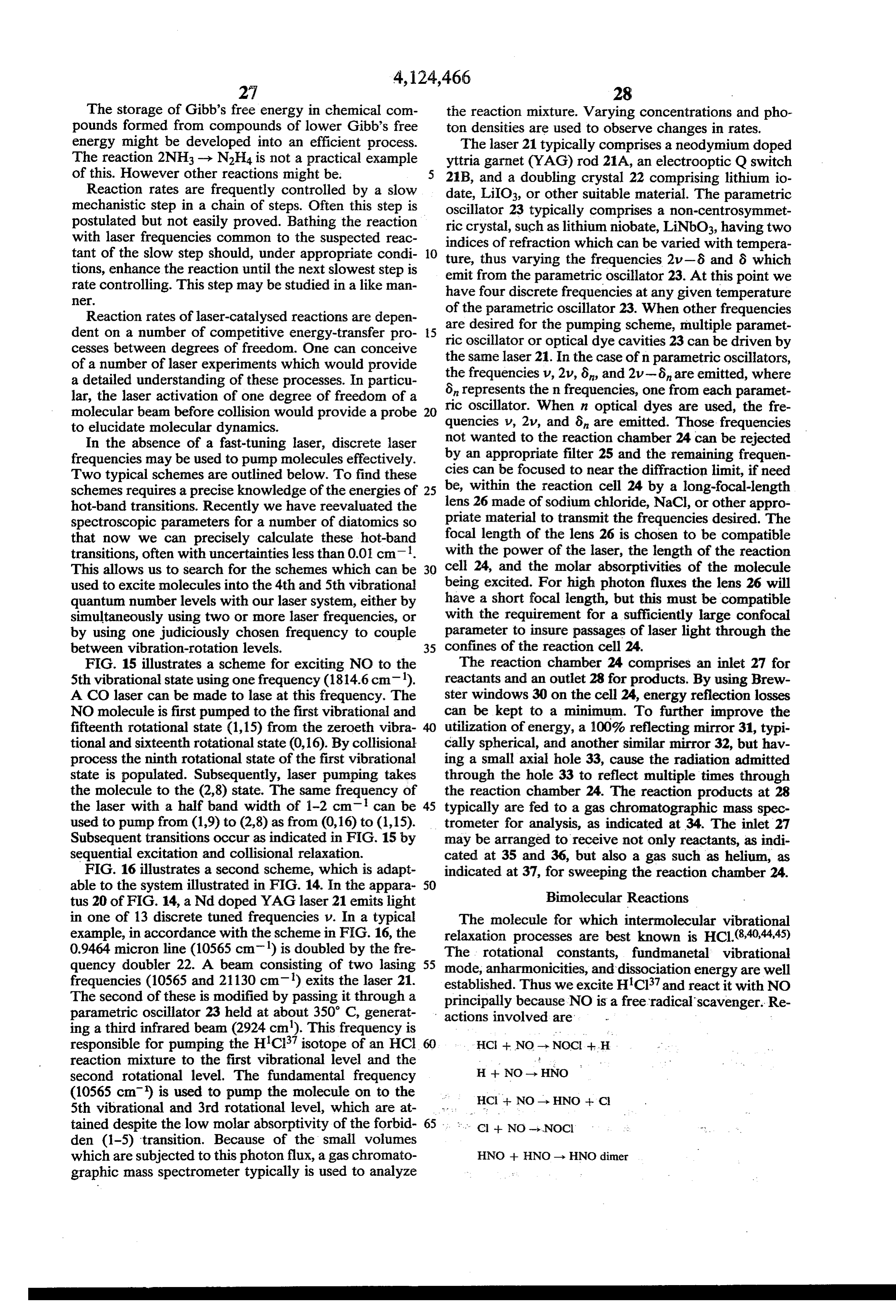
The storage of Gibb's free energy in chemical com the reaction mixture. Varying concentrations and pho pounds formed from compounds of lower Gibb's free ton densities are used to observe changes in rates. energy might be developed into an efficient process. The laser 21 typically comprises a neodymium doped The reaction 2NH3 - N2H4 is not a practical example yttria garnet (YAG) rod 21A, an electrooptic Q switch of this. However other reactions might be. 21B, and a doubling crystal 22 comprising lithium io Reaction rates are frequently controlled by a slow date, LiIO3, or other suitable material. The parametric mechanistic step in a chain of steps. Often this step is Oscillator 23 typically comprises a non-centrosymmet postulated but not easily proved. Bathing the reaction ric crystal, such as lithium niobate, LiNbO3, having two with laser frequencies common to the suspected reac tant of the slow step should, under appropriate condi 10 indices of refraction which can be varied with tempera ture, thus varying the frequencies 2u-8 and 8 which tions, enhance the reaction until the next slowest step is emit from the parametric oscillator 23. At this point we rate controlling. This step may be studied in a like man have four discrete frequencies at any given temperature
Reaction rates of laser-catalysed reactions are depen of are the parametric oscillator 23. When other frequencies desired for the pumping scheme, multiple paramet dent on a number of competitive energy-transfer pro 5 ric oscillator cesses between degrees of freedom. One can conceive the same laseror21.optical dye cavities 23 can be driven by of a number of laser experiments which would provide the frequencies V, In the case of n parametric oscillators, a detailed understanding of these processes. In particu 6, represents then2v, 8, and 2v-6 are emitted, where lar, the laser activation of one degree of freedom of a ric oscillator. Whenfrequencies, in optical one from each paramet dyes are used, the fre molecular beam before collision would provide a probe quencies V, 2v, and 8 are emitted.
Those frequencies to elucidate molecular dynamics.
In the absence of a fast-tuning laser, discrete laser not wanted to the reaction chamber 24 can be rejected frequencies may be used to pump molecules effectively. by an appropriate filter 25 and the remaining frequen Two typical schemes are outlined below. To find these cies can be focused to near the diffraction limit, if need schemes requires a precise knowledge of the energies of 25 be, within the reaction cell 24 by a long-focal-length hot-band transitions. Recently we have reevaluated the lens 26 made of sodium chloride, NaCl, or other appro spectroscopic parameters for a number of diatomics so priate material to transmit the frequencies desired. The that now we can precisely calculate these hot-band focal length of the lens 26 is chosen to be compatible transitions, often with uncertainties less than 0.01 cm. with the power of the laser, the length of the reaction This allows us to search for the schemes which can be 30 cell 24, and the molar absorptivities of the molecule used to excite molecules into the 4th and 5th vibrational being excited. For high photon fluxes the lens 26 will quantum number levels with our laser system, either by have a short focal length, but this must be compatible simultaneously using two or more laser frequencies, or with the requirement for a sufficiently large confocal by using one judiciously chosen frequency to couple parameter to insure passages of laser light through the between vibration-rotation levels. 35 confines of the reaction cell 24. FIG. 15 illustrates a scheme for exciting NO to the The reaction chamber 24 comprises an inlet 27 for 5th vibrational state using one frequency (1814.6 cm). reactants and an outlet 28 for products. By using Brew A CO laser can be made to lase at this frequency. The ster windows 30 on the cell 24, energy reflection losses NO molecule is first pumped to the first vibrational and can be kept to a minimum. To further improve the fifteenth rotational state (1,15) from the zeroeth vibra 40 utilization of energy, a 100% reflecting mirror 31, typi tional and sixteenth rotational state (0,16). By collisional cally spherical, and another similar mirror 32, but hav process the ninth rotational state of the first vibrational ing a small axial hole 33, cause the radiation admitted state is populated. Subsequently, laser pumping takes through the hole 33 to reflect multiple times through the molecule to the (2,8) state. The same frequency of the reaction chamber 24. The reaction products at 28 the laser with a half band width of 1-2 cm can be 45 typically are fed to a gas chromatographic mass spec used to pump from (1,9) to (2,8) as from (0,16) to (1,15). trometer for analysis, as indicated at 34. The inlet 27 Subsequent transitions occur as indicated in FIG. 15 by may be arranged to receive not only reactants, as indi sequential excitation and collisional relaxation. cated at 35 and 36, but also a gas such as helium, as FIG. 16 illustrates a second scheme, which is adapt indicated at 37, for sweeping the reaction chamber 24. able to the system illustrated in FIG. 14. In the appara 50 tus 20 of FIG. 14, a Nd doped YAG laser 21 emits light Bimolecular Reactions in one of 13 discrete tuned frequencies v. In a typical The molecule for which intermolecular vibrational example, in accordance with the scheme in FIG. 16, the relaxation processes are best known is HCl(8:40,445) 0.9464 micron line (10565 cm) is doubled by the fre The rotational constants, fundmanetal vibrational quency doubler 22. A beam consisting of two lasing 55 frequencies (10565 and 21130 cm) exits the laser 21. mode, anharmonicities, and dissociation energy are well established. Thus we excite HC-7 and react it with NO
The second of these is modified by passing it through a principally because NO is a free radical scavenger. Re parametric oscillator 23 held at about 350 C, generat actions involved are ing a third infrared beam (2924 cm). This frequency is responsible for pumping the HC-7 isotope of an HCl reaction mixture to the first vibrational level and the
HC + No - NOCl + H second rotational level. The fundamental frequency H + NO - HNo (10565 cm) is used to pump the molecule on to the 5th vibrational and 3rd rotational level, which are at HCl + NO - HNO + C) tained despite the low molar absorptivity of the forbid 65 .
den (1-5) transition. Because of the small volumes
which are subjected to this photon flux, a gas chromato HNO -- HNO - HINO dimer graphic mass spectrometer typically is used to analyze
Page 30
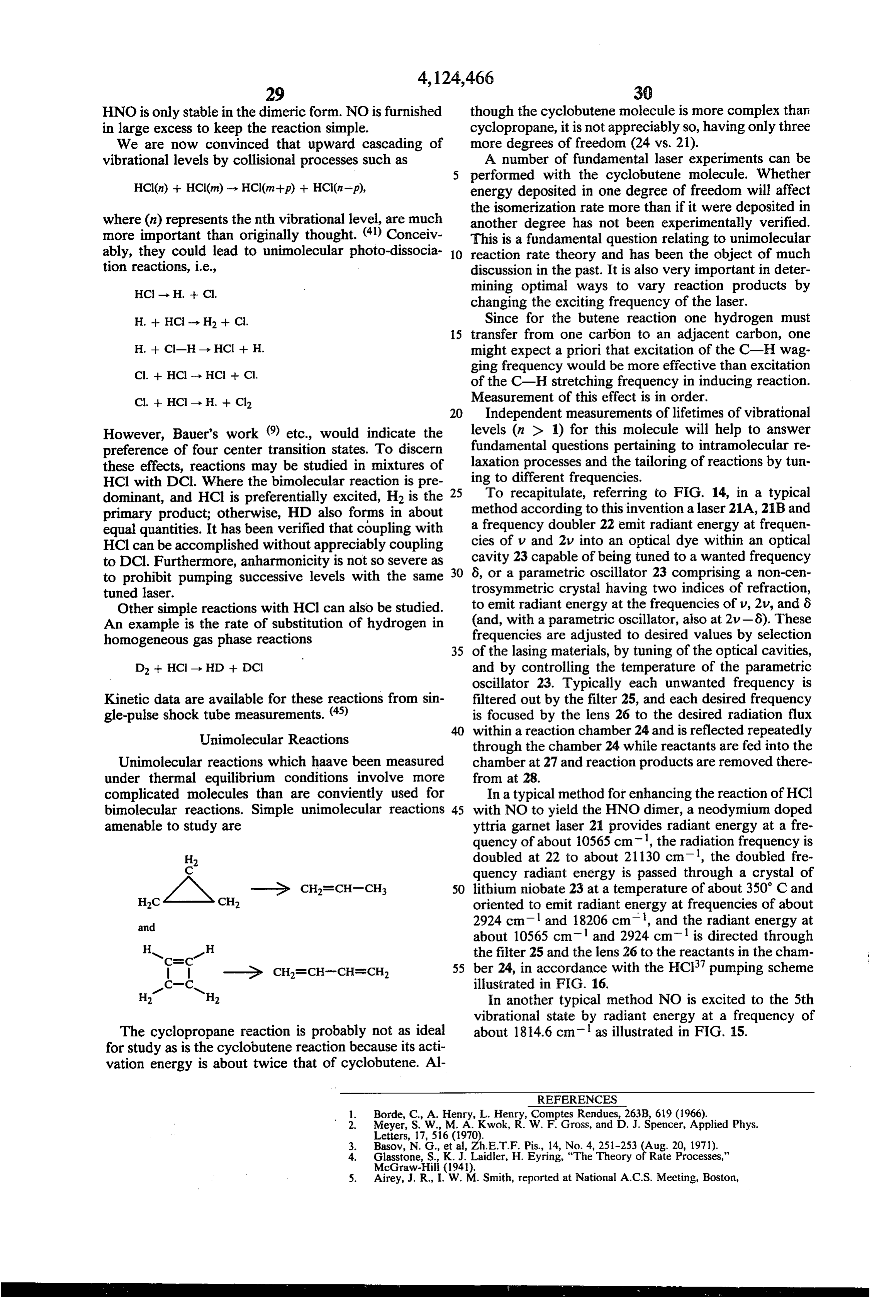
HNO is only stable in the dimeric form. NO is furnished though the cyclobutene molecule is more complex than in large excess to keep the reaction simple. cyclopropane, it is not appreciably so, having only three We are now convinced that upward cascading of more degrees of freedom (24 vs. 21). vibrational levels by collisional processes such as A number of fundamental laser experiments can be performed with the cyclobutene molecule. Whether energy deposited in one degree of freedom will affect the isomerization rate more than if it were deposited in where (n) represents the nth vibrational level, are much another degree has not been experimentally verified. more important than originally thought. (') Conceiv This is a fundamental question relating to unimolecular ably, they could lead to unimolecular photo-dissocia- 10 reaction rate theory and has been the object of much tion reactions, i.e., discussion in the past. It is also very important in deter
mining optimal ways to vary reaction products by changing the exciting frequency of the laser.
H. -- HCl - H. -- Cl. Since for the butene reaction one hydrogen must 15 transfer from one carbon to an adjacent carbon, one
H. -- C-H -> HCl - H. might expect a priori that excitation of the C-H wag
ging frequency would be more effective than excitation of the C-H stretching frequency in inducing reaction.
Cl. + HCl - H. + Cl2 Measurement of this effect is in order. Independent measurements of lifetimes of vibrational
However, Bauer's work () etc., would indicate the levels (n > 1) for this molecule will help to answer preference of four center transition states. To discern fundamental questions pertaining to intramolecular re these effects, reactions may be studied in mixtures of inglaxation processes and the tailoring of reactions by tun HCl with DCI. Where the bimolecular reaction is pre 25 Toto recapitulate, different frequencies.
referring to FIG. 14, in a typical dominant, and HCl is preferentially excited, H2 is the primary product; otherwise, HD also forms in about amethod according to this invention a laser 21A, 21.B and frequency doubler 22 emit radiant energy at frequen equal quantities. It has been verified that coupling with cies of v and 2v into an optical dye within an optical HCl can be accomplished without appreciably coupling to DC. Furthermore, anharmonicity is not so severe as 30 cavity 23 capable of being tuned to a wanted frequency 6, or a parametric oscillator 23 comprising a non-cen to prohibit pumping successive levels with the same trosymmetric tuned laser. crystal having two indices of refraction, Other simple reactions with HCl can also be studied. to emit radiant energy at the frequencies of v, 2u, and 8 (and, with a parametric oscillator, also at 2v-6). These
An example is the rate of substitution of hydrogen in frequencies homogeneous gas phase reactions are adjusted to desired values by selection 35 of the lasing materials, by tuning of the optical cavities,
D + HCl - HD + DCI and by controlling the temperature of the parametric oscillator 23. Typically each unwanted frequency is
Kinetic data are available for these reactions from sin filtered out by the filter 25, and each desired frequency gle-pulse shock tube measurements. () is focused by the lens 26 to the desired radiation flux Unimolecular Reactions within a reaction chamber 24 and is reflected repeatedly through the chamber 24 while reactants are fed into the
Unimolecular reactions which haave been measured chamber at 27 and reaction products are removed there under thermal equilibrium conditions involve more from at 28.
complicated molecules than are conviently used for In a typical method for enhancing the reaction of HCl bimolecular reactions. Simple unimolecular reactions 45 with NO to yield the HNO dimer, a neodymium doped amenable to study are yttria garnet laser 21 provides radiant energy at a fre quency of about 10565 cm, the radiation frequency is
H2 doubled at 22 to about 21130 cm, the doubled fre C quency radiant energy is passed through a crystal of HC ZN CH -> CH-CH-CH, 50 lithium niobate 23 at a temperature of about 350° C and oriented to emit radiant energy at frequencies of about and 2924 cm and 18206 cm, and the radiant energy at
about 10565 cm and 2924 cm is directed through
the filter 25 and the lens 26 to the reactants in the cham 55 ber 24, in accordance with the HCl pumping scheme
- y, -G CH2=CH-CH=CH2. illustrated in FIG. 16.
In another typical method NO is excited to the 5th vibrational state by radiant energy at a frequency of
The cyclopropane reaction is probably not as ideal about 1814.6 cm as illustrated in FIG. 15. for study as is the cyclobutene reaction because its acti vation energy is about twice that of cyclobutene. Al
REFERENCES
Borde, C., A. Henry, L. Henry, Comptes Rendues, 263B, 619 (1966).
Meyer, S. W. M. A. Kwok, R. W. F. Gross, and D. J. Spencer, Applied Phys.
Basov, N. G., et al., Zh, E.T.F. Pis, 14, No. 4, 251-253 (Aug. 20, 1971).
Glasstone, S. K. J. Laidler, H. Eyring, "The Theory of Rate Processes,"
Airey, J. R., I. W. M. Smith, reported at National A.C.S. Meeting, Boston,
Page 31
REFERENCES
Spig E. W., S. Schneider, S. F. Fucher, Ann. Rev. Phys. Chem., 22, 465 Spicer, L. D., B. S. Rabinovitch, Ann. Rev. Phys. Chem, 21, 349 (1970). Moore, Chapter
3. Ed. G. G. Guilbault, Marcel Dekker, New York 9. Slater, N. B., "Theory of Unimolecular Reactions, Ithaca, N. Y., Cornell
10. Bott, J. F., T. A. Jacobs, J. Chem. Phys. 33, 1271 (1960).
11. Moore, C. B., and Y. T. Yardley, J. Chem. Phys. 45, 1066 (1966).
T., "Inorganic Chemistry,” John Wiley & Sons, New York (1952), 13. Audrieth, L. F., and P. Mohr, Chem. Eng. News, 26, 3746 (1948). 14. Herzberg, G., “Infrared and Raman Spectra," D. Van Nostrand, New York (1945), 6th Edition.
15. Sullivan. J. H., J. Chem. Phys., 30, 1292 (1959). N. F. H. Bright and R. P.
16. Kasell, L., "Kinetics of Homogeneous Gas Reactions,” Reinhold Publishing Co.,
17. Wellinsky, I., and H. A. Taylor, J. Chem. Phys, 6, 466 (1938). 18. Benson, S., "The Foundations of Chemical Kinetics,' McGraw-Hill Book Co.,
19. Lewis, B., and G. Von Elbe, "Combustion, Flames and Explosions,' Acedemic
20. Burns, W. G., and F. S. Dainton, Trans. Faraday, Soc., 48, 39 (1952). 21. Anderson, H. G., G. B. Kistiakowsky and E. R. van Artsdalen, J. Chem. Phys.,
1952). J. R., G. W. Tomplin, and J. D. Park, J. Am. Chem. Soc., 74, 1693 23. Ekowsky, G. B., and W. W. Ransom, J. Chem. Phys, 7, 725 (1939). 24. Frost, A., and R. G. Pearson, "Kinetics and Mechamism," John Wiley & Sons,
25. This study, no experiment reported.
26. Chambers T. S., and G. B. Kistiakowsky, J. Am. Chem. Soc., 56, 399 (1934);
27.Smith, D. F., J. Arn. Chem. Soc., 49, 43 (1927); J. E. Hawkins and J. W. Vogh,
28. Kistiakowsky, G. B., and W. R. Smith, J. Am. Chem. Soc., 58,2428 (1936). 29.Schuler, F. W., and G. W. Murphy, J. Am. Chem. Soc., 72, 3155 (1950). 30.Cooper, W., and W. D. Walters, J. Am. Chem. Soc., 80, 4220 (1958). 31.Barton, D. H. R., and K. E. Howlett, J. Chem. Soc., 155, 165 (1949). 32.Blades, A. T., and G. W. Murphy, J. Am..Chem. Soc., 74,6219 (1952). 33.Rudy, C. E., Jr., and P. Fugassi, J. Phys. and Colloid Chem., 52, 357 (1948).
35.Atkinson, B., and A. B. Trenwith, J. Chem. Phys., 20, 754 (1952). 36.Carrington, T., and N. Davidson, J. Chem. Phys, 19, 1313 (1951). 37.Szwarc, M., Nature, 160, 403 (1947), J. Chem. Phys., 16, 128 (1948). 38.Harris, E. J., Proc. Ray. Soc. (London), Ai 73, 126 (1939); R. E. Rebbert and
C. B. Moore, "Fiuorescence," Chapter 3 G. G. Guibault, Editor,
Marcel Dekker, Inc., New York 1967 39. F. DeMartini, J. Duculing, Phys. Rev. Letters, 17, 117 (1966)
41. T. J. Odiorne, P. R. Brooks, J. V. V. Kasper, Rice
University (1972) gde, A, Henry, L. Henry, Comptes Rendues, 263B, 619
S. W. Mayer, M. A. Kwok, R. W. F. Gross, D. J. Spencer,
42. N. G. Basov, E. P. Markin, A. N. Oraevskii, A. W. Pankratov,
A. N. Skachkov, Doklady Akadeinii Nak SSSR,
43. See for example: S. H. Bauer, E. Ossa, J. Chem. Phys., 45, 434 (1966); D. Rapp, P. Englander-Golden, J. Chem. Phys., 40,
Airey, J. W. M. Smith, i. Chem. Phys. (to be published; J.
Sackett, J. T. Yardley, Chem. Phys. Letters, 6, 323 (1970);
T. D. Padrick, G. C. Pimentel, j. Chern. Phys. 54, 720 (1971);
L. D. Spicer, B. S. Rabinovitch, Annual Rev. Phys. Chem.,
44. S. H. Bauer, Private Communication 45. S. H. Bauer, E. L. Resier, Jr., Science, 146, 1045 (1964)
I clairn: 60 1. A method of enhancing a selected chemical reac tion that comprises increasing the population of a se- temperature, pressure, and concentrations of reactants lected high vibrational energy state of a reactant mole- maintained at a combination of values selected to opti cule substantially above its population at thermal equi- mize the reaction in preference to thermal degradation librium by directing onto the molecule a beam of radi- 65 by transforming the absorbed energy into translational ant energy from a laser having a combination of fre- motion, wherein photons are excited from one energy quency and intensity selected to pump the selected level to a level above the next higher energy level by energy state, and carrying out the reaction with the providing radiant energy having a plurality of selected
Page 32
frequencies from a laser that is tuned rapidly from one frequency and intensity selected to pump the selected selected frequency to another. energy state, and carrying out the reaction with the 2. A method as in claim 1, wherein the laser is tuned temperature, pressure, and concentrations of reactants rapidly from higher to lower frequencies corresponding maintained at a combination of values selected to opti to the vibrational energy levels of the molecule being mize the reaction in preference to thermal degradation excited, to successively populate higher vibrational by transforming the absorbed energy into translational levels of the molecule. motion, wherein a neodymium doped yttria garnet laser 3. A method as in claim 2, wherein the laser is tuned provides the radiant energy at a frequency of about at a rate comparable to those of the dynamic processes 10565 cm, the radiation frequency is doubled to within the molecule leading to depopulation. 10 about 21130 cm, the doubled frequency radiant en 4. A method for enhancing the reaction of HCl with ergy is passed through a crystal of lithium niobate at a NO to yield the HNO dimer that comprises increasing temperature of about 350° C and oriented to emit radi the population of a selected high vibrational energy ant energy at frequencies of about 2924 cm and 18206 state of a reactant molecule substantially above its popu cm, and the radiant energy at about 10565 cm and lation at thermal equilibrium by directing onto the mol- 15 2924 cm is directed: to thek reactants. ecule a beam of radiant energy having a combination of it
Provenance
- Collection
- Cited prior art
- Original PDF
- patentimages.storage.googleapis.com →
- Filed
- 1974-06-18
- Pages
- 32
- Method
- pdftotext (the PDF's own text layer) + pdftoppm 300dpi page scans
- Source
- Google Patents bibliographic record
- Granted
- 1978-11-07
- Inventors
- John R. Morrey; Battelle Memorial Institute Inc
- Transcribed from
- patentimages.storage.googleapis.com →