patent · US4108114
Fuel reformer for generating gaseous fuel containing hydrogen and/or carbon monoxide
22 August 1978
Page 1 — bibliographic record
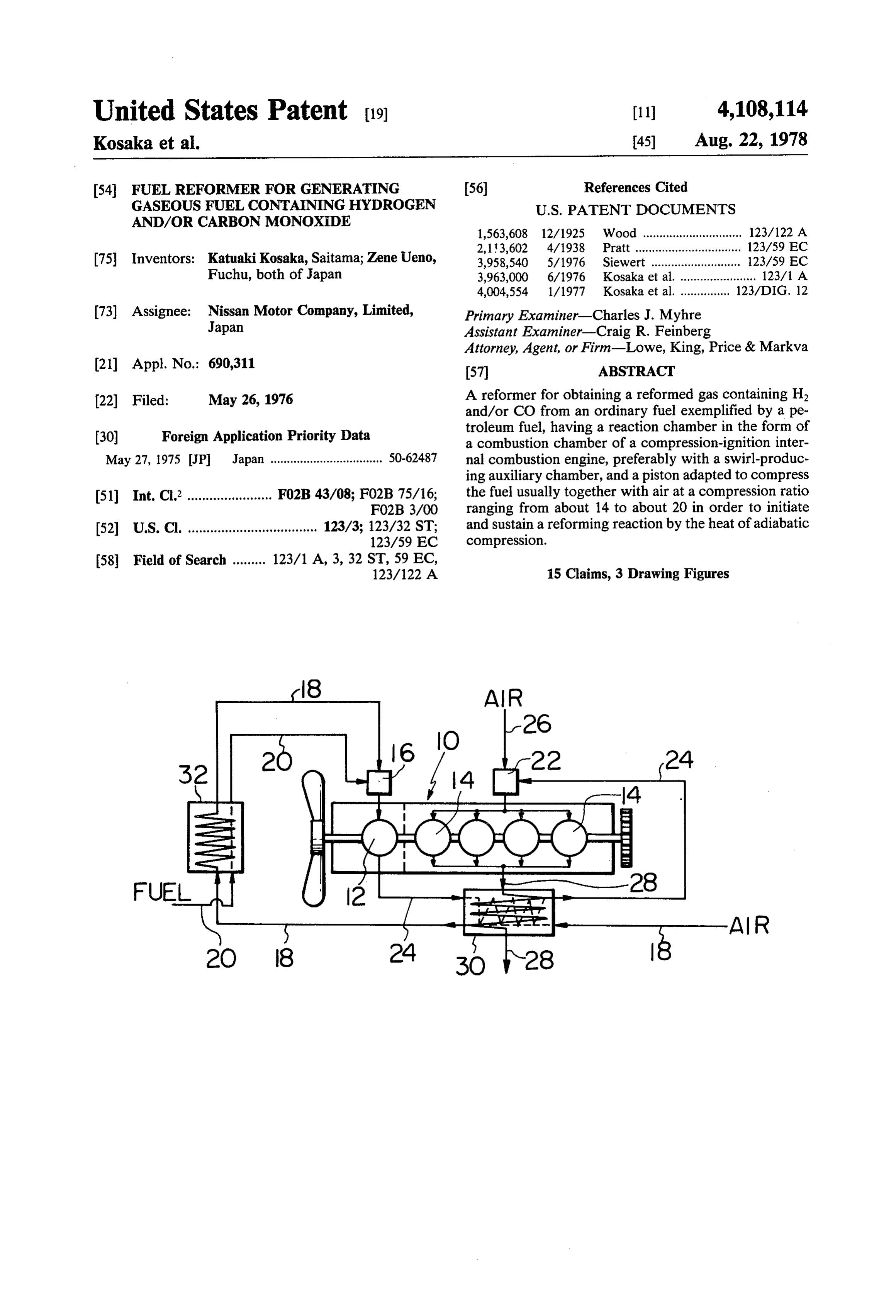
United States Patent (19) 11) 4,108,114 Kosaka et al. (45) Aug. 22, 1978 54 FUEL REFORMER FOR GENERATING (56) References Cited GASEOUS FUEL CONTAINING HYDROGEN U.S. PATENT DOCUMENTS
AND/OR CARBON MONOXDE
1,563,608 12/1925 Wood .............................. 123/122 A 2, 13,602 4/1938 ... 123/59 EC 75 Inventors: Katuaki Kosaka, Saitama; Zene Ueno, 3,958,540 5/1976 ... 123/59 EC Fuchu, both of Japan 3,963,000 6/1976 Kosaka et al. ....................... 123/1 A
73) Assignee: Nissan Motor Company, Limited, Primary Examiner-Charles J. Myhre Japan Assistant Examiner-Craig R. Feinberg
Attorney, Agent, or Firm-Lowe, King, Price & Markva (21) Appl. No.: 690,311 57 ABSTRACT (22 Filed: May 26, 1976 A reformer for obtaining a reformed gas containing H2 and/or CO from an ordinary fuel exemplified by a pe (30) Foreign Application Priority Data troleum fuel, having a reaction chamber in the form of a combustion chamber of a compression-ignition inter
May 27, 1975 (JP) Japan .................................. 50-624.87 nal combustion engine, preferably with a swirl-produc ing auxiliary chamber, and a piston adapted to compress 51 Int. Cl. ....................... F02B 43/08; FO2B 75/16; the fuel usually together with air at a compression ratio FO2B 3/00 ranging from about 14 to about 20 in order to initiate 52 U.S. C. ................................... 123/3; 123/32 ST; and sustain a reforming reaction by the heat of adiabatic
123/122 A 15 Claims, 3 Drawing Figures
Page 2
Drawing sheet — no readable text.
Page 3
compactly with the provision of no separate heat gener
FUEL REFORMER FOR GENERATING GASEOUS ator other than simple heat exchangers, that the re FUEL CONTAINING HYDROGEN AND/OR former allows the reforming reaction to proceed effi CARBON MONOXDE ciently and self-sustainingly and that the reformer can easily be combined with a conventional combustion
This invention relates to an engine system including a engine to constitute a practicable engine system useful fuel-reforming apparatus for reforming an ordinary fuel as a power plant of a vehicle such as an automobile. exemplified by a hydrocarbon fuel into a gaseous fuel containing large amounts of hydrogen and/or carbon ingAccording out a to the invention, a fuel reformer for carry fuel-reforming reaction which gives a gaseous monoxide by adiabatic compression of a mixture of the O fuel containing as combustible former fuel and an oxygen-containing gas and a com and/or carbon monoxide from atcomponents hydrogen least one fuel selected bustion engine which is fed with the gaseous fuel.
It is known as a solution to the problem of the atmo from hydrocarbon fuels, alcohols, nitrogen-hydrogen spheric pollution by exhaust gases of combustion en ing elements:and(a)solid compounds carbon fuels comprises the follow a reaction chamber in the form of a gines to operate the engines with a gaseous fuel which 15 combustion of a compression-ignition internal combus contains as combustible components hydrogen and/or carbon monoxide and is obtained through, for example, tion engine, (b) a piston adapted to compress a gas in the partial oxidation or water gas reaction of an ordinary reaction chamber at a compression ratio in the range fuel typified by gasoline. A great variety of currently from about 14 to about 20, (c) a fluid feed circuit to available fuels can be used as a starting material for 20 supply a gaseous reactant which contains at least the producing such gaseous fuel. Examples of useful fuels aforementioned fuel to the reaction chamber, and (d) a are: petroleum fuels such as natural gas, LPG, gasoline, heat exchanger arranged to transfer heat from the gase kerosene, light oil and heavy oil; synthetic fuels typified ous fuel discharged from the reaction chamber to at by synthetic gasoline; alcohols typified by methanol and least one component of the reactant to be supplied to ethanol; and nitrogen-hydrogen compounds such as 25 the reaction chamber.
ammonia and hydrazine. Even solid fuels such as coal The fluid feed circuit preferably comprises a fluid and charcoal can be utilized. mixing device adapted to prepare a gaseous mixture of In the following description, gasoline (octane) will be either oxygen or air and the aforementioned fuel in such taken as a typical example of ordinary fuels to be re a proportion that the amount of oxygen in the mixture is formed into a gaseous fuel, which is commonly called a 30 sufficient to accomplish partial oxidation of the fuel to reformed gas, containing hydrogen and/or carbon mon give the gaseous fuel but is insufficient to accomplish oxide as principal combustible components, but it will complete oxidation of the fuel.
be understood from the description that various liquid The reformer preferably includes an auxiliary cham and gaseous fuels other than gasoline can be used in an ber which communicates with the reaction chamber engine system according to the invention either singu 35 and is located and shaped such that a portion of the larly or in combinations. reactant in the reaction chamber is squeezed into the Gasoline (octane C8H8) undergoes partial oxidation auxiliary chamber at a last stage of a compression stroke by air as expressed by the following chemical equation: of the piston to produce swirl.
CH + (40 + 15.1N) - 8CO + 9H + 15.1N, When the reactant supplied to the reformer is a mix (1) 40 ture of gasoline and air, the air/fuel ratio of the mixture
This is an exothermic reaction with a reaction heat of is regulated to be within the range from 5 to 5.5 by 1.43 Kcal per 1 g of CH18. This reaction heat, however, weight. The reformer can easily be combined with a combus is far smaller than the reaction heat, 10.4 Kcal/g, at complete oxidation of octane. It is necessary, therefore, 45 tion engine with the provision of a mixing device to for the partial oxidation reaction according to Equation prepare a combustible mixture of air and the gaseous (1) that the reaction system be heated by a certain means of fuel supplied from the reformer. In this case, a fraction in order to cause the rate of reaction to become high usedpower for provided by the combustion engine may be accomplishing compression in the reformer, enough to self-sustain the reaction. For example, Jet
Propulsion Laboratory (Pasadena, Calif., U.S.A.) has and the exhaust gas of the combustion engine is passed proposed to preheat air and gasoline at least to about 50 through a heat exchanger to preheat at least one compo 600 C and about 300 C, respectively. Heat for initiat nent of the reactant to be supplied to the reformer. ing and sustaining the partial oxidation reaction of gaso Other features and advantages of the invention will line has usually been obtained by subjecting a small become apparent from the following detailed descrip quantity of gasoline to complete combustion. This tion of preferred embodiments with reference to the means the consumption of gasoline without the genera 55 accompanying drawings, wherein:
tion of any useful motive power. Accordingly, an en FIG. 1 is a diagrammatic presentation of a general gine system including a gasoline-reforming apparatus construction of an engine system including a fuel re has suffered from an increase in the specific fuel con former according to the invention;
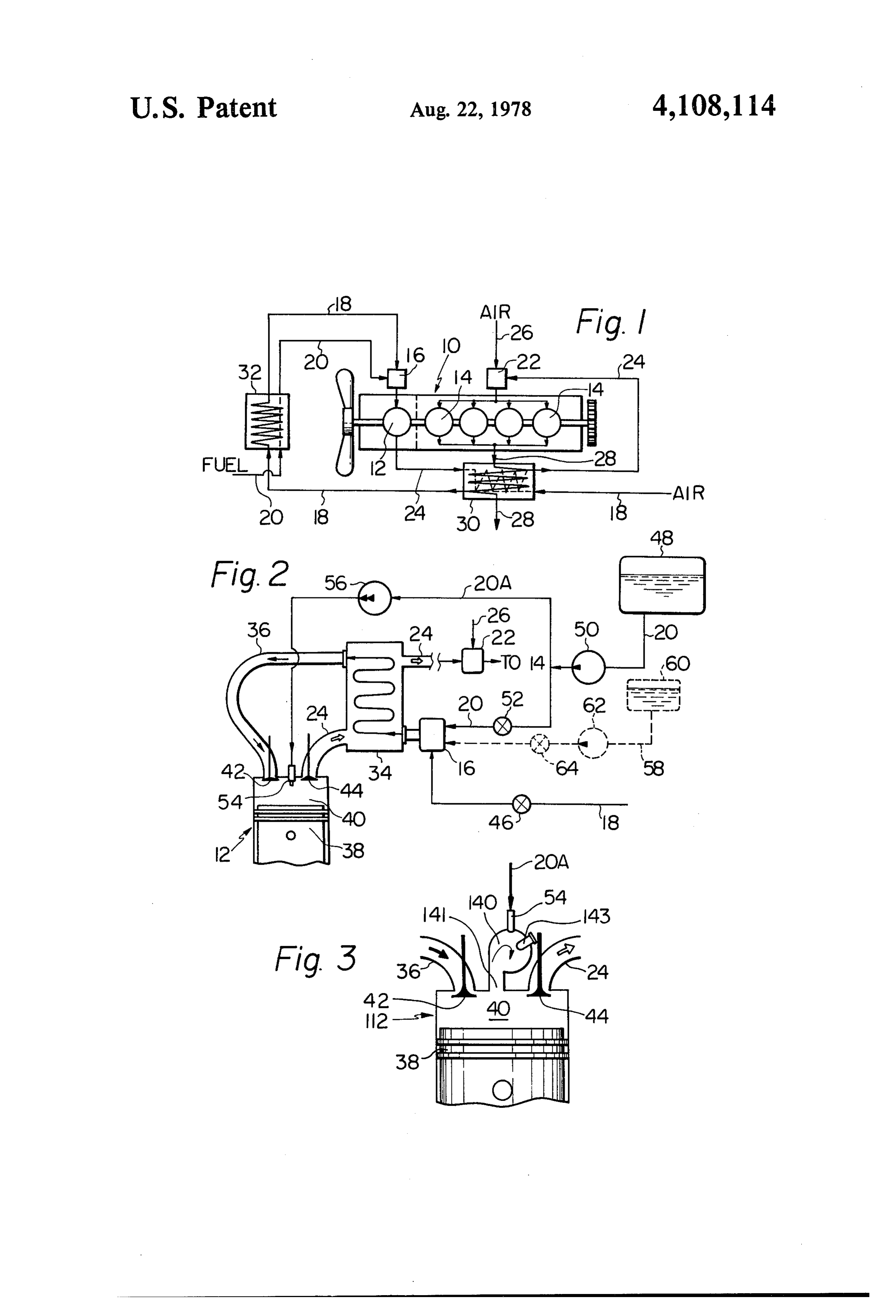
sumption. Besides, it is difficult to construct a reforming FIG. 2 is a diagrammatic presentation of a fuel re apparatus which is compact enough to serve, for exam 60 former in a system of FIG. 1 as a preferred embodiment ple, as part of a power plant of cars because the appara of the invention; and tus must include bulky components for the evolution of FIG. 3 is a schematic and sectional view of a slightly heat, preheating of the starting materials and shielding modified fuel reformer as another embodiment of the of the heat-evolving components. invention.
It is an object of the present invention to provide a 65 An engine system of FIG. 1 has a multi-cylinder fuel reformer which is adapted to carry out a fuel reciprocating internal combustion engine 10. A minor reforming reaction of the described type and contains number of engine cylinders of this engine 10 repre the following features: that the reformer is constructed sented by a cylinder 12 located at the extreme left is
Page 4
constructed to serve as a fuel reformer, and the remain 46. The fuel line 20 includes a fuel tank 48, a fluid trans ing cylinders 14 are constructed in a usual manner to fer pump 50 and a flow control valve 52. An auxiliary produce power by combustion of an air-fuel mixture. fuel line 20A branches from the fuel line 20 at a section The cylinder 12 needs not to produce power. On the between the pump 50 and the valve 52 and terminates at a fuel injector 54 which is provided to the combustion contrary, this cylinder 12 is usually driven by a portion chamber of the power produced by the other cylinders 14. As an the top face 40 of the reformer 12 at a location remote from essential feature of the invention, the cylinder 12 (which of the piston 38. This fuel injector 54 in will hereinafter be referred to as reformer) takes the cludes such a control mechanism (not shown) that the form of an engine cylinder of a reciprocating piston injection can be carried out at a controlled injection rate diesel engine, i.e. a compression-ignition internal com 10 only includes when the necessity arises. The auxiliary fuel line bustion engine in which the compression ratio is from 20A The engine a pressurizing pump 56.
system may have a water (or steam) line about 14 to about 20. The power-producing cylinders 14 are fundamentally similar to engine cylinders of a 58 which extends from a water tank 60 to the mixing conventional gasoline engine. The reformer 12 is 15 device 16 and is provided with a transfer pump 62 and equipped with a fluid mixing device 16. Line 18 and line a flow control valve 64. The engine 10 includes a starter 20 are arranged to supply respectively air and fuel (gas (not shown) which can reciprocate the piston 38 of the oline) to the mixing device 16 in such a proportion that reformer
initial stage of the operation, the control valve the air/fuel ratio (by weight) of the air-gasoline mixture supplied from the mixing device 16 to the reformer 12 is 20 52 in the fuel line 20 is kept closed. Air is supplied to the combustion chamber 40 of the reformer 12 through line from about 5 to about 5.5.
The power-producing cylinders 14 are equipped with 18, while gasoline is pressurized by the pump 56 and a mixing device 22, and line 24 is arranged to pass a injected into the combustion chamber 40 from the injec reformed gas (essentially a mixture of H., CO and N) tor 54 in a nearly stoichiometric proportion to the quan tity of the supplied air. The piston 38 is made to recipro from the reformer 12 to the mixing device 22. This 25 cate by the starter to compress the air-gasoline mixture mixing device 22 is regulated to prepare a combustible mixture of air admitted through line 26 and the re ratio iscombustion in the chamber 40. Since the compression as high as 14-20, the mixture is heated to a tem formed gas at such a ratio that the mixture contains air perature above its ignition temperature by the adiabatic in slight excess of a stoichiometric amount in order to compression, assure complete oxidation of CO and suppress the for 30 tion chamber and 40.
combustion is initiated in the combus
The combustion gas is passed through mation of NOx. The exhaust gas of the engine 10 (i.e.
cylinders 14) is discharged from the engine system into line 24 to heat the heat exchanger 34. The combustion the atmosphere through line 28. A heat exchanger 30 is under this condition is repeated until the heat exchanger provided in the line 28, and the reformed gas line 24 is 34 is heated to a sufficiently high temperature, i.e. about arranged to serve as a part of this heat exchanger 30. 500 C. Then the flow control valve 52 is opened and The air line 18 is arranged to pass through the heat 35 are the injector 54 is closed. The control valves 46 and 52 exchanger 30 so that the air may be preheated by the mixing regulated such that air and gasoline is mixed in the heat of the reformed gas and the exhaust gas without device at an air/fuel ratio (by weight) in the coming into direct contact with these gases. Another range from 5 to 5.5.
heat exchanger 32 is provided in the air line 18 at a changer The air-gasoline mixture is preheated in the heat ex section downstream of the heat exchanger 30, and the into the combustion34 to, for example, 200-300° C and admitted fuel line 20 is passed through the heat exchanger 32 so passage chamber 40 through the induction that the fuel may be preheated by the heat of the pre 36. The temperature of the mixture rises to about 800-1000 C upon adiabatic compression of the heated air. As an alternative to the provision of the two mixture heat exchangers 30 and 32 for individually heating air in the combustion chamber 40, so that the mix and gasoline, it is permissible to provide a heat ex 45 tionture undergoes the partial oxidation reaction of Equa changer (not shown in FIG. 1) between the mixing the combustion (1). Accordingly the exhaust gas discharged from device 16 and the reformer 12 to preheat the mixture of reformed gas containing chamber 40 under this condition is a air and gasoline. Particulars of the reformer 12 and components. The reformedH2 and CO as combustible auxiliary elements will be described hereinafter with 50 to the mixing device 22 for gas the is passed through line 24 power-producing cylin reference to FIGS. 2 and 3.
In FIG. 2, a heat exchanger 34 is provided between ders 14 via the heat exchanger 34 which transfers heat the mixing device 16 and the reformer 12 such that an fromtothethereformed gas to the air-gasoline mixture to be induction passage 36 for the reformer (a diesel engine fed reformer 12. The engine cylinders 14 are cylinder) 12 passes through this heat exchanger 34. The operated with a mixture of air and the reformed gas. reformer 12 has a reciprocating piston 38 and a combus 55 Once vided combustion in the engine cylinders 14 has pro power, the piston 38 of the reformer 12 can con tion chamber 40 defined between the top face of the tinually be reciprocated by a fraction of the provided piston 38 and a surface of the cylinder head (omitted power.
from the illustration). An intake valve 42 and an exhaust The heat exchange between the reformed gas and valve 44 govern the communication of the combustion either air or the air-gasoline mixture results in a temper chamber 40 with the induction passage 36 and the re ature reduction of the reformed gas and hence contrib formed gas line 24, respectively. The reformed gas line utes to the improvement of the intake efficiency of the 24 passes through the heat exchanger 34 to transfer heat power-producing engine cylinders 14. from the reformed gas to the air-gasoline mixture flow According to the invention, no heating means for ing in the induction passage 36 without allowing the 65 directly heating the combustion chamber 40 is needed. two fluids to come into direct contact with each other.
Preferably, also the exhaust line 28 from the power-pro The partial oxidation or imcomplete combustion of the ducing cylinders 14 is passed through this heat ex air-gasoline mixture can proceed self-sustainingly be changer 34. The airline 18 includes a flow control valve cause of the temperature rise of the mixture to about
Page 5
800-1000 Cadiabatic compression. Such high temper eration of soot in the partial oxidation reaction. It is ature is realized by merely heating the mixture to about possible to separate steam from the exhaust gas of the 200-300' C prior to the compression by the use of the power-producing cylinders 14 and supply the separated heat of the reformed gas and/or the exhaust gas of an steam to the mixing device 16. engine which is fed with the reformed gas. For example, Also it is permissible to provide a catalyst (not the temperature of the mixture reaches about 900 C at shown) in the auxiliary chamber 140 to promote the the end of a compression stroke of the piston 38 if the reforming reaction.
mixture is admitted into the combustion chamber 40 at As will have been understood from the foregoing about 200 C and the compression ratio is 18. The rate description, a commercial and inexpensive diesel engine of the reaction according to Equation (1) at about 500 O can be utilized as the reformer 12 or 112 according to C or above is calculated as to be on the order of milli the invention without need of including a large-sized second based on the thermochemical data presented in and complicated heat-evolving apparatus. Neverthe "Combustion Science and Technology”, Vol. 6(1973), less, a reforming reaction in the reformer 12 or 112 pp.279-286. The aforementioned temperature of about proceeds stably and self-sustainingly. Accordingly, a 900 C, therefore, is sufficient to allow the reforming 15 reformer according to the invention can easily be com reaction to proceed self-sustainingly at a rate corre bined with a conventional engine to constitute an en sponding to a practicable speed range of an internal gine system which is compact, efficient and ready to use combustion engine which is combined with the re in vehicles such as automobiles. former. It will be understood that the partial oxidation in the The air/fuel ratio of an air-fuel mixture subject to a 20 reformer 12 or 112 can be carried out by the use of partial oxidation reaction in the reformer 12 should be oxygen in place of air. As an easily practicable tech considerably lower than a stoichiometric ratio and be nique, oxygen for this purpose can be obtained by cata controlled accurately within a relatively narrow range lytic decomposition of an aqueous solution of hydrogen (for example, between 5 and 5.5 with gasoline as the peroxide.
fuel). A higher air/fuel ratio causes complete combus 25 A reformer according to the invention does not nec tion of at least a portion of the mixture, while a lower essarily consist of a single engine cylinder of a diesel air/fuel ratio causes the reformed gas to contain soot engine. A multi-cylinder diesel engine (of either the (free carbon) and/or hydrocarbons in noticeable quanti reciprocating type or rotary type) may entirely be used ties. Also it is required that the regulated quantities of as a reformer. In such a case, the reformer can provide air and fuel are thoroughly mixed in the mixing device 30 some power simultaneously with the production of a 16. In other words, the air/fuel ratio must be uniform in reformed gas.
every region of the combustion chamber 40. What is claimed is:
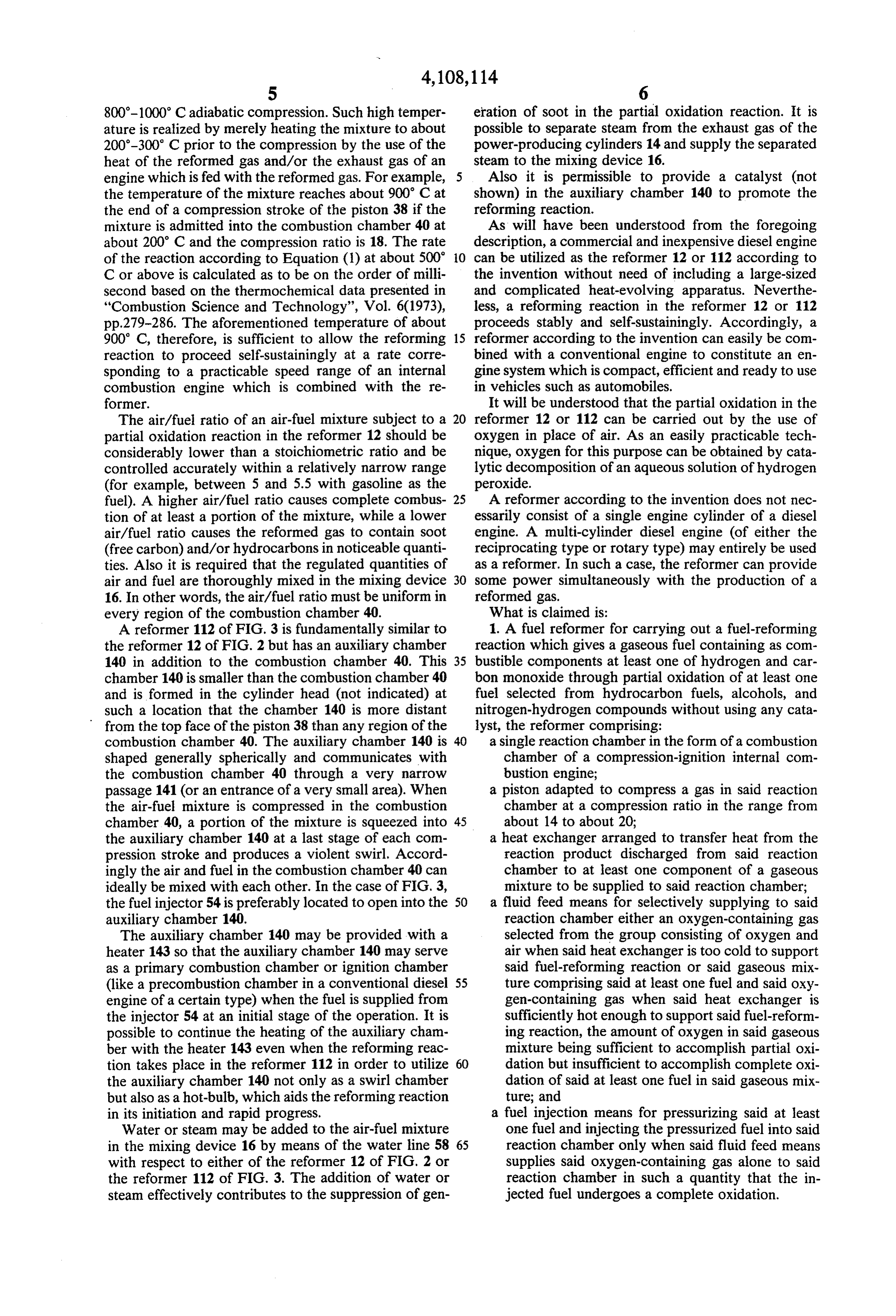
A reformer 112 of FIG. 3 is fundamentally similar to 1. A fuel reformer for carrying out a fuel-reforming the reformer 12 of FIG. 2 but has an auxiliary chamber reaction which gives a gaseous fuel containing as com 140 in addition to the combustion chamber 40. This 35 bustible components at least one of hydrogen and car chamber 140 is smaller than the combustion chamber 40 bon monoxide through partial oxidation of at least one and is formed in the cylinder head (not indicated) at fuel selected from hydrocarbon fuels, alcohols, and such a location that the chamber 140 is more distant nitrogen-hydrogen compounds without using any cata from the top face of the piston 38 than any region of the lyst, the reformer comprising:
combustion chamber 40. The auxiliary chamber 140 is 40 a single reaction chamber in the form of a combustion shaped generally spherically and communicates with chamber of a compression-ignition internal com the combustion chamber 40 through a very narrow bustion engine;
passage 141 (or an entrance of a very small area). When a piston adapted to compress a gas in said reaction the air-fuel mixture is compressed in the combustion chamber at a compression ratio in the range from chamber 40, a portion of the mixture is squeezed into 45 about 14 to about 20;
the auxiliary chamber 140 at a last stage of each con a heat exchanger arranged to transfer heat from the pression stroke and produces a violent swirl. Accord reaction product discharged from said reaction ingly the air and fuel in the combustion chamber 40 can chamber to at least one component of a gaseous ideally be mixed with each other. In the case of FIG. 3, mixture to be supplied to said reaction chamber; the fuel injector 54 is preferably located to open into the 50 a fluid feed means for selectively supplying to said auxiliary chamber 140. reaction chamber either an oxygen-containing gas The auxiliary chamber 140 may be provided with a selected from the group consisting of oxygen and heater 143 so that the auxiliary chamber 140 may serve air when said heat exchanger is too cold to support as a primary combustion chamber or ignition chamber said fuel-reforming reaction or said gaseous mix (like a precombustion chamber in a conventional diesel 55 ture comprising said at least one fuel and said oxy engine of a certain type) when the fuel is supplied from gen-containing gas when said heat exchanger is the injector 54 at an initial stage of the operation. It is sufficiently hot enough to support said fuel-reform possible to continue the heating of the auxiliary cham ing reaction, the amount of oxygen in said gaseous ber with the heater 143 even when the reforming reac mixture being sufficient to accomplish partial oxi tion takes place in the reformer 112 in order to utilize 60 dation but insufficient to accomplish complete oxi the auxiliary chamber 140 not only as a swirl chamber dation of said at least one fuel in said gaseous mix but also as a hot-bulb, which aids the reforming reaction ture; and in its initiation and rapid progress. a fuel injection means for pressurizing said at least Water or steam may be added to the air-fuel mixture one fuel and injecting the pressurized fuel into said in the mixing device 16 by means of the water line 58 65 reaction chamber only when said fluid feed means with respect to either of the reformer 12 of FIG. 2 or Supplies said oxygen-containing gas alone to said the reformer 112 of FIG. 3. The addition of water or reaction chamber in such a quantity that the in steam effectively contributes to the suppression of gen jected fuel undergoes a complete oxidation.
Page 6
2. A fuel reformer as claimed in claim 1, further com ture comprising said at least one fuel and said oxy prising a fluid feed means for introducing water into gen-containing gas when said heat exchanger is said gaseous mixture. sufficiently hot enough to support said fuel-reform 3. A fuel reformer as claimed in claim 1, wherein said ing reaction, the amount of oxygen in said gaseous at least one fuel and said oxygen-containing gas are 5 mixture being sufficient to accomplish complete gasoline and air, respectively, said fluid feed means oxidation of said at least one fuel in said gaseous being regulated such that the air/fuel ratio of said mix mixture, a fuel injection means for pressurizing said ture is in the range from 5 to 5.5 by weight. at least one fuel and injecting the pressurized fuel 4. A fuel reformer as claimed in claim 3, wherein said into said reaction chamber only when said fluid heat exchanger is constructed such that said gaseous 10 feed means supplies said oxygen-containing gas mixture is admitted into said reaction chamber at tem alone to said reaction chamber in such a quantity peratures between about 200° C. and about 300 C., said that the injected fuel undergoes a complete oxida compression ratio being determined such that said gase tion;
ous mixture is heated to about 800-1000 C. by the a combustion engine adapted to produce power; and compression in said reaction chamber. means for preparing a combustible mixture of air and 5. A fuel reformer as claimed in claim 1, further com said gaseous fuel supplied from said fuel reformer prising an auxiliary chamber which communicates with and supplying the prepared combustible mixture to said reaction chamber and is located and shaped such said combustion engine.
that a portion of said gaseous reactant supplied to said 10. An engine system as claimed in claim 9, wherein reaction chamber is squeezed into said auxiliary cham 20 said reformer and said combustion engine are integrated ber and produces swirl at a last stage of a compression to constitute a multi-cylinder internal combustion en stroke of said piston. gine, a minor number of engine cylinders of said multi 6. A fuel reformer as claimed in claim 5, further com cylinder internal combustion engine being adapted to prising a catalyst contained in said auxiliary chamber serve as said fuel reformer, the remaining engine cylin for promoting said fuel-reforming reaction. 25 ders being operated with said combustible mixture to 7. A fuel reformer as claimed in claim 5, further com provide power.
prising means for pressurizing said at least one fuel and 11. An engine system as claimed in claim 9, wherein injecting the pressurized fuel into said auxiliary cham said reformer and said combustion engine are mechani ber. cally combined with each other such that a fraction of 8. A fuel reformer as claimed in claim 7, further com 30 power provided by said combustion engine is used to prising a heater arranged to heat the interior of said accomplish compression in said reformer. auxiliary chamber. 12. An engine system as claimed in claim 9, wherein 9. An engine system comprising:
a fuel reformer which is adapted to carry out a fuel beingatgasoline said least one fuel and said oxygen-containing gas and air, respectively, said fluid feed reforming reaction to give a gaseous fuel contain 35 means being regulated ing as combustible components at least one of hy mixture is in the rangesuchfrom that the air/fuel ratio of said 5 to 5.5 by weight.
drogen and carbon monoxide through partial oxi dation of at least one fuel selected from hydrocar said heat exchanger is constructedinsuch 13. A fuel reformer as claimed claim 12, wherein that said gase bon fuels, alcohols, and nitrogen-hydrogen com ous mixture is admitted into said reaction chamber at pounds without using any catalyst and includes a 40 temperatures between about 200 C. and about 300° C., single reaction chamber in the form of a combus said compression tion chamber of a compression-ignition internal gaseous mixture isratio being determined such that said heated to about 800-1000 C. by the combustion engine, a piston adapted to compress a compression in said reaction chamber. gas in said reaction chamber at a compression ratio in the range from about 14 to about 20x; at least one 45 said14.atAnleast engine system as claimed in claim 12, wherein one heat exchanger is arranged such that heat exchanger arranged to accomplish heat ex change between the exhaust gas of said combustion said exhaust gas transfers heat thereof to said mixture of engine and at least one component of a gaseous gasoline and air.
reactant to be supplied to said reaction chamber; a said15.atAnleast engine system as claimed in claim 14, wherein one heat exchanger is arranged such that fluid feed means for selectively supplying to said 50 reaction chamber either an oxygen-containing gas ture also said gaseous fuel transfers heat thereof to said mix selected from the group consisting of oxygen and of gasoline and air in said at least one heat ex air when said heat exchanger is too cold to support changer. k sk k said fuel-reforming reaction or said gaseous mix
Provenance
- Collection
- Cited prior art
- Original PDF
- patentimages.storage.googleapis.com →
- Filed
- 1976-05-26
- Pages
- 6
- Method
- pdftotext (the PDF's own text layer) + pdftoppm 300dpi page scans
- Source
- Google Patents bibliographic record
- Granted
- 1978-08-22
- Inventors
- Katuaki Kosaka; Zene Ueno; Nissan Motor Co Ltd
- Transcribed from
- patentimages.storage.googleapis.com →