patent · US4035255
Operation of a diaphragm electrolylytic cell for producing chlorine including feeding an oxidizing gas having a regulated moisture content to the cathode
12 July 1977
Page 1 — bibliographic record
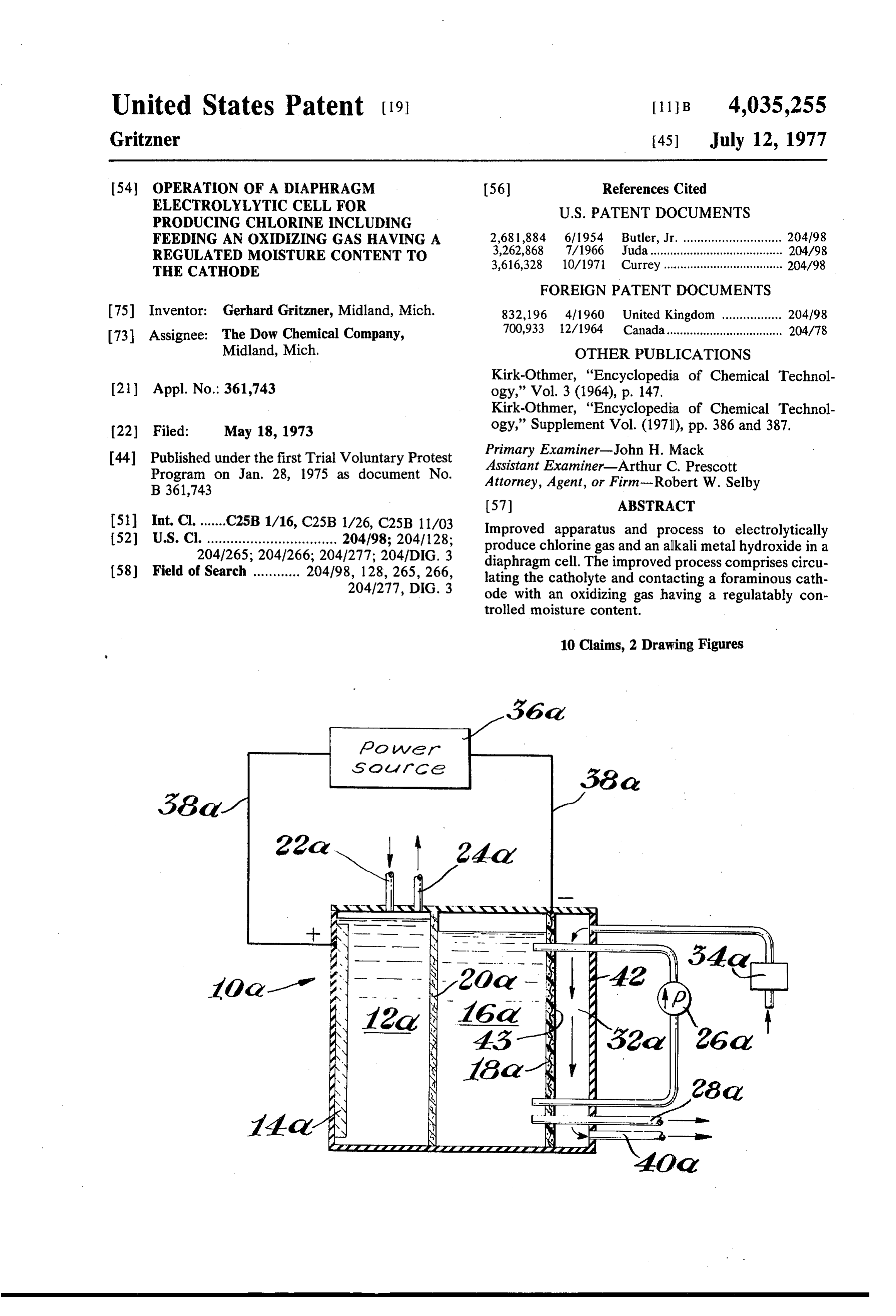
United States Patent (19) 11 B 4,035,255 Gritzner (45) July 12, 1977 54) OPERATION OF A DIAPHRAGM 56 References Cited ELECTROLYLYTIC CELL FOR U.S. PATENT DOCUMENTS
PRODUCING CHLORINE INCLUDING
FEED ING AN OXDZING GAS HAVING A 2,681,884 6/1954 Butler, Jr. ............................ 204,198 REGULATED MOISTURE CONTENT TO 3,262,868 7/1966 Juda........................................ 204/98 THE CATHODE 3,616,328 10/1971 Currey.................................... 204/98
FOREIGN PATENT DOCUMENTS
75) Inventor: Gerhard Gritzner, Midland, Mich. 832,196 4/1960 United Kingdom ................. 204/98 73 Assignee: The Dow Chemical Company, 700,933 12/1964 Canada................................... 204/78 Midland, Mich. OTHER PUBLICATIONS
Kirk-Othmer, "Encyclopedia of Chemical Technol (21) Appl. No.: 361,743 ogy," Vol. 3 (1964), p. 147.
Kirk-Othmer, “Encyclopedia of Chemical Technol 22 Filed: May 18, 1973 ogy," Supplement Vol. (1971), pp. 386 and 387. 44 Published under the first Trial Voluntary Protest Primary Examiner-John H. Mack
Program on Jan. 28, 1975 as document No. Assistant Examiner-Arthur C. Prescott B 361,743 Attorney, Agent, or Firm-Robert W. Selby
51 Int. Cl........C25B 1/16, C25B 1/26, C25B 11/03 Improved apparatus and process to electrolytically (52) U.S. Cl. ................................. 204/98; 204/128; produce chlorine gas and an alkali metal hydroxide in a 204/265; 204/266; 2041277; 204/DIG. 3 diaphragm cell. The improved process comprises circu 58 Field of Search ............ 204/98, 128, 265, 266, lating the catholyte and contacting a foraminous cath 2041277, DIG. 3 ode with an oxidizing gas having a regulatably con trolled moisture content.
10 Claims, 2 Drawing Figures
w N“ T j4a
2. 23a
Page 2
Drawing sheet — no readable text.
Page 3
metal hydroxide formed from the cathode compart
ELECTROLYLYTC CELL FOR PRODUCING The described electrolytic cell is advantageously CHILORINE INCLUDING FEEDING ANOXDZING used in an improved process to produce chlorine and GAS HAVING A REGULATED MOSTURE an alkali metal hydroxide. In the improved process an CONTENT TO THE CATHODE alkali chloride brine is fed into the anode compart BACKGROUND OF THE INVENTION ment. At least a portion of the brine containing alkali metal ions passes through the diaphragm into the cath
This invention pertains to the electrolytic production ode chamber. Sufficient electrical energy is supplied to of chlorine in a diaphragm cell and more in particular O the anode and cathode to release gaseous chlorine at to an electrolytic cell containing an oxidizing gas depo the anode and to form the alkali metal hydroxide in the larized cathode and a method of producing chlorine cathode compartment. The gaseous chlorine and alkali and an alkali metal hydroxide in such electrolytic cell. metal hydroxide are suitably recovered by means Gaseous chlorine has long been produced from so known to those skilled in the art.
dium chloride in an electrolytic cell having an anode 15 The electrical efficiency of the cell is improved by positioned within an anode chamber and a cathode in a substantially simultaneously contacting different wall cathode chamber spaced apart from the anode cham portions of the cathode with the catholyte and with an ber by an ion and liquid permeable diaphragm, such as oxidizing gas. The moisture content of the oxidizing gas one at least partially formed of asbestos. In such an 20 is suitably controlled to minimize drying and deposition electrolytic cell chlorine is released at the anode and of materials such as sodium chloride, sodium hydroxide sodium hydroxide is formed in the cathode chamber. and the like on the cathode surface. The catholyte is Various methods to conserve electrical power in circulated within the cathode compartment to maxi electrolytic cells have been developed using porous mize contact between the catholyte and the cathode to cathodes in combination with an oxidizing gas to depo 25 thereby further improve the electrical efficiency of the larize the electrode; see for example, Juda, U.S. Pat. cell.
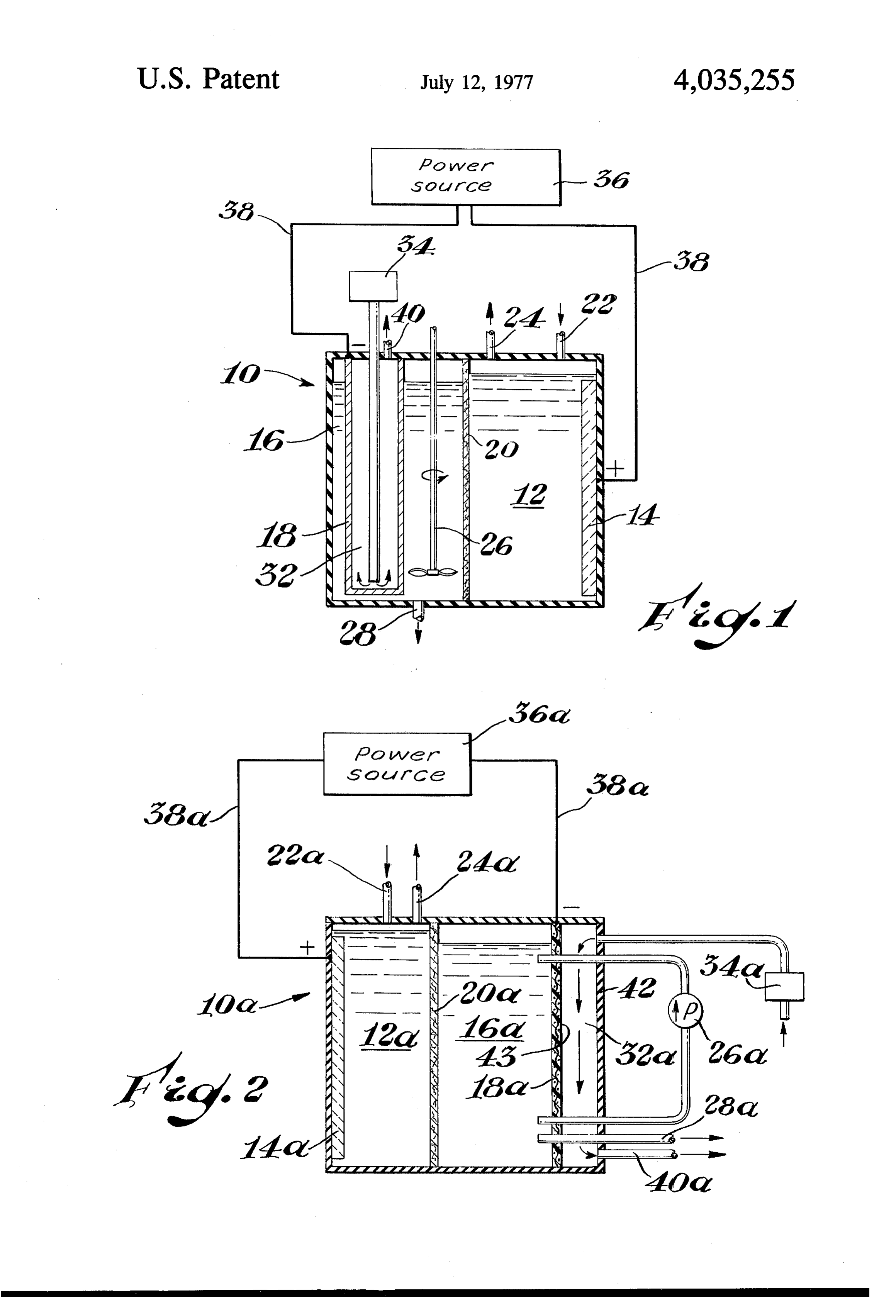
No. 3,124,520. It is desired to provide an improved apparatus and process to reduce the electrical con DESCRIPTION OF THE DRAWING sumption of chlorine producing electrolytic diaphragm The accompanying drawing further illustrates the cells. invention:
SUMMARY OF THE INVENTION In FIG. 1 is depicted a cross sectional view of one embodiment of the invention.
An improved electrolytic cell to produce chlorine In FIG. 2 is a cross sectional view of another embodi and an alkali metal hydroxide has been developed. The electrolytic cell comprises an anode compartment ment of the invention.
Identical numbers, distinguished by a letter suffix,
suited to contain an anolyte such as an aqueous solu within the several tion or mixture of an alkali metal chloride, for example, lar function withinfigures represent parts having a simi the different embodiments.
sodium chloride. A cathode compartment adapted to contain a catholyte containing the hydroxide of the DESCRIPTION OF THE PREFERRED alkali metal is spaced apart from the anode compart 40 EMBODIMENTS ment by a diaphragm. The diaphragm separating the An electrolytic cell 10 of FIG. 1 includes an anode anode and cathode compartments is suited to passions compartment of at least the alkali metal from the anode compartment juxtaposed and12spaced with an anode 14 positioned therein apart from a cathode compart to the cathode compartment. The diaphragm is suitably ment 16 with a depolarized cathode 18 positioned positioned in the electrolytic cell to substantially en 45 therein. The anode compartment 12 is spaced apart tirely separate the anode compartment from the cath ode compartment. from the cathode compartment 16 by a diaphragm 20 An anode is suitably positioned within the anode capable of passing at least alkali metal ions from the compartment and a cathode is suitably positioned anode compartment 12 to the cathode compartment within the cathode compartment to be spaced apart 16. The electrolytic cell 10 further includes a source of from the diaphragm, that is substantially all of the cath 50 alkali metal chloride brine (not shown) and a means 22 olyte is contained within a space or opening at least to introduce or feed the brine into the anode compart partially defined by the diaphragm and at least partially ment 12. A gaseous chlorine removal means such as a by an outer surface of the cathode. The cathode is pipe 24 is suitably connected to the anode compart further adapted to have at least one wall portion in 55 ment 12 to afford removal of gaseous chlorine without contact with the catholyte and at least one other wall substantial loss of chlorine to the ambient atmosphere. portion substantially simultaneously in contact with an A means, such as a pump, ultrasonic vibrator or a oxidizing gas. turbine type impeller 26, to circulate the catholyte at A means to circulate the catholyte at least within the least within the cathode compartment 16 is suitably cathode compartment is in operative combination with 60 positioned within the cathode compartment 16 to af the cathode compartment. A means to control the ford circulation of the catholyte throughout the cath moisture content of the oxidizing gas in contact with ode compartment 16. During operation of the electro the cathode is in operative combination with the cath lytic cell 10 the catholyte contains increasing concen ode. trations of an alkali metal hydroxide, such as sodium A means to supply a direct current to the anode and 65 hydroxide, which for efficient operation should be re the cathode is suitably electrically connected to these moved from the cathode compartment 16 to reduce the electrodes. The electrolytic cell further includes a hydroxide concentration. For this purpose an alkali means to remove the chlorine produced from the metal hydroxide removal means such as pipe 28 is in anode compartment and a means to remove the alkali combination with the cathode compartment 16.
Page 4
The cathode 18 is formed of a material adapted to the gas compartment 32 through the oxidizing gas re transmit or pass an ozidizing gas from a gas compart moval means or port 40.
ment 32 to the outer surface of the cathode 18. Prefer To minimize what is believed to be formation of ably, formation of oxidizing gas bubbles on the outer hydrogen at the cathode 18 it is desirable that substan surface of the cathode 18 is minimized and more pref tially all of the catholyte comes into contact with the erably the outer surface of the cathode is substantially cathode. To promote such contact and reduce the oc free of oxidizing gas bubbles. An oxidizing gas moisture currence of stagnant portions of catholyte within the control means 34 is provided to regulatably control the cathode compartment 16 where little movement of the dew point of the oxidizing gas introduced into the gas catholyte occurs, the catholyte is preferably circulated compartment 32 to minimize and preferably substan at a rate sufficient for substantially all of the catholyte tially entirely eliminate accumulation of liquid water to contact the cathode 18 and insufficient to result in within the gas compartment 32. The moisture control physical injury to the asbestos diaphragm 20. means 34 is further adapted to maintain the oxidizing FIG. 2 is illustrative of an electrolytic cell 10a gas moisture content at a concentration adequate to 15 having therein an anode compartment or chamber minimize and preferably substantially entirely prevent 12a spaced apart from a cathode compartment or removal of sufficient moisture from the catholyte chamber 16a by an asbestos containing diaphragm 20a within the cathode compartment 16 to result in deposi formed from, for example, asbestos sheet or particu tion of solid materials such as sodium chloride or so late. An anode 14a is suitably attached in the anode dium hydroxide in, for example, the pores of the cath 20 chamber 12a. Likewise, a cathode 18a is suitably at ode 18. Preferably the moisture control means 34 is tached in the cathode compartment 16a. The anode is adapted to regulate the moisture content of the oxidiz constructed of a material such as carbon or what is ing gas within the range of from about 50 to 100 per known in the art as dimensionally stable anode such as cent of saturation. titanium or tantalum coated or plated with materials The cathode 18, which is used in combination with 25 including for example, at least one metal or oxide of the the oxidizing gas control means 34, is preferably a platinum group metals including Ru, Rh, Pd, Ag, Os, Ir, foraminous body, such as a screen, expanded metal or Pt and Au.
a sheet with holes extending therethrough, having at The cathode 18a is preferably a metallic silver plated least the surface thereof composed of a substantially foraminous copper substrate such as a copper screen or inert material such as, for example Ru, Rh, Pd, Ag, Os, sheet with a thickness of about 0.01 to about 0.02 inch Ir, Pt and Au with a coating of a mixture of the particu and sufficient pores or holes with a diameter of about late inert metal and for example, polytetrafluoroethyl 0.015 to about 0.03 inch diameter extending there ene, polyhexafluoropropylene and other polyhalogen through to provide a total hole or open area equivalent ated ethylene or propylene derivatives. Preferably the to about 20 to about 40 per cent of that portion of the inert material is what is known in the art as platinum 35 copper sheet having the greatest surface area. The black, silver black and carbon black. Particulates foraminous copper sheet is preferably coated or plated which are designated as "black' generally and prefera with sufficient metallic silver to provide a substantially bly have a U.S. Standard Mesh size range of less than continuous silver layer with a thickness of up to about about 300. Preferably the cathode 18 is a screen at 0.002 inch. Plating of the copper substrate is carried least partially woven from or adherently coated with 40 out in a manner known to those skilled in the plating metallic platinum, silver or gold with a mesh size of art. A screen woven from about 0.005 to about 0.02 about 30 to about 60. inch diameter wire into a screen having a U.S. Standard A source of electrical energy 36 is electrically con Mesh size of about 20 to about 50 is satisfactory when nected to an energy transmission or carrying means plated with silver as described above. The silver plated such as aluminum or copper conduit as bus bar or 45 copper substrate is coated with a mixture of platinum cables 38 to transmit direct electrical current to the black, silver black or carbon black and, for example, anode 14 and the cathode 18. polytetrafluoroethylene or a fluorinated copolymer of In operation of the electrolytic cell an metal chloride hexafluoropropylene or tetrafluoroethylene. The mix containing brine, such as sodium chloride, is supplied ture preferably contains from about 30 to about 70 or fed through the brine feed means 22 into the anode 50 weight per cent carbon black with a mesh size of less chamber 12 wherein, through electrolytic processes than about 300 admixed with up to about 10 weight per known to those skilled in the art, gaseous chlorine is cent carbon fibers. The balance of the mixture is essen formed and removed through pipe 24 and thence to a tially the organic material and impurities generally chlorine condensing and storage system (not shown). found in the carbon and the organic material. The Sodium ions pass through the asbestos diaphragm 20 55 organic mixture coated, silver plated copper is prefera into the cathode compartment 16 wherein sodium hy bly substantially impervious to passage of the catholyte. droxide is formed. An oxidizing gas, preferably oxygen, The term copper includes commercially pure copper is fed into the gas compartment 32 within the cathode and alloys thereof containing at least 50 weight per 18 substantially simultaneously with formation of the cent copper.
sodium hydroxide. The presence of the oxidizing gas 60 The pump 26a together with appropriate conduits and the physical contact thereof with the inner surface extending into the cathode chamber 16a are provided of the cathode 18, while the outer surface of the cath to afford effective circulation of the catholyte during ode 18 is simultaneously in contact with the sodium operation of the cell 10a. Generally the catholyte will hydroxide containing catholyte, is believed to minimize be pumped in a manner to enter at the upper portion of and preferably prevent formation of gaseous hydrogen 65 the cathode chamber 16a and be withdrawn at the in the cathode compartment 16 to thereby reduce the lower portion of the chamber; however, pumping can electrical consumption and improve the electrical effi be carried out to remove catholyte at the upper portion ciency of the cell. Excess oxidizing gas is removed from of the cathode chamber.
Page 5
The cathode 18a is spaced apart from a side portion faces of the aluminum foil. The aluminum foil-screen or wall 42 of the cell 10a to form an opening or gas composite was compressed under a pressure of 2,000 compartment 32a between the diaphragm 18a and the lbs. per square inch and simultaneously heated for 2 inner surface of the wall 42. An oxidizing gas with the minutes at a temperature of 360°C. The composite was moisture content suitably controlled by a moisture cooled and then placed in a 20 per cent sodium hydrox control means 34a is pumped into, preferably, the ide solution to dissolve the aluminum foils. The com upper portion of the gas compartment 32a and flowed posite cathode was washed and dried before being into intimate contact with the outer surface 43 of the positioned in the electrolytic cell with the Teflon cathode 18a and withdrawn through removal means coated surface forming a wall portion of the gas com 40a for disposal. 10 partment.
A brine supply means 22a and a chlorine removal The cell was operated using an electrode area of 3.14 means 24a are in combination with the anode chamber square inches for each the anode and cathode. The 12a. A sodium hydroxide containing catholyte is gener spacing between the anode and cathode was either ally removed through a conduit 28a. A source of direct 15 1 1/16 inch or 1 1 1/16 inches as shown in the Tables. electrical current 36a is electrically connected to elec An aqueous brine containing about 300 grams per liter trical conduits 38a which are in turn electrically at sodium chloride was continuously fed into the anode tached to the anode 14a and the cathode 18a. chamber and a sodium hydroxide containing cell efflu Operation of the electrolytic cell 10a is substantially ent was removed from the cathode chamber. Although the same as that described for the embodiment of FIG. chlorine gas was continuously removed from the anode 1 except that the catholyte is preferably circulated chamber it was unnecessary to remove any gaseous within the cathode chamber by pumping through the product from the cathode compartment while the de pump 26a. polarizing cathode was functioning.
The following examples further illustrate the inven Operation of the cell was crrried out in a manner tion. known to those skilled in the art with the exception that 25 either oxygen or air was pumped through the gas com
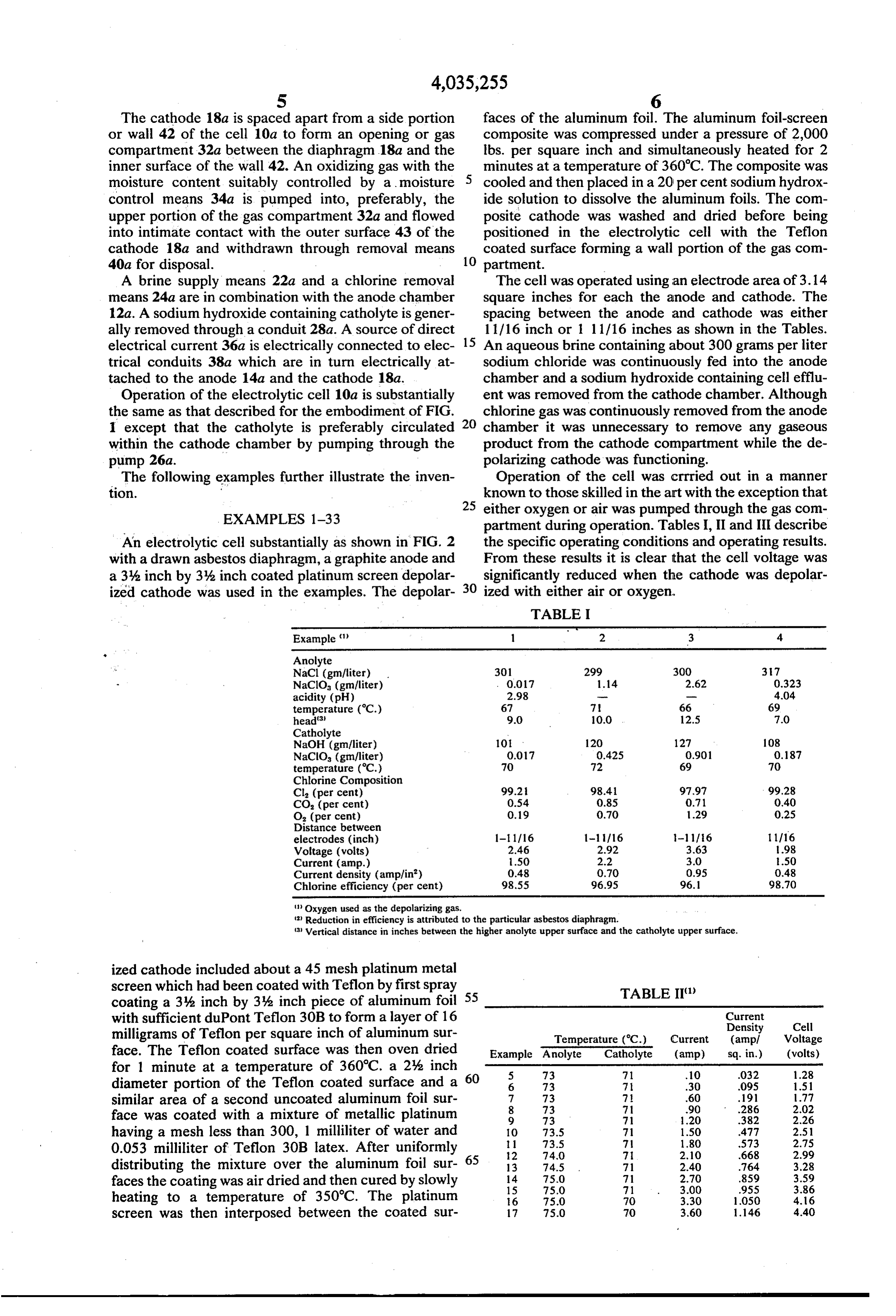
EXAMPLES 1-33 partment during operation. Tables I, II and III describe
An electrolytic cell substantially as shown in FIG. 2 the specific operating conditions and operating results. with a drawn asbestos diaphragm, a graphite anode and From these results it is clear that the cell voltage was a 3% inch by 3% inch coated platinum screen depolar significantly reduced when the cathode was depolar ized cathode was used in the examples. The depolar- 30 ized with either air or oxygen.
TABLE I
Example' 1 2 3 4. Anolyte
NaCl (gm/liter) . 301 299 300 37 NaClO (gm/liter) 0.017 1.14 2.62 0.323 acidity (pH) 2.98 www. 4.04 temperature (C.) 67 g 66 69 head 9.0 10.0 12.5 7.0 Catholyte
NaOH (gm/liter) O 120 127 108 NaClO (gm/liter) 0.017 0.425 0.901 0.87 temperature (C.) 70 72 69 70 Chlorine Composition
Cl (per cent) 99.2 98.4 97.97 99.28 CO, (per cent) 0.54 0.85 0.71 0.40 O (per cent) 0.19 0.70 1.29 0.25 Distance between electrodes (inch) 1- 1116 1-1 fló -1116 11116 Voltage (volts) 2.46 2.92 3.63 1.98 Current (amp.) 50 2.2 3.0 50 Current density (amplin) 0.48 0.70 0.95 0.48 Chlorine efficiency (per cent) 98.55 96.95 96.1 98.70 ''Oxygen used as the depolarizing gas.
Reduction in efficiency is attributed to the particular asbestos diaphragm.
3. Vertical distance in inches between the higher anolyte upper surface and the catholyte upper surface.
ized cathode included about a 45 mesh platinum metal screen which had been coated with Teflon by first spray TABLE IIl coating a 3% inch by 3% inch piece of aluminum foil 55 with sufficient duPont Teflon 30B to form a layer of 16
milligrams of Teflon per square inch of aluminum sur Temperature (C.) Current (ampl Voltage face. The Teflon coated surface was then oven dried Example Anolyte Catholyte (amp) sq. in.) (volts) for 1 minute at a temperature of 360°C. a 2% inch 5 73 7 10 O32 1.28 diameter portion of the Teflon coated surface and a 60 7 36 o55 5 similar area of a second uncoated aluminum foil sur- 7 73 7 60 .191 1.77 face was coated with a mixture of metallic platinum 23 138 3. 29: having a mesh less than 300, 1 milliliter of water and 10 73.5 71 1.50 477 2.51 0.053 milliliter of Teflon 30B latex. After uniformly i. 7. 7. 26 33 distributing the mixture over the aluminum foil sur- 65 71 2.46 764 3.28 faces the coating was air dried and then cured by slowly
738 2. 38 : E.
heating to a temperature of 350°C. The platinum 6 5.0 70 3.30 1.050 4.16 screen was then interposed between the coated sur- 17 75.0 70 360 1.146 4.40
Page 6
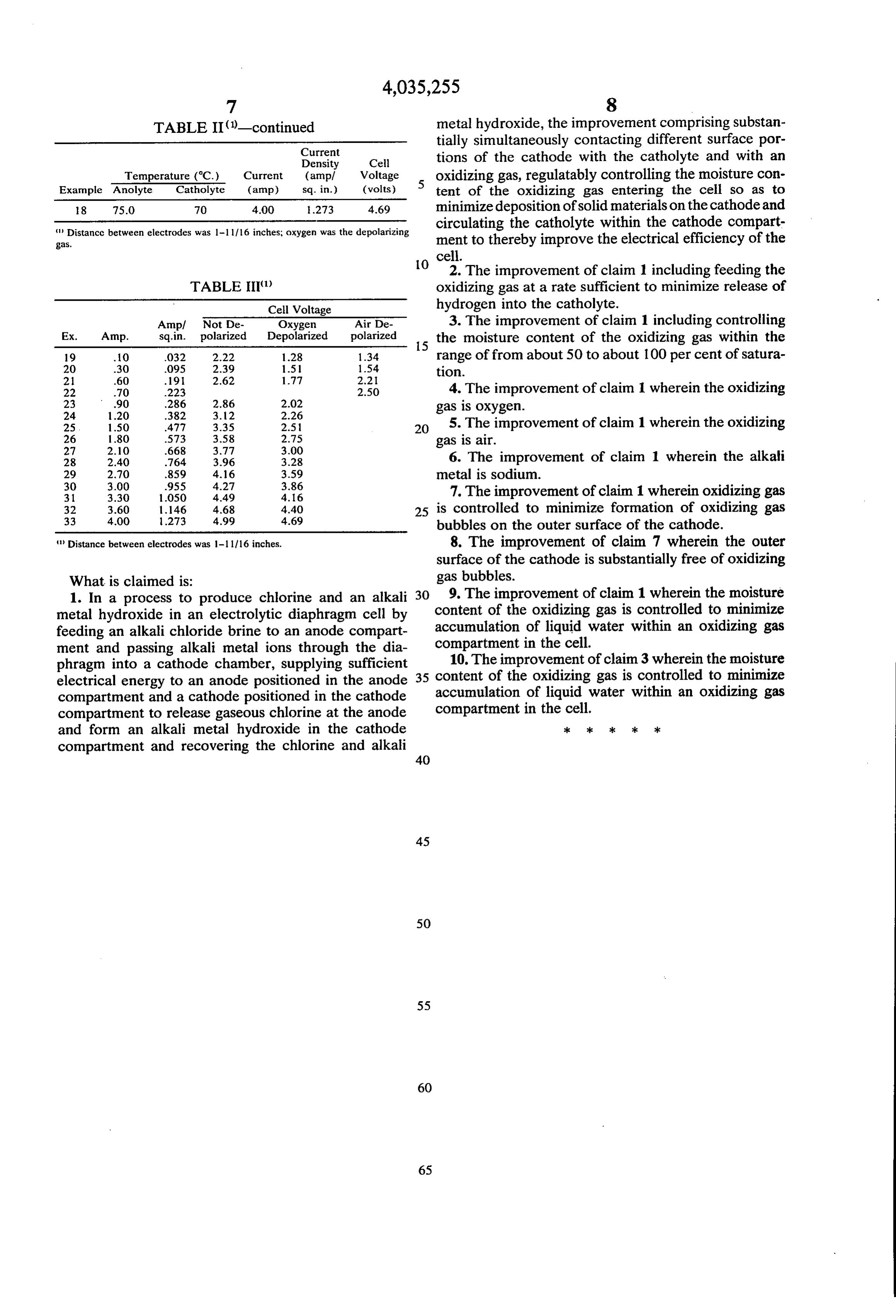
TABLE II (9-continued metal hydroxide, the improvement comprising substan Current tially simultaneously contacting different surface por
Density Cell tions of the cathode with the catholyte and with an
Temperature (C.) Current (ampl Voltage oxidizing gas, regulatably controlling the moisture con Example Anolyte Catholyte (amp) sq. in.) (volts) tent of the oxidizing gas entering the cell so as to 8 75.0 70 4.00 273 4.69 minimize deposition of solid materials on the cathode and Distance between electrodes was 1-11116 inches; oxygen was the depolarizing circulating the catholyte within the cathode compart gas. ment to thereby improve the electrical efficiency of the cell.
O 2. The improvement of claim 1 including feeding the
TABLE III oxidizing gas at a rate sufficient to minimize release of Cell Voltage hydrogen into the catholyte.
Ampf Not De- Oxygen Air De 3. The improvement of claim 1 including controlling Ex. Amp. sq.in. polarized Depolarized polarized the moisture content of the oxidizing gas within the
range of from about 50 to about 100 percent of satura
tion.
22 .70 .223 2.50 4. The improvement of claim 1 wherein the oxidizing
gas is oxygen.
25 150 477 3.35 2.5 20 5. The improvement of claim 1 wherein the oxidizing
gas is air.
28 2.40 .764 3.96 3.28 6. The improvement of claim 1 wherein the alkali 29 2.70 859 4.16 3.59 metal is sodium.
31 3.30 1.050 4.49 4.16 7. The improvement of claim 1 wherein oxidizing gas 32 3.60 1.146 4.68 4.40 25 is controlled to minimize formation of oxidizing gas 33 4.00 1273 4.99 4.69 bubbles on the outer surface of the cathode. ' Distance between electrodes was 1-1 1/16 inches. 8. The improvement of claim 7 wherein the outer surface of the cathode is substantially free of oxidizing
What is claimed is: gas bubbles.
1. In a process to produce chlorine and an alkali 30 9. The improvement of claim 1 wherein the moisture metal hydroxide in an electrolytic diaphragm cell by content of the oxidizing gas is controlled to minimize feeding an alkali chloride brine to an anode compart accumulation of liquid water within an oxidizing gas ment and passing alkali metal ions through the dia compartment in the cell.
phragm into a cathode chamber, supplying sufficient 10. The improvement of claim3 wherein the moisture electrical energy to an anode positioned in the anode 35 content of the oxidizing gas is controlled to minimize compartment and a cathode positioned in the cathode accumulation of liquid water within an oxidizing gas compartment to release gaseous chlorine at the anode compartment in the cell.
and form an alkali metal hydroxide in the cathode ck k k k sk compartment and recovering the chlorine and alkali
Provenance
- Collection
- Cited prior art
- Original PDF
- patentimages.storage.googleapis.com →
- Filed
- 1973-05-18
- Pages
- 6
- Method
- pdftotext (the PDF's own text layer) + pdftoppm 300dpi page scans
- Source
- Google Patents bibliographic record
- Granted
- 1977-07-12
- Inventors
- Gerhard Gritzner
- Transcribed from
- patentimages.storage.googleapis.com →