patent · US3973524
Fuel conversion system
10 August 1976
Page 1 — bibliographic record
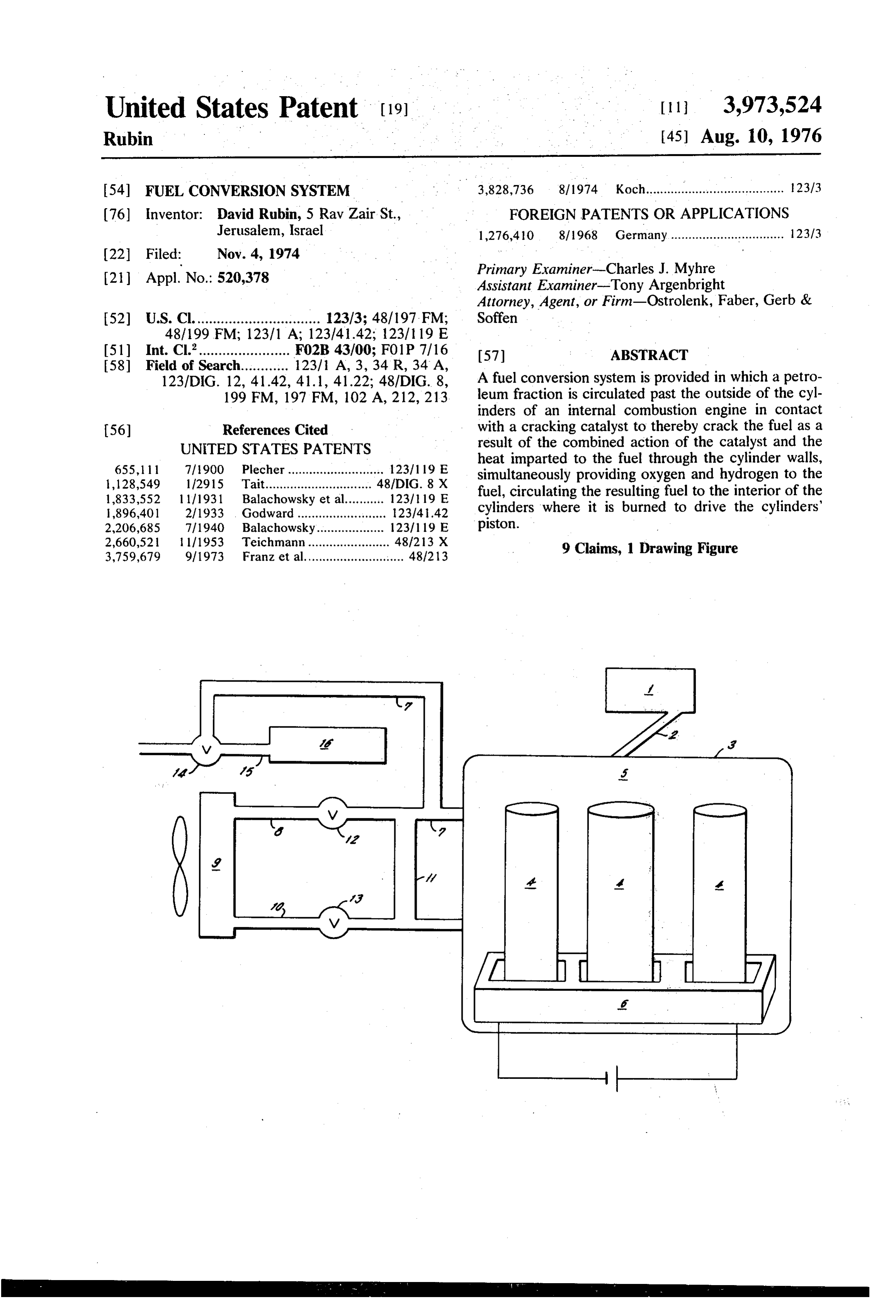
United States Patent (19) 11, 3,973,524 Rubin . . . . (45) Aug. 10, 1976 54 FUEL CONVERSION SYSTEM 3,828,736 8/1974 Koch....r. 23/3 76) Inventor: David Rubin, 5 Rav Zair St., FOREIGN PATENTS OR APPLICATIONS Jerusalem, Israel 1,276,410 8/1968 Germany ................... . . . . . . . . . . . . . 123/3
21 Appl. No.: 520,378 Primary Examiner-Charles J. Myhre Assistant Examiner-Tony Argenbright
Attorney, Agent, or Firm-Ostrolenk, Faber, Gerb & 52) U.S. Cl................................ 123/3; 48/197. FM; Soffen
51) Int. Cl.'....................... F02B 43/00; FO1 P 7/16 (57) ABSTRACT
123/DIG. 12, 41.42, 41.1, 41.22; 48/DIG. 8, A fuel conversion system is provided in which a petro 199 FM, 197 FM, 102 A, 212, 213 leum fraction is circulated past the outside of the cyl inders of an internal combustion engine in contact 56) References Cited with a cracking catalyst to thereby crack the fuel as a UNITED STATES PATENTS result of the combined action of the catalyst and the 655,111 7/1900 Plecher........................... 12311 19 E heat imparted to the fuel through the cylinder walls, 1,128,549 112915 Tait.............................. 48/DIG. 8 X simultaneously providing oxygen and hydrogen to the 1,833,552 11/1931 Balachowsky et al........... 123/19 E fuel, circulating the resulting fuel to the interior of the 1,896,401 2/1933 Godward......................... 2314.42 cylinders where it is burned to drive the cylinders' 2,206,685 7/1940 Balachowsky................... 12311 19 E piston.
2,660,521 1 1/1953 Teichmann....................... 48/213 X 9 Claims, 1 Drawing Figure 3,759,679 9/1973 Franz et al............................ 48/213
Page 2
Drawing sheet — no readable text.
Page 3
DESCRIPTION OF THE PREFERRED
FUEL CONVERSION SYSTEM EMBODIMENTS
BACKGROUND OF THE INVENTION
- Referring to the FIGURE, the fuel to be converted is
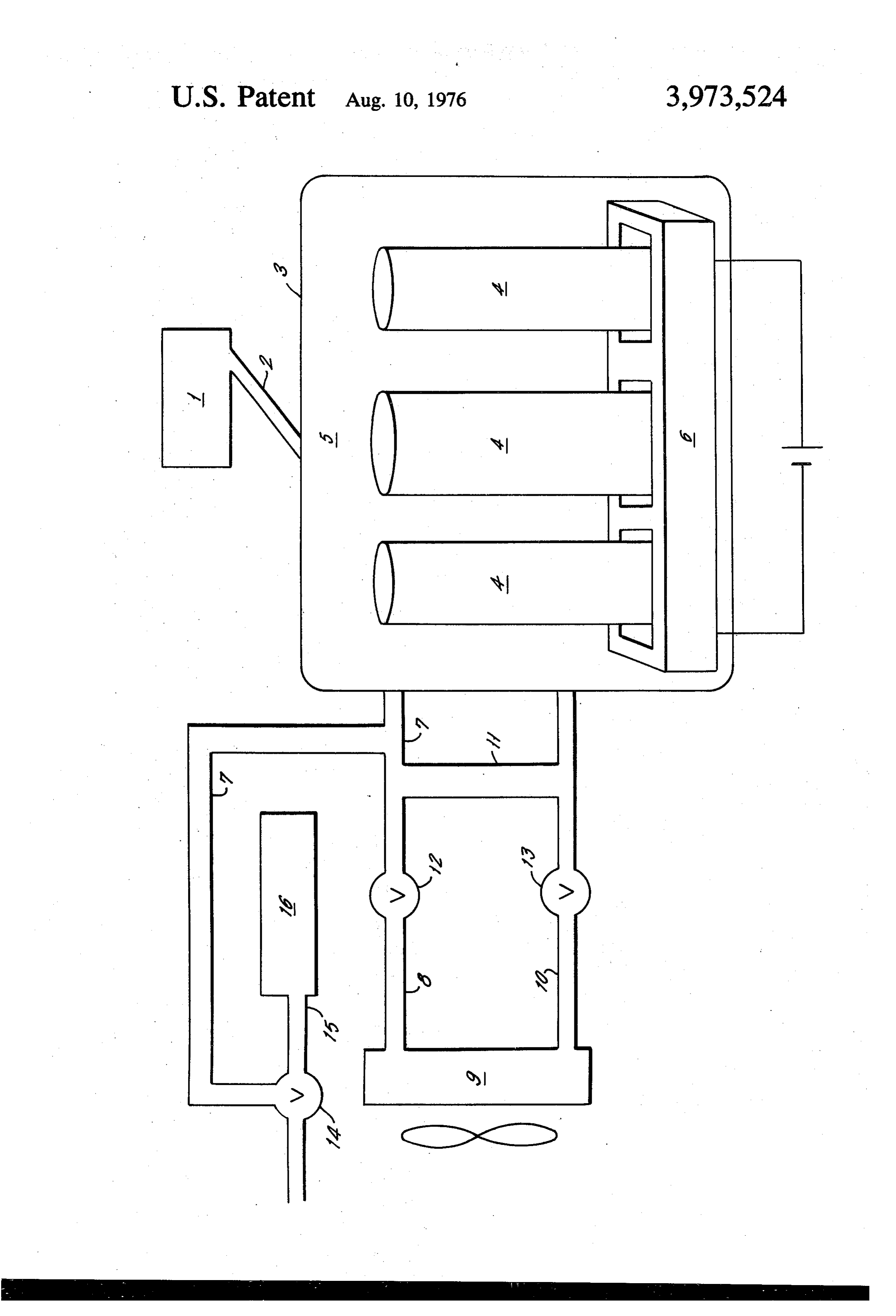
Petroleum is conventionally separated by distillation 5 stored in a fuel tank 1. The fuel can be any paraffinic into various fractions resulting in a rough separation fraction capable of being converted into gasoline, such according to carbon number as a result of the relation as kerosene and gas oil. The fuel is conveyed from the ship between the boiling point and molecular weight of tank 1 through line 2 by a pump (e.g., the pump nor the petroleum constituents. The natural gasoline, after mally used to pass fuel from the tank to the carburetor, appropriate treatment, is used in those internal com 10 not shown) into the cylinder block 3 where it is sprayed bustion engines that require a fairly volatile fuel, kero onto the external surface of the cylinders 4. It will be sene is used in tractor and jet engines, and gas oil is recognized that the fuel is being introduced into the used in diesel engines. The kerosene and gas oil are also space 5 in which cooling water is usually circulated in a used for heating purposes, the latter being familiarly conventional internal combustion engine. The burning known as “furnace oil'. In the refinery, certain petro 5 of gasoline within the cylinders creates, as usual, a large leum fractions are cracked to convert the higher al amount of heat which is radiated through the cylinder kenes into smaller alkanes and alkenes and thus in walls. This heat is absorbed by the liquid fuel causing it crease the yield of gasoline. . . . . . to vaporize. In this way, the radiation energy normally In the internal combustion engine, the gasoline is lost in a conventional internal combustion engine is ignited by use of a spark plug. This process involves the 20 utilized to provide the energy for vaporization and to reaction of the alkanes with oxygen to form carbon increase the potential energy of the fuel. monoxide, carbon dioxide, water, and heat by means of In a refinery, gasoline is produced by the pyrolysis of a free radical chain reaction. The reaction is extremely alkanes in a process known as cracking. A suitable exothermic but also requires a very high temperature paraffinic fraction containing the alkanes, usually the 'for its ignition. In other words, a great deal of activation 25 kerosene and gas oil fractions, are simply passed energy is required for the reaction to begin and once through the chamber heated to 400-600°C., generally this energy level is achieved, the subsequent chain in the presence of a suitable cracking catalyst. The carrying steps proceed rapidly and with the evolution products are alkanes of smaller carbon atom chains of energy. In order to prevent overheating, the internal than the initial alkenes, various alkenes and some hy combustion engine is provided with a cooling circuit. In 30 drogen. The breaking of the large molecules in the the circuit, cooling water is circulated past the exterior paraffinic fractions into smaller ones increases the yield of the cylinders to the radiator, where the heat is given of gasoline from petroleum. Since alkenes, which con off into the surrounding atmosphere, and then the cool stitute a large proportion of the cracked product have ing water is recirculated to the space surrounding the good anti-knocking qualities, the cracking process also cylinders. It is apparent that a great deal of the heat 35 improves the gasoline. Additionally, through the pro energy created by burning the gasoline in the cylinders cess of alkylation, certain of the smaller alkanes and is necessarily lost with a resulting decrease in the effi alkenes are converted into high octane synthetic fuels. ciency of the engine. . . . . . . It will be appreciated that the vaporized fuel within the Various proposals have been made to utilize the heat 40 empty space 5 of engine block 3 is in appropriate con energy usually lost through the radiator. For example, dition to be cracked into gasoline. An appropriate tem it has been previously proposed to circulate the gaso perature has been provided by the heat radiated line past the exterior of the cylinders so that it will through the walls of cylinders 4. Accordingly, in order absorb the heat being generated through the cylinder to crack the vaporized fuel, a suitable cracking catalyst walls in order to vaporize the liquid fuel before intro is provided within space 5. Any of the known cracking duction into the cylinders and to result in increased 45 catalysts can be employed such as a copper or nickel burning efficiency. , , , , powder. Thus, the conversion of kerosene or gas oil It is the object of this invention to provide a novel into gasoline which is usually performed at the rcfinery fuel conversion system which can utilize kerosene and is now being performed within the internal combustion other petroleum fractions for an internal combustion engine. . . . engine and eliminate the necessity for a cooling circuit. 50 Also provided within the internal space 5 of engine This and other objects of the invention will become block 3 is a closed electrolysis unit 6. The electrolysis apparent to those of ordinary skill in the art from the unit 6 is generally located in the lower portion of en following detailed description in which the FIGURE is gine block 3 and is used to form hydrogen and oxygen a schematic flow diagram of the fuel conversion system by electrolysis of an appropriate electrolyte. For exam of this invention. 55 ple, the electrolyte may suitably be a solution of sulfu
SUMMARY OF THE INVENTION ric acid in water. The gascous oxygen and hydrogen produced within electrolysis unit 6 are introduced into
This invention relates to a fuel conversion system and the open space 5 of the engine block 3 where they mix more particularly to a fuel conversion system which with the cracked fuel. This will result in the presence of involves circulating a petroleum fraction such as kero 60 a greater amount of hydrogen in the cracked product sene and/or gas oil past the outside of the cylinders of than normally encountered which, in turn, will result in an internal combustion engine in contact with a crack the saturation of a greater amount of the alkenes pro ing catalyst to thereby crack the fuel as a result of the duced during the cracking reaction and thereby im combined action of the catalyst and heat imparted to prove the quality of the fuel. It will be further recog the fuel through the cylinder walls, while simulta 65 nized that the resulting fuel also contains a significant neously providing oxygen and hydrogen to the fuel, and amount of oxygen. . . . thereafter circulating the resulting fuel to the interior The fuel which is now in appropriate condition for of the cylinders where it is burned. burning in the internal combustion engine is conveyed
Page 4
from space 5 to the carburetor through line 7 where it of heat through the radiator in the standard engine, the is mixed with air and returned to the cylinders 4 for heat will be used in vaporizing the fuel and in the crack burning in the usual manner. The ignition will be much ing process. Moreover, the engine comes to its full more efficient than in a conventional engine because operating cfficiency without a significant warm-up pe the fuel/air mixture contains a greater proportion of 5 riod and due to the elimination of the cooling water, oxygen and in this condition, the carbonated acids and antifreeze is no longer necessary. . . . carbon produced will be oxidized to carbon dioxide The instant invention also has the advantage that (e.g., 2CO-HO - 2CO). . . . . . standard engines can be easily converted into the in In order to maintain optimal conditions for the crack stant process. For example, the engine in a 1965 Ford ing reaction within space 5, a bypass and return system 10 Taunus 12M was modified by using copper pipes with is provided. This system comprises a take-off line 8 injection eyes in chamber 5, and by using cribriform which is connected to a radiator 9 which in turn is (holed) stainless steel pipes as electrodes for the elec connected to a return line 10 communicating with open trolysis unit which was supplied with current from the space 5. Additionally, a bypass line 11 is provided to battery. . . . . . . . . . .. . . . connect take-off line 8 and return line 10. A valve 12 is 5 . The fuel tank of the car was filled with kerosene provided in take-off line. 8 between the bypass line. 11 which was sprayed against the external surfaces of the and radiator 9. A valve 13 is provided in return line. 10 cylinders at the rate of 1-5 cc/sec. Also located in this between radiator 9 and bypass line 11. Valves 12 and open space surrounding the cylinders was a cracking 13 are conveniently bimetal thermal valves and are catalyst, namely copper powder. The resulting fuel designed to be temperature (and/or pressure) sensitive. 20 efficiency was found to be 14, kilometers per liter kero When the temperature in the open or cracking space 5 scne as opposed to 10 kilometers per liter, using con exceeds a predetermined level, valves 12 and 13 open ventional gasoline. . .. . . so that a portion of the gases will be conveyed to radia Various changes and modifications can be made in tor 9, where they are cooled and expanded in the con this invention without departing from the spirit and the ventional manner and then recirculated to open space 25 scope thereof. The embodiments set forth herein were 5 thereby lowering the temperature within open space for the purpose of illustration only and were not in 5. When the temperature within open space 5 is below tended to limit the invention. i the predetermined valuc, valves 12 and 13 are closed I claim: . . . . . . . . . . . . . . .' thereby isolating the radiator. The predetermined tem 1. In a method of producing mechanical work by perature at which valves 12 and 13 will open is, of 30 burning a fuel in an internal combustion engine by course, adjusted in accordance with the particular fuel introducing the fuel into the cylinders and igniting the being utilized. . . . ." . fuel therein, the improvement, which comprises circu When the engine is first started, the fuel emanating lating a petroleum fraction capable of being cracked from space 5 is not appropriate for ignition in cylinders into gasoline past the outside of said cylinders in 4. Accordingly, a valve 14, suitably, a bimetal thermal 35 contact with a cracking catalyst to thereby crack the valve, is provided in line 7 so as to prevent the fuel from fraction, providing oxygen and hydrogen to the being conveyed to the carburetor and thence to the cracked fraction, and thereafter circulating the result cylinders. Also connected to valve 14 is another line 15 ing cracked fraction to the interior of the cylinders. which in turn communicates with a second fuel tank 16 40 2. The process of claim 1 wherein the petroleum in which conventional gasoline is stored. When valve fraction is kerosene or gas oil.
14 prevents the fuel from open space 5 from being 3. The process of claim 1 wherein the hydrogen and conveyed to the carburetor, the conventional gasoline oxygen are provided by electrolysis. . . . in tank 16. is conveyed to the carburetor through line 4. The process of claim 1 wherein the cracked fuel is 15, valve 4 and line. 7. This conventional gasoline is conveyed to a carburetor and from the carburetor to burned in cylinders 4 causing radiation of heat through 45 the interior of the cylinders. . . the cylinder walls into open space 5 and creating an 5. The process of claim 1 wherein the cracking cata appropriate temperature for the cracking reaction. As lyst is copper, nickel or cadmium. , , , soon as the fuel emanating from space 5 through line 7. 6. In an internal combustion engine comprising a fuel is in appropriate form for ignition, valve 14 reverses 50 tank, a carburetor, cylinders, and a cooling circuit positions isolating tank 16 from the carburetor and comprising a radiator communicating with an enclosed allowing communication between open space 5 and the space surrounding the exterior surfaces of the cylin carburetor through line 7 and valve 14. ders, the improvement which comprises placing said The fuel conversion system of the instant invention fuel tank in communication with the space surrounding has numerous advantages over the conventional inter 55 the exterior surfaces of said cylinders, connecting said nal combustion engine. The fuel used is kerosene or carburetor with said space, and providing isolating any other paraffinic fraction which can be converted valves in the communication between the radiator and into gasoline rather than refined gasoline. The gasoline said space. W which is ignited in the cylinders will have a variable 7. The internal combustion engine of claim 6 further octanc value proportional to the engine load since the 60 comprising a closed electrolysis unit within said space. faster the engine is working, the more heat will be 8. The internal combustion engine of claim 6 wherein generated to open space 5 and the increased heat will said space communicates with said carburetor through increase the amount of cracking. Becausc of the oxida a valve, a second fuel tank communicating with the tion and reduction occuring in the fuel conversion carburetor through the same valve, said valve being process, the undesirable by-products of the fuel igni adapted to allow communication to the carburetor to tion which cause air pollution will be much lower in 65 only one of said space and said second fuel tank at any comparison to the standard engine. Additionally, the given period of time. . . S. cfficiency, of the engine will be higher than a standard 9. In a method of producing mechanical work by engine because instead of the loss of cnergy in the form burning a fuel in an internal combustion engine by
Page 5
introducing the fuel into the cylinders and igniting the fraction and thereafter circulating the resulting fuel therein, the improvement which comprises circu cracked fraction to the interiors of the cylinders, lating a petroleum fraction capable of being cracked wherein excess heat is removed from the cracked fuel into gasoline past the outside of said cylinders, in 5 by circulating a portion of said fuel to a radiator. contact with a cracking catalyst to thereby crack the sk k ck k
Provenance
- Collection
- Cited prior art
- Original PDF
- patentimages.storage.googleapis.com →
- Filed
- 1974-11-04
- Pages
- 5
- Method
- pdftotext (the PDF's own text layer) + pdftoppm 300dpi page scans
- Source
- Google Patents bibliographic record
- Granted
- 1976-08-10
- Inventors
- David Rubin
- Transcribed from
- patentimages.storage.googleapis.com →