patent · US3917520
Electrolysis cell system and process for generating hydrogen and oxygen
4 November 1975
Page 1 — bibliographic record
United States Patent (19) [11] 3,917,520 Katz et al. (45) Nov. 4, 1975
54 ELECTROLYSIS CELL SYSTEM AND
PROCESS FOR GENERATING HYDROGEN (57) ABSTRACT
AND OXYGEN An electrolysis cell system includes a compact elec (75) Inventors: Murray Katz, Newington; Robert A. trolysis cell comprising gas diffusion electrodes on Sanderson, Wethersfield; John H. each side of an aqueous electrolyte retaining matrix. A Hirschenhofer, Glastonbury, all of portion of the hydrogen gas produced by the cell is re Conn. circulated through the gas space of the cell and has water vapor added thereto to replenish the water used 73) Assignee: United Technologies Corporation, by the cell. A water metering device senses the Hartford, Conn. amount of current supplied to the cell and adds the 22 Filed: Nov. 20, 1974 appropriate amount of water to the system in precisely the amount needed according to Faraday's law cor (21) Appl. No.: 525,609 rected to reflect water lost in the product gases leav ing the system. In a preferred embodiment a separate 52 U.S. C. ................ 204/129; 204/274; 204/277; coolant loop flows through a thermal exchange por 204/278; 136/86 R; 136/86 C tion of the cell in a direction opposite the flow of the (51 int. Cl’............................................ C25B 1/02 recirculating product gas through the cell thereby re 58) Field of Search........... 204/129, 274, 277,278; sulting in a temperature gradient across the cell which 136/86 R, 86 C helps maintain an even concentration of electrolyte across the cell for most efficient cell operation.
56) References Cited The subject matter of this application is related to the UNITED STATES PATENTS subject matter of a commonly assigned application 3,507,702 4/1970 Sanderson......................... E36/86 C titled “Electrolysis Cell System Including a 3,779,811 12/1973 Bushnell et al................... 136/86 R Recirculating Product Gas Stream for Cooling the Cell' by E. Parenti, D. Bloomfield, P. Grevstad and D.
Primary Examiner-R. L. Andrews Beal, filed on even date herewith. Attorney, Agent, or Firm-Stephen E. Revis 9 Claims, 2 Drawing Figures
/2- ----------- - -N -C - TDC -- 7 a.4/7aa/Mae 72 (2-azé;4 ---"? -2-N 4
Taeza
az N. S. S. /23 \ &N SN | RS 17
242 I-66 32 7- -(2)- i. | | HE 723- 12 44 ya !-z I-74%ze Y---- wzze</7 (2) 12 y - M/477AA
Page 2
Drawing sheet — no readable text.
Page 3
Drawing sheet — no readable text.
Page 4
trodes may be spaced very close to each other. In the
ELECTROLYSIS CELL SYSTEM AND PROCESS fuel cell system of Sanderson there is a separate coolant FOR GENERATING HYDROGEN AND OxYGEN loop for carrying a liquid cooling through the fuel cell to remove waste heat therefrom. Also, moisture is
The invention claimed herein was made under or added to the air entering the cathode side of the fuel during the course of a contract with the Department of cell to provide a positive means of fuel cell water bal the Air Force. ance control over the range of ambient temperature BACKGROUND OF THE INVENTION and humidity expected. In an electrolysis cell water is continuously being used up and must therefore be con 1. Field of the Invention O tinuously supplied. Of course, if an electrolysis cell sys This invention relates to electrolysis cells and more tem used a cell constructed similar to the cell of FIG. 2 particular to a compact electrolysis cell system. in Sanderson there would not be the usual circulating 2. Description of the Prior Art electrolyte for water addition. In Sanderson water is it is well known that it is possible to operate fuel cells brought into the cell in the incoming air stream. But, in in a reverse mode so that they generate hydrogen and 15 an electrolysis cell system the electrolysis cell produces oxygen when supplied with liquid water and electric oxygen and hydrogen and thus there would be no in power. Cells that operate in that manner are referred to coming reactant gas stream for carrying water vapor to as electrolysis cells. In one common type of electrolysis the cell as there is in Sanderson. In any event, Sander cell two solid electrodes which may, for example, be son adds water merely to prevent dryout of the electro made from nickel, are spaced apart in a free liquid elec 20 lyte matrix near the inlet thus providing for more uni trolyte and a potential is applied across the electrodes. form water removal. There is no means for providing Water in the electrolyte is electrolyzed liberating hy the proper amount of water input if the Sanderson sys drogen and oxygen into the electrolyte in the form of tem were an electrolysis system using up water. gas bubbles. The water used is replenished by adding it SUMMARY OF THE INVENTION directly to the liquid electolyte between the electrodes. 25
Generally the electrolyte is also used to cool the cell; An object of the present invention is an improved for example, a recirculating loop of electrolyte picks up electrolysis cell system utilizing a compact design elec waste heat from the cell, rejects this heat outside the trolysis cell.
cell, and then returns to the cell, makeup water being Another object of the present invention is an elec added somewhere in the loop. Another type of cell 30 trolysis cell system with an improved and simplified called the Bacon Cell utilizes two spaced apart dual po means for introducing and controlling the amount of rosity electrodes enclosing a free liquid electrolyte water provided to the cell. - trapped in a sealed compartment. These elecctrodes Accordingly, the present invention is an electrolysis may, for example, be made of sintered nickel. How cell system including an electrolyte matrix sandwiched ever, since both sides of the electrodes are metallic, 35 between a pair of gas porous electrodes wherein one of electrolysis can occur in the electrolyte as well as on the products of electrolysis recirculates through the the gas side of the electrode. If this cell were to operate cell and has water added thereto in vapor form to re in a zero gravity environment, such as in a space craft, plenish the water used by the cell, the amount of water the gas in the electrolyte would have to be removed added being controlled by the amount of current sup such as by the use of a liquid-gas vortex separator, thus 40 plied to the cell. In a preferred embodiment the water complicating the design. is vaporized by the waste heat from the cell and means Although these electrodes could be modified so as to is provided to maintain a temperature gradient across be made of inert material on the fine pore side exposed the cell wherein the cell is hotter where the moist recir to the electrolyte to prevent gas formation within the culating gas stream enters the cell and is cooler where bulk of the electrolyte, this type of cell would have to 45 it leaves the cell (i.e., counter-current gas and coolant operate at relatively high temperatures. In either of the flow) thereby helping to maintain as small an electro foregoing systems, wherein the electrolyte is a circulat lyte concentration gradient across the cell as possible. ing or non-circulating free liquid disposed between or Also, in a preferred embodiment, a liquid coolant is cir around the electrodes, and is not held within a matrix, culated through the thermal exchange portion of the each cell within a stack of cells would necessarily have 50 cell to create the temperature gradient thereacross and be be fairly thick in order to either permit electrolyte to to pick up waste heat from the cell. The temperature of flow or to prevent the electrodes from touching. the coolant fluid entering the cell is controlled by a by It is often desirable that an electrolysis cell be as pass conduit which includes means for rejecting heat to compact as possible. Thus, it would be desirable to use, a heat sink. The hot coolant passes in indirect heat ex as an electrolysis cell, a fuel cell similar to the type 55 change relationship with the water being added to the shown in FIG. 2 of Sanderson U.S. Pat. No. 3,507,702 cell and vaporizes this water into the recirculating or Bushnell, et al., U.S. Pat. No. 3,779,81 l, both of product gas stream.
common assignee with the present application. In the Faraday's law tells us that there is a linear propor type of cell shown in Sanderson the electrolyte is held tionality correspondence between the current input to in a matrix trapped between partially hydrophobic par 60 the cell and the amount of water used by the cell to pro tially hydrophilic gas diffusion electrodes; a gas space is duce hydrogen and oxygen. Thus the amount of reac formed on the nonelectrolyte side of each electrode for tant water added may be controlled solely by the cur carrying the oxidant and fuel. The matrix is usually of rent input into the cell thereby eliminating the need for very fine pore structure with a high resistance to bubble temperature and dew point sensors to maintain the formation in the electrolyte. This type of cell is very 65 proper partial pressure of water in the gas stream flow thin compared to the earlier mentioned type since ing through the cell.
there is no requirement that the electrolyte must be The foregoing and other objects, features and advan pumped through the system, and therefore the elec tages of the present invention will become more appar
Page 5
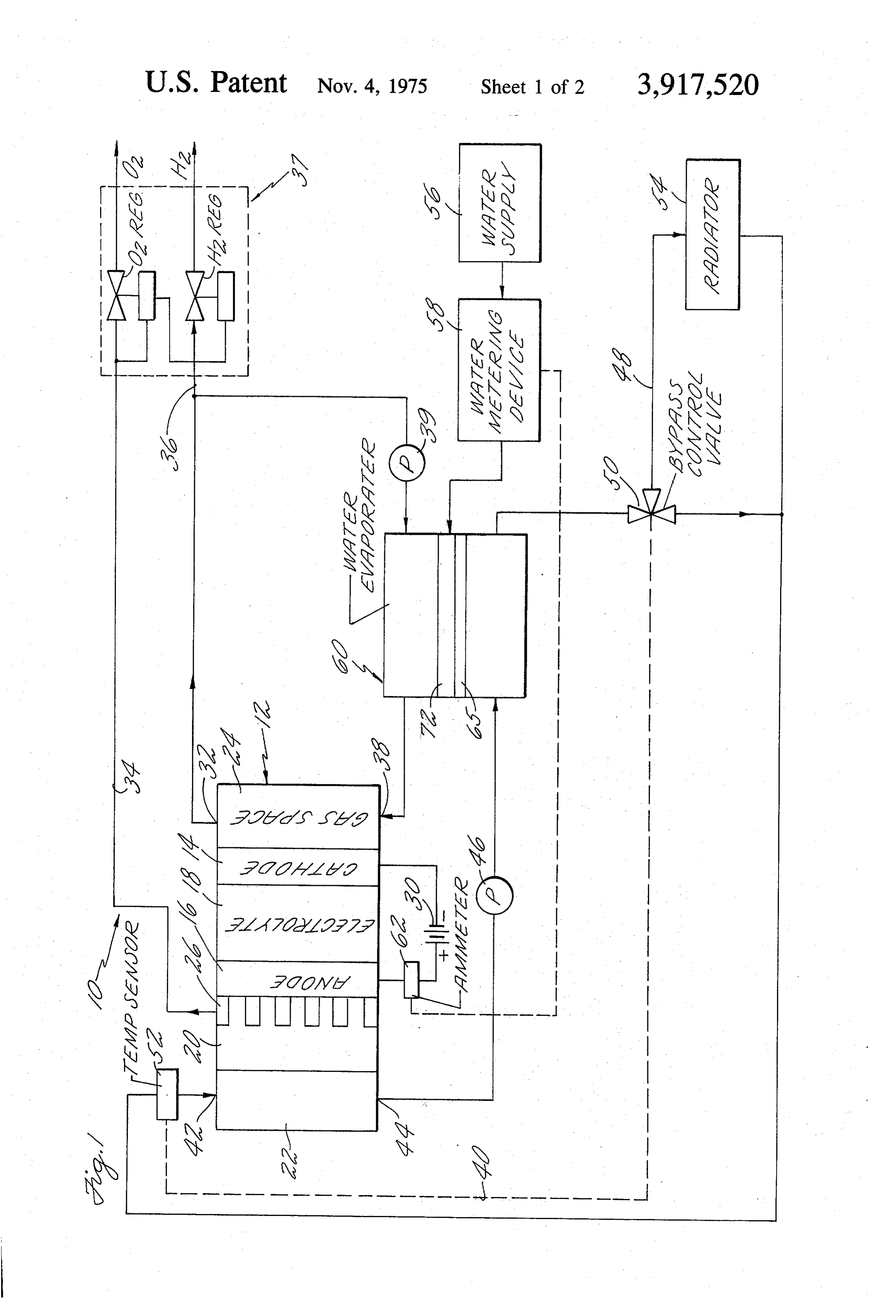
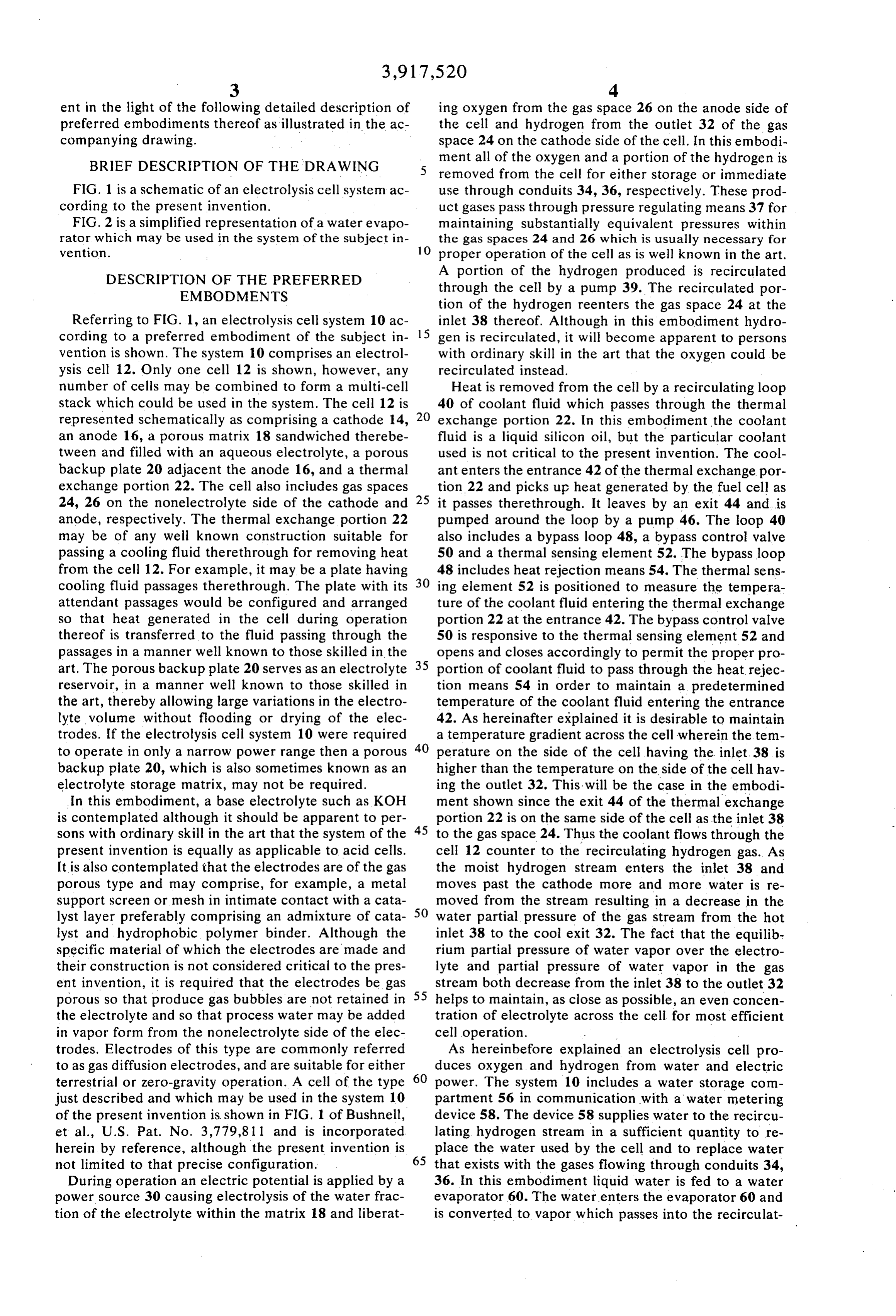
ent in the light of the following detailed description of ing oxygen from the gas space 26 on the anode side of preferred embodiments thereof as illustrated in the ac the cell and hydrogen from the outlet 32 of the gas companying drawing. space 24 on the cathode side of the cell. In this embodi ment all of the oxygen and a portion of the hydrogen is
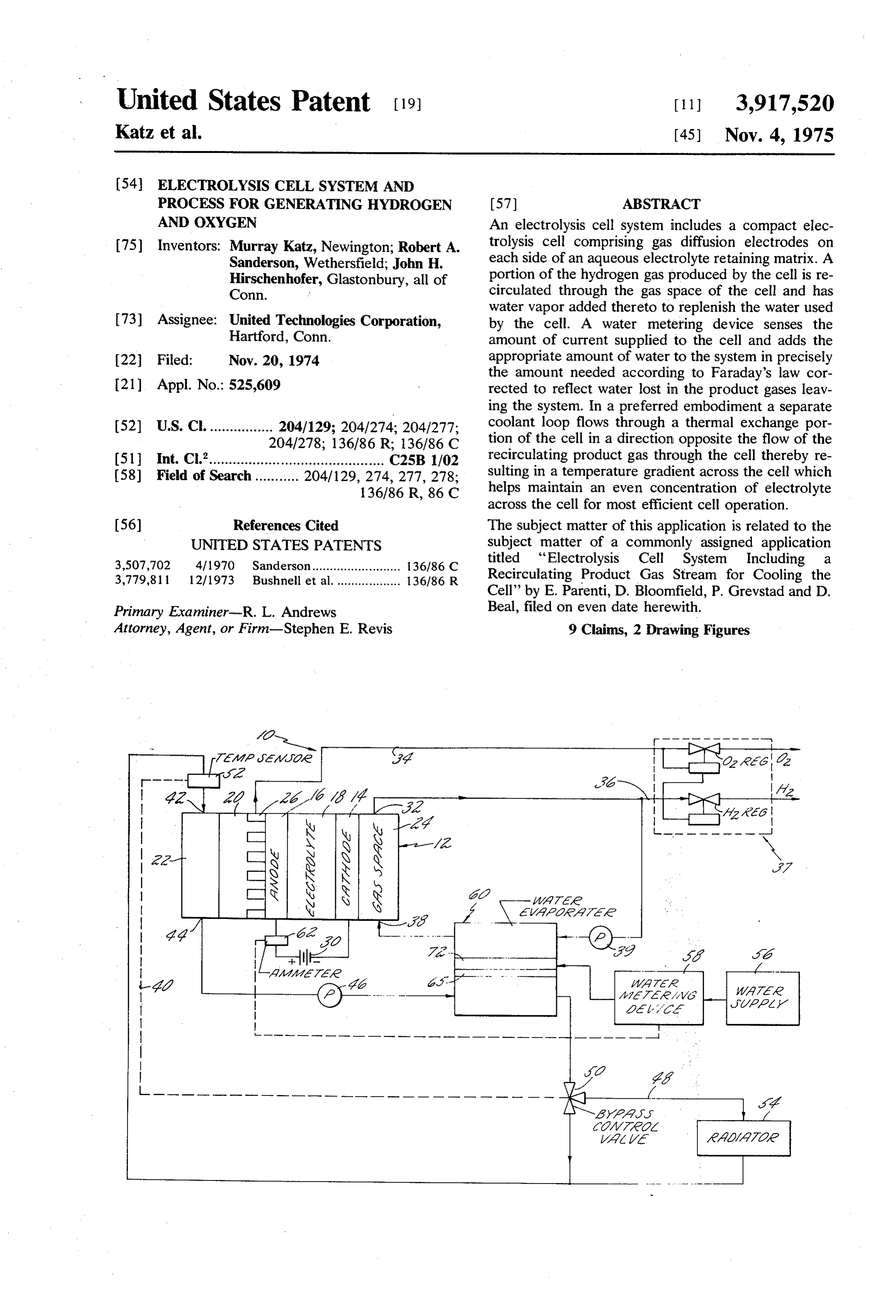
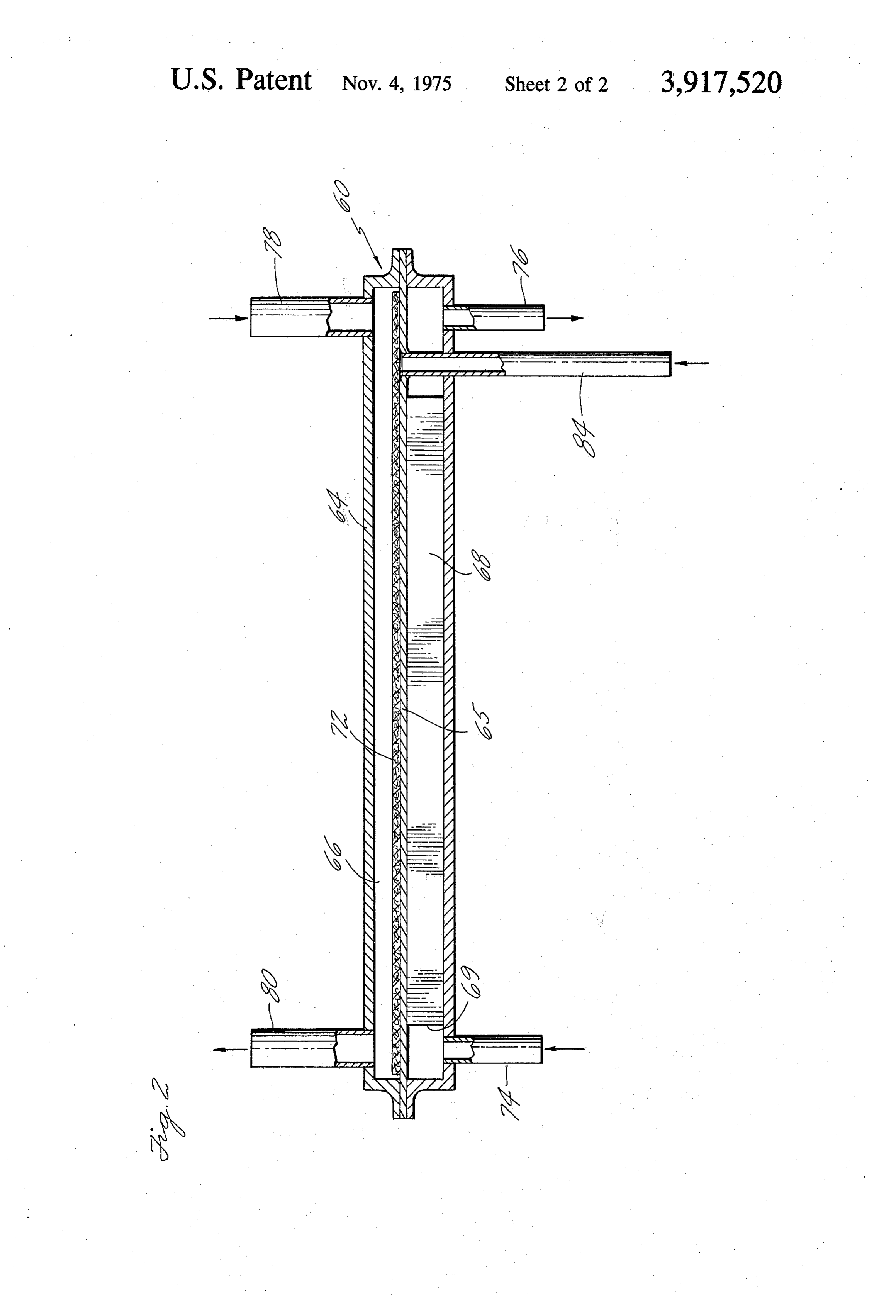
BRIEF DESCRIPTION OF THE DRAWING removed from the cell for either storage or immediate FIG. 1 is a schematic of an electrolysis cell system ac use through conduits 34, 36, respectively. These prod cording to the present invention. uct gases pass through pressure regulating means 37 for FIG. 2 is a simplified representation of a water evapo maintaining substantially equivalent pressures within rator which may be used in the system of the subject in the gas spaces 24 and 26 which is usually necessary for vention. 10 proper operation of the cell as is well known in the art.
DESCRIPTION OF THE PREFERRED
A portion of the hydrogen produced is recirculated
EMBODMENTS through the cell by a pump 39. The recirculated por tion of the hydrogen reenters the gas space 24 at the
Referring to FIG. 1, an electrolysis cell system 10 ac inlet 38 thereof. Although in this embodiment hydro cording to a preferred embodiment of the subject in 15 gen is recirculated, it will become apparent to persons vention is shown. The system 10 comprises an electrol with ordinary skill in the art that the oxygen could be ysis cell 12. Only one cell 12 is shown, however, any recirculated instead.
number of cells may be combined to form a multi-cell Heat is removed from the cell by a recirculating loop stack which could be used in the system. The cell 12 is 40 of coolant fluid which passes through the thermal represented schematically as comprising a cathode 14, 20 exchange portion 22. In this embodiment the coolant an anode 16, a porous matrix 18 sandwiched therebe fluid is a liquid silicon oil, but the particular coolant tween and filled with an aqueous electrolyte, a porous used is not critical to the present invention. The cool backup plate 20 adjacent the anode 16, and a thermal ant enters the entrance 42 of the thermal exchange por exchange portion 22. The cell also includes gas spaces tion 22 and picks up heat generated by the fuel cell as 24, 26 on the nonelectrolyte side of the cathode and 25 it passes therethrough. It leaves by an exit 44 and is anode, respectively. The thermal exchange portion 22 pumped around the loop by a pump 46. The loop 40 may be of any well known construction suitable for also includes a bypass loop 48, a bypass control valve passing a cooling fluid therethrough for removing heat 50 and a thermal sensing element 52. The bypass loop from the cell 12. For example, it may be a plate having 48 includes heat rejection means 54. The thermal sens cooling fluid passages therethrough. The plate with its 30 ing element 52 is positioned to measure the tempera attendant passages would be configured and arranged ture of the coolant fluid entering the thermal exchange so that heat generated in the cell during operation portion 22 at the entrance 42. The bypass control valve thereof is transferred to the fluid passing through the 50 is responsive to the thermal sensing element 52 and passages in a manner well known to those skilled in the opens and closes accordingly to permit the proper pro art. The porous backup plate 20 serves as an electrolyte 35 portion of coolant fluid to pass through the heat rejec reservoir, in a manner well known to those skilled in tion means 54 in order to maintain a predetermined the art, thereby allowing large variations in the electro temperature of the coolant fluid entering the entrance lyte volume without flooding or drying of the elec 42. As hereinafter explained it is desirable to maintain trodes. If the electrolysis cell system 10 were required a temperature gradient across the cell wherein the tem to operate in only a narrow power range then a porous 40 perature on the side of the cell having the inlet 38 is backup plate 20, which is also sometimes known as an higher than the temperature on the side of the cell hav electrolyte storage matrix, may not be required. ing the outlet 32. This will be the case in the embodi In this embodiment, a base electrolyte such as KOH ment shown since the exit 44 of the thermal exchange is contemplated although it should be apparent to per portion 22 is on the same side of the cell as the inlet 38 sons with ordinary skill in the art that the system of the 45 to the gas space 24. Thus the coolant flows through the present invention is equally as applicable to acid cells. cell 12 counter to the recirculating hydrogen gas. As It is also contemplated that the electrodes are of the gas the moist hydrogen stream enters the inlet 38 and porous type and may comprise, for example, a metal moves past the cathode more and more water is re support screen or mesh in intimate contact with a cata 50 moved from the stream resulting in a decrease in the lyst layer preferably comprising an admixture of cata water partial pressure of the gas stream from the hot lyst and hydrophobic polymer binder. Although the inlet 38 to the cool exit 32. The fact that the equilib specific material of which the electrodes are made and rium partial pressure of water vapor over the electro their construction is not considered critical to the pres lyte and partial pressure of water vapor in the gas ent invention, it is required that the electrodes be gas stream both decrease from the inlet 38 to the outlet 32 porous so that produce gas bubbles are not retained in 55 helps to maintain, as close as possible, an even concen the electrolyte and so that process water may be added tration of electrolyte across the cell for most efficient in vapor form from the nonelectrolyte side of the elec cell operation.
trodes. Electrodes of this type are commonly referred As hereinbefore explained an electrolysis cell pro to as gas diffusion electrodes, and are suitable for either duces oxygen and hydrogen from water and electric terrestrial or zero-gravity operation. A cell of the type 60 power. The system 10 includes a water storage com just described and which may be used in the system 10 partment 56 in communication with a water metering of the present invention is shown in FIG. 1 of Bushnell, device 58. The device 58 supplies water to the recircu et al., U.S. Pat. No. 3,779,811 and is incorporated lating hydrogen stream in a sufficient quantity to re herein by reference, although the present invention is place the water used by the cell and to replace water not limited to that precise configuration. 65 that exists with the gases flowing through conduits 34, During operation an electric potential is applied by a 36. In this embodiment liquid water is fed to a water power source 30 causing electrolysis of the water frac evaporator 60. The water enters the evaporator 60 and tion of the electrolyte within the matrix 18 and liberat is converted to vapor which passes into the recirculat
Page 6
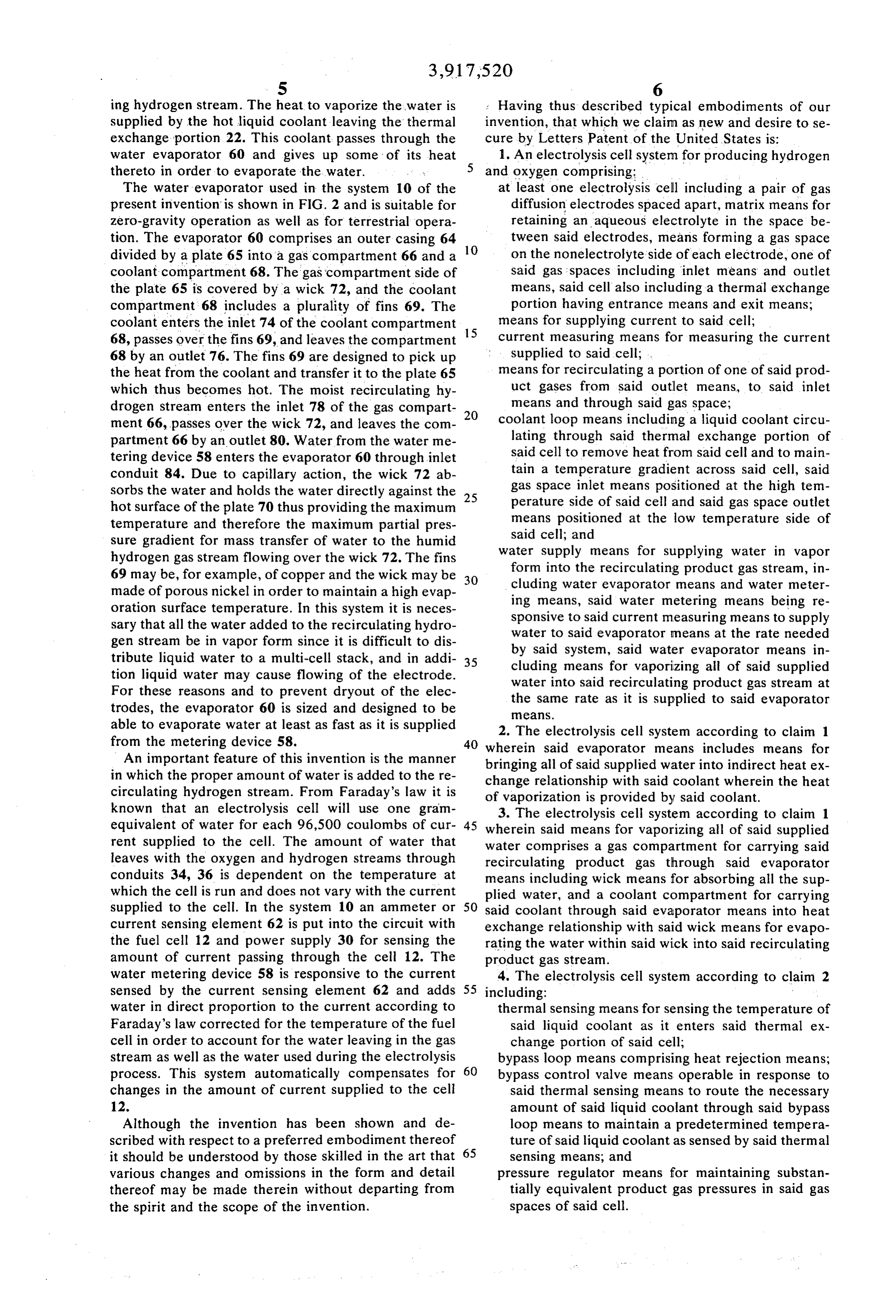
S 6 ing hydrogen stream. The heat to vaporize the water is : Having thus described typical embodiments of our supplied by the hot liquid coolant leaving the thermal invention, that which we claim as new and desire to se exchange portion. 22. This coolant passes through the cure by Letters Patent of the United States is: water evaporator 60 and gives up some of its heat 1. An electrolysis cell system for producing hydrogen 5 and oxygen comprising:
thereto in order to evaporate the water. . .'
The water evaporator used in the system 10 of the at least one electrolysis cell including a pair of gas present invention is shown in FIG. 2 and is suitable for diffusion electrodes spaced apart, matrix means for zero-gravity operation as well as for terrestrial opera retaining an aqueous electrolyte in the space be tion. The evaporator 60 comprises an outer casing 64 10 tween said electrodes, means forming a gas space divided by a plate 65 into a gas compartment 66 and a on the nonelectrolyte side of each electrode, one of coolant compartment 68. The gas compartment side of said gas spaces including inlet means and outlet the plate 65 is covered by a wick 72, and the coolant means, said cell also including a thermal exchange compartment 68 includes a plurality of fins 69. The portion having entrance means and exit means; coolant enters the inlet 74 of the coolant compartment 15 means for supplying current to said cell; 68, passes over the fins 69, and leaves the compartment current measuring means for measuring the current 68 by an outlet 76. The fins 69 are designed to pick up supplied to said cell; .
the heat from the coolant and transfer it to the plate 65 means for recirculating a portion of one of said prod which thus becomes hot. The moist recirculating hy uct gases from said outlet means, to said inlet drogen stream enters the inlet 78 of the gas compart 20 means and through said gas space; ment 66, passes over the wick 72, and leaves the com coolant loop means including a liquid coolant circu partment 66 by an outlet 80. Water from the water me lating through said thermal exchange portion of tering device 58 enters the evaporator 60 through inlet said cell to remove heat from said cell and to main conduit 84. Due to capillary action, the wick 72 ab tain a temperature gradient across said cell, said Sorbs the water and holds the water directly against the 25 gas space inlet means positioned at the high tem hot surface of the plate 70 thus providing the maximum perature side of said cell and said gas space outlet temperature and therefore the maximum partial pres means positioned at the low temperature side of sure gradient for mass transfer of water to the humid said cell; and hydrogen gas stream flowing over the wick 72. The fins water supply means for supplying water in vapor 69 may be, for example, of copper and the wick may be 30 form into the recirculating product gas stream, in made of porous nickel in order to maintain a high evap cluding water evaporator means and water meter oration surface temperature. In this system it is neces ing means, said water metering means being re sary that all the water added to the recirculating hydro sponsive to said current measuring means to supply gen stream be in vapor form since it is difficult to dis water to said evaporator means at the rate needed tribute liquid water to a multi-cell stack, and in addi 35 by said system, said water evaporator means in tion liquid water may cause flowing of the electrode. cluding means for vaporizing all of said supplied For these reasons and to prevent dryout of the elec water into said recirculating product gas stream at trodes, the evaporator 60 is sized and designed to be the same rate as it is supplied to said evaporator
able to evaporate water at least as fast as it is supplied 2. The electrolysis cell system according to claim 1 from the metering device 58. 40 wherein said evaporator means includes means for An important feature of this invention is the manner bringing all of said supplied water into indirect heat ex in which the proper amount of water is added to the re change relationship with said coolant wherein the heat circulating hydrogen stream. From Faraday's law it is of vaporization is provided by said coolant. known that an electrolysis cell will use one gram 3. The electrolysis cell system according to claim 1 equivalent of water for each 96,500 coulombs of cur 45 wherein said means for vaporizing all of said supplied rent supplied to the cell. The amount of water that water comprises a gas compartment for carrying said leaves with the oxygen and hydrogen streams through recirculating product gas through said evaporator conduits 34, 36 is dependent on the temperature at means including wick means for absorbing all the sup which the cell is run and does not vary with the current plied water, and a coolant compartment for carrying supplied to the cell. In the system 10 an ammeter or 50 said coolant through said evaporator means into heat current sensing element 62 is put into the circuit with exchange relationship with said wick means for evapo the fuel cell 12 and power supply 30 for sensing the rating the water within said wick into said recirculating amount of current passing through the cell 12. The product gas stream.
water metering device 58 is responsive to the current 4. The electrolysis cell system according to claim 2 sensed by the current sensing element 62 and adds 55 including:
water in direct proportion to the current according to thermal sensing means for sensing the temperature of Faraday's law corrected for the temperature of the fuel said liquid coolant as it enters said thermal ex cell in order to account for the water leaving in the gas change portion of said cell; stream as well as the water used during the electrolysis bypass loop means comprising heat rejection means; process. This system automatically compensates for 60 bypass control valve means operable in response to changes in the amount of current supplied to the cell said thermal sensing means to route the necessary 12. amount of said liquid coolant through said bypass Although the invention has been shown and de loop means to maintain a predetermined tempera scribed with respect to a preferred embodiment thereof ture of said liquid coolant as sensed by said thermal it should be understood by those skilled in the art that 65 sensing means, and various changes and omissions in the form and detail pressure regulator means for maintaining substan thereof may be made therein without departing from tially equivalent product gas pressures in said gas the spirit and the scope of the invention. spaces of said cell.
Page 7
5. The electrolysis cell system according to claim 4 supplying water to said electrolysis cell at a rate di wherein said recirculating product gas is hydrogen. rectly proportional to the current supplied to said 6. In the process of generating hydrogen gas and oxy cell and in an amount equal to the amount used by gen gas in the electrolysis cell wherein the cell includes said cell plus the amount leaving said cell in the a pair of gas diffusion electrodes spaced apart, matrix non-recirculating product gases, said step of sup means for retaining an aqueous electrolyte in the space plying water to said cell including the step of vapor izing into the recirculating gas stream all of the between said electrodes, means forming a hydrogen gas water supplied before the water enters the gas space on the non-electrolyte side of one of said pair of space of the cell.
electrodes and an oxygen space on the nonelectrolyte 10 7. The process according to claim 6 wherein the step side of the other of said pair of electrodes, and a ther of vaporizing includes the step of passing the circulat mal exchange portion, the steps of: ing coolant in heat exchange relationship with the supplying current to said cell; water supplied to provide the heat of vaporization. recirculating a portion of one of the gases produced 8. The process according to claim 6 wherein the step by said cell through its respective gas space; 5 of maintaining a temperature gradient across said cell maintaining a temperature gradient across said cell includes the step of maintaining a predetermined tem perature of said liquid coolant at the entrance of the wherein the recirculating gas stream enters said gas thermal space at the high temperature side of said cell and exchange portion of the cell; and maintaining substantially equivalent product gas leaves said gas space at the low temperature side of pressures in the gas spaces of the cell. said cell including the step of circulating a liquid 9. The process according to claim 6 wherein the step coolant through said thermal exchange portion of of recirculating a portion of one of said product gas in said cell in a direction counter to the flow of said cludes recirculating hydrogen.
recirculating gas stream through said gas space; k k k sk ck
Page 8
UNITED STATES PATENT OFFICE
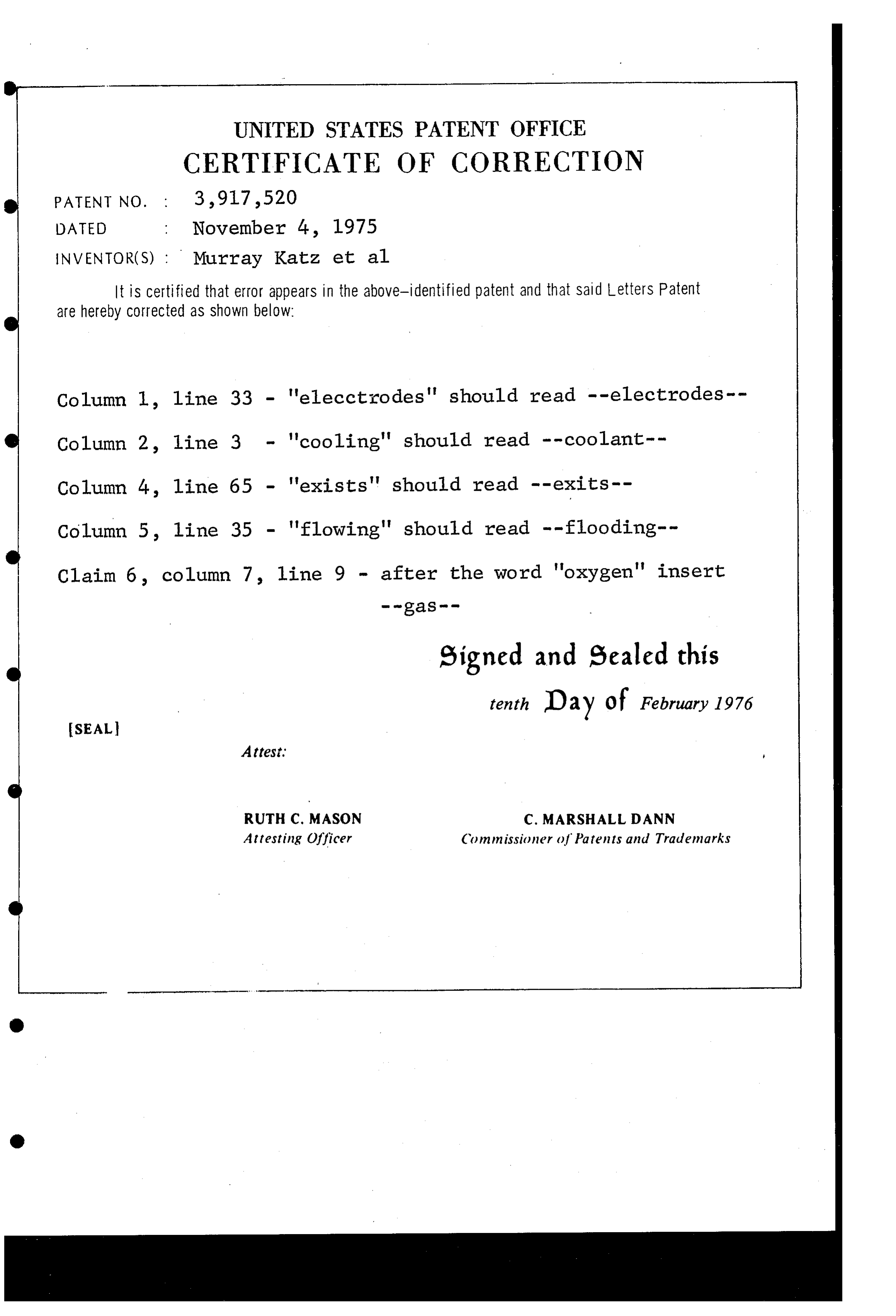
CERTIFICATE OF CORRECTION
INVENTOR(S) : Murray Katz et all
It is Certified that error appears in the above-identified patent and that said Letters Patent are hereby Corrected as shown below:
Column 1, 1ine 33 - 'elecctrodes' should read --electrodes-- Column 2, 1ine 3 - 'cooling" should read -- coolant-- Column 4, 1ine 65 - 'exists' should read --exits-- Column 5, 1ine 35 - "flowing" should read --flooding-- Claim 6, column 7, 1ine 9 - after the word 'oxygen' insert
eigned and Sealed this tenth Day of February 1976
SEAL
Attest.
RUTH C. MASON C. MARSHALL D ANN Attesting Officer Commissioner of Patents and Trademarks
Provenance
- Collection
- Cited prior art
- Original PDF
- patentimages.storage.googleapis.com →
- Filed
- 1974-11-20
- Pages
- 8
- Method
- pdftotext (the PDF's own text layer) + pdftoppm 300dpi page scans
- Source
- Google Patents bibliographic record
- Granted
- 1975-11-04
- Inventors
- Murray Katz; Robert A Sanderson; John H Hirschenhofer; United Technologies Corp
- Transcribed from
- patentimages.storage.googleapis.com →