patent · US3442632
Processes of producing fuel gases by reforming liquid hydrocarbons
6 May 1969
Page 1
Drawing sheet — no readable text.
Page 2
United States Patent Office 3,442,632 Patented May 6, 1969
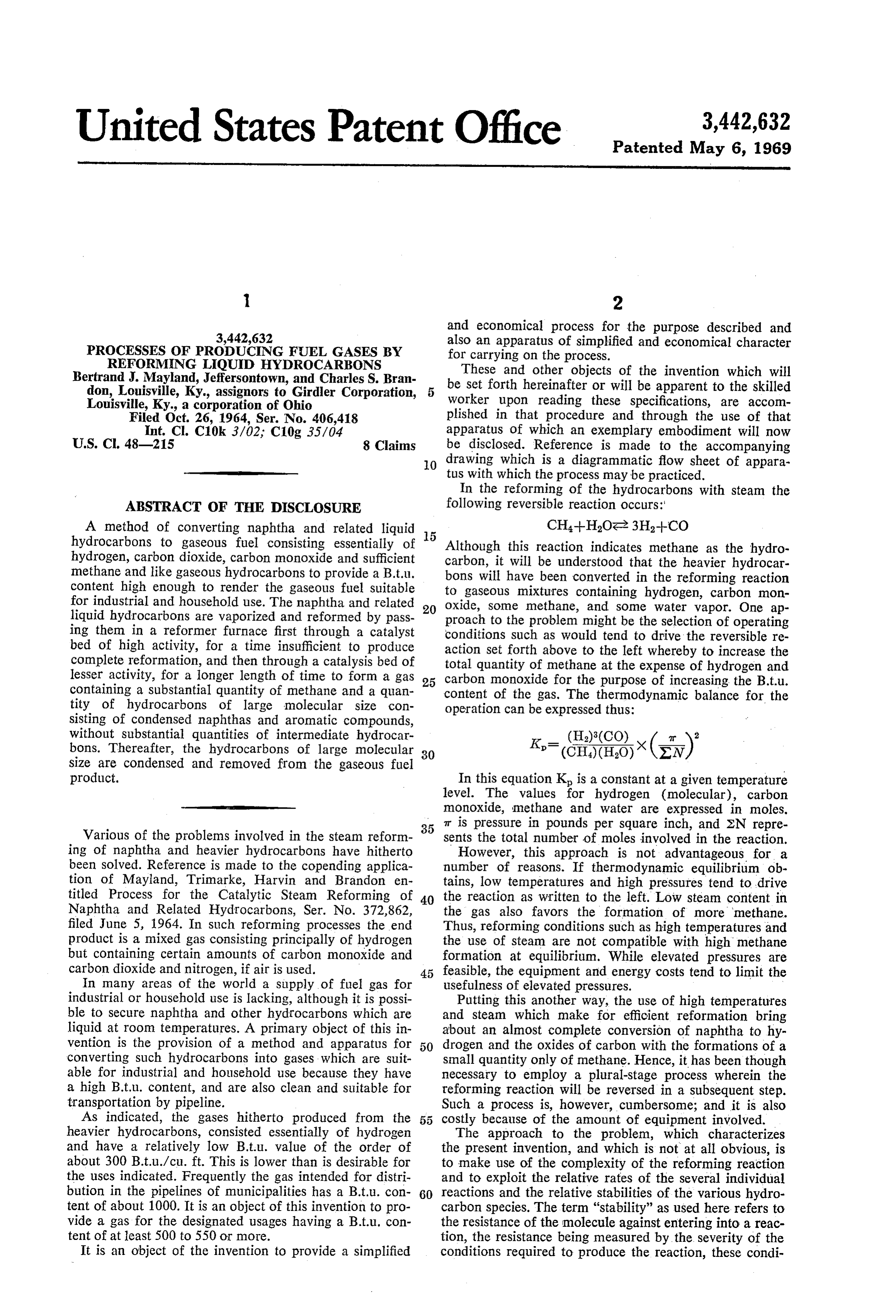
and economical process for the purpose described and 3,442,632 also an apparatus of simplified and economical character
PROCESSES OF PRODUCING FUEL GASES BY for carrying on the process.
REFORMING LIQUID HYDROCARBONS These and other objects of the invention which will Bertrand J. Mayland, Jeffersontown, and Charles S. Bran be set forth hereinafter or will be apparent to the skilled don, Louisville, Ky., assignors to Girdler Corporation, worker upon reading these specifications, are accom Louisville, Ky., a corporation of Ohio
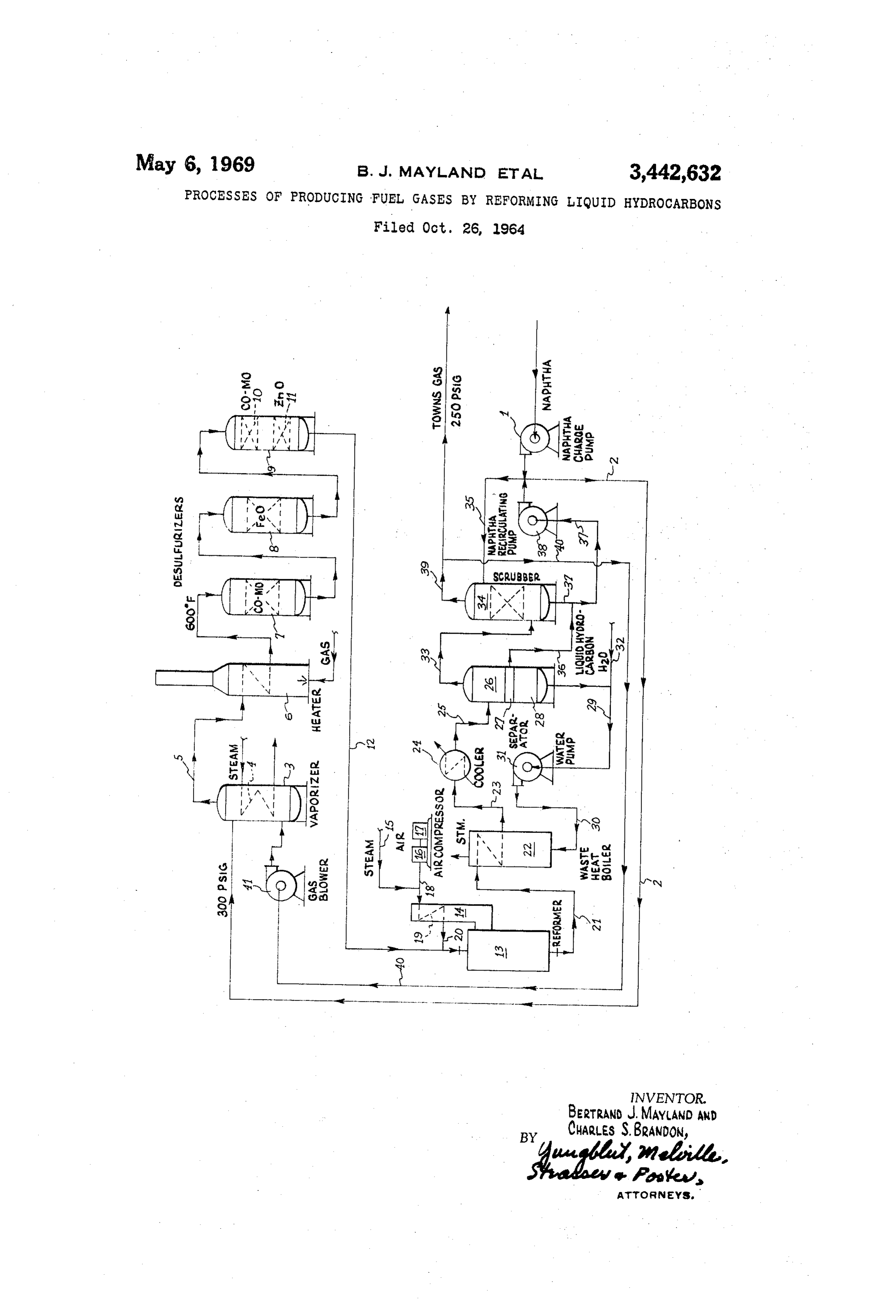
Filed Oct. 26, 1964, Ser. No. 406,418 plished in that procedure and through the use of that Int. CI. C10k 3/02, C10g|35/04 apparatus of which an exemplary embodiment will now U.S. C. 48-215 8 Claims be disclosed. Reference is made to the accompanying O drawing which is a diagrammatic flow sheet of appara tus with which the process may be practiced.
In the reforming of the hydrocarbons with steam the
ABSTRACT OF THE DISCLOSURE following reversible reaction occurs:
A method of converting naphtha and related liquid 5 CH--HOC23H--CO hydrocarbons to gaseous fuel consisting essentially of Although this reaction indicates methane as the hydro hydrogen, carbon dioxide, carbon monoxide and sufficient carbon, it will be understood that the heavier hydrocar methane and like gaseous hydrocarbons to provide a B.t.u. bons will have been converted in the reforming reaction content high enough to render the gaseous fuel suitable to gaseous mixtures containing hydrogen, carbon mon for industrial and household use. The naphtha and related 20 oxide, some methane, and some water vapor. One ap liquid hydrocarbons are vaporized and reformed by pass proach to the problem might be the selection of operating ing them in a reformer furnace first through a catalyst conditions such as would tend to drive the reversible re bed of high activity, for a time insufficient to produce action set forth above to the left whereby to increase the complete reformation, and then through a catalysis bed of total quantity of methane at the expense of hydrogen and lesser activity, for a longer length of time to form a gas carbon monoxide for the purpose of increasing the B.t.u. containing a substantial quantity of methane and a quan 25 content of the gas. The thermodynamic balance for the tity of hydrocarbons of large molecular size con operation can be expressed thus: sisting of condensed naphthas and aromatic compounds, without substantial quantities of intermediate hydrocar bons. Thereafter, the hydrocarbons of large molecular 30 K size are condensed and removed from the gaseous fuel product. In this equation K is a constant at a given temperature level. The values for hydrogen (molecular), carbon monoxide, methane and water are expressed in moles.
Various of the problems involved in the steam reform 35 Tr is pressure in pounds per square inch, and XN repre ing of naphtha and heavier hydrocarbons have hitherto sents the total number of moles involved in the reaction. However, this approach is not advantageous for a been solved. Reference is made to the copending applica number of reasons. If thermodynamic equilibrium ob tion of Mayland, Trimarke, Harvin and Brandon en tains, low temperatures and high pressures tend to drive titled Process for the Catalytic Steam Reforming of 40 the reaction as written to the left. Low steam content in Naphtha and Related Hydrocarbons, Ser. No. 372,862, the gas also favors the formation of more methane. filed June 5, 1964. In such reforming processes the end Thus, reforming conditions such as high temperatures and product is a mixed gas consisting principally of hydrogen the use of steam are not compatible with high methane but containing certain amounts of carbon monoxide and formation at equilibrium. While elevated pressures are carbon dioxide and nitrogen, if air is used. feasible, the equipment and energy costs tend to limit the In many areas of the world a supply of fuel gas for usefulness of elevated pressures. industrial or household use is lacking, although it is possi Putting this another way, the use of high temperatures ble to secure naphtha and other hydrocarbons which are and steam which make for efficient reformation bring liquid at room temperatures. A primary object of this in about an almost complete conversion of naphtha to hy vention is the provision of a method and apparatus for 50 drogen and the oxides of carbon with the formations of a converting such hydrocarbons into gases which are suit small quantity only of methane. Hence, it has been though able for industrial and household use because they have necessary to employ a plural-stage process wherein the a high B.t.u. content, and are also clean and suitable for reforming reaction will be reversed in a subsequent step. transportation by pipeline. Such a process is, however, cumbersome; and it is also As indicated, the gases hitherto produced from the 55 costly because of the amount of equipment involved. heavier hydrocarbons, consisted essentially of hydrogen The approach to the problem, which characterizes and have a relatively low B.t.u. value of the order of the present invention, and which is not at all obvious, is about 300 B.t.u./cu. ft. This is lower than is desirable for to make use of the complexity of the reforming reaction the uses indicated. Frequently the gas intended for distri and to exploit the relative rates of the several individual bution in the pipelines of municipalities has a B.t. u. con 60 reactions and the relative stabilities of the various hydro tent of about 1000. It is an object of this invention to pro carbon species. The term "stability' as used here refers to vide a gas for the designated usages having a B.t.u. con the resistance of the molecule against entering into a reac tent of at least 500 to 550 or more. tion, the resistance being measured by the severity of the It is an object of the invention to provide a simplified conditions required to produce the reaction, these condi
Page 3
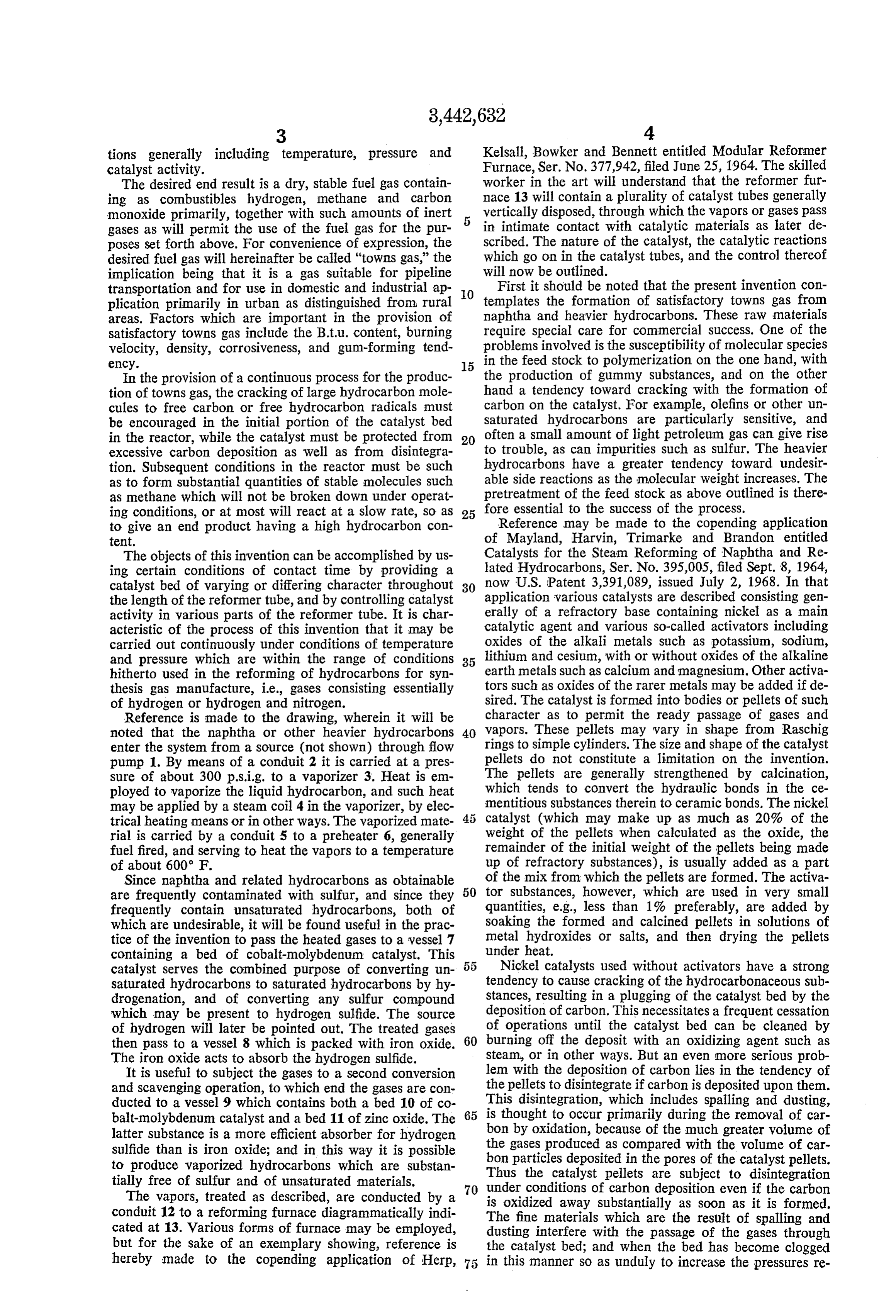
tions generally including temperature, pressure and Kelsall, Bowker and Bennett entitled Modular Reformer catalyst activity. Furnace, Ser. No. 377,942, filed June 25, 1964. The skilled The desired end result is a dry, stable fuel gas contain worker in the art will understand that the reformer fur ing as combustibles hydrogen, methane and carbon nace 13 will contain a plurality of catalyst tubes generally monoxide primarily, together with such amounts of inert vertically disposed, through which the vapors or gases pass gases as will permit the use of the fuel gas for the pur in intimate contact with catalytic materials as later de poses set forth above. For convenience of expression, the scribed. The nature of the catalyst, the catalytic reactions desired fuel gas will hereinafter be called "towns gas,” the which go on in the catalyst tubes, and the control thereof implication being that it is a gas suitable for pipeline will now be outlined.
transportation and for use in domestic and industrial ap O First it should be noted that the present invention con plication primarily in urban as distinguished from rural templates the formation of satisfactory towns gas from areas. Factors which are important in the provision of naphtha and heavier hydrocarbons. These raw materials satisfactory towns gas include the B.t.u. content, burning require special care for commercial success. One of the velocity, density, corrosiveness, and gum-forming tend problems involved is the susceptibility of molecular species ency. 5 in the feed stock to polymerization on the one hand, with In the provision of a continuous process for the produc the production of gummy substances, and on the other tion of towns gas, the cracking of large hydrocarbon mole hand a tendency toward cracking with the formation of cules to free carbon or free hydrocarbon radicals must carbon on the catalyst. For example, olefins or other un be encouraged in the initial portion of the catalyst bed saturated hydrocarbons are particularly sensitive, and in the reactor, while the catalyst must be protected from 20 often a small amount of light petroleum gas can give rise excessive carbon deposition as well as from disintegra to trouble, as can impurities such as Sulfur. The heavier tion. Subsequent conditions in the reactor must be such hydrocarbons have a greater tendency toward undesir as to form substantial quantities of stable molecules Such able side reactions as the molecular weight increases. The as methane which will not be broken down under operat pretreatment of the feed stock as above outlined is there ing conditions, or at most will react at a slow rate, so as 25 fore essential to the success of the process. to give an end product having a high hydrocarbon con Reference may be made to the copending application tent, of Mayland, Harvin, Trimarke and Brandon entitled The objects of this invention can be accomplished by us Catalysts for the Steam Reforming of Naphtha and Re ing certain conditions of contact time by providing a lated Hydrocarbons, Ser. No. 395,005, filed Sept. 8, 1964, catalyst bed of varying or differing character throughout 30 now U.S. Patent 3,391,089, issued July 2, 1968. In that the length of the reformer tube, and by controlling catalyst application various catalysts are described consisting gen activity in various parts of the reformer tube. It is char erally of a refractory base containing nickel as a main acteristic of the process of this invention that it may be catalytic agent and various so-called activators including carried out continuously under conditions of temperature oxides of the alkali metals such as potassium, sodium, and pressure which are within the range of conditions 35 lithium and cesium, with or without oxides of the alkaline hitherto used in the reforming of hydrocarbons for syn earth metals such as calcium and magnesium. Other activa thesis gas manufacture, i.e., gases consisting essentially tors such as oxides of the rarer metals may be added if de of hydrogen or hydrogen and nitrogen. sired. The catalyst is formed into bodies or pellets of such Reference is made to the drawing, wherein it will be character as to permit the ready passage of gases and noted that the naphtha or other heavier hydrocarbons 40 vapors. These pellets may vary in shape from Raschig enter the system from a source (not shown) through flow rings to simple cylinders. The size and shape of the catalyst pump 1. By means of a conduit 2 it is carried at a pres pellets do not constitute a limitation on the invention. sure of about 300 p.s.i.g. to a vaporizer 3. Heat is em The pellets are generally strengthened by calcination, ployed to vaporize the liquid hydrocarbon, and such heat which tends to convert the hydraulic bonds in the ce may be applied by a steam coil 4 in the vaporizer, by elec mentitious substances therein to ceramic bonds. The nickel trical heating means or in other ways. The vaporized mate catalyst (which may make up as much as 20% of the rial is carried by a conduit 5 to a preheater 6, generally weight of the pellets when calculated as the oxide, the fuel fired, and serving to heat the vapors to a temperature remainder of the initial weight of the pellets being made of about 600 F. up of refractory substances), is usually added as a part Since naphtha and related hydrocarbons as obtainable of the mix from which the pellets are formed. The activa are frequently contaminated with sulfur, and since they 50 tor substances, however, which are used in very small frequently contain unsaturated hydrocarbons, both of quantities, e.g., less than 1% preferably, are added by which are undesirable, it will be found useful in the prac soaking the formed and calcined pellets in solutions of tice of the invention to pass the heated gases to a vessel 7 metal hydroxides or salts, and then drying the pellets containing a bed of cobalt-molybdenum catalyst. This under heat.
catalyst serves the combined purpose of converting un 55 Nickel catalysts used without activators have a strong saturated hydrocarbons to saturated hydrocarbons by hy tendency to cause cracking of the hydrocarbonaceous sub drogenation, and of converting any sulfur compound stances, resulting in a plugging of the catalyst bed by the which may be present to hydrogen sulfide. The source deposition of carbon. This necessitates a frequent cessation of hydrogen will later be pointed out. The treated gases of operations until the catalyst bed can be cleaned by then pass to a vessel 8 which is packed with iron oxide. 60 burning off the deposit with an oxidizing agent such as The iron oxide acts to absorb the hydrogen sulfide. Steam, or in other ways. But an even more serious prob It is useful to subject the gases to a second conversion lem with the deposition of carbon lies in the tendency of and Scavenging operation, to which end the gases are con the pellets to disintegrate if carbon is deposited upon them. ducted to a vessel 9 which contains both a bed 10 of co This disintegration, which includes spalling and dusting, balt-molybdenum catalyst and a bed 11 of zinc oxide. The 65 is thought to occur primarily during the removal of car latter substance is a more efficient absorber for hydrogen the bon by oxidation, because of the much greater volume of sulfide than is iron oxide; and in this way it is possible bon gases produced as compared with the volume of car particles deposited in the pores of the catalyst pellets.
to produce vaporized hydrocarbons which are substan Thus the catalyst pellets are subject to disintegration tially free of sulfur and of unsaturated materials. 70 under conditions of carbon deposition even if the carbon The vapors, treated as described, are conducted by a is oxidized away substantially as soon as it is formed. conduit 12 to a reforming furnace diagrammatically indi The fine materials which are the result of spalling and cated at 13. Various forms of furnace may be employed, dusting interfere with the passage of the gases through but for the sake of an exemplary showing, reference is the catalyst bed; and when the bed has become clogged hereby made to the copending application of Herp, in this manner so as unduly to increase the pressures re
Page 4
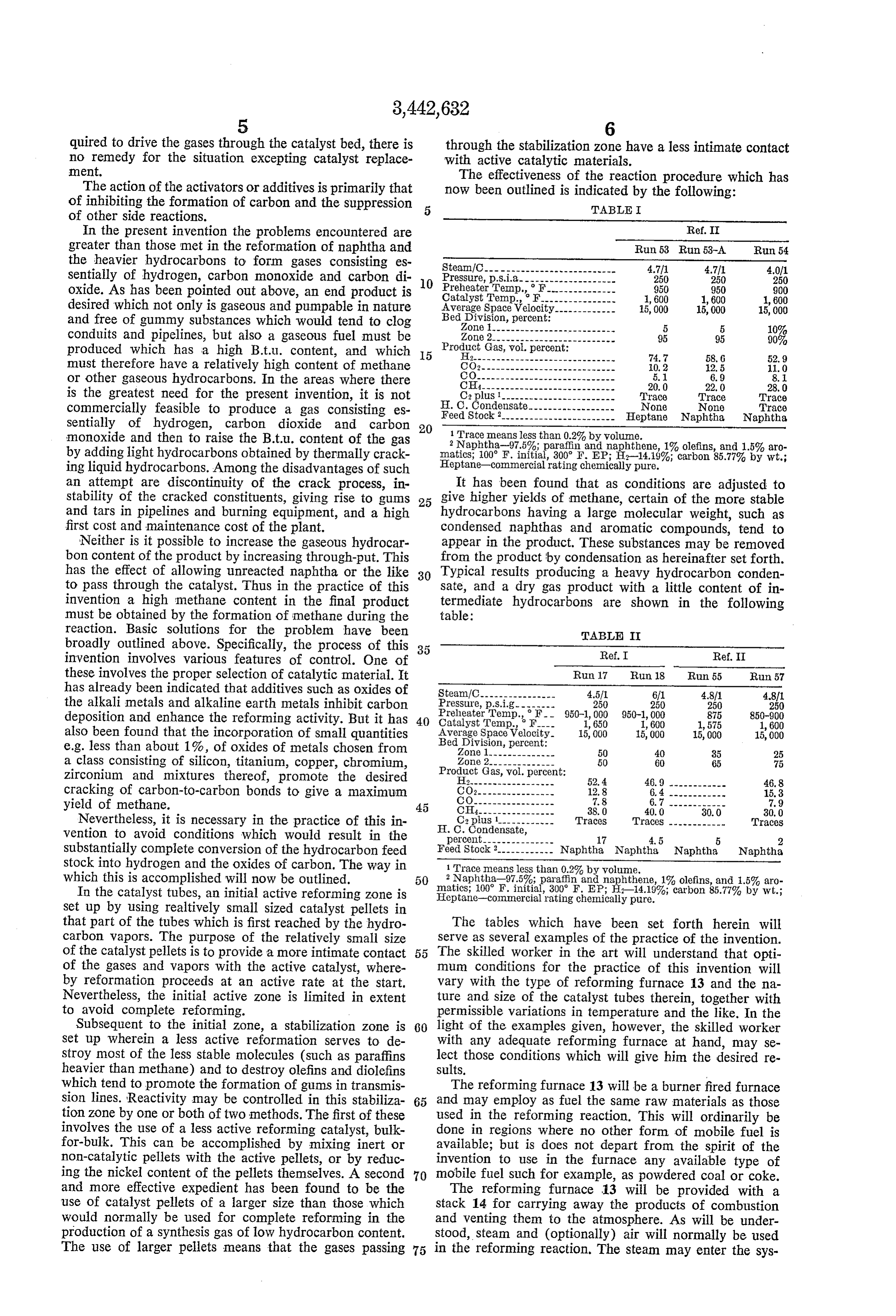
quired to drive the gases through the catalyst bed, there is through the stabilization zone have a less intimate contact no remedy for the situation excepting catalyst replace with active catalytic materials.
ment. The effectiveness of the reaction procedure which has The action of the activators or additives is primarily that now been outlined is indicated by the following: of inhibiting the formation of carbon and the suppression TABLE I of other side reactions.
In the present invention the problems encountered are Ref. III greater than those met in the reformation of naphtha and Run 53 Run 53-A Run 54 the heavier hydrocarbons to form gases consisting es Steam/C--------------------------- 4.7/1 4.7, 4.01 sentially of hydrogen, carbon monoxide and carbon di O Pressure, p.S.i.a.------- ???? 250 250 250 oxide. As has been pointed out above, an end product is Catalyst Temp. ° F----- - - - - 1,600
desired which not only is gaseous and pumpable in nature Average Space Velocity---- - - - - 15,000 15,000 15,000 and free of gummy substances which would tend to clog Bed Division, percent:
conduits and pipelines, but also a gaseous fuel must be Zone 2-------------------------- 95 95 90% Product Gas, vol. percent:
produced which has a high B.t.u. content, and which 15 H2------------------------------ 74.7 58.6 52.9 must therefore have a relatively high content of methane CO2---------------------------- 0.2 2.5 1.0 or other gaseous hydrocarbons. In the areas where there CO----
is the greatest need for the present invention, it is not C2 plus 1------ Trace Trace Trace commercially feasible to produce a gas consisting es H. C. Condensate
None None Trace ---- Heptane Naphtha Naphtha sentially of hydrogen, carbon dioxide and carbon 20 monoxide and then to raise the B.t.u. content of the gas 1 Trace means less than 0.2% by volume.
by adding light hydrocarbons obtained by thermally crack 2 Naphtha-97.5%; paraffin and maphtheme, 1% olefins, and 1.5% aro matics; 100° F. initial, 300° F. EP; H-14.19%; carbon 85.77% by wt.;
Heptane-commercial rating chemically pure.
ing liquid hydrocarbons. Among the disadvantages of such an attempt are discontinuity of the crack process, in It has been found that as conditions are adjusted to stability of the cracked constituents, giving rise to gums 25 give higher yields of methane, certain of the more stable and tars in pipelines and burning equipment, and a high hydrocarbons having a large molecular weight, such as first cost and maintenance cost of the plant. condensed naphthas and aromatic compounds, tend to Neither is it possible to increase the gaseous hydrocar appear in the product. These substances may be removed bon content of the product by increasing through-put. This from the product by condensation as hereinafter set forth. has the effect of allowing unreacted naphtha or the like 30 Typical results producing a heavy hydrocarbon conden to pass through the catalyst. Thus in the practice of this sate, and a dry gas product with a little content of in invention a high methane content in the final product termediate hydrocarbons are shown in the following must be obtained by the formation of methane during the table:
reaction. Basic solutions for the problem have been TABILE III broadly outlined above. Specifically, the process of this 35 invention involves various features of control. One of Ref. I Ref. II these involves the proper selection of catalytic material. It Run 17 Rum 18 Run 55 Run 57 has already been indicated that additives such as oxides of Steam/C---------------- 4.5|1 6/1 4.8/1 4.8/1 the alkali metals and alkaline earth metals inhibit carbon Pressure, p.S.i.g-------- 250 250 250 250
deposition and enhance the reforming activity. But it has 40 Catalyst Temp., ° F---- 1,650 000 950-1, 000 875 850-900
also been found that the incorporation of small quantities Average Space Velocity- 15,000 15,000
Bed Division, percent:
e.g. less than about 1%, of oxides of metals chosen from Zonel-------------- 50 40 35 25 a class consisting of silicon, titanium, copper, chromium, Zone 2.-------------
Product Gas, vol. percent:
zirconium and mixtures thereof, promote the desired H2------------------ 52.4 46.9 46.8 cracking of carbon-to-carbon bonds to give a maximum 12.8 6.4 5.3 yield of methane. 7.8
Nevertheless, it is necessary in the practice of this in Traces Traces Traces vention to avoid conditions which would result in the percent--------------- 17 4.5 5 2 substantially complete conversion of the hydrocarbon feed Feed Stock ------------ Naphtha Naphtha Naphtha Naphtha stock into hydrogen and the oxides of carbon. The way in 1 Trace means less than 0.2% by volume. which this is accomplished will now be outlined. 50 2 Naphtha–97.5%; paraffin and naphthene, 1% olefins, and 1.5% aro matics; 100 F. initial, 300 F. EP; H-14.19%; carbon 85.77% by wt.;
In the catalyst tubes, an initial active reforming zone is Heptane-commercial rating chemically pure. set up by using realtively small sized catalyst pellets in that part of the tubes which is first reached by the hydro The tables which have been set forth herein will carbon vapors. The purpose of the relatively small size serve as several examples of the practice of the invention. of the catalyst pellets is to provide a more intimate contact 55 The skilled worker in the art will understand that opti of the gases and vapors with the active catalyst, where mum conditions for the practice of this invention will by reformation proceeds at an active rate at the start. vary with the type of reforming furnace 13 and the na Nevertheless, the initial active zone is limited in extent ture and size of the catalyst tubes therein, together with to avoid complete reforming. permissible variations in temperature and the like. In the Subsequent to the initial zone, a stabilization zone is 60 light of the examples given, however, the skilled worker set up wherein a less active reformation serves to de With any adequate reforming furnace at hand, may se stroy most of the less stable molecules (such as paraffins lect those conditions which will give him the desired re heavier than methane) and to destroy olefins and diolefins sults.
which tend to promote the formation of gums in transmis The reforming furnace 13 will be a burner fired furnace sion lines. Reactivity may be controlled in this stabiliza 65 and may employ as fuel the same raw materials as those tion zone by one or both of two methods. The first of these used in the reforming reaction. This will ordinarily be involves the use of a less active reforming catalyst, bulk done in regions where no other form of mobile fuel is for-bulk. This can be accomplished by mixing inert or available; but is does not depart from the spirit of the non-catalytic pellets with the active pellets, or by reduc invention to use in the furnace any available type of ing the nickel content of the pellets themselves. A second 70 mobile fuel such for example, as powdered coal or coke. and more effective expedient has been found to be the The reforming furnace 13 will be provided with a use of catalyst pellets of a larger size than those which stack 14 for carrying away the products of combustion would normally be used for complete reforming in the and venting them to the atmosphere. As will be under production of a synthesis gas of low hydrocarbon content. stood, steam and (optionally) air will normally be used The use of larger pellets means that the gases passing 75 in the reforming reaction. The steam may enter the sys
Page 5
tem through a conduit 15 from the waste heat boiler later hydrocarbons to a gaseous fuel consisting essentially of described, or from any suitable source. The atmospheric hydrogen, carbon dioxide, carbon monoxide and sufficient air may be pressurized by a compressor 16 driven by an methane and like gaseous hydrocarbons to provide a electric motor or other prime mover 17 and may enter B.t.u. content of at least about 500 per cubic foot, which the system through a conduit 18. Some of the waste heat 5 process comprises the steps of vaporizing liquid hydro from the flue gases may be salvaged by providing a heat carbons and reforming them by passing them in a reform exchanger 19 in the stack; and the steam and air mix ing furnace first through a catalyst bed of high activity ture may be delivered to the conduit 12 as at 20. for a time insufficient to produce complete reformation, The reformed gases exit from the catalyst tubes in and then through a catalyst bed of lesser activity for a the furnace 13 at high temperature, and may be carried 10 longer length of time whereby to form a gase contain by a conduit 21 to a waste heat boiler 22 wherein a por ing a substantial quantity of methane and a quantity of tion of the sensible heat of the gases is recovered. The hydrocarbons of large molecular size consisting of con partially cooled gases are carried by a conduit 23 to a densed naphthas and aromatic compounds but without cooler 24 where their temperature is reduced by any substantial quantities of intermediate hydrocarbons, and suitable coolant to approximately room temperature. The thereafter condensing and removing from the gaseous gases next pass through a conduit 25 to a separator 26. product said hydrocarbons of large molecular size. In this separator heavier hydrocarbons are separated 2. The process claimed in claim 1 wherein the feed from the gases, forming a layer 27, and water is also stock comprising said naphtha and related hydrocarbons separated from the gases forming a layer 28. The water is vaporized and then subjected to a catalytic treatment may be discarded or may be delivered through con 20 in which unsaturated hydrocarbons are converted to sat duits 29 and 30 and the action of a pump 31 to the urated hydrocarbons by hydrogenation, and in which sul waste heat boiler 22. Provision is made as at 32 for the fur compounds are converted to hydrogen sulfide, which introduction of additional water as may be required by hydrogen sulfide is removed from the vaporized mate the boiler. rials by passing them over a bed of material capable of The gaseous product from the separator 26 is delivered 2: 5 adsorbing hydrogen sulfide.
by a conduit 33 to a scrubber 34 wherein it is treated 3. The process claimed in claim 2 wherein the catalyst in known ways for the condensation and removal of any employed in the reformation step is a nickel-bearing cat remaining quantities of the heavier hydrocarbons. One alyst containing small amounts of an activator material way of accomplishing the scrubbing is to employ Raschig chosen from a group consisting of oxides of the alkali and rings or bubble plates in the scrubber together with a 30 alkaline earth metais and mixtures thereof. liquid scrubbing medium which is a portion of the hy 4. The process claimed in claim 2 wherein a portion drocarbon feed stock delivered by the pump 1 and enter of the gaseous product is added to the feed stock to fur ing the scrubber through the conduit 35. Heavier hydro nish hydrogen for the said hydrogenation step. carbons thus become dissolved in the lighter hydrocarbon 5. The process claimed in claim 2 wherein the gaseous feed stock, 35 product is scrubbed with the said feed stock. Liquid hydrocarbons from the layer 27 in the separator 6. The process claimed in claim 2 wherein the cata 26 are removed by the conduit 36 so as to join the liquid lyst employed in the reformation step is a nickel-bearing hydrocarbon materials passing through the Scrubber 34 catalyst containing small amounts of an activator mate and entering the conduit 37 containing a pump 38 which rial chosen from a group consisting of oxides of the alkali delivers the liquid hydrocarbons to the conduit 2. Thus 40 and alkaline earth metals and mixtures thereof, and con heavier hydrocarbons separated from the gaseous product taining also a material chosen from the group consist are returned at a pressure of about 300 p.s. i.g. and are ing of oxides of silicon, titanium, copper, chromium, Zir retreated in the apparatus. This is a matter of economy; conium and mixtures thereof.
and it will be seen that the process of this invention does 7. The process claimed in claim 6 wherein the gase not necessarily produce any hydrocarbon residue for dis ous product is scrubbed with a portion of said feed stock. posal. 8. The process claimed in claim 7 in which steam and The gaseous product leaving the Scrubber 34 through air are added to the vaporized materials prior to the said the conduit 39 will be in finished condition and suitable reformation.
for use as towns gas; and it will ordinarily be at a pres 50 References Cited sure of 250 p.s.i.g. although this does not constitute a UNITED STATES PATENTS limitation on the invention. It will be seen, however, that 2,565,395 8/1951 Scharmann.
a portion of the finished gas is diverted by a conduit 40 3,010,813 11/1961 Clarke et al. --------- 48-215 which carries it to a blower 41 for raising its pressure sufficiently to permit mixing with the feed stocks passing 55 3,022,148 2/1962 James --------------- 48-215
through the vaporizer 3. The purpose of the diversion and 3,119,667 1/1964 McMahon.
recirculation of some of the finished gas is to provide 3,202,603 8/1965 Keith et al. ---------- 48-213 hydrogen for the catalytic conversion of unsaturated hy drocarbons to saturated hydrocarbons in the vessel 7. FOREIGN PATENTS Modifications may be made in the invention without 60 875,136 8/1961 Great Britain.
departing from the spirit of it.
The embodiments of the invention in which an exclu MORRIS O. WOLK, Primary Examiner. sive property or privilege is claimed are defined as fol R. E. SERWIN, Assistant Examiner.
lows.
We claim: U.S. C. X.R. 1. A method of converting naphtha and related liquid 48-211
Provenance
- Collection
- Cited prior art
- Original PDF
- patentimages.storage.googleapis.com →
- Filed
- 1964-10-26
- Pages
- 5
- Method
- pdftotext (the PDF's own text layer) + pdftoppm 300dpi page scans
- Source
- Google Patents bibliographic record
- Granted
- 1969-05-06
- Inventors
- Bertrand J Mayland; Charles S Brandon; Girdler Corp
- Transcribed from
- patentimages.storage.googleapis.com →