patent · US2051363
Process fob the preparation of
18 August 1936
Page 1
Drawing sheet — no readable text.
Page 2
Patented Aug. 18, 1936 2,051,363
PROCESS FOR YDROGEN
THE PREPARATION OF
John S. Beekey, Charleston, W. War, assignor, by mesne assignments, to E. I. duPont de Nemours & Company, Wilmington, Dei, a corporation of Delaware
Application October 20, 1930, Serial No. 489,859
This invention relates to a process for the prep steam to yield hydrogen and carbon dioxide. aration of hydrogen and particularly to a process After removal of carbon dioxide and carbon mon in which a hydrocarbon-containing gas is sub Oxide by any of the conventional methods, the jected to thermal decomposition with oxygen at product consists of pure hydrogen, suitable for an elevated temperature. any desired purpose, or of pure hydrogen-nitro The increase in the demand of hydrogen for gen mixture, Suitable for ammonia synthesis. use in the chemical and allied industries, has de It should be noted that the partial combustion veloped to Such an extent in recent years that process may be followed by the steam-conversion numerous methods have been exploited to supply process without dropping the temperature of the O this demand. As hydrocarbon-containing gases, gases being handled to atmospheric temperature. O Such as natural gas, coke oven gas, and the like, If the ultimate use of the gas mixture produced are readily available, catalytic, combustion and by partial combustion is to be in the synthesis of other processes have been proposed for convert oxygenated organic compounds, such as, for ex ing these gases into hydrogen. Owing to the ample, aliphatic alcohols, it may be desirable to 5 difficulties encountered, however, in breaking Control the ratio of carbon monoxide to hydro 15 down the hydrocarbons to obtain their hydrogen gen. This may be readily done by controlling content, investigators have endeavored, due to the the Oxygen in-put and the operating tempera disadvantages and more or less uneconomical op ture, and, if necessary, by adding some steam with
eration of the known processes, to obtain less ex the reactants before combustion. pensive methods for hydrogen preparation. In It is the object of the present invention to in 20 the partial combustion process for the conver prove the operating conditions under which the sion of a hydrocarbon into hydrogen and oxides reaction may be effected. Another object of the of carbon, the following chemical equation illus invention is to provide a process for the prepara trates the reaction which takes place when tion of mixtures consisting principally of carbon methane is the reacting hydrocarbon: monoxide and hydrogen or carbon monoxide, hy 25 drogen, and nitrogen, wherein the temperature of partial combustion of hydrocarbons is accurately
As this reaction is Suitably exothermic, the addi controlled. A further object of this invention tion of the hydrocarbon and the oxygen to the is to provide such a process in which partial com combustion at proper temperatures is sufficient to bustion of gases containing methane, or homo 30 Sustain the reaction. The reaction is generally logues thereof, may be effected under high pres Conducted by the addition of approximately one sure. A still further object of the invention is to half a mol. of oxygen per mol. of methane. A provide a suitable apparatus for conducting such larger proportion of oxygen will, of course, de processes.
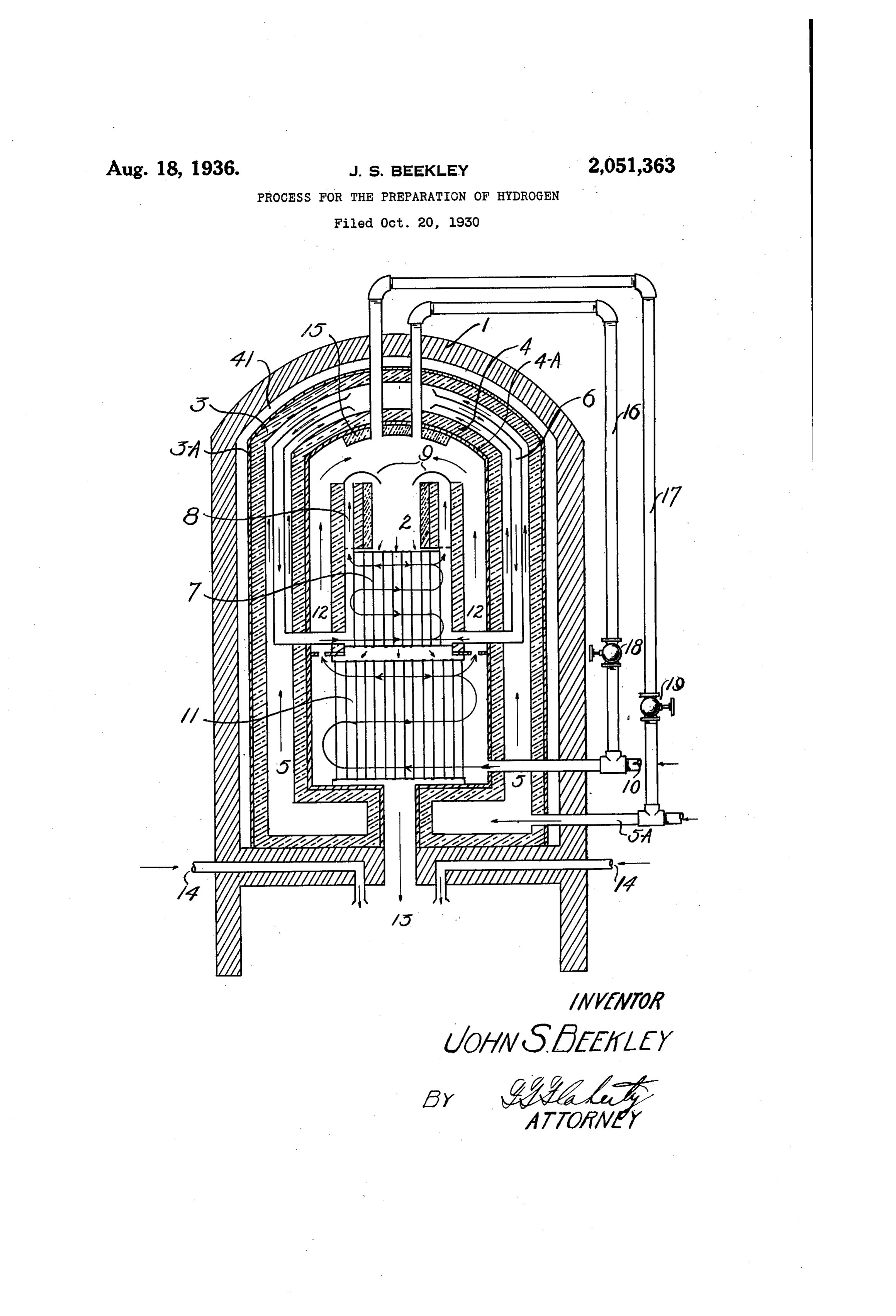
crease the yield of hydrogen due to some of the Other objects and advantages will be more fully 35 hydrogen being burned to Water. understood by reference to the following specif It is understood, of course, that in all cases cation and to the accompanying drawing in some Water and some carbon dioxide are formed. which
Although it is possible to reduce the formation of The figure is a diagrammatical illustration of a these products to an almost negligible minimum preferred form of combustion apparatus in which 40 by proper control of the quantity of oxygen sup the reaction may take place.
plied and the operating temperature, it is desir In effecting the partial combustion of a hydro able in some instances to use excess Oxygen, there carbon with Oxygen Or an Oxygen-containing gas by increasing their formation above this mini or air I have found that the operation can be mum, in order to prevent deposition of carbon in greatly improved and more economically con 45 the combustion chamber or in parts of the ap ducted by effecting the operation under elevated paratus subsequently encountered by the reaction pressures. Generally I prefer to compress each products. gas separately, and after preheating each to the The gas mixture produced, consisting essen desired temperature, inject them simultaneously tially of carbon monoxide and hydrogen if pure into the reaction chamber.
oxygen is used, and of carbon monoxide, hydro There are numerous advantages which are re gen, and nitrogen if air or Oxygen-enriched air is | alized by carrying out the combustion reaction used, may be subjected to the well-known reac in this manner. Important economies of con tion with steam over a catalyst mass, wherein pression result, particularly when the hydrogen is nearly all of the carbon monoxide reacts with the produced is for utilization in high-pressure syn
Page 3
thesis, or when it is desired to carry out a sub cooled if desired in the cooling chamber 13, by sequent treatment with steam or a purification means of water entering said chamber through process, such as removal of carbon dioxide, at pipes 4.
elevated pressures, since the volume of the re Owing to the high degree of heat, which may actants is very considerably less than the volume yield a temperature in the neighborhood of of the products of the partial combustion, be 1100-1500 C., evolved in combustion chamber 2, fore or after any supplementary treatment. it is of advantage to line this chamber with the Thus, when methane and pure oxygen are used, refractory material 15 to protect the steel shell the volume of reactants is only slightly more 4-A from too rapid oxidization. 0 than one-half the volume of the products of Under some conditions of operation it is ad 0 combustion obtained, and very little more than Vantageous to heat the hydrocarbon-containing one-third the volume of the gas mixture pro gas in the preheater 7. This should be effected duced by treating these same products of com by so regulating the heat exchange surface and/or bustion with steam. Also, conducting the partial the velocity of the gas that there results substan 15 combustion process under pressure permits sub tially no deposition of carbon. I have found, 15 jection of the products to reaction with steam un however, that it is generally more advantageous der pressure without cooling them to atmospheric to preheat the air by heat exchange with the temperature. Furthermore, due to the high gases just as they issue from the combustion pressures used the apparatus required for effect chamber. By so doing the air may be heated al 20 ing the combustion as well as the preheaters em most to the temperature of combustion while the ployed are much more efficient and can be more gases from the combustion, after preheating the economically constructed.
Referring now to the drawing which illustrates air, have sufficient heat remaining to preheat hydrocarbon-containing gases. -- the a preferred form of apparatus for carrying out In order to control more accurately the tem 25 this thermal decomposition of hydrocarbons, the perature of the combustion, a part of the gas 25 cylindrical casing , which is constructed to with and/or air may be by-passed through the pipes stand high pressures, is separated from the con 6 and 7 controlled by valves 8 and 9. The bustion chamber 2, by a steel shell 3-A Covered gas or air passing through these pipes has no de with a suitable layer of insulation 3, which sur gree of preheat and, therefore, enters the com 30 rounds the combustion chamber. Between the bustion chamber 2 at a low temperature, thereby 30 cylindrical casing , and the insulated steel shell enabling the operator to accurately control the 3-A, there extends a space 4 for the circulation temperature of combustion.
of cooling water by which the temperature of the The operation of the above apparatus may be casing f of the apparatus may be maintained at 35 a comparatively cool temperature. Between the air or aout carried in the following manner. Oxygen, suitable oxygen-containing gas, after 35 outer insulated shell 3-A and the inner steel compression by suitable compressors not shown, shell 4-A to which is applied the layer of insula enters the partial combustion apparatus through tion 4, there lies an annular space 5, in which pipe S-A, into the annular passageway 5. It part of the cool incoming gases likewise add in here aids in maintaining the low temperature of 40 maintaining a low temperature of the casing . the walls of the apparatus by insulating the 40 The requisite amount of air for combustion en combustion chamber 2 from the outer walls of ters the apparatus and the annular space 5 the apparatus. The air then passes into the air through the pipe 5-A, from this annular space 5 preheater in which its heat content is increased. the air passes into the conduit 6, and from con 45 duit 6 it passes into a heat interchanger or air
The air from this preheater passes through the annular passage 8, being further heated to but 45 preheater 7. The air flows from the air pre a few degrees under the temperature of combus heater Tinto the annular space 8, about the com tion, and then it is directed into the combustion bustion chamber 2 from which it receives further chamber. The hydrocarbon-containing gas preheating and thence through the nozzles 9, after compression by means not shown passes 50 into the combustion chamber 2, which may con into the combustion apparatus through pipe O, tain refractory material having more or less cata is heated to an intermediate temperature in lytic activity for the combustion reaction. the gas preheater if, and finally through heat The other reactant-the hydrocarbon-con interchange in chamber 12, is raised to a tem taining gas-enters the combustion apparatus perature not in excess of that at which it de 55 through pipe O, into heat interchange relation posits carbon, i. e. not generally higher than 55 with the gases flowing through the tubes of the 500 C., at which temperature it enters the com heat interchanger or gas preheater f. The gas bustion chamber 2, which is maintained at a preheater f, and the air preheater 7, may be any temperature in the neighborhood of 1200° C. suitable type of heat interchanger-those of the The gases after combustion pass through the 60 tubular form shown in which the heated gases air preheater giving up a large proportion of flow through the tubes and the gases being pre their heat to the incoming air, then through the heated flow in contact with the outer Walls of the gas preheater flin which they give up a further tubes, have proven satisfactory. From the gas quantity of heat to the incoming hydrocarbon preheater f the gases flow through the passage containing gas and finally into the cooler 13.
2, which encircles the air preheater and com The gases produced by this partial combus bustion chamber and from this passage they go tion apparatus consist primarily, if natural gas into contact with the gases from the annular be decomposed, of carbon monoxide and hydro space 8 in the combustion chamber 2. The gases gen. The carbon monoxide can be readily con verted into carbon dioxide and hydrogen by con 70 after combustion pass then through the air pre tacting this gas in the presence of an excess of O heater 7 and the gas preheater , out of direct steam with any of the well known water-gas contact with the incoming gases, of course, ex catalysts, such as iron oxide, at a temperature in cept by heat interchange through the walls of the neighborhood of approximately 500° C. these preheaters. From the gas preheater if While for some purposes this conversion is not 75 these partially cooled gases are then further required if the hydrogen is to be utilized in the is
Page 4
presence of carbon monoxide, it is desirable, if a high hydrogen low carbon monoxide content is be accurately controlled for best results. Should too small an amount of oxygen be present, the sought. Furthermore, if air rather than oxygen hydrocarbons will often deposit much carbon be used in the combustion process, the hydrogen with an ultimate clogging of the apparatus, thus produced will contain an appreciable percentage necessitating costly shut-downs, while, On the of nitrogen and by the addition of stoichiometri cal portions of nitrogen or hydrogen, the gas may other hand, if too large a quantity of air be em ployed, the hydrogen will burn and a high per be used directly in the production of synthetic centage of nitrogen Will appear in the produced
10 In order to obtain the full advantages of con gas, too high for direct use in the synthesis of
trolling the temperature of this reaction, I have Various changes may be made in the above found that pressures in the neighborhood of process and apparatus for the preparation of hy from 10 to 50 atmospheres should be employed as drogen, for example, in the pressure and tem the hydrogen-containing gaseous products which 15 are obtained by my process may be utilized in perature of the gas prior to and during the ther the Synthesis of ammonia and other processes. mal decomposition and the method of control
ling the temperature thereof, as well as in the
I prefer generally, however, to conduct the com structure of the partial combustion apparatus, bustion reaction at a pressure of approximately
25 atmospheres, at which pressure many of these without departing from this invention or sacrific ing any of the advantages that may be derived processes are carried out. therefrom. 20 Due to the high temperature of combustion, the I claim:
heat interchange apparatus is subjected to 1. The process for the preparation of, a hy rapid deterioration. I have found it, therefore, drogen-containing gas from a hydrocarbon-Con advisable to so control the temperature of the 25 combustion by regulating the degree of preheat taining gas which comprises subjecting the hy of the air and hydrocarbon and/or the amount drocarbon-containing gas under elevated pres 25 of unpreheated gases, and especially the amount sure to at least partial combustion in the pres ence of an oxygen-containing gas, the gases prior of air injected into the combustion chamber that to combustion insulating the combustion reac the Optimum minimum temperature be main tion, the oxygen-containing gas in proximity tained in the combustion chamber. By preheat- . to, and substantially surrounding the combus 30 ing the air to a temperature of approximately tion reaction, and the hydrocarbon-containing 900° C. and the hydrocarbons to 500° C. the re gas substantially surrounding both the combus action in a well insulated chamber will be held tion reaction and the oxygen-containing gas. in the neighborhood of 1500° C., by lowering the 2. The process for the preparation of a hydro temperature of the preheated gases and/or in gen-containing gas from a methane-containing jecting unpreheated gases into the combustion containing gas which comprises subjecting the methane gas under elevated pressure to at least chamber this temperature can be lowered at will.
partial combustion in the presence of an oxygen
By this procedure the reaction temperature is containing 40 accurately controlled. The control of the reac gas, the gases prior to combustion tion temperature in conjunction with the quan insulating the combustion reaction, the Oxygen 40 tity of gases entering into the reaction likewise containing gas in proximity to, and substantially regulates the extent of the reaction and the surrounding productS obtainable.
the combustion reaction, and the methane-containing gas substantially surround 45 When preparing hydrogen by this process from ing both the combustion gen-containing gas. reaction and the oxy natural gas the quantity of oxygen used must 45 JOHN s. BEEKLEY.
Provenance
- Collection
- Cited prior art
- Original PDF
- patentimages.storage.googleapis.com →
- Pages
- 4
- Method
- pdftotext (the PDF's own text layer) + pdftoppm 300dpi page scans
- Source
- Google Patents bibliographic record
- Granted
- 1936-08-18
- Transcribed from
- patentimages.storage.googleapis.com →