patent · US3410770
Electrolytic method for producing oxygen and hydrogen
12 November 1968
Page 1
Drawing sheet — no readable text.
Page 2
United States Patent Office 3,410,770 Patented Nov. 12, 1968
3,410,770 erated at the second electrode is evolved into an empty ELECTROLYTIC METHOD FOR PRODUCING gas chamber adjacent to the electrode. In the electrolysis OXYGEN AND HYDROGEN of water using this cell, the first electrode is preferably the anode, since the volume of oxygen produced at the
Lester W. Buechler, Elm Grove, Wis., assignor to Allis 5 anode
Chalmers Manufacturing Company, Milwaukee, Wis. is one-half that of the hydrogen produced at the Filed Feb. 18, 1966, Ser. No. 528,652 cathode and consequently a smaller separator is required 3 Claims. (C. 204-129) to disentrain the O from the circulating electrolyte. Con stant replenishment of electrolyte consumed by electroly sis at the second electrode is achieved by diffusion of
ABSTRACT OF THE DISCLosURE O fresh electrolyte from the electrolyte chamber through the porous first electrode. To prevent leakage of electro
A system for producing hydrogen and oxygen by the electrolysis of water in a bipolar cell, wherein oxygen is lyte through the porous second electrode, a pressure dif produced at one porous electrode and is collected in a ferential is maintained across the cell by regulating the gas chamber adjacent thereto and hydrogen is produced pressure difference between the gas removed from the at the other porous electrode and is collected in the elec gas chamber adjacent to the second electrode and the gas removed from the circulating electrolyte.
trolyte chamber adjacent thereto. The electrolyte con
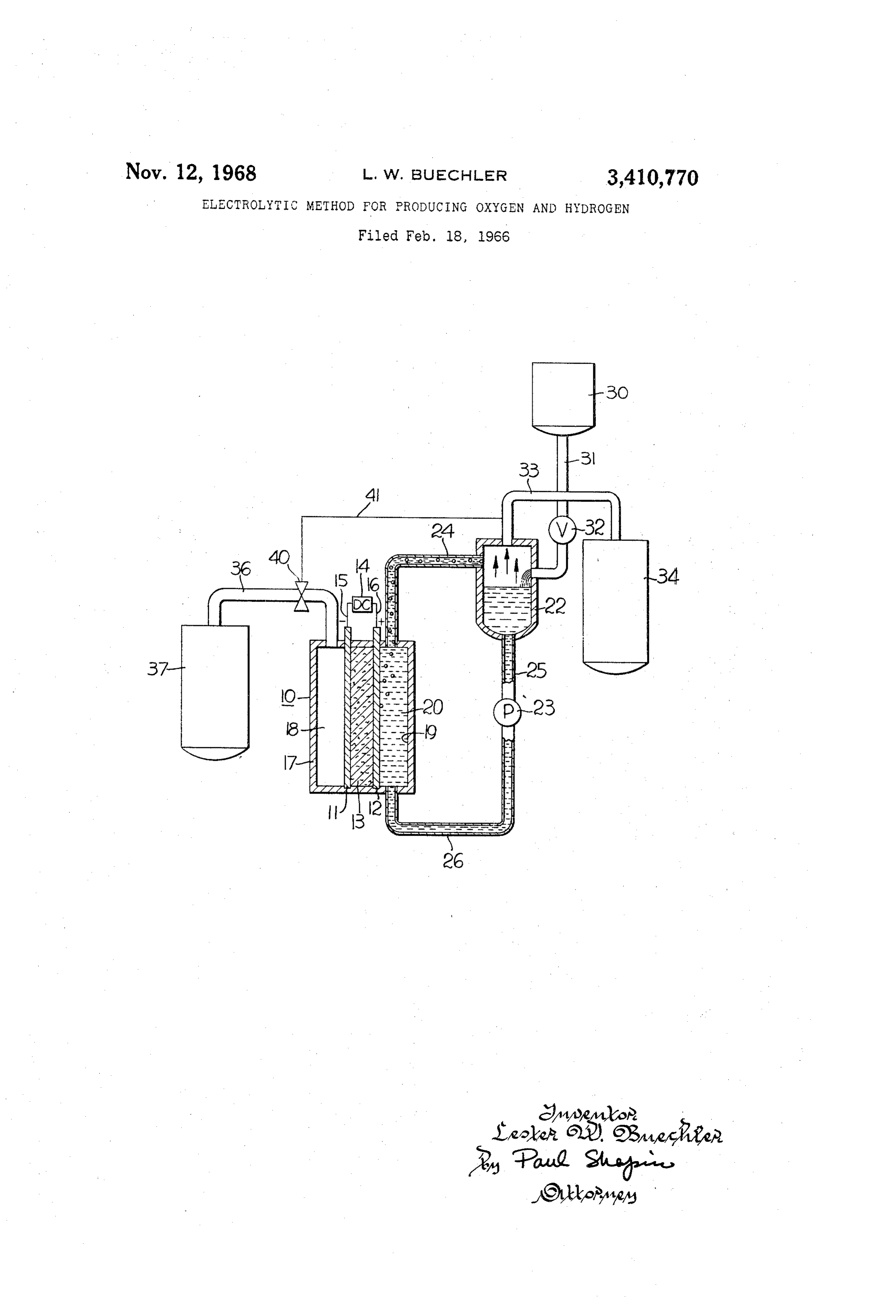
Sumed from the electrolyte matrix between the electrodes The figure illustrates, in schematic cross section, one is replaced by circulating fresh electrolyte through the embodiment of a unit cell of the present invention. electrolyte chamber causing it to diffuse through the hy 20 Referring now to the accompanying figure, the cell drogen producing electrode. The hydrogen gas must be 10 comprises a pair of gas permeable electrodes, cathode separated from the circulating electrolyte. Oxygen pres 11 and anode 12 in direct contact with the opposite sur Sure is controlled within the gas chamber to maintain faces of electrolyte matrix 13 saturated with an aqueous a pressure differential across the cell to prevent electrolyte electrolyte and connected to a source of DC potential 14 from diffusing into the gas chamber. by leads 15, 16. Electrolyte matrix 13 is a porous dia phragm of asbestos fibers or other material which is re
unania sistant to attack by caustic alkali solution or other elec
This invention relates to improvements in process and trolyte. The relative thickness of the electrodes 11, 12 apparatus for effecting electrolysis. More particularly, and the matrix 13 as shown in the figure have been exag the present invention relates to an electrolytic cell appa 30 gerated for the purposes of clarity in the description. Ac ratus for the production of oxygen and hydrogen from tually in the preferred form, the electrodes and matrix aqueous electrolyte solutions. may be but a few mils in thickness, the dimension not In the electrolysis of Water for the production of hy being critical. The electrodes 11 and 12 and electrolyte drogen and oxygen, a direct current is passed through matrix 13 are supported in housing 17, which forms a gas an aqueous electrolyte, usually a solution of caustic soda 35 chamber 18 with the cathode 11 and an electrolyte cham or caustic potash. Hydrogen is deposited at the cathode ber 19 with the anode 12. Aqueous electrolyte 20 is con or negative electrode and oxygen at the anode or positive tained in the electrolyte chamber 19. electrode. A particularly suitable electrolytic cell for the The electrolyte matrix 13 saturated with the aqueous electrolysis of water is the bipolar or filter press type. electrolyte serves a dual function. The matrix 13 main This type of cell consists of a plurality of thin porous 40 tains intimate contact between the interface of the elec electrodes separated by a porous diaphragm, usually of trolyte and the gas permeable electrodes 11 and 12 and asbestos, which separates the oxygen from the accom also serves as a gas barrier to prevent mixing of the gas panying hydrogen produced at the electrodes. Electrolyte products.
is continuously circulated to each of the electrodes to re Electrolyte is supplied to the cell by the circulation of plenish the solution consumed by electrolysis, and to 45 electrolyte solution from separator 22 to electrolyte maintain the electrolyte an optimum concentration, i.e., chamber 19 by means of pump 23 through lines 24, 25 between about 15 to about 45 percent potassium or so and 26. The gas generated at the electrode 12 adjacent dium hydroxide. The hydrogen and oxygen gas produced the electrolyte chamber 19 is removed from the electro by the electrolytic cell move through the electrodes and lyte chamber entrained in the circulating electrolyte escape freely from the back side of the electrodes and 50 solution. -- . During the operation of the cell, the electrolyte solution are evolved into the electrolyte solution and are there after disentrained from the circulating electrolyte solu 20 impelled by the driving force of the gas bubbles present tion by suitable separators. in it is forced from the electrolyte chamber 19 through Electrolytic cells of this type are highly advantageous conduit means 24 and passed to electrolyte separator 22 as they are of a relatively compact structure and require wherein the gas produced at the electrode 12 and entrained less space for an equivalent productive capacity espe in the electrolyte solution 20 is extracted and separated cially when compared to the tank type electrolytic cell. from the circulating electrolyte solution. Design details A drawback in the use of the bipolar electrolysis cells for the separators 22 are not shown, as separators of this nature are well known in the art. Water consumed by just described is the requirement of dual systems for the electrolysis is replaced by means of water Storage means supply of electrolyte to the electrodes of the cell, and the 60 separation of gas from the electrolyte which add to the 30 from which water is fed in controlled amounts to bulk and cost of the cells. separator 22 via conduit 31 to maintain the electrolyte In accordance with the present invention, there is pro at optimum concentration. Valve 32 regulates the addi vided a bipolar electrolysis cell for the production of tion of water to the electrolyte solution in separator 22 at a rate determined to replace the water consumed by hydrogen and oxygen having a unitary circulatory and 65 electrolysis.
separation system for the cell electrolyte and gaseous product which comprises a pair of porous electrodes The gas produced at electrode 12 is withdrawn over separated by and in contact with an electrolyte matrix The head from the separator via line 33 to storage means 34. saturated with an aqueous electrolyte. Aqueous electro degassed electrolyte passes out of the separator 22 lyte is circulated through an electrolyte chamber adjacent 70 via conduit means 25 to pump 23 wherein it is directed to a first porous electrode. Gas generated at the first elec via conduit means 26 back to the electrolyte chamber 19. trode is evolved into the circulating electrolyte. Gas gen The gas generated at electrode 11 is evolved into gas
Page 3
chamber 18 and the chamber maintained under pressure As an illustration of the invention, a 25 percent KOH by regulating the passage of gas out of the chamber. solution was electrolyzed in a module comprised of 70 The gas that is removed from gas chamber 18 is passed individual cells of the type illustrated in the figure to by conduit 36 into storage means 37. When a DC elec generate about 3.0 lbs./hr. oxygen and 0.38 lb./hr. hy trode potential is initially applied to the apparatus at drogen by impressing a DC voltage across the electrodes cathode 11 and anode 12, gas generated at the electrode of the module utilizing a conventional DC power supply. 11 is collected in chamber 18 until the pressure of the Power was delivered at 65 amperes at 110 volts to the gas in the chamber 18 exceeds the pressure of the gas module. The cell electrodes were comprised of sintered generated at the electrode 12. This occurs in a relatively porous nickel electrodes having a porosity of 80 percent short time interval and if any electrolyte is present in and separated by and in contact with an asbestos matrix
chamber 18 it will be forced through the capillary matrix saturated with 25 percent KOH solution. The electrodes to chamber 19. were of circular design and had a diameter of 7% inches A differential pressure control valve means 40 on con and a thickness of 0.028 inch. The cell was operated at duit 36 maintains a preset pressure differential between a temperature of 180° F. and a pressure of 300 p.s. i. A the gas pressure in gas chamber 18 and the pressure of 5 pressure differential of 1-2 p.s. i. was maintained across the gas withdrawn from the separator 22 which is moni the cell. Oxygen gas was removed at the anode at ambient tored to the valve 40 by the conduit 41. As the pressure pressure from a 25 percent KOH solution which was cir of the gas produced at electrode 12 is raised or lowered, culated through the electrolyte chamber adjacent to the the valve 40 opens or closes in response to this pressure anode by the action of the evolving oxygen. to provide an increase or decrease in the pressure of the 20 The embodiments of the invention in which an ex gas in chamber 18 so as to maintain a constant differen clusive property or privilege is claimed are defined as tial pressure across the cell, and avoid leakage of elec follows:
trolyte solution through the matrix 13 to chamber 18. A I claim:
differential pressure across the cell of about A to 10 1. A method for producing hydrogen and oxygen by p.s. i. is sufficient and a differential pressure of about 1-2 25 the electrolysis of water in a bipolar cell comprising a p.s. i. is preferred. In this manner, the electrolyte in the housing enclosing a first and second porous electrode electrolyte matrix 13 adjacent electrode 11 is constantly spaced by an electrolyte matrix saturated with an aqueous replenished with electrolyte solution. Since the gas pro electrolyte, a gas chamber defined between said first elec duced at electrode 11 is not entrained in electrolyte, the trode and said housing, and an electrolyte chamber de need for a separator unit to disentrain gas from electro 30 fined between said second electrode and said housing, the lyte is eliminated. steps comprising:
The electrodes used in the electrolysis cell of the pres applying a direct current electrical potential to said ent invention must be porous so that the gas products electrodes whereby the water in the electrolyte is produced thereon may be removed therefrom and allow dissociated to produce hydrogen gas at one electrode fresh electrolyte solution to diffuse through the electrolyte 35 and oxygen gas at the other electrode, each of Said matrix. Preferably, the electrodes employed in the elec gases diffusing through the respective electrodes to trolysis cells of the present invention are sintered nickel the respective chambers adjacent thereto; electrodes having a porosity of about 80 percent. If de maintaining the gas generated at the first electrode sired, the electrodes and especially the porous electrode within said gas chamber at a sufficient pressure to used for the generation of hydrogen may be catalyzed 40 prevent electrolyte from diffusing into said gas by a deposit on the electrode surface of platinum, iridium, chamber;
palladium, rhodium and other metals chosen from Group exhausting and collecting excess gas from said gas VIII of the Periodic Table. chamber;
The electrolyte matrix is preferably a fibrous material circulating fresh aqueous electrolyte through said elec having a high capillary potential higher than either elec trolyte chamber causing a first portion of said fresh trode 11 or 12. Such fibrous material can be spun fibrous electrolyte to diffuse through the second electrode polypropylene, or asbestos, asbestos being the preferred to replenish the aqueous electroltye consumed within fibrous material. After assembly, electrolyte matrix 13 is the electrolyte matrix;
compressed against the electrodes 11, 12 in sealing en exhausting the second portion of said fresh electrolyte gagement. and the gas produced at said second electrode from An electrolyte 20 is carried by electrolyte matrix 13. 50 said electrolyte chamber; and Suitable electrolytes include the aqueous solutions of in removing the gas from said second portion of fresh organic acids such as sulfuric acid, or bases such as alkali electrolyte.
hydroxides, and their salts. 2. The method for producing hydrogen and oxygen Concentrations of electrolyte vary according to the according to claim 1 wherein hydrogen is produced at Specific electrolyte employed. Electrolyte solutions con 55 said first electrode and oxygen is produced at said second taining 15 to 45 percent by weight of an alkali hydroxide electrode.
Such as sodium or potassium hydroxide are preferred. 3. The method for producing hydrogen and oxygen The electrolysis cells may be operated at temperatures according to claim 1 whereby the pressure maintained in ranging from 0 to 250 F. Operating temperatures of said gas chamber is sufficient to provide a pressure differ 140 to 180° F. are preferred when electrolyte solutions 60 ential across the cell of about 1-2 p.s.i. containing alkali hydroxides are employed.
The electrolysis cells may be operated at ambient or References Cited elevated pressures, but at whatever pressure employed, a UNITED STATES PATENTS pressure differential of about 4-10 p.s.i. must be main tained across the cell to prevent excess leakage of elec 65 1,588,214 6/1926 Walsh ------------- 204-129 trolyte through the porous electrode adjacent to the gas 3,017,338 1/1962. Butler et al. -------- 204-129 chamber. 3,057,794 10/1962 Carlin ----------- 204-252 As is obvious to one skilled in the art, a multicellular 3,313,718 4/1967 Bloch ---------- 204-129 XR apparatus comprised of a plurality of the unit cells of 3,316,163 4/1967 Oser -------------- 204-129 the present invention may be connected in series and 70 FOREIGN PATENTS clamped into a compressed face-to-face relationship along a common axis to form a module or stack of cells. In 1,386,878 12/1964 France.
commercial applications such assemblies are preferred for efficient, quantitative production of hydrogen and JOHN H. MACK, Primary Examiner. OXygen. 5
D. ROBERT JORDAN, Assistant Examiner.
Provenance
- Collection
- Cited prior art
- Original PDF
- patentimages.storage.googleapis.com →
- Filed
- 1966-02-18
- Pages
- 3
- Method
- pdftotext (the PDF's own text layer) + pdftoppm 300dpi page scans
- Source
- Google Patents bibliographic record
- Granted
- 1968-11-12
- Inventors
- Lester W Buechler; Allis Chalmers Corp
- Transcribed from
- patentimages.storage.googleapis.com →