patent · US1588214
Production of gas by electrolysis
8 June 1926
Page 1
Drawing sheet — no readable text.
Page 2
Drawing sheet — no readable text.
Page 3
Patented June 8, 1926. 1,588,214
ROBERT L. WALSH, OF SACRANIENTO, CALIFORNIA.
PRODUCTION OF CAS BY ELECTROLYSIS.
Application filed June 29, 1921. Serial No. 481,311.
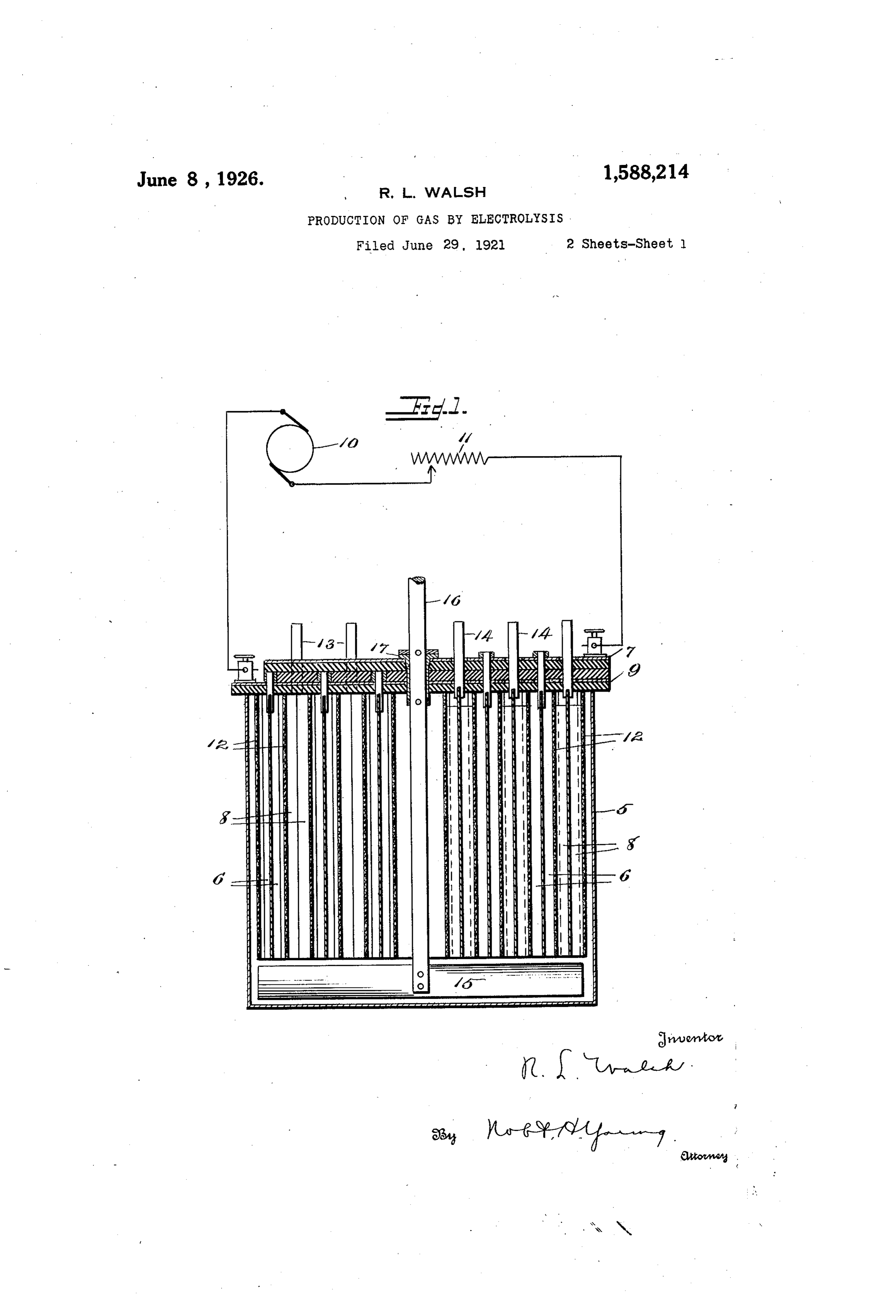
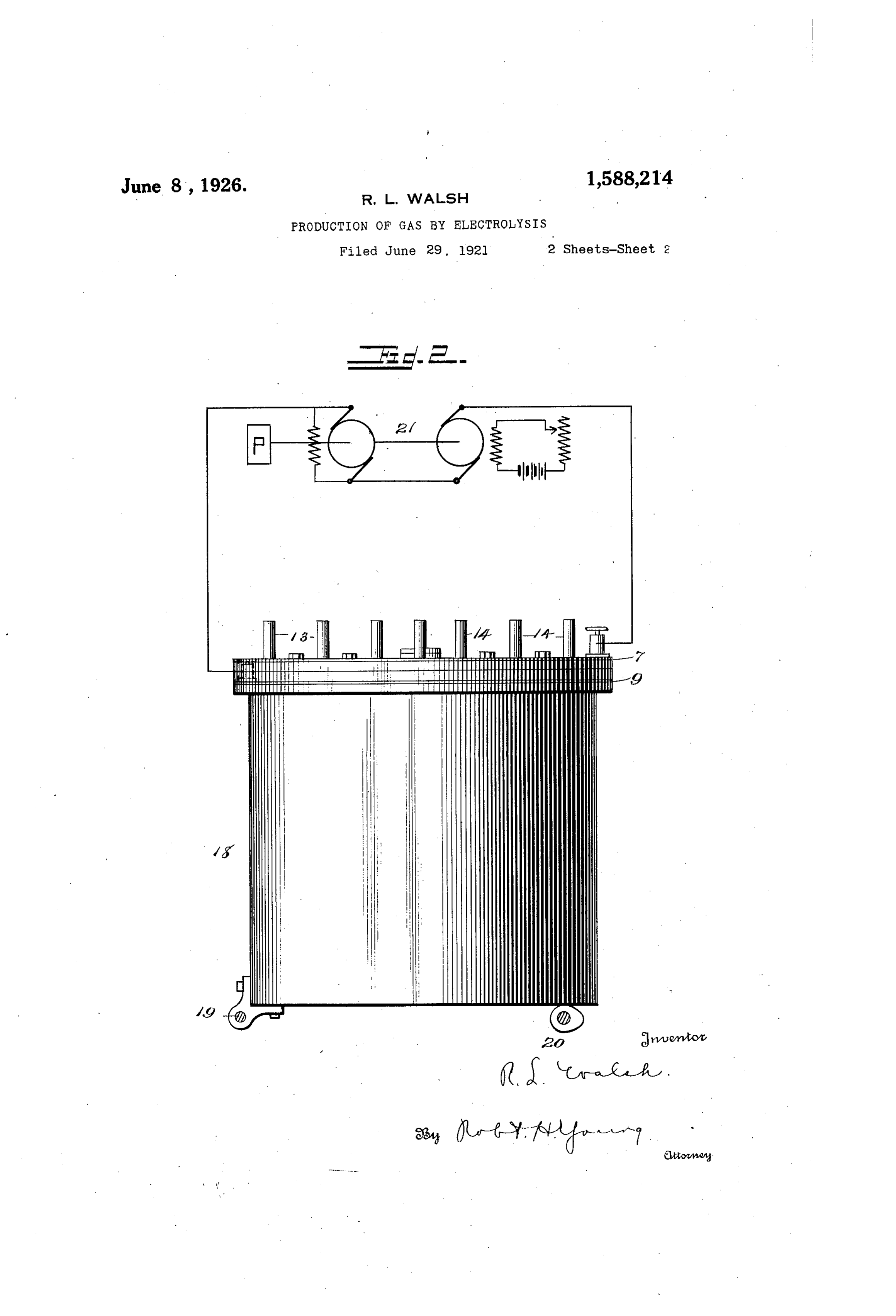
This invention relates to the production pear as the following specific description 55 of gas by electrolysis of a chemical com is read in connection with the accompany pound in liquid form or in solution. ing drawing, in which: While this is the broad application of Figure 1 is a vertical section through an the inventive idea, it is contemplated spe electrolytic cell for the decomposition of cifically as applied to the production of hy Water and constructed in accordance with 60 drogen and oxygen by decomposition of the present invention, showing convenient Water. m . means for depolarizing the electrodes me The primary object in view is to increase chanically 10 the gas output of any given electrolytic cell density; and and for varying the current of this type and thereby render it more effi Figure 2 is a side elevation of a cell hav 'cient. ing modified depolarizing and current vary Heretofore, the efficiency of electrolytic ling means.
cells has been reduced by polarization of the In Figure 1 of the drawing, one form of 5 electrodes. The accumulation of gas bubbles apparatus for carrying out the new method on the electrodes has increased the resist of electrolysis is disclosed. I do not want ance of the circuit to such an extent that to be restricted to the use of this particular the current density has been lowered very apparatus, however. The requirements of materially. Since the rate of evolution of practice may necessitate the adoption of 20 gas is proportional to the current density, Some other apparatus. Another form is this reduction in amperage has meant suggested in Figure 2. s choking of the cell and lowering of the gas Referring to Figure 1, the cell in this in output. stance includes a fluid-tight casing 5 which The necessity of preventing polarization is intended to be stationarily mounted. 25 has long been realized, the object being to Since no novelty resides in the specific con permit continuous and uninterrupted activ struction of electrodes or the supporting Rn ity of the cell. It has been proposed to means therefor, these details will be de depolarize primary and secondary batteries scribed only in broad terms. The anodes 6 and various types of electrolytic cells by are electrically connected with the bus bar 30 mechanically removing the film of gas bub 7, whereas the cathodes 8 are connected elec bles from the electrode faces as fast as it trically with the bus bar 9. The bus bars SS forms. Such treatment has been intended 7 and 9 are properly insulated and are con to keep the resistance down to a minimum nected in circuit with a source of current. and thereby prevent interruption of elec such as the generator 10, which is conven 35 trolytic action. That is evidently the extent tionally represented. The current density of purpose in each instance. may be varied at will by means of a rheo 90 I propose to advance a step further in stat 11 connected in the circuit. In accord the art by effecting depolarization and at ance with the usual practice, sheets 12 of the same time increasing the current den asbestos or other suitable material separate 40 sity positively and through a wide range the anodes from adjoining cathodes to pre for the express purpose of multiplying the vent mixing of the gaseous constituents of 95 output of gas. I am not aware of any prior the electrolyte during evolution. A series method which involves positive manipula of tubes 13 and 14 respectively are provided tion of the current density. Therefore, the for conducting off the oxygen and hydrogen 45 result sought, which is multiplied output, separately from the anodes and cathodes. seems to be entirely new. m In this instance depolarization is accom 00 An ultimate object of the invention is to plished by producing relative motion be provide a gas producing apparatus of com tween the electrolyte and the electrodes by pact form and small size, capable of instal agitating the electrolyte. For this purpose lation on a field truck, which is capable of an agitating vane 15 is mounted within the 05 generating the gas output which now re cell casing upon a rotatable shaft 16. This quires the use of an enormous stationary shaft is journaled in a bearing 17 disposed plant. in the cover of the casing. The bearing is Other objects of the invention may ap insulated from the bus bars in convenient
Page 4
manner. The shaft may be driven by any cubic feet per kilowatt hour, when operat suitable prime mover such as an electric mo ing with a voltage of 1.69 and an amperage tor (not shown). of 591.71--, but the polarization increases The apparatus just described, while in the internal resistance of the cell and auto tended primarily for use in the production matically reduces the amperage. There 55 of hydrogen and oxygen by electrolysis of fore, the theoretical results are not obtain water, can be used in the generation of able under those conditions.
other gases by decomposition of compounds I have found, however, that, by mechan containing the same. ically depolarizing the cell and at the same O Before describing the operation of the ap time increasing the current density, much 60 paratus in carrying out the method for the more satisfactory results will be obtained. production of any particular gas, or gases, For instance, with a voltage of 3.0 and an the mechanical construction of a modified amperage of 800, 12 to 15 cubic feet of gas form of apparatus will be disclosed. This will be produced per kilowatt hour. In 65 modification is illustrated diagrammatically fact, I have discovered that multiplication in Figure 2. In this instance, the electro of the current density to ten times that pos lytic cell 18 is pivoted by trunnions 19 for sible in a polarized cell results in the pro Oscillation by means of a motor or other duction of approximately ten times the gas convenient prime mover (not shown) output, when depolarization is performed 70
through the medium of cam 20. Relative simultaneously with such increase of the motion between electrolyte and electrodes annperage.
may be accomplished in this alternative From the foregoing, it should be apparent manner without having to extend a moving that, by the employment of my improved part through the cell casing, as is required method, one cell can give the output of ten 25 in the apparatus of Figure 1. Also, in cells as heretofore worked. That means stead of the simple electric generator and that a series of cells necessary for a cer rheostat shown in Figure 1, the current may tain desired gas output will occupy one be supplied and regulated in the modified tenth of the space usually required. This apparatus by the regulating booster set 21. advantage is certainly most important when 80 s an example of the way in which the the installation of gas producing cells in method may be carried out in either form of small buildings, or rooms, and in trucks or apparatus disclosed, or in some other suit railroad cars, is considered. Numerous able apparatus, the electrolysis of water other advantages, such as reduced cost of will be considered. First, however, the old apparatus for a given project, reduction in 85 method upon which the present invention the personnel required to operate the ap is an improvement will be discussed for paratus, etc., should also be evident to per the purpose of comparison with the theoret sons working in this art.
ical results obtainable and with the im The What is claimed is:
proved method and its results. method of producing gas by decom 40 It is only necessary to consider a single position of a chemical compound which 90 cell in the example. Multiplication of the consists in applying an electric current to number of cells merely represents propor the compound through a plurality of elec tional multiplication of the current factors, trodes to release the gaseous constituent, output, etc. One like that shown in Fig simultaneously washing the surfaces of the
ure 1, when operating as a caustic soda cell electrodes to depolarize the same, and reg 95 (10% solution) without depolarization and ulating the current density of the electric with a current density of 400 amperes and circuit.
an E. M. F. Of 2.5 volts, gives a gas output In testimony whereof...I affix my signature. of 5.2 to 7 cubic feet per kilowatt hour.
Theoretically, this same cell should give 9.3 ROBERT L. WALSH.
Provenance
- Collection
- Cited prior art
- Original PDF
- patentimages.storage.googleapis.com →
- Filed
- 1921-06-29
- Pages
- 4
- Method
- pdftotext (the PDF's own text layer) + pdftoppm 300dpi page scans
- Source
- Google Patents bibliographic record
- Granted
- 1926-06-08
- Inventors
- Robert L Walsh
- Transcribed from
- patentimages.storage.googleapis.com →