patent · US3407122
Solar still with a cassegranian optical system
22 October 1968
Page 1
Drawing sheet — no readable text.
Page 2
United States Patent Office 3,407,122 Patented Oct. 22, 1968
accomplished by providing a light weight solar furnace 3,407,122 which is highly mobile and which is adapted for process SOLAR STELL WITH A CASSEGRANIAN ing lunar materials in place.
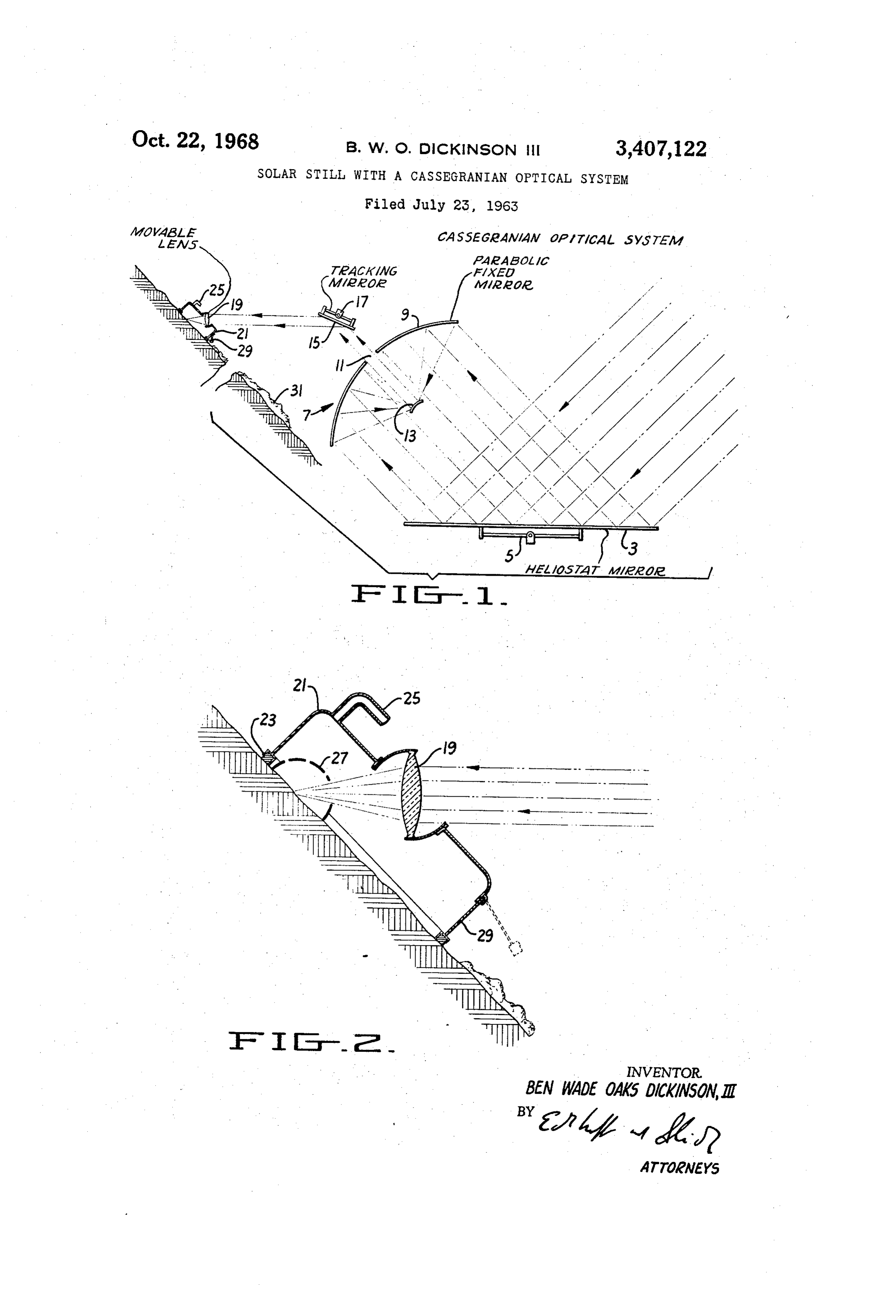
OPTICAL SYSTEM In the drawings forming a part of this application: Ben Wade Oakes Dickinson III, San Francisco, Calif., as FIGURE 1 is a schematic diagram of an embodiment signor, by mesne assignments, to Bechtel International of the present invention.
Corporation, San Francisco, Calif., a corporation of
Delaware FIGURE 2 is an enlarged diagram of the collection Filed July 23, 1963, Ser. No. 297,048 chamber shown in FIGURE 1.
2 Claims. (Cl. 202-83) Referring now to the drawings by reference characters, 10 there is shown in the drawings a main flat heliostat mirror
This invention relates to a process for extracting water 3 supported by a gimbal assembly 5 so that the mirror and other chemicals from rocks under vacuum conditions can be moved in two degrees of freedom. Mounted ad utilizing the sun as the principal source of energy. The jacent to the heliostat is a Cassegranian optical system, invention is particularly applicable to a process for re generally designated 7, which comprises a parabolic fixed covering water and other chemicals from the moon or 5 mirror 9 having a central aperture 11 therein and a small similar bodies which are substantially lacking in atmos convex mirror 13. The light beam from the Cassegranian phere. system is reflected by a small tracking mirror 15 mounted It has been estimated by the National Aeronautics and on a gimbal assembly 17 from which the beam is re Space Administration that the cost of transporting mate flected to a movable lens 19. The lens 19 is mounted in rials to the moon will be on the order of $4,000 to $5,000 20 a collection chamber 21. The collection chamber 21 may per pound, so that it is essential to provide some method be provided with a vapor-tight seal 23 and an effluent of extracting water and other chemicals from the moon conduit 25. As will be apparent later, the vapor-tight seal to avoid this expense. Furthermore, it has been estimated 23 and conduit 25 are necessary only when the direct by the National Aeronautics and Space Administration process is used; these parts can be eliminated when the that initially it will cost $60,000 to $100,000 per man 25 indirect process is used. The chamber also contains a hour for labor on the moon, so it is further essential that radiation heat trap 27 and is preferably provided with an any equipment not only be light in weight but also that automatic trap door 29 for removal of waste material, its operation be as simple as possible and that it have as at 31. It is contemplated that in one practical embodi minimum maintenance requirements. ment of the later described device, the main heliostat Since the percentage of water in lunar rocks is prob 30 mirror will be about 45 feet in diameter and the Cas ably low, the system must be capable of processing large segranian optical system will produce a light beam of quantities of material. It is also desirable that the mate about 1 foot in diameter.
rial be treated in place to avoid the handling of large Various means can be used for supporting the collec quantities of low grade ore and that lunar gravity be tion chamber on a slope or outcropping and for moving employed for the removal of waste material. Additionally, 35 it slowly over the surface of the rock. For instance, it is desirable that any system be adaptable for a wide pulleys can be provided at each end of the horizontal range of conditions since at the present time the exact traverse and at the top of the slope so that the chamber characteristics of lunar materials are unknown. can be moved vertically and horizontally by adjusting the Additionally, it is highly desirable that the sun be used cable system. For moderate slopes, a beam resting against as a principal source of energy for operating such a sys 40 the slope with wheels or treads at its bottom can be used tem, since if a nuclear chemical or other source were to support and move the chamber. When the device is used, it would involve the transportation of fuel material used on steep cliffs, the chamber can be supported from to the moon, probably require the transporting of the low a single point near the top of the cliff and swung like a grade ore to a processing station, probably increase the 45 pendulum through a long radius of arc. Although the mass of the system thereby limiting the mobility of the process is preferably carried out on a slope so that gravity device, and might induce radioactivity in the product and can be used to remove waste material, it can also be con waste material. ducted on flat ground.
The present invention envisions two modes of oper The waste product will be a hard, glass-like material ation. The first mode, termed hereinafter the Direct Proc 50 which is much harder and which has a higher melting ess, provides a unique method for extracting water from point than the original rock. If such glass covers rock rock. The second mode, termed hereinafter the Indirect from which water is to be extracted, the glass must be Process, makes use of inherent chemical properties to removed to provide a clean surface for the next pass. produce a stable, vacuum-storable intermediate product The glass can be cracked by passing a heavy pronged enriched in water content. This solid intermediate can be ball over the surface, or it can be cracked by natural or treated in a subsequent step to release either water as 55 forced cooling, or it can be cracked by differential thermal such or to release the oxygen and hydrogen separately. expansion promoted by using the present invention as a It is therefore an object of the present invention to pulse heater at selected spots. In any case, since the device provide a method of extracting water and other chemicals is preferably used on a relatively steep slope, lunar gravity from lunar materials. can be used to remove the broken glass either by moving Another object of this invention is to provide for such 60 the collection chamber or by withdrawing the material a recovery system utilizing the Sun as a principal heat through the trap door 29.
SOCC. Two modes of operation, the aforementioned direct Still another object of this invention is to provide a and indirect processes can be effected when utilizing the system for extracting water and chemicals which does not 65 present invention for water or chemical recovery. involve the transportation of raw materials. In the direct process the maximum temperature devel Still another object of this invention is to provide an oped at the hot spot is maintained at a temperature in extraction system which is light in weight and which will excess of 1200° C. The desired temperature can be main operate with a minimum of maintenance difficulty. tained by varying the speed at which the beam of light is Other objects will be apparent from the specification moved over the surface. At this temperature about 90% which follows. of the water contained is released from most volcanic In general, the objects of the present invention are rocks. There will be some losses due to mirror reflectivity
Page 3
loss, mirror geometrical imperfections, radiation from the rock face. In this system, the hot spot is moved across the hot rock, and thermal diffusion into the rock mass. Assum slope face continuously while removing the water-bearing ing that each mirror has a reflectivity of 0.8, a 50% geom product from a shallow, narrow strip. After the water has etry loss, a 50% diffusion loss, and a vapor recovery effi been removed from the surface material, the depleted sur ciency of 67%, a system utilizing a heliostat of 45 feet in 5 face will be in the form of a hard, glassy material, as de diameter operating on rock containing 1% water would scribed above, which must be removed before another pass produce 0.4 lb. of free water per hour or, operating on is made over the same area.
rock having a water content of only 0.1%, would produce I claim:
0.04 lb. of water per hour. In the direct process, the water 1. Apparatus for recovering water and valuable chemi vapor would be removed through the conduit 25 and sent 0. cals from lunar and similar surfaces comprising in com to a suitable water condensation and storage apparatus. If bination:
the direct process is used, it is highly desirable to use a (a) a chamber having an open bottom adapted to be labyrinth seal 23 to prevent water loss and thus increase moved over a surface to be treated, the efficiency. (b) sealing means around the bottom of said chamber, Experiments using an electron beam furnace as a Source (c) a Cassegranian optical system for concentrating the of heat in a vacuum have shown that ordinary basalt rock, Sun's rays on a small area within said chamber, when heated to a temperature of 1600 to 1700° C. melts (d) a trap door structure for removing waste solid ma with an effluent vapor which condenses on the walls of a terial from said chamber and cooled vessel to a white powdery substance. An exact (e) means for recovering volatized material from said analysis of this material has not been made, but it is known 20 chamber.
to contain a substantial amount of water, together with 2. The apparatus of claim 1 wherein a large flat helio some sodium. This dry powder can be stored under vac stat movable in two degrees of freedom is provided to uum conditions and can be later processed by electrolysis reflect light into said Cassegranian optical system and a to produce oxygen and hydrogen, or can be processed in small flat tracking mirror movable in two degrees of free other ways to produce water as such. 25 dom is provided to receive the rays of light from said Cas Two different recovery techniques can be utilized in segranian optical system together with a movable lens to operting the equipment; either of these recovery techniques concentrate the light on the lunar surface. can be applied to the direct or the indirect process. The first technique is essentially a hole-boring operation in References Cited which the concentrated hot spot and collection System are 30 UNITED STATES PATENTS kept in one location on a slope and a hole is progressively deepened, melting the rock and allowing the waste molten 1,302,363 4/1919 Graham --------- 202-234 X rock to pour out of the hole. For flat locations a pre 1,678,711 7/1928 Shipman ------------- 88-25 drilled hole is used and the melted rock from which water 2,803,591 8/1957 Coanda ------------ 202-234
has been removed gradually fills this hole. For all applica 35 2,902,028 tions the desired products are released from the freshly 9/1959 Manly ----------- 202-234 X exposed rock at the inner end or heated portion of the FOREIGN PATENTS hole. This can be continued until adequate melting of the 974,650 1 1/1964 Great Britain. rock is prevented by the high rate of heat diffusion into 386,077 5/1963 Japan.
the exposed rock surface. 40
The second technique is applicable to situations where NORMAN YUDKOFF, Primary Examiner.
it is not desirable or possible to melt deep holes into the
Provenance
- Collection
- Cited prior art
- Original PDF
- patentimages.storage.googleapis.com →
- Filed
- 1963-07-23
- Pages
- 3
- Method
- pdftotext (the PDF's own text layer) + pdftoppm 300dpi page scans
- Source
- Google Patents bibliographic record
- Granted
- 1968-10-22
- Inventors
- Iii Ben Wade Oakes Dickinson; Bechtel International Corp
- Transcribed from
- patentimages.storage.googleapis.com →