patent · US2534533
Methods of preparing alkali metal borohydrides
19 December 1950
Page 1
Patented Dec. 19, 1950 2,534,533
UNITED STATES PATENT OFFICE
METHODS OF PREPARING ALKALI METAL
BOROHYDRDES
Hermann I. Schlesinger, Chicago, Ill., and Her bert C. Brown, Detroit, Mich.
No Drawing. Application November 5, 1945,
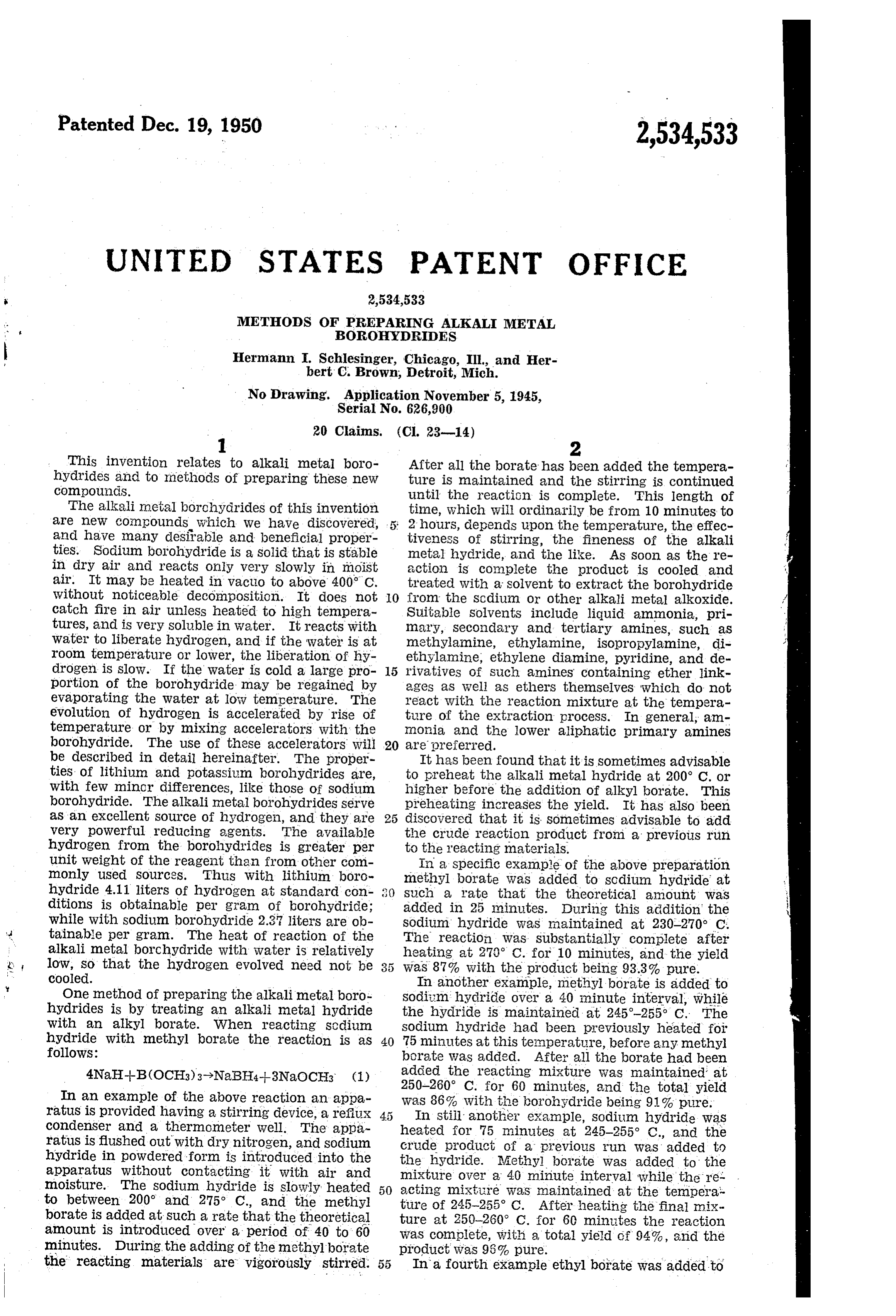
This invention relates to alkali metal boro After all the borate has been added the tempera hydrides and to methods of preparing these new ture is maintained and the stirring is continued COmpoundS. until the reaction is complete. This length of The alkali netal borohydrides of this invention time, which will ordinarily be from 10 minutes to are new compounds which we have discovered, . 5: 2 hours, depends upon the temperature, the effec and have many desirable and beneficial proper tiveness of stirring, the fineness of the alkali ties. Sodium borohydride is a solid that is stable metal hydride, and the like. As soon as the re in dry air and reacts only very slowly in moist action is complete the product is cooled and air. It may be heated in vacuo to above 400° C. treated with a solvent to extract the borohydride without noticeable decomposition. It does not 0. from the scdium or other alkali metal alkoxide. catch fire in air unless heated to high tempera Suitable solvents include liquid ammonia, pri tures, and is very soluble in water. It reacts with mary, secondary and tertiary amines, such as Water to liberate hydrogen, and if the Water is at methylamine, ethylamine, isopropylamine, di room temperature or lower, the liberation of hy ethylamine, ethylene diamine, pyridine, and de drogen is slow. If the water is cold a large pro 15 rivatives of such amines containing ether link portion of the borohydride may be regained by ages as well as ethers themselves which do not evaporating the water at low temperature. The react with the reaction mixture at the tempera evolution of hydrogen is accelerated by rise of ture of the extraction process. In general, am temperature or by mixing accelerators with the nonia, and the lower aliphatic primary amines borohydride. The use of these accelerators will 20 are preferred.
be described in detail hereinafter. The proper It has been found that it is sometimes advisable ties of lithium and potassium borohydrides are, to preheat the alkali metal hydride at 200° C. or with few mincr differences, like those of sodium higher before the addition of alkyl borate. This borohydride. The alkali metal borohydrides serve preheating increases the yield. It has also been as an excellent source of hydrogen, and they are discovered that it is sometimes advisable to add very powerful reducing agents. The available hydrogen from the borohydrides is greater per to thecrude the reaction product from a previous run reacting materials.
unit weight of the reagent than from other com In a specific example of the above preparation monly used sources. Thus with lithium boro methyl borate was added to scolium hydride at hydride 4.11 liters of hydrogen at standard con 30 such a rate that the theoretical amount was ditions is obtainable per gram of borohydride; added in 25 minutes. During this addition the while with sodium borohydride 2.37 liters are ob sodium hydride was maintained at 230-270° C. tainable per gram. The heat of reaction of the ihe reaction was substantially complete after alkali metal borchydride with water is relativelyheating at 270° C. for 10 minutes, and the yield low, so that the hydrogen evolved need not be was 87% with the product being 93.3% pure. cooled. In another example, methylborate is added to One method of preparing the alkali metal boro sodium hydride over a 40 minute interval, while hydrides is by treating an alkali metal hydride the hydride is maintained at 245-255° C. The with an alkyl borate. When reacting scdium sodium hydride had been previously heated foi hydride with methyl borate the reaction is as 40 75 minutes at this temperature, before any methyl follows: borate was added. After all the borate had been 4NaH--B(OCH3)3->NaBH4-3NaOCH3 (1) 250-260° added the reacting mixture was maintained at In an example of the above reaction an appa was 86% withC. for 60 minutes, and the total yield ratus is provided having a stirring device, a reflux the borohydride being 91% pure. In still another example, sodium hydride was condenser and a thermometer well. The appa heated for 75 minutes at 245-255° C., and the ratus is flushed out with dry nitrogen, and sodium crude product of a previous run was added to hydride in powdered form is introduced into the the hydride. Miethyl borate was added to the apparatus without contacting it with air and mixture over a 40 minute interval while the re. moisture. The sodium hydride is slowly heated 50 acting mixture was maintained at the tempera to between 200° and 275° C., and the methyl ture of 245-255° C. After heating the final mix borate is added at Such a rate that the theoretical ture at 250-260° C. for 60 minutes the reaction amount is introduced over a period of 40 to 60 was complete, with a total yield of 94%, and the minutes. During the adding of the methylborate product was 98% pure. .. . the reacting materials are vigorously stirred. 55 In a fourth example ethylborate was added to
Page 2
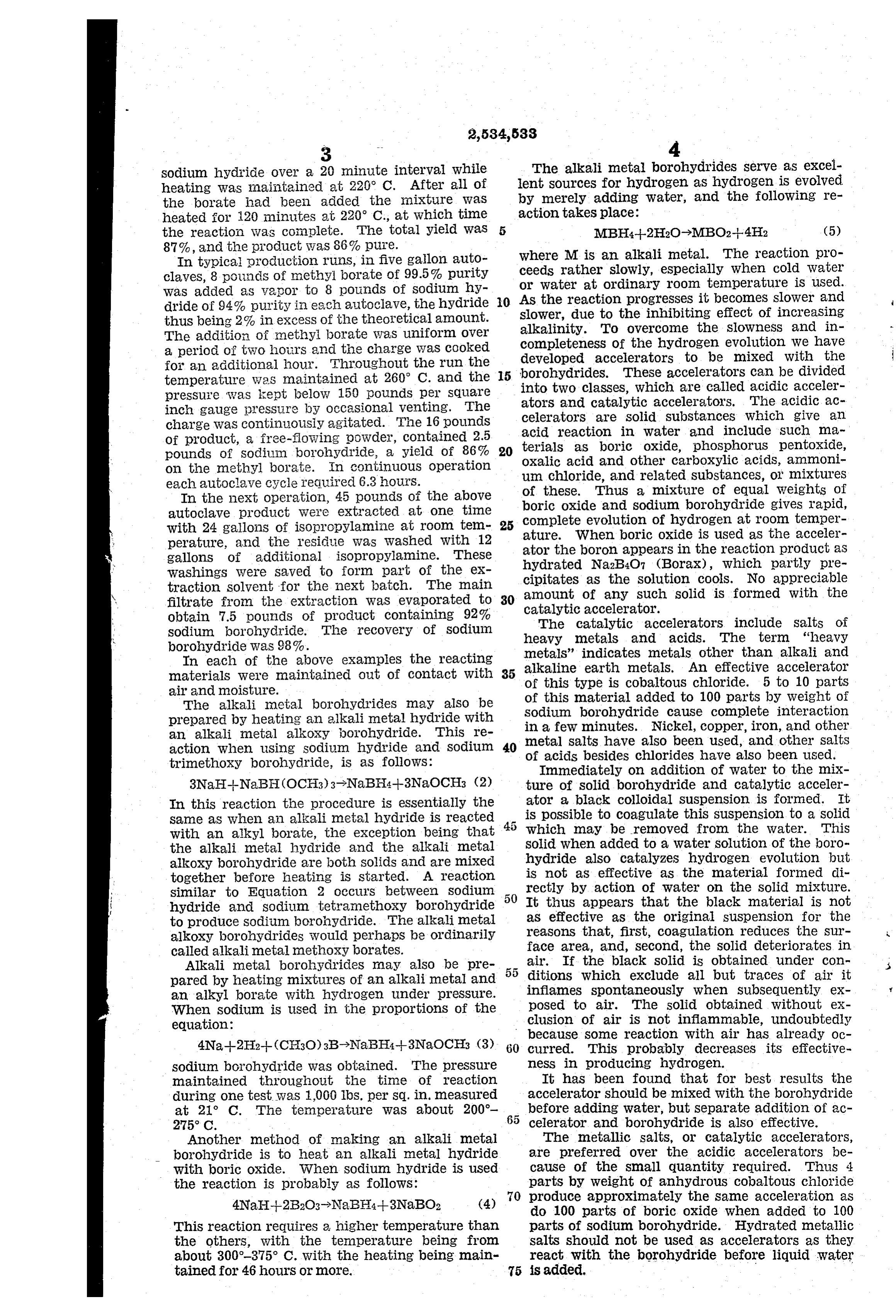
sodium hydride over a 20 minute interval while lentThe alkali metal borohydrides serve as excel sources for hydrogen as hydrogen is evolved heating was maintained at 220° C. After all of by merely the borate had been added the mixture was adding water, and the following re heated for 120 minutes at 220 C., at which time action takes place:
the reaction was coinplete. The total yield was 87%, and the product was 86% pure. where M is an alkali metal. The reaction pro In typical production runs, in five gallon auto claves, 8 pounds of methyl borate of 99.5% purity ceeds rather slowly, especially when cold Water or water at ordinary room temperature is used.
was added as vapor to 8 pounds of sodium hy dride of 94% purity in each autoclave, the hydride 0 As the reaction progresses it becomes slower and thus being 2% in excess of the theoretical amount. slower, due to the inhibiting effect of increasing alkalinity. To overcome the Slowness and in
The addition of methyl borate was uniform Over a period of two hours and the charge was cooked completeness of the hydrogen evolution. We have developed accelerators to be mixed with the for an additional hour. Throughout the run the borohydrides. These accelerators can be divided temperature was maintained at 260° C. and the 5 into two classes, which are called acidic acceler pressure was kept below 150 pounds per Square inch gauge pressure by occasional venting. The ators and catalytic accelerators. The acidic ac celerators are solid substances which give an charge was continuously agitated. The 16 pounds acid reaction in water and include Such ma of product, a free-flowing powder, contained 2.5 terials as boric oxide, phosphorus pentoxide, pounds of sodium borohydride, a yield of 86% oxalic acid
and other carboxylic acids, ammoni on the methyl borate. In continuous operation um chloride, and related substances, or mixtures each autoclave cycle required 6.3 hourS. of these. Thus a mixture of equal Weights of In the next operation, 45 pounds of the above boric oxide and sodium borohydride gives rapid, autoclave product were extracted at one time with 24 gallons of isopropylamine at room tem 25 complete evolution of hydrogen at room temper perature, and the residue was washed with 12 ator the boron boric ature. When oxide is used as the acceler appears in the reaction product as gallons of additional isopropylamine. These hydrated Na2B4O7 (Borax), which partly pre Washings were saved to form part of the ex cipitates as the solution cools. No appreciable traction solvent for the next batch. The main filtrate from the extraction was evaporated to 30 amount of any such Solid is formed with the catalytic accelerator.
obtain 7.5 pounds of product containing 92% The catalytic accelerators include Salts of sodium borohydride. The recovery of Sodium heavy metals and acids. The term “heavy borohydride Was 98%. metals' indicates metals other than alkali and In each of the above examples the reacting materials were maintained out of contact with 35 alkaline of this earth metals. An effective accelerator type is cobaltous chloride. 5 to 10 partS air and moisture. of this material added to 100 parts by weight of The alkali metal borohydrides may also be Sodium borohydride cause complete interaction prepared by heating an alkali metal hydride with in a few minutes. Nickel, copper, iron, and other an alkali metal alkoxy borohydride. This re metal salts have also been used, and other salts action when using sodium hydride and Sodium 40 of acids besides chlorides have also been used.
trimethoxy borohydride, is as follows: Immediately on addition of Water to the mix 3NaH--NaBH(OCH3)3->NaBH4--3NaOCH3 (2) ture of Solid borohydride and catalytic acceler In this reaction the procedure is essentially the ator a black colloidal Suspension is formed. It same as when an alkali metal hydride is reacted is poSSible to coagulate this suspension to a Solid with an alkyl borate, the exception being that which may be removed from the Water. This the alkali metal hydride and the alkali metal Solid when added to a Water Solution of the boro alkoxy borohydride are both solids and are mixed hydride also catalyzes hydrogen evolution but together before heating is started. A reaction is not as effective as the material formed di similar to Equation 2 occurs between sodium rectly by action of water on the Solid mixture. hydride and sodium tetramethoxy borohydride 50 It thus appears that the black material is not to produce sodium borohydride. The alkali metal as effective as the Original suspension for the alkoxy borohydrides would perhaps be ordinarily reasons that, first, coagulation reduces the Sur called alkalimetal methoxy borates. face area, and, Second, the Solid deteriorates in Alkali metal borohydrides may also be pre air. If the black solid is obtained under con pared by heating mixtures of an alkali metal and 55 inflames ditions which exclude all but traces of air it
Spontaneously when subsequently ex an alkyl borate with hydrogen under pressure.
When sodium is used in the proportions of the posed to air. The solid obtained without ex equation: clusion of air is not inflammable, undoubtedly because Some reaction with air has already oc 60 Curred. This probably decreases its effective
Sodium borohydride was obtained. The pressure neSS in producing hydrogen. maintained throughout the time of reaction It has been found that for best results the during one test was 1,000 lbs. per Sq. in, measured accelerator should be mixed with the borohydride at 21 C. The temperature was about 200 65 before adding water, but separate addition of ac 275° C. celerator and borohydride is also effective. Another method of making an alkali metal The metallic salts, or catalytic accelerators, borohydride is to heat an alkali metal hydride are preferred over the acidic accelerators be with boric oxide. When sodium hydride is used cause of the Small quantity required. Thus 4 the reaction is probably as follows: parts by Weight of anhydrous cobaltous chloride 70 produce approximately the same acceleration as do 100 parts of boric oxide when added to 100
This reaction requires a higher temperature than parts of Sodium borohydride. Hydrated metallic the others, with the temperature being from salts should not be used as accelerators as they about 300°-375° C. with the heating being main react with the borohydride before liquid water tained for 46 hours or more, 5 is added. w
Page 3
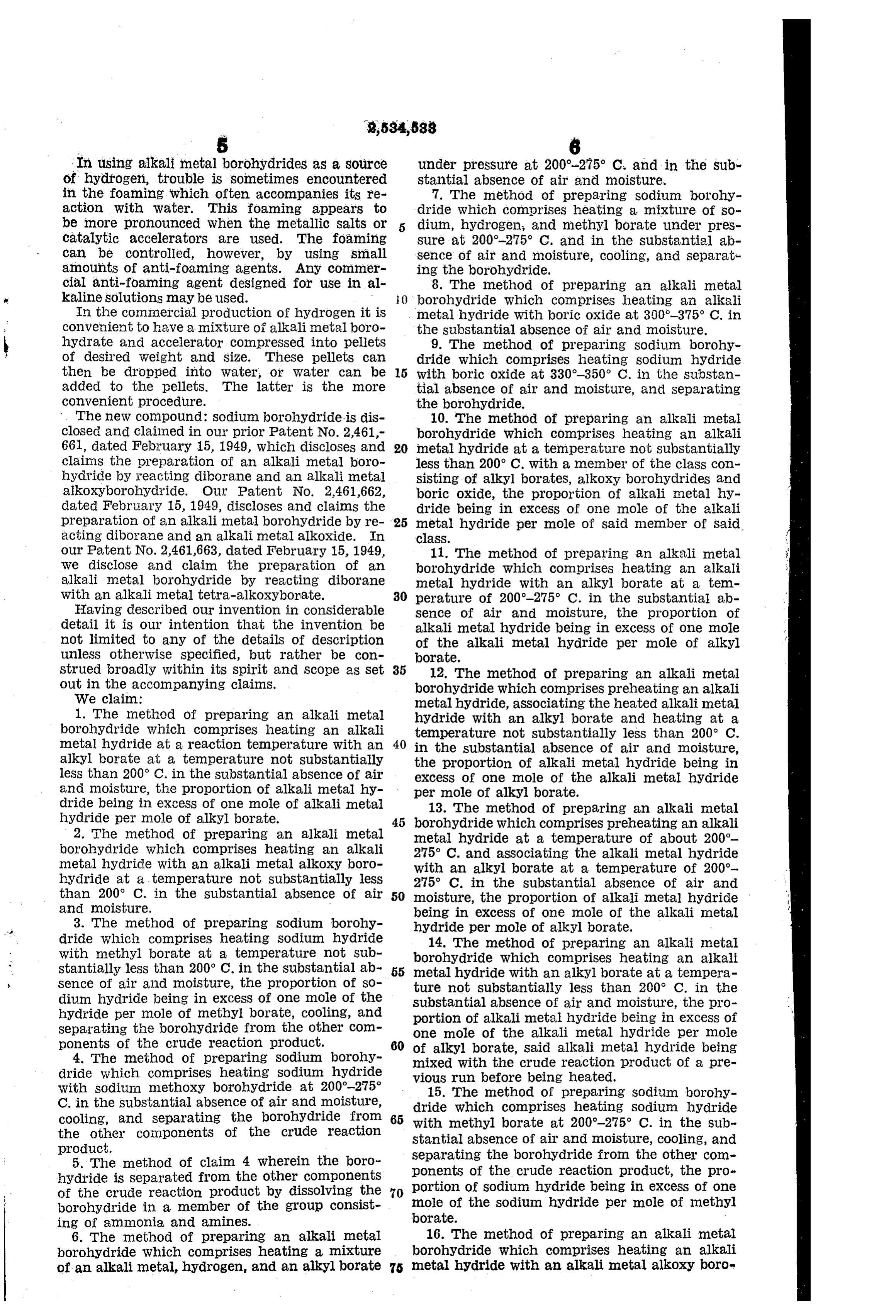
In using alkali metal borohydrides as a source under pressure at 200°-275° C. and in the sub of hydrogen, trouble is sometimes encountered stantial absence of air and moisture. in the foaming which often accompanies its re 7. The method of preparing sodium borohy action with water. This foaming appears to dride Which comprises heating a mixture of so be more pronounced when the metallic salts or dium, hydrogen, and methyl borate under pres catalytic accelerators are used. The foaming Sure at 200°-275 C. and in the substantial ab can be controlled, however, by using small Sence of air and moisture, cooling, and separat amounts of anti-foaming agents. Any commer ing the borohydride.
cial anti-foaming agent designed for use in al 8. The method of preparing an alkali metal kaline Solutions may be used. borohydride Which comprises heating an alkali In the commercial production of hydrogen it is metal hydride with boric oxide at 300°-375° C. in convenient to have a mixture of alkali metal boro the substantial absence of air and moisture. hydrate and accelerator compressed into pellets 9. The method of preparing sodium borohy of desired weight and size. These pellets can dride which comprises heating sodium hydride then be dropped into water, or water can be 5 With boric Oxide at 330-350° C. in the Substan added to the pellets. The latter is the more tial absence of air and moisture, and separating convenient procedure. the borohydride.
The new compound: sodium borohydride is dis 10. The method of preparing an alkali metal closed and claimed in our prior Patent No. 2,461 borohydride which comprises heating an alkali 661, dated February 15, 1949, which discloses and 20 metal hydride at a temperature not substantially claims the preparation of an alkali metal boro less than 200° C. With a member of the class con hydride by reacting diborane and an alkali metal sisting of alkyl borates, alkoxy borohydrides and alkoxyborohydride. Our Patent No. 2,461,662, boric oxide, the proportion of alkali metal hy dated February 15, 1949, discloses and claims the dride being in excess of one mole of the alkali preparation of an alkali metal borohydride by re 25 metal hydride per mole of said member of Said acting diborane and an alkali metal alkoxide. In class.
our Patent No. 2,461,663, dated February 15, 1949, 11. The method of preparing an alkali metal We disclose and claim the preparation of an borohydride which comprises heating an alkali alkali metal borohydride by reacting diborane metal hydride with an alkyl borate at a tem With an alkali metal tetra-alkoxyborate. 30 perature of 200°-275° C. in the Substantial ab Having described our invention in considerable Sence of air and moisture, the proportion of detail it is our intention that the invention be alkali metal hydride being in excess of one mole not limited to any of the details of description of the alkali metal hydride per mole of alkyl unleSS Otherwise Specified, but rather be con bOrate.
Strued broadly within its Spirit and Scope as set 35 12. The method of preparing an alkali metal out in the accompanying claims. borohydride which comprises preheating an alkali We Cain: metal hydride, associating the heated alkali metal 1. The method of preparing an alkali metal hydride with an alkyl borate and heating at a borohydride which comprises heating an alkali temperature not substantially less than 200° C. metal hydride at a reaction temperature with an 40 in the substantial absence of air and moisture, alkyl borate at a temperature not substantially the proportion of alkali metal hydride being in leSS than 200 C. in the substantial absence of air excess of one mole of the alkali metal hydride and moisture, the proportion of alkali metal hy per mole of alky borate.
dride being in excess of one mole of alkali metal 13. The method of preparing an alkali metal hydride per mole of alkyl borate. borohydride which comprises preheating an alkali 2. The method of preparing an alkali metal metal hydride at a temperature of about 200° borohydride which comprises heating an alkali 275° C. and associating the alkali metal hydride metal hydride With an alkali metal alkoxy boro with an alkyl borate at a temperature of 200 hydride at a temperature not substantially less 275 C. in the substantial absence of air and than 200° C. in the Substantial absence of air 50 moisture, the proportion of alkali metal hydride and moisture. - being in excess of One mole of the alkali metal 3. The method of preparing sodium borohy hydride per mole of alkyl borate. dride which comprises heating Sodium hydride 14. The method of preparing an alkali metal with methyl borate at a temperature not Sub borohydride which comprises heating an alkali stantially less than 200° C. in the substantial ab 55 metal hydride with an alkyl borate at a tempera sence of air and moisture, the proportion of SO ture not substantially less than 200° C. in the dium hydride being in excess of one mole of the Substantial absence of air and moisture, the pro hydride per mole of methyl borate, cooling, and portion of alkali metal hydride being in excess of separating the borohydride from the other com one mole of the alkali metal hydride per mole ponents of the crude reaction product. O of alkyl borate, said alkali metal hydride being 4. The method of preparing Sodium borohy mixed with the crude reaction product of a pre dride which comprises heating sodium hydride vious run before being heated. With sodium methoxy borohydride at 200-275 15. The method of preparing sodium borohy C. in the substantial absence of air and moisture, dride which comprises heating Sodium hydride cooling, and separating the borohydride from 65 with methyl borate at 200°-275° C. in the sub the other components of the crude reaction stantial absence of air and moisture, cooling, and product. separating the borohydride from the other com 5. The method of claim 4 wherein the boro ponents of the crude reaction product, the pro hydride is separated from the other components portion of Sodium hydride being in excess of one of the crude reaction product by dissolving the O borohydride in a member of the group consist mole of the Sodium hydride per mole of methyl ing of ammonia, and amines. borate.
6. The method of preparing an alkali metal 16. The method of preparing an alkali metal borohydride which comprises heating a mixture borohydride which comprises heating an alkali of an alkali metal, hydrogen, and an alkyl borate 5 metal hydride with an alkali metal alkoxy boro
Page 4
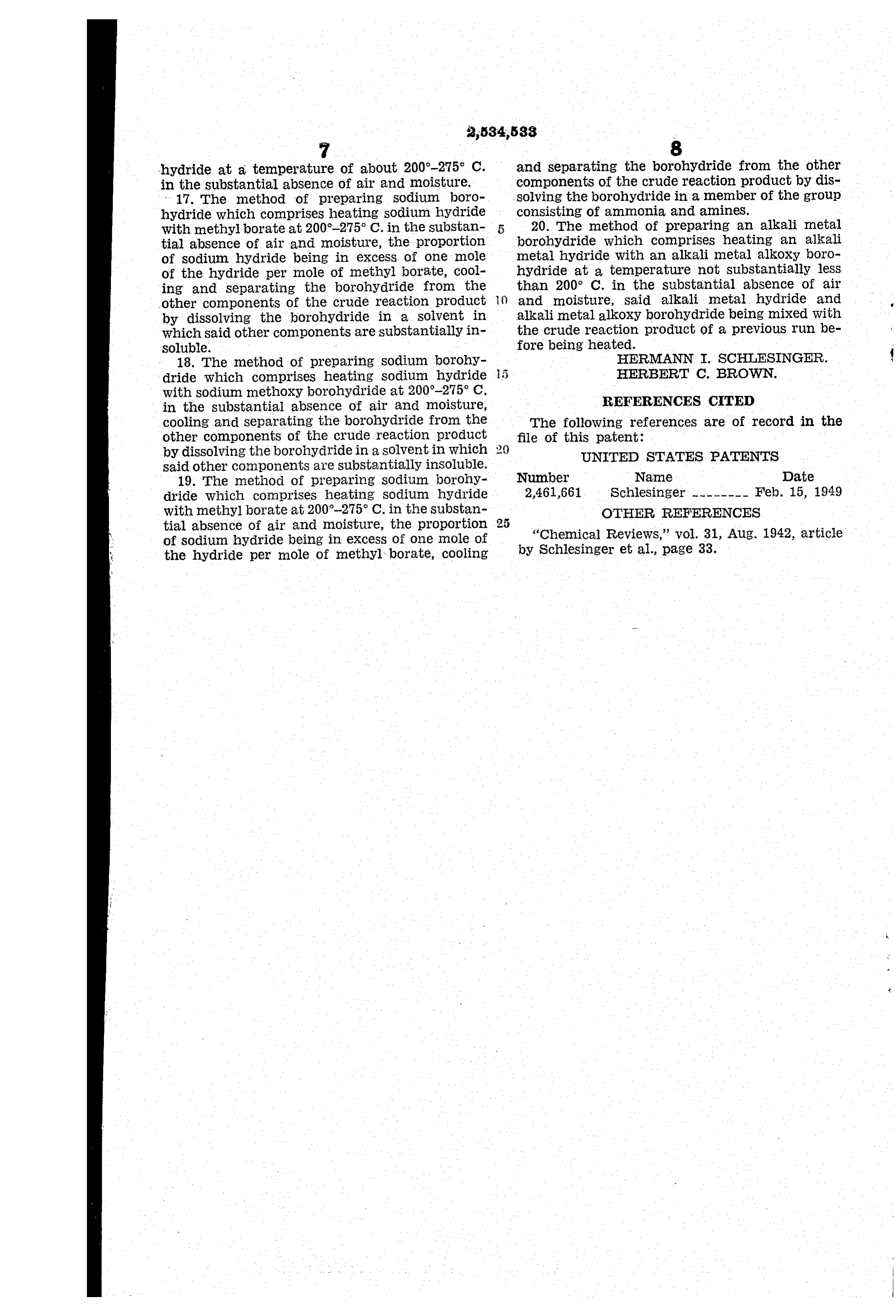
hydride at a temperature of about 200°-275° C. and separating the borohydride from the other in the substantial absence of air and moisture. components of the crude reaction product by dis i7. The method of preparing sodium boro solving the borohydride in a member of the group hydride which comprises heating sodium hydride consisting of ammonia and amines. with methylborate at 200°-275° C. in the substan 20. The method of preparing an alkali metal tial absence of air and moisture, the proportion borohydride which comprises heating an alkali of sodium hydride being in excess of one mole metal hydride with an alkali metal alkoxy boro of the hydride per mole of methyl borate, cool hydride at a temperature not substantially less ing and separating the borohydride from the than 200° C. in the substantial absence of air other components of the crude reaction product and moisture, said alkali metal hydride and by dissolving the borohydride in a solvent in alkali metal alkoxy borohydride being mixed with which said other components are substantially in the crude reaction product of a previous run be Soluble. fore being heated.
18. The method of preparing sodium borohy HERMANN I. SCHILESINGER. dride which comprises heating sodium hydride HERBERT C. BROWN. with sodium methoxy borohydride at 200°-275° C.
in the substantial absence of air and moisture, REFERENCES CTED cooling and separating the borohydride from the The following references are of record in the other components of the crude reaction product file of this patent:
by dissolving the borohydride in a solvent in which : UNITED STATES PATENTS Said other components are substantially insoluble.
19. The method of preparing sodium borohy Number Name Date dride which comprises heating Sodium hydride 2,461,661 Schlesinger -------- Feb. 15, 1949 with methyl borate at 200°-275 C. in the Substan OTHER REFERENCES tial absence of air and moisture, the proportion 25 of Sodium hydride being in excess of one mole of “Chemical Reviews,' vol. 31, Aug. 1942, article the hydride per mole of methylborate, cooling by Schlesinger et al., page 33.
Provenance
- Collection
- Cited prior art
- Original PDF
- patentimages.storage.googleapis.com →
- Filed
- 1945-11-05
- Pages
- 4
- Method
- pdftotext (the PDF's own text layer) + pdftoppm 300dpi page scans
- Source
- Google Patents bibliographic record
- Granted
- 1950-12-19
- Inventors
- Hermann I Schlesinger; Herbert C Brown
- Transcribed from
- patentimages.storage.googleapis.com →