patent · US2365330
Apparatus for electrolytically producing oxygen and hydrogen
19 December 1944
Page 1
Drawing sheet — no readable text.
Page 2
Drawing sheet — no readable text.
Page 3
Drawing sheet — no readable text.
Page 4
Patented Dec. 19, 1944
APPARATUs FoR ELECTROLYTICALLY PRO
DUCING OXYGEN AND HYDROGEN
Asa B. Carmichael, Tujunga, Calif.
Application October 11, 1941, Serial No. 414,681
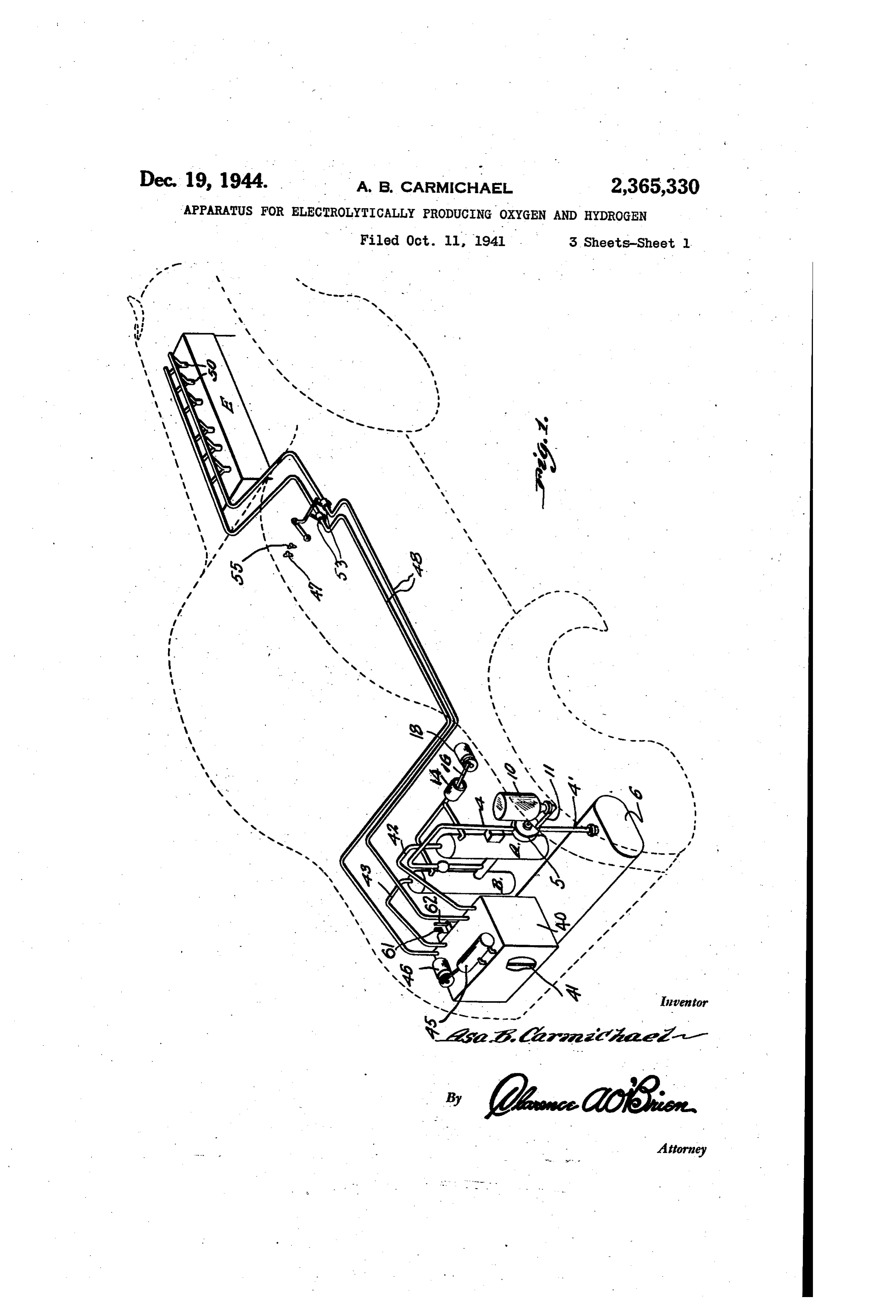
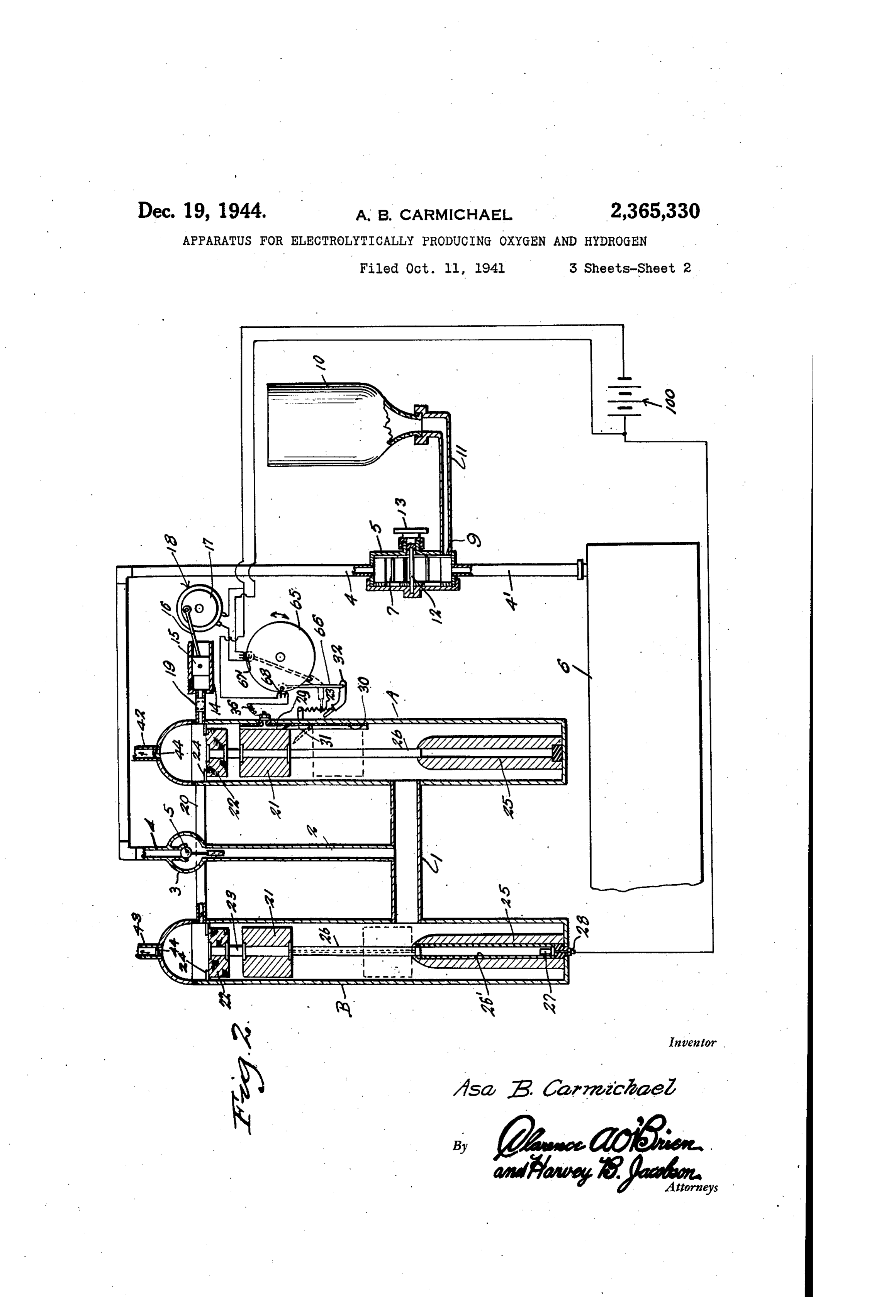
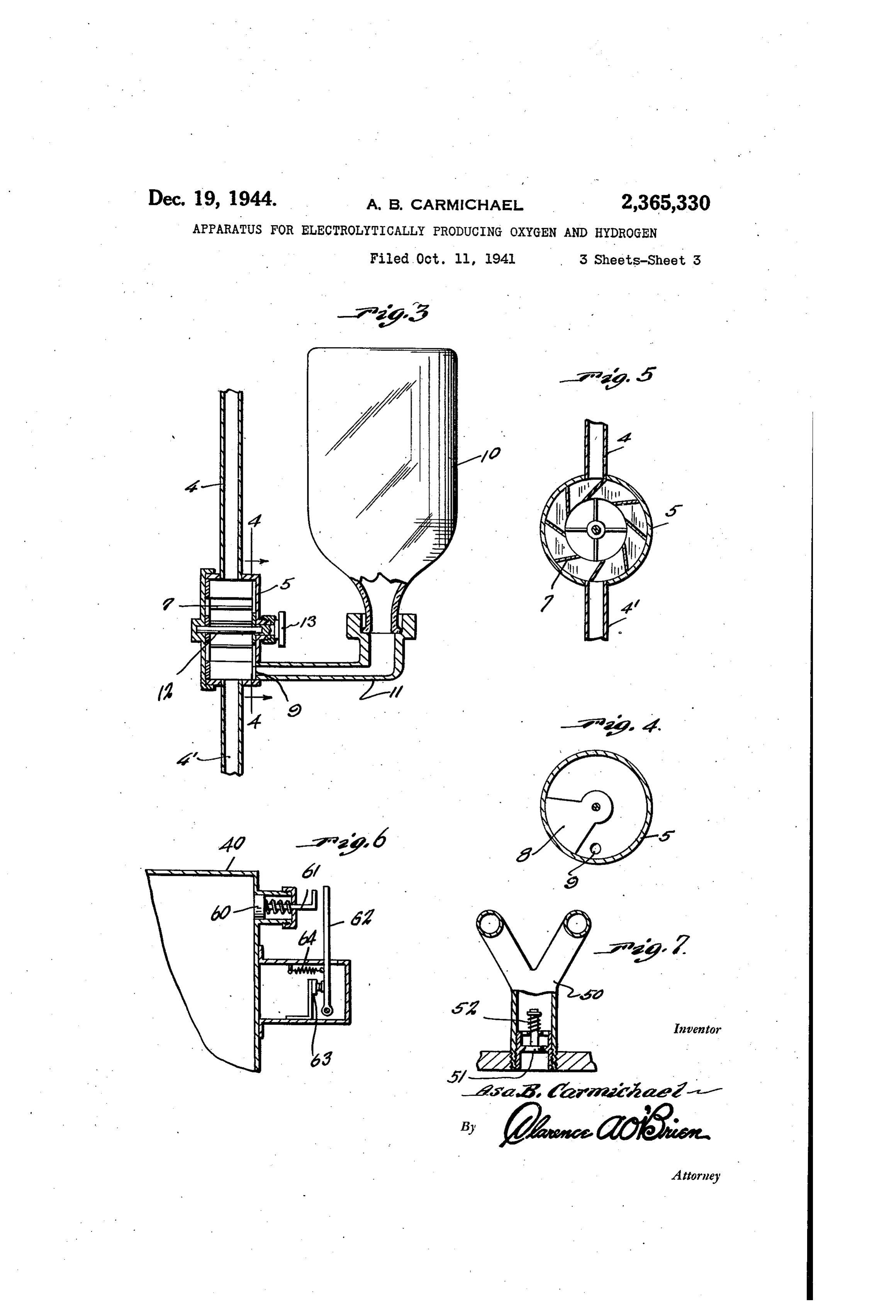
This invention relates to a fuel making attach A bladed wheel 7 is located in the casing 5, ment for vehicles of different kinds, aeroplanes, the blades of which are so arranged that as the boats, etc., the general object of the invention water flows upwardly through the pipes 4 and 4 being to provide means for producing oxygen and the wheel will be rotated and this causes a shut hydrogen by electrolysis and then utilizing the ter 8 connected to a side part of the wheel to gases in the engine of the vehicle, boat or air open a port 9 in a side part of the casing so that craft. sulphuric acid from a bottle O will flow through This invention also consists in certain other the pipe if and the port 9 into the casing 5 where features of construction and in the combination the acid will mix with the water flowing to the and arrangement of the several parts to be here O cylinder A and B. The wheel 7 is carried on a inafter fully described, illustrated in the accom shaft 2 connected to a handle f3 which is pro panying drawings and specifically pointed out in vided with a pointer and graduation means so the appended claims. that the wheel can be adjusted to cause the shut In describing the invention in detail, reference ter. 8 to open the port 9 after a certain amount Will be had to the accompanying drawings where of Water has passed from the tank 6 through the in like characters denote like or corresponding pipes 4 and 4'. Thus the amount of acid intro parts throughout the several views, and in duced into the flow of water can be regulated. Which A pump cylinder 4 is provided with a piston Figure i is a diagrammatic view showing the 5 actuated by a pitman 6 from an eccentric invention in use on an automobile, bile being shown in dotted lines. ..
the automo 20 disk which is connected to the shaft of a Small motor 8 supplied with current from the battery
Figure 2 is a vertical sectional view through 00 of the car or otherwise. A pipe f 9 connects the means for making the oxygen and hydrogen. the inlet of the pump 4 with the top of the cyl Figure 3 is a view of the means for intro inder A and a pipe 20 connects the top of the ducing sulphuric acid into the water supply line 25 cylinder B with an intermediate part of the pipe for the apparatrus shown in Figure 2. 9 So that when the pump is in operation a vacu Figure 4 is a section on the line 4-4 of Fig um will be produced in the two cylinders A and ure 3. B which will cause the water to be drawn from Figure 5 is a sectional view showing the water
Operated wheel shown in Figure 3. 30 the tank 6 through the pipes 4 and 4 into the mixing chamber 3 where the water will be mixed
Figure 6 is a sectional view through the tank With the sulphuric acid and then the mixture will for receiving the oxygen and hydrogen from the pass through the pipe 2 into the pipe f as well formation plant and this view showing the au as into the cylinders. Of course, the acid will be tomatic control means for stopping the supply of mixed with the water by the wheel 7 and also as gases when the tank is filled. - -: 35 the acid water flows through the pipes 8. Elec Figure 7 is a detail sectional view showing the rodes 2 are located' in the cylinders and a float means for supplying the two gases to a cylinder 22 is arranged in each cylinder above the elec- . of the engine. trode and these floats are connected to the elec In these drawings the letter A indicates an trodes by rods 23 of non-conducting material. oxygen formation cylinder and the letter B the 40 Stops 24 are arranged in the upper portions of hydrogen formation cylinder, these cylinders be the cylinders to limit upward movement of the ing connected together intermediate their ends floats. Tubular guide members 25 extend up by a cross pipe from which leads a conduit 2 Wardly from the bottom portions of the cylinders having a mixing chamber 3 therein. A pipe Or for receiving the rods 26 depending from the elec conduit 4 extends into the mixing chamber 3 45 trodes 2. A sleeve of conducting material 26' is and a float control valve 5 is located in the arranged in the member 25 located in the cyl chamber 3 and will close the lower end of the inder B and a contact 2 is in electrical connec pipe 4 when the water level in the two cylinders tion with the lower end of the sleeve 26' and and the connections and 2 reaches a certain this contact is electrically connected by a con degree. The pipe 4 connects with a casing 5, see ductor 28 with a source of supply which may Figures 1, 2 and 5 and a pipe 4' leads from the be the battery CO of the vehicle. An upper casing into a tank 6 which may be the tank usu ally used for holding the gasoline supply of a conductor plate 29 is placed in an upper portion of the cylinder A and a lower guide plate 30 is vehicle or craft. However, in this case the tank placed in said cylinder and these plates are nor 6 contains water. 55 mally bridged by a gate 3 of conducting mate
Page 5
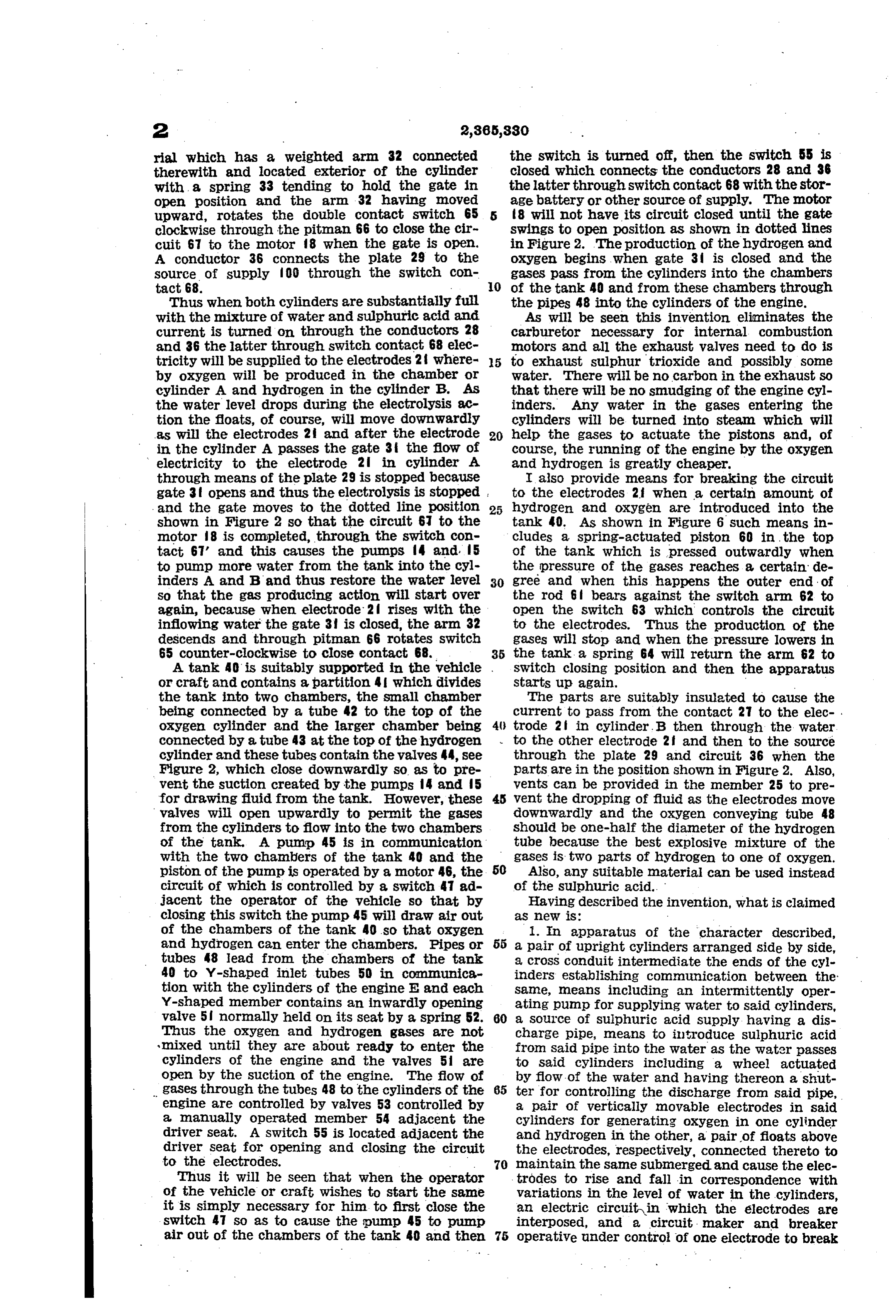
rial which has a weighted arm 32 connected the switch is turned off, then the switch 55 is therewith and located exterior of the cylinder closed which connects the conductors 28 and 36 with a spring 33 tending to hold the gate in the latter through switch contact 68 with the stor open position and the arm 32 having moved age battery or other source of supply. The motor upward, rotates the double contact switch 65 8 will not have its circuit closed until the gate clockwise through the pitman 66 to close the cir swings to open position as shown in dotted lines cuit 67 to the motor 8 when the gate is Open. in Figure 2. The production of the hydrogen and A conductor 36 connects the plate 29 to the oxygen begins when gate 3 is closed and the source of supply 00 through the switch con gases pass from the cylinders into the chambers tact 68. 0 of the tank 40 and from these chambers through Thus when both cylinders are substantially full the pipes 48 into the cylinders of the engine. with the mixture of water and sulphuric acid and As will be seen this invention eliminates the current is turned on through the conductors 28 carburetor necessary for internal combustion and 36 the latter through switch contact 68 elec motors and all the exhaust valves need to do is tricity will be supplied to the electrodes 2 where 5 to exhaust sulphur trioxide and possibly some by oxygen will be produced in the chamber or water. There will be no carbon in the exhaust SO cylinder A and hydrogen in the cylinder B. As that there will be no smudging of the engine cyl the water level drops during the electrolysis ac inders. Any water in the gases entering the tion the floats, of course, will move downwardly cylinders will be turned into steam which will as will the electrodes 2 and after the electrode 20 help the gases to actuate the pistons and, of in the cylinder A passes the gate 3i the flow of course, the running of the engine by the oxygen electricity to the electrode 2 in cylinder A. and hydrogen is greatly cheaper. through means of the plate 29 is stopped because I also provide means for breaking the circuit gate 3 opens and thus the electrolysis is stopped to the electrodes 2 when a certain amount of and the gate moves to the dotted line position 25 hydrogen and oxygen are introduced into the shown in Figure 2 so that the circuit 6 to the tank 40. As shown in Figure 6 Such means in motor 8 is completed, through the switch con cludes a spring-actuated piston 60 in the top tact 67 and this causes the pumps 4 and 5 of the tank which is pressed outwardly when to pump more water from the tank into the cyl the pressure of the gases reaches a certain de inders A and B and thus restore the water level 30 gree and when this happens the outer end of so that the gas producing action will start Over the rod 6 bears against the switch arm 62 to again, because when electrode 2 rises with the open the Switch 63 which controls the circuit inflowing water the gate 3 is closed, the arm 32 to the electrodes. Thus the production of the descends and through pitman 66 rotates Switch gases will stop and when the pressure lowers in 65 counter-clockwise to close contact 68. 35 the tank, a spring 64 will return the arm 62 to A tank 40 is suitably supported in the vehicle . Switch closing position and then the apparatus or craft and contains a partition 4 which divides Starts up again.
the tank into two chambers, the Small chamber The parts are suitably insulated to cause the being connected by a tube 42 to the top of the current to pass from the contact 2 to the elec- . oxygen cylinder and the larger chamber being 43 trode 2 in cylinder. B then through the water connected by a tube 43 at the top of the hydrogen - to the other electrode 2 and then to the source cylinder and these tubes contain the valves 44, see through the plate 29 and circuit 36 when the Figure 2, which close downwardly so as to pre parts are in the position shown in Figure 2. Also, vent the suction created by the pumps 4 and 5 vents can be provided in the member 25 to pre for drawing fluid from the tank. However, these 45 vent the dropping of fluid as the electrodes move valves will open upwardly to permit the gases downwardly and the oxygen conveying tube 48 from the cylinders to flow into the two chambers should be one-half the diameter of the hydrogen of the tank. A pump 45 is in communication tube because the best explosive mixture of the with the two chambers of the tank 40 and the gases is two parts of hydrogen to one of oxygen. piston of the pump is operated by a motor 46, the 50 Also, any suitable material can be used instead circuit of which is controlled by a switch 47 ad of the Sulphuric acid.
jacent the operator of the vehicle so that by Having described the invention, what is claimed closing this switch the pump 45 will draw air out aS new is:
of the chambers of the tank 40 so that oxygen i. In apparatus of the character described, and hydrogen can enter the chambers. Pipes or 55 a pair of upright cylinders arranged side by side, tubes 48 lead from the chambers of the tank a CrOSS conduit intermediate the ends of the cyl 40 to Y-shaped inlet tubes 50 in communica inders establishing communication between the tion with the cylinders of the engine E and each Sane, means including an intermittently oper Y-shaped member contains an inwardly opening atting pump for Supplying water to said cylinders, valve 5 normally held on its seat by a spring 52. 60 a Source of Sulphuric acid supply having a dis Thus the oxygen and hydrogen gases are not charge pipe, means to introduce sulphuric acid • mixed until they are about ready to enter the from Said pipe into the water as the water passes cylinders of the engine and the valves 5 are to said cylinders including a wheel actuated Open by the suction of the engine. The flow of by flow of the water and having thereon a shut gases through the tubes 48 to the cylinders of the 65 ter for controlling the discharge from said pipe, engine are controlled by valves 53 controlled by a pair of vertically movable electrodes in said a manually operated member 54 adjacent the cylinders for generating oxygen in one cylinder driver Seat. A Switch 55 is located adjacent the and hydrogen in the other, a pair of floats above driver seat for opening and closing the circuit the electrodes, respectively, connected thereto to to the electrodes. 70 maintain the same submerged and cause the elec Thus it will be seen that when the operator trodes to rise and fall in correspondence with of the vehicle or craft wishes to start the same variations in the level of water in the cylinders, it is simply necessary for him to first close the an electric circuit-in which the electrodes are switch 47 so as to cause the pump 45 to pump interposed, and a circuit maker and breaker air out of the chambers of the tank 40 and then 75 Operative under controi of one electrode to break
Page 6
said circuit when the water in said cylinders falls variations in the level of the water in the cyl to a predetermined level. inders, an electric circuit in which said electrodes 2. In apparatus of the class described, a pair are interposed, and means to make and break said of upright cylinders arranged side by side, a cross circuit under control of one of the electrodes conduit intermediate the ends of the cylinders comprising a plate of conductive material in one establishing communication between the same, a cylinder, a second guide plate in said cylinder source of water supply, a conduit extending from spaced from the first-mentioned plate, a bridge Said Source to said cylinders, means to cause Waterpiece of conductive material extending between to flow through said conduit to said cylinders said plates and held in bridging relation thereto intermittently, means actuated by flow of water 10 by the electrode in said one cylinder when the through said conduit for introducing sulphuric water in said one cylinder stands at high level, acid into the water as it passes to said cylinders, said bridge piece being constructed and arranged a pair of vertically movable electrodes in said to be released by said electrodes when the water cylinders for generating oxygen in One cylinder in said one cylinder falls to a low level, and and hydrogen in the other, a pair of floats above 15 means for moving the bridge piece out of bridging said electrodes, respectively, connected thereto relation. When released by Said electrode. to maintain the same submerged and cause the electrodes to rise and fall in correspondence with ASA. B. CARMICHAEL.
Provenance
- Collection
- Cited prior art
- Original PDF
- patentimages.storage.googleapis.com →
- Filed
- 1941-10-11
- Pages
- 6
- Method
- pdftotext (the PDF's own text layer) + pdftoppm 300dpi page scans
- Source
- Google Patents bibliographic record
- Granted
- 1944-12-19
- Inventors
- Asa B Carmichael
- Transcribed from
- patentimages.storage.googleapis.com →