patent · US2016442
Production of gases by decomposition of aqueous electrolytes
8 October 1935
Page 1
Drawing sheet — no readable text.
Page 2
Patented Oct. 8, 1935 2016,442
UNITED STATES2,016,442PATENT OFFICE
PRODUCTION OF GASES BY DECOMPOS
TION OF AGUEOUSELECTROLYTES
Alfred Kilgus, Stuttgart-oberturkheim, Germany
Application
My invention relates to decomposing methods, netic under the influence of the magnetic field. more particularly to such methods wherein . The other details which should be observed aqueous electrolytes are decomposed. It is an when carrying out my invention do not differ object of my invention to facilitate such methods fromelectrolytical those usual in the corresponding chemical s with a particular view to the energy consumed or decomposition methods. When decomposing for instance water I may collect the
therein.
As is known to those skilled in the art aqueous gases arately developed on the two electrodes either sep or together. By using closed pressure electrolytes may be decomposed with the aid of resisting decomposing vessels I may collect and electric currents, whereby hydrogen and oxygen, withdraw the gases, under pressure. O or other gases, depending on the nature of the In any case the use of an electromagnetic field
Substances dissolved in the water, are developed. reduces the energy consumed in the decomposi My invention is based on the discovery that tion reaction, and the yield is increased accord such decompositions may be either brought about . ingly.
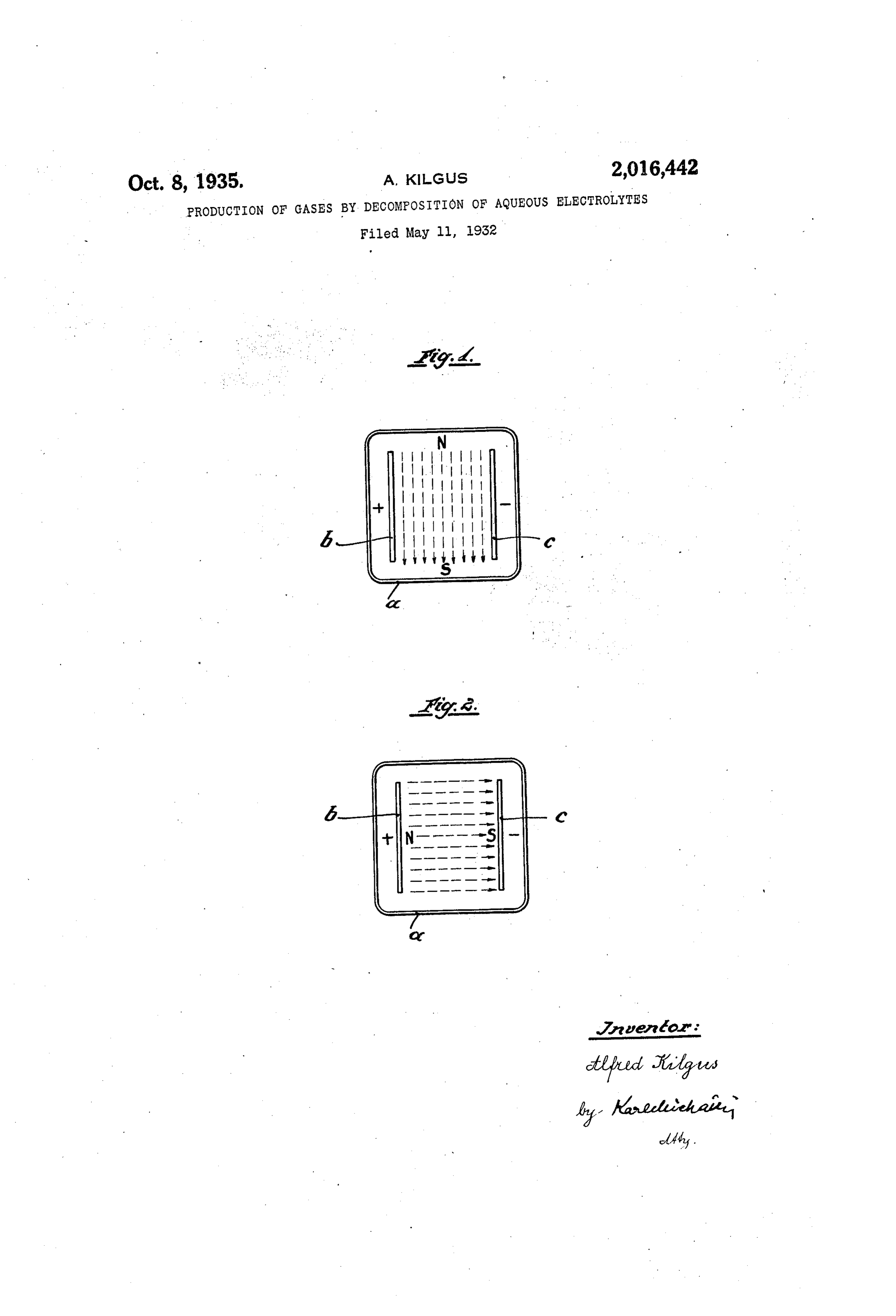
or favorably influenced by magnetic fields and/or In the drawing affixed to this specification and 5 5 magnetic forces. forming part thereof I have diagrammatically If for instance a permanent magnet or an shown electromagnetic body is brought into contact Water. electrolytic cells for the decomposition of with acidulated water, a distinct development of In Fig. 1 the tank a contains an anode b and a gases occurs, which mainly consist of hydrogen cathode c, which are connected with the positive 20 20 which is by no means due to merely chemical and negative poles, respectively, of a source of phenomena, i. e. to a dissolution of the iron of electricity (not shown). Both electrodes con the magnet, since the development of gases also sist
Occurs in Such cases in which a magnet or elec Thisofcella magnetizable metal, preferably of iron. is subjected to the influence of an tromagnet has been previously passivated with 25 the aid of concentrated nitric acid to such an artificial magnetic field, which is produced by 2 means well known to those skilled in the art, for extent that it does not react with dilute acids.
This decomposition with the aid of magnetic instance direction by strong electromagnetic coils. The of the magnetic field is indicated in forces may be used either alone or, preferably, together with electrical or chemical influences. dutted lines.
Fig. 2 is a diagrammatical plan view of a simi- 30 30 If for instance an aqueous electrolyte underlying lar cell, but the direction of the magnetic electrolytic decomposition is simultaneously sub field is not in parallel to the surfaces of the elec jected to the action of a magnetic field, the yield trodes, but runs from the anode to the cathode. in gaseous decomposition products is materially increased. When subjecting acidulated water perIncent operating these cells I fill them with a 30 to electrolysis, I have ascertained a development plying to solution of caustic potash, and on ap- 35 of gases, which is increased for about 50 per cent tain a development ofa sufficient the electrodes voltage, I ob hydrogen, and oxygen when simultaneously subjecting the electrolyte greatly in excess of the quantities which would to the influence of a magnetic field.
In carrying Out my invention I may produce a be obtained by the same amount of electrical energy if the magnetic field were omitted. 40 40 magnetic field between the electrodes of an elec trolytic cell, where the decomposition is brought The direction of the magnetic field according about, but I may also use electrodes, which are to Fig. 1, i. e. in parallel to the electrode sur magnets themselves, viz. permanent magnets faces, reduces the voltage wanted for a given decomposition effect, while the direction of the and/or electromagnets. magnetic field according to Fig. 2 resuits in an 45 Another modification of my invention consists in alternatingly arranging magnetic and non increased gas yield.
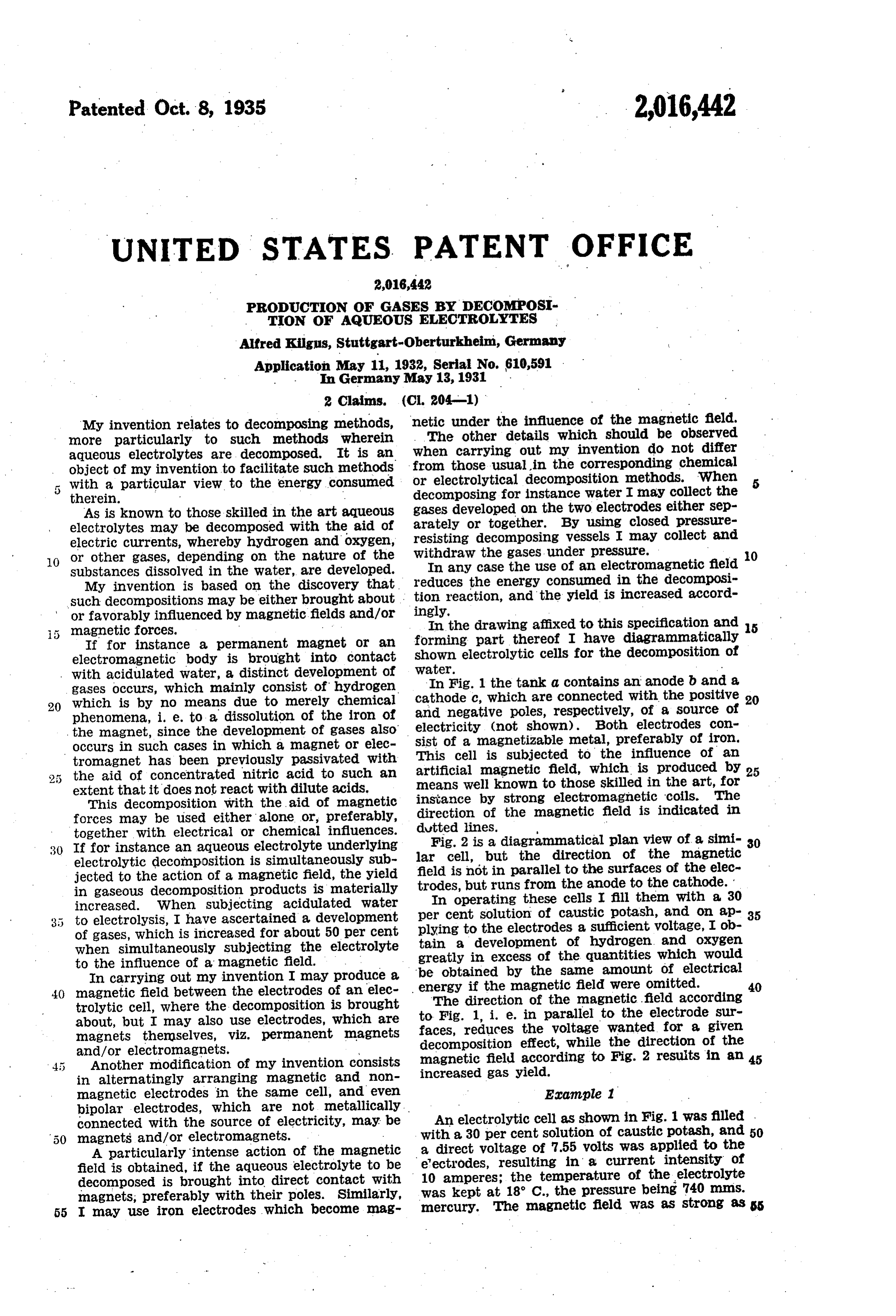
magnetic electrodes in the same cell, and even Eacample 1 bipolar electrodes, which are not metallically. An electrolytic cell as shown in Fig. 1 was filled . connected with the source of electricity, may be magnets and/or electromagnets. with a 30 per cent solution of caustic potash, and 50 A particularly intense action of the magnetic a direct voltage of 7.55 volts was applied to the field is obtained, if the aqueous electrolyte to be e'ectrodes, resulting in a current intensity of decomposed is brought into direct contact with 10 amperes; the temperature of the electrolyte magnets, preferably with their poles. Similarly, was kept at 18 C., the pressure being 740 mms. 55 I may use iron electrodes which become mag mercury. The magnetic field was as strong as sis
Page 3
feasible between the poles of an electromagnet to 10.44 ccms. (reduced as above) per ampere arranged outside of the tank E. There Were Obs and minute.
tained 27.720 litres of gas per hour. Various changes may be made in the details On repeating this experiment under the same disclosed in the foregoing specification without conditions, but On Omitting the magnetic field, a departing from the invention or sacrificing the is voltage of 10.6 volts proved to be necessary to advantages thereof.
obtain a current intensity of 10 amperes, and In the claims affixed to this specification no the yield was reduced to about 24.9000 litres per selection of any particular modification of the hour. invention is intended to the exclusion of other 10 Eacample 2 modifications thereof and the right to subse- 0 quently make claim to any modification not
A cell corresponding to that shown in Fig. 2 covered by these claims is expressly reserved. was operated under similar conditions as de I claim:- scribed with reference to Example 1, the volt 1. The method of producing gases by elec age being 2.9 volts, the current intensity 5.0 trolytic decomposition of an aqueous electrolyte 15 15 amperes, the temperature 16° C. and the pressure comprising subjecting the electrolyte to the elec 751 mms. mercury (absolute). On using a strong trolytic action of an electric current between magnetic field there were obtained 15.5 ccms. gas magnet electrodes.
(reduced to 0° C. and 760 mm.S. mercury) per 2. The method of producing gases by electro 20 ampere and minute, i. e. materially more than lytic decomposition of an aqueous electrolyte 20 corresponds
CCS.
to the theoretical amount of 1044 comprising causing an electric current to pass through the electrolyte between magnetized iron
On repeating this experiment under omission electrodes.
of the magnetic field, a voltage of 2.95 volts res. ALFRED KILGUS. sulted in a gas yield, which exactly corresponds . . s
Provenance
- Collection
- Cited prior art
- Original PDF
- patentimages.storage.googleapis.com →
- Filed
- 1932-05-11
- Pages
- 3
- Method
- pdftotext (the PDF's own text layer) + pdftoppm 300dpi page scans
- Source
- Google Patents bibliographic record
- Granted
- 1935-10-08
- Inventors
- Kilgus Alfred
- Transcribed from
- patentimages.storage.googleapis.com →