patent · US102633
Improvement in evaporating and distilling by solar heat
3 May 1870
Page 1
Drawing sheet — no readable text.
Page 2
UNITED STATES PATENT OFFICE.
NORMAN W. WHEELER, OF BROOKLYN, AND WALTON W. EVANs, OF NEW
ROCHELLE, NEW YORK. .
IMPROVEMENT IN EvaPORATING AND DISTILLING BY soLAR HEAT.
Specification forming part of Letters Patent No. 102,633, dated May 3, 1870. To all whom it may concern : to be distilled, and arrange the troughs so Be it known that we, NoRMAN W. WHEEL that, when the box a is placed at the proper ER, of the city of Brooklyn, county of Kings, angle and position to receive the sun's rays and WALTON W. EVANs, of the town of New through the glass, the liquid will lie quietly Rochelle, county of Westchester and State of in the troughs,
New York, have invented a new and useful may be filled orand in such position that they replenished through the pipe
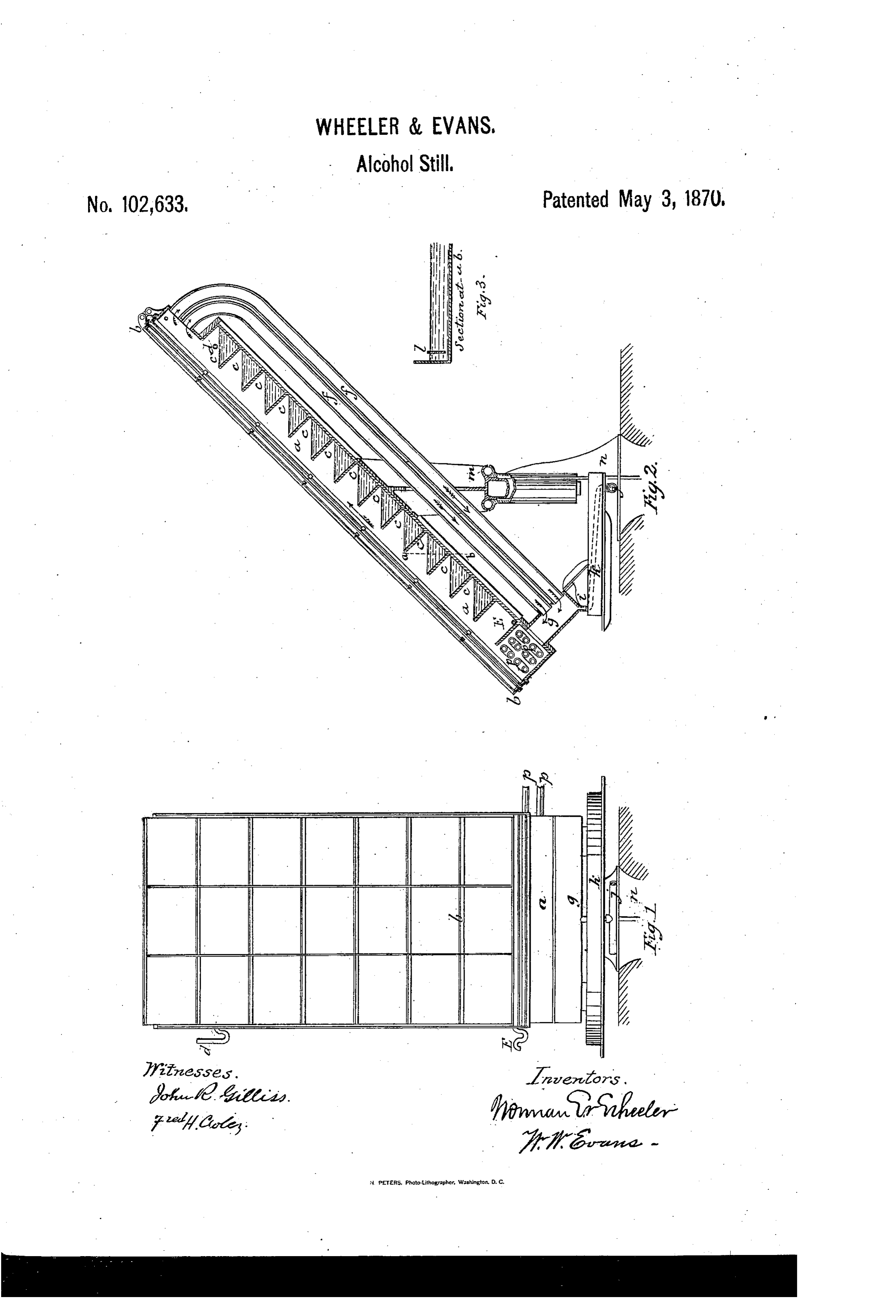
Method of Distillation; and we do hereby de d, which will deliver the liquid clare that the following is a full and exact de trough, and, after that is filled,into the upper Scription of the apparatus pertaining thereto, supply will run over into the one nextfurther any and the operation thereof, reference being had and so on until all are filled except thebelow, lower to the accompanying drawings making a part trough, which is fitted with the waste-pipe E, of this specification, in which with the view of conducting away any sur Figure 1 is a front elevation, Fig. 2 a sec plus of impure liquid, and so preventing its tional elevation, and Fig. 3 a section, to illus mingling with the purer distilled liquid in the trate the construction of important parts. receptacle below.
This invention is based upon well-known To the upper part of the box a, and to the physical laws, viz: small extension g of the same, at the lower Heat radiated from a luminous body--that part, is to say, luminous heat-will pass through ably ofwetinattach a series of tubes, ff, prefer or other not easily oxidized metal, moderately moist air, or through glass of in such a way that both ends of each tube . moderate change. thickness, with very little loss or will open into the inclosed space, and allow a Heat radiated from a non-luminous body upper to the lower partsofofairthe downward movement or gas from the inclosed space.
that is to say, obscure heat-is in great part We prefer to make the troughs occ each arrested or glass. and absorbed by the same kind of air some with an imperfect diaphragm, l, Fig. 3, in part of it, and to so arrange the pipe d,
Air and other gases tend to rise when and the places of overflow from one trough to heated, and to fall when cold. another, that any liquid flowing in will fall The capacity of air and other gases for the into a small compartment, fill the trough vapors of all or many of the liquids is in through the opening in the diaphragm, and creased ation.
by heat and decreased by refriger the overflow pass on without mixing with the When water or other liquid is vaporized ing of the liquid in the upper troughsthebycool main body in the trough, to prevent the the chief parts of the salts or other like im fact of replenishing the liquid in the lower purities held in suspension or solution remain O6S.
behind, and the liquid resulting from the con The boxa and its appurtenances are mounted densation pure. .
of such vapor is comparatively by the bracket m upon the standard n, in such a way that the face or sash may be turned
To put our invention into practice, We in from close a space, as the box a, making the box of movedtime to time toward the sun, or be about by automatic machinery.
wood, metal, or other suitable material, and The standard in we prefer to have cut away covering the open top with a sash, b, having beyond the center line or axis of the pin of panes of glass set therein in the usual Way, the bracket preferring that there be more than one sash, pipe, i, beingm,laid so as to allow of a collecting so arranged that there shall be air-spaces be the turning-pins ofalong a row in the axial lines of of stills, to which tween the contiguous panes of glass, to pre will lead the pipe i from each still to carry off vent, in a measure, the loss of heat by con the distilled liquid from the small box g, and duction through the glass. deliver it into the collecting-pipe j, and still In the bottom of the box a we form or place allow a sufficient turning movement of the one or more troughs, cc c, to hold the liquid box a.
Page 3
As a matter of convenience, we attach to perature, are not so and low absolute heat in the box a, effective asin atheless difference and . . each still a segment, k, to which may be fast greater general ened a rope or chain, in such a way that all be accounted forheat box a, which may by the fact that the capacity the stills in a row may be attached to the chain or rope, and the whole turned about of air or gas for vapor augments in a higher at once by Windlasses or other suitable appli ratio For than the augmentation of its heat.
instance, when the heat of the water in
The operation of this apparatus is as follows: the troughs c c e was 90o Fahrenheit, and the heat within the tubes ff, 40 Fahrenheit, the
The troughs c c e having been filled through distillation proceeded very slowly, while, with the pipe d, or otherwise, and the still turned the water heated to 1300, and with the tubes to face the sun, in clear weather the luminous ff at 900, the distillation was very rapid. rays pass through the glass and impinge upon Alcohol and other liquids, which boil at the surface of the liquid in the troughs, or lower temperature than water, are readily dis upon the material of the troughs, that part, tilled at a lower heat than above indicated. which is reflected from the liquid surfaces be For instance, the spirit may be distilled ing directed chiefly upon the lower sides of from a fermenting mash, wash, or must, of the troughs next above. grapes or other fruit, without heating it above This impingement of luminous heat upon dark surfaces changes it into obscnre heat, the proper fermenting temperature, and, hence, the process may be carried on during and renders it incapable of being radiated the back through the glass, except in small quan wholefermentation,of the and until very nearly the spirit-making constituents of the tity, so that it remains within the box a, and fermenting material are exhausted, without raises the temperature of the liquid and gases therein contained, which increase of temper allowing any part to advance to the acetous fermentation, and without heat sufficient to ature induces a movement of the air or gases destroy the essential oils which constitute the toward the upper part of the box a, and this, flavors and in turn, induces a downward movement. When thearomas object of vinous spirits.
is to procure fresh and through the pipes.ff. pure water from salt, alkaline, or otherwise These pipes are herein shown freely ex impure sources, the still may be allowed to posed to the air, and any excess of heat con act through the day, and cease operations tained in the downward current of air or gases will be, in great part, transferred by conduc during the night, in which case the distill tion to the outer air. : lation goes on during a great part of the night, Elence, heat being continually received for the reason that, when the sun ceases to act upon the water in the troughs e o c, the through the glass and continually escaping heat contained therein seeks to diffuse itself through the tubes ff, a continuous current of warm air or gas rises upward through the through box a a larger space, but the sides of the being made of non-conducting material, box a, and a continuous current of air or gas and there being a layer of non-conducting air descends through the pipes.ff, which is cooled between the panes of glass, the readiest way as it flows, all in the directions indicated by for the escape of heat is by the continued the arrows in the drawing.
This gaseous current, passing into the lower evaporation and cooling through the tubes.ff, until the differential temperature disappears, end of the box a. at a lower temperature than and that at which it passes out at the upper end, is notthemuch heat of the water in the troughs do c has its capacity for vapor constantly increased rounding air. greater than that of the sur as it ascends, and as its heat is increased, while, But, when spirit is being distilled from a during its passage downward through the fermenting mixture, this nightly cooling would tubes.ff, its capacity for vapor is constantly be disastrous, because complete fermentation decreased by reason of its progressive lower occupies a longer time than one day, and the ing of temperature.
Hence, the gaseous current takes up vapor action is arrested by a lower temperature than from the liquid exposed to its action in the about 800 Fahrenheit.
This can be prevented by covering the cool troughs ce c, and deposits it by condensation ing-surfaces with matting, or other good non in the tubes.ff, from which it flows into the conducting material, or the distillation may receptacle g, and off through the pipes i and j. be carried steadily on during nights, or cloudy The tubes ffmay be readily cooled by in weather, by means of artificial closing them in a separate box and surround to the gases within the box a. heat applied ing them with water, by sprinkling them, or To this end we fit into the lower part of the by incasing them in a box open at the lower end, and continued upward as a chimney, to box at the pipes pip, in such a way that the induce a strong current of cooling air among gases nect within will impinge upon them and con them with a body of water or air heated the tubes, or even by an artificial blast of air, and thus the effectiveness of the machine be by a fire, and made to circulate through them. increased within certain limits. This will induce the proper currents, and We have found, by a series of experiments, cause the distillation to proceed as before de that when Water is distilled, the cooling action Scribed.
should be limited, as a great difference in tem In stills designed to operate solely by arti
Page 4
ficial heat, the glass and sashes b b may be dis ried on in an atmosphere of carbonic-acid gas, or any mixture of gases not containing free pensed with, and the box a made solid, in which case the still may be properly fixed in oxygen, fusil and other deleterious oils usu place. ally found in spirits are carried over to a very In the course of experiments made with a Small extent.
view of perfecting our invention, we have We claim as our invention placed sponge and other porous material in 1. The arrangement of the imperfect dia the troughs 0 cc, which projected above the phragms l in the troughs c 0 c, substantially surface of the liquid, and raised it by capil as and for the purpose described. - lary attraction, thus presenting a great area 2. The combination and mounting of the of moist surface to the action of the gaseous distilling apparatus herein described, with currents, and have sought to prevent a sup and upon the bracket m and standard n, sub posed loss of heat by the reflection of lumi stantially as and for the purpose described. nous rays back through the glass from the 3. The combination of the segment K, or its liquid surfaces, by means of covers of dark equivalent, with the above-described appara colored fabric, and of charcoal-dust. tus, substantially as and for the purpose de These devices produced an apparent small Scribed.
gain, but we are inclined to believe that re 4. The Combination of the box at With the flected luminous heat does not pass readily pipes i and j, or their equivalents, substan through glass, and is in a state intermediate be tially as and for the purposes described. tween luminous heat proper and obscure heat. 5. The combination of the sash b b, box a, At all events, we found that, under ordi lents,troughs 0 cc, and tubes ff, or their equiva nary circumstances, the gas or air in the up described. substantially as and for the purposes per part of the apparatus was saturated with
Vapor, or so nearly saturated that the passage 6. The combination of the pipes d and E, of a small cloud which would obscure the sun with the troughs c c c, or their equivalents, but a few minutes, or seconds in some cases, substantially as and for the purposes de would cause dew to be deposited upon the un scribed.
der sides of the upper panes of glass in the in 7. The combination of the pipes pp with terior sash, which would obstruct the entrance the troughs c e c and tubes.ff, or their equiv of luminous heat for a considerable time after alents, substantially as and for the purpose de the cloud had passed away. scribed.
A good way to prevent loss by reflection 8. The method herein described for distill from the liquid surfaces is to interpose be ing liquids by means of solar or artificial heat, tween the troughs 0 c e and the glass, a sheet through the instrumentality of gaseous cur or sheets of wire-cloth, care being taken not rents, substantially in the manner and with to use an easily oxidizable metal, for the air the apparatus herein described, or the equiv Within the box at seems to be ozonized, and at alent thereof. NORMAN W. WHEELER tacks metals with great avidity. When dis W. W. EVANS. tilling from a fermenting mixture, however, the air is soon expelled by the carbonic acid Witnesses:
evolved, and oxidation ceases, JoHN R. GILLISS,
It is believed that, when distillation is car FRED. H. COLES.
Provenance
- Collection
- Cited prior art
- Original PDF
- patentimages.storage.googleapis.com →
- Pages
- 4
- Method
- pdftotext (the PDF's own text layer) + pdftoppm 300dpi page scans
- Source
- Google Patents bibliographic record
- Granted
- 1870-05-03
- Transcribed from
- patentimages.storage.googleapis.com →