patent · US37487
Improved boot and shoe blacking apparatus
27 January 1863
Page 1
Drawing sheet — no readable text.
Page 2
UNITED STATES PATENT OFFICE.
ISAAC BICKHART, OF HARLAN, INDIANA.
IMPROVED BOOT AND SHOE BLACKING APPARATUS.
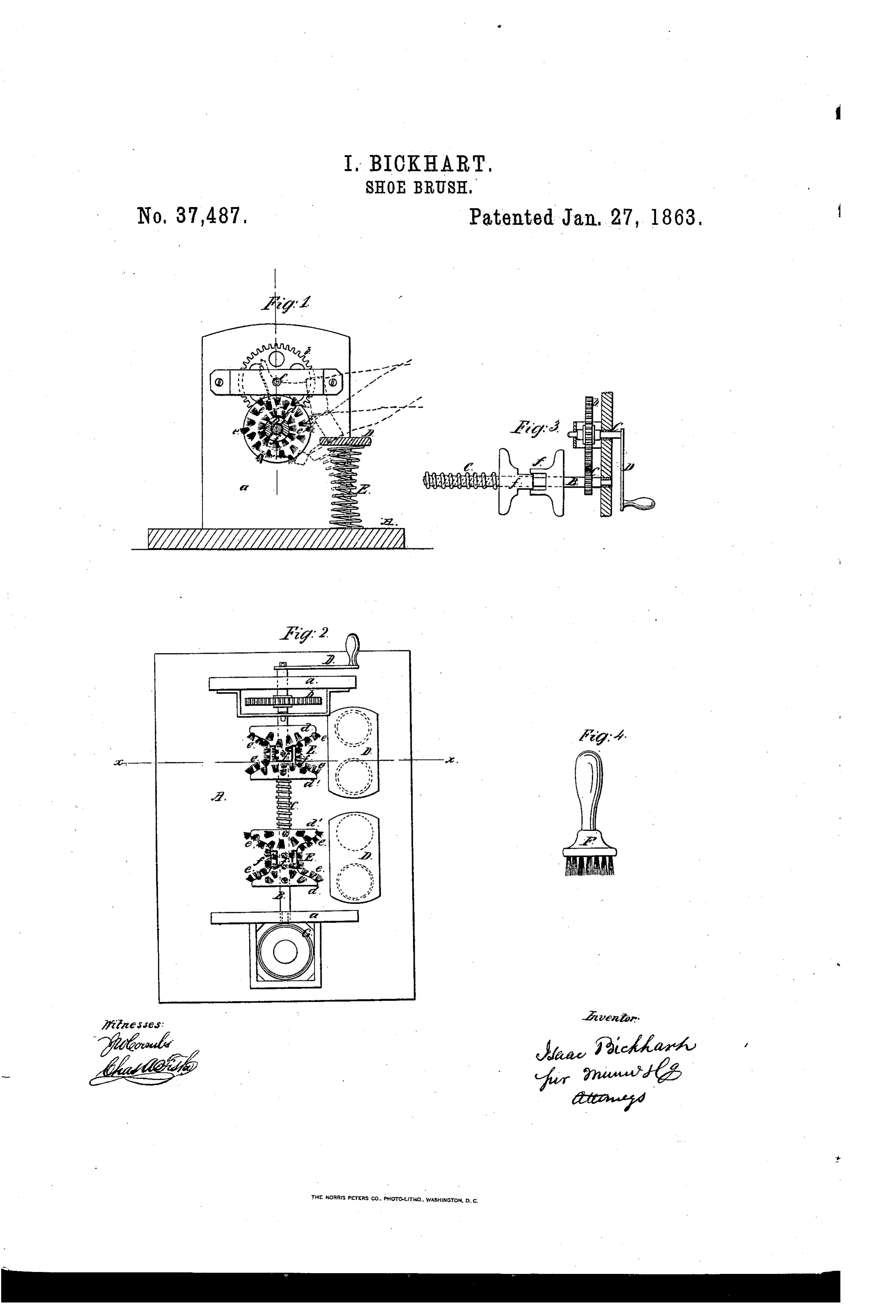
Specification forming part of Letters Patent No. 37,4S2, dated January 27, 1863. (To all whom it may concern: turn the partd, which is fitted loosely thereon, Be it known that I, ISAAC BICKHART, of and the slots in the hubs f are made suffi. Harlan, in the county of Allen and State of ciently deep to admit of the parts did being Indiana, have invented a new and Improved connected under a considerable play or move Machine for Cleaning and Blackening or Pol ment of the part d’. This will be fully un ishing Boots and Shoes; and I do hereby de derstood by referring to Fig. 3. The parts d' clare that the following is a full, clear, and of the brush-wheels have a spiral spring, C, exact description of the same, reference being bearing against them, and this spring is had to the accompanying drawings, making a placed on the shaft B between the parts d', as part of this specification, in which shown clearly in Fig. 2. The spring C has a Figure 1 is a transverse vertical section of tendency to keep the parts did of both brush my invention, taken in the line acac, Fig. 2; wheels in close contact with the parts did. Fig. 2, a plan or top view of the same; Fig. 3, D D represent two foot-stands, which are a detached view of a portion of the same, simply two pieces of boards placed horizon- . showing the adjustment of the brush-wheels; tally on the upper ends of springs E, which Fig. 4, a detached side view of a hand-brush are of spiral form and attached at their lower pertaining to the same. ends to the base A. The springs E are of Similar letters of reference indicate corre such a height that the foot-stands D D will sponding pants in the several figures. be about in line with the lower edge of shaft This invention consists in the employment IB. Each foot-stand D is supported by two or use of one or more revolving adjustable springs, E.
brush-wheels, in connection with one or more The operation is as follows:. The person yielding foot-stands, arranged in such a man places the machine on the floor in front of ner that boots and shoes may be expeditiously him, and, being seated on a chair, places his (leaned and blackened while on the feet of foot on one of the foot-stands E, and presses the wearer. it downward and forward so that the upper of To enable those skilled in the art to fully the boot or shoe will be underneath the brush understand and construct my invention, I will wheel, the part d thereof yielding so that the proceed to describe it. brush-wheel will conform to the size of the A represents the base of the machine, which boot or shoe. The shaft C is rotated by an has two uprights, a a, attached to it, in which attendant, and the upper part of the boot or the journals of a horizontal shaft, B, are fitted shoe will be cleaned or freed from dust and and allowed to rotate freely. This shaft B is dirt. The person then withdraws his foot rotated from a driving-shaft, C, through the from the foot-stand, and places it on the top of medium of gears bc, and the shaft C may be the brush-wheel, which then cleans the heel rotated manually by means of a crank, D. and back part of the boot or shoe. These (See Figs. 2 and 3.) On the shaft B there are two positions of the boot are shown in red placed two brush-wheels, EE, each of which outline in Fig. 1. The person then applies is formed of two parts, dd, the parts D be blacking to the boot or shoe by means of a ing firmly keyed to the shaft, B, and the parts brush, F, the blacking-box G being secured d fitted loosely upon it so that they may slide on the base A, at the outer side of one of the freely thereon. The two parts did, which uprightsa. When the boot or shoe is blacked compose each brush-wheel E, are of curved it is operated upon and polished by the other cyma form at their inner sides, as show In brush-wheel, E, the boot or shoe being ap clearly in Figs. 2 and 3, and the bristles e are plied to the brush-wheel in the same manner inserted in these curved sides of the parts did, as previously described for clearing off the and each of said parts terminates in a cylin dust and dirt. Two brush-wheels are desira drical projection or hub, f, which are slotted ble in order that the blacking brush-wheel 'longitudinally so as to form a clutch and may always be kept clean. One brush-wheel cause said parts to be connected so that the to answer both purposes-to wit, clearing off part d, which is keyed to the shaft B, will the dirt and polishing-although it might
Page 3
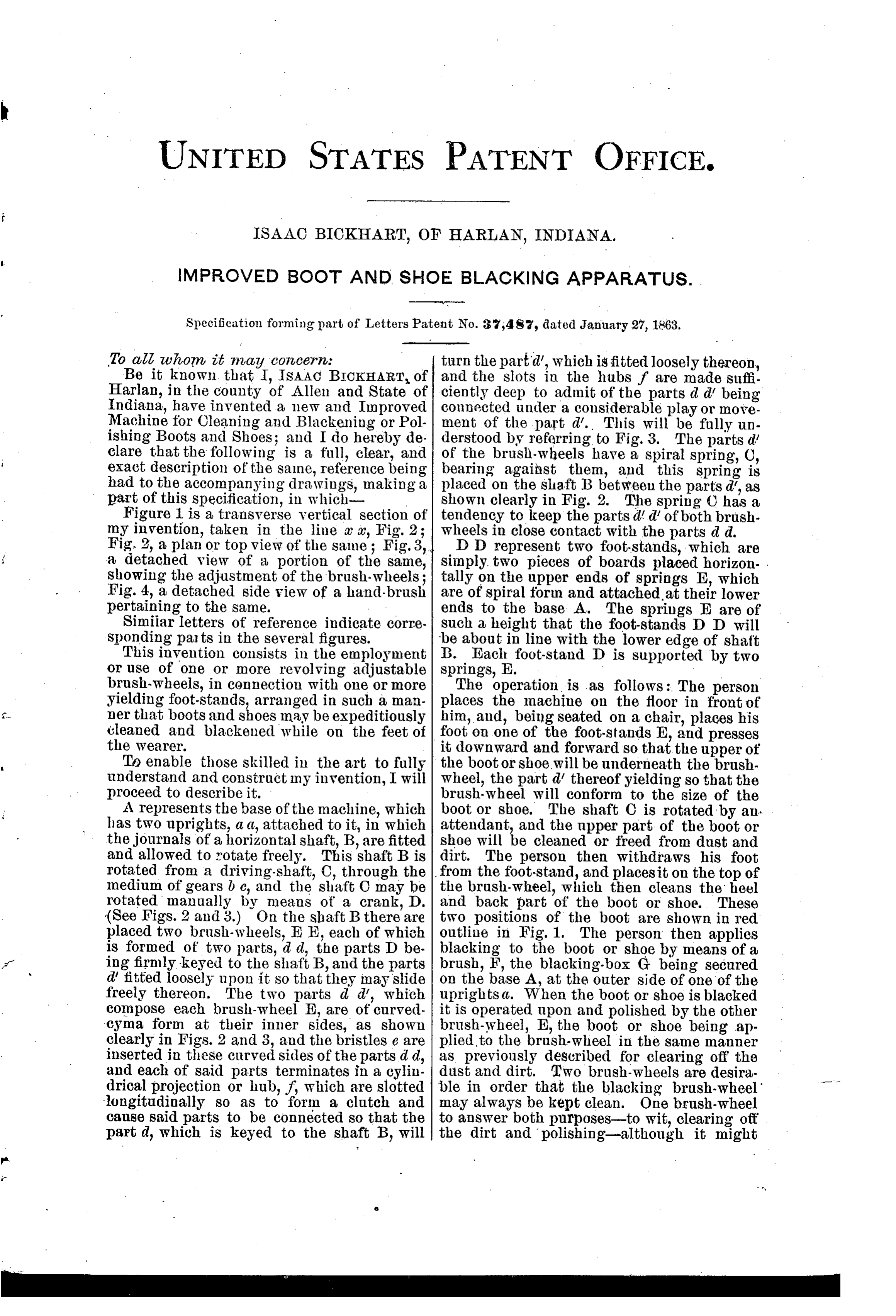
be used, would not answer a good practical combination D, arranged with the yielding foot-stands D substantially as and for the pur purpose.
Having thus described my invention, what I pose herein set forth.ISAAC BICKHART. claim as new, and desire to secure by Letters Witnesses: Patent, is HARVEY W. LEWIs, The revolving brush-wheels E E, one or W. H. ALDRICH. more, constructed substantially as shown, in
Provenance
- Collection
- Cited prior art
- Original PDF
- patentimages.storage.googleapis.com →
- Pages
- 3
- Method
- pdftotext (the PDF's own text layer) + pdftoppm 300dpi page scans
- Source
- Google Patents bibliographic record
- Granted
- 1863-01-27
- Transcribed from
- patentimages.storage.googleapis.com →