patent · US218520
Improvement in magneto-electric machines
12 August 1879
Page 1
Z. T. GRAMME.
Magneto-Electric Machine.
Lig 1 le — QD Ly
=A y_ Pood ep BZ SSZi;
amen |
ATiases)
RY ASS
ion
WMG
Cpireeer Tl, men |
ZSSSSA NWS YU. TG
1G. soos ii
ESS SSS KK KR
ye pee
Fig. COE
oll l
I | Laventor
fg vntmen CF CI
N.PETERS, PHOTO-LITHOGHAPHER, WASMINGTON, D ©
Page 2
UNITED STATES PATENT OFFICE
ZENOBE T. GRAMME, OF PARIS, FRANCE.
IMPROVEMENT IN MAGNETO-ELECTRIC MACHINES.
Specitication forming part of Letters Patent No. 218,520, dated Angust 12, 1879; application filed
To all whom it may concern:
Be it known that I, ZinoBE_THEOPHILE
GRAMME, of Paris, in the French Republic, have invented certain new and useful Improvements in Magneto-Electric Machines, of which the following isa full, clear, and exact deseription, reference being had to the accompanying drawings, in which—
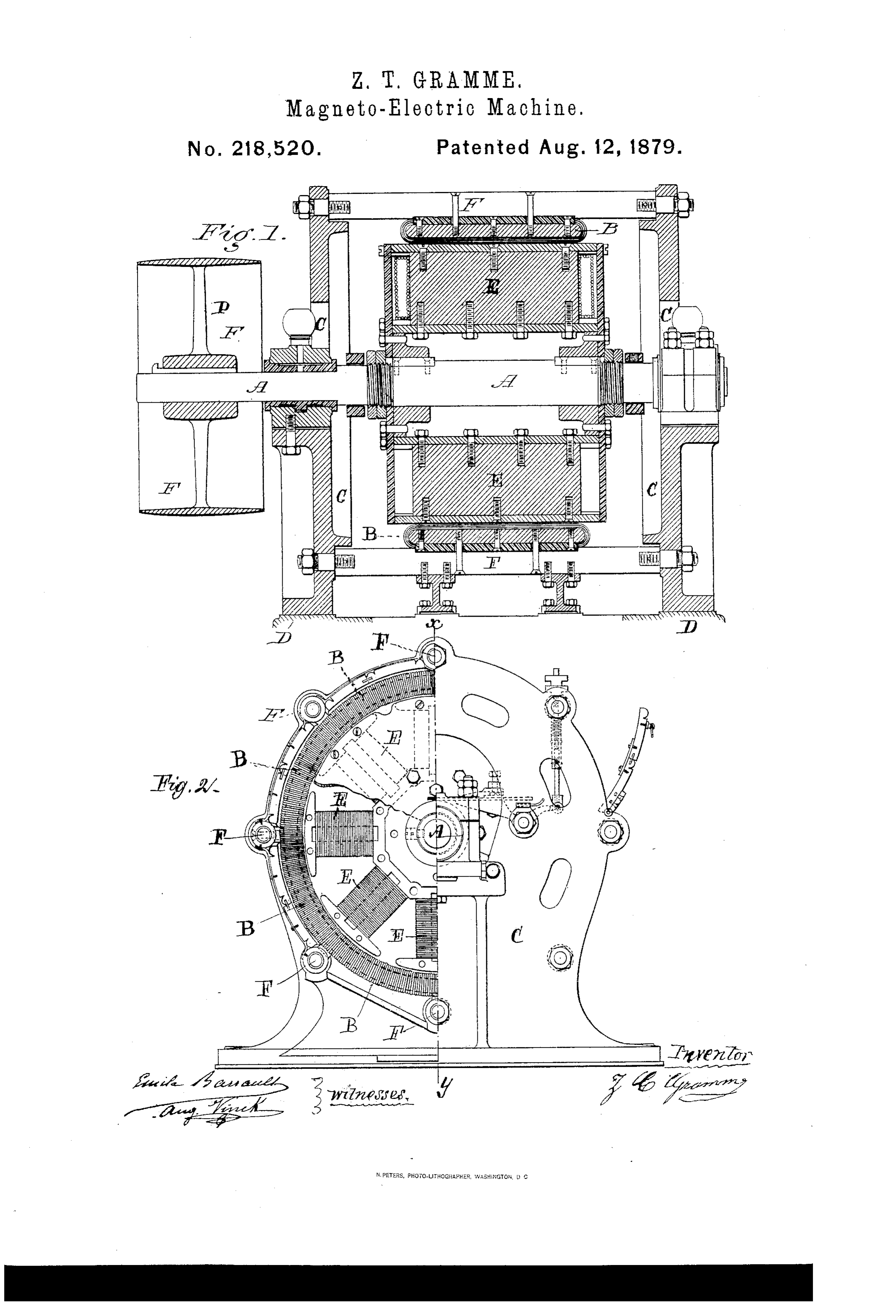
Figure 1 is a vertical section along line x y in Fig. 2, and Vig. 2 partly an elevation and partly a transverse sectional view of the machine.
A patent has heretofore been granted to me jointly with E. L. C. D’Ivernois, dated Octo-
trig machine, in which a ring wound with a continuous strand of wire is combined with one or more electro or permanent magnets, The machine was especially adapted and intended for the production of continuous currents, although by means of modifications described in said patent currents of alternatelyopposite polarity could be produced, the eurrents generated being taken off in all cases by the aid of brushes or other conductors.
The new machine which constitutes the present invention is adapted to and possesses great advantages in the generation of electric eurrents of alternately-opposite polarity, which can be carried off without the aid of a commutator, brushes, or similar conductors.
It consists, substantially, of a ring of soft iron encircled or wound with copper wire, which latter is divided into a number of sections, and an electro- magnet with a number of single poles, rotating on an axis passing through the center of the ring.
The poles are alternately north and south polessand consequently as they pass in succession each section of the surrounding coil they produce in that section currents of opposite polarity—that is, when a north pole is passing a positive current flows in one direction, and when a south pole is passing a positive current Hows in a direction opposite thereto, Both north and south poles therefore should not act on the same section at the same time, and consequently the number of sections will be the same in number as the poles or a multiple of such number. ;
As the wire is wound in all the sections in
the same direction, it is evident that the positive currents in contiguous sections, when their number is the same as that of the poles, flow in opposite directions. The several sections under the same condition, therefore, in order that the positive currents simultaneously generated in them during any one portion of the revolution of magnets may be earried through the electric light or other cirenit in the same direction, are connected with one end of said cireuit alternately at their opposite ends; or those sections which at any one time are opposite similar poles may be coupled together, thus forming two series, which may be connected with the circuit, as described for alternate sections; or each section may be connected with the one next to it on both sides at corresponding ends, so that a current in following the course of the wire will, in one section, move iu the same direction as the magnets revolve, and in the next one in a direction opposite thereto, and so alternately; and when all the sections are coupled, then the wire is connected with the circuit.
By the different arrangements alternate currents are produced in all the cases; but the currents are different in the tension and quantity.
When the number of sections is a multiple of, say, four times the number of poles, it is evident that each section may be connected independently with the circuit; or the first, second, third, or fourth of cach series of four may be coupled with the first, second, third, or fourth, respectively, of the other series of four, in the manner indicated with reference to each section when the number of sections and poles is the same, and the four circuits of tension thus formed may be connected in the same light or other circuit or in different circuits.
In dividing the coil about the iron ring into sections it may not be necessary in all cases to sever it, but the wire for conducting off the alternate currents may be connected with said wire at the proper points to form the section; but in some cases, as when a number a multiple of the number of poles is used, the sections are completely severed.
In coupling the various sections with each other, or connecting them with the light cir-
Page 3
cuit,-no- brushes. or other current - collectors need be used; but the wires are connected directly by binding - screws or other suitable means.
In the drawings, E E E represent a series of electro-magnets arranged radially around and rigidly connected with a central shaft, A, to which rotary movement is imparted. by means of a pulley, P. These electro-magnets are separated byequal arcs. Theyare excited by means of an electric current from any suitable source, as a battery. or magneto-electric machine.
B is a fixed ring of soft or malleable iron, covered with copper wire wound around it spirally.
- A frame’ composed of two plates, C O, and a base, D, rigidly connected by meansof braces or stays I F, receives und supports the fixed ring and the bearings of the shaft before referred to.
The core of the fixed ring B, instead of be-
ing made of a single piece, is or may be composed of iron wire, surrounded by cotton, silk, or other insulating substance.
. As before stated, the covering copper wire may be divided into any given number of sections, and the alternating currents (which can be utilized) are taken upon the fixed ring without the aid of a commutator, so that a series of independent currents can. be produced at will, or one single current of. great intensity, according to the connection of the sections tnade upon the fixed ring. These currents, being alternating, can be employed for the pro- ’ duction of electric light, for tanning, and for all electro-chemical operations which do not require continuity of current.
Machines constructed according to my invention may be made of any dimension.
Although the wire heretofore is described as coiled in the same direction, in order to more clearly explain the invention, and because it is the preferred construction, it is obvious that the coils forming the different sections may be _ wound in opposite directions by making the proper connections.
It is evident that while the machine pro- , duces alternate currents, these currents of al-. ‘ternately-opposite polarity might, by a com-
mutator, be put upon a circuit so as to form a continuous current of the same polarity.
Having thus described my invention and the manner in which the same is or may be carried into effect, what I claim, and desire to sectire by Letters Patent, is—
1. The combination, in an organized mag: neto-electric machine producing alternating currents, with a series of electro-magnets arranged radially around but rigidly connected’
with a revolving shaft, and excited by means .
of electric currents of any kind, of a fixed soft - ring surrounded with spirally-wound copper wire, divided into a suitable number of: sections, and arranged in relation to the shaft which carries the electro: magnets. so that. the
latter shall revolve within the interior of said -
ring, substantially as herein. shown and set forth.
number of aforesaid electro-magnets, substan-_
tially as set forth, whereby corresponding sec: -
tions of the ring are simultaneously and equally~. affected by the corresponding electro- -magnets, ° and the currents of alternating opposite polarity generated in said sections may. be carried off without the aid of a commutator, as specified. |
In testimony wher eof I have signed myname to this specification before two subseribing” witnesses. i
Z. T. GRAMME.
Witnesses:
EMILE BARRAULT,
AUG. VINCK.
2. The combination, with a series of single- “ pole electro-magnets revolving with a central / axis, radially attached thereto and separated / by equal arcs, of a fixed metallic ring wound ~ with conducting-wireand divided into sections, ‘~ which may be independentorcoupled together, |
as described, the number of said sections cor- |. responding with or being a multiple of the ’
ers
Provenance
- Collection
- Cited prior art
- Original PDF
- patentimages.storage.googleapis.com →
- Pages
- 3
- Method
- pdftoppm 300dpi + tesseract 5 (eng)
- Source
- Google Patents bibliographic record
- Granted
- 1879-08-12
- Transcribed from
- patentimages.storage.googleapis.com →