Skip to content
Stan’s Legacy

Peter Lindemann

23 posts · 1 thread started · 235 more in threads this archive does not carry · writing between Aug 2007 and May 2014

An identity on Energetic Forum as it was harvested, not an account on this site. Nobody here has claimed it, and nothing connects it to a person by name.

Excellent!

Chet,

Thanks for posting this. I've worked on a similar set of ideas for years, using air and water as the working fluids, where the air is in an open cycle and the water is re-used over and over.

The front end is essentially an off-the-shelf piston compressor. Ambient air is drawn in and compressed, raising the temperature. This hot, compressed air is pushed into a small reactor chamber just off the piston head. Water is preheated by the input cylinder heat and then injected into the reactor chamber to flash to steam. Next, the valve opens and the compressed air and the expanding steam produce the power stroke in a "steam engine" type wet environment piston (like brass or bronze) with a shorter stroke so the water re-condenses right at the bottom of the stoke. Finally, the exhaust valve opens and the cool air and water are evacuated to be separated and the cycle starts again. The water is recycled but new ambient air is used with each stroke.

The machine is essentially a "solar powered steam engine" that works on the heat in the ambient air for 24/7 operation.

Chris Hunter's design, using LPG in a closed cycle, uses the same basic physics and this document looks to be the description of a real, working system. By using a single refrigerant in both its liquid and gaseous forms, it simplifies the engine design considerably. Is there any way to find out more? Pictures, diagrams, test results? There are people who would fund development of this technology.

I also discuss a variant of this idea published by Nikola Tesla in 1900 in a lecture I gave last summer titled Open System Thermodynamics.

Tesla called his machine the "Self-acting Engine." He believed that the "heat in the ambient air" was the largest, untapped energy source on the planet, and the engine that tapped that source would be the most important engine ever developed for the future of civilization.

Thanks for sharing.

Best regards,
Peter
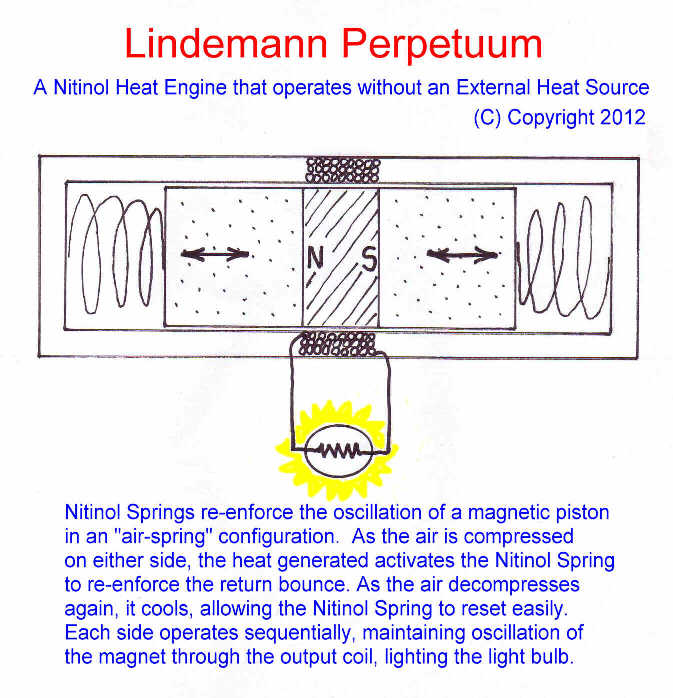
Lindemann Perpetuum

Hi folks,

In keeping with my plan to introduce this idea as an example of a machine that can produce energy from the behavior of the Natural World, I reproduce the slide from my Convention Presentation here:


Since this thread has already presented evidence that the act of compressing air can increase the temperature of that air, as well as the facts that NITINOL, when it is cool, can be bent easily, and when it is warmed passed it's transition temperature, springs back to it's original shape with a great deal of force. These are the basic concepts necessary to contemplate the operation of the LINDEMANN PERPETUUM.

Peter
Thanks for the Link!

ibpointless2 wrote:

Here is proof that you can get heat from compressing air, it gets hot enough to start a fire.

Gray Matter: How to Start a Fire With Only Compressed Air | Popular Science
Dear ibpointless2,

Yes, heat can definitely be manifested by compressing air. Your link shows this very conclusively. These processes are used every day in Diesel Engines, where the "heat of compression" is so high it ignites the diesel fuel without a spark plug. So, this process is well known and used industrially all over the world.

The question is, what else can we do with this so called "heat of compression"? Obviously, I am suggesting that we can use it to push a NITINOL spring passed its transition temperature to produce the release of mechanical energy that will ADD to the mechanical energy we can recover when the air itself is decompressed. This should produce a gain in mechanical energy with each cycle.

I am also suggesting that the repeated cycling of this phenomena will not dramatically change the temperature of the mechanism. I say this because I have never seen a report showing a momentary dip in the temperature of NITINOL as it transitions from one crystal structure to the other. As of today, that is what we know. The temperature dip is either present and unreported, or is simply absent all together.

Of course, lab testing will tell us the truth at some point, but it seems like a very promising possibility regardless.

Peter
Thanks, WONZA!

wonza wrote:

I purchased it too. Found it's very interesting. I found this on YouTube about nitinol Free Energy Nitinol Heat Machines invented in the early 1970.flv - YouTube

Also found some available on eBay for very cheap prices and I think I'm going to purchase some after I think of my own design for an application for this.
Dear Wonza,

Thanks for posting that film on NITINOL. I was about to do that. Notice that Ridgeway Banks says his friend told him "don't wonder about where the energy is coming from...... it's a gift from God." And the other researcher says that it's "like perpetual motion." I couldn't agree more!

The purpose of proposing the Lindemann Perpetuum is to get people thinking outside of the "energy conservation" straight jacket and back out in the real world! NITINOL heat engines do not have to be splashing water all over the place. Instead, they can run indefinitely by injecting and extracting the same heat, over and over again, to produce REAL PERPETUAL MOTION.

I am very gratified that my lecture has triggered an interest in NITINOL for you. Good luck with your experiments.

Peter
Nitinol

ibpointless2 wrote:

@Peter Lindemann

All the videos i see on YouTube about Nitinol engines involve water that is close to boiling point for it to work. Heatmobile - YouTube

Would the Lindemann Perpetuum get hot enough?

Also what would be your guess on how Bessler wheel worked?
Hey ibpointless2,

The transition temperature of Nitinol can be set by changing the ratio of Nickel and Titanium in the mix. Some mixes can transition at body temperature (98.6F). So, YES, the compression stroke of the LINDEMANN PERPETUUM can get hot enough! It is simply a matter of research to see how hot the air spring can get in any specific design, and use a spring configuration and Nitinol mix that is appropriate for that temperature swing.

Please spend some time doing your own research on Nitinol and its properties, as there are a number of subtleties about this situation that may not be immediately apparent. The most important one is this. Nitinol transitions from one internal crystal structure to another at a certain temperature, but there is no evidence that this transition actually CONVERTS heat into mechanical energy. In other words, the temperature of Nitinol does not DROP (consumption of heat) when the material flexes and gives the mechanical energy. You must sit with this for a while before you understand the full implications.

As for Bessler's Wheel, that is an on-going project. I would prefer to discuss my current ideas on Bessler's Wheel in one of the Bessler threads.

Thanks for your questions.

Peter
Aaron, Thanks for Starting this Thread

Greetings,

This thread is dedicated to an open discussion of any of the information that I presented in my recent presentation at the Conference. Please DO NOT post here if you have not seen the Lecture or were not at the Conference.

This includes any of the topics, inventors, and historic perspectives, as well as my new Nitinol powered generator that does not require a source of heat to operate.

I look forward to a lively discussion.

Peter
All Correct Ingredients?

MourningHour wrote:

Hello,

I own small company that researches new technology, to fund further projects we are selling Chemalloy.

You can read more about it hear:
Thermalloy US Patent # 2,796,345 ~ Samuel Freedman

it even tells you how to make it, but since I realize there is a lot of people interest in free-energy, but for the average person it is difficult to carrying out melting and casting of complex metal alloys, so we offer it for sale at $35 a lb, less for larger quantities.

Also if you have special requests on technology you would like us to look into, feel free to ask.
Dear Mourninghour,

Thank you for your interest in ChemAlloy and for offering to make this amazing material available to other researchers. My questions are as follows:

1) Are you using all of the ingredients listed in the patents and going through the manufacturing procedure described there, or are you making substitutions in the ingredients and simplifying the process?

2) In particular, are you using "willow charcoal" and "ground copper slag" from the first scraping of a virgin smelt? If so, where have you acquired these ingredients?

3) Does the material you are supplying remain "inert" as it dissociates water molecules?

I am very interested in ChemAlloy and would like to speak with you about the material you are selling. Please PM me and leave me your phone number.

Thank you,
Peter
Clear Thinking.......not good enough!

TRON wrote:

@Peter:
the problem with two brushes on the outer perimeter and 4 alternating bar magnet poles passing by for AC output is the fact that the RPM will determine the frequency, and the magnets may fly off.

What if the plate / disc had high density coils on each side that changed polarity 60 times per second?

These coils could be on either side of the disc and power obtained between axle and perimeter. thus the RPM could be any value, and RPM could be changed to produce varying output.

any ideas on how to get current from a copper mass without rotating it, using simple arrangements of coils and flux induction?
Dear Tron,

Thanks for being interested in the possibilities of an "AC Disc Generator". Michael Knox and I were the first to ever show that AC could be produced in a one piece generator design with a rotor and no stator. We showed the experiment in the Borderlands film titled Free Energy Research, produced in 1987. That film is still available today as part of the Classic Energy Videos package available HERE.

The important point of the demonstration wasn't that two perimeter brushes could be used, but that TWO BRUSHES ON THE SHAFT could be used! It was always assumed that AC could be put into a rotating electro-magnet and power drawn from the classical set-up, like DePalma built in the "Sunburst Machine". The mechanical problems of the machine always centered around drawing high currents from the high speed perimeter brush.

In an attempt to solve this issue, dozens of experiments were tried. Only one in ten behaved the way we thought it would. It became very clear to us that the rotating magnetized disc generator was much more unusual than we had conceived of it in our minds.

I applaud your interest in this topic, but caution you, only experimental results will teach you anything about this machine.

Best regards,
Peter
Sent: Tuesday, March 29, 2011 5:18 PM
Subject: A request from Dr. Masaru Emoto. OFFICE MASARU EMOTOThe water of Fukushima Nuclear Plant,
we are sorry to make you suffer.
Please forgive us. We thank you, and we love you.

Please say it aloud or in your mind. Repeat it three times as you put your hands together in a prayer position. Please offer your sincere prayer.

Thank you very much from my heart.

With love and gratitude,
Masaru Emoto
Messenger of Water
Other Possibilities

Hi Elias,

Another possibility is that your friend's house is wired wrong and the light switch in his bedroom is on the Neutral line instead of the HOT line. This may account for the periodic charging and discharging of the capacitor, like Sebosfato has proposed.

I have noticed that CFLs flash once in a dark room whenever I touch the light switch, BEFORE I turn the light on. So, they are very susceptible to electrostatic discharges and voltage spikes.

Peter
Of Course!

Dear Steve,

Of course I know how to make devices that produce more energy than they run on. In fact, I know quite a few ways.

The MYTH of Free Energy is that hobbyists can build one of these things in their spare time! The fact is, that 99.9% of all people could not even make a ball-point pen from scratch parts in their garage, or even something as well understood as an internal combustion engine. These are major engineering projects that take time, energy, money, KNOWLEDGE and SKILL.

I work for a living. That means I don't have much time for these projects anymore. I set out to study Free Energy technology in my early 20's, in 1973. Since then, I have learned much more than I ever imagined was possible about this field, and having stayed alive, I ended up being considered "knowledgeable" by comparison with others.

I have been told, by people who knew Stan Meyer, that my explanation of Stan's system, as presented in the YouTube clip, is essentially correct, but slightly over simplified. But that was the purpose of my lecture at the KeelyNet Conference, to make things understandable to the whole audience.

As for why I haven't published exactly how to do it, Aaron and I were going to work the whole thing out, at the end of the summer in 2008, when the big crash happened. We both ran out of money and had to stop all of our projects. In the meantime, a number of other people have worked it out and there are some Yahoo Groups right now showing people how to run an engine/generator set on water.

Good luck with your research. That is all I am going to say here. No more questions.

Peter
Worse Than a Joke!

Kirill wrote:

Hi everyone,

i have seen in internet following site : Free Energy Motors Generators
they are offering to purchase some plans of overunity devices.
Does anybody know , is it real or just joke ?

Thanks in advance,
Kirill
Russia.
Kirill,

This company, Creative Science, has been selling plans like these for over 15 years. No one has ever made a free energy machine from these plans. You are far better off studying the information in the other threads here, to learn the basic principles of the science. Or if you want a summary of the best there is in the public domain, buy a copy of the Quantum Key, advertised on the main page, here.

Whatever you do, don't buy the Creative Science plans. They don't work, and the company doesn't honor the money back guarantee!

Peter

rethinking science

#5 ·

Interesting

Vortex wrote:

Tron,
It isn't hard to find examples that do not fit into the "mold" of what we have been told.

As Peter said "100% agree", and he has been telling those that would listen this for a very long time.

Peter,
it would be great if you have time, to review the link below and maybe expand or explain what is covered there. If nothing else, take a quick look
at the images on that web page.

All,
I'm still lacking a "ah-ha" moment .. I have the "oh-it's there" feeling due to the research I've done. I see and read things where I lack the background knowledge to grasp the meaning or to make use of it.

For example in the link below: "THIS IS POWER .. NOT ENERGY."
I'm lacking a good mental image of the difference between power and energy.

Link originally posted by Ted Ewert here.
The link is a single web page : Compelling Questions About The Grand Unified Theory
Which is busting loose and declaring a lot of "laws" are just wrong.
Newton, Thermodynamics, Faraday, etc.


About the link above, I have a "feeling" about this information but not grasping it.
It would help me to know it does or does not relate to things Peter Lindemann has told us.

Thanks
Randy
Randy,

The link definitely has some good stuff, but even this author has not shown designs that "best embody" the ideas he is promoting. Straightening out your head does not automatically make you a good engineer! Diagram 10 is a good example. His design is missing three simple features that making lifting water, at least 32 feet, a self-powering process, using Centrifugal Force.

A working system would include a stationary standing pipe with a passive "check valve" at the bottom, in a lower water pool. At the top, the interface between the standing pipe and the rotating section is provided by a device called a "rotary union" (such as this: Rotating Swivels - Rotary Swivels - Rotary Couplings - Rotary Joints - Rotary Unions) The rotating section at the top is spun up with a starter motor to produce a "vacuum" in the center to "lift" the water up the pipe (artificial siphon) and the high pressure water at the perimeter by Centrifugal Force. It uses standard nozzle technology to blast the water ejected by the system into stationary "Pelton Wheel" type cups that re-direct the water blast back at the wheel to push it again. The nozzle reaction torque combined with anything else you can extract from the water bounce-back, is used to relieve the energy of the motor turning the upper wheel. If you can reduce the amount of electricity the motor uses by 50% or more, then you just lifted the water for a major discount. If you can relieve the motor by 85%, then all the better.

This is a matter of engineering design and managing the nozzle and receiver cup geometries. Here, we can see that a larger diameter wheel helps because the pressure of the water coming out the nozzles is driven by the Centrifugal Force. The reaction torque from the nozzles is based on the velocity of the water ejected. At the point where the water is ejected from the nozzles at twice the perimeter speed of the wheel, the probability of "self turning" becomes very good! So, once you have the geometry right, relieving the start motor 100% should be possible.

The water is then caught in a pool at the higher elevation, which can then run another identical system on its return to the bottom. The return system does not need a motor to spin it up, because it has 30 ft of water pressure to get things started. The combined energy gain from gravity and centrifugal force should be substantial.

There are dozens of these "windows of opportunity" in the Natural World. Developing a well engineered design for a machine that operates in a stable manner in one of these windows takes more work.

That's just one example. Enjoy.

Peter

rethinking science

#2 ·

Excellent

TRON,

I agree 100%. Your friend is both wise and knowledgeable. Learn all you can from him.

The biggest impediment to making this intellectual transition, is the emotional upheaval it causes. We have all been lied to about how the Universe works, in a wholesale manner. Modern physics is nothing more than a "hand maiden" in the Castle of Financial Barons. It has nothing to offer, either itself, or a hopeful public in need.

Peter
Gerry Vassilatos

Hi Guys,

The only place I have ever seen The Dissipation of Electricity mentioned, is in Secrets of Cold War Technology, by Gerry Vassilatos. This lecture was supposedly given in December of 1892. I have never found any other reference to it.

Having looked for this lecture for years, I finally "wised up" and realized what was going on. In his next lecture in the series, Tesla covers the same information again. So, the lecture On Light and other High Frequency Phenomena, given in both February and March of 1893, everything you are looking for......is right before your eyes!

You can find this lecture on the web, or download it from my website at:

image_placeholder.svg


Enjoy,

Peter

Merry Christmas!!!

#7 ·

Merry Christmas and Happy Hanukkah


To everyone who participates in these forums, I wish a warm and loving celebration with your family and friends, this Holiday.

May 2009 continue our growing tradition of open, honest sharing of newly discovered facts and experimental findings. Science can only thrive in an environment of honesty, respect, and politeness. We each have been given a different perspective on reality that is unique and authentic. Only by respectful sharing can we broaden our vision beyond our personal perspective.

Thank you ALL for Enlightening me so much this year!

Best wishes always,

Peter
Lutec: a Short Story

Hi Guys,

While I'm sure there may be other points of view on this, here is mine, having seen the whole thing unfold over the years.

It starts back in 1992 when ROBERT ADAMS published plans for his motor/generator in Nexus Magazine. About 6 years later, Lutec shows up with their first prototype of Adams' system, claiming to be the inventors. Adams immediately went ballistic, claiming both priority and intellectual property theft. Adams lived in New Zealand, and Lutec was in Australia, so there wasn't much Adams could do except complain.

The first Lutec machine used BRUSH COMMUTATORS and apparently worked. At that point, they started raising money. But, not being the inventors, and not really understanding the technology, they immediately thought they could go to solid-state switching and everything would just scale up easily. OOOPS! For years, they were "right around the corner" with their big, shiny, power plant...that never worked. Their US Patent is granted for a simple commutation system, not a power supply.

After 4 years of total failure with the solid-state circuits, these geniuses finally got the idea to go back to what they had stolen from Adams in the first place. Voila! The LEA is born, sporting a fancy, new.... BRUSH COMMUTATOR!!!!!

The rest is recent history... leading to the deal with EverGreen. But even the EverGreen site is over 2 years old. They just have a little "bot" that plugs today's date into the top of the page, but really, nothing has happened on that site in over a year, either.

The moral of this story is: "People who steal aren't smart enough to do it right in the first place."

Robert Adams was a genius and a good friend of mine. His passing was a great loss to the FE movement. He is sorely missed.

Peter
Google

dambit wrote:

I have a great book titled "Suppressed Inventions and Other Discoveries". It is a fantastic book with all kinds of medical and technical information that has been suppressed. I'm not sure if anyone here has looked into it, but with regards to water/hydrogen converters, an inventor by the name of Francisco Pacheco built an amazing hydrogen generator/cell. patent # 5,089,107 . It uses basic chemestry and is fairly simple to construct. The only problem is getting magnesium in sheet form. I can't seem to find it. I did a small proof of concept to see if it might work. I used small scraps of the metals and arranged them in the correct manner. It seems to work fairly well even in small scale.
Dear Dambit,

If you Google "magnesium sheet", there are 2.7 million hits. I think the days of not being able to find things are over. When in doubt, just do a Google search. Its out there!

Hope this helps.

Peter

Davey's Water Heater

#5 ·

Awesome!!!

elias wrote:

Peter,

I constructed a simple Davey heater by using two metallic bowls and it works!! But I don't know if it has COP > 1. It boiled two liters of water pretty fast. I am looking for a way to tune it to get the most out of it.

As you have extensive experience in this area can you recommend an easy and affordable way to measure the efficiency of heaters?

I'll post some pictures and videos later.
Thanks
Elias
Elias,

The only way to accurately quantify the COP is by putting the whole thing in a Calorimeter. However, to get a "ballpark" idea to see if its worth all the trouble, the simplest way to go is to weigh the water you put in the machine and measure its temperature. Obviously, two liters of water weighs 2kg (4.4lbs.). Measure the temperature of the water before you start. Stir the water for about 30 seconds before you take the measurement to make sure the temperature is uniform throughout the sample.

1 KCal = the amount of heat required to raise 1 kg of water by 1 degree C. This is also equivalent to 4184 Joules (watt-seconds).

So, what does this all mean. Well, it means that if you put 418.4 watts of electricity into your 2 liters of water for 20 seconds, it should raise its temperature by ONE DEGREE CELSIUS. It sounds like you might be doing a little better than this, but this is the benchmark you must get over to have a COP>1. If you start with 2 liters of water, measure your electrical input in watts, measure the time you heat the water in seconds, and your temperature before and after in degrees C, you should be able to calculate a "ballpark" estimate of the COP.

Peter

Davey's Water Heater

#2 ·

Awesome!!!!

elias wrote:

Hello,

A simple device that the inventor claims that has a COP of around 20.
It simply consists of two bell shaped bowls within each other not touching. Alternating current of 50Hz or any other frequency is applied across the two bowls, while the bowls are in water. The water heats up so fast and quickly reaches to boiling point.

The trick as it is claimed to tune the bowl so that 50Hz or any other frequency applied is the resonant frequency of the system. The tuning is done by adjusting the distance of the two bell shaped metallic bowls from each other.

This is quite interesting if it works as claimed. The full document is attached.

I wonder what will happen if we pulse the bowls? Will it heat the water too or make Hydrogen?
Maybe I'll experiment with it later to see what's its capabilities.

Good Luck
Elias
Elias,

This Davey Resonant Heater looks awesome. I had never seen this before. Thank you for starting this thread!!!

I encourage someone to look into this.

Peter