patent · US6348143
Hydrothermal electrolysis method and apparatus
19 February 2002
Page 1 — bibliographic record
(12) United States Patent (10) Patent No.: US 6,348,143 B1 Serikawa et al. (45) Date of Patent: Feb. 19, 2002
(54) HYDROTHERMAL ELECTROLYSIS (56) References Cited
METHOD AND APPARATUS
(75) Inventors: Roberto Masahiro Serikawa; 4,077.862 A 3/1978 Okazaki ..................... 204/262 Qingquan Su; Akira Watanabe, all of 4,278.527 A 7/1981 Dotson ....................... 204/272 Kanagawa (JP) 4.389.288 A 6/1983 Vaughan ..................... 204/101 4,405,420 A 9/1983 Vaughan ..................... 204/105 (73) Assignee: Ebara Corporation, Tokyo (JP) 4,692.232 A 9/1987 King .......................... 204/278 4,752,364 A * 6/1988 Dhooge ...................... 204/151 (*) Notice: Subject to any disclaimer, the term of this 5,401,374. A 3/1995 Leutwyler ................... 204/272 patent is extended or adjusted under 35 FOREIGN PATENT DOCUMENTS
(21) Appl. No.: 09/485,519 JP 49-116858 11/1974 (22) PCT Filed: Aug. 10, 1998 JP SO-OO3O8O 1/1975
* cited by examiner
Primary Examiner Arun S. Phasge
S 102(e) Date: Feb. 11, 2000 (74) Attorney, Agent, or Firm Wenderoth, Lind & Ponack, (87) PCT Pub. No.: WO99/07641 LLP.
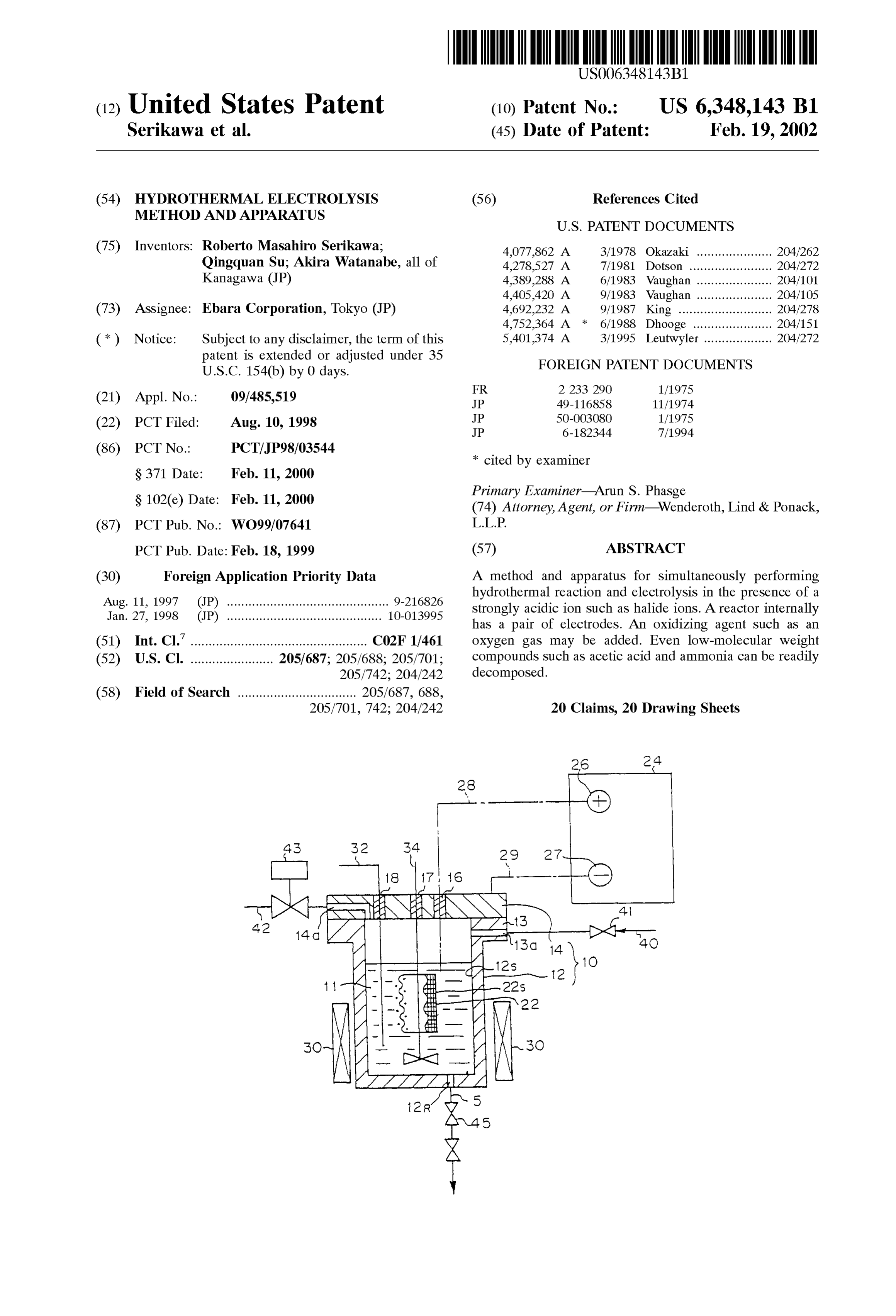
PCT Pub. Date: Feb. 18, 1999 (57) ABSTRACT (30) Foreign Application Priority Data A method and apparatus for Simultaneously performing hydrothermal reaction and electrolysis in the presence of a
Aug. 11, 1997 (JP) ............................................. 9-216826 Strongly acidic ion Such as halide ions. A reactor internally Jan. 27, 1998 (JP) ........................................... 10-013995 has a pair of electrodes. An oxidizing agent Such as an (51) Int. Cl. ................................................. CO2F 1/461 oxygen gas may be added. Even low-molecular weight (52) U.S. Cl. ....................... 205/687: 205/688; 205/701; compounds Such as acetic acid and ammonia can be readily
(58) Field of Search ................................. 205/687, 688, 205/701, 742; 204/242 20 Claims, 20 Drawing Sheets
Page 2
Drawing sheet — no readable text.
Page 3
Drawing sheet — no readable text.
Page 4
Drawing sheet — no readable text.
Page 5
Drawing sheet — no readable text.
Page 6
Drawing sheet — no readable text.
Page 7
Drawing sheet — no readable text.
Page 8
Drawing sheet — no readable text.
Page 9
Drawing sheet — no readable text.
Page 10
Drawing sheet — no readable text.
Page 11
Drawing sheet — no readable text.
Page 12
Drawing sheet — no readable text.
Page 13
Drawing sheet — no readable text.
Page 14
Drawing sheet — no readable text.
Page 15
Drawing sheet — no readable text.
Page 16
Drawing sheet — no readable text.
Page 17
Drawing sheet — no readable text.
Page 18
Drawing sheet — no readable text.
Page 19
Drawing sheet — no readable text.
Page 20
Drawing sheet — no readable text.
Page 21
Drawing sheet — no readable text.
Page 22
HYDROTHERMAL ELECTROLYSIS wastes landfill sometimes contain 1,000 to 30,000 mg/L of METHOD AND APPARATUS chloride ions together with COD components. It is not rare that wastewaters from chemical plants and food plants
This application is a 371 of PCT/JP98/03544 filed Aug. contain tens of thousands of mg/L of chloride ions. Even if 10, 1998. 5 these Salts are not initially contained, halide ions may be generated in water when wastewaters or wastes containing
FIELD OF THE INVENTION halogenated organic compounds are treated by hydrothermal reaction.
The present invention relates to a method and an appa Thus, Special caution was needed to treat wastewaters ratus for Simultaneously performing hydrothermal reaction containing Salts. Such as halide ions. However, the present and electrolysis. AS used herein, hydrothermal electrolysis invention allows halide ions to involve in oxidative decom refers to performing hydrothermal reaction and electrolysis position of reduced matters, and the presence thereof at the same time. improves treatment of wastewaters. RELATED ART SUMMARY OF THE INVENTION
Hydrothermal reaction requires high pressure, and
Wastewaters containing organic matters or the like have therefore, it has commonly been performed in a closed been treated by hydrothermal reaction. The hydrothermal container. When the internal preSSure in the closed container reaction refers to a reaction which proceeds by holding increases above a determined value, a gas releases from an wastewater or the like at high temperatures under high escape valve.
preSSures in the presence of water to decompose organic On the other hand, electrolysis in the presence of water matters in the wastewater.
generally leads to generation of a hydrogen gas and an an
During hydrothermal reaction, wastewater its held at an oxygen gas. The presence of the hydrogen gas and the elevated temperature of, for example, 100 to 350° C. for, oxygen gas may involve a danger of explosion. typically, Several tens of minutes. For continuous treatment, 25 Thus, electrolysis of wastewater in a closed container may for example, pressurized wastewater is introduced into a mix the hydrogen gas with the oxygen gas to create a danger reactor which has been heated So that the wastewater may of explosion. Particularly, when the hydrothermal reaction retain at high temperatures under high pressures for a given and electrolysis are performed Simultaneously, it would be period of time. For batch treatment or Semi-continuous expected that a mixed gas containing the hydrogen gas and treatment including repeated batch treatments, wastewater in the oxygen gas is brought to high temperatures under high a preSSure-resistant closed container is heated, and pressure preSSures to further increase the force of the explosion. is raised with the increasing temperatures. However, we carefully performed hydrothermal reaction It is also known to perform the hydrothermal reaction in and electrolysis simultaneously in an aqueous Solution con the presence of an oxidizing agent Such as Oxygen or taining a halide ion on a Small Scale. To our Surprise, we hydrogen peroxide for Oxidatively decomposing organic 35 have found that the generation of a hydrogen gas and an matters or the like in wastewater. Such oxidative decompo oxygen gas is highly Suppressed at high temperatures and Sition reaction is called hydrothermal oxidation reaction or wet oxidation proceSS. In the hydrothermal oxidation reac that reduced matterS Such as organic matters and ammonia therein are effectively decomposed by oxidation.
tion or wet oxidation process, compounds having low According to a first aspect of the present invention, a molecular weights Such as acetic acid or ammonia can not be 40 method for hydrothermal electrolysis is provided compris readily decomposed, and the decomposition rate is limited. ing the Step of applying direct current to an aqueous medium Thus, the presence of a heterogeneous catalyst for promot containing water, ing oxidation reaction was proposed as described in JPB No. temperature ranginga halide from ion and a reduced matter at a 100° C. to a critical temperature 19757/84. The wet oxidation process using a heterogeneous of the aqueous medium under a pressure catalyst is also called as catalytic wet oxidation proceSS. In 45 aqueous medium in the liquid phase. for maintaining the this way, the chemical oxygen demand (COD) of wastewater In the present invention, Said aqueous medium preferably can be lowered by hydrothermal reaction, which includes is held in a reactor having a metallic inner wall which Serves wet oxidation proceSS and catalytic wet oxidation proceSS. as a cathode while an anode is placed inside of Said reactor. Various wastewaters are treated by hydrothermal reaction When an aqueous medium containing a Salt Such as halide or wet oxidation process. For example, influent wastewaters 50 ions is hydrothermally decomposed, the reactor can be include a slurry obtained from organic wastes in a Solid, protected from corrosion by cathodic protection. Sludge or liquid form Such as municipal waste, night Soil, According to a Second aspect of the present invention, an Sewage sludge and industrial waste. Organic Sludge and apparatus for hydrothermal electrolysis is provided compris various industrial wastewaters are also treated. Wastewaters ing a reactor capable of withstanding a pressure of a hydro contain various materials, and it is desirable to readily 55 thermal reaction and a pair of electrodes for electrolyzing a decompose any kind of materials therein. matter in the reactor.
However, metallic material used in the reactor rapidly According to a third aspect of the present invention, a corrodes when wastewaters containing Salts were treated by method for hydrothermal electrolysis is provided compris the wet oxidation process or catalytic wet oxidation process.
When salts were present in the order of percents, they 60 ing the Step of applying direct current to an aqueous medium containing water, a strongly acidic ion and a reduced matter
Sometimes act as catalyst poison in the catalytic wet oxida at a temperature ranging from 100 C. to a critical tempera tion process. ture of the aqueous medium under a pressure for maintaining Wastewaters containing Salts include, for example, indus the aqueous medium in the liquid phase.
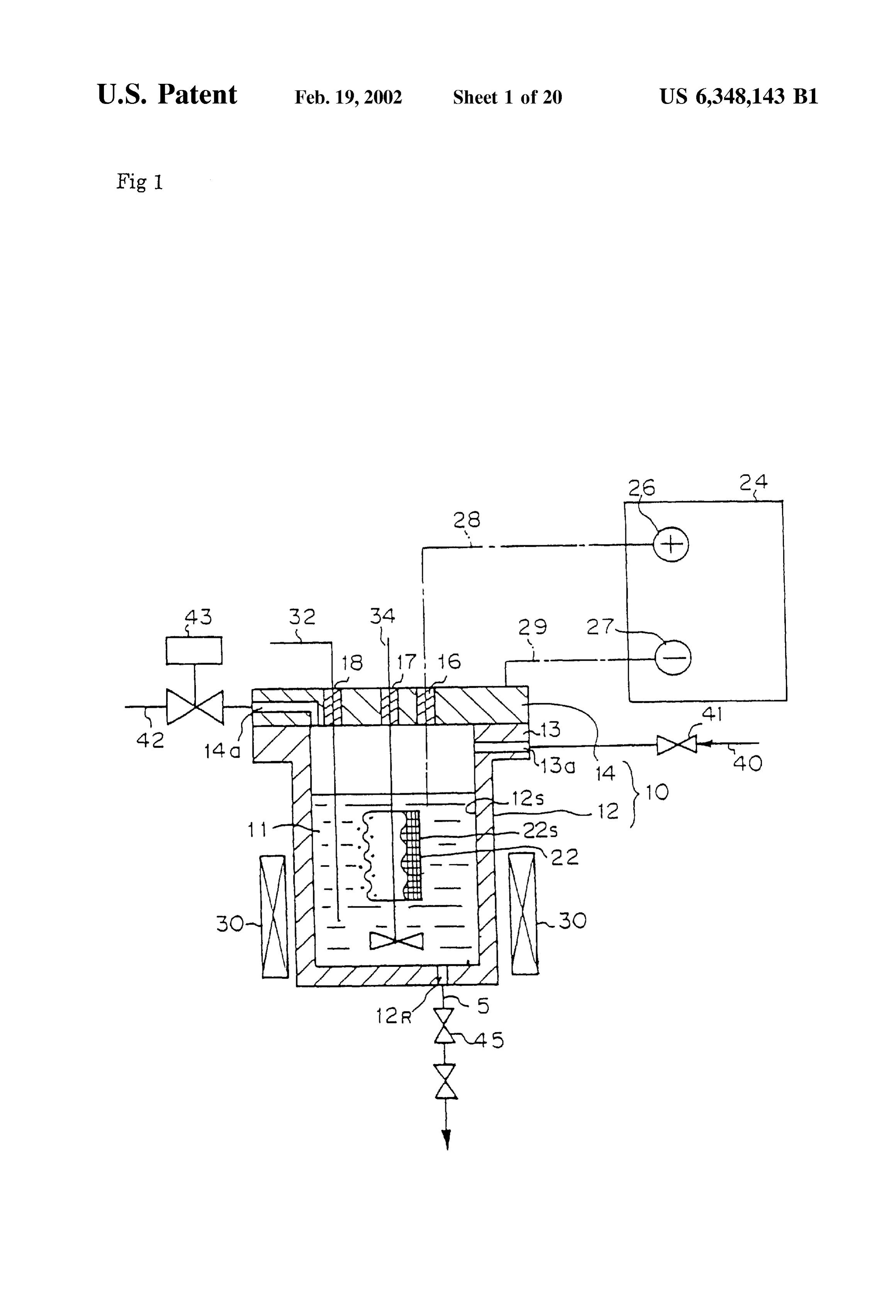
trial wastewaters, which often contain chloride ions. Con BRIEF EXPLANATION OF THE DRAWINGS taminated wastewater from power plants. Sometimes con 65 tains 500 to 20,000 mg/L of sodium chloride together with FIG. 1 shows a hydrothermal electrolysis apparatus ammonia or monoethanolamine. Leachates from municipal according to one embodiment of the present invention.
Page 23
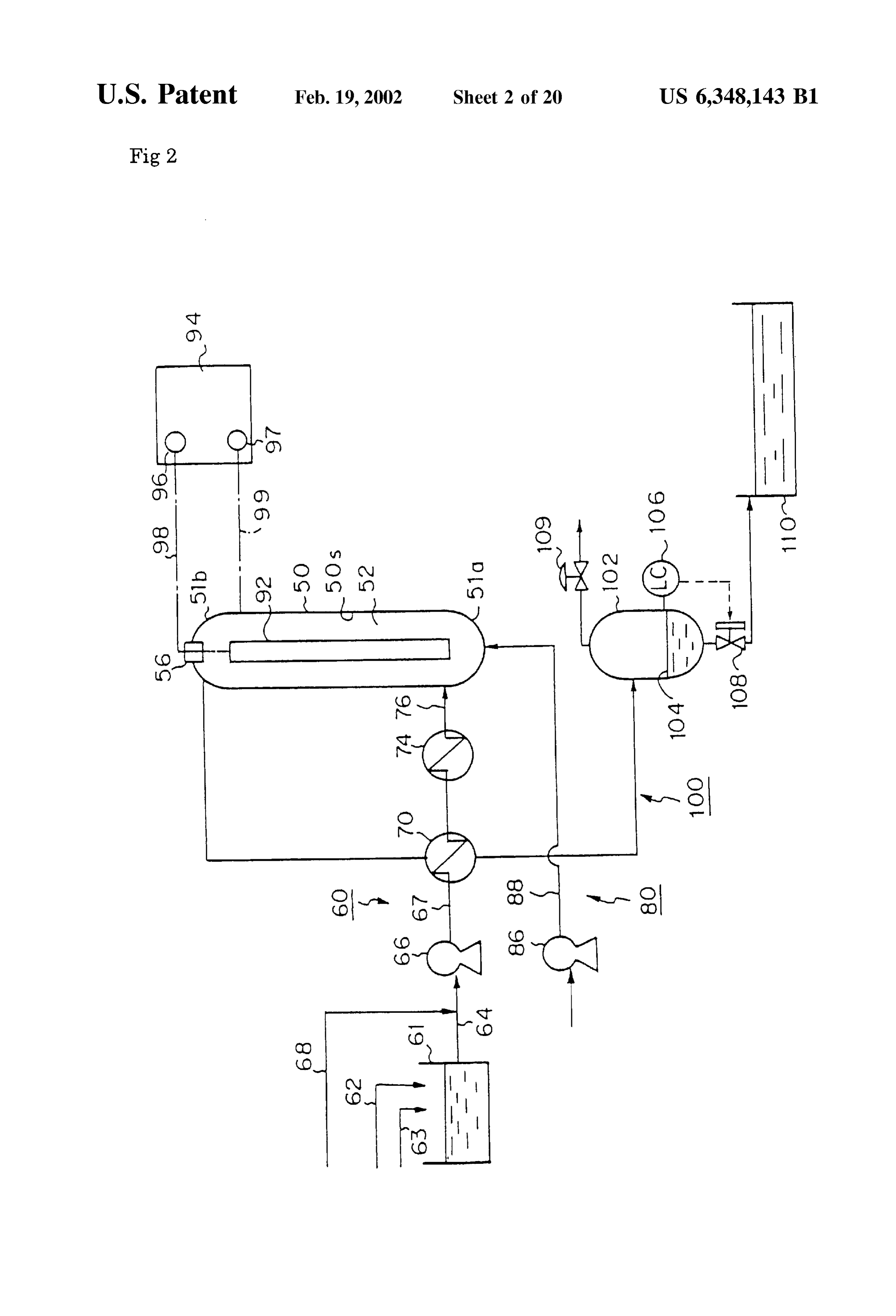
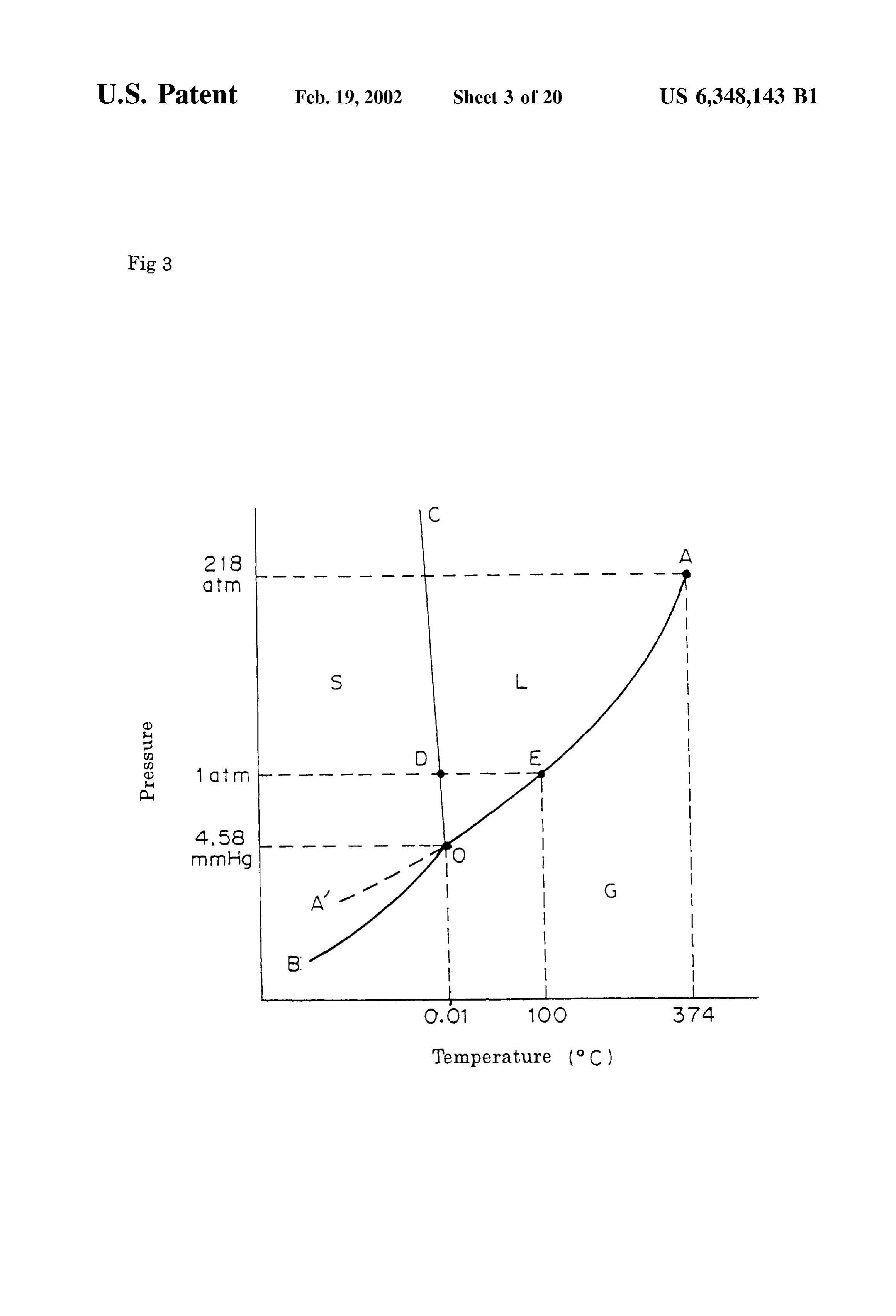
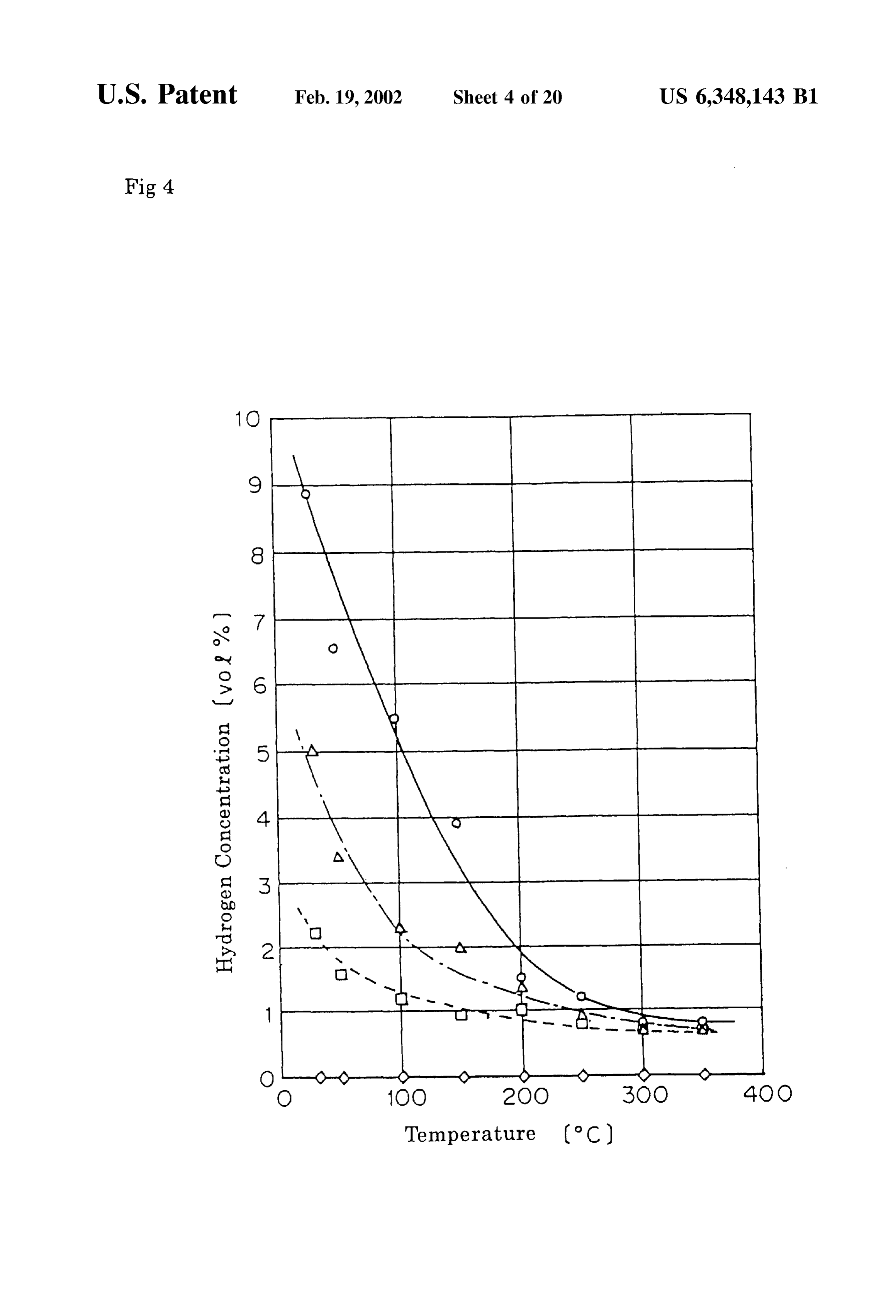
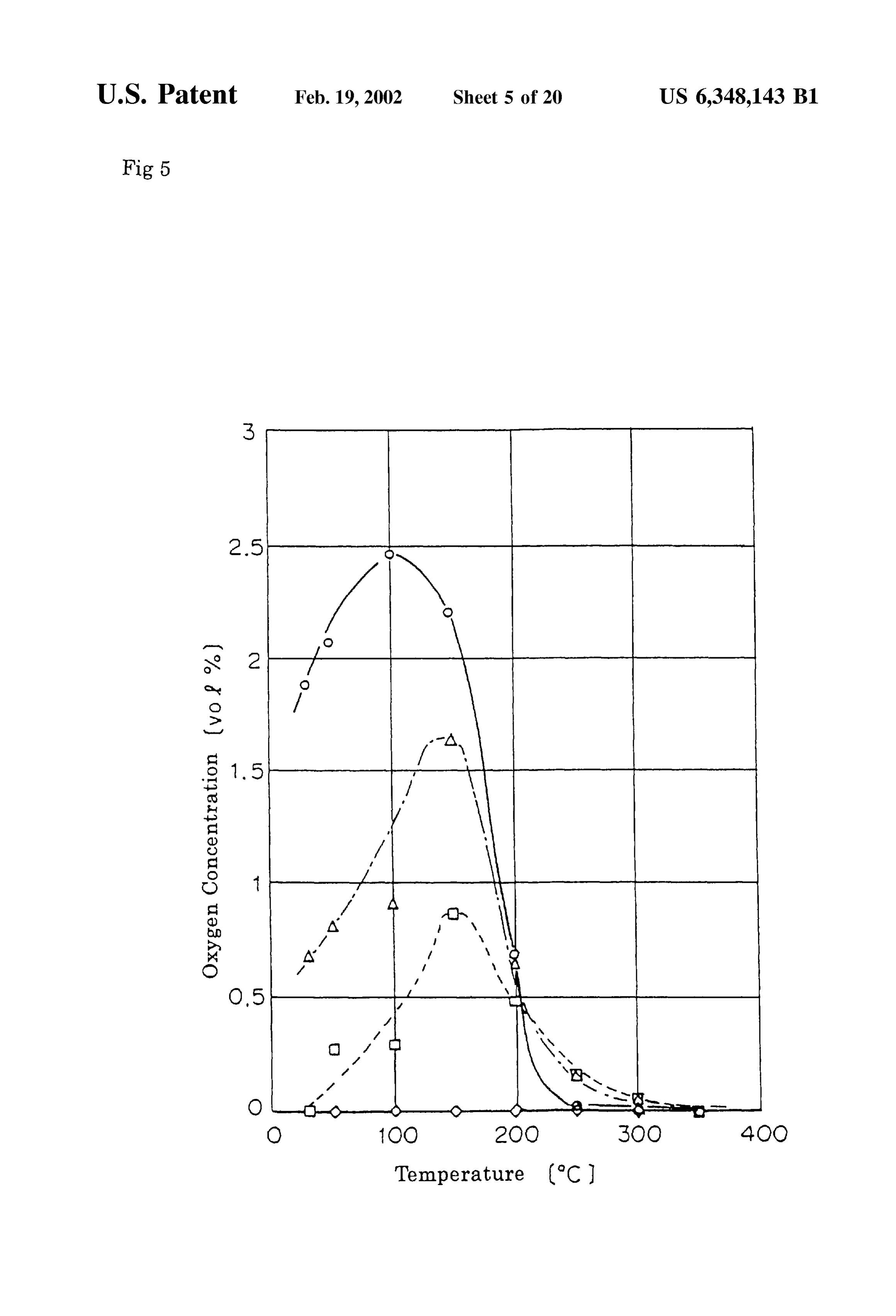
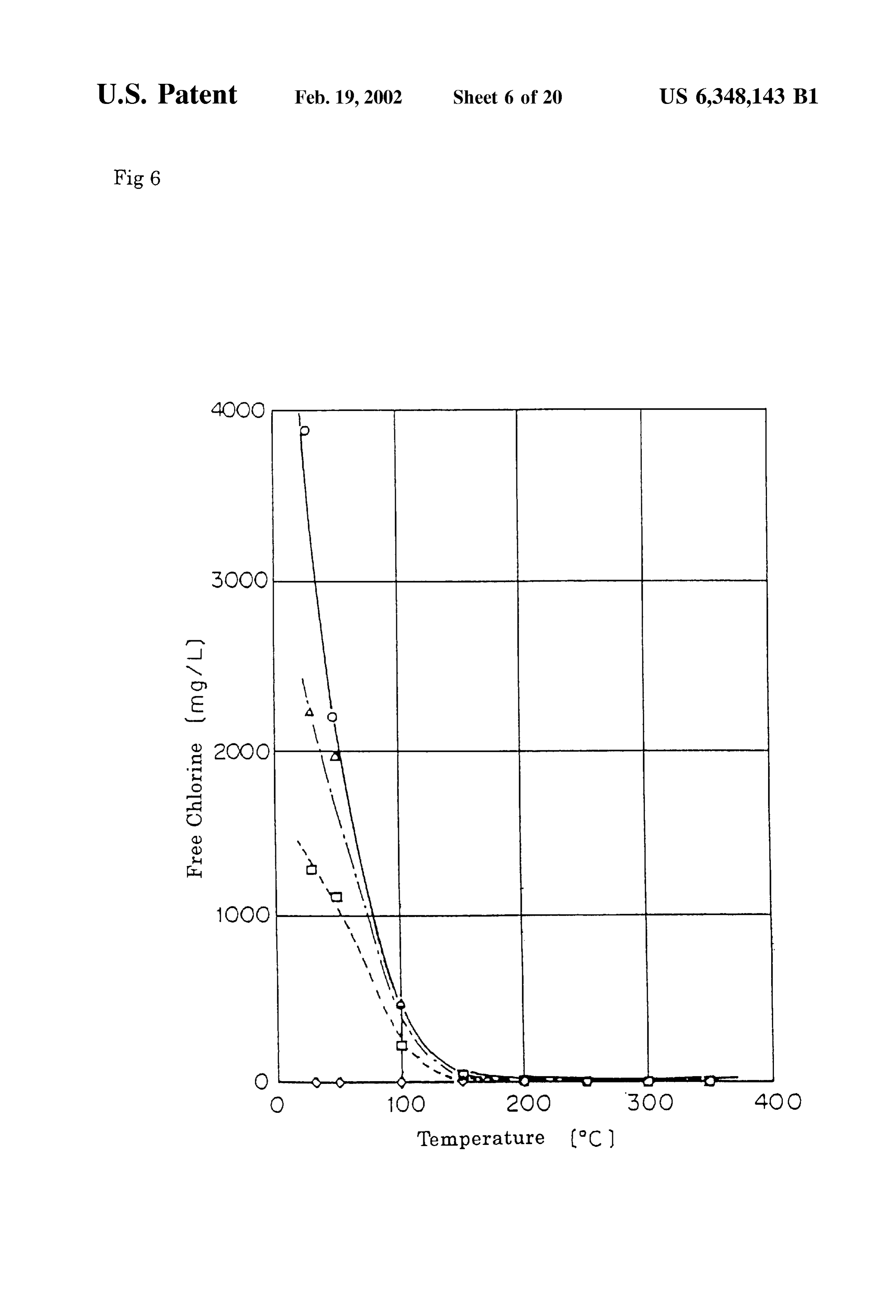
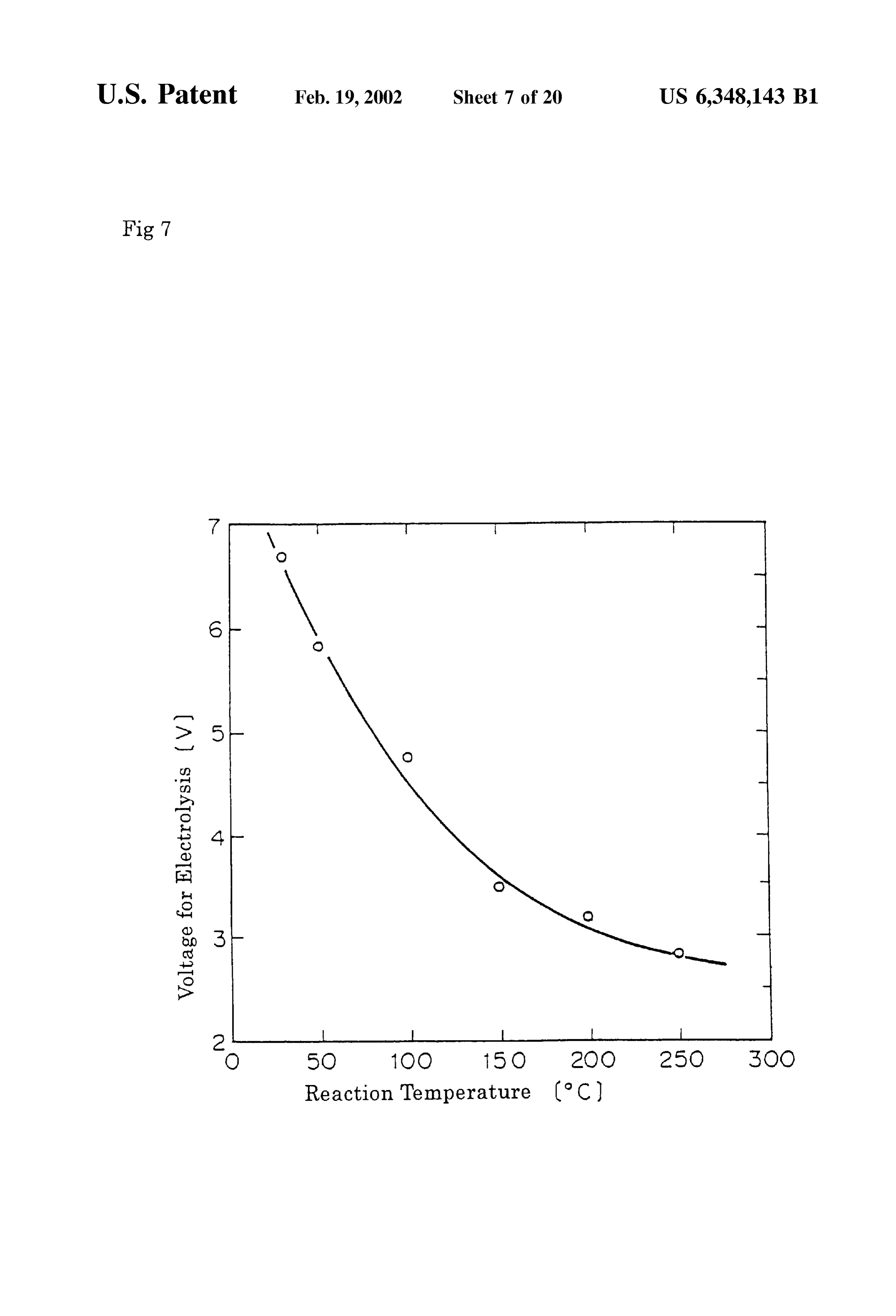
FIG. 2 shows a hydrothermal electrolysis apparatus PREFERRED EMBODIMENTS OF THE according to another embodiment of the present invention. INVENTION FIG. 3 shows a State diagram of pure water. According to the present invention, an aqueous medium FIG. 4 is a graph showing the correlation of a hydrogen 5 containing water, a halide ion Such as chloride ion and a gas generated with reaction temperature concerning hydro reduced matter Such as organic matters, ammonia and So on thermal electrolysis of an aqueous Solution of Sodium chlo is electrolyzed at a given high temperature under high ride being free from reduced matters. preSSure to oxidatively decompose the reduced matter. Dur FIG. 5 is a graph showing the correlation of an oxygen gas ing electrolysis, oxidation reaction proceeds at the anode to generated with reaction temperature concerning hydrother generate an oxygen gas and a halogenous Oxidizing agent mal electrolysis of an aqueous Solution of Sodium chloride Such as hypohalous acids. In the presence of the oxidizing being free from reduced matters. agent Such as the oxygen gas at high temperatures under FIG. 6 is a graph showing the correlation of the free high pressure of the hydrothermal reaction, oxidation reac chlorine content in a resultant, treated water with reaction tion tends to readily proceed. The present invention allows temperature concerning hydrothermal electrolysis of an 15 the reduced matter Such as organic matters and ammonia to aqueous Solution of Sodium chloride free from reduced effectively decompose by performing hydrothermal reaction matterS. and electrolysis Simultaneously. FIG. 7 is a graph showing the correlation of voltage with The electrode reactions which can proceed in hydrother reaction temperature concerning hydrothermal electrolysis mal electrolysis of the present invention are described of an aqueous Solution of Sodium chloride free from reduced below. At the anode, the following reactions (1), (2) and (3) matterS. Seem to proceed:
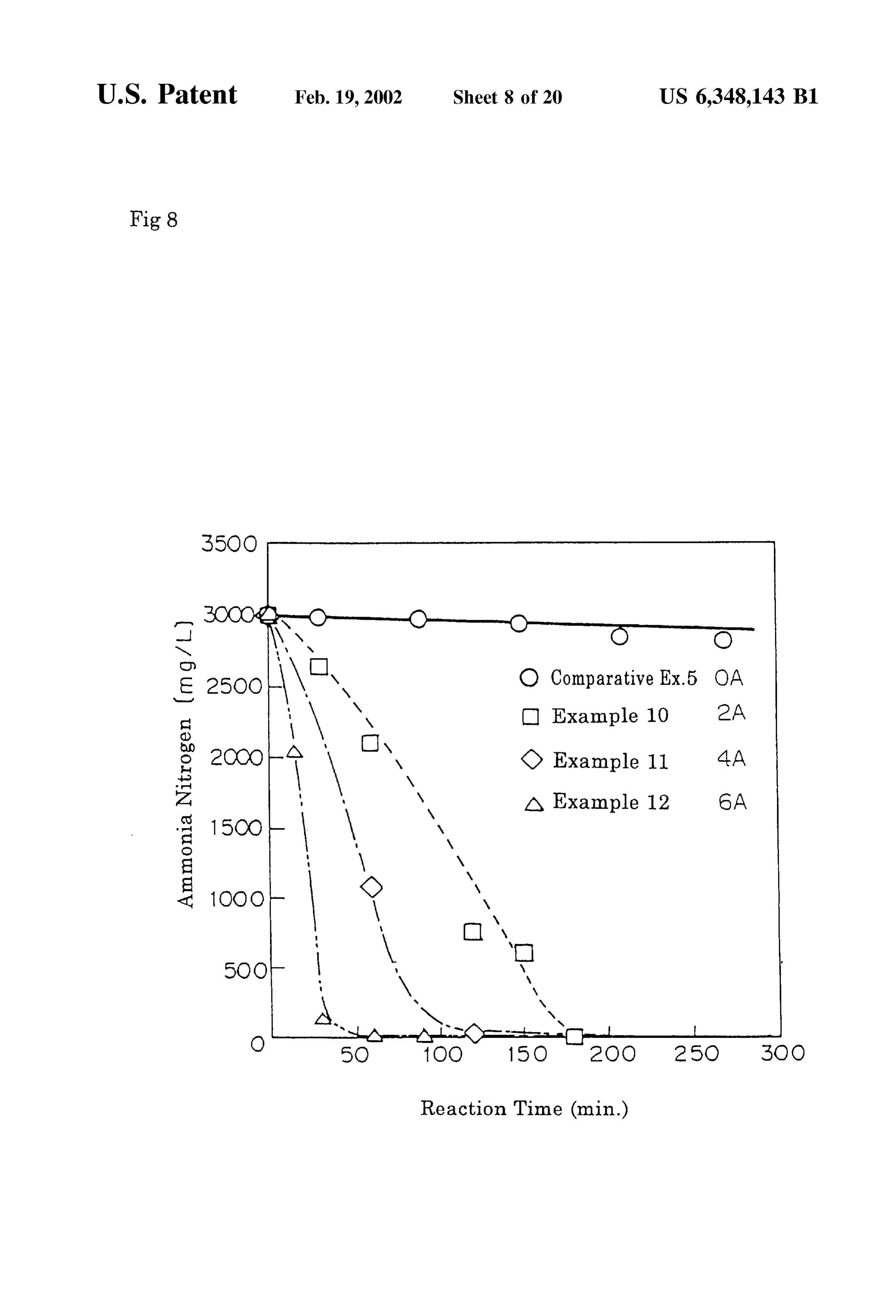
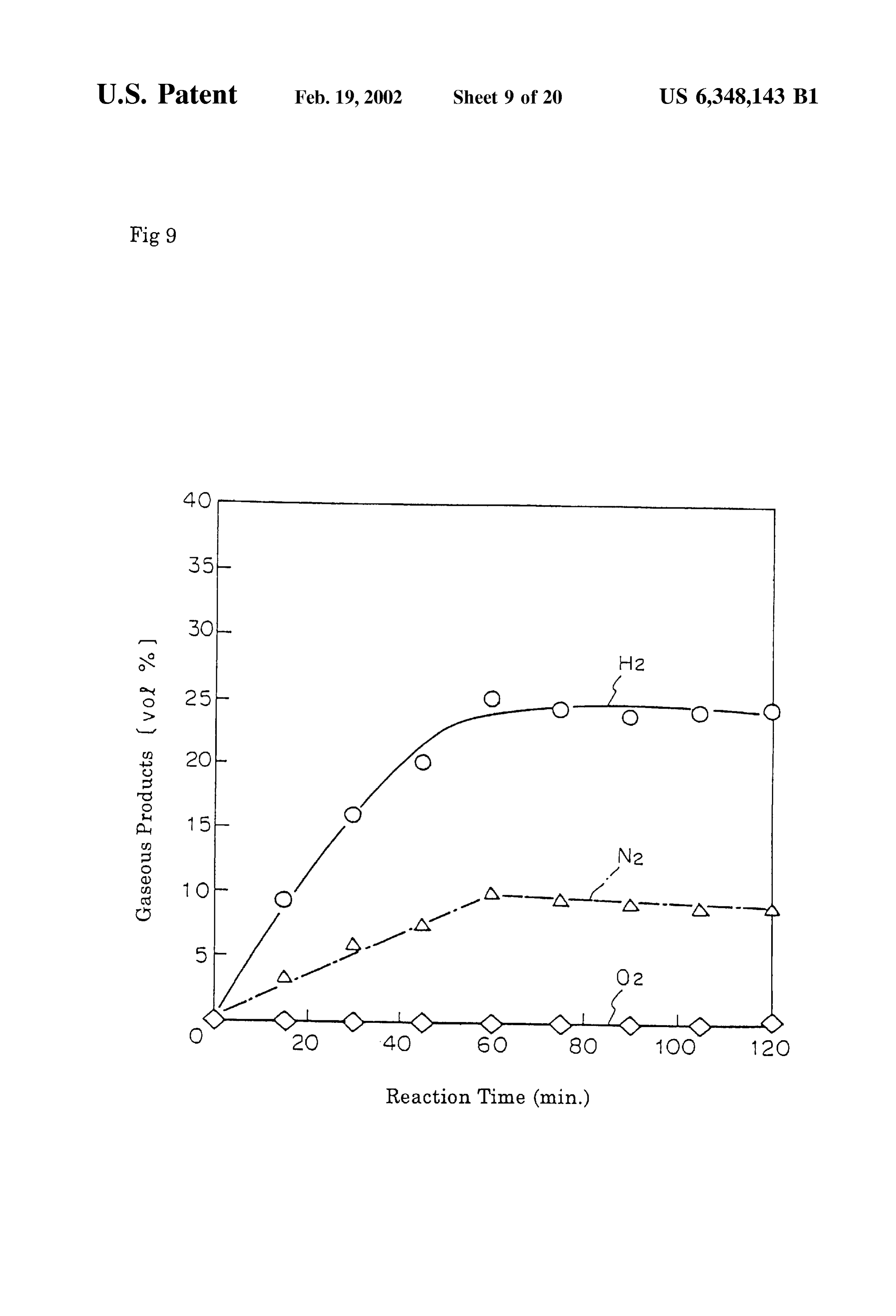
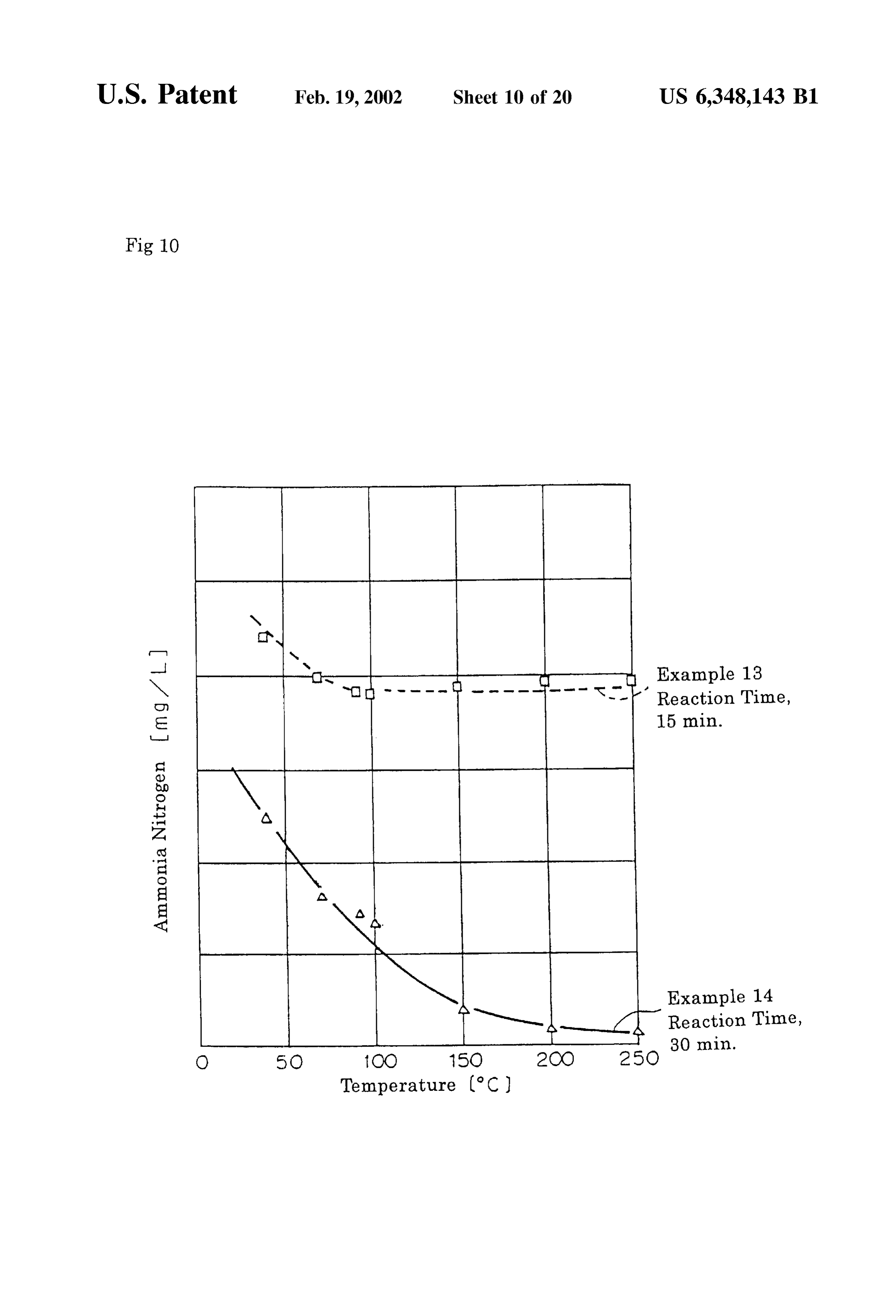
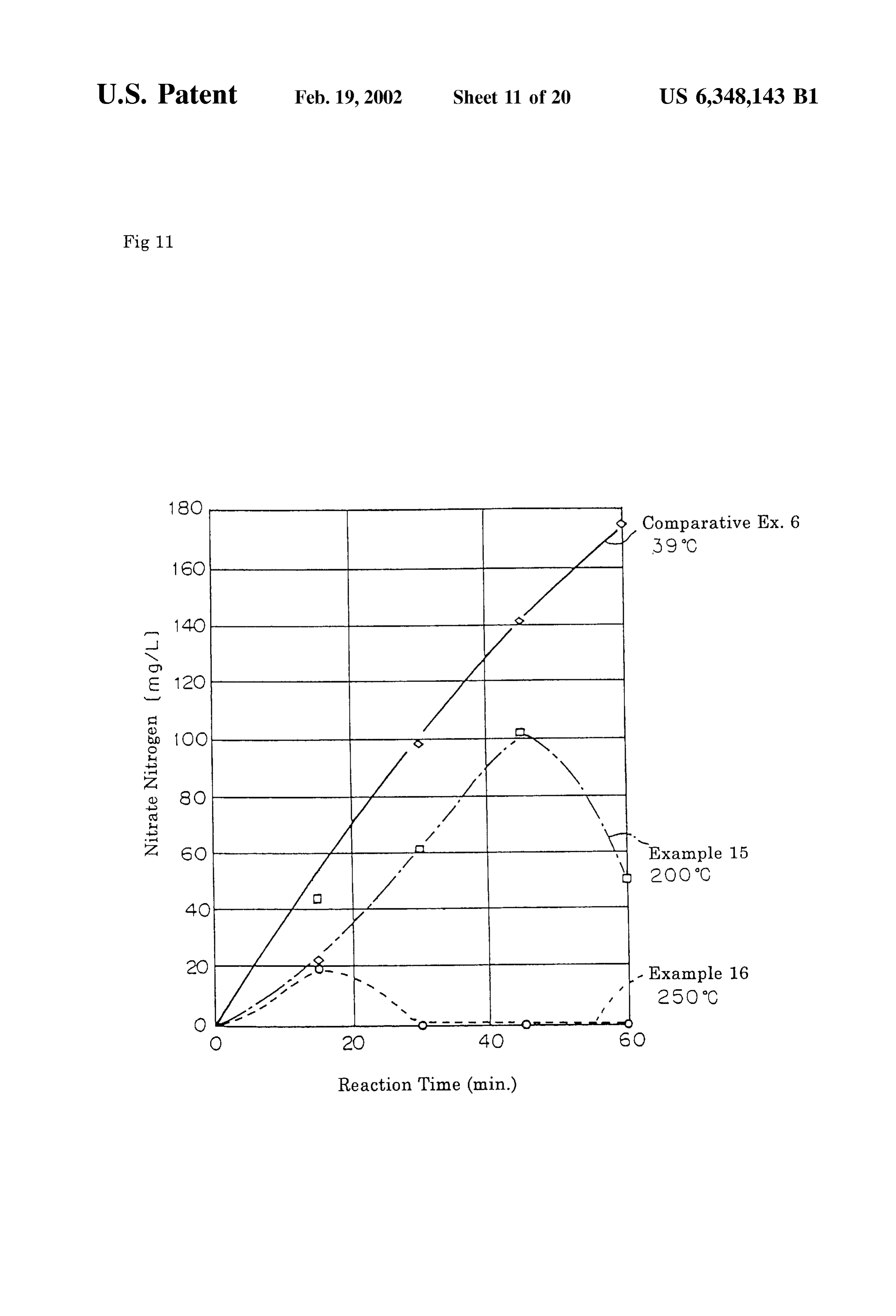
FIG. 8 is a graph showing the correlation of the ammo nium nitrogen content with reaction time at different elec 2X ->X+2e. (1) trolytic current values concerning hydrothermal electrolysis wherein X represents a chlorine atom, a bromine atom, an of an aqueous ammonium Solution. 25 iodine atom or any combination thereof. FIG. 9 is a graph showing the correlation of the compo
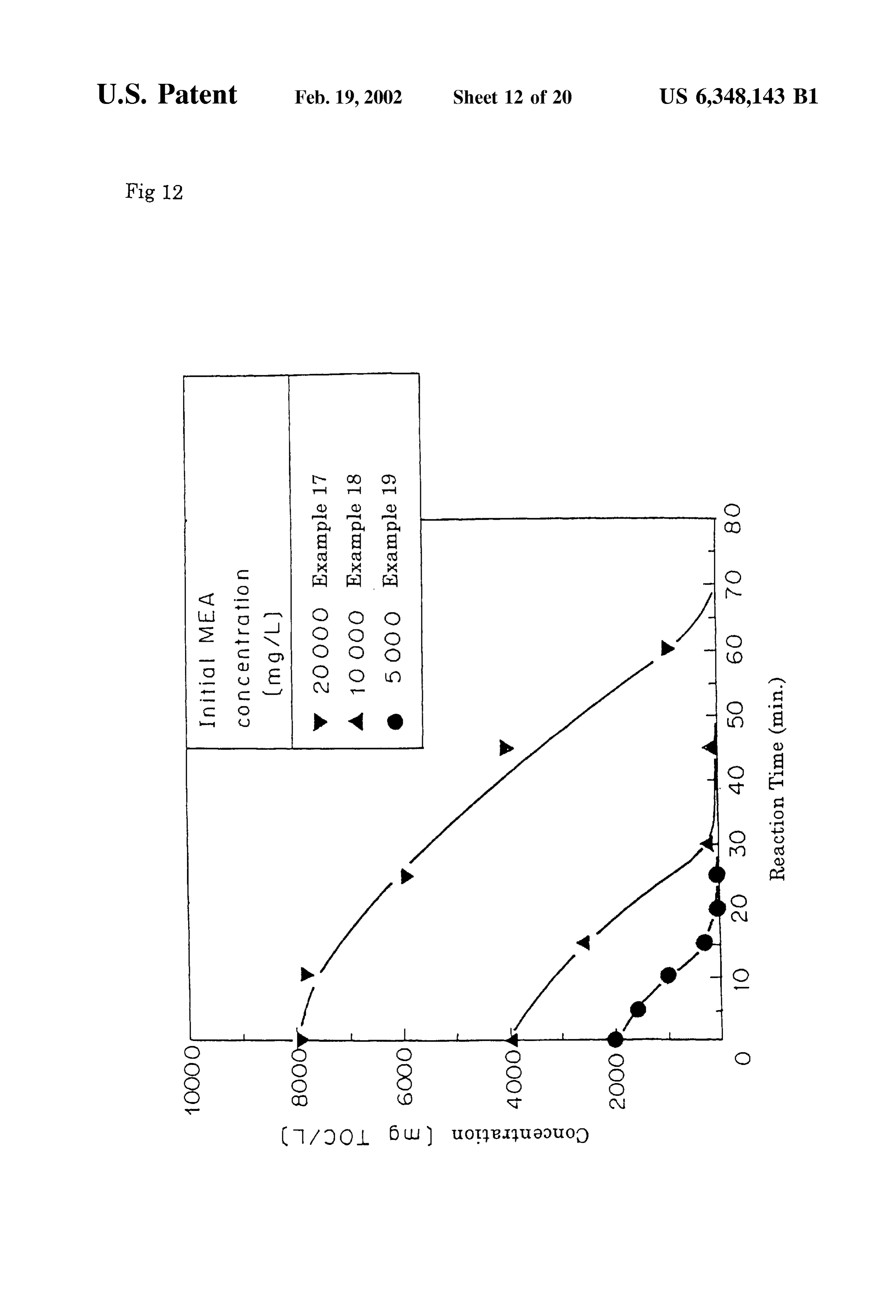
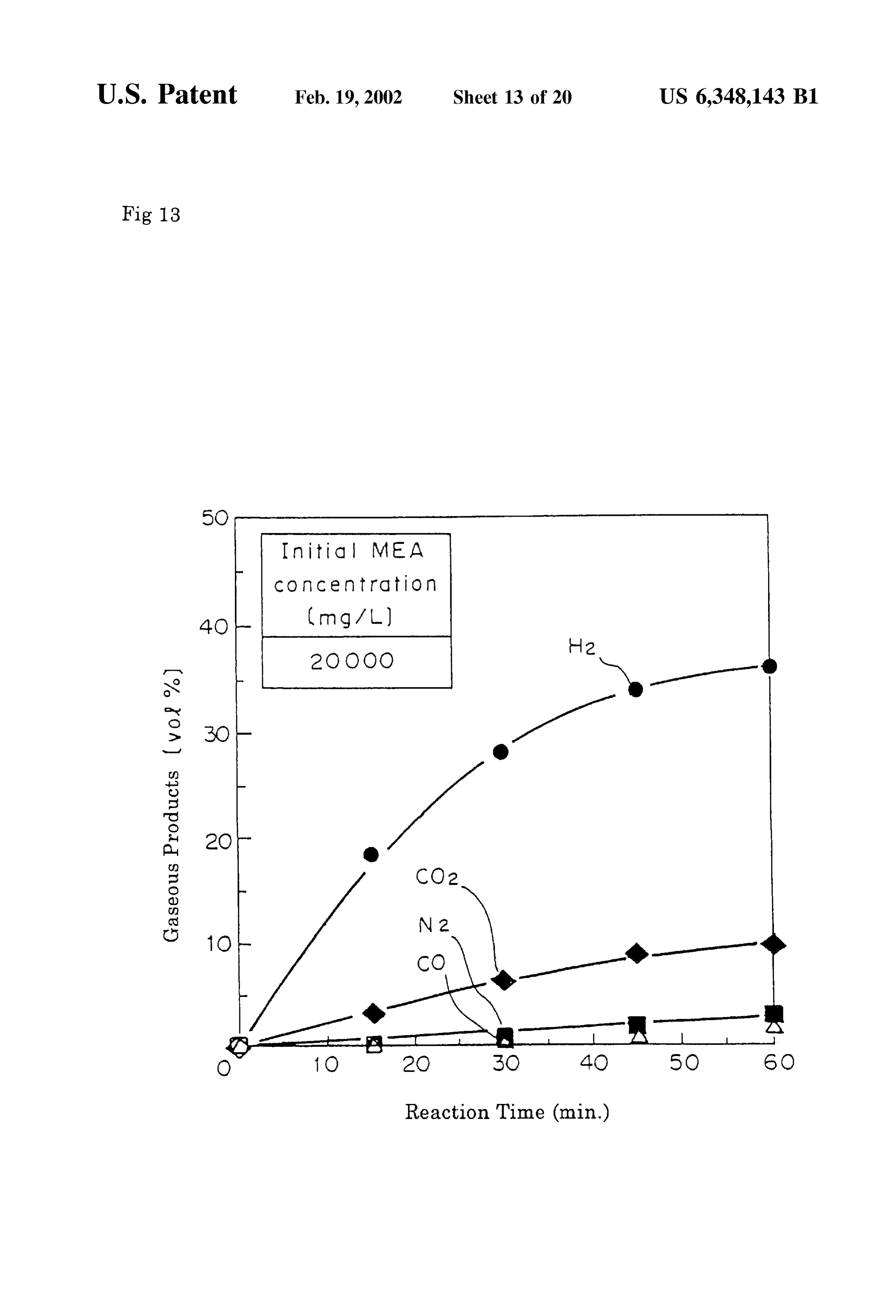
Sition of the gaseous product with reaction time concerning hydrothermal electrolysis of an aqueous ammonium Solu Organic matter+HO->CO+H"+e tion. (3) FIG. 10 is a graph showing the correlation of the ammo In formula (1), the halide ion is oxidized to generate a nium nitrogen content with reaction temperature at different halogen molecule. If X is a chlorine atom, for example, a reaction times concerning hydrothermal electrolysis of an chlorine gas is generated. In formula (2), water is electro aqueous ammonium Solution. lyzed to generate an oxygen gas. In formula (3), an organic FIG. 11 is a graph showing the correlation of the nitrate matter is directly oxidized at the anode. The reactions of nitrogen content with reaction time at different temperatures 35 formulae (1) and (2) compete with each other, and which concerning hydrothermal electrolysis of an aqueous ammo reaction prevails depends on the type of the anode, the halide nium Solution. ion content in the aqueous medium or the like. If the halide FIG. 12 shows the correlation of the total organic carbon ion content is a given level or more when a chlorine (TOC) in a resultant, treated water with reaction time 40 generating electrode is used, for example, the reaction of concerning hydrothermal electrolysis of an aqueous mono formula (1) can preferentially proceeds. ethanolamine (MEA) solution at different concentrations. The halogen molecule generated at the interface between FIG. 13 shows the correlation of the composition of the the anode and the electrolyte according to formula (1) reacts gaseous product with reaction time concerning hydrother with water in its vicinity to generate a hypohalous acid and mal electrolysis of an aqueous monoethanolamine Solution. 45 a hydrogen halide.
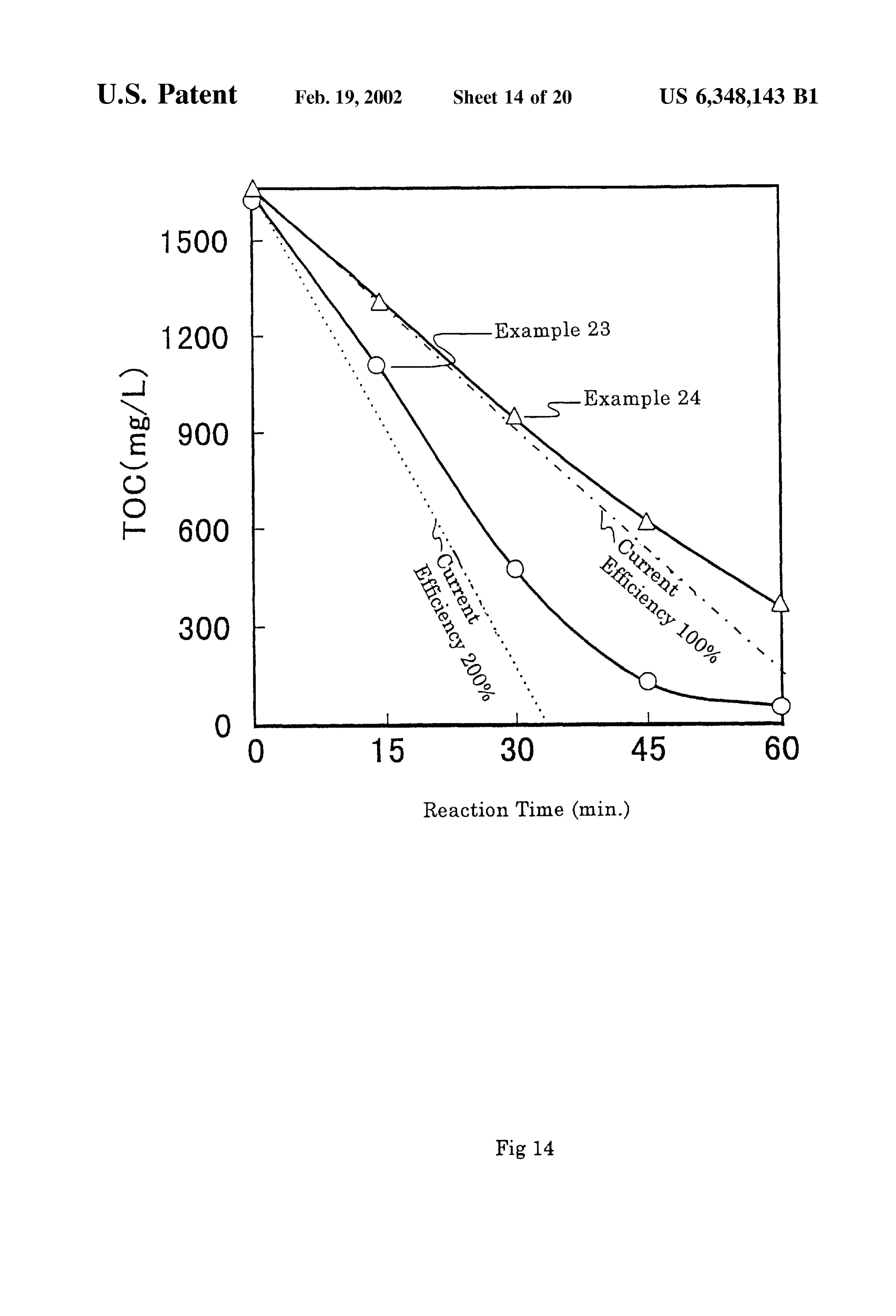
FIG. 14 shows the correlation of the total organic carbon
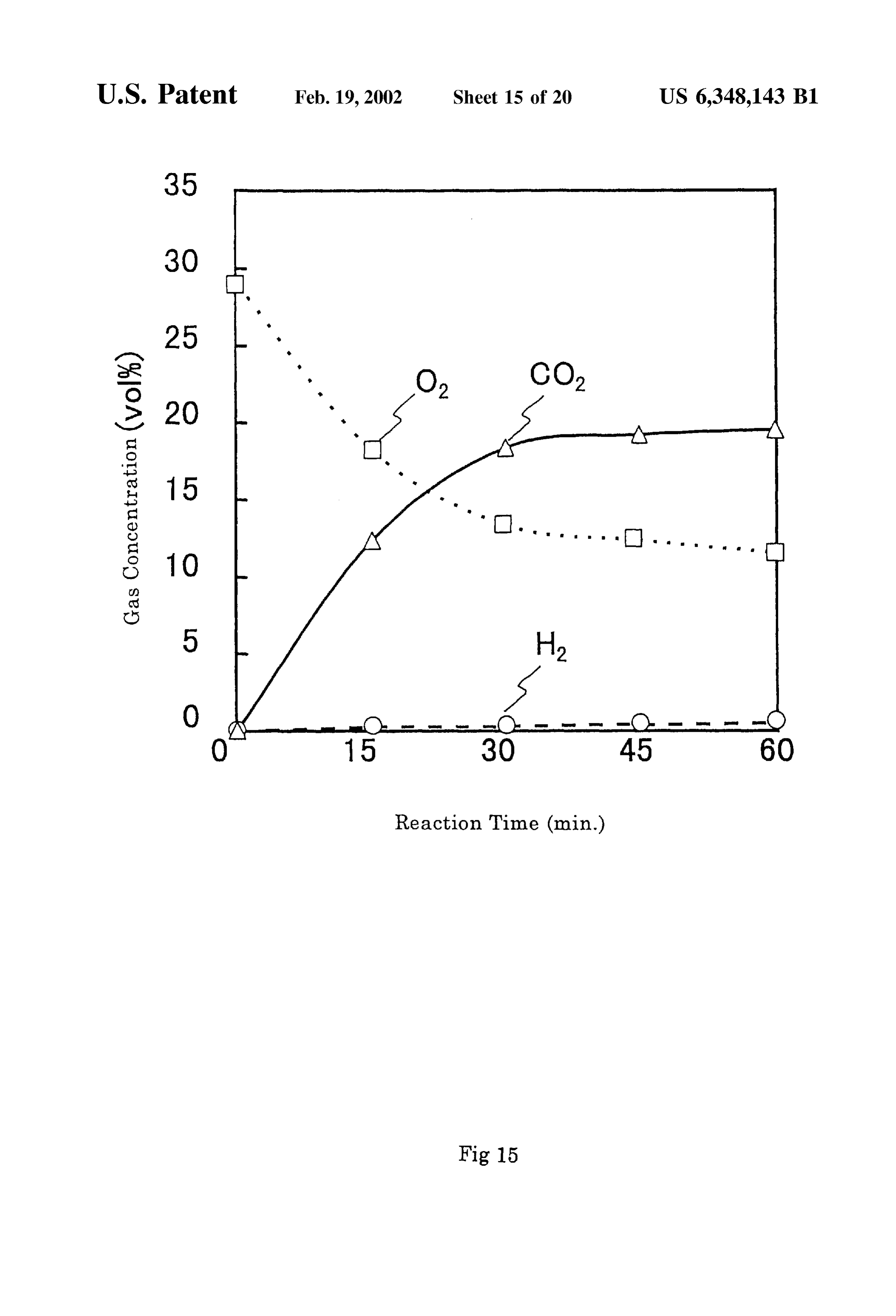
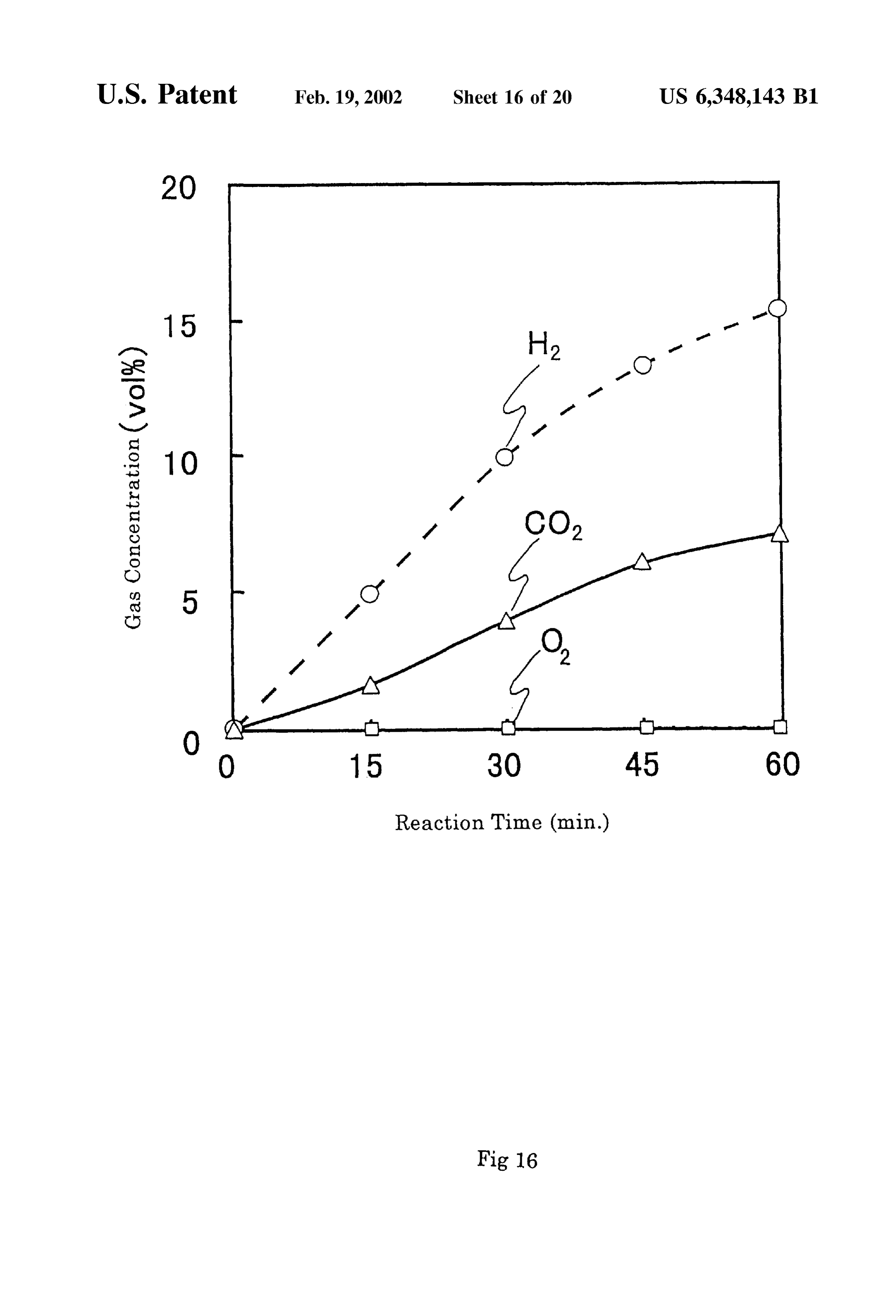
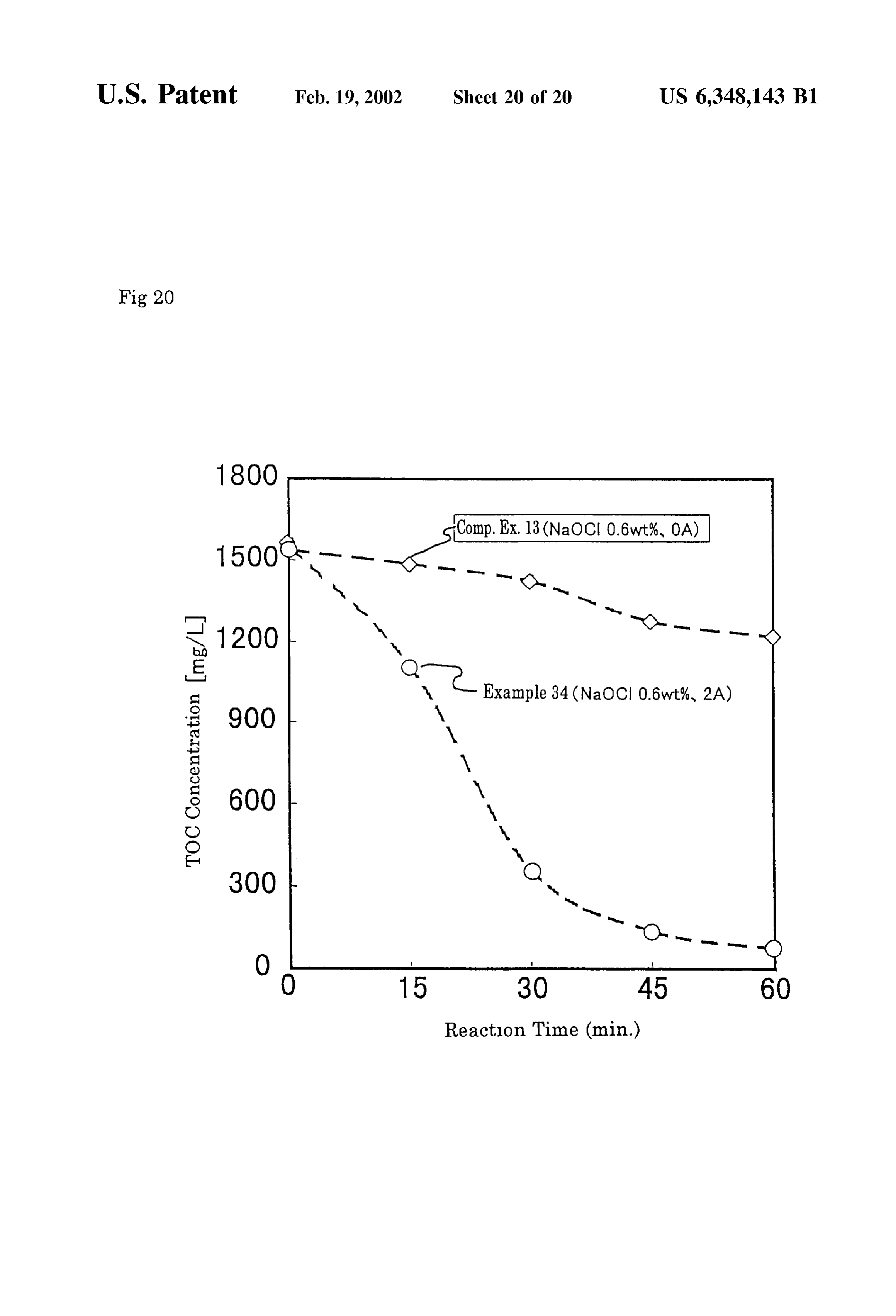
(TOC) in a resultant, treated water with reaction time concerning hydrothermal electrolysis of an aqueous acetic wherein X has the same meaning as above. acid Solution. The hypohalous acid is an excellent oxidizing agent, FIG. 15 shows the correlation of gas contents with reac 50 which can oxidatively decompose the reduced matter con tion time concerning hydrothermal electrolysis of an aque tained in the aqueous medium. If the reduced matter is an ous acetic acid Solution. organic matter, for example, the organic matter Seems to be FIG. 16 shows the correlation of gas contents with reac oxidized via the following reaction.
tion time in hydrothermal electrolysis of an aqueous acetic Organic matter+HXO->CO +HO+HX (5) acid Solution. 55
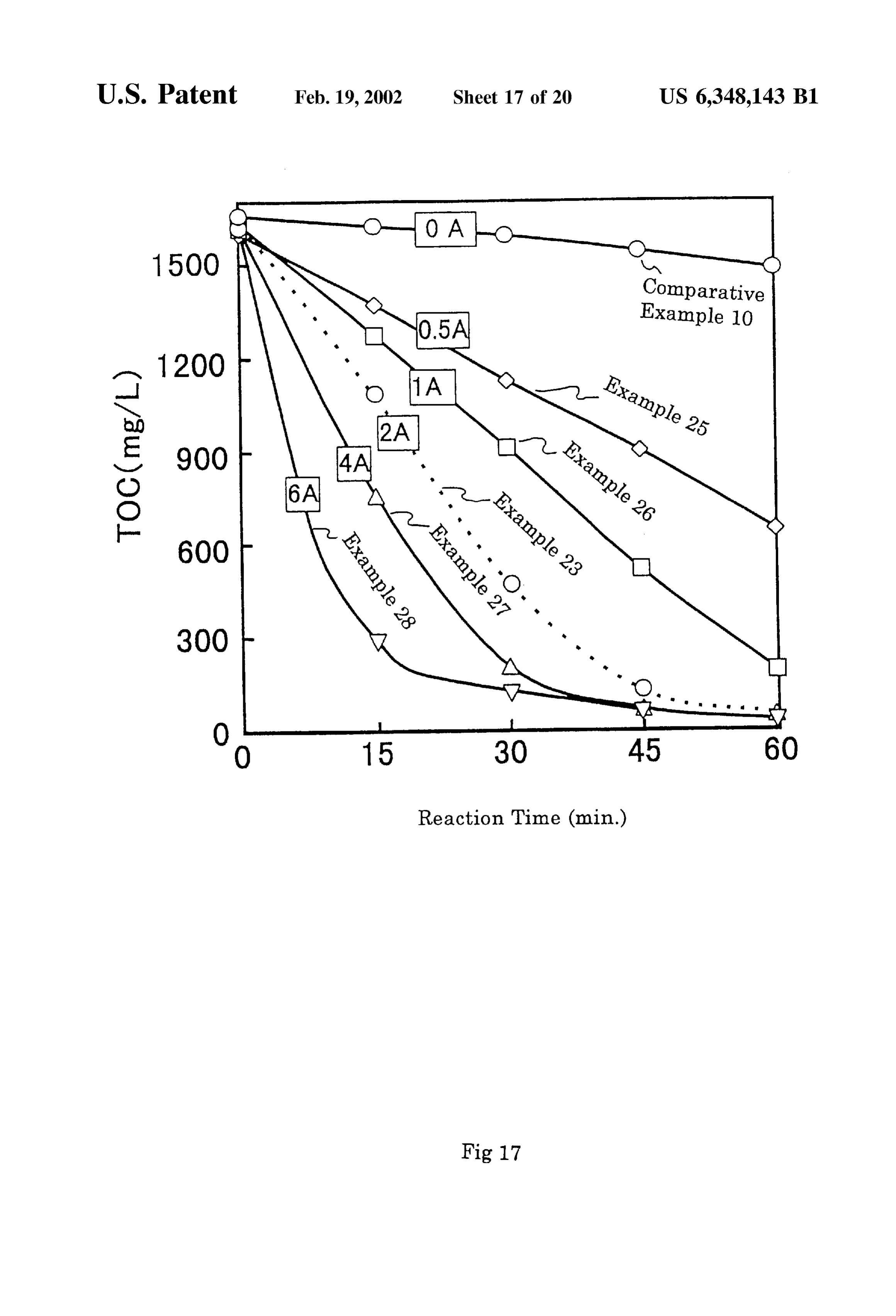
FIG. 17 shows the correlation of the total organic carbon wherein X has the same meaning as above. (TOC) in a resultant, treated water with reaction time in If the reduced matter is ammonia, the ammonia Seems to hydrothermal electrolysis of an aqueous acetic acid Solution. be oxidized via the following reaction. FIG. 18 shows the correlation of the total organic carbon
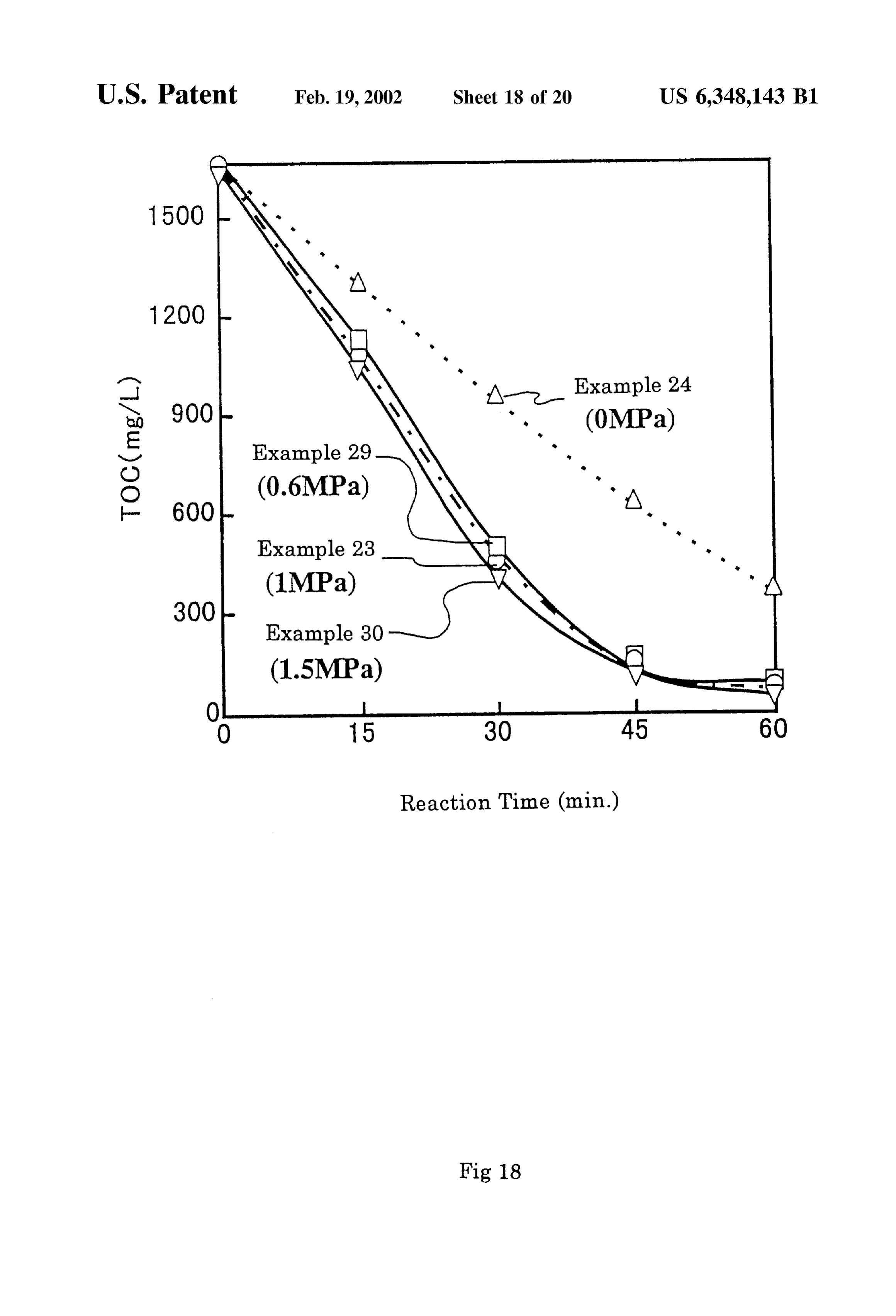
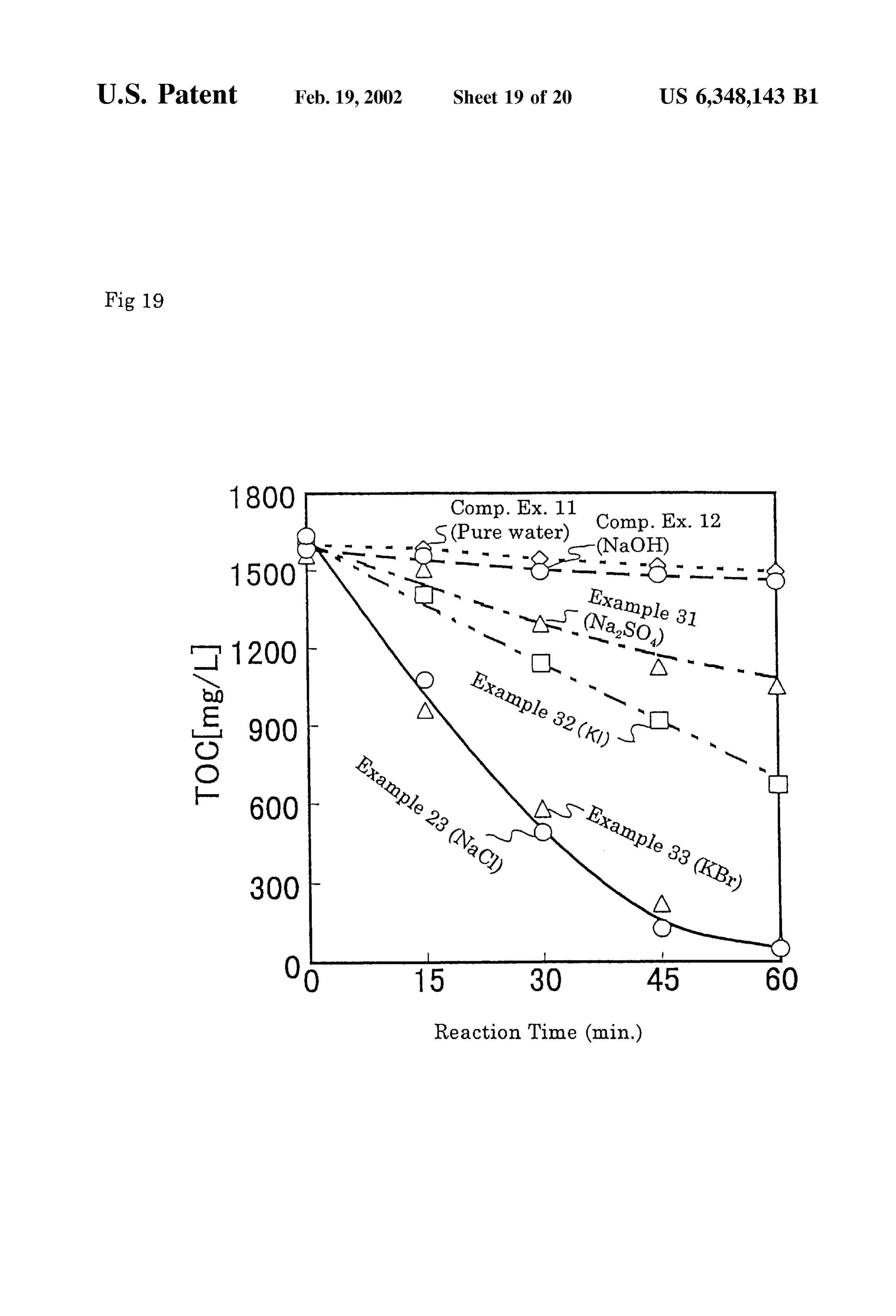
(TOC) in a resultant, treated water with reaction time in 60 hydrothermal electrolysis of an aqueous acetic acid Solution. The hypohalous acid is an excellent oxidizing agent FIG. 19 shows the correlation of the total organic carbon especially in acidic Solutions, and Surroundings of the anode (TOC) in a resultant, treated water with reaction time in in which the hypohalous acid is generated tend to be acidic hydrothermal electrolysis of an aqueous acetic acid Solution. because hydrogen ions are generated according to formulae FIG. 20 shows the correlation of the total organic carbon 65 (2), (3), (4) or the like. Therefore, the hypohalous acid is (TOC) in a resultant, treated water with reaction time in more likely to act as an oxidizing agent especially in the hydrothermal electrolysis of an aqueous acetic acid Solution. vicinity of the anode.
Page 24
S 6
When X is a chlorine atom, it appears that the oxidation At the cathode, the reactions of formulae (11), (12) and reaction with the hypohalous acid especially involves in the (13) that the oxidizers are reduced may compete with the decomposition of the reduced matter. reaction of formula (10) that hydrogen is generated. When X is a bromine atom or an iodine atom, however, Our experiments revealed that, in the hydrothermal the halate ion may involve in the decomposition of the electrolysis, the reactions of formulae (11), (12), (13) or the reduced matter. A hypohalite ion disproportionates in a basic like that the oxidizers are reduced preferentially proceed Solution to generate a halate ion and a halide ion. than the reaction that hydrogen is generated. Thus, the
hydrothermal electrolysis Suppresses generation of hydro gen So that the possibility of presence of an oxygen gas and
If the hypohalous acid moves to the neighborhood of the a hydrogen gas in the reactor at the same time reduces, cathode by diffusion or the like, the reaction of formula (7) thereby decreasing the danger of explosion. Moreover, the might occur because a cathodic reaction produces hydroxide oxidizing agent Such as hypohalous acids is decomposed at ions, and therefore, the neighborhood of the cathode tends to the cathode, and therefore, any Secondary treatment for be basic. The rate of the disproportionation reaction of making the oxidizing agent in a resultant, treated water formula (7) increases in the order of chlorine, bromine and 15 innocuous is unnecessary. During electrolysis at room iodine So that the halate ion can be quantitatively obtained temperature, for example, hypohalite ions are generated at a in case of bromine and iodine (F. A. Cotton, G. Wilkinson, high concentration. However, almost no detectable hypo P. L. Gauss, “Basic Inorganic Chemistry”, Baifukan halite ions were generated during electrolysis at high tem Publishers, the 2nd edition, 1991, p. 379). The halate is a peratures.
Strong acid and a strong oxidizing agent. Whatever the reaction mechanisms are, according to the In formula (2), water is electrolyzed to generate an present invention, the reduced matter Such as organic oxygen gas. Here, this nascent oxygen seem to be initially matters, ammonia and So on can be decomposed by Oxida generated at the interface between the anode and the elec tion and the generation of a hydrogen gas and an oxygen gas trolyte. Such nascent oxygen is more active as an oxidizing is highly Suppressed.
agent than molecular oxygen (an oxygen gas) to efficiently 25 Halide ions used in the present invention include a oxidize the reduced matter. Even if oxygen molecules are chloride ion (Cl), a bromide ion (Br), an iodide ion (I) or generated, the reduced matter can be oxidized by hydrother any combination thereof, among which the chloride ion or mal oxidation reaction.
When the reduced matter is an organic matter, the fol the bromide ion is especially preferred. A Salt for producing lowing oxidation reaction by oxygen may proceed. a halide ion may be dissolved in the aqueous medium. Alternatively, the aqueous medium may contain an acid Such
Organic matter+O->CO+HO (8) as hydrogen chloride (HCl), hydrogen bromide (HBr), hydrogen iodide (HI) or the like.
The reduced matter Such as organic matters, ammonia and The Salt for producing a halide ion may be either an So on may be Sometimes directly oxidized at the anode by inorganic or organic Salt. For example, preferably used are the electrode reaction as shown in formula (3). When the 35 Salts of an acid Such as hydrogen chloride (HCl), hydrogen reduced matter is ammonia, for example, the following bromide (HBr) and hydrogen iodide (HI) with a base. reaction may proceed. Inorganic Salts include, for example, alkali metal halides 2NH->N, +6H"+6e (9) Such as Sodium chloride, potassium chloride, alkali earth metal halides Such as calcium chloride; ammonium halides
Thus, hydrothermal electrolysis of the present invention 40 Such as ammonium chloride; complex Salts Such as tris may include many reaction mechanisms through which the (ethylenediamine)cobalt (III) chloride, tris(2,2'-bipyridine) reduced matter is efficiently decomposed by oxidation at or iron(II) bromide. Organic salts may be tetraalkylammonium near the anode. halides Such as tetraethylammonium chloride. Addition Salts On the other hand, following reactions may occur at the of an amine with a hydrogen halide (for example, aniline cathode.
Water is electrolyzed to generate hydrogen at the cathode. hydrogen chloride) or the like are also suitable. Wastewaters
derived from municipal waste or chlorine-containing poly 2H2O+2e->H +2OH (10) merS Such as polyvinyl chloride or polyvinylidene chloride contain an overwhelmingly amount of chloride ions com
Here, the reactor body may be used as a cathode to allow pared with other halide ions.
So-called cathodic protection. 50 The aqueous medium preferably contains 0.05 mmol/L or A reaction may also proceed in which an oxidizing agent more of halide ions, more preferably 0.5 mmol/L or more of is reduced at the cathode. Here, the oxidizing agent includes halide ions, still more preferably 5 mmol/L or more of halide those generated at the anode Such as hypohalous acids and ions, because halide ions produce hypohalous acids by the those externally added as demanded. Examples of Such a electrolysis of the aqueous medium So that the hypohalous reaction are shown in the following formulae (11), (12) and 55 acids may oxidize the reduced matter in the aqueous (13). medium.
A hypohalous acid may be reduced at the cathode. The aqueous medium preferably contains 0.05 mmol/L or HXO-e-eX-OH (11) more of chloride ions (Cl), more preferably 0.5 mmol/L or more of chloride ions, still more preferably 5 mmol/L or
Dissolved oxygen in the aqueous medium (as represented 60 more of chloride ions.
by O., in the following formula) can be also reduced. The reduced matter which can be decomposed by the present invention may be a compound which is oxidized 1/2O+H.O+2e->2OH (12) with an OXion wherein X represents a chlorine atom, a If hydrogen peroxide is present, the hydrogen peroxide 65 bromine atom, an iodine atom or any combination thereof. also can be reduced at the cathode. Alternatively, the reduced matter may be a compound which is oxidized with an oxidizing agent Such as an oxygen gas in the presence of water at a temperature of 100° C. or more but
Page 25
not higher than the critical temperature of the aqueous similarly to the following cholinesterase inhibitors which are medium. The reduced matter may be either organic or also decomposable by the present invention: inorganic.
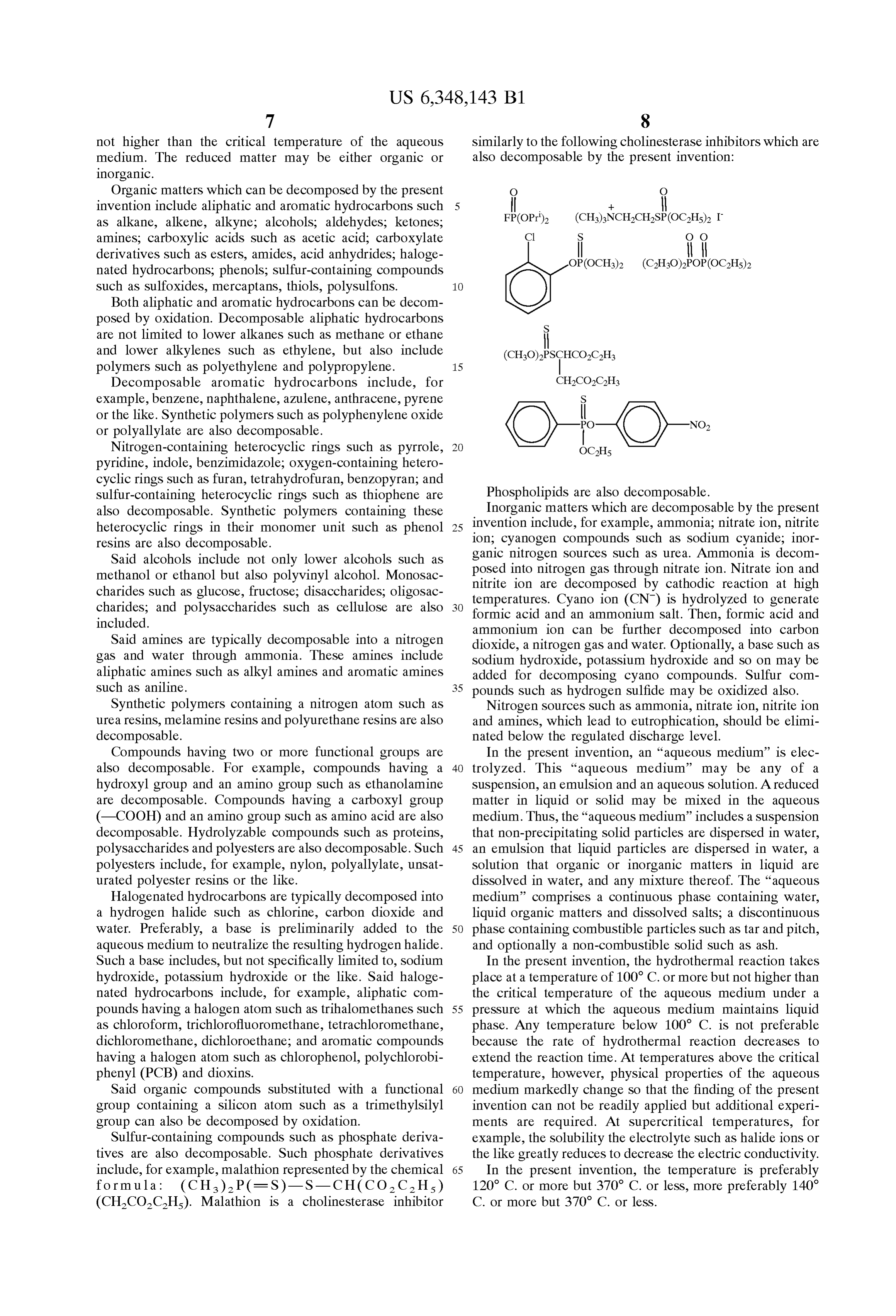
Organic matters which can be decomposed by the present O O invention include aliphatic and aromatic hydrocarbons Such -- as alkane, alkene, alkyne; alcohols, aldehydes, ketones, FP(OPr') (CH3)3NCH2CH2SP(OCHs). I amines, carboxylic acids Such as acetic acid; carboxylate C S O O derivatives Such as esters, amides, acid anhydrides, haloge | nated hydrocarbons, phenols, Sulfur-containing compounds OP(OCH3)2 (C2H5O)2POP(OCH5)2 Such as Sulfoxides, mercaptans, thiols, polysulfons.
Both aliphatic and aromatic hydrocarbons can be decom posed by oxidation. Decomposable aliphatic hydrocarbons are not limited to lower alkanes Such as methane or ethane and lower alkylenes Such as ethylene, but also include i
polymerS Such as polyethylene and polypropylene. 15
Decomposable aromatic hydrocarbons include, for CH2CO2C2H3 example, benzene, naphthalene, aZulene, anthracene, pyrene S or the like. Synthetic polymerS Such as polyphenylene oxide or polyallylate are also decomposable. f NO2 Nitrogen-containing heterocyclic ringS Such as pyrrole, OCHs pyridine, indole, benzimidazole; oxygen-containing hetero cyclic ringS Such as furan, tetrahydrofuran, benzopyran; and
Sulfur-containing heterocyclic ringS Such as thiophene are Phospholipids are also decomposable. also decomposable. Synthetic polymers containing these Inorganic matters which are decomposable by the present heterocyclic rings in their monomer unit Such as phenol 25 invention include, for example, ammonia; nitrate ion, nitrite resins are also decomposable. ion; cyanogen compounds Such as Sodium cyanide, inor Said alcohols include not only lower alcohols Such as ganic nitrogen Sources Such as urea. Ammonia is decom methanol or ethanol but also polyvinyl alcohol. Monosac nitrite into posed nitrogen gas through nitrate ion. Nitrate ion and ion are decomposed by cathodic reaction at high charides Such as glucose, fructose; disaccharides, oligosac temperatures.
charides, and polysaccharides Such as cellulose are also formic acid andCyano an ion (CN) is hydrolyzed to generate ammonium Salt. Then, formic acid and included.
Said amines are typically decomposable into a nitrogen dioxide, a nitrogen gas and water. decomposed ammonium ion can be further into carbon
Optionally, a base Such as gas and Water through ammonia. These amines include sodium hydroxide, potassium hydroxide and so on may be aliphatic amines Such as alkyl amines and aromatic amines added for decomposing cyano compounds. Sulfur com Such as aniline. 35 pounds Such as hydrogen Sulfide may be oxidized also. Synthetic polymers containing a nitrogen atom Such as Nitrogen Sources Such as ammonia, nitrate ion, nitrite ion urea resins, melamine resins and polyurethane resins are also and amines, which lead to eutrophication, should be elimi decomposable. nated below the regulated discharge level. Compounds having two or more functional groups are In the present invention, an “aqueous medium' is elec also decomposable. For example, compounds having a 40 trolyzed. This “aqueous medium” may be any of a hydroxyl group and an amino group Such as ethanolamine Suspension, an emulsion and an aqueous Solution. A reduced are decomposable. Compounds having a carboxyl group matter in liquid or Solid may be mixed in the aqueous (-COOH) and an amino group Such as amino acid are also medium. Thus, the “aqueous medium' includes a Suspension decomposable. Hydrolyzable compounds Such as proteins, that non-precipitating Solid particles are dispersed in water, polysaccharides and polyesters are also decomposable. Such 45 an emulsion that liquid particles are dispersed in water, a polyesters include, for example, nylon, polyallylate, unsat Solution that organic or inorganic matters in liquid are urated polyester resins or the like. dissolved in water, and any mixture thereof. The “aqueous Halogenated hydrocarbons are typically decomposed into medium' comprises a continuous phase containing water, a hydrogen halide Such as chlorine, carbon dioxide and liquid organic matters and dissolved Salts, a discontinuous water. Preferably, a base is preliminarily added to the 50 phase containing combustible particles Such as tar and pitch, aqueous medium to neutralize the resulting hydrogen halide. and optionally a non-combustible Solid Such as ash. Such a base includes, but not specifically limited to, Sodium In the present invention, the hydrothermal reaction takes hydroxide, potassium hydroxide or the like. Said haloge place at a temperature of 100° C. or more but not higher than nated hydrocarbons include, for example, aliphatic com the critical temperature of the aqueous medium under a pounds having a halogen atom Such as trihalomethaneS Such 55 preSSure at which the aqueous medium maintains liquid as chloroform, trichlorofluoromethane, tetrachloromethane, phase. Any temperature below 100° C. is not preferable dichloromethane, dichloroethane; and aromatic compounds because the rate of hydrothermal reaction decreases to having a halogen atom Such as chlorophenol, polychlorobi extend the reaction time. At temperatures above the critical phenyl (PCB) and dioxins. temperature, however, physical properties of the aqueous Said organic compounds Substituted with a functional 60 medium markedly change So that the finding of the present group containing a Silicon atom Such as a trimethylsilyl invention can not be readily applied but additional experi group can also be decomposed by oxidation. ments are required. At Supercritical temperatures, for Sulfur-containing compounds Such as phosphate deriva example, the Solubility the electrolyte Such as halide ions or tives are also decomposable. Such phosphate derivatives the like greatly reduces to decrease the electric conductivity. include, for example, malathion represented by the chemical 65 In the present invention, the temperature is preferably formula: (CH)2P(=S)-S-CH(COC Hs) 120° C. or more but 370° C. or less, more preferably 140°
(CH2COCHs). Malathion is a cholinesterase inhibitor C. or more but 370° C. or less.
Page 26
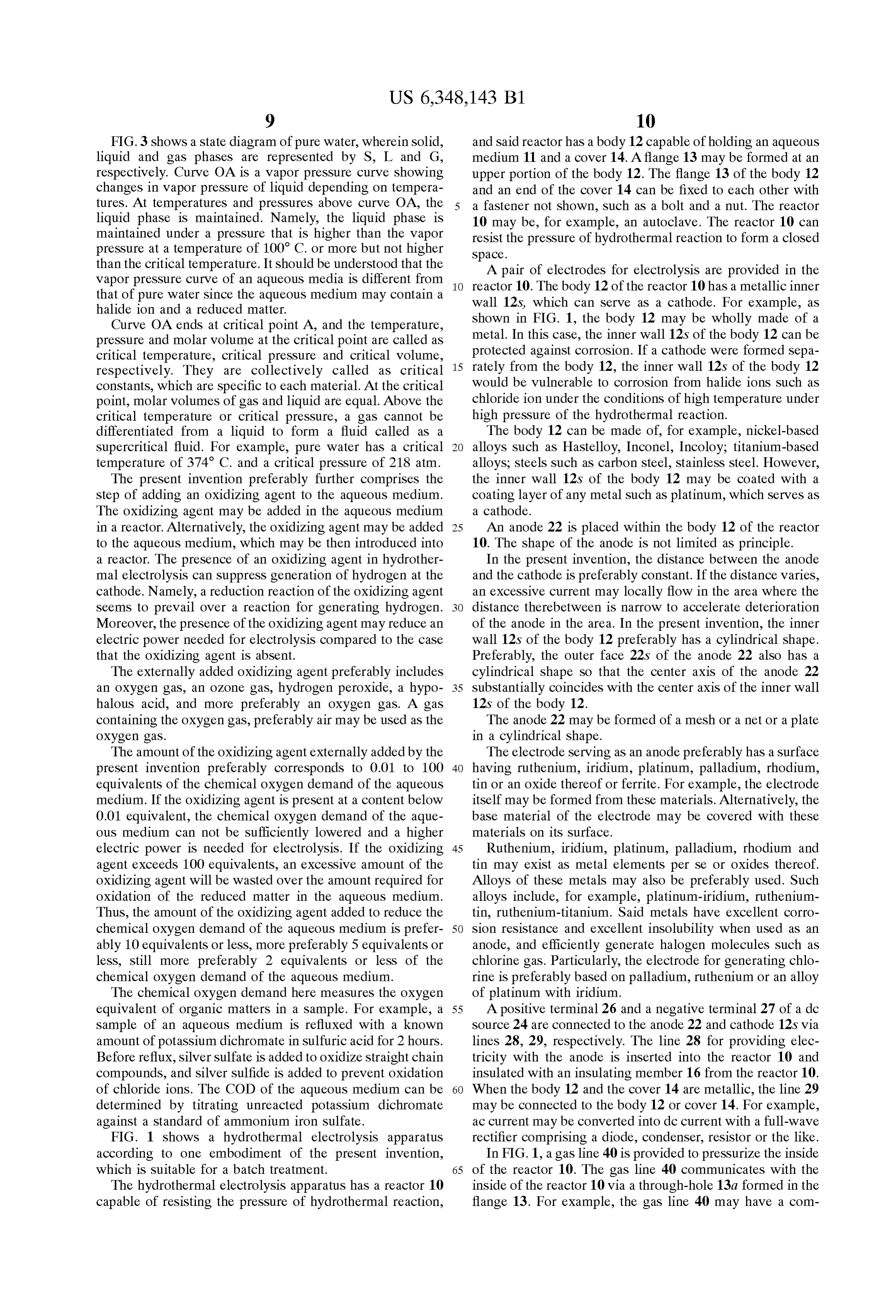
FIG.3 shows a State diagram of pure water, wherein Solid, and Said reactor has a body 12 capable of holding an aqueous liquid and gas phases are represented by S, L and G, medium 11 and a cover 14. A flange 13 may be formed at an respectively. Curve OA is a vapor pressure curve showing upper portion of the body 12. The flange 13 of the body 12 changes in vapor pressure of liquid depending on tempera and an end of the cover 14 can be fixed to each other with tures. At temperatures and pressures above curve OA, the a fastener not shown, Such as a bolt and a nut. The reactor liquid phase is maintained. Namely, the liquid phase is 10 may be, for example, an autoclave. The reactor 10 can maintained under a pressure that is higher than the vapor resist the pressure of hydrothermal reaction to form a closed pressure at a temperature of 100° C. or more but not higher Space.
than the critical temperature. It should be understood that the A pair of electrodes for electrolysis are provided in the Vapor pressure curve of an aqueous media is different from reactor 10. The body 12 of the reactor 10 has a metallic inner that of pure water Since the aqueous medium may contain a wall 12s, which can Serve as a cathode. For example, as halide ion and a reduced matter.
Curve OA ends at critical point A, and the temperature, shown in FIG. 1, the body 12 may be wholly made of a preSSure and molar volume at the critical point are called as metal. In this case, the inner wall 12s of the body 12 can be critical temperature, critical pressure and critical Volume, 15 protected against corrosion. If a cathode were formed Sepa respectively. They are collectively called as critical rately from the body 12, the inner wall 12s of the body 12 constants, which are specific to each material. At the critical would be vulnerable to corrosion from halide ions Such as point, molar volumes of gas and liquid are equal. Above the chloride ion under the conditions of high temperature under critical temperature or critical pressure, a gas cannot be high pressure of the hydrothermal reaction. differentiated from a liquid to form a fluid called as a The body 12 can be made of, for example, nickel-based Supercritical fluid. For example, pure water has a critical alloys Such as Hastelloy, Inconel, Incoloy, titanium-based temperature of 374 C. and a critical pressure of 218 atm. alloys, Steels Such as carbon Steel, Stainless Steel. However, The present invention preferably further comprises the the inner wall 12s of the body 12 may be coated with a Step of adding an oxidizing agent to the aqueous medium. coating layer of any metal Such as platinum, which Serves as The oxidizing agent may be added in the aqueous medium a cathode.
in a reactor. Alternatively, the oxidizing agent may be added 25 An anode 22 is placed within the body 12 of the reactor to the aqueous medium, which may be then introduced into 10. The shape of the anode is not limited as principle. a reactor. The presence of an oxidizing agent in hydrother In the present invention, the distance between the anode mal electrolysis can SuppreSS generation of hydrogen at the and the cathode is preferably constant. If the distance varies, cathode. Namely, a reduction reaction of the oxidizing agent an excessive current may locally flow in the area where the Seems to prevail over a reaction for generating hydrogen. distance therebetween is narrow to accelerate deterioration Moreover, the presence of the oxidizing agent may reduce an of the anode in the area. In the present invention, the inner electric power needed for electrolysis compared to the case wall 12s of the body 12 preferably has a cylindrical shape. that the oxidizing agent is absent. Preferably, the outer face 22s of the anode 22 also has a The externally added oxidizing agent preferably includes cylindrical shape So that the center axis of the anode 22 an OXygen gas, an OZone gas, hydrogen peroxide, a hypo 35 Substantially coincides with the center axis of the inner wall halous acid, and more preferably an oxygen gas. A gas 12s of the body 12.
containing the oxygen gas, preferably air may be used as the The anode 22 may be formed of a mesh or a net or a plate OXygen gaS. in a cylindrical shape.
The amount of the oxidizing agent externally added by the The electrode Serving as an anode preferably has a Surface present invention preferably corresponds to 0.01 to 100 40 having ruthenium, iridium, platinum, palladium, rhodium, equivalents of the chemical oxygen demand of the aqueous tin or an oxide thereof or ferrite. For example, the electrode medium. If the oxidizing agent is present at a content below itself may be formed from these materials. Alternatively, the 0.01 equivalent, the chemical oxygen demand of the aque base material of the electrode may be covered with these ous medium can not be Sufficiently lowered and a higher materials on its Surface.
electric power is needed for electrolysis. If the oxidizing 45 Ruthenium, iridium, platinum, palladium, rhodium and agent exceeds 100 equivalents, an excessive amount of the tin may exist as metal elements per Se or oxides thereof. oxidizing agent will be wasted over the amount required for Alloys of these metals may also be preferably used. Such oxidation of the reduced matter in the aqueous medium. alloys include, for example, platinum-iridium, ruthenium Thus, the amount of the oxidizing agent added to reduce the tin, ruthenium-titanium. Said metals have excellent corro chemical oxygen demand of the aqueous medium is prefer 50 Sion resistance and excellent insolubility when used as an ably 10 equivalents or less, more preferably 5 equivalents or anode, and efficiently generate halogen molecules Such as less, Still more preferably 2 equivalents or less of the chlorine gas. Particularly, the electrode for generating chlo chemical oxygen demand of the aqueous medium. rine is preferably based on palladium, ruthenium or an alloy The chemical oxygen demand here measures the oxygen of platinum with iridium.
equivalent of organic matters in a Sample. For example, a 55 A positive terminal 26 and a negative terminal 27 of a dc Sample of an aqueous medium is refluxed with a known Source 24 are connected to the anode 22 and cathode 12S via amount of potassium dichromate in Sulfuric acid for 2 hours. lines 28, 29, respectively. The line 28 for providing elec Before reflux, silver sulfate is added to oxidize straight chain tricity with the anode is inserted into the reactor 10 and compounds, and Silver Sulfide is added to prevent oxidation insulated with an insulating member 16 from the reactor 10. of chloride ions. The COD of the aqueous medium can be 60 When the body 12 and the cover 14 are metallic, the line 29 determined by titrating unreacted potassium dichromate may be connected to the body 12 or cover 14. For example, against a Standard of ammonium iron Sulfate. accurrent may be converted into dc current with a full-wave FIG. 1 shows a hydrothermal electrolysis apparatus rectifier comprising a diode, condenser, resistor or the like. according to one embodiment of the present invention, In FIG. 1, a gas line 40 is provided to pressurize the inside which is Suitable for a batch treatment. 65 of the reactor 10. The gas line 40 communicates with the The hydrothermal electrolysis apparatus has a reactor 10 inside of the reactor 10 via a through-hole 13a formed in the capable of resisting the pressure of hydrothermal reaction, flange 13. For example, the gas line 40 may have a com
Page 27
preSSor not shown. A valve 41 may be opened to preSSurize the liquid phase at the heating temperature. A gas introduced the inside of the reactor 10. via the gas line 40 is preferably an inert gas Such as nitrogen The reactor 10 is heated with a heating device 30. The gas, an argon gas. When a hydrogen gas generates, the gas heating device may be, for example, an electric heater or a introduced decreases a partial pressure of the hydrogen gas silicone oil or other bath. If the reactor is a tower, it may be for reducing the danger of explosion. externally heated with a burner or the like. Subsequently, the reactor 10 is heated to a prescribed The hydrothermal electrolysis apparatus preferably has a temperature with the heating device 30. Preferably, the thermocouple 32 for measuring the temperature of the temperature in the reactor 10 is monitored.
aqueous medium 11. The thermocouple may be formed After the prescribed temperature has been reached, cur from, for example, a chromel-alumel alloy or a platinum rent is applied across the anode 22 and the body 12 of the alloy. In FIG. 1, the cover 14 of the reactor 10 has an reactor Serving as a cathode from the dc Source 24. Thus, the insulating member 18 through which the thermocouple 32 aqueous medium is electrolyzed whereby the reduced matter passes. The thermocouple 32 may directly pass through the in the aqueous medium is oxidatively decomposed. cover 14 without providing the insulating member 18. A The dc Source 24 preferably has a constant current rather temperature control mechanism for controlling the heating than a constant Voltage. AS electrolysis in the aqueous device 30 on the basis of the value of the thermocouple 32 15 medium proceeds, the electrical resistance of the aqueous may be provided. medium varies with various factors. The amount of gas Preferably, the aqueous medium 11 is appropriately generated or the like can be more easily controlled when the stirred with a stirring device 34. The stirring device 34 may current is constant. Moreover, the Voltage necessary for have a shaft which coincides with the center axis of the applying a constant current can be monitored to know reactor 10, for example. deposition of Scale within the reactor. The hydrothermal electrolysis apparatus preferably has a In the process of the present invention, the current density discharge line 42 having a preSSure-control valve 43. The at the anode is preferably 0.1 mA/dm° to 500 A/dmf. If the discharge line 42 communicates with the inside of the current density exceeds 500A/dmf, the surface of the anode reactor 10 through a through-hole 14.a formed in the cover may be readily Stripped or dissoluted. If the current density 14. When hydrothermal reaction should be terminated, the is lower than 0.1 mA/dmf, the anode must have a large area, preSSure-control valve 43 may be opened to discharge a gas 25 leading to a bulky System. The current density is more through the discharge line 42 for decreasing the inner preferably 10 mA/dm to 100 A/dmf, still more preferably pressure of the reactor 10 to the atmospheric pressure. When 10 mA/dm° to 50 A/dmf. If a novel material for anode were the inner pressure of the reactor 10 rises above a determined developed, the current density of the anode could be higher. value, the pressure-control valve 43 may be opened to When dc is Supplied for a given period of time, Scale may release a gas to for decreasing the inner pressure. occur on the Surface of the cathode, i.e. the inner wall 12S The hydrothermal electrolysis apparatus preferably has a of the body 12 of the reactor 10. Scale seems to result from discharge line 44 for discharging a resultant, treated water. precipitation of a Salt Such as calcium carbonate. The The discharge line 44 communicates with the inside of the electrical resistance increases. With appearance of Scale. reactor 10 via a through-hole 12R formed in the bottom of When a constant dc is Supplied, for example, the Voltage the body 12. A valve 45 on the discharge line 44 may be 35 increases. Thus, the anode and the cathode are inverted for opened to remove a resultant, treated water.
A hydrothermal electrolysis proceSS using the hydrother dc Supply once a determined electric resistance has been reached. The inner wall 12s of the body 12 of the reactor 10 mal electrolysis apparatus shown in FIG. 1 is explained as now Serves as anode to generate hydrogen ions, which make follows. the reactor locally acidic. In the presence of a strong acid, The aqueous medium described above is introduced into 40 calcium carbonate releases a weak acid carbonic acid the body 12 of the reactor 10 at room temperature under (H2CO) and dissolves. Thus, Scale Such as calcium carbon atmospheric pressure. The aqueous medium preferably con ate can be dissolved.
tains an oxidizing agent. The oxidizing agent can repress CaCO+H"(strong acid)->Ca'+HCO, (14) generation of hydrogen during electrolysis of the aqueous medium to reduce the possibility of explosion and Save the In the embodiment where the electrodes are inverted, a electric power needed for electrolysis. 45 corrosion-resistant material is preferably used for the reactor For batch treatment, the Volume of the aqueous medium 10.
introduced into the reactor 10 is preferably 75% or less, ore Then, heating with the heating device 30 and electric preferably 65% or less of the volume of the inner space of Supply from the dc Source 24 may be terminated Simulta the reactor 10. Thus, a space remains within the reactor 10 neously. The reactor 10 may be cooled preferably to room for introducing a gas or receiving a gas generated by 50 temperature. During then, the reactor 10 may be aerated to hydrothermal electrolysis. The volume of the aqueous accelerate the cooling rate.
medium introduced into the reactor 10 is preferably 10% or The pressure-control valve 43 is opened to lower the inner more, more preferably 25% or more of the volume of the pressure of the reactor 10. Then, the valve 45 is preferably inner space of the reactor 10. If the volume of the aqueous opened to discharge the treated acqueous medium 11 via the medium is less than 10%, only a limited amount of the 55 line 45.
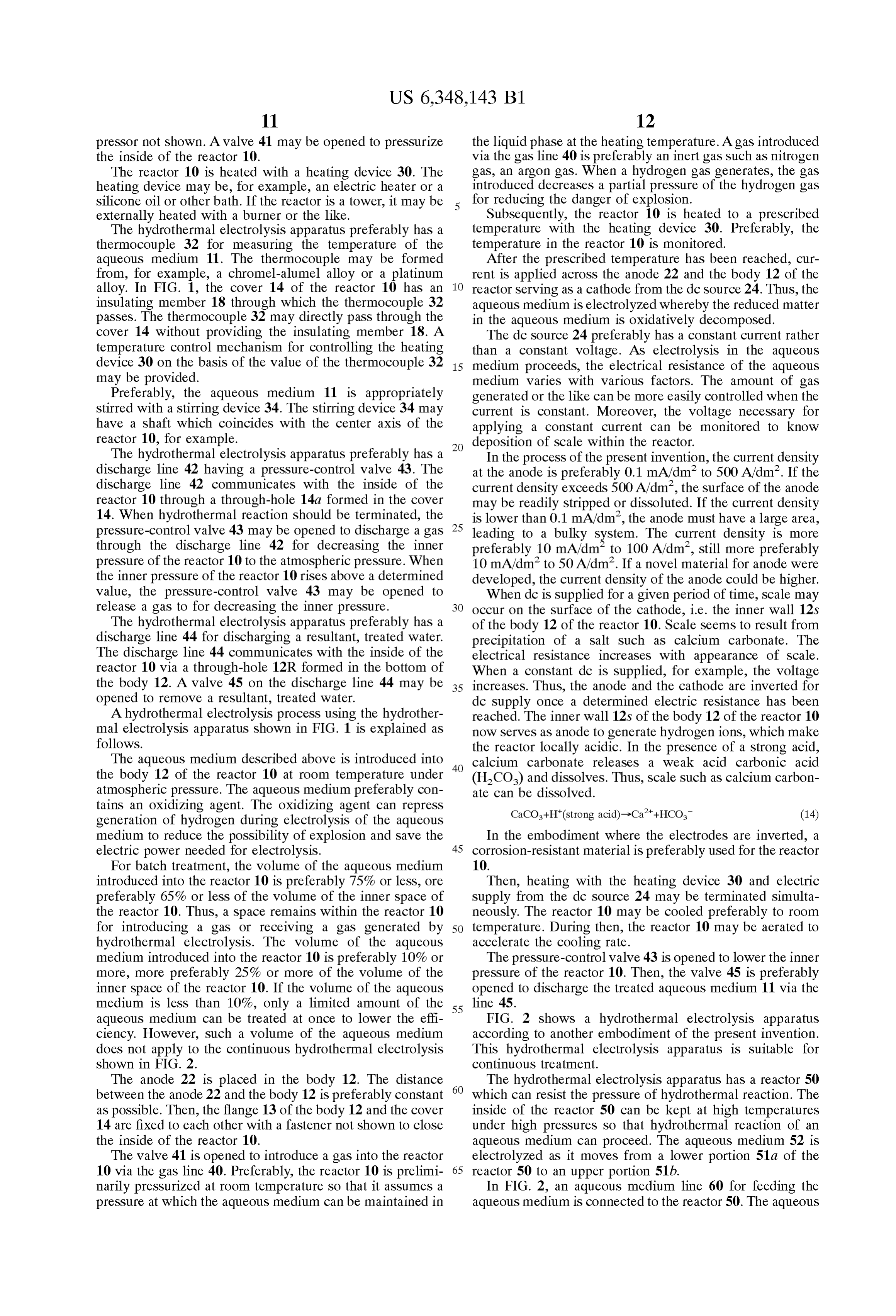
aqueous medium can be treated at once to lower the effi FIG. 2 shows a hydrothermal electrolysis apparatus ciency. However, Such a volume of the aqueous medium according to another embodiment of the present invention. does not apply to the continuous hydrothermal electrolysis This hydrothermal electrolysis apparatus is Suitable for shown in FIG. 2. continuous treatment.
The anode 22 is placed in the body 12. The distance The hydrothermal electrolysis apparatus has a reactor 50 between the anode 22 and the body 12 is preferably constant 60 which can resist the pressure of hydrothermal reaction. The as possible. Then, the flange 13 of the body 12 and the cover inside of the reactor 50 can be kept at high temperatures 14 are fixed to each other with a fastener not shown to close under high pressures So that hydrothermal reaction of an the inside of the reactor 10. aqueous medium can proceed. The aqueous medium 52 is The valve 41 is opened to introduce a gas into the reactor electrolyzed as it moves from a lower portion 51a of the 10 via the gas line 40. Preferably, the reactor 10 is prelimi 65 reactor 50 to an upper portion 51b. narily pressurized at room temperature So that it assumes a In FIG. 2, an aqueous medium line 60 for feeding the preSSure at which the aqueous medium can be maintained in aqueous medium is connected to the reactor 50. The aqueous
Page 28
medium line 60 preferably has a feed tank 61, a high The reactor 50 preferably has an axially extending sleeve preSSure pump 66, a heat eXchanger 70 and a heating device shape, preferably a cylindrical shape. 74, and the aqueous medium can circulate in this order. A pair of electrodes for electrolysis are provided within The feed tank 61 can hold the aqueous medium. A the reactor 50. The reactor 50 has a metallic inner wall 50s, wastewater line 62 for introducing wastewater into the feed which can Serve as a cathode. For example, the wall of the tank 61 and a halide line 63 for feeding a halide ion source reactor 50 may be wholly made from a metal. such as chloride ion (Cl) to the feed tank 61 are connected Similarly to FIG. 1, the distance between the anode and to the feed tank 61. The halide ion source may be seawater. the cathode is preferably constant. Also preferably, the inner The halide line 63 can feed a halide ion Such as chloride ion wall 50s of the reactor 50 has a cylindrical shape as well as to the feed tank 61 to control the halide ion content in the the outer face of the anode 92 so that the center axis of the aqueous medium held in the feed tank 61. 1O anode 92 Substantially coincides with the center axis of the The feed tank 61 is connected to the high-pressure pump reactor 50. The materials for the reactor 50 and anode 92 are 66 via the line 64 to transfer the aqueous medium. as described about FIG. 1.
Preferably, a tap water line 68 for feeding tap water is A positive terminal 96 and a negative terminal 97 of a dic connected to the line 64. Thus, tap water substantially free Source 94 are connected to the anode 92 and the cathode 50s from reduced matters can be temporally circulated when the 15 via lines 98, 99, respectively. The line 98 for providing hydrothermal electrolysis apparatus of FIG. 2 is started up or electricity with the anode passes through the upper portion terminated.
The high-pressure pump 66 pressurizes the aqueous 51b of the reactor 50 and the line 98 is insulated with an medium to a pressure required for hydrothermal reaction to is metallic,member insulating the 56 from the reactor 50. If the reactor 50 line 99 may be directly connected to the force the aqueous medium into the reactor 50 via the heat reactor 50. The dc source is similar to that of the hydrother exchanger 70 and heating device 74.
Preferably, the aqueous medium line 60 has the heat malInelectrolysis apparatus of FIG. 1. FIG. 2, the discharge line 100 for discharging the exchanger 70. The heat exchanger 70 is connected to the aqueous medium hydrothermally electrolyzed is connected acqueous medium line 60 and a discharge line 100 to eXchange heat between the aqueous medium circulating to the reactor 50. The discharge line 100 preferably has a through the aqueous medium line 60 and the treated water 25 heat eXchanger 70, a gas-liquid Separator 102 and a treated circulating through the discharge line 100. The aqueous water tank 110, so that the effluent hydrothermally decom medium preSSurized by the high-pressure pump 66 is often posed in the reactor 50 may be transferred in this order. The at room temperature. However, the treated water 52 dis heat eXchanger 70 has already been explained. charged from the reactor 50 remains at a high temperature Preferably, the gas-liquid Separator 102 is connected to via hydrothermal reaction. Thus, the heat exchanger 70 heats the discharge line 100. The gas-liquid separator 102 sepa up the aqueous medium circulating through the aqueous rates gas and liquid in treated water. Treated water is held in medium line 60 while cooling the treated water circulating the gas-liquid separator 102 to a determined level 104. A through the discharge line 100. Even the absence of the heat lead pipe may be provided between the Space above this exchanger only results in lowered heat efficiency. level 104 and the treated water below this level 104, and said Preferably, the aqueous medium line 60 has the heating lead pipe may have a level detector to determine the gas device 74 for further heating the aqueous medium heated by 35 liquid interface or Slurry level. A level-detecting mechanism the heat eXchanger 70, because heat loss tends to increase if 106 may determine the level 104 from pressure difference the aqueous medium 52 within the reactor 50 is heated from between gas and liquid to control the discharged amount of the outside of the reactor 50. The heating device 74 heats the treated water so that this level 104 may be fixed or within a aqueous medium to, for example, a temperature required for fixed range. A piezoelectric device for transducing preSSure hydrothermal reaction. The temperature to which the aque 40 into electric Signals may be each provided above and below ous medium is heated should be set considering heat evo the level 104 in the gas-liquid separator 102 so that the lution due to oxidative reaction of the reduced matter and electric Signal are entered into a level detector to detect heat evolution due to electrolysis. A heating device for preSSure difference.
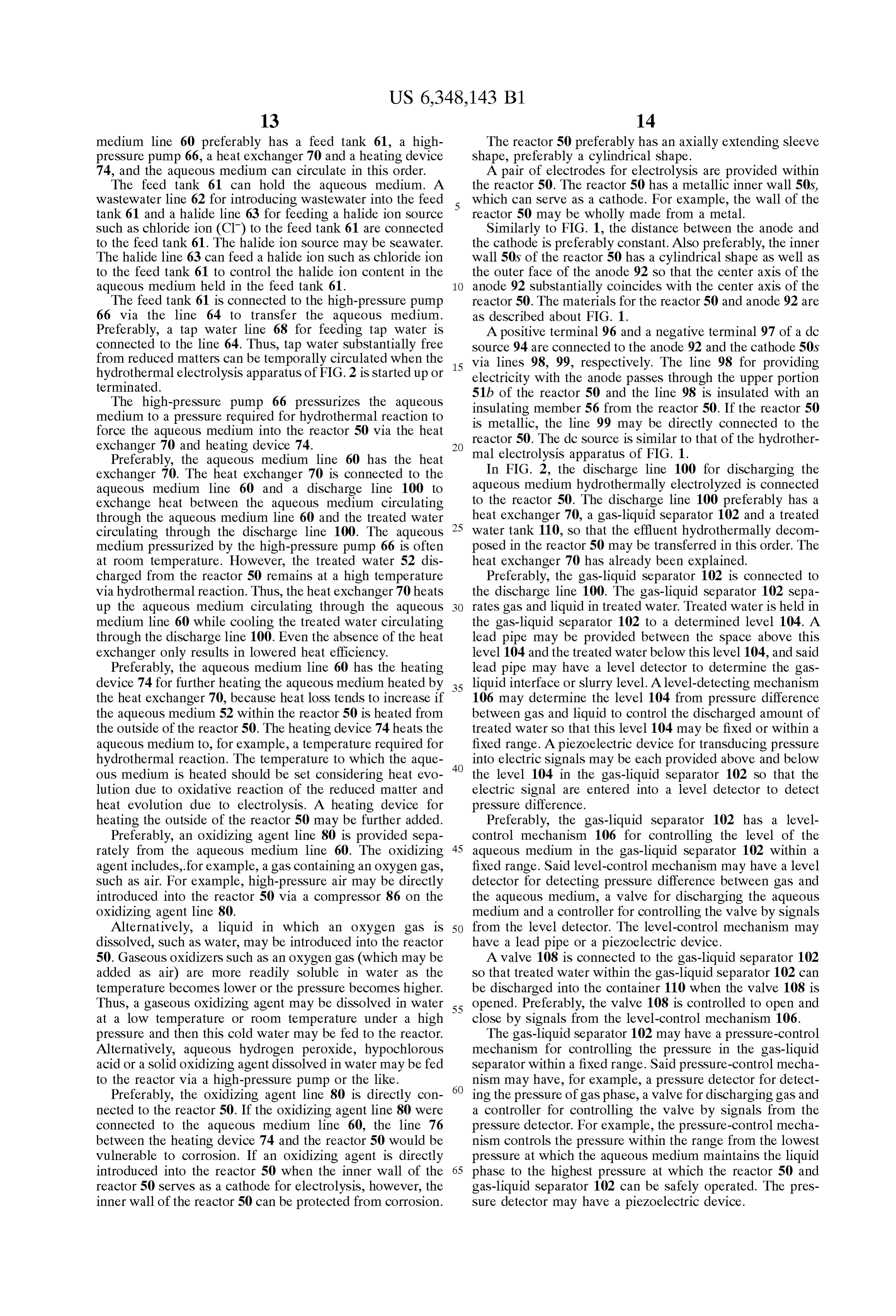
heating the outside of the reactor 50 may be further added. Preferably, the gas-liquid separator 102 has a level Preferably, an oxidizing agent line 80 is provided sepa control mechanism 106 for controlling the level of the rately from the aqueous medium line 60. The oxidizing 45 aqueous medium in the gas-liquid Separator 102 within a agent includes, for example, a gas containing an oxygen gas, fixed range. Said level-control mechanism may have a level Such as air. For example, high-pressure air may be directly detector for detecting pressure difference between gas and introduced into the reactor 50 via a compressor 86 on the the aqueous medium, a valve for discharging the aqueous oxidizing agent line 80. medium and a controller for controlling the valve by Signals Alternatively, a liquid in which an oxygen gas is 50 from the level detector. The level-control mechanism may dissolved, Such as water, may be introduced into the reactor have a lead pipe or a piezoelectric device. 50. Gaseous oxidizerS Such as an oxygen gas (which may be A valve 108 is connected to the gas-liquid separator 102 added as air) are more readily Soluble in water as the So that treated water within the gas-liquid Separator 102 can temperature becomes lower or the preSSure becomes higher. be discharged into the container 110 when the valve 108 is Thus, a gaseous oxidizing agent may be dissolved in water 55 opened. Preferably, the valve 108 is controlled to open and at a low temperature or room temperature under a high close by signals from the level-control mechanism 106. preSSure and then this cold water may be fed to the reactor. The gas-liquid Separator 102 may have a pressure-control Alternatively, aqueous hydrogen peroxide, hypochlorous mechanism for controlling the preSSure in the gas-liquid acid or a Solid oxidizing agent dissolved in water may be fed Separator within a fixed range. Said pressure-control mecha to the reactor via a high-pressure pump or the like. nism may have, for example, a pressure detector for detect Preferably, the oxidizing agent line 80 is directly con 60 ing the pressure of gas phase, a valve for discharging gas and nected to the reactor 50. If the oxidizing agent line 80 were a controller for controlling the valve by Signals from the connected to the aqueous medium line 60, the line 76 preSSure detector. For example, the pressure-control mecha between the heating device 74 and the reactor 50 would be nism controls the pressure within the range from the lowest Vulnerable to corrosion. If an oxidizing agent is directly preSSure at which the aqueous medium maintains the liquid introduced into the reactor 50 when the inner wall of the 65 phase to the highest pressure at which the reactor 50 and reactor 50 serves as a cathode for electrolysis, however, the gas-liquid Separator 102 can be safely operated. The pres inner wall of the reactor 50 can be protected from corrosion. Sure detector may have a piezoelectric device.
Page 29
A valve 109 is connected to the gas-liquid separator 102 gas is generated at the anode to oxidatively decompose the to release gas within the gas-liquid Separator 102 to atmo reduced matter. The reduced matter can be decomposed by sphere when the valve 109 is opened. Preferably, the valve oxidation better when hydrothermal reaction and electroly 109 is controlled to open and close by signals from a sis take place Simultaneously than hydrothermal reaction preSSure-control mechanism not shown. alone.
Then, a hydrothermal electrolysis process using the The aqueous medium preferably contains 0.1 mmol/L or hydrothermal electrolysis apparatus of FIG. 2 is explained as more, more preferably 1 mmol/L or more, Still more pref follows.
At first, Start-up is explained. ASSume that any liquid has erably 10 mmol/L or more of the electrolytic component. For not been introduced into the reactor 50. Tap water is first example, an aqueous Sodium chloride Solution at 0.05 introduced into the aqueous medium line 60 from the tap mmol/L contains 0.1 mmol/L of an electrolytic component water line 68 at room temperature under atmospheric pres consisting of 0.05 mmol of sodium ion and 0.05 mmol of sure. The tap water is introduced into the reactor 50 through chloride ion.
the heat exchanger 70 and heating device 76 by the action of In the present invention, hydrothermal electrolysis may the high-pressure pump 66. After the tap water has been 15 also be performed on an aqueous medium containing water, introduced into the heating device 74, the heating device 74 a strongly acidic ion and a reduced matter. is started up to heat the tap water. The heated tap water is The Strongly acidic ion is preferably an ion corresponding discharged from the reactor 50 into the discharge line 100 to a strong acid having a dissociation constant (pK) at 25 C. and Sent to the container 110 through the gas-liquid Sepa of 3.5 or less, more preferably 2.5 or less. The acid corre rator 102.
After the system has been stabilized, feed of tap water sponding to the Strongly acidic ion is preferably protonic. from the tap water line to the aqueous medium line 60 is The Strongly acidic ion may be an inorganic acid ion or an terminated and feed of an aqueous medium from the feed organic acid ion. However, the Strong acid is preferably an tank 61 to the aqueous medium line 60 is started. The halide inorganic acid ion, because organic acid ions are Sometimes ion content in the aqueous medium or the like has prelimi 25 decomposed as hydrothermal electrolysis proceeds. narily been controlled by the halide line 63 or the like. The Inorganic Strongly acidic ions include, for example, halide acqueous medium is introduced into the reactor 50 while the ions, sulfate ion (SO), nitrate ion (NO) and phosphate aqueous medium is continuously heated by the heating ion (PO). Organic strongly acidic ions include, for device 74. An oxidizing agent is introduced into the reactor example, trifluoroacetate ion (CFCOO) or the like. 50 via the oxidizing agent line 80. The Strongly acidic ion may exist as an acid or a Salt. The After the aqueous medium and oxidizing agent have been Salt may be formed with an inorganic cation Such as alkali introduced into the reactor 50, electrolysis is started. metal ions, alkali earth metal ions, or an organic cation. Namely, the dc Source 94 is turned on to Supply direct current to the anode 92 and the reactor 50 serving as a EXAMPLES cathode. The aqueous medium maintained in the liquid 35 phase at a high temperature under a high pressure moves In the following examples and Comparative Examples, from the bottom to the top of the reactor 50, during which the autoclave 10 shown in FIG. 1 was used. The inner hydrothermal reaction and electrolysis proceed Simulta volume was 300 ml, and the body 12 and cover 14 were neously. The heating temperature by the heating device 74 is made from SUS304 stainless steel unless otherwise speci appropriately lowered because heat is generated as hydro 40 fied.
thermal reaction and electrolysis proceed. In the following examples and Comparative Examples, The reaction time should be Sufficient for the reduced matter in the aqueous medium to be decomposed by the gaseous composition in the autoclave after hydrothermal reaction was analyzed with a gas chromatograph equipped oxidation, for example, 1 Second to 48 hours, preferably 1 minute to 24 hours. The reaction time is more preferably 5 45 with a TCD detector. Analysis of H, O, CO and CO was performed at a current of the TCD detector of 60 mA.
hours or less, still more preferably 2 hours or less. The Analysis of Cl gas was performed with a detecting tube. In reaction time is controlled depending on the Volume of the the following tables, nd means not detected. reactor 50 and the circulating rate of the aqueous medium.
When the reaction is to be terminated, inflow from the Total organic carbon (TOC) in treated water after hydro feed tank 61 to the aqueous medium line 60 is terminated 50 thermal reaction was determined with a TOC analyzer. TOC and tap water is introduced from the tap water line into the decomposition rate was calculated according to the follow aqueous medium line 60. Introduction of the oxidizing agent ing equation.
from the oxidizing agent line 80 into the reactor 50 is also terminated. Then, the dc Source is turned off to terminate TOC decomposition rate={1-(TOC of treated water/TOC of feed electrolysis. Then, the power of the heating device 74 is 55 water)x100 (15) lowered to gradually lower the temperature of the aqueous medium flowing in the reactor 50. Free chlorine contents in treated water were determined In the present invention, hydrothermal electrolysis may by the DPD method. Analysis of ammonia nitrogen and also be performed on an aqueous medium containing water, nitrate nitrogen was performed with an autoanalyzer avail an electrolytic component and a reduced matter. The elec 60 able from BRAN--LUEBEE.
trolytic component is not limited to a halide ion, but also may be an anion Such as hydroxide ion (OH), Sulfate ion Example 1
(SO), nitrate ion (NO), or a cation Such as hydrogen ion
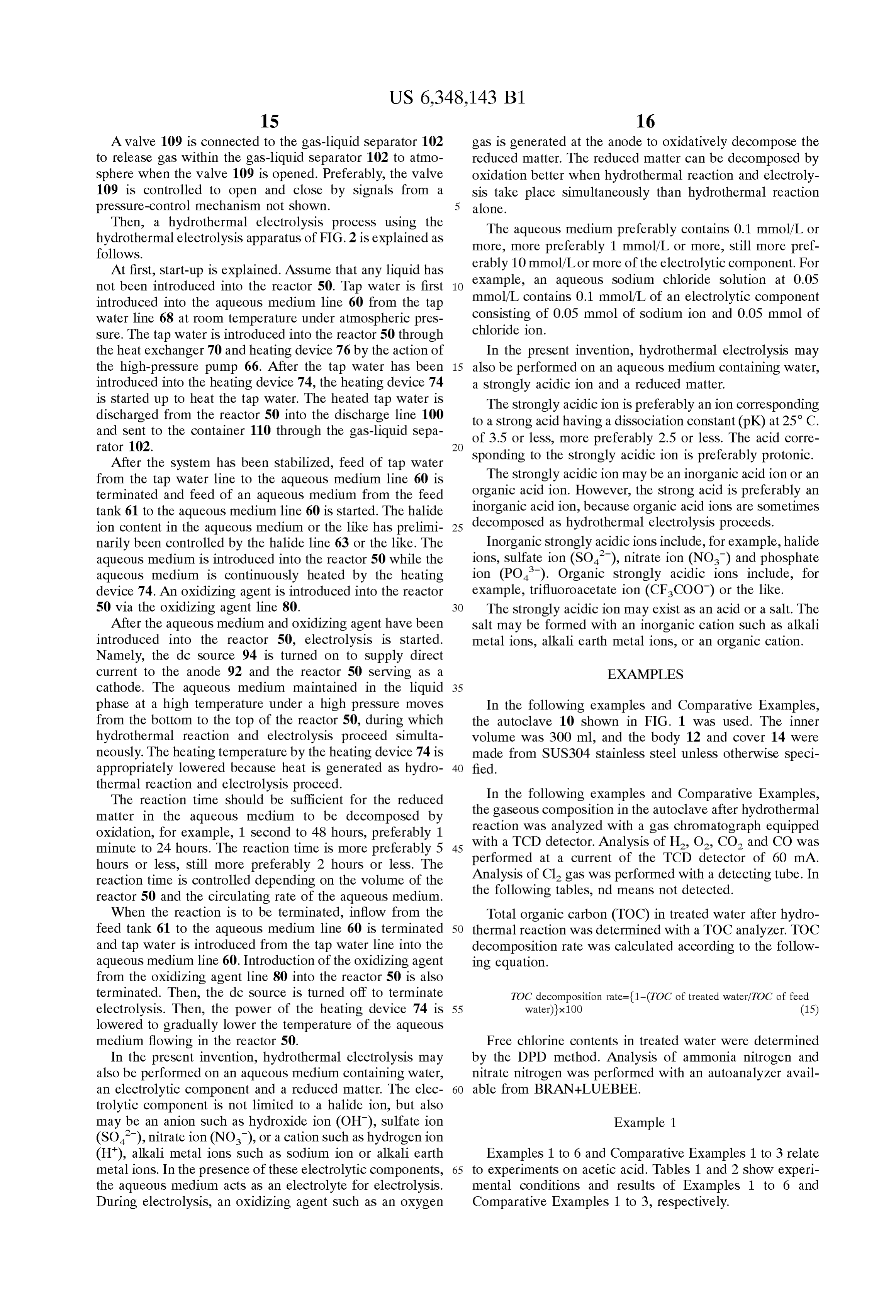
(H), alkali metal ions Such as Sodium ion or alkali earth Examples 1 to 6 and Comparative Examples 1 to 3 relate metal ions. In the presence of these electrolytic components, 65 to experiments on acetic acid. Tables 1 and 2 show experi the aqueous medium acts as an electrolyte for electrolysis. mental conditions and results of Examples 1 to 6 and During electrolysis, an oxidizing agent Such as an oxygen Comparative Examples 1 to 3, respectively.
Page 30
TABLE 1.
Ex. 1 Ex. 2 Ex. 3 Ex. 4 Ex. 5 Ex. 6
Reaction Feed water volume 150 150 150 150 150 150 conditions (mL)
Feed water acetic 5,000 5,000 5,000 5,000 5,000 5,000 acid content (mg/L)
Feed water NaCl 2 2 2 2 2 2 content (wt %)
Feed water H.O. O O O O 1.5 4.5 content (wt %)
Initial Ar pressure 3 3 3 3 3 3
(MPa)
Initial O. Pressure O O O O O O
(MPa)
Reaction 150 150 250 250 250 250 temperature (C.)
Average reaction 3.3 2.8 5.9 6 6.6 7.4 pressure (MPa)
Reaction time (min) 60 60 60 60 60 60
Anode type Ru Pt Ru Ru Ru Ru
Electrolytic 2 2 2 6 2 2 current (A)
Average 3.8 3.2 2.9 3.2 2.9 2.8 electrolytic voltage (V)
Gaseous H2 (vol%) 21.0 2O.O 22.1 22.7 O.2 O.2 Product O2 (vol%) 1.O O.7 ind ind 2.9 24.3 (gas Compo- CO, (vol%) 5.7 5.7 7.0 1O.S 13.8 9.5 sition in CO (vol%) O1 O.1 O1 O.2 ind ind the CI2 (ppm) ind ind ind ind ind ind reactor)
Effluent Feed water TOC 2OOO 2OOO 2OOO 2OOO 2OOO 2OOO
quality Effluent TOC (mg/L) 838 768 658 87 73 63 TOC decomposition 58.1 61.6 67.1 95.7 96.4 96.9 rate (%)
Effluent free 3 1. ind ind ind ind chlorine (mg/L)
center of the autoclave, which was then closed.
TABLE 2 Subsequently, 3 MPa of argon gas was introduced into the autoclave at room temperature under atmospheric pressure.
Comp. Comp. Comp. Then, the autoclave was heated with an electric heater
" until the temperature in the autoclave reached 150 C., at
Reaction Feed water volume (mL) 150 150 150 which it was maintained for 60 minutes. Starting from the condi- Feed water acetic acid 5,000 5,000 5,000 moment when the temperature in the autoclave reached 150 tions content (mg/L) C., electrolysis was continued for 60 minutes. Namely, Feed water NaCl content (wt %) 2 2 2 Supply of 2 A dc was started acroSS the ruthenium calcined Feed water H.O., content (wt %) O 4.5 O 45 electrode Serving as anode and the autoclave body Serving as Initial Air pressure (MPa) 2 3 2
Initial O. Pressure (MPa) 1. O 1. a cathode at that moment. Reaction temperature (C.) 250 250 250 After current supply at the autoclave temperature of 150 Average reaction pressure 6.2 5.9 6.3 C. for 60 minutes, the heater and dc Supply were terminated (MPa) Simultaneously. Then, the autoclave was air-cooled with a Reaction time (min) 12O 12O 12O
Anode type Ole Ru Ru 50 fan. After reaction, treated water was clear and no corrosion Electrolytic current (A) O O O was found in the autoclave. Average electrolytic O O O Table 1 shows that hydrothermal electrolysis in Example voltage (V)
Gaseous H (vol%) ind ind ind 1 gave a TOC decomposition rate 7.6, 5.6 and 1.5 times Product O (vol%) 3O.O 16.0 14.6 higher than those of Comparative Examples 1, 2 and 3, CO, (vol%) 2.44 2.8 5.6 55 respectively, in which electrolysis did not take place, at a CO (vol%) ind ind ind temperature lower by 100° C. with a half of the reaction Cl (ppm) ind ind ind
Effluent Feed water TOC (mg/L) 2OOO 2OOO 2OOO time.
Water Effluent TOC (mg/L) 185O 1794 1260 Example 2 quality TOC decomposition rate (%) 7.5 10.3 37.O
Effluent free chlorine (mg/L) ind ind ind 60 The ruthenium calcined electrode of Example 1 was replaced with a cylindrical platinum plate electrode (outer
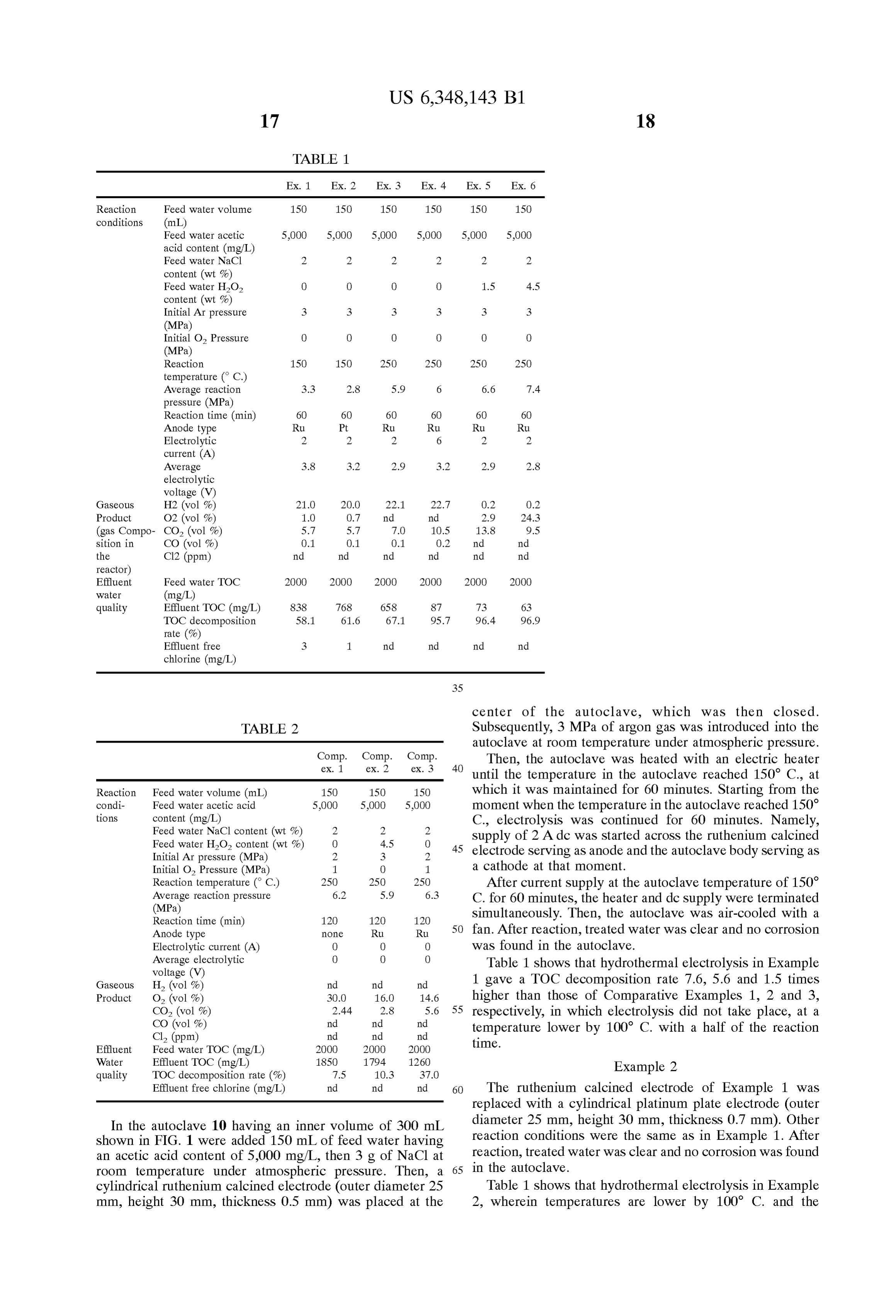
In the autoclave 10 having an inner volume of 300 mL diameter 25 mm, height 30 mm, thickness 0.7 mm). Other shown in FIG. 1 were added 150 mL of feed water having reaction conditions were the Same as in Example 1. After an acetic acid content of 5,000 mg/L, then 3 g of NaCl at reaction, treated water was clear and no corrosion was found room temperature under atmospheric pressure. Then, a 65 in the autoclave.
cylindrical ruthenium calcined electrode (outer diameter 25 Table 1 shows that hydrothermal electrolysis in Example mm, height 30 mm, thickness 0.5 mm) was placed at the 2, wherein temperatures are lower by 100° C. and the
Page 31
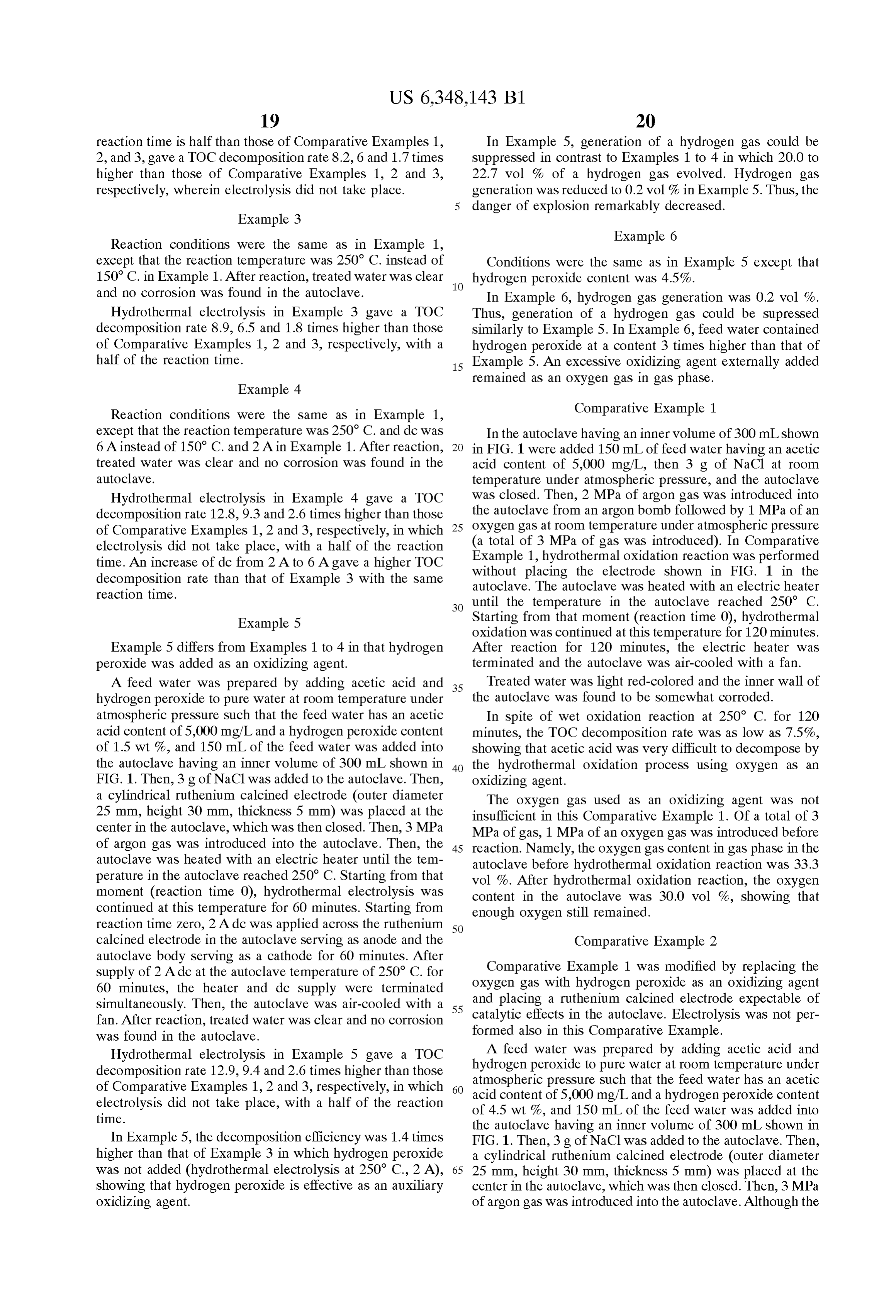
reaction time is half than those of Comparative Examples 1, In Example 5, generation of a hydrogen gas could be 2, and 3, gave a TOC decomposition rate 8.2, 6 and 1.7 times suppressed in contrast to Examples 1 to 4 in which 20.0 to higher than those of Comparative Examples 1, 2 and 3, 22.7 Vol % of a hydrogen gas evolved. Hydrogen gas respectively, wherein electrolysis did not take place. generation was reduced to 0.2 vol% in Example 5. Thus, the danger of explosion remarkably decreased.
Example 3
Example 6
Reaction conditions were the same as in Example 1, except that the reaction temperature was 250 C. instead of Conditions were the same as in Example 5 except that 150° C. in Example 1. After reaction, treated water was clear 1O hydrogen peroxide content was 4.5%. and no corrosion was found in the autoclave. In Example 6, hydrogen gas generation was 0.2 vol%. Hydrothermal electrolysis in Example 3 gave a TOC Thus, generation of a hydrogen gas could be Supressed decomposition rate 8.9, 6.5 and 1.8 times higher than those Similarly to Example 5. In Example 6, feed water contained of Comparative Examples 1, 2 and 3, respectively, with a hydrogen peroxide at a content 3 times higher than that of 15 Example 5. An excessive oxidizing agent externally added half of the reaction time.
remained as an oxygen gas in gas phase.
Example 4
Reaction conditions were the same as in Example 1, Comparative Example 1 except that the reaction temperature was 250 C. and dc was In the autoclave having an inner volume of 300 mL shown 6 A instead of 150° C. and 2 A in Example 1. After reaction, in FIG. 1 were added 150 mL of feed water having an acetic treated water was clear and no corrosion was found in the acid content of 5,000 mg/L, then 3 g of NaCl at room autoclave. temperature under atmospheric pressure, and the autoclave Hydrothermal electrolysis in Example 4 gave a TOC was closed. Then, 2 MPa of argon gas was introduced into decomposition rate 12.8, 9.3 and 2.6 times higher than those the autoclave from an argon bomb followed by 1 MPa of an of Comparative Examples 1, 2 and 3, respectively, in which 25 oxygen gas at room temperature under atmospheric preSSure electrolysis did not take place, with a half of the reaction (a total of 3 MPa of gas was introduced). In Comparative Example 1, hydrothermal oxidation reaction was performed time. An increase of dc from 2 A to 6 Agave a higher TOC without placing the electrode shown in FIG. 1 in the decomposition rate than that of Example 3 with the same autoclave. The autoclave was heated with an electric heater reaction time.
until the temperature in the autoclave reached 250 C.
Example 5 Starting from that moment (reaction time 0), hydrothermal oxidation was continued at this temperature for 120 minutes.
Example 5 differs from Examples 1 to 4 in that hydrogen After reaction for 120 minutes, the electric heater was peroxide was added as an oxidizing agent. terminated and the autoclave was air-cooled with a fan. A feed water was prepared by adding acetic acid and 35 Treated water was light red-colored and the inner wall of hydrogen peroxide to pure water at room temperature under the autoclave was found to be Somewhat corroded. atmospheric pressure Such that the feed water has an acetic In spite of wet oxidation reaction at 250 C. for 120 acid content of 5,000 mg/L and a hydrogen peroxide content minutes, the TOC decomposition rate was as low as 7.5%, of 1.5 wt %, and 150 mL of the feed water was added into showing that acetic acid was very difficult to decompose by the autoclave having an inner volume of 300 mL shown in 40 the hydrothermal oxidation proceSS using oxygen as an FIG.1. Then, 3 g of NaCl was added to the autoclave. Then, Oxidizing agent.
a cylindrical ruthenium calcined electrode (outer diameter The oxygen gas used as an oxidizing agent was not 25 mm, height 30 mm, thickness 5 mm) was placed at the insufficient in this Comparative Example 1. Of a total of 3 center in the autoclave, which was then closed. Then, 3 MPa. MPa of gas, 1 MPa of an oxygen gas was introduced before of argon gas was introduced into the autoclave. Then, the 45 reaction. Namely, the oxygen gas content in gas phase in the autoclave was heated with an electric heater until the tem autoclave before hydrothermal oxidation reaction was 33.3 perature in the autoclave reached 250 C. Starting from that Vol %. After hydrothermal oxidation reaction, the oxygen moment (reaction time 0), hydrothermal electrolysis was content in the autoclave was 30.0 vol %, showing that continued at this temperature for 60 minutes. Starting from enough oxygen Still remained.
reaction time Zero, 2 A dc was applied across the ruthenium 50 calcined electrode in the autoclave Serving as anode and the Comparative Example 2 autoclave body Serving as a cathode for 60 minutes. After Comparative Example 1 was modified by replacing the supply of 2 Adc at the autoclave temperature of 250 C. for oxygen gas with hydrogen peroxide as an oxidizing agent 60 minutes, the heater and dc Supply were terminated and placing a ruthenium calcined electrode expectable of Simultaneously. Then, the autoclave was air-cooled with a 55 catalytic effects in the autoclave. Electrolysis was not per fan. After reaction, treated water was clear and no corrosion was found in the autoclave. formed also in this Comparative Example. Hydrothermal electrolysis in Example 5 gave a TOC A feed water was prepared by adding acetic acid and decomposition rate 12.9, 9.4 and 2.6 times higher than those hydrogen peroxide to pure water at room temperature under of Comparative Examples 1, 2 and 3, respectively, in which 60 atmospheric acid content pressure Such that the feed water has an acetic of 5,000 mg/L and a hydrogen peroxide content electrolysis did not take place, with a half of the reaction of 4.5 wt %, and 150 mL of the feed water was added into time.
the autoclave having an inner volume of 300 mL shown in
In Example 5, the decomposition efficiency was 1.4 times FIG.1. Then, 3 g of NaCl was added to the autoclave. Then, higher than that of Example 3 in which hydrogen peroxide a cylindrical ruthenium calcined electrode (outer diameter was not added (hydrothermal electrolysis at 250° C., 2 A), 65 25 mm, height 30 mm, thickness 5 mm) was placed at the showing that hydrogen peroxide is effective as an auxiliary center in the autoclave, which was then closed. Then, 3 MPa. Oxidizing agent. of argon gas was introduced into the autoclave. Although the
Page 32
ruthenium calcined electrode was placed, dc was not In formula (20), acetic acid is oxidatively decomposed applied. Other conditions were similar to those of Compara with hydrogen peroxide into carbon dioxide gas and water. tive Example 1. In Comparative Example 2, hydrogen This reaction alone is very slow as will be explained in the peroxide was used in an amount about 4 times the Stoichio examples. In formula (21), acetic acid is decomposed with metric equivalent necessary for oxidatively decomposing 5 oxygen dissolved in the aqueous medium into carbon diox acetic acid contained in feed water. After reaction, treated ide gas and water. This reaction alone is also very slow. water was light red-colored and the inner wall of the Comparative Example 4 autoclave appeared to be somewhat corroded. The TOC In Comparative Example 4, hydrothermal electrolysis was decomposition rate slightly increased to 10.3% from 7.5% in performed on an aqueous Solution of Sodium chloride free Comparative Example 1. from reduced matters.
Comparative Example 3 In the autoclave 10 having an inner volume of 300 mL shown in FIG. 1 were added 150 mL of tap water, then 4 g.
In the autoclave having an inner volume of 300 mL shown of NaCl at room temperature under atmospheric pressure. in FIG. 1, were added 150 mL offeed water having an acetic Then, a cylindrical ruthenium calcined electrode (outer acid content of 5,000 mg/L and 3 g of NaCl at room 15 diameter 25 mm, height 30 mm, thickness 0.5 mm) was temperature under atmospheric pressure. Then, a cylindrical placed at the center of the autoclave, which was then closed. ruthenium calcined electrode Similar to the one used in Subsequently, 3 MPa of argon gas was introduced into the Comparative Example 2 (outer diameter 25 mm, height 30 autoclave at room temperature under atmospheric pressure. mm) was placed at the center in the autoclave, which was until Then, the autoclave was heated with an electric heater then closed. Then, 2 MPa of argon gas was introduced into the temperature in the autoclave reached a given the autoclave from an argon bomb followed by 1 MPa of the wastemperature in the range from 30° C. to 350° C., at which it oxygen gas at room temperature under atmospheric pressure maintained for a given period of time in the range from (a total of 3 MPa of gas was introduced). 15 to 60 minutes. Starting from the moment when the given temperature was reached, 2 A dc was Supplied to continue
In Comparative Example 3, the ruthenium calcined elec electrolysis for a given period of time. The heater and dc trode was placed but dc was not applied. Other conditions 25 Supply were terminated Simultaneously, and the autoclave were similar to those of Comparative Example 1. In Com was air-cooled with a fan.
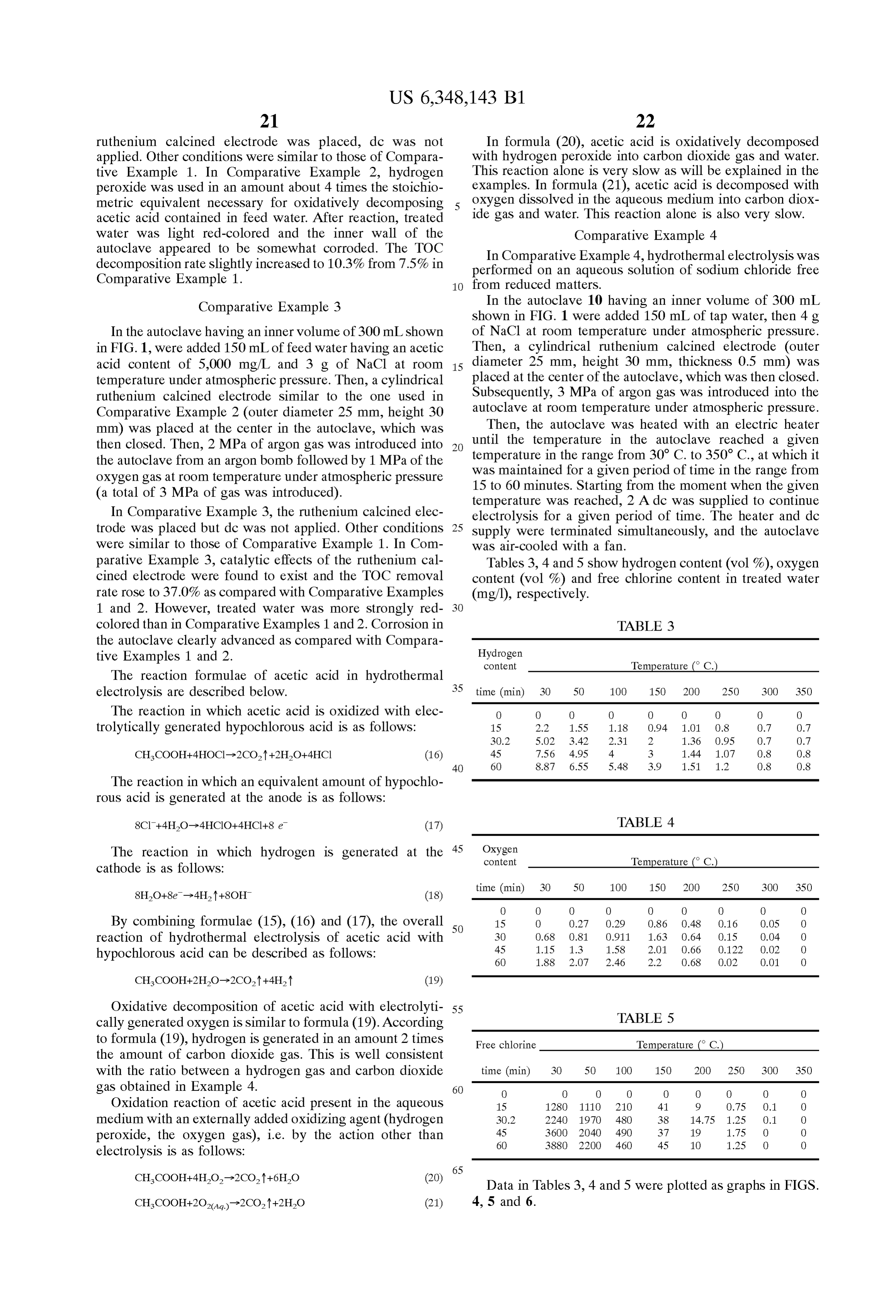
parative Example 3, catalytic effects of the ruthenium cal Tables 3, 4 and 5 show hydrogen content (vol%), oxygen cined electrode were found to exist and the TOC removal content (vol%) and free chlorine content in treated water rate rose to 37.0% as compared with Comparative Examples (mg/l), respectively.
1 and 2. However, treated water was more Strongly red colored than in Comparative Examples 1 and 2. Corrosion in TABLE 3 the autoclave clearly advanced as compared with Compara tive Examples 1 and 2. Hydrogen
The reaction formulae of acetic acid in hydrothermal 35 electrolysis are described below. time (min) 30 50 1OO 1SO 200 250 3OO 350 The reaction in which acetic acid is oxidized with elec O O O O O O O O O trolytically generated hypochlorous acid is as follows: 15 2.2 155 1.18 O.94 1.O1 O.8 O.7 O.7 30.2 S.O2 3.42 2.31 2 1.36 O.95 O.7 O.7 45 7.56 4.95 4 3 1.44 107 O.8 O.8 40 60 8.87 6.55 5.48 3.9 1.51 1.2 O.8 O.8
The reaction in which an equivalent amount of hypochlo rous acid is generated at the anode is as follows:
TABLE 4
The reaction in which hydrogen is generated at the 45 Oxygen cathode is as follows: content Temperature (C. time (min) 30 50 1OO 1SO 200 250 3OO 350
O O O O O O O O O
By combining formulae (15), (16) and (17), the overall 50 15 O O.27 O.29 O.86 O.48 0.16 O.OS O reaction of hydrothermal electrolysis of acetic acid with 3O 0.68 0.81 0.911 1.63 0.64 0.15 O.04 O 45 1.15 1.3 1.58 2.O1 O.66 0.122 O.O2 O hypochlorous acid can be described as follows: 60 1.88 2.07 246 2.2 O.68 O.O2 O.O1 O
Oxidative decomposition of acetic acid with electrolyti 55 cally generated oxygen is similar to formula (19). According TABLE 5 to formula (19), hydrogen is generated in an amount 2 times Free chlorine Temperature (C. the amount of carbon dioxide gas. This is well consistent with the ratio between a hydrogen gas and carbon dioxide time (min) 3O 50 1OO 150 2OO 2SO 3OO 350 gas obtained in Example 4. 60 O O O O O O O O O Oxidation reaction of acetic acid present in the aqueous 15 128O 1110 210 41 9 O.75 0.1 O medium with an externally added oxidizing agent (hydrogen 30.2 2240 1970 480 38 14.75 1.25 O1 O peroxide, the oxygen gas), i.e. by the action other than 45
electrolysis is as follows:
CHCOOH+4HO,->2CO, +6HO (20) Data in Tables 3, 4 and 5 were plotted as graphs in FIGS.
Page 33
Tables 3 and 4 as well as FIGS. 4 and 5 show that whole amount of the feed water was added in the autoclave generation of a hydrogen gas and an oxygen gas is Sup having an inner volume of 300 mL shown in FIG. 1 at room pressed as the reaction temperature rises. AS the reaction temperature under atmospheric pressure. A cylindrical temperature rises, free chlorine content decreases, indicating platinum-iridium calcined electrode (outer diameter 25 mm, that hypochlorous acid may probably reduced to chlorine ion 5 height 30 mm, thickness 0.5 mm) was placed at the center via cathodic reaction shown in reaction formula (11). in the autoclave, which was then closed. Then, 3 MPa of In other words, even though hydrothermal electrolysis bomb argon gas was introduced into the autoclave from an argon takes place in the absence of reduced matter, generation of Then, the at room temperature under atmospheric pressure. a hydrogen gas and an oxygen gas is Suppressed So that the temperature autoclave was heated with an electric heater until in the autoclave reached 250 C. Starting danger of explosion can be avoided. Moreover, excessive 10 from that moment (reaction time 0), hydrothermal electroly hypochlorous acid ions may be consumed via cathodic sis was continued at this temperature for 5 minutes. Starting reaction So that no hypochlorous acid, which may require the from reaction time Zero, 2 A dc was applied between the Secondary treatment, remains in the treated water. platinum-iridium calcined electrode in the autoclave Serving When an aqueous medium is treated by hydrothermal 15 as anode and the autoclave body Serving as a cathode for 5 electrolysis according to the present invention, as the reac minutes. After current Supply at the autoclave temperature of tion proceeds, the reduced matter is oxidized So that no 250 C. for 5 minutes, the heater and dc supply were reduced matter remains in the aqueous medium. Even if cooled terminated Simultaneously. Then, the autoclave was air hydrothermal electrolysis is further carried out in this State, with a fan.
Safety can be ensured. Any excessive oxidizing agent is Table 6 shows that the TOC of treated water was 0.5 mg/L reduced at the cathode to Suppress generation of hydrogen. as compared with the TOC of the feed water of 160 mg/L. Namely, 99% or more of trichloroethylene was decomposed
FIG. 7 shows the correlation of voltage with reaction temperature, indicating that Voltage decreases, i.e. electric (TOC decomposition rate). The pH of treated water was near neutral.
resistance of water decreases as the reaction temperature Trichloroethylene probably may have been decomposed rises. This demonstrates that lower electric power is required 25 by hydrothermal electrolysis according to the following for electrolysis at high temperatures than low temperatures. oxidation reaction:
Example 7 CHCI+4HO->2CO, +3H +3HCl (22) Experimental conditions and results of Examples 7 to 9 Example 8 are shown in Table 6. 3O Dimethylsulfoxide (DMSO) was hydrothermally electro lyzed. DMSO is a Sulfur-containing compound used as a
TABLE 6 water-soluble solvent.
To a 150 mL graduated flask was added 0.078 g of
dimethyl sulfoxide (DMSO), 0.06 g of NaOH and 3 g of
Reaction Analyte Trichloro- DMSO Malathion 35 NaCl, and then pure water was added to prepare 150 mL of conditions ethylene feed water. The whole amount of the feed water was added Feed water volume 150 150 150 to the autoclave having an inner volume of 300 mL, as (mL) shown in FIG. 1, at room temperature under atmospheric Feed water analyte 876 521 2,203 preSSure. A cylindrical platinum-iridium calcined electrode content (wt %) (outer diameter 25 mm, height 30 mm, thickness 0.5 mm) Feed water NaCl 2 2 2 40 content (wt %) was placed at the center in the autoclave, which was then NaOH loading (mg) 12O 60 28O closed. Then, 3 MPa of argon gas was introduced into the Initial Air Pressure 3 3 3 autoclave from an argon bomb at room temperature under (MPa) atmospheric pressure. Then, the autoclave was heated with
( C.) 45 an electric heater until the temperature in the autoclave
Average reaction 6.3 6 5.9 reached 250° C. Starting from that moment (reaction time pressure (MPa) O), hydrothermal electrolysis was continued at this tempera Reaction time (min) 5 15 25 ture for 15 minutes. Starting from reaction time Zero, 2 Adc Anode type Pt-Ir Pt-Ir Pt-r was applied between the platinum-iridium calcined elec Electrolytic current 2 2 6 trode in the autoclave Serving as anode and the autoclave
Average electrolytic 2.9 2.9 3.3 50 body Serving as a cathode for 5 minutes. After keeping the voltage (V) autoclave at 250 C. and current supply for 15 minutes, the Gaseous H., (vol%) 1.6 4.6 16.6 heater and dc Supply were terminated Simultaneously. Then, product O, (vol%) ind Nd ind the autoclave was air-cooled with a fan. (gas compo- CO2 (vol%) 1.1 1.1 4.3 sition CO (vol%) ind Nd ind Table 6 shows that the TOC of treated water was 0.8 mg/L in the Cl2 (ppm) ind Nd ind 55 as compared with the TOC of the feed water of 160 mg/L. reactor)
Effluent Feed water TOC 160 160 8OO
Namely, 99% or more of DMSO was decomposed (TOC water (mg/L) decomposition rate). The pH of treated water was near quality Effluent TOC (mg/L) 0.5 O.8 2 neutral.
TOC decomposition 99.7 99.5 99.8 Dimethylsulfoxide probably may have been decomposed rate (%) 60 by hydrothermal electrolysis according to the following
chlorine (mg/L) oxidation reaction:
Trichloroethylene was hydrothermally electrolyzed. Example 9
In a 150 mL graduated flask containing 0.131 g of 65 Malathion was hydrothermally electrolyzed. Malathion is trichloroethylene, 0.12 g of NaOH and 3 g of NaCl was a compound containing phosphorus and Sulfur for use as a added pure water to prepare 150 mL offeed water. Then, the pesticide.
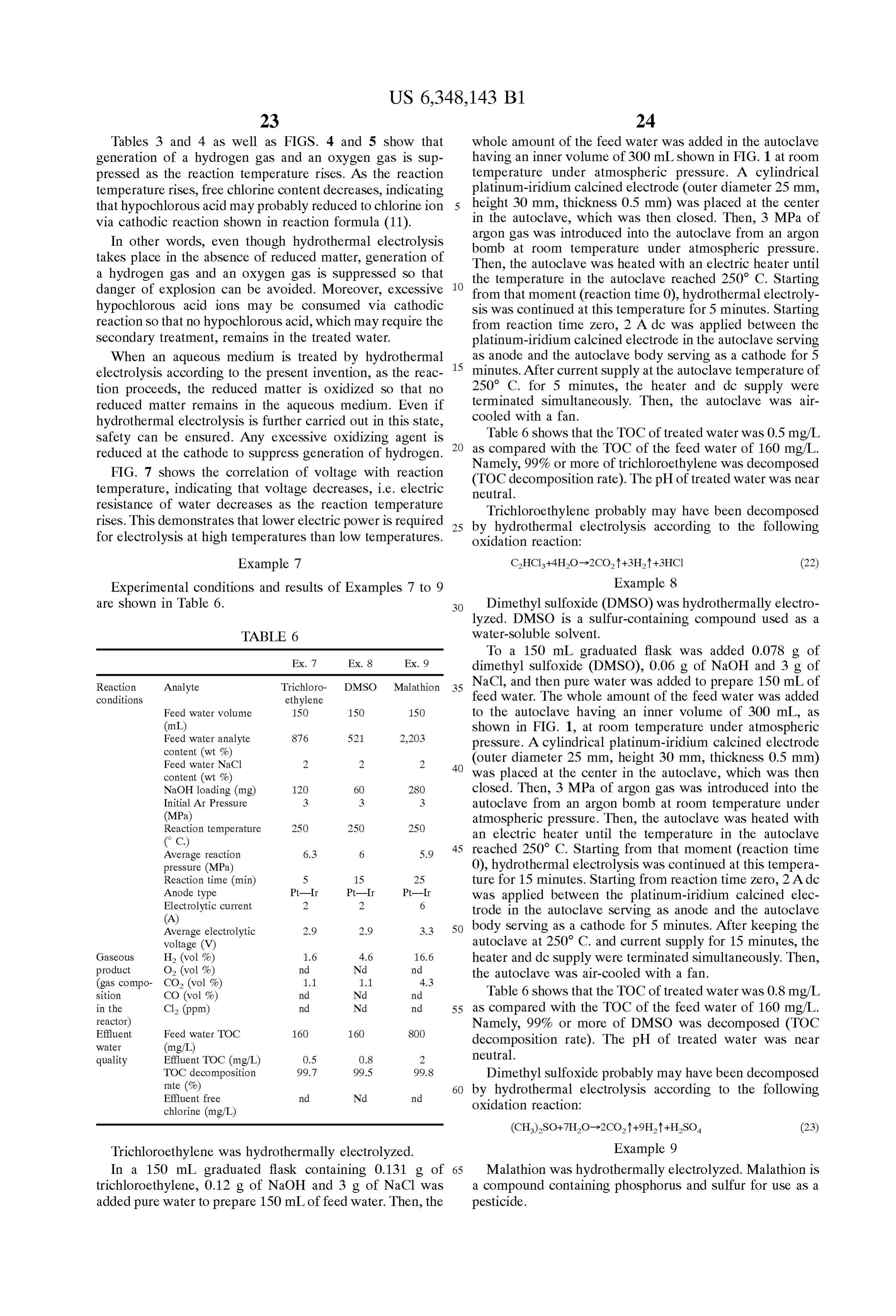
Page 34
To a 150 mL graduated flask was added 0.330 g of Example 12. The ratio between H gas and N gas is about malathion, 0.28 g of NaOH, and 3 g of NaCl, and then pure 3:1. In Example 12, almost all of the ammonia nitrogen was water was added to prepare 150 mL offeed water. Then, the decomposed after a reaction time of 60 minutes. FIG. 9 whole amount of the feed water was added in the autoclave shows that, in Example 12, 60 minutes and 120 minutes having an inner volume of 300 mL shown in FIG. 1 at room reaction times generate about the Same amount of hydrogen temperature under atmospheric pressure. A cylindrical gases generated. This indicates that the absence of reduced platinum-iridium calcined electrode (outer diameter 25 mm, matter (ammonia in this case) in the aqueous medium height 30 mm, thickness 0.5 mm) was placed at the center greatly SupreSSes generation of hydrogen. in the autoclave, which was then closed. Then, 3 MPa of The overall reaction of hydrothermal electrolysis of argon gas was introduced into the autoclave from an argon ammonia may be as follows:
bomb at room temperature under atmospheric pressure.
Then, the autoclave was heated with an electric heater until 2NH->N, +3H, (25) the temperature in the autoclave reached 250 C. Starting from that moment (reaction time 0), hydrothermal electroly A hydrogen gas generated in formula (25) results from sis was continued at this temperature for 25 minutes. Start 15 electrolysis of water. Hydrogen contained in the ammonia ing from reaction time Zero, 6 A dc was applied between the molecule is not shown in the overall reaction formula (25) platinum-iridium calcined electrode in the autoclave Serving because it has been oxidatively decomposed into water. as anode and the autoclave body Serving as a cathode for 25 minutes. After keeping the autoclave at 250 C. with current Examples 13 and 14 Supply for 25 minutes, the heater and dc Supply were In Examples 13 and 14, ammonia was Subjected to terminated Simultaneously. Then, the autoclave was air hydrothermal reaction.
cooled with a fan.
Table 6 shows that the TOC of the treated water was 2 Hydrothermal reaction was performed under the same mg/L as compared with the TOC of the feed water of 800 conditions as in Example 12 except for reaction temperature mg/L. Namely, 99% or more of malathion was decomposed 25 and reaction time. In Examples 13 and 14, reaction times (TOC decomposition rate) via hydrothermal electrolysis at a were 15 minutes and 30 minutes, respectively, and reaction temperature of 250 C., 6 A dc for 25 minutes. The pH of temperature was varied. Results are shown in FIG. 10. treated water was near neutral. When the reaction time is 30 minutes, ammonia is rapidly Malathion probably may have been decomposed by decomposed as the reaction temperature rises. Ammonia is hydrothermal electrolysis according to the following oxida decomposed even at low temperatures, because the aqueous tion reaction: medium becomes rich in hypochlorous acid during elec trolysis at low temperatures (see FIG. 6). Although this
CHOPS+26HO-10CO, +38H +2HSO+HPO, (24) reaction between hypochlorous acid and ammonia at low temperatures proceeds as a known break-point reaction,
Examples 10 to 12 and Comparative Example 5 35 hydrothermal electrolysis of the present invention obviously In Examples 10 to 12 and Comparative Example 5, allows ammonia to be rapidly decomposed almost in the ammonia was Subjected to hydrothermal reaction. In absence of hypochlorous acid in the aqueous medium. Examples 10, 11 and 12, 2 A, 4A and 6 A dc were applied at 250 C. for a given period of reaction time, respectively. Examples 15 and 16 and Comparative Example 6 In Comparative Example 5, however, dc was not applied. 40 Hydrothermal reaction was performed under the same Commercially available 25% aqueous ammonia was conditions as in Example 12 except for reaction temperature diluted to prepare a feed ammonia water having an ammonia and reaction time. In Examples 15 and 16, reaction tem nitrogen content of 3000 mg/L. In the autoclave 10 having peratures were 200 C. and 250 C., respectively. In Com an inner volume of 300 mL, shown in FIG. 1, were added 45 parative Example 6, reaction temperature was 39 C. Nitrate 150 mL of this feed ammonia water, then 4 g of NaCl at nitrogen contents were measured for varying reaction times. room temperature under atmospheric pressure. Then, a Results are shown in FIG. 11.
cylindrical ruthenium calcined electrode (outer diameter 25 It was confirmed that nitrate ion is generated as an mm, height 30 mm, thickness 0.5 mm) was placed at the intermediate product when ammonia is electrolytically center of the autoclave, which was then closed. 50 decomposed. The content of nitrate nitrogen generated at a Subsequently, 3 MPa of argon gas was introduced into the low temperature such as 39 C. continuously increased autoclave at room temperature under atmospheric pressure.
Then, the autoclave was heated with an electric heater within the period of reaction time of this Comparative Example. However, in Example until the temperature in the autoclave reached 250 C., at subject to the hydrothermal electrolysis 16 wherein ammonia is which it was maintained for a given period of time. Starting 55 nitrate nitrogen is once generated, but after at
short period of from the moment when 250 C. was reached, 2 A, 4A and 6 Adc was applied to continue electrolysis for a given period presumably have been minerallized into a nitrogen gasions time, the nitrate nitrogen is decomposed again. Nitrate
Via of time in Examples 10, 11 and 12, respectively. In Com cathodic reaction in the present invention. parative Example 5, however, dc was not applied.
The heater and dc Supply were terminated Simultaneously, 60 Examples 17, 18 and 19 and the autoclave was air-cooled with a fan.
FIG. 8 shows the correlation of ammonia nitrogen content Monoethanolamine, i.e. 2-aminoethanol was hydrother with reaction time, indicating that ammonia is more rapidly mally electrolyzed. In Examples 17, 18 and 19, feed waters decomposed at higher electrolytic current when the reaction having monoethanolamine concentrations of 20,000 mg/l, time is constant. 65 10,000 mg/l and 5,000 mg/l were used, respectively. FIG. 9 shows the correlation between a gaseous product To the autoclave 10 having an inner volume of 300 mL composition and reaction time for 6 A dc charged in shown in FIG. 1 were added 110 mL of said feed water, then
Page 35
4 g of NaCl at room temperature under atmospheric pres Experimental conditions and results are shown in Table 7. Sure. Then, a cylindrical ruthenium calcined electrode (outer diameter 25 mm, height 30 mm, thickness 0.5 mm) was After reaction, gas was odorless, and treated water had a placed at the center of the autoclave, which was then closed. relatively clear pale yellow color and precipitates. Solids Subsequently, 3 MPa of argon gas was introduced into the 5 precipitated well. The inside of the autoclave was not autoclave at room temperature under atmospheric pressure. corroded at all.
TABLE 7
Treatment Temperature, C. 250 250 250 250
Condi- Pressure, atm 70 70 70 70 tions Electrolytic 6 6 O O current, A 2 2 2 2
Reaction time, h O O O O
Oxygen, atm
MLSS, mg/l 12,000 3,420 2.988 4,275 3,750
MLVSS, mg/1 9,800 1,662 1309 2,438 1,720
Supernatant TOC, mg/l 1O 1,349 986 2,970 1,800
Supernatant COD, mg/1 5.4 888 396 3,100 2,332
PH 7.3 5.71 4.71 6.36 5.2
Supernatant color Clear Pale Clear Black Brown
Yellow
Effluent gas odor No No No Bad No
Corrosion in the autoclave No No Yes Severe
Then, the autoclave was heated with an electric heater Example 21 until the temperature in the autoclave reached 250 C., at Hydrothermal electrolysis was performed under the same which it was maintained for a given period of time. Starting conditions as in Example 20 except that the platinum-plated from the moment when the temperature reached 250 C., 12 electrode was replaced with a ruthenium oxide calcined Adc was Supplied to continue electrolysis for a given period electrode and that Sodium chloride was added at a chloride of time. Then, the heater and dc Supply were terminated ion content of 10.0 mmol/L in the sludge. simultaneously, and the autoclave was air-cooled with a fan. After reaction, gas was odorless and treated water was FIG. 12 shows the correlation of total organic carbon 35 wholly clear. Solids precipitated well. The inside of the (TOC) with reaction time, indicating that monoethanola autoclave was not corroded at all.
mine is decomposed in Substantially direct proportion with reaction time. In all the examples shown in FIG. 12, which Comparative Example 7 apply electrolytic current of 12 A, a higher decomposition Hyrothermal reaction was performed under the same rate can be obtained within a short period of time at lower 40 conditions as in Example 20 except that the platinum monoethanolamine concentrations in feed water.
electrode was not placed in the autoclave 10. After reaction,
The overall reaction of hydrothermal electrolysis of gas had a very bad odor, and treated water was black. Solids monoethanolamine presumably proceeds according to the did not always precipitate. The inner wall of the autoclave following reaction formula: was Somewhat corroded.
FIG. 13 shows the composition of the gaseous product in In the autoclave not equipped with an electrode was added Example 17. AS shown in FIG. 13, the nitrogen gas, carbon atm 150 ml of organic Sludge, then 60 atm of argon gas and 10 dioxide gas and hydrogen gas contents at a reaction time of One ofhour an oxygen gas were introduced at room temperature. 60 minutes are 2.46 vol %, 9.38 vol % and 3.58 vol %, 50 temperatureafter of heating of the autoclave was Started, a 250 C. was reached. The autoclave was respectively, which are almost consistent with the product maintained at 250 C. under 70 atm for 2 hours, then cooled. ratio of reaction formula (25). After reaction, gas was odorless and treated water was In Examples 20 and 21 and Comparative Examples 7 and 8, hydrothermal reaction was performed on an organic brown. Solids in the effluent precipitated well. The inner Sludge in the autoclave as shown in FIG. 1. Characteristics 55 wall of the autoclave was heavily corroded. and results of the organic Sludge are shown in Table 7. Example 22 Example 20 Formation of Scale in hydrothermal reaction was con trolled by hydrothermal electrolysis.
Sodium chloride was added to Sludge at a chloride ion 60 The polarities of electrodes were temporally inverted content of 0.5 mmol/L in the sludge. during hydrothermal electrolysis to control formation of Using a platinum-plated electrode, a constant current of 6 Scale on the inner wall of the autoclave. A was supplied for 2 hours at 250 C. under a pressure of 70 The autoclave shown in FIG. 1 was used. The anode was atm. Average Voltage was 10 V. The pressure was maintained a titanium base plated with platinum. at 70 atm via the pressure-control valve 43. After current 65 Feed water used was tap water containing calcium chlo Supply for 2 hours, the heater and current Supply were ride and Sodium bicarbonate at a calcium hardness of 250 terminated and the autoclave was cooled. mg/L and a total alkalinity of 200 mg/L.
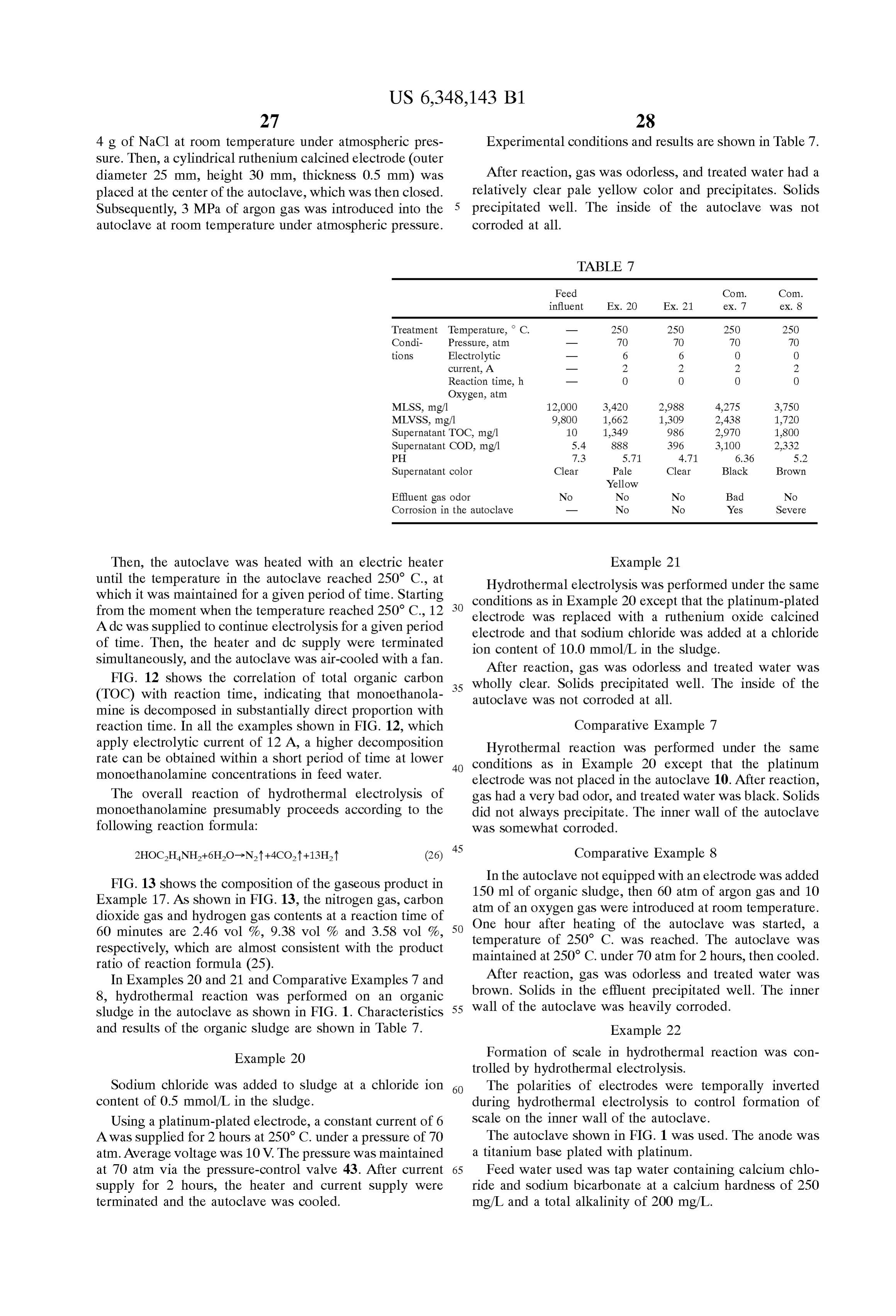
Page 36
In the autoclave was added 150 ml of the feed water. adding an oxygen gas to perform hydrothermal electrolysis While heating the autoclave, 150 mA dc was supplied. This of an aqueous acetic acid Solution. corresponds to an anodic current density of 2 mA/cm. The FIG. 14 shows TOCs in the reaction Solutions collected at autoclave was heated Such that temperature increases at a each reaction time, indicating that acetic acid is more rapidly constant rate, and after the temperature reached 200 C., the 5 decomposed in the presence of an oxygen gas (Example 23) autoclave was maintained at 200 C. for 40 minutes. During than otherwise (Example 24).
this process, the polarities of the electrodes were appropri FIG. 14 also shows calculated TOCs based on the Fara ately inverted as shown in Table 8. days law when 2 A current is applied acroSS electrodes at current efficiencies of 100% and 200%. Both calculated
TABLE 8 values are based on only anodic reaction. Namely, the
Temperature, Electrolytic calculated TOC at a current efficiency of 100% is based on Time, min. o C. Voltage, V polarity the premise that the current applied acroSS electrodes is
totally consumed to generate an oxidizing agent (reaction
formula (17)) and that said oxidizing agent is totally con 2O 8O 4.6 Positive Sumed for oxidation reaction with acetic acid (reaction
Positive
Positive formula (16)) at the anode. The calculated TOC at a current
efficiency of 200% is based on the premise that an oxidizing 60 2OO 6.5 Positive --> agent is generated double the amount generated at the anode. inverse In Example 23, the current efficiency apparently exceeds
about 100%, Suggesting that not only the anode but also the positive cathode participate in decomposition reaction. Such partici 90 2OO 4.1 Positive pation of the cathode in decomposition may be described by 1OO 2OO 4.3 Positive the following reactions.
25 The oxygen gas added is dissolved in aqueous phase
After the lapse of 100 minutes, current Supply was under high pressure (reaction formula (27)), and then the terminated, and the autoclave was cooled. No Scale depos dissolved oxygen is converted into active oxygen via reduc ited on the inner wall of the reactor. tion reaction at the cathode as shown in reaction formula
Comparative Example 9
Hydrothermal electrolysis was performed under the same O(aq)+HO+e-active oxygen--OH (28) conditions as in Example 22 except that the polarities of electrodes were not inverted. Scale deposited on the inner Here, active oxygen has a high oxidizing ability to rapidly wall of the reactor. oxidize organic matters.
Examples 23 and 24 CHCOOH--active oxygen->CO+HO (29) Example 23 demonstrates hydrothermal electrolysis of Namely, the current efficiency based on only anodic acetic acid when an oxygen gas was added as an oxidizing reaction exceeds 100%, probably because cathodic decom agent. Example 24 differs from Example 23 in that an 40 position reaction (reaction formulae (27) to (29)) proceeds in oxygen gas was not added. addition to anodic decomposition reaction (reaction formu In the autoclave having an inner volume of 300 mL shown lae (16) and (17)) in hydrothermal electrolysis when oxygen in FIG. 1 was added 150 mL of feed water containing acetic is added. Therefore, addition of an oxidizing agent can Save acid in pure water at an acetic acid content of 4,000 mg/L at electric power needed for hydrothermal electrolysis. room temperature under atmospheric pressure. Then, 3 g of 45 FIG. 15 shows the contents of gaseous components col NaCl was added in the autoclave. Then, a cylindrical plati lected from the autoclave in Example 23. The oxygen gas is num plate electrode (outer diameter 25 mm, height 30 mm, rapidly consumed to produce a gas essentially consisting of thickness 0.5 mm) was placed at the center in the autoclave, carbon dioxide gas. Moreover, the active oxygen-producing which was then closed. Subsequently, 1 MPa of an oxygen reaction (28) proceeds at the cathode to greatly repress the gas and 2 MPa of argon gas (a total of 3 MPa) were 50 hydrogen-producing reaction (18). This means that even introduced. Then, the autoclave was heated with an electric addition of an oxygen gas in a high-pressure reactor can not heater. Starting from the moment when the temperature in give a mixed gas of oxygen and hydrogen involving the the autoclave reached 250° C. (reaction time zero), elec danger of explosion. Thus, either gaseous (the oxygen gas in trolysis was continued for 60 minutes at this temperature. Example 23) or liquid (the hydrogen peroxide in Examples Starting from reaction time Zero, 2 Adc was applied between 55 5 and 6) oxidizing agents externally added repress hydrogen the platinum-plated electrode in the autoclave Serving as generation.
anode and the autoclave body Serving as a cathode. Also FIG. 16 shows the contents of gaseous components col starting from reaction time Zero, the valves 45 and 43 shown lected from the autoclave in Example 24 with no oxygen in FIG. 1 were operated at intervals of 15 minutes to collect added. The gaseous product consist of hydrogen and carbon a Small amount of gaseous components and the reaction 60 dioxide gas. No detectable oxygen gas (O) was generated. Solution in the autoclave. Therefore, there is little danger of explosion even in the In Example 24, 3 MPa of argon gas was introduced into presence of a hydrogen gas because no oxygen gas exists. the autoclave instead of 1 MPa of an oxygen gas and 2 MPa This demonstrates that acetic acid contained in the reaction of argon gas in Example 23. Namely, an oxygen gas was not Solution has been decomposed into carbon dioxide gas added as an oxidizing agent. Other conditions and opera 65 (CO). An oxidizing agent is Supplied from water molecule tions were similar to those of Example 23. In Example 24, (HO) via electrolysis Oxygen atom (O) of water molecule only argon gas was introduced into the autoclave without is used to convert acetic acid into carbon dioxide gas (CO),
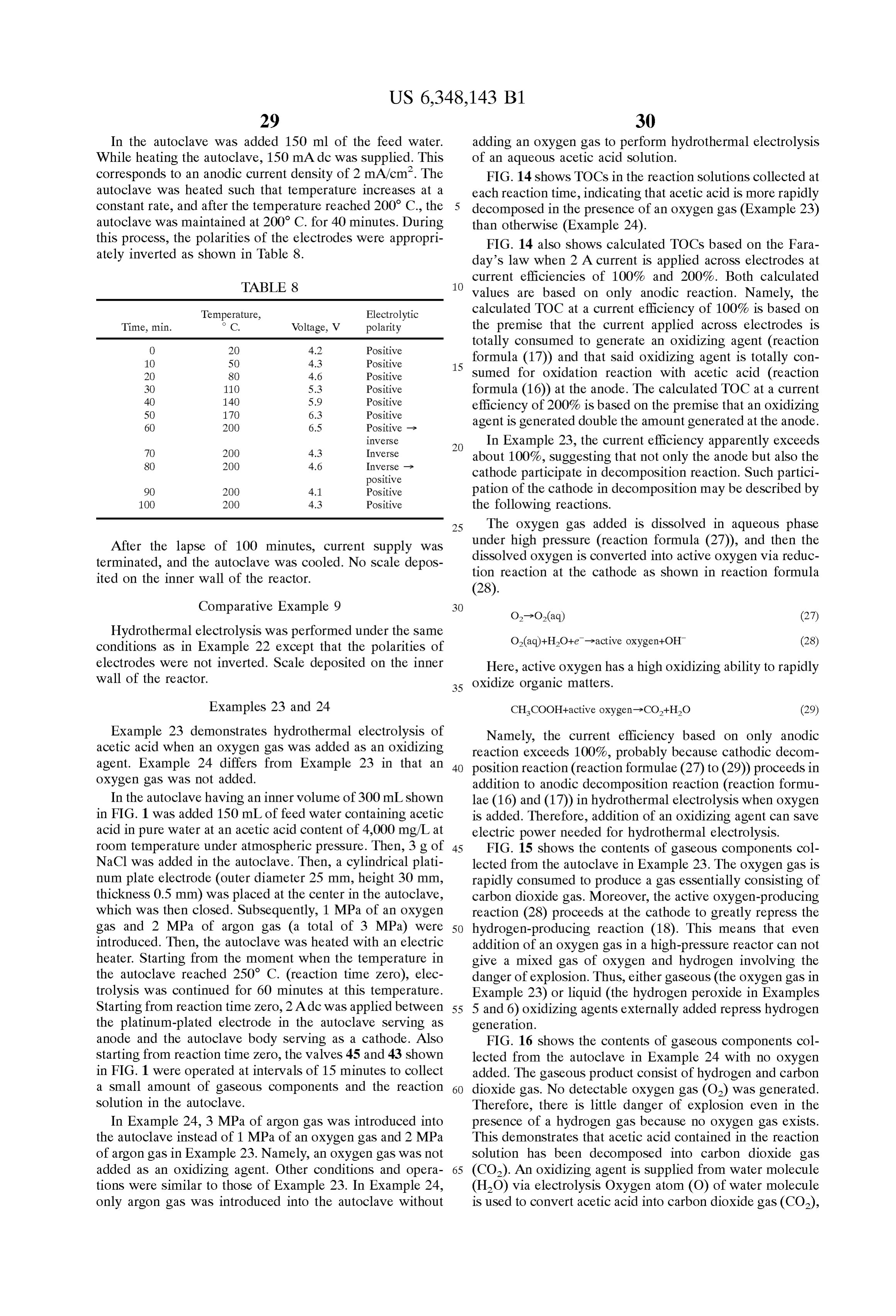
Page 37
and hydrogen atom (H) of water molecule is used to generate high Voltage during dc Supply, therefore a cost for electric a hydrogen gas (H). power increases.
In hydrothermal electrolysis of an aqueous medium con FIG. 19 shows variation in TOC in this Comparative taining a reduced matter, if oxygen is added hydrogen is not Example. A little amount of acetic acid was decomposed. produced, while if oxygen is not added, hydrogen is pro In Comparative Example 12, 3 g of NaOH was used as duced without the production of oxygen. Thus, hydrother electrolyte.
mal electrolysis of an aqueous medium containing a reduced Example 23 Other except reaction conditions were the same as in that NaCl was replaced with NaOH. The matter can prevent formation of a highly explosive mixed Voltage needed to apply 2 A dc between the electrodes was gas of oxygen and hydrogen to ensure Safety whether an 3 V because the electrolyte NaOH was contained in the oxidizing agent is added or not. 1O aqueous medium.
Examples 25 to 28 and Comparative Example 10 As shown in FIG. 19, a little amount of acetic acid was decomposed similarly to Comparative Example 11 as dem
In Examples 25 to 28 and Comparative Example 10, onstrated by variation in TOC.
electrolytic current was varied in hydrothermal electrolysis 15 In Example 31, 3 g of NaSO was used as electrolyte. of acetic acid with an oxygen gas added. Other reaction conditions were the same as in Example 23 In Examples 25 to 28, current of 0.5 A, 1A, 4A and 6 A except that NaCl was replaced with NaSO. The voltage was applied. In Comparative Example 10, however, no needed to apply 2 Adc acroSS electrodes in this example was current was applied. Other conditions were the same as in 3 V.
Example 23. Results are shown in FIG. 17. FIG. 19 shows variation in TOC. TOC decreased with In Comparative Example 10 with no current applied, reaction time. This indicates that sulfate ion (SO?) pro acetic acid was decomposed very slowly. However, motes decomposition of acetic acid Similarly to halogen Examples 25 to 28 with current applied rapidly gave high ions.
decomposition rates as electrolytic current increased.
Namely, hydrothermal electrolysis involving anodic reac 25 Examples 32 and 33 tion and cathodic reaction with addition of oxygen can effectively decompose acetic acid, which is difficult to In Examples 32 and 33, acetic acid was hydrothermally decompose by the conventional wet oxidation relying on the electrolyzed in the presence of an oxygen gas as the oxi action of dissolved oxygen alone. dizing agent, using iodine ion and bromine ion, respectively, as a halogen ion. It was confirmed that the iodine ion and
Examples 29 and 30 bromine ion decompose organic matters as well as the In Examples 29 and 30, an oxygen gas content was varied chlorine ion in hydrothermal electrolysis. in hydrothermal electrolysis of acetic acid when an oxygen In Example 32, 3 g of KI (potassium iodide) was used as gas was added. electrolyte. Other reaction conditions were the same as in In Examples 29, 0.6 MPa of an oxygen gas and 2.4 MPa. 35 Exampleneeded 23 except that NaCl was replaced with KI. The of argon gas were introduced. In Example 30, 1.5 MPa of an Voltage example was 3 to apply 2 Adc between the electrodes in this
oxygen gas and 1.5 MPa of argon gas were introduced. FIG. 19 shows variation in TOC. TOC decreased with Other conditions were the same as in Example 23. Results are shown in FIG. 18. reaction time. In Example 32, a tendency was observed that 40 the treated water changes to a Somewhat red color.
According to the present invention which performs hydro thermal reaction and electrolysis simultaneously, reduced Example 33, 3 g of KBr (potassium bromide) was used as matterS Such as organic matters or ammonia can effectively electrolyte. Other reaction conditions were the same as in be decomposed by oxidation. Example 23 except that NaCl was replaced with KBr. The According to the conventional catalytic oxidation process, 45 Voltage example needed to apply 2 Adc between the electrodes in this was 3 V.
halide ions corroded the reactor. According to the present FIG. 19 shows variation in TOC. TOC decreased with invention, however, halide ions can promote oxidative decomposition of reduced matters. Moreover, the inner wall reaction time. Bromine ion decomposed acetic acid into of the reactor can be protected from corrosion via cathodic rable carbon dioxide gas. This result was quantitatively compa protection if the inner wall of the reactor is used as a 50 to that of chlorine ion. cathode.
Comparative Example 13
Comparative Examples 11 and 12 and Example 31 In Comparative Example 13 and Example 34, Sodium In Comparative Examples 11 and 12 and Example 31, hypochlorite was used as an oxidizing agent. In Compara acetic acid was hydrothermally electrolyzed in the presence 55 tive Example 13, Simple hydrothermal oxidation reaction of an oxygen gas with no halogen ion existing in the aqueous was performed without applying current acroSS electrodes, medium. i.e. wet oxidation. In Example 34, however, current was In Comparative Example 11, acetic acid was hydrother applied acroSS electrodes to perform hydrothermal electroly mally electrolyzed without adding any electrolyte. Other SS.
reaction conditions were the Same as in Example 23 except 60 In Comparative Example 13, 150 mL of feed water that NaCl was not added. Namely, acetic acid was dissolved containing acetic acid and a Sodium hypochlorite Solution in in pure water and 2 A dc was applied acroSS electrodes at pure water at an acetic acid content of 4,000 mg/L and an 250 C. in the presence of an oxygen gas in the autoclave. NaOCl (sodium hypochlorite) content of 0.6 wt % was In this Comparative Example, the Voltage needed to apply 2 added into the autoclave having an inner volume of 300 mL A was 48 V on average. 65 shown in FIG. 1 at room temperature under atmospheric In the absence of a Salt Serving as electrolyte, the electric preSSure. Then, 3 MPa of argon gas was introduced into the resistance of the aqueous acetic acid Solution rises to incur autoclave. Then, the autoclave was heated with an electric
Page 38
heater. Starting from the moment when the temperature in In Example 34, the hypochlorite autodecomposes into an the autoclave reached 250° C. (reaction time zero), wet oxygen gas and NaCl during heating of the autoclave oxidation reaction was continued at this temperature for 60 similarly to Comparative Example 13. When current supply minutes. Starting from reaction time Zero, the valves 45 and is started acroSS electrodes, however, NaCl and an oxygen 43 shown in FIG. 1 were operated at intervals of 15 minutes gas are converted into a hypochlorite and hydrogen to collect a Small amount of gaseous components and the peroxide, respectively in the proximity of the electrodes. reaction Solution in the autoclaves. Oxidation reaction of organic matters effectively proceeds FIG. 20 shows variation in TOC of the collected reaction probably because these free chlorine and active oxygen Solution, indicating that wet oxidation of Comparative Serve as oxidizers.
What is claimed is:
Example 13 using Sodium hypochlorite as an oxidizing agent decomposed acetic acid at low efficiency. Hypochlo Step1. A method for hydrothermal electrolysis, comprising a of applying direct current, in a reactor which is not rite is thought to involve in an oxidation reaction route in provided with a separation membrane between a cathode hydrothermal electrolysis, but the same effect can not be and an anode, to an aqueous medium containing water, a obtained even if a chemical oxidizing agent Sodium halide ion and a reduced matter at a temperature ranging hypochlorite is used in wet oxidation. In hydrothermal 15 from 100° C. to a critical temperature of the aqueous electrolysis, organic matters are effectively oxidatively medium and under a preSSure for maintaining the aqueous decomposed probably because a hypohalous acid is gener medium in the liquid phase.
ated in situ in the field of the hydrothermal reaction, which 2. The method of claim 1 wherein Said aqueous medium is highly reactive. If Sodium hypochlorite is added in the is held in a reactor having a metallic inner wall Serving as a autoclave in wet oxidation, however, the following autode cathode while an anode is placed in Said reactor. composition reaction may proceed during heating of the 3. The method of claim 1 further comprising the step of autoclave. adding an oxidizing agent to Said aqueous medium. 4. The method of claim 3 wherein Said oxidizing agent (30) comprises at least one of the group consisting of an oxygen
NaOCl 25 gas, OZone gas, hydrogen peroxide and hypohalous acids.
- NaCl + 1/2 O. 5. The method of claim 1 wherein said halide ion com prises chloride ion, bromide ion, iodide ion or any combi
In wet oxidation using a hypochlorite as an oxidizing agent, nation thereof.
the hypochlorite Seems to autodecompose from a tempera 6. The method of claim 1 wherein said aqueous medium ture of 100 C. or less and be almost lost at the reaction contains 0.05 mmol/L or more of the halide ion. temperature leaving an OXygen gas. 7. The method of claim 1 wherein said reduced matter In hydrothermal electrolysis, hypochlorite ion Seems to comprises a compound oxidized with OX ion where X involve in the reaction. However, the above difference in represents a chlorine atom, bromine atom, iodine atom or reactivity clearly distinguishes hydrothermal electrolysis any combination thereof, or a compound oxidized with an from wet oxidation reaction using a chemical hypochlorite. 35 oxidizing agent in the presence of water at a temperature Although Comparative Example 13 is a batch test, the ranging from 100 C. to a critical temperature of the aqueous hypochlorite Seems to also autodecompose in a continuous medium.
System. 8. The method of claim 1 wherein said reactor is Substan tially closed.
Example 34 40 9. The method of claim 1, wherein the aqueous medium
In Example 34, acetic acid was hydrothermally hydro consists essentially of water, the halide ion and the reduced lyzed using a chemical oxidizing agent Sodium hypochlorite matter.
when 2 A dc was applied acroSS electrodes. 10. An apparatus for hydrothermal electrolysis, compris In the autoclave having an inner volume of 300 mL shown ing:
in FIG. 1 was added 150 mL of feed water containing acetic 45 a reactor being capable of withstanding a pressure of a acid and a Sodium hypochlorite Solution in pure water at an hydrothermal reaction; and acetic acid content of 4,000 mg/L and an NaOCl (sodium a pair of electrodes for electrolyzing a matter in the hypochlorite) content of 0.6 wt % at room temperature under reactOr.
atmospheric pressure. Then, a cylindrical platinum plate 11. An apparatus for hydrothermal electrolysis of claim 10 electrode (outer diameter 25 mm, height 30 mm, thickness 50 wherein the pair of the electrodes Serve as a cathode and an 5 mm) was placed at the center in the autoclave, which was anode, respectively, the reactor has a metallic inner Surface, then closed. Then, 3 MPa of argon gas was introduced into the metallic inner Surface is capable of Serving as the the autoclave. Then, the autoclave was heated with an cathode, and an electrode, which is capable for Serving as the electric heater. Starting from the moment when the tempera anode, is disposed in the reactor.
ture in the autoclave reached 250° C. (reaction time zero), 55 12. The apparatus of claim 11 wherein Said anode has a wet oxidation reaction was continued at this temperature for Surface having ruthenium, iridium, platinum, palladium, 60 minutes. Starting from reaction time Zero, 2 A dc was rhodium, tin or an oxide thereof or ferrite. applied acroSS the platinum electrode Serving as anode and 13. The apparatus of claim 10 further comprising a the autoclave body Serving as a cathode. Also from reaction heating device for heating Said reactor. time Zero, the valves 45 and 43 shown in FIG. 1 were 60 14. The apparatus of claim 10 wherein an aqueous operated at intervals of 15 minutes to collect a Small amount medium line for feeding an aqueous medium to Said reactor of gaseous components and the reaction Solution in the and a discharge line for discharging the aqueous medium autoclaves. hydrothermally electrolyzed from Said reactor are connected FIG. 20 shows variation in TOC of the collected reaction to Said reactor.
Solution. Acetic acid was effectively decomposed into car 65 15. The apparatus of claim 14 comprising a heat bon dioxide gas as demonstrated by a decrease in TOC with eXchanger connected to Said aqueous medium line and Said time. discharge line.
Page 39
16. The apparatus of claim 14 wherein a gas-liquid medium and under a preSSure for maintaining the aqueous Separator is connected to Said discharge line. medium in the liquid phase.
17. The apparatus of claim 14 wherein an oxidizing agent 19. The method of claim 18 wherein said strongly acidic line for feeding an oxidizing agent to Said reactor is con ion comprises halide ions, Sulfate ion (SO), nitrate ion nected to Said reactor. (NO), phosphate ion (PO) and trifluoroacetate ion 18. A method for hydrothermal electrolysis, comprising a (CFCOO).
Step of applying direct current, in a reactor which is not 20. The method of claim 18, wherein the aqueous medium provided with a separation membrane between a cathode consists essentially of water, the Strongly acidic ion and the and an anode, to an aqueous medium containing water, a reduced matter.
Strongly acidic ion and a reduced matter at a temperature ranging from 100 C. to a critical temperature of the aqueous
Provenance
- Collection
- Cited prior art
- Original PDF
- patentimages.storage.googleapis.com →
- Filed
- 1998-08-10
- Pages
- 39
- Method
- pdftotext (the PDF's own text layer) + pdftoppm 300dpi page scans
- Source
- Google Patents bibliographic record
- Granted
- 2002-02-19
- Inventors
- Roberto Masahiro Serikawa; Qingquan Su; Akira Watanabe; Ebara Corp
- Transcribed from
- patentimages.storage.googleapis.com →