patent · US6328861
Electrolytic apparatus using a hydrogen storage cathode
11 December 2001
Page 1 — bibliographic record
(12) United States Patent (10) Patent No.: US 6,328,861 B1 Yoshida et al. (45) Date of Patent: Dec. 11, 2001
(54) ELECTROLYTIC APPARATUS USINGA (56) References Cited
HYDROGEN STORAGE CATHODE
(75) Inventors: Yasuki Yoshida; Setsuro Ogata;
Masaharu Uno, Masashi Tanaka; 4,265,720 5/1981 Winstel.
Yoshinori Nishiki, all of Kanagawa; 4539,086 9/1985 Fujita et al. . Takayuki Shimamune, Tokyo; Hiroshi 5,865,982 2/1999 Sawa et al. .......................... 205/413 Inoue, Chiaki Iwakura, both of Osaka, 5,954,928 9/1999 Kishi et al..
all of (JP) (73) Assignee: Permelec Electrode Ltd., Kanagawa * cited by examiner
Primary Examiner Kathryn Gorgos (*) Notice: Subject to any disclaimer, the term of this Assistant Examiner Wesley A. Nicolas patent is extended or adjusted under 35 (74) Attorney, Agent, or Firm-Sughrue, Mion, Zinn, U.S.C. 154(b) by 0 days. Macpeak & Seas, PLLC (21) Appl. No.: 09/401,292 (57) ABSTRACT (22) Filed: Sep. 23, 1999 An electrolytic apparatus which comprises effecting elec Related U.S. Application Data trolysis of an electrolytic Solution in an electrolytic chamber Separated from a reaction chamber by a hydrogen-Storing (62) Division of application No. 09/131,677, filed on Aug. 10, metal member with one Surface of the hydrogen-Storing 1998, now Pat. No. 6.224,741. metal member as a cathode opposing an anode So that (30) Foreign Application Priority Data hydrogen thus produced is adsorbed by the hydrogen-Storing metal member while allowing hydrogen thus adsorbed and
Aug. 8, 1997 (JP) ................................................... 9-225568 a material to be treated to undergo continuous catalytic Aug. 8, 1997 (JP) ................................................... 9-225569 reaction in the reaction chamber on the other Surface of the (51) Int. Cl." ................................ C25B 9/00; C25C 7/00; hydrogen-storing metal member to cause hydrogenation or C25D 17/00 reduction reaction by hydrogen thus adsorbed, wherein an (52) U.S. Cl. ................. 204/252; 204/275.1; 204/290.14; electrolytic apparatus having a porous catalyst layer pro 204/263; 427/437 Vided on the catalytic reaction Surface of the hydrogen (58) Field of Search ............................. 420/900; 205/637, Storing metal member is used.
427/437, 125, 304,305 3 Claims, 3 Drawing Sheets
9:POWER SUPPLY
ANODC
GAS OUTLE
11"1: ELECTROLYTIC
4: HYDROGENATION
REACTION CHAMBER
3: ELECTROLYTIC
CHAMBER
7: REACTANTSOLUTION FEED OPENING
2: HYDROGEN-OCCLUDING METALPLATE (CATHODE)
Page 2
FIG. 1
9:POWER SUPPLY
6: 1: ELECTROLYTIC
ANODC
GAS OUTLET
4: HYDROGENATION
5: REACTION CHAMBER
ANODE
3: ELECTROLYTIC
CHAMBER
7: REACTANTSOLUTION FEED OPENING
2: HYDROGEN-OCCLUDING METALPLATE (CATHODE)
1: ELECTROLYTIC
CELL
11: CIRCULATING 12: ROLLER PUMP
TANK
Page 3
Drawing sheet — no readable text.
Page 4
Drawing sheet — no readable text.
Page 5
ELECTROLYTIC APPARATUS USINGA comprises bringing the reaction compound to be hydroge HYDROGEN STORAGE CATHODE nated into contact with palladium or other hydrogen-Storing metals (metal hydride) having hydrogen held therein. It is
This is a divisional of application Ser. No. 09/131,677 Said that palladium or many hydrogen-Storing alloys also filed Aug. 10, 1998, now U.S. Pat. No. 6,224,741 the have a catalytic action in this reaction and thus can fairly act disclosure of which is incorporated herein by reference. in the reaction. However, this proceSS is disadvantageous in that once hydrogen adsorbed in the hydrogen-storing metal
FIELD OF THE INVENTION alloy or palladium is consumed for the reaction with a Small The present invention relates to an electrolytic proceSS amount of the reactant, the reaction no longer proceeds even which comprises a continuous reaction in which active if the remaining reactant is left unreacted. Thus, this proceSS hydrogen converted from hydrogen produced by electrolysis can be performed batchwise only. This process can be takes part, e.g., a hydrogenation reaction and a hydrogen performed reasonably well on an experimental basis but at reduction reaction, an apparatus therefor and a process for an extremely low efficiency on an industrial basis. the production of an electrode for use in Such an electrolytic 15 In order to Solve these problems, the inventors proposed apparatuS. the following process and apparatus. In other words, elec trolysis is effected in an electrolytic Solution with one
BACKGROUND OF THE INVENTION Surface of a plate-like hydrogen-storing metal as a cathode A hydrogen reaction in which active hydrogen takes part, to produce hydrogen. The hydrogen thus produced is then e.g., a hydrogenation reaction of organic material is adsorbed by the plate-like hydrogen-Storing metal at one employed in various chemical fields. In accordance with the Surface thereof. The hydrogen is diffused into the hydrogen cracking reaction of petroleum, for example, gasoline or Storing metal through which it moves to-the other Surface kerosene can be obtained from heavy oil. Further, reaction thereof. The reactant to be hydrogenated is brought into which comprises liquefying tar content So that it is adapted contact with the other Surface of the hydrogen-storing metal more for the purpose is actually practiced. Moreover, the 25 at which a hydrogenation reaction or a reduction reaction by conversion of unsaturated hydrocarbon to Saturated hydro hydrogen is continuously effected. It has been obvious that carbon is practiced. this proceSS and apparatus can find wide application in the Some hydrogenation reactions are often allowed to pro industry and can produce a hydrogenated product at a high ceed in a uniform System. For example, an organic material efficiency.
is hydrogenated in the presence of a contact catalyst. It is However, this reaction process is disadvantageous in that known that a noble metal Such as palladium is an excellent the hydrogenation reaction often is a rate-limiting Step. The catalyst for the hydrogenation reaction of an unsaturated inventors made extensive Studies of this reaction process. AS organic compound (S. Siegel, in “Comprehensive Organic a result, the following facts were found. When the current Synthesis”, ed., B. M. Trost and I. Fleming, Pergamon Press, density is raised to accelerate the production of hydrogen by Oxford, 1991, vol. 8). These reactions are disadvantageous 35 electrolysis, the rate of production of hydrogen exceeds the in that they require a high pressure reaction vessel or highest allowable value for hydrogenation reaction at an normally require a relatively high temperature that can cause early Stage. Even if hydrogen is present in excess, the the explosion depending on the purity of the hydrogen gas hydrogen-Storing metal can keep adsorbing and holding used in hydrogenation. These reactions are also disadvan hydrogen. Therefore, hydrogen thus produced is rarely tageous in that the catalyst used has an insufficient reaction 40 wasted. However, this is limited. If the current density is Selectivity and thus Side reactions can occur. raised beyond a predetermined value, the current efficiency In order to enhance reaction Selectivity and reduce energy isdisadvantageous reduced So much. In other words, this reaction proceSS is in that the productivity of hydrogenated consumption, electrolytic reduction, which is a heterog enous System reaction, may be employed as described in A. product cannot be increased beyond a certain limit. M. Couper, D. Pletcher and F. C. Walsh, “Chem. Rev.”, 45 SUMMARY OF THE INVENTION 1990, 90, 837, T. Nonaka, M. Takashashi and T. Fuchigami, “Bull. Chem. Soc. Jpn.”, 18256, 2584, M. A. Casadei and It is therefore one object of the present invention to D. Pletcher, “Electrochim. Acta, 33, 117 (1988), T. Yamada, provide an electrolytic process and apparatus which can T. Osa and T. Matsue, “Chem. Lette.”, 1989 (1987), L. operate in the hydrogen reaction chamber at a hydrogen Coche, B. Ehui, and J. C. Moutet, “J. Org. Chem.”,55, 5905 50 reaction rate corresponding to the increase in the rate of (1990), and J. C. Moutet, Y. Ouennoghi, A. Ourari and S. production of hydrogen accompanying the increase in the Hamar-Thibault, “Electrochim. Acta', 40, 1827 (1995). An electrolysis rate and maintain the current efficiency at a very electrode catalyst having a large Surface area Such as Raney high value with respect to the electrolytic current for pro nickel can be used for an electrochemical hydrogenation ducing hydrogen.
reaction and thus can be expected to provide a high power 55 Another object of the present invention is to provide a efficiency. Further, Such an electrode catalyst provides Safe process for the production of an electrode for the above and easy operation. However, this System requires that the purpose.
organic material to be treated be electrically conductive. The above-described objects of the present invention are Otherwise, an additive must be added to the organic material accomplished by the following embodiments of the present to render the organic material electrically conductive. 60 invention:
AS described above, hydrogenation reactions can be (1) An electrolytic process which comprises effecting divided into two types, i.e., homogeneous System reactions electrolysis of an electrolytic Solution in an electrolytic and heterogeneous System reactions. It is known that atomic chamber Separated from a reaction chamber by a hydrogen hydrogen produced on the catalyst acts to accelerate the Storing metal member with one Surface of the hydrogen reaction in either case. 65 Storing metal member as a cathode opposing an anode So AS one of other processes for Safely effecting hydroge that hydrogen thus produced is adsorbed by the hydrogen nation reaction at a high efficiency, a proceSS is known which Storing metal member while allowing hydrogen thus
Page 6
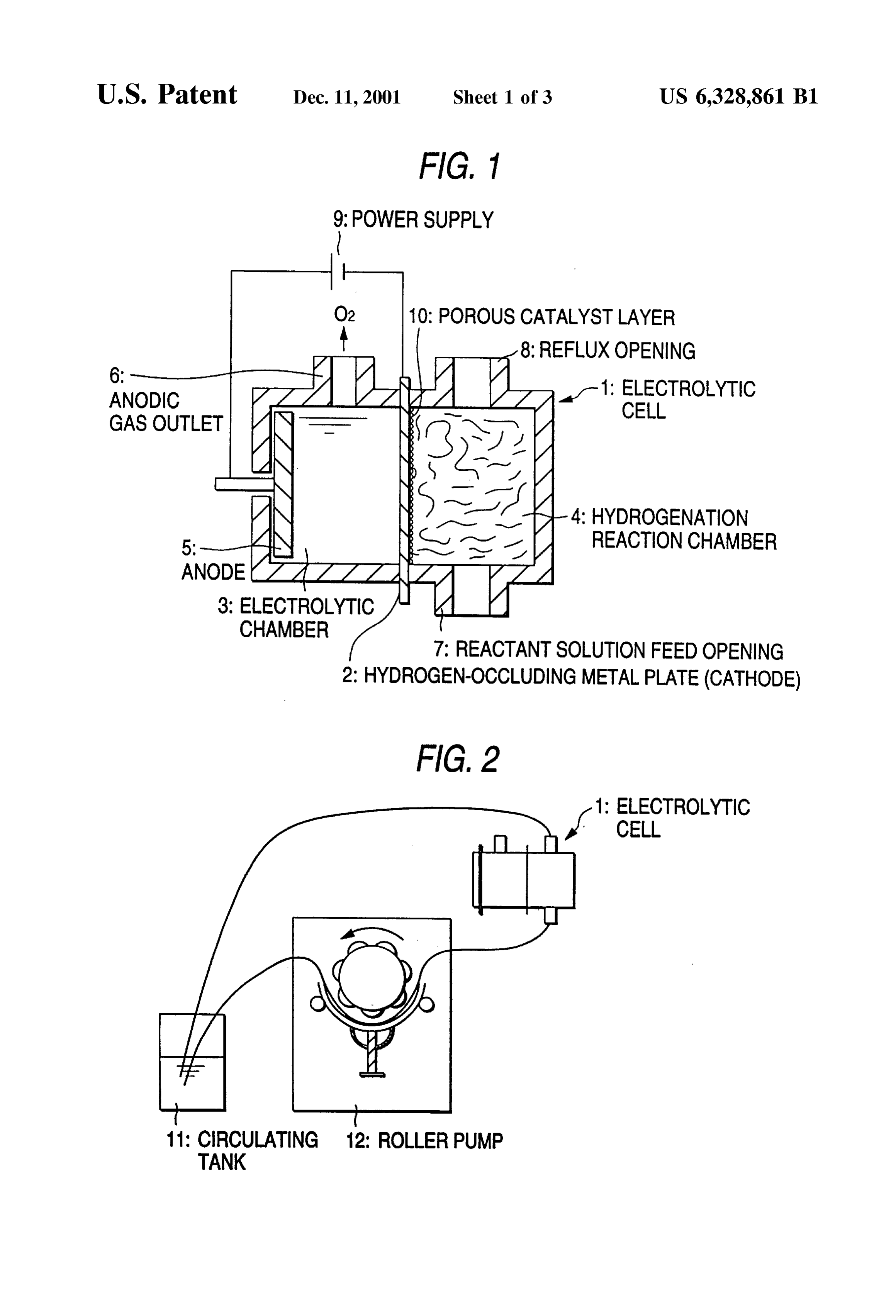
adsorbed and a material to be treated to undergo continuous FIG. 1 is a Schematic diagram illustrating a Section of an catalytic reaction in the reaction chamber on the other electrolytic cell used in the electrolytic process of the Surface of the hydrogen-Storing metal member to cause a present invention;
hydrogenation or reduction reaction by hydrogen thus adsorbed, wherein that an electrolytic apparatus having a of FIG. the 2 is a Schematic diagram illustrating an embodiment electrolytic apparatus of the present invention used in porous catalyst layer provided on the catalytic reaction the electrolytic process of the present invention: Surface of the hydrogen-Storing metal member is used.
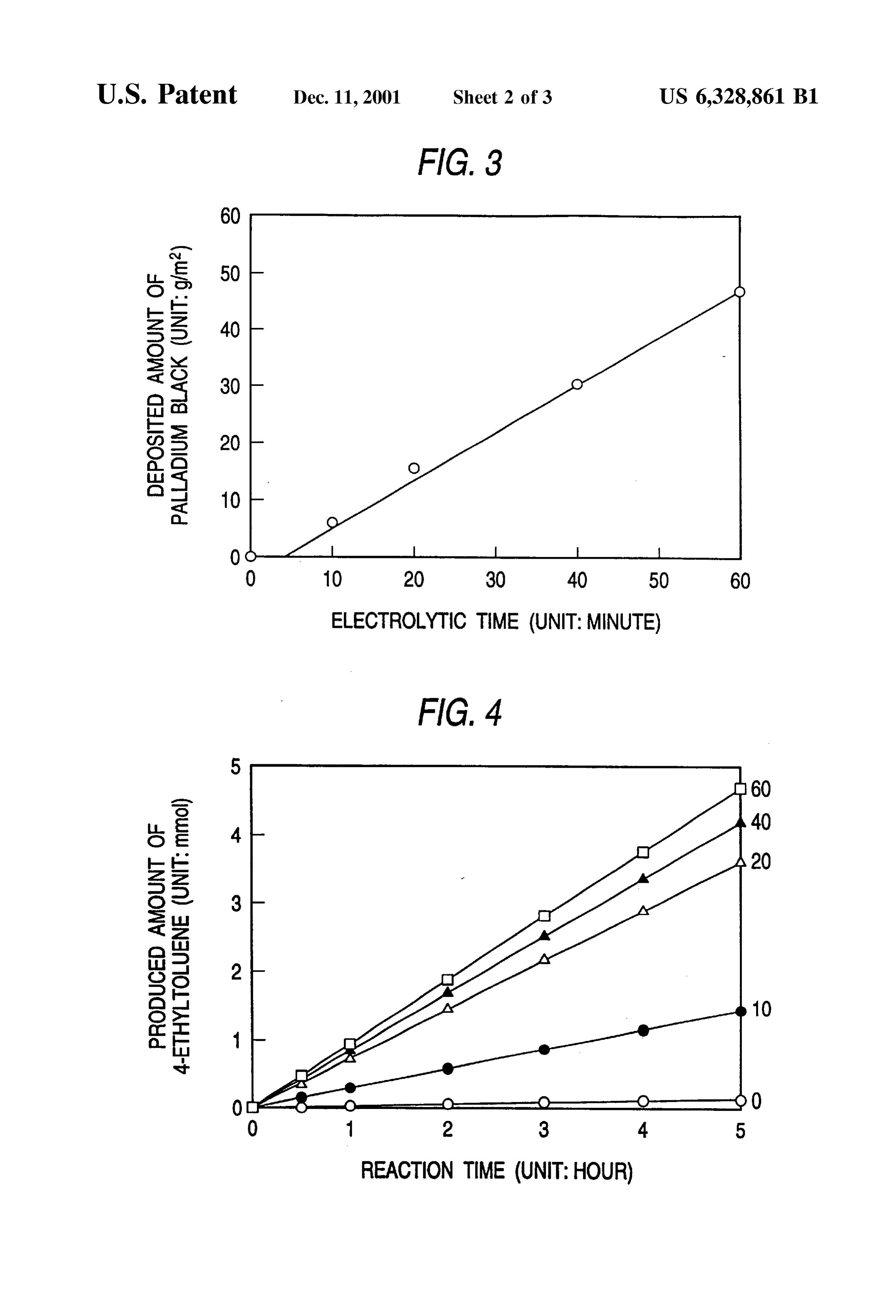
(2) An electrolytic apparatus comprising an electrolytic palladium black deposited duringtheelectrolysis, FIG. 3 is a graph illustrating cumulative amount of chamber and a reaction chamber Separated by a hydrogen
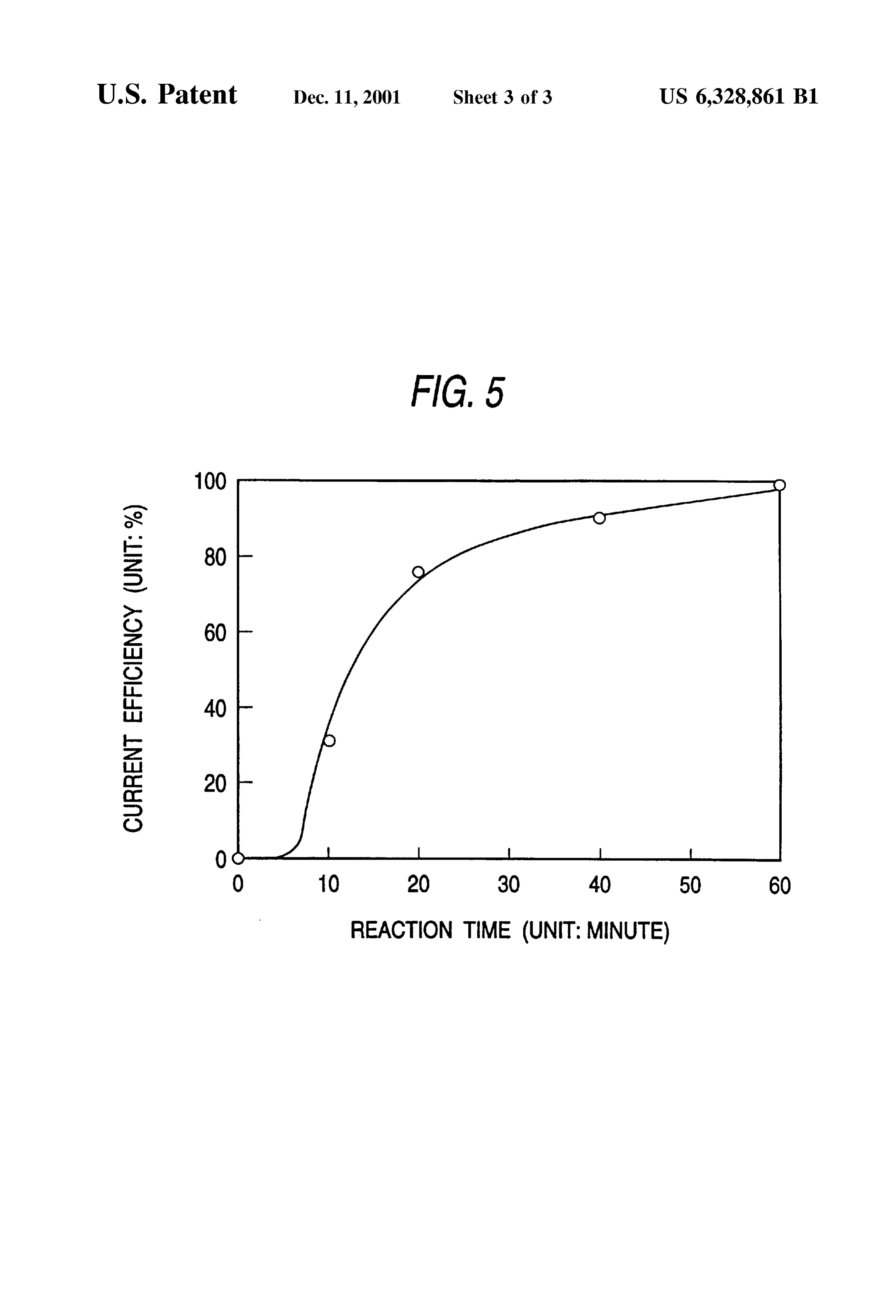
Storing metal member, an electrolytic Solution charged in the 1O FIG. 4 is a graph illustrating the relationship between the electrolytic chamber, and an anode provided opposing the cumulative produced amount of 4-ethyltoluene and the hydrogen-Storing metal member in the electrolytic chamber reduction reaction time, and as a cathode, wherein that the hydrogen-Storing metal mem FIG. 5 is a graph illustrating the relationship between the ber comprises a porous catalyst layer taking part in a deposition time of palladium and the reaction efficiency of hydrogen reaction on at least a part of the Surface thereof in 15 4-ethyltoluene, wherein in the above figures the reference contact with the reactive compound in the reaction chamber. numeral 1 indicates an electrolytic cell, the reference (3) The electrolytic apparatus according to embodiment numeral 2 indicates a hydrogen-Storing metal plate (2) above, wherein the hydrogen-storing metal is palladium (cathode), the reference numeral 3 indicates an electrolytic or an alloy thereof, the porous catalyst layer is a metal black belonging to the platinum group or gold and the hydrogen chamber, the reference numeral 4 indicates a hydrogenation reaction in which the catalyst takes part is a reduction reaction chamber, the reference numeral 5 indicates an anode, the reference numeral 6 indicates an anodic gas reaction involving the hydrogenation of an unsaturated outlet, the reference numeral 7 indicates a reactant Solution hydrocarbon.
(4) The electrolytic apparatus according to embodiment feed opening, the reference numeral 8 indicates a reflux (2) above, wherein the porous catalyst layer formed on the opening, the reference numeral 9 indicates a power Supply, Surface of the hydrogen-Storing metal member is obtained 25 the the reference numeral 10 indicates a porous catalyst layer, reference numeral 11 indicates a circulating tank, and the by bringing a hydrogen-Storing metal member which has adsorbed hydrogen into contact with an electroleSS plating reference numeral 12 indicates a roller pump. Solution containing a catalyst component So that the Surface DETAILED DESCRIPTION OF THE of the hydrogen-Storing metal member is electrolessly plated INVENTION with the catalyst metal by the action of hydrogen adsorbed in the hydrogen-storing member. The present invention will be described in more detail (5) A process for the production of an electrode which below.
comprises Subjecting an electroless plating Solution contain In the present invention, a hydrogen reaction is a reaction ing a cation of a metal which Serves as a catalyst to in which active hydrogen takes part, Such as a hydrogenation electrolysis with one Surface of a hydrogen-Storing metal 35 reaction. Specific examples of hydrogenation reactions body being in contact with an electrolytic Solution while the include a hydrogenation reaction and a hydrogen reduction other being in contact with the electroless plating Solution reaction. Examples of these hydrogenation reactions include with the hydrogen-Storing metal body Serving as a cathode, reactions for converting methylstyrene to ethyl toluene, the cathode being opposed to an anode in contact with the cracking reactions of petroleum, and reactions for producing electrolytic Solution to produce on the cathode Side hydro 40 gasoline or kerosene from heavy oil.
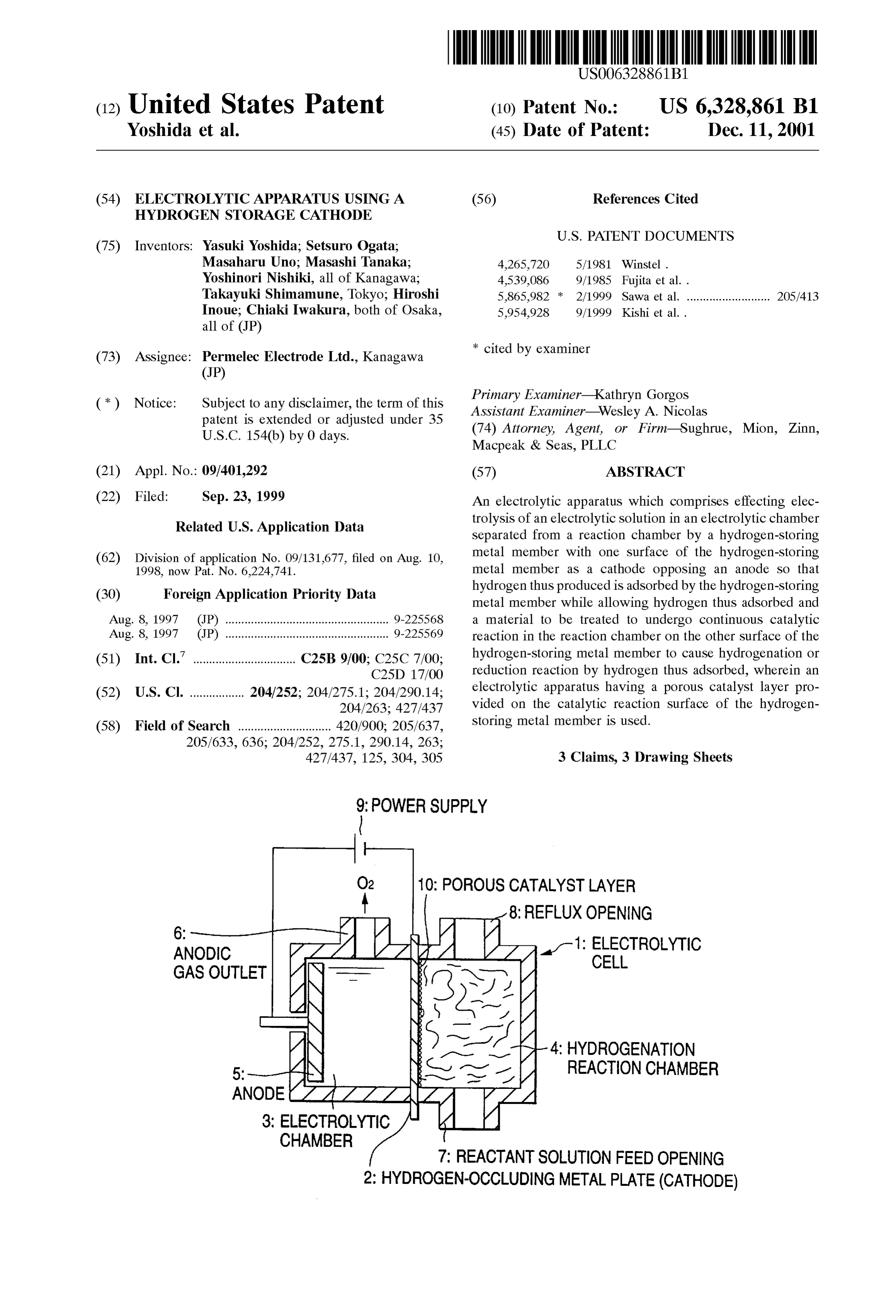
gen which is then adsorbed in the hydrogen-Storing metal FIG. 1 is a Schematic diagram illustrating a Section of an body through which hydrogen moves and reaches the other electrolytic cell used in the electrolytic process of the surface thereof on which it is desorbed therefrom to produce present invention.
active hydrogen by which the metallic cation in the electro FIG. 2 is a Schematic diagram illustrating an embodiment less plating Solution is reduced So that the hydrogen-Storing metal body is plated with the catalyst metal on the Surface 45 of the electrolytic apparatus of the present invention used in thereof in contact with the electroleSS plating Solution, the electrolytic process of the present invention. whereby the catalyst component is attached to the hydrogen The electrolytic cell 1 shown in FIGS. 1 and 2 is adapted Storing metal body and the contact area for reaction is for the hydrogenation reaction of the reactant. The electro enlarged. lytic cell 1 is coated with Teflon on the interior side thereof. (6) The process for the production of an electrode accord 50 As shown in FIG. 1, the electrolytic cell 1 is partitioned into ing to embodiment (5) above, wherein the hydrogen-storing an electrolytic chamber 3 and a hydrogenation reaction metal body is a palladium or palladium alloy plate, the metal chamber 4 by a thin plate-like or foil-like hydrogen-Storing cation in the electroleSS plating Solution is an ion of a metal metal plate 2. The hydrogen-Storing metal plate 2 has a belonging to the platinum group or gold and the component porous catalyst layer 10 provided on the surface thereof which Serves as a catalyst to be attached to the hydrogen 55 facing the hydrogenation reaction chamber 4. An aqueous Storing metal body is a metal black belonging to the plati Solution of potassium hydroxide as an electrolytic Solution is num group or gold. charged in the electrolytic chamber 3. The hydrogen-Storing (7) The process for the production of an electrode accord metal plate 2 is connected to a power Supply 9. The ing to embodiment (5) or (6) above, wherein the electroless hydrogen-Storing metal plate 2 forms a cathode on the plating Solution contains a cation of at least one metal 60 electrolytic chamber side thereof. Provided opposed to the Selected from the group consisting of gold, Silver, nickel, cathode 2 and in the vicinity of the Side wall is a plate-like copper, lead and metallic elements belonging to the platinum anode 5. The anode 5 is made of nickel. However, the anode grOup.
5 may be made of stainless steel rather than nickel. The
BRIEF DESCRIPTION OF THE DRAWINGS reference numeral 6 indicates an anodic gas outlet in which By way of example and to make the description more 65 an electrolytic Solution feed opening may be provided. clear, reference is made to the accompanying drawings in Provided in the reaction chamber 4 are a reactant Solution which: feed opening 7 and a reflux opening 8. As shown in FIG. 2,
Page 7
S 6 a circulating tank 11 connected to the electrolytic cell 1 and In Some detail, the hydrogen-Storing metal member com a roller pump 12 are provided So that the reactant can be prises a porous catalyst layer 10 formed on at least a part of circulated. The electrolytic cell 1 and the circulating tank 11 the Surface thereof in contact with the reaction compound in are communicated to each other via a connecting pipe made the hydrogenation reaction chamber 4. The term “catalyst” of fluororubber. as used herein is meant to indicate a catalyst which takes part Into the hydrogenation reaction chamber 4 of the electro in and accelerates, e.g., a hydrogenation reaction involving lytic cell 1 is Supplied a Solution of an organic compound the hydrogenation and conversion of Styrene to ethylben Such S Styrene in an organic Solvent from the circulating tank Zene. Because of its porosity, the catalyst layer allows the 11 by the action of the roller pump 12. At the same time, the hydrogen-Storing metal plate to maintain its capability of electrolytic chamber 3 is filled with an electrolytic solution 1O adsorbing and desorbing hydrogen and hence desorption Such as an aqueous Solution of potassium hydroxide as Sites for adsorbed hydrogen on the Surface thereof. mentioned above. When ah electric current from the power The catalyst to be used in the catalyst layer of the Supply 9 is applied across the anode 5 and the hydrogen hydrogen-Storing metal plate is a catalyst which takes part in Storing metal plate as a cathode, hydrogen is produced by the hydrogenation reaction. For example, metals belonging electrolysis in the electrolytic chamber 3. The hydrogen thus 15 to the platinum group, particularly palladium, platinum, produced is adsorbed by the hydrogen-Storing metal plate iridium and ruthenium can be used. Besides these metals, (cathode) 2. The hydrogen thus adsorbed is then transmitted noble metals. Such as gold and Silver can be used. Further, by the hydrogen-Storing metal plate 2 in the direction nickel, copper, lead, etc. can be used. Other catalyst mate perpendicular to the Surface thereof. The hydrogen then rials may be appropriately Selected depending on the kind of reaches the hydrogenation reaction chamber Side thereof at the hydrogenation reaction to be effected in the presence which it then comes in contact with and hydrogenates the thereof. A metal having a catalytic action alone may be organic compound Such as Styrene to produce ethylbenzene. Selected. However, a catalyst metal is preferably Selected During this process, the porous catalyst layer 10 provided on which can be easily provided with a Surface area large the hydrogenation reaction chamber Side of the hydrogen enough to increase the possibility of contact with the reac Storing metal plate 2 accelerates the hydrogenation reaction. 25 tant. From this Standpoint of View, a metal black belonging The Solution containing the reactant thus hydrogenated is to the platinum group or gold, particularly palladium black, circulated through the reflux opening 8 and the circulating which is free of luster, is often most desirable. This is tank 11. If necessary, the Solution is again hydrogenated in because palladium black has a large Surface area and thus the electrolytic cell 1. can form a catalyst layer which exerts an extremely excel The hydrogen-Storing metal plate 2 needs to be lent effect of catalyzing the hydrogenation reaction of electrically-conductive and Stable as a cathode during elec organic materials. Further, palladium is also capable of trolysis. Preferably, the hydrogen-Storing metal plate 2 has adsorbing and desorbing hydrogen besides these capabili Some catalytic activity for hydrogenation reaction. If ties.
possible, the hydrogen-storing metal plate 2 must Satisfy the The provision of the foregoing catalyst on the hydrogen requirements that it should show little Volumetric change 35 Storing metal plate in the form of porous layer can be during occlusion and release of hydrogen and should have accomplished, e.g., by the following method. In Some detail, little tendency toward embrittlement after repeated adsorp an electroleSS plating Solution having cations of catalyst tion and release of hydrogen. Representative examples of metal component dissolved therein is prepared. A hydrogen Such a material include palladium, which belongs to the Storing metal plate having hydrogen adsorbed therein is then platinum group, and palladium alloy. Palladium is known to 40 allowed to come in contact with the electroleSS plating exhibit an extremely high hydrogen permeability. Further, Solution So that the cations of catalyst metal component are palladium has Some catalytic activity. Thus, palladium is one reduced by hydrogen thus desorbed in a required amount. In of the most desirable metals. Palladium alloyed with a small this manner, the catalyst component thus reduced is attached amount of gold or aluminum is resistant to embrittlement to the hydrogen-Storing metal plate as a deposit having a and is Suitable for many purposes. Lanthanum-nickel alloy, 45 required Sufficient thickness, leaving desorption sites for alloy containing a rare earth element Such as mischmetal, adsorbed hydrogen.
titanium alloy, Zirconium alloy, etc., too, are useful as The catalyst layer thus formed has a structure Such that hydrogen-Storing metal plate. active hydrogen which is desorbed from the hydrogen It is usual that the thickness of the hydrogen-Storing metal Storing metal plate to take part in a hydrogen reaction Such plate is sufficiently thin from the standpoint of efficiency of 50 as a hydrogenation reaction can be Supplied from the vicin hydrogenation reaction. In order to Subject the hydrogen ity of the catalyst. In this arrangement, the catalyst layer can Storing metal plate to electrolysis as a cathode, the provide a desired product at a far greater efficiency than hydrogen-Storing metal plate needs to have Some thickness. catalyst layers prepared otherwise.
In general, the thickness of the hydrogen-Storing metal plate The electroleSS plating Solution is not specifically limited. is preferably from 0.01 to 2 mm, but there is no reason why 55 If the hydrogen-Storing metal plate is plated with platinum this plate should be limited to this range. It may be properly or palladium as a catalyst, the electroleSS plating Solution determined according to the electrolytic conditions. The may be hydrochloric acid or Sulfuric acid with a Salt con hydrogen-Storing metal plate adsorbs and transmits hydro taining Such an element incorporated therein. The Salt con gen and acts as a power Supplying material. Therefore, if centration of the electroless plating Solution is preferably used as a part of industrial facilities, the hydrogen-Storing 60 from 1 to 100 g/l, and the acid concentration of the elec metal plate may be made of a metal foil clad with a metal troless plating solution is preferably from 1 to 100 g/l. For mesh or the like. example, the electroleSS plating Solution preferably contains In the present invention, the hydrogen-Storing metal HCl and PdCl in an amount of 36.5 g/l and 5 g/l, member used in this electrolytic apparatus comprises a respectively, to allow easy production of dull black deposit. porous catalyst layer 10 provided on the catalytic reaction 65 The electroleSS plating Solution preferably comprises a slight Side thereof, which faces the reaction chamber, to accelerate amount of lead ion dissolved therein to. produce palladium the hydrogenation reaction. black.
Page 8
In the foregoing formation of the catalyst layer, the then diffuses into the hydrogen-Storing metal plate 2. Thus, electrolytic cell 1 shown in FIG. 1 may be advantageously the active hydrogen is then rendered desorbable on the inner used because it allows continuous processing. Side of the hydrogenation reaction chamber 4. The hydrogenation reaction chamber 4 is filled with the When the hydrogen-storing metal plate 2 which has electroleSS plating Solution while the electrolytic chamber 3 adsorbed atomic hydrogen is allowed to come in contact is filled with the electrolytic solution. Under these with the plating Solution containing cations, the cations are circumstances, an electric current is applied acroSS the anode reduced by the atomic hydrogen. The material which has 5 and the hydrogen-storing metal plate (cathode) 2. So that thus been reduced and lost electric charge is then deposited hydrogen is produced at the hydrogen-Storing metal plate on the Surface of the hydrogen-Storing metal plate 2. At the (cathode) 2. Same time, the atomic hydrogen becomes hydrogen ion The electrolytic aqueous Solution to be injected into the which is then desorbed from the hydrogen-Storing metal electrolytic chamber 3 preferably does not corrode the plate 2.
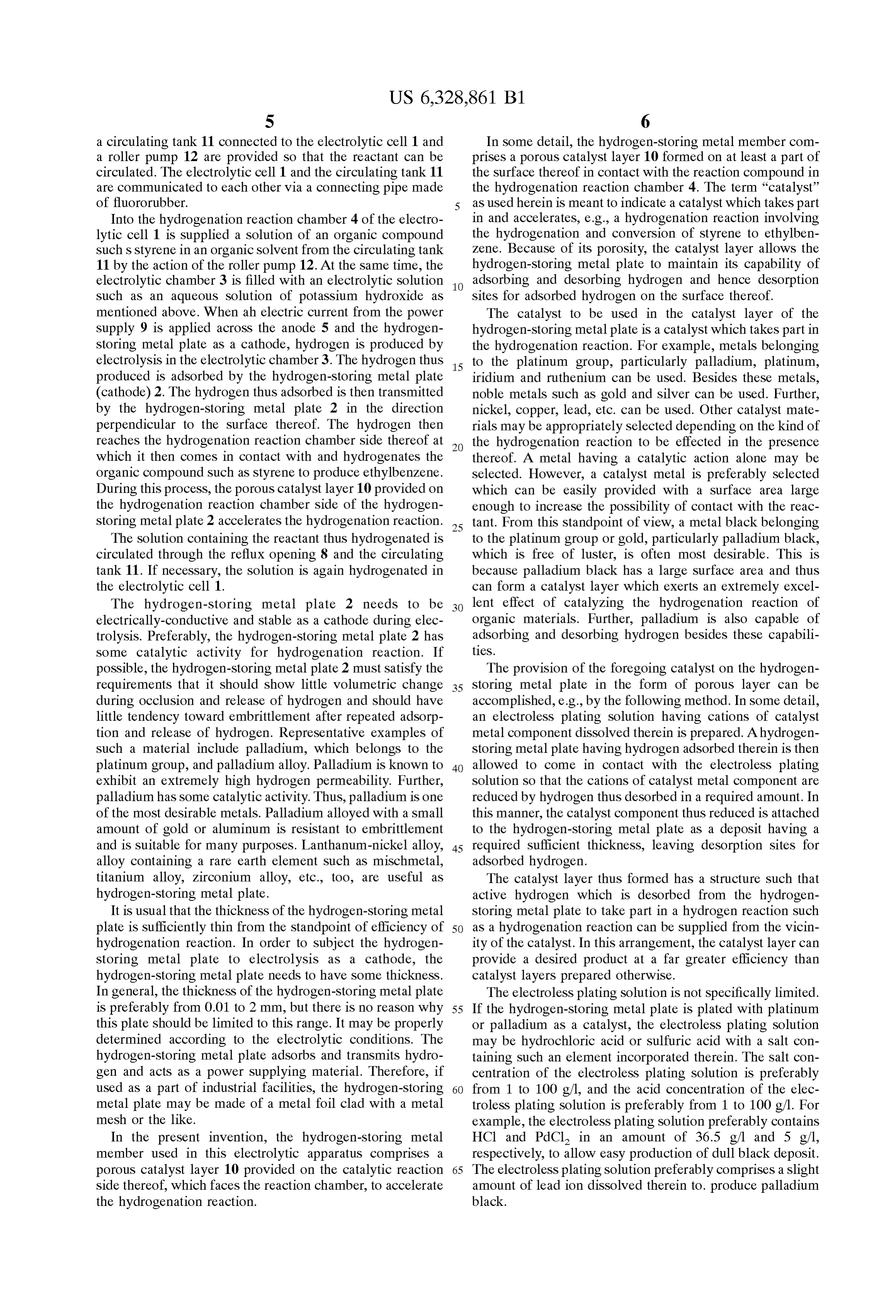
The foregoing reaction mechanism is represented by the hydrogen-storing metal plate 2 and the electrically following, using palladium for example as a plating metal: conductive plate 2, which acts as an electrode. For example, 15 an aqueous Solution of potassium hydroxide is desirable. Pd2+2H->Pd+2H (3) The hydrogen-Storing metal plate 2 on which a catalyst is to be provided is preferably sufficiently rough. This is because If the plating metal is palladium, the deposit can be the plating reaction can proceed Smoothly when the contact thickened because palladium can transmit atomic hydrogen. area of the hydrogen-Storing metal plate with the plating Even if an ion of a metallic component having no capability Solution is Sufficiently large. The hydrogen-Storing metal of adsorbing hydrogen Such as platinum, gold and copper is plate 2 is preferably Subjected to blast finishing or etching on used to plate the hydrogen-storing metal, plating may be the Surface thereof to be plated in the hydrogenation reaction effected on one Surface of the hydrogen-Storing metal plate chamber 4. The degree of Such a Surface treatment is not while atomic hydrogen migrates from the other Surface Specifically limited. The blast finishing may be accom 25 thereof to the one Surface thereof. In this manner, the plished by the use of alumina grit having a size of from 15 thickness of the deposit of the plating metal is nonuniform to 20 meshes. The blast finishing provides an increase of over the migration paths of hydrogen. The hydrogen-Storing effective Surface area twice or three times. metal is partially exposed on Some migration paths. AS a The density of electrolytic current applied during plating result, a thick porous deposit having a very large effective may be Such that the production of hydrogen gas is not Surface area can be obtained. The electroless plating of the observed on the Surface of the hydrogen-Storing metal plate hydrogen-Storing metal can be effected in the hydrogenation 2. In some detail, it is preferably from 0.1 to 10 A/dmf, reaction chamber 4 at the same time with the hydrogen particularly from 1 to 5 A/dmf. If the current density falls adsorption and permeation reaction by electrolysis in the below 0.1 A/dm’, the plating takes too much time. In electrolytic chamber 3.
particular, if a metal having no hydrogen permeability Such 35 Platinum or gold exhibits characteristics close to that of as platinum is provided as a catalyst, the resulting deposit is palladium, although its mechanism is unknown. So dense that desorption Sites on the hydrogen-storing metal The hydrogen-Storing metal which has been plated with a plate are blocked, easily inhibiting the plating reaction by Specific catalyst may be further plated with another catalyst atomic hydrogen. On the contrary, if the current density metal. In order to form another metal layer on the metal exceeds 10 A/dmf, it accelerates the deformation of metal. 40 plate, electrolytic plating method is normally employed. In Further, the amount of hydrogen gas released from the accordance with electrolytic plating method, the entire Sur electrolytic cell increased. The plating metal is deposited face of the hydrogen-Storing metal can be uniformly cov more in the form of dendrite. The resulting deposit exhibits ered. Thus, this method is basically not preferred in the a reduced Strength. present invention. However, if the hydrogen-Storing metal When a hydrogen-Storing metal Such as palladium and 45 has been plated with palladium black to have a sufficient palladium alloy is allowed to come in contact with Surface area, the upper layer may be formed by electrolytic hydrogen, it adsorbs hydrogen on the Surface thereof from plating method or electroleSS plating method. which hydrogen is then adsorbed by the interior of the metal. In order to form a deposit by an electrolytic plating method,
When an aqueous electrolytic Solution Such as an alkali electrolessly an electric current is applied to the electrode thus plated while the electrode is being dipped in an
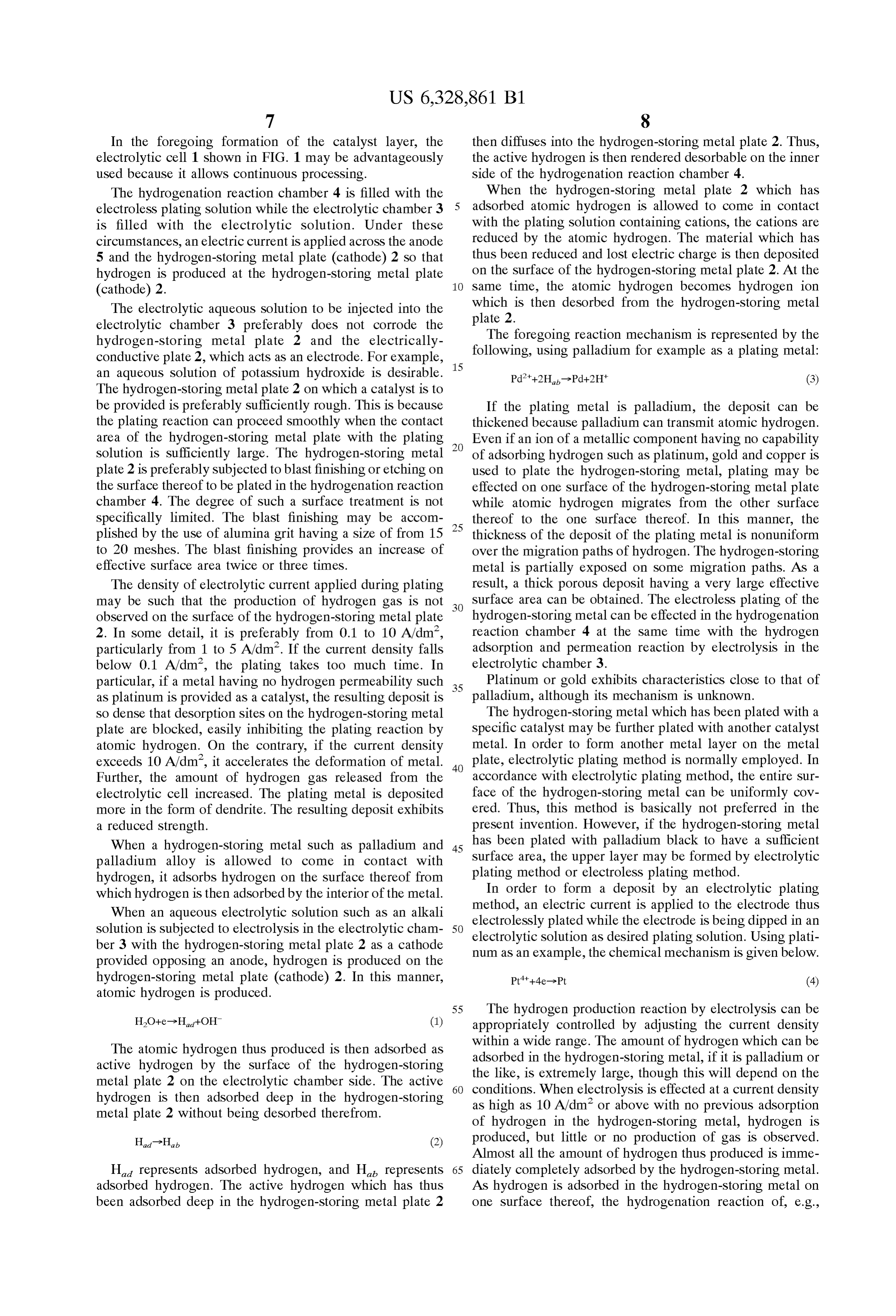
Solution is Subjected to electrolysis in the electrolytic cham 50 electrolytic Solution ber 3 with the hydrogen-Storing metal plate 2 as a cathode num as an example, the as desired plating Solution. Using plati provided opposing an anode, hydrogen is produced on the chemical mechanism is given below. hydrogen-storing metal plate (cathode) 2. In this manner, atomic hydrogen is produced.
55 The hydrogen production reaction by electrolysis can be appropriately controlled by adjusting the current density
The atomic hydrogen thus produced is then adsorbed as within a wide range. The amount of hydrogen which can be active hydrogen by the Surface of the hydrogen-Storing the like, isinextremely adsorbed the hydrogen-Storing metal, if it is palladium or large, though this will depend on the metal plate 2 on the electrolytic chamber side. The active 60 conditions. When electrolysis hydrogen is then adsorbed deep in the hydrogen-Storing as high as 10 A/dmfor aboveiswith effected at a current density no previous adsorption metal plate 2 without being desorbed therefrom. of hydrogen in the hydrogen-Storing metal, hydrogen is H-H, (2) produced, but little or no production of gas is observed. Almost all the amount of hydrogen thus produced is imme
H represents adsorbed hydrogen, and H, represents 65 diately completely adsorbed by the hydrogen-Storing metal. adsorbed hydrogen. The active hydrogen which has thus AS hydrogen is adsorbed in the hydrogen-Storing metal on been adsorbed deep in the hydrogen-storing metal plate 2 one Surface thereof, the hydrogenation reaction of, e.g.,
Page 9
Styrene, proceeds on the reaction chamber Side at a rate on the palladium plate. When the current efficiency was not corresponding to the rate of production of hydrogen. In more than about 0.1%, 4-ethyltoluene was obtained. general, however, a hydrogenation reaction or a hydrogen
EXAMPLE 2
reduction reaction proceeds at a lower rate than an electro chemical reaction. The inventors made extensive Studies of 5 Using the same electrolytic cell 1 as used in Example 1, acceleration of hydrogenation reaction or reduction reaction palladium black was deposited on a palladium plate under to the rate of production of hydrogen. The present invention the following conditions:
has thus been worked out. Reaction solution: PdCl 5 g/dm -HCl 1 mol/dm The present invention will be further described in the Current density: 1 A/dm (10 mA) following examples, but the present invention should not be Agitation: None construed as being limited thereto. Unless otherwise indicated, all parts, percents, ratioS and the like are by Electrical quantity: 36C weight. When the current efficiency was 30%, palladium black was deposited to a thickness of 2.5 lim. The deposit thus
EXAMPLE 1. 15 formed had a specific surface area of about 500 m /m’ as Using an electrolytic apparatus as shown in FIG. 2, a determined by BET method.
4-Methylstyrene was then subjected to the same reduction palladium plate as a hydrogen-Storing metal was plated with reaction as mentioned above. When the current efficiency palladium black on the Surface thereof. was 10%, 4-ethyltoluene was obtained. A palladium plate having a thickness of 0.1 mm was FIG. 3 is a graph illustrating the cumulative amount of inserted as a cathode into an electrolytic cell 1 at the center electrolytically deposited palladium black determined at thereof. A platinum plate having a thickness of 0.5 mm as an various times by weight. The current efficiency was 24%. anode was provided opposing the cathode in an electrolytic FIG. 4 is a graph illustrating the relationship between the chamber 3. The electrolytic chamber 3 was filled with a 6M cumulative amount of 4-ethyltoluene produced by a galvano aqueous Solution of caustic potassium as an electrolytic 25 electroStatic electrolytic apparatus at a current density of 5 Solution. The cathode plate had a cathode area of 1 cm. A/dm with various hydrogen-storing metals having palla A reaction chamber 4 was filled with an aqueous Solution dium black deposited thereon for different periods of time of palladium chloride as a reaction Solution (plating and the reduction reaction time. In the graph, Dindicates the Solution, hereinafter referred to as "reaction Solution”). measurements on the hydrogen-Storing metal having palla Under the following conditions, an electric current was dium black deposited thereon for 60 minutes, A indicates applied to the electrolytic chamber 3 with the reaction the measurements on the hydrogen-Storing metal having chamber 4 filled with the electroless plating solution of palladium black deposited thereon for 40 minutes, A indi palladium chloride So that the palladium plate was electro cates the measurements on the hydrogen-storing metal hav lessly plated with palladium on the plating chamber side ing palladium black deposited there on for 20 thereof. 35 minutes, O indicates the measurements on the hydrogen Reaction solution: PdCl 5 g/dm 4-HCl 1 mol/dm Storing metal having palladium black deposited thereon for Current density: 1 A/dmf (10 MA) 10 minutes, and 0 indicates the measurements on the Agitation: None hydrogen-Storing metal having palladium black deposited thereon for 0 minutes.
Electrical quantity: 5C (coulomb) 40 FIG. 5 is a graph illustrating the relationship between the Reaction formula: Pd*+2H.->Pd+2H" deposition time during which palladium black is deposited When the current efficiency was 30%, palladium black and the reaction efficiency of 4-ethyltoluene. was deposited to a thickness of 0.5 lum. When observed on an SEM photograph, a granular deposit having a size of 1 um EXAMPLE 3 was confirmed. The plating of the hydrogen-Storing metal 45 Using the same electrolytic cell 1 as used in Example 1, with the catalyst was then completed. platinum black was deposited by the action of active hydro Thereafter, a reduction reaction was conducted in the gen.
Same manner as mentioned above except that the reaction Reaction solution: HPtCl6HO 0.1 mol/l chamber 4 was filled with 4-methylstyrene rather than the Electrolytic solution: 6M KOH foregoing reaction Solution. The introduction of the reactant 50 was accomplished by the action of a roller pump through a Current density: 5 A/dm (50 MA) fluororubber tube. The reaction conditions in the reaction Agitation: None chamber 4 were as follows: Electrical quantity: 6C
Reaction substrate: 4-Methylstyrene Reaction formula: PtCl-2H->Pt+4CI+2H Temperature: Room temperature 55 When the current efficiency was 20%, platinum black was Flow rate: 2.5 ml/min deposited to a thickness of 1 lum. Using the palladium plate having platinum black depos
Loading: 6 ml ited thereon, electrolysis was effected while 4-methylstyrene Current density: 5 A/dm (50 mA) was Subjected to a reduction reaction in the same manner as Electrolysis time: 5 hours 60 in Example 1. When the current efficiency was 30%, Under the foregoing conditions, electrolysis was effected. 4-ethyltoluene was obtained.
When the current efficiency was 30%, 4-ethyltoluene was EXAMPLE 4 obtained.
COMPARATIVE EXAMPLE 1.
Using the same electrolytic cell 1 as used in Example 1, 65 palladium black was deposited by the action of active
The reduction reaction was effected in the same manner as hydrogen. Thereafter, platinum black was produced on the in Example 1 except that palladium black was not deposited deposit of palladium black.
Page 10
Conditions of Deposition of Palladium Black When the current efficiency was 60%, propylene was obtained. When the current efficiency was 30%, propane was
Reaction solution: PdCl 5 g/dmi--HCl 1 mol/dm obtained.
Current density: 1 A/dmf (10 mA)
Agitation: None COMPARATIVE EXAMPLE 2 Electrical quantity: 5C The reduction reaction procedure of Example 6 was followed except that palladium black was not deposited.
Conditions of Deposition of Platinum Black When the current efficiency was 40%, propylene was Reaction solution: HPtCl6H2O 0.1 mol/l obtained. When the current efficiency was 5%, propane was obtained.
Current density: 5 A/dm (50 mA)
Agitation: None EXAMPLE 7 Electrical quantity: 6C Using the same electrolytic cell 1 as used in Example 1, Reaction formula: PtCl-2H.->Pt+4CI+2H 15 gold was deposited by the action of active hydrogen. Using the palladium plate thus obtained, 4-methylstyrene Reaction solution: HAuCl4H2O 0.1 mol/l was Subjected to a reduction reaction in the same manner as Electrolytic solution: 6M KOH mentioned above. When the current efficiency was 80%, 4-ethyltoluene was obtained. Current density: 5 A/dm (50 mA) It can be presumed that Since the platinum catalyst is a Agitation: None
Structure developed on palladium black, the increase of Electrical quantity: 6C Surface area and the catalytic activity are combined to exert the foregoing effect. Reaction formula: AuCl-3H.->Au+4C1+3H" When the current efficiency was 20%, gold was deposited
EXAMPLE 5 to a thickness of 1.5 lim.
Using the same electrolytic cell 1 as used in Example 1, sitySubsequently, electrolysis was effected at a current den
palladium black was deposited on a palladium plate by the Supplied into the reaction while oxygen gas and pure water were action of active hydrogen. Thereafter, platinum black was chamber at a rate of 20 ml and 1 electrolytically deposited on the deposit of palladium black. ml per minute, respectively, instead of the reaction Solution During this process, an electric current was applied to the for plating. When the current efficiency was 10%, aqueous palladium plate having palladium black deposited thereon as hydrogen peroxide having a concentration of 6 ppm was a cathode provided opposing the interior of the electrolytic obtained.
chamber 3 filled with a plating solution. COMPARATIVE EXAMPLE 3 Conditions of Deposition of Palladium Black The reduction reaction procedure of Example 7 was
followed except that gold was not deposited. When the
Reaction solution: PdCl 5 g/dm 4-HCl 1 mol/dm current efficiency was 5%, aqueous hydrogen peroxide hav Current density: 1 A/dm (10 mA) ing a concentration of 3 ppm was obtained. Agitation: None EXAMPLE 8
Electrical quantity: 5C
Using the same electrolytic cell 1 as used in Example 1,
Conditions of Deposition of Platinum Black electrolysis was effected with the reaction chamber 6 being (electrolytic plating) filled with the reaction Solution containing 1 cc of lanthanum-nickel alloy powder under the following condi
Reaction solution: HPtCl6H2O 0.1 mol/l 45 tions. Palladium black was produced on the other surface Current density: 5 A/dm (50 mA) and the powder Surface of the cathode. Agitation: None Reaction solution: PdCl 5 g/dm -HCl 1 mol/dm Electrical quantity: 6C Current density: 1 A/dm (10 mA) The cathode thus prepared was then mounted in the same 50 Agitation: Circulation by pump cell in Such an arrangement that the platinum black Side Electrical quantity: 50C thereof faces the reaction chamber. Under these conditions, Reaction formula: Pd*+2H.->Pd+2H" 4-methylstyrene was Subjected to reduction reaction in the same manner as mentioned above. When the current effi When the current efficiency was 30%, a granular deposit ciency was 70%, 4-ethyltoluene was obtained. having a size of 0.1 um was observed on the powder Surface 55 of the cathode on SEM photograph.
EXAMPLE 6 AS mentioned above, the present invention provides an Using the plated electrode prepared by plating a catalyst electrolytic process which comprises effecting electrolysis in Example 1, acetylene gas was Subjected to a reduction with a hydrogen-Storing metal member as a cathode to reaction in the reaction chamber of the electrolytic cell 1 produce hydrogen which is then adsorbed by the hydrogen used in Example 1. The reaction conditions were as follows: 60 Storing metal member through which it is allowed to migrate Reaction Substrate: Acetylene to at least a part of the other Surface thereof at which it is Temperature: Room temperature deSorbed and utilized in a hydrogen reaction, wherein the Flow rate: 2.5 ml/min hydrogen-Storing metal member is provided with a porous catalyst layer on the Surface thereof.
Loading: 5 ml (1 atm) 65 The present invention also provides an electrolytic appa Current density: 5 A/dm (50 mA) ratus using the foregoing electrolytic process. In this Electrolysis time: 5 hours arrangement, hydrogen thus adsorbed is desorbed to allow
Page 11
the catalyst to accelerate its reaction with the reactant. Storing metal member is adapted to adsorb hydrogen Because of its porosity, the catalyst layer has a large Surface produced in the electrolytic chamber by electrolysis of the area at which the reactant can come in contact with electrolytic Solution, the adsorbed hydrogen transferring to hydrogen, making it possible to raise the reaction rate. the Side of the hydrogen-Storing metal member facing the Accordingly, even if electrolysis is effected at a great current reaction chamber, and Said hydrogen-Storing metal member density to produce hydrogen at a high rate, the hydrogen comprising a porous catalyst layer which is adapted to reaction can be raised correspondingly, making it possible to catalyze a hydrogenation or reduction reaction in Said reac provide a high current efficiency. tion chamber between a reactive compound in contact with The present invention provides an electrolytic apparatus a Surface of the catalyst layer and the adsorbed hydrogen. comprising a hydrogenation reaction applied electrode hav 2. The electrolytic apparatus as claimed in claim 1, ing a large Surface area. It was confirmed that the use of this wherein Said hydrogen-Storing metal comprises palladium electrolytic apparatus makes it easy to reduce the reactant or an alloy thereof, Said porous catalyst layer comprises a unprecedentedly. Thus, the use of this electrolytic apparatus metal black belonging to the platinum group or gold and the makes it easy to develop a new Synthesis process. hydrogenation or reduction comprises hydrogenation of an While the invention has been described in detail and with 15 unsaturated hydrocarbon.
reference to specific embodiments thereof, it will be appar 3. The electrolytic apparatus as claimed in claim 1, ent to one skilled in the art that various changes and wherein Said porous catalyst layer formed on the Surface of modifications can be made therein without departing from Said hydrogen-Storing metal member is obtained by bringing the Spirit and Scope thereof. a hydrogen-Storing metal member which has adsorbed What is claimed is: hydrogen into contact with an electroleSS plating Solution 1. An electrolytic apparatus comprising an electrolytic containing a catalyst component So that the Surface of Said chamber and a reaction chamber Separated by a hydrogen hydrogen-Storing metal member is electrolessly plated with Storing metal member, means for charging an electrolytic Said catalyst metal by the action of hydrogen adsorbed in Solution into Said electrolytic chamber, and an anode pro Said hydrogen-Storing member.
Vided in Said electrolytic chamber opposing Said hydrogen 25
Storing metal member Serving as a cathode, Said hydrogen k k k k k
Provenance
- Collection
- Cited prior art
- Original PDF
- patentimages.storage.googleapis.com →
- Filed
- 1999-09-23
- Pages
- 11
- Method
- pdftotext (the PDF's own text layer) + pdftoppm 300dpi page scans
- Source
- Google Patents bibliographic record
- Granted
- 2001-12-11
- Inventors
- Yasuki Yoshida; Setsuro Ogata; Masaharu Uno; Masashi Tanaka; Yoshinori Nishiki; Takayuki Shimamune; Hiroshi Inoue; Chiaki Iwakura; Permelec Electrode Ltd
- Transcribed from
- patentimages.storage.googleapis.com →