patent · US6177131
Method of making an anti-reflection coating
23 January 2001
Page 1 — bibliographic record
(12) United States Patent (10) Patent No.: US 6,177,131 B1 Glaubitt et al. (45) Date of Patent: Jan. 23, 2001
(54) METHOD OF MAKING AN ANTI FOREIGN PATENT DOCUMENTS
REFLECTION COATING
(75) Inventors: Walther Glaubitt, Veithoechheim;
Andreas Gombert, Freiburg, both of * cited by examiner
(DE) Primary Examiner Erma Cameron (73) Assignee: Fraunhofer-Gesellschaft Zur (74) Attorney, Agent, or Firm- Karl Hormann Förderung der angewandten (57) ABSTRACT
Forschung e.V., Munich (DE) A method of and a Solution for making a highly porous (*) Notice: Under 35 U.S.C. 154(b), the term of this optical antireflection coating of a Selectively designed index patent shall be extended for 0 days. of refraction, by applying a colloidal dispersion derived from hydrolytically condensing, in the presence of water and (21) Appl. No.: 08/953,841 a catalyst, one or more Silicon compounds of the general formula RSiX, or precondensates derived therefrom, to a (22) Filed: Oct. 14, 1997 Substrate. In the formula, R is an organic group having from (30) Foreign Application Priority Data 1 to 10 carbon atoms which may be interrupted by oxygen atoms and/or Sulfur atoms and/or amino groups, X is
Oct. 14, 1996 (DE) .............................................. 196 42. 419 hydrogen, halogen, hydroxy, alkoxy, acyloxy, alkylcarbonyl, alkoxycarbonyl or NR, R being hydrogen, alkyl or aryland (51) Int. Cl." ................................. B05D3/02; B05D 5/06 a being 0, 1 or 2. The Solution also contains colloidally (52) U.S. Cl. .......................... 427/162; 427/167; 427/226; dispersed organic polymers at a molar ratio, relative to the 427/387 silane, between 0.1 mmol/mol silane and 100 mmol/mol (58) Field of Search ..................................... 427/387, 162, Silane, the median molecular mass of the polymer being 427/167, 226 between 200 and 500,000. Sol-vents, preferably alcohol, may also be present in the Solution. After being applied to an (56) References Cited optical Substrate, the Solution is dried and organic compo
predetermined index of refraction.
4,830,879 5/1989 Debsikdar ............................ 427/162 5,976,680 1/1945 Ikemori et al. ...................... 428/212 8 Claims, 1 Drawing Sheet
with antireflection
without antireflection
O.4 O.6 O.8 1.O 1.2 1.4 1.6 1.8
Page 2
with antireflection
without antireflection
O.4 O.6 O.8 1.O 1.2 1.4 1.6 1.8
FIG. 1
9. O 1O O 9 O
() A 2 A
S 4. Probe T3/4-8 9 o visual
o A Solar
O 10 2O 3O 4O 50 60 7O Incident Angle
FIG. 2
Page 3
METHOD OF MAKING AN ANTI application of at least two coatings. This results in lower REFLECTION COATING productivity and higher production costs. To render Spec tacle lenses or Video Screens anti-reflective, for instance,
BACKGROUND OF THE INVENTION interference layers are applied by vapor deposition. While 1. Field of the Invention the layers thus produced are relatively abrasion resistant, The present invention, in general, relates to a composition their high costs of about S60.00 (DM 100.00) to about
S100.00 (DM 150.00) per square meter of treated surface for, and a method of, making a highly porous anti-flection area constitute a disadvantage. On the other hand, Sputtered coating, and, more particularly, to an optical anti-reflection multi-layered interference coatings are Suitable only for coating for Simultaneously improving the transmission and Visual anti-reflection coatings and cannot be applied to every preventing or minimizing undesired reflections of Visible kind of Substrate geometry, Such as the internal Surfaces of and other electromagnetic radiation of the kind occurring, tubes, for instance. Diffuse anti-reflection by roughening the for instance, at cathode ray tubes, liquid crystal displayS, Surface is most common but does not result in enhanced instrument panels, spectacle lenses, picture tubes, Solar transmission. Anti-reflection of high optical value may be collectors and automotive windscreens. obtained by a treble-layered System involving a Sol-gel
2. The State of the Art process. Such a process is Suitable even for making large When light is penetrating the interface between two media display windows anti-reflective. But at a cost of about of different diffractive indices a portion of the radiation is S100.00 (DM 140.00) to about S150.00 (DM200.00) it is a reflected. The reflected portion of light vertically impinging relatively expensive process.
upon a pane of glass having an index of refraction n=1.5 is German patent application 4,430,859 discloses an anti about 4%. If, however, the light falls on the interface at an reflection coating consisting of two layers of different indi acute angle, a much greater portion is reflected. ces of refraction. At least its first layer also contains a light Display devices Such as, for example, cathode ray tubes or absorber. While the processes for producing these layers are liquid crystal displayS are used for many different applica 25 conventional, involving Sputtering, vapor deposition or tions. While the quality of their images has been improved, other common coating processes, they are, nevertheless, the images are often difficult to distinguish because of expensive. Moreover, another disadvantage of Such an anti reflections. Furthermore, the reliability of the information reflection coating and of its manufacturing proceSS resides in transmitted, for instance, from instrument panels, watch the fact that because of the light absorber it is very unlikely crystals or automotive windscreens is often reduced signifi that the transmission is significantly increased. cantly because of reflections. European patent Specification 0,514,973 discloses an anti Reduced reflections are desirable for a great many optical reflection coating for cathode ray tubes, in particular. The Systems. Anti-reflection coatings on Spectacle lenses are a coating has a graduated index of refraction decreasing from well-known example. By using covers with anti-reflection the Surface of the Substrate in the direction of the coating coatings on Solar devices their efficiency could be enhanced. 35 Surface. The coating is produced by a Sol-gel process in Reflection may also be reduced by the application of which the conditions of the reaction during the gel formation interference coatings. If a coating of a thickneSS )/4 is are varied Such that the resultant gel is non-porous with the applied to glass (n=1.5), for instance, destructive interfer degree of croSS-linkage increasing from the Surface of the ence will result between the reflected portion at the inter Substrate toward the outer Surface of the coating. The faces between air and coating as well as coating and glass. 40 disadvantage of this process is the dispersion occurring as a Yet the conditions for destructive interference always hold result of relatively large particles in the coating. The dis only for a particular wave length and a particular angle of persion results in reduced transmission thus rendering it incidence. The refractive index of the coating determines the unsuited for Solar applications. Also, the multiple coating level of minimum reflection. For glass of optimum anti application is very expensive.
reflection properties it has to be 1.22 in order to result in 45 U.S. Pat. No. 4,830,879 also teaches an anti-reflective close to Zero at a wavelength of . Such a low index of coating for Surfaces of glass, metal and crystal. The coating refraction cannot, however, be achieved with dense coatings. is produced by multiple coating and by a Sol-gel proceSS by A Single anti-reflection coating of the kind mentioned is hydrolytic condensation of metal alkoxides. To this end, four extremely effective for visual as well as for Solar purposes. differently aged Solutions each containing particles of a size The antireflective effect of the often used treble layered 50 different from those of the other solutions are produced for interference coatings reasonably extends over the range of consecutive coatings of a Substrate. The resultant antireflec visible light, i.e. from about 400 nm to about 800 nm. Such tion coating has a gradient of particle sizes and, hence, of coatings are, however, unsuited for Solar applications porosity and refractive index. While such multi-layer coat because the Spectrum of Solar radiation covers a much wider ings or gradient layerS lead to broad-band antireflection, range. 55 they do, however, depend upon extremely porous Structures Reduced reflection may also be achieved by a Surface (n=1.05) in the direction of the surface of the coating. These with a graduated refractive index. That is to Say, rather than structures tend to be very unstable mechanically. The dis changing abruptly the refractive indeX approaches the value advantage of this kind of coating, moreover, resides in its for glass from the value for air (n=1) in Several steps. The complex manufacturing proceSS which, because of the advantage of Such a layer is that it effectively reduces 60 numerous process Steps, is very expensive. reflection over a broad-band Spectral range and for all angles OBJECTS OF THE INVENTION of incidence.
Different processes for fabricating anti-reflective Surfaces It is a primary object of the invention to provide a method exist already. For example, transparent anti-reflection films of producing by a single coating a refractive indeX with ideal or coatings of different refractive indices have been applied 65 antireflection properties to Surfaces to reduce undesirable Surface reflections. Such Another object resides in the provision of Such a method processes do, however, entail problems as they involve the useful for coating Surfaces of many different Substrates Such
Page 4
as, for instance, glasses, metals, or polymeric materials to monomethylamino, monoethylamino, dimethylamino, reduce or even eliminate reflections. 4, diethylamino, N-ethylanilino, acetyloxy, propionyloxy, Another object of the invention is to provide a method of methylcarbonyl, ethylcarbonyl, methoxycarbonyl, the kind referred to of Structuring a Surface in Such a way ethoxycarbonyl, benzyl, 2-phenylethyl and tolyl. that aside from reducing or eliminating reflections an The mentioned groups may, optionally carry one or more increase in transmission is also achieved. Substituents Such as, for example, halogen, alkyl, A still further object of the invention is a qualitatively hydroxyalkyl, alkoxycarbonyl, alkoxy, aryl, aryloxy, alkylcarbonyl, furfuryl, tetrahydrofurfuryl, amino, uniform and inexpensive elimination or reduction of reflec monoalkylamino, dialkylamino, trialkylammonium, amido, tions on large area Substrates. hydroxy, formyl, carboxy, mercapto, cyano, isocyanato, It is yet another object of the invention to provide for a process of applying an antireflection coating in a single nitro, epoxy, SOH or P0H.
Fluorine, bromine and, more particularly, chlorine are the operational Step. preferred halogens.
A further object of the invention is to provide an antire The silanes of general formula I are hydrolyzable and flection coating of negligible thickness variations on large 15 condensible through the X groups. An inorganic network Surface Substrates in a single operational Step. containing Si-O-Siunits is built up by these hydrolyzable It is also an object of the invention universally to structure and condensible groups. Without limitation, examples of an antireflective coating application method Such that dif Such silanes in general are Cl-SiCH, Si(CH)(OCHs), ferent Substrate materials may be provided with an antire Si(CH3)C1, Si(CH4)(OCH), Si(CH=CH-)(OCH), flection System. Si(CH=CH-)(OCHOCH), Si(CH=CH-)(OOCCH), Still another object of the invention resides in a method of ClSi(CH), Si(CH)(OCHs), Si(CH)(OCH), making an antireflection coating for reducing or eliminating ClSi(CH=CH2)(CH), Si(CH)(OCH), ClSi(CH3), reflections of electromagnetic radiation of different wave Si(CH4)(OCH), ClSi(CH=CH-), Si(OCH)(CH lengths. CH=CH-), Si(OOCCH) (CH-CH=CH-) and (HO)Si
DETAILED DESCRIPTION OF THE In a preferred embodiment of the method in accordance INVENTION. with the invention, Silicon compounds of general formula In accordance with a currently preferred embodiment of SiX are used. Without limitation, concrete examples of the invention, a colloidal dispersion is applied to the Surface such silanes are SiCl, HSiCl, Si(OCH), Si(OOCH) and Si(OCH), tetraalkoxysilane being preferred and to be provided with an antireflection coating and is dried. Si(OCH) (TMOS) being especially preferred. Thereafter, organic components are removed by heating. The Silanes of general formula I may either be purchased The colloidal dispersion or solution is preferably derived by commercially, or they may be produced in the manner hydrolytic condensation of Silicon compounds having the described in “Chemie und Technologie der Silicone' by W. general formula I: 35 Noll, Verlag Chemie, Weinheim/Bergstrasse, Germany, RSiX. (1) 1968). They may be used as Such or as precondensates. For erecting the inorganic network, Silicones of general in which the groups are alike or different and R is an organic formula I are hydrolyzed and polycondensed. Preferably, the group with 1 to 10 carbon atoms which may be interrupted polycondensation is carried out by a Sol-gel-method of the by oxygen and/or Sulfur atoms and/or amino groups, and X 40 kind described, for instance, in German patent Specifications is hydrogen, halogen, hydroxy, alkoxy, acyloxy, 2,758,414, 2,758,415, 3,011,761, 3,826,715 and 3,835,968. alkylcarbonyl, alkoxycarbonyl or NR, R being hydrogen, The polycondensation may be carried out, for instance, by alkyl or aryl and a being 0, 1 or 2. Monomeric Silicon directly adding the required water, either at room tempera compounds of formula I or precondensates derived there ture of slightly cooled, (preferably by Stirring and in the from may be used to produce the colloidal dispersion. The 45 presence of a hydrolysis or condensation catalyst) to the hydrolytic condensation is carried out with water or mois Silicon compounds to be hydrolyzed, the Silicon compounds ture and, if necessary, in the presence of a catalyst and/or being used either as Such or dissolved in a Suitable Solvent. Solvent. The resultant mixture is thereafter stirred for some time (one The colloidal dispersion or Solution additionally contains to Several hours).
one or more organic polymers carrying one or more OH 50 AS a rule, the hydrolysis is carried out at temperatures and/or NH groups. The median molecular mass of these between -20 and 130° C., preferably between 0 and 30° C. polymers is between 200 and 500,000, and the molar ratio or at the boiling point of any Solvent which may be present. between polymer and Silane is between 0.1 mmol/mol Silane The best mode of adding water depends primarily upon the and 100 mmol/mol silane. reactivity of the Starting compounds used. Thus, the dis The alkyl groups in general formula I are long-chain, 55 Solved Starting compounds may be slowly dripped to an croSS-linked or cyclic groups having 1 to 10 carbon atoms excess of water, or the water is added in one lot, or it is added and preferably lower alkyl groups having 1 to 6 and more in portions to the possibly dissolved Starting compounds. It particularly 1 to 4 carbon atoms. Particular examples are may also be useful not to add the water as Such but to add methyl, ethyl, n-propyl, 1-propyl, n-butyl, 1-butyl, S-butyl, it to the reaction System by means of aqueous organic or t-butyl, n-pentyl, n-hexyl, cyclohexyl, 2-ethylhexyl, dodecyl 60 inorganic Systems. However, the water may also be added by and octadecyl. way of a chemical reaction during the course of which water Preferred aryl groups of general formula I are, for is released. Esterifications are examples thereof. instance, phenyl, biphenyl and naphthyl. The alkoxy, Aside from low aliphatic alcohols (e.g. ethanol or acyloxy, alkylcarbonyl, alkoxycarbonyl, alkylamino and 1-propanol), Solvents which may also be used are ketones, dialkylamino groups are preferably derived from alkyl and 65 preferably low dialkylketones Such as acetone or aryl groups mentioned Supra. Particular examples are methylisobutylketone, ether, preferably low dialkylether methoxy, ethoxy, n- and 1-propoxy, n-, 1-, S- and t-butoxy, such as diethylether or dibutylether, THF, amide, ester, more
Page 5
S 6 particularly acetic acid ethyl ester, dimethylformamide, It has been found to be particularly advantageous to use amines, especially triethylamine, and mixtures thereof. In a volatile base which may then be driven out by simply preferred embodiments of the method in accordance with the increasing the temperature.
invention alcohols are used as solvents. Preferred alcohols The coating Solution in accordance with the invention are ethanol, 1-propanol, n-propanol, 1-methoxy-2-propanol may be applied to, and dried on, the Surfaces to which an or methoxyethanol and, especially preferred, methanol. The antireflection coating is to be applied, by conventional quantity of the Solvent used depends upon the quantity and methods. It goes without Saying that the Viscosity of the Solubility of the (partially)condensed silicon compounds and inventive coating Solution and the parameters of the coating the polymers used. It is critical that the coating Solution of operation, e.g. the Speed of Submersion and withdrawal of the invention is a colloidal dispersion. Moreover, an alcohol the Substrate to be coated into and out of the coating Solution Solvent may function as a moderator for the hydrolysis and have to be coordinated as a function of the desired coating the condensation. In that manner the reactivity of the System thickness. This is, however, well known to any perSon may be controlled and adjusted to the requirements of any given application. skilled in the art of Such coatings. It is not necessary that all of the Starting compounds be 15 It may in many instances be of advantage to age the present at the commencement of the hydrolysis coating Solution in accordance with the invention by Stirring (polycondensation). Rather, in certain circumstances it may it and by Storing it. This leads to a growth in the size of the be advantageous, initially to contact only Some of these particles and to the formation of oligomeric Structures. It is, compounds with water and to add the remaining compounds however, necessary to ensure that at the time of the coating later on. operation the inventive coating Solution is in the State of a Water may be added in one batch or in several steps, for colloidal dispersion. In that way, particularly uniform and instance, in three Steps. For example, one tenth to one homogeneous antireflection coatings may be obtained. twentieth of the quantity of water required for the hydrolysis Thereafter the organic components, i.e. the organic poly may be added during the first Step. After Stirring for a short merS and any of the R groups present in the polycondensate period, one fifth to one tenth of the required quantity of are removed by heating. The temperatures applied for this water may be added, and after brief Stirring the remainder 25 purpose are, of course, dependent upon the thermal Stability may be added. of the coated Substrates and of the organic components to be The condensation time is dependent upon the Starting removed. The resultant antireflection coating is entirely compounds used as well as on the proportional shares, any inorganic and may be Subjected to Strong thermal influences. catalyst used, the reaction temperature, and So forth. In It has Surprisingly been found that by the process of the general, the polycondensation is carried out at normal present preSSure, but it may also be carried out at increased or at providedinvention large Surface Substrates may at low cost be with an antireflection coating of negligible varia reduced pressure.
Aside from hydrolytically (partially) condensed silicon tions in thickness. The coating may be provided by a single compounds the coating solution in accordance with the layer of applied to the Substrate. It was also found as a matter
Surprise that by infusing organic polymers into the coating invention contains one or more organic polymers in a 35 colloidally dispersed state. The polymers have OH and/or Solution of the invention, particularly uniform antireflection NH groups, and their median molecular masses lie between coatings of a particularly uniform porosity and coating 200 and 500,000, the molar ratio of polymer to silane being thickness are obtained. As a consequence, the antireflection between 0.1 mmol/mol silane to 100 mmol/mol silane. The coatings in accordance with the invention have a particularly polymers added in accordance with the invention contain 40 uniform index of reflection and that Substrates provided with OH, NH or SH groups which provide for an interaction with the antireflection coating in accordance with the invention the inorganic network erected by the hydrolytic condensa have a uniform coloring of their Surfaces. In contrast to the tion of the Silicon compounds. This interaction results in a State of the art, the antireflection coating in accordance with uniform distribution of the organic polymers in the poly the invention has no graduated index of refraction. condensate which, in turn, leads to a particularly homog 45 Not only do the antireflection coatings in accordance with enous porosity of the antireflective coating of the invention. the invention reduce or eliminate reflections, but at the same The organic polymerS may be added at the commence time they improve the transmission.
ment of the hydrolytic condensation, during the condensa tionTheareantireflection coatings in accordance with the inven pure inorganic Systems offering all the advantages tion or after its termination.
Without be so limited, examples of such polymers are 50 inherent therein, Such as, for instance, Stability agains polyhydrazides CO-R-CO-NH-NH-CO-R" mechanical and thermal StreSS as well as against aging. CO-NH-NH) or polyethyleneimines (CH-CH-NHl. Accordingly, invention may antireflection coatings in accordance with the be Subjected to higher operating temperatures
CH-CH-N), of the kind occurring in Solar power plants. CH-CHNHL-CHCH-NH. In contrast to prior art Systems, antireflection coatings in whereby polyethylene glycolalkylethers, polyvinylacetates, 55 accordance with the invention may be applied significantly polyvinyl pyrrolidones, polyvinyl alcohols, poly-(2-ethyl-2- more economically. Conservative estimates would Suggest oxazolines), poly-(hydroxymethacrylates) and poly that the price of glass coated on both sides would be below (hydroxyacrylates) are particularly preferred. S7.00 (DM 10.00) per square meter. In preferred embodiments of the method in accordance Not only do antireflection coatings in accordance with the with the invention, the median molecular mass of the 60 invention adhere to almost all kinds of mineral glass, but organic polymers lies between 500 and 50,000. also to metals, Such as, for instance, Steel, and plastics, Such In further preferred embodiments, the pH-value of the as, for instance, PMMA (polymethylmethacrylate), PC coating Solution in accordance with the invention is is 7. (polycarbonate) or PS (polystyrene).
This may be attained, for instance, by using alkaline con The porosity and, hence, the refractive index of antire densation catalysts, Such as, for example, ammonia or basi 65 flection coatings in accordance with the invention may be cally reacting polymers, Such as, for instance, polyethylene Selectively controlled by the size and quantity of the organic imines. polymer, and they may thus be adjusted to the requirements
Page 6
of any given application. For instance, an increase in the condensing at least one of at least one of a Silicon Volume of pores results in a reduction of the refractive index. compound of general formula I: Furthermore, the antireflective properties of the coating in accordance with the invention may be Selectively adjusted to RSiX. (1) the wavelength of any incident radiation.
The antireflection coating in accordance with the inven wherein the groups are alike or different and wherein R is tion may be used, for instance, to impart antireflection and an organic group having 1 to 10 carbon atoms and X is hydrogen, halogen, hydroxy, alkoxy, acyloxy, increased transmission to cathode ray tubes, instrument alkylcarbonyl, alkoxycarbonyl or NR", R' being panels, spectacle lenses, video Screens, Solar collectors for hydrogen, alkyl or aryl and a being 0, 1 or 2, increasing their efficiency, windows, tubes and So forth. and a precondensate derived therefrom, An embodiment of the method in accordance with the and containing at least one colloidally dispersed organic invention will be explained in more detail with reference to polymer of a median molecular mass between 200 and the following example: 500,000, said polymer having at least one of OH and NH grOupS,
EXAMPLE 15 the molar ratio between polymer and Silicon compound In the presence of 27.0 g of methanol, 7.6 g of polyeth being between 0.1 mmol/mol silane and 100 mmol/mol ylene glycol of a median molecular mass of 10,000 are Silane;
dissolved in 9.5 g of ammoniacal water having a pH-value applying Said Solution to a Substrate; of 9.5. The resultant mixture is added to a mixture of 15.2 drying Said Solution; and g of tetramethoxysilane and 80.0 of methanol. After stirring removing Said organic components by heating. for 10 minutes, the resultant mixture is filtered. After it had 2. The method of claim 1, wherein Said organic group R aged for about 80 minutes, glass panes were coated by is interrupted by at least one of oxygen atoms, Sulfur atoms Submersion in the mixture. To obtain a particularly uniform and amino groups.
coating of about 100 nm the pane to be coated is fixed in the 25 3. The method of claim 2, wherein said silicon compound coating bath and the coating Solution therein is removed free is of the general formula SiX, group X being as defined in of vibration within 2 minutes. Following their coating, the claim 1.
panes are dried at 130 C. for 30 minutes. Thereafter, their 4. The method of claim 1, further including the step of temperature is raised to 500 C. at a rate of 120 K/h, and the adding a Solvent for preparing Said colloidal disperse Solu panes are maintained at this temperature for one hour. The tion.
result is glass panes with an antireflection coating of a 5. The method of claim 4, wherein said solvent is an mauve-bluish hue. The resultant antireflection coating was alcohol Selected from the group consisting of methanol, found to have an index of refraction of 1.22. ethanol, l-propanol, n-propanol, 1-methoxy-2-propanol and
BRIEF DESCRIPTION OF THE DRAWINGS
6. The method of claim 1, further including the step of adding a catalyst for preparing Said colloidal disperse Solu
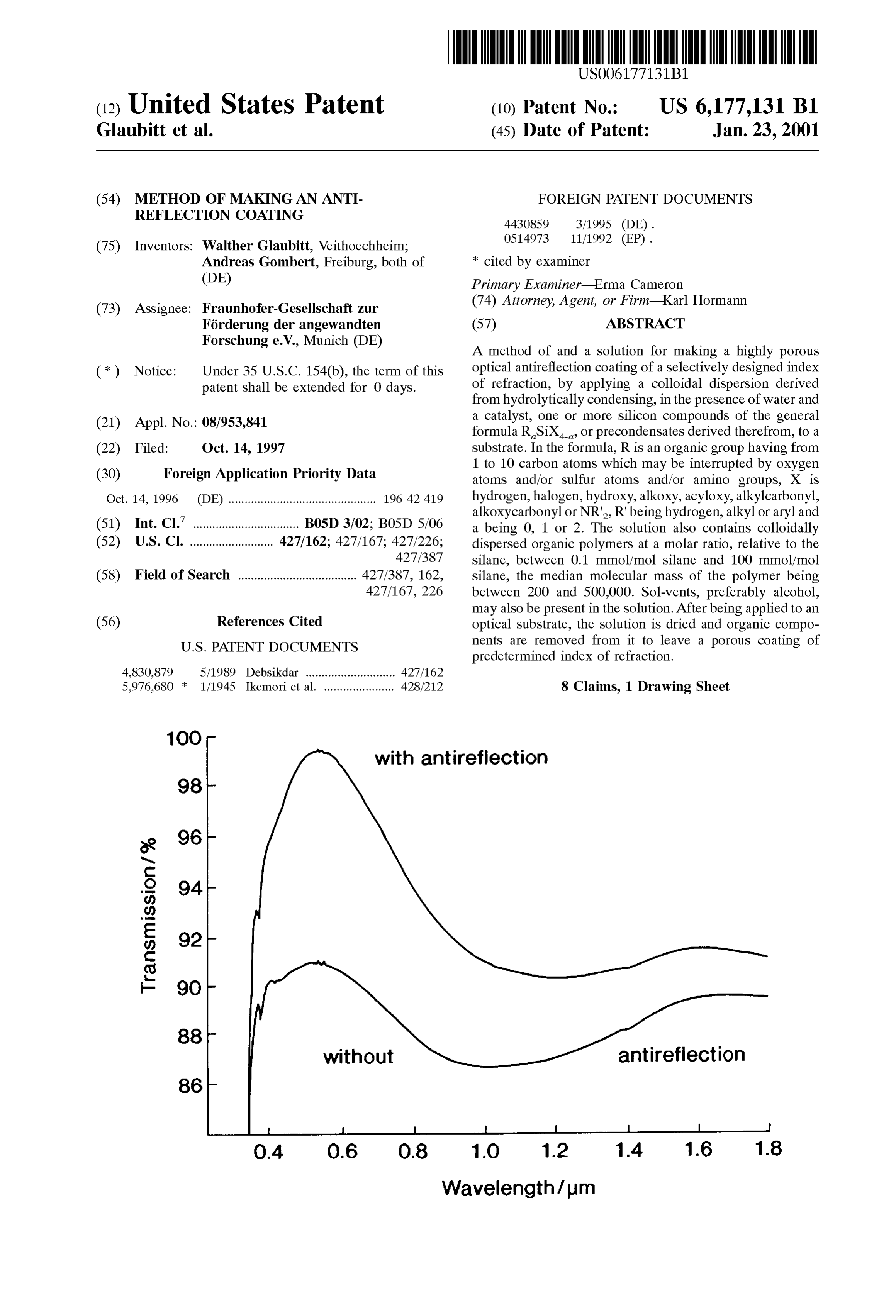
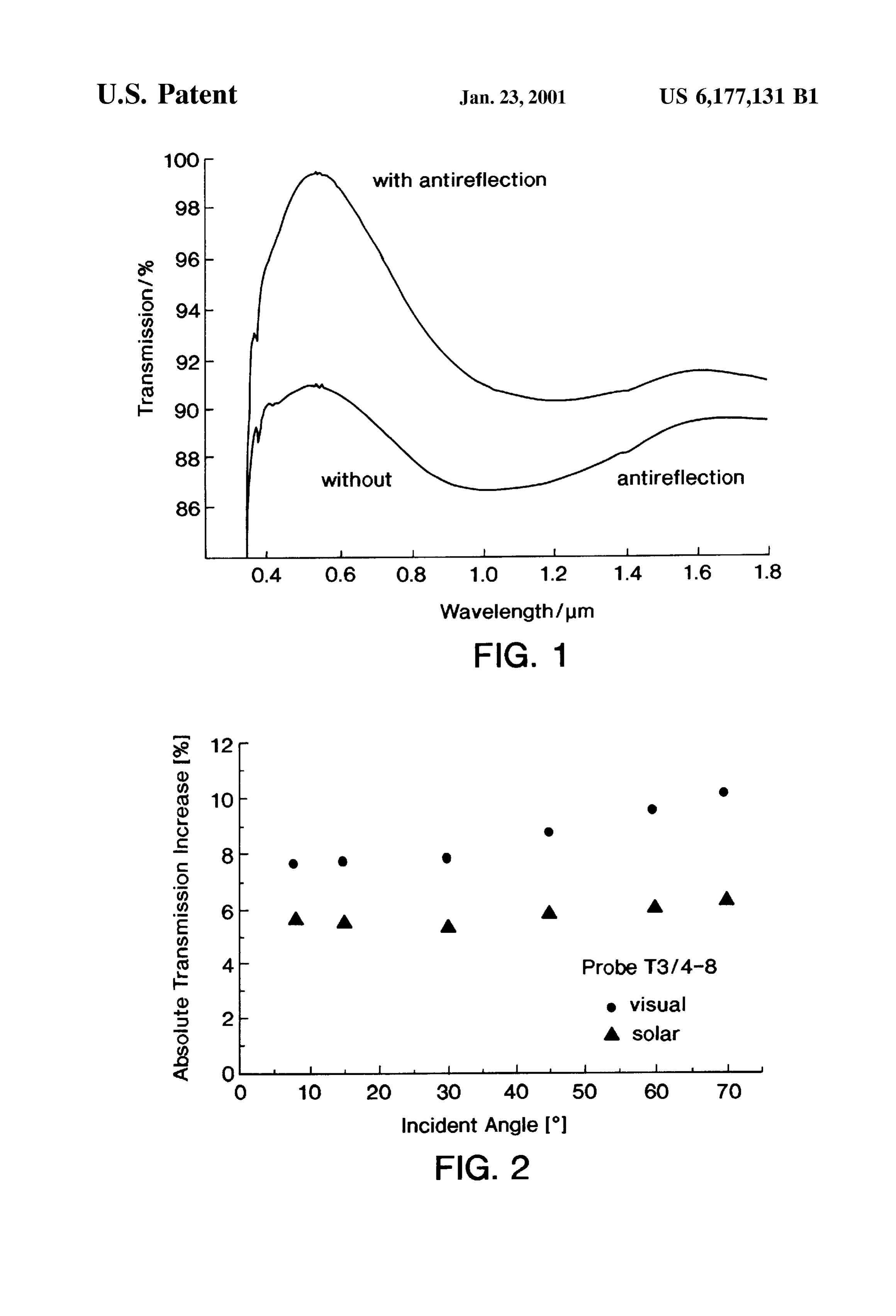
FIG. 1 depicts the transmission of a glass pane having an tion.
antireflection coating in accordance with the described embodiment in comparison with a Sample without coating. said7. organic The method of claim 1, wherein the median mass of polymer is between 500 and 50,000.
FIG. 2 depicts the increase of Visual and Solar transmis 8. The method of claim 7, wherein said organic polymer Sion of a glass pane with an antireflection coating in accor 40 is Selected from the group consisting of dance with the described embodiment. polyethylene glycolalky lether, poly Vinyl acetate, What is claimed is: polyvinylpyrrolidone, polyvinylalcohol, poly-(2-ethyl-2- 1. A method of making a porous antireflection coating, oxazoline), poly-(hydroxymethylacrylate) and poly comprising the Steps of: (hydroxyacrylate).
preparing a colloidal disperse Solution of a pH value e7 45 and including organic components by hydrolytically
Provenance
- Collection
- Cited prior art
- Original PDF
- patentimages.storage.googleapis.com →
- Filed
- 1997-10-14
- Pages
- 6
- Method
- pdftotext (the PDF's own text layer) + pdftoppm 300dpi page scans
- Source
- Google Patents bibliographic record
- Granted
- 2001-01-23
- Inventors
- Walther Glaubitt; Andreas Gombert; Fraunhofer Gesellschaft zur Foerderung der Angewandten Forschung eV
- Transcribed from
- patentimages.storage.googleapis.com →