patent · US3616645
Conversion of heat into kinetic energy
2 November 1971
Page 1
Drawing sheet — no readable text.
Page 2
United States Patent Office 3,616,645 Patented Nov. 2, 1971
heat exchangers. The two cold sources E and F coincide 3,616,645 physically; they are kept separate in theory to simplify CONVERSION OF HEAT INTO KNETC ENERGY the explanation.
Eric van der Voort, Ispra, Italy, assignor to European The function of the FS is to recover as far as possible Atomic Energy Community-Euratom, Brussels, Belgium the heat yielded by the FF between 4 and 1 and to re Filed Aug. 5, 1968, Ser. No. 750,152 turn it to the FF between 3 and 2, so that the latter is
U.S. C. 60- 4 Claims heated from T to T2 between 2 and 3 and cooled from T to T1 between 4 and 1.
It is known that because of the alignment of the Weiss
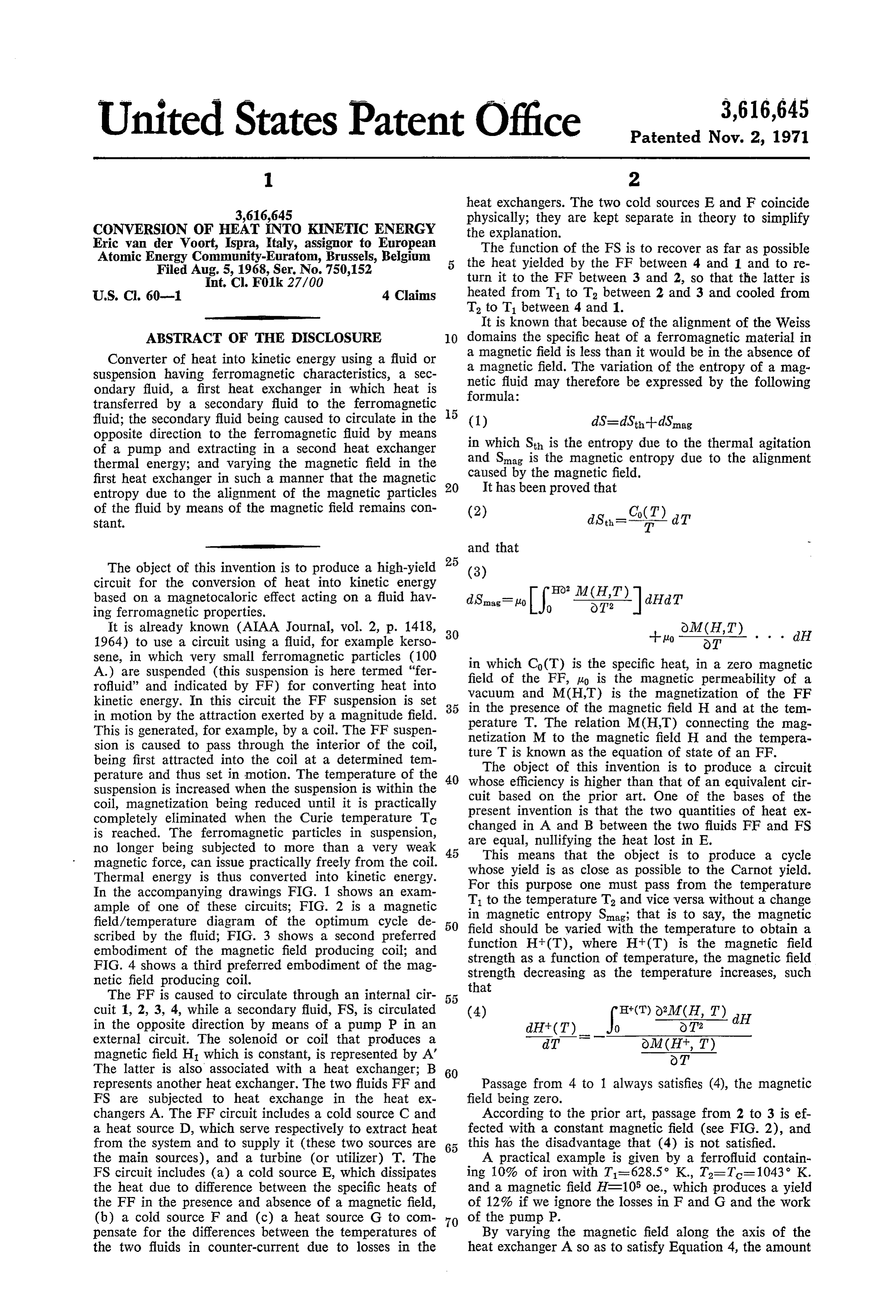
ABSTRACT OF THE DISCLOSURE O domains the specific heat of a ferromagnetic material in Converter of heat into kinetic energy using a fluid or a magnetic field is less than it would be in the absence of suspension having ferromagnetic characteristics, a sec a magnetic field. The variation of the entropy of a mag ondary fluid, a first heat exchanger in which heat is netic fluid may therefore be expressed by the following transferred by a secondary fluid to the ferromagnetic 5 formula:
fluid; the secondary fluid being caused to circulate in the (1) dS=dSth-dSmag opposite direction to the ferromagnetic fluid by means in which Sth is the entropy due to the thermal agitation of a pump and extracting in a second heat exchanger and Smag is the magnetic entropy due to the alignment thermal energy; and varying the magnetic field in the first heat exchanger in such a manner that the magnetic 20 caused by the magnetic field. It has been proved that entropy due to the alignment of the magnetic particles of the fluid by means of the magnetic field remains con 2
Stant. (2) dS=9A) at
The object of this invention is to produce a high-yield 25 (3) circuit for the conversion of heat into kinetic energy
based on a magnetocaloric effect acting on a fluid hav ing ferromagnetic properties. disa-lo?, MgT) dHT
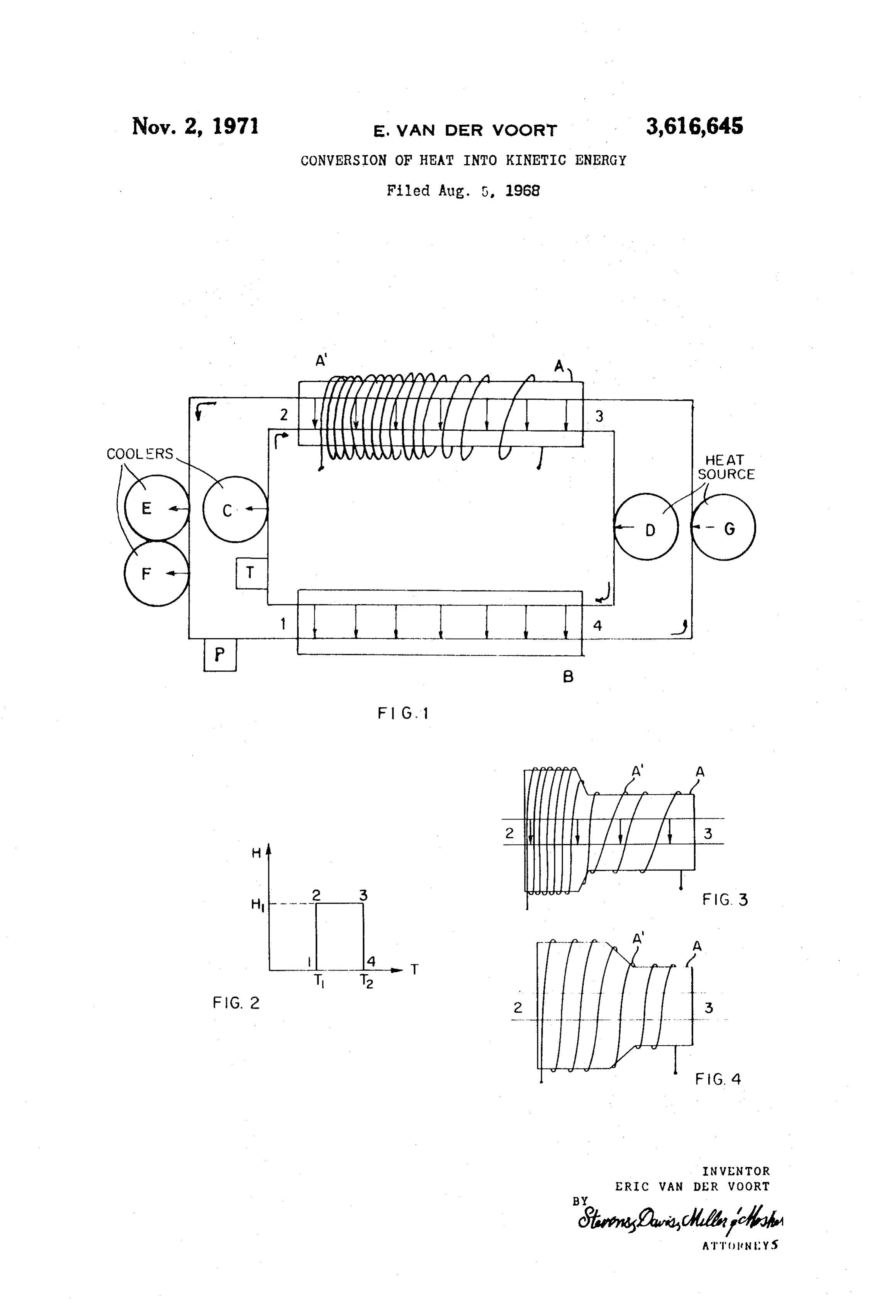
It is already known (AIAA Journal, vol. 2, p. 1418, OM (H, 1964) to use a circuit using a fluid, for example kerso 30 + O.E.T). . . . dEH sene, in which very small ferromagnetic particles (100 in which Co(T) is the specific heat, in a zero magnetic A.) are suspended (this suspension is here termed "fer field of the FF, pio is the magnetic permeability of a rofluid' and indicated by FF) for converting heat into kinetic energy. In this circuit the FF suspension is set 35 vacuum in the and M(H,T) is the magnetization of the FF presence of the magnetic field H and at the tem in motion by the attraction exerted by a magnitude field. perature T. The relation M(HT) connecting the mag This is generated, for example, by a coil. The FF suspen netization M to the magnetic field H and the tempera sion is caused to pass through the interior of the coil, ture T is known as the equation of state of an FF. being first attracted into the coil at a determined tem The object of this invention is to produce a circuit perature and thus set in motion. The temperature of the 40 whose efficiency is higher than that of an equivalent cir suspension is increased when the suspension is within the cuit based on the prior art. One of the bases of the coil, magnetization being reduced until it is practically present invention is that the two quantities of heat ex completely eliminated when the Curie temperature Tc changed in A and B between the two fluids FF and FS is reached. The ferromagnetic particles in suspension, no longer being subjected to more than a very weak 45 areThis equal, nullifying the heat lost in E. means that the object is to produce a cycle magnetic force, can issue practically freely from the coil. whose yield is as close as possible to the Carnot yield. Thermal energy is thus converted into kinetic energy. For this purpose one must pass from the temperature In the accompanying drawings FIG. 1 shows an exam T to the temperature T and vice versa without a change ample of one of these circuits; FIG. 2 is a magnetic in magnetic entropy Sma; that is to say, the magnetic field/temperature diagram of the optimum cycle de 50 field should be varied with the temperature to obtain a scribed by the fluid; FIG. 3 shows a second preferred function. H+(T), where H+ (T) is the magnetic field embodiment of the magnetic field producing coil; and strength as a function of temperature, the magnetic field FIG. 4 shows a third preferred embodiment of the mag strength decreasing as the temperature increases, such netic field producing coil.
The FF is caused to circulate through an internal cir 55 that cuit 1, 2, 3, 4, while a secondary fluid, FS, is circulated in the opposite direction by means of a pump P in an (4) dH+(T) Jo?ect O'MGHT) T2 at external circuit. The solenoid or coil that produces a - T - oM (H+, T) magnetic field H which is constant, is represented by A T The latter is also associated with a heat exchanger; B 60 represents another heat exchanger. The two fluids FF and Passage from 4 to 1 always satisfies (4), the magnetic FS are subjected to heat exchange in the heat ex field being zero.
changers A. The FF circuit includes a cold source C and According to the prior art, passage from 2 to 3 is ef a heat source D, which serve respectively to extract heat fected with a constant magnetic field (see FIG. 2), and from the system and to Supply it (these two sources are 65 this has the disadvantage that (4) is not satisfied. the main sources), and a turbine (or utilizer) T. The A practical example is given by a ferrofluid contain FS circuit includes (a) a cold source E, which dissipates ing 10% of iron with T=628.5 K., T= T=1043 K. the heat due to difference between the specific heats of and a magnetic field H=105 oe., which produces a yield the FF in the presence and absence of a magnetic field, of 12% if we ignore the losses in F and G and the work (b) a cold source F and (c) a heat Source G to com 70 of the pump P.
pensate for the differences between the temperatures of By varying the magnetic field along the axis of the the two fluids in counter-current due to losses in the heat eXchanger Aso as to satisfy Equation 4, the amount
Page 3
of heat lost in E becomes zero, and, with identical con means for accelerating said ferromagnetic fluid in a closed ditions, a 40% yield will be obtained: circuit, said accelerating means including said magnetic field; said closed circuit containing a cold source upstream q=1-2 = 40% of said first heat exchanger and a heat source downstream of said first heat exchanger; pump means for circulating where "eta" (m) represents the efficiency obtained. said secondary fluid in a direction generally opposite to That is, the passage from 2 to 3 is effected without a that of said ferromagnetic fluid; second heat exchanger change in magnetic entropy as required by (4). means for extracting thermal energy from said ferro The variation in the magnetic field within the coil as magnetic fluid; external heat source means for heating said sociated with the fact that the specific heat of the fluid O secondary fluid between said second and said first heat in question, in the presence of a magnetic field, is less exchanger means; and cold source means for cooling said than in the absence of the field enable a higher yield to secondary fluid between said first and said second heat be obtained than was possible before this invention. exchanger means; wherein the magnetic field in said first According to the main feature of the invention, the heat exchanger has a magnetic-field-strength profile which magnetic field in the first heat exchanger has a variable 5 varies along the axis of movement of said ferromagnetic magnetic-field-strength profile along the axis of move fluid in such manner that the magnetic entropy due to the ment of the ferromagnetic fluid such that the magnetic alignment of the magnetic particles of said ferromagnetic entropy due to the alignment of the particles by means fluid by means of said magnetic field remains substantially of the magnetic field remains substantially constant. constant, wherein said magnetic-field-strength profile is According to another feature of the invention, the 20 produced in a coil associated with said first heat exchanger profile of the magnetic field within the coil is varied by and the density of the turns along the axis of said coil varying the density of the turns of the coil. is made variable according to the desired magnetic-field According to another feature of the invention, the profile.
profile of the magnetic field within the coil is varied 2. A converter of heat into kinetic energy using a fluid by varying the diameter of the turns of the coil. 25 or suspension having ferromagnetic characteristics, com The circuits according to the invention will now be prising: first heat exchanger means for transferring heat described more specifically again with reference to from a secondary fluid to said ferromagnetic fluid; means FIG. 1, in which A and B represent the first and second for subjecting said ferromagnetic fluid to a magnetic field; heat exchangers respectively, and C and F the cold means for accelerating said ferromagnetic fluid in a closed sources, for example radiators, the cold source E is omit 30 circuit, said accelerating means including said magnetic ted, since the system used eliminates the heat passing field; said closed circuit containing a cold source upstream through it. The heat sources D and G may be formed by of said first heat exchanger and a heat source downstream two separate parts of a single heater, for example a of said first heat exchanger; pump means for circulating nuclear reactor, while the utilizer T may be formed, for said secondary fluid in a direction generally opposite to example, by a turbine or MHD (magnetohydro dynamic) generator or equivalent external apparatus. that of said ferromagnetic fluid; second heat exchanger The practical production of the coil solenoid does means for extracting thermal energy from said ferro not present any technological difficulties, as the follow magnetic fluid; external heat source means for heating said ing example shows: secondary fluid between said second and said first heat eXchanger means; and cold source means for cooling said
Axial length of solenoid 1 m. the solenoid is subdivided 40 Secondary fluid between said first and said second heat into transverse sections: exchanger means; wherein the magnetic field in said first Diameter of transverse sections 0.1 m. heat exchanger has a magnetic-field-strength profile which Number of transverse sections 50. Ivaries along the axis of movement of said ferromagnetic Each transverse section is formed by a number of 45 fluid in such manner that the magnetic entropy due to the alignment of the magnetic particles of said ferromagnetic turns of contant diameter to that of the section. Each fluid by means of said magnetic field remains substantially section contains a different number of turns. constant, wherein said magnetic-field-strength profile is In this case, the density of the turns is varied along the produced by a coil associated with said first heat exchang solenoid while their diameter remains constant.
If, however, one wished to keep the density of the 50 and the er diameter of the turns of said coil is made turns constant, their diameters would be varied accord variable according to the desired magnetic-field profile. 3. A converter of heat into kinetic energy using a fluid ing to the desired field profile. Furthermore it is possible Or suspension having ferromagnetic characteristics, com to vary both the density and the diameter of the turns. prising: first heat exchanger means for transferring heat It is also possible to vary the current strength in the from a secondary fluid to said ferromagnetic fluid; means sections.
The system according to this invention may be used for subjecting said ferromagnetic fluid to a magnetic field; in nuclear reactors operating at high temperatures means for accelerating said ferromagnetic fluid in a closed (900-1100° C.). In this case the coolant represents the circuit, said accelerating means including said magnetic heat source of the system, while the cold source is field; said closed circuit containing a cold source up formed by steam or other vapour. 60 stream of said first heat exchanger and a heat source The fact that this system is smaller and lighter in downstream of said first heat exchanger; pump means for weight and also has a distinctly higher yield than con circulating said secondary fluid in a direction generally ventional converters makes its use interesting and high opposite to that of said ferromagnetic fluid; second heat eXchanger means for extracting thermal energy from said ly competitive where weight restriction is of prime im ferromagnetic portance, for example in space. 65 fluid; external heat source means for heat The invention is not limited to the form described and ing said secondary fluid between said second and said illustrated in the accompanying drawings, but includes first heat exchanger means; and cold source means for the many variants that may be used without going be cooling said secondary fluid between said first and said yond the principle of the invention. second heat exchanger means; wherein the magnetic field I claim: 70 in Said first heat exchanger has a magnetic-field-strength 1. A converter of heat into kinetic energy using a fluid profile which varies along the axis of movement of said or suspension having ferromagnetic characteristics, com ferromagnetic fluid in such manner that the magnetic en prising: first heat exchanger means for transferring heat tropy due to the alignment of the magnetic particles of from a secondary fluid to said ferromagnetic fluid; means said ferromagnetic fluid by means of said magnetic field for subjecting said ferremagnetic fluid to a magnetic field; 75 remains substantially constant, wherein said magnetic
Page 4
field-strength profile is produced by a coil associated with ferromagnetic fluid in such manner that the magnetic said first heat exchanger and the variation of said mag entropy due to the alignment of the magnetic particles of netic-field-strength profile along the axis of said coil is said ferromagnetic fluid by means of said magnetic field obtained by varying the density of the turns of said coil remains substantially constant, wherein said first heat ex and the diameter of said turns. changer comprises coils through which current flows to 4. A converter of heat into kinetic energy using a fluid create said magnetic field, said current remaining constant or suspension having ferromagnetic characteristics, com with time.
prising: first heat exchanger means for transferring heat References Cited from a secondary fluid to said ferromagnetic fluid; means UNITED STATES PATENTS for subjecting said ferromagnetic fluid to a magnetic field; O
means for accelerating said ferromagnetic fluid in a closed 3,257,949 6/1966 Mead -------------- 103-1 X circuit, said accelerating means including said magnetic field; said closed circuit containing a cold source up 3,348,487 10/1967 Miller ------------- 103-1 X stream of said first heat exchanger and a heat Source 3,448,751 6/1969 Rosaen ------------ 103-1 X downstream of said first heat exchanger; pump means for 15 OTHER REFERENCES circulating said secondary fluid in a direction generally opposite to that of said ferromagnetic fluid; second heat AIAA Journal, vol. 2 pp. 1418-1420 (1964), Resler & exchanger means for extracting thermal energy from Said Rosensweig.
ferromagnetic fluid; external heat source means for heat ing said secondary fluid between said second and said 20 MARTIN P. SCHWADRON, Primary Examiner first heat exchanger means; and cold source means for L. J. PAYNE, Assistant Examiner cooling said secondary fluid between said first and said second heat exchanger means; wherein the magnetic field U.S. C. X.R. in said first heat exchanger has a magnetic-field-strength 60-36; 417-50 profile which varies along the axis of movement of said 25
Provenance
- Collection
- Cited prior art
- Original PDF
- patentimages.storage.googleapis.com →
- Filed
- 1968-08-05
- Pages
- 4
- Method
- pdftotext (the PDF's own text layer) + pdftoppm 300dpi page scans
- Source
- Google Patents bibliographic record
- Granted
- 1971-11-02
- Inventors
- Eric Van Der Voort; European Atomic Energy Community Euratom
- Transcribed from
- patentimages.storage.googleapis.com →