patent · US5941219
Method and apparatus for cleaning exhaust gas by alpha-decay
24 August 1999
Page 1 — bibliographic record
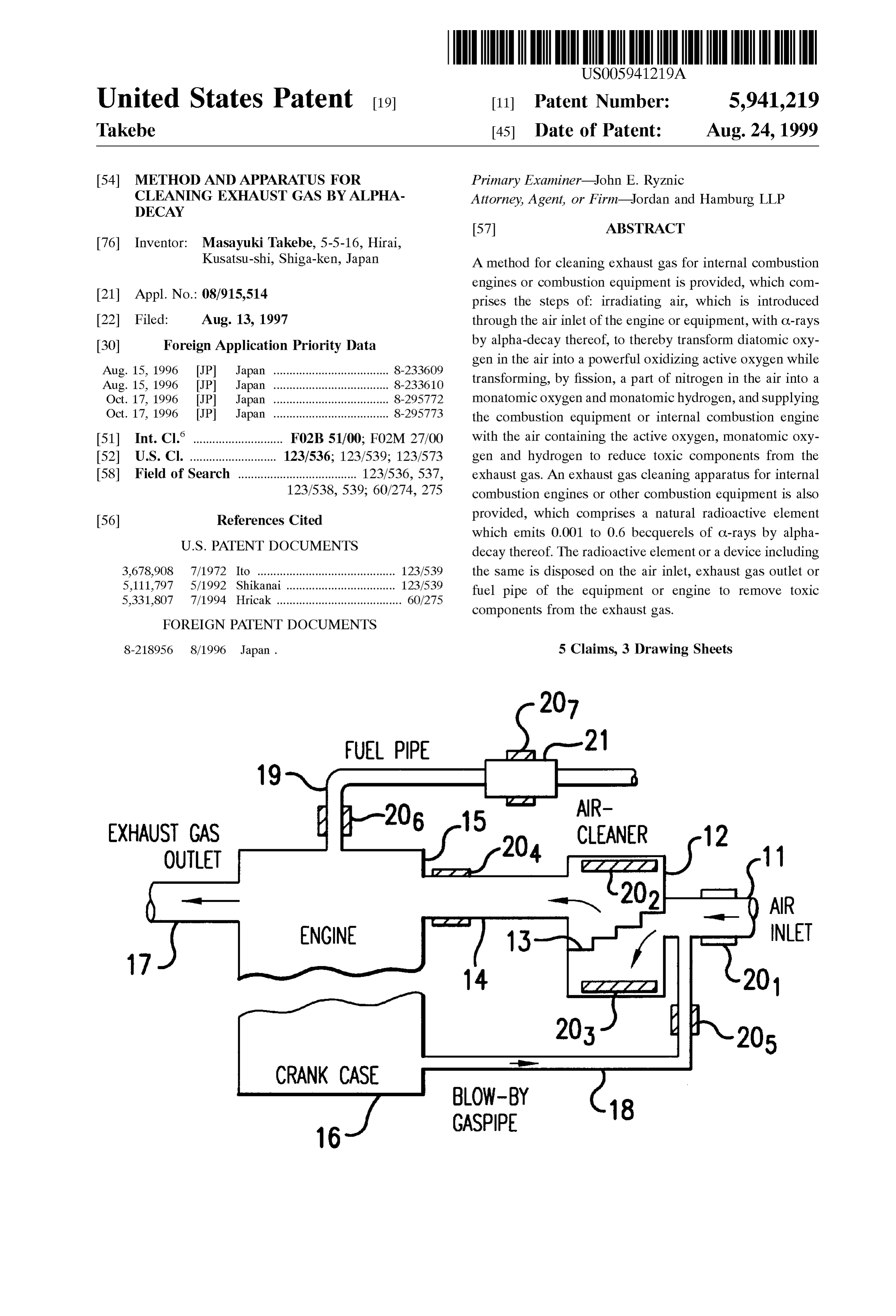
United States Patent (19) 11 Patent Number: 5,941,219 Takebe (45) Date of Patent: Aug. 24, 1999 54 METHOD AND APPARATUS FOR Primary Examiner John E. Ryznic CLEANING EXHAUST GAS BY ALPHA Attorney, Agent, or Firm Jordan and Hamburg LLP
DECAY
76 Inventor: Masayuki Takebe, 5-5-16, Hirai,
Kusatsu-shi, Shiga-ken, Japan A method for cleaning exhaust gas for internal combustion engines or combustion equipment is provided, which com 21 Appl. No.: 08/915,514 prises the Steps of irradiating air, which is introduced 22 Filed: Aug. 13, 1997 through the air inlet of the engine or equipment, with C-rays 30 Foreign Application Priority Data by alpha-decay thereof, to thereby transform diatomic oxy gen in the air into a powerful oxidizing active oxygen while
Aug. 15, 1996 JP Japan .................................... 8-233609 transforming, by fission, a part of nitrogen in the air into a
Oct. 17, 1996 JP Japan .... monatomic oxygen and monatomic hydrogen, and Supplying Oct. 17, 1996 JP Japan ... s. 295773 the combustion equipment or internal combustion engine 51 Int. Cl. ............................ F02B 51/00; F02M 27/00 with the air containing the active oxygen, monatomic oxy 52 U.S. Cl. ........................... 123/536; 123/539; 123/573 gen and hydrogen to reduce toxic components from the 58 Field of Search ..................................... 123/536,537, exhaust gas. An exhaust gas cleaning apparatus for internal 123/538,539; 60/274, 275 combustion engines or other combustion equipment is also 56) References Cited provided, which comprises a natural radioactive element which emits 0.001 to 0.6 becquerels of C-rays by alpha
decay thereof. The radioactive element or a device including 3,678,908 7/1972 Ito ........................................... 123/539 the same is disposed on the air inlet, exhaust gas outlet or 5,111,797 5/1992 Shikanai. ... 123/539 fuel pipe of the equipment or engine to remove toxic 5,331,807 7/1994 Hricak ....................................... 60/275 components from the exhaust gas.
FOREIGN PATENT DOCUMENTS
8-218956 8/1996 Japan. 5 Claims, 3 Drawing Sheets
AIR
EXHAUST CAS CLEANER
OUTLET
GASPIPE
Page 2
Drawing sheet — no readable text.
Page 3
Drawing sheet — no readable text.
Page 4
Drawing sheet — no readable text.
Page 5
METHOD AND APPARATUS FOR transforming, by fission, a part of nitrogen in the air into a CLEANING EXHAUST GAS BY ALPHA monatomic oxygen and monatomic hydrogen, and Supplying DECAY the combustion equipment or internal combustion engine with the air containing the active oxygen, monatomic oxy
BACKGROUND OF THE INVENTION gen and hydrogen to reduce toxic components from the 1. Field of the Invention exhaust gas.
The present invention relates to a method and apparatus ingAlso the present invention provides an exhaust gas clean apparatus for internal combustion engines or other for cleaning exhaust gas exhausted from combustion equip combustion equipment, comprising members each made of ment Such as a boiler, incinerator, etc. and internal combus a Substance containing a natural radioactive element which tion engines Such as a gasoline engine, diesel engine, etc. emits 0.001 to 0.6 becquerels of C-rays by alpha-decay 2. Description of the Prior Art thereof, or a device including the member, and disposed on The exhaust gas from internal combustion engines Such as the air inlet, exhaust gas outlet and fuel pipe of the equip the gasoline engine, diesel engine, etc. contains Various ment or engine to remove toxic components from the kinds of toxic Substances. To improve the rate of fuel 15 exhaust gas.
consumption and clean the exhaust gas, it has been proposed According to the present invention, a part of nitrogen in to use an exhaust gas cleaner using a catalyst, to attain a the air undergoes, when irradiated with C-rays, and a fission complete combustion of the fuel by electronically control transformation into oxygen and hydrogen So that the oxygen ling the Supply of air and fuel to the engine, etc. in the air is increased in concentration and the oxygen in the To remove toxic components from the exhaust gas of air is transformed into a powerful oxidizing active oxygen. combustion equipment Such as a boiler, incinerator, etc., it Also, irradiation of C-rays, B-rays and Y-rays to hydro has been proposed to use an apparatus which provides a carbon in the fuel promotes the decomposition and bridging complete combustion of fuel by automatic control of the reactions, which is estimated to be due to the effects of combustion in the furnace, to provide a Stack gas desulfu 25 ionization, excitation, etc. of the hydrogen and carbon rization and denitration facility, an electric precipitator, etc. atOmS.
in combination with the combustion, etc. Since the fuel is thus completely burnt by the above The exhaust gas from internal combustion engines con mentioned active oxygen, the toxic Substances in the exhaust tains carbon monoxide(CO), hydrocarbon(HC), nitrogen gas are reduced and thus the exhaust gas is cleaned. That is oxides(NO), black Smoke, etc. It is considered that Such to Say, the method for cleaning the exhaust gas is extremely toxic components are caused to develop by any of the Simple and the cleaning apparatus needs only a Small space following: for installation. The exhaust gas can be cleaned at low costs, (1) Incomplete combustion due to insufficient Supply of and the rate of fuel consumption can be effectively air improved.
(2) Dissociative thermo-reaction of carbon dioxide(CO) 35 These objects and other objects, features, aspects and and steam (H2O) during combustion at an elevated tempera advantages of the present invention will become more ture apparent from the following detailed description of the (3) Generation of intermediate products during incom present invention when taken in conjunction with the plete combustion accompanying drawings.
The combustion equipment Such as a boiler, incinerator, BRIEF DESCRIPTION OF THE DRAWINGS etc. exhausts, together with a large Volume of Sulfur oxides
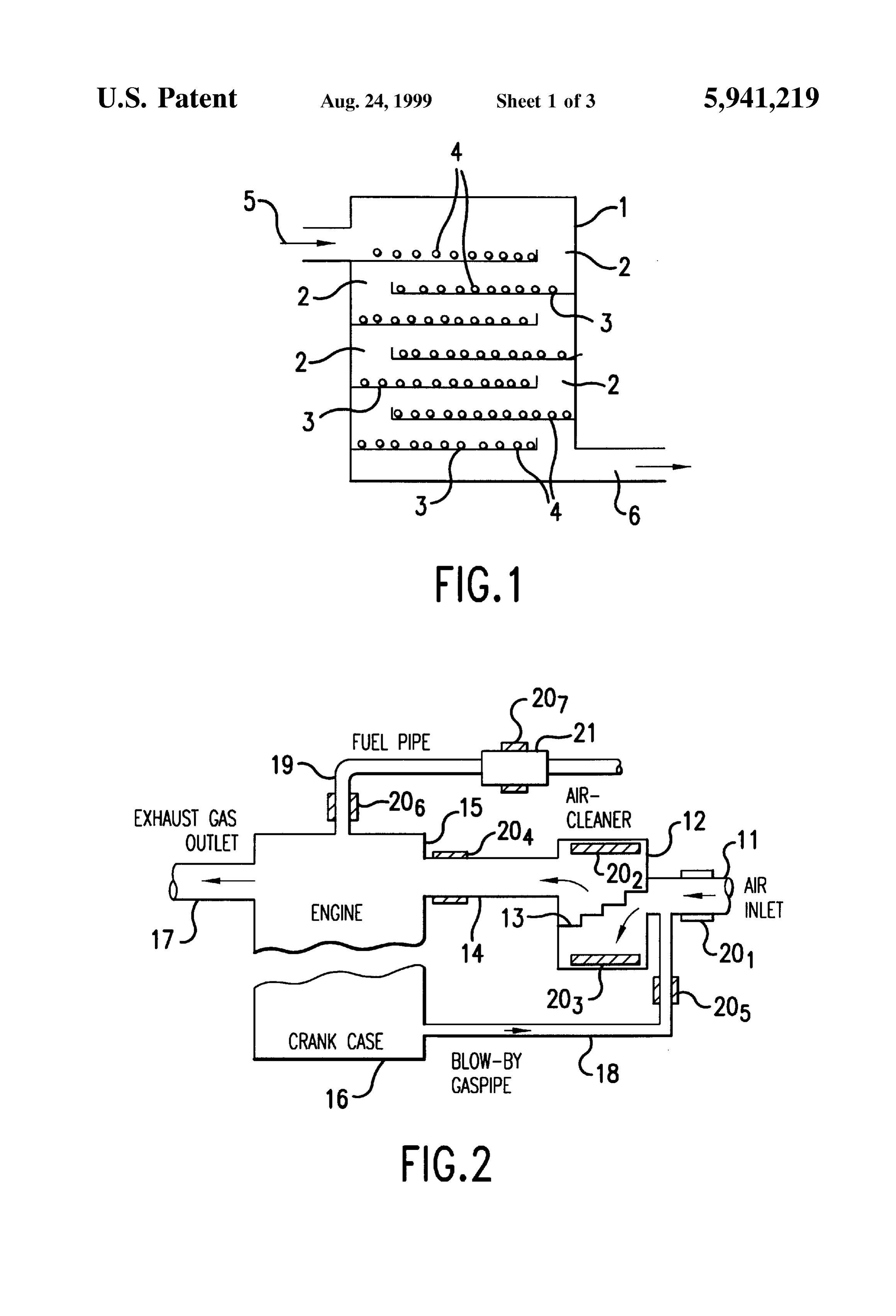
(SO) and nitrogen oxides(NO) yielded from a fuel such as FIG. 1 shows the construction of an active oxygen gen oil, coal or the like and coarse particulates and dust resulting erator according to the present invention, installed in the air from incomplete combustion of the fuel. inlet,
The conventional exhaust gas cleaner does not of remove FIG. 2 is an explanatory drawing showing sheets each the toxic components Satisfactory. The exhaust gas cannot be made of a Substance containing a natural radioactive effectively removed without a plurality of such cleaners in element, installed on the air inlet and fuel pipe of an internal combination. The cleaners require a large Space for instal combustion engine;
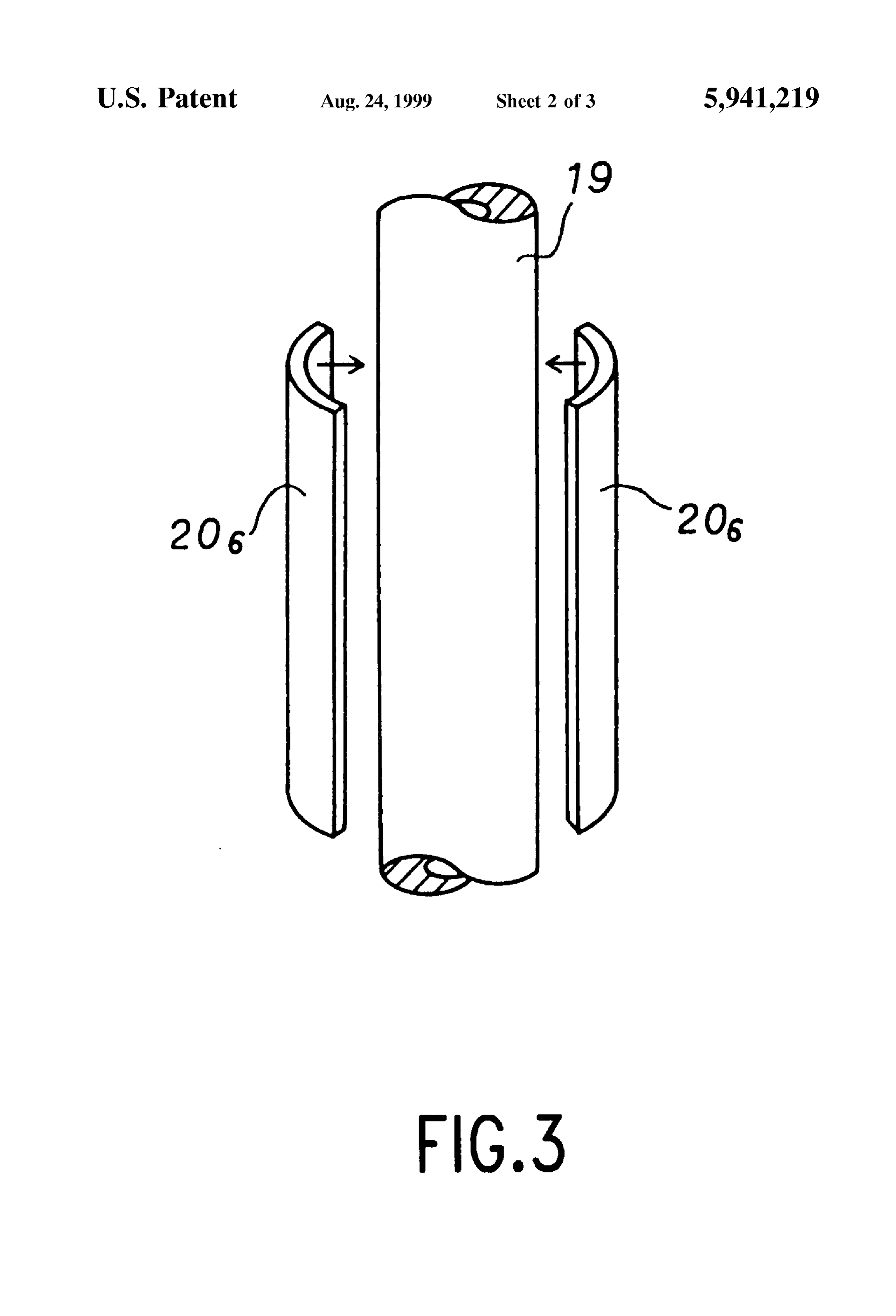
lation and also large costs. 50 FIG. 3 is a perspective view showing a method for installing the sheet on the fuel pipe, and
SUMMARY OF THE PRESENT INVENTION
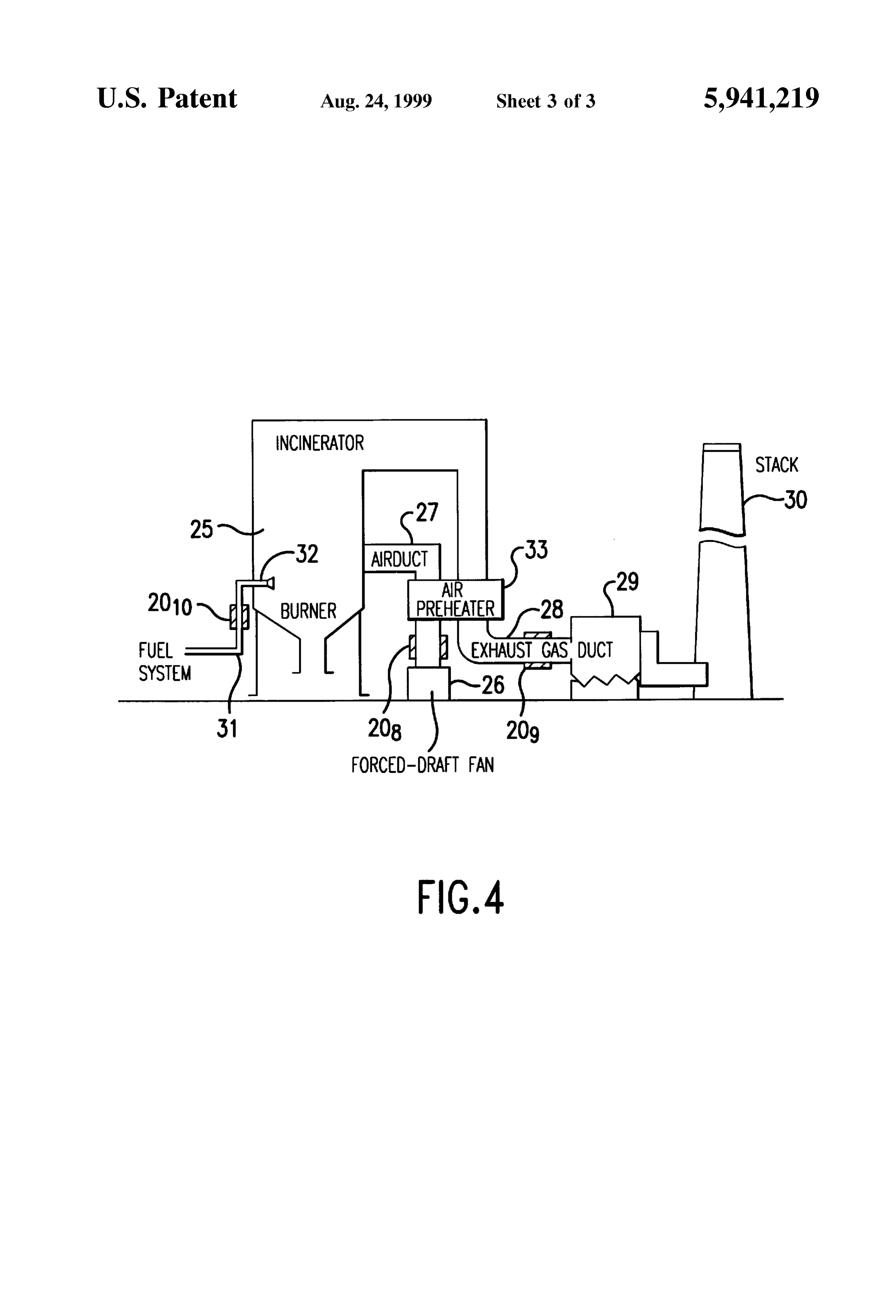
FIG. 4 is an explanatory drawing showing the sheet
Accordingly, the present invention has an object to over member installed in an incinerator.
come the above-mentioned drawbacks of the prior art by DETAILED DESCRIPTION OF THE providing a method and apparatus for cleaning exhaust gas, 55 PREFERRED EMBODIMENTS permitting the exhaust gas to be cleaned at low costs and improving the rate of fuel consumption by attaining com FIG. 1 shows the construction of an active oxygen gen plete combustion of the fuel. The apparatus does not require erator installed in the air inlet of combustion equipment Such a large Space for installation and is very easy to install. as a boiler, incinerator or the like. The above object is accomplished by providing a method 60 AS shown, the active oxygen generator has an enclosure for cleaning exhaust gas, destined for internal combustion 1 inside which shelves 3 are so laid as to form an air path 2. engines or other combustion equipment, comprising the Granules 4 of a Substance containing a radioactive element Steps of irradiating to air through the air passage of the are dispersed on the shelves 3. The enclosure 1 has an air engine or equipment C-rays emerging from a natural radio inlet 5 and outlet 6. Oxygen contained in the air Supplied active element which emits 0.001 to 0.6 becquerels of C-rays 65 from the air inlet 5 into the enclosure 1 is irradiated with by alpha-decay thereof, to thereby transform diatomic oxy C-rays emerging from the granules 4 and transformed into gen in the air into a powerful oxidizing active oxygen while an active oxygen while nitrogen in the Supplied air under
Page 6
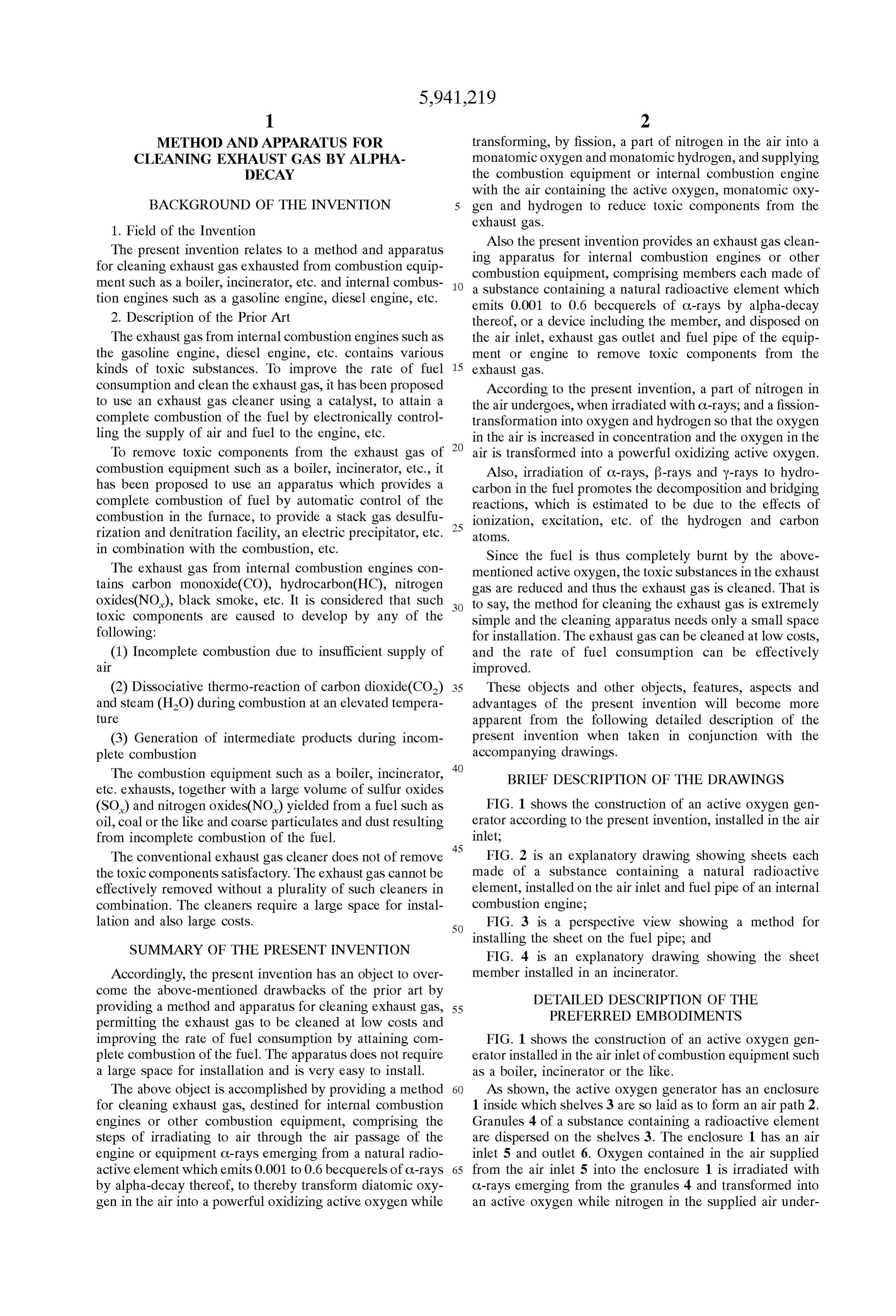
goes a fission-transformation into monatomic oxygen and a highly reactive oxygen atom having an atomic number 17 hydrogen. Thus, the air containing the active oxygen, mona and hydrogen atom having an atomic number 1 as in the tomic oxygen and hydrogen is discharged from the outlet 6 following:
of the enclosure 1.
FIG. 2 shows an example of sheets, each made of a 4N + He -- SO + H
Substance containing a natural radioactive element, installed on the air inlet and fuel pipe of an electric-ignition com bustion engine.
AS shown, the internal combustion engine has an air inlet It is considered that the above-mentioned combination of 11, air-cleaner 12, air-cleaner element (filter) 13, intake pipe the transformation of the part of the nitrogen in the Supplied 14, combustion chamber 15 consisting of a cylinder and air into oxygen and hydrogen and the transformation of the cylinder head and a crank case 16, and an exhaust gas outlet diatomic oxygen in air into the powerful oxidizing oxygen, 17. Air is supplied from the air inlet 11 and passed through will improve the fuel ignitability and combustion efficiency the filter 13 into the combustion chamber 15 via the intake of the internal combustion engine and combustion 15 equipment, to thereby reduce the amounts of hydrocarbon pipe 14. The combustion gas from the combustion chamber 15 is discharged from the exhaust gas outlet 17. and carbon monoxide in the exhaust gas and that the exhaust The combustion gas leaking through the clearance tion isisthus gas effectively cleaned and the rate of fuel consump improved.
between the piston and ring into the crank case 16 is recirculated to the air cleaner 12 via a blow-by gas pipe 18 dueMore particularly, the monatomic oxygen (O) produced to the atomic nucleus-transformation of the nitrogen will to SuppreSS generation of hydrocarbon.
react with the carbon monoxide (CO) to produce carbon
As seen in FIG. 2, sheets 20 to 207, which are made of dioxide as in the following. In other words, the fuel will be a Substance containing a natural radioactive element, are completely burnt.
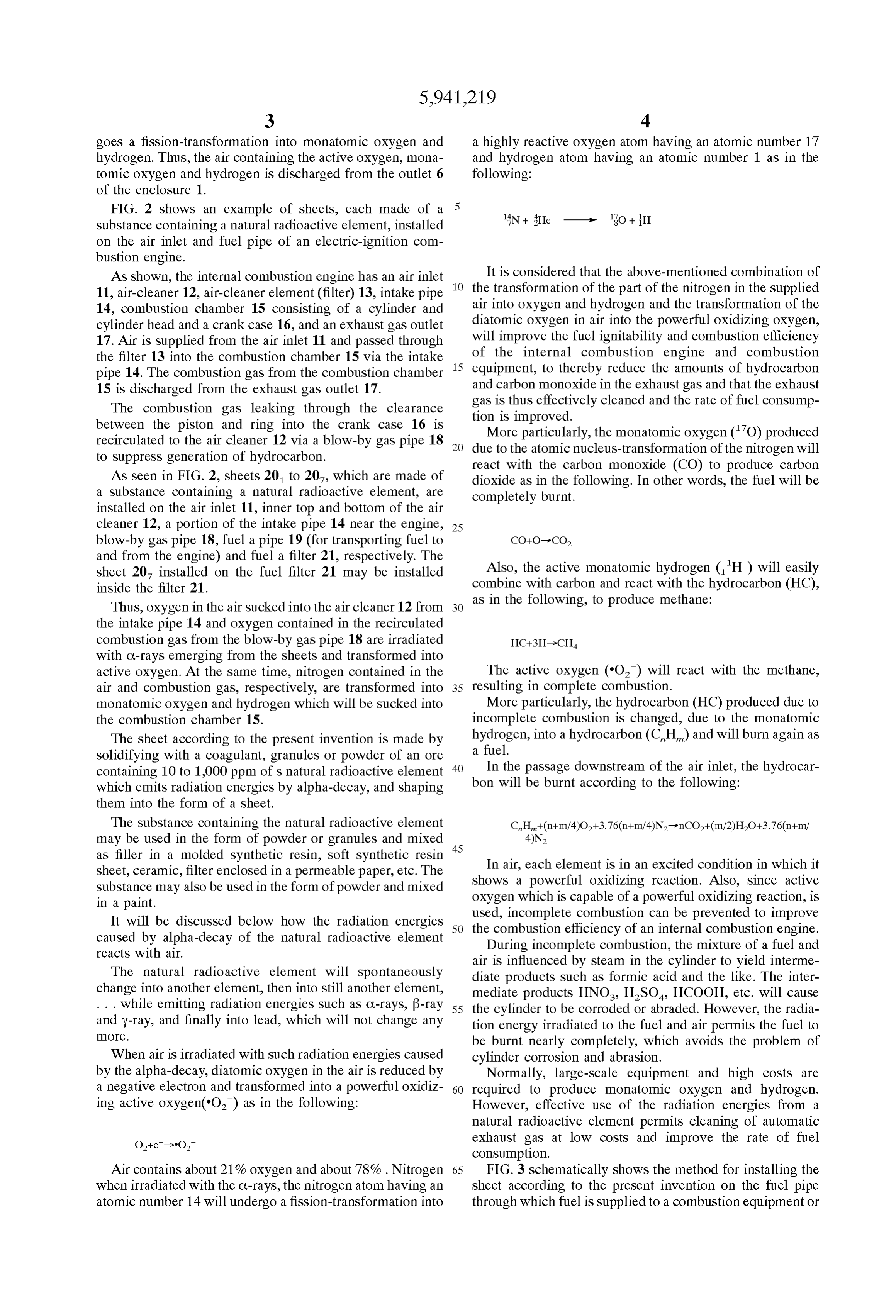
installed on the air inlet 11, inner top and bottom of the air cleaner 12, a portion of the intake pipe 14 near the engine, 25 blow-by gas pipe 18, fuel a pipe 19 (for transporting fuel to and from the engine) and fuel a filter 21, respectively. The sheet 20, installed on the fuel filter 21 may be installed Also, the active monatomic hydrogen (H) will easily inside the filter 21. combine with carbon and react with the hydrocarbon (HC), Thus, OXygen in the air Sucked into the air cleaner 12 from as in the following, to produce methane: the intake pipe 14 and oxygen contained in the recirculated combustion gas from the blow-by gas pipe 18 are irradiated with C-rays emerging from the sheets and transformed into active oxygen. At the same time, nitrogen contained in the The active oxygen (O) will react with the methane, air and combustion gas, respectively, are transformed into 35 resulting in complete combustion.
monatomic oxygen and hydrogen which will be Sucked into More particularly, the hydrocarbon (HC) produced due to the combustion chamber 15. incomplete combustion is changed, due to the monatomic The sheet according to the present invention is made by hydrogen, into a hydrocarbon (CH) and will burn again as Solidifying with a coagulant, granules or powder of an ore a fuel.
containing 10 to 1,000 ppm of S natural radioactive element 40 In the passage downstream of the air inlet, the hydrocar which emits radiation energies by alpha-decay, and shaping bon will be burnt according to the following: them into the form of a sheet.
The Substance containing the natural radioactive element may be used in the form of powder or granules and mixed 45 as filler in a molded Synthetic resin, Soft Synthetic resin sheet, ceramic, filter enclosed in a permeable paper, etc. The shows In air, each element is in an excited condition in which it Substance may also be used in the form of powder and mixed oxygen awhich powerful oxidizing reaction. Also, Since active is capable of a powerful oxidizing reaction, is in a paint.
used, incomplete
It will be discussed below how the radiation energies 50 the combustion efficiencycombustion can be prevented to improve caused by alpha-decay of the natural radioactive element of an internal combustion engine. reacts with air. During incomplete combustion, the mixture of a fuel and air is influenced by Steam in the cylinder to yield interme
The natural radioactive element will Spontaneously diate products Such as formic acid and the like. The inter change into another element, then into Still another element, mediate products HNO, HSO, HCOOH, etc. will cause . . . while emitting radiation energies Such as C.-rays, B-ray 55 the cylinder to be corroded or abraded. However, the radia and Y-ray, and finally into lead, which will not change any tion energy irradiated to the fuel and air permits the fuel to
be burnt nearly completely, which avoids the problem of
When air is irradiated with Such radiation energies caused cylinder corrosion and abrasion.
by the alpha-decay, diatomic oxygen in the air is reduced by Normally, large-scale equipment and high costs are a negative electron and transformed into a powerful oxidiz 60 required to produce monatomic oxygen and hydrogen. ing active oxygen(O) as in the following: However, effective use of the radiation energies from a natural radioactive element permits cleaning of automatic
O+e-erO. exhaust gas at low costs and improve the rate of fuel consumption.
Air contains about 21% oxygen and about 78%. Nitrogen 65 FIG. 3 schematically shows the method for installing the when irradiated with the C-rays, the nitrogen atom having an sheet according to the present invention on the fuel pipe atomic number 14 will undergo a fission-transformation into through which fuel is Supplied to a combustion equipment or
Page 7
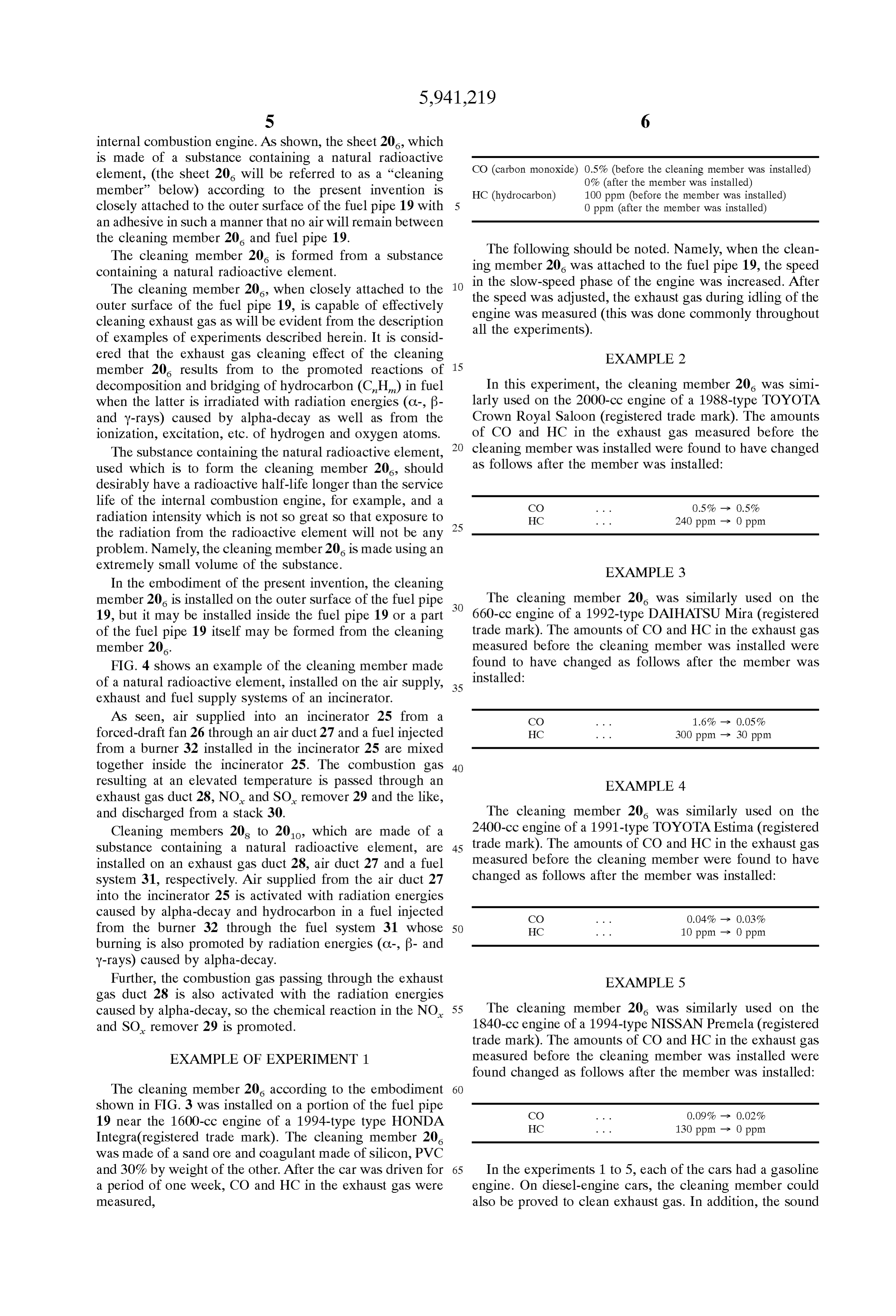
internal combustion engine. AS shown, the sheet 20, which is made of a Substance containing a natural radioactive element, (the sheet 20 will be referred to as a “cleaning CO (carbon monoxide) 0.5% (before the cleaning member was installed) member” below) according to the present invention is 0% (after the member was installed) HC (hydrocarbon) 100 ppm (before the member was installed) closely attached to the outer Surface of the fuel pipe 19 with 0 ppm (after the member was installed) an adhesive in Such a manner that no air will remain between the cleaning member 20 and fuel pipe 19.
The cleaning member 20 is formed from a substance ingThe following should be noted. Namely, when the clean member 20 was attached to the fuel pipe 19, the speed containing a natural radioactive element. in the slow-speed phase of the engine was increased. After The cleaning member 20, when closely attached to the the Speed was adjusted, the exhaust gas during idling of the outer surface of the fuel pipe 19, is capable of effectively engine was measured (this was done commonly throughout cleaning exhaust gas as will be evident from the description all the experiments).
of examples of experiments described herein. It is consid ered that the exhaust gas cleaning effect of the cleaning EXAMPLE 2 member 20 results from to the promoted reactions of 15 decomposition and bridging of hydrocarbon (CH) in fuel In this experiment, the cleaning member 20 was simi when the latter is irradiated with radiation energies (Cl-, f larly used on the 2000-cc engine of a 1988-type TOYOTA and Y-rays) caused by alpha-decay as well as from the Crown Royal Saloon (registered trade mark). The amounts ionization, excitation, etc. of hydrogen and oxygen atoms. of CO and HC in the exhaust gas measured before the The Substance containing the natural radioactive element, cleaning member was installed were found to have changed used which is to form the cleaning member 20, should as follows after the member was installed: desirably have a radioactive half-life longer than the Service life of the internal combustion engine, for example, and a CO O.5% -> 0.5% radiation intensity which is not So great So that exposure to 25 HC 240 ppm -> 0 ppm the radiation from the radioactive element will not be any problem. Namely, the cleaning member 20 is made using an extremely Small Volume of the Substance. EXAMPLE 3 In the embodiment of the present invention, the cleaning member 20 is installed on the outer Surface of the fuel pipe The cleaning member 20 was similarly used on the 19, but it may be installed inside the fuel pipe 19 or a part 660-cc engine of a 1992-type DAIHATSU Mira (registered of the fuel pipe 19 itself may be formed from the cleaning trade mark). The amounts of CO and HC in the exhaust gas member 20. measured before the cleaning member was installed were FIG. 4 shows an example of the cleaning member made found to have changed as follows after the member was of a natural radioactive element, installed on the air Supply, 35 installed:
exhaust and fuel Supply Systems of an incinerator.
AS Seen, air Supplied into an incinerator 25 from a CO 1.6% -> 0.05% forced-draft fan 26 through an air duct 27 and a fuel injected HC 300 ppm -> 30 ppm from a burner 32 installed in the incinerator 25 are mixed together inside the incinerator 25. The combustion gas 40 resulting at an elevated temperature is passed through an EXAMPLE 4 exhaust gas duct 28, NO, and SO remover 29 and the like, and discharged from a stack 30. The cleaning member 20 was similarly used on the Cleaning members 20s to 20, which are made of a 2400-cc engine of a 1991-type TOYOTA Estima (registered Substance containing a natural radioactive element, are 45 trade mark). The amounts of CO and HC in the exhaust gas installed on an exhaust gas duct 28, air duct 27 and a fuel measured before the cleaning member were found to have system 31, respectively. Air Supplied from the air duct 27 changed as follows after the member was installed: into the incinerator 25 is activated with radiation energies caused by alpha-decay and hydrocarbon in a fuel injected CO O.04% -> 0.03% from the burner 32 through the fuel system 31 whose 50 HC 10 ppm -> 0 ppm burning is also promoted by radiation energies (Cl-, ?- and
Y-rays) caused by alpha-decay.
Further, the combustion gas passing through the exhaust EXAMPLE 5 gas duct 28 is also activated with the radiation energies caused by alpha-decay, So the chemical reaction in the NO 55 The cleaning member 20 was similarly used on the and SO remover 29 is promoted. 1840-cc engine of a 1994-type NISSAN Premela (registered trade mark). The amounts of CO and HC in the exhaust gas
EXAMPLE OF EXPERIMENT 1. measured before the cleaning member was installed were found changed as follows after the member was installed:
The cleaning member 20 according to the embodiment 60 shown in FIG. 3 was installed on a portion of the fuel pipe CO O.09% -> 0.02% 19 near the 1600-cc engine of a 1994-type type HONDA HC 130 ppm -> 0 ppm Integra(registered trade mark). The cleaning member 20 was made of a Sand ore and coagulant made of Silicon, PVC and 30% by weight of the other. After the car was driven for 65 In the experiments 1 to 5, each of the cars had a gasoline a period of one week, CO and HC in the exhaust gas were engine. On diesel-engine cars, the cleaning member could measured, also be proved to clean exhaust gas. In addition, the Sound
Page 8
from the diesel engines using the cleaning member accord was installed on the car engine having the Specifications ing to the present invention was reduced. Moreover, the shown below:
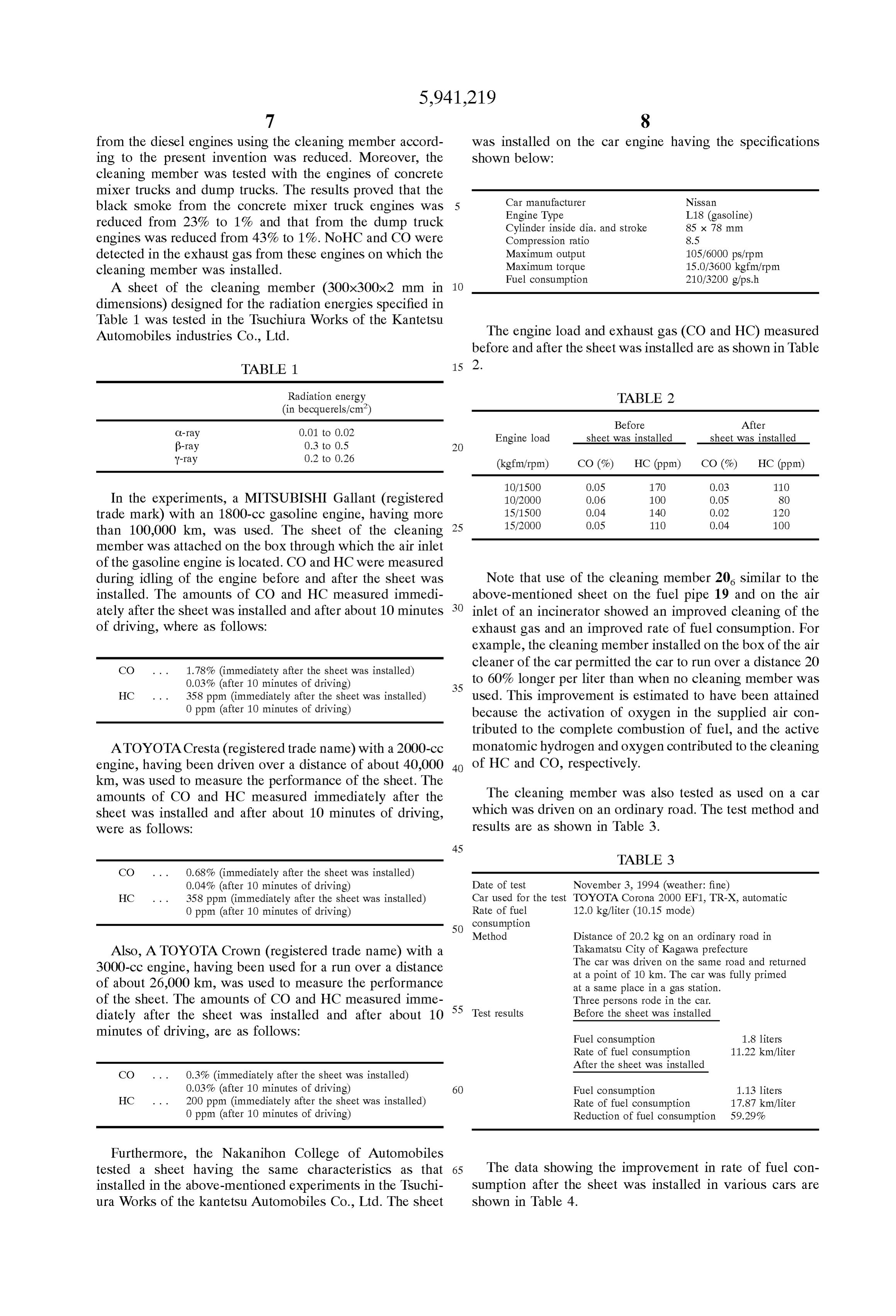
cleaning member was tested with the engines of concrete mixer trucks and dump trucks. The results proved that the Car manufacturer Nissan black Smoke from the concrete mixer truck engines was Engine Type L18 (gasoline) reduced from 23% to 1% and that from the dump truck Cylinder inside dia. and stroke 85 x 78 mm engines was reduced from 43% to 1%. NoHC and CO were Compression ratio 8.5 detected in the exhaust gas from these engines on which the Maximum output 105/6000 ps/rpm cleaning member was installed. Maximum torque 15.0/3600 kgfm/rpm
A sheet of the cleaning member (300x300x2 mm in 1O dimensions) designed for the radiation energies specified in
Table 1 was tested in the TSuchiura Works of the Kantetsu
Automobiles industries Co., Ltd. The engine load and exhaust gas (CO and HC) measured before and after the sheet was installed are as shown in Table
Radiation energy TABLE 2
C-ray O.O1 to O.O2 Engine load sheet was installed sheet was installed
(kgfm/rpm) CO (%) HC (ppm) CO (%) HC (ppm) 10/1500 O.OS 170 O.O3 110
In the experiments, a MITSUBISHI Gallant (registered 10/2OOO O.O6 1OO O.OS 8O trade mark) with an 1800-cc gasoline engine, having more 15/1500
than 100,000 km, was used. The sheet of the cleaning 25 member was attached on the box through which the air inlet of the gasoline engine is located. CO and HC were measured during idling of the engine before and after the Sheet was Note that use of the cleaning member 20 similar to the installed. The amounts of CO and HC measured immedi above-mentioned sheet on the fuel pipe 19 and on the air ately after the sheet was installed and after about 10 minutes inlet of an incinerator showed an improved cleaning of the of driving, where as follows: exhaust gas and an improved rate of fuel consumption. For example, the cleaning member installed on the box of the air
CO 1.78% (immediatety after the sheet was installed) cleaner of the car permitted the car to run over a distance 20
to 60% longer per liter than when no cleaning member was
HC 358 ppm (immediately after the sheet was installed) used. This improvement is estimated to have been attained 0 ppm (after 10 minutes of driving) because the activation of oxygen in the Supplied air con tributed to the complete combustion of fuel, and the active
ATOYOTA Cresta (registered trade name) with a 2000-cc monatomic hydrogen and oxygen contributed to the cleaning engine, having been driven over a distance of about 40,000 40 of HC and CO, respectively.
km, was used to measure the performance of the sheet. The amounts of CO and HC measured immediately after the The cleaning member was also tested as used on a car sheet was installed and after about 10 minutes of driving, which was driven on an ordinary road. The test method and were as follows: results are as shown in Table 3.
TABLE 3
CO 0.68% (immediately after the sheet was installed) 0.04% (after 10 minutes of driving) Date of test November 3, 1994 (weather: fine) HC 358 ppm (immediately after the sheet was installed) Car used for the test TOYOTA Corona 2000 EF1, TR-X, automatic 0 ppm (after 10 minutes of driving) Rate of fuel 12.0 kg/liter (10.15 mode) 50 consumption
Method Distance of 20.2 kg on an ordinary road in
Also, ATOYOTA Crown (registered trade name) with a Takamatsu City of Kagawa prefecture The car was driven on the same road and returned 3000-cc engine, having been used for a run over a distance at a point of 10 km. The car was fully primed of about 26,000 km, was used to measure the performance at a same place in a gas station. of the sheet. The amounts of CO and HC measured imme Three persons rode in the car. diately after the sheet was installed and after about 10 55 Test results Before the sheet was installed minutes of driving, are as follows: Fuel consumption 1.8 liters Rate of fuel consumption 11.22 km/liter
After the sheet was installed
CO 0.3% (immediately after the sheet was installed) 0.03% (after 10 minutes of driving) 60 Fuel consumption 1.13 liters HC 200 ppm (immediately after the sheet was installed) Rate of fuel consumption 17.87 km/liter 0 ppm (after 10 minutes of driving) Reduction of fuel consumption 59.29%
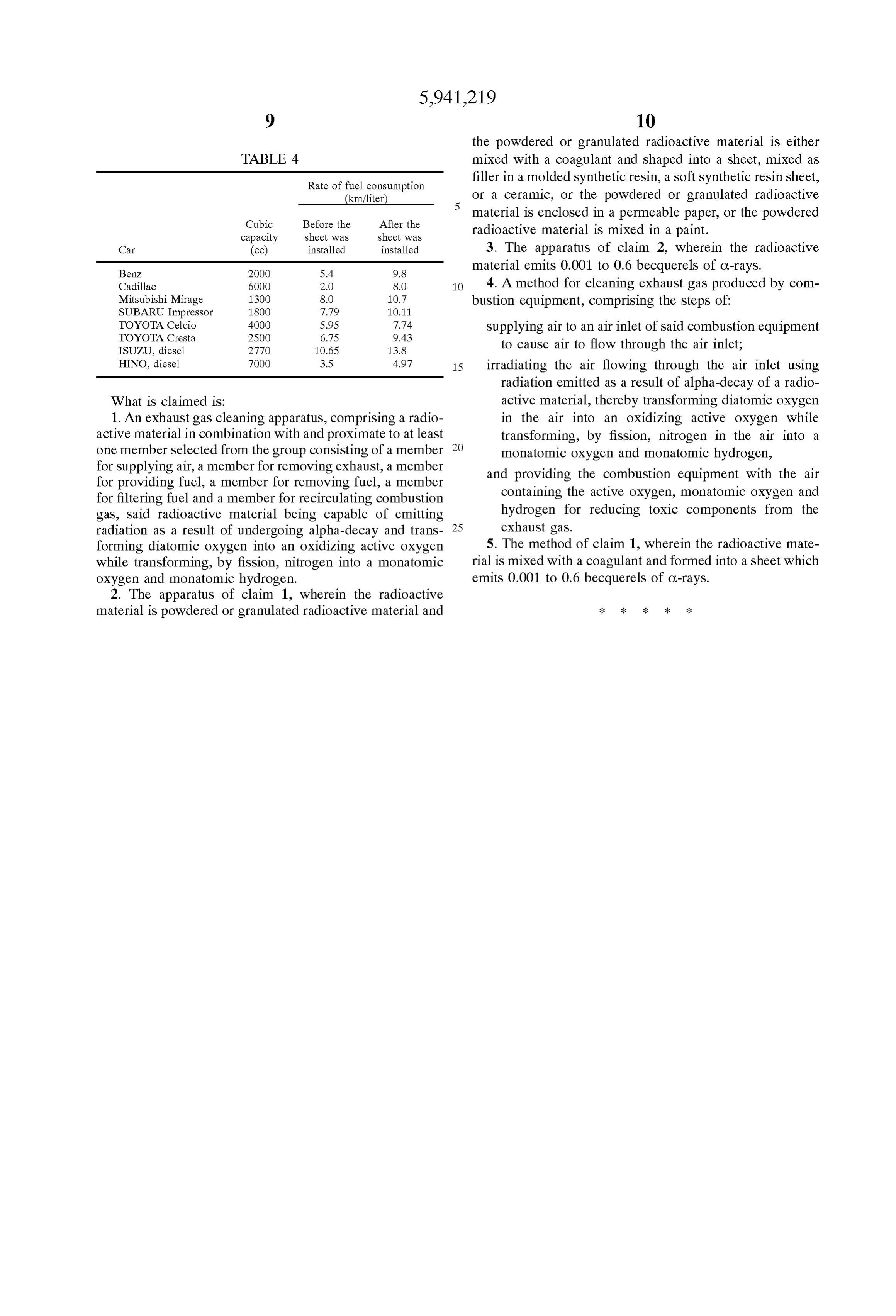
Furthermore, the Nakanihon College of Automobiles tested a sheet having the same characteristics as that 65 The data showing the improvement in rate of fuel con installed in the above-mentioned experiments in the TSuchi Sumption after the sheet was installed in various cars are ura Works of the kantetsu Automobiles Co., Ltd. The sheet shown in Table 4.
Page 9
the powdered or granulated radioactive material is either
TABLE 4 mixed with a coagulant and shaped into a sheet, mixed as Rate of fuel consumption filler in a molded Synthetic resin, a Soft Synthetic resin sheet, km/liter or a ceramic, or the powdered or granulated radioactive
Cubic Before the After the material is enclosed in a permeable paper, or the powdered capacity sheet was sheet was radioactive material is mixed in a paint.
Car (cc) installed installed 3. The apparatus of claim 2, wherein the radioactive
material emits 0.001 to 0.6 becquerels of C-rays.
Cadillac 6OOO 2.O 8.O 4. A method for cleaning exhaust gas produced by com Mitsubishi Mirage 13OO 8.O 10.7 bustion equipment, comprising the Steps of:
TOYOTA Cecio
TOYOTA Cresta
Supplying air to an air inlet of Said combustion equipment
ISUZU, diesel 2770 10.65 13.8 to cause air to flow through the air inlet; HINO, diesel 7OOO 3.5 4.97 15 irradiating the air flowing through the air inlet using radiation emitted as a result of alpha-decay of a radio
What is claimed is: active material, thereby transforming diatomic oxygen 1. An exhaust gas cleaning apparatus, comprising a radio in the air into an oxidizing active oxygen while active material in combination with and proximate to at least transforming, by fission, nitrogen in the air into a one member Selected from the group consisting of a member monatomic oxygen and monatomic hydrogen, for Supplying air, a member for removing exhaust, a member and providing the combustion equipment with the air for providing fuel, a member for removing fuel, a member containing the active oxygen, monatomic oxygen and for filtering fuel and a member for recirculating combustion gas, Said radioactive material being capable of emitting hydrogen for reducing toxic components from the radiation as a result of undergoing alpha-decay and trans 25 exhaust gas.
forming diatomic oxygen into an oxidizing active oxygen 5. The method of claim 1, wherein the radioactive mate while transforming, by fission, nitrogen into a monatomic rial is mixed with a coagulant and formed into a sheet which oxygen and monatomic hydrogen. emits 0.001 to 0.6 becquerels of C-rays. 2. The apparatus of claim 1, wherein the radioactive material is powdered or granulated radioactive material and
Provenance
- Collection
- Cited prior art
- Original PDF
- patentimages.storage.googleapis.com →
- Filed
- 1997-08-13
- Pages
- 9
- Method
- pdftotext (the PDF's own text layer) + pdftoppm 300dpi page scans
- Source
- Google Patents bibliographic record
- Granted
- 1999-08-24
- Inventors
- Masayuki Takebe
- Transcribed from
- patentimages.storage.googleapis.com →