patent · US5912190
Synergistic process for improving combustion
15 June 1999
Page 1 — bibliographic record
United States Patent 19 11 Patent Number: 5,912,190 Barr et al. (45) Date of Patent: Jun. 15, 1999
54 SYNERGISTIC PROCESS FOR IMPROVING 5,304,783 4/1994 Clough et al.. COMBUSTION 5,344,467 9/1994 Huang et al. ............................. 44/358 5,534,039 7/1996 Huang et al. ... ... 44/367 75 Inventors: Donald Barr, South Wirral; Stephen L. 5.535,708 7/1996 Valentine ... ... 44/301 Cook, Chester; Paul J. Richards; 5,584.265 12/1996 Rao et al. ... ... 44/335 Maurice W. Rush, both of 5,584.894 12/1996 Peter-Hoblyn. ... 44/301 Buckinghamshire, all of United 5,593,464 1/1997 Cook et al. ............................... 44/358 Kingdom 73 Assignee: The Associated Octel Company FOREIGN PATENT DOCUMENTS Limited, London, United Kingdom O 141998 5/1985 European Pat. Off..
21 Appl. No.: 08/945,351 2 248 068 9/1990 United Kingdom. 22 PCT Filed: Apr. 24, 1996 WO 92/20762 11/1992 WIPO.
86 PCT No.: PCT/GB9600991 WO95/04119 2/1995 WIPO.
S 102(e) Date: Feb. 2, 1998 Primary Examiner Jacqueline V. Howard 87 PCT Pub. No.: WO96/34075 Attorney, Agent, or Firm Nixon & Vanderhye P.C. PCT Pub. Date: Oct. 31, 1996 57 ABSTRACT 30 Foreign Application Priority Data A process of improving the combustion of fuel and/or Apr. 24, 1995 GB United Kingdom ................... 9508248 improving the oxidation of carbonaceous products derived pr. 24, GB nited Kingdom from the combustion or pyrolysis of fuel is described. The 51 Int. Cl. ................................ C10L 1/30; C1OL 1/18 process comprises adding to the fuel before the combustion 52 U.S. Cl. ................................. 44/330; 44/331; 44/385; thereof a composition comprising a mixture of organo 44/386 metallic complexes, characterised in that the organo 58 Field of Search ..................................... 414/330, 331, metallic complexes only consist of Group I and Group II 414/385, 386 organo-metallic complexes and wherein the composition 56) References Cited comprises at least one Group I organo-metallic complex and at least one Group II organo-metallic complex.
f Ha. 30 Claims, 3 Drawing Sheets
KXXXXXXXXXXXXXXXXXXXXXX
XXXXXXXXXXXXXXXXXXXXX
XXXXX
CXXXXXXXX
XXXXXXXXC
CXXXXXX
CXXXXXXXXXXXX S&S
KXXXXXXXXXXXXXXXXXXX Yassy as a
XXXXXXXXXXXX X
Page 2
Drawing sheet — no readable text.
Page 3
Drawing sheet — no readable text.
Page 4
Drawing sheet — no readable text.
Page 5
SYNERGISTIC PROCESS FOR IMPROVING Species, mainly oxides of nitrogen. However, there is a COMBUSTION drawback in using E.G.R. in that Soot particles in the exhaust gas also become recirculated within the engine. Thus,
This application is a 371 of PCT/GB96/00991 Apr. 24, engines running with E.G.R. for prolonged periods of time 1996. can become choked with carbon particulate in areas Such as The present invention relates to a proceSS for improving the exhaust gas recycle lines and control valves, inlet ports the combustion of fuel and/or improving the oxidation of and valves, and the piston top ring glands. Even the piston carbonaceous products derived from the combustion or rings themselves can become choked in the ring grooves. pyrolysis of fuel. Also, the carbon and other particles become deposited in the engine lubricant So causing premature deterioration of the
In particular, the present invention relates to as proceSS lubricant.
for improving the combustion of fuel and/or improving the Particulate traps having the capability to oxidise col oxidation of carbonaceous products derived from the com lected material are also proposed in the light of forthcoming bustion or pyrolysis of fuel by use of the combination of at legislation. Such devices are well known to those familiar least one alkaline metal complex and at least one alkaline with the art and Some examples are discussed in "Advanced earth metal complex. 15 techniques for thermal and catalytic diesel particulate trap Products from the combustion or pyrolysis of hydrocar regeneration”, SAE International Congress (February 1985) bon fuels include carbon monoxide, nitrous oxides (NO) SAE Special Publication-42 343–59 (1992) and S.A.E. unburnt hydrocarbons and particulates. These particulates International Congress (February 1995) S.A.E. Special Pub include not only those particulates which are visible as lication SP-1073 (1995). However, the trap oxidation solu Smoke emission, but also unburned and partially oxidised tions also Suffer from the problems of expense, complexity hydrocarbons from fuel and the lubricants used in engines. and poor capability for retrofit. An additional problem is that The particulate and Soot emission are known to be harmful of trap blockage which causes an increase in exhaust back and themselves contain harmful pollutants. In this regard, preSSure and a loSS of engine efficiency and/or "chimney there is a growing recognition of the health risks associated fires' resulting from Sudden and intense burn off of Soot with particulates emissions. In particular, unburned or par 25 from highly loaded traps.
tially oxidised hydrocarbons emitted to the atmosphere are Catalytic devices can assist the control of emissions from irritant astringent materials. Further, in a problem recently diesel engines. However, these devices require low Sulphur highlighted for diesel fuel, emissions of particulate matter of fuel (<500 ppm) to enable benefits to exhaust emission to be less than 10 micrometers of principle dimension (“PM10 achieved.
matter”) is claimed to cause 10,000 deaths in England and Also, low speed engine operation can cause carbon Wales and 60,000 deaths in the USA annually, as published aceous deposits to form on the active parts of the diesel in the New Scientist, March 1994, p.12. It is suspected that engine oxidation catalyst and So inhibit the effectiveness of these Smaller particles penetrate deeper into the lung and the catalyst until a Sufficiently high enough gas temperature adhere. is available to regenerate the catalyst active Surface. Diesel fuels and diesel engines, and fuel combustors for 35 Exhaust catalyst devices fitted to diesel and gasoline heating units, are particularly prone to the emission of Small fuelled engines become effective after engine Start up when Size Soot particulate material in the exhaust gas. Diesel the exhaust gas passing the catalyst Substrate exceeds about engines especially are prone to emission of high levels of 250 C. Experimental work is proceeding to develop catalyst particulate matter when the engine is overloaded, worn or systems effective from temperatures below this level. badly maintained. Particulate matter is also emitted from 40 Details are given in the proceedings of the S.A.E. Interna diesel engines exhausts when engines are operated at partial tional Congress February 1995; S.A.E. publications 95.0404 load and these emissions are normally invisible to the naked to 950412, inclusive. Cold engine operation Such as Stop eye. Start driving in gasoline vehicles, or prolonged engine idling Combustors fuelled by liquid hydrocarbon fuels are also for diesel engines, can cause a layer of Soot and other prone to emission of unburned and partially burned Sub 45 carbonaceous material to form over the active catalyst stances especially when operated on a frequent start-Stop Surfaces. The emissions control of catalysts with active programme or when the burner parts are inadequately main Surfaces covered with Soot and other carbonaceous material tained. AS energy regulations become more Stringent the is poor, and additional vehicle driving distance or engine control and Stop start operation of combustors must be operation is necessary to heat the catalyst Surfaces to regen improved. 50 eration conditions. Similarly, the performance of a lambda Legislation now exists in many countries of the World oxygen Sensor in the exhaust gas of a gasoline fuelled engine that is designed to control pollution from diesel engines. can become degraded by cold engine Stop-start driving and More demanding legislation is planned. A number of ways the formation of carbonaceous deposits on the exhaust gas are being examined to enable diesel engines to run and Sensing Surface.
comply with the developing legislation. Engine designs to 55 Carbonaceous deposits can even form on the combustion give effective combustion within the cylinder are being Surfaces of engines. Particularly affected are gasoline developed. The engine designs developed to achieve low engines where the deposits and residues from the combus levels of emission are well known to those familiar with the tion or pyrolysis of fuel and lubricant cause Spark knock or art and examples of Such designs are given in S.A.E. can increase the emissions from the engine. Details on these International Congress (February 1995) S.A.E. Special Pub 60 aspects are given in the proceedings of the S.A.E. Interna lication SP-1092. The drawbacks to the various engine tional congress February 1995; S.A.E. publication 950680. management Solutions include cost, complexity and the poor Two Stroke engines are also prone to the formation of capability for retrofitting. deposits in the combustion chamber, Such as on the piston Many modern engine designs use a technology known as crown and around the piston rings and ring grooves. Depos Exhaust Gas Recirculation (E.G.R.). In this regard, exhaust 65 its also form in the exhaust ports of two stroke engines gas recycled in a controlled way to the intake of a diesel causing a loSS of engine performance efficiency and emis exhaust can contribute to the reduction of certain emissions Sion control.
Page 6
Additives have been used in an attempt to provide bustion thereof a composition comprising a mixture of Solutions to many of these problems. organo-metallic complexes, characterised in that the organo WO-A-94/11467 to Platinum Plus discloses the use of metallic complexes only consist of Group I and Group II platinum compounds in conjunction with a trap to lower the organo-metallic complexes and wherein the composition unburned hydrocarbon and carbon monoxide concentration comprises at least one Group I organo-metallic complex and of diesel exhaust gases. Lithium and Sodium compounds are at least one Group II organo-metallic complex. also claimed to be useful in lowering the regeneration According to a Second aspect of the present invention temperature of the trap. No engine data is Supplied in there is provided a use of a combination of organo-metallic Support of this claim. The teaching of this patent is that complexes as defined in the first aspect of the present lithium and Sodium organic Salts are available and Suitable invention for improving combustion of fuel and/or improv for use to the extent that they are fuel soluble and are stable ing the oxidation of carbonaceous products derived from the in Solution. There is no Suggestion that combinations of combustion or pyrolysis of fuel (Such as with the use of a metals produce additional benefits.
particulate trap for use with diesel engines), wherein the
DE-A-40 41 127 to Daimler-Benz describes the use of complexes are added to the fuel before the combustion thereof, preferably wherein the total concentration of the various fuel Soluble, stable lithium and Sodium salts in 15 metals of the Group I organo-metallic complex and the reducing the ignition temperature of the mateial retained Group II organo-metallic complex in the fuel before com within a diesel particulate filter. Frequent partial unblocking bustion is 100 ppm or less, preferably 50 ppm or less. Many of the filter is observed at sodium levels of around 32 ppm types of particulate traps are known to those skilled in the art m/m, 28 ppm m/m with lithium. There is no Suggestion that including as non-limiting examples 'cracked wall and deep any one fuel Soluble, Stable Salt performs better than any bed ceramic types and Sintered metal types. The invention other. There is also no teaching in this document that is Suitable for use with all particulate traps; the optimum combinations of the additives might produce additional dose rate is a function of the trap type. For use with a benefits. particulate filter trap of the 'cracked wall type, Such as the EP-A-207 560 to Shell concerns the use of Succinic acid Corning EX80TM, a preferred total concentration of the derivatives and their alkali or alkaline earth metal 25 metals of the Group I organometallic complex and the Group (especially potassium) Salts as additives for increasing the use II organometallic complex in the fuel is 100 ppm or less. For flame Speed within Spark ignition internal combustion with a particulate filter trap of the deep bed type, Such as one engines. However, there is no teaching regarding the use of concentrationconstructed from 3M NextelTM fibre, a preferred total Such additives in compression ignition engines. There is also complex and the of the metals of the Group I organo-metallic no teaching in this document regarding the use of Such fuel is 50 ppm or Group less.
II organometallic complex in the additives in combination.
EP-A-555 006 to Slovnaft AS discloses the use of alkali
The key advantages of the present invention are that it provides additives for diesel and other hydrocarbon fuels or alkaline earth metal Salts of derivatised alkenyl Succinates that give an overall emissions benefit to the environment on as additives for reducing the extent of valve Seat recession combustion by any one or more of improving the combus in gasoline engines designed for leaded fuel but used with 35 tion process, controlling the formation of Soot and carbon non-leaded. aceous deposits in engines and combustors, and improving GB-A-2 248 068 to Exxon teaches the use of additives the oxidation of particulates within trap Systems, engines or containing an alkali, an alkaline earth and a transition metal exhaust Systems.
to reduce Smoke and particulate emissions during the com The composition of the present invention promotes and bustion of diesel fuel. According to the teachings of this 40 Sustains combustion in the trap. Another key advantage is document, the presence of a transition metal is essential. that the composition of the present invention may be used in EP-A-0476 196 to Ethyl Petroleum Additives teaches low dosage amounts.
the use of a three part composition including a Soluble and Preferably, the total concentration of the metals of the Stable manganese Salt, a fuel Soluble and Stable alkali or Group I and the Group II organo-metallic complexes in the alkaline earth metal and a neutral or basic detergent Salt to 45 fuel before combustion is 30 ppm or less. reduce Soot levels, particulates, and the acidity of carbon Preferably, for use with a particulate filter trap of the aceous combustion products. cracked wall type, such as the Corning EX80TM, the total EP-A-0423744 teaches the use of a hydrocarbon soluble concentration of the metals of the Group I and the Group II alkali or alkaline earth metal containing composition in the organo-metallic complexes in the fuel before combustion is prevention of valve Seat recession in gasoline engines 50 20 ppm or less.
designed for leaded but run on unleaded fuel. There is no Preferably, for use with a particulate filter trap of the teaching in this document relevant to diesel combustion. “deep bed type, such as one constructed from 3M NextelTM As there is still a need to control the formation of fibre, the total concentration of the metals of the Group I and particulates and/or to prevent or to remove carbonaceous the Group II organo-metallic complexes in the fuel before deposits, So there is still a need to prepare improved addi 55 combustion is 20 ppm or less, preferably 5 ppm or less. tives which will be of benefit in reducing the rate of Preferably, the Group I organo-metallic complex is a deposition or in cleaning up existing deposits. complex of Na and/or K.
The present invention therefore Seeks to provide a pro Preferably, the Group II organo-metallic complex is a ceSS for improving the combustion of fuel and/or improving complex of Sr and/or Ca, preferably Sr. the oxidation of carbonaceous products derived from the 60 Preferably, each organo-metallic complexe is fuel combustion or pyrolysis of fuel. Soluble.
According to a first aspect of the present invention there Preferably, each organometallic complex is Soluble in a is provided a process of improving the combustion of fuel fuel-compatible Solvent Such that each organometallic com and/or improving the oxidation of carbonaceous products plex is soluble to the extent of 10 wt %, preferably 25 wt % derived from the combustion or pyrolysis of fuel (such as 65 and most preferably 50 wt % or more in the solvent. with the use of a particulate trap used with diesel engines), Conveniently, the fuel-compatible Solvent may comprise a the proceSS comprising adding to the fuel before the com poly(butene).
Page 7
S 6
Preferably, the ratio of Group I organo-metallic complex off, thereby giving the engineer more freedom to achieve to Group II organo-metallic complex is in the range of from power output or fuel economy within a given emission 20:1 to 1:20, preferably from 10:1 to 1:10. Standard.
Preferably, the ratio of Group I organo-metallic complex In trap approaches, the composition of the present inven to Group II organo-metallic complex is in the range of from tion may be effective in reducing engine out emissions or as 20:1 to 1:1, preferably from 10:1 to 1:1. a combustion catalyst aiding the oxidation of trapped par Preferably, in the composition there is more Group I ticles. Either way, the composition of the present invention organo-metallic complex than Group II organo-metallic provides for Simpler, Safer and less costly traps by enabling complex. less frequent, less intense or less energetic regeneration, Preferably, each of the organo-metallic complexes is of whether the heat required for the regeneration is provided by the formula M(R), nL where M is the respective cation of the exhaust gas or through Some external mechanism. an alkali metal or an alkaline earth metal, of Valency m, not In Some instances, the combustion of fuel containing the all metal cations (M) in the complex necessarily being the composition of the present invention enables engines to be Same; R is the residue of an organic compound RH, where run at a full load and at a fractional load with a Suitable trap R is an organic group containing an active hydrogen atom H 15 arrangement and in doing So a Self regenerating mechanism replaceable by the metal M and attached to an O, S, P N or is initiated.
C atom in the group R, n is a positive number indicating the In Some instances, when an engine and asSociated par number of donor ligand molecules forming a bond with the ticulate trap are run burning a fuel containing the composi metal cation, but which can be Zero; and L is a species or tion of the present invention there are provided two broad functional group capable of acting as a Lewis base. modes of trap function. First, a Soot and particulate trapping Preferably, R and L for at least one of the complexes, Stage associated with a minor clogging function can be preferably for each of the complexes, are in the same observed. This is then followed by an automatic burn off or molecule. Self-regeneration function. Trap conditions which favour Preferably, each organometallic complex is dosed to the Self regeneration are influenced by particulate Size and fuel at any Stage in the fuel Supply chain. 25 formation, the composition of unburned hydrocarbons, the Preferably each complex is added to the fuel close to the back pressure and composition of the exhaust gas in the engine or combustion Systems, within the fuel Storage SyS exhaust System. These discrete functions of trapping then tem for the engine or combustor, at the refinery, distribution burn off are particularly recordable at light to medium terminal or at any other Stage in the fuel Supply chain. engine duty.
The term “fuel” includes any hydrocarbon that can be Up until now, many diesel trap devices have required used to generate power or heat. The term also covers fuel complicated devices to initiate and control the exotherm of containing other additives Such as dyes, cetane improvers, trap regeneration. In Some instances, the composition of the rust inhibitors, antistatic agents, gum inhibitors, metal present invention can significantly reduce or eliminate the deactivators, de-emulsifiers, upper cylinder lubricants, and need for regeneration initiation and control devices. The anti-icing agents. Preferably, the term covers diesel fuel. 35 need for energy input to initiate the regeneration can also be The term “diesel fuel” means a distillate hydrocarbon Substantially reduced or eliminated for many engine designs. fuel or for compression ignition internal combustion engines At conditions of medium to full engine load the trapping and meeting the standards set by BS 2869 Parts 1 and 2 as well regeneration mechanisms operate Simultaneously giving as fuels in which hydrocarbons constitute a major compo excellent control of the particulate emissions from diesel nent and alternative fuels. Such as rape Seed oil and rape oil 40 exhaust.
methyl ester. Preferably, the composition of the present invention is The combustion of the fuel can occur in, for example, an designed to remain compatible with hydrocarbon fuels and engine Such as a diesel engine, or any other Suitable com remain stable up to the point of entry to the combustion bustion System. Examples of other Suitable combustion Zone. The composition of the present invention when burned Systems include recirculation engine Systems, domestic 45 with the fuel can reduce the Soot and carbonaceous material burners and industrial burners. entrained in the exhaust gas recycle System of certain The term “species capable of acting as a Lewis base' engines. Thus, the levels of Soot and carbonaceous material includes any atom or molecule that has one or more avail that are Subsequently trapped in the engine becomes able electron pairs in accordance with the Lewis acid-base reduced.
theory. 50 Burning of a fuel comprising the composition of the The term “regeneration' or “regenerating” means clean present invention gives particulate matter remaining in the ing a particulate trap So that it contains minimal or no exhaust gas which is in a form readily collectable on a trap. particulates. The usual regeneration proceSS includes burn Further, when the fuel is burned with the additive of the ing off the trapped particulates in and on the particulate trap. present invention the trapped material exhibits a reduced Regeneration of the trap is accompanied by a reduction in 55 ignition temperature and oxidation of the trapped material is preSSure drop across the trap. enhanced, when compared to that of fuel burned without the The present invention therefore relates to additives for composition of the present invention. The burning of Soot liquid hydrocarbon fuel, and fuel compositions containing and other hydrocarbons from the Surfaces of a trap therefore them. provides a way to regenerate the filter and So prevent the The composition of the present invention can have many 60 unacceptable clogging of particulate traps. uses, Some of which are now described. Preferably, the composition of the present invention is In engine management approaches, there is a well-known designed So that very low levels of combustion or pyrolysis trade-off between NO, and particulates emissions. Diesel ash are formed. In this way clogging of the trap from engines emissions tests now include specified levels for additive residue is kept to a minimum.
many pollutants. In Some instances, the composition of the 65 When a fuel comprising the composition of the present present invention achieves a useful level of particulates invention is burned the fuel causes the carbonaceous depos Suppression and to Such an extent that it decouples this trade its that form during Stop start driving on the active Surfaces
Page 8
of catalytic converters can be cleared away even from low atom (O, S, or N) or to a carbon atom close to an electron driving duty thereby enabling a fast light off or early withdrawing group. The electron withdrawing group may be regeneration to full conversion efficiency. a hetero atom or group consisting of or containing O, S, or When a fuel comprising the composition of the present N, e.g. a carbonyl (>C=O), thione (>C=S) or imide invention is burned the fuel provides a significant reduction (>C=NH) group, or an aromatic group, e.g. phenyl. When in levels of Soot and carbonaceous deposits that form on the the electron withdrawing group is a hetero atom or group, combustion Surfaces of engines in the piston rings and piston the hetero atom or group may be situated in either an ring bands, and also in the exhaust ports, thereby contrib aliphatic or alicyclic group, which, when the active hydro uting to a maintenance of engine performance emissions and gen group is an NH group, may or may not, but usually will longevity. contain that group as part of a heterocyclic ring. Preferably, the composition of the present invention is Suitable complexes are derived from a 3-diketone of the designed Such that the Soot and hydrocarbons burned formula become emitted as water vapour, carbon monoxide and carbon dioxide.
A highly preferred aspect of the present invention is the 15 use of metals of known low toxicity to prepare the compo where R' or R is C-Cs, alkyl or substituted alkyl, e.g. halo-, amino-, alkoxy- or hydroxyalkyl-, C-C cycloalkyl, sition of the present invention. Preferably the metals are benzyl, phenyl or C-C alkylphenyl, e.g. tolyl, Xylyl, etc., those that are essential to life and are widely prevalent in the environment. and where R' may be the same as or may be different to R. In a preferred embodiment, the composition of the Suitable f3-diketones include:
present invention provides ultimate products that are readily hexafluoroacetylacetone: CFC(O)CHC(O)CF. (HFA); water Soluble, or Soluble in Solvents non-corrosive towards 2.2,6,6-tetramethylheptane-3,5-dione: exhaust System components thereby Simplifying any recycle (CH),CC(O) CHC(O)C(CH), of the System. If the active hydrogen atom is attached to oxygen in the Preferably the composition of the present invention is 25 organic compound RH, then Suitable compounds include fuel-soluble or fuel miscible. This serves to reduce the phenolic compounds containing from 6-30 carbon atoms, complexity and cost of any on-board dosing device. preferably Substituted phenols containing from 1-3 Substitu A further advantage of a highly preferred composition of ents Selected from alkyl, alkylaminoalkyl, and alkoxy the invention is that it can be Supplied in concentrated form groups of 1-8 carbon atoms, e.g. creSols, guiacols, di-tin a suitable solvent that is fully compatible with diesel and butylcresols, dimethylaminomethylene-cresol. The substi other hydrocarbon fuels, such that blending of fuel and tuted phenols are particularly preferred.
additive may be more easily and readily carried out. Especially preferred compounds wherein the hydrogen A further advantage of a highly preferred composition of atom is attached to oxygen in the organic compound RH are the present invention is that it is at least resistant and those derived from reaction of a metal hydroxide or other preferably totally inert towards water leaching, thus provid 35 alkali or alkaline earth metal Source with an alkyl or alkenyl ing a fuel additive that is compatible with the fuel handling, Substituted Succinic anhydride or the hydrolysis product. Storage and delivery Systems in common use. In particular, Typically Such anhydrides are those prepared by reaction of diesel fuel often encounters water, especially during delivery oligomerised isobutenes or other simple olefins with maleic to the point of Sale and So the composition of the present anhydride. A wide variety of such alkyl or alkenyl substi invention is not affected by the presence of that water. 40 tuted Succinic anhydrides and a range of techniques for their In one aspect of the present invention, the alkali metal preparation are known to those skilled in the art. In general, and alkaline earth metal complexes of the present invention a high molecular weight poly(isobutene) Substituent pro have the general formula vides the resulting complex with good hydrocarbon Solubil ity at the cost of lower metal content. We have found the 45 alkenyl substituted succinic anhydride derived from the where M is the cation of an alkali metal or an alkaline earth thermal reaction of BP Napvis X-10TM with maleic anhy metal of Valence m, R is the residue of an organic compound dride to give a good compromise between hydrocarbon of formula RH where H represents an active hydrogen atom solubility and metal content. Whilst not wishing to be bound reactive with the metal M and attached either to a hetero by theoretical considerations, it is believed that in Such atom Selected from O, S and N in the organic group R, or to 50 compounds one carboxylic acid group is deprotonated and a carbon atom, that hetero or carbon being situated in the bound in Salt-like fashion to metal ion and the Second organic group R close to an electron withdrawing group, e.g. carboxylic acid group to be protonated and to bind as a a hetero atom or group consisting of or containing O, S or Lewis base.
N, or aromatic ring, e.g. phenyl, n is a number indicating the If the active hydrogen is attached to a nitrogen atom in the number of organic electron donor molecules (Lewis bases) 55 organic compound RH, then Suitable compounds are het forming dative bonds with the metal cation in the complex, erocyclic compounds of up to 20 carbon atoms containing a usually up to five in number, more usually an integer from -C(Y)-NH-group as part of the heterocycle, Y being 1 to 4, and L is one or more organic electron donor ligand either O, S or =NH. Suitable compounds are succinimide, (Lewis base). R and L may be combined in the one molecule, 2-mercaptobenzo Xazole, 2-mercaptopyrimidine, in which case n can be and often is Zero and L is a functional 60 2-mercaptothiazoline, 2-mercaptoben Zimidazole, group capable of acting as a Lewis base. 2-oxobenzoxazole.
In a more detailed aspect, the Lewis base metallo-organic In more detail, L can be any Suitable organic electron co-ordination complexes used in accordance with the donor molecule (Lewis base), the preferred ones being present invention contain the residue of an organic molecule hexamethylphosphoramide (HMPA), tetramethylethylenedi RH which contains an active hydrogen atom H which is 65 amine (TMEDA), pentamethyldiethylenetriamine, dimeth replaceable with a metal cation. In the organic compound ylpropyleneurea (DMPU), dimethylimidazolidinone (DMI), RH the active hydrogen atom will be attached to a hetero dimethylcarbonate (DMC), dimethylsulphoxide (DMSO),
Page 9
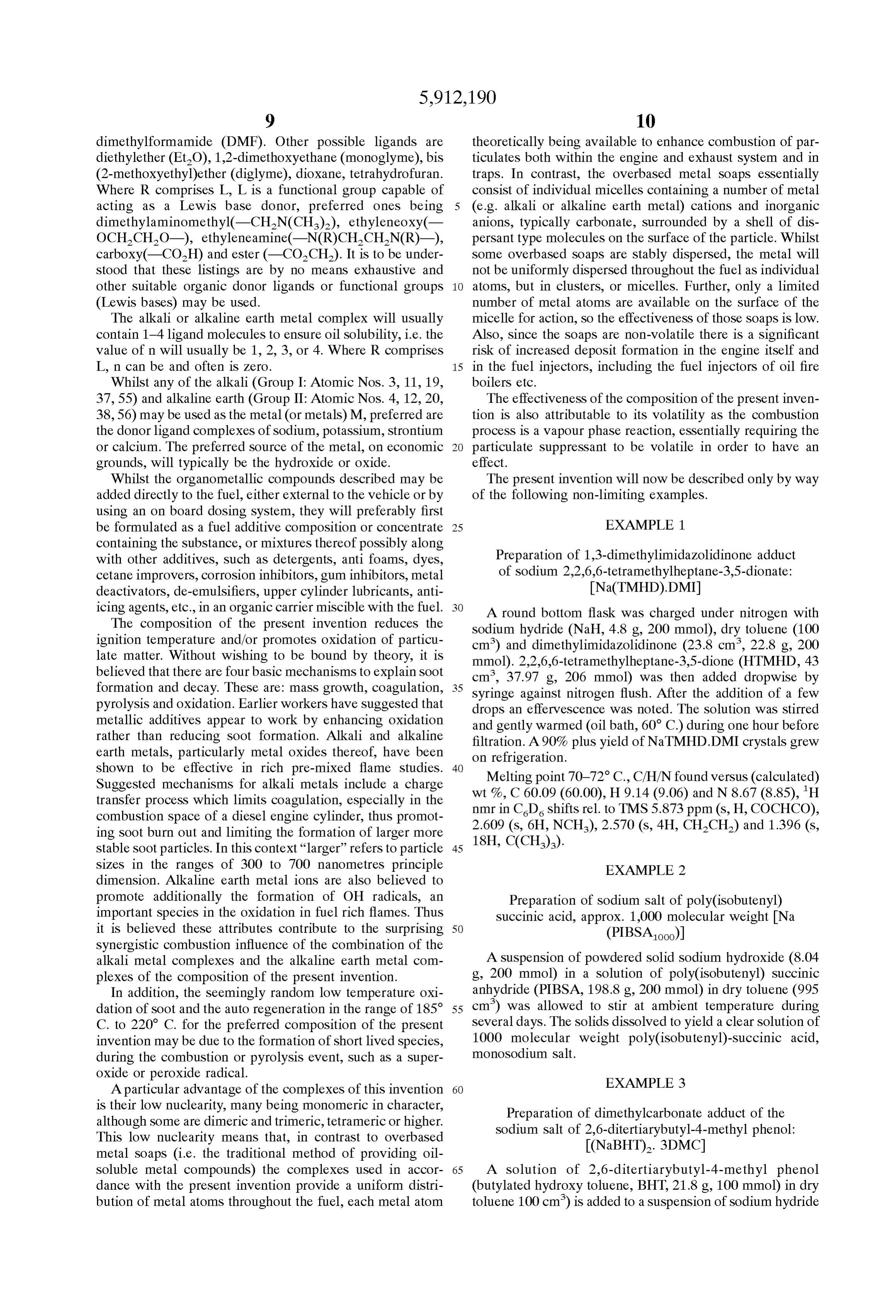
dimethylformamide (DMF). Other possible ligands are theoretically being available to enhance combustion of par diethylether (EtO), 1,2-dimethoxyethane (monoglyme), bis ticulates both within the engine and exhaust System and in (2-methoxyethyl)ether (diglyme), dioxane, tetrahydrofuran. traps. In contrast, the overbased metal Soaps essentially Where R comprises L., L is a functional group capable of consist of individual micelles containing a number of metal acting as a Lewis base donor, preferred ones being 5 (e.g. alkali or alkaline earth metal) cations and inorganic dimethylaminomethyl(-CHN(CH)), ethyleneoxy(- anions, typically carbonate, Surrounded by a shell of dis OCHCHO-), ethyleneamine(-N(R)CHCHN(R)-), persant type molecules on the Surface of the particle. Whilst carboxy(-COH) and ester (-COCH). It is to be under Some overbased Soaps are stably dispersed, the metal will stood that these listings are by no means exhaustive and not be uniformly dispersed throughout the fuel as individual other Suitable organic donor ligands or functional groups atoms, but in clusters, or micelles. Further, only a limited (Lewis bases) may be used. number of metal atoms are available on the Surface of the The alkali or alkaline earth metal complex will usually micelle for action, So the effectiveness of those Soaps is low. contain 1–4 ligand molecules to ensure oil Solubility, i.e. the Also, Since the Soaps are non-volatile there is a significant value of n will usually be 1, 2, 3, or 4. Where R comprises risk of increased deposit formation in the engine itself and L., n can be and often is Zero. 15 in the fuel injectors, including the fuel injectors of oil fire Whilst any of the alkali (Group I: Atomic Nos. 3, 11, 19, boilers etc.
37, 55) and alkaline earth (Group II: Atomic Nos. 4, 12, 20, The effectiveness of the composition of the present inven 38,56) may be used as the metal (or metals) M, preferred are tion is also attributable to its volatility as the combustion the donor ligand complexes of Sodium, potassium, Strontium process is a vapour phase reaction, essentially requiring the or calcium. The preferred Source of the metal, on economic particulate Suppressant to be volatile in order to have an grounds, will typically be the hydroxide or oxide. effect.
Whilst the organometallic compounds described may be The present invention will now be described only by way added directly to the fuel, either external to the vehicle or by of the following non-limiting examples. using an on board dosing System, they will preferably first be formulated as a fuel additive composition or concentrate 25 EXAMPLE 1. containing the Substance, or mixtures thereof possibly along with other additives, Such as detergents, anti foams, dyes, Preparation of 1,3-dimethylimidazolidinone adduct cetane improvers, corrosion inhibitors, gum inhibitors, metal of Sodium 2,2,6,6-tetramethylheptane-3,5-dionate: deactivators, de-emulsifiers, upper cylinder lubricants, anti Na(TMHD). DMI icing agents, etc., in an organic carrier miscible with the fuel. A round bottom flask was charged under nitrogen with The composition of the present invention reduces the sodium hydride (NaH, 4.8 g., 200 mmol), dry toluene (100 ignition temperature and/or promotes oxidation of particu cm) and dimethylimidazolidinone (23.8 cm, 22.8 g., 200 late matter. Without wishing to be bound by theory, it is mmol). 2.2,6,6-tetramethylheptane-3,5-dione (HTMHD, 43 believed that there are four basic mechanisms to explain Soot cm, 37.97 g, 206 mmol) was then added dropwise by formation and decay. These are: mass growth, coagulation, 35 Syringe against nitrogen flush. After the addition of a few pyrolysis and oxidation. Earlier workers have Suggested that drops an effervescence was noted. The Solution was Stirred metallic additives appear to work by enhancing oxidation and gently warmed (oil bath, 60° C) during one hour before rather than reducing Soot formation. Alkali and alkaline filtration. A 90% plus yield of NaTMHD.DMI crystals grew earth metals, particularly metal oxides thereof, have been on refrigeration.
shown to be effective in rich pre-mixed flame studies. 40 Melting point 70–72°C., C/H/N found versus (calculated) Suggested mechanisms for alkali metals include a charge transfer process which limits coagulation, especially in the wt %, C60.09 (60.00), H 9.14 (9.06) and N 8.67 (8.85), "H combustion Space of a diesel engine cylinder, thus promot nmr in CD shifts rel. to TMS 5.873 ppm (s, H., COCHCO), ing Soot burn out and limiting the formation of larger more 2.609 (s, 6H, NCH), 2.570 (s, 4H, CHCH) and 1.396 (s, Stable Soot particles. In this context "larger' refers to particle 45 18H, C(CH)).
sizes in the ranges of 300 to 700 nanometres principle EXAMPLE 2 dimension. Alkaline earth metal ions are also believed to promote additionally the formation of OH radicals, an Preparation of sodium salt of poly(isobutenyl) important Species in the Oxidation in fuel rich flames. Thus Succinic acid, approx. 1,000 molecular weight Na it is believed these attributes contribute to the Surprising 50 (PIBSA)
Synergistic combustion influence of the combination of the alkali metal complexes and the alkaline earth metal com A suspension of powdered solid sodium hydroxide (8.04 plexes of the composition of the present invention. g, 200 mmol) in a Solution of poly(isobutenyl) Succinic In addition, the Seemingly random low temperature oxi anhydride (PIBSA, 198.8 g., 200 mmol) in dry toluene (995 dation of Soot and the auto regeneration in the range of 185 55 cm) was allowed to stir at ambient temperature during C. to 220 C. for the preferred composition of the present several days. The solids dissolved to yield a clear solution of invention may be due to the formation of Short lived species, 1000 molecular weight poly(isobutenyl)-Succinic acid, during the combustion or pyrolysis event, Such as a Super monosodium Salt.
oxide or peroxide radical. EXAMPLE 3
A particular advantage of the complexes of this invention 60 is their low nuclearity, many being monomeric in character, Preparation of dimethylcarbonate adduct of the although Some are dimeric and trimeric, tetrameric or higher. Sodium salt of 2,6-ditertiarybutyl-4-methyl phenol: This low nuclearity means that, in contrast to overbased (NaBHT) 3DMC) metal Soaps (i.e. the traditional method of providing oil
Soluble metal compounds) the complexes used in accor 65 A solution of 2,6-ditertiarybutyl-4-methyl phenol dance with the present invention provide a uniform distri (butylated hydroxy toluene, BHT, 21.8 g., 100 mmol) in dry bution of metal atoms throughout the fuel, each metal atom toluene 100 cm) is added to a suspension of sodium hydride
Page 10
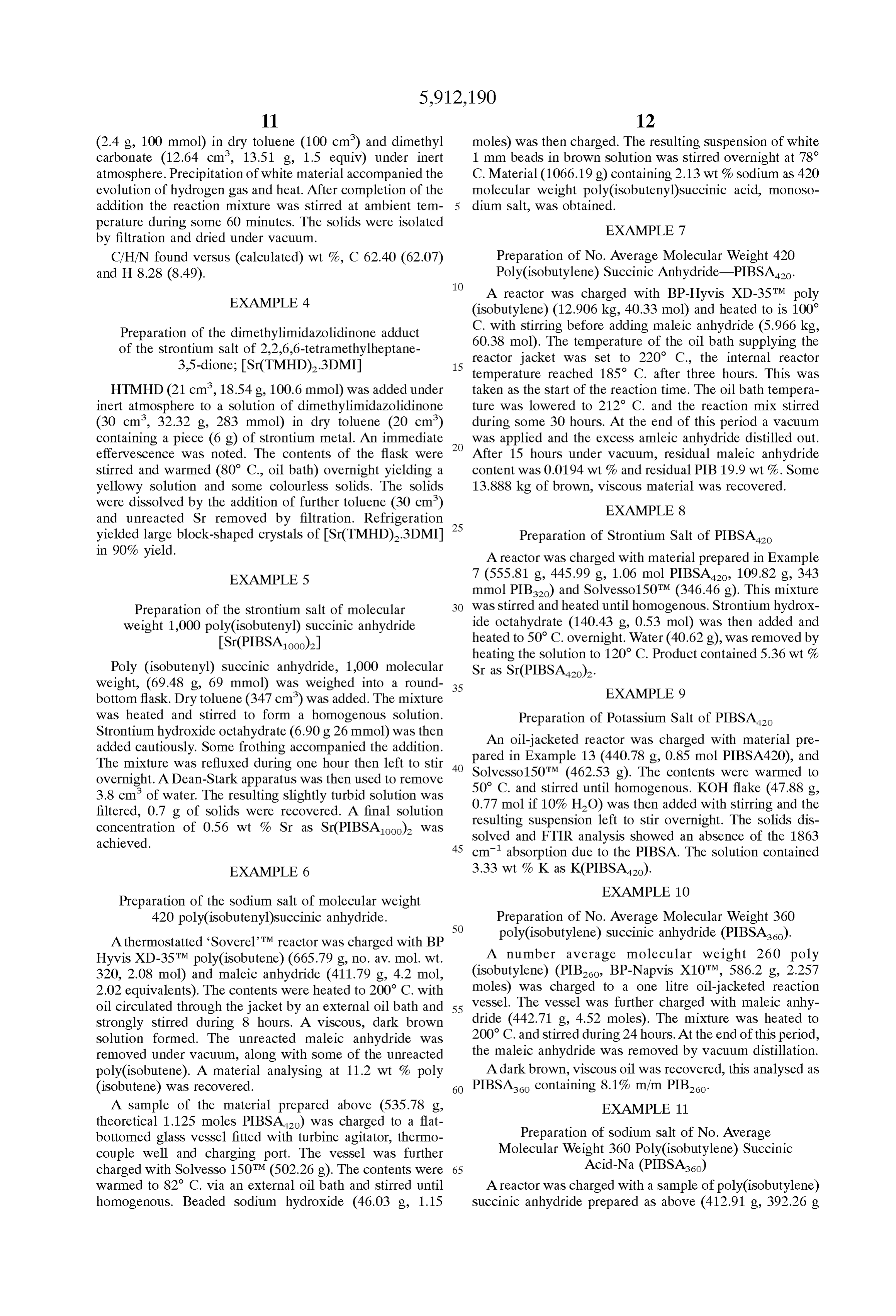
(2.4g, 100 mmol) in dry toluene (100 cm) and dimethyl moles) was then charged. The resulting Suspension of white carbonate (12.64 cm, 13.51 g, 1.5 equiv) under inert 1 mm beads in brown solution was stirred overnight at 78 atmosphere. Precipitation of white material accompanied the C. Material (1066.19 g) containing 2.13 wt % sodium as 420 evolution of hydrogen gas and heat. After completion of the molecular weight poly(isobutenyl)Succinic acid, monoso addition the reaction mixture was stirred at ambient tem dium Salt, was obtained.
perature during Some 60 minutes. The Solids were isolated EXAMPLE 7 by filtration and dried under vacuum.
C/H/N found versus (calculated) wt %, C 62.40 (62.07) Preparation of No. Average Molecular Weight 420 and H 8.28 (8.49). Poly(isobutylene) Succinic Anhydride-PIBSA.
EXAMPLE 4
A reactor was charged with BP-Hyvis XD-35TM poly (isobutylene) (12.906 kg, 40.33 mol) and heated to is 100
Preparation of the dimethylimidazolidinone adduct C. with stirring before adding maleic anhydride (5.966 kg, of the Strontium Salt of 2,2,6,6-tetramethylheptane 60.38 mol). The temperature of the oil bath supplying the
reactor jacket was set to 220 C., the internal reactor temperature reached 185 C. after three hours. This was
HTMHD (21 cm, 18.54g, 100.6 mmol) was added under taken as the Start of the reaction time. The oil bath tempera inert atmosphere to a Solution of dimethylimidazolidinone ture was lowered to 212 C. and the reaction mix stirred (30 cm, 32.32 g, 283 mmol) in dry toluene (20 cm) during Some 30 hours. At the end of this period a vacuum containing a piece (6 g) of Strontium metal. An immediate was applied and the excess amleic anhydride distilled out. effervescence was noted. The contents of the flask were After 15 hours under Vacuum, residual maleic anhydride stirred and warmed (80° C., oil bath) overnight yielding a content was 0.0194 wt % and residual PIB 19.9 wt %. Some yellowy Solution and Some colourless Solids. The Solids 13.888 kg of brown, viscous material was recovered. were dissolved by the addition of further toluene (30 cm) EXAMPLE 8 and unreacted Sr removed by filtration. Refrigeration yielded large block-shaped crystals of Sr(TMHD).3DMI 25 Preparation of Strontium Salt of PIBSA in 90% yield. A reactor was charged with material prepared in Example EXAMPLE 5 7 (555.81 g, 445.99 g, 1.06 mol PIBSA, 109.82 g, 343 mmol PIB) and Solves.so150TM (346.46 g). This mixture
Preparation of the strontium salt of molecular was stirred and heated until homogenous. Strontium hydrox weight 1,000 poly(isobutenyl) succinic anhydride ide octahydrate (140.43 g, 0.53 mol) was then added and Sr(PIBSAoo) heated to 50° C. overnight. Water (40.62g), was removed by heating the solution to 120° C. Product contained 5.36 wt %
Poly (isobutenyl) succinic anhydride, 1,000 molecular Sr as Sr(PIBSA).
weight, (69.48 g. 69 mmol) was weighed into a round 35 EXAMPLE 9 bottom flask. Dry toluene (347 cm) was added. The mixture was heated and Stirred to form a homogenous Solution. Preparation of Potassium Salt of PIBSA Strontium hydroxide octahydrate (6.90 g 26 mmol) was then An oil-jacketed reactor was charged with material pre added cautiously. Some frothing accompanied the addition.
The mixture was refluxed during one hour then left to stir 40 pared in Example 13 (440.78 g., 0.85 mol PIBSA420), and Solves.so 150TM (462.53 g). The contents were warmed to overnight. A Dean-Stark apparatus was then used to remove 50° C. and stirred until homogenous. KOH flake (47.88 g, 3.8 cm of water. The resulting slightly turbid solution was 0.77 mol if 10% HO) was then added with stirring and the filtered, 0.7 g of Solids were recovered. A final solution resulting Suspension left to Stir overnight. The Solids dis concentration of 0.56 wt % Sr as Sr(PIBSAoo) was solved and FTIR analysis showed an absence of the 1863 achieved. 45 cm absorption due to the PIBSA. The solution contained
EXAMPLE 6 3.33 wt % K as K(PIBSA).
EXAMPLE 10
Preparation of the sodium salt of molecular weight 420 poly(isobutenyl)succinic anhydride. Preparation of No. Average Molecular Weight 360 50 poly(isobutylene) Succinic anhydride (PIBSA).
Athermostatted SoverelTM reactor was charged with BP
Hyvis XD-35TM poly(isobutene) (665.79 g, no. av. mol. wt. A number average molecular weight 260 poly 320, 2.08 mol) and maleic anhydride (411.79 g, 4.2 mol, (isobutylene) (PIB, BP-Napvis X10TM, 586.2 g, 2.257 2.02 equivalents). The contents were heated to 200° C. with moles) was charged to a one litre oil-jacketed reaction oil circulated through the jacket by an external oil bath and 55 vessel. The vessel was further charged with maleic anhy Strongly Stirred during 8 hours. A Viscous, dark brown dride (442.71 g, 4.52 moles). The mixture was heated to Solution formed. The unreacted maleic anhydride was 200 C. and stirred during 24 hours. At the end of this period, removed under vacuum, along with Some of the unreacted the maleic anhydride was removed by Vacuum distillation. poly(isobutene). A material analysing at 11.2 wt % poly A dark brown, Viscous oil was recovered, this analysed as (isobutene) was recovered. 60 PIBSA containing 8.1% m/m PIB. A sample of the material prepared above (535.78 g, EXAMPLE 11 theoretical 1.125 moles PIBSA) was charged to a flat Preparation of sodium salt of No. Average bottomed glass vessel fitted with turbine agitator, thermo couple well and charging port. The vessel was further Molecular Weight 360 Poly(isobutylene) Succinic charged with Solves.so 150TM (502.26 g). The contents were 65 Acid-Na (PIBSA) warmed to 82 C. via an external oil bath and stirred until A reactor was charged with a sample of poly(isobutylene) homogenous. Beaded sodium hydroxide (46.03 g, 1.15 Succinic anhydride prepared as above (412.91 g, 392.26 g
Page 11
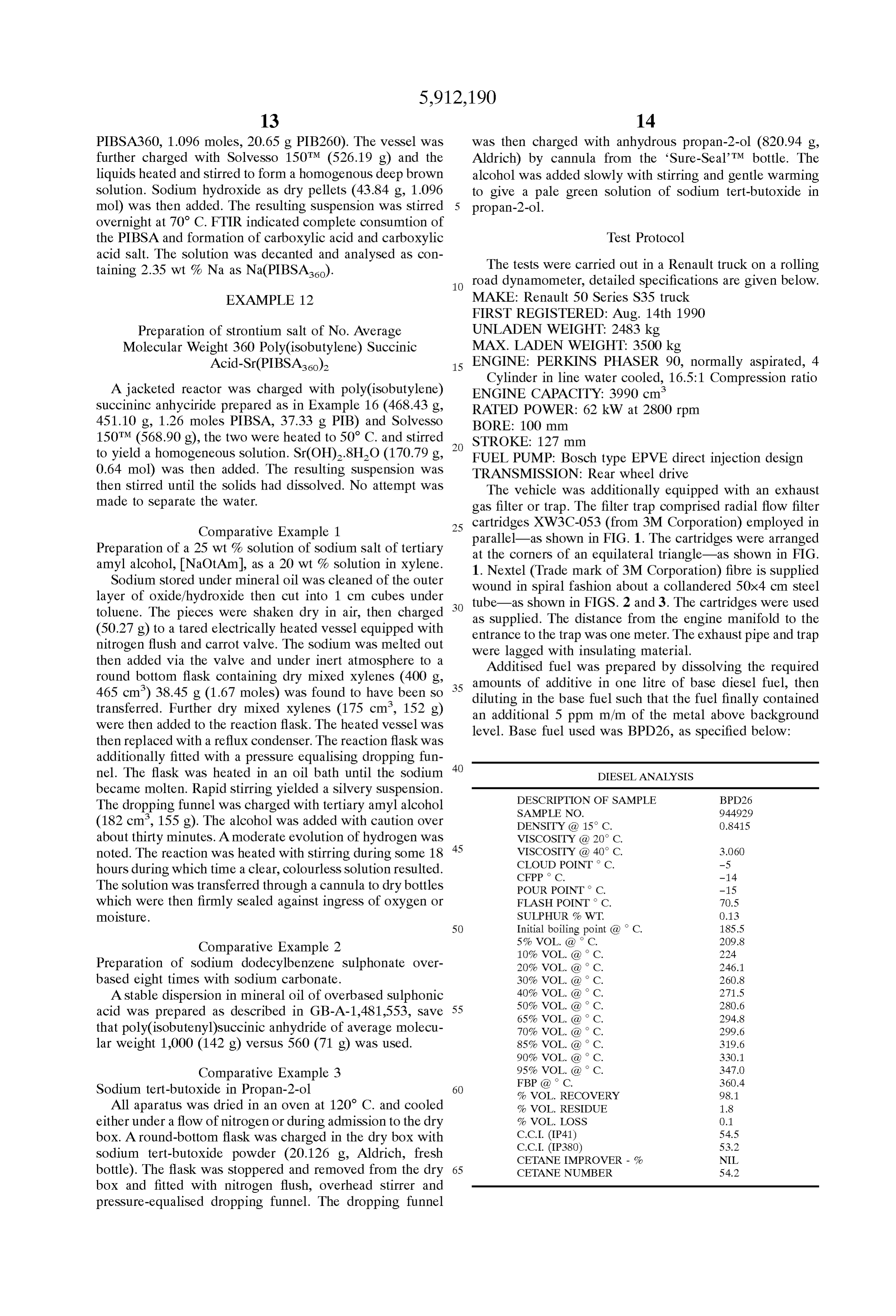
PIBSA360, 1.096 moles, 20.65 g PIB260). The vessel was was then charged with anhydrous propan-2-ol (820.94 g, further charged with Solves.so 150TM (526.19 g) and the Aldrich) by cannula from the 'Sure-SealTM bottle. The liquids heated and Stirred to form a homogenous deep brown alcohol was added slowly with Stirring and gentle warming solution. Sodium hydroxide as dry pellets (43.84 g, 1.096 to give a pale green Solution of Sodium tert-butoxide in mol) was then added. The resulting Suspension was stirred propan-2-ol.
overnight at 70° C. FTIR indicated complete consumtion of the PIBSA and formation of carboxylic acid and carboxylic Test Protocol acid Salt. The Solution was decanted and analysed as con taining 2.35 wt % Na as Na(PIBSA). The tests were carried out in a Renault truck on a rolling 1O road dynamometer, detailed specifications are given below.
EXAMPLE 12 MAKE: Renault 50 Series S35 truck
FIRST REGISTERED: Aug. 14th 1990
Preparation of strontium salt of No. Average UNLADEN WEIGHT: 24.83 kg
Molecular Weight 360 Poly(isobutylene) Succinic MAX. LADEN WEIGHT: 3500 kg
Acid-Sr(PIBSA). 15 ENGINE: PERKINS PHASER 90, normally aspirated, 4 Cylinder in line water cooled, 16.5:1 Compression ratio
A jacketed reactor was charged with poly(isobutylene) ENGINE CAPACITY: 3990 cm
Succininc anhyciride prepared as in Example 16 (468.43 g, RATED POWER: 62 kW at 2800 rpm 451.10 g, 1.26 moles PIBSA, 37.33 g PIB) and Solves.so BORE: 100 mm 150TM (568.90 g), the two were heated to 50° C. and stirred STROKE: 127 mm to yield a homogeneous solution. Sr(OH)2.8HO (170.79 g, FUEL PUMP: Bosch type EPVE direct injection design 0.64 mol) was then added. The resulting Suspension was TRANSMISSION: Rear wheel drive then stirred until the solids had dissolved. No attempt was The vehicle was additionally equipped with an exhaust made to Separate the water. gas filter or trap. The filter trap comprised radial flow filter Comparative Example 1 25 cartridges XW3C-053 (from 3M Corporation) employed in parallel-as shown in FIG. 1. The cartridges were arranged
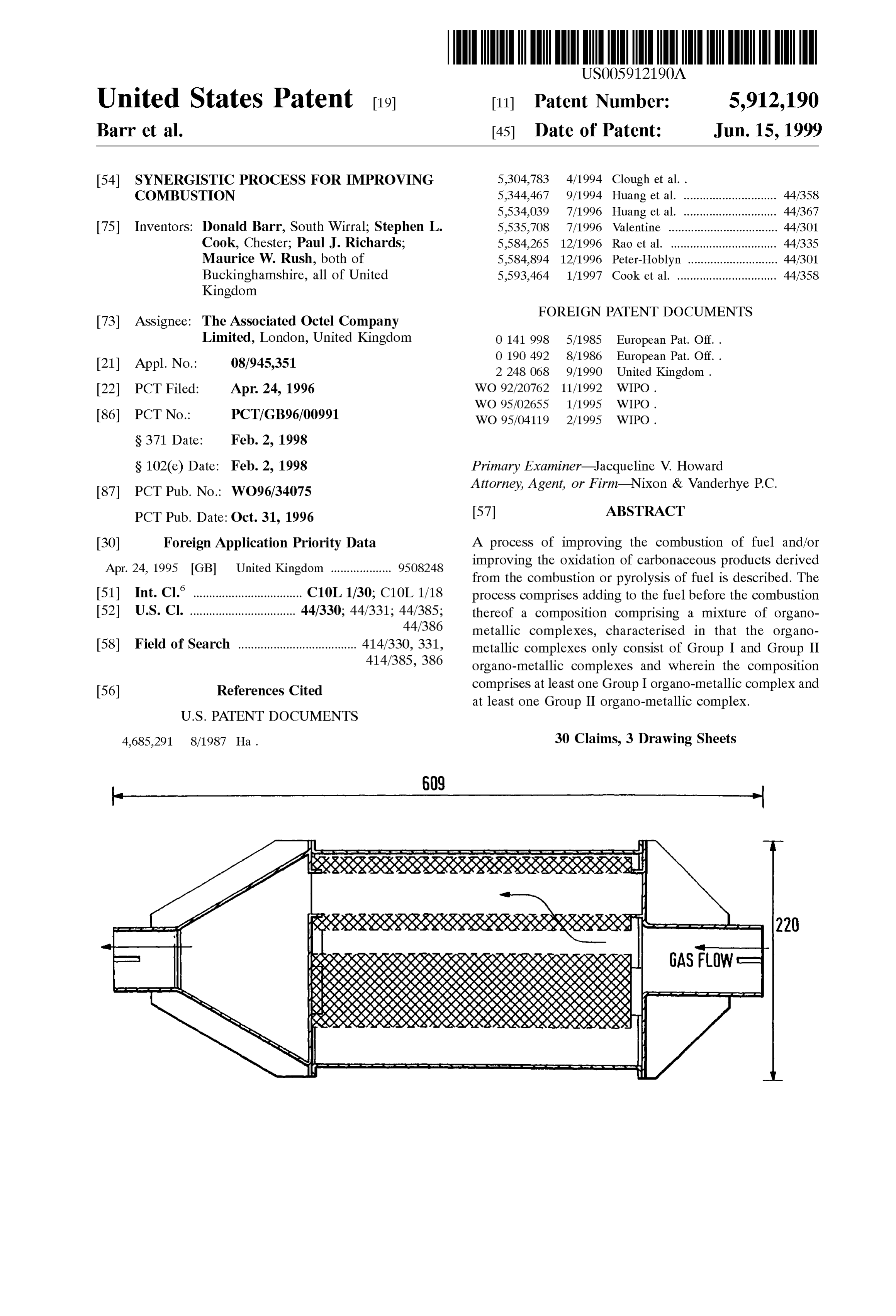
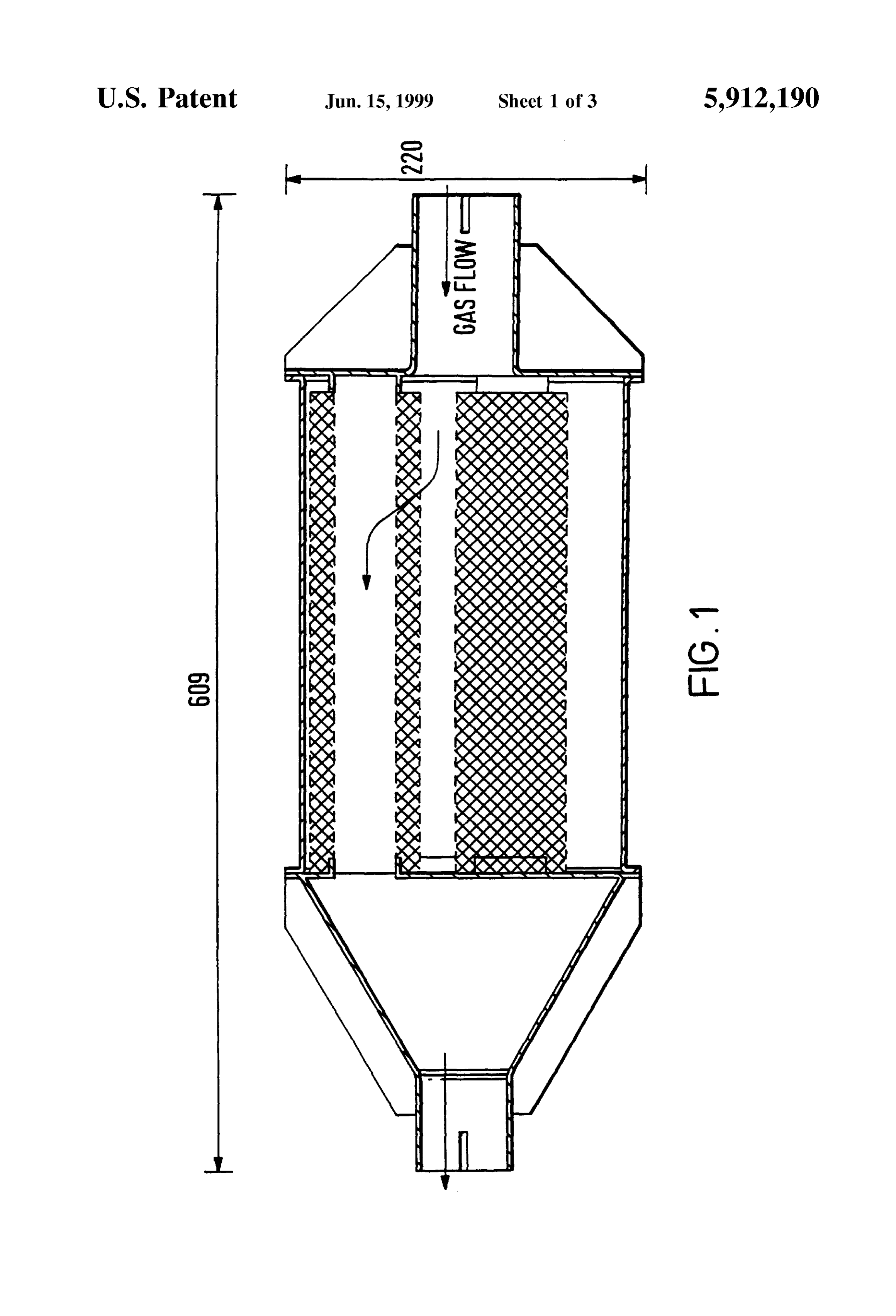
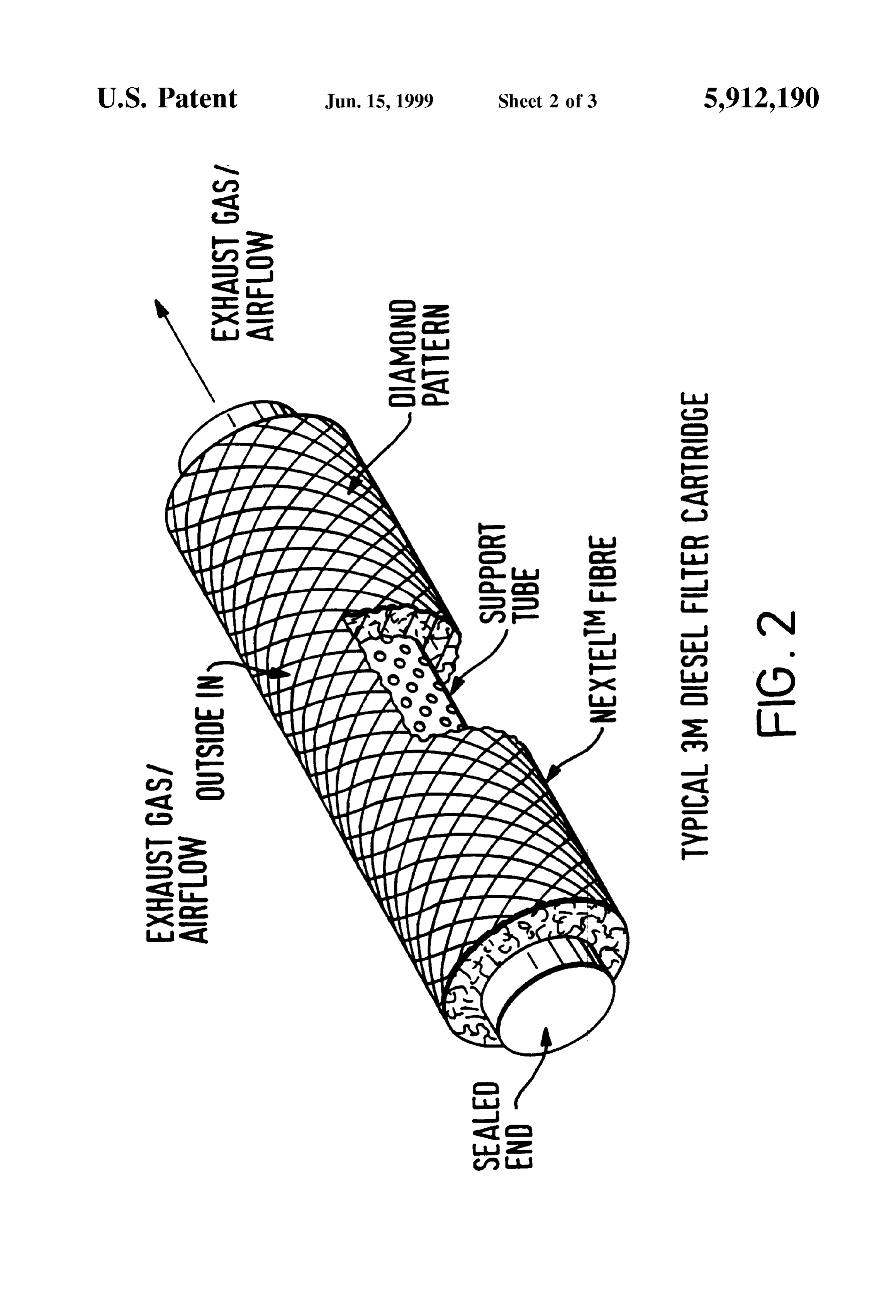
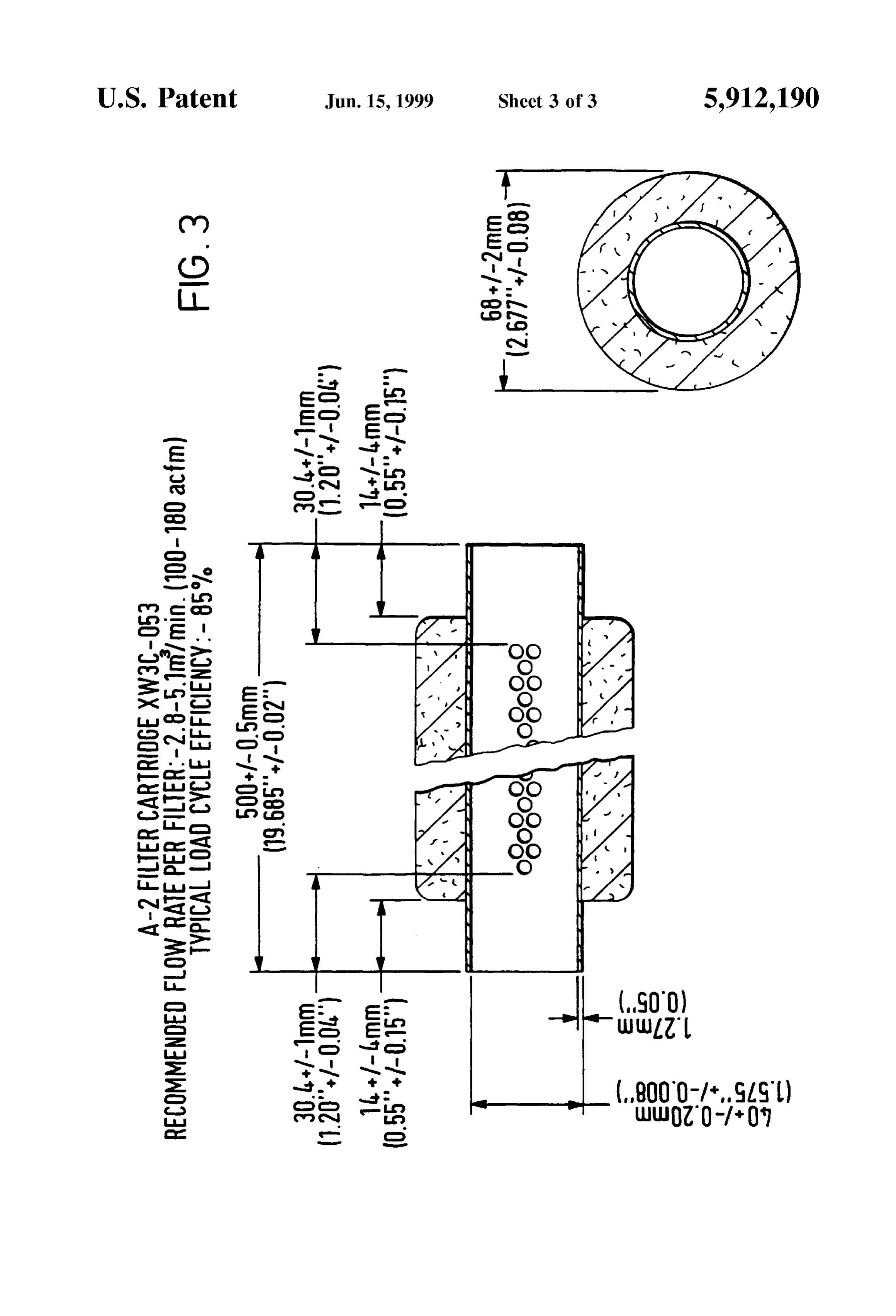
Preparation of a 25 wt % Solution of sodium salt of tertiary at the corners of an equilateral triangle-as shown in FIG. amyl alcohol, NaOtAm), as a 20 wt % Solution in Xylene. 1. Nextel (Trade mark of 3M Corporation) fibre is supplied Sodium stored under mineral oil was cleaned of the outer layer of oxide/hydroxide then cut into 1 cm cubes under wound tube-as in spiral fashion about a collandered 50x4 cm steel shown in FIGS. 2 and 3. The cartridges were used toluene. The pieces were shaken dry in air, then charged as Supplied.
(50.27 g) to a tared electrically heated vessel equipped with entrance to theThetrapdistance from the engine manifold to the nitrogen flush and carrot valve. The Sodium was melted out were lagged with insulatingmeter.
was one The exhaust pipe and trap material.
then added via the valve and under inert atmosphere to a Additised fuel was prepared by dissolving the required round bottom flask containing dry mixed xylenes (400 g, 35 amounts of additive in one litre of base diesel fuel, then 465 cm) 38.45 g (1.67 moles) was found to have been so diluting in the base fuel such that the fuel finally contained transferred. Further dry mixed xylenes (175 cm, 152 g) an additional 5 ppm m/m of the metal above background were then added to the reaction flask. The heated vessel was then replaced with a reflux condenser. The reaction flask was level. Base fuel used was BPD26, as specified below: additionally fitted with a pressure equalising dropping fun nel. The flask was heated in an oil bath until the Sodium 40 DIESEL ANALYSIS became molten. Rapid stirring yielded a Silvery Suspension. DESCRIPTION OF SAMPLE BPD26 The dropping funnel was charged with tertiary amyl alcohol SAMPLE NO. 944929 (182 cm, 155 g). The alcohol was added with caution over DENSITY (a 15° C. O.8415 about thirty minutes. A moderate evolution of hydrogen was VISCOSITY (a 20° C. noted. The reaction was heated with Stirring during Some 18 45 VISCOSITY (a 40° C.
CLOUD POINT C.
hours during which time a clear, colourleSS Solution resulted. CFPP C. -14 The Solution was transferred through a cannula to dry bottles POUR POINT C. -15 which were then firmly Sealed against ingreSS of oxygen or FLASH POINT C. 70.5 moisture. SULPHUR 9% WT O.13
Comparative Example 2 5% VOL. (a) C. 209.8
Preparation of Sodium dodecylbenzene Sulphonate over 20% VOL. (a) C. 246.1 based eight times with Sodium carbonate. 30% VOL. (a) C. 260.8 A Stable dispersion in mineral oil of Overbased Sulphonic 40% VOL. (a) C. 271.5
acid was prepared as described in GB-A-1,481,553, save 55 65% VOL. (a) C. 2.94.8 that poly(isobutenyl)Succinic anhydride of average molecu 70% VOL. (a) C. 299.6 lar weight 1,000 (142 g) versus 560 (71 g) was used. 85% VOL. (a) C. 319.6
Comparative Example 3 95% VOL. (a) C. 347.O
Sodium tert-butoxide in Propan-2-ol 60
All aparatus was dried in an oven at 120° C. and cooled % VOL. RESIDUE 18 either under a flow of nitrogen or during admission to the dry % VOL. LOSS O1 box. A round-bottom flask was charged in the dry box with C.C.I. (IP41) 54.5
sodium tert-butoxide powder (20.126 g, Aldrich, fresh CETANE IMPROVER - % NIL bottle). The flask was stoppered and removed from the dry 65 CETANE NUMBER 54.2 box and fitted with nitrogen flush, overhead stirrer and preSSure-equalised dropping funnel. The dropping funnel
Page 12
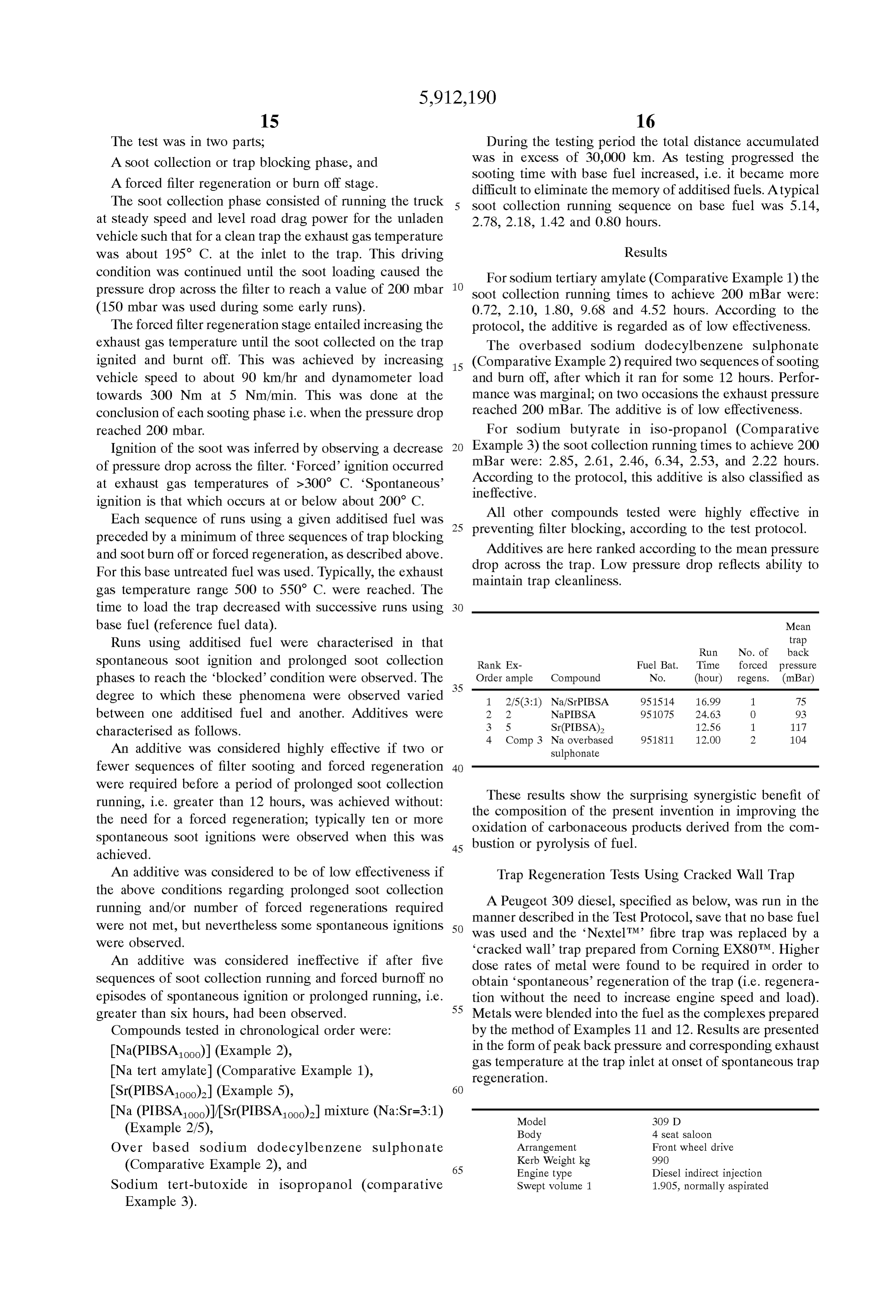
The test was in two parts, During the testing period the total distance accumulated A Soot collection or trap blocking phase, and was in exceSS of 30,000 km. AS testing progressed the A forced filter regeneration or burn off Stage. Sooting time with base fuel increased, i.e. it became more difficult to eliminate the memory of additised fuels. A typical
The Soot collection phase consisted of running the truck 5 Soot collection running Sequence on base fuel was 5.14, at Steady Speed and level road drag power for the unladen 2.78, 2.18, 1.42 and 0.80 hours.
vehicle Such that for a clean trap the exhaust gas temperature was about 195 C. at the inlet to the trap. This driving Results condition was continued until the Soot loading caused the For Sodium tertiary amylate (Comparative Example 1) the pressure drop across the filter to reach a value of 200 mbar soot collection running times to achieve 200 m Bar were: (150 mbar was used during Some early runs). 0.72, 2.10, 1.80, 9.68 and 4.52 hours. According to the The forced filter regeneration Stage entailed increasing the protocol, the additive is regarded as of low effectiveness. exhaust gas temperature until the Soot collected on the trap The overbased sodium dodecylbenzene Sulphonate ignited and burnt off. This was achieved by increasing 15 (Comparative Example 2) required two sequences of Sooting vehicle speed to about 90 km/hr and dynamometer load and burn off, after which it ran for Some 12 hours. Perfor towards 300 Nm at 5 Nm/min. This was done at the mance was marginal; on two occasions the exhaust preSSure conclusion of each Sooting phase i.e. when the pressure drop reached 200 m Bar. The additive is of low effectiveness. reached 200 mbar. For Sodium butyrate in iso-propanol (Comparative Ignition of the Soot was inferred by observing a decrease Example 3) the soot collection running times to achieve 200 of pressure drop across the filter. Forced ignition occurred mBar were: 2.85, 2.61, 2.46, 6.34, 2.53, and 2.22 hours. at exhaust gas temperatures of >300° C. Spontaneous According to the protocol, this additive is also classified as ineffective.
ignition is that which occurs at or below about 200 C.
All other compounds tested were highly effective in
Each Sequence of runs using a given additised fuel was 25 preventing preceded by a minimum of three Sequences of trap blocking filter blocking, according to the test protocol. Additives are here ranked according to the mean preSSure and Soot burn off or forced regeneration, as described above. drop across the trap. Low pressure drop reflects ability to For this base untreated fuel was used. Typically, the exhaust maintain gas temperature range 500 to 550° C. were reached. The trap cleanliness.
time to load the trap decreased with Successive runs using base fuel (reference fuel data). Mean Runs using additised fuel were characterised in that trap
Spontaneous Soot ignition and prolonged Soot collection Rank Ex- Fuel Bat. Time forced pressure phases to reach the blocked condition were observed. The 35 Order ample Compound No. (hour) regens. (mBar) degree to which these phenomena were observed varied 1 2/5(3:1) Na/SrPIBSA 951514 16.99 1. 75 between one additised fuel and another. Additives were 2 2 NaPBSA 951075 24.63 O 93 characterised as follows. 3 5 Sr(PIBSA), 12.56 1. 117 4 Comp 3 Na overbased 951811 12.00 2 104
An additive was considered highly effective if two or sulphonate fewer Sequences of filter Sooting and forced regeneration 40 were required before a period of prolonged Soot collection running, i.e. greater than 12 hours, was achieved without: These results show the Surprising Synergistic benefit of the composition of the present invention in improving the the need for a forced regeneration; typically ten or more oxidation
Spontaneous Soot ignitions were observed when this was 45 bustion orofpyrolysis carbonaceous products derived from the com of fuel.
achieved.
An additive was considered to be of low effectiveness if Trap Regeneration Tests Using Cracked Wall Trap the above conditions regarding prolonged Soot collection running and/or number of forced regenerations required A Peugeot 309 diesel, specified as below, was run in the manner described in the Test Protocol, save that no base fuel were not met, but nevertheless Some Spontaneous ignitions 50 was were observed. used and the NextelTM fibre trap was replaced by a An additive was considered ineffective if after five cracked wall trap prepared from Corning EX80TM. Higher dose rates of metal were found to be required in order to
Sequences of Soot collection running and forced burnoff no obtain spontaneous regeneration of the trap (i.e. regenera episodes of Spontaneous ignition or prolonged running, i.e. tion without the need to increase engine speed and load).
greater than Six hours, had been observed. Metals were blended into the fuel as the complexes prepared Compounds tested in chronological order were: by the method of Examples 11 and 12. Results are presented Na(PIBSA) (Example 2), in the form of peak back pressure and corresponding exhaust Na tert amylate (Comparative Example 1), gas temperature at the trap inlet at onset of Spontaneous trap regeneration.
Na (PIBSAoo)/Sr(PIBSAoo) mixture (Na:Sr=3:1) Model 309 D (Example 2/5), Body 4 seat saloon Over based sodium dodecylbenzene sulphonate Arrangement Front wheel drive (Comparative Example 2), and Kerb Weight kg 990 65 Engine type Diesel indirect injection
Sodium tert-butoxide in isopropanol (comparative Swept volume 1 1.905, normally aspirated Example 3).
Page 13
-continued combustion of fuel and/or improving the oxidation of car bonaceous products derived from the combustion or pyroly
Compression ratio 23.5:1 sis of fuel.
Fuel pump Rotary type Rotodiesel Other modifications will be apparent to those skilled in Transmission 5 speed manual the art without departing from the Scope of the present invention.
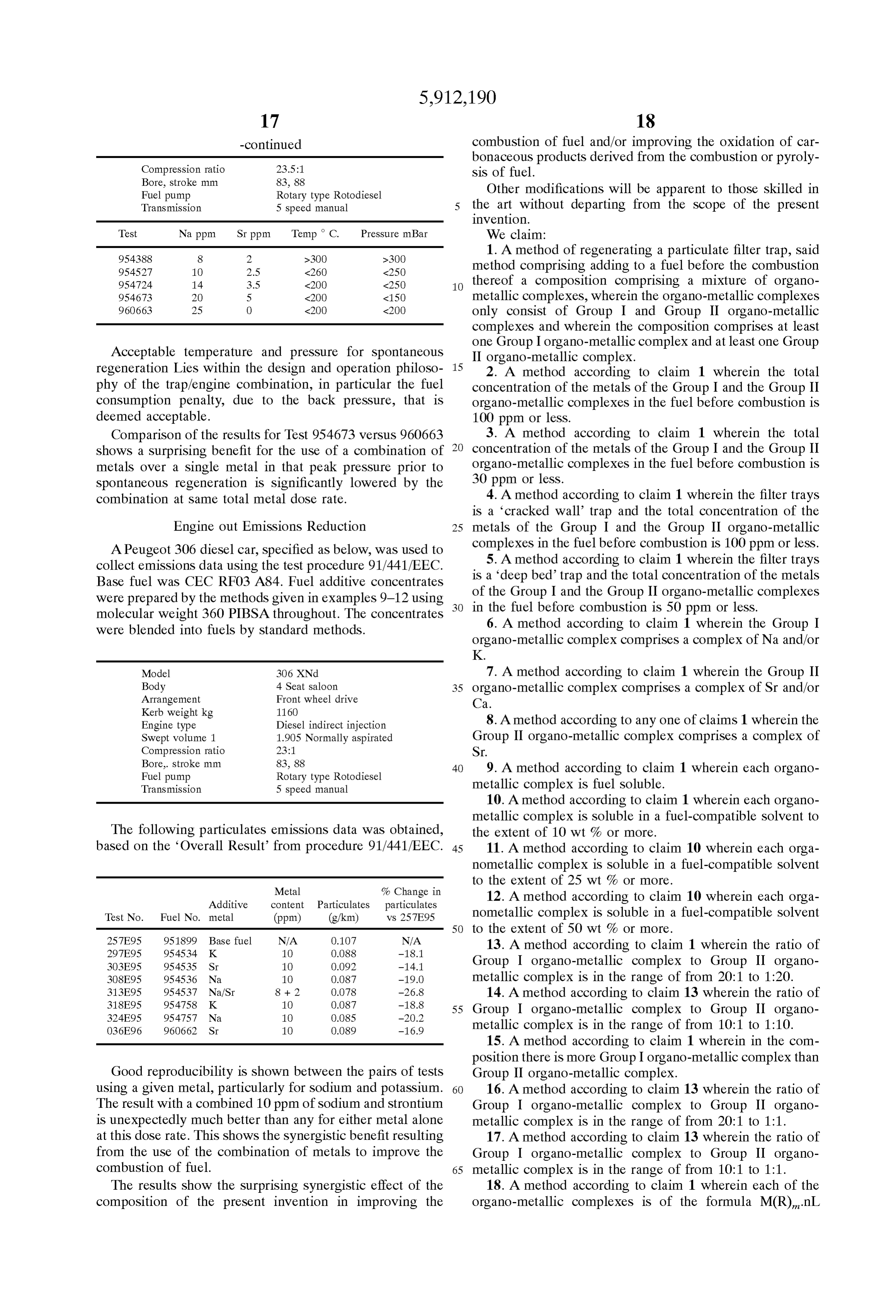
Test Na ppm Sr. ppm Temp C. Pressure mBar We claim:
1. A method of regenerating a particulate filter trap, Said
954527 1O 2.5 &260 method comprising adding to a fuel before the combustion
954,724 14 3.5 &2OO thereof a composition comprising a mixture of organo
954673 2O 5 &2OO metallic complexes, wherein the organo-metallic complexes
96.0663 25 O &2OO only consist of Group I and Group II organo-metallic
complexes and wherein the composition comprises at least
Acceptable temperature and preSSure for Spontaneous one II
Group I organo-metallic complex and at least one Group organo-metallic complex.
regeneration Lies within the design and operation philoso 15 2. A method according to claim 1 wherein the total phy of the trap/engine combination, in particular the fuel concentration of the metals of the Group I and the Group II consumption penalty, due to the back pressure, that is organo-metallic complexes in the fuel before combustion is deemed acceptable. 100 ppm or less.
Comparison of the results for Test 954673 versus 960663 3. A method according to claim 1 wherein the total shows a Surprising benefit for the use of a combination of concentration of the metals of the Group I and the Group II metals over a single metal in that peak pressure prior to organo-metallic complexes in the fuel before combustion is Spontaneous regeneration is significantly lowered by the 30 ppm or less.
combination at Same total metal dose rate. 4. A method according to claim 1 wherein the filter trayS is a 'cracked wall trap and the total concentration of the
Engine out Emissions Reduction 25 metals of the Group I and the Group II organo-metallic
A Peugeot 306 diesel car, Specified as below, was used to complexes in the fuel before combustion is 100 ppm or less. 5. A method according to claim 1 wherein the filter trays collect emissions data using the test procedure 91/441/EEC.
Base fuel was CEC RFO3 A84. Fuel additive concentrates is a 'deep bed trap and the total concentration of the metals were prepared by the methods given in examples 9-12 using of the Group I and the Group II organo-metallic complexes molecular weight 360 PIBSA throughout. The concentrates in 6.theAfuel before combustion is 50 ppm or less. method according to claim 1 wherein the Group I were blended into fuels by standard methods. organo-metallic complex comprises a complex of Na and/or
Model 306 XNd 7. A method according to claim 1 wherein the Group II Body 4 Seat saloon 35 organo-metallic complex comprises a complex of Sr and/or Arrangement Front wheel drive Ca.
Engine type Diesel indirect injection 8. A method according to any one of claims 1 wherein the Swept volume 1 1.905 Normally aspirated Group II organo-metallic complex comprises a complex of Compression ratio 23:1 Sr.
Bore... stroke mm 83, 88 40 9. A method according to claim 1 wherein each organo Fuel pump Rotary type Rotodiesel
Transmission 5 speed manual metallic complex is fuel Soluble. 10. A method according to claim 1 wherein each organo metallic complex is Soluble in a fuel-compatible Solvent to
The following particulates emissions data was obtained, the extent of 10 wt % or more.
based on the “Overall Result from procedure 91/441/EEC. 45 11. A method according to claim 10 wherein each orga nometallic complex is Soluble in a fuel-compatible Solvent to the extent of 25 wt % or more.
Metal % Change in 12. A method according to claim 10 wherein each orga Additive content Particulates particulates
Test No. Fuel No. metal (ppm) (g/km) vs 257E95 nometallic complex is Soluble in a fuel-compatible Solvent 50 to the extent of 50 wt % or more.
257E95 951899 Base fuel N/A O.107 N/A 297E95 95.4534 K 1O O.O88 13. A method according to claim 1 wherein the ratio of
3O3E95 95.4535 Sir 1O O.O92 Group I organo-metallic complex to Group II organo
3O8E95 95.4536 Na 1O O.O87 metallic complex is in the range of from 20:1 to 1:20.
313E95 95.4537 Na/Sr 8+2 O.O78 14. A method according to claim 13 wherein the ratio of
318E95 954758 K. 1O O.O87 55 Group I organo-metallic complex to Group II organo
3.24E95 954757 Na 1O O.O85 -20.2
O36E96 96.O662 Sir 1O O.O89 metallic complex is in the range of from 10:1 to 1:10.
15. A method according to claim 1 wherein in the com position there is more Group I organo-metallic complex than
Good reproducibility is shown between the pairs of tests Group II organo-metallic complex.
using a given metal, particularly for Sodium and potassium. 60 16. A method according to claim 13 wherein the ratio of The result with a combined 10 ppm of sodium and strontium Group I organo-metallic complex to Group II organo is unexpectedly much better than any for either metal alone metallic complex is in the range of from 20:1 to 1:1. at this dose rate. This shows the Synergistic benefit resulting 17. A method according to claim 13 wherein the ratio of from the use of the combination of metals to improve the Group I organo-metallic complex to Group II organo combustion of fuel. 65 metallic complex is in the range of from 10:1 to 1:1. The results show the Surprising Synergistic effect of the 18. A method according to claim 1 wherein each of the composition of the present invention in improving the organo-metallic complexes is of the formula M(R).nL
Page 14
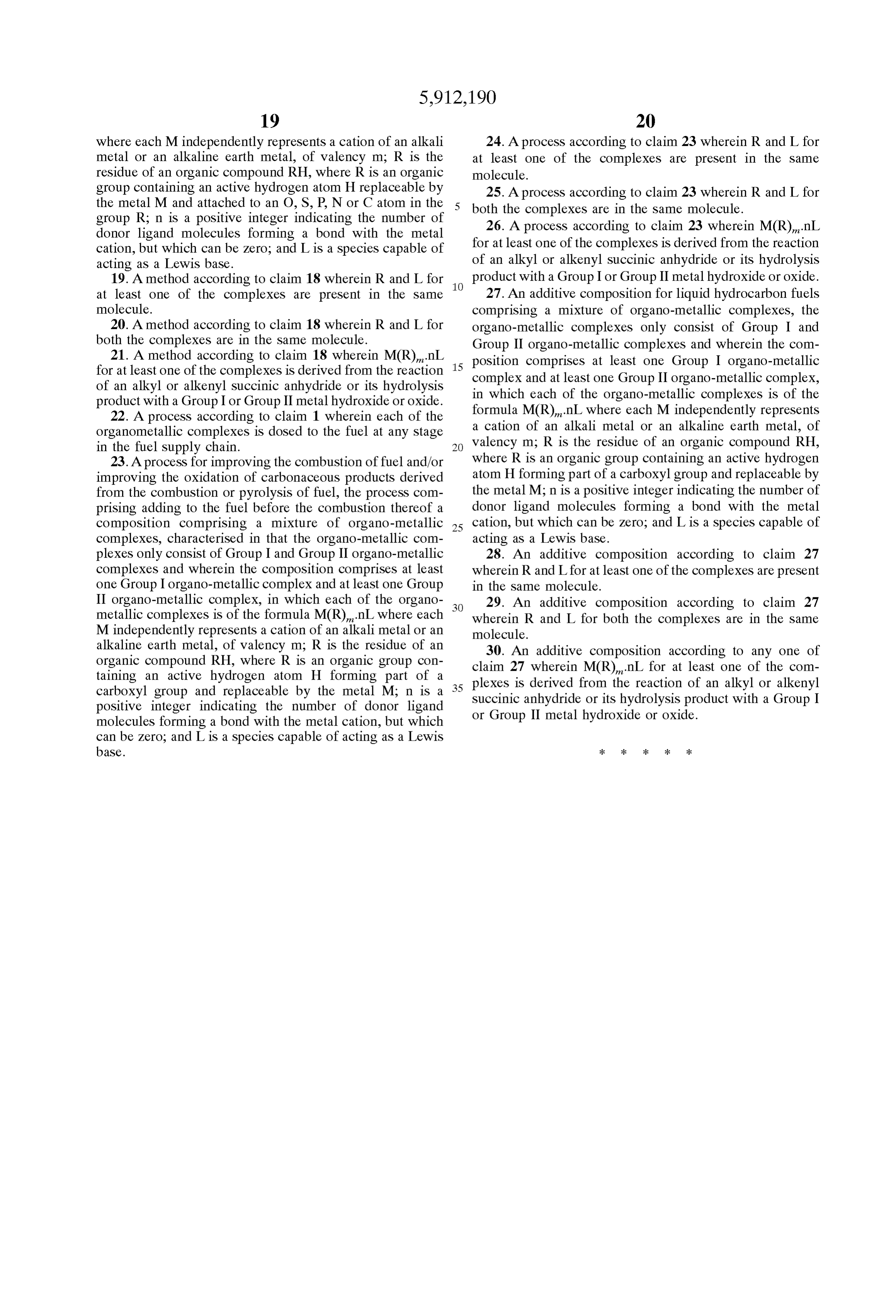
where each Mindependently represents a cation of an alkali 24. A process according to claim 23 wherein R and L for metal or an alkaline earth metal, of Valency m; R is the at least one of the complexes are present in the same residue of an organic compound RH, where R is an organic molecule.
group containing an active hydrogen atom H replaceable by 25. A process according to claim 23 wherein R and L for the metal M and attached to an O, S, P, N or C atom in the 5 both the complexes are in the same molecule. group R, n is a positive integer indicating the number of 26. A process according to claim 23 wherein M(R)-nL donor ligand molecules forming a bond with the metal cation, but which can be Zero; and L is a species capable of for at least one of the complexes is derived from the reaction acting as a Lewis base. of an alkyl or alkenyl Succinic anhydride or its hydrolysis 19. A method according to claim 18 wherein R and L for product with a Group I or Group II metal hydroxide or oxide. at least one of the complexes are present in the same 27. An additive composition for liquid hydrocarbon fuels molecule. comprising a mixture of organo-metallic complexes, the 20. A method according to claim 18 wherein R and L for organo-metallic complexes only consist of Group I and both the complexes are in the same molecule. Group II organo-metallic complexes and wherein the com 21. A method according to claim 18 wherein M(R)-nL 15 position comprises at least one Group I organo-metallic for at least one of the complexes is derived from the reaction complex and at least one Group II organo-metallic complex, of an alkyl or alkenyl Succinic anhydride or its hydrolysis in which each of the organo-metallic complexes is of the product with a Group I or Group II metal hydroxide or oxide. formula M(R)-nL where each Mindependently represents 22. A proceSS according to claim 1 wherein each of the organometallic complexes is dosed to the fuel at any stage a cation of an alkali metal or an alkaline earth metal, of in the fuel Supply chain. Valency m; R is the residue of an organic compound RH, 23. A process for improving the combustion of fuel and/or where R is an organic group containing an active hydrogen improving the oxidation of carbonaceous products derived atom H forming part of a carboxyl group and replaceable by from the combustion or pyrolysis of fuel, the process com the metal M., n is a positive integer indicating the number of prising adding to the fuel before the combustion thereof a donor ligand molecules forming a bond with the metal composition comprising a mixture of organo-metallic 25 cation, but which can be Zero; and L is a species capable of complexes, characterised in that the organo-metallic com acting as a Lewis base.
plexes only consist of Group I and Group II organo-metallic 28. An additive composition according to claim 27 complexes and wherein the composition comprises at least wherein R and L for at least one of the complexes are present one Group I organo-metallic complex and at least one Group in the same molecule.
II organo-metallic complex, in which each of the organo 29. An additive composition according to claim 27 metallic complexes is of the formula M(R)-nL where each wherein R and L for both the complexes are in the same Mindependently represents a cation of an alkali metal or an molecule.
alkaline earth metal, of Valency m; R is the residue of an 30. An additive composition according to any one of organic compound RH, where R is an organic group con claim taining an active hydrogen atom H forming part of a plexes 27is derived wherein M(R)-nL for at least one of the com carboxyl group and replaceable by the metal M., n is a Succinic anhydridefrom 35 the reaction of an alkyl or alkenyl or its hydrolysis product with a Group I positive integer indicating the number of donor ligand or Group II metal hydroxide or oxide. molecules forming a bond with the metal cation, but which can be Zero; and L is a species capable of acting as a Lewis base.
Provenance
- Collection
- Cited prior art
- Original PDF
- patentimages.storage.googleapis.com →
- Filed
- 1996-04-24
- Pages
- 14
- Method
- pdftotext (the PDF's own text layer) + pdftoppm 300dpi page scans
- Source
- Google Patents bibliographic record
- Granted
- 1999-06-15
- Inventors
- Donald Barr; Stephen L. Cook; Paul J. Richards; Maurice W. Rush; Associated Octel Co Ltd
- Transcribed from
- patentimages.storage.googleapis.com →