patent · US2686819
Synthesis of methane
17 August 1954
Page 1
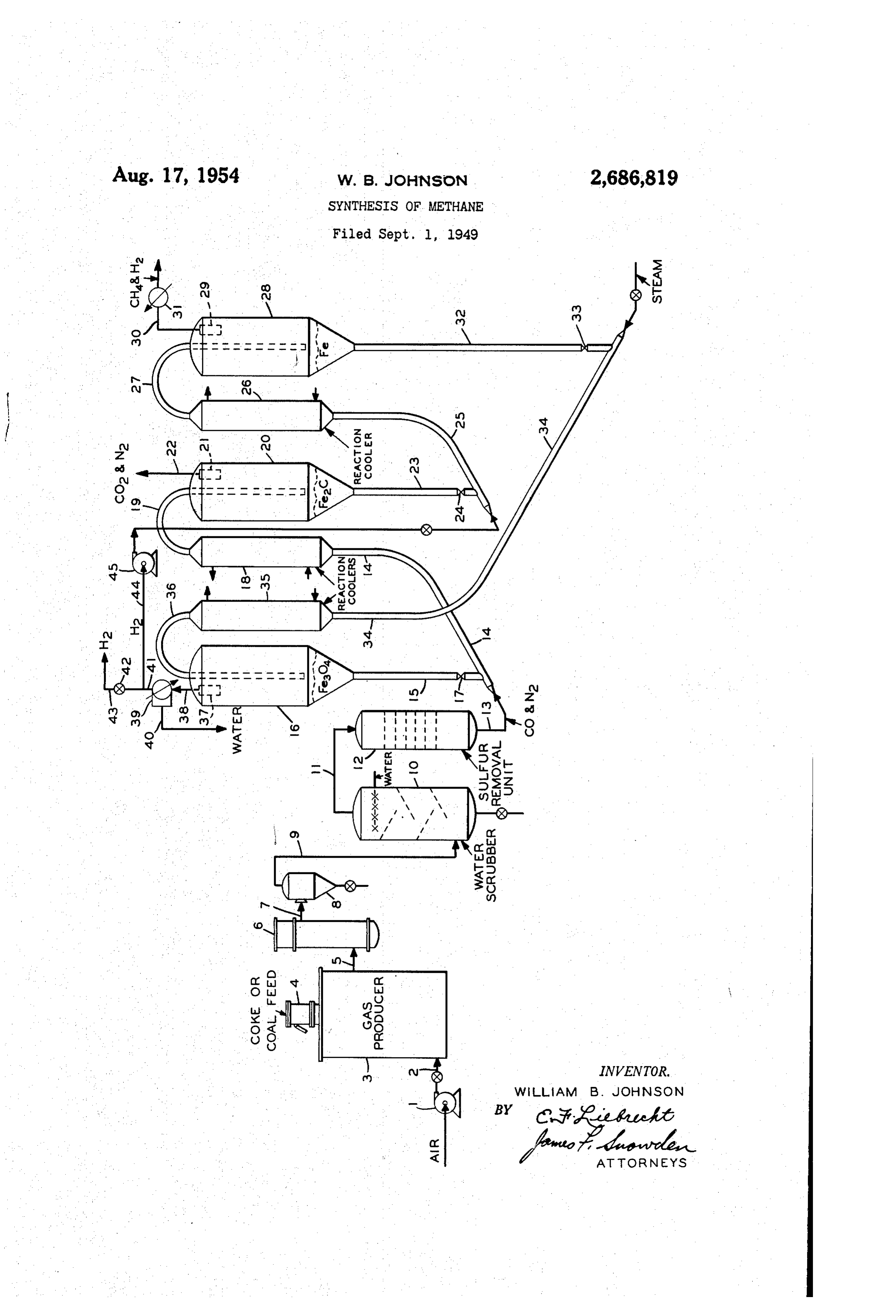
Drawing sheet — no readable text.
Page 2
Patented Aug. 17, 1954 2,686,819
UNITED STATES PATENT OFFICE
SYNTHESS OF METHANE
William B. Johnson, Far Hills, N.J., assignor to
The M. W. Kellogg Company, Jersey City, N.J., a corporation of Delaware
Application September 1, 1949, Serial No. 13,503
This invention relates to a synthesis of meth burning coal or coke in substantially pure oxygen. ane from carbon honoxide and steam; more par. A fifth object of the invention is to provide a ticularly it is concerned with a synthesis in which new process for making methane in which sub producer gas is the source of the carbon non Stantially pure hydrogen is also produced. oxide. In this manner a gas of low heating A Sixth object of the invention is to provide an Value is converted into one of high B. t. u. Con economical, continuous, cyclic process for pro tent. ducing methane and hydrogen from inexpensive Producer gas, although easily made from any arid readily available raw materials: available type of coal or coke, is of compara Other objects of the invention will in part be tively limited utility because of its extremely low O obvious and will in part appear in the detailed de grOSS. heating. Wale of approximately 136. B. t. u. scription hereinafter.
per cubic foot. While this gas is widely used in The presert invention concerns a cyclic proc industry, it is not distributed without enrich eSS for Synthesizing methane from carbon non ment to the public. In addition, larger distribu oxide, preferably furnished by producer gas, and tion lines are required as the use of a greater 5 Steam in which a carbide-forming metal is re volume of gas is necessary to furnish any given acted with Steam at a sufficiently high tempera quantity of heat. Consequently, there is a need ture to produce hydrogen and an oxide of the for an economical process for obtaining a gas of metal. The metal oxide is then carbided with high heating value from the product of a sim carbola Inonoxide at a suitably elevated temper ple and inexpensive producer gas System. This ; ature and the metal carbide is reduced with the richer gas should desirably be suitable for mix aforementioned hydrogen at a temperature high ing with any heating gas in order that it may enough to produce methane and regenerate the serve as an enriching, agent for manufactured metal. The invention accordingly comprises the gases and as an extender for limited supplies of Several steps and the relation of one or more of natural gas. Methane is ideal for the purpose in 2 5 Such steps with respect to each of the others view of its high heating value, low toxicity, and thereof, which Will be exemplified in the method the close similarity of its combustion characteris hereinafter disclosed; and the scope of the in tics to those of common natural gases. More vention will be indicated in the claims. over, the proper utilization of methane is already The process of the present invention consumes well understood by public utility companies, serv-, Only air, water and either coal or coke in pro icemen and gas appliance manufacturers. ducing methane and hydrogen, for the metal Other processes for the synthesis of hydro in powdered form is regenerated and recycled, carbons from carbon monoxide have involved the While the hydrogen required in one step is pro preliminary, removal of inert.nitrogen from air duced in exceSS in another reaction. Moreover. and the burning, of coal or coke in relatively pure. no extreme temperatures are encountered, since oxygen. However, elimination of nitrogen by the coal or coke inlay be burned in air rather than liquefaction and fractional distillation of air is Substantially jure oxygen. Nitrogen and other a very costly process. Further, the extremely high inertS, as Well as carbon dioxide, are elimitiated, temperatures produced by the combustion of coal inexpensively and without difficulty by merely or coke in oxygen introduced major design prob venting all gaseous products of the carbiding re iens. The process of the present invention. action to the atmosphere; alternatively, some or avoids the disadvantages and difficulties inher all of the nitrogen may be recovered in relatively ent in these Steps. pure" form. All of the chemical changes de An object of the invention is to provide a syn scribed hereinafter are exothermic and the Water thesis for methane in which the only reactants. employed as a coolant in a variety of heat, ex consumed are inexpensive and readily available. 45 changer's provides a more than ample supply of A second object of the invention is to provide Steam for the oxidation step. In the preferred an improved method for manufacturing a gas process the oxidation, carbiding and reduction re of high heating value. actions are carried out simultaneously and con A third object of the invention is to provide a tinuously in different, reaction zones, by circult method for synthesizing, methane from producer ing the fluidized Solids through the system. gas, which does not require.a. preliminary removal The base metal employed in the process is a of nitrogen.- reactant and not a catalyst in the true sense of A fourth object of the invention is to provide the term. Nevertheless, catalysts may be advan a synthesis of methane which does not involve 55 tageously used along with the carbide-forming
Page 3
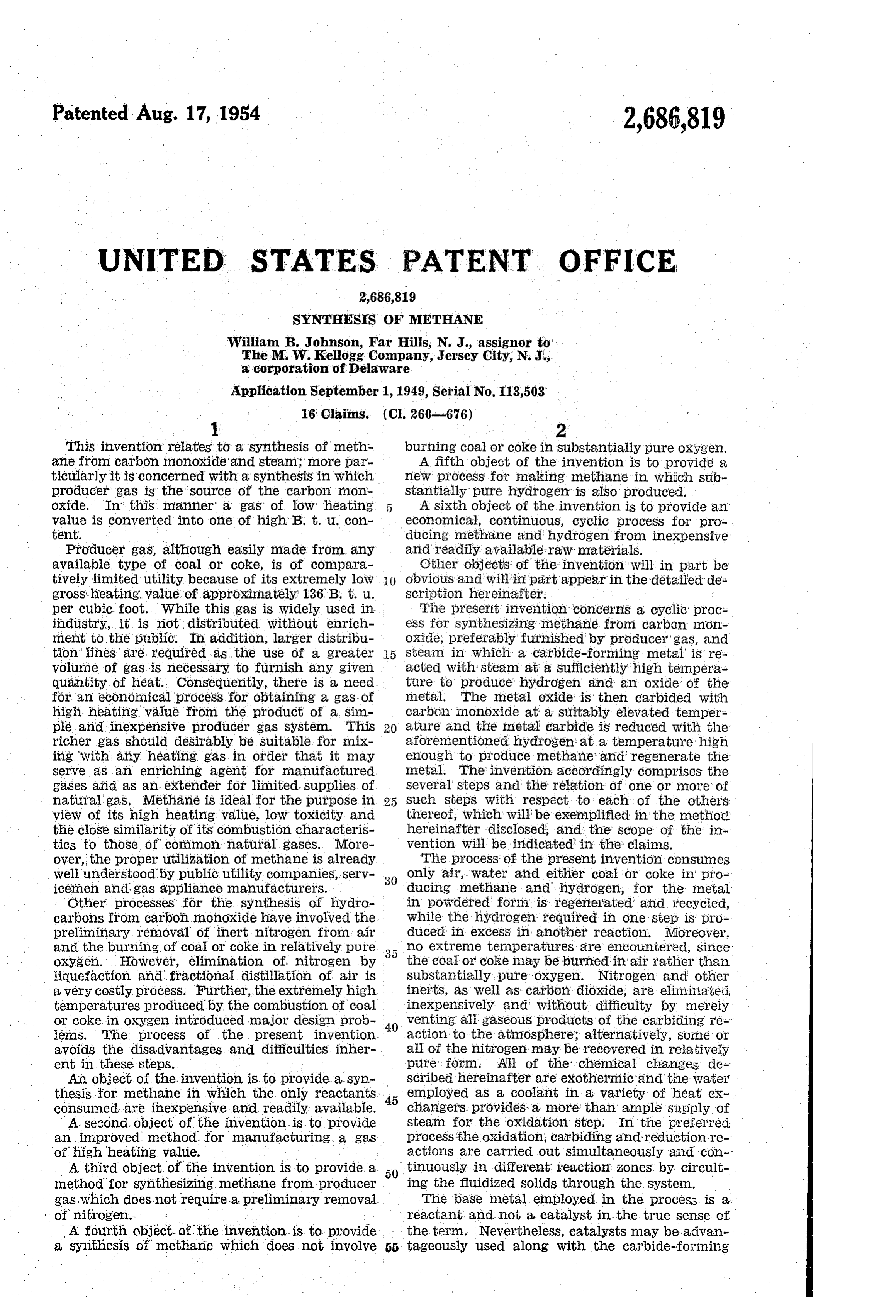
metal in practicing the present invention, for they coke is a better fuel for the producer than coal permit the carbiding operation to be conducted inasmuch as coal producer gas contains a minor at lower temperatures. Examples of Such cata amount of hydrogen.
lysts include manganous oxide, manganese diox Carbon monoxide from any other Source may ide and copper, among others; and they are used be used provided there are no excessive quanti in Small quantities, as for instance 1% or 2% by ties of impurities which will inhibit or interfere Weight of the metal reactant. with the carbiding reaction described below un Promoters in Small amounts ranging up to less such impurities can be removed in a COm 1.5% of the Weight of the base metal may also be mercially feasible manner. added to the carbide-forming metal or to the O In another step a carbide-forming metal at an mixture of metal and catalyst. These Substances elevated temperature is oxidized with steam to increase the carbon content of the metal car produce a metal oxide and hydrogen. bide, thereby permitting a reduction in the quan tity of primary metal employed in the process.
Non-volatile alkali and alkaline earth oxides, as An excess of steam, amounting to Say 50%, is rec for instance the oxides, hydroxides and carbo commended to obtain substantial completion of nates of potassium, Sodium, calcium, Strontiuin. the reaction. The broad range of Operative re and barium are Suitable promoters. In general, action temperatures runs from 700 to 1200 de it may be said that any catalyst or promoter grees Fahrenheit for iron and from 800 to 1200 which has been successfully used in the Fischer 20 degrees Fahrenheit in the case of either cobalt Tropsch synthesis will produce equivalent ef or nickel. Within these ranges higher tempera fects in the present process. tures increase the reaction rate but reduce the Any metal capable of forming a carbide may yield slightly in the case of finely divided iron; be utilized in this synthesis. Iron, cobalt, nickel, accordingly, it is recommended that, with iron, zinc, manganese, chronium, tin, and molyb the temperature be maintained between 950 and denum constitute only a few of the metals 1050 degrees Fahrenheit.
available for the purpose. The first three named, The oxide, such as fluidized ferrosic oxide, is which make up the fourth period of group WII then reacted with the producer gas to form a of the periodic table of elements, appear Superior metal carbide.
to the others, and iron is the preferred metal by 30 reason of low cost and high activity. Best resultS are secured when the metal is in fluidized form This reaction proceeds very rapidly and a more in order to obtain the advantages inherent in a continuous, cyclic, fluidized process in which active carbide results when pressures ranging the solid reactants are rapidly circulated While from atmospheric up to 30 p.S. i. g. are employed. Suspended in streams of gaseous reactants, and It is thought that a variety of carbides of the Se flow under the influence of gravity like pseudo lected metal are actually produced, especially liquids developing pseudo-hydrostatic fluistatic When ferrosic oxide is involved. However, the pressures after separation from the gas Streams. carbon content of the mixture of iron carbides Fluidized operations not only provide Superior 40 appears to approximate that of ferrous carbide control of reaction temperatures but also afford and the product may be regarded as ferrous car maximum surface contact between the reacting bide for all practical purposes. The nitrogen in gases and solids. Moreover, due to the increased the producer gas is inactive in this reaction and Surface area of the fiuidized solids, their chemical the only effects due to its presence arise from its activity is enhanced and all of the reactions in 45 reduction of the carbon monoxide partial pres Wolving them are carried out at lower tempera Sure. In this instance only the Solid resultant is tures than is the case with larger particles. eSSential in the present process, so the gaseous For the application of the fluid technique de productS aS Well as inert gases are usually vented scribed herein, the powder should all pass to the atmosphere. However, a portion of the ex through a 40-mesh screen. But to reduce the 50 haust gases may be Scrubbed free of carbon di minimum transport velocity in the reaction cool Oxide in any Suitable manner to provide substan ers and to minimize bridging or blocking during tially pure nitrogen. Which may be added to the gravity flow down the hoppers and standpipes, it eXceSS of almost pure hydrogen produced in reac is desirable to have a range of particle Sizes a Ver tion II to form a Satisfactory feed for an ann aging about 200-mesh or finer. 55 monia, Synthesis plaint. In addition, the car The temperatures of each of the three reac bon dioxide may be recovered from the absorp tions involving a metal or compound thereof vary tion liquid and recycled back to the gas producer With the different carbide-forning metals; those Where it Will be reduced by the incandescent coke required for iron, cobalt and nickel are set forth to carbon monoxide thereby increasing the car below. Pressures ranging from atmospheric to 60 bOn efficiency of the process.
50 pounds per Square inch gage (p. S. i. g.) are The yield of metal carbide is substantially that recommended for all three reactions, but higher of theory When an excess of ferrosic oxide is em preSSures, up to Say 500 p.S. i. g., may be justified ployed. Where the carbon monoxide is in excess, in order to increase reaction rates or permit the an undesirable deposition of carbon on the fer use of Smaller and less expensive equipment. 65 rous carbide occurs. Not only does this reduce As the source of carbon monoxide, producer the carbon efficiency of the process, but it also gas is preferably employed in the instant process; retards the Subsequent reduction of the metal its production is exemplified in the following carbide to methane and iron. An excess of fer equation: rOsic OXide on the other hand increases the car 70 biding rate and this excess of solids permits bet
I. Air (7O2--26N2) --14C->14CO--26N2 ter control of heat transfer throughout the sys Water gas may be Substituted but is less satis tem. Without interfering with the other reactions factory inasmuch as the relatively large quantity of the process cycle. Thus, a deficiency of the of hydrogen present reduces the carbon efficiency Oxide is disadvantageous and it should be present in the carbiding reaction. For the same reason, 75 in at least Stoichiometric proportions or an ex
Page 4
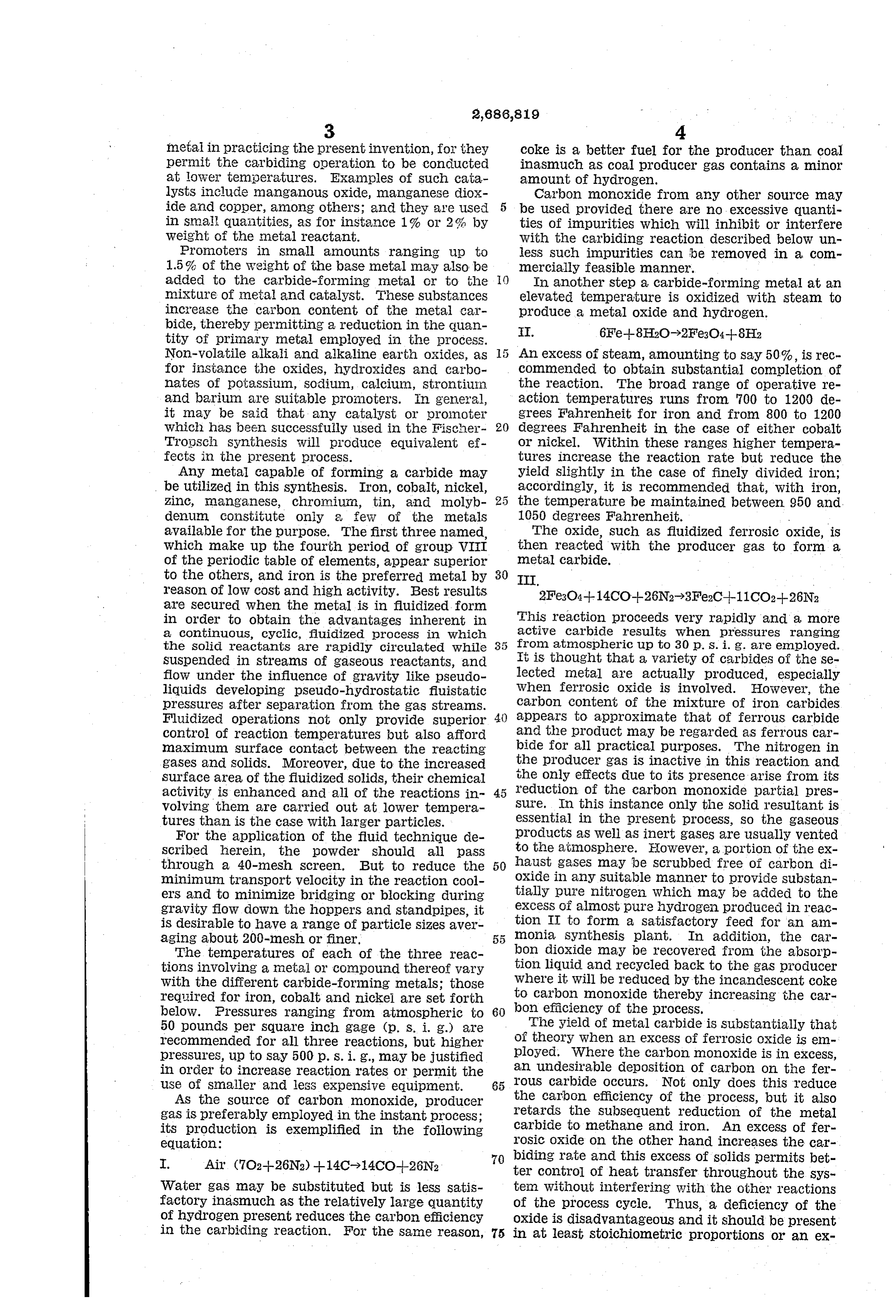
cess tranging up to say 1000% for more. Pref isreaction insufficient to interfere with the subsequent erably the excess of ferrosic oxide amounts to with ferrosic oxide. - 50 to 50%. Over theory. . . . . . "Next the gaseous mixture, consisting chiefly 3A particular advantage is realized hereby using of nitrogen and carbon monoxide, proceeds a concurrent flow fluidized process in that the through pipe 3 into transport line.f4 where the very fast.reaction rate is not slowed down as it is hot fluidized ferrosic oxide, usually in Stoichio in the case of a dense phase fixed (or circulating metric excess, is injected from standpipe 5 at bed of ferrosic oxide where the rate is reduced tached to a sealed vessel 8...and controlled by...a by the introduction of carbon monoxide into slide valve i7. If necessary a small quantity of solids of sub-normali activity due to their sub O a suitable aerating agent, Such as Steam, may stantial ferrous carbide content and also by the be introduced into pipe i? 5 and also at the bot increasing concentration of carbon-dioxide as the tom of hopper E6 at one or more points to main gases rise through the bed. ... ". . . . . . tain the finely divided-oxide in fluidized condi Suitable temperature ranges for the carbiding rtion. As the powdered oxide sweeps up through operation are 450 to 800 degrees Fahrenheit in ine 3 as a dilute turbulent suspension in the the case of iron, 550 to 650 degrees Fahrenheit carrier stream of gases an exothermic reaction being preferred, and 300 to .500 degrees Fahren commences...in which the carbide of the metal heit for either cobalt or nickel. Lowering the is formed. Che. density of the Suspension in this temperature favors the reaction equilibrium carrier line is a function of the static pressure while raising it increases the reaction rate. 20 and the preferred range is from 0.3 to 5.0 lbs./cu. :Next the metal carbide is reacted with all or ft. The optimum velocity of the mixture is about a portion of the hydrogen produced in reaction 20 to 30 ft./sec. Such conditions are-readily ob II. The hydrogen reduces the carbide to the tained by known design principles in selecting metal and combines with the carbon liberated to 25 the proper pressure drop through pipe f4 and form methane. choosing an internal diameter for this line: ade IV. 3Fe2C+6H->6Fe+3CH4 ... quate for the flow rates of reactants. The heat necessary...to initiate the reaction is furnished
Moderately elevated pressures of a few atmos by the ferosic oxide. Which enters pipe 4 at a pheres favor the reaction, while, higher pres temperature in the neighborhood of 1000 degrees sures tend to yield higher hydrocarbons than Fahrenheit, for the producer gas is not far above methane. With stoichiometric proportions of atmospheric temperature. A water-cooled re reactants this fairly rapid reaction proceeds to action cooler 8...is provided to maintain a re over 95% of completion, and where hydrogen . action temperature of 550 to 650 degrees Fahren in a desirable excess of about 10% is used, the heit. In this vessel, the reaction zone is of yields are very close to that of theory. It will 35 greater CrOSS-Sectional area, than line-4, thereby be noted that the hydrogen produced in reac reducing the velocity of the. Suspension to about tion II, amounts to one-third more than is...re 3 to i0-ft./sec. and increasing its density to ap quired for reaction IV, and all of this excess mayproximately 20 to 40 lbs./cu. ft. The length of be employed in the latter reaction where a prod this reaction zone is of course. determined by the uct: gas of somewhat lower heating value is ac 40 requirements of adequate time...for the reaction ceptable. The operative temperature range for and sufficient heat transfer area to maintain iron extends from 650 to 950 degrees Fahren tha, reaction ternperature within the limits indi heit, and the latter figure should not be exceeded cated. Line i8 which carries the mixture into the inasmuch as iron begins to soften and become closed vessel 26 extends wells down into the in Somewhat tacky at 950. degrees. For iron the terior, but not below the surface of the dense recommended temperature range is from 750 to bed (approximately 70 to 100 lbs./cu. ft.) of iron 800 degrees Fahrenheit. Considerably less heat carbide and excess ferrosic oxide. Stored therein. is required for cobalt, or nickel as the tempera At this point the gases in the mixture, chiefly ture heit.
may. range
from 400 to 600 degrees Fahren Caroon dioxide... and nitrogen under a pressure of 20 to 30 p.s. i.g., separate from the finely .
The invention is best understood by reference divided Solids, and the settling or separation to the accompanying drawing which is a flow sheet of the novel process in its preferred form efficiency is enhanced greatly by the downward disciarge of the suspension into settler 29. The
This figure is purely schematic in nature and is not intended to illustrate the optimum locations 55 diameter of this vessel is selected to provide an upward velocity of gases therein of from i to 2 or dimensions of any of the apparatus depicted. ft./sec. and its length is designed to furnish Air from the blower if is supplied through Stoi'age Space for an ample supply of the metai valved line 2 to gas producer 3 which is prefer compounds plus Sufficient disengaging space ably of the slagging type. The coke or coal feed for the producer enters through hopper & and 60 thereabove to attain the optimum gravity sepa the producer gas passes through line 5 to a exhausted to the from ration of powder the gases. The gases are atmosphere through a fiitering waste heat boiler-6 where it gives up most of its device -25 and exhaust pipe 22. Any entrained heat. Leaving through line 7, the gas passes fine pairticles are removed by the filter, which is to a cyclone separator 8 in which fly ash is re preferably of porous metal or ceramic construc moved from the gas stream. Pipe 9 carries the 65 tion, and consists of several sections. A valve gas to a scrubber 8 where it is scrubbed with water to further cool it and remove any dust, arrangement operated by an automatic time carbon or remaining ash. It is then transferred cycle controller (not shown) is provided to clear through line is to a conventional sulfur removal the filter of adhering powder by blowing back unit 42. This device need only be employed 70 the exit gases through each section of the filter where the sulfur content of the coke or coal is in Succession. This mechanism is so adjusted sufficient to inhibit the carbiding reaction, and as to always be clearing one section of the filter any equipment suitable for removing sulfur from while the other sections are filtering the exhaust city gas will serve the purpose here. At this gases. If a cyclone separator is used in place of point the moisture.co.ontent of the producer gas 15 the filter, the exit gases from the cyclone should
Page 5
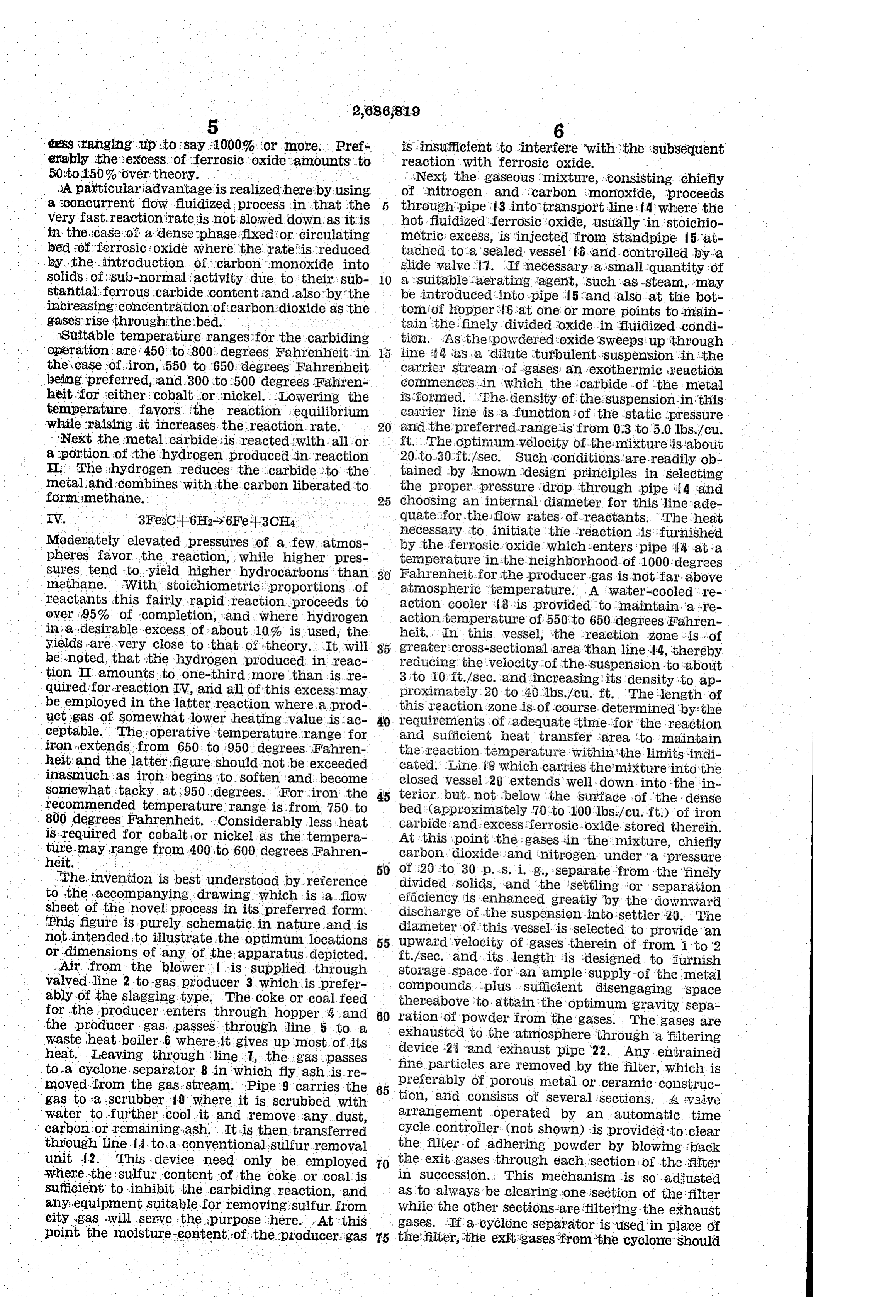
be passed through a water Scrubber to avoid the pure product while the remainder is recycled loSS of ines. through pipe 44 and compressor. 45 to transport : In the event that either the nitrogen or carbon line 25 for the reduction. Stage of the proceSS. dioxide in the exhaust gases are to be recovered, Any excess hydrogen recycled through the re line 22 is connected to an absorber or Scrubber duction step is not lost, and will be recovered (not shown) where the carbon dioxide is dis along with the methane from cooler-3. solved by passing the gases through any suitable Where it is necessary, to aerate the bottom of absorption liquid from Which the carbon dioxide tank 28 and/or line 32, this may be accomplished may later be recovered. The absorber effluent With either Some of the excess hydrogen from consists of relatively pure nitrogen contaminated O pipe 43 or 44 or product gas from cooler 3. with the rare gases of the atmosphere in Small In maintaining the desired concurrent fiOW amounts along With lesser quantities of unre in all three reactions involving fluidized solids, acted carbon nonoxide and perhaps hydrogen. the maintenance of approximately equal veloci The hot metal carbide and oxide, at a ten ties in carrier lines 4, 9, 25, 2, 34 and 36 of perature only a few degrees below that in re 5 from 20 to 30 ft./sec. is recommended and the actor i3, descend from tank 20 through Stand densities in these lines are from 0.3 to 5 lbs./cu. pipe 23 controlled by slide valve 24 into a rapid ft. depending on reaction pressure. . The veloci current of hydrogen in line 25. Any aeration ties in reaction coolers. 8, 26 and 35 are pref necessary for tank 2 or pipe 23 can be Supplied erably 3 to 10 ft/sec. and the Suspensions there by flue gases or by compressing and recycling 2 have densities of 20 to 40 lbs./cu. ft. In set the effluent from line 22. The hydrogen en tlers or hopper's f6, 28 and 28, upward gas veloci ployed in this Step is produced in exceSS in the ties of from 1 to 2 ft./sec. are preferred. . . These oxidation of the metal as described hereinafter. Velocities are obtained by designing this equip Since this gas is comparatively cool, the hot ment along the lines indicated previously. ' Solids furnish all or most of the heat required 25 The proper lengths of Standpipes 5, 23 and 32 to start the rapid exothermic reaction. In pipe are determined in conventional manner to pro 25 and enlarged reaction cooler 26, which main duce Sufficient fluistatic pressure to inject the tains the reaction temperature between 750 and Solid reactant into the carrier lines at suitable 800 degrees Fahrenheit, the metal carbide in the rates. Since, none of the hoppers may collect Suspension is reduced while in concurrent flow to 30 fiulidized Solids at a greater rate than the other iron and methane by the hydrogen which is Settlers Over an extended period without throw preferably present in 10% stoichiometric excess. ing the System out of operating balance, it is This powdered iron and ferrosic oxide suspen apparent that the flow rates of solids, calculated Sion is then discharged by line 27 just above the aS Fe, down each of the three standpipes must bed of solids in hopper 28 where the pressure is 35 be equal in the long run. Therefore, the op in the 20 to 30 p.s. i. g. range. The methane erating adjustments on the plant to attain the and any unreacted hydrogen Separate from the desired Velocities and stoichiometry will be made powder and leave through filtering device 29, On the fluid reactants by means of the valves in Similar to filter 2i. Thereafter the product gas lines 2, 44 and the steam line. , ,. is paSSed through pipe 30, cooler 3 and then to In the event that it proves desirable to achieve Suitable storage facilities. better control of reactant temperatures, this From the bottom of vessel 28, where the density may be readily accomplished by the installation is of the order of 70 to 100 lbs./cu. ft. and its of heat exchangers in One or more of the reactant temperature only slightly below that of reac Supply lines (the Standpipes and pipes 3 and 44) tion Cooler 25, the hot, fluidized metal and excess 45 to heat or cool the reactant to the desired figure. Oxide fioW down standpipe 32 controlled by slide The process described above is cyclic and in Valve 33 to carrier line 34 and are there picked Volves the rapid circulation of fiuidized solids with up by a SWift, Valve-controlled stream of steam the various reactions occurring simultaneously from the boiler 6 or reaction coolers. The tur and continuously in different reaction zones. bulent Suspension of reactants passes through 50 This represents the greatly preferred form. enlarged reaction cooler 35 maintained at 950 Nevertheless, it is readily apparent that the proc to C50 degrees Fahrenheit and the powder is eSS can be performed in an intermittent manner deposited by pipe 3 in tank 6 on top of the With all reactions. occurring in sequence in a layer of metal oxide which has a density of about Single reaction Zone, or alternatively in fixed beds 50 to 80 lbs./cu. ft. The steam enters transport 55 of Solids in three reactors using known cycle con line 3 at a pressure equal to the 20 to 30 p.s. i. g. trol devices. In Such cases, the particle size of the maintained in hopper is plus the designed pres Solid reactant may range from the fine powders Sure drop between the bottom of standpipe 32 discussed hereinbefore up to granules of approxi and hopper 3. Its temperature is adjusted to mately %' diameter. However, it is to be under the minimum required to initiate reaction with 60 Stood that the efficiency of the intermittent cyclic the iron in the powdered mixture to form hy proceSS is considerably below that of the continu drogen and ferrosic oxide while in transport to OuS Circulatory. One because the reactor or reac the receiving hopper. tors Would necessarily be kept at a single average The hydrogen and excess steam leave tank is temperature rather than in the optimum range through the cyclone or filter 37 which separates 65 for each of the reactions and the temperature the fines. Since the steam constituent of the Control in a Wide fixed bed is inferior to that ob effluent in pipe 38 will inhibit the reduction of tainable in a turbulent circulating suspension of iron Carbide by hydrogen in the following step the Solids in a relatively narrow stream of gas. of the cycle, as much moisture as possible is Where the fixed bed consists of granular rather Condensed out of the mixture in a water-cooled 70 than fluidized Solids, the variations in tempera Condenser from which the condensate leaves by ture in various parts of the bed are far greater trap line 4. While the hydrogen passes up pipe and higher reaction temperatures are required. 4. By Suitable adjustment of valve 42 some In addition the operating costs of the intermittent or all of the excess hydrogen may be drawn off, process Would obviously be much greater than the if desired, through line 43 as a substantially s circulating continuous process,
Page 6
Since certain changes may be made in carrying pally hydrogen and an oxide of nickel, reacting out the above process without departing from the carbon monoxide with said oxide of nickel at a scope of the invention, it is intended that all temperature sufficiently elevated to produce a matter contained in the above description shall carbide of nickel, and reducing said carbide of be interpreted as illustrative and not. in. . . a limiting nickel with at least a portion of said hydrogen at
a temperature Sufficientiy elevated to produce
It is also to be understood that the following nickel and a gasiform mixture comprising chiefly claims are intended to cover all the generic and methane. ". . . . , specific features of the invention herein described, ( 7. A cyclic process for the synthesis of methane and all statements of the Scope of the invention, from carbon monoxide and steam which com which as a matter of language might be said to prises reacting iron obtained from the reduction fall therebetween. step mentioned hereinafter with steam at a tem Having described my invention, what I claim perature of from 700 to 1200 degrees Fahrenheit as new and desire to secure by Letters Patent, is: to produce principally hydrogen and ferrosic
1. A cyclic process for the synthesis of methane oxide atreacting oxide, carbon monoxide with the ferrosic a temperature of from 450 to 800 degrees.
from 'carbon monoxide and steam which com Fahrenheit to produce a carbide of iron, and re prises reacting a carbide-forming metal obtained dulcing said carbide of iron with at least a portion from the reduction step mentioned hereinafter of said hydrogen at a temperature of from 650 with steam at a temperature sufficiently elevated 20 to 950 degrees Fahrenheit to produce iron and a to produce principally hydrogen and an oxide of gasiform mixture comprising chiefly methane. the metal, reacting carbon monoxide with said 8. A process' according to claim 7 in which the metal oxide at a temperature sufficiently elevated iron and said iron compounds are in fluidized to produce a carbide of the metal, and reducing foir;
said metal carbide with a least a portion of Said 5 9. A cyclic process for the synthesis of methane hydrogen at a temperature sufficiently elevated from carbon monoxide, and steam which com to produce the metal and a gasiform mixture prises oxidizing iron obtained from the reduction comprising chiefly methane. . step mentioned hereinafter with steam at a tem 2. A process according to claim.1 in which the 30 perature of from 950 to 1050 degrees Fahrenheit metal and said metal compounds are in fluidized to produce principally hydrogen and ferrosic iform. - . . .. oxide, reacting carbon monoxide with the ferrosic 3. A cyclic process for the Synthesis of methane oxide at a temperature of from 550 to 650 degrees from carbon monoxide and steam which com Fahrenheit, to produce a carbide of iron, and re prises reacting a metal of the fourth period of 35 ducing said carbide of iron. With at least a por Group VIII of the Periodic Table of Elements ob tion of Said hydrogen at a temperature of from tained from the reduction stepmentioned here 750, to 800 degrees Fahrenheit to produce iron inafter with steam at a temperature sufficiently and a gasiform mixture comprising chiefly elevated to produce principally hydrogen and an methane. ... oxide of the metal, reacting carbon monoxide with 40 10. A process according to clain. 9 in which said metal oxide at a temperature. Sufficiently all reactions take place at less than 50 pounds elevated to produce a carbide of the metal, and per square inch gauge pressure.
reducing said metal carbide with at least a por ill. A cyclic process for the synthesis of a gas tion of said hydrogen at a temperature sufficiently of high heating value which comprises burning elevated to produce the metal and a gasiforn carbonaceous matter in a restricted quantity of mixture comprising chiefly methane. air to form producer gas, reacting a carbide 4. A cyclic process for the synthesis of methane forning metal obtained from the reduction step from carbon monoxide and steam which con mentioned hereinafter with steam at a tem prises reacting iron obtained from the reduction perature sufficiently elevated to produce prin step mentioned hereinafter with steam at a ten cipally hydrogen and an oxide of the metal, re perature sufficiently elevated to produce princi i acting the producer gas With Said metal oxide pally hydrogen and ferrosic oxide, reacting car at a temperature sufficiently elevated to pro bon monoxide with the ferrosic oxide at a tem duce a carbide of the retal, and redicing said perature sufficiently elevated to produce a car i8tal carbide With at least, a portiorn of Said bide of iron, and reducing said carbide of iron ydrogei) at a temperature Suficiently elevated with at least a portion of said hydrogen at a tem to produce the metal and a gasiforniaixture perature sufficiently elevated to produce iron and coRinprising chiefly methane. a gasiform mixture comprising chiefly methane. 12. A process according to claim li in Which 5. A cyclic process for the synthesis of methane the metal and said metal compounds are in from carbon monoxide and Stean Which COin fluidized form.
prises reacting cobalt obtained from the reduction 60 13. A cyclic process for the Synthesis of a gas step mentioned hereinafter with steam at a ten of high heating value which cornprises burning perature sufficiently elevated to produce princi garoonaceous ratter with a restricted quantity pally hydrogen and an oxide of cobalt, reacting of air to forin producer gas, oxidizing iron ob carbon monoxide with said oxide of cobalt at a tained from the reduction step manticined here temperature sufficiently elevated to produce a car inafter with steam at a temperature of from 700 to 12C0 degrees Fahrenheit to produce prin bide of cobalt, and reducing said carbide of cobalt with at least a portion of Said hydrogen at a tem cipally hydrogen and ferrosic oxide, reacting the perature sufficiently elevated to produce cobalt producer gas with the ferrosic oxide at a ten and a gasiform mixture comprising chiefly perature of from 450 to 800 degrees Fahrenheit, methane. O to produce a carbide of iron, and reducing Said 6. A cyclic process for the synthesis of methane carbide of iron with at least, a portion of Said from carbon monoxide and steam which con hydrogen at a temperature of from 650 to 950 prises reacting nickel obtained from the reduction degrees Fahrenheit to produce iron ald a gasir step mentioned hereinafter with steam at a tem form mixture comprising chiefly metaine. perature sufficiently elevated to produce princi 14. A continuous cyclic process for the Syn."
Page 7
thesis of methane from carbon monoxide and thesis of a gas of high heating value which Steam. Which comprises oxidizing a Suspension comprises burning carbonaceous matter in a re of a carbide-forming fluidized metal obtained stricted quantity of air to form producer gas, from the reduction step mentioned hereinafter oxidizing a suspension of fluidized iron obtained With a carrier stream of steam at a tempera from the reduction step mentioned hereinafter ture sufficiently elevated to produce principally With a carrier Stream Of Steam at a temperature hydrogen and an oxide of the metal, separating of from 700 to 1200 degrees Fahrenheit to pro the hydrogen and said metal oxide, reacting a duce principally hydrogen and ferrosic Oxide, Suspension of Said fluidized metal oxide With a separating the ferrosic oxide and the hydrogen, carrier stream of carbon monoxide at a ten 10 reacting a suspension of the fluidized ferrosic perature. Sufficiently elevated to produce a car oxide with a carrier stream of producer gas at bide of the metal, separating said metal carbide a temperature of from 450 to 800 degrees Fahren from the gases in the reaction products, reduc heit to produce a carbide of iron, separating Said ing a suspension of said fluidized metal carbide carbide of iron from the gases in the reaction With a carrier stream comprising at least a por products, reducing a suspension of said fluidized tion of said hydrogen at a temperature suffi carbide of iron With a carrier Stream comprising ciently elevated to produce the metal and a gasi at least a portion of said hydrogen at a tem form mixture comprising chiefly methane, and perature of from 650 to 950 degrees Fahrenheit separating the fluidized metal and the methane. to produce iron and a gasiform mixture com 15. A continuous cyclic process for the Syn prising chiefly methane, and separating the thesis of methane from carbon monoxide and fluidized iron and the methane. steam which comprises oxidizing a suspension of fluidized iron obtained from the reduction References Cited in the file of this patent step mentioned hereinafter with a carrier stream UNITED STATES PATENTS of steam at a temperature of from 700 to 1200 25 degrees Fahrenheit to produce principally hy Number Name Date drogen and ferrosic oxide, separating the hy 2,130,163 Tiddy et al. -------- Sept. 13, 1938 drogen and ferrosic oxide, reacting a Suspension 2,364,123 Benner ------------ Dec. 5, 1944 of the fluidized ferrosic oxide With a carrie 2,369,548 Elian ------------- Feb. 13, 1945 stream of carbon monoxide at a temperature of 30 2,409,235 AtWell ------------ Oct. 15, 1946 from 450 to 800 degrees Fahrenheit to produce 2,449,635 Barr ------------- Sept. 21, 1948 a carbide of iron, separating Said carbide of iron 2.537,496 Watson ---------- Jan. 9, 1951. from the gases in the reaction products, reduc 2,544,574. Walker et al. ------ Mar. 6, 1951 ing a suspension of said fluidized carbide of iron FOREIGN PATENTS With a carrier stream comprising at least a por 35 tion of Said hydrogen at a temperature of from Nubei Country Date 650 to 950 degrees Fahrenheit to produce iron 13,861 Great Britain ------ June 15, 1907 and a gasiform mixture comprising chiefly OTHER REFERENCES methane, and separating the fluidized iron and the methane. 40 Bahr et al., Berichte (July-Dec. 1933), pages 16. A continuous cyclic process for the Syn 1238 to 1241.
Provenance
- Collection
- Cited prior art
- Original PDF
- patentimages.storage.googleapis.com →
- Filed
- 1949-09-01
- Pages
- 7
- Method
- pdftotext (the PDF's own text layer) + pdftoppm 300dpi page scans
- Source
- Google Patents bibliographic record
- Granted
- 1954-08-17
- Inventors
- William B Johnson; MW Kellogg Co
- Transcribed from
- patentimages.storage.googleapis.com →