patent · US5824202
Electrode for use in membrane electrolyzers
20 October 1998
Page 1 — bibliographic record
United States Patent (19) 11 Patent Number: 5,824,202 Fabian et al. (45) Date of Patent: Oct. 20, 1998 54 ELECTRODE FOR USE IN MEMBRANE 56) References Cited
ELECTROLYZERS
75 Inventors: Peter Fabian, Hanau, Germany; Emilio
Zioni, Trezzano, Italy 4,923,583 5/1990 Woodard, Jr. et al. ................. 204/286 5,660,698 8/1997 Scannell et al. ........................ 204/288 73 Assignee: De Nora S.p.A., Italy 21 Appl. No.: 960,829 Primary Examiner Bruce F. Bell Attorney, Agent, or Firm Bierman, Muserlian and Lucas
Related U.S. Application Data
The invention concerns an improved electrode particularly 62 Division of Ser. No. 743,108, Nov. 4, 1996, Pat. No. useful for electrochemical processes forming gaseous prod
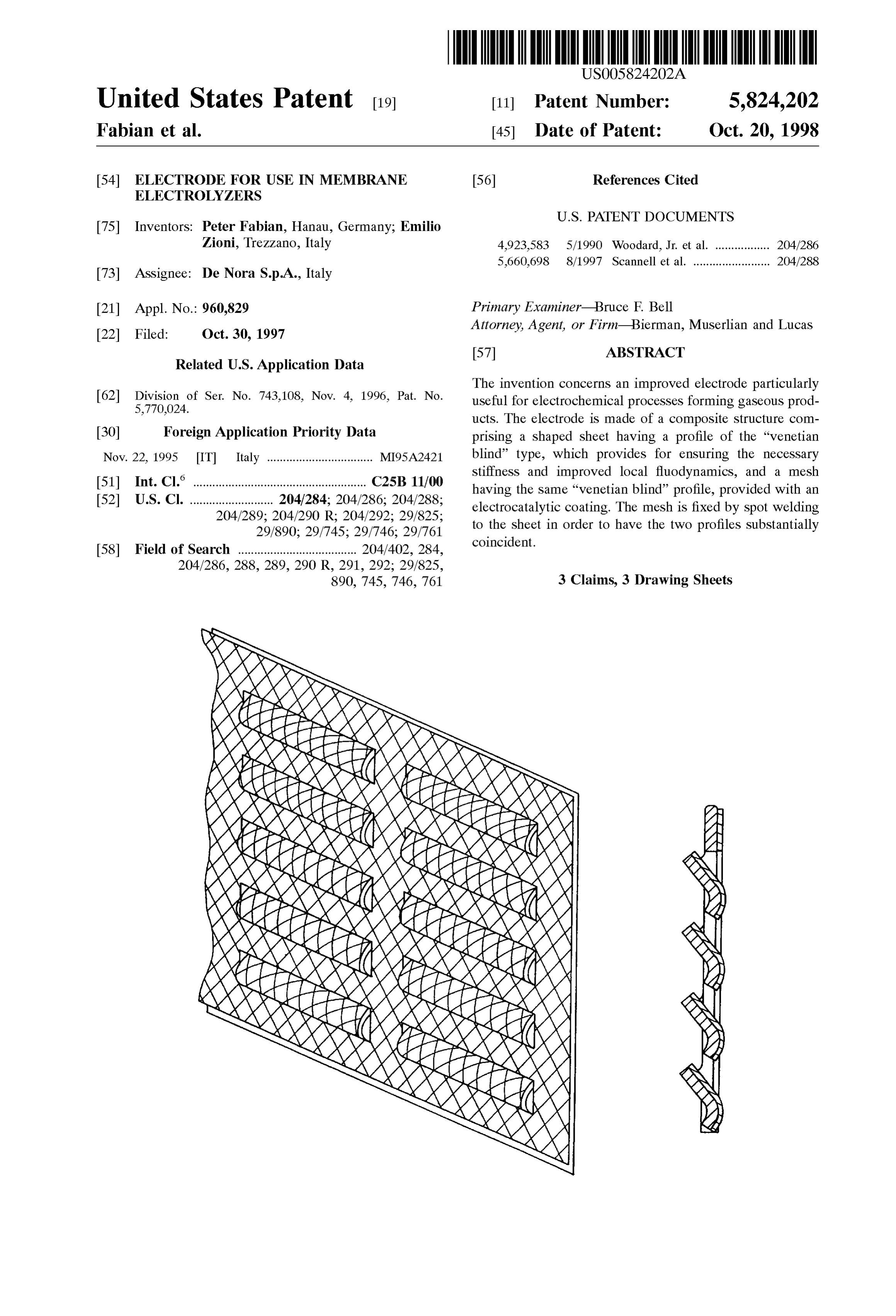
ucts. The electrode is made of a composite Structure com 30 Foreign Application Priority Data prising a shaped sheet having a profile of the “Venetian Nov. 22, 1995 IT Italy ................................. MI95A2421 blind' type, which provides for ensuring the necessary StiffneSS and improved local fluodynamics, and a mesh (51) Int. Cl." ...................................................... C25B 11/00 having the same “venetian blind” profile, provided with an 52 U.S. Cl. .......................... 204/284; 204/286; 204/288; electrocatalytic coating. The mesh is fixed by Spot welding 204/289; 204/290 R; 204/292; 29/825; to the sheet in order to have the two profiles substantially
58 Field of Search ..................................... 204/402, 284,
890, 745, 746, 761 3 Claims, 3 Drawing Sheets
XEXXX
XXX.
KEX $9CXX
Page 2
Drawing sheet — no readable text.
Page 3
Drawing sheet — no readable text.
Page 4
Drawing sheet — no readable text.
Page 5
ELECTRODE FOR USE IN MEMBRANE These phenomena of membrane damaging are more easily ELECTROLYZERS controlled with expanded metal electrodes wherein the dimensions of the mesh openings and of the Solid metal
PRIORAPPLICATION portions may be largely varied by Suitably adapting various This application is a division of U.S. patent application parameterS Such as the pitch between cuts and their length,
as well as the expansion degree. The situation is much more critical with other geometries, in particular with "venetian 5,770,024. blind’ electrodes which, on the other hand, offer remarkable STATE OF THE ART advantages as regards local fluodynamics of the gas-liquid mixtures of the electrolysis products (see European publi
The ion-exchange membrane electrolysis proceSS is pres cation No. 0 189535). In fact, with the “venetian blind” ently the preferred method for the industrial production of electrodes, there are large areas of contact between the chlorine and caustic Soda from brine, that is from an aqueous membrane and the Solid metal portions of the electrodes and concentrated Solution of Sodium chloride, although promis therefore there is a high risk of damageS as aforementioned, ing opportunities may be devised also for other industrial 15 the more probable the higher is the current density during applications Such as the production of hydrogen and oxygen operation in industrial electrolyzers. by electrolysis of alkali metal hydroxide solutions. To overcome the problem of membrane damaging, vari However, in View of the current outstanding preeminence of ous Solutions have been Suggested Such as the roughening of chlor-akali electrolysis, the following description will make the membrane Surface to be contacted with the electrode. reference to this process without any intention of limiting This roughening may be obtained through a partial corrosion the invention thereto. The chlor-alkali electrolysis process is of the Surface, for example by a plasma beam or by applying characterized by a Smooth operation in the long term pro a layer of hydrophilic powder which hinders the adhesion of Vided that certain technical aspects are adequately gas bubbles. Alternatively the electrode Surface may be addressed. Two of these aspects are represented by the roughened by engraving it with holes and channels in a reciprocal interaction between the electrodes and the ion 25 herring-bone pattern, made by a laser equipment (see U.S. eXchange membranes and by the operating lifetime of the Pat. No. 5,114.547).
electrodes.
AS concerns the Second aspect, that is the operating
AS concerns the first of these aspects, it must be taken into lifetime of the electrodes, this depends on the structure of the account that the turbulence of the electrolytes may easily electrodes which comprises a metal Substrate having the cause fluttering of the delicate ion-exchange membrane. To aforementioned geometries, provided with an electrocata avoid Such a problem, which would readily cause ruptures of lytic coating. For example, when the electrodes act as the membrane, usually the two compartments of each anodes (positive polarity), the Substrate is titanium and the elementary cell, which form an industrial electrolyzer, are coating is made of oxides of the platinum group metals characterized by a pressure differential which actually main having a thickness of Some microns. When the electrodes act tains the membrane pressed against one the electrodes, 35 as cathodes (negative polarity), the Substrate is nickel or normally the anode in membrane chlor-alkali electrolysis. carbon Steel or stainless Steel coated by a thin film (Some The other electrode may also be pressed against the mem microns) of Raney nickel, platinum group metals or oxides brane by means of Suitable resilient Systems, thus increasing of the same, alone or in combination. The lifetime of these the mechanical stability of the membrane itself (this tech electrocatalytic coatings depends on the operating nology is known as “Zero-gap'). Alternatively, the other 40 conditions, in particular temperature, current density, elec electrode may be spaced apart from the membrane which is trolyte concentration and presence of poisoning agents pushed against the first electrode by the preSSure differential, capable of hindering the electrocatalytic activity as already said (technology known as "finite-gap' or ("poisoning”). In any case, after a certain period of “narrow-gap'). operation, the electrodes must be renewed (in the following In any case the membrane is in contact with at least one 45 description: reactivation). The simplest way is shipping the electrode, the geometry of which is extremely important. Structures where the electrodes are fixed to the producer's Various electrode geometries are known in the art, from the facilities where the electrodes are detached from the Sup So-called expanded metal to plates cut into parallel Strips porting Structures and Substituted with new electrodes. provided with edged profiles which act as gas-diverting Obviously this operation is time-consuming (shipping, means (see European Publication No. 0 102 099), to the 50 mechanical operations) and expensive (total renewal of the “venetian blind” electrodes (see European Publication No. 0 electrodes including the metal Substrate). A possible alter 189535), obtained by cutting metal sheets with suitable native consists in fixing, usually by Spot-welding, a new tools. electrode onto the Surface of the exhausted one. For this To obtain the best performance of the membrane it is purpose, thin nets are used which have Suitable dimensions important that the portions of the electrode made of Solid 55 of the openings and above all a small thickness (see Euro metal have dimensions as reduced as possible as the diffu pean publication No. 0 044 035). This method has the Sion of Sodium chloride brine inside the interstices between Substantial inconvenience of altering the local geometry of the membrane and the metal is slowed down and as a the membrane-electrode contact, thus modifying to a great consequence, the liquid inside the interstices is progres extent the fluodynamics of the mixtures of electrolyte and sively diluted. The dilution of the brine leads to blistering of 60 produced gas. This inconvenience is of particular concern the membrane. Another deterioration mechanism derives when the thin activated net is applied to exhausted elec from the Stagnation of chlorine pockets inside the trodes of the “venetian blind” type or similar geometry. membrane/metal interstices. This stagnation causes the for It is therefore evident that the solutions proposed by the mation of Sodium chloride crystals inside the membrane, the prior art (e.g. roughening of the membrane or electrode Structure of which becomes permanently altered thus spoil 65 surface) have only reduced the impact of the width of the ing its performances (see Modern Chlor-Alkali Technology, membrane-electrode contact, remarkably adding to the pro Vol. 4, Elsevier Applied Science, 1990, pages 109-123). duction costs (e.g. use of laser equipment) or have Solved a
Page 6
problem (reactivation of exhausted electrodes using thin profile particularly useful for preventing the membrane from activated nets) giving rise to additional inconveniences Sticking to the metal and thus avoiding the negative phe (worse local fluodynamics of the gas-electrolyte mixtures). nomena of dilution of the Sodium chloride Solution and gas entrapping. This result is obtained in an efficient way, at low
OBJECTS OF THE INVENTION cost and with an easy construction method, in particular when the dimensions of the mesh openings are lower than
It is the object of the present invention to provide for a the width of the strips of the “venetian blind’ electrode. new electrode capable of completely overcoming the prob Preferably the mesh is obtained by expansion of a sheet lems affecting the prior art, particularly concerning the having a Suitable thickness. As a consequence, the preferred geometry of the contact area between the membrane and embodiment of the invention Sums up all the advantages electrodes of the “Venetian blind' type or Similar geometries, offered by different prior art inventions, that is reactivation when the electrodes become exhausted after a period of using a planar sheet and elimination of the problem of operation. AS concerns this last aspect, the electrode of the dilution in the interstices and gas entrapping by engraving present invention has a structure whereby the reactivation the electrode Surface with channels in a herring-bone pat may be effected at plant Site without shipping the exhausted 15 tern. Furthermore, these advantages are joined in a Single electrode Systems to the producer facilities. element, easy to be produced with low costs, capable of It is a further object of the present invention to provide for maintaining the fluodynamicS characteristics of the Struc a new electrode Structure provided with an electrocatalytic tures of the prior art. For this reason the preferred embodi coating which Strongly decreases the problems associated ment of the present invention is useful not only for the with the membrane-electrode contact and further permits reactivation of exhausted electrodes but also for installation easy reactivation of the coating when it become exhausted. in new electrolyzers. In this case the production procedure foresees the following Steps:
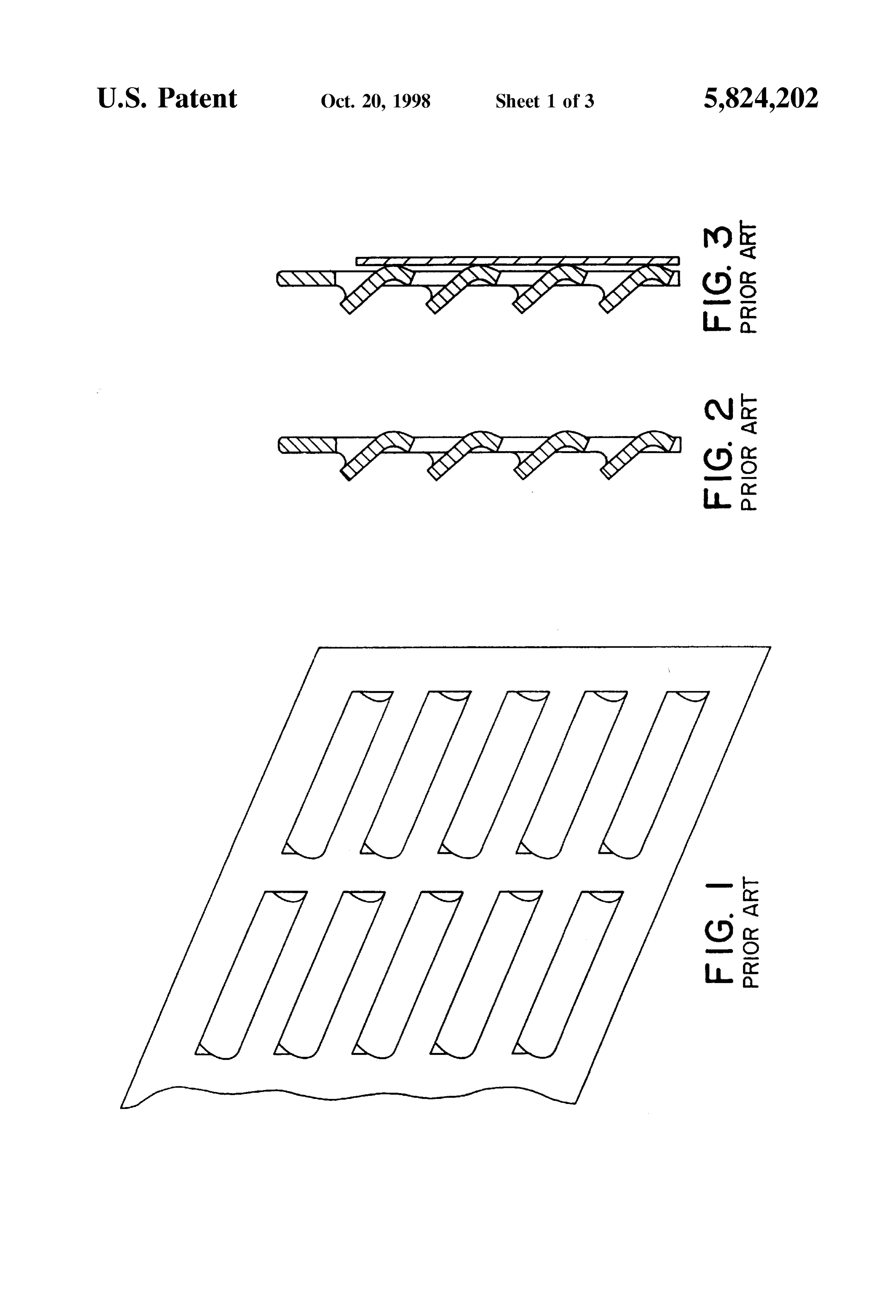
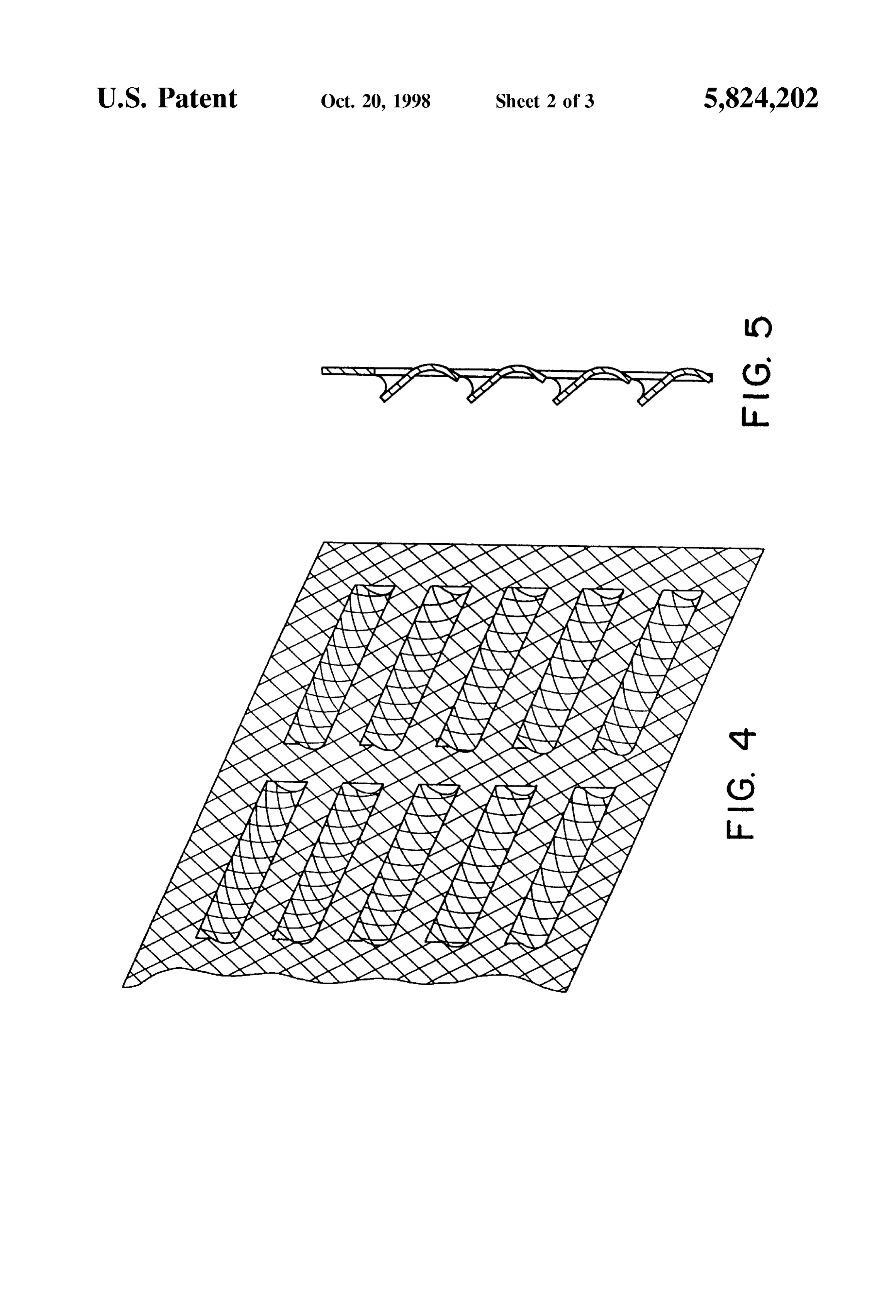
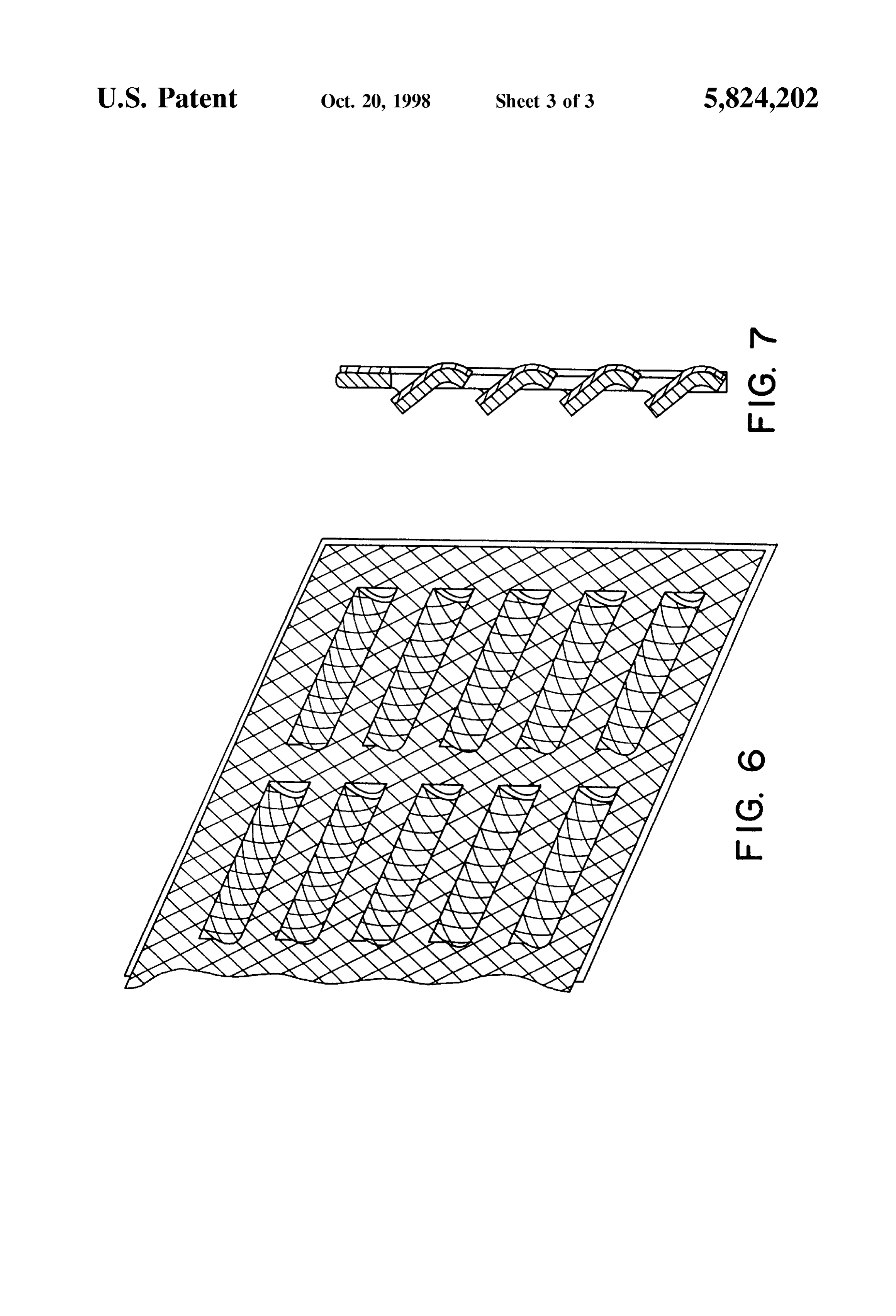
BRIEF DESCRIPTION OF THE FIGURES Shaping of a metal sheet to obtain the Structure and profile FIG. 1 is a front view of an electrode of the "venetian of FIGS. 1 and 2. Contrary to the teachings of the prior blind' type. 25 art, this Structure is not provided with an electrocata lytic coating;
FIG. 2 is a cross-section of the electrode structure of FIG. expansion of a thin sheet to form the mesh characterized 1. The electrode is obtained from a metal sheet shaped with by Suitable dimensions of the mesh openings and by a special tool which at the same time cuts Strips in the sheet lower thickness with respect to the shaped sheet. The and bends them. mesh is provided with a Suitable electrocatalytic coat FIG. 3 shows a composite Structure comprising the elec ing. The mesh is then shaped with the same tool used trode of FIG. 1 provided with an activated planar sheet used to shape the metal sheet. A shaped mesh is thus to renew the electrode electrocatalytic activity according to obtained which perfectly adapts to the shaped sheet. In the teachings of the prior art. this way the sheet-mesh assembly may be more easily FIG. 4 is a front view of the preferred embodiment of the 35 welded and the reliability of the welding is enhanced. present invention. A planar mesh made of the same metal as AS a conclusion, in the composite Structure of the present the Sheet and previously provided with an electrocatalytic invention, the two components have different and comple coating is shaped using the same tool used for the electrode mentary functions. In particular, the shaped mesh, having a of FIG. 1. The shaped mesh therefore has the same profile Sufficient thickness, ensures the necessary rigidity to the as the sheet electrode as shown in FIG. 5 40 electrode assembly and with its profile provides for the best FIGS. 6 and 7 show the coincident profiles of the shaped local fluodynamics. The mesh has the main function of mesh of FIGS. 4 and 5 applied to the sheet of FIGS. 1 and providing the assembly with the necessary electrocatalytic activity and the necessary Surface roughness to prevent
damaging of the membrane caused by dilution in too small
DESCRIPTION OF THE INVENTION 45 interstices and gas entrapping, as mentioned before. In another less preferred embodiment of the present invention,
A preferred embodiment of the present invention is illus a thin Sheet is used instead of the mesh. In this case the sheet trated in FIGS. 4, 5, 6 and 7. The mesh provided with an is provided with a Suitable electrocatalytic coating and is electrocatalytic coating fixed to the electrode of FIG. 1, then shaped with the same tool used to shape the thicker known in the art, ensures Several advantages which will be 50 sheet. In this way, the thin sheet, provided with the electro explained in the following description. First of all, the mesh, catalytic coating, perfectly adheres to the profile of the characterized by a lower thickness than that of the electrode, thicker shaped sheet. Obviously the use of the sheet may be perfectly adheres to the electrode sheet profile, and may be resorted to only in the case of reactivation of exhausted efficiently fixed thereto by spot-welding. The solution pro electrodes. However, the use of the thin sheet involves posed by the prior art and illustrated in FIG. 3 is negatively 55 higher costs than the thin mesh and the electrode assembly affected by Several problems concerning welding, probably profile is Smooth. Therefore, in the absence of the necessary due to the Small contact area between the planar sheet and roughness, the membrane may be damaged, as it happens the bent profiles of the electrode of the “venetian blind” with the prior art electrodes of FIG. 1. Conversely, likewise type. Therefore the welding procedure known in the art is the thin mesh, welding of the thin sheet, previously shaped Scarcely reliable and detachments are possible with the 60 as aforesaid, is easy and reliable. Further, also with the thin consequent uneven distribution of current. In addition to the sheet the local fluodynamicS typical of the original electrode possibility of resorting to an easier and more reliable Weld are maintained. The above discussion clearly illustrates the ing procedure, the preferred embodiment of the present distinctive features of the present invention and Some pre invention maintains all the advantageous fluodynamicS char ferred embodiments of the same. However, further modifi acteristics of the prior art electrode of FIG. 1. 65 cations are possible without departing from the Scope of the AS a further advantage, the present invention provides for invention, which is limited only by the following appended an electrode, the bent profiles of which have an irregular claims.
Page 7
S 6
We claim: profile coincident with that of the metal sheet and attaching 1. A process for reactivating an electrode made of a metal the metal mesh or thin metal sheet by welding. sheet provided with a louvered profile and having an 2. The method of claim 1 wherein the welding is electrical exhausted electrocatalytic coating thereon comprising form resistance Spot-welding.
ing a metal mesh or a thin metal sheet which has a thickneSS 5 3. The method of claim 1 wherein a metal mesh is used. which ensures rigidity of the electrode, and which metal mesh or thin metal sheet are made of the same metal as the metal sheet provided with an electrocatalytic coating with a
Provenance
- Collection
- Cited prior art
- Original PDF
- patentimages.storage.googleapis.com →
- Filed
- 1997-10-30
- Pages
- 7
- Method
- pdftotext (the PDF's own text layer) + pdftoppm 300dpi page scans
- Source
- Google Patents bibliographic record
- Granted
- 1998-10-20
- Inventors
- Peter Fabian; Emilio Zioni; De Nora SpA
- Transcribed from
- patentimages.storage.googleapis.com →