patent · US5723029
Photo-electric chemical apparatus using carbon cluster electrode
3 March 1998
Page 1 — bibliographic record
United States Patent (19) 11 Patent Number: 5,723,029 Shimoyama (45) Date of Patent: Mar. 3, 1998
54 PHOTO-ELECTRIC CHEMICAL APPARATUS OTHER PUBLICATIONS USING CARBON CLUSTER ELECTRODE Patent Abstracts of Japan; vol. 018. No. 161 (E-1526), 17 (75) Inventor: Masashi Shimoyama, Kanagawa-ken, Mar. 1994; JP-A-05 335614 (Idemitsu Kosan Co. Ltd). 17
Japan Fujishima et al. "Electrochemical Photolysis of Water at a 73) Assignee: Ebara Research Co., Ltd., Fujisawa. Semiconductor Electrode”. Nature, vol. 238, Jul. 7, 1972, Japan pp. 37-38.
A.J. Nozik, “Photochemical diodes". Applied Physics Let
21 Appl. No.: 825,396 Miller et al. "Photoelectrochemical Behavior of CoFilms". 22 Filed: Mar 28, 1997 J. Am. Chem. Soc., vol. 11.No. 16, 1991. pp. 6291-6293, no month available.
Related U.S. Application Data Tsubomura, "Photoelectrochemistry and Energy Conver
63 Continuation of Ser. No. 534,001, Sep. 25, 1995, abandoned. Primary Examiner-John Niebling which is a continuation of Ser. No. 291,952, Aug. 17, 1994, Assistant Examiner-Brendan Mee abandoned.
Attorney, Agent, or Firm-Armstrong, Westerman. Hattori, (30) Foreign Application Priority Data McLeland & Naughton
Aug. 23, 1993 JP Japan .................................... 5-229.407 57 ABSTRACT (51) Int. Cl. ... H01 L, 31/0256 A photo-electric chemical apparatus comprising an (52) U.S. C. .......................... 204/242; 204/294; 205/340: electrolyte. a first electrode having an n-type semiconductor 205/630; 136/291; 429/111 member disposed to be in touch with the electrolyte and a 58 Field of Search ..................................... 204/242, 294: second electrode having a carbon cluster member disposed 205/340, 630; 136/291; 429/111 to be in touch with the electrolyte. The first and second electrodes are short-circuited and irradiated with a light 56) References Cited beam to thereby generate oxygen and hydrogen. The first
electrode is a laminated member consisting of a light trans mitting glass, a transparent conducting layer and an n-type 3925212 12/1975 Tchernev ................................. 422/186 semiconductor layer. The second electrode is a laminated 4,090,933 51978 Nozik ........ ... 204/129 member consisting of a light transmitting glass, a transpar 4.643,87 2/1987 Appleby ... ... 204/242 ent conducting layer and a carbon cluster thin film. 5,171,373 12?1992 Hebard .......... ... 136,252 5,320,723 6/1994 Kawakami .... ... 204/140 4 Claims, 2 Drawing Sheets
TRACER
VARABLE
BAS
Page 2
Fig. 1
VARABLE
BAS
--- O O O " " ' " " " " res - - - - - O
Ns O OO Ns - -> a is a- - so as O O
2 2O 22 24 44 42 4O
Page 3
Drawing sheet — no readable text.
Page 4
PHOTO-ELECTRIC CHEMICAL APPARATUS acid, etc. where a flat band potential is positive relative to the USING CARBON CLUSTER ELECTRODE reduction voltage of hydrogen ion and a band gap is 1.5 to 3 Ev, a photo current does not flow even if such a semicon
This is a Continuation of application Ser. No. 08/534,001 ductor is short-circuited to a platinum electrode. Therefore, filed Sep. 25, 1995, abandoned, which is a Continuation of 5 itelectrode is necessary to apply a large negative bias to the platinum in order to achieve effective generation of hydro
Ser. No. 08/291,952, filed Aug. 17, 1994, abandoned. gen and oxygen.
BACKGROUND OF THE INVENTION Namely, electrolysis of water by means of a light energy 1. Field of the Invention using a combination of a platinum electrode and a semiconductor, such as titanium dioxide, iron oxide, tung
The present invention relates to a photo-electric chemical sten oxide, tin oxide, lead oxide, indium oxide and iron apparatus and particularly to a photo-electric chemical appa titanic acid essentially requires the application a bias volt ratus for generating hydrogen and oxygen from water by age. This results in the necessity of extra associated appa utilizing light energy. ratuses and extra supplies of energy. 2. Description of the Prior Art 15
Various apparatuses for realizing electrolysis of water by
It has long been known that water is decomposed to means of a light energy using a semiconductor electrode oxygen and hydrogen in a photo-electric chemical apparatus have been heretofore proposed in Japanese Patent Laid structured such that an n-type semiconductor electrode and Open Nos. 62-48928, 53-43488, 54-4582 and 63-231883. a platinum electrode are soaked into an electrolyte is irra SUMMARY OF THE INVENTION diated with a light beam (for example, "Nature”. No. 283, In order to overcome the problems of the prior art, it is an p37, by Fujishima et al. 1972). Such a phenomenon occurs object of the present invention to provide a photo-electric due to the fact that charge separation of electrons and holes chemical apparatus which can generate hydrogen and oxy caused by irradiation of the light beam on the semiconductor gen with light energy without the application of any bias results from a Schottky-barrier-type field distribution at the voltage across the electrodes.
interface between the semiconductor and the electrolyte. 25 It is another object of the present invention to provide a When the semiconductor electrode is irradiated with the photo-electric chemical apparatus which can adjust an light beam with the semiconductor electrode being con amount of hydrogen and oxygen generated by means of the nected with the platinum electrode through a lead wire, irradiation of a light beam by applying a variable voltage electrons pushed out of a conduction band of the semicon across the electrodes.
ductor electrode are accumulated in the platinum electrode. 30 According to one aspect of the present invention, a thereby causing the platinum electrode to charge in the photo-electric chemical apparatus comprises an electrolyte; direction of negative potential. If a voltage difference a first electrode having an n-type semiconductor member between both electrodes is equal to or higher than 1.23 Ev disposed to be in touch with the electrolyte; and a second which is required for decomposition of water and an electric electrode having a carbon cluster member disposed to be in potential of the platinum electrode is more negative than the 35 touch with the electrolyte, the first and second electrodes reduction level of the hydrogen ion, water is decomposed, thereby being short-circuited and irradiated with a light beam to resulting in the generation of oxygen and hydrogen. generate oxygen and hydrogen. Actually, hydrogen is generated when an electric potential of consisting ofelectrode
The first is preferably a laminated member a light transmitting glass, a transparent con the platinum electrode goes in the negative direction further ducting layer and an n-type semiconductor layer. from the reduction voltage of the hydrogen ion beyond a The second electrode is preferably a laminated member hydrogen over voltage of the platinum. It is noted that a consisting of a light transmitting glass, a transparent con platinum electrode is often used because a hydrogen over ducting layer and a carbon cluster thin film. voltage of the platinum is low, that is, platinum is a metal The photo-electric chemical apparatus of the present having an electric potential for hydrogen ion reduction invention can be provided with a variable bias source which which is the closest to a theoretical value. 45 can apply a variable bias voltage across the transparent Typically, titanium dioxide is used as a semiconductor conducting layers of the first and second electrodes. By electrode for the electrolysis of water, because it has a wide adjusting the bias voltage, the apparatus can vary any band gap and is very stable in the electrolyte. amount of oxygen and hydrogen to be generated therefrom. However, since a flat band potential of a titanium dioxide The n-type semiconductor electrode and the carbon clus semiconductor is substantially equal to a reduction potential 50 ter electrode are soaked in the electrolyte or set in contact of hydrogen ion, a potential of the titanium dioxide semi with the electrolyte and these electrodes are short-circuited. conductor must come nearer to the flat band condition in When these electrodes are irradiated with a light beam, order to cause hydrogen ion reduction. But, electrons and oxidation of water occurs on the surface of the n-type holes generated by light beam are not immediately separated semiconductor electrode. while reduction to the hydrogen and, if separated, couple again at a high rate, causing a photo 55 ion occurs on the surface of the carbon cluster electrode. current to become remarkably small. For this reason, in a That is, water contained in the electrolyte is decomposed to photo-electric chemical apparatus employing a titanium generate hydrogen and oxygen.
dioxide semiconductor electrode and a platinum electrode. Above and other objects and advantages of the present little photo current flows when both electrodes are short invention will become apparent from the following detailed circuited and irradiated with light beam. Thus, it is required description taken with reference to the accompanying draw to apply a negative bias to the platinum electrode in order to ings.
allow a large amount of photo current resulting from the BRIEF DESCRIPTION OF THE oxidation and reduction of water to flow ("Photo-Electric ACCOMPANYNG DRAWNGS Chemistry and Energy Conversion" by Hiroshi Tsubomura,
Tokyo Chemistry Coterie, p181-182). 65 FIG. 1 is a schematic diagram illustrating the structure of In a semiconductor, for example, iron oxide, tungsten a photo-electric chemical apparatus to which the present oxide, tin oxide, lead oxide, indium oxide and iron titanic invention is applied;
Page 5
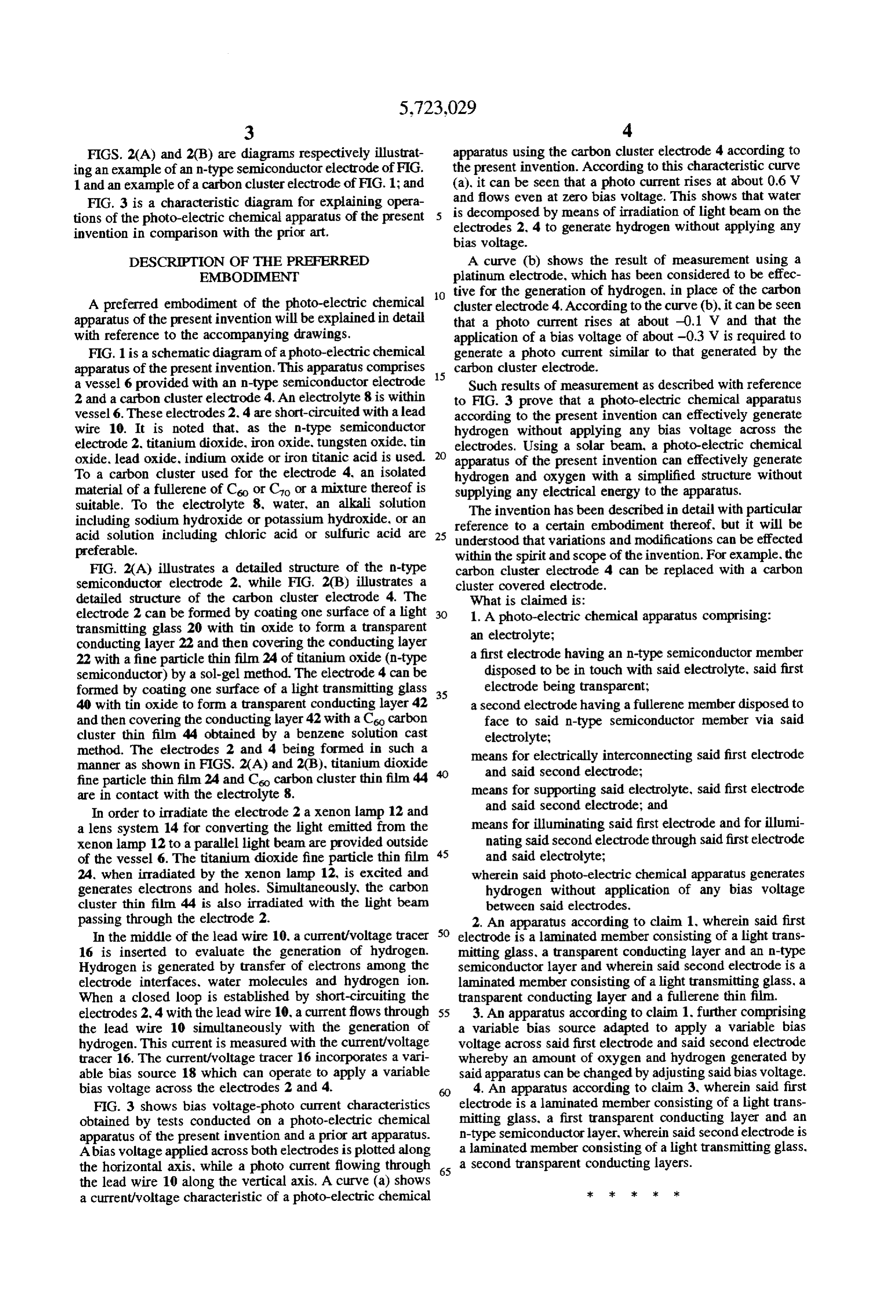
FIGS. 2(A) and 20B) are diagrams respectively illustrat apparatus using the carbon cluster electrode 4 according to ing an example of an n-type semiconductor electrode of FIG. the present invention. According to this characteristic curve 1 and an example of a carbon cluster electrode of FIG. 1; and (a), it can be seen that a photo current rises at about 0.6 V FIG. 3 is a characteristic diagram for explaining opera and flows even at zero bias voltage. This shows that water tions of the photo-electric chemical apparatus of the present is decomposed by means of irradiation of light beam on the invention in comparison with the prior art. electrodes 2, 4 to generate hydrogen without applying any bias voltage.
DESCRIPTION OF THE PREFERRED A curve (b) shows the result of measurement using a EMBODIMENT platinum electrode, which has been considered to be effec tive for the generation of hydrogen, in place of the carbon
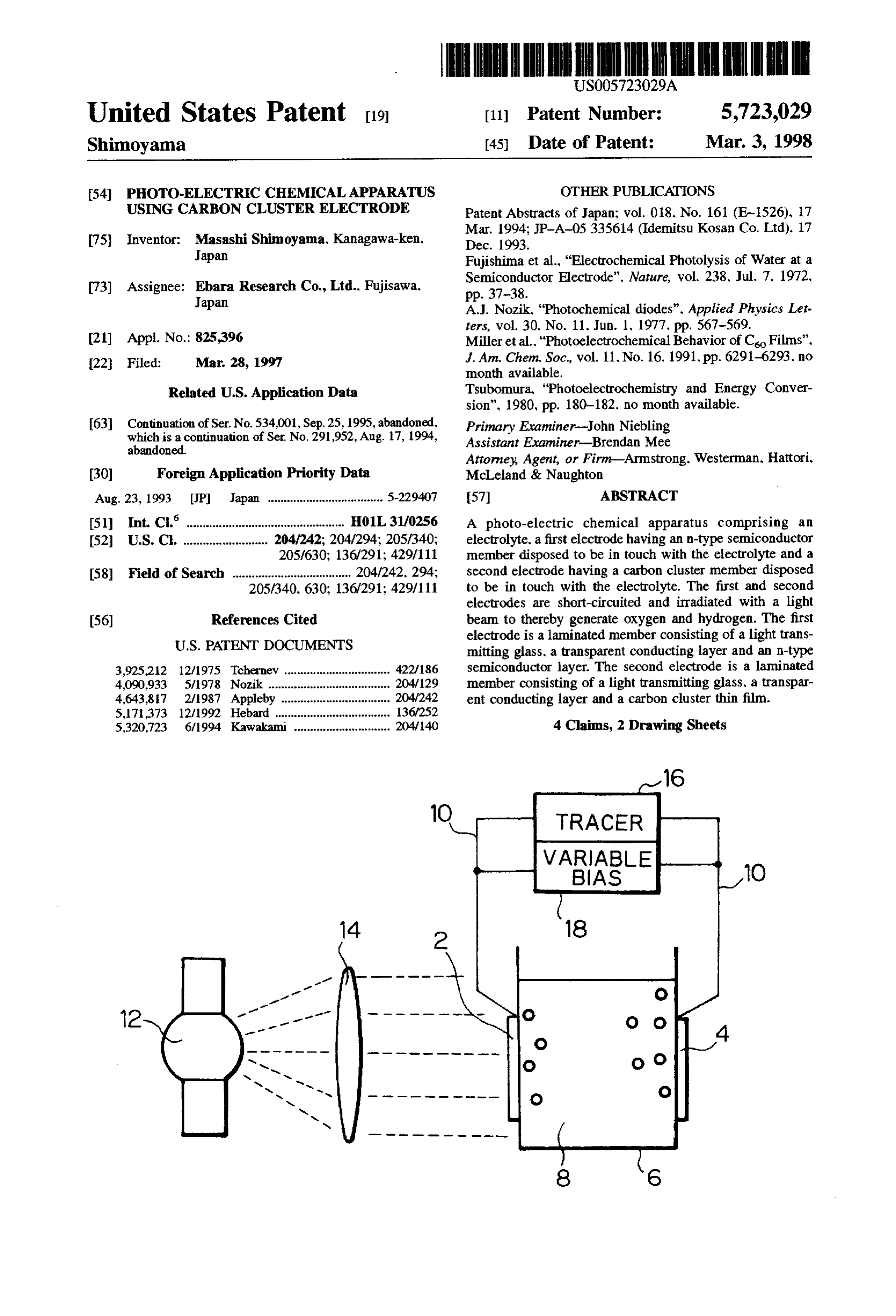
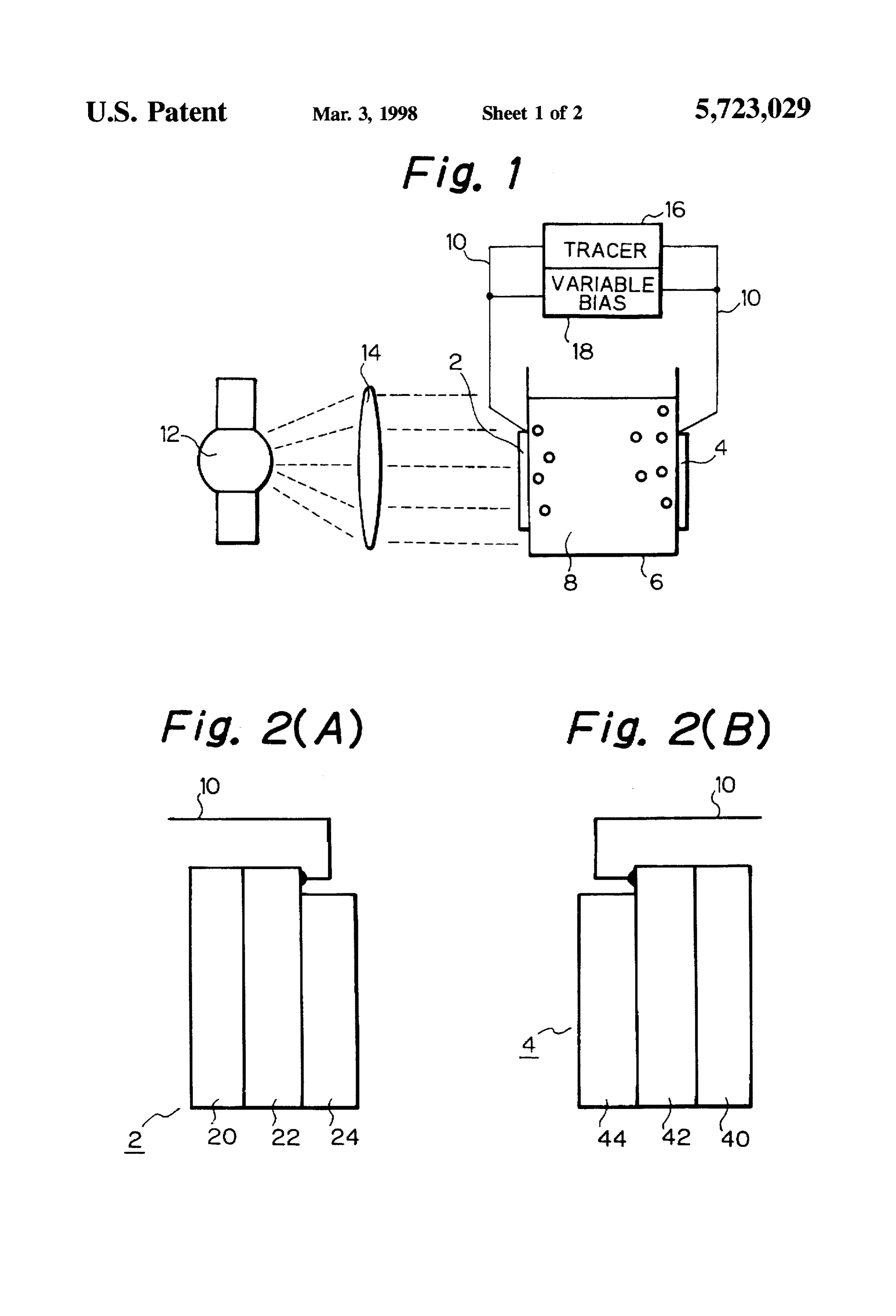
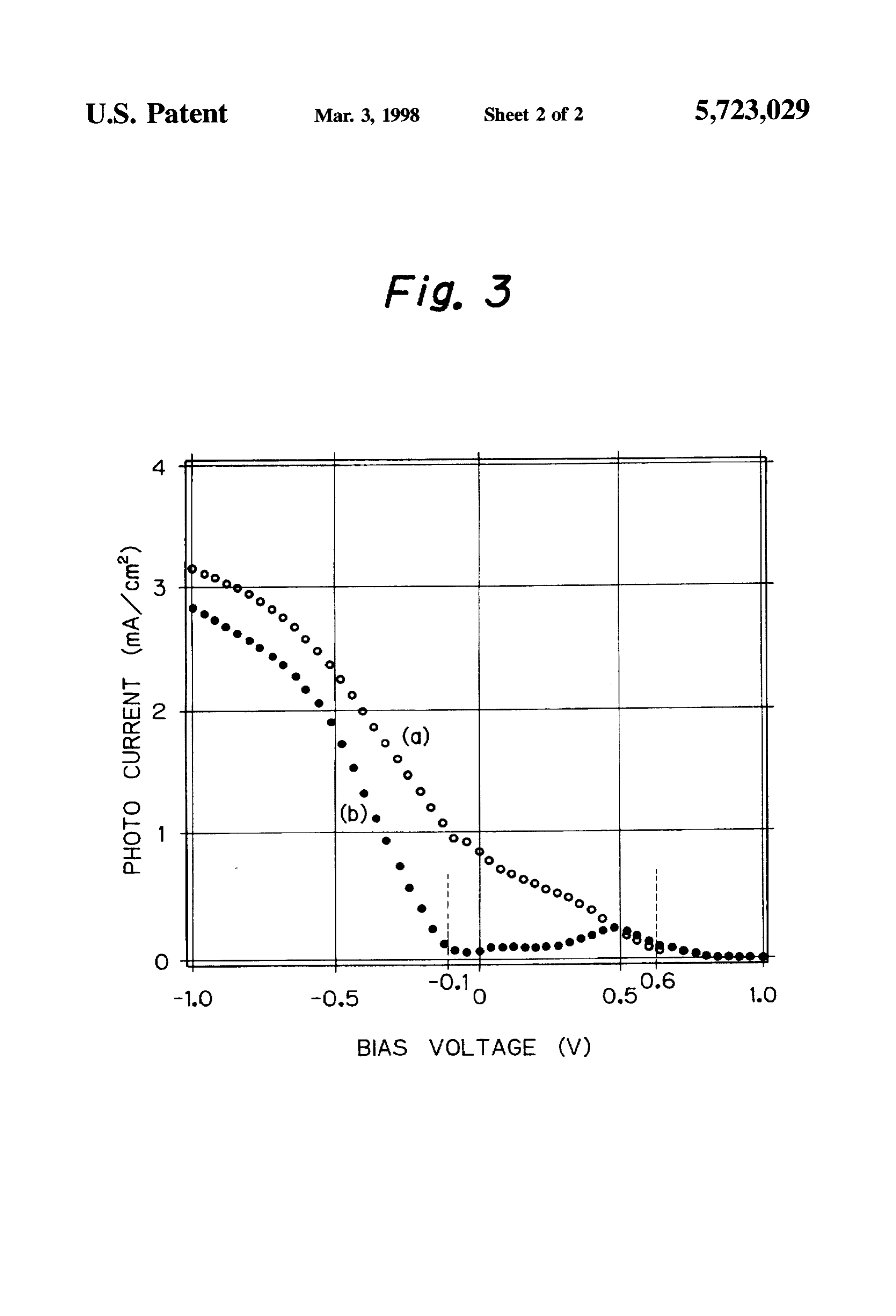
A preferred embodiment of the photo-electric chemical O cluster electrode 4. According to the curve (b), it can be seen apparatus of the present invention will be explained in detail that a photo current rises at about -0.1 V and that the with reference to the accompanying drawings. application of a bias voltage of about -0.3 V is required to FIG. 1 is a schematic diagram of a photo-electric chemical generate a photo current similar to that generated by the apparatus of the present invention. This apparatus comprises 15 carbon cluster electrode.
a vessel 6 provided with an n-type semiconductor electrode Such results of measurement as described with reference 2 and a carbon cluster electrode 4. An electrolyte 8 is within to FIG. 3 prove that a photo-electric chemical apparatus vessel 6. These electrodes 2.4 are short-circuited with a lead according to the present invention can effectively generate wire 10. It is noted that, as the n-type semiconductor hydrogen without applying any bias voltage across the electrode 2. titanium dioxide, iron oxide, tungsten oxide, tin 20 electrodes. Using a solar beam, a photo-electric chemical oxide, lead oxide, indium oxide or iron titanic acid is used. apparatus of the present invention can effectively generate To a carbon cluster used for the electrode 4, an isolated hydrogen and oxygen with a simplified structure without material of a fullerene of Co or Co or a mixture thereof is supplying any electrical energy to the apparatus. suitable. To the electrolyte 8, water, an alkali solution The invention has been described in detail with particular including sodium hydroxide or potassium hydroxide, or an reference to a certain embodiment thereof, but it will be acid solution including chloric acid or sulfuric acid are understood that variations and modifications can be effected
preferable. within the spirit and scope of the invention. For example, the FIG. 2(A) illustrates a detailed structure of the n-type carbon cluster electrode 4 can be replaced with a carbon semiconductor electrode 2, while FIG. 2(B) illustrates a cluster covered electrode.
detailed structure of the carbon cluster electrode 4. The What is claimed is:
electrode 2 can be formed by coating one surface of a light 30 1. A photo-electric chemical apparatus comprising: transmitting glass 20 with tin oxide to form a transparent an electrolyte;
conducting layer 22 and then covering the conducting layer 22 with a fine particle thin film 24 of titanium oxide (n-type a first electrode having an n-type semiconductor member semiconductor) by a sol-gel method. The electrode 4 can be disposed to be in touch with said electrolyte. said first formed by coating one surface of a light transmitting glass 35 electrode being transparent; 40 with tin oxide to form a transparent conducting layer 42 a second electrode having a fullerene member disposed to and then covering the conducting layer 42 with a Cocarbon face to said n-type semiconductor member via said cluster thin film 44 obtained by a benzene solution cast electrolyte;
method. The electrodes 2 and 4 being formed in such a means for electrically interconnecting said first electrode manner as shown in FIGS. 2(A) and 20B), titanium dioxide and said second electrode: fine particle thin film 24 and Cocarbon cluster thin film 44 means for supporting said electrolyte, said first electrode are in contact with the electrolyte 8.
In order to irradiate the electrode 2 a xenon lamp 12 and and said second electrode; and a lens system 14 for converting the light emitted from the means for illuminating said first electrode and for illumi xenon lamp 12 to a parallel light beam are provided outside 45 nating said second electrode through said first electrode of the vessel 6. The titanium dioxide fine particle thin film and said electrolyte;
24, when irradiated by the xenon lamp 12, is excited and wherein said photo-electric chemical apparatus generates generates electrons and holes. Simultaneously, the carbon hydrogen without application of any bias voltage cluster thin film 44 is also irradiated with the light beam between said electrodes.
passing through the electrode 2. 2. An apparatus according to claim 1, wherein said first In the middle of the lead wire 10, a current/voltage tracer 50 electrode is a laminated member consisting of a light trans 16 is inserted to evaluate the generation of hydrogen. mitting glass, a transparent conducting layer and an n-type Hydrogen is generated by transfer of electrons among the semiconductor layer and wherein said second electrode is a electrode interfaces, water molecules and hydrogen ion. laminated member consisting of a light transmitting glass, a When a closed loop is established by short-circuiting the transparent conducting layer and a fullerene thin film. electrodes 2.4 with the lead wire 10, a current flows through 55 3. An apparatus according to claim 1 further comprising the lead wire 10 simultaneously with the generation of a variable bias source adapted to apply a variable bias hydrogen. This current is measured with the current/voltage voltage across said first electrode and said second electrode tracer 16. The current/voltage tracer 16 incorporates a vari whereby an amount of oxygen and hydrogen generated by able bias source 18 which can operate to apply a variable said apparatus can be changed by adjusting said bias voltage. bias voltage across the electrodes 2 and 4. 4. An apparatus according to claim 3, wherein said first FIG. 3 shows bias voltage-photo current characteristics electrode is a laminated member consisting of a light trans obtained by tests conducted on a photo-electric chemical mitting glass, a first transparent conducting layer and an apparatus of the present invention and a prior art apparatus. n-type semiconductor layer, wherein said second electrode is Abias voltage applied across both electrodes is plotted along a laminated member consisting of a light transmitting glass. the horizontal axis, while a photo current flowing through 65 a second transparent conducting layers. the lead wire 10 along the vertical axis. A curve (a) shows a current/voltage characteristic of a photo-electric chemical se k ck :: x:
Provenance
- Collection
- Cited prior art
- Original PDF
- patentimages.storage.googleapis.com →
- Filed
- 1997-03-28
- Pages
- 5
- Method
- pdftotext (the PDF's own text layer) + pdftoppm 300dpi page scans
- Source
- Google Patents bibliographic record
- Granted
- 1998-03-03
- Inventors
- Masashi Shimoyama; Ebara Research Co Ltd
- Transcribed from
- patentimages.storage.googleapis.com →